* Western Chokecherry – Prunus virginiana var. demissa (PROO-nus vir-jin-ee-AN-uh)
Family: Rosaceae (Rose Family)
Native to: Western North America from Mexico to British Columbia; much of CA except coast.
Grows on rocky slopes, canyons and stream beds, mostly in oak/pine woodland, coniferous forest of
mountains and foothills. Locally, it grows in the San Gabriel mountains.
Growth characteristics: woody shrub/small tree mature height:6-20 ft. mature width:15-20 ft.
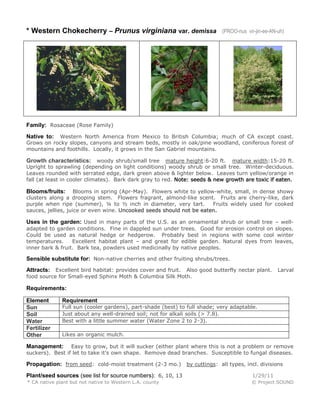
Upright to sprawling (depending on light conditions) woody shrub or small tree. Winter-deciduous.
Leaves rounded with serrated edge, dark green above & lighter below. Leaves turn yellow/orange in
fall (at least in cooler climates). Bark dark gray to red. Note: seeds & new growth are toxic if eaten.
Blooms/fruits: Blooms in spring (Apr-May). Flowers white to yellow-white, small, in dense showy
clusters along a drooping stem. Flowers fragrant, almond-like scent. Fruits are cherry-like, dark
purple when ripe (summer), ¼ to ½ inch in diameter, very tart. Fruits widely used for cooked
sauces, jellies, juice or even wine. Uncooked seeds should not be eaten.
Uses in the garden: Used in many parts of the U.S. as an ornamental shrub or small tree – well-
adapted to garden conditions. Fine in dappled sun under trees. Good for erosion control on slopes.
Could be used as natural hedge or hedgerow. Probably best in regions with some cool winter
temperatures. Excellent habitat plant – and great for edible garden. Natural dyes from leaves,
inner bark & fruit. Bark tea, powders used medicinally by native peoples.
Sensible substitute for: Non-native cherries and other fruiting shrubs/trees.
Attracts: Excellent bird habitat: provides cover and fruit. Also good butterfly nectar plant. Larval
food source for Small-eyed Sphinx Moth & Columbia Silk Moth.
Requirements:
Element Requirement
Sun Full sun (cooler gardens), part-shade (best) to full shade; very adaptable.
Soil Just about any well-drained soil; not for alkali soils (> 7.8).
Water Best with a little summer water (Water Zone 2 to 2-3).
Fertilizer
Other Likes an organic mulch.
Management: Easy to grow, but it will sucker (either plant where this is not a problem or remove
suckers). Best if let to take it’s own shape. Remove dead branches. Susceptible to fungal diseases.
Propagation: from seed: cold-moist treatment (2-3 mo.) by cuttings: all types, incl. divisions
Plant/seed sources (see list for source numbers): 6, 10, 13 1/29/11
* CA native plant but not native to Western L.A. county © Project SOUND

Qm prunus virginiana

  • 1.
    * Western Chokecherry– Prunus virginiana var. demissa (PROO-nus vir-jin-ee-AN-uh) Family: Rosaceae (Rose Family) Native to: Western North America from Mexico to British Columbia; much of CA except coast. Grows on rocky slopes, canyons and stream beds, mostly in oak/pine woodland, coniferous forest of mountains and foothills. Locally, it grows in the San Gabriel mountains. Growth characteristics: woody shrub/small tree mature height:6-20 ft. mature width:15-20 ft. Upright to sprawling (depending on light conditions) woody shrub or small tree. Winter-deciduous. Leaves rounded with serrated edge, dark green above & lighter below. Leaves turn yellow/orange in fall (at least in cooler climates). Bark dark gray to red. Note: seeds & new growth are toxic if eaten. Blooms/fruits: Blooms in spring (Apr-May). Flowers white to yellow-white, small, in dense showy clusters along a drooping stem. Flowers fragrant, almond-like scent. Fruits are cherry-like, dark purple when ripe (summer), ¼ to ½ inch in diameter, very tart. Fruits widely used for cooked sauces, jellies, juice or even wine. Uncooked seeds should not be eaten. Uses in the garden: Used in many parts of the U.S. as an ornamental shrub or small tree – well- adapted to garden conditions. Fine in dappled sun under trees. Good for erosion control on slopes. Could be used as natural hedge or hedgerow. Probably best in regions with some cool winter temperatures. Excellent habitat plant – and great for edible garden. Natural dyes from leaves, inner bark & fruit. Bark tea, powders used medicinally by native peoples. Sensible substitute for: Non-native cherries and other fruiting shrubs/trees. Attracts: Excellent bird habitat: provides cover and fruit. Also good butterfly nectar plant. Larval food source for Small-eyed Sphinx Moth & Columbia Silk Moth. Requirements: Element Requirement Sun Full sun (cooler gardens), part-shade (best) to full shade; very adaptable. Soil Just about any well-drained soil; not for alkali soils (> 7.8). Water Best with a little summer water (Water Zone 2 to 2-3). Fertilizer Other Likes an organic mulch. Management: Easy to grow, but it will sucker (either plant where this is not a problem or remove suckers). Best if let to take it’s own shape. Remove dead branches. Susceptible to fungal diseases. Propagation: from seed: cold-moist treatment (2-3 mo.) by cuttings: all types, incl. divisions Plant/seed sources (see list for source numbers): 6, 10, 13 1/29/11 * CA native plant but not native to Western L.A. county © Project SOUND