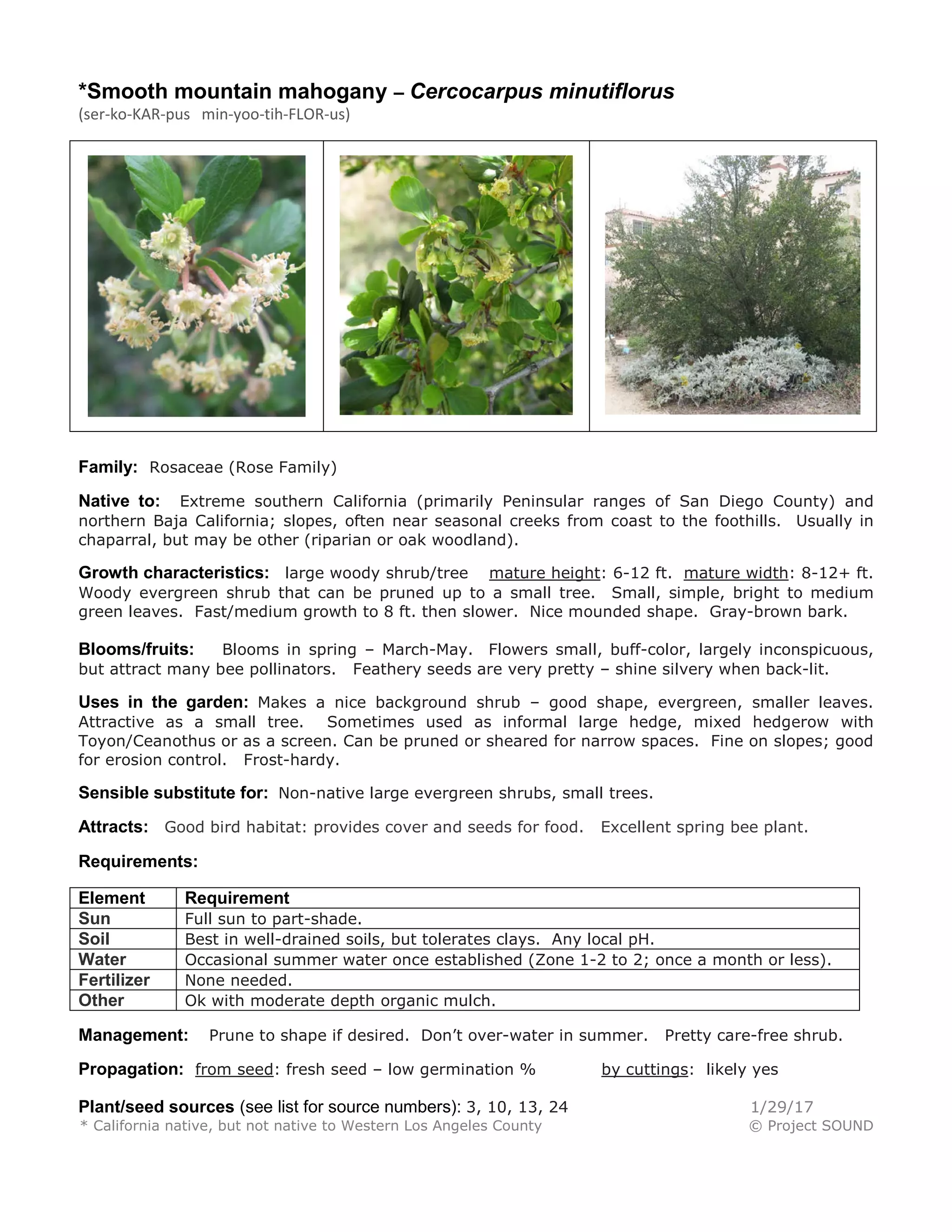
*Smooth mountain mahogany – Cercocarpus minutiflorus
(ser-ko-KAR-pus min-yoo-tih-FLOR-us)
Family: Rosaceae (Rose Family)
Native to: Extreme southern California (primarily Peninsular ranges of San Diego County) and
northern Baja California; slopes, often near seasonal creeks from coast to the foothills. Usually in
chaparral, but may be other (riparian or oak woodland).
Growth characteristics: large woody shrub/tree mature height: 6-12 ft. mature width: 8-12+ ft.
Woody evergreen shrub that can be pruned up to a small tree. Small, simple, bright to medium
green leaves. Fast/medium growth to 8 ft. then slower. Nice mounded shape. Gray-brown bark.
Blooms/fruits: Blooms in spring – March-May. Flowers small, buff-color, largely inconspicuous,
but attract many bee pollinators. Feathery seeds are very pretty – shine silvery when back-lit.
Uses in the garden: Makes a nice background shrub – good shape, evergreen, smaller leaves.
Attractive as a small tree. Sometimes used as informal large hedge, mixed hedgerow with
Toyon/Ceanothus or as a screen. Can be pruned or sheared for narrow spaces. Fine on slopes; good
for erosion control. Frost-hardy.
Sensible substitute for: Non-native large evergreen shrubs, small trees.
Attracts: Good bird habitat: provides cover and seeds for food. Excellent spring bee plant.
Requirements:
Element Requirement
Sun Full sun to part-shade.
Soil Best in well-drained soils, but tolerates clays. Any local pH.
Water Occasional summer water once established (Zone 1-2 to 2; once a month or less).
Fertilizer None needed.
Other Ok with moderate depth organic mulch.
Management: Prune to shape if desired. Don’t over-water in summer. Pretty care-free shrub.
Propagation: from seed: fresh seed – low germination % by cuttings: likely yes
Plant/seed sources (see list for source numbers): 3, 10, 13, 24 1/29/17
* California native, but not native to Western Los Angeles County © Project SOUND

Gardening sheet cercocarpus minutiflorus

  • 1.
    *Smooth mountain mahogany– Cercocarpus minutiflorus (ser-ko-KAR-pus min-yoo-tih-FLOR-us) Family: Rosaceae (Rose Family) Native to: Extreme southern California (primarily Peninsular ranges of San Diego County) and northern Baja California; slopes, often near seasonal creeks from coast to the foothills. Usually in chaparral, but may be other (riparian or oak woodland). Growth characteristics: large woody shrub/tree mature height: 6-12 ft. mature width: 8-12+ ft. Woody evergreen shrub that can be pruned up to a small tree. Small, simple, bright to medium green leaves. Fast/medium growth to 8 ft. then slower. Nice mounded shape. Gray-brown bark. Blooms/fruits: Blooms in spring – March-May. Flowers small, buff-color, largely inconspicuous, but attract many bee pollinators. Feathery seeds are very pretty – shine silvery when back-lit. Uses in the garden: Makes a nice background shrub – good shape, evergreen, smaller leaves. Attractive as a small tree. Sometimes used as informal large hedge, mixed hedgerow with Toyon/Ceanothus or as a screen. Can be pruned or sheared for narrow spaces. Fine on slopes; good for erosion control. Frost-hardy. Sensible substitute for: Non-native large evergreen shrubs, small trees. Attracts: Good bird habitat: provides cover and seeds for food. Excellent spring bee plant. Requirements: Element Requirement Sun Full sun to part-shade. Soil Best in well-drained soils, but tolerates clays. Any local pH. Water Occasional summer water once established (Zone 1-2 to 2; once a month or less). Fertilizer None needed. Other Ok with moderate depth organic mulch. Management: Prune to shape if desired. Don’t over-water in summer. Pretty care-free shrub. Propagation: from seed: fresh seed – low germination % by cuttings: likely yes Plant/seed sources (see list for source numbers): 3, 10, 13, 24 1/29/17 * California native, but not native to Western Los Angeles County © Project SOUND