QA/QC
PROGRAM
WASTE WATER ANALYSIS
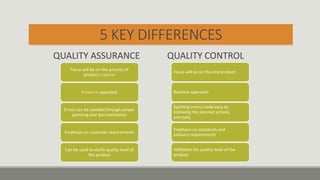
5 KEY DIFFERENCES
Focus will be on the process of
product creation
Proactive approach
Errors can be avoided through proper
planning and documentation
Emphasis on customer requirements
Can be used to verify quality level of
the product
Focus will be on the end product
Reactive approach
Spotting errors made easy by
following the planned activity
precisely
Emphasis on standards and
industry requirements
Validation for quality level of the
product
QUALITY ASSURANCE QUALITY CONTROL
/
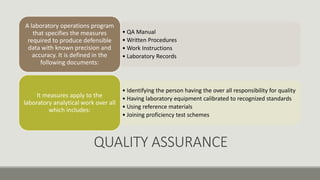
QUALITY ASSURANCE
• QA Manual
• Written Procedures
• Work Instructions
• Laboratory Records
A laboratory operations program
that specifies the measures
required to produce defensible
data with known precision and
accuracy. It is defined in the
following documents:
• Identifying the person having the over all responsibility for quality
• Having laboratory equipment calibrated to recognized standards
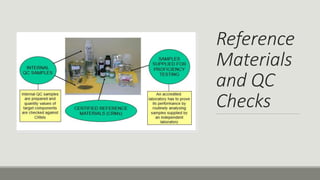
• Using reference materials
• Joining proficiency test schemes
It measures apply to the
laboratory analytical work over all
which includes:
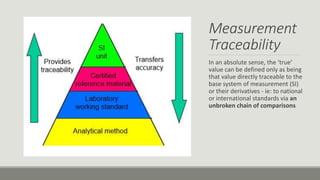
Measurement
Traceability
In an absolute sense, the ‘true’
value can be defined only as being
that value directly traceable to the
base system of measurement (SI)
or their derivatives - ie: to national
or international standards via an
unbroken chain of comparisons
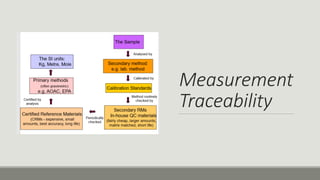
Measurement
Traceability
Reference
Materials
and QC
Checks
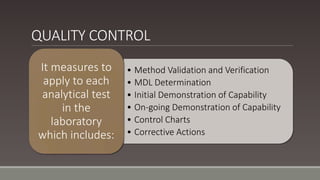
QUALITY CONTROL
• Method Validation and Verification
• MDL Determination
• Initial Demonstration of Capability
• On-going Demonstration of Capability
• Control Charts
• Corrective Actions
It measures to
apply to each
analytical test
in the
laboratory
which includes:
QUALITY
CONTROL
Method
Validation
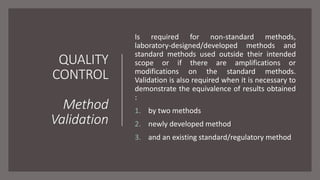
Is required for non-standard methods,
laboratory-designed/developed methods and
standard methods used outside their intended
scope or if there are amplifications or
modifications on the standard methods.
Validation is also required when it is necessary to
demonstrate the equivalence of results obtained
:
1. by two methods
2. newly developed method
3. and an existing standard/regulatory method
QUALITY
CONTROL
Method
Verification
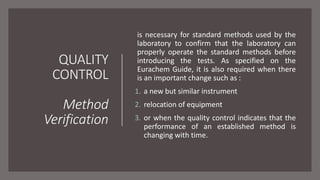
is necessary for standard methods used by the
laboratory to confirm that the laboratory can
properly operate the standard methods before
introducing the tests. As specified on the
Eurachem Guide, it is also required when there
is an important change such as :
1. a new but similar instrument
2. relocation of equipment
3. or when the quality control indicates that the
performance of an established method is
changing with time.
STEPS ON
HOW TO
VERIFY A
METHOD
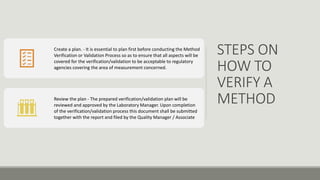
Create a plan. - It is essential to plan first before conducting the Method
Verification or Validation Process so as to ensure that all aspects will be
covered for the verification/validation to be acceptable to regulatory
agencies covering the area of measurement concerned.
Review the plan - The prepared verification/validation plan will be
reviewed and approved by the Laboratory Manager. Upon completion
of the verification/validation process this document shall be submitted
together with the report and filed by the Quality Manager / Associate
What is included in the verification plan
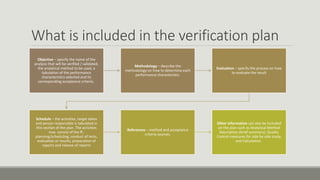
Objective – specify the name of the
analysis that will be verified / validated,
the analytical method to be used, a
tabulation of the performance
characteristics selected and its
corresponding acceptance criteria.
Methodology – describe the
methodology on how to determine each
performance characteristic.
Evaluation – specify the process on how
to evaluate the result
Schedule – the activities, target dates
and person responsible is tabulated in
this section of the plan. The activities
may consist of the ff.:
planning/scheduling, conduct of tests,
evaluation or results, preparation of
reports and release of reports
References – method and acceptance
criteria sources.
Other information can also be included
on the plan such as Analytical Method
Description (brief summary), Quality
Control measures for side by side study,
and Calculation.
Methodology (Method Verification)
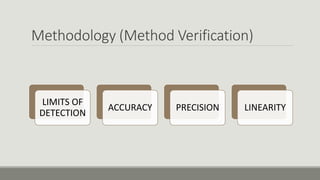
LIMITS OF
DETECTION
ACCURACY PRECISION LINEARITY
LIMITS OF
DETECTION
Method Detection
Limit (MDL)
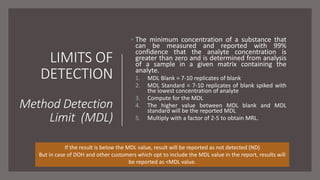
◦ The minimum concentration of a substance that
can be measured and reported with 99%
confidence that the analyte concentration is
greater than zero and is determined from analysis
of a sample in a given matrix containing the
analyte.
1. MDL Blank = 7-10 replicates of blank
2. MDL Standard = 7-10 replicates of blank spiked with
the lowest concentration of analyte
3. Compute for the MDL
4. The higher value between MDL blank and MDL
standard will be the reported MDL
5. Multiply with a factor of 2-5 to obtain MRL.
If the result is below the MDL value, result will be reported as not detected (ND)
But in case of DOH and other customers which opt to include the MDL value in the report, results will
be reported as <MDL value.
LIMITS OF
DETECTION
Method Reporting
Limit (MRL)
◦ The lowest concentration that can reliably
achieve within specified limits of precision
and accuracy during routine laboratory
operating conditions. The MRL should be at a
minimum, twice the MDL.
If the result above MDL but lower than the MRL, the result will be qualified. A qualifier will be
reported along with the result.
If the result, is higher than the specified MRL, report result as it is.
ACCURACY
◦ Prepare 3 different concentrations of the
spiked samples/blanks, 3 replicates
each. Analyze as per method, and then
calculate the percent recovery. Compare
calculated mean recovery with the set
acceptance criteria.
1. Accuracy LOW
2. Accuracy MID
3. Accuracy HIGH
Accuracy is being performed by two different analyst on different days using different concentrations
of spike related to the LCS value.
PRECISION
Repeatability
Prepare at least 6 replicates of a single
concentration of spiked blanks. Analyze using
one equipment, and then determine the
standard deviation of the results. Compare
the standard deviation to the precision
acceptance criteria.
Repeatability is being performed by one analyst on using 6 replicates of the LCS concentration
PRECISION
Intermediate
Precision
Prepare at least 6 replicates of a single
concentration of spiked blanks. Analyze by a
different analyst or using different
equipment. Calculate the standard deviation
of the results. Compare the standard
deviation to the precision acceptance
criteria.
Intermediate Precision is being performed by two different analysts on different days using 6
replicates of LCS concentration and comparison of results will be calculated
LINEARITY
Measure blank plus calibration standards at
5-10 concentrations evenly spaced across
the linear range. Plot the response (y axis)
against concentration (x axis). Visually
examine for outliers which may not be
reflected in the regression. Calculate
appropriate regression statistics.
Linearity is only applicable for methods which requires calibration curves.
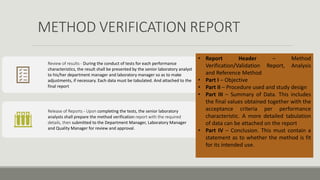
METHOD VERIFICATION REPORT
Review of results - During the conduct of tests for each performance
characteristics, the result shall be presented by the senior laboratory analyst
to his/her department manager and laboratory manager so as to make
adjustments, if necessary. Each data must be tabulated. And attached to the
final report
Release of Reports - Upon completing the tests, the senior laboratory
analysts shall prepare the method verification report with the required
details, then submitted to the Department Manager, Laboratory Manager
and Quality Manager for review and approval.
• Report Header – Method
Verification/Validation Report, Analysis
and Reference Method
• Part I – Objective
• Part II – Procedure used and study design
• Part III – Summary of Data. This includes
the final values obtained together with the
acceptance criteria per performance
characteristic. A more detailed tabulation
of data can be attached on the report
• Part IV – Conclusion. This must contain a
statement as to whether the method is fit
for its intended use.
QUALITY CONTROL
• Method Validation and Verification
• MDL Determination
• Initial Demonstration of Capability
• On-going Demonstration of Capability
• Control Charts
• Corrective Actions
It measures to
apply to each
analytical test
in the
laboratory
which includes:
QUALITY
CONTROL
Initial
Demonstration
of Capability
◦ Each analyst in the laboratory should conduct
an IDC at least once before analyzing any
sample to demonstrate proficiency in
performing the method and obtaining
acceptable results for each analyte.
◦ It is used to demonstrate that the
laboratory's modifications to a method will
produce results as precise and accurate as
those produced by the reference method.
◦ As a minimum it should include
1. 1 reagent blank
2. At least 4 LCS (at a concentration between
10 times the MDL and the midpoint of the
calibration curve)
QUALITY
CONTROL
On-going
Demonstration
of Capability
THIS IS SOMETIMES CALLED THE LCS
– LABORATORY CONTROL
SAMPLE/STANDARD QC – QUALITY
CONTROL CHECK SAMPLE LFB –
LABORATORY FORTIFIED BLANK
THIS IS TO ENSURE THE
LABORATORY REMAINS IN CONTROL
WHILE SAMPLES ARE ANALYZED
AND SEPARATES LABORATORY
PERFORMANCE FROM METHOD
PERFORMANCE ON THE SAMPLE
MATRIX.
FOR INITIAL CALIBRATION, THE
CALIBRATION MUST BE VERIFIED BY
COMPARING IT TO A SECOND
SOURCE CALIBRATION STANDARD
SOLUTION.
OTHER Quality Control Protocol for Preparation Batch Processing

QA QC Program for Waste Water Analysis ppt

  • 1.
  • 2.
    5 KEY DIFFERENCES Focuswill be on the process of product creation Proactive approach Errors can be avoided through proper planning and documentation Emphasis on customer requirements Can be used to verify quality level of the product Focus will be on the end product Reactive approach Spotting errors made easy by following the planned activity precisely Emphasis on standards and industry requirements Validation for quality level of the product QUALITY ASSURANCE QUALITY CONTROL
  • 3.
    / QUALITY ASSURANCE • QAManual • Written Procedures • Work Instructions • Laboratory Records A laboratory operations program that specifies the measures required to produce defensible data with known precision and accuracy. It is defined in the following documents: • Identifying the person having the over all responsibility for quality • Having laboratory equipment calibrated to recognized standards • Using reference materials • Joining proficiency test schemes It measures apply to the laboratory analytical work over all which includes:
  • 4.
    Measurement Traceability In an absolutesense, the ‘true’ value can be defined only as being that value directly traceable to the base system of measurement (SI) or their derivatives - ie: to national or international standards via an unbroken chain of comparisons
  • 5.
  • 6.
  • 7.
    QUALITY CONTROL • MethodValidation and Verification • MDL Determination • Initial Demonstration of Capability • On-going Demonstration of Capability • Control Charts • Corrective Actions It measures to apply to each analytical test in the laboratory which includes:
  • 8.
    QUALITY CONTROL Method Validation Is required fornon-standard methods, laboratory-designed/developed methods and standard methods used outside their intended scope or if there are amplifications or modifications on the standard methods. Validation is also required when it is necessary to demonstrate the equivalence of results obtained : 1. by two methods 2. newly developed method 3. and an existing standard/regulatory method
  • 9.
    QUALITY CONTROL Method Verification is necessary forstandard methods used by the laboratory to confirm that the laboratory can properly operate the standard methods before introducing the tests. As specified on the Eurachem Guide, it is also required when there is an important change such as : 1. a new but similar instrument 2. relocation of equipment 3. or when the quality control indicates that the performance of an established method is changing with time.
  • 10.
    STEPS ON HOW TO VERIFYA METHOD Create a plan. - It is essential to plan first before conducting the Method Verification or Validation Process so as to ensure that all aspects will be covered for the verification/validation to be acceptable to regulatory agencies covering the area of measurement concerned. Review the plan - The prepared verification/validation plan will be reviewed and approved by the Laboratory Manager. Upon completion of the verification/validation process this document shall be submitted together with the report and filed by the Quality Manager / Associate
  • 11.
    What is includedin the verification plan Objective – specify the name of the analysis that will be verified / validated, the analytical method to be used, a tabulation of the performance characteristics selected and its corresponding acceptance criteria. Methodology – describe the methodology on how to determine each performance characteristic. Evaluation – specify the process on how to evaluate the result Schedule – the activities, target dates and person responsible is tabulated in this section of the plan. The activities may consist of the ff.: planning/scheduling, conduct of tests, evaluation or results, preparation of reports and release of reports References – method and acceptance criteria sources. Other information can also be included on the plan such as Analytical Method Description (brief summary), Quality Control measures for side by side study, and Calculation.
  • 12.
    Methodology (Method Verification) LIMITSOF DETECTION ACCURACY PRECISION LINEARITY
  • 13.
    LIMITS OF DETECTION Method Detection Limit(MDL) ◦ The minimum concentration of a substance that can be measured and reported with 99% confidence that the analyte concentration is greater than zero and is determined from analysis of a sample in a given matrix containing the analyte. 1. MDL Blank = 7-10 replicates of blank 2. MDL Standard = 7-10 replicates of blank spiked with the lowest concentration of analyte 3. Compute for the MDL 4. The higher value between MDL blank and MDL standard will be the reported MDL 5. Multiply with a factor of 2-5 to obtain MRL. If the result is below the MDL value, result will be reported as not detected (ND) But in case of DOH and other customers which opt to include the MDL value in the report, results will be reported as <MDL value.
  • 14.
    LIMITS OF DETECTION Method Reporting Limit(MRL) ◦ The lowest concentration that can reliably achieve within specified limits of precision and accuracy during routine laboratory operating conditions. The MRL should be at a minimum, twice the MDL. If the result above MDL but lower than the MRL, the result will be qualified. A qualifier will be reported along with the result. If the result, is higher than the specified MRL, report result as it is.
  • 15.
    ACCURACY ◦ Prepare 3different concentrations of the spiked samples/blanks, 3 replicates each. Analyze as per method, and then calculate the percent recovery. Compare calculated mean recovery with the set acceptance criteria. 1. Accuracy LOW 2. Accuracy MID 3. Accuracy HIGH Accuracy is being performed by two different analyst on different days using different concentrations of spike related to the LCS value.
  • 16.
    PRECISION Repeatability Prepare at least6 replicates of a single concentration of spiked blanks. Analyze using one equipment, and then determine the standard deviation of the results. Compare the standard deviation to the precision acceptance criteria. Repeatability is being performed by one analyst on using 6 replicates of the LCS concentration
  • 17.
    PRECISION Intermediate Precision Prepare at least6 replicates of a single concentration of spiked blanks. Analyze by a different analyst or using different equipment. Calculate the standard deviation of the results. Compare the standard deviation to the precision acceptance criteria. Intermediate Precision is being performed by two different analysts on different days using 6 replicates of LCS concentration and comparison of results will be calculated
  • 18.
    LINEARITY Measure blank pluscalibration standards at 5-10 concentrations evenly spaced across the linear range. Plot the response (y axis) against concentration (x axis). Visually examine for outliers which may not be reflected in the regression. Calculate appropriate regression statistics. Linearity is only applicable for methods which requires calibration curves.
  • 19.
    METHOD VERIFICATION REPORT Reviewof results - During the conduct of tests for each performance characteristics, the result shall be presented by the senior laboratory analyst to his/her department manager and laboratory manager so as to make adjustments, if necessary. Each data must be tabulated. And attached to the final report Release of Reports - Upon completing the tests, the senior laboratory analysts shall prepare the method verification report with the required details, then submitted to the Department Manager, Laboratory Manager and Quality Manager for review and approval. • Report Header – Method Verification/Validation Report, Analysis and Reference Method • Part I – Objective • Part II – Procedure used and study design • Part III – Summary of Data. This includes the final values obtained together with the acceptance criteria per performance characteristic. A more detailed tabulation of data can be attached on the report • Part IV – Conclusion. This must contain a statement as to whether the method is fit for its intended use.
  • 20.
    QUALITY CONTROL • MethodValidation and Verification • MDL Determination • Initial Demonstration of Capability • On-going Demonstration of Capability • Control Charts • Corrective Actions It measures to apply to each analytical test in the laboratory which includes:
  • 21.
    QUALITY CONTROL Initial Demonstration of Capability ◦ Eachanalyst in the laboratory should conduct an IDC at least once before analyzing any sample to demonstrate proficiency in performing the method and obtaining acceptable results for each analyte. ◦ It is used to demonstrate that the laboratory's modifications to a method will produce results as precise and accurate as those produced by the reference method. ◦ As a minimum it should include 1. 1 reagent blank 2. At least 4 LCS (at a concentration between 10 times the MDL and the midpoint of the calibration curve)
  • 22.
    QUALITY CONTROL On-going Demonstration of Capability THIS ISSOMETIMES CALLED THE LCS – LABORATORY CONTROL SAMPLE/STANDARD QC – QUALITY CONTROL CHECK SAMPLE LFB – LABORATORY FORTIFIED BLANK THIS IS TO ENSURE THE LABORATORY REMAINS IN CONTROL WHILE SAMPLES ARE ANALYZED AND SEPARATES LABORATORY PERFORMANCE FROM METHOD PERFORMANCE ON THE SAMPLE MATRIX. FOR INITIAL CALIBRATION, THE CALIBRATION MUST BE VERIFIED BY COMPARING IT TO A SECOND SOURCE CALIBRATION STANDARD SOLUTION. OTHER Quality Control Protocol for Preparation Batch Processing