Project Partners PROODOS A.E.  Centre of Vocational Training
Comparative Results :  Implications for the Design of the Web Resource Dr Chris Riley,  University of Worcester, UK
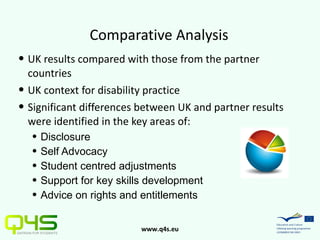
UK results compared with those from the partner countries UK context for disability practice Significant differences between UK and partner results were identified in the key areas of: Disclosure Self Advocacy Student centred adjustments Support for key skills development Advice on rights and entitlements Comparative Analysis
56% of UK participants 37% of participants in the other partner countries (BG, GR, TR). Disclosed before starting course Disclosure before starting course TR = 33%
Need for Disclosure advice Non disclosure before starting course -implications:
54% of UK participants 26% of participants in the other partner countries (BG, GR, TR).  All  their teachers knew how to teach them ‘ All  their teachers knew how to teach them ’ TR = 24%
4% of UK participants 19% in the other partner countries (BG, GR, TR) None of their teachers knew how to teach them ‘ None  of their teachers knew how to  teach them ’ TR = 22%
Need for student centred adjustment strategies Teachers knew how to teach them  - implications:
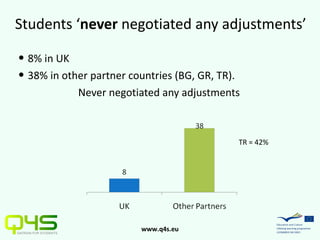
8% in UK  38% in other partner countries (BG, GR, TR).  Never negotiated any adjustments Students  ‘ never  negotiated any adjustments ’ TR = 42%
12% in UK 30% in other partner countries (BG, GR, TR). Teachers  never  made any adjustments for the students Teachers   ‘ never  made any adjustments for the students ’ TR = 47%
Need for advice on negotiating and accessing adjustments Need to promote self advocacy Students not negotiating adjustments and Teachers not making adjustments – implications:
60% of UK participants - true 21% of participants in the other partner countries (BG, GR, TR).  Have equipment - true ‘ I have all the equipment I need including assistive technology ’ TR = 26%
Need advice on equipment  Need for advice on self advocacy Need for advice on financial support  Equipment they need - implications:
ICT and Numeracy were identified as the most difficult skills.  Some literacy related tasks involving writing and listening (dictation) were also found difficult.  Practical skills were moderately difficult.  Similar findings for the UK.  Clear need for key skills support Skill Development
50% in UK 33% in the other partner countries (BG, GR, TR).  Did not know their legal rights   ‘ Did  not  know their legal rights and entitlements ’   TR = 44%
Need for Advice on Rights and Entitlements   Knowledge of their legal rights – implications:

Q4 s comparative research

  • 1.
  • 2.
    Project Partners PROODOSA.E. Centre of Vocational Training
  • 3.
    Comparative Results : Implications for the Design of the Web Resource Dr Chris Riley, University of Worcester, UK
  • 4.
    UK results comparedwith those from the partner countries UK context for disability practice Significant differences between UK and partner results were identified in the key areas of: Disclosure Self Advocacy Student centred adjustments Support for key skills development Advice on rights and entitlements Comparative Analysis
  • 5.
    56% of UKparticipants 37% of participants in the other partner countries (BG, GR, TR). Disclosed before starting course Disclosure before starting course TR = 33%
  • 6.
    Need for Disclosureadvice Non disclosure before starting course -implications:
  • 7.
    54% of UKparticipants 26% of participants in the other partner countries (BG, GR, TR). All their teachers knew how to teach them ‘ All their teachers knew how to teach them ’ TR = 24%
  • 8.
    4% of UKparticipants 19% in the other partner countries (BG, GR, TR) None of their teachers knew how to teach them ‘ None of their teachers knew how to teach them ’ TR = 22%
  • 9.
    Need for studentcentred adjustment strategies Teachers knew how to teach them - implications:
  • 10.
    8% in UK 38% in other partner countries (BG, GR, TR). Never negotiated any adjustments Students ‘ never negotiated any adjustments ’ TR = 42%
  • 11.
    12% in UK30% in other partner countries (BG, GR, TR). Teachers never made any adjustments for the students Teachers ‘ never made any adjustments for the students ’ TR = 47%
  • 12.
    Need for adviceon negotiating and accessing adjustments Need to promote self advocacy Students not negotiating adjustments and Teachers not making adjustments – implications:
  • 13.
    60% of UKparticipants - true 21% of participants in the other partner countries (BG, GR, TR). Have equipment - true ‘ I have all the equipment I need including assistive technology ’ TR = 26%
  • 14.
    Need advice onequipment Need for advice on self advocacy Need for advice on financial support Equipment they need - implications:
  • 15.
    ICT and Numeracywere identified as the most difficult skills. Some literacy related tasks involving writing and listening (dictation) were also found difficult. Practical skills were moderately difficult. Similar findings for the UK. Clear need for key skills support Skill Development
  • 16.
    50% in UK33% in the other partner countries (BG, GR, TR). Did not know their legal rights   ‘ Did not know their legal rights and entitlements ’ TR = 44%
  • 17.
    Need for Adviceon Rights and Entitlements   Knowledge of their legal rights – implications: