User-Driven Social Enterprise:
What does it mean in practice?

Nigel Fenner and Margaret Martin


March 2010


Keywords:
service user, user-driven, user-led, user-controlled, user engagement,
stakeholder participation, user participatory/ partnership approaches,
user-centred design (UCD), co-production, core economy, disability, social
model of disability, barriers experienced by people with disability,
emancipatory disability research, disabled people’s organisations, capacity
building, social enterprise, personalisation/ choice agenda, citizenship/
participation.


This document is part of the Social Enterprise East of England resource
library.

                                                                          1
Context

Nigel Fenner is manager of Hertfordshire PASS, a „user-driven charity using
employment and self-directed support to enable disabled people to live more
independently‟.

He has been given a grant from Social Enterprise East of England (SEEE) to write a
paper (representing his views alone) on „User-driven social enterprise‟ based on his
experiences of working with disabled people, as well as referring to other examples
of user-driven social enterprises, identified through a literature review, and regional
mapping exercise.

The outputs from this work are:
    This report, outlining a theoretical and practical framework for user-driven
      social enterprises
    A list of useful resources and links, and
    A literature review by Margaret Martin which explores three overarching
      areas in relation to disability: “user-driven”, “social enterprise” and
      “citizenship”; how these three areas relate/ interact and the barriers which
      may prevent their interaction. It covers theoretical aspects, including some
      discussion of definitions, and describes examples of good practice in user-
      driven work.

The report focuses on disability however the authors believe the learning can
usefully transfer to work in other fields.

The report is divided into the following sections:             Page

          1. The framework: person-system-role                 4
                 a. Person: lived experience                   6
                 b. Role                                       14
                 c. Context and Systems                        22
          2. Main findings and conclusions                     31
          3. Useful links and resources                        35
          4. Literature review                                 37


                                                                                      2
Summary

The person-system-role framework is considered an appropriate framework to
understand user-driven social enterprises.

      The starting point for „user-driven social enterprise‟, are the PERSONAL
      LIVED EXPERIENCES of „users‟ and those who work with or for them, and
      those who don‟t, because they are „scared, frightened, or ignorant of
      disability‟.

      In transforming „users‟ into „drivers of social enterprise‟ it is important to focus
      on key ROLES, such as citizen, co-producer, expert by experience, and those
      who collaborate with them, such as “power sharer” and so on.

      Such personal lived experiences and the roles people strive to take up are set
      in a context or SYSTEM defined by the system‟s purpose or aim.

In applying this person-system-role framework to case studies largely focussing on
disabled people striving to be independent, the authors have identified the following
main findings and conclusions for establishing and developing „user-driven social
enterprise‟. These include the importance of
     Using the „person-system-role‟ framework to understand and develop user-
       driven social enterprises,
     Valuing the lived experience of disability especially in relation to poverty and
       unemployment, and citizenship,
     Using such lived experience to promote sharing and networking, and to clarify
       the purpose of organisations,
     Exploring co-production as a catalyst for bringing together „user-led‟ and
       „social enterprise‟, and
     Exploring and developing the means to measure and validate user-driven
       social enterprise.


                                                                                         3
Section 1: The framework: ‘person-system-role’

„Person-system-role‟ is an integrated and practical framework developed by the
Grubb Institute to understand behaviour in organisations. In turn, the framework is
derived from the Tavistock Group Relations tradition – which combines practical
understanding of experiential learning, psychoanalysis, and open systems theory.

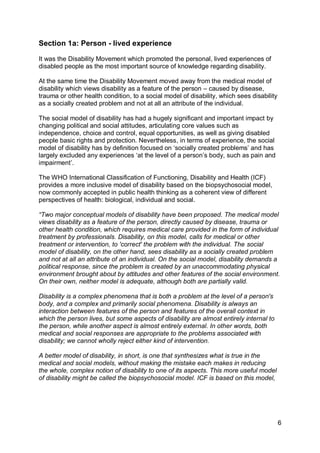
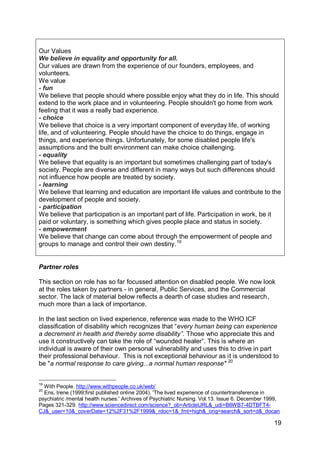
The diagram below, published by the Grubb Institute, portrays the interaction
between „person-system-role‟ set in a context – for a head teacher. The framework
has also been applied to the Hertfordshire PASS‟s WorkABILITY project, which is an
employment preparation programme run by, and for young disabled people1.


The ‘person-system-role’ framework (Reed et al, 2002)2


                 Headteacher                                  Headteacher
                 experiencing                                 experiencing
                    SELF                                       SCHOOL
                      as                                           as
               PERSON                                        SYSTEM

                                        Headteacher
                                        experiencing
                                      BEHAVIOUR
                                            as
                                        ROLE


                                 Headteacher experiencing
                           COMMUNITY, SOCIETY, INSTITUTIONS and
                                      GOVERNMENT
                                           as
                                     CONTEXT


1
  Bird, A. et al. (2010). UserDriven 2: WorkABILITY: Employment through overcoming barriers to
work.
2
  Reed, B., Bazalgette,J., Hutton,J and Kehoe,I. (2002). Becoming fit for purpose. Leading
transformation in Church schools. The Grubb Institute.


                                                                                                 4
The WorkABILITY project as “user-driven work is not just a simple matter of allowing
young disabled people to get on with it alone, as there needs to be some sort of
framework within which such work can take place. (This is not peculiar to young
disabled people as it applies to all young people growing up).
To appreciate the [person-system-role] framework we use, it is necessary to
understand the implicit outcome in user-driven work. We want young disabled people
to move from being 'just a disabled young person' (often imposed on them by others)
to taking up a wide range of 'driving' roles such as facilitator, writer, mentor, planner,
strategist, or manager.........

Clearly 'role' is important, but it begs the question 'where does a role come from?' In
our view a role is always linked to achieving the aim of the project, or meeting, or
organisation. Therefore being explicit about the aim enables the participants in the
meeting or project to take up an appropriate role to achieve that aim. However, many
meetings and projects have implicit aims ( - or none at all) and / or are driven by
strong and charismatic individuals, resulting in a vagueness of role. Therefore being
clear about the aim of the project, meeting or organisation is vital.

In turn this begs the next question 'where does the aim of the project, or meeting, or
organisation come from?' There is a danger the aim often emanates from the strong
and powerful - and their ideas, thoughts, hunches, opinions or beliefs. Alternatively
the aim can grow out of a sharing of relevant lived experiences, which when
weaved together reflect the shared story of those involved and what they want to do
together.

So in summary, in our user-driven work we focus on three main areas:

      the person and their lived experience
      defining the system (ie meeting, project, organisation) through clarifying its
       aim or purpose, and
      the roles we all take up in achieving this aim.”


                                                                                         5
Section 1a: Person - lived experience

It was the Disability Movement which promoted the personal, lived experiences of
disabled people as the most important source of knowledge regarding disability.

At the same time the Disability Movement moved away from the medical model of
disability which views disability as a feature of the person – caused by disease,
trauma or other health condition, to a social model of disability, which sees disability
as a socially created problem and not at all an attribute of the individual.

The social model of disability has had a hugely significant and important impact by
changing political and social attitudes, articulating core values such as
independence, choice and control, equal opportunities, as well as giving disabled
people basic rights and protection. Nevertheless, in terms of experience, the social
model of disability has by definition focused on „socially created problems‟ and has
largely excluded any experiences „at the level of a person‟s body, such as pain and
impairment‟.

The WHO International Classification of Functioning, Disability and Health (ICF)
provides a more inclusive model of disability based on the biopsychosocial model,
now commonly accepted in public health thinking as a coherent view of different
perspectives of health: biological, individual and social.

“Two major conceptual models of disability have been proposed. The medical model
views disability as a feature of the person, directly caused by disease, trauma or
other health condition, which requires medical care provided in the form of individual
treatment by professionals. Disability, on this model, calls for medical or other
treatment or intervention, to 'correct' the problem with the individual. The social
model of disability, on the other hand, sees disability as a socially created problem
and not at all an attribute of an individual. On the social model, disability demands a
political response, since the problem is created by an unaccommodating physical
environment brought about by attitudes and other features of the social environment.
On their own, neither model is adequate, although both are partially valid.

Disability is a complex phenomena that is both a problem at the level of a person's
body, and a complex and primarily social phenomena. Disability is always an
interaction between features of the person and features of the overall context in
which the person lives, but some aspects of disability are almost entirely internal to
the person, while another aspect is almost entirely external. In other words, both
medical and social responses are appropriate to the problems associated with
disability; we cannot wholly reject either kind of intervention.

A better model of disability, in short, is one that synthesizes what is true in the
medical and social models, without making the mistake each makes in reducing
the whole, complex notion of disability to one of its aspects. This more useful model
of disability might be called the biopsychosocial model. ICF is based on this model,


                                                                                           6
an integration of medical and social. ICF provides, by this synthesis, a coherent view
of different perspectives of health: biological, individual and social.” 3

It is these excluded or unspoken realities – disabled people‟s experience of pain and
impairment - which employers for example, can be most afraid of, particularly in the
commercial sector (who may hold key „social enterprise‟ insights). These factors can
combine with negative attitudes and low expectations in society to create the overall
experience of disability.

CASE STUDIES

Employers – fearful ignorant, scared

Young disabled people visited local employers to secure work experience
placements for Hertfordshire PASS‟s WorkABILITY project and found them “fearful,
ignorant, scared”, with a “lack of understanding in employers” regarding disability.

The principal at a Kindergarten wrote “Having agreed to take a student on work
placement I was worried when Sarah (not her real name) was referred to us because
she was in a wheelchair. It raised prejudices I didn‟t realize I had. Soon after Sarah
started however, I was very surprised at how well the placement was going and that
my prejudices were totally misplaced. This really shocked me. Things have gone so
well Sarah is now employed by us…”

A Director of a Printing Company wrote “„You‟ve got to be joking, aren‟t you?‟ This
was the response I was greeted with when I informed the staff that we were going to
take on a work taster student from Hertfordshire PASS. What can we offer them?
How are we going to cope? What are their disabilities? What if they muck up some of
our work? The best reply I could muster was I don‟t know, yet. Thankfully this was
the biggest challenge we faced when working with Hertfordshire PASS”.

Another company told Hertfordshire PASS (off the record) “we would never employ
disabled people because we‟d be worried about saying the wrong thing and being
taken to court”.

Such fears operate among disabled people too

These fears may operate not only between disabled people and employers but
among disabled people themselves. For example Hertfordshire PASS recently
employed 3 new apprentices to join 3 existing apprentices. All 6 apprentices have a
range of disabilities. After about a month one of the new apprentices who has
cerebral palsy said at a staff meeting “I‟ve never been with people who have learning
disabilities ( - referring to 4 of the other apprentices who have learning disabilities) so
when I came here to work I was worried – but I needn‟t of; my induction has gone
really well.”


3
 WHO (2002) International Towards a Common Language for Functioning, Disability and Health: ICF,
The International Classification of Functioning, Disability and Health (ICF)
http://www.who.int/classifications/icf/training/icfbeginnersguide.pdf

                                                                                              7
Such fears are not just restricted to disabled people and employers. In response to
our survey, Cally Lawrence, Director of Wooden Hill UK wrote the following about
her worst experiences of user-driven work: “where to start, I have been invited to
many meetings to discuss events that are being put on for “young people” (service
users) and have found that no young person has been consulted, there are no young
people on the steering group or committee to shape the event, and no young people
have been asked to be involved in the running of the actual event...... some things
that have been said to me in relation to the above....... “wow, that‟s a great idea, it
didn‟t occur to us”, “we can‟t just let the young people tell us what to do” and “the
young people I know are all in school” to which my response is of course “then
change the time of your meeting”.

I have also had the experience of ringing the organiser of a conference on Cyber
Bullying to book a place for myself and a young person to be told “the event is about
young people it‟s not for young people”.

Finding ways of sharing knowledge – born out of direct experience – between
different groups of service users is of central importance for disabled people:
“The disabled people‟s movement grew out of the determination of a group of
residential service users to live their lives in their own homes, rather than to continue
to be segregated. Service users have consistently emphasised the importance of
doing things together – of collectivity – as the route to changing their personal
situation and bringing about broader social and political change. The disabled
people‟s movement has long stressed that self-organisation offers the most effective
route both to personal empowerment and to challenging social oppression.4

So how do we bring people with different lived experiences together to share their
knowledge and work together? Again, some further case studies

Allowing disabled people to be themselves

Peter Beresford (Professor of Social Policy, Brunel University, and Chair, Shaping
our Lives) spoke at the „ULOs: 2010 and beyond‟ conference and shared the
following ( - used with permission):
 “I have used mental health services for 12 years in all. I also lived on benefits for
eight years during that time and that for me created at least as many problems. But
after seven years of using mental health services, I heard about a service users
organisation, a survivors organisation, what we are now calling a ULO, a user led
organisation. I decided to try to go to one of its meetings. This was when things were
starting to get better for me. But I still had a lot of problems making sense of what
had happened and going out was very difficult for me as one of my problems is what
they call agoraphobia or fear of going out. I had bit by bit to learn how to go out
again. So I went to this meeting. There were lots of people there. I didn‟t know
anybody. But people were friendly. It was easy to be there. I can still see it very
clearly because it had such an effect on me. I quickly realised I didn‟t have to worry
about feeling worked up and anxious, not being sure what to do or say. People were
just themselves, whatever that was. And for the first time outside in the world, I felt I
4
 Branfield, F., Beresford, P. (2006) Making User Involvement Work: Supporting Service User
Networking and Knowledge, York, Joseph Rowntree Foundation:
http://www.jrf.org.uk/knowledge/findings/socialcare/1966.asp

                                                                                             8
could be myself. I did not have to pretend to be this or that, to be ok, or confident or
able to do the right thing. It was a wonderful feeling. I have never forgotten it. I was
with people who simply understood and didn‟t judge me or see me as having
something wrong with them. Do you know what I mean? It was great.”

Sharing stories

Sharing knowledge and networking between disabled people‟s organisations based
on the same openness and dialogue is fundamental to the kind of collaboration with
external organisations, envisaged in social enterprise through “co-production”.
Hertfordshire PASS uses adults (disabled, or not) to share their work story in
response to questions from young disabled people about their experience of
„overcoming barriers to work‟. This is entirely user-driven.

Consultation

“Consultation is built into all of our work. In Hastings, Diversity Training for Council
workers is based on the experiences of a wide variety of local people and the plays
and films we have been involved in producing are inspired by the experiences of real
people we have spoken to along the way. We also run consultations for
organisations to get feedback from the people who use their services. These aim to
be interactive and fun and wherever possible peer-led.” Cally Lawrence, Director of
Wooden Hill UK.

Users writing about their own experiences

Young disabled people employed by Hertfordshire PASS have written their own
books (entitled „User-driven‟, and „User-driven 2‟) about their experiences of
„overcoming barriers to work‟.

The use of apprenticeships – which major on „learning by experience‟.

Hertfordshire PASS employs 6 young disabled people as apprentices to manage its
WorkABILITY project. Apprenticeships major on „learning by experience‟.

Support for staff and board members

Tony Phillips (Director of the Realife Trust) was asked to share his best experiences
of something being the most user-driven. His answers included “use of co-
representation to ensure inexperienced service users learn to operate at
management and board level from day one.” By definition „inexperienced service
users‟ need the experience of co-representatives or mentors to enable them to
develop in their role.

The aim of an organisation grows and develops out of lived experience

Hertfordshire PASS maintains on its website that “the aim (of any organisation) can
grow out of a sharing of relevant lived experiences, which when weaved together
reflect the shared story of those involved and what they want to do together”.


                                                                                           9
Sometimes experience needs to be worked on and presented in creative ways.
Again some more examples:

Use of theatre / the arts # 1
“In 2008 Government Offices East commissioned Wooden Hill to consult with young
people living in Care across the Eastern Region, then develop the interviews into a
performance. The script used the exact words of the young people interviewed and
covered their experience and opinions of social services, particularly looking at the
Regional Pledge to Looked After Children and what promises they would like to see
Social Services making to them.

We employed 3 actors, rehearsed intensively with service users attending rehearsals
to advise and give feedback on what we were doing with their words, chopped the
script up, moved it around, added in a Rick Astley song, some brightly coloured
blocks and some ensemble rhythmic sounds and a week later we performed to an
audience made up of professionals from a wide range of services throughout the
Eastern Region who LOVED it! The piece provoked a lot of discussion which was
facilitated by some of our Care experienced young trainers. We have since had
feedback that people have changed their own working practice in direct response to
the messages that came across in the piece and we have been asked to revive it for
another conference in Worcester this coming February.” Cally Lawrence, Director of
Wooden Hill UK.

Use of theatre / the arts # 2
“Having worked with the Social Work and Performing Arts departments of the
University of Bedfordshire on separate projects for some time, we suddenly realised
the potential of bringing the two disciplines together and 4 years later we‟re still doing
it.

In year 1 Third Year Performing Arts students worked closely with young trainers at
Wooden Hill, skill swapping and training and planning together. The final result was a
day of training for Social Work degree students based around the Moon Watcher
Media/ Wooden Hill co-production Unbeatable (30 minute film).
The social workers watched the film, the actors recreated the characters from it and
young trainers facilitated sessions in which the events in the film were changed
through social work intervention. The feedback was fantastic and students, lecturers
and trainers ended up presenting the results at a series of conferences up and down
the country, finishing at the House of Commons. In years 2 and 3 an additional level
to the project was developed based on representing the experiences of mental
health service users and culminating in a live theatrical performance kicking off the
training day. In 2010 we are continuing the existing work and extending Project Vena
into the Health arena. This will involve delivering sessions to student nurses
exploring working with children and young people in an interactive way through the
actors, developing empathy, testing approaches in a safe environment and bringing
a very real context to their learning. We will also be working in Milton Keynes with
their health and social care transformation programme to ensure service users are
central to the process through consultation and theatrical presentation, then
developing a safe environment for staff to explore the future of services in a creative
way.” Cally Lawrence Director of Wooden Hill UK.


                                                                                       10
Use of theatre / the arts # 3
Hertfordshire PASS‟s WorkABILITY project ran a Job Forum over the summer for
young disabled people exploring how best to overcome barriers to work. One
session focussed on theatre and included Mat Fraser ( - a well known actor, writer
and presenter) sharing his work story in response to questions from the young
people. The afternoon session was set aside for a role play which would focus on
material Mat shared with the group. „Out of the blue‟ one participant asked to perform
Jack and the Beanstalk. The initial reaction was that this did not focus on
„overcoming barriers to work‟ however on further inspection it was an excellent
metaphor, with the beans representing qualifications, the beanstalk - the career
ladder, Jack‟s mum – the „parent trap‟, the giant – a manager discriminating against
Jack, and so on. The play was written there and then, and performed – as Forum
Theatre which involved plenty of audience participation.

How do we learn from lived experience?

Maximising the use of lived experience can be much more difficult than we might
think. According to the text books we all have a “hatred of learning from experience”
because it is new or unknown5. This protects us against shock and disappointment
and having to change things. This means we avoid conflict, so we feel safe.

Given this avoidance behaviour, what can be done?

Experience needs to be interpreted – and validated. Clearly „lived experience‟ is not
enough as it needs to be interpreted, otherwise the resultant knowledge is likely to
be inaccurate, unreliable and distorted. Part of this process includes developing
ways of validating lived experience as the driving force in organisations, and finding
ways to measure this. This is not easy! However, in the absence of this validation,
organisations will continue to fall back on management structures, processes,
outputs and targets, and lose the value of lived experience.

Some academics argue that we need to „move on‟ from the social model of disability,
as far as lived experience is concerned. The reasoning behind this is that the social
model of disability focuses on „socially created problems‟ and has excluded any
experiences „at the level of a person‟s body, such as pain and impairment‟. However,
the ICF classification of disability proposed by the World Health Organisation (WHO)
recognizes that “disability is a complex phenomena that is both a problem at the
level of a person's body, and a complex and primarily social phenomena”.6

In other words, we all experience some impairment / disability. If this ICF
classification of disability is used it recognizes that “every human being can
experience a decrement in health and thereby experience some disability”. This
perhaps represent a useful „starting point‟ for disabled people, and employers and /

5
 . Lazar Ross. (2004) Experiencing, understanding, and dealing with intergroup and institutional
conflict. Chapter in Gould, L.J et al (eds) (2004) Page 165. Experiential learning in organizations.
Application of the Tavistock Group Relations Approach. Karnac publications.
6
 WHO (2002) International Towards a Common Language for Functioning, Disability and Health: ICF,
The International Classification of Functioning, Disability and Health (ICF)
http://www.who.int/classifications/icf/training/icfbeginnersguide.pdf

                                                                                                       11
or other groups to engage in a dialogue, to share their „disability‟ experiences as a
means of managing the fear and lack of understanding likely to be present.

The concept of the „Wounded Healer‟ takes this even further, being common to many
in the caring professions. People are better „wounded healers‟ when they appreciate
that “we have an internal relationship with our own personal vulnerability (for
example, to be ill, frail, helpless, afraid, etc.) and our external professional behaviour
is driven partly by this".7


Co-production – based on „lived experience and professional learning‟

An approach which is becoming more and more widely adopted is that of co-
production. It has evolved partly as a result of pressure from the user representative
and Disability Movements that services should be designed around the people that
use them, rather than matching people to services and treating them as passive
recipients. Social enterprises were originally set up as a way of meeting the needs
of deprived local communities and to address social exclusion. Many are based on
the models of co-production. Social enterprises are sustainable businesses which
engage local communities in a new and dynamic way and empower citizens to bring
innovative solutions to local problems and stimulate new markets. It is this emphasis
on innovation and new ways of meeting needs which has spurred the growing
interest in social enterprises.

An essential element of co-production is that it is based on „lived experience and
professional learning‟:

“Co-production is central to the process of growing the core economy. It goes well
beyond the idea of „citizen engagement‟ or „service user involvement‟ to foster the
principle of equal partnership. It offers to transform the dynamic between the public
and public service workers, putting an end to „them‟ and „us‟. Instead, people pool
different types of knowledge and skills, based on lived experience [my emphasis]
and professional learning.”8

Co-production can be the catalyst for bringing together the concepts of user-led and
social enterprise: co-production could be considered the “life blood” of both:

“co-production is not a new delivery mechanism for social care services. It is an
approach which affirms and supports an active and productive role for people who
use services, and the value of collaborative relationships in delivering the outcomes
negotiated with the person using the service. …Co-production has much in common
with initiatives to increase involvement by the people who use services. However, it
is linked to a particular kind of participation in which people are producers rather than
critical consumers of service outcomes. Co-production means that people who use

7
  Tilllet R. (2003) The patient within - psychopathology in the helping professions. Advances in
Psychiatric Treatment (2003) 9: 272-279. Royal College of Psychiatrists.
http://apt.rcpsych.org/cgi/content/full/9/4/272
8
  Boyle D Harris M. (2009) for nef. The Challenge of Co-production. How equal partnerships between
professionals and the public are crucial to improving public services.
http://www.neweconomics.org/sites/neweconomics.org/files/The_Challenge_of_Co-production.pdf

                                                                                               12
services are recognised as active participants in shaping the arrangements for care
and support that offer choice and control, both on an individual and collective level:
„Involving users as collaborators rather than consumers enables them to use
frontline professionals‟ skills alongside other assets to develop services that suit
them and bring about positive outcomes.”9.


The lived experience referred to in this section, when utilised effectively by disabled
people, gives them a new role: „expert by experience‟. The next section therefore
looks at such roles taken up by disabled people and the changing roles taken by
those who work with them. The report then focuses on the context, and the systems
within which people have these experiences, and the roles which are taken up.


9
 SCIE Research briefing 31 (2009) Needham C. Co-production: an emerging evidence base for adult
social care transformation. http://www.scie.org.uk/publications/briefings/briefing31/index.asp

                                                                                            13
Section 1b: Role

Many different roles

Disabled people have taken, and continue to take up, roles where they have things
„done to‟ them by service providers; such roles include service user / passive
recipient / accepting and receiving a service / consumer / being dependent on public
services.

Increasingly though, given the success of the Disability Movement, disabled people
have taken up more active roles such as fighter / evangelist / campaigner / service
provider. With the introduction of co-production and similar models they are now
being encouraged to take up new roles such as co-producer / shaper / expert by
experience / entrepreneur / self determinator / collaborator / user- citizen / co-
dependent.

Traditionally those providing a service to disabled people have taken up roles
focusing on „caring‟. With the advent of co-production a more appropriate role is
seen to be that of power sharer / acceptor of user expertise / risk taker.

As far as those people who do not have contact with disabled people, for example
many employers who are „fearful, ignorant, scared‟ of disability, their roles revolve
around „taking flight‟ i.e. they just do not feel able to engage.

These roles are now explored in more detail.

Disabled people having things „done to‟ them

Disabled people are often called „service users‟ which restricts their identity or role to
that of a passive recipient, “who has things „done to them‟ or who quietly accepts and
receives a service”. This role of service user, used as a generic term, fails to
recognize that people‟s identities are complex and that they wear many “hats”.

What are these “hats” or roles, beyond being a service user?

Users as citizens
An important change not just for service users, but also for others is to appreciate
and understand that service users are citizens. In fact, we are all citizens. Carr
reminds us that “When service users understand participation as active citizenship it
goes beyond their rights as users of social services to assert their broader rights as
citizens and as people. Service users may [then] have a dual identity as consumers
of services, and as citizens to whom such services are accountable.” 10

Being included in mainstream society and fully participating in community and
national life and contributing to political decisions which affect your life is an essential
part of being a citizen. For disabled people, self determination is an essential


10
  Carr S. (2004) Has service user participation made a difference to social care services?, London,
Social Care Institute for Excellence, http://www.scie.org.uk/publications/positionpapers/pp03.pdf

                                                                                                  14
component of what it means to be a “free and equal citizen”. Self determination,
put simply, means making decisions for yourself.

Self determination and citizenship
The principle of self determination has “helped begin to re-shape disabled peoples'
relationship with public services from ‟passive recipients‟ to „co-producers‟ – for
example through direct payments and individual budgets and the emphasis on
involving disabled people in the new Disability Equality Duty. It is the foundation
stone of independent living – now Government policy.

The principle of „self-determination‟ is what made a disabled people‟s movement
make sense, providing through solidarity a powerful voice to gain first recognition,
then rights.”11

The concept can be combined with various forms of user involvement and service
redesign, “so long as there is a commitment to power-sharing, an active and
productive role for the user, and a recognition of the importance of collaborative
relationships in delivering service outcomes.”12

User Led Organisations (ULOs)

User-led organisations (ULOs) have provided the opportunity for disabled people to
exercise such self determination. The report now focuses on the roles disabled
people take up and develop in ULOs beyond „service user‟, and the roles of the
ULOs and staff in supporting this.

ULOs, and the social model of disability
Given the impact that the social model of disability has had historically on very many
issues affecting disabled people, ULOs are understandably very passionate about it.
For example, the following statement was part of a presentation by a chief executive
of a ULO at the „ULO: 2010 and beyond‟ conference held in March 2010 in London:

“We live and breathe the social model of disability which is our core philosophy…We
believe we are the keepers of „Independent Living‟ and the „Social Model of
Disability‟ faith…..We‟re evangelical in what we believe in…The social model of
disability was the most significant change in the 20 th Century…..It‟s society that
makes us vulnerable. We need to be empowered.......ULOs must be campaigners,
not just service providers”.

Developing staff, leaders and board members in ULOs
In addition to developing the role of campaigners in ULOs, Tony Phillips (Director of
the Realife Trust) has made the following general comments on leadership, and
developing users as professional staff / board members in user-driven organisations
based on his experience:


11
   Crowther N. Nothing without us or nothing about us? (2007) Disability Archive.
http://www.leeds.ac.uk/disability-studies/archiveuk/crowther/Nothing%20without%20us-bt.pdf
12
   Needham C, Carr S. for SCIE (2009) SCIE Research briefing 31: Co-production: an emerging
evidence base for adult social care transformation
http://www.scie.org.uk/publications/briefings/briefing31/index.asp

                                                                                              15
“User led agencies have active recruitment cultures and policies that ensure service
users are more likely to be directly employed; be active at board level and directly
affect organizational development.”

“Use of co-representation to ensure inexperienced service users learn to operate at
management and board level from day one.”

“User led agencies still need to be run and managed by competent, creative people.
Being a service user is not a general qualification.”

“User leadership is not an end in itself – outcomes are the main quality measure.”

“Some ULOs are dominated by key personalities which creates a controlled, self-
interested style of leadership.”

”User leadership is best achieved at local level – local people have little or no direct
contact, with the great and the good who occupy management and board level roles
on large, anonymous agencies even though these „leaders‟ undoubtedly have great
influence on strategy and other policy issues.”

User-driven staff interviews
As far as examples of other user-driven roles are concerned, Hertfordshire PASS
WorkABILITY project recently ran a staff selection process, driven not just by
disabled people as employees on the selection panel but also by the interviewees
themselves. For example each interviewee, when invited to interview, was sent the
following statement:

"Because WorkABILITY tries very hard to be user-driven we want you to think
of 2 questions you expect to be asked in your interview. Please write these
questions on a piece of paper with your name on them and hand them to us on the
day. We will ask one of your questions of you, and all the other candidates."

According to Hertfordshire PASS “this had all sorts of benefits. Firstly it
communicated how strongly committed we are to being user-driven. Secondly it gave
the shortlisted candidates opportunity to think about the type of questions they might
be asked and at the very least, opportunity to plan answers to their own question,
and thirdly it threw up some excellent questions we had not thought of ourselves”.

The importance of defining purpose when taking a role
Hertfordshire PASS also had a visit from Lord Young (Minister for Apprenticeships)
because PASS at the time had 3 young disabled people employed as apprentices.
By way of preparation for this meeting (which involved a closed hour-long session
between the 3 apprentices and Lord Young), there was much discussion about the
purpose or aim of the meeting. This was to ensure Lord Young and the 3 apprentices
took up an appropriate role because “unless the purpose of a meeting, event or
organisation is worked on to ensure it is clear, explicit and acted on, it is very difficult
for 'disabled people' to shake off this label and take up a different role, such as


                                                                                         16
'apprentice', and 'shaper' of government policy and practice we hope will occur when
the government minister comes visiting”. 13

The importance of purpose in relation to user-driven social enterprise is further
expanded upon in section 1c.

In addition to disabled people taking up roles such as apprentice, or shaper there are
increasing opportunities for co-producers – to deliver the personalization and
independent living agenda.

Co-producers, shapers and collaborators
Co-production represents a powerful and radical model of user-citizen for disabled
people, as it “rejects the traditional understanding of service users as dependents of
public services, and instead redefines the service-user (or government-citizen)
relationship as one of co-dependency and collaboration. Just like users need the
support from public services, so service providers need the insights and expertise of
its users in order to make the right decisions and build effective services."14
Service users become shapers, collaborators, rather than consumers.

In addition, “Co-production means that people who use services are recognised as
active participants in shaping the arrangements for care and support that offer choice
and control, both on an individual and collective level: „Involving users as
collaborators rather than consumers enables them to use frontline professionals‟
skills alongside other assets to develop services that suit them and bring about
positive outcomes.”15.

According to Professor Peter Beresford “Co-production is about doing things as
equals”.

THREE CASE STUDIES: CO-PRODUCTION

Note that in the following case studies the emphasis is both on the “co” as well as
the production; disabled people want to be active producers. The descriptions are
extracts from their websites: more detailed descriptions of these organisations can
be found in the appendix to the literature review.

1. Brighter Future Workshop

Extracts from website:
 “The Brighter Future Workshop is a… disability friendly facility, equipped for the
repair and servicing of electric mobility scooters, wheel chairs, power chairs and
other disability equipment….Young persons (with or without disabilities) will train in
the workshop, supervised by specialist staff including engineers and technicians,
supported by volunteers, to repair and service electric mobility scooters, wheel
chairs, power chairs and other disability equipment. By taking part, young people

13
   Nigel Fenner‟s Blog http://nigelfenner.blogspot.com/2009/07/being-clear-about-purpose.html
14
   People and Participation.net website definition of co-production.
http://www.peopleandparticipation.net/display/Methods/Co-production
15
   SCIE Research briefing 31 (2009) Needham C. Co-production: an emerging evidence base for
adult social care transformation. http://www.scie.org.uk/publications/briefings/briefing31/index.asp

                                                                                                       17
with disabilities will learn new skills and gain valuable work experience. As such,
their own personal development will be enhanced. With the right support and
encouragement, individuals will gain self worth and confidence, which in turn will
lead to improved „employability‟. For many, this may be the first step on the ladder to
paid employment. Trainees will also learn workshop administration and IT skills, so
they can help with the costing of repairs, ordering spares and internet research for
parts and products; thus further improving their personal development and
employability.”16


2. Pack-IT Group Wales

“Established in 1988, the Pack-IT Group is an award-winning Social Enterprise and
Social Firm offering almost 20 years of professional and reliable expertise in the
storage, distribution, fulfilment and mailing sector….

Our business philosophy is simple:
To be considered by our peers to be a company of good worth and reputation
To maintain the highest levels of client satisfaction by delivering quality products and
services to meet clients' individual needs
To be a technically sound company able to proffer help and advice to new customers
whilst supporting the growth and development of existing customers
We handle everything from one-off promotions and direct mail fulfilment to storage
and warehousing, international distribution, and customer response management….
Our employees, both able and those with disabilities, are all key players and have
been instrumental in our success story. They all have real jobs, earn real wages and
benefit immeasurably from being part of a busy working environment…17.“Ten of the
company‟s 15 staff have a mixture of disabilities or disadvantage ranging
from ex-offenders to colleagues with Down syndrome, Asperger‟s Syndrome or
behavioural and learning difficulties. Everyone at Pack-IT is fully waged and fully
pensioned.”18

3. With People

“With People is a Community Interest Company, and social firm, who specialise in
marketing for social enterprises, charities, and small business…. With People was
founded out of the direct experience of the founders and their peers. As people with
physical and sensory impairments the founding team are aware that disabled people
find it difficult to get meaningful employment. Research and experience has shown
employers‟ perceptions and expectations of the abilities of disabled people do not
always match the aspirations and talents of disabled job seekers. To break the cycle
of low expectations the founders decided to move from the traditional idea of things
being done to people to one of working with people to empower them. From this
came a simple idea -if employment opportunities couldn't be found then why not
create them?

16
   Brighter Future Workshop website http://www.bfworkshop.co.uk/
17
   Pack-IT Group Wales http://www.pack-it.com/default.asp
18
   State of Social Enterprise Report 2009.
http://www.socialenterprise.org.uk/data/files/stateofsocialenterprise2009.pdf

                                                                                     18
Our Values
We believe in equality and opportunity for all.
Our values are drawn from the experience of our founders, employees, and
volunteers.
We value
- fun
We believe that people should where possible enjoy what they do in life. This should
extend to the work place and in volunteering. People shouldn't go home from work
feeling that it was a really bad experience.
- choice
We believe that choice is a very important component of everyday life, of working
life, and of volunteering. People should have the choice to do things, engage in
things, and experience things. Unfortunately, for some disabled people life's
assumptions and the built environment can make choice challenging.
- equality
We believe that equality is an important but sometimes challenging part of today's
society. People are diverse and different in many ways but such differences should
not influence how people are treated by society.
- learning
We believe that learning and education are important life values and contribute to the
development of people and society.
- participation
We believe that participation is an important part of life. Participation in work, be it
paid or voluntary, is something which gives people place and status in society.
- empowerment
We believe that change can come about through the empowerment of people and
groups to manage and control their own destiny. 19


Partner roles

This section on role has so far focussed attention on disabled people. We now look
at the roles taken by partners - in general, Public Services, and the Commercial
sector. The lack of material below reflects a dearth of case studies and research,
much more than a lack of importance.

In the last section on lived experience, reference was made to the WHO ICF
classification of disability which recognizes that “every human being can experience
a decrement in health and thereby some disability”. Those who appreciate this and
use it constructively can take the role of “wounded healer”. This is where an
individual is aware of their own personal vulnerability and uses this to drive in part
their professional behaviour. This is not exceptional behaviour as it is understood to
be "a normal response to care giving...a normal human response" 20


19
  With People. http://www.withpeople.co.uk/web/
20
  Ens, Irene (1999;first published online 2004). 'The lived experience of countertransference in
psychiatric /mental health nurses.' Archives of Psychiatric Nursing. Vol.13. Issue 6. December 1999,
Pages 321-329. http://www.sciencedirect.com/science?_ob=ArticleURL&_udi=B6WB7-4DTBFT4-
CJ&_user=10&_coverDate=12%2F31%2F1999&_rdoc=1&_fmt=high&_orig=search&_sort=d&_docan

                                                                                                 19
Roles in public services
There is a call for “more empowered frontline staff (in public services) who are able
and confident to share power and accept user expertise....... Staff should be
supported in positive risk-taking and encouraged to identify new opportunities for
collaboration with people who use services”21. Unfortunately, this new role of „risk
taker‟ ( a key role in any social enterprise) is quite different to the traditional „duty of
care‟ role taken by health and social care staff.

This became evident to Hertfordshire PASS‟s WorkABILITY project when it was
endeavouring to forge closer links with the local day care centres managed by the
Adult Care Services department of the local authority. The manager who came to
observe and take part was very impressed with the work of WorkABILITY (a user-
driven employment preparation project). However, he said “because we in the local
authority have a „duty of care‟ it is more difficult for us to allow the user-driven work
you encourage”.

Roles in the commercial sector / social enterprise
There has been limited contact between disabled people and the commercial sector
in terms of „helping‟ each other in a co-productive way, despite ULOs appreciating
they need to get more entrepreneurial – as made explicit by a number of ULO Chief
Executives at the „ULOs: 2010 and beyond‟ conference in March 2010. As discussed
earlier in this report, the commercial sector has probably taken „flight‟ from disability
because they are “scared, frightened and ignorant” of it. In order to address this
“fear” on the part of employers in the commercial sector, WorkABILITY has been
“exploring what it has to offer local companies on such a „2-way street‟. Probably of
most importance is the „disabled £‟, or „purple £‟, similar to the „green £‟ ( - where
products exploit their green, or environmentally friendly credentials), or the „pink £‟ ( -
relating to products targeted at the gay and lesbian community). The „purple £‟ is
estimated to be worth £80billion per year (Massie, 2006), which represents the
spending power of people with disabilities who make up 20% of the population.”22

Were this market to be opened up in a co-productive way, this could result in very
many opportunities for disabled people to take up a wide range of important and new
commercial-type roles. The outcome could be many more „user-driven social
enterprises‟.

Linking role to aim and purpose

As far as Hertfordshire PASS is concerned “'role' is important, but it begs the
question 'where does a role come from?' In our view a role is always linked to
achieving the aim of the project, or meeting, or organisation. Therefore being
explicit about the aim enables the participants in the meeting or project to take up an


chor=&view=c&_searchStrId=1272738470&_rerunOrigin=google&_acct=C000050221&_version=1&_
urlVersion=0&_userid=10&md5=abc498c8d877845ab900c7e1543dade2
21
   SCIE Media release (March 2009): Co-production requires more empowered frontline staff.
http://www.scie.org.uk/news/mediareleases/2009/180309.asp
22
   Fenner N. Bate A. (2008) The relationship between disabled people and the commercial sector –
moving on from „fight and flight‟ to access the purple £... Paper presented at the 5th UK Social
Enterprise Research Conference, 2008.

                                                                                             20
appropriate role to achieve that aim. However, many meetings and projects have
implicit aims (or none at all) and / or are driven by strong and charismatic individuals,
resulting in a vagueness of role. Therefore being clear about the aim of the project,
meeting or organisation is vital.

The next section, therefore, focuses on the aim or purpose of user-led organisations
– as SYSTEMs, whilst also providing a context for such work.


                                                                                      21
Section 1c: Context and Systems

So far this report has focused on people‟s experiences in section 1a, and the roles
they take up in section 1b. In this section the focus is on User-Driven Social
Enterprise as a system compared to other systems – such as ULOs, the Charitable
sector, the Public Sector, etc. – all set in the context of our society today.

Sections 1a and 1b of this report have relied on case studies, and on evidence from
academic research to strengthen the points made. Because the current section
covers such a large cross section of major issues, the justification for making the
observations, suggestions and claims here are based more on current debates,
commentaries and opinion. Whilst systems, and the societal/ political context they
operate in are complex, they do need to be worked on alongside an appreciation of
lived experience and role.

1. The context

The efforts of disabled people striving to be included in society as citizens must be
seen in the context of the current recession. In addition, because this report focuses
on user-driven social enterprise (as a means of providing employment opportunities
for disabled people) it is necessary to focus on current levels of poverty and
unemployment amongst disabled people. A disabled person cannot exercise self
determination if they are discriminated against, either directly or indirectly, in society.
Two of the main manifestations of discrimination are in the levels of unemployment
(including training for employment) and poverty experienced by disabled people.

Disabled people as citizens participating in society

Disabled people are still striving to be included in mainstream society to fully
participate in community and national life and contributing to political decisions which
affect their lives, as an essential part of being a citizen. Despite the Disability
Discrimination Act, the Commission for Equality & Human Rights (which
amalgamated with the Disability Rights Commission) and The Office for Disability
Issues, many disabled people are still denied the opportunity to be active citizens.
The Report “Improving the Life Chances of Disabled People”23 focused on four main
areas
            independent living
            support for families of young disabled children
            transition into adulthood
            support and incentives for getting and staying in employment.

The current recession means it is highly likely the above 4 main areas will not benefit
from public sector finance and support as had been previously envisaged.
Unconfirmed reports indicate that county councils will have to cut their overall budget
by between 25 and 30%. In addition, any finance from government is unlikely to be
“part of a long term investment”.


23
   Prime Minister‟s Strategy Unit (2005) Improving the Life Chances of Disabled People.
http://www.cabinetoffice.gov.uk/media/cabinetoffice/strategy/assets/disability.pdf

                                                                                          22
If public finance will not provide, then this is all the more reason to look to social
enterprise to do so. If „user-driven‟ this could impact on the current levels of poverty
and unemployment amongst disabled people (the 4 th area from the Improving the
Life Chances of Disabled People report).

Poverty and unemployment: a vicious trap

Lack of employment opportunities for disabled people combined with (and
sometimes a causal effect of) poverty is a vicious trap. A report to the Rowntree
Foundation on poverty and social exclusion in 2005 found that
“Three out of every ten disabled adults of working age are living in poverty in Britain
– a higher proportion than a decade ago and double the rate among non-disabled
adults. Disabled adults are now more likely to live in poor households than either
pensioners or children.”24

“Many disabled people are trapped in inescapable poverty – those furthest from the
labour market with little immediate chance of getting in to work frequently rely on
benefits that are simply not sufficient to lift them out of poverty. This leaves people
with little or no chance of escaping poverty other than through charity, or support
from family and friends.”25


2. Systems

The term “system” is used in this report to define a network of human relationships
defined by its boundaries and its aim or purpose. “For example, a classroom is a
network of relationships, as a system, it has the aim of enabling pupils to learn and is
defined by the boundaries held in the mind of the teacher and the pupils, i.e. break
times, the hallway, interruptions etc Every network of human relationships can be
understood as being a system with boundaries and an aim. Conceiving of human
networks as systems allows us to find, make and take roles in relation to their
purpose”.26

2.a The Disability Movement

The Disability Movement is a much bigger system than a classroom. However, it is
still essentially a network of human relationships largely defined by the adoption and
promotion of the social model of disability as its aim or purpose.

The social model of disability
In the second section of this report it was reported that the Disability Movement
moved away from the medical model of disability which views disability as a feature
of the person – caused by disease, trauma or other health condition, to a social


24
   Joseph Rowntree Foundation (2005) Poverty and Social Exclusion. Press release.
http://www.jrf.org.uk/media-centre/uk-poverty-falls-overall-rates-increase-among-disabled-people-jrf-
press-release
25
   Leonard Cheshire Disability (2008) Disability Poverty in the UK.
http://www.lcdisability.org/?lid=6386
26
   Grubb Institute Website www.grubb.co.uk

                                                                                                   23
model of disability, which sees disability as a socially created problem and not at all
an attribute of the individual.

The aim and methods of the Disability Movement has therefore focused on
challenging and changing these „socially created problems‟, which it has done
robustly and with great success in terms of “changing political and social attitudes,
articulating core values such as independence, choice and control, equal
opportunities, as well as giving disabled people basic rights and protection”. The
impact of the Social Model of Disability, and Independent Living has resulted in
disabled people „self-organizing locally, nationally and internationally‟ including
setting up their own Disabled People‟s Organisations (DPOs), and in collaboration
with the Public Sector, User-Led Organisations (ULOs).

Over time and with the broad acceptance of the social model there have been
changes which allow a more inclusive approach which recognises that the complex
phenomenon of disability includes, and respects, individual experience of impairment
and pain. Whilst not in any way wanting to minimise the importance of the social
model of disability, it is perhaps time to also emphasise
           experiences „at the level of a person‟s body, such as pain and
             impairment‟ and not just those relating to „socially created problems‟,
             and
           efforts to work interdependently through co-production with the public
             and commercial sectors, rather than just focus on independent living.

Hertfordshire PASS‟s experience of working co-productively with employers has led
to the recognition that it is disabled people‟s experience of pain, impairment,
motivation, self esteem, which employers can be most afraid of, particularly in the
commercial sector, which may have very little direct experience of disability
compared with the public sector. These factors combine with negative attitudes and
low expectations in society to create the overall experience of disability.
Hertfordshire PASS‟s young people with physical or learning challenges reported a
“lack of understanding in employers” regarding disability.”

Put simply, the Disability Movement may now be at a stage where it has a choice to
either continue with its main focus on independent living (overcoming socially
created problems), or to work co-productively with other partners in the Charitable,
Public and Private sectors, or a combination of the two. Recognising that the
complex nature of disability includes pain and impairment could engender an open
dialogue with those who are ignorant of what disability involves, who erect barriers
through fear. This would appear to be an essential dialogue in breaking down the
societal barriers, particularly in relation to employment, which the Disability
Movement has fought so successfully for over the last 40 years. However, this could
pose an ideological and practical dilemma for some grass roots organisations.

This dilemma facing the Disability Movement coincides perhaps with the Disability
LIB alliance‟s observation that “with basic rights secured in law, the role of the
Disabled People‟s Movement and DPOs is less clear-cut than 20 years ago. Many
DPOs set up in the „80s and „90s are struggling to identify where they should focus


                                                                                        24
their resources and attention in a political and economic landscape that is changing
rapidly”.27

Whatever model is in the ascendant over the next 10 years, whether it is the social
model of disability, or the model proposed by the World Health Organisation‟s ICF
classification which recognizes that “disability is a complex phenomena that is both a
problem at the level of a person's body, and a complex and primarily social
phenomena”, it is important to remember that these are only theoretical models. In
any field where a dominant paradigm has been replaced there will be a period of
controversy and polarisation, before a position is reached which incorporates
elements of both positions. For those outside the paradigm debate it can be
confusing. The danger here is that the theory can be more important than what is
happening in practice, the lived experience of disabled people, hence the focus on
lived experience in section 1a at the start of this report.


2.b User-led Organisations (ULOs) – all shapes and sizes

The Government definition of user-led organisations is set out in the 2009 report
“Putting People First: Working together with User-led Organisations”:
“ULOs are organisations led and controlled by the very people who they help –
disabled people, carers and other people who use services. They provide a range of
services, including information and advice, advocacy and peer support, support
in using direct payments and individual budgets, and disability equality training.
ULOs are organisations that bring together people with a common purpose and can
include any people with impairments, such as people with learning disabilities,
mental health survivors, people from ethnic backgrounds and older people.”28

According to Shaun Gallagher, Director of Social Care Policy & Innovation,
Department of Health, when speaking at the „ULOs: 2010 and Beyond‟ Conference,
“There is no one model, because each ULO is dependent on its context”.

However, because of the interest in, and the funding that „independent living‟ now
attracts, one well known ULO is considering expanding their remit, currently on
employment, to include independent living.29 This seems to imply that „independent
living‟ is becoming both the means and the ends to gaining employment.

For other ULOs, there is a differing focus, or at least different terms are used to
describe their organisations. For example, 3 chief executives spoke one after the
other at the „ULOs: 2010 and beyond‟ conference whose designations were from:
            the Southampton Centre for Independent Living,
            the Derbyshire Coalition for Inclusive Living, and
            the Leicestershire Centre for Integrated Living.

27
   Thriving or Surviving: Challenges and Opportunities for Disabled People‟s Organisations in the 21st
Century. Published by Scope in February 2008 on behalf of Disability LIB alliance.) Disability LIB.
http://www.disabilitylib.org.uk/index.php/resources
28
   Department of Health (2009) Putting People First: Working together with User-led Organisations.
http://www.shapingourlives.org.uk/documents/Puttingpeoplefirst.pdf
29
   private conversation with the CEO at the ULOs: 2010 and Beyond conference – used with
permission

                                                                                                   25
Whilst it is appreciated there is no one model, it is nevertheless very difficult to
understand a „system‟ whose purpose is to both promote independent living,
alongside inclusive, and integrated living.

Another danger is that by their very name – „User-led Organisation‟ - “user-
leadership can become an end in themselves”. This is an observation made by Tony
Phillips of the Realife Trust in response to our survey. He also observed that the
worst examples of user-led agencies are that they can “be run as inward looking self-
interest groups with no sense of collective action across impairment or age groups.”
In his view the best examples are those agencies who “ensure control over the
inevitable tendency for organizations to develop cultures that are more to do with
survival, self-interest and professionalization than they are to responsiveness,
flexibility and local accountability”.

Some of this dilemma over organisational definitions can be tracked back to the
fundamental interpretations of what user-led actually means and how it can be
measured. Centres for Independent Living (CILs), Disabled People‟s Organisations
(DPOs) and User-led Organisations (ULOs) all have a view on how they meet the
criteria of being user-driven or user-controlled: some may not agree on what that
should look like in practice, especially if attempts are made to introduce some
consistency. This is discussed in more depth in the literature review.

The Department of Health‟s (DH‟s) User-led organisation (ULO) project policy
document30 includes the design criteria which are key requirements for a viable and
sustainable ULO modelled on existing CILs in 2010.

A basic analysis of these 21 criteria indicate that:
      8 of 21 focus on being user-driven
      7 of 21 focus on governance and management (2 overlap with „user-driven‟)
      3 on values
      2 on client group
      1 on partners,
      1 on outputs and
      1 on outcomes

Understandably these criteria focus predominately on ensuring the organisation is
user-driven, which is no surprise given the criteria relate to establishing a ULO. But
as already stated “user leadership is not an end in itself”. The lack of focus on
outputs and outcomes is of concern, but not surprising at this stage in the
development of ULOs. Measuring effectiveness and impact may require more
understanding at a political level about the wide range of definitions used and the
challenge this poses for research and evaluation. One of the key findings from the
National Mapping Exercise on the capacity and potential for user-led organisations
commissioned by the Department of Health was that:
 “some matters arose during the mapping which were significant and are worthy of
mention - Some respondents felt there was a need for clarity regarding User Led
30
   Department of Health (2007) User Led Organisations Project.
http://www.dh.gov.uk/prod_consum_dh/groups/dh_digitalassets/@dh/@en/documents/digitalasset/dh
_078802.pdf

                                                                                           26
Organisations, CILs, and Disabled People‟s Organisations. (section 1.4.) The DH
could usefully make the distinction. Many did not understand all the ULO criteria, or
did not think them all relevant, with one LA deciding not to use them. The ULO
criteria could be reviewed as part of the recommended programme of organisational
advocacy, or through the recommended sub-regional meetings. (4.3.c)”31.

2.c Charities

The models of independent living and user-led social enterprise are radically
different from the old models such as “charity which did things to people „for their
own good‟ or to be „kind‟. Or the state, which did things to control people, or kept
them separate, often in bad conditions. Or the market or private sector, which did
things mainly to make a profit out of people.”32

The need for charity persists because very many disabled person are unable to
exercise self determination because they are mostly discriminated against, either
directly or indirectly, by society. Unemployment (including training for employment)
and poverty experienced by disabled people leaves people with little or no chance of
escaping poverty other than through charity, or support from family and friends.
In addition to reliance on charity a disabled person will have to rely on support from
the Public Sector.

2.d Public sector / government

The „system‟ of government is complex enough, but for disabled people and the
ULOs etc who work with them, perhaps more so. Barriers within the public sector
include:

Government being organised into service led administrative categories. As
Beresford points out, administrative structures can divide service users into service
led administrative categories. “The overall effect for service users is that they feel
they are not treated as whole people, but divided into service led administrative
categories.”33

The plans for local government to be organised more regionally than locally.
This may create space for ULOs to work more effectively with local communities,
assuming such work is properly financed and supported.

Government funding – often a short term investment
ULO work requires longer term investment. With the recession this is unlikely to
happen.

31
   Breakthrough UK LTD. (2009) Supporting the Development of User- Led Organisations in the
North West 2008- 2010 http://209.85.229.132/search?q=cache:l_otldipqjUJ:www.breakthrough-
uk.com/ULOReportFINALMay.rtf+ULO+mapping+self+assessment+tool&cd=1&hl=en&ct=clnk&gl=uk
32
   Beresford P. Hasler F. (2009) Transforming Social Care Changing the future together. Centre for
Citizen Participation.
http://www.shapingourlives.org.uk/documents/132459TransformingSocialCareFinal150dpi.pdf
33
   Beresford P (2007) The Changing Roles and Tasks Of Social Work From Service Users‟
Perspectives: A literature informed discussion paper. Shaping Our Lives.
http://www.gscc.org.uk/NR/rdonlyres/072DD7D6-B915-4F41-B54B-
79C62FDB9D95/0/SoLSUliteraturereviewreportMarch07.pdf

                                                                                                27
Government support of the bigger charities
There is a sense among small local charities that government contracts are awarded
to the larger charities and that neighbourhood, and user-led groups miss out.

Government focus on targets – can miss the point
Everyone agrees that government funded projects must be accountable, however its
obsession with reaching targets can sometimes mean that the real work is not done.
As Shaun Gallagher (Director of Social Care Policy & Innovation, Department of
Health) said at the ULOs: 2010 and beyond conference, “you can hit the target, but
miss the point‟.

Can government trust user-driven work?

A recent event at the „ULOs: 2010 and beyond conference‟ run by the Department of
Health gave rise to some discussion. Normally at such conferences they finish with a
question and answer session, with questions taken from the floor at random. At
„ULOs: 2010 and beyond‟, whilst there was a question and answer session, it
emerged in the session itself that the questioners had been selected beforehand and
the panel had sight of their prepared questions in advance of the session. No one
had been made aware this was to be the case beforehand. Some participants
commented afterwards that it felt like being user-led or user-managed – by the
Department of Health. This is a small example: but it may reflect a serious concern
within organisations that letting work really be “user-driven” may be seen as a high
risk strategy at times which could be difficult to control.

2.e Commerce

As already highlighted in this report, the model of independent living is different to
the market or private sector model because the latter „does things mainly to make a
profit out of people‟.

However in order to operate social enterprises perhaps it is necessary for both sides
to come closer together to share their expertise and understanding. At present there
is a sense of disengagement or „flight‟ on the part of many employers in the
commercial sector. “Given that the language of disability has, over the last hundred
years or so, sometimes been used (quite rightly) to fight, battle and struggle for equal
rights in society, including the workplace, it may explain why the young people
canvassing for work experience placements have found “employers sometimes
fearful, ignorant, scared” (Bird et al, 2008). Clearly employers need to learn the
language of disability, but WorkABILITY also has to respect and learn some of the
language of business.”34

Some parts of the voluntary and third sector see the business model of social
enterprise as controversial, particularly at a grass roots level. A recent study by
TSRC looking at how the third sector views social enterprises notes that, politically,

34
 Fenner N. Bate A. (2008) The relationship between disabled people and the commercial sector –
moving on from „fight and flight‟ to access the purple £.. Paper presented at the 5th UK Social
Enterprise Research Conference, 2008.


                                                                                                  28
the „Third Sector‟ has became “an integral part of the dominant discourse, in
particular for the role the sector and social enterprises could play, in service
provision (notably through „partnership‟ with the public sector), to assist in public
service reforms and to create a competitive market of service delivery providers..
The briefing suggests that this is an uneasy partnership.

User-driven social enterprises: what did the Social Enterprise East of England
(SEEE) members think?

Both „user-driven‟ and „social enterprise‟ are popular concepts, some think they are
„flavours of the month‟, attracting attention and funding, maybe more so, when
combined together.

In preparation for this report, a survey was circulated on behalf of the author by
Social Enterprise East of England to its membership and supporters early 2010 with
the following questions:

We want to map what „user-driven social enterprises‟ there are across the Eastern
Region.
      What user-driven social enterprises are you aware of local to you? Can you
      list their name, what they do and what town or area they cover?
      Do you consider your organisation to be a user-driven social enterprise? Can
      you list your organisation, what you do, and the town or area you cover?

The following are extracts from the responses:

Fledglings
“I started Fledglings nearly 12 years ago now and it most certainly was user-driven
from the start. I worked with families who had a disabled child and found that they
were unable to obtain a whole range of products to help their children and, after
researching their needs, I set out to find things that they needed. Some were found,
some were made, some were commissioned and others are still to be discovered.
Over the years Fledglings has become both a charity and a social enterprise with a
mail order catalogue. We have well over 10,000 families and organisations
throughout the UK on our mailing list. Families call our helpline or email us with their
problems on a daily basis and we continue to look for products to meet their newly
identified needs or to order items they need from our catalogue. We despatch a wide
range of items to families twice weekly. Some of these items have been designed
and produced by families for their own use and through Fledglings now supply
others. We plan to grow this side of our work in the coming years.

If you want to see more about Fledglings take a look at our website.”
 www.fledglings.org.uk.” Ruth Lingard MBE, Fledglings, Saffron Walden, Essex.

Sound Sense
“Well I‟m not sure what one of these is. I‟m a professional association, a charitable
company, and with income derived from contracts, members‟ fees, some small
amounts of sales and occasionally grants. Which I guess makes me a social
enterprise. My board is directly elected from my membership, so I further guess I‟m


                                                                                        29
user-driven. I operate UK wide. Kathryn Deane. Sound Sense, the UK association
for community musicians, Bury St Edmunds, Suffolk.

Hertfordshire Action on Disability (HAD) – a charity delivering innovative,
affordable, practical services to disabled people.
“......HAD regards itself as a user-driven social enterprise...” Annabelle Waterfield,
CEO, HAD, Welwyn Garden City, Hertfordshire.

Ferry Project and Hope Social Enterprises
“We are a client centred organisation which means the focus is on the client. Our
clients are involved in planning and giving feedback on the service. We have no
clients on a management board though. We help homeless people and our clients
move on before they are trained to be involved in the board.” Keith Smith, Director,
Ferry Project and Hope Social Enterprises, Huntingdon, Cambridgeshire.

Wooden Hill UK
“I suppose it depends on how you interpret the phrase user-led, for us it means a
variety of things from our service users actually running the training to them being
involved in the development of a project or coming up with an idea for a project in the
first place. A lot of the work we do is in partnership with service users, but if they
weren‟t there then we wouldn‟t exist so it‟s hard to separate the two.” Cally
Lawrence, Wooden Hill UK, Bedford and Hastings.

The above responses confirm the findings in the national mapping exercise already
discussed that there is broad interpretation as to what a „user-driven social
enterprise‟ is in practice.


                                                                                         30
Section 2: Main findings and conclusions

In this section we look at
     the implications of the issues discussed in Section1 of this report
     how some of the barriers could be overcome
    and
     suggest some ways forward to encourage the development of „user-driven
        social enterprises‟ in the context of disability.


1. The person-system-role framework to be considered alongside other
   methods for understanding, and developing user-driven social enterprises.

The framework starts from the lived experience of disabled people as „persons‟, and
the systems they are part of, as „disabled person‟, or „citizen‟ or „co-producer‟ - in
terms of their role. Such roles result out of a clarity, or lack of clarity of purpose – of
the system(s) they are part of.

The person-system-role framework has therefore been used to understand user-
driven social enterprises and the roles required to develop them.

2. The complex nature of disability: focus on the lived experience of disabled
   people

Personal-lived-experience of disability includes pain and impairment. It is often these
excluded or unspoken realities – disabled people‟s experience of pain and
impairment - which employers for example, can be most afraid of, particularly in the
commercial sector (who may hold key „social enterprise‟ insights). These factors
combine with negative attitudes and low expectations in society to create the overall
experience of disability.

Recognising that the complex nature of disability includes pain and impairment could
engender an open dialogue with those who are ignorant of what disability involves,
who erect barriers through fear. This would appear to be an essential dialogue in
breaking down the societal barriers, particularly in relation to employment, which the
Disability Movement has fought so successfully for over the last 40 years. However,
this could pose an ideological and practical dilemma for some grass roots
organisations.

Whatever model of disability is in the ascendant over the next 10 years, it is
important to remember that these are only theoretical models. The danger here is
that the theory can be more important than what is happening in practice, the lived
experience of disabled people, hence this report‟s focus on lived experience.

3. Personal-lived-experience of disability includes citizenship

Being included in mainstream society and fully participating in community and
national life and contributing to political decisions which affect your life is an essential
part of being a citizen. For disabled people, self determination is an essential


                                                                                         31
component of what is means to be a “free and equal citizen”. Self determination
means making decisions for yourself.

4. Experts in their own experience: user knowledge and networking

Finding ways of sharing their knowledge – based on lived experience – between
different groups of service users is of central importance for disabled people:

“The disabled people‟s movement grew out of the determination of a group of
residential service users to live their lives in their own homes, rather than to continue
to be segregated. Service users have consistently emphasised the importance of
doing things together – of collectivity – as the route to changing their personal
situation and bringing about broader social and political change. The disabled
people‟s movement has long stressed that self-organisation offers the most effective
route both to personal empowerment and to challenging social oppression.35

5. Personal-lived-experience of disability includes poverty and unemployment

A disabled person cannot exercise self determination if they are discriminated
against, either directly or indirectly, in society. Two of the main manifestations of
discrimination are in the levels of unemployment ( - including training for
employment) and poverty experienced by disabled people.
    Many disabled people are trapped in inescapable poverty – those furthest
       from the labour market with little immediate chance of getting in to work
       frequently rely on benefits that are simply not sufficient to lift them out of
       poverty. This leaves people with little or no chance of escaping poverty other
       than through charity, or support from family and friends.

Although the Disability Discrimination Act and reforms of the benefit and employment
support systems were designed to challenge this, employment opportunities – and
remaining in employment – are both still curtailed by discrimination and lack of
support or adjustment on the part of employers.

6. Clarifying the purpose or primary task of organisations can grow out of a
sharing of relevant lived experiences

The aim or purpose of a user-driven social enterprise needs to be explicit and
worked on regularly to ensure it reflects the shared experience of those involved,
and where they want to go together. A key finding from the WorkABILITY case study
was that the aim (of any organisation) can grow out of a sharing of relevant lived
experiences. In turn it is only through being clear about the aim or purpose that a
role ( - beyond „just‟ being a disabled person) can be taken up – in order to achieve
that purpose.


35
   Branfield, F., Beresford, P. (2006) Making User Involvement Work: Supporting Service User
Networking and Knowledge, York, Joseph Rowntree Foundation:
http://www.jrf.org.uk/knowledge/findings/socialcare/1966.asp

                                                                                               32
7. Co-production and social enterprise: a way forward

Co-production can act as a catalyst for bringing together the concepts of user-led
and social enterprise: co-production could be considered the “life blood” of both. An
essential element of co-production is that it is based on „lived experience and
professional learning‟.

Social enterprise enables disabled people to be co-producers in society. The model
of co-production is a valuable approach we can use in order to address the many
challenges which disabled people experience, particularly in relation to poverty and
employment. It is “central to the process of growing the core economy. It goes well
beyond the idea of „citizen engagement‟ or „service user involvement‟ to foster the
principle of equal partnership. It offers to transform the dynamic between the public
and public service workers, putting an end to „them‟ and „us‟. Instead, people pool
different types of knowledge and skills, based on lived experience and professional
learning.”36

Co-production represents a powerful and radical model of user-citizen for disabled
people, as it “rejects the traditional understanding of service users as dependents of
public services, and instead redefines the service-user (or government-citizen)
relationship as one of co-dependency and collaboration.”37

It is also a model which could be “future proofed” against an unreliable financial
position in the public sector:
“The reason our current services are so badly equipped to respond is that they have
largely overlooked the underlying operating system they depend on: the social
economy of family and neighbourhood – (now called) the „core economy‟. We can
no longer rely on continuing economic growth to provide enough finance for public
services, or on pseudo-market mechanisms to make sure they are efficient. Because
the financial system is unreliable, markets can‟t tackle inequalities, and because
unchecked growth puts the planet at risk. If we are to avoid a massive decline in the
scope and ambition of our services, we need a new idea to reshape them”. 38

Co-production has much in common with initiatives to increase involvement by the
people who use services. Whilst co-production is usually applied to the relationship
between public services and disabled people, could it not be extended to include the
relationship between
     disabled people in employment as co-producers in society
     the private sector and disabled people in a socially enterprising way?

However, one of the problems is that at present there is a lack of agreed definition of
co-production:
“The difficulty is that, as always with new ideas, coproduction is often used loosely to
cover a range of related concepts. There is no agreed definition, nor are many

36
   Boyle D Harris M. (2009) for nef. The Challenge of Co-production. How equal partnerships between
professionals and the public are crucial to improving public services.
http://www.neweconomics.org/sites/neweconomics.org/files/The_Challenge_of_Co-production.pdf
37
   People and Participation.net website definition of co-production.
http://www.peopleandparticipation.net/display/Methods/Co-production
38
   Boyle D, Harris M (2009) opus cit.

                                                                                                33
people yet clear about where the idea came from or its full implications. We are in
the early stages of understanding how co-production can transform mainstream
public services – and yet there is an understandable urgency amongst policymakers
to find new approaches that work. This is then a potentially creative moment for
public services, as well as a dangerous one. This is the challenge of co-production –
it provides a strong critique of existing approaches to reform, but it requires a
stronger agreed understanding and evidence base in order to make a real impact in
policy and in mainstream public services”.” 39

At this early stage it could be argued that co-production should be exempt from a
range of narrow targets and specifications which can smother innovation.

8. We need to develop ways of measuring and validating ‘user-driven social
enterprises’. This could include using the ‘Person-System-Role’ framework.

Existing “mapping” exercises have suffered from a confusion over definition of social
enterprise. Some of this dilemma over definition must also apply to the
interpretations of what user-led actually means and how it can be measured. Centres
for Independent Living (CILs), Disabled People‟s Organisations (DPOs) and User-led
Organisations (ULOs) all have a view on how they meet the criteria of being user-
driven or user-controlled: some may not agree on what that should look like in
practice. Measuring effectiveness and impact will require more understanding at a
political level about the wide range of definitions used and the challenge this poses
for research and evaluation.

The use of the Person-System-Role framework in this report may be considered
suitable not just as a means of understanding and user-driven social enterprises, but
for developing and sustaining them too.

9. Explore links with the commercial sector

Social enterprises are sustainable businesses which engage local communities in a
new and dynamic way and empower citizens to bring innovative solutions to local
problems and stimulate new markets. It is this emphasis on innovation and new
ways of meeting needs which has spurred the growing interest in social enterprises.
Some parts of the voluntary and third sector see the business model of social
enterprises as controversial, particularly at a grass roots level.

The opportunity for disabled people to work collaboratively with the commercial
sector to access the „disabled £‟ or „purple £‟ market worth £80billion per year, and
benefit from it, has yet to be explored. This surely represents probably the best
opportunity for user-driven social enterprises to demonstrate their effectiveness.


39
     Boyle D. Harris M (2009) opus cit.

                                                                                        34
Section 3: user-driven social enterprise: resources

1. Literature review

A wealth of resources exists about user involvement, co-production and social
enterprises. New studies are appearing all the time. The accompanying literature
review to this paper covers some of the main areas of debate and provides
references for further in-depth reading. The literature review is not intended to be
comprehensive but to provide an overview of (and directions to find more) available
information and findings from research.

For those who haven‟t time to read the full review at present, here are 6 key
documents:

Beresford, P. (2003) It‟s Our Lives: A Short Theory of Knowledge, Distance and
Experience. London: Citizen Press in association with Shaping Our Lives.
http://www.shapingourlives.org.uk/documents/ItsOurLives.pdf

Branfield, F., Beresford, P. (2006) Making User Involvement Work: Supporting
Service User Networking and Knowledge, York, Joseph Rowntree Foundation:
http://www.jrf.org.uk/knowledge/findings/socialcare/1966.asp

Boyle D, Harris M (December 2009) The challenge of co-production. How equal
partnerships between professionals and the public are crucial to improving public
services. NESTA Publication.
http://www.nesta.org.uk/library/documents/Co-production-report.pdf

Needham C, Carr S. for SCIE (2009) SCIE Research briefing 31: Co-production: an
emerging evidence base for adult social care transformation.
http://www.scie.org.uk/publications/briefings/briefing31/index.asp

Hunter P, editor, (2009) Social Enterprise for Public Service: how does the Third
Sector deliver? The Smith Institute.
http://www.tsrc.ac.uk/LinkClick.aspx?fileticket=5MOUWQwqcLM%3d&tabid=523

Department of Health (2009) Putting People First: Working together with User-led
Organisations. http://www.shapingourlives.org.uk/documents/Puttingpeoplefirst.pdf

2. Useful websites

Social Care Institute for Excellence: http://www.scie.org.uk/

Shaping Our Lives: http://www.shapingourlives.org.uk

Third Sector Research Centre: http://www.tsrc.ac.uk

People and Participation.net website: http://www.peopleandparticipation.net

Social Enterprise Journal: http://www.sel.org.uk/social-enterprise-journal.aspx


                                                                                    35
University of Manchester. Partnership Research:
http://partnership.education.manchester.ac.uk

NHS Evidence: Patient and Public Involvement: http://www.library.nhs.uk/PPI/

Social Enterprise Coalition: http://www.socialenterprise.org.uk/

Social Enterprise East of England: http://www.seee.co.uk/

Office for Disability Issues website: http://www.odi.gov.uk/about/who.php

Department of Health Social Enterprise Unit:
http://www.dh.gov.uk/en/Managingyourorganisation/Socialenterprise/index.htm


3. Practical guides

A practical guide to setting up a social enterprise has been produced by Forth Sector
Development in Scotland and covers all aspects involved:
Forth Sector Development (2008) A business planning guide to developing a social
enterprise. http://www.forthsector.org.uk/docs/New_BusPlanGuide.pdf

NHS Centre for Involvement (now closed, but website still available): Tools and
resources to support Patient and Public Involvement:
http://www.nhscentreforinvolvement.nhs.uk/index.cfm?Content=257

A guide to capturing and using patient, public and service user feedback effectively.
(2009) University of Birmingham Health Services Management Centre.
https://www.institute.nhs.uk/images/documents/Quality_and_value/productivecommu
nityservices/PP/A%20guide%20to%20capturing%20and%20using%20patient%20pu
blic%20and%20service%20user%20feedback%20effectively%20-
%20West%20Mids%20NHS.pdf

Walk a mile in my shoes: scrutiny of dignity and respect for individuals in health and
social care services - a guide. (2009) Centre for Public Scrutiny.
http://www.cfps.org.uk/what-we-do/publications/cfps-health/?id=113


                                                                                     36
Section 4: User-driven social enterprise: literature review

                                  By Margaret Martin

Background: brief from client

Nigel Fenner, Manager of Hertfordshire PASS, has been given a grant from Social
Enterprise East of England (SEEE) to write a paper on „User-driven social enterprise‟
based on his experiences of working with disabled people, and young offenders, as
well as referring to other examples of user-driven social enterprises (identified
through a literature review, and mapping exercise).

The paper will also include practical advice and support, for example a
    theoretical and practical framework for user-driven work,
    checklist of questions for prospective or existing social enterprises to use in
      exploring their approach to being user-driven, and
    list of useful resources and links.

This paper be presented at a „networking user-led organisations in Hertfordshire‟
conference planned in early 2010 by Hertfordshire County Council, and the
Department of Health. The responses etc from this conference will then be written up
in a final paper to be considered for presentation at the 7th UK Social Enterprise
Research Conference due in summer 2010.

Scope of search

3 days’ equivalent electronic search of relevant research databases, journals,
organisations‟ publications, websites.

After initial discussion it was agreed that the overarching three areas to be focused
on in the search will be user-driven, social enterprise and citizenship in relation to
disability; how these three areas relate/ interact and how to remove the barriers
which may prevent their interaction. This review will explore theoretical aspects,
including some discussion of definitions, as well as describe examples of good
practice in user-driven work. For the purpose of this review, the conceptual
framework behind the notion of “good practice” is broadly that of “co-production”:
“Co-production means delivering public services in an equal and reciprocal
relationship between professionals, people using services, their families and their
neighbours. Where activities are co-produced in this way, both services and
neighbourhoods become far more effective agents of change.”40

Keywords
Keyword searches will cover (but not be restricted to) the following terms:
service user, user-driven, user-led, user-controlled, user engagement, stakeholder
participation, user participatory/ partnership approaches, user-centred design (UCD),

40
   Boyle D, Harris M (December 2009) The challenge of co-production. How equal partnerships
between professionals and the public are crucial to improving public services. NESTA Publication.
http://www.nesta.org.uk/library/documents/Co-production-report.pdf

                                                                                                    37
co-production, core economy, disability, social model of disability, barriers
experienced by people with disability, emancipatory disability research, disabled
people‟s organisations, capacity building, social enterprise, personalisation/ choice
agenda, citizenship/ participation.

The review is divided into 3 sections:

      Background and definitions
          o Disability
          o User-led/ driven, user involvement
                 user knowledge and networking
          o Citizenship, participation
                 poverty and unemployment
          o Social enterprise
                 Social enterprise and Third Sector relationships

      The big issues
          o Social model of disability
          o Disability research and academic debates
          o User-led Organisations (ULOs), Disabled People‟s Organisations
             (DPOs) and Centres for Independent Living (CILs)
          o Personalisation and direct payments
          o Co-production

      Key findings from the literature review

The Appendix provides some examples of organisations which, in their different
ways, illustrate good practice in user-driven social enterprise in the health and social
care sector.


                                                                                        38
1. Background and definitions

The phrases “user-driven”, “social enterprise” and “disability” are not simply semantic
challenges to understand or interpret. They are each embedded in a complex and
iterative interweaving of historical, political and social developments over the last 30
years. It is beyond the scope of a short review of this kind to explore these concepts
in the depth they merit. This review will look at some of the key aspects, and indicate
where a more in-depth analysis can be found.

Disability

The notion of “disability” in particular has generated passionate debate and resulted
in polarised positions. The clash between the “medical model of disability” which
dominated thinking up to 30 years ago, and the “social model of disability”, led by the
disability movement, is discussed in more detail in section 1a.

The WHO International Classification of Functioning, Disability and Health (ICF)
provides the best conceptual framework for disability because it recognises that
disability is a complex phenomenon, which ranges from the medical to the socio-
political. This, more inclusive, model of disability is based on the Biopsychosocial
model, now commonly accepted in public health thinking as a coherent view of
different perspectives of health: biological, individual and social.

“Two major conceptual models of disability have been proposed. The medical model
views disability as a feature of the person, directly caused by disease, trauma or
other health condition, which requires medical care provided in the form of individual
treatment by professionals. Disability, on this model, calls for medical or other
treatment or intervention, to 'correct' the problem with the individual. The social
model of disability, on the other hand, sees disability as a socially created problem
and not at all an attribute of an individual. On the social model, disability demands a
political response, since the problem is created by an unaccommodating physical
environment brought about by attitudes and other features of the social environment.
On their own, neither model is adequate, although both are partially valid.

Disability is a complex phenomena that is both a problem at the level of a person's
body, and a complex and primarily social phenomena. Disability is always an
interaction between features of the person and features of the overall context in
which the person lives, but some aspects of disability are almost entirely internal to
the person, while another aspect is almost entirely external. In other words, both
medical and social responses are appropriate to the problems associated with
disability; we cannot wholly reject either kind of intervention.

A better model of disability, in short, is one that synthesizes what is true in the
medical and social models, without making the mistake each makes in reducing
the whole, complex notion of disability to one of its aspects. This more useful model
of disability might be called the biopsychosocial model. ICF is based on this model,


                                                                                       39
an integration of medical and social. ICF provides, by this synthesis, a coherent view
of different perspectives of health: biological, individual and social.”41

The International Classification of Functioning, Disability and Health (ICF) is based
on the belief that disability is not a minority issue: we all experience or will
experience, some degree of disability:
“ICF puts the notions of „health‟ and „disability‟ in a new light. It acknowledges
that every human being can experience a decrement in health and thereby
experience some disability. This is not something that happens to only a minority
of humanity. ICF thus „mainstreams‟ the experience of disability and recognises
it as a universal human experience. By shifting the focus from cause to impact it
places all health conditions on an equal footing allowing them to be compared
using a common metric – the ruler of health and disability”42

Definitions of user and user involvement

Defining who is the “user” who drives, leads and controls, and the mechanisms
which have been designed to support this (i.e. personalisation, self-directed support,
direct payments, individual budgets) have a long history in the research literature
and in policy developments. The last 30 years has seen an emphasis on
participation in public services which has resulted in service user involvement being
enshrined in legislation. This emphasis has been most developed in relation to
disability, health and social care. ''Service user' has tended to develop as a generic
term to describe people who receive, have received or are eligible for health and
social care services, particularly on a longer term basis.'”43 Beresford goes on to
point out that this generic term fails to recognise that people‟s identities are complex
and that they wear many hats: all aspects of life are interlinked and have an impact
on each other. The term service user implies that their sole identity is that of using
services, and they have this identity in common with other service users. It also
ignores the fact that many service users have no say in whether or not they receive
services they use. All members of society are users of services at some time or
other, and are also likely to be users of multiple services.

In practice there is no one meaning attached to the concept of user involvement:
“Often user involvement has been framed in terms of seeking to involve service
users in the service system‟s activities, ways of thinking, goals and structures. The
most common calls have been to „join our committee‟, „send in your views to our
consultation‟, „fill in our questionnaire‟ and the like. That is still what most service
user involvement is like. But from the beginnings of the emergence of new
movements of service users, 30 and more years ago, first disabled people and then
other groups of service users, began to develop a different understanding of what
user involvement and participation might mean. They didn‟t necessarily want to get
involved in existing organisations and services. They wanted to develop their
own"…. Since service user movements began to emerge in the 1970s, service users

41
   WHO (2002) International Towards a Common Language for Functioning, Disability and Health:
ICF, The International Classification of Functioning, Disability and Health (ICF)
http://www.who.int/classifications/icf/training/icfbeginnersguide.pdf
42
   WHO (2002) opus cit.
43
   Beresford P (2005) 'Service user': regressive or liberatory terminology? Disability & Society Vol 20,
No 4, June 2005. 469-477. http://www.tandf.co.uk/journals/titles/09687599.asp.

                                                                                                      40
have highlighted two activities as crucial for taking forward participation. These are,
first, people being able to get together to work collectively for change and to support
each other; and, second, making their voices heard and developing and making
known their experience, views and ideas..”44

Beresford points out that administrative structures, for example in social work
(children, schools and families), can divide service users into service led
administrative categories:
“Service users have highlighted that such divisions have created significant
problems for them, for example:
• Where the identity of service users crosses over administrative boundaries, for
example, that of disabled children (Beazley and Moore, 1995; Corker, 1998;
Priestley and others, 1999);
• Where people have multiple identities as service users, for example, as parents
and people with learning difficulties (Morris, 2003, 2004);
• At times of transition, for example, when disabled children are growing into young
adulthood (Morris, 1999; Murray, 2002).

There are similar problems with adult services where these are divided
administratively, for example, into older people (people can also expect to lose
services and benefits when they reach traditional retirement age), people with
physical and sensory impairments, both when people move from one category to
another and when they fill more than one category (Gibbs, 2004). The overall effect
for service users is that they feel they are not treated as whole people, but
divided into service led administrative categories. This results in fragmentation of the
services and support available to them (Morris, 2004).”45

Experts in their own experience: user knowledge and networking

The greater the distance between direct experience and its interpretation, then the
more likely resulting knowledge is to be inaccurate, unreliable and distorted. 46 Until
the 1990s service users were being seen as the recipients of services based on
professional ideas and “knowledge” of what they need. Service users „knowledge‟,
born out of direct experience, was largely ignored. Yet in terms of the evidence-base
or knowledge base, users are “experts in their own experience”, and have their own
goals and aspirations.
“There is a growing sense among people who use social and health care services
that they are the „experts by experience‟. In other words service users can be the
best people to tell the professionals what they want and need from any particular
service, because it is intended for them and their knowledge of it is based on direct

44
   Branfield, F., Beresford, P. (2006) Making User Involvement Work: Supporting Service User
Networking and Knowledge, York, Joseph Rowntree Foundation:
http://www.jrf.org.uk/knowledge/findings/socialcare/1966.asp
45
   Beresford P (2007) The Changing Roles and Tasks Of Social Work From Service Users‟
Perspectives: A literature informed discussion paper. Shaping Our Lives.
http://www.gscc.org.uk/NR/rdonlyres/072DD7D6-B915-4F41-B54B-
79C62FDB9D95/0/SoLSUliteraturereviewreportMarch07.pdf
46
   Beresford, P. (2003) It‟s Our Lives: A Short Theory of Knowledge, Distance and Experience.
London: Citizen Press in association with Shaping Our Lives.
http://www.shapingourlives.org.uk/documents/ItsOurLives.pdf

                                                                                                41
experience. Equally there is recognition that any judgement of whether a service
constitutes good practice is likely to require the involvement of the views, experience
and knowledge of service users, and that to achieve such provision it is likely to be
necessary for service users and service user knowledge to be involved in the
planning and delivery of such services.”47

In recent years users of services have “set out both their individual and collective
views of who they are, what they want and how policy and services need to develop.
Service users have developed their own knowledge, based on their own individual
and collective experience and reflection.”48 Recognising this collective identity is a
valuable resource has enabled disabled people to establish networks which together
can change or influence policy and practice. Branfield and Morris‟s report for the
Rowntree Foundation emphasises that this kind of user knowledge is an important
departure for users themselves:
 There is a big difference between feeding into someone else‟s ideas and
organisations and developing your own. This distinction needs to be recognised. The
first approach can be a very individualistic exercise, requiring no more than that
people fill in a form or go to a meeting. But the second represents a new departure. It
means people getting together and working things out for themselves and
developing their own agendas. And it is here that the importance of user networking
and user knowledge becomes most apparent.49

Finding ways of sharing this knowledge – born out of direct experience – between
different groups of service users is of central importance for disabled people:
“The disabled people’s movement grew out of the determination of a group of
residential service users to live their lives in their own homes, rather than to continue
to be segregated.
Service users have consistently emphasised the importance of doing things together
– of collectivity – as the route to changing their personal situation and bringing about
broader social and political change. The disabled people‟s movement has long
stressed that self-organisation offers the most effective route both to personal
empowerment and to challenging social oppression (Oliver, 1996). Many service
users, including the authors of this report, judge the strength and vitality of service
user movements as most reflected in the state of local grassroots user-controlled
organisations. This is where involvement starts for most service users. It is such
local organisations and groups that are the first experience of getting involved for
many service users. It is these organisations which offer service users their initial
opportunities for linking up with others and being able to challenge conventional
understandings and responses to them.”50

Until Branfield and Beresford‟s seminal study quoted above on user networking and
knowledge, very little attention had been paid in research to the relationships
between user organisations, what contact they had, how they worked together, the
obstacles they faced and how they overcame them. Some of the main barriers to
networking were:

47
   Branfield, F., Beresford, P. (2006) opus cit.
48
   Branfield, F., Beresford, P. (2006) opus cit..
49
   Branfield, F., Beresford, P. (2006) opus cit.
50
   Branfield, F., Beresford, P. (2006) opus cit.


                                                                                       42
   “inadequate and insecure funding and resources. Service user organisations
         generally do not have secure or reliable funding. Because of this many
         service user organisations are liable to become funding led rather than led by
         their own concerns, priorities and principles, which can undermine their
         independence
        lack of adequate and secure funding which can be divisive as service user-
         controlled organisations are placed under perverse pressure to compete with
         each other for the same inadequate funding
        the unequal position of service user organisations in competition with big
         charitable organisations
        inadequate resources leaving user-controlled organisations dependent on a
         small core of activists
        limited profile
        lack of resources to ensure full and equal access for all service users
        lack of local user-controlled organisations generally and for particular user
         groups, for example young disabled people, people living with HIV/AIDS,
         disabled parents, etc. There are major gaps in the types of user-controlled
         organisations that exist in most areas
        inadequate provision for black and minority ethnic involvement because of
         restricted funding
        a strong perception among some service users that, in practice, not all
         organisations which claim to be user controlled are actually controlled by
         service users”51.

Disability and Citizenship

Service users are also citizens. Carr reminds us that “When service users
understand participation as active citizenship it goes beyond their rights as users of
social services to assert their broader rights as citizens and as people. Service users
may [then] have a dual identity as consumers of services, and as citizens to whom
such services are accountable.”52 Jenny Morris‟s paper, Citizenship and Disabled
People, points out that, historically

“Disabled people‟s perspective has been singularly absent from contemporary
debates on citizenship, not just in Britain but also in other Western democracies
(Meekosha and Dowse, 1997). The very language of the debate often excludes
people who have physical and/or sensory impairment, mental health problems or
learning disabilities. Even feminist challenges to the dominant concepts of
citizenship have, in inserting the private world of the family and women‟s caring role,
still treated disabled people as absent… It is very important, therefore, to take as the
starting point the language and concepts which disabled people themselves have
articulated as crucial to their status as equal citizens.”53


51
   Branfield, F., Beresford, P. (2006) opus cit.
52
   Carr S. (2004) Has service user participation made a difference to social care services?, London,
Social Care Institute for Excellence, http://www.scie.org.uk/publications/positionpapers/pp03.pdf
53
   Morris J. (2005) Citizenship and Disabled People. Policy Paper for The Disabled Rights
Commission http://www.leeds.ac.uk/disability-
studies/archiveuk/morris/Citizenship%20and%20disabled%20people.pdf

                                                                                                   43
For disabled people, self determination is an essential component of what it
means to be a “free and equal citizen”. Self determination means making
decisions for yourself. Morris illustrates what this means by quoting Simon Duffy:
“Put simply, if you have self-determination then this means you are in charge of your
own life. If you do not have self-determination then other people are in charge of
you” (Duffy, 2003, p.5).54 This is the point made most forcefully by the independent
living movement ( see Section 1a). Self determination benefits all members of
society and should be a universal aspiration. However, disabled people cannot
exercise self determination without social rights. In relation to this Morris says that
three key points need to be made “in terms of self-determination as an important
component of disabled people‟s citizenship:

        A need for support to make choices does not mean that someone cannot
         experience self-determination
        In order for disabled people to have equal opportunities to be full citizens, it is
         necessary to take action to remove barriers to self-determination and, for
         some disabled people, it will be necessary to use resources to support self-
         determination
        The action to be taken must be determined by disabled people themselves”. 55

 The disadvantages experienced by disabled people are “examples of social injustice
and it is therefore impossible to address disabled people‟s potential for full
citizenship without discussing values.”56 Disabled people hold up a mirror to the kind
of society we are: “In a society where life chances are entirely dependent on
individual wealth and ability, inequality and intolerance will be played out in the
disadvantages experienced by people with physical or sensory impairments, or
learning disabilities or mental health problems. In a society where life chances are
determined by redistribution of resources and a high level of social capital, the self-
determination, participation and contribution of disabled people will be a reflection of
an egalitarian society characterised by trust, inclusion and mutual support…. such
experiences also predict to currently non-disabled people what the future holds for
them should they themselves (or those they love) acquire an impairment or
experience mental illness.”57

The principle of self determination has “helped begin to re-shape disabled peoples'
relationship with public services from ‟passive recipients‟ to „co-producers‟ - for
example through direct payments and individual budgets and the emphasis on
involving disabled people in the new Disability Equality Duty. It is the foundation
stone of independent living – now Government policy.
The principle of „self-determination‟ is what made a disabled people‟s movement
make sense, providing through solidarity a powerful voice to gain first recognition,
then rights.”58


54
   Morris (2005) opus cit.
55
   Morris (2005) opus cit.
56
   Morris (2005) opus cit
57
   Morris (2005) opus cit
58
   Crowther N. Nothing without us or nothing about us? (2007) Disability Archive.
http://www.leeds.ac.uk/disability-studies/archiveuk/crowther/Nothing%20without%20us-bt.pdf

                                                                                             44
Disabled people need to be treated as both belonging to and contributing to the
communities in which they live:
“Disabled people require some kind of collective mechanism whereby group
resources are redistributed to provide the additional requirements that individuals
need to experience self-determination, to participate and to contribute. Moreover,
such redistribution needs to be in the context of a value system which values
diversity and where, therefore, disabled people are treated as belonging and
contributing to the communities in which they live.”59

Being included in mainstream society and fully participating in community and
national life and contributing to political decisions which affect your life is an essential
part of being a citizen. Despite the Disability Discrimination Act, the Commission for
Equality & Human Rights (which amalgamated with the Disability Rights
Commission) and The Office for Disability Issues, many disabled people are denied
the opportunity to be active citizens. The Report “Improving the Life Chances of
Disabled People”60 focused on four main areas
      independent living
      support for families of young disabled children
      transition into adulthood
      support and incentives for getting and staying in employment.
It identified three key areas for development and improvement:
      “common goals between government departments
      collective ownership of policies for disabled people
      collective commitment to and delivery of the policies.
There were also gaps in policies and services, and conflicts between policies in
different departments” The report set out a 20-year vision:
"By 2025, disabled people in Britain should have full opportunities and choices to
improve their quality of life, and will be respected and included as equal members of
society.” The vision aims to address the “cliff edges” in service provision; giving
young disabled people access to a more transparent and more appropriate menu of
opportunities and choices."61

Despite these new initiatives, involvement in the political process can be daunting:
     Nearly 4 in 10 disabled and non-disabled people participated in civic life...
      This figure has not significantly changed since 2001.

        1 in 100 disabled people compared to 1 in 50 non disabled people
         participated in a civic role (i.e. being local councillor, school governor,
         volunteer special constable, or magistrate)62

What Morris pointed out in 2005 about practical barriers to citizen participation for
disabled people still holds sway today:
“there remain significant barriers and there is a continued struggle for acceptance
and for the resources that would enable us to participate on an equal basis.

59
   Morris (2005) opus cit
60
   Prime Minister‟s Strategy Unit (2005) Improving the Life Chances of Disabled People.
http://www.cabinetoffice.gov.uk/media/cabinetoffice/strategy/assets/disability.pdf
61
   Office for Disability Issues website: http://www.odi.gov.uk/about/who.php
62
   Office for Disability factsheet.
http://www.officefordisability.gov.uk/docs/res/factsheets/Factsheet_civicParticipation.pdf

                                                                                             45
Methods of participation are often themselves excluding: for example, meetings
relying on the spoken word and on printed material (and often involving jargon
particular to a group or context) are the most common method of community
participation. The basic form of political participation – voting in local and national
elections – is still not accessible to all disabled people (Scott and Morris, 2001;
Daone et al, 2004) and many people are excluded (by design or by default) from jury
service.”63

Poverty and unemployment

A disabled person cannot exercise self determination if they are discriminated
against, either directly or indirectly, in society. Two of the main manifestations of
discrimination are in the levels of unemployment (including training for employment)
and poverty experienced by disabled people:

The Shaw Trust quotes the following statistics on employment and disability:

      
      There are currently 1.3 million disabled people in the UK who are available for
      and want to work
    Only half of disabled people of working age are in work (50%), compared with
      80% of non disabled people
    Employment rates vary greatly according to the type of impairment a person
      has; only 20% of people with mental health problems are in employment
    23% of disabled people have no qualifications compared to 9% of non
      disabled people
    Nearly one in five people of working age (7 million, or 18.6%) in Great Britain
      have a disability
    The average gross hourly pay for disabled employees is £11.08 compared to
      £12.30 for non disabled employees.
Source: Office for National Statistics Labour Force Survey, Jan - March 2009.64

Although the Disability Discrimination Act and reforms of the benefit and employment
support systems were designed to challenge this, employment opportunities – and
remaining in employment – are both still curtailed by discrimination and lack of
support or adjustment on the part of employers. Some other barriers are highlighted
in Hertfordshire PASS Workability‟s report “User Driven”:
     “A „living routine‟ not suited to work i.e. getting up in the morning when in
       residential care (eg Simon) (Someone had written ‘Brilliant’ against this barrier)
     Lack of belief... expectations are low on the part of parents, carers etc
     Other peoples bad experiences of work
     Employers taking advantage of a person‟s vulnerability (e.g. working for
       florist)….
Whilst there have been 17 barriers identified by WorkABILITY users over the last
year the following were specifically mentioned during the meeting:
     Employers are sometimes fearful, ignorant, scared. Sometimes they are
       patronising.
     Some shops are still not accessible… they have a step into them.
63
     Morris (2005) opus cit.
64
     The Shaw Trust http://www.shaw-trust.org.uk/disability_and_employment_statistics

                                                                                        46
   All barriers (except 1) are as relevant to everyone, not just people with
         disabilities.”65

Some of this fear stems from the history of fighting against discrimination:
“given that the language of disability has, over the last hundred years or so,
sometimes been used (quite rightly) to fight, battle and struggle for equal rights in
society, including the workplace, it may explain why the young people canvassing for
work experience placements have found “employers sometimes fearful, ignorant,
scared” (Bird et al, 2008). Clearly employers need to learn the language of disability,
but WorkABILITY also has to respect and learn some of the language of business.”66

One of the employers described the reaction of his staff when he told them he was
taking on a student from Hertfordshire PASS:
“„You‟ve got to be joking, aren‟t you?‟ This was the response I was greeted with
when I informed the staff that we were going to take on a work taster student from
Hertfordshire PASS. What can we offer them? How are we going to cope? What are
their disabilities? What if they muck up some of our work? The best reply I could
muster was I don‟t know, yet. Thankfully this was the biggest challenge we faced
when working with Hertfordshire PASS. [Ian Whitelegg Director of Prime Impressions
(a local printing company).”67

In order to address this “fear” on the part of employers, WorkABILITY has been
“exploring what it has to offer local companies on such a „2-way street‟. Probably of
most importance is the „disabled £‟, or „purple £‟, similar to the „green £‟ ( - where
products exploit their green, or environmentally friendly credentials), or the „pink £‟ ( -
relating to products targeted at the gay and lesbian community). The „purple £‟ is
estimated to be worth £80billion per year (Massie, 2006), which represents the
spending power of people with disabilities who make up 20% of the population.”68

These initiatives are much needed. Lack of employment opportunities for disabled
people combined with (and sometimes a causal effect of) poverty is a vicious trap. A
report to the Rowntree Foundation on poverty and social exclusion in 2005 found
that
“Three out of every ten disabled adults of working age are living in poverty in Britain
– a higher proportion than a decade ago and double the rate among non-disabled
adults. Disabled adults are now more likely to live in poor households than either
pensioners or children.”69
In 2008, the situation was hardly better:


65
   Bird, A. et al. (2008). User-driven. People with a learning or physical challenge overcoming barriers
to work. Hertfordshire PASS.
66
  Fenner N. Bate A. (2008) The relationship between disabled people and the commercial sector –
moving on from „fight and flight‟ to access the purple £.. Paper presented at the 5th UK Social
Enterprise Research Conference, 2008.
67
   Bird, A. et al. (2010). UserDriven 2: WorkABILITY: Employment through overcoming barriers to
work.
68
   Fenner N. Bate A. (2008) opus cit.
69
   Joseph Rowntree Foundation (2005) Poverty and Social Exclusion. Press release.
http://www.jrf.org.uk/media-centre/uk-poverty-falls-overall-rates-increase-among-disabled-people-jrf-
press-release

                                                                                                     47
   “Disabled people are around twice as likely to live in poverty as non-disabled
         people –with current figures suggesting that around 16% of non-disabled
         people live in relative poverty, as opposed to around 30% of disabled people.
        Disabled people face extra costs related to managing their impairment that
         amount, on average, to approximately an extra quarter above normal
         expenditure compared to nondisabled people. The extra costs can result, for
         example, from paying for adaptations to the home, social care support,
         mobility aids or communication aids.
        Because of the extra costs of disability the real poverty line could actually be
         much higher for disabled people – when the extra costs of disability are
         factored in, well over half of disabled people live on less than 60% of median
         national income, as opposed to the unadjusted figure of around 30%.
        Nearly half (49%) of respondents …[said] that they had no savings at all.
        This is in stark contrast to figures from a recent National Savings and
         Investments 'Savings Survey' which found that just 12% of the general
         population had no savings.
        The social care charging system can provide an active disincentive to saving
         for many disabled people – a disincentive that can be present throughout their
         entire lives.
        The employment rate among disabled people remains far below that of non-
         disabled people, with around 50% of disabled people not in work, compared
         to around 20% of nondisabled people.
        Disabled people who are in work are at a substantially higher risk of in-work
         poverty, on average earning less than their non-disabled peers and being
         more likely to work in low skill, low paid jobs.
        Many disabled people are trapped in inescapable poverty – those furthest
         from the labour market with little immediate chance of getting in to work
         frequently rely on benefits that are simply not sufficient to lift them out of
         poverty. This leaves people with little or no chance of escaping poverty other
         than through charity, or support from family and friends.
        Poor decision-making in the benefit system can drive people into problem
         debt, and push people into financial poverty.”70

The same discrimination operates in relation to education and training opportunities:
    Disabled people still face substantial disadvantage in the education system –
      25% of disabled people of working age have no qualifications compared to
      11% of non-disabled people. Barriers to educational attainment can have a
      direct impact on future life chances.
    At 16, young disabled people are twice as likely not to be in any form of
      education, employment or training as their non-disabled peers (15% as
      opposed to 7%), and at the same time the percentage of jobs requiring no
      qualifications is decreasing. The Institute for Public Policy Research predicts
      that by 2020 almost half of all employment will be in occupations requiring
      degree level qualifications.71


70
   Leonard Cheshire Disability (2008) Disability Poverty in the UK.
http://www.lcdisability.org/?lid=6386
71
   Leonard Cheshire Disability (2008) opus cit.

                                                                                      48
The “disability industry” can reinforce negative values in society

Organisations representing disabled people have themselves contributed to some of
the negative values in society in relation to disabled people:
“Underpinning all the material barriers to self-determination, participation and
contribution are assumptions about disabled people: our needs and how best to
meet them; our feelings and aspirations; our worth and humanity. “To be disabled
means to be unable to function socially as an independent citizen having the same
rights and expectations as „normal‟ people and that the management of disability
demands life-long care and professional expertise” (Finkelstein, 1991, p.19). As
Colin Barnes points out, the construction of people with impairments as in need of
„care‟ has “resulted in the generation of a thriving and costly „disability‟ industry
comprised of state institutions, private businesses, charities and voluntary
organisations staffed by vast armies of professional helpers including doctors,
nurses, therapists and social workers” (Barnes, 2004). And as Frances Hasler, Mike
Oliver, Gerry Zarb and others have identified there is a fundamental conflict between
the community care system and the principles of independent living (e.g. Zarb et al,
2000).”72

Vic Finkelstein‟s commentary on the Le Court Cheshire Home case emphasises that
“There is a singular lack of awareness that there may be something profoundly
undemocratic about able-bodied people supporting the systematic removal of
disabled people from their communities, that it is only able-bodied people who write
glowingly about each other for having done this to disabled people and that it is able-
bodied people who give themselves awards for this contribution to the isolation of
disabled people from the mainstream of life”73

Towards a definition of service user

The multi-faceted nature of the definition of “service user” has been addressed by
Shaping Our Lives, an independent national user-controlled organisation and
network:

“Shaping Our Lives sees „service user‟ as an active and positive term that means
more than one thing. It is important that „service user‟ should always be based on
self-identification. But here are some of the things we think it means:
     It means that we are in an unequal and oppressive relationship with the state
        and society.
     It is about entitlement to receive welfare services. This includes the past when
        we might have received them and the present. Some people still need to
        receive services but are no longer entitled to for many different reasons.
     It may mean having to use services for a long time which separate us from
        other people and which make people think we are inferior and that there is
        something wrong with us.

72
   Morris (2005) opus cit
73
   Finkelstein, V. 1991. „Disability: An administrative challenge? (The health and welfare heritage)‟
Page 19, in Oliver, M. Social Work: Disabled people and disabling environments, London: Jessica
Kingsley Publishers. The chapter is also available on the Disability Archive website:
http://www.leeds.ac.uk/disability-studies/archiveuk/finkelstein/Administrative%20Challenge%201.pdf


                                                                                                    49
   Being a service user means that we can identify and recognise that we share
          a lot of experiences with a wide range of other people who use services. This
          might include, for example, young people with experience of being looked
          after in care, people with learning difficulties, mental health service users,
          older people, physically and/or sensory impaired people, people using
          palliative care services and people with drug and alcohol problems.
         This last point about recognising our shared experiences of using services,
          whoever we are, makes us powerful and gives us a strong voice to improve
          the services we are given and to give us more control and say over what kind
          of services we want…

“What people sometimes mean by the term „service user‟
The term ‘service user’ can be used to restrict your identity as if all you are is a
passive recipient of health and welfare services. That is to say that a service user
can be seen to be someone who has things ‘done to them’ or who quietly accepts
and receives a service. This makes it seem that the most important thing about you
is that you use or have used services. It ignores all the other things you do and
which make up who you are as a person. This is not what Shaping Our Lives means
when we talk of ‘service users’.”74

User-led / driven

User-driven, user-led, user-controlled, these are all terms which are used
interchangeably in policy documents in a way which belies the complex reality of
these concepts. Some of the different definitions used by Government are discussed
under “User-led organisations (ULOs) in Section 2 below. The definition which best
reflects the complexity of what “user-driven, user-led user-controlled” means in
practice is from the Shaping Our Lives network:

“What do we mean when we say „user controlled‟?
There is a range of meanings attached to the term ‘user controlled’. Here are some
of the things the Shaping Our Lives National User Network thinks ‘user controlled’
could include:
     that service users decide what things they want done and how
     that the majority of the controlling group (usually the management committee)
        of the organisation are users of the organisation or members of the group for
        whom it was set up
     that the group or organisation strives to work from an equalities approach to
        service users, addressing diversity and rejecting any hierarchies of
        impairment or other difference.” 75

Some see the “co-production” model as a way to support an active and productive
role for users of services: to make services user-driven. Co-production is discussed
in more detail in Section 2.


74
     Shaping Our Lives: Definitions: http://www.shapingourlives.org.uk/definitions.html
75
     Shaping Our Lives: Definitions: http://www.shapingourlives.org.uk/definitions.html

                                                                                          50
Although co-production seems a simple concept – people who use services being
recognised as active participants in shaping provision, both individually and
collectively – what this should look like in practice is more complex:

“Co-production is a complex concept with a range of implications for social care.
Rather than offering an off-the-shelf model of social care it:
    challenges existing service models and delivery patterns
    questions assumptions of users as the passive consumers rather than the
      active producers of care
    supports collective rather than primarily one-to-one service relationships
    demands renegotiation and restructuring of relationships between people who
      use services and professionals, which in turn requires the empowerment of
      both parties
    recognises that social care provision is an iterative and negotiated process,
      not a simple delivery chain from Whitehall to the front room. The concept can
      be combined with various forms of user involvement and service redesign, so
      long as there is a commitment to power-sharing, an active and productive role
      for the user, and a recognition of the importance of collaborative relationships
      in delivering service outcomes.”76

This is a fundamental challenge to the nature of relationships as well as to service
models and delivery patterns which doesn‟t come easily: „Involving users as
collaborators rather than consumers enables them to use frontline professionals‟
skills alongside other assets to develop services that suit them and bring about
positive outcomes.77”

Co-production represents a powerful and radical model of user-citizen for disabled
people, as it “rejects the traditional understanding of service users as dependents of
public services, and instead redefines the service-user (or government-citizen)
relationship as one of co-dependency and collaboration. Just like users need the
support from public services, so service providers need the insights and expertise of
its users in order to make the right decisions and build effective services."78

Significantly, co-production is not just about services or choice, but it offers disabled
people a role as citizens. It often starts at grass roots level from citizens having poor
experience of services and wanting to do something about it.

“co-production not only calls into question the current role of public services – which
often underestimate the potential role and contribution of service users and other
citizens – but also of self-organising activities („self-help‟) in civil society, which are
often lower quality and less cost effective than they could be because they are
getting insufficient input from public sector expertise and other resources

…… There is also the possibility of scaling up through „social movements‟ (e.g. UK

76
   Needham C, Carr S. for SCIE (2009) SCIE Research briefing 31: Co-production: an emerging
evidence base for adult social care transformation
http://www.scie.org.uk/publications/briefings/briefing31/index.asp
77
   Needham & Carr (2009) opus cit.
78
   People and Participation.net website definition of co-production.
http://www.peopleandparticipation.net/display/Methods/Co-production

                                                                                              51
Diabetes), whose activities could affect policy and practice all over the country.
Perhaps the role of the public sector is to learn how to “launch these social
movement organizations at us”, encouraging them to demand the better
interactions between service professionals and service users which will make
coproduction more vibrant and successful? (“A co-production charter for diabetes,
which starts „We demand …‟!”).”79.

Social enterprises were originally set up as a way of meeting the needs of deprived
local communities and to address social exclusion. Many are based on the models of
co-production. They are sustainable businesses which engage local communities in
a new and dynamic way and empower citizens to bring innovative solutions to local
problems and stimulate new markets. It is this emphasis on innovation and new
ways of meeting needs which has spurred the growing interest in social enterprises.


Social enterprise

The official definition is “a social enterprise is a business with primarily social
objectives whose surpluses are principally reinvested for that purpose in the
business or in the community, rather than being driven by the need to maximise
profit for shareholders and owners.”80

Social enterprises are not new and have a rich history in the UK. Although the
phrase “social enterprise” was only invented in 1998, the roots of social enterprise go
back as far as the founding of mutuals, self help organisations and cooperatives,
such as the Rochdale Pioneers Equitable Society in 1884.81 The Pioneers put
together the rules and practices which set the goal for future successful
cooperatives: their overall goal was to serve the needs of the people who use them
in a way which keeps community resources within the community. The Pioneers
principles were based on open membership and democratic control by those who
use the services (one member one vote), profit re-invested in the business, and the
promotion of education and welfare. These “market-led value-driven” principles are
strikingly similar to the Social Enterprise East of England‟s definition of a social
enterprise business:

“A business that has social or environmental objectives.
- That reinvest their surpluses into the business or community.
- And are organisations interested in overcoming:
Social Injustice
Exclusion
Contributing to society.


79
   Third Sector Research Centre. (2008) Centre for Public Service Partnerships: What next for the co-
production of public services? Summary of CPSP roundtable on co-production and engaging
customers and users in public services and partnerships.
http://www.tsrc.ac.uk/LinkClick.aspx?fileticket=Nji4OBsLNww%3d&tabid=628
80
   DTi (2003) A progress Report for Social Enterprise: a Strategy for Success.
http://www.sustainweb.org/pdf/StrategyforSocialEnterprise_ProgressReport_2003.pdf
81
   The Rochdale Pioneers http://archive.co-op.ac.uk/pioneers.htm

                                                                                                  52
Social Enterprise is the fastest growing business model in Europe, it:
    Tackles social and environmental problems
    Raises the bar for corporate responsibility
    Improves public services and shapes public service delivery
    Offers a high level of engagement with users
    Pioneers new approaches to existing problems
    Encourages under-represented groups (e.g. women, youth and offenders)”82

Government estimates suggest there are 62,000 social enterprises which fit this
broad description above across the UK, contributing £24 billion to the UK economy.
Social enterprises can take any legal form but many are Community Interest
Companies or Companies Limited by Guarantee. Many also have charitable status,
particularly if they are trading directly in support of their social goals.

The distinctive characteristics of “social” and “enterprise” are described in detail by
Haugh:
“In the terminology, „social‟ relates to their aim of generating non-economic outcomes, and
„enterprise‟ is manifest in their financial structure (they aim to be self-financing and
independent and not reliant on donations and philanthropy), and their innovation in trading
goods and services to bring new responses to unmet needs, and/or contracting to supply
services on behalf of the state. In bringing together social purpose and entrepreneurial spirit,
social enterprises might be described as hybrid organisations: they are autonomous (EMES
1999) and trade, they might generate profit, they employ people and engage volunteers and
adopt innovative strategies in pursuit of their social purpose. In common with non-profit
enterprises (Hansmann 1980), and unlike private sector organisations, social enterprises are
prevented from distributing their profits to those who exercise control over them. Any surplus
generated must be retained in the organisation and/or community, either as direct services
or as grants to the service-targeted population (Wallace 1999). The benefits of combining
social purpose with enterprise have been found to include greater market responsiveness,
efficiency, innovation and leveraging of resources (Dees and Anderson 2003). Social
enterprises blur the boundaries between for-profit enterprises and non-profit enterprises and
research that investigated how the tensions that arise from managing potentially conflicting
aims would be useful for practitioners and policy makers.”83

Research on the effectiveness of social enterprises is relatively new. The Third
Sector Research Centre (TSRC) has an extensive work stream on social enterprises
based on these key research questions:

        What is the role of policies aimed directly at promoting and supporting social
         enterprise?
        What contribution can social enterprise make to service provision? This
         includes analysis of initiatives that encourage enterprises to undertake
         contract-based delivery of public sector services - including different
         organisational forms and funding models, and the role of regional and local
         support.

82
   Social Enterprise East of England definition
http://www.seee.co.uk/page.asp?section=28&sectionTitle=What+is+Social+Enterprise%3F
83
  Haugh H. (2005) A research agenda for social entrepreneurship. Social Enterprise Journal Vol.1
No.1 http://www.sel.org.uk/uploads/SEJVol1Iss1_1.pdf

                                                                                               53
   What is the distinctive role (positive or negative) that enterprise can play in
         promoting social inclusion and social cohesion?84

A report for the Smith Institute on social enterprise for public service 85 provides a
lengthy but essential presentation of different perspectives and analyses. In his
chapter “Setting the Scene and vision for the sector”, Jonathan Bland, Chief
Executive of the Social Enterprise Coalition, argues that
“Right now, private companies provide a significant proportion of our public services.
Private companies operating in competitive markets pursue, on the whole, purely
economic ends – their primary motivation is not to provide freedom, justice, collective
security, clean air or other social goods. In a well-functioning market, the private
sector usually has an incentive to respond to customers‟ needs, but this is not
always so in public services. The private sector will focus on fulfilling the needs of a
contract agreed with the public sector – which, in order to be measurable, are often
output-based – rather than focusing on the outcomes for the user.

Social enterprise can fill the gap by providing the motivation, ingenuity and customer
focus that successful private companies are good at – while avoiding the simplistic
“one size fits all” approaches that often characterise public services provided by the
government, whether directly or “vended out” to private companies, under rigid or
misguided rules that are designed to suit the convenience and political influence of
the government bureaucracy.

A social enterprise‟s main purpose is to fulfil its social and/or environmental goals.
This is achieved by reinvesting most of the profits in the business or the community.
Because profits are pursued (and largely reinvested) to meet social aims, the quality
standards of social enterprises tend to be placed above financial considerations.
They will often have a wider remit than service delivery and provide multiple
outcomes across a wider range of objectives than a traditional, narrower approach to
service delivery.86”

In the same report Professor Fergus Lyon argues that there has been “little research
evaluating the impact of social enterprises compared with charities that are not
trading and with bodies in the public sector and private sector. The public-sector
procurement process has a central role in both encouraging this innovation and
scaling up the impact of social enterprises through including innovative approaches
in the specification for procurement of other services.

Measurement of impact should also consider the effect of social enterprise activity
on the impact of other providers. Three key aspects need to be considered – raising
standards, additionality and displacement:
• Social enterprises can raise the standards of service provision and encourage
procurers to make other providers follow suit.
• Additionality refers to the extent to which social enterprises are providing services
that would not be there otherwise. There is a risk that social enterprises will deliver

84
   Third Sector Research Centre: social enterprise.
http://www.tsrc.ac.uk/Research/SocialEnterprise/tabid/510/Default.aspx
85
   Hunter P, editor, (2009) Social Enterprise for Public Service: how does the Third Sector deliver?
The Smith Institute http://www.tsrc.ac.uk/LinkClick.aspx?fileticket=5MOUWQwqcLM%3d&tabid=523
86
   Hunter P editor (2009) opus cit. Chapter 1: Setting the scene and vision for the sector.

                                                                                                   54
services that are already being provided by other public-, private- or third-sector
organisations. In the short term this may be considered part of a competitive
marketplace with “winners” and “losers”, but in the long run there is a risk of wasting
public resources.
• Displacement refers to the effect on other organisations (including other third-sector
organisations) that might be displaced by the growth of a social enterprise. This may
be considered positive in terms of the “productive churn” bringing in new ideas,
although it may have negative effects on the employees and beneficiaries of services
delivered by other providers.”87

As social enterprises become more and more involved in public sector delivery, there
is much work still to be done on evaluating their impact, some of which, as implied
above, may have negative as well as positive effects. “As social enterprises become
increasingly important in the delivery of public services and as recipients of public
sector support (such as advisory services), the issues of mapping and definition of
social enterprise continue to grow in importance and complexity.”88

Professor Lyon points out that existing “mapping” exercises have suffered from a
confusion over definition of social enterprise. The Social Enterprise Action Plan
(2006) defines them as a broad church “including development trusts, community
enterprises, housing associations, football supporters‟ trusts, social firms, leisure
trusts and co-operatives.”89

 “Documents defining social enterprise avoid using clear criteria but rather use a set
of organisational forms and activities as a way of defining the concept. There are
also different perspectives on social enterprise coming from the rest of Europe and
North America, with the UK social enterprise movement drawing on a range of
different traditions such as not-for-profit, third-sector, co-operatives, and so on,
resulting in diversity but also confusion when trying to define and measure.

While a loose definition is inclusive and has enabled the concept of social enterprise
to be embraced by a range of organisational types, the interpretation of the definition
varies particularly with regard to how people define social aims and trading income.
This variation between studies makes comparisons and the development of larger
combined datasets problematic.”90

A particular challenge in relation to mapping has been in defining what is meant by
“social aims” or “trading income”. “This presents interesting political dilemmas with
many studies avoiding clarity in order to be inclusive thereby reducing the rigour of
their data collection and analysis”.91

87
     Hunter P editor (2009) opus cit. Chapter 4: Measuring the value of social and community impact.
88
   TSRC (2009) Briefing Paper 4. Lyon F. Sepulveda L. Mapping social enterprises: past approaches,
challenges and future directions.
http://www.tsrc.ac.uk/LinkClick.aspx?fileticket=w%2b5EZQDsBt4%3d&tabid=521
89
   TSRC (2009) Briefing Paper 4 opus cit.
90
   Hunter P editor (2009) opus cit. Lyon F. Chapter 4: Measuring the value of social and community
impact.
  http://www.tsrc.ac.uk/LinkClick.aspx?fileticket=5MOUWQwqcLM%3d&tabid=523
91
   TSRC (2009) Briefing Paper 4 opus cit.

                                                                                                       55
Despite many calls for more clarity about definitions “there is little evidence of this
being resolved as the political origins of the term social enterprise result in politically
sensitive attempts to keep the definition open and therefore the need for each
mapping exercise to make their own political decisions about what is included or
not.”.92

Some of this dilemma over definition must also apply to the interpretations of what
user-led actually means and how it can be measured. Centres for Independent
Living (CILs), Disabled People‟s Organisations (DPOs) and User-led Organisations
(ULOs) all have a view on how they meet the criteria of being user-driven or user-
controlled: some may not agree on what that should look like in practice, especially if
attempts are made to introduce some consistency.

Measuring effectiveness and impact will require more understanding at a political
level about the wide range of definitions used and the challenge this poses for
research and evaluation.

A practical guide to setting up a social enterprise has been produced by Forth Sector
Development in Scotland and covers all aspects involved.93

Social enterprise and Third Sector relationships

The “institutionalisation” of the Third Sector to assist in public service reform and
create a competitive market of service providers was central to New Labour‟s
philosophy and backed by many powerful Third Sector organisations. It was hoped
that it would “solve endemic financial problems faced by traditional voluntary and
third sector organisations derived from its dependency on grants, subsidies and
donations dependency. The cure for this in turn is represented by the need for a
strong enterprising and business culture which can lead to efficiency, financial
sustainability, accountability and so on.”94

This was considered to be a politically neutral move, but although now mainstream
and accepted by both Labour and Conservatives, it is still the source of controversy
among smaller, grass roots organisations. This inevitably affects how social
enterprise is viewed by some Third Sector organisations.

A recent study by TSRC looking at how the third sector views social enterprises
notes that, politically, the „Third Sector‟ has became “an integral part of the dominant
discourse, in particular for the role the sector and social enterprises could play, in
service provision (notably through „partnership‟ with the public sector), to assist in


92
   Cabinet Office (2006) Social Enterprise Action Plan page 13.
http://www.cabinetoffice.gov.uk/media/cabinetoffice/third_sector/assets/se_action_plan_2006.pdf
93
   Forth Sector Development (2008) A business planning guide to developing a social enterprise.
http://www.forthsector.org.uk/docs/New_BusPlanGuide.pdf
94
   TSRC (2009) Working Paper for Briefing Paper 15 Sepulveda L. Outsider, missing link or panacea?
Some reflections about the place of social enterprise (with)in and in relation to the Third Sector.
http://www.tsrc.ac.uk/LinkClick.aspx?fileticket=DusBIXssUUA%3d&tabid=616

                                                                                                56
public service reforms and to create a competitive market of service delivery
providers (Cabinet Office, 2006 a, b)95.

The briefing suggests that this is an uneasy partnership: some parts of the voluntary
and third sector see the business model of social enterprises as controversial,
particularly at a grass roots level:
“Three broad views on the relationship between social enterprise and the third
sector can be distinguished based on the analysis above. Firstly, those views that
loudly and silently see social enterprises as „outsiders‟ to the third sector, despite
their claimed social goals, as they are seen as conventional profit driven businesses.
Secondly, those views that recognise the fact that social enterprises play a role
within the voluntary and third sector, notably building links between „traditional‟
organisations and trading cultures and markets, hence the „missing link‟ metaphor.
Finally, those that view social enterprises as potent organisational devices to
address social needs and problems through a more financially sustainable, efficient
and viable „business-like‟ approach which traditional voluntary and third sector
organisations often lack; hence the idea of social enterprises as both an alternative
to traditional non-profits and third sector (Dart, 2004) and a „panacea‟ to address
social problems.”96

There may be controversies if financial cuts in welfare provision lead to more transfer
of responsibilities which are currently state responsibilities to Third Sector social
enterprises:
“„Social enterprised‟ as opposed to „privatised‟ public services becomes
ideologically more appealing for many and politically less controversial and/or
confrontational (e.g. in the eye of trade unions). However, the morality of a state-led
development like this is not only highly questionable but is also unacceptable
considering the existing and growing bulk of unsolved social needs and problems
particularly in the current context of economic crisis.”97


95
   TSRC (2009) Briefing Paper 15. Outsider, missing link or panacea? Some reflections about the
place of social enterprise (with)in and in relation to the Third Sector.
http://www.tsrc.ac.uk/LinkClick.aspx?fileticket=pNZVKJh88jY%3d&tabid=616
96
     TSRC Briefing Paper 15. Opus cit.
97
     TSRC (2009) Briefing Paper 15. Opus cit

                                                                                                  57
Section 2: The big issues

Social model of disability

The “social model of disability emerged from the political struggle over the last 30
years to bring in laws which would secure the rights of disabled people. It was
developed in the 1970s by activists in the Union of the Physically Impaired Against
Segregation (UPIAS). Disabled people were seen as an oppressed social group:
disability is the oppression experienced by disabled people, not the impairments they
experience. The social model of disability was of massive importance in the disability
movement. It turned attention away from individual impairment, the “deficit” model,
towards the external barriers experienced by disabled people. It focused on the
barriers experienced by people with impairments, which may be physical, economic,
social, cultural, etc. Just as the feminist movement made women think about
themselves in a completely different way, so the social model of disability gave
disabled people the impetus to demand their rights and for society to change. The
achievements of this model have transformed social policy, research and practice.

The central tenet of the social model is that it is society which disables people not
their bodies, which challenged the “medical model of disability”, which saw treating
the individual as a priority and, until then, had dominated social and cultural models
of disability:
“One crucial component in the discrimination against disabled people was seen to be
a matter of definition and knowledge: the traditional medical view of disability
reduced social disadvantages to biological impairments, thus making disability an
object of medical scrutiny, and medical scientists the primary experts concerning
disability. The disability movement revolutionised the conceptualisation of disability
by (1) raising the personal experiences of disabled people as the primary source of
knowledge regarding disability and (2) identifying disability as a social problem that
should be dealt with through social interventions, not an individual problem that was
to be dealt with through medical interventions.”98

Michael Morgan gives an excellent “thumbnail” sketch of what could cover hundreds
of pages if fully described, the clash between the disability movement‟s social model
and the medical model, two polarised stances:
“The key problem was the dichotomy laid down between the social model of
disability and the medical or individuated model. Essentially this meant disability
became a social construct, one in which impairment as such was held to be neutral if
not irrelevant. This led to denial of the medical side to disability – now theorised as
the medical model of disability – and this generated increasingly bizarre hostility
between the medical model and the social model. The medical model was now
inflated to include not just medical professionals but also medical sociology, indeed
anything that even hinted that there was ever a medical side and the social model on
the other side which held disability to be exclusively social – that it was society which
created the problem of disability, that it was all simply a matter of discrimination, of


98
  Vehmas S (2008) Philosophy and science: the axes of evil in disability studies?
J Med Ethics 2008;34:21-23 http://jme.bmj.com/content/34/1/21.full


                                                                                      58
barriers erected in the way of disabled people, and further that there was no
necessary connection between disability and impairment.”99

Over time and with the broad acceptance of the social model there have been
changes which allow a more inclusive approach which recognises that the complex
phenomenon of disability includes, and respects, individual experience of impairment
and pain. Tom Shakespeare argues that

 “Social model theory in the UK rests on a distinction between impairment, an
attribute of the individual body or mind, and disability, a relationship between a
person with impairment and society. A binary division is established between the
biological and the social.”100

Using the social model of disability as a measure to evaluate organisations and
policies is part of current practice. Government funding criteria for User-led
Organisations (ULOs) require these organisations to be defined by the “social model
of disability.

The WHO‟s ICF model, previously discussed, is based on the biopsychosocial model
of health. Disability results from the interplay of individual and contextual factors:
people are disabled by society AND their bodies.
 “First, I think that neither the 'medical model' nor the 'social model' provide the whole
picture. Disabled people's lives are complex. Our limitations or difficulties of body
and brain do cause us problems. Nobody wants their experience to be medicalised,
but nor do we want to reject medicine. Equally, we want to challenge barriers and
discrimination. In other words, people are disabled by society, and by their bodies. It
is the interaction of individual factors - impairment, motivation and self-esteem - with
external factors - the barriers, oppression and expectations and attitudes of other
people - which combine to create the experience of disability….
…we have to recognise that the world has changed since 1976. For example, most
special schools are very different from those that activists attended decades ago.
Many disability charities have transformed themselves. Attitudes to disabled people
and provision for disabled people have changed considerably. Slogans and
ideologies which were created in a different world have less resonance or relevance
in 2006. Of course there are still major issues and barriers to be overcome. Many
disabled people are still living in poverty and are still excluded from the mainstream.
But if our thinking and our activism is to respond to these challenges, we have to be
forward looking and radical, not backward looking and conservative”.101

Another failure of the social model of disability, it is argued, is that it does not
acknowledge the personal experience of pain and limitation which is often a part of
the daily experience of impairment. If someone‟s impairment causes pain, how can
that be the result of societal barriers?

99
   Morgan M. Book review: Disability Rights and Wrongs.
http://nujdisability.wordpress.com/2007/02/20/review-of-tom-shakespeares-new-book/
100
    Shakespeare T. Watson N. (2002) The social model of disability: an outdated ideology? „Social
Science and Disability‟ Volume 2, pp. 9-28 (2002)). http://www.leeds.ac.uk/disability-
studies/archiveuk/Shakespeare/social%20model%20of%20disability.pdf
101
    Shakespeare T. (2006) Looking Back, Moving Forward. BBC – Ouch! Disability.
http://www.bbc.co.uk/ouch/opinion/looking_back_moving_forward.shtml

                                                                                                    59
In any field where a dominant paradigm has been replaced there will be a period of
controversy and polarisation, before a position is reached which incorporates
elements of both positions. For those outside the paradigm debate it can be
confusing. These are not just academic debates. Recognising that the complex
nature of disability includes pain and impairment can engender an open dialogue
with those who are ignorant of what disability involves, who erect barriers through
fear. Pain and impairment are indeed a barrier: Hertfordshire PASS has, however,
found that not all barriers are in the disabled person‟s environment.

It is sometimes precisely these “unspoken” realities – disabled people‟s experience
of pain, impairment, motivation, self esteem – which employers, for example, can be
most afraid of, particularly in the commercial sector, which may have very little direct
experience of disability compared with the public sector. These factors combine with
negative attitudes and low expectations in society to create the overall experience of
disability. We have already noted that Hertfordshire PASS‟s WorkABILITY found that
the young people with physical or learning challenges reported “employers are
sometimes fearful, ignorant, scared”. In addition, they reported a “lack of
understanding in employers” regarding disability.” These fears may operate not only
between disabled people and employers but among disabled people themselves.

Sharing knowledge and networking between disabled people‟s organisations based
on the same openness and dialogue is fundamental to the kind of collaboration with
external organisations, the “co-production” envisaged in social enterprise. Branfield
and Beresford‟s in-depth study begins with a comment from one of the service users
involved in the project:
“‟At first I didn‟t want to know other people who were disabled, I didn‟t want to be one
of „them‟, but gradually „them‟ becomes „we‟ and „us‟ and you realise that talking and
being with „us‟ is where we get our strength. We can have a more powerful voice and
perhaps we can make a difference. People think the only thing we know is how to
moan. But they are not listening. We know what needs changing, what works and
what doesn‟t work. We know this because we live it 24/7, 52 weeks a year with no
days off.‟ (Service users who took part in this project)”102

One of the key findings of their report was that “Most service users thought that
networking was a key route to strengthening service user knowledge and increasing
its credibility and visibility, both in services and policy and among service users and
service user organisations. Thus user networking and knowledge development are
seen as closely linked and mutually dependent…. Service users repeatedly stated
that the best way for them to have more say in the services they use, and for their
knowledge to become valid in the eyes of service providers, was through better and
sustained involvement, as opposed to „tick-box‟ exercises..”103

Disability research and academic debates

The medical model of disability which underpinned disability research until the social
model became dominant was based on the “personal tragedy” model, the deficit

102
      Branfield, F., Beresford, P. (2006) opus cit.
103
      Branfield, F., Beresford, P. (2006) opus cit.

                                                                                     60
within the individual person. The introduction of the social model to disability
research resulted in an “emancipatory research paradigm” proposed by Oliver in
1992. The research agenda became: "not the disabled people of the positivist and
interpretative research paradigms, but the disablism ingrained in the individualistic
consciousness and institutionalised practices of what is, ultimately, a disablist
society"104

Barnes argues that “Emancipatory research is about the demystification of the
structures and processes which create disability, and the establishment of a
workable dialogue between the research community and disabled people. To do this
researchers must put their knowledge and skills at the disposal of disabled people.
They do not have to have impairments themselves to do this.”105

There is a good analysis of the main exponents views on the University of
Manchester‟s Partnership Research site:
“The emancipatory research paradigm is openly partisan (Mercer 2002): its focus is
on disabling environments or a disabling society; not the individual deficit or
'difference' of disabled people (Oliver 1990; 1992). The challenging of disabling
traditional (individual model) academic or 'expert' knowledge about disabled people
is an integral part of the emancipatory research process. For Oliver (1992) the
research agenda for emancipatory research is: "not the disabled people of the
positivist and interpretative research paradigms, but the disablism ingrained in the
individualistic consciousness and institutionalised practices of what is, ultimately, a
disablist society" (Oliver, 1992, p112)….. Mercer (2002, p232) provides an overview
of the development of emancipatory research over the last ten years which suggests
an emancipatory disability research model that stresses the following features:
      rejection of the individual model of disability and its replacement by a social
        model approach:
      concentration on a partisan research approach (so denying researcher
        objectivity and neutrality) in order to facilitate the political struggles of disabled
        people;
      reversal of the traditional researcher-researched hierarchy / social relations of
        research production, while also challenging the material relations of research
        production;
      pluralism in choice of methodologies and methods (Mercer 2002, p233).” 106

A key element is that disabled people commission the research and are in control of
how the findings are used.

Several commentators criticise the emancipatory research model:
According to Vehmas it is too deeply rooted in ideology: “Especially in Britain, the
field of disability studies has been closely related to the disability movement and it
was harnessed early on to promoting political aims defined by the movement. So,
research and politics have traditionally walked hand in hand in British disability
104
    Oliver, M. (1992) Changing the Social Relations of Research Production , Disability, Handicap &
Society , 7, 2, p101-114
105
    Barnes C. (2001) Emancipatory‟ Disability Research: project or process? The Disability Archive
http://www.leeds.ac.uk/disability-studies/archiveuk/Barnes/glasgow%20lecture.pdf
106
    University of Manchester. Partnership Research: Emancipatory Disability Research.
http://partnership.education.manchester.ac.uk/documents/emancipatory_participatory_rsrch_full.htm#

                                                                                                61
studies. For someone educated outside of Britain, and according to the ideals of old-
fashioned modern science, the marriage between science and disability politics
seems highly problematic.107

Danieli and Woodhams are concerned that it constrains the kind of knowledge that
users have “by experience”:
“the emancipatory paradigm may serve to undermine the generation of knowledge
that can be used by disabled people for self-emancipation. The paper concludes that
rather than prescribe emancipatory research as the only legitimate methodology for
disability research, disability writers should, as feminists have in researching gender,
adopt a more pluralist and eclectic approach to theorising and researching
disability.”108

Vehmas argues that failure to acknowledge the physical experience of disabled
people results in flawed research evidence:

“Researchers using the social model of disability, however, have placed themselves
at the service of disabled people and adopted an emancipatory research paradigm.
This approach requires the adoption of a social model of disability as the ontological
and epistemological basis for research production, undertaking such research as will
be of practical benefit to the self-empowerment of disabled people and developing
control over research production to ensure full accountability to disabled people and
their organisations.

….The problem with the emancipatory research paradigm is that its foundation is
based on the upper stairs of the ontological ladder, as it were, and that it ignores the
inevitable physical foundation of social phenomena. As a result, what it manages to
provide is ontologically an insufficient, or even a flawed, account of the phenomenon
of disability.”109

Again, these are not just academic debates; whichever viewpoint is taken affects the
way research is commissioned and presented as evidence of what disability means
to disabled people. The majority of disabled people know little of these ideological
debates. They want their experience – their whole experience – to be part of the
research evidence base upon which policy and practice is based.

User-led Organisations (ULOs), Disabled People‟s Organisations (DPOs) and
Centres for Independent Living (CILs)

The 2005 report “Improving the Life Chances of Disabled People” had envisaged a
future in which, by 2025, disabled people should have full opportunities and choices
to improve their quality of life and be respected and included as equal members of
society. Promoting independent living and the active participation of disabled people
in the design, delivery and monitoring of resources and services is recognised as
being fundamental to the process of improving the life chances of disabled people.

107
    Vehmas S (2008) opus cit.
108
    Danieli A. Woodhams C. (2005) Emancipatory Research Methodology and Disability: A Critique.
International Journal of Social Research Methodology. Volume 8, Issue 4 October 2005 , pages 281 –
296. http://www.informaworld.com/smpp/content~content=a727288171&db=all
109
    Vehmas S (2008) opus cit.

                                                                                               62
Another key component to support this was that “by 2010, each locality (defined
as that area covered by a Council with social services responsibilities) should have a
user-led organisation modelled on existing CILs [centres for independent living]”110

The Government definition of user-led organisations is set out in the 2009 report
“Putting People First: Working together with User-led Organisations”:

“ULOs are organisations led and controlled by the very people who they help –
disabled people, carers and other people who use services. They provide a range of
services, including information and advice, advocacy and peer support, support
in using direct payments and individual budgets, and disability equality training.
ULOs are organisations that bring together people with a common purpose and can
include any people with impairments, such as people with learning disabilities,
mental health survivors, people from ethnic backgrounds and older people.”111

The Government has argued for several years that its definition of ULOs “is based
on what we have understood from speaking to and working with disabled people,
carers and other people who use support, in order to achieve a common
understanding. It is not for government to prescribe to organisations every last detail
of the definition of a ULO. Therefore, the characteristics identified within the policy
have arisen from research and from consultation with a working group of disabled
people, carers and local government representatives.”112

Centres for Independent Living (CILs) were the “first fruits” of the disability rights
movement
“Existing service user organisations and Centres for Independent Living have their
history rooted in the disabled people‟s and the wider user movement with people
coming together to share experiences and bring about change through
understanding their collective experience of oppression, discrimination and
dissatisfaction with the way services were organised and delivered.”113

“Disabled people started challenging the way services were delivered and started
organising new forms of provision which put the policy and practice of independent
living firmly on the public agenda. Indeed Centres for Independent Living (now also
known as Centres for Inclusive Living) emerged as a new form of provision run and
controlled by disabled people to promote independent living.”114

Independent living is radically different from the old models such as “charity which
did things to people „for their own good‟ or to be „kind‟. Or the state, which did things
to control people, or kept them separate, often in bad conditions. Or the market or
private sector, which did things mainly to make a profit out of people.

110
    Prime Minister‟s Strategy Unit (2005) opus cit.
111
    Department of Health (2009) Putting People First: Working together with User-led Organisations.
http://www.shapingourlives.org.uk/documents/Puttingpeoplefirst.pdf
112
    Department of Health (2007) User Led Organisations Project.
http://www.dh.gov.uk/prod_consum_dh/groups/dh_digitalassets/@dh/@en/documents/digitalasset/dh
_078802.pdf
113
    Barnes C and Mercer G (2006) Independent Futures: Creating user-led disability services in a
disabling society, Bristol, BASW/Policy Press/
114
    Department of Health (2007) User Led Organisations Project. opus cit.

                                                                                                63
….It can transform millions of people‟s lives and make it possible for them to live
much better, more equal lives, where they can contribute and have
rights and responsibilities.

… this idea came from service users themselves, people who have often been
written off as incapable and inadequate. Service users, their organisations and
movements created these new ideas and new ways of doing things, which see
people as equal, able to speak and act for themselves and with rights to live
alongside and on equal terms with other people. Service users have got together in
their own organisations and movements to do this, organising in new and inclusive
ways. They have got together with progressive workers to do so. They have
developed new democratic and participatory ways of supporting people.”115

Beresford and Hasler describe some examples of how this has revolutionised the
lives of disabled people:
     Service users designing and running their own schemes of support through
        direct payments and individual budget schemes;
     Service user organisations providing the infrastructure to enable a wide range
        of service users to access such self directed-support schemes;
     Service users creating new forms of support, for example, peer support
        schemes, non-medicalised crisis houses for mental health service users, self-
        advocacy schemes, advice and information services, self-management
        schemes, user-led help lines to meet people‟s needs as they want.”116

Two underlying principles of ULOs are, in government terms, based on that of CILs
“For the purposes of this project, an underlying principle is that there are two
fundamental premises for ULOs modelled on Centres for Independent Living:
• that their work is underpinned by a social model of disability perspective
• that the organisation‟s constituents constitute the majority of the governing and
other decision making bodies”.

User-led organisation design criteria have been developed which “aim to define the
key requirements to be a viable and sustainable ULO modelled on existing CILs in
2010. It is important to stress that these criteria may be met in a variety of ways
according to local demand, resources and circumstances.”117

a) User-led Organisations values

A User-led Organisation should adhere to a minimum set of values:
1. works from a social model of disability perspective
2. promotes independent living
3. promotes people‟s human and other legal rights
4. shaped and driven by the initiative and demand of the organisation‟s constituency
5. is peer support based
115
    Beresford P. Hasler F. (2009) Transforming Social Care Changing the future together. Centre for
Citizen Participation.
http://www.shapingourlives.org.uk/documents/132459TransformingSocialCareFinal150dpi.pdf
116
    Beresford and Hasler (2009) opus cit.
117
    Department of Health (2007) User Led Organisations Project. opus cit.

                                                                                                 64
6. covers all local disabled people, carers and other people who use support either
directly or via establishing links with other local organisations and networks
7. is non-discriminatory and recognises and works with diversity in terms of race,
religion and belief, gender, sexual orientation, disability and age
8. recognises that carers have their own needs and requirements as carers
9. engages the organisation‟s constituents in decision-making processes at every
level of their organisation

b) User-led Organisation‟s organisational characteristics

A User-led Organisation should have the following organisational characteristics:
10. provides support to enable people to exercise choice and control
11. is a legally constituted organisation
12. has a minimum of 75 per cent of the voting members on the management board
drawn from the organisation‟s constituency
13. is able to demonstrate that the organisation‟s constituents are effectively
supported to play a full and active role in key decision-making
14. has a clear management structure
15. has robust and rigorous systems for running a sustainable organisation (e.g.
financial management/contingency planning)
16. is financially sustainable as there will be no ongoing central government funding
17. has paid employees, many of whom must reflect the organisation‟s constituency
18. identifies the diverse needs of the local population and contributes to meeting
those needs
19. is accountable to the organisation‟s constituents and represents their views at a
local level
20. supports the participation of its constituents in designing, delivering and
monitoring of the organisation‟s services
21. works with commissioners to improve commissioning and procurement

c) User-led Organisation‟s minimum services

The minimum User-led Organisations‟ services to support independent living are
defined in Improving Life Chances as:
22. Information and advice.
23. Advocacy and peer support.
24. Support in using direct payments and/or individual budgets.
25. Support to recruit and employ personal assistants.
26. Assistance with self-assessment.
27. Disability equality training.
28. Support the implementation of the Disability Equality Duty by public sector
0rganisations in the locality (including consumer audits).”118

Some of the key findings from the National Mapping Exercise on the capacity and
potential for user-led organisations commissioned by the Department of Health were
that :


118
      Department of Health (2007) User Led Organisations Project. opus cit.

                                                                                      65
“There was broad agreement within all strands of the research that issues like
diversity, social model of disability, independent living, peer support and
accountability must underpin the values that ULOs work from.

…Many health, social care and charitable organisations describe themselves as led
by the needs of their service users, but in most instances service users do not make
executive decisions, such as exercising control over policy or resources” (cited
Woodin 2006).

…Whilst the literature review, mapping and conversations work identified user
involvement in governance and management arrangements as key to being a ULO
there was also a recognition that their constituents needed to be involved in a variety
of ways, such as providing peer support, delivering services, and being involved in
monitoring (conversations).
The researchers commented that ULOs “…need to ensure the involvement and
employment of their users at all levels of the organisation…” (Research Reports).

… Having the organisation‟s constituency engaged in governance and other decision
making processes is not just a question of numbers or percentages, where actual
power rests is at the heart of the matter. A detailed look at the case study sites found
that “few (of the organisations) had transparent governance arrangements, making it
difficult to identify the extent to which they are user-led or controlled” (Research
Reports).

… The „added-value‟ provided by ULOs is seen to derive from their local knowledge
and networks and their ability to present the authentic voice of their constituents who
know what works for them. Particular areas of expertise within ULOs are seen to
include knowledge about access, participation and empowerment issues, provision
of peer-led support, mentoring, advocacy and self-help techniques.
Using local knowledge and expertise to identify the diverse needs of the local
population and contributing to meeting those needs is fundamental to the way ULOs
operate.”119

Support from local authorities and NHS Commissioners is critical to the success of
ULOs. It is not clear that the contracting process does not yet reflect a robust
understanding of what characterises a user-led organisation. Mark Ivory, in
Community Care News, describes some of the dangers:
“Sue Bott, Director of the National Centre for Independent Living (NCIL), says that
roughly a dozen local CILs, 15% of her membership, have closed in the past two
years because they cannot afford to carry on. This is in spite of the fact that well-
established CILs, run by users for users, have the potential to serve up most of the
dishes on the menu.
"Local authorities are contracting with the cheapest providers they can get to support
people on direct payments, and most of these are not user-led organisations," Bott
says. "Opportunists have flooded the market because they've seen a chance to


119
      Department of Health (2007) User Led Organisations Project. opus cit.

                                                                                     66
make money. There's not really much evidence that local authorities are taking into
account the value of having an organisation which is user-led on their patch."120

The Department of Health‟s current mapping exercise taking place of ULOs has not
yet reported collective national findings. Some of the regional surveys are available
individually through a web search. The North West Mapping Exercise (2009)
recommendations are likely to be similar in many parts of the UK and cover the need
for:
      “Developing a Regional Steering Group
      Financial sustainability: local commissioning is clearly key to the long term
       financial sustainability of ULOs, both in terms of shaping the market and
       developing the capacity of ULOs as providers
      Awareness and support to Commissioners : whilst this was not a direct need
       identified by the ULOs, nevertheless it was clear from responses that there is
       a great developmental need for ensuring that commissioners are at the
       leading edge of this work, and feel empowered to support the capacity, growth
       and effectiveness of ULOs. It is clear that the sustainability of ULOs, both
       financially and operationally, depends on the knowledge and practices of
       commissioners.
      Support to ULOs to develop a knowledge base on national policies and
       challenges. Emerging, and often established, ULOs find it a challenge to keep
       abreast of a rapidly changing environment: support to develop more effective
       ways of receiving and sharing knowledge is vital.
      Networking and partnerships, including peer support: NW ULOs set a high
       value on networking and partnerships: a package of measures to address the
       difficulties should be a relatively low cost value”
      Engagement with, and accountability to, constituents: many NW ULOs
       struggle with understanding this, let alone delivering it. Indeed, it is a
       challenge for any organisation. This must be seen as an organic process,
       which needs ongoing support if it is to deliver.
      Communications: to ensure ULOs are up to date with trends and
       developments which are significant to them and to improve communications
       between ULOs and relevant agencies and their programmes.
      Other: some matters arose during the mapping which were significant and are
       worthy of mention - Some respondents felt there was a need for clarity
       regarding User Led Organisations, CILs, and Disabled People‟s
       Organisations. (section 1.4.) The DH could usefully make the distinction.
       Many did not understand all the ULO criteria, or did not think them all relevant,
       with one LA deciding not to use them. The ULO criteria could be reviewed as
       part of the recommended programme of organisational advocacy, or through
       the recommended sub-regional meetings. (4.3.c)”121.


120
    Ivory M. Community Care News (2008) User-led organisations a necessity for disabled people to
live independently. http://www.communitycare.co.uk/Articles/2008/03/26/107710/User-led-
organisations-a-necessity-for-disabled-people-to-live.htm
121
     Breakthrough UK LTD. (2009) Supporting the Development of User- Led Organisations in the
North West 2008- 2010 http://209.85.229.132/search?q=cache:l_otldipqjUJ:www.breakthrough-
uk.com/ULOReportFINALMay.rtf+ULO+mapping+self+assessment+tool&cd=1&hl=en&ct=clnk&gl=uk

                                                                                               67
Note that one LA had decided not to use the ULO criteria. The need for clarity about
definition is a “hot issue” still. It may be particularly relevant in relation to the role of
“Disabled People‟s Organisations” (DPOs). DPOs traditionally embody the wider
disabled people‟s movement. The United Kingdom Disabled People‟s Council
(UKDPC) has a factsheet which challenges some of the rhetoric on ULOs in national
policy documents:
“A User Led Organisation can be made up of people who might be called „disabled‟
or „service users‟ (7). However a member of a ULO may not identify themselves, or
indeed be, a disabled person. Many disabled people refuse to identify themselves as
“service users”.
For a start many disabled people are not service users in the traditional sense of that
phrase. The term “service user” can include anybody who uses a service, and this
can include a parent, a carer, or anybody who uses a local authority (LA) service
(would someone who borrows a library book be a “service user”?).
Furthermore a ULO does not need to be set up by disabled people, or even by
service users. A local authority might create a ULO - for example, to run their Direct
Payments Scheme, or some other local authority service.
On the positive side, a ULO may be in a position to challenge disablism (8), injustice
and a voice for disabled people. However a ULO might not :
     Be controlled by disabled people
     Accurately and decisively reflect the views of disabled people
     Represent disabled people to external bodies, including; Government, Local
        Authorities and funding bodies.
     Raise issues regarding inclusion and;
     Enable the full participation of disabled people.

A ULO might only be concerned with one LA service and its management. As such it
might not have a view on the broader political agenda in connection with the rights
and entitlements of disabled people in general.

…. Now is the time to be clear about the differences that exist between ULOs and
DPOs. Central Government is trying to force Local Authorities to pass services to
smaller organisations controlled by the people who use those services. The
government is talking a lot about the need for ULOs to be controlling elements of the
Personalisation Agenda, including the running of Centres for Independent Living.
Now, more than ever, we need to be emphasising the added value and extra
benefits to Local Authorities of using DPOs to provide these services. Who is better
placed than disabled people themselves, through the framework of a Disabled
People‟s Organisation, to represent the issues that affect them?

„There is no other social change movement that is so dominated by people without
the direct experience of that which they seek to address‟… Most of the bigger
disability organisations were not created by disabled people. Some of these
organisations do not employ many disabled people, while others call themselves
ULOs, not DPOs.

Alongside the struggle for the empowerment of disabled people, the recognition of
the value of Disabled People‟s Organisations is part of the enormous challenge that
DPOs are aiming to put right. In brief, Disabled People‟s Organisations have the
following distinct advantages:

                                                                                          68
They are created by disabled people.
      They are led, managed and controlled by disabled people.
      They support the social model of disability and the human rights of all
       disabled people.
     They offer a wide and unique range of skills, empowering disabled people to
       tackle injustice.
     They better understand the issues and challenges facing not only disabled
       people, but also their families and carers.
     They understand how to make information and consultation accessible to a
       wide range of disabled people and;
     They can offer the collective force needed to affect positive social change and
       promote inclusion.”122
Some of these concerns led to the founding of Disability LIB in 2007, a three year
Big Lottery funded project which is an alliance of 7 organisations offering capacity
building support and advice to Disabled People‟s Organisations (DPOs) in England.
Their report “Thriving or Surviving” (2008) argues that ”DPOs are excluded from
most mainstream voluntary sector capacity-building initiatives, due to barriers and a
lack of understanding of the user-controlled disability sector.”123

Another concern is the position of organisations representing carers and children
which, by definition, cannot fit into the “user-led” template of being user-controlled.

Personalisation direct payments and individual budgets

Self determination is at the heart of the personalisation agenda. The Social Care
Institute for Excellence (SCIE) has produced a “rough guide” to personalisation. It
defines it as
“starting with the individual as a person with strengths and preferences who may
have a network of support and resources, which can include family and friends. They
may have their own funding sources or be eligible for state funding. Personalisation
reinforces the idea the individual is best placed to know what they need and how
those needs can be best met. It means that people can be responsible for
themselves and can make their own decisions about what they require, but that they
should also have information and support to enable them to do so. In this way
services should respond to the individual instead of the person having to fit with the
service. This traditional service led approach has often meant that people have not
received the right support for their circumstances or been able to help shape the kind
of help they need. Personalisation is about giving people much more choice and
control over their lives.”124

In practice this means
     “finding new collaborative ways of working and developing local partnerships,
       which produce a range of services for people to choose from and
       opportunities for social inclusion

122
    UKDPC Factsheet: DPO versus ULO.
http://www.ukdpc.net/library/DPO%20v%20ULO%20Helpsheet.pdf
123
    Disability LIB. http://www.disabilitylib.org.uk/index.php/resources
124
    SCIE (2008) Personalisation: a rough guide
.http://www.scie.org.uk/publications/reports/report20.pdf

                                                                                          69
   tailoring support to people‟s individual needs
         recognising and supporting carers in their role, while enabling them to
          maintain a life beyond their caring responsibilities
         a total system response so that universal and community services and
          resources are accessible to everyone
         early intervention and prevention so that people are supported early on and in
          a way that‟s right for them.”125

Different approaches to personalisation include direct payments and individual
budgets (IBs):

“direct payment is a means-tested cash payment made in the place of regular social
service provision to an individual who has been assessed as needing support.
Following a financial assessment, those eligible can choose to take a direct payment
and arrange for their own support instead. The money included in a direct payment
only applies to social services…. Unlike direct payments, an IB sets an overall
budget for a range of services, not just from social care, from which the individual
may choose to receive as cash or services or a mixture of both. IBs combine
resources from the different funding streams to which an assessed individual is
entitled. Currently, these are:
     local authority adult social care
     integrated community equipment services
     Disabled Facilities Grants
     Supporting People for housing-related support
     Access to Work
     Independent Living Fund.”126

So far the take up has been limited, and some leading social commentators have
criticised the way personalisation has been implemented:
“Peter Beresford, chair of the national user-led network of service-users Shaping Our
Lives, spoke out to an audience of social care professionals at the Community Care
Live event in May. He said he feared that “another great idea” would be “debased
and lost” and that personalisation and personal budgets must not be “degraded and
devalued”. He said service-users across the country reported a “big and growing
gulf” between the “impressive” commitment of those leading the work and the
realities as “lived and experienced” by service-users.

And he compared personalisation to the Valuing People learning difficulties white
paper of 2001, which was “ground-breaking” but didn‟t have “the resources to make
it happen”. He warned of a new bureaucracy that had grown up around
personalisation, with “new forms, new procedures and new requirements”, and said
some councils were just rebranding what they had always done and “calling it
personalisation”.

Service-users, he said, do not have “any real sense that they or their organisations
are really being involved”, and he pointed to closures of user-led organisations
(ULOs) due to funding problems, even though the government has said it wants a

125
  SCIE (2008) Personalisation: a rough guide. Opus cit.
126
  SCIE (2008) Personalisation: a rough guide. Opus cit.

                                                                                       70
national network of groups led by service-users. He also said there was a fear that
personalisation was really about making “cuts by stealth” to services.

Melanie Henwood, a health and social care consultant, told the same session that
too many people with “complex needs” were being denied personal budgets.
She said: “Some councils clearly are engaging with the personalisation agenda with
people with complex needs, but others – and I would say most – are probably still
too conservative and limited in their ambitions.”

Clive Newton, national development manager, health and social care, for Help the
Aged and Age Concern, said the “acid test” of personalisation was whether it could
work for “a frail 85-year-old living on her own” with no support from relatives or
neighbours. He added: “I want to see personalisation working for older people and
we have yet to see that happen.”127

Co-production

Co-production has already been highlighted in this report as a catalyst for bringing
together the concepts of user-led and social enterprise: co-production could be
considered the “life blood” of both.

“co-production is not a new delivery mechanism for social care services. It is an
approach which affirms and supports an active and productive role for people who
use services, and the value of collaborative relationships in delivering the outcomes
negotiated with the person using the service.

Over the last 30 years, the service user and disability rights movements have
promoted the idea of people who use services as active participants with resources,
rather than passive dependents with needs resulting in innovations such as direct
payments. The associated move towards „personalisation‟ in adult social care
services can be seen as a continued response to this need for choice and control…
Service user and carer movements, professional bodies and the policy community
have called for services to be designed around the people that use them, rather than
matching people to services... „Deep‟ forms of personalisation within social care have
much in common with co-production and raise similar issues... These issues vary,
depending on the type of co-production being used and the groups of people
involved…

Co-production has much in common with initiatives to increase involvement by the
people who use services. However, it is linked to a particular kind of participation in
which people are producers rather than critical consumers of service outcomes. Co-
production means that people who use services are recognised as active
participants in shaping the arrangements for care and support that offer choice and
control, both on an individual and collective level: „Involving users as collaborators
rather than consumers enables them to use frontline professionals‟ skills alongside


127
   Disability News Service May 2009: Personalisation at risk of being debased and devalued.
http://www.disabilitynewsservice.com/index.php/2009/05/personalisation-%E2%80%98at-risk-of-
being-debased-and-devalued%E2%80%99/

                                                                                              71
other assets to develop services that suit them and bring about positive
outcomes.”128.

Key messages from the SCIE research are

         „To act as partners, both users and providers must be empowered‟…. Co-
          production means involving citizens in collaborative relationships with more
          empowered frontline staff who are able and confident to share power and
          accept user expertise.
         Staff should be trained in the benefits of co-production, supported in positive
          risk-taking and encouraged to identify new opportunities for collaboration with
          people who use services.
         People should be encouraged to access co-productive initiatives, recognising
          and supporting diversity among the people who use services.
         The creation of new structures, regulatory and commissioning practices and
          financial streams is necessary to embed co-production as a long-term rather
          than ad hoc solution.129

The report recognises that many of the limitations of co-production – institutional
resistance, resource and cultural constraints – are those of user involvement
generally.

A recent report from the New Economics Foundation (nef) by David Boyle and
Michael Harris points out that the time has now come for users not only to strengthen
services but also to improve their local communities at the same time.
“The reason our current services are so badly equipped to respond is that they have
largely overlooked the underlying operating system they depend on: the social
economy of family and neighbourhood (what has been called the „core economy‟, for
which see below). We can no longer rely on continuing economic growth to provide
enough finance for public services, or on pseudo-market mechanisms to make sure
they are efficient. Because the financial system is unreliable, markets can‟t tackle
inequalities, and because unchecked growth puts the planet at risk. If we are to
avoid a massive decline in the scope and ambition of our services, we need a
new idea to reshape them…”.

“co-production has emerged as a critique of the way that professionals and users
have been artificially divided, sometimes by technology, sometimes by professional
and managerial practice, and sometimes by a spurious understanding of efficiency. It
provides an alternative way for people to share in the design and delivery of
services, and contribute their own wisdom and experience, in ways that can broaden
and strengthen services and make them more effective…

Co-production means delivering public services in an equal and reciprocal
relationship between professionals, people using services, their families and their
neighbours. Where activities are co-produced in this way, both services and
neighbourhoods become far more effective agents of change….

128
    SCIE Research briefing 31 (2009) Needham C. Co-production: an emerging evidence base for
adult social care transformation. http://www.scie.org.uk/publications/briefings/briefing31/index.asp
129
   SCIE Research briefing 31 (2009) opus cit.

                                                                                                       72
Co-production is central to the process of growing the core economy. It goes well
beyond the idea of „citizen engagement‟ or „service user involvement‟ to foster the
principle of equal partnership. It offers to transform the dynamic between the public
and public service workers, putting an end to „them‟ and „us‟. Instead, people pool
different types of knowledge and skills, based on lived experience and professional
learning.”130

The authors argue that co-production should be exempt from a range of narrow
targets and specifications which can smother innovation: There are important
implications for the shape of services in the future. We need to help services turn
themselves inside out, so that they are far less inclined to look inward to processes,
targets and rigid standards, and instead look outwards, involving their users to build
new mutual networks that are able to stem the tide of demand.131

One of the problems, again, and dangers, is there is a lack of agreed definition:
“The difficulty is that, as always with new ideas, coproduction is often used loosely to
cover a range of related concepts. There is no agreed definition, nor are many
people yet clear about where the idea came from or its full implications. We are in
the early stages of understanding how co-production can transform mainstream
public services – and yet there is an understandable urgency amongst policymakers
to find new approaches that work. This is then a potentially creative moment for
public services, as well as a dangerous one. This is the challenge of co-production –
it provides a strong critique of existing approaches to reform, but it requires a
stronger agreed understanding and evidence base in order to make a real impact in
policy and in mainstream public services”.”132
The extensive workstream on co-production at the New Economics Foundation (nef)
will help develop appropriate measures and test out models.


130
    Boyle D Harris M. (2009) for nef. The Challenge of Co-production. How equal partnerships
between professionals and the public are crucial to improving public services.
http://www.neweconomics.org/sites/neweconomics.org/files/The_Challenge_of_Co-production.pdf
131
    Boyle D. Harris M (2009) opus cit.
132
    Boyle D. Harris M (2009) opus cit.

                                                                                               73
3. Key findings from the literature review

The phrases “user-driven”, “social enterprise” and “disability” are not simply semantic
challenges to understand or interpret. They are each embedded in a complex and
iterative interweaving of historical, political and social developments over the last 30
years.

The WHO International Classification of Functioning, Disability and Health (ICF)
provides the best conceptual framework for disability because it recognises that
disability is a complex phenomenon, which ranges from the medical to the socio-
political. Over time and with the broad acceptance of the social model there have
been changes which allow a more inclusive approach which recognises that the
complex phenomenon of disability includes, and respects, individual experience of
impairment and pain. Recognising that the complex nature of disability includes pain
and impairment can engender an open dialogue with those who are ignorant of what
disability involves, who erect barriers through fear. It is sometimes precisely these
“unspoken” realities – disabled people‟s experience of pain, impairment, motivation,
self esteem – which employers, for example, can be most afraid of, particularly in the
commercial sector, which may have very little direct experience of disability
compared with the public sector.

''Service user' has tended to develop as a generic term to describe people who
receive, have received or are eligible for health and social care services, particularly
on a longer term basis.' The term service user implies that their sole identity is that of
using services, and they have this identity in common with other service users. It
also ignores the fact that many service users have no say in whether or not they
receive services they use. All members of society are users of services at some time
or other, and are also likely to be users of multiple services. The multi-faceted
nature of the definition of “service user” has been addressed by Shaping Our Lives,
an independent national user-controlled organisation and network.

In recent years users of services have “set out both their individual and collective
views of who they are, what they want and how policy and services need to develop.
Service users have developed their own knowledge, based on their own individual
and collective experience and reflection.”

Finding ways of sharing this knowledge – based on lived experience – between
different groups of service users is of central importance for disabled people:
“Service users have consistently emphasised the importance of doing things
together – of collectivity – as the route to changing their personal situation and
bringing about broader social and political change.” Sharing knowledge and
networking between disabled people‟s organisations based on the same openness
and dialogue is fundamental to the kind of collaboration with external organisations,
the “co-production” envisaged in social enterprise.

For disabled people, self determination is an essential component of what is
means to be a “free and equal citizen”. Self determination means making
decisions for yourself. The principle of self determination has “helped begin to re-
shape disabled peoples' relationship with public services from ‟passive recipients‟ to
„co-producers‟.

                                                                                       74
A disabled person cannot exercise self determination if they are discriminated
against, either directly or indirectly, in society. Two of the main manifestations of
discrimination are in the levels of unemployment ( including training for employment)
and poverty experienced by disabled people. “Three out of every ten disabled adults
of working age are living in poverty in Britain – a higher proportion than a decade
ago and double the rate among non-disabled adults. Disabled adults are now more
likely to live in poor households than either pensioners or children.”
User-driven, user-led, user-controlled, these are all terms which are used
interchangeably in policy documents in a way which belies the complex reality of
these concepts.

Some see the “co-production” model as a way to support an active and productive
role for users of services: to make services user-driven. This is a fundamental
challenge to the nature of relationships as well as to service models and delivery
patterns which doesn‟t come easily: „Involving users as collaborators rather than
consumers enables them to use frontline professionals‟ skills alongside other assets
to develop services that suit them and bring about positive outcomes.” Co-production
is not just about services or choice, but it offers disabled people a role as citizens.

Social enterprises are sustainable businesses which engage local communities in a
new and dynamic way and empower citizens to bring innovative solutions to local
problems and stimulate new markets. It is this emphasis on innovation and new
ways of meeting needs which has spurred the growing interest in social enterprises.

There has been “little research evaluating the impact of social enterprises compared
with charities that are not trading and with bodies in the public sector and private
sector. The public-sector procurement process has a central role in both
encouraging this innovation and scaling up the impact of social enterprises through
including innovative approaches in the specification for procurement of other
services.”

Existing “mapping” exercises have suffered from a confusion over definition of social
enterprise. Some of this dilemma over definition must also apply to the
interpretations of what user-led actually means and how it can be measured. Centres
for Independent Living (CILs), Disabled People‟s Organisations (DPOs) and User-led
Organisations (ULOs) all have a view on how they meet the criteria of being user-
driven or user-controlled: some may not agree on what that should look like in
practice. Measuring effectiveness and impact will require more understanding at a
political level about the wide range of definitions used and the challenge this poses
for research and evaluation.

A recent study by TSRC which explores how the third sector views social enterprises
notes how, politically, the „Third Sector‟ has became “an integral part of the dominant
discourse.”

Some parts of the voluntary and third sector see the business model of social
enterprises as controversial, particularly at a grass roots level. There may be
controversies if financial cuts in welfare provision lead to more transfer of


                                                                                    75
responsibilities which are currently state responsibilities to Third Sector social
enterprises.
Mapping ULOs emphasises the need for:
    Awareness and support to Commissioners : whilst this was not a direct need
      identified by the ULOs, nevertheless it was clear from responses that there is
      a great developmental need for ensuring that commissioners are at the
      leading edge of this work, and feel empowered to support the capacity, growth
      and effectiveness of ULOs. It is clear that the sustainability of ULOs, both
      financially and operationally, depends on the knowledge and practices of
      commissioners.
    Support to ULOs to develop a knowledge base on national policies and
      challenges. Emerging, and often established ULOs find it a challenge to keep
      abreast of a rapidly changing environment: support to develop more effective
      ways of receiving and sharing knowledge is vital.
    Networking and partnerships, including peer support: NW ULOs set a high
      value on networking and partnerships: a package of measures to address the
      difficulties should be a relatively low cost value.

However, Disabled People‟s Organisations (DPOs) which traditionally embody the
wider disabled people‟s movement, challenge some of the rhetoric on ULOs in
national policy documents. Another concern is the position of organisations
representing carers and children which, by definition, cannot fit into the “user-led”
template of being user-controlled.

Self determination is at the heart of the personalisation agenda. “Personalisation
reinforces the idea the individual is best placed to know what they need and how
those needs can be best met. It means that people can be responsible for
themselves and can make their own decisions about what they require, but that they
should also have information and support to enable them to do so. In this way
services should respond to the individual instead of the person having to fit with the
service.”

Some leading social commentators have criticised the way personalisation has been
implemented: “service-users across the country reported a “big and growing gulf”
between the “impressive” commitment of those leading the work and the realities as
“lived and experienced” by service-users.”

Co-production can act as a catalyst for bringing together the concepts of user-led
and social enterprise: co-production could be considered the “life blood” of both. “co-
production is not a new delivery mechanism for social care services. It is an
approach which affirms and supports an active and productive role for people who
use services, and the value of collaborative relationships in delivering the outcomes
negotiated with the person using the service.”

Co-production should be exempt from a range of narrow targets and specifications
which can smother innovation.

Margaret Martin – March 2010
mtmartin@o2.co.uk


                                                                                        76
Appendix : examples of organisations which illustrate, in their
different ways, good practice in user-driven social enterprise in the
health and social care sector


Brighter Future Workshop

Extracts from website:
 “The Brighter Future Workshop is a Company Limited by Guarantee which was set
up on 11th April 2005 and obtained charity status before opening on 14th July 2005.
We now have several employees and nine volunteers. The workshop is a showcase
of good practice on environmental sustainability and equal opportunities. It is a
disability friendly facility, equipped for the repair and servicing of electric mobility
scooters, wheel chairs, power chairs and other disability equipment.

Young persons (with or without disabilities) will train in the workshop, supervised by
specialist staff including engineers and technicians, supported by volunteers, to
repair and service electric mobility scooters, wheel chairs, power chairs and other
disability equipment. By taking part, young people with disabilities will learn new
skills and gain valuable work experience. As such, their own personal development
will be enhanced. With the right support and encouragement, individuals will gain self
worth and confidence, which in turn will lead to improved „employability‟. For many,
this may be the first step on the ladder to paid employment. Trainees will also learn
workshop administration and IT skills, so they can help with the costing of repairs,
ordering spares and internet research for parts and products; thus further improving
their personal development and employability.”133

The Project‟s objectives are to:
“Set up a workshop, refurbished to accommodate people with disabilities and
maintain and repair mobility equipment.
•Recycle mobility equipment.
•Provide „on-the-job‟ training and boost skills of young people with disabilities, which
will ultimately affect improved employability.
•Assisting people with disabilities to move into sustainable employment. Provide a
service to the public in mobility equipment service and repair at reasonable cost.
•Create a sustainable social enterprise.
•Create new jobs.
•Provide 120 people with learning opportunities.”134

Brighter Future Workshop has developed a series of videos135 showing the services
and training they provide. The Brighter Future Workshop won the overall Social
Enterprise Award for 2009.


133
    Brighter Future Workshop website http://www.bfworkshop.co.uk/
134
    Brighter Future Workshop website http://www.bfworkshop.co.uk/
135
    http://www.bfworkshop.co.uk/company-videos.aspx

                                                                                      77
Speaking Up (now merged with Advocacy Partners)

Extracts from website:
 “Speaking Up provides advocacy services, self advocacy based projects and
resources for people with learning difficulties, mental health issues and physical
disabilities. Our mission is Voice – Action – Change.

Voice
We enable people who experience learning difficulties, mental health issues or other
disabilities to find their voice and shape their own lives.
Action
We create positive choices for disabled people, by helping organizations to
understand their needs and representing their views or supporting them to speak up
for themselves.
Change
We lead society towards recognizing disabled people as equal and valued citizens
with the same choices and opportunities as everyone else.

… Speaking Up believes that change and progression must be led by those who it
affects the most. We therefore ensure that we include the views and opinions of our
members and service users at all levels of our organisation….

      We hold regular consultations with service-users to discover their views and
       wishes, the results of which inform strategy and development
      Services or projects have a steering group of service-users, providing a
       further opportunity for service-users to shape the project so it best meets their
       needs, make changes and use their experiences and ideas to improve the
       service
      Service-users are asked to complete confidential feedback questionnaires,
       which rate a service or project and the distance they have traveled with our
       support
      Service-users are also encouraged to be involved in and have their say on
       fund raising, events and the working environment

      Service users are involved in recruitment for every staff post
      Our board of 9 trustees contains 4 former users of services with another 2
       new trustees with experience of mental ill health set to join. We provide
       independent coaching and support to each of these trustees with the aim of
       ensuring that they effectively represent the needs of all of our service-users in
       governance and strategic issues
      A team of current service-users, known as the Big Ideas Group, are supported
       by the board to visit each of our services to find out services users views on
       what we do well and find out their ideas for improvements. The results of
       these consultations are regularly fed back to our board, providing a link
       between the people using our services and those governing the organisation.

64% of our income is from contracts gained to deliver advocacy or self-advocacy
services. 60% of these contracts come from the public sector and 40% come from
private sector organizations. A contract can involve either one type of advocacy such


                                                                                      78
as Mental Health or can include a number of areas of advocacy such as Learning
Disability, Mental Health & IMCA services. Winning and maintaining successful
contracts gives us as Charity a degree of security and self sufficiency. It allows us to
become established in new areas and become a core stable service that we then
build our innovative projects around.

Speaking Up work with a vast range of providers, professionals and groups. We
work in partnership with these people where communication and co-operation are
key. To us partnership working involves a number of elements:
    Building strong working relationships at operational and strategic levels.
    Understanding the processes and pressures on statutory agencies.
    Working hard to build trust with people in statutory agencies.
    Challenging in a professional but non-adversarial way.
    Maintaining strong lines of communication, even over difficult issues.

Current supporters of Speaking Up's work include a range of charitable trusts and
foundations, central and local government, corporate supporters, and the Big Lottery
Fund. Currently 34% of our organizational income is from grants.”136

Turning Point

Extracts from website:
“Turning Point is a provider of specialist and integrated services that meet the needs
of individuals, families and communities across England and Wales.
We‟ve been operating for over 40 years now, which means we are highly
experienced in caring for, and about, people with complex needs. We have a track
record of finding innovative ways of delivering services to maximise effectiveness
and reach as many people as possible.

Whether our service users come to us with drug or alcohol problems, mental health
issues, a learning disability or a combination of these, we are able to offer integrated
services that respond to the needs of each individual.By tailoring our services, we
create individual ways to support our service users to face their personal
challenges. We can support them to keep a stable home, find the right job, learn
new skills or rebuild family relationships and help them to maximise the opportunities
in their lives.

Extract from the Annual Review (2007-8):

… Turning Point is a social enterprise. We are a not-for-profit organisation with
charitable status run for the purpose of serving our service users. This business
ethos in a care environment brings greater responsiveness and flexibility and the
ability to deliver specialist provision that targets people often missed by statutory
agencies. This means our services both reflect the needs of the communities we
work in and, in turn, strengthen those communities through our involvement in
building social capital.


136
      Speaking Up website http://www.speakingup.org/

                                                                                        79
Turning Point people embrace our values and our mission to put the individual at the
heart of all the services we provide. Our staff are specialists, but with an awareness
of the wider health and social care challenges facing all of our service users. We
pride ourselves on our ability to work with individuals in an integrated way, to tackle
their specific issues in the context of any wider problems, and help people truly turn
their lives around.

Objective: Develop strategic partnerships
Northern Pathways is just one example of how we‟re forging new business
partnerships to deliver much needed services. This is a joint venture between
Turning Point and The Retreat, a specialist mental health provider with a long track
record of excellence. Northern Pathways‟ first project will be to provide a low secure
mental health service for women that is shaped by its service users and allows them
greater choice and control over the service they receive. Our collective expertise,
driven by a not-for-profit business ethos, is enabling us to collaboratively respond to
unmet need and enable women currently „stuck‟ in the mental health system to start
living more independent, fully supported lives.

In addition, our partnership with Rainer and Serco led to the creation of the
Path2work project. This strategic partnership brought together a unique level of
voluntary and private sector expertise to deliver the new service, working with ex-
offenders to create a service dedicated to helping them into sustainable employment
and reducing rates of re-offending.

Objective: Shape innovative objectives and service delivery
Over the last year Turning Point has focused on creating innovative services that
meet emerging commissioner and service user needs. So, our groundbreaking
Rightsteps programme is a successful response to the Government‟s new priority of
Improving Access to Psychological Therapies (IAPT). Rightsteps integrates health
and social care support for individuals through engaging with hard to reach groups
and seeks to establish a model for delivering Connected Care services. Rightsteps
works by bringing together partners across the private, statutory and third sector in
order to provide a „menu‟ of stepped care interventions. We‟re building a new way of
tackling some old problems – enshrining the principle of service user choice and
enabling commissioners to select the options that best suit the needs of the local
community.

Service user involvement is about making sure that the people who use social care
services are placed at the very heart of the service and that their voices are heard.
Through our service user involvement strategy, we have embedded those service
user voices firmly within our service planning and delivery. We have recruited 122
service user champions within services who, with ongoing support, are driving this
agenda for all.137


137
      Turning Point: http://www.turning-point.co.uk/Pages/home.aspx

                                                                                     80
Pack-IT Group Wales

Extracts from website:
“Established in 1988, the Pack-IT Group is an award-winning Social Enterprise and
Social Firm offering almost 20 years of professional and reliable expertise in the
storage, distribution, fulfilment and mailing sector….

Our business philosophy is simple:

         To be considered by our peers to be a company of good worth and reputation
         To maintain the highest levels of client satisfaction by delivering quality
          products and services to meet clients' individual needs
         To be a technically sound company able to proffer help and advice to new
          customers whilst supporting the growth and development of existing
          customers

We handle everything from one-off promotions and direct mail fulfilment to storage
and warehousing, international distribution, and customer response management….

Our People
Our employees, both able and those with disabilities, are all key players and have
been instrumental in our success story. They all have real jobs, earn real wages and
benefit immeasurably from being part of a busy working environment….

Corporate Social Responsibility
We take our triple bottom line and Corporate Social Responsibility seriously.
In addition to our well-documented social agenda, recycling our waste paper and
board is really 'old hat' as far as we're concerned. Recycling ink cartridges, CD cases
and fluorescent light tubes are recent additions to our environmental contribution.
However, we are always looking for even more ways to help the environment
including increasing our use of email for providing quotations and web-based stock
control, stock ordering and invoicing.

Pack-IT actively supports a number of community groups. Providing work experience
opportunities for local schools and colleges, supporting local youth organisations and
supplying premises and speakers are working examples of Pack-IT's commitment to
sharing its CSR experiences…. In 2005, we were recognised and acknowledged by
the European community as the 'European Social Firm of the Year', an achievement
of which we are immensely proud. As a company and a Social Firm of good worth
and excellent business reputation, this accolade gave us the opportunity to promote
our brand as well as that of social enterprise and Social Firms. Receiving the Welsh
Assembly Government's 'Excellence in Enterprise' award in 2006 was both an
endorsement and a recognition of our worth as an outstanding business and a
committed social enterprise.”138

“Ten of the company‟s 15 staff have a mixture of disabilities or disadvantage ranging


138
      Pack-IT Group Wales http://www.pack-it.com/default.asp

                                                                                    81
from ex-offenders to colleagues with Down syndrome, Asperger‟s Syndrome or
behavioural and learning difficulties. Everyone at Pack-IT is fully waged and fully
pensioned.”139

The Bread Maker

Extract from website:
“The Bread Maker is an artisan bakery and coffee house which provides meaningful
work and training for adults with learning disability.

At The Bread Maker we have 27 apprentices with a learning disability, supported by
a staff of 13 people and a group of volunteers who give their time freely.

Within the bakery and coffee house our apprentices, staff and volunteers work
together with shared goals: to create and sell a range of innovative hand-crafted
bread and rolls and a wide selection of confectionery, sandwiches, soups and
salads, freshly made in-house with high quality ingredients; and to provide these for
sale in a warm and welcoming environment with the highest standards of customer
service.

We are open 6 days per week from Monday to Saturday, 8.30am to 5.00pm with
apprentices working and training within these times.

The Bread Maker is operated by a charity, Aberdeen Day Project Ltd., which was
established in 2000. Its aim is to assist our apprentices to cope with the challenges
of working within a business environment through a combination of support, training
and therapy, with the intention that in time a number will find full or part-time
employment in other businesses in Aberdeen.

…The role of the Continuous Personal Development Manager is key to the success
of the business in enabling each apprentice to fulfil their full potential. The role
contains many elements including the mastery of numeracy and literacy skills for
each apprentice; enabling them to develop their social and communication skills; and
assisting them to grow in confidence as they face the challenge of the many tasks
which have to be understood and the skills required to complete them.”140

The Bread Maker also runs courses for local people in bread making and is
supported by local volunteers.

With People

Extract from website:
“With People is a Community Interest Company, and social firm, who specialise in
marketing for social enterprises, charities, and small business. Based in Edinburgh
we provide web site design and hosting, graphic design, e-communication services


139
    State of Social Enterprise Report 2009.
http://www.socialenterprise.org.uk/data/files/stateofsocialenterprise2009.pdf
140
    The Bread Maker http://www.thebreadmaker.org.uk/index.cfm

                                                                                      82
and accessibility consultancy. The work of the business provides employment and
volunteering opportunities for disabled people.

With People was founded out of the direct experience of the founders and their
peers. As people with physical and sensory impairments the founding team are
aware that disabled people find it difficult to get meaningful employment.
Research and experience has shown employers‟ perceptions and expectations of
the abilities of disabled people do not always match the aspirations and talents of
disabled job seekers. To break the cycle of low expectations the founders decided to
move from the traditional idea of things being done to people to one of working with
people to empower them. From this came a simple idea -if employment opportunities
couldn't be found then why not create them?
Taking the idea forward the founders set up a business, called it With People, and
started trading. Little by little the business went from one customer to two, then
three, and onward. The services were provided by the founders on a voluntary basis,
then one was employed, and then two, and so the business grew as the turnover
increased. The business was a true grass roots development. Today With People
are known for services which are leading edge, innovative, and competitive. By
working in this way we believe people will come to understand that disabled people
have skills, talents and aspirations which can contribute to a commercially viable,
sustainable and vibrant enterprise.

We believe our approach can bring about change, provide opportunity, and
contribute to the community.
Others think so to, as we have been recognised through our achievements:
    In 2009 we were short listed as one of the top three new social enterprises in
       Scotland in the Social Enterprise Awards 2009 - Scotland
    In 2010, we were proud to be awarded the Social Enterprise Mark which
       demonstrated our trading for people and planet

Our Values
We believe in equality and opportunity for all.
Our values are drawn from the experience of our founders, employees, and
volunteers.
We value
- fun
We believe that people should where possible enjoy what they do in life. This should
extend to the work place and in volunteering. People shouldn't go home from work
feeling that it was a really bad experience.
- choice
We believe that choice is a very important component of everyday life, of working
life, and of volunteering. People should have the choice to do things, engage in
things, and experience things. Unfortunately, for some disabled people life's
assumptions and the built environment can make choice challenging.
- equality
We believe that equality is an important but sometimes challenging part of today's
society. People are diverse and different in many ways but such differences should
not influence how people are treated by society.
- learning


                                                                                  83
We believe that learning and education are important life values and contribute to the
development of people and society.
- participation
We believe that participation is an important part of life. Participation in work, be it
paid or voluntary, is something which gives people place and status in society.
- empowerment
We believe that change can come about through the empowerment of people and
groups to manage and control their own destiny. 141


141
      With People. http://www.withpeople.co.uk/web/

                                                                                     84
Copyright
Users are welcome to download, save, perform or distribute this work electronically
or in any other format, including in foreign language translation without written
permission subject to the conditions set out in the Creative Commons license.

If you are interested in using the work, please note that:
     SEEE Ltd. and the author(s) are credited;
     The SEEE website address (www.seee.co.uk) is published together with a
       copy of this policy statement in a prominent position;
     The text is not altered and is used in full (the use of extracts under existing fair
       usage rights is not affected by this condition);
     The work is not resold or used for commercial purposes;
     A copy of the work or link to its use online is sent to the address below for our
       archive.


By downloading publications, you are confirming that you have read and accepted the terms
of the SEEE open access license.

Social Enterprise East of England (SEEE) Ltd.

Bedford i-Lab
Stannard Way
Priory Business Park
Bedford
MK44 3RZ


March 2010

                                                                                       85

User Driven Social Enterprise 1 Sept 2010[1][1]

  • 1.
    User-Driven Social Enterprise: Whatdoes it mean in practice? Nigel Fenner and Margaret Martin March 2010 Keywords: service user, user-driven, user-led, user-controlled, user engagement, stakeholder participation, user participatory/ partnership approaches, user-centred design (UCD), co-production, core economy, disability, social model of disability, barriers experienced by people with disability, emancipatory disability research, disabled people’s organisations, capacity building, social enterprise, personalisation/ choice agenda, citizenship/ participation. This document is part of the Social Enterprise East of England resource library. 1
  • 2.
    Context Nigel Fenner ismanager of Hertfordshire PASS, a „user-driven charity using employment and self-directed support to enable disabled people to live more independently‟. He has been given a grant from Social Enterprise East of England (SEEE) to write a paper (representing his views alone) on „User-driven social enterprise‟ based on his experiences of working with disabled people, as well as referring to other examples of user-driven social enterprises, identified through a literature review, and regional mapping exercise. The outputs from this work are:  This report, outlining a theoretical and practical framework for user-driven social enterprises  A list of useful resources and links, and  A literature review by Margaret Martin which explores three overarching areas in relation to disability: “user-driven”, “social enterprise” and “citizenship”; how these three areas relate/ interact and the barriers which may prevent their interaction. It covers theoretical aspects, including some discussion of definitions, and describes examples of good practice in user- driven work. The report focuses on disability however the authors believe the learning can usefully transfer to work in other fields. The report is divided into the following sections: Page 1. The framework: person-system-role 4 a. Person: lived experience 6 b. Role 14 c. Context and Systems 22 2. Main findings and conclusions 31 3. Useful links and resources 35 4. Literature review 37 2
  • 3.
    Summary The person-system-role frameworkis considered an appropriate framework to understand user-driven social enterprises. The starting point for „user-driven social enterprise‟, are the PERSONAL LIVED EXPERIENCES of „users‟ and those who work with or for them, and those who don‟t, because they are „scared, frightened, or ignorant of disability‟. In transforming „users‟ into „drivers of social enterprise‟ it is important to focus on key ROLES, such as citizen, co-producer, expert by experience, and those who collaborate with them, such as “power sharer” and so on. Such personal lived experiences and the roles people strive to take up are set in a context or SYSTEM defined by the system‟s purpose or aim. In applying this person-system-role framework to case studies largely focussing on disabled people striving to be independent, the authors have identified the following main findings and conclusions for establishing and developing „user-driven social enterprise‟. These include the importance of  Using the „person-system-role‟ framework to understand and develop user- driven social enterprises,  Valuing the lived experience of disability especially in relation to poverty and unemployment, and citizenship,  Using such lived experience to promote sharing and networking, and to clarify the purpose of organisations,  Exploring co-production as a catalyst for bringing together „user-led‟ and „social enterprise‟, and  Exploring and developing the means to measure and validate user-driven social enterprise. 3
  • 4.
    Section 1: Theframework: ‘person-system-role’ „Person-system-role‟ is an integrated and practical framework developed by the Grubb Institute to understand behaviour in organisations. In turn, the framework is derived from the Tavistock Group Relations tradition – which combines practical understanding of experiential learning, psychoanalysis, and open systems theory. The diagram below, published by the Grubb Institute, portrays the interaction between „person-system-role‟ set in a context – for a head teacher. The framework has also been applied to the Hertfordshire PASS‟s WorkABILITY project, which is an employment preparation programme run by, and for young disabled people1. The ‘person-system-role’ framework (Reed et al, 2002)2 Headteacher Headteacher experiencing experiencing SELF SCHOOL as as PERSON SYSTEM Headteacher experiencing BEHAVIOUR as ROLE Headteacher experiencing COMMUNITY, SOCIETY, INSTITUTIONS and GOVERNMENT as CONTEXT 1 Bird, A. et al. (2010). UserDriven 2: WorkABILITY: Employment through overcoming barriers to work. 2 Reed, B., Bazalgette,J., Hutton,J and Kehoe,I. (2002). Becoming fit for purpose. Leading transformation in Church schools. The Grubb Institute. 4
  • 5.
    The WorkABILITY projectas “user-driven work is not just a simple matter of allowing young disabled people to get on with it alone, as there needs to be some sort of framework within which such work can take place. (This is not peculiar to young disabled people as it applies to all young people growing up). To appreciate the [person-system-role] framework we use, it is necessary to understand the implicit outcome in user-driven work. We want young disabled people to move from being 'just a disabled young person' (often imposed on them by others) to taking up a wide range of 'driving' roles such as facilitator, writer, mentor, planner, strategist, or manager......... Clearly 'role' is important, but it begs the question 'where does a role come from?' In our view a role is always linked to achieving the aim of the project, or meeting, or organisation. Therefore being explicit about the aim enables the participants in the meeting or project to take up an appropriate role to achieve that aim. However, many meetings and projects have implicit aims ( - or none at all) and / or are driven by strong and charismatic individuals, resulting in a vagueness of role. Therefore being clear about the aim of the project, meeting or organisation is vital. In turn this begs the next question 'where does the aim of the project, or meeting, or organisation come from?' There is a danger the aim often emanates from the strong and powerful - and their ideas, thoughts, hunches, opinions or beliefs. Alternatively the aim can grow out of a sharing of relevant lived experiences, which when weaved together reflect the shared story of those involved and what they want to do together. So in summary, in our user-driven work we focus on three main areas:  the person and their lived experience  defining the system (ie meeting, project, organisation) through clarifying its aim or purpose, and  the roles we all take up in achieving this aim.” 5
  • 6.
    Section 1a: Person- lived experience It was the Disability Movement which promoted the personal, lived experiences of disabled people as the most important source of knowledge regarding disability. At the same time the Disability Movement moved away from the medical model of disability which views disability as a feature of the person – caused by disease, trauma or other health condition, to a social model of disability, which sees disability as a socially created problem and not at all an attribute of the individual. The social model of disability has had a hugely significant and important impact by changing political and social attitudes, articulating core values such as independence, choice and control, equal opportunities, as well as giving disabled people basic rights and protection. Nevertheless, in terms of experience, the social model of disability has by definition focused on „socially created problems‟ and has largely excluded any experiences „at the level of a person‟s body, such as pain and impairment‟. The WHO International Classification of Functioning, Disability and Health (ICF) provides a more inclusive model of disability based on the biopsychosocial model, now commonly accepted in public health thinking as a coherent view of different perspectives of health: biological, individual and social. “Two major conceptual models of disability have been proposed. The medical model views disability as a feature of the person, directly caused by disease, trauma or other health condition, which requires medical care provided in the form of individual treatment by professionals. Disability, on this model, calls for medical or other treatment or intervention, to 'correct' the problem with the individual. The social model of disability, on the other hand, sees disability as a socially created problem and not at all an attribute of an individual. On the social model, disability demands a political response, since the problem is created by an unaccommodating physical environment brought about by attitudes and other features of the social environment. On their own, neither model is adequate, although both are partially valid. Disability is a complex phenomena that is both a problem at the level of a person's body, and a complex and primarily social phenomena. Disability is always an interaction between features of the person and features of the overall context in which the person lives, but some aspects of disability are almost entirely internal to the person, while another aspect is almost entirely external. In other words, both medical and social responses are appropriate to the problems associated with disability; we cannot wholly reject either kind of intervention. A better model of disability, in short, is one that synthesizes what is true in the medical and social models, without making the mistake each makes in reducing the whole, complex notion of disability to one of its aspects. This more useful model of disability might be called the biopsychosocial model. ICF is based on this model, 6
  • 7.
    an integration ofmedical and social. ICF provides, by this synthesis, a coherent view of different perspectives of health: biological, individual and social.” 3 It is these excluded or unspoken realities – disabled people‟s experience of pain and impairment - which employers for example, can be most afraid of, particularly in the commercial sector (who may hold key „social enterprise‟ insights). These factors can combine with negative attitudes and low expectations in society to create the overall experience of disability. CASE STUDIES Employers – fearful ignorant, scared Young disabled people visited local employers to secure work experience placements for Hertfordshire PASS‟s WorkABILITY project and found them “fearful, ignorant, scared”, with a “lack of understanding in employers” regarding disability. The principal at a Kindergarten wrote “Having agreed to take a student on work placement I was worried when Sarah (not her real name) was referred to us because she was in a wheelchair. It raised prejudices I didn‟t realize I had. Soon after Sarah started however, I was very surprised at how well the placement was going and that my prejudices were totally misplaced. This really shocked me. Things have gone so well Sarah is now employed by us…” A Director of a Printing Company wrote “„You‟ve got to be joking, aren‟t you?‟ This was the response I was greeted with when I informed the staff that we were going to take on a work taster student from Hertfordshire PASS. What can we offer them? How are we going to cope? What are their disabilities? What if they muck up some of our work? The best reply I could muster was I don‟t know, yet. Thankfully this was the biggest challenge we faced when working with Hertfordshire PASS”. Another company told Hertfordshire PASS (off the record) “we would never employ disabled people because we‟d be worried about saying the wrong thing and being taken to court”. Such fears operate among disabled people too These fears may operate not only between disabled people and employers but among disabled people themselves. For example Hertfordshire PASS recently employed 3 new apprentices to join 3 existing apprentices. All 6 apprentices have a range of disabilities. After about a month one of the new apprentices who has cerebral palsy said at a staff meeting “I‟ve never been with people who have learning disabilities ( - referring to 4 of the other apprentices who have learning disabilities) so when I came here to work I was worried – but I needn‟t of; my induction has gone really well.” 3 WHO (2002) International Towards a Common Language for Functioning, Disability and Health: ICF, The International Classification of Functioning, Disability and Health (ICF) http://www.who.int/classifications/icf/training/icfbeginnersguide.pdf 7
  • 8.
    Such fears arenot just restricted to disabled people and employers. In response to our survey, Cally Lawrence, Director of Wooden Hill UK wrote the following about her worst experiences of user-driven work: “where to start, I have been invited to many meetings to discuss events that are being put on for “young people” (service users) and have found that no young person has been consulted, there are no young people on the steering group or committee to shape the event, and no young people have been asked to be involved in the running of the actual event...... some things that have been said to me in relation to the above....... “wow, that‟s a great idea, it didn‟t occur to us”, “we can‟t just let the young people tell us what to do” and “the young people I know are all in school” to which my response is of course “then change the time of your meeting”. I have also had the experience of ringing the organiser of a conference on Cyber Bullying to book a place for myself and a young person to be told “the event is about young people it‟s not for young people”. Finding ways of sharing knowledge – born out of direct experience – between different groups of service users is of central importance for disabled people: “The disabled people‟s movement grew out of the determination of a group of residential service users to live their lives in their own homes, rather than to continue to be segregated. Service users have consistently emphasised the importance of doing things together – of collectivity – as the route to changing their personal situation and bringing about broader social and political change. The disabled people‟s movement has long stressed that self-organisation offers the most effective route both to personal empowerment and to challenging social oppression.4 So how do we bring people with different lived experiences together to share their knowledge and work together? Again, some further case studies Allowing disabled people to be themselves Peter Beresford (Professor of Social Policy, Brunel University, and Chair, Shaping our Lives) spoke at the „ULOs: 2010 and beyond‟ conference and shared the following ( - used with permission): “I have used mental health services for 12 years in all. I also lived on benefits for eight years during that time and that for me created at least as many problems. But after seven years of using mental health services, I heard about a service users organisation, a survivors organisation, what we are now calling a ULO, a user led organisation. I decided to try to go to one of its meetings. This was when things were starting to get better for me. But I still had a lot of problems making sense of what had happened and going out was very difficult for me as one of my problems is what they call agoraphobia or fear of going out. I had bit by bit to learn how to go out again. So I went to this meeting. There were lots of people there. I didn‟t know anybody. But people were friendly. It was easy to be there. I can still see it very clearly because it had such an effect on me. I quickly realised I didn‟t have to worry about feeling worked up and anxious, not being sure what to do or say. People were just themselves, whatever that was. And for the first time outside in the world, I felt I 4 Branfield, F., Beresford, P. (2006) Making User Involvement Work: Supporting Service User Networking and Knowledge, York, Joseph Rowntree Foundation: http://www.jrf.org.uk/knowledge/findings/socialcare/1966.asp 8
  • 9.
    could be myself.I did not have to pretend to be this or that, to be ok, or confident or able to do the right thing. It was a wonderful feeling. I have never forgotten it. I was with people who simply understood and didn‟t judge me or see me as having something wrong with them. Do you know what I mean? It was great.” Sharing stories Sharing knowledge and networking between disabled people‟s organisations based on the same openness and dialogue is fundamental to the kind of collaboration with external organisations, envisaged in social enterprise through “co-production”. Hertfordshire PASS uses adults (disabled, or not) to share their work story in response to questions from young disabled people about their experience of „overcoming barriers to work‟. This is entirely user-driven. Consultation “Consultation is built into all of our work. In Hastings, Diversity Training for Council workers is based on the experiences of a wide variety of local people and the plays and films we have been involved in producing are inspired by the experiences of real people we have spoken to along the way. We also run consultations for organisations to get feedback from the people who use their services. These aim to be interactive and fun and wherever possible peer-led.” Cally Lawrence, Director of Wooden Hill UK. Users writing about their own experiences Young disabled people employed by Hertfordshire PASS have written their own books (entitled „User-driven‟, and „User-driven 2‟) about their experiences of „overcoming barriers to work‟. The use of apprenticeships – which major on „learning by experience‟. Hertfordshire PASS employs 6 young disabled people as apprentices to manage its WorkABILITY project. Apprenticeships major on „learning by experience‟. Support for staff and board members Tony Phillips (Director of the Realife Trust) was asked to share his best experiences of something being the most user-driven. His answers included “use of co- representation to ensure inexperienced service users learn to operate at management and board level from day one.” By definition „inexperienced service users‟ need the experience of co-representatives or mentors to enable them to develop in their role. The aim of an organisation grows and develops out of lived experience Hertfordshire PASS maintains on its website that “the aim (of any organisation) can grow out of a sharing of relevant lived experiences, which when weaved together reflect the shared story of those involved and what they want to do together”. 9
  • 10.
    Sometimes experience needsto be worked on and presented in creative ways. Again some more examples: Use of theatre / the arts # 1 “In 2008 Government Offices East commissioned Wooden Hill to consult with young people living in Care across the Eastern Region, then develop the interviews into a performance. The script used the exact words of the young people interviewed and covered their experience and opinions of social services, particularly looking at the Regional Pledge to Looked After Children and what promises they would like to see Social Services making to them. We employed 3 actors, rehearsed intensively with service users attending rehearsals to advise and give feedback on what we were doing with their words, chopped the script up, moved it around, added in a Rick Astley song, some brightly coloured blocks and some ensemble rhythmic sounds and a week later we performed to an audience made up of professionals from a wide range of services throughout the Eastern Region who LOVED it! The piece provoked a lot of discussion which was facilitated by some of our Care experienced young trainers. We have since had feedback that people have changed their own working practice in direct response to the messages that came across in the piece and we have been asked to revive it for another conference in Worcester this coming February.” Cally Lawrence, Director of Wooden Hill UK. Use of theatre / the arts # 2 “Having worked with the Social Work and Performing Arts departments of the University of Bedfordshire on separate projects for some time, we suddenly realised the potential of bringing the two disciplines together and 4 years later we‟re still doing it. In year 1 Third Year Performing Arts students worked closely with young trainers at Wooden Hill, skill swapping and training and planning together. The final result was a day of training for Social Work degree students based around the Moon Watcher Media/ Wooden Hill co-production Unbeatable (30 minute film). The social workers watched the film, the actors recreated the characters from it and young trainers facilitated sessions in which the events in the film were changed through social work intervention. The feedback was fantastic and students, lecturers and trainers ended up presenting the results at a series of conferences up and down the country, finishing at the House of Commons. In years 2 and 3 an additional level to the project was developed based on representing the experiences of mental health service users and culminating in a live theatrical performance kicking off the training day. In 2010 we are continuing the existing work and extending Project Vena into the Health arena. This will involve delivering sessions to student nurses exploring working with children and young people in an interactive way through the actors, developing empathy, testing approaches in a safe environment and bringing a very real context to their learning. We will also be working in Milton Keynes with their health and social care transformation programme to ensure service users are central to the process through consultation and theatrical presentation, then developing a safe environment for staff to explore the future of services in a creative way.” Cally Lawrence Director of Wooden Hill UK. 10
  • 11.
    Use of theatre/ the arts # 3 Hertfordshire PASS‟s WorkABILITY project ran a Job Forum over the summer for young disabled people exploring how best to overcome barriers to work. One session focussed on theatre and included Mat Fraser ( - a well known actor, writer and presenter) sharing his work story in response to questions from the young people. The afternoon session was set aside for a role play which would focus on material Mat shared with the group. „Out of the blue‟ one participant asked to perform Jack and the Beanstalk. The initial reaction was that this did not focus on „overcoming barriers to work‟ however on further inspection it was an excellent metaphor, with the beans representing qualifications, the beanstalk - the career ladder, Jack‟s mum – the „parent trap‟, the giant – a manager discriminating against Jack, and so on. The play was written there and then, and performed – as Forum Theatre which involved plenty of audience participation. How do we learn from lived experience? Maximising the use of lived experience can be much more difficult than we might think. According to the text books we all have a “hatred of learning from experience” because it is new or unknown5. This protects us against shock and disappointment and having to change things. This means we avoid conflict, so we feel safe. Given this avoidance behaviour, what can be done? Experience needs to be interpreted – and validated. Clearly „lived experience‟ is not enough as it needs to be interpreted, otherwise the resultant knowledge is likely to be inaccurate, unreliable and distorted. Part of this process includes developing ways of validating lived experience as the driving force in organisations, and finding ways to measure this. This is not easy! However, in the absence of this validation, organisations will continue to fall back on management structures, processes, outputs and targets, and lose the value of lived experience. Some academics argue that we need to „move on‟ from the social model of disability, as far as lived experience is concerned. The reasoning behind this is that the social model of disability focuses on „socially created problems‟ and has excluded any experiences „at the level of a person‟s body, such as pain and impairment‟. However, the ICF classification of disability proposed by the World Health Organisation (WHO) recognizes that “disability is a complex phenomena that is both a problem at the level of a person's body, and a complex and primarily social phenomena”.6 In other words, we all experience some impairment / disability. If this ICF classification of disability is used it recognizes that “every human being can experience a decrement in health and thereby experience some disability”. This perhaps represent a useful „starting point‟ for disabled people, and employers and / 5 . Lazar Ross. (2004) Experiencing, understanding, and dealing with intergroup and institutional conflict. Chapter in Gould, L.J et al (eds) (2004) Page 165. Experiential learning in organizations. Application of the Tavistock Group Relations Approach. Karnac publications. 6 WHO (2002) International Towards a Common Language for Functioning, Disability and Health: ICF, The International Classification of Functioning, Disability and Health (ICF) http://www.who.int/classifications/icf/training/icfbeginnersguide.pdf 11
  • 12.
    or other groupsto engage in a dialogue, to share their „disability‟ experiences as a means of managing the fear and lack of understanding likely to be present. The concept of the „Wounded Healer‟ takes this even further, being common to many in the caring professions. People are better „wounded healers‟ when they appreciate that “we have an internal relationship with our own personal vulnerability (for example, to be ill, frail, helpless, afraid, etc.) and our external professional behaviour is driven partly by this".7 Co-production – based on „lived experience and professional learning‟ An approach which is becoming more and more widely adopted is that of co- production. It has evolved partly as a result of pressure from the user representative and Disability Movements that services should be designed around the people that use them, rather than matching people to services and treating them as passive recipients. Social enterprises were originally set up as a way of meeting the needs of deprived local communities and to address social exclusion. Many are based on the models of co-production. Social enterprises are sustainable businesses which engage local communities in a new and dynamic way and empower citizens to bring innovative solutions to local problems and stimulate new markets. It is this emphasis on innovation and new ways of meeting needs which has spurred the growing interest in social enterprises. An essential element of co-production is that it is based on „lived experience and professional learning‟: “Co-production is central to the process of growing the core economy. It goes well beyond the idea of „citizen engagement‟ or „service user involvement‟ to foster the principle of equal partnership. It offers to transform the dynamic between the public and public service workers, putting an end to „them‟ and „us‟. Instead, people pool different types of knowledge and skills, based on lived experience [my emphasis] and professional learning.”8 Co-production can be the catalyst for bringing together the concepts of user-led and social enterprise: co-production could be considered the “life blood” of both: “co-production is not a new delivery mechanism for social care services. It is an approach which affirms and supports an active and productive role for people who use services, and the value of collaborative relationships in delivering the outcomes negotiated with the person using the service. …Co-production has much in common with initiatives to increase involvement by the people who use services. However, it is linked to a particular kind of participation in which people are producers rather than critical consumers of service outcomes. Co-production means that people who use 7 Tilllet R. (2003) The patient within - psychopathology in the helping professions. Advances in Psychiatric Treatment (2003) 9: 272-279. Royal College of Psychiatrists. http://apt.rcpsych.org/cgi/content/full/9/4/272 8 Boyle D Harris M. (2009) for nef. The Challenge of Co-production. How equal partnerships between professionals and the public are crucial to improving public services. http://www.neweconomics.org/sites/neweconomics.org/files/The_Challenge_of_Co-production.pdf 12
  • 13.
    services are recognisedas active participants in shaping the arrangements for care and support that offer choice and control, both on an individual and collective level: „Involving users as collaborators rather than consumers enables them to use frontline professionals‟ skills alongside other assets to develop services that suit them and bring about positive outcomes.”9. The lived experience referred to in this section, when utilised effectively by disabled people, gives them a new role: „expert by experience‟. The next section therefore looks at such roles taken up by disabled people and the changing roles taken by those who work with them. The report then focuses on the context, and the systems within which people have these experiences, and the roles which are taken up. 9 SCIE Research briefing 31 (2009) Needham C. Co-production: an emerging evidence base for adult social care transformation. http://www.scie.org.uk/publications/briefings/briefing31/index.asp 13
  • 14.
    Section 1b: Role Manydifferent roles Disabled people have taken, and continue to take up, roles where they have things „done to‟ them by service providers; such roles include service user / passive recipient / accepting and receiving a service / consumer / being dependent on public services. Increasingly though, given the success of the Disability Movement, disabled people have taken up more active roles such as fighter / evangelist / campaigner / service provider. With the introduction of co-production and similar models they are now being encouraged to take up new roles such as co-producer / shaper / expert by experience / entrepreneur / self determinator / collaborator / user- citizen / co- dependent. Traditionally those providing a service to disabled people have taken up roles focusing on „caring‟. With the advent of co-production a more appropriate role is seen to be that of power sharer / acceptor of user expertise / risk taker. As far as those people who do not have contact with disabled people, for example many employers who are „fearful, ignorant, scared‟ of disability, their roles revolve around „taking flight‟ i.e. they just do not feel able to engage. These roles are now explored in more detail. Disabled people having things „done to‟ them Disabled people are often called „service users‟ which restricts their identity or role to that of a passive recipient, “who has things „done to them‟ or who quietly accepts and receives a service”. This role of service user, used as a generic term, fails to recognize that people‟s identities are complex and that they wear many “hats”. What are these “hats” or roles, beyond being a service user? Users as citizens An important change not just for service users, but also for others is to appreciate and understand that service users are citizens. In fact, we are all citizens. Carr reminds us that “When service users understand participation as active citizenship it goes beyond their rights as users of social services to assert their broader rights as citizens and as people. Service users may [then] have a dual identity as consumers of services, and as citizens to whom such services are accountable.” 10 Being included in mainstream society and fully participating in community and national life and contributing to political decisions which affect your life is an essential part of being a citizen. For disabled people, self determination is an essential 10 Carr S. (2004) Has service user participation made a difference to social care services?, London, Social Care Institute for Excellence, http://www.scie.org.uk/publications/positionpapers/pp03.pdf 14
  • 15.
    component of whatit means to be a “free and equal citizen”. Self determination, put simply, means making decisions for yourself. Self determination and citizenship The principle of self determination has “helped begin to re-shape disabled peoples' relationship with public services from ‟passive recipients‟ to „co-producers‟ – for example through direct payments and individual budgets and the emphasis on involving disabled people in the new Disability Equality Duty. It is the foundation stone of independent living – now Government policy. The principle of „self-determination‟ is what made a disabled people‟s movement make sense, providing through solidarity a powerful voice to gain first recognition, then rights.”11 The concept can be combined with various forms of user involvement and service redesign, “so long as there is a commitment to power-sharing, an active and productive role for the user, and a recognition of the importance of collaborative relationships in delivering service outcomes.”12 User Led Organisations (ULOs) User-led organisations (ULOs) have provided the opportunity for disabled people to exercise such self determination. The report now focuses on the roles disabled people take up and develop in ULOs beyond „service user‟, and the roles of the ULOs and staff in supporting this. ULOs, and the social model of disability Given the impact that the social model of disability has had historically on very many issues affecting disabled people, ULOs are understandably very passionate about it. For example, the following statement was part of a presentation by a chief executive of a ULO at the „ULO: 2010 and beyond‟ conference held in March 2010 in London: “We live and breathe the social model of disability which is our core philosophy…We believe we are the keepers of „Independent Living‟ and the „Social Model of Disability‟ faith…..We‟re evangelical in what we believe in…The social model of disability was the most significant change in the 20 th Century…..It‟s society that makes us vulnerable. We need to be empowered.......ULOs must be campaigners, not just service providers”. Developing staff, leaders and board members in ULOs In addition to developing the role of campaigners in ULOs, Tony Phillips (Director of the Realife Trust) has made the following general comments on leadership, and developing users as professional staff / board members in user-driven organisations based on his experience: 11 Crowther N. Nothing without us or nothing about us? (2007) Disability Archive. http://www.leeds.ac.uk/disability-studies/archiveuk/crowther/Nothing%20without%20us-bt.pdf 12 Needham C, Carr S. for SCIE (2009) SCIE Research briefing 31: Co-production: an emerging evidence base for adult social care transformation http://www.scie.org.uk/publications/briefings/briefing31/index.asp 15
  • 16.
    “User led agencieshave active recruitment cultures and policies that ensure service users are more likely to be directly employed; be active at board level and directly affect organizational development.” “Use of co-representation to ensure inexperienced service users learn to operate at management and board level from day one.” “User led agencies still need to be run and managed by competent, creative people. Being a service user is not a general qualification.” “User leadership is not an end in itself – outcomes are the main quality measure.” “Some ULOs are dominated by key personalities which creates a controlled, self- interested style of leadership.” ”User leadership is best achieved at local level – local people have little or no direct contact, with the great and the good who occupy management and board level roles on large, anonymous agencies even though these „leaders‟ undoubtedly have great influence on strategy and other policy issues.” User-driven staff interviews As far as examples of other user-driven roles are concerned, Hertfordshire PASS WorkABILITY project recently ran a staff selection process, driven not just by disabled people as employees on the selection panel but also by the interviewees themselves. For example each interviewee, when invited to interview, was sent the following statement: "Because WorkABILITY tries very hard to be user-driven we want you to think of 2 questions you expect to be asked in your interview. Please write these questions on a piece of paper with your name on them and hand them to us on the day. We will ask one of your questions of you, and all the other candidates." According to Hertfordshire PASS “this had all sorts of benefits. Firstly it communicated how strongly committed we are to being user-driven. Secondly it gave the shortlisted candidates opportunity to think about the type of questions they might be asked and at the very least, opportunity to plan answers to their own question, and thirdly it threw up some excellent questions we had not thought of ourselves”. The importance of defining purpose when taking a role Hertfordshire PASS also had a visit from Lord Young (Minister for Apprenticeships) because PASS at the time had 3 young disabled people employed as apprentices. By way of preparation for this meeting (which involved a closed hour-long session between the 3 apprentices and Lord Young), there was much discussion about the purpose or aim of the meeting. This was to ensure Lord Young and the 3 apprentices took up an appropriate role because “unless the purpose of a meeting, event or organisation is worked on to ensure it is clear, explicit and acted on, it is very difficult for 'disabled people' to shake off this label and take up a different role, such as 16
  • 17.
    'apprentice', and 'shaper'of government policy and practice we hope will occur when the government minister comes visiting”. 13 The importance of purpose in relation to user-driven social enterprise is further expanded upon in section 1c. In addition to disabled people taking up roles such as apprentice, or shaper there are increasing opportunities for co-producers – to deliver the personalization and independent living agenda. Co-producers, shapers and collaborators Co-production represents a powerful and radical model of user-citizen for disabled people, as it “rejects the traditional understanding of service users as dependents of public services, and instead redefines the service-user (or government-citizen) relationship as one of co-dependency and collaboration. Just like users need the support from public services, so service providers need the insights and expertise of its users in order to make the right decisions and build effective services."14 Service users become shapers, collaborators, rather than consumers. In addition, “Co-production means that people who use services are recognised as active participants in shaping the arrangements for care and support that offer choice and control, both on an individual and collective level: „Involving users as collaborators rather than consumers enables them to use frontline professionals‟ skills alongside other assets to develop services that suit them and bring about positive outcomes.”15. According to Professor Peter Beresford “Co-production is about doing things as equals”. THREE CASE STUDIES: CO-PRODUCTION Note that in the following case studies the emphasis is both on the “co” as well as the production; disabled people want to be active producers. The descriptions are extracts from their websites: more detailed descriptions of these organisations can be found in the appendix to the literature review. 1. Brighter Future Workshop Extracts from website: “The Brighter Future Workshop is a… disability friendly facility, equipped for the repair and servicing of electric mobility scooters, wheel chairs, power chairs and other disability equipment….Young persons (with or without disabilities) will train in the workshop, supervised by specialist staff including engineers and technicians, supported by volunteers, to repair and service electric mobility scooters, wheel chairs, power chairs and other disability equipment. By taking part, young people 13 Nigel Fenner‟s Blog http://nigelfenner.blogspot.com/2009/07/being-clear-about-purpose.html 14 People and Participation.net website definition of co-production. http://www.peopleandparticipation.net/display/Methods/Co-production 15 SCIE Research briefing 31 (2009) Needham C. Co-production: an emerging evidence base for adult social care transformation. http://www.scie.org.uk/publications/briefings/briefing31/index.asp 17
  • 18.
    with disabilities willlearn new skills and gain valuable work experience. As such, their own personal development will be enhanced. With the right support and encouragement, individuals will gain self worth and confidence, which in turn will lead to improved „employability‟. For many, this may be the first step on the ladder to paid employment. Trainees will also learn workshop administration and IT skills, so they can help with the costing of repairs, ordering spares and internet research for parts and products; thus further improving their personal development and employability.”16 2. Pack-IT Group Wales “Established in 1988, the Pack-IT Group is an award-winning Social Enterprise and Social Firm offering almost 20 years of professional and reliable expertise in the storage, distribution, fulfilment and mailing sector…. Our business philosophy is simple: To be considered by our peers to be a company of good worth and reputation To maintain the highest levels of client satisfaction by delivering quality products and services to meet clients' individual needs To be a technically sound company able to proffer help and advice to new customers whilst supporting the growth and development of existing customers We handle everything from one-off promotions and direct mail fulfilment to storage and warehousing, international distribution, and customer response management…. Our employees, both able and those with disabilities, are all key players and have been instrumental in our success story. They all have real jobs, earn real wages and benefit immeasurably from being part of a busy working environment…17.“Ten of the company‟s 15 staff have a mixture of disabilities or disadvantage ranging from ex-offenders to colleagues with Down syndrome, Asperger‟s Syndrome or behavioural and learning difficulties. Everyone at Pack-IT is fully waged and fully pensioned.”18 3. With People “With People is a Community Interest Company, and social firm, who specialise in marketing for social enterprises, charities, and small business…. With People was founded out of the direct experience of the founders and their peers. As people with physical and sensory impairments the founding team are aware that disabled people find it difficult to get meaningful employment. Research and experience has shown employers‟ perceptions and expectations of the abilities of disabled people do not always match the aspirations and talents of disabled job seekers. To break the cycle of low expectations the founders decided to move from the traditional idea of things being done to people to one of working with people to empower them. From this came a simple idea -if employment opportunities couldn't be found then why not create them? 16 Brighter Future Workshop website http://www.bfworkshop.co.uk/ 17 Pack-IT Group Wales http://www.pack-it.com/default.asp 18 State of Social Enterprise Report 2009. http://www.socialenterprise.org.uk/data/files/stateofsocialenterprise2009.pdf 18
  • 19.
    Our Values We believein equality and opportunity for all. Our values are drawn from the experience of our founders, employees, and volunteers. We value - fun We believe that people should where possible enjoy what they do in life. This should extend to the work place and in volunteering. People shouldn't go home from work feeling that it was a really bad experience. - choice We believe that choice is a very important component of everyday life, of working life, and of volunteering. People should have the choice to do things, engage in things, and experience things. Unfortunately, for some disabled people life's assumptions and the built environment can make choice challenging. - equality We believe that equality is an important but sometimes challenging part of today's society. People are diverse and different in many ways but such differences should not influence how people are treated by society. - learning We believe that learning and education are important life values and contribute to the development of people and society. - participation We believe that participation is an important part of life. Participation in work, be it paid or voluntary, is something which gives people place and status in society. - empowerment We believe that change can come about through the empowerment of people and groups to manage and control their own destiny. 19 Partner roles This section on role has so far focussed attention on disabled people. We now look at the roles taken by partners - in general, Public Services, and the Commercial sector. The lack of material below reflects a dearth of case studies and research, much more than a lack of importance. In the last section on lived experience, reference was made to the WHO ICF classification of disability which recognizes that “every human being can experience a decrement in health and thereby some disability”. Those who appreciate this and use it constructively can take the role of “wounded healer”. This is where an individual is aware of their own personal vulnerability and uses this to drive in part their professional behaviour. This is not exceptional behaviour as it is understood to be "a normal response to care giving...a normal human response" 20 19 With People. http://www.withpeople.co.uk/web/ 20 Ens, Irene (1999;first published online 2004). 'The lived experience of countertransference in psychiatric /mental health nurses.' Archives of Psychiatric Nursing. Vol.13. Issue 6. December 1999, Pages 321-329. http://www.sciencedirect.com/science?_ob=ArticleURL&_udi=B6WB7-4DTBFT4- CJ&_user=10&_coverDate=12%2F31%2F1999&_rdoc=1&_fmt=high&_orig=search&_sort=d&_docan 19
  • 20.
    Roles in publicservices There is a call for “more empowered frontline staff (in public services) who are able and confident to share power and accept user expertise....... Staff should be supported in positive risk-taking and encouraged to identify new opportunities for collaboration with people who use services”21. Unfortunately, this new role of „risk taker‟ ( a key role in any social enterprise) is quite different to the traditional „duty of care‟ role taken by health and social care staff. This became evident to Hertfordshire PASS‟s WorkABILITY project when it was endeavouring to forge closer links with the local day care centres managed by the Adult Care Services department of the local authority. The manager who came to observe and take part was very impressed with the work of WorkABILITY (a user- driven employment preparation project). However, he said “because we in the local authority have a „duty of care‟ it is more difficult for us to allow the user-driven work you encourage”. Roles in the commercial sector / social enterprise There has been limited contact between disabled people and the commercial sector in terms of „helping‟ each other in a co-productive way, despite ULOs appreciating they need to get more entrepreneurial – as made explicit by a number of ULO Chief Executives at the „ULOs: 2010 and beyond‟ conference in March 2010. As discussed earlier in this report, the commercial sector has probably taken „flight‟ from disability because they are “scared, frightened and ignorant” of it. In order to address this “fear” on the part of employers in the commercial sector, WorkABILITY has been “exploring what it has to offer local companies on such a „2-way street‟. Probably of most importance is the „disabled £‟, or „purple £‟, similar to the „green £‟ ( - where products exploit their green, or environmentally friendly credentials), or the „pink £‟ ( - relating to products targeted at the gay and lesbian community). The „purple £‟ is estimated to be worth £80billion per year (Massie, 2006), which represents the spending power of people with disabilities who make up 20% of the population.”22 Were this market to be opened up in a co-productive way, this could result in very many opportunities for disabled people to take up a wide range of important and new commercial-type roles. The outcome could be many more „user-driven social enterprises‟. Linking role to aim and purpose As far as Hertfordshire PASS is concerned “'role' is important, but it begs the question 'where does a role come from?' In our view a role is always linked to achieving the aim of the project, or meeting, or organisation. Therefore being explicit about the aim enables the participants in the meeting or project to take up an chor=&view=c&_searchStrId=1272738470&_rerunOrigin=google&_acct=C000050221&_version=1&_ urlVersion=0&_userid=10&md5=abc498c8d877845ab900c7e1543dade2 21 SCIE Media release (March 2009): Co-production requires more empowered frontline staff. http://www.scie.org.uk/news/mediareleases/2009/180309.asp 22 Fenner N. Bate A. (2008) The relationship between disabled people and the commercial sector – moving on from „fight and flight‟ to access the purple £... Paper presented at the 5th UK Social Enterprise Research Conference, 2008. 20
  • 21.
    appropriate role toachieve that aim. However, many meetings and projects have implicit aims (or none at all) and / or are driven by strong and charismatic individuals, resulting in a vagueness of role. Therefore being clear about the aim of the project, meeting or organisation is vital. The next section, therefore, focuses on the aim or purpose of user-led organisations – as SYSTEMs, whilst also providing a context for such work. 21
  • 22.
    Section 1c: Contextand Systems So far this report has focused on people‟s experiences in section 1a, and the roles they take up in section 1b. In this section the focus is on User-Driven Social Enterprise as a system compared to other systems – such as ULOs, the Charitable sector, the Public Sector, etc. – all set in the context of our society today. Sections 1a and 1b of this report have relied on case studies, and on evidence from academic research to strengthen the points made. Because the current section covers such a large cross section of major issues, the justification for making the observations, suggestions and claims here are based more on current debates, commentaries and opinion. Whilst systems, and the societal/ political context they operate in are complex, they do need to be worked on alongside an appreciation of lived experience and role. 1. The context The efforts of disabled people striving to be included in society as citizens must be seen in the context of the current recession. In addition, because this report focuses on user-driven social enterprise (as a means of providing employment opportunities for disabled people) it is necessary to focus on current levels of poverty and unemployment amongst disabled people. A disabled person cannot exercise self determination if they are discriminated against, either directly or indirectly, in society. Two of the main manifestations of discrimination are in the levels of unemployment (including training for employment) and poverty experienced by disabled people. Disabled people as citizens participating in society Disabled people are still striving to be included in mainstream society to fully participate in community and national life and contributing to political decisions which affect their lives, as an essential part of being a citizen. Despite the Disability Discrimination Act, the Commission for Equality & Human Rights (which amalgamated with the Disability Rights Commission) and The Office for Disability Issues, many disabled people are still denied the opportunity to be active citizens. The Report “Improving the Life Chances of Disabled People”23 focused on four main areas  independent living  support for families of young disabled children  transition into adulthood  support and incentives for getting and staying in employment. The current recession means it is highly likely the above 4 main areas will not benefit from public sector finance and support as had been previously envisaged. Unconfirmed reports indicate that county councils will have to cut their overall budget by between 25 and 30%. In addition, any finance from government is unlikely to be “part of a long term investment”. 23 Prime Minister‟s Strategy Unit (2005) Improving the Life Chances of Disabled People. http://www.cabinetoffice.gov.uk/media/cabinetoffice/strategy/assets/disability.pdf 22
  • 23.
    If public financewill not provide, then this is all the more reason to look to social enterprise to do so. If „user-driven‟ this could impact on the current levels of poverty and unemployment amongst disabled people (the 4 th area from the Improving the Life Chances of Disabled People report). Poverty and unemployment: a vicious trap Lack of employment opportunities for disabled people combined with (and sometimes a causal effect of) poverty is a vicious trap. A report to the Rowntree Foundation on poverty and social exclusion in 2005 found that “Three out of every ten disabled adults of working age are living in poverty in Britain – a higher proportion than a decade ago and double the rate among non-disabled adults. Disabled adults are now more likely to live in poor households than either pensioners or children.”24 “Many disabled people are trapped in inescapable poverty – those furthest from the labour market with little immediate chance of getting in to work frequently rely on benefits that are simply not sufficient to lift them out of poverty. This leaves people with little or no chance of escaping poverty other than through charity, or support from family and friends.”25 2. Systems The term “system” is used in this report to define a network of human relationships defined by its boundaries and its aim or purpose. “For example, a classroom is a network of relationships, as a system, it has the aim of enabling pupils to learn and is defined by the boundaries held in the mind of the teacher and the pupils, i.e. break times, the hallway, interruptions etc Every network of human relationships can be understood as being a system with boundaries and an aim. Conceiving of human networks as systems allows us to find, make and take roles in relation to their purpose”.26 2.a The Disability Movement The Disability Movement is a much bigger system than a classroom. However, it is still essentially a network of human relationships largely defined by the adoption and promotion of the social model of disability as its aim or purpose. The social model of disability In the second section of this report it was reported that the Disability Movement moved away from the medical model of disability which views disability as a feature of the person – caused by disease, trauma or other health condition, to a social 24 Joseph Rowntree Foundation (2005) Poverty and Social Exclusion. Press release. http://www.jrf.org.uk/media-centre/uk-poverty-falls-overall-rates-increase-among-disabled-people-jrf- press-release 25 Leonard Cheshire Disability (2008) Disability Poverty in the UK. http://www.lcdisability.org/?lid=6386 26 Grubb Institute Website www.grubb.co.uk 23
  • 24.
    model of disability,which sees disability as a socially created problem and not at all an attribute of the individual. The aim and methods of the Disability Movement has therefore focused on challenging and changing these „socially created problems‟, which it has done robustly and with great success in terms of “changing political and social attitudes, articulating core values such as independence, choice and control, equal opportunities, as well as giving disabled people basic rights and protection”. The impact of the Social Model of Disability, and Independent Living has resulted in disabled people „self-organizing locally, nationally and internationally‟ including setting up their own Disabled People‟s Organisations (DPOs), and in collaboration with the Public Sector, User-Led Organisations (ULOs). Over time and with the broad acceptance of the social model there have been changes which allow a more inclusive approach which recognises that the complex phenomenon of disability includes, and respects, individual experience of impairment and pain. Whilst not in any way wanting to minimise the importance of the social model of disability, it is perhaps time to also emphasise  experiences „at the level of a person‟s body, such as pain and impairment‟ and not just those relating to „socially created problems‟, and  efforts to work interdependently through co-production with the public and commercial sectors, rather than just focus on independent living. Hertfordshire PASS‟s experience of working co-productively with employers has led to the recognition that it is disabled people‟s experience of pain, impairment, motivation, self esteem, which employers can be most afraid of, particularly in the commercial sector, which may have very little direct experience of disability compared with the public sector. These factors combine with negative attitudes and low expectations in society to create the overall experience of disability. Hertfordshire PASS‟s young people with physical or learning challenges reported a “lack of understanding in employers” regarding disability.” Put simply, the Disability Movement may now be at a stage where it has a choice to either continue with its main focus on independent living (overcoming socially created problems), or to work co-productively with other partners in the Charitable, Public and Private sectors, or a combination of the two. Recognising that the complex nature of disability includes pain and impairment could engender an open dialogue with those who are ignorant of what disability involves, who erect barriers through fear. This would appear to be an essential dialogue in breaking down the societal barriers, particularly in relation to employment, which the Disability Movement has fought so successfully for over the last 40 years. However, this could pose an ideological and practical dilemma for some grass roots organisations. This dilemma facing the Disability Movement coincides perhaps with the Disability LIB alliance‟s observation that “with basic rights secured in law, the role of the Disabled People‟s Movement and DPOs is less clear-cut than 20 years ago. Many DPOs set up in the „80s and „90s are struggling to identify where they should focus 24
  • 25.
    their resources andattention in a political and economic landscape that is changing rapidly”.27 Whatever model is in the ascendant over the next 10 years, whether it is the social model of disability, or the model proposed by the World Health Organisation‟s ICF classification which recognizes that “disability is a complex phenomena that is both a problem at the level of a person's body, and a complex and primarily social phenomena”, it is important to remember that these are only theoretical models. In any field where a dominant paradigm has been replaced there will be a period of controversy and polarisation, before a position is reached which incorporates elements of both positions. For those outside the paradigm debate it can be confusing. The danger here is that the theory can be more important than what is happening in practice, the lived experience of disabled people, hence the focus on lived experience in section 1a at the start of this report. 2.b User-led Organisations (ULOs) – all shapes and sizes The Government definition of user-led organisations is set out in the 2009 report “Putting People First: Working together with User-led Organisations”: “ULOs are organisations led and controlled by the very people who they help – disabled people, carers and other people who use services. They provide a range of services, including information and advice, advocacy and peer support, support in using direct payments and individual budgets, and disability equality training. ULOs are organisations that bring together people with a common purpose and can include any people with impairments, such as people with learning disabilities, mental health survivors, people from ethnic backgrounds and older people.”28 According to Shaun Gallagher, Director of Social Care Policy & Innovation, Department of Health, when speaking at the „ULOs: 2010 and Beyond‟ Conference, “There is no one model, because each ULO is dependent on its context”. However, because of the interest in, and the funding that „independent living‟ now attracts, one well known ULO is considering expanding their remit, currently on employment, to include independent living.29 This seems to imply that „independent living‟ is becoming both the means and the ends to gaining employment. For other ULOs, there is a differing focus, or at least different terms are used to describe their organisations. For example, 3 chief executives spoke one after the other at the „ULOs: 2010 and beyond‟ conference whose designations were from:  the Southampton Centre for Independent Living,  the Derbyshire Coalition for Inclusive Living, and  the Leicestershire Centre for Integrated Living. 27 Thriving or Surviving: Challenges and Opportunities for Disabled People‟s Organisations in the 21st Century. Published by Scope in February 2008 on behalf of Disability LIB alliance.) Disability LIB. http://www.disabilitylib.org.uk/index.php/resources 28 Department of Health (2009) Putting People First: Working together with User-led Organisations. http://www.shapingourlives.org.uk/documents/Puttingpeoplefirst.pdf 29 private conversation with the CEO at the ULOs: 2010 and Beyond conference – used with permission 25
  • 26.
    Whilst it isappreciated there is no one model, it is nevertheless very difficult to understand a „system‟ whose purpose is to both promote independent living, alongside inclusive, and integrated living. Another danger is that by their very name – „User-led Organisation‟ - “user- leadership can become an end in themselves”. This is an observation made by Tony Phillips of the Realife Trust in response to our survey. He also observed that the worst examples of user-led agencies are that they can “be run as inward looking self- interest groups with no sense of collective action across impairment or age groups.” In his view the best examples are those agencies who “ensure control over the inevitable tendency for organizations to develop cultures that are more to do with survival, self-interest and professionalization than they are to responsiveness, flexibility and local accountability”. Some of this dilemma over organisational definitions can be tracked back to the fundamental interpretations of what user-led actually means and how it can be measured. Centres for Independent Living (CILs), Disabled People‟s Organisations (DPOs) and User-led Organisations (ULOs) all have a view on how they meet the criteria of being user-driven or user-controlled: some may not agree on what that should look like in practice, especially if attempts are made to introduce some consistency. This is discussed in more depth in the literature review. The Department of Health‟s (DH‟s) User-led organisation (ULO) project policy document30 includes the design criteria which are key requirements for a viable and sustainable ULO modelled on existing CILs in 2010. A basic analysis of these 21 criteria indicate that: 8 of 21 focus on being user-driven 7 of 21 focus on governance and management (2 overlap with „user-driven‟) 3 on values 2 on client group 1 on partners, 1 on outputs and 1 on outcomes Understandably these criteria focus predominately on ensuring the organisation is user-driven, which is no surprise given the criteria relate to establishing a ULO. But as already stated “user leadership is not an end in itself”. The lack of focus on outputs and outcomes is of concern, but not surprising at this stage in the development of ULOs. Measuring effectiveness and impact may require more understanding at a political level about the wide range of definitions used and the challenge this poses for research and evaluation. One of the key findings from the National Mapping Exercise on the capacity and potential for user-led organisations commissioned by the Department of Health was that: “some matters arose during the mapping which were significant and are worthy of mention - Some respondents felt there was a need for clarity regarding User Led 30 Department of Health (2007) User Led Organisations Project. http://www.dh.gov.uk/prod_consum_dh/groups/dh_digitalassets/@dh/@en/documents/digitalasset/dh _078802.pdf 26
  • 27.
    Organisations, CILs, andDisabled People‟s Organisations. (section 1.4.) The DH could usefully make the distinction. Many did not understand all the ULO criteria, or did not think them all relevant, with one LA deciding not to use them. The ULO criteria could be reviewed as part of the recommended programme of organisational advocacy, or through the recommended sub-regional meetings. (4.3.c)”31. 2.c Charities The models of independent living and user-led social enterprise are radically different from the old models such as “charity which did things to people „for their own good‟ or to be „kind‟. Or the state, which did things to control people, or kept them separate, often in bad conditions. Or the market or private sector, which did things mainly to make a profit out of people.”32 The need for charity persists because very many disabled person are unable to exercise self determination because they are mostly discriminated against, either directly or indirectly, by society. Unemployment (including training for employment) and poverty experienced by disabled people leaves people with little or no chance of escaping poverty other than through charity, or support from family and friends. In addition to reliance on charity a disabled person will have to rely on support from the Public Sector. 2.d Public sector / government The „system‟ of government is complex enough, but for disabled people and the ULOs etc who work with them, perhaps more so. Barriers within the public sector include: Government being organised into service led administrative categories. As Beresford points out, administrative structures can divide service users into service led administrative categories. “The overall effect for service users is that they feel they are not treated as whole people, but divided into service led administrative categories.”33 The plans for local government to be organised more regionally than locally. This may create space for ULOs to work more effectively with local communities, assuming such work is properly financed and supported. Government funding – often a short term investment ULO work requires longer term investment. With the recession this is unlikely to happen. 31 Breakthrough UK LTD. (2009) Supporting the Development of User- Led Organisations in the North West 2008- 2010 http://209.85.229.132/search?q=cache:l_otldipqjUJ:www.breakthrough- uk.com/ULOReportFINALMay.rtf+ULO+mapping+self+assessment+tool&cd=1&hl=en&ct=clnk&gl=uk 32 Beresford P. Hasler F. (2009) Transforming Social Care Changing the future together. Centre for Citizen Participation. http://www.shapingourlives.org.uk/documents/132459TransformingSocialCareFinal150dpi.pdf 33 Beresford P (2007) The Changing Roles and Tasks Of Social Work From Service Users‟ Perspectives: A literature informed discussion paper. Shaping Our Lives. http://www.gscc.org.uk/NR/rdonlyres/072DD7D6-B915-4F41-B54B- 79C62FDB9D95/0/SoLSUliteraturereviewreportMarch07.pdf 27
  • 28.
    Government support ofthe bigger charities There is a sense among small local charities that government contracts are awarded to the larger charities and that neighbourhood, and user-led groups miss out. Government focus on targets – can miss the point Everyone agrees that government funded projects must be accountable, however its obsession with reaching targets can sometimes mean that the real work is not done. As Shaun Gallagher (Director of Social Care Policy & Innovation, Department of Health) said at the ULOs: 2010 and beyond conference, “you can hit the target, but miss the point‟. Can government trust user-driven work? A recent event at the „ULOs: 2010 and beyond conference‟ run by the Department of Health gave rise to some discussion. Normally at such conferences they finish with a question and answer session, with questions taken from the floor at random. At „ULOs: 2010 and beyond‟, whilst there was a question and answer session, it emerged in the session itself that the questioners had been selected beforehand and the panel had sight of their prepared questions in advance of the session. No one had been made aware this was to be the case beforehand. Some participants commented afterwards that it felt like being user-led or user-managed – by the Department of Health. This is a small example: but it may reflect a serious concern within organisations that letting work really be “user-driven” may be seen as a high risk strategy at times which could be difficult to control. 2.e Commerce As already highlighted in this report, the model of independent living is different to the market or private sector model because the latter „does things mainly to make a profit out of people‟. However in order to operate social enterprises perhaps it is necessary for both sides to come closer together to share their expertise and understanding. At present there is a sense of disengagement or „flight‟ on the part of many employers in the commercial sector. “Given that the language of disability has, over the last hundred years or so, sometimes been used (quite rightly) to fight, battle and struggle for equal rights in society, including the workplace, it may explain why the young people canvassing for work experience placements have found “employers sometimes fearful, ignorant, scared” (Bird et al, 2008). Clearly employers need to learn the language of disability, but WorkABILITY also has to respect and learn some of the language of business.”34 Some parts of the voluntary and third sector see the business model of social enterprise as controversial, particularly at a grass roots level. A recent study by TSRC looking at how the third sector views social enterprises notes that, politically, 34 Fenner N. Bate A. (2008) The relationship between disabled people and the commercial sector – moving on from „fight and flight‟ to access the purple £.. Paper presented at the 5th UK Social Enterprise Research Conference, 2008. 28
  • 29.
    the „Third Sector‟has became “an integral part of the dominant discourse, in particular for the role the sector and social enterprises could play, in service provision (notably through „partnership‟ with the public sector), to assist in public service reforms and to create a competitive market of service delivery providers.. The briefing suggests that this is an uneasy partnership. User-driven social enterprises: what did the Social Enterprise East of England (SEEE) members think? Both „user-driven‟ and „social enterprise‟ are popular concepts, some think they are „flavours of the month‟, attracting attention and funding, maybe more so, when combined together. In preparation for this report, a survey was circulated on behalf of the author by Social Enterprise East of England to its membership and supporters early 2010 with the following questions: We want to map what „user-driven social enterprises‟ there are across the Eastern Region. What user-driven social enterprises are you aware of local to you? Can you list their name, what they do and what town or area they cover? Do you consider your organisation to be a user-driven social enterprise? Can you list your organisation, what you do, and the town or area you cover? The following are extracts from the responses: Fledglings “I started Fledglings nearly 12 years ago now and it most certainly was user-driven from the start. I worked with families who had a disabled child and found that they were unable to obtain a whole range of products to help their children and, after researching their needs, I set out to find things that they needed. Some were found, some were made, some were commissioned and others are still to be discovered. Over the years Fledglings has become both a charity and a social enterprise with a mail order catalogue. We have well over 10,000 families and organisations throughout the UK on our mailing list. Families call our helpline or email us with their problems on a daily basis and we continue to look for products to meet their newly identified needs or to order items they need from our catalogue. We despatch a wide range of items to families twice weekly. Some of these items have been designed and produced by families for their own use and through Fledglings now supply others. We plan to grow this side of our work in the coming years. If you want to see more about Fledglings take a look at our website.” www.fledglings.org.uk.” Ruth Lingard MBE, Fledglings, Saffron Walden, Essex. Sound Sense “Well I‟m not sure what one of these is. I‟m a professional association, a charitable company, and with income derived from contracts, members‟ fees, some small amounts of sales and occasionally grants. Which I guess makes me a social enterprise. My board is directly elected from my membership, so I further guess I‟m 29
  • 30.
    user-driven. I operateUK wide. Kathryn Deane. Sound Sense, the UK association for community musicians, Bury St Edmunds, Suffolk. Hertfordshire Action on Disability (HAD) – a charity delivering innovative, affordable, practical services to disabled people. “......HAD regards itself as a user-driven social enterprise...” Annabelle Waterfield, CEO, HAD, Welwyn Garden City, Hertfordshire. Ferry Project and Hope Social Enterprises “We are a client centred organisation which means the focus is on the client. Our clients are involved in planning and giving feedback on the service. We have no clients on a management board though. We help homeless people and our clients move on before they are trained to be involved in the board.” Keith Smith, Director, Ferry Project and Hope Social Enterprises, Huntingdon, Cambridgeshire. Wooden Hill UK “I suppose it depends on how you interpret the phrase user-led, for us it means a variety of things from our service users actually running the training to them being involved in the development of a project or coming up with an idea for a project in the first place. A lot of the work we do is in partnership with service users, but if they weren‟t there then we wouldn‟t exist so it‟s hard to separate the two.” Cally Lawrence, Wooden Hill UK, Bedford and Hastings. The above responses confirm the findings in the national mapping exercise already discussed that there is broad interpretation as to what a „user-driven social enterprise‟ is in practice. 30
  • 31.
    Section 2: Mainfindings and conclusions In this section we look at  the implications of the issues discussed in Section1 of this report  how some of the barriers could be overcome and  suggest some ways forward to encourage the development of „user-driven social enterprises‟ in the context of disability. 1. The person-system-role framework to be considered alongside other methods for understanding, and developing user-driven social enterprises. The framework starts from the lived experience of disabled people as „persons‟, and the systems they are part of, as „disabled person‟, or „citizen‟ or „co-producer‟ - in terms of their role. Such roles result out of a clarity, or lack of clarity of purpose – of the system(s) they are part of. The person-system-role framework has therefore been used to understand user- driven social enterprises and the roles required to develop them. 2. The complex nature of disability: focus on the lived experience of disabled people Personal-lived-experience of disability includes pain and impairment. It is often these excluded or unspoken realities – disabled people‟s experience of pain and impairment - which employers for example, can be most afraid of, particularly in the commercial sector (who may hold key „social enterprise‟ insights). These factors combine with negative attitudes and low expectations in society to create the overall experience of disability. Recognising that the complex nature of disability includes pain and impairment could engender an open dialogue with those who are ignorant of what disability involves, who erect barriers through fear. This would appear to be an essential dialogue in breaking down the societal barriers, particularly in relation to employment, which the Disability Movement has fought so successfully for over the last 40 years. However, this could pose an ideological and practical dilemma for some grass roots organisations. Whatever model of disability is in the ascendant over the next 10 years, it is important to remember that these are only theoretical models. The danger here is that the theory can be more important than what is happening in practice, the lived experience of disabled people, hence this report‟s focus on lived experience. 3. Personal-lived-experience of disability includes citizenship Being included in mainstream society and fully participating in community and national life and contributing to political decisions which affect your life is an essential part of being a citizen. For disabled people, self determination is an essential 31
  • 32.
    component of whatis means to be a “free and equal citizen”. Self determination means making decisions for yourself. 4. Experts in their own experience: user knowledge and networking Finding ways of sharing their knowledge – based on lived experience – between different groups of service users is of central importance for disabled people: “The disabled people‟s movement grew out of the determination of a group of residential service users to live their lives in their own homes, rather than to continue to be segregated. Service users have consistently emphasised the importance of doing things together – of collectivity – as the route to changing their personal situation and bringing about broader social and political change. The disabled people‟s movement has long stressed that self-organisation offers the most effective route both to personal empowerment and to challenging social oppression.35 5. Personal-lived-experience of disability includes poverty and unemployment A disabled person cannot exercise self determination if they are discriminated against, either directly or indirectly, in society. Two of the main manifestations of discrimination are in the levels of unemployment ( - including training for employment) and poverty experienced by disabled people.  Many disabled people are trapped in inescapable poverty – those furthest from the labour market with little immediate chance of getting in to work frequently rely on benefits that are simply not sufficient to lift them out of poverty. This leaves people with little or no chance of escaping poverty other than through charity, or support from family and friends. Although the Disability Discrimination Act and reforms of the benefit and employment support systems were designed to challenge this, employment opportunities – and remaining in employment – are both still curtailed by discrimination and lack of support or adjustment on the part of employers. 6. Clarifying the purpose or primary task of organisations can grow out of a sharing of relevant lived experiences The aim or purpose of a user-driven social enterprise needs to be explicit and worked on regularly to ensure it reflects the shared experience of those involved, and where they want to go together. A key finding from the WorkABILITY case study was that the aim (of any organisation) can grow out of a sharing of relevant lived experiences. In turn it is only through being clear about the aim or purpose that a role ( - beyond „just‟ being a disabled person) can be taken up – in order to achieve that purpose. 35 Branfield, F., Beresford, P. (2006) Making User Involvement Work: Supporting Service User Networking and Knowledge, York, Joseph Rowntree Foundation: http://www.jrf.org.uk/knowledge/findings/socialcare/1966.asp 32
  • 33.
    7. Co-production andsocial enterprise: a way forward Co-production can act as a catalyst for bringing together the concepts of user-led and social enterprise: co-production could be considered the “life blood” of both. An essential element of co-production is that it is based on „lived experience and professional learning‟. Social enterprise enables disabled people to be co-producers in society. The model of co-production is a valuable approach we can use in order to address the many challenges which disabled people experience, particularly in relation to poverty and employment. It is “central to the process of growing the core economy. It goes well beyond the idea of „citizen engagement‟ or „service user involvement‟ to foster the principle of equal partnership. It offers to transform the dynamic between the public and public service workers, putting an end to „them‟ and „us‟. Instead, people pool different types of knowledge and skills, based on lived experience and professional learning.”36 Co-production represents a powerful and radical model of user-citizen for disabled people, as it “rejects the traditional understanding of service users as dependents of public services, and instead redefines the service-user (or government-citizen) relationship as one of co-dependency and collaboration.”37 It is also a model which could be “future proofed” against an unreliable financial position in the public sector: “The reason our current services are so badly equipped to respond is that they have largely overlooked the underlying operating system they depend on: the social economy of family and neighbourhood – (now called) the „core economy‟. We can no longer rely on continuing economic growth to provide enough finance for public services, or on pseudo-market mechanisms to make sure they are efficient. Because the financial system is unreliable, markets can‟t tackle inequalities, and because unchecked growth puts the planet at risk. If we are to avoid a massive decline in the scope and ambition of our services, we need a new idea to reshape them”. 38 Co-production has much in common with initiatives to increase involvement by the people who use services. Whilst co-production is usually applied to the relationship between public services and disabled people, could it not be extended to include the relationship between  disabled people in employment as co-producers in society  the private sector and disabled people in a socially enterprising way? However, one of the problems is that at present there is a lack of agreed definition of co-production: “The difficulty is that, as always with new ideas, coproduction is often used loosely to cover a range of related concepts. There is no agreed definition, nor are many 36 Boyle D Harris M. (2009) for nef. The Challenge of Co-production. How equal partnerships between professionals and the public are crucial to improving public services. http://www.neweconomics.org/sites/neweconomics.org/files/The_Challenge_of_Co-production.pdf 37 People and Participation.net website definition of co-production. http://www.peopleandparticipation.net/display/Methods/Co-production 38 Boyle D, Harris M (2009) opus cit. 33
  • 34.
    people yet clearabout where the idea came from or its full implications. We are in the early stages of understanding how co-production can transform mainstream public services – and yet there is an understandable urgency amongst policymakers to find new approaches that work. This is then a potentially creative moment for public services, as well as a dangerous one. This is the challenge of co-production – it provides a strong critique of existing approaches to reform, but it requires a stronger agreed understanding and evidence base in order to make a real impact in policy and in mainstream public services”.” 39 At this early stage it could be argued that co-production should be exempt from a range of narrow targets and specifications which can smother innovation. 8. We need to develop ways of measuring and validating ‘user-driven social enterprises’. This could include using the ‘Person-System-Role’ framework. Existing “mapping” exercises have suffered from a confusion over definition of social enterprise. Some of this dilemma over definition must also apply to the interpretations of what user-led actually means and how it can be measured. Centres for Independent Living (CILs), Disabled People‟s Organisations (DPOs) and User-led Organisations (ULOs) all have a view on how they meet the criteria of being user- driven or user-controlled: some may not agree on what that should look like in practice. Measuring effectiveness and impact will require more understanding at a political level about the wide range of definitions used and the challenge this poses for research and evaluation. The use of the Person-System-Role framework in this report may be considered suitable not just as a means of understanding and user-driven social enterprises, but for developing and sustaining them too. 9. Explore links with the commercial sector Social enterprises are sustainable businesses which engage local communities in a new and dynamic way and empower citizens to bring innovative solutions to local problems and stimulate new markets. It is this emphasis on innovation and new ways of meeting needs which has spurred the growing interest in social enterprises. Some parts of the voluntary and third sector see the business model of social enterprises as controversial, particularly at a grass roots level. The opportunity for disabled people to work collaboratively with the commercial sector to access the „disabled £‟ or „purple £‟ market worth £80billion per year, and benefit from it, has yet to be explored. This surely represents probably the best opportunity for user-driven social enterprises to demonstrate their effectiveness. 39 Boyle D. Harris M (2009) opus cit. 34
  • 35.
    Section 3: user-drivensocial enterprise: resources 1. Literature review A wealth of resources exists about user involvement, co-production and social enterprises. New studies are appearing all the time. The accompanying literature review to this paper covers some of the main areas of debate and provides references for further in-depth reading. The literature review is not intended to be comprehensive but to provide an overview of (and directions to find more) available information and findings from research. For those who haven‟t time to read the full review at present, here are 6 key documents: Beresford, P. (2003) It‟s Our Lives: A Short Theory of Knowledge, Distance and Experience. London: Citizen Press in association with Shaping Our Lives. http://www.shapingourlives.org.uk/documents/ItsOurLives.pdf Branfield, F., Beresford, P. (2006) Making User Involvement Work: Supporting Service User Networking and Knowledge, York, Joseph Rowntree Foundation: http://www.jrf.org.uk/knowledge/findings/socialcare/1966.asp Boyle D, Harris M (December 2009) The challenge of co-production. How equal partnerships between professionals and the public are crucial to improving public services. NESTA Publication. http://www.nesta.org.uk/library/documents/Co-production-report.pdf Needham C, Carr S. for SCIE (2009) SCIE Research briefing 31: Co-production: an emerging evidence base for adult social care transformation. http://www.scie.org.uk/publications/briefings/briefing31/index.asp Hunter P, editor, (2009) Social Enterprise for Public Service: how does the Third Sector deliver? The Smith Institute. http://www.tsrc.ac.uk/LinkClick.aspx?fileticket=5MOUWQwqcLM%3d&tabid=523 Department of Health (2009) Putting People First: Working together with User-led Organisations. http://www.shapingourlives.org.uk/documents/Puttingpeoplefirst.pdf 2. Useful websites Social Care Institute for Excellence: http://www.scie.org.uk/ Shaping Our Lives: http://www.shapingourlives.org.uk Third Sector Research Centre: http://www.tsrc.ac.uk People and Participation.net website: http://www.peopleandparticipation.net Social Enterprise Journal: http://www.sel.org.uk/social-enterprise-journal.aspx 35
  • 36.
    University of Manchester.Partnership Research: http://partnership.education.manchester.ac.uk NHS Evidence: Patient and Public Involvement: http://www.library.nhs.uk/PPI/ Social Enterprise Coalition: http://www.socialenterprise.org.uk/ Social Enterprise East of England: http://www.seee.co.uk/ Office for Disability Issues website: http://www.odi.gov.uk/about/who.php Department of Health Social Enterprise Unit: http://www.dh.gov.uk/en/Managingyourorganisation/Socialenterprise/index.htm 3. Practical guides A practical guide to setting up a social enterprise has been produced by Forth Sector Development in Scotland and covers all aspects involved: Forth Sector Development (2008) A business planning guide to developing a social enterprise. http://www.forthsector.org.uk/docs/New_BusPlanGuide.pdf NHS Centre for Involvement (now closed, but website still available): Tools and resources to support Patient and Public Involvement: http://www.nhscentreforinvolvement.nhs.uk/index.cfm?Content=257 A guide to capturing and using patient, public and service user feedback effectively. (2009) University of Birmingham Health Services Management Centre. https://www.institute.nhs.uk/images/documents/Quality_and_value/productivecommu nityservices/PP/A%20guide%20to%20capturing%20and%20using%20patient%20pu blic%20and%20service%20user%20feedback%20effectively%20- %20West%20Mids%20NHS.pdf Walk a mile in my shoes: scrutiny of dignity and respect for individuals in health and social care services - a guide. (2009) Centre for Public Scrutiny. http://www.cfps.org.uk/what-we-do/publications/cfps-health/?id=113 36
  • 37.
    Section 4: User-drivensocial enterprise: literature review By Margaret Martin Background: brief from client Nigel Fenner, Manager of Hertfordshire PASS, has been given a grant from Social Enterprise East of England (SEEE) to write a paper on „User-driven social enterprise‟ based on his experiences of working with disabled people, and young offenders, as well as referring to other examples of user-driven social enterprises (identified through a literature review, and mapping exercise). The paper will also include practical advice and support, for example a  theoretical and practical framework for user-driven work,  checklist of questions for prospective or existing social enterprises to use in exploring their approach to being user-driven, and  list of useful resources and links. This paper be presented at a „networking user-led organisations in Hertfordshire‟ conference planned in early 2010 by Hertfordshire County Council, and the Department of Health. The responses etc from this conference will then be written up in a final paper to be considered for presentation at the 7th UK Social Enterprise Research Conference due in summer 2010. Scope of search 3 days’ equivalent electronic search of relevant research databases, journals, organisations‟ publications, websites. After initial discussion it was agreed that the overarching three areas to be focused on in the search will be user-driven, social enterprise and citizenship in relation to disability; how these three areas relate/ interact and how to remove the barriers which may prevent their interaction. This review will explore theoretical aspects, including some discussion of definitions, as well as describe examples of good practice in user-driven work. For the purpose of this review, the conceptual framework behind the notion of “good practice” is broadly that of “co-production”: “Co-production means delivering public services in an equal and reciprocal relationship between professionals, people using services, their families and their neighbours. Where activities are co-produced in this way, both services and neighbourhoods become far more effective agents of change.”40 Keywords Keyword searches will cover (but not be restricted to) the following terms: service user, user-driven, user-led, user-controlled, user engagement, stakeholder participation, user participatory/ partnership approaches, user-centred design (UCD), 40 Boyle D, Harris M (December 2009) The challenge of co-production. How equal partnerships between professionals and the public are crucial to improving public services. NESTA Publication. http://www.nesta.org.uk/library/documents/Co-production-report.pdf 37
  • 38.
    co-production, core economy,disability, social model of disability, barriers experienced by people with disability, emancipatory disability research, disabled people‟s organisations, capacity building, social enterprise, personalisation/ choice agenda, citizenship/ participation. The review is divided into 3 sections:  Background and definitions o Disability o User-led/ driven, user involvement  user knowledge and networking o Citizenship, participation  poverty and unemployment o Social enterprise  Social enterprise and Third Sector relationships  The big issues o Social model of disability o Disability research and academic debates o User-led Organisations (ULOs), Disabled People‟s Organisations (DPOs) and Centres for Independent Living (CILs) o Personalisation and direct payments o Co-production  Key findings from the literature review The Appendix provides some examples of organisations which, in their different ways, illustrate good practice in user-driven social enterprise in the health and social care sector. 38
  • 39.
    1. Background anddefinitions The phrases “user-driven”, “social enterprise” and “disability” are not simply semantic challenges to understand or interpret. They are each embedded in a complex and iterative interweaving of historical, political and social developments over the last 30 years. It is beyond the scope of a short review of this kind to explore these concepts in the depth they merit. This review will look at some of the key aspects, and indicate where a more in-depth analysis can be found. Disability The notion of “disability” in particular has generated passionate debate and resulted in polarised positions. The clash between the “medical model of disability” which dominated thinking up to 30 years ago, and the “social model of disability”, led by the disability movement, is discussed in more detail in section 1a. The WHO International Classification of Functioning, Disability and Health (ICF) provides the best conceptual framework for disability because it recognises that disability is a complex phenomenon, which ranges from the medical to the socio- political. This, more inclusive, model of disability is based on the Biopsychosocial model, now commonly accepted in public health thinking as a coherent view of different perspectives of health: biological, individual and social. “Two major conceptual models of disability have been proposed. The medical model views disability as a feature of the person, directly caused by disease, trauma or other health condition, which requires medical care provided in the form of individual treatment by professionals. Disability, on this model, calls for medical or other treatment or intervention, to 'correct' the problem with the individual. The social model of disability, on the other hand, sees disability as a socially created problem and not at all an attribute of an individual. On the social model, disability demands a political response, since the problem is created by an unaccommodating physical environment brought about by attitudes and other features of the social environment. On their own, neither model is adequate, although both are partially valid. Disability is a complex phenomena that is both a problem at the level of a person's body, and a complex and primarily social phenomena. Disability is always an interaction between features of the person and features of the overall context in which the person lives, but some aspects of disability are almost entirely internal to the person, while another aspect is almost entirely external. In other words, both medical and social responses are appropriate to the problems associated with disability; we cannot wholly reject either kind of intervention. A better model of disability, in short, is one that synthesizes what is true in the medical and social models, without making the mistake each makes in reducing the whole, complex notion of disability to one of its aspects. This more useful model of disability might be called the biopsychosocial model. ICF is based on this model, 39
  • 40.
    an integration ofmedical and social. ICF provides, by this synthesis, a coherent view of different perspectives of health: biological, individual and social.”41 The International Classification of Functioning, Disability and Health (ICF) is based on the belief that disability is not a minority issue: we all experience or will experience, some degree of disability: “ICF puts the notions of „health‟ and „disability‟ in a new light. It acknowledges that every human being can experience a decrement in health and thereby experience some disability. This is not something that happens to only a minority of humanity. ICF thus „mainstreams‟ the experience of disability and recognises it as a universal human experience. By shifting the focus from cause to impact it places all health conditions on an equal footing allowing them to be compared using a common metric – the ruler of health and disability”42 Definitions of user and user involvement Defining who is the “user” who drives, leads and controls, and the mechanisms which have been designed to support this (i.e. personalisation, self-directed support, direct payments, individual budgets) have a long history in the research literature and in policy developments. The last 30 years has seen an emphasis on participation in public services which has resulted in service user involvement being enshrined in legislation. This emphasis has been most developed in relation to disability, health and social care. ''Service user' has tended to develop as a generic term to describe people who receive, have received or are eligible for health and social care services, particularly on a longer term basis.'”43 Beresford goes on to point out that this generic term fails to recognise that people‟s identities are complex and that they wear many hats: all aspects of life are interlinked and have an impact on each other. The term service user implies that their sole identity is that of using services, and they have this identity in common with other service users. It also ignores the fact that many service users have no say in whether or not they receive services they use. All members of society are users of services at some time or other, and are also likely to be users of multiple services. In practice there is no one meaning attached to the concept of user involvement: “Often user involvement has been framed in terms of seeking to involve service users in the service system‟s activities, ways of thinking, goals and structures. The most common calls have been to „join our committee‟, „send in your views to our consultation‟, „fill in our questionnaire‟ and the like. That is still what most service user involvement is like. But from the beginnings of the emergence of new movements of service users, 30 and more years ago, first disabled people and then other groups of service users, began to develop a different understanding of what user involvement and participation might mean. They didn‟t necessarily want to get involved in existing organisations and services. They wanted to develop their own"…. Since service user movements began to emerge in the 1970s, service users 41 WHO (2002) International Towards a Common Language for Functioning, Disability and Health: ICF, The International Classification of Functioning, Disability and Health (ICF) http://www.who.int/classifications/icf/training/icfbeginnersguide.pdf 42 WHO (2002) opus cit. 43 Beresford P (2005) 'Service user': regressive or liberatory terminology? Disability & Society Vol 20, No 4, June 2005. 469-477. http://www.tandf.co.uk/journals/titles/09687599.asp. 40
  • 41.
    have highlighted twoactivities as crucial for taking forward participation. These are, first, people being able to get together to work collectively for change and to support each other; and, second, making their voices heard and developing and making known their experience, views and ideas..”44 Beresford points out that administrative structures, for example in social work (children, schools and families), can divide service users into service led administrative categories: “Service users have highlighted that such divisions have created significant problems for them, for example: • Where the identity of service users crosses over administrative boundaries, for example, that of disabled children (Beazley and Moore, 1995; Corker, 1998; Priestley and others, 1999); • Where people have multiple identities as service users, for example, as parents and people with learning difficulties (Morris, 2003, 2004); • At times of transition, for example, when disabled children are growing into young adulthood (Morris, 1999; Murray, 2002). There are similar problems with adult services where these are divided administratively, for example, into older people (people can also expect to lose services and benefits when they reach traditional retirement age), people with physical and sensory impairments, both when people move from one category to another and when they fill more than one category (Gibbs, 2004). The overall effect for service users is that they feel they are not treated as whole people, but divided into service led administrative categories. This results in fragmentation of the services and support available to them (Morris, 2004).”45 Experts in their own experience: user knowledge and networking The greater the distance between direct experience and its interpretation, then the more likely resulting knowledge is to be inaccurate, unreliable and distorted. 46 Until the 1990s service users were being seen as the recipients of services based on professional ideas and “knowledge” of what they need. Service users „knowledge‟, born out of direct experience, was largely ignored. Yet in terms of the evidence-base or knowledge base, users are “experts in their own experience”, and have their own goals and aspirations. “There is a growing sense among people who use social and health care services that they are the „experts by experience‟. In other words service users can be the best people to tell the professionals what they want and need from any particular service, because it is intended for them and their knowledge of it is based on direct 44 Branfield, F., Beresford, P. (2006) Making User Involvement Work: Supporting Service User Networking and Knowledge, York, Joseph Rowntree Foundation: http://www.jrf.org.uk/knowledge/findings/socialcare/1966.asp 45 Beresford P (2007) The Changing Roles and Tasks Of Social Work From Service Users‟ Perspectives: A literature informed discussion paper. Shaping Our Lives. http://www.gscc.org.uk/NR/rdonlyres/072DD7D6-B915-4F41-B54B- 79C62FDB9D95/0/SoLSUliteraturereviewreportMarch07.pdf 46 Beresford, P. (2003) It‟s Our Lives: A Short Theory of Knowledge, Distance and Experience. London: Citizen Press in association with Shaping Our Lives. http://www.shapingourlives.org.uk/documents/ItsOurLives.pdf 41
  • 42.
    experience. Equally thereis recognition that any judgement of whether a service constitutes good practice is likely to require the involvement of the views, experience and knowledge of service users, and that to achieve such provision it is likely to be necessary for service users and service user knowledge to be involved in the planning and delivery of such services.”47 In recent years users of services have “set out both their individual and collective views of who they are, what they want and how policy and services need to develop. Service users have developed their own knowledge, based on their own individual and collective experience and reflection.”48 Recognising this collective identity is a valuable resource has enabled disabled people to establish networks which together can change or influence policy and practice. Branfield and Morris‟s report for the Rowntree Foundation emphasises that this kind of user knowledge is an important departure for users themselves: There is a big difference between feeding into someone else‟s ideas and organisations and developing your own. This distinction needs to be recognised. The first approach can be a very individualistic exercise, requiring no more than that people fill in a form or go to a meeting. But the second represents a new departure. It means people getting together and working things out for themselves and developing their own agendas. And it is here that the importance of user networking and user knowledge becomes most apparent.49 Finding ways of sharing this knowledge – born out of direct experience – between different groups of service users is of central importance for disabled people: “The disabled people’s movement grew out of the determination of a group of residential service users to live their lives in their own homes, rather than to continue to be segregated. Service users have consistently emphasised the importance of doing things together – of collectivity – as the route to changing their personal situation and bringing about broader social and political change. The disabled people‟s movement has long stressed that self-organisation offers the most effective route both to personal empowerment and to challenging social oppression (Oliver, 1996). Many service users, including the authors of this report, judge the strength and vitality of service user movements as most reflected in the state of local grassroots user-controlled organisations. This is where involvement starts for most service users. It is such local organisations and groups that are the first experience of getting involved for many service users. It is these organisations which offer service users their initial opportunities for linking up with others and being able to challenge conventional understandings and responses to them.”50 Until Branfield and Beresford‟s seminal study quoted above on user networking and knowledge, very little attention had been paid in research to the relationships between user organisations, what contact they had, how they worked together, the obstacles they faced and how they overcame them. Some of the main barriers to networking were: 47 Branfield, F., Beresford, P. (2006) opus cit. 48 Branfield, F., Beresford, P. (2006) opus cit.. 49 Branfield, F., Beresford, P. (2006) opus cit. 50 Branfield, F., Beresford, P. (2006) opus cit. 42
  • 43.
    “inadequate and insecure funding and resources. Service user organisations generally do not have secure or reliable funding. Because of this many service user organisations are liable to become funding led rather than led by their own concerns, priorities and principles, which can undermine their independence  lack of adequate and secure funding which can be divisive as service user- controlled organisations are placed under perverse pressure to compete with each other for the same inadequate funding  the unequal position of service user organisations in competition with big charitable organisations  inadequate resources leaving user-controlled organisations dependent on a small core of activists  limited profile  lack of resources to ensure full and equal access for all service users  lack of local user-controlled organisations generally and for particular user groups, for example young disabled people, people living with HIV/AIDS, disabled parents, etc. There are major gaps in the types of user-controlled organisations that exist in most areas  inadequate provision for black and minority ethnic involvement because of restricted funding  a strong perception among some service users that, in practice, not all organisations which claim to be user controlled are actually controlled by service users”51. Disability and Citizenship Service users are also citizens. Carr reminds us that “When service users understand participation as active citizenship it goes beyond their rights as users of social services to assert their broader rights as citizens and as people. Service users may [then] have a dual identity as consumers of services, and as citizens to whom such services are accountable.”52 Jenny Morris‟s paper, Citizenship and Disabled People, points out that, historically “Disabled people‟s perspective has been singularly absent from contemporary debates on citizenship, not just in Britain but also in other Western democracies (Meekosha and Dowse, 1997). The very language of the debate often excludes people who have physical and/or sensory impairment, mental health problems or learning disabilities. Even feminist challenges to the dominant concepts of citizenship have, in inserting the private world of the family and women‟s caring role, still treated disabled people as absent… It is very important, therefore, to take as the starting point the language and concepts which disabled people themselves have articulated as crucial to their status as equal citizens.”53 51 Branfield, F., Beresford, P. (2006) opus cit. 52 Carr S. (2004) Has service user participation made a difference to social care services?, London, Social Care Institute for Excellence, http://www.scie.org.uk/publications/positionpapers/pp03.pdf 53 Morris J. (2005) Citizenship and Disabled People. Policy Paper for The Disabled Rights Commission http://www.leeds.ac.uk/disability- studies/archiveuk/morris/Citizenship%20and%20disabled%20people.pdf 43
  • 44.
    For disabled people,self determination is an essential component of what it means to be a “free and equal citizen”. Self determination means making decisions for yourself. Morris illustrates what this means by quoting Simon Duffy: “Put simply, if you have self-determination then this means you are in charge of your own life. If you do not have self-determination then other people are in charge of you” (Duffy, 2003, p.5).54 This is the point made most forcefully by the independent living movement ( see Section 1a). Self determination benefits all members of society and should be a universal aspiration. However, disabled people cannot exercise self determination without social rights. In relation to this Morris says that three key points need to be made “in terms of self-determination as an important component of disabled people‟s citizenship:  A need for support to make choices does not mean that someone cannot experience self-determination  In order for disabled people to have equal opportunities to be full citizens, it is necessary to take action to remove barriers to self-determination and, for some disabled people, it will be necessary to use resources to support self- determination  The action to be taken must be determined by disabled people themselves”. 55 The disadvantages experienced by disabled people are “examples of social injustice and it is therefore impossible to address disabled people‟s potential for full citizenship without discussing values.”56 Disabled people hold up a mirror to the kind of society we are: “In a society where life chances are entirely dependent on individual wealth and ability, inequality and intolerance will be played out in the disadvantages experienced by people with physical or sensory impairments, or learning disabilities or mental health problems. In a society where life chances are determined by redistribution of resources and a high level of social capital, the self- determination, participation and contribution of disabled people will be a reflection of an egalitarian society characterised by trust, inclusion and mutual support…. such experiences also predict to currently non-disabled people what the future holds for them should they themselves (or those they love) acquire an impairment or experience mental illness.”57 The principle of self determination has “helped begin to re-shape disabled peoples' relationship with public services from ‟passive recipients‟ to „co-producers‟ - for example through direct payments and individual budgets and the emphasis on involving disabled people in the new Disability Equality Duty. It is the foundation stone of independent living – now Government policy. The principle of „self-determination‟ is what made a disabled people‟s movement make sense, providing through solidarity a powerful voice to gain first recognition, then rights.”58 54 Morris (2005) opus cit. 55 Morris (2005) opus cit. 56 Morris (2005) opus cit 57 Morris (2005) opus cit 58 Crowther N. Nothing without us or nothing about us? (2007) Disability Archive. http://www.leeds.ac.uk/disability-studies/archiveuk/crowther/Nothing%20without%20us-bt.pdf 44
  • 45.
    Disabled people needto be treated as both belonging to and contributing to the communities in which they live: “Disabled people require some kind of collective mechanism whereby group resources are redistributed to provide the additional requirements that individuals need to experience self-determination, to participate and to contribute. Moreover, such redistribution needs to be in the context of a value system which values diversity and where, therefore, disabled people are treated as belonging and contributing to the communities in which they live.”59 Being included in mainstream society and fully participating in community and national life and contributing to political decisions which affect your life is an essential part of being a citizen. Despite the Disability Discrimination Act, the Commission for Equality & Human Rights (which amalgamated with the Disability Rights Commission) and The Office for Disability Issues, many disabled people are denied the opportunity to be active citizens. The Report “Improving the Life Chances of Disabled People”60 focused on four main areas  independent living  support for families of young disabled children  transition into adulthood  support and incentives for getting and staying in employment. It identified three key areas for development and improvement:  “common goals between government departments  collective ownership of policies for disabled people  collective commitment to and delivery of the policies. There were also gaps in policies and services, and conflicts between policies in different departments” The report set out a 20-year vision: "By 2025, disabled people in Britain should have full opportunities and choices to improve their quality of life, and will be respected and included as equal members of society.” The vision aims to address the “cliff edges” in service provision; giving young disabled people access to a more transparent and more appropriate menu of opportunities and choices."61 Despite these new initiatives, involvement in the political process can be daunting:  Nearly 4 in 10 disabled and non-disabled people participated in civic life... This figure has not significantly changed since 2001.  1 in 100 disabled people compared to 1 in 50 non disabled people participated in a civic role (i.e. being local councillor, school governor, volunteer special constable, or magistrate)62 What Morris pointed out in 2005 about practical barriers to citizen participation for disabled people still holds sway today: “there remain significant barriers and there is a continued struggle for acceptance and for the resources that would enable us to participate on an equal basis. 59 Morris (2005) opus cit 60 Prime Minister‟s Strategy Unit (2005) Improving the Life Chances of Disabled People. http://www.cabinetoffice.gov.uk/media/cabinetoffice/strategy/assets/disability.pdf 61 Office for Disability Issues website: http://www.odi.gov.uk/about/who.php 62 Office for Disability factsheet. http://www.officefordisability.gov.uk/docs/res/factsheets/Factsheet_civicParticipation.pdf 45
  • 46.
    Methods of participationare often themselves excluding: for example, meetings relying on the spoken word and on printed material (and often involving jargon particular to a group or context) are the most common method of community participation. The basic form of political participation – voting in local and national elections – is still not accessible to all disabled people (Scott and Morris, 2001; Daone et al, 2004) and many people are excluded (by design or by default) from jury service.”63 Poverty and unemployment A disabled person cannot exercise self determination if they are discriminated against, either directly or indirectly, in society. Two of the main manifestations of discrimination are in the levels of unemployment (including training for employment) and poverty experienced by disabled people: The Shaw Trust quotes the following statistics on employment and disability:  There are currently 1.3 million disabled people in the UK who are available for and want to work  Only half of disabled people of working age are in work (50%), compared with 80% of non disabled people  Employment rates vary greatly according to the type of impairment a person has; only 20% of people with mental health problems are in employment  23% of disabled people have no qualifications compared to 9% of non disabled people  Nearly one in five people of working age (7 million, or 18.6%) in Great Britain have a disability  The average gross hourly pay for disabled employees is £11.08 compared to £12.30 for non disabled employees. Source: Office for National Statistics Labour Force Survey, Jan - March 2009.64 Although the Disability Discrimination Act and reforms of the benefit and employment support systems were designed to challenge this, employment opportunities – and remaining in employment – are both still curtailed by discrimination and lack of support or adjustment on the part of employers. Some other barriers are highlighted in Hertfordshire PASS Workability‟s report “User Driven”:  “A „living routine‟ not suited to work i.e. getting up in the morning when in residential care (eg Simon) (Someone had written ‘Brilliant’ against this barrier)  Lack of belief... expectations are low on the part of parents, carers etc  Other peoples bad experiences of work  Employers taking advantage of a person‟s vulnerability (e.g. working for florist)…. Whilst there have been 17 barriers identified by WorkABILITY users over the last year the following were specifically mentioned during the meeting:  Employers are sometimes fearful, ignorant, scared. Sometimes they are patronising.  Some shops are still not accessible… they have a step into them. 63 Morris (2005) opus cit. 64 The Shaw Trust http://www.shaw-trust.org.uk/disability_and_employment_statistics 46
  • 47.
    All barriers (except 1) are as relevant to everyone, not just people with disabilities.”65 Some of this fear stems from the history of fighting against discrimination: “given that the language of disability has, over the last hundred years or so, sometimes been used (quite rightly) to fight, battle and struggle for equal rights in society, including the workplace, it may explain why the young people canvassing for work experience placements have found “employers sometimes fearful, ignorant, scared” (Bird et al, 2008). Clearly employers need to learn the language of disability, but WorkABILITY also has to respect and learn some of the language of business.”66 One of the employers described the reaction of his staff when he told them he was taking on a student from Hertfordshire PASS: “„You‟ve got to be joking, aren‟t you?‟ This was the response I was greeted with when I informed the staff that we were going to take on a work taster student from Hertfordshire PASS. What can we offer them? How are we going to cope? What are their disabilities? What if they muck up some of our work? The best reply I could muster was I don‟t know, yet. Thankfully this was the biggest challenge we faced when working with Hertfordshire PASS. [Ian Whitelegg Director of Prime Impressions (a local printing company).”67 In order to address this “fear” on the part of employers, WorkABILITY has been “exploring what it has to offer local companies on such a „2-way street‟. Probably of most importance is the „disabled £‟, or „purple £‟, similar to the „green £‟ ( - where products exploit their green, or environmentally friendly credentials), or the „pink £‟ ( - relating to products targeted at the gay and lesbian community). The „purple £‟ is estimated to be worth £80billion per year (Massie, 2006), which represents the spending power of people with disabilities who make up 20% of the population.”68 These initiatives are much needed. Lack of employment opportunities for disabled people combined with (and sometimes a causal effect of) poverty is a vicious trap. A report to the Rowntree Foundation on poverty and social exclusion in 2005 found that “Three out of every ten disabled adults of working age are living in poverty in Britain – a higher proportion than a decade ago and double the rate among non-disabled adults. Disabled adults are now more likely to live in poor households than either pensioners or children.”69 In 2008, the situation was hardly better: 65 Bird, A. et al. (2008). User-driven. People with a learning or physical challenge overcoming barriers to work. Hertfordshire PASS. 66 Fenner N. Bate A. (2008) The relationship between disabled people and the commercial sector – moving on from „fight and flight‟ to access the purple £.. Paper presented at the 5th UK Social Enterprise Research Conference, 2008. 67 Bird, A. et al. (2010). UserDriven 2: WorkABILITY: Employment through overcoming barriers to work. 68 Fenner N. Bate A. (2008) opus cit. 69 Joseph Rowntree Foundation (2005) Poverty and Social Exclusion. Press release. http://www.jrf.org.uk/media-centre/uk-poverty-falls-overall-rates-increase-among-disabled-people-jrf- press-release 47
  • 48.
    “Disabled people are around twice as likely to live in poverty as non-disabled people –with current figures suggesting that around 16% of non-disabled people live in relative poverty, as opposed to around 30% of disabled people.  Disabled people face extra costs related to managing their impairment that amount, on average, to approximately an extra quarter above normal expenditure compared to nondisabled people. The extra costs can result, for example, from paying for adaptations to the home, social care support, mobility aids or communication aids.  Because of the extra costs of disability the real poverty line could actually be much higher for disabled people – when the extra costs of disability are factored in, well over half of disabled people live on less than 60% of median national income, as opposed to the unadjusted figure of around 30%.  Nearly half (49%) of respondents …[said] that they had no savings at all.  This is in stark contrast to figures from a recent National Savings and Investments 'Savings Survey' which found that just 12% of the general population had no savings.  The social care charging system can provide an active disincentive to saving for many disabled people – a disincentive that can be present throughout their entire lives.  The employment rate among disabled people remains far below that of non- disabled people, with around 50% of disabled people not in work, compared to around 20% of nondisabled people.  Disabled people who are in work are at a substantially higher risk of in-work poverty, on average earning less than their non-disabled peers and being more likely to work in low skill, low paid jobs.  Many disabled people are trapped in inescapable poverty – those furthest from the labour market with little immediate chance of getting in to work frequently rely on benefits that are simply not sufficient to lift them out of poverty. This leaves people with little or no chance of escaping poverty other than through charity, or support from family and friends.  Poor decision-making in the benefit system can drive people into problem debt, and push people into financial poverty.”70 The same discrimination operates in relation to education and training opportunities:  Disabled people still face substantial disadvantage in the education system – 25% of disabled people of working age have no qualifications compared to 11% of non-disabled people. Barriers to educational attainment can have a direct impact on future life chances.  At 16, young disabled people are twice as likely not to be in any form of education, employment or training as their non-disabled peers (15% as opposed to 7%), and at the same time the percentage of jobs requiring no qualifications is decreasing. The Institute for Public Policy Research predicts that by 2020 almost half of all employment will be in occupations requiring degree level qualifications.71 70 Leonard Cheshire Disability (2008) Disability Poverty in the UK. http://www.lcdisability.org/?lid=6386 71 Leonard Cheshire Disability (2008) opus cit. 48
  • 49.
    The “disability industry”can reinforce negative values in society Organisations representing disabled people have themselves contributed to some of the negative values in society in relation to disabled people: “Underpinning all the material barriers to self-determination, participation and contribution are assumptions about disabled people: our needs and how best to meet them; our feelings and aspirations; our worth and humanity. “To be disabled means to be unable to function socially as an independent citizen having the same rights and expectations as „normal‟ people and that the management of disability demands life-long care and professional expertise” (Finkelstein, 1991, p.19). As Colin Barnes points out, the construction of people with impairments as in need of „care‟ has “resulted in the generation of a thriving and costly „disability‟ industry comprised of state institutions, private businesses, charities and voluntary organisations staffed by vast armies of professional helpers including doctors, nurses, therapists and social workers” (Barnes, 2004). And as Frances Hasler, Mike Oliver, Gerry Zarb and others have identified there is a fundamental conflict between the community care system and the principles of independent living (e.g. Zarb et al, 2000).”72 Vic Finkelstein‟s commentary on the Le Court Cheshire Home case emphasises that “There is a singular lack of awareness that there may be something profoundly undemocratic about able-bodied people supporting the systematic removal of disabled people from their communities, that it is only able-bodied people who write glowingly about each other for having done this to disabled people and that it is able- bodied people who give themselves awards for this contribution to the isolation of disabled people from the mainstream of life”73 Towards a definition of service user The multi-faceted nature of the definition of “service user” has been addressed by Shaping Our Lives, an independent national user-controlled organisation and network: “Shaping Our Lives sees „service user‟ as an active and positive term that means more than one thing. It is important that „service user‟ should always be based on self-identification. But here are some of the things we think it means:  It means that we are in an unequal and oppressive relationship with the state and society.  It is about entitlement to receive welfare services. This includes the past when we might have received them and the present. Some people still need to receive services but are no longer entitled to for many different reasons.  It may mean having to use services for a long time which separate us from other people and which make people think we are inferior and that there is something wrong with us. 72 Morris (2005) opus cit 73 Finkelstein, V. 1991. „Disability: An administrative challenge? (The health and welfare heritage)‟ Page 19, in Oliver, M. Social Work: Disabled people and disabling environments, London: Jessica Kingsley Publishers. The chapter is also available on the Disability Archive website: http://www.leeds.ac.uk/disability-studies/archiveuk/finkelstein/Administrative%20Challenge%201.pdf 49
  • 50.
    Being a service user means that we can identify and recognise that we share a lot of experiences with a wide range of other people who use services. This might include, for example, young people with experience of being looked after in care, people with learning difficulties, mental health service users, older people, physically and/or sensory impaired people, people using palliative care services and people with drug and alcohol problems.  This last point about recognising our shared experiences of using services, whoever we are, makes us powerful and gives us a strong voice to improve the services we are given and to give us more control and say over what kind of services we want… “What people sometimes mean by the term „service user‟ The term ‘service user’ can be used to restrict your identity as if all you are is a passive recipient of health and welfare services. That is to say that a service user can be seen to be someone who has things ‘done to them’ or who quietly accepts and receives a service. This makes it seem that the most important thing about you is that you use or have used services. It ignores all the other things you do and which make up who you are as a person. This is not what Shaping Our Lives means when we talk of ‘service users’.”74 User-led / driven User-driven, user-led, user-controlled, these are all terms which are used interchangeably in policy documents in a way which belies the complex reality of these concepts. Some of the different definitions used by Government are discussed under “User-led organisations (ULOs) in Section 2 below. The definition which best reflects the complexity of what “user-driven, user-led user-controlled” means in practice is from the Shaping Our Lives network: “What do we mean when we say „user controlled‟? There is a range of meanings attached to the term ‘user controlled’. Here are some of the things the Shaping Our Lives National User Network thinks ‘user controlled’ could include:  that service users decide what things they want done and how  that the majority of the controlling group (usually the management committee) of the organisation are users of the organisation or members of the group for whom it was set up  that the group or organisation strives to work from an equalities approach to service users, addressing diversity and rejecting any hierarchies of impairment or other difference.” 75 Some see the “co-production” model as a way to support an active and productive role for users of services: to make services user-driven. Co-production is discussed in more detail in Section 2. 74 Shaping Our Lives: Definitions: http://www.shapingourlives.org.uk/definitions.html 75 Shaping Our Lives: Definitions: http://www.shapingourlives.org.uk/definitions.html 50
  • 51.
    Although co-production seemsa simple concept – people who use services being recognised as active participants in shaping provision, both individually and collectively – what this should look like in practice is more complex: “Co-production is a complex concept with a range of implications for social care. Rather than offering an off-the-shelf model of social care it:  challenges existing service models and delivery patterns  questions assumptions of users as the passive consumers rather than the active producers of care  supports collective rather than primarily one-to-one service relationships  demands renegotiation and restructuring of relationships between people who use services and professionals, which in turn requires the empowerment of both parties  recognises that social care provision is an iterative and negotiated process, not a simple delivery chain from Whitehall to the front room. The concept can be combined with various forms of user involvement and service redesign, so long as there is a commitment to power-sharing, an active and productive role for the user, and a recognition of the importance of collaborative relationships in delivering service outcomes.”76 This is a fundamental challenge to the nature of relationships as well as to service models and delivery patterns which doesn‟t come easily: „Involving users as collaborators rather than consumers enables them to use frontline professionals‟ skills alongside other assets to develop services that suit them and bring about positive outcomes.77” Co-production represents a powerful and radical model of user-citizen for disabled people, as it “rejects the traditional understanding of service users as dependents of public services, and instead redefines the service-user (or government-citizen) relationship as one of co-dependency and collaboration. Just like users need the support from public services, so service providers need the insights and expertise of its users in order to make the right decisions and build effective services."78 Significantly, co-production is not just about services or choice, but it offers disabled people a role as citizens. It often starts at grass roots level from citizens having poor experience of services and wanting to do something about it. “co-production not only calls into question the current role of public services – which often underestimate the potential role and contribution of service users and other citizens – but also of self-organising activities („self-help‟) in civil society, which are often lower quality and less cost effective than they could be because they are getting insufficient input from public sector expertise and other resources …… There is also the possibility of scaling up through „social movements‟ (e.g. UK 76 Needham C, Carr S. for SCIE (2009) SCIE Research briefing 31: Co-production: an emerging evidence base for adult social care transformation http://www.scie.org.uk/publications/briefings/briefing31/index.asp 77 Needham & Carr (2009) opus cit. 78 People and Participation.net website definition of co-production. http://www.peopleandparticipation.net/display/Methods/Co-production 51
  • 52.
    Diabetes), whose activitiescould affect policy and practice all over the country. Perhaps the role of the public sector is to learn how to “launch these social movement organizations at us”, encouraging them to demand the better interactions between service professionals and service users which will make coproduction more vibrant and successful? (“A co-production charter for diabetes, which starts „We demand …‟!”).”79. Social enterprises were originally set up as a way of meeting the needs of deprived local communities and to address social exclusion. Many are based on the models of co-production. They are sustainable businesses which engage local communities in a new and dynamic way and empower citizens to bring innovative solutions to local problems and stimulate new markets. It is this emphasis on innovation and new ways of meeting needs which has spurred the growing interest in social enterprises. Social enterprise The official definition is “a social enterprise is a business with primarily social objectives whose surpluses are principally reinvested for that purpose in the business or in the community, rather than being driven by the need to maximise profit for shareholders and owners.”80 Social enterprises are not new and have a rich history in the UK. Although the phrase “social enterprise” was only invented in 1998, the roots of social enterprise go back as far as the founding of mutuals, self help organisations and cooperatives, such as the Rochdale Pioneers Equitable Society in 1884.81 The Pioneers put together the rules and practices which set the goal for future successful cooperatives: their overall goal was to serve the needs of the people who use them in a way which keeps community resources within the community. The Pioneers principles were based on open membership and democratic control by those who use the services (one member one vote), profit re-invested in the business, and the promotion of education and welfare. These “market-led value-driven” principles are strikingly similar to the Social Enterprise East of England‟s definition of a social enterprise business: “A business that has social or environmental objectives. - That reinvest their surpluses into the business or community. - And are organisations interested in overcoming: Social Injustice Exclusion Contributing to society. 79 Third Sector Research Centre. (2008) Centre for Public Service Partnerships: What next for the co- production of public services? Summary of CPSP roundtable on co-production and engaging customers and users in public services and partnerships. http://www.tsrc.ac.uk/LinkClick.aspx?fileticket=Nji4OBsLNww%3d&tabid=628 80 DTi (2003) A progress Report for Social Enterprise: a Strategy for Success. http://www.sustainweb.org/pdf/StrategyforSocialEnterprise_ProgressReport_2003.pdf 81 The Rochdale Pioneers http://archive.co-op.ac.uk/pioneers.htm 52
  • 53.
    Social Enterprise isthe fastest growing business model in Europe, it:  Tackles social and environmental problems  Raises the bar for corporate responsibility  Improves public services and shapes public service delivery  Offers a high level of engagement with users  Pioneers new approaches to existing problems  Encourages under-represented groups (e.g. women, youth and offenders)”82 Government estimates suggest there are 62,000 social enterprises which fit this broad description above across the UK, contributing £24 billion to the UK economy. Social enterprises can take any legal form but many are Community Interest Companies or Companies Limited by Guarantee. Many also have charitable status, particularly if they are trading directly in support of their social goals. The distinctive characteristics of “social” and “enterprise” are described in detail by Haugh: “In the terminology, „social‟ relates to their aim of generating non-economic outcomes, and „enterprise‟ is manifest in their financial structure (they aim to be self-financing and independent and not reliant on donations and philanthropy), and their innovation in trading goods and services to bring new responses to unmet needs, and/or contracting to supply services on behalf of the state. In bringing together social purpose and entrepreneurial spirit, social enterprises might be described as hybrid organisations: they are autonomous (EMES 1999) and trade, they might generate profit, they employ people and engage volunteers and adopt innovative strategies in pursuit of their social purpose. In common with non-profit enterprises (Hansmann 1980), and unlike private sector organisations, social enterprises are prevented from distributing their profits to those who exercise control over them. Any surplus generated must be retained in the organisation and/or community, either as direct services or as grants to the service-targeted population (Wallace 1999). The benefits of combining social purpose with enterprise have been found to include greater market responsiveness, efficiency, innovation and leveraging of resources (Dees and Anderson 2003). Social enterprises blur the boundaries between for-profit enterprises and non-profit enterprises and research that investigated how the tensions that arise from managing potentially conflicting aims would be useful for practitioners and policy makers.”83 Research on the effectiveness of social enterprises is relatively new. The Third Sector Research Centre (TSRC) has an extensive work stream on social enterprises based on these key research questions:  What is the role of policies aimed directly at promoting and supporting social enterprise?  What contribution can social enterprise make to service provision? This includes analysis of initiatives that encourage enterprises to undertake contract-based delivery of public sector services - including different organisational forms and funding models, and the role of regional and local support. 82 Social Enterprise East of England definition http://www.seee.co.uk/page.asp?section=28&sectionTitle=What+is+Social+Enterprise%3F 83 Haugh H. (2005) A research agenda for social entrepreneurship. Social Enterprise Journal Vol.1 No.1 http://www.sel.org.uk/uploads/SEJVol1Iss1_1.pdf 53
  • 54.
    What is the distinctive role (positive or negative) that enterprise can play in promoting social inclusion and social cohesion?84 A report for the Smith Institute on social enterprise for public service 85 provides a lengthy but essential presentation of different perspectives and analyses. In his chapter “Setting the Scene and vision for the sector”, Jonathan Bland, Chief Executive of the Social Enterprise Coalition, argues that “Right now, private companies provide a significant proportion of our public services. Private companies operating in competitive markets pursue, on the whole, purely economic ends – their primary motivation is not to provide freedom, justice, collective security, clean air or other social goods. In a well-functioning market, the private sector usually has an incentive to respond to customers‟ needs, but this is not always so in public services. The private sector will focus on fulfilling the needs of a contract agreed with the public sector – which, in order to be measurable, are often output-based – rather than focusing on the outcomes for the user. Social enterprise can fill the gap by providing the motivation, ingenuity and customer focus that successful private companies are good at – while avoiding the simplistic “one size fits all” approaches that often characterise public services provided by the government, whether directly or “vended out” to private companies, under rigid or misguided rules that are designed to suit the convenience and political influence of the government bureaucracy. A social enterprise‟s main purpose is to fulfil its social and/or environmental goals. This is achieved by reinvesting most of the profits in the business or the community. Because profits are pursued (and largely reinvested) to meet social aims, the quality standards of social enterprises tend to be placed above financial considerations. They will often have a wider remit than service delivery and provide multiple outcomes across a wider range of objectives than a traditional, narrower approach to service delivery.86” In the same report Professor Fergus Lyon argues that there has been “little research evaluating the impact of social enterprises compared with charities that are not trading and with bodies in the public sector and private sector. The public-sector procurement process has a central role in both encouraging this innovation and scaling up the impact of social enterprises through including innovative approaches in the specification for procurement of other services. Measurement of impact should also consider the effect of social enterprise activity on the impact of other providers. Three key aspects need to be considered – raising standards, additionality and displacement: • Social enterprises can raise the standards of service provision and encourage procurers to make other providers follow suit. • Additionality refers to the extent to which social enterprises are providing services that would not be there otherwise. There is a risk that social enterprises will deliver 84 Third Sector Research Centre: social enterprise. http://www.tsrc.ac.uk/Research/SocialEnterprise/tabid/510/Default.aspx 85 Hunter P, editor, (2009) Social Enterprise for Public Service: how does the Third Sector deliver? The Smith Institute http://www.tsrc.ac.uk/LinkClick.aspx?fileticket=5MOUWQwqcLM%3d&tabid=523 86 Hunter P editor (2009) opus cit. Chapter 1: Setting the scene and vision for the sector. 54
  • 55.
    services that arealready being provided by other public-, private- or third-sector organisations. In the short term this may be considered part of a competitive marketplace with “winners” and “losers”, but in the long run there is a risk of wasting public resources. • Displacement refers to the effect on other organisations (including other third-sector organisations) that might be displaced by the growth of a social enterprise. This may be considered positive in terms of the “productive churn” bringing in new ideas, although it may have negative effects on the employees and beneficiaries of services delivered by other providers.”87 As social enterprises become more and more involved in public sector delivery, there is much work still to be done on evaluating their impact, some of which, as implied above, may have negative as well as positive effects. “As social enterprises become increasingly important in the delivery of public services and as recipients of public sector support (such as advisory services), the issues of mapping and definition of social enterprise continue to grow in importance and complexity.”88 Professor Lyon points out that existing “mapping” exercises have suffered from a confusion over definition of social enterprise. The Social Enterprise Action Plan (2006) defines them as a broad church “including development trusts, community enterprises, housing associations, football supporters‟ trusts, social firms, leisure trusts and co-operatives.”89 “Documents defining social enterprise avoid using clear criteria but rather use a set of organisational forms and activities as a way of defining the concept. There are also different perspectives on social enterprise coming from the rest of Europe and North America, with the UK social enterprise movement drawing on a range of different traditions such as not-for-profit, third-sector, co-operatives, and so on, resulting in diversity but also confusion when trying to define and measure. While a loose definition is inclusive and has enabled the concept of social enterprise to be embraced by a range of organisational types, the interpretation of the definition varies particularly with regard to how people define social aims and trading income. This variation between studies makes comparisons and the development of larger combined datasets problematic.”90 A particular challenge in relation to mapping has been in defining what is meant by “social aims” or “trading income”. “This presents interesting political dilemmas with many studies avoiding clarity in order to be inclusive thereby reducing the rigour of their data collection and analysis”.91 87 Hunter P editor (2009) opus cit. Chapter 4: Measuring the value of social and community impact. 88 TSRC (2009) Briefing Paper 4. Lyon F. Sepulveda L. Mapping social enterprises: past approaches, challenges and future directions. http://www.tsrc.ac.uk/LinkClick.aspx?fileticket=w%2b5EZQDsBt4%3d&tabid=521 89 TSRC (2009) Briefing Paper 4 opus cit. 90 Hunter P editor (2009) opus cit. Lyon F. Chapter 4: Measuring the value of social and community impact. http://www.tsrc.ac.uk/LinkClick.aspx?fileticket=5MOUWQwqcLM%3d&tabid=523 91 TSRC (2009) Briefing Paper 4 opus cit. 55
  • 56.
    Despite many callsfor more clarity about definitions “there is little evidence of this being resolved as the political origins of the term social enterprise result in politically sensitive attempts to keep the definition open and therefore the need for each mapping exercise to make their own political decisions about what is included or not.”.92 Some of this dilemma over definition must also apply to the interpretations of what user-led actually means and how it can be measured. Centres for Independent Living (CILs), Disabled People‟s Organisations (DPOs) and User-led Organisations (ULOs) all have a view on how they meet the criteria of being user-driven or user- controlled: some may not agree on what that should look like in practice, especially if attempts are made to introduce some consistency. Measuring effectiveness and impact will require more understanding at a political level about the wide range of definitions used and the challenge this poses for research and evaluation. A practical guide to setting up a social enterprise has been produced by Forth Sector Development in Scotland and covers all aspects involved.93 Social enterprise and Third Sector relationships The “institutionalisation” of the Third Sector to assist in public service reform and create a competitive market of service providers was central to New Labour‟s philosophy and backed by many powerful Third Sector organisations. It was hoped that it would “solve endemic financial problems faced by traditional voluntary and third sector organisations derived from its dependency on grants, subsidies and donations dependency. The cure for this in turn is represented by the need for a strong enterprising and business culture which can lead to efficiency, financial sustainability, accountability and so on.”94 This was considered to be a politically neutral move, but although now mainstream and accepted by both Labour and Conservatives, it is still the source of controversy among smaller, grass roots organisations. This inevitably affects how social enterprise is viewed by some Third Sector organisations. A recent study by TSRC looking at how the third sector views social enterprises notes that, politically, the „Third Sector‟ has became “an integral part of the dominant discourse, in particular for the role the sector and social enterprises could play, in service provision (notably through „partnership‟ with the public sector), to assist in 92 Cabinet Office (2006) Social Enterprise Action Plan page 13. http://www.cabinetoffice.gov.uk/media/cabinetoffice/third_sector/assets/se_action_plan_2006.pdf 93 Forth Sector Development (2008) A business planning guide to developing a social enterprise. http://www.forthsector.org.uk/docs/New_BusPlanGuide.pdf 94 TSRC (2009) Working Paper for Briefing Paper 15 Sepulveda L. Outsider, missing link or panacea? Some reflections about the place of social enterprise (with)in and in relation to the Third Sector. http://www.tsrc.ac.uk/LinkClick.aspx?fileticket=DusBIXssUUA%3d&tabid=616 56
  • 57.
    public service reformsand to create a competitive market of service delivery providers (Cabinet Office, 2006 a, b)95. The briefing suggests that this is an uneasy partnership: some parts of the voluntary and third sector see the business model of social enterprises as controversial, particularly at a grass roots level: “Three broad views on the relationship between social enterprise and the third sector can be distinguished based on the analysis above. Firstly, those views that loudly and silently see social enterprises as „outsiders‟ to the third sector, despite their claimed social goals, as they are seen as conventional profit driven businesses. Secondly, those views that recognise the fact that social enterprises play a role within the voluntary and third sector, notably building links between „traditional‟ organisations and trading cultures and markets, hence the „missing link‟ metaphor. Finally, those that view social enterprises as potent organisational devices to address social needs and problems through a more financially sustainable, efficient and viable „business-like‟ approach which traditional voluntary and third sector organisations often lack; hence the idea of social enterprises as both an alternative to traditional non-profits and third sector (Dart, 2004) and a „panacea‟ to address social problems.”96 There may be controversies if financial cuts in welfare provision lead to more transfer of responsibilities which are currently state responsibilities to Third Sector social enterprises: “„Social enterprised‟ as opposed to „privatised‟ public services becomes ideologically more appealing for many and politically less controversial and/or confrontational (e.g. in the eye of trade unions). However, the morality of a state-led development like this is not only highly questionable but is also unacceptable considering the existing and growing bulk of unsolved social needs and problems particularly in the current context of economic crisis.”97 95 TSRC (2009) Briefing Paper 15. Outsider, missing link or panacea? Some reflections about the place of social enterprise (with)in and in relation to the Third Sector. http://www.tsrc.ac.uk/LinkClick.aspx?fileticket=pNZVKJh88jY%3d&tabid=616 96 TSRC Briefing Paper 15. Opus cit. 97 TSRC (2009) Briefing Paper 15. Opus cit 57
  • 58.
    Section 2: Thebig issues Social model of disability The “social model of disability emerged from the political struggle over the last 30 years to bring in laws which would secure the rights of disabled people. It was developed in the 1970s by activists in the Union of the Physically Impaired Against Segregation (UPIAS). Disabled people were seen as an oppressed social group: disability is the oppression experienced by disabled people, not the impairments they experience. The social model of disability was of massive importance in the disability movement. It turned attention away from individual impairment, the “deficit” model, towards the external barriers experienced by disabled people. It focused on the barriers experienced by people with impairments, which may be physical, economic, social, cultural, etc. Just as the feminist movement made women think about themselves in a completely different way, so the social model of disability gave disabled people the impetus to demand their rights and for society to change. The achievements of this model have transformed social policy, research and practice. The central tenet of the social model is that it is society which disables people not their bodies, which challenged the “medical model of disability”, which saw treating the individual as a priority and, until then, had dominated social and cultural models of disability: “One crucial component in the discrimination against disabled people was seen to be a matter of definition and knowledge: the traditional medical view of disability reduced social disadvantages to biological impairments, thus making disability an object of medical scrutiny, and medical scientists the primary experts concerning disability. The disability movement revolutionised the conceptualisation of disability by (1) raising the personal experiences of disabled people as the primary source of knowledge regarding disability and (2) identifying disability as a social problem that should be dealt with through social interventions, not an individual problem that was to be dealt with through medical interventions.”98 Michael Morgan gives an excellent “thumbnail” sketch of what could cover hundreds of pages if fully described, the clash between the disability movement‟s social model and the medical model, two polarised stances: “The key problem was the dichotomy laid down between the social model of disability and the medical or individuated model. Essentially this meant disability became a social construct, one in which impairment as such was held to be neutral if not irrelevant. This led to denial of the medical side to disability – now theorised as the medical model of disability – and this generated increasingly bizarre hostility between the medical model and the social model. The medical model was now inflated to include not just medical professionals but also medical sociology, indeed anything that even hinted that there was ever a medical side and the social model on the other side which held disability to be exclusively social – that it was society which created the problem of disability, that it was all simply a matter of discrimination, of 98 Vehmas S (2008) Philosophy and science: the axes of evil in disability studies? J Med Ethics 2008;34:21-23 http://jme.bmj.com/content/34/1/21.full 58
  • 59.
    barriers erected inthe way of disabled people, and further that there was no necessary connection between disability and impairment.”99 Over time and with the broad acceptance of the social model there have been changes which allow a more inclusive approach which recognises that the complex phenomenon of disability includes, and respects, individual experience of impairment and pain. Tom Shakespeare argues that “Social model theory in the UK rests on a distinction between impairment, an attribute of the individual body or mind, and disability, a relationship between a person with impairment and society. A binary division is established between the biological and the social.”100 Using the social model of disability as a measure to evaluate organisations and policies is part of current practice. Government funding criteria for User-led Organisations (ULOs) require these organisations to be defined by the “social model of disability. The WHO‟s ICF model, previously discussed, is based on the biopsychosocial model of health. Disability results from the interplay of individual and contextual factors: people are disabled by society AND their bodies. “First, I think that neither the 'medical model' nor the 'social model' provide the whole picture. Disabled people's lives are complex. Our limitations or difficulties of body and brain do cause us problems. Nobody wants their experience to be medicalised, but nor do we want to reject medicine. Equally, we want to challenge barriers and discrimination. In other words, people are disabled by society, and by their bodies. It is the interaction of individual factors - impairment, motivation and self-esteem - with external factors - the barriers, oppression and expectations and attitudes of other people - which combine to create the experience of disability…. …we have to recognise that the world has changed since 1976. For example, most special schools are very different from those that activists attended decades ago. Many disability charities have transformed themselves. Attitudes to disabled people and provision for disabled people have changed considerably. Slogans and ideologies which were created in a different world have less resonance or relevance in 2006. Of course there are still major issues and barriers to be overcome. Many disabled people are still living in poverty and are still excluded from the mainstream. But if our thinking and our activism is to respond to these challenges, we have to be forward looking and radical, not backward looking and conservative”.101 Another failure of the social model of disability, it is argued, is that it does not acknowledge the personal experience of pain and limitation which is often a part of the daily experience of impairment. If someone‟s impairment causes pain, how can that be the result of societal barriers? 99 Morgan M. Book review: Disability Rights and Wrongs. http://nujdisability.wordpress.com/2007/02/20/review-of-tom-shakespeares-new-book/ 100 Shakespeare T. Watson N. (2002) The social model of disability: an outdated ideology? „Social Science and Disability‟ Volume 2, pp. 9-28 (2002)). http://www.leeds.ac.uk/disability- studies/archiveuk/Shakespeare/social%20model%20of%20disability.pdf 101 Shakespeare T. (2006) Looking Back, Moving Forward. BBC – Ouch! Disability. http://www.bbc.co.uk/ouch/opinion/looking_back_moving_forward.shtml 59
  • 60.
    In any fieldwhere a dominant paradigm has been replaced there will be a period of controversy and polarisation, before a position is reached which incorporates elements of both positions. For those outside the paradigm debate it can be confusing. These are not just academic debates. Recognising that the complex nature of disability includes pain and impairment can engender an open dialogue with those who are ignorant of what disability involves, who erect barriers through fear. Pain and impairment are indeed a barrier: Hertfordshire PASS has, however, found that not all barriers are in the disabled person‟s environment. It is sometimes precisely these “unspoken” realities – disabled people‟s experience of pain, impairment, motivation, self esteem – which employers, for example, can be most afraid of, particularly in the commercial sector, which may have very little direct experience of disability compared with the public sector. These factors combine with negative attitudes and low expectations in society to create the overall experience of disability. We have already noted that Hertfordshire PASS‟s WorkABILITY found that the young people with physical or learning challenges reported “employers are sometimes fearful, ignorant, scared”. In addition, they reported a “lack of understanding in employers” regarding disability.” These fears may operate not only between disabled people and employers but among disabled people themselves. Sharing knowledge and networking between disabled people‟s organisations based on the same openness and dialogue is fundamental to the kind of collaboration with external organisations, the “co-production” envisaged in social enterprise. Branfield and Beresford‟s in-depth study begins with a comment from one of the service users involved in the project: “‟At first I didn‟t want to know other people who were disabled, I didn‟t want to be one of „them‟, but gradually „them‟ becomes „we‟ and „us‟ and you realise that talking and being with „us‟ is where we get our strength. We can have a more powerful voice and perhaps we can make a difference. People think the only thing we know is how to moan. But they are not listening. We know what needs changing, what works and what doesn‟t work. We know this because we live it 24/7, 52 weeks a year with no days off.‟ (Service users who took part in this project)”102 One of the key findings of their report was that “Most service users thought that networking was a key route to strengthening service user knowledge and increasing its credibility and visibility, both in services and policy and among service users and service user organisations. Thus user networking and knowledge development are seen as closely linked and mutually dependent…. Service users repeatedly stated that the best way for them to have more say in the services they use, and for their knowledge to become valid in the eyes of service providers, was through better and sustained involvement, as opposed to „tick-box‟ exercises..”103 Disability research and academic debates The medical model of disability which underpinned disability research until the social model became dominant was based on the “personal tragedy” model, the deficit 102 Branfield, F., Beresford, P. (2006) opus cit. 103 Branfield, F., Beresford, P. (2006) opus cit. 60
  • 61.
    within the individualperson. The introduction of the social model to disability research resulted in an “emancipatory research paradigm” proposed by Oliver in 1992. The research agenda became: "not the disabled people of the positivist and interpretative research paradigms, but the disablism ingrained in the individualistic consciousness and institutionalised practices of what is, ultimately, a disablist society"104 Barnes argues that “Emancipatory research is about the demystification of the structures and processes which create disability, and the establishment of a workable dialogue between the research community and disabled people. To do this researchers must put their knowledge and skills at the disposal of disabled people. They do not have to have impairments themselves to do this.”105 There is a good analysis of the main exponents views on the University of Manchester‟s Partnership Research site: “The emancipatory research paradigm is openly partisan (Mercer 2002): its focus is on disabling environments or a disabling society; not the individual deficit or 'difference' of disabled people (Oliver 1990; 1992). The challenging of disabling traditional (individual model) academic or 'expert' knowledge about disabled people is an integral part of the emancipatory research process. For Oliver (1992) the research agenda for emancipatory research is: "not the disabled people of the positivist and interpretative research paradigms, but the disablism ingrained in the individualistic consciousness and institutionalised practices of what is, ultimately, a disablist society" (Oliver, 1992, p112)….. Mercer (2002, p232) provides an overview of the development of emancipatory research over the last ten years which suggests an emancipatory disability research model that stresses the following features:  rejection of the individual model of disability and its replacement by a social model approach:  concentration on a partisan research approach (so denying researcher objectivity and neutrality) in order to facilitate the political struggles of disabled people;  reversal of the traditional researcher-researched hierarchy / social relations of research production, while also challenging the material relations of research production;  pluralism in choice of methodologies and methods (Mercer 2002, p233).” 106 A key element is that disabled people commission the research and are in control of how the findings are used. Several commentators criticise the emancipatory research model: According to Vehmas it is too deeply rooted in ideology: “Especially in Britain, the field of disability studies has been closely related to the disability movement and it was harnessed early on to promoting political aims defined by the movement. So, research and politics have traditionally walked hand in hand in British disability 104 Oliver, M. (1992) Changing the Social Relations of Research Production , Disability, Handicap & Society , 7, 2, p101-114 105 Barnes C. (2001) Emancipatory‟ Disability Research: project or process? The Disability Archive http://www.leeds.ac.uk/disability-studies/archiveuk/Barnes/glasgow%20lecture.pdf 106 University of Manchester. Partnership Research: Emancipatory Disability Research. http://partnership.education.manchester.ac.uk/documents/emancipatory_participatory_rsrch_full.htm# 61
  • 62.
    studies. For someoneeducated outside of Britain, and according to the ideals of old- fashioned modern science, the marriage between science and disability politics seems highly problematic.107 Danieli and Woodhams are concerned that it constrains the kind of knowledge that users have “by experience”: “the emancipatory paradigm may serve to undermine the generation of knowledge that can be used by disabled people for self-emancipation. The paper concludes that rather than prescribe emancipatory research as the only legitimate methodology for disability research, disability writers should, as feminists have in researching gender, adopt a more pluralist and eclectic approach to theorising and researching disability.”108 Vehmas argues that failure to acknowledge the physical experience of disabled people results in flawed research evidence: “Researchers using the social model of disability, however, have placed themselves at the service of disabled people and adopted an emancipatory research paradigm. This approach requires the adoption of a social model of disability as the ontological and epistemological basis for research production, undertaking such research as will be of practical benefit to the self-empowerment of disabled people and developing control over research production to ensure full accountability to disabled people and their organisations. ….The problem with the emancipatory research paradigm is that its foundation is based on the upper stairs of the ontological ladder, as it were, and that it ignores the inevitable physical foundation of social phenomena. As a result, what it manages to provide is ontologically an insufficient, or even a flawed, account of the phenomenon of disability.”109 Again, these are not just academic debates; whichever viewpoint is taken affects the way research is commissioned and presented as evidence of what disability means to disabled people. The majority of disabled people know little of these ideological debates. They want their experience – their whole experience – to be part of the research evidence base upon which policy and practice is based. User-led Organisations (ULOs), Disabled People‟s Organisations (DPOs) and Centres for Independent Living (CILs) The 2005 report “Improving the Life Chances of Disabled People” had envisaged a future in which, by 2025, disabled people should have full opportunities and choices to improve their quality of life and be respected and included as equal members of society. Promoting independent living and the active participation of disabled people in the design, delivery and monitoring of resources and services is recognised as being fundamental to the process of improving the life chances of disabled people. 107 Vehmas S (2008) opus cit. 108 Danieli A. Woodhams C. (2005) Emancipatory Research Methodology and Disability: A Critique. International Journal of Social Research Methodology. Volume 8, Issue 4 October 2005 , pages 281 – 296. http://www.informaworld.com/smpp/content~content=a727288171&db=all 109 Vehmas S (2008) opus cit. 62
  • 63.
    Another key componentto support this was that “by 2010, each locality (defined as that area covered by a Council with social services responsibilities) should have a user-led organisation modelled on existing CILs [centres for independent living]”110 The Government definition of user-led organisations is set out in the 2009 report “Putting People First: Working together with User-led Organisations”: “ULOs are organisations led and controlled by the very people who they help – disabled people, carers and other people who use services. They provide a range of services, including information and advice, advocacy and peer support, support in using direct payments and individual budgets, and disability equality training. ULOs are organisations that bring together people with a common purpose and can include any people with impairments, such as people with learning disabilities, mental health survivors, people from ethnic backgrounds and older people.”111 The Government has argued for several years that its definition of ULOs “is based on what we have understood from speaking to and working with disabled people, carers and other people who use support, in order to achieve a common understanding. It is not for government to prescribe to organisations every last detail of the definition of a ULO. Therefore, the characteristics identified within the policy have arisen from research and from consultation with a working group of disabled people, carers and local government representatives.”112 Centres for Independent Living (CILs) were the “first fruits” of the disability rights movement “Existing service user organisations and Centres for Independent Living have their history rooted in the disabled people‟s and the wider user movement with people coming together to share experiences and bring about change through understanding their collective experience of oppression, discrimination and dissatisfaction with the way services were organised and delivered.”113 “Disabled people started challenging the way services were delivered and started organising new forms of provision which put the policy and practice of independent living firmly on the public agenda. Indeed Centres for Independent Living (now also known as Centres for Inclusive Living) emerged as a new form of provision run and controlled by disabled people to promote independent living.”114 Independent living is radically different from the old models such as “charity which did things to people „for their own good‟ or to be „kind‟. Or the state, which did things to control people, or kept them separate, often in bad conditions. Or the market or private sector, which did things mainly to make a profit out of people. 110 Prime Minister‟s Strategy Unit (2005) opus cit. 111 Department of Health (2009) Putting People First: Working together with User-led Organisations. http://www.shapingourlives.org.uk/documents/Puttingpeoplefirst.pdf 112 Department of Health (2007) User Led Organisations Project. http://www.dh.gov.uk/prod_consum_dh/groups/dh_digitalassets/@dh/@en/documents/digitalasset/dh _078802.pdf 113 Barnes C and Mercer G (2006) Independent Futures: Creating user-led disability services in a disabling society, Bristol, BASW/Policy Press/ 114 Department of Health (2007) User Led Organisations Project. opus cit. 63
  • 64.
    ….It can transformmillions of people‟s lives and make it possible for them to live much better, more equal lives, where they can contribute and have rights and responsibilities. … this idea came from service users themselves, people who have often been written off as incapable and inadequate. Service users, their organisations and movements created these new ideas and new ways of doing things, which see people as equal, able to speak and act for themselves and with rights to live alongside and on equal terms with other people. Service users have got together in their own organisations and movements to do this, organising in new and inclusive ways. They have got together with progressive workers to do so. They have developed new democratic and participatory ways of supporting people.”115 Beresford and Hasler describe some examples of how this has revolutionised the lives of disabled people:  Service users designing and running their own schemes of support through direct payments and individual budget schemes;  Service user organisations providing the infrastructure to enable a wide range of service users to access such self directed-support schemes;  Service users creating new forms of support, for example, peer support schemes, non-medicalised crisis houses for mental health service users, self- advocacy schemes, advice and information services, self-management schemes, user-led help lines to meet people‟s needs as they want.”116 Two underlying principles of ULOs are, in government terms, based on that of CILs “For the purposes of this project, an underlying principle is that there are two fundamental premises for ULOs modelled on Centres for Independent Living: • that their work is underpinned by a social model of disability perspective • that the organisation‟s constituents constitute the majority of the governing and other decision making bodies”. User-led organisation design criteria have been developed which “aim to define the key requirements to be a viable and sustainable ULO modelled on existing CILs in 2010. It is important to stress that these criteria may be met in a variety of ways according to local demand, resources and circumstances.”117 a) User-led Organisations values A User-led Organisation should adhere to a minimum set of values: 1. works from a social model of disability perspective 2. promotes independent living 3. promotes people‟s human and other legal rights 4. shaped and driven by the initiative and demand of the organisation‟s constituency 5. is peer support based 115 Beresford P. Hasler F. (2009) Transforming Social Care Changing the future together. Centre for Citizen Participation. http://www.shapingourlives.org.uk/documents/132459TransformingSocialCareFinal150dpi.pdf 116 Beresford and Hasler (2009) opus cit. 117 Department of Health (2007) User Led Organisations Project. opus cit. 64
  • 65.
    6. covers alllocal disabled people, carers and other people who use support either directly or via establishing links with other local organisations and networks 7. is non-discriminatory and recognises and works with diversity in terms of race, religion and belief, gender, sexual orientation, disability and age 8. recognises that carers have their own needs and requirements as carers 9. engages the organisation‟s constituents in decision-making processes at every level of their organisation b) User-led Organisation‟s organisational characteristics A User-led Organisation should have the following organisational characteristics: 10. provides support to enable people to exercise choice and control 11. is a legally constituted organisation 12. has a minimum of 75 per cent of the voting members on the management board drawn from the organisation‟s constituency 13. is able to demonstrate that the organisation‟s constituents are effectively supported to play a full and active role in key decision-making 14. has a clear management structure 15. has robust and rigorous systems for running a sustainable organisation (e.g. financial management/contingency planning) 16. is financially sustainable as there will be no ongoing central government funding 17. has paid employees, many of whom must reflect the organisation‟s constituency 18. identifies the diverse needs of the local population and contributes to meeting those needs 19. is accountable to the organisation‟s constituents and represents their views at a local level 20. supports the participation of its constituents in designing, delivering and monitoring of the organisation‟s services 21. works with commissioners to improve commissioning and procurement c) User-led Organisation‟s minimum services The minimum User-led Organisations‟ services to support independent living are defined in Improving Life Chances as: 22. Information and advice. 23. Advocacy and peer support. 24. Support in using direct payments and/or individual budgets. 25. Support to recruit and employ personal assistants. 26. Assistance with self-assessment. 27. Disability equality training. 28. Support the implementation of the Disability Equality Duty by public sector 0rganisations in the locality (including consumer audits).”118 Some of the key findings from the National Mapping Exercise on the capacity and potential for user-led organisations commissioned by the Department of Health were that : 118 Department of Health (2007) User Led Organisations Project. opus cit. 65
  • 66.
    “There was broadagreement within all strands of the research that issues like diversity, social model of disability, independent living, peer support and accountability must underpin the values that ULOs work from. …Many health, social care and charitable organisations describe themselves as led by the needs of their service users, but in most instances service users do not make executive decisions, such as exercising control over policy or resources” (cited Woodin 2006). …Whilst the literature review, mapping and conversations work identified user involvement in governance and management arrangements as key to being a ULO there was also a recognition that their constituents needed to be involved in a variety of ways, such as providing peer support, delivering services, and being involved in monitoring (conversations). The researchers commented that ULOs “…need to ensure the involvement and employment of their users at all levels of the organisation…” (Research Reports). … Having the organisation‟s constituency engaged in governance and other decision making processes is not just a question of numbers or percentages, where actual power rests is at the heart of the matter. A detailed look at the case study sites found that “few (of the organisations) had transparent governance arrangements, making it difficult to identify the extent to which they are user-led or controlled” (Research Reports). … The „added-value‟ provided by ULOs is seen to derive from their local knowledge and networks and their ability to present the authentic voice of their constituents who know what works for them. Particular areas of expertise within ULOs are seen to include knowledge about access, participation and empowerment issues, provision of peer-led support, mentoring, advocacy and self-help techniques. Using local knowledge and expertise to identify the diverse needs of the local population and contributing to meeting those needs is fundamental to the way ULOs operate.”119 Support from local authorities and NHS Commissioners is critical to the success of ULOs. It is not clear that the contracting process does not yet reflect a robust understanding of what characterises a user-led organisation. Mark Ivory, in Community Care News, describes some of the dangers: “Sue Bott, Director of the National Centre for Independent Living (NCIL), says that roughly a dozen local CILs, 15% of her membership, have closed in the past two years because they cannot afford to carry on. This is in spite of the fact that well- established CILs, run by users for users, have the potential to serve up most of the dishes on the menu. "Local authorities are contracting with the cheapest providers they can get to support people on direct payments, and most of these are not user-led organisations," Bott says. "Opportunists have flooded the market because they've seen a chance to 119 Department of Health (2007) User Led Organisations Project. opus cit. 66
  • 67.
    make money. There'snot really much evidence that local authorities are taking into account the value of having an organisation which is user-led on their patch."120 The Department of Health‟s current mapping exercise taking place of ULOs has not yet reported collective national findings. Some of the regional surveys are available individually through a web search. The North West Mapping Exercise (2009) recommendations are likely to be similar in many parts of the UK and cover the need for:  “Developing a Regional Steering Group  Financial sustainability: local commissioning is clearly key to the long term financial sustainability of ULOs, both in terms of shaping the market and developing the capacity of ULOs as providers  Awareness and support to Commissioners : whilst this was not a direct need identified by the ULOs, nevertheless it was clear from responses that there is a great developmental need for ensuring that commissioners are at the leading edge of this work, and feel empowered to support the capacity, growth and effectiveness of ULOs. It is clear that the sustainability of ULOs, both financially and operationally, depends on the knowledge and practices of commissioners.  Support to ULOs to develop a knowledge base on national policies and challenges. Emerging, and often established, ULOs find it a challenge to keep abreast of a rapidly changing environment: support to develop more effective ways of receiving and sharing knowledge is vital.  Networking and partnerships, including peer support: NW ULOs set a high value on networking and partnerships: a package of measures to address the difficulties should be a relatively low cost value”  Engagement with, and accountability to, constituents: many NW ULOs struggle with understanding this, let alone delivering it. Indeed, it is a challenge for any organisation. This must be seen as an organic process, which needs ongoing support if it is to deliver.  Communications: to ensure ULOs are up to date with trends and developments which are significant to them and to improve communications between ULOs and relevant agencies and their programmes.  Other: some matters arose during the mapping which were significant and are worthy of mention - Some respondents felt there was a need for clarity regarding User Led Organisations, CILs, and Disabled People‟s Organisations. (section 1.4.) The DH could usefully make the distinction. Many did not understand all the ULO criteria, or did not think them all relevant, with one LA deciding not to use them. The ULO criteria could be reviewed as part of the recommended programme of organisational advocacy, or through the recommended sub-regional meetings. (4.3.c)”121. 120 Ivory M. Community Care News (2008) User-led organisations a necessity for disabled people to live independently. http://www.communitycare.co.uk/Articles/2008/03/26/107710/User-led- organisations-a-necessity-for-disabled-people-to-live.htm 121 Breakthrough UK LTD. (2009) Supporting the Development of User- Led Organisations in the North West 2008- 2010 http://209.85.229.132/search?q=cache:l_otldipqjUJ:www.breakthrough- uk.com/ULOReportFINALMay.rtf+ULO+mapping+self+assessment+tool&cd=1&hl=en&ct=clnk&gl=uk 67
  • 68.
    Note that oneLA had decided not to use the ULO criteria. The need for clarity about definition is a “hot issue” still. It may be particularly relevant in relation to the role of “Disabled People‟s Organisations” (DPOs). DPOs traditionally embody the wider disabled people‟s movement. The United Kingdom Disabled People‟s Council (UKDPC) has a factsheet which challenges some of the rhetoric on ULOs in national policy documents: “A User Led Organisation can be made up of people who might be called „disabled‟ or „service users‟ (7). However a member of a ULO may not identify themselves, or indeed be, a disabled person. Many disabled people refuse to identify themselves as “service users”. For a start many disabled people are not service users in the traditional sense of that phrase. The term “service user” can include anybody who uses a service, and this can include a parent, a carer, or anybody who uses a local authority (LA) service (would someone who borrows a library book be a “service user”?). Furthermore a ULO does not need to be set up by disabled people, or even by service users. A local authority might create a ULO - for example, to run their Direct Payments Scheme, or some other local authority service. On the positive side, a ULO may be in a position to challenge disablism (8), injustice and a voice for disabled people. However a ULO might not :  Be controlled by disabled people  Accurately and decisively reflect the views of disabled people  Represent disabled people to external bodies, including; Government, Local Authorities and funding bodies.  Raise issues regarding inclusion and;  Enable the full participation of disabled people. A ULO might only be concerned with one LA service and its management. As such it might not have a view on the broader political agenda in connection with the rights and entitlements of disabled people in general. …. Now is the time to be clear about the differences that exist between ULOs and DPOs. Central Government is trying to force Local Authorities to pass services to smaller organisations controlled by the people who use those services. The government is talking a lot about the need for ULOs to be controlling elements of the Personalisation Agenda, including the running of Centres for Independent Living. Now, more than ever, we need to be emphasising the added value and extra benefits to Local Authorities of using DPOs to provide these services. Who is better placed than disabled people themselves, through the framework of a Disabled People‟s Organisation, to represent the issues that affect them? „There is no other social change movement that is so dominated by people without the direct experience of that which they seek to address‟… Most of the bigger disability organisations were not created by disabled people. Some of these organisations do not employ many disabled people, while others call themselves ULOs, not DPOs. Alongside the struggle for the empowerment of disabled people, the recognition of the value of Disabled People‟s Organisations is part of the enormous challenge that DPOs are aiming to put right. In brief, Disabled People‟s Organisations have the following distinct advantages: 68
  • 69.
    They are createdby disabled people. They are led, managed and controlled by disabled people. They support the social model of disability and the human rights of all disabled people.  They offer a wide and unique range of skills, empowering disabled people to tackle injustice.  They better understand the issues and challenges facing not only disabled people, but also their families and carers.  They understand how to make information and consultation accessible to a wide range of disabled people and;  They can offer the collective force needed to affect positive social change and promote inclusion.”122 Some of these concerns led to the founding of Disability LIB in 2007, a three year Big Lottery funded project which is an alliance of 7 organisations offering capacity building support and advice to Disabled People‟s Organisations (DPOs) in England. Their report “Thriving or Surviving” (2008) argues that ”DPOs are excluded from most mainstream voluntary sector capacity-building initiatives, due to barriers and a lack of understanding of the user-controlled disability sector.”123 Another concern is the position of organisations representing carers and children which, by definition, cannot fit into the “user-led” template of being user-controlled. Personalisation direct payments and individual budgets Self determination is at the heart of the personalisation agenda. The Social Care Institute for Excellence (SCIE) has produced a “rough guide” to personalisation. It defines it as “starting with the individual as a person with strengths and preferences who may have a network of support and resources, which can include family and friends. They may have their own funding sources or be eligible for state funding. Personalisation reinforces the idea the individual is best placed to know what they need and how those needs can be best met. It means that people can be responsible for themselves and can make their own decisions about what they require, but that they should also have information and support to enable them to do so. In this way services should respond to the individual instead of the person having to fit with the service. This traditional service led approach has often meant that people have not received the right support for their circumstances or been able to help shape the kind of help they need. Personalisation is about giving people much more choice and control over their lives.”124 In practice this means  “finding new collaborative ways of working and developing local partnerships, which produce a range of services for people to choose from and opportunities for social inclusion 122 UKDPC Factsheet: DPO versus ULO. http://www.ukdpc.net/library/DPO%20v%20ULO%20Helpsheet.pdf 123 Disability LIB. http://www.disabilitylib.org.uk/index.php/resources 124 SCIE (2008) Personalisation: a rough guide .http://www.scie.org.uk/publications/reports/report20.pdf 69
  • 70.
    tailoring support to people‟s individual needs  recognising and supporting carers in their role, while enabling them to maintain a life beyond their caring responsibilities  a total system response so that universal and community services and resources are accessible to everyone  early intervention and prevention so that people are supported early on and in a way that‟s right for them.”125 Different approaches to personalisation include direct payments and individual budgets (IBs): “direct payment is a means-tested cash payment made in the place of regular social service provision to an individual who has been assessed as needing support. Following a financial assessment, those eligible can choose to take a direct payment and arrange for their own support instead. The money included in a direct payment only applies to social services…. Unlike direct payments, an IB sets an overall budget for a range of services, not just from social care, from which the individual may choose to receive as cash or services or a mixture of both. IBs combine resources from the different funding streams to which an assessed individual is entitled. Currently, these are:  local authority adult social care  integrated community equipment services  Disabled Facilities Grants  Supporting People for housing-related support  Access to Work  Independent Living Fund.”126 So far the take up has been limited, and some leading social commentators have criticised the way personalisation has been implemented: “Peter Beresford, chair of the national user-led network of service-users Shaping Our Lives, spoke out to an audience of social care professionals at the Community Care Live event in May. He said he feared that “another great idea” would be “debased and lost” and that personalisation and personal budgets must not be “degraded and devalued”. He said service-users across the country reported a “big and growing gulf” between the “impressive” commitment of those leading the work and the realities as “lived and experienced” by service-users. And he compared personalisation to the Valuing People learning difficulties white paper of 2001, which was “ground-breaking” but didn‟t have “the resources to make it happen”. He warned of a new bureaucracy that had grown up around personalisation, with “new forms, new procedures and new requirements”, and said some councils were just rebranding what they had always done and “calling it personalisation”. Service-users, he said, do not have “any real sense that they or their organisations are really being involved”, and he pointed to closures of user-led organisations (ULOs) due to funding problems, even though the government has said it wants a 125 SCIE (2008) Personalisation: a rough guide. Opus cit. 126 SCIE (2008) Personalisation: a rough guide. Opus cit. 70
  • 71.
    national network ofgroups led by service-users. He also said there was a fear that personalisation was really about making “cuts by stealth” to services. Melanie Henwood, a health and social care consultant, told the same session that too many people with “complex needs” were being denied personal budgets. She said: “Some councils clearly are engaging with the personalisation agenda with people with complex needs, but others – and I would say most – are probably still too conservative and limited in their ambitions.” Clive Newton, national development manager, health and social care, for Help the Aged and Age Concern, said the “acid test” of personalisation was whether it could work for “a frail 85-year-old living on her own” with no support from relatives or neighbours. He added: “I want to see personalisation working for older people and we have yet to see that happen.”127 Co-production Co-production has already been highlighted in this report as a catalyst for bringing together the concepts of user-led and social enterprise: co-production could be considered the “life blood” of both. “co-production is not a new delivery mechanism for social care services. It is an approach which affirms and supports an active and productive role for people who use services, and the value of collaborative relationships in delivering the outcomes negotiated with the person using the service. Over the last 30 years, the service user and disability rights movements have promoted the idea of people who use services as active participants with resources, rather than passive dependents with needs resulting in innovations such as direct payments. The associated move towards „personalisation‟ in adult social care services can be seen as a continued response to this need for choice and control… Service user and carer movements, professional bodies and the policy community have called for services to be designed around the people that use them, rather than matching people to services... „Deep‟ forms of personalisation within social care have much in common with co-production and raise similar issues... These issues vary, depending on the type of co-production being used and the groups of people involved… Co-production has much in common with initiatives to increase involvement by the people who use services. However, it is linked to a particular kind of participation in which people are producers rather than critical consumers of service outcomes. Co- production means that people who use services are recognised as active participants in shaping the arrangements for care and support that offer choice and control, both on an individual and collective level: „Involving users as collaborators rather than consumers enables them to use frontline professionals‟ skills alongside 127 Disability News Service May 2009: Personalisation at risk of being debased and devalued. http://www.disabilitynewsservice.com/index.php/2009/05/personalisation-%E2%80%98at-risk-of- being-debased-and-devalued%E2%80%99/ 71
  • 72.
    other assets todevelop services that suit them and bring about positive outcomes.”128. Key messages from the SCIE research are  „To act as partners, both users and providers must be empowered‟…. Co- production means involving citizens in collaborative relationships with more empowered frontline staff who are able and confident to share power and accept user expertise.  Staff should be trained in the benefits of co-production, supported in positive risk-taking and encouraged to identify new opportunities for collaboration with people who use services.  People should be encouraged to access co-productive initiatives, recognising and supporting diversity among the people who use services.  The creation of new structures, regulatory and commissioning practices and financial streams is necessary to embed co-production as a long-term rather than ad hoc solution.129 The report recognises that many of the limitations of co-production – institutional resistance, resource and cultural constraints – are those of user involvement generally. A recent report from the New Economics Foundation (nef) by David Boyle and Michael Harris points out that the time has now come for users not only to strengthen services but also to improve their local communities at the same time. “The reason our current services are so badly equipped to respond is that they have largely overlooked the underlying operating system they depend on: the social economy of family and neighbourhood (what has been called the „core economy‟, for which see below). We can no longer rely on continuing economic growth to provide enough finance for public services, or on pseudo-market mechanisms to make sure they are efficient. Because the financial system is unreliable, markets can‟t tackle inequalities, and because unchecked growth puts the planet at risk. If we are to avoid a massive decline in the scope and ambition of our services, we need a new idea to reshape them…”. “co-production has emerged as a critique of the way that professionals and users have been artificially divided, sometimes by technology, sometimes by professional and managerial practice, and sometimes by a spurious understanding of efficiency. It provides an alternative way for people to share in the design and delivery of services, and contribute their own wisdom and experience, in ways that can broaden and strengthen services and make them more effective… Co-production means delivering public services in an equal and reciprocal relationship between professionals, people using services, their families and their neighbours. Where activities are co-produced in this way, both services and neighbourhoods become far more effective agents of change…. 128 SCIE Research briefing 31 (2009) Needham C. Co-production: an emerging evidence base for adult social care transformation. http://www.scie.org.uk/publications/briefings/briefing31/index.asp 129 SCIE Research briefing 31 (2009) opus cit. 72
  • 73.
    Co-production is centralto the process of growing the core economy. It goes well beyond the idea of „citizen engagement‟ or „service user involvement‟ to foster the principle of equal partnership. It offers to transform the dynamic between the public and public service workers, putting an end to „them‟ and „us‟. Instead, people pool different types of knowledge and skills, based on lived experience and professional learning.”130 The authors argue that co-production should be exempt from a range of narrow targets and specifications which can smother innovation: There are important implications for the shape of services in the future. We need to help services turn themselves inside out, so that they are far less inclined to look inward to processes, targets and rigid standards, and instead look outwards, involving their users to build new mutual networks that are able to stem the tide of demand.131 One of the problems, again, and dangers, is there is a lack of agreed definition: “The difficulty is that, as always with new ideas, coproduction is often used loosely to cover a range of related concepts. There is no agreed definition, nor are many people yet clear about where the idea came from or its full implications. We are in the early stages of understanding how co-production can transform mainstream public services – and yet there is an understandable urgency amongst policymakers to find new approaches that work. This is then a potentially creative moment for public services, as well as a dangerous one. This is the challenge of co-production – it provides a strong critique of existing approaches to reform, but it requires a stronger agreed understanding and evidence base in order to make a real impact in policy and in mainstream public services”.”132 The extensive workstream on co-production at the New Economics Foundation (nef) will help develop appropriate measures and test out models. 130 Boyle D Harris M. (2009) for nef. The Challenge of Co-production. How equal partnerships between professionals and the public are crucial to improving public services. http://www.neweconomics.org/sites/neweconomics.org/files/The_Challenge_of_Co-production.pdf 131 Boyle D. Harris M (2009) opus cit. 132 Boyle D. Harris M (2009) opus cit. 73
  • 74.
    3. Key findingsfrom the literature review The phrases “user-driven”, “social enterprise” and “disability” are not simply semantic challenges to understand or interpret. They are each embedded in a complex and iterative interweaving of historical, political and social developments over the last 30 years. The WHO International Classification of Functioning, Disability and Health (ICF) provides the best conceptual framework for disability because it recognises that disability is a complex phenomenon, which ranges from the medical to the socio- political. Over time and with the broad acceptance of the social model there have been changes which allow a more inclusive approach which recognises that the complex phenomenon of disability includes, and respects, individual experience of impairment and pain. Recognising that the complex nature of disability includes pain and impairment can engender an open dialogue with those who are ignorant of what disability involves, who erect barriers through fear. It is sometimes precisely these “unspoken” realities – disabled people‟s experience of pain, impairment, motivation, self esteem – which employers, for example, can be most afraid of, particularly in the commercial sector, which may have very little direct experience of disability compared with the public sector. ''Service user' has tended to develop as a generic term to describe people who receive, have received or are eligible for health and social care services, particularly on a longer term basis.' The term service user implies that their sole identity is that of using services, and they have this identity in common with other service users. It also ignores the fact that many service users have no say in whether or not they receive services they use. All members of society are users of services at some time or other, and are also likely to be users of multiple services. The multi-faceted nature of the definition of “service user” has been addressed by Shaping Our Lives, an independent national user-controlled organisation and network. In recent years users of services have “set out both their individual and collective views of who they are, what they want and how policy and services need to develop. Service users have developed their own knowledge, based on their own individual and collective experience and reflection.” Finding ways of sharing this knowledge – based on lived experience – between different groups of service users is of central importance for disabled people: “Service users have consistently emphasised the importance of doing things together – of collectivity – as the route to changing their personal situation and bringing about broader social and political change.” Sharing knowledge and networking between disabled people‟s organisations based on the same openness and dialogue is fundamental to the kind of collaboration with external organisations, the “co-production” envisaged in social enterprise. For disabled people, self determination is an essential component of what is means to be a “free and equal citizen”. Self determination means making decisions for yourself. The principle of self determination has “helped begin to re- shape disabled peoples' relationship with public services from ‟passive recipients‟ to „co-producers‟. 74
  • 75.
    A disabled personcannot exercise self determination if they are discriminated against, either directly or indirectly, in society. Two of the main manifestations of discrimination are in the levels of unemployment ( including training for employment) and poverty experienced by disabled people. “Three out of every ten disabled adults of working age are living in poverty in Britain – a higher proportion than a decade ago and double the rate among non-disabled adults. Disabled adults are now more likely to live in poor households than either pensioners or children.” User-driven, user-led, user-controlled, these are all terms which are used interchangeably in policy documents in a way which belies the complex reality of these concepts. Some see the “co-production” model as a way to support an active and productive role for users of services: to make services user-driven. This is a fundamental challenge to the nature of relationships as well as to service models and delivery patterns which doesn‟t come easily: „Involving users as collaborators rather than consumers enables them to use frontline professionals‟ skills alongside other assets to develop services that suit them and bring about positive outcomes.” Co-production is not just about services or choice, but it offers disabled people a role as citizens. Social enterprises are sustainable businesses which engage local communities in a new and dynamic way and empower citizens to bring innovative solutions to local problems and stimulate new markets. It is this emphasis on innovation and new ways of meeting needs which has spurred the growing interest in social enterprises. There has been “little research evaluating the impact of social enterprises compared with charities that are not trading and with bodies in the public sector and private sector. The public-sector procurement process has a central role in both encouraging this innovation and scaling up the impact of social enterprises through including innovative approaches in the specification for procurement of other services.” Existing “mapping” exercises have suffered from a confusion over definition of social enterprise. Some of this dilemma over definition must also apply to the interpretations of what user-led actually means and how it can be measured. Centres for Independent Living (CILs), Disabled People‟s Organisations (DPOs) and User-led Organisations (ULOs) all have a view on how they meet the criteria of being user- driven or user-controlled: some may not agree on what that should look like in practice. Measuring effectiveness and impact will require more understanding at a political level about the wide range of definitions used and the challenge this poses for research and evaluation. A recent study by TSRC which explores how the third sector views social enterprises notes how, politically, the „Third Sector‟ has became “an integral part of the dominant discourse.” Some parts of the voluntary and third sector see the business model of social enterprises as controversial, particularly at a grass roots level. There may be controversies if financial cuts in welfare provision lead to more transfer of 75
  • 76.
    responsibilities which arecurrently state responsibilities to Third Sector social enterprises. Mapping ULOs emphasises the need for:  Awareness and support to Commissioners : whilst this was not a direct need identified by the ULOs, nevertheless it was clear from responses that there is a great developmental need for ensuring that commissioners are at the leading edge of this work, and feel empowered to support the capacity, growth and effectiveness of ULOs. It is clear that the sustainability of ULOs, both financially and operationally, depends on the knowledge and practices of commissioners.  Support to ULOs to develop a knowledge base on national policies and challenges. Emerging, and often established ULOs find it a challenge to keep abreast of a rapidly changing environment: support to develop more effective ways of receiving and sharing knowledge is vital.  Networking and partnerships, including peer support: NW ULOs set a high value on networking and partnerships: a package of measures to address the difficulties should be a relatively low cost value. However, Disabled People‟s Organisations (DPOs) which traditionally embody the wider disabled people‟s movement, challenge some of the rhetoric on ULOs in national policy documents. Another concern is the position of organisations representing carers and children which, by definition, cannot fit into the “user-led” template of being user-controlled. Self determination is at the heart of the personalisation agenda. “Personalisation reinforces the idea the individual is best placed to know what they need and how those needs can be best met. It means that people can be responsible for themselves and can make their own decisions about what they require, but that they should also have information and support to enable them to do so. In this way services should respond to the individual instead of the person having to fit with the service.” Some leading social commentators have criticised the way personalisation has been implemented: “service-users across the country reported a “big and growing gulf” between the “impressive” commitment of those leading the work and the realities as “lived and experienced” by service-users.” Co-production can act as a catalyst for bringing together the concepts of user-led and social enterprise: co-production could be considered the “life blood” of both. “co- production is not a new delivery mechanism for social care services. It is an approach which affirms and supports an active and productive role for people who use services, and the value of collaborative relationships in delivering the outcomes negotiated with the person using the service.” Co-production should be exempt from a range of narrow targets and specifications which can smother innovation. Margaret Martin – March 2010 mtmartin@o2.co.uk 76
  • 77.
    Appendix : examplesof organisations which illustrate, in their different ways, good practice in user-driven social enterprise in the health and social care sector Brighter Future Workshop Extracts from website: “The Brighter Future Workshop is a Company Limited by Guarantee which was set up on 11th April 2005 and obtained charity status before opening on 14th July 2005. We now have several employees and nine volunteers. The workshop is a showcase of good practice on environmental sustainability and equal opportunities. It is a disability friendly facility, equipped for the repair and servicing of electric mobility scooters, wheel chairs, power chairs and other disability equipment. Young persons (with or without disabilities) will train in the workshop, supervised by specialist staff including engineers and technicians, supported by volunteers, to repair and service electric mobility scooters, wheel chairs, power chairs and other disability equipment. By taking part, young people with disabilities will learn new skills and gain valuable work experience. As such, their own personal development will be enhanced. With the right support and encouragement, individuals will gain self worth and confidence, which in turn will lead to improved „employability‟. For many, this may be the first step on the ladder to paid employment. Trainees will also learn workshop administration and IT skills, so they can help with the costing of repairs, ordering spares and internet research for parts and products; thus further improving their personal development and employability.”133 The Project‟s objectives are to: “Set up a workshop, refurbished to accommodate people with disabilities and maintain and repair mobility equipment. •Recycle mobility equipment. •Provide „on-the-job‟ training and boost skills of young people with disabilities, which will ultimately affect improved employability. •Assisting people with disabilities to move into sustainable employment. Provide a service to the public in mobility equipment service and repair at reasonable cost. •Create a sustainable social enterprise. •Create new jobs. •Provide 120 people with learning opportunities.”134 Brighter Future Workshop has developed a series of videos135 showing the services and training they provide. The Brighter Future Workshop won the overall Social Enterprise Award for 2009. 133 Brighter Future Workshop website http://www.bfworkshop.co.uk/ 134 Brighter Future Workshop website http://www.bfworkshop.co.uk/ 135 http://www.bfworkshop.co.uk/company-videos.aspx 77
  • 78.
    Speaking Up (nowmerged with Advocacy Partners) Extracts from website: “Speaking Up provides advocacy services, self advocacy based projects and resources for people with learning difficulties, mental health issues and physical disabilities. Our mission is Voice – Action – Change. Voice We enable people who experience learning difficulties, mental health issues or other disabilities to find their voice and shape their own lives. Action We create positive choices for disabled people, by helping organizations to understand their needs and representing their views or supporting them to speak up for themselves. Change We lead society towards recognizing disabled people as equal and valued citizens with the same choices and opportunities as everyone else. … Speaking Up believes that change and progression must be led by those who it affects the most. We therefore ensure that we include the views and opinions of our members and service users at all levels of our organisation….  We hold regular consultations with service-users to discover their views and wishes, the results of which inform strategy and development  Services or projects have a steering group of service-users, providing a further opportunity for service-users to shape the project so it best meets their needs, make changes and use their experiences and ideas to improve the service  Service-users are asked to complete confidential feedback questionnaires, which rate a service or project and the distance they have traveled with our support  Service-users are also encouraged to be involved in and have their say on fund raising, events and the working environment  Service users are involved in recruitment for every staff post  Our board of 9 trustees contains 4 former users of services with another 2 new trustees with experience of mental ill health set to join. We provide independent coaching and support to each of these trustees with the aim of ensuring that they effectively represent the needs of all of our service-users in governance and strategic issues  A team of current service-users, known as the Big Ideas Group, are supported by the board to visit each of our services to find out services users views on what we do well and find out their ideas for improvements. The results of these consultations are regularly fed back to our board, providing a link between the people using our services and those governing the organisation. 64% of our income is from contracts gained to deliver advocacy or self-advocacy services. 60% of these contracts come from the public sector and 40% come from private sector organizations. A contract can involve either one type of advocacy such 78
  • 79.
    as Mental Healthor can include a number of areas of advocacy such as Learning Disability, Mental Health & IMCA services. Winning and maintaining successful contracts gives us as Charity a degree of security and self sufficiency. It allows us to become established in new areas and become a core stable service that we then build our innovative projects around. Speaking Up work with a vast range of providers, professionals and groups. We work in partnership with these people where communication and co-operation are key. To us partnership working involves a number of elements:  Building strong working relationships at operational and strategic levels.  Understanding the processes and pressures on statutory agencies.  Working hard to build trust with people in statutory agencies.  Challenging in a professional but non-adversarial way.  Maintaining strong lines of communication, even over difficult issues. Current supporters of Speaking Up's work include a range of charitable trusts and foundations, central and local government, corporate supporters, and the Big Lottery Fund. Currently 34% of our organizational income is from grants.”136 Turning Point Extracts from website: “Turning Point is a provider of specialist and integrated services that meet the needs of individuals, families and communities across England and Wales. We‟ve been operating for over 40 years now, which means we are highly experienced in caring for, and about, people with complex needs. We have a track record of finding innovative ways of delivering services to maximise effectiveness and reach as many people as possible. Whether our service users come to us with drug or alcohol problems, mental health issues, a learning disability or a combination of these, we are able to offer integrated services that respond to the needs of each individual.By tailoring our services, we create individual ways to support our service users to face their personal challenges. We can support them to keep a stable home, find the right job, learn new skills or rebuild family relationships and help them to maximise the opportunities in their lives. Extract from the Annual Review (2007-8): … Turning Point is a social enterprise. We are a not-for-profit organisation with charitable status run for the purpose of serving our service users. This business ethos in a care environment brings greater responsiveness and flexibility and the ability to deliver specialist provision that targets people often missed by statutory agencies. This means our services both reflect the needs of the communities we work in and, in turn, strengthen those communities through our involvement in building social capital. 136 Speaking Up website http://www.speakingup.org/ 79
  • 80.
    Turning Point peopleembrace our values and our mission to put the individual at the heart of all the services we provide. Our staff are specialists, but with an awareness of the wider health and social care challenges facing all of our service users. We pride ourselves on our ability to work with individuals in an integrated way, to tackle their specific issues in the context of any wider problems, and help people truly turn their lives around. Objective: Develop strategic partnerships Northern Pathways is just one example of how we‟re forging new business partnerships to deliver much needed services. This is a joint venture between Turning Point and The Retreat, a specialist mental health provider with a long track record of excellence. Northern Pathways‟ first project will be to provide a low secure mental health service for women that is shaped by its service users and allows them greater choice and control over the service they receive. Our collective expertise, driven by a not-for-profit business ethos, is enabling us to collaboratively respond to unmet need and enable women currently „stuck‟ in the mental health system to start living more independent, fully supported lives. In addition, our partnership with Rainer and Serco led to the creation of the Path2work project. This strategic partnership brought together a unique level of voluntary and private sector expertise to deliver the new service, working with ex- offenders to create a service dedicated to helping them into sustainable employment and reducing rates of re-offending. Objective: Shape innovative objectives and service delivery Over the last year Turning Point has focused on creating innovative services that meet emerging commissioner and service user needs. So, our groundbreaking Rightsteps programme is a successful response to the Government‟s new priority of Improving Access to Psychological Therapies (IAPT). Rightsteps integrates health and social care support for individuals through engaging with hard to reach groups and seeks to establish a model for delivering Connected Care services. Rightsteps works by bringing together partners across the private, statutory and third sector in order to provide a „menu‟ of stepped care interventions. We‟re building a new way of tackling some old problems – enshrining the principle of service user choice and enabling commissioners to select the options that best suit the needs of the local community. Service user involvement is about making sure that the people who use social care services are placed at the very heart of the service and that their voices are heard. Through our service user involvement strategy, we have embedded those service user voices firmly within our service planning and delivery. We have recruited 122 service user champions within services who, with ongoing support, are driving this agenda for all.137 137 Turning Point: http://www.turning-point.co.uk/Pages/home.aspx 80
  • 81.
    Pack-IT Group Wales Extractsfrom website: “Established in 1988, the Pack-IT Group is an award-winning Social Enterprise and Social Firm offering almost 20 years of professional and reliable expertise in the storage, distribution, fulfilment and mailing sector…. Our business philosophy is simple:  To be considered by our peers to be a company of good worth and reputation  To maintain the highest levels of client satisfaction by delivering quality products and services to meet clients' individual needs  To be a technically sound company able to proffer help and advice to new customers whilst supporting the growth and development of existing customers We handle everything from one-off promotions and direct mail fulfilment to storage and warehousing, international distribution, and customer response management…. Our People Our employees, both able and those with disabilities, are all key players and have been instrumental in our success story. They all have real jobs, earn real wages and benefit immeasurably from being part of a busy working environment…. Corporate Social Responsibility We take our triple bottom line and Corporate Social Responsibility seriously. In addition to our well-documented social agenda, recycling our waste paper and board is really 'old hat' as far as we're concerned. Recycling ink cartridges, CD cases and fluorescent light tubes are recent additions to our environmental contribution. However, we are always looking for even more ways to help the environment including increasing our use of email for providing quotations and web-based stock control, stock ordering and invoicing. Pack-IT actively supports a number of community groups. Providing work experience opportunities for local schools and colleges, supporting local youth organisations and supplying premises and speakers are working examples of Pack-IT's commitment to sharing its CSR experiences…. In 2005, we were recognised and acknowledged by the European community as the 'European Social Firm of the Year', an achievement of which we are immensely proud. As a company and a Social Firm of good worth and excellent business reputation, this accolade gave us the opportunity to promote our brand as well as that of social enterprise and Social Firms. Receiving the Welsh Assembly Government's 'Excellence in Enterprise' award in 2006 was both an endorsement and a recognition of our worth as an outstanding business and a committed social enterprise.”138 “Ten of the company‟s 15 staff have a mixture of disabilities or disadvantage ranging 138 Pack-IT Group Wales http://www.pack-it.com/default.asp 81
  • 82.
    from ex-offenders tocolleagues with Down syndrome, Asperger‟s Syndrome or behavioural and learning difficulties. Everyone at Pack-IT is fully waged and fully pensioned.”139 The Bread Maker Extract from website: “The Bread Maker is an artisan bakery and coffee house which provides meaningful work and training for adults with learning disability. At The Bread Maker we have 27 apprentices with a learning disability, supported by a staff of 13 people and a group of volunteers who give their time freely. Within the bakery and coffee house our apprentices, staff and volunteers work together with shared goals: to create and sell a range of innovative hand-crafted bread and rolls and a wide selection of confectionery, sandwiches, soups and salads, freshly made in-house with high quality ingredients; and to provide these for sale in a warm and welcoming environment with the highest standards of customer service. We are open 6 days per week from Monday to Saturday, 8.30am to 5.00pm with apprentices working and training within these times. The Bread Maker is operated by a charity, Aberdeen Day Project Ltd., which was established in 2000. Its aim is to assist our apprentices to cope with the challenges of working within a business environment through a combination of support, training and therapy, with the intention that in time a number will find full or part-time employment in other businesses in Aberdeen. …The role of the Continuous Personal Development Manager is key to the success of the business in enabling each apprentice to fulfil their full potential. The role contains many elements including the mastery of numeracy and literacy skills for each apprentice; enabling them to develop their social and communication skills; and assisting them to grow in confidence as they face the challenge of the many tasks which have to be understood and the skills required to complete them.”140 The Bread Maker also runs courses for local people in bread making and is supported by local volunteers. With People Extract from website: “With People is a Community Interest Company, and social firm, who specialise in marketing for social enterprises, charities, and small business. Based in Edinburgh we provide web site design and hosting, graphic design, e-communication services 139 State of Social Enterprise Report 2009. http://www.socialenterprise.org.uk/data/files/stateofsocialenterprise2009.pdf 140 The Bread Maker http://www.thebreadmaker.org.uk/index.cfm 82
  • 83.
    and accessibility consultancy.The work of the business provides employment and volunteering opportunities for disabled people. With People was founded out of the direct experience of the founders and their peers. As people with physical and sensory impairments the founding team are aware that disabled people find it difficult to get meaningful employment. Research and experience has shown employers‟ perceptions and expectations of the abilities of disabled people do not always match the aspirations and talents of disabled job seekers. To break the cycle of low expectations the founders decided to move from the traditional idea of things being done to people to one of working with people to empower them. From this came a simple idea -if employment opportunities couldn't be found then why not create them? Taking the idea forward the founders set up a business, called it With People, and started trading. Little by little the business went from one customer to two, then three, and onward. The services were provided by the founders on a voluntary basis, then one was employed, and then two, and so the business grew as the turnover increased. The business was a true grass roots development. Today With People are known for services which are leading edge, innovative, and competitive. By working in this way we believe people will come to understand that disabled people have skills, talents and aspirations which can contribute to a commercially viable, sustainable and vibrant enterprise. We believe our approach can bring about change, provide opportunity, and contribute to the community. Others think so to, as we have been recognised through our achievements:  In 2009 we were short listed as one of the top three new social enterprises in Scotland in the Social Enterprise Awards 2009 - Scotland  In 2010, we were proud to be awarded the Social Enterprise Mark which demonstrated our trading for people and planet Our Values We believe in equality and opportunity for all. Our values are drawn from the experience of our founders, employees, and volunteers. We value - fun We believe that people should where possible enjoy what they do in life. This should extend to the work place and in volunteering. People shouldn't go home from work feeling that it was a really bad experience. - choice We believe that choice is a very important component of everyday life, of working life, and of volunteering. People should have the choice to do things, engage in things, and experience things. Unfortunately, for some disabled people life's assumptions and the built environment can make choice challenging. - equality We believe that equality is an important but sometimes challenging part of today's society. People are diverse and different in many ways but such differences should not influence how people are treated by society. - learning 83
  • 84.
    We believe thatlearning and education are important life values and contribute to the development of people and society. - participation We believe that participation is an important part of life. Participation in work, be it paid or voluntary, is something which gives people place and status in society. - empowerment We believe that change can come about through the empowerment of people and groups to manage and control their own destiny. 141 141 With People. http://www.withpeople.co.uk/web/ 84
  • 85.
    Copyright Users are welcometo download, save, perform or distribute this work electronically or in any other format, including in foreign language translation without written permission subject to the conditions set out in the Creative Commons license. If you are interested in using the work, please note that:  SEEE Ltd. and the author(s) are credited;  The SEEE website address (www.seee.co.uk) is published together with a copy of this policy statement in a prominent position;  The text is not altered and is used in full (the use of extracts under existing fair usage rights is not affected by this condition);  The work is not resold or used for commercial purposes;  A copy of the work or link to its use online is sent to the address below for our archive. By downloading publications, you are confirming that you have read and accepted the terms of the SEEE open access license. Social Enterprise East of England (SEEE) Ltd. Bedford i-Lab Stannard Way Priory Business Park Bedford MK44 3RZ March 2010 85