Marcia Rumsey
WHO WOULD BE THE AUDIENCE FOR YOUR MEDIA
PRODUCT AND HOW DID YOU ATTRACT/ADDRESS YOUR
AUDIENCE?
attract/address your audience?
Looking at statistics I found that the majority of
people that watch films are an older audience with
60% being female. However we decided that our
target audience although mainstream is late teens
to middle-aged. By it being targeted at a
mainstream audience we are also more likely to
make a large profit. Also as it is aimed at a
younger audience than usual we could use social
media to advertise which is cheap therefore
further increasing our profit.
TARGET AUDIENCE
Uses and gratification theory originally arose in the
1940s but has been changed since then in the 1970s and
80s. The theory is about why and how people actively
seek out specific media and is positivistic in it’s
approach. It assumes that audience members are not
passive consumers of media but actually have an active
role in interpreting and integrating media into their
own lives. For example for our opening people who
regularly watch psychological thrillers make seek out
our film as it is a genre that they are
familiar with.
USES AND GRATIFICATION
THEORY
Our main protagonist is a teenage female. We choose to
cast a younger person as the protagonist so we appealed
to a younger audience. We also cast a female as we
wouldn’t to go against the common convention of a male
lead. Another reason we cast a women is because the
majority of viewers of psychological thrillers are
female and therefore we would attract them. After
looking at how Mulvey said about how media is controlled
by men and therefore women are presented as men see them
we wanted to go against this. Therefore we tried to
present her as a pluralistic view of a teenager.
CASTING
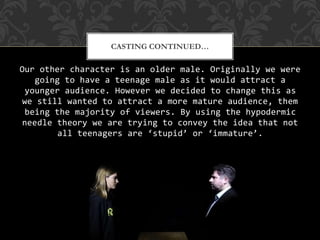
Our other character is an older male. Originally we were
going to have a teenage male as it would attract a
younger audience. However we decided to change this as
we still wanted to attract a more mature audience, them
being the majority of viewers. By using the hypodermic
needle theory we are trying to convey the idea that not
all teenagers are ‘stupid’ or ‘immature’.
CASTING CONTINUED…
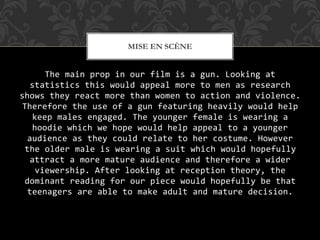
The main prop in our film is a gun. Looking at
statistics this would appeal more to men as research
shows they react more than women to action and violence.
Therefore the use of a gun featuring heavily would help
keep males engaged. The younger female is wearing a
hoodie which we hope would help appeal to a younger
audience as they could relate to her costume. However
the older male is wearing a suit which would hopefully
attract a more mature audience and therefore a wider
viewership. After looking at reception theory, the
dominant reading for our piece would hopefully be that
teenagers are able to make adult and mature decision.
MISE EN SCÈNE
In our piece we used a lot of common codes and
conventions. By doing this our audience and common
viewers of psychological thrillers would recognise this
and therefore be more inclined to watch it. For example
we used the Barthes theory of hermeneutic codes (meaning
the audience asks questions). We also used white
typography on a black background, another common
convention of this genre. However we do challenge some
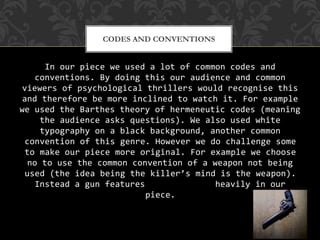
to make our piece more original. For example we choose
no to use the common convention of a weapon not being
used (the idea being the killer’s mind is the weapon).
Instead a gun features heavily in our
piece.
CODES AND CONVENTIONS

Q4 and 5

  • 1.
    Marcia Rumsey WHO WOULDBE THE AUDIENCE FOR YOUR MEDIA PRODUCT AND HOW DID YOU ATTRACT/ADDRESS YOUR AUDIENCE? attract/address your audience?
  • 2.
    Looking at statisticsI found that the majority of people that watch films are an older audience with 60% being female. However we decided that our target audience although mainstream is late teens to middle-aged. By it being targeted at a mainstream audience we are also more likely to make a large profit. Also as it is aimed at a younger audience than usual we could use social media to advertise which is cheap therefore further increasing our profit. TARGET AUDIENCE
  • 3.
    Uses and gratificationtheory originally arose in the 1940s but has been changed since then in the 1970s and 80s. The theory is about why and how people actively seek out specific media and is positivistic in it’s approach. It assumes that audience members are not passive consumers of media but actually have an active role in interpreting and integrating media into their own lives. For example for our opening people who regularly watch psychological thrillers make seek out our film as it is a genre that they are familiar with. USES AND GRATIFICATION THEORY
  • 4.
    Our main protagonistis a teenage female. We choose to cast a younger person as the protagonist so we appealed to a younger audience. We also cast a female as we wouldn’t to go against the common convention of a male lead. Another reason we cast a women is because the majority of viewers of psychological thrillers are female and therefore we would attract them. After looking at how Mulvey said about how media is controlled by men and therefore women are presented as men see them we wanted to go against this. Therefore we tried to present her as a pluralistic view of a teenager. CASTING
  • 5.
    Our other characteris an older male. Originally we were going to have a teenage male as it would attract a younger audience. However we decided to change this as we still wanted to attract a more mature audience, them being the majority of viewers. By using the hypodermic needle theory we are trying to convey the idea that not all teenagers are ‘stupid’ or ‘immature’. CASTING CONTINUED…
  • 6.
    The main propin our film is a gun. Looking at statistics this would appeal more to men as research shows they react more than women to action and violence. Therefore the use of a gun featuring heavily would help keep males engaged. The younger female is wearing a hoodie which we hope would help appeal to a younger audience as they could relate to her costume. However the older male is wearing a suit which would hopefully attract a more mature audience and therefore a wider viewership. After looking at reception theory, the dominant reading for our piece would hopefully be that teenagers are able to make adult and mature decision. MISE EN SCÈNE
  • 7.
    In our piecewe used a lot of common codes and conventions. By doing this our audience and common viewers of psychological thrillers would recognise this and therefore be more inclined to watch it. For example we used the Barthes theory of hermeneutic codes (meaning the audience asks questions). We also used white typography on a black background, another common convention of this genre. However we do challenge some to make our piece more original. For example we choose no to use the common convention of a weapon not being used (the idea being the killer’s mind is the weapon). Instead a gun features heavily in our piece. CODES AND CONVENTIONS