Q2 2012 Global Digital
Advertising Update


Adobe® Digital Index
Adobe Digital Index Report


                             Q2 2012 Global Digital Advertising Update

Table of contents
                             Executive summary
1: Executive summary
2: Overall search trends     During Q2 2012 paid search continued to grow across industries. Spend grew by double digits
4: Search by device type     and ROI improved, driven by lower CPC rates. Bing/Yahoo’s share of click volume shifted up
6: Facebook update           slightly from Q1, and its share of overall search spend grew one percent year over year while
  Forecast for Q3-Q4 2012    Google’s share fell one percent.
  Implications
7: Methodology               As in Q1 2012, Q2 spend on tablet devices was particularly effective, generating higher conversion
                             rates and ROI than spend on PCs and smartphones. Additionally, changes to Facebook’s
                             platform generated a significant 338% increase in engagement, suggesting brands are
                             finding additional value in social media.

                             For digital marketers and advertisers, these findings have three implications:
                               • Search, especially on mobile devices, should continue to be a major part of the marketing
                                 mix given growth in mobile device use and attractive ROI.
                               •	 However, marketers can drive higher returns by optimizing spend across devices; search
                                  spend on tablets offers the most attractive opportunities.
                               •	 Brands should adjust spending on Facebook to benefit from improvements to the
                                  Facebook platform.
Overall search trends
In Q2 2012, search continued to grow in the U.S., U.K., and Germany. Growth continued in
these countries despite economic uncertainty, demonstrating the stability and importance
of search for digital marketers. Increases in ROI continue to drive this growth trend. As in Q1
2012, healthy room for additional growth in spending exists.1 Additionally, increased traffic
across mobile devices shifted search spend to smartphones and tablets, changing CPCs,
especially for Google.

Spend and ROI—Figures 1 and 2 show that U.S. search spend grew 13% over the prior year while
ROI improved by 23%. Search spend in the U.K. and Germany grew 18% and 12% year over year,
respectively. Spend share for Google and Bing/Yahoo were roughly flat over the prior quarter; Bing/
Yahoo increased share 1% year over year, while Google’s share declined 1%.


                           U.K. up 18% YoY                                                      Germany
                                                                                                down 5% YoY
                   U.S. up 13% YoY                                                                                 U.K. up
                                                                                        U.S. up 23% YoY
                                                                                                                   5% YoY


                                                    Indexed at 100%
   100%
                   Germany up 12% YoY

   Q2/11   Q3/11    Q4/1     Q1/12   Q2/12         Q2/11                 Q3/11      Q4/1        Q1/12      Q2/12


Figure 1—Spend by country	                     Figure 2—ROI by country


Click volume and cost per click (CPC)—Click volume on Google dropped slightly compared to the
prior quarter, but increased 32% year over year, as shown in Figure 3. Bing/Yahoo click volume
surged from the first quarter, ending at a 26% increase year over year. This surge in Bing/Yahoo’s
click volume may be due to algorithmic changes and lower CPCs, as Bing/Yahoo regained market
share lost to Google in the prior two quarters. By the end of Q2, market click volume share for
Google and Bing/Yahoo were 81.5% and 18.5%, respectively, as shown in Figure 4.


                     Google up 32% YoY
                                                                      Q3                    Q4                 Bing/Yahoo
                                                                                                               Google
                                                                      2011                   2011


   100%
               Bing/Yahoo up 26% YoY

                                                                                 Q1                     Q2
   Q2/11   Q3/11    Q4/1     Q1/12   Q2/12                                       2012                   2012


Figure 3—Click volume by search engine, U.S.    Figure 4—Click volume by search engine, U.S.


                                                                                                    Adobe Digital Index Report 2
Figure 5 shows that CPCs on Google continued to decrease, falling slightly over the prior quarter to
end 13 percentage points down year over year, while Bing/Yahoo CPCs decreased from the prior
quarter to end flat year over year. We attribute the decrease in overall Google CPCs to an increase in
share of mobile clicks – where CPCs are less expensive. The decrease in Bing/Yahoo CPCs is
attributed to changes in the finance sector, where CPCs dropped considerably over the prior quarter. 2

Figure 6 shows that in the U.K., click volume was flat compared to Q1 and increased 21% year over
year, while CPCs edged down 1% for the quarter, declining 11% year over year over year. Germany
click volume increased 10 percentage points over the first quarter for growth of 32% year over year,
while CPCs fell 3% from the first quarter for a 14% year over year decline.


                                                                                        Clicks up 32% YoY


   100%                                   100%                              100%
                                                        CPC down 11% YoY                CPC down 14% YoY
          Google down 13% YoY

   Q2/11 Q3/11 Q4/1 Q1/12 Q2/12            Q2/11 Q3/11 Q4/1 Q1/12 Q2/12     Q2/11 Q3/11 Q4/1 Q1/12 Q2/12

  Search engine [U.S.]                    U.K.                             Germany


Figure 5—CPC, U.S.		                 Figure 6—Click volume and CPC, U.K. and Germany


Industry breakdown—Figure 7 show performance trends for the automobile, financial services, and
retail industries in the United States. The auto industry saw a robust increase in spend, up 28% year
over year, consistent with broader recovery in this industry. The financial services and retail
industries saw 5% and 14% increases in spend, respectively, year over year. ROI fell 9% year over
year for the automobile industry, but increased 50% and 25% in financial services and retail,
respectively. The decline in spend and increase in ROI over the prior quarter for financial services
results form more effective spend optimization. Growth in both search spend and ROI in financial
services and retail signals that these industries have additional opportunity for spending growth in
the coming quarters.


                 Spend up 28% YoY                       ROI up 9% YoY                      ROI up 50% YoY


    100%                                100%                               100%          Spend up 14% YoY
                                                       Spend up 5% YoY
                 ROI fell 9% YoY

    Q2/11 Q3/11 Q4/1 Q1/12 Q2/12        Q2/11 Q3/11 Q4/1 Q1/12 Q2/12        Q2/11 Q3/11 Q4/1 Q1/12 Q2/12

   Automobile [U.S.]                   Retail [U.S.]                       Financial Services [U.S.]


Figure 7—Spend and ROI by industry


                                                                                    Adobe Digital Index Report 3
Search by device type
While overall search spend increased year over year across PC, smartphone, and tablet
device types, conversion rates, CPCs, and ROI for these devices varied widely. Conversion
rates for tablet campaigns, relative to PC campaigns, rose over the past quarter, creating a
surge in tablet ROI despite the fact that tablet CPC remain below those of PCs. This
indicates that there are significant opportunities for marketers to drive higher ROI by
shifting spend to tablets, findings consistent with those in prior Adobe Digital Index reports
on the use of tablet devices and returns on tablet search spend.3

Conversion rates relative to PC desktops by device and industry—Figure 8 shows that across
industries, overall tablet conversion rates were approximately 20 percentage points higher than
those of PCs. Likewise, smartphone conversion rates were significantly lower across the board, with
overall conversion rates approximately 42 percentage points lower than PC conversion rates.


         120%
                            PC = 100%
                                                             122%                  PC = 100%


                                   58%                                                    62%


         Overall [U.S.]                                      Financial Services [U.S.]


          119%
                            PC = 100%
                                                             120%                  PC = 100%


                                    57%                                                   63%


         Retail [U.S.]                                       Overall [U.K. and Germany]


Figure 8—Conversion rates by device and industry


                                                                               Adobe Digital Index Report 4
CPC and ROI by device and vertical—As shown in Figure 9, overall smartphone and tablet CPCs in
the United States were 56% and 71% of CPCs for PCs, respectively. Both smartphone and tablet CPCs
were higher in the financial industry than in the retail. Because both smartphone CPCs and
conversion rates are significantly lower than those for PCs, overall smartphone ROI is similar to ROI
on PCs. In contrast, tablets have lower CPCs but higher conversion rates, increasing tablet ROI to
nearly 70% higher than that of PCs, as shown in Figure 10.


                      PC = 100%                            PC = 100%                       PC = 100%


       71%                               79%                               69%
                             56%                                  71%                            49%


      Overall [U.S]                     Financial [U.S.]                   Retail [U.S.]


Figure 9—CPC by device and industry


                            103%         155%                     88%                            116%
     168%                                                                 173%
                         PC = 100%                            PC = 100%                       PC = 100%


      Overall [U.S]                     Financial [U.S.]                   Retail [U.S.]


Figure 10—ROI by device and industry


                                                                             Adobe Digital Index Report 5
Facebook update
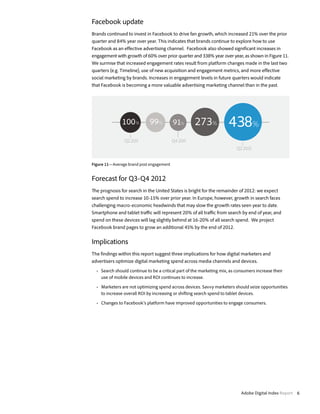
Brands continued to invest in Facebook to drive fan growth, which increased 21% over the prior
quarter and 84% year over year. This indicates that brands continue to explore how to use
Facebook as an effective advertising channel. Facebook also showed significant increases in
engagement with growth of 60% over prior quarter and 338% year over year, as shown in Figure 11.
We surmise that increased engagement rates result from platform changes made in the last two
quarters (e.g. Timeline), use of new acquisition and engagement metrics, and more effective
social marketing by brands. Increases in engagement levels in future quarters would indicate
that Facebook is becoming a more valuable advertising marketing channel than in the past.


               100 %         99%          91%        273%             438%
                Q2 2011                   Q4 2011
                                                                           Q2 2012


Figure 11—Average brand post engagement


Forecast for Q3-Q4 2012
The prognosis for search in the United States is bright for the remainder of 2012: we expect
search spend to increase 10-15% over prior year. In Europe, however, growth in search faces
challenging macro-economic headwinds that may slow the growth rates seen year to date.
Smartphone and tablet traffic will represent 20% of all traffic from search by end of year, and
spend on these devices will lag slightly behind at 16-20% of all search spend. We project
Facebook brand pages to grow an additional 45% by the end of 2012.


Implications
The findings within this report suggest three implications for how digital marketers and
advertisers optimize digital marketing spend across media channels and devices.
  •	 Search should continue to be a critical part of the marketing mix, as consumers increase their
     use of mobile devices and ROI continues to increase.

  •	 Marketers are not optimizing spend across devices. Savvy marketers should seize opportunities
     to increase overall ROI by increasing or shifting search spend to tablet devices.

  •	 Changes to Facebook’s platform have improved opportunities to engage consumers.


                                                                             Adobe Digital Index Report 6
Methodology
                             Our analysis of Facebook performance is based on index derived from data captured by Adobe
                             AdLens and Adobe® Social, which are part of the Adobe® Digital Marketing Suite. The index’s data
                             compromises over 250 billion impressions and activity of 46 million fans for 225 companies in the
                             automotive, CPG, financial services, media and entertainment, and retail industries.
                             Key terms in this report are defined as follows:
                                 •	 Cost per click (CPC)—The amount paid by a marketer per user click on a paid search ad. CPC
                                    is determined by an auctioning process and is a good indicator of market conditions. Increases
                                    in CPC indicate advertisers are willing to spend more on advertising, and decreases indicate
                                    that advertisers are willing to spend less.
                                 •	 Return on investment (ROI)—A measure of profitability based on how much a marketer receives
                                    in terms of results compared to how much is invested. Also known as a measure of efficiency.
                                 •	 Spend share—The amount of share that marketers spend buying keywords on a particular
                                    search engine as calculated by this formula: particular search engine spend/total search engine
                                    marketing spend.


                             About Adobe Digital Index
                             Adobe Digital Index publishes research on digital marketing and other topics of interest to senior
                             marketing and e-commerce executives across industries. Research is based on the analysis of select,
                             anonymous, and aggregated data from over 5,000 companies worldwide that use the Adobe Digital
                             Marketing Suite, powered by Adobe technology and solutions, to obtain real-time data and analysis
                             of activity on their websites.
                             For additional information about this report, contact Austin Bankhead, director, Adobe Digital Index,
                             at DigIndex@adobe.com.


                             About Adobe Digital Marketing Suite
                             Adobe® Digital Marketing Suite offers an integrated and open platform for online business
                             optimization, a strategy for using customer insight to drive innovation throughout the business and
                             enhance marketing efficiency. The Digital Marketing Suite consists of integrated applications to
                             collect and unleash the power of customer insight to optimize customer acquisition, conversion and
                             retention efforts, as well as the creation and distribution of content. For example, using the Digital
                             Marketing Suite, marketers can identify the most effective marketing strategies and ad placements as
                             well as create relevant, personalized, and consistent customer experiences across digital marketing
                             channels, such as onsite, display, email, social media, video, and mobile. The Digital Marketing Suite
                             enables marketers to make quick adjustments, automate certain customer interactions, and better
                             maximize marketing ROI, which, ultimately, can positively impact the bottom line.


                             1
                               Adobe® Digital Index, “Global Digital Advertising Update Q1 2012”, April 2012
                             2
                               Because CPCs in the financial sector tend to be much higher than average, fluctuations in CPCs typically have a significant impact
                             on the CPC average for the overall index.
                             3
                               See Adobe® Digital Index reports: “The Impact of Tablet Visitors on Retail Websites”, January 2012, “Global Digital Advertising
                             Update Q1 2012”, April 2012, and “How Tablets Are Catalyzing Brand Website Engagement”, May 2012.


                             Adobe and the Adobe logo are either registered trademarks or trademarks of Adobe Systems Incorporated in the United States and/or other countries. All
Adobe Systems Incorporated   other trademarks are the property of their respective owners.
345 Park Avenue
San Jose, CA 95110-2704      © 2012 Adobe Systems Incorporated. All rights reserved. Printed in the USA.
USA
www.adobe.com                7/12                                                                                                                                                     7

Q2 2012 Global Digital Advertising Update

  • 1.
    Q2 2012 GlobalDigital Advertising Update Adobe® Digital Index
  • 2.
    Adobe Digital IndexReport Q2 2012 Global Digital Advertising Update Table of contents Executive summary 1: Executive summary 2: Overall search trends During Q2 2012 paid search continued to grow across industries. Spend grew by double digits 4: Search by device type and ROI improved, driven by lower CPC rates. Bing/Yahoo’s share of click volume shifted up 6: Facebook update slightly from Q1, and its share of overall search spend grew one percent year over year while Forecast for Q3-Q4 2012 Google’s share fell one percent. Implications 7: Methodology As in Q1 2012, Q2 spend on tablet devices was particularly effective, generating higher conversion rates and ROI than spend on PCs and smartphones. Additionally, changes to Facebook’s platform generated a significant 338% increase in engagement, suggesting brands are finding additional value in social media. For digital marketers and advertisers, these findings have three implications: • Search, especially on mobile devices, should continue to be a major part of the marketing mix given growth in mobile device use and attractive ROI. • However, marketers can drive higher returns by optimizing spend across devices; search spend on tablets offers the most attractive opportunities. • Brands should adjust spending on Facebook to benefit from improvements to the Facebook platform.
  • 3.
    Overall search trends InQ2 2012, search continued to grow in the U.S., U.K., and Germany. Growth continued in these countries despite economic uncertainty, demonstrating the stability and importance of search for digital marketers. Increases in ROI continue to drive this growth trend. As in Q1 2012, healthy room for additional growth in spending exists.1 Additionally, increased traffic across mobile devices shifted search spend to smartphones and tablets, changing CPCs, especially for Google. Spend and ROI—Figures 1 and 2 show that U.S. search spend grew 13% over the prior year while ROI improved by 23%. Search spend in the U.K. and Germany grew 18% and 12% year over year, respectively. Spend share for Google and Bing/Yahoo were roughly flat over the prior quarter; Bing/ Yahoo increased share 1% year over year, while Google’s share declined 1%. U.K. up 18% YoY Germany down 5% YoY U.S. up 13% YoY U.K. up U.S. up 23% YoY 5% YoY Indexed at 100% 100% Germany up 12% YoY Q2/11 Q3/11 Q4/1 Q1/12 Q2/12 Q2/11 Q3/11 Q4/1 Q1/12 Q2/12 Figure 1—Spend by country Figure 2—ROI by country Click volume and cost per click (CPC)—Click volume on Google dropped slightly compared to the prior quarter, but increased 32% year over year, as shown in Figure 3. Bing/Yahoo click volume surged from the first quarter, ending at a 26% increase year over year. This surge in Bing/Yahoo’s click volume may be due to algorithmic changes and lower CPCs, as Bing/Yahoo regained market share lost to Google in the prior two quarters. By the end of Q2, market click volume share for Google and Bing/Yahoo were 81.5% and 18.5%, respectively, as shown in Figure 4. Google up 32% YoY Q3 Q4 Bing/Yahoo Google 2011 2011 100% Bing/Yahoo up 26% YoY Q1 Q2 Q2/11 Q3/11 Q4/1 Q1/12 Q2/12 2012 2012 Figure 3—Click volume by search engine, U.S. Figure 4—Click volume by search engine, U.S. Adobe Digital Index Report 2
  • 4.
    Figure 5 showsthat CPCs on Google continued to decrease, falling slightly over the prior quarter to end 13 percentage points down year over year, while Bing/Yahoo CPCs decreased from the prior quarter to end flat year over year. We attribute the decrease in overall Google CPCs to an increase in share of mobile clicks – where CPCs are less expensive. The decrease in Bing/Yahoo CPCs is attributed to changes in the finance sector, where CPCs dropped considerably over the prior quarter. 2 Figure 6 shows that in the U.K., click volume was flat compared to Q1 and increased 21% year over year, while CPCs edged down 1% for the quarter, declining 11% year over year over year. Germany click volume increased 10 percentage points over the first quarter for growth of 32% year over year, while CPCs fell 3% from the first quarter for a 14% year over year decline. Clicks up 32% YoY 100% 100% 100% CPC down 11% YoY CPC down 14% YoY Google down 13% YoY Q2/11 Q3/11 Q4/1 Q1/12 Q2/12 Q2/11 Q3/11 Q4/1 Q1/12 Q2/12 Q2/11 Q3/11 Q4/1 Q1/12 Q2/12 Search engine [U.S.] U.K. Germany Figure 5—CPC, U.S. Figure 6—Click volume and CPC, U.K. and Germany Industry breakdown—Figure 7 show performance trends for the automobile, financial services, and retail industries in the United States. The auto industry saw a robust increase in spend, up 28% year over year, consistent with broader recovery in this industry. The financial services and retail industries saw 5% and 14% increases in spend, respectively, year over year. ROI fell 9% year over year for the automobile industry, but increased 50% and 25% in financial services and retail, respectively. The decline in spend and increase in ROI over the prior quarter for financial services results form more effective spend optimization. Growth in both search spend and ROI in financial services and retail signals that these industries have additional opportunity for spending growth in the coming quarters. Spend up 28% YoY ROI up 9% YoY ROI up 50% YoY 100% 100% 100% Spend up 14% YoY Spend up 5% YoY ROI fell 9% YoY Q2/11 Q3/11 Q4/1 Q1/12 Q2/12 Q2/11 Q3/11 Q4/1 Q1/12 Q2/12 Q2/11 Q3/11 Q4/1 Q1/12 Q2/12 Automobile [U.S.] Retail [U.S.] Financial Services [U.S.] Figure 7—Spend and ROI by industry Adobe Digital Index Report 3
  • 5.
    Search by devicetype While overall search spend increased year over year across PC, smartphone, and tablet device types, conversion rates, CPCs, and ROI for these devices varied widely. Conversion rates for tablet campaigns, relative to PC campaigns, rose over the past quarter, creating a surge in tablet ROI despite the fact that tablet CPC remain below those of PCs. This indicates that there are significant opportunities for marketers to drive higher ROI by shifting spend to tablets, findings consistent with those in prior Adobe Digital Index reports on the use of tablet devices and returns on tablet search spend.3 Conversion rates relative to PC desktops by device and industry—Figure 8 shows that across industries, overall tablet conversion rates were approximately 20 percentage points higher than those of PCs. Likewise, smartphone conversion rates were significantly lower across the board, with overall conversion rates approximately 42 percentage points lower than PC conversion rates. 120% PC = 100% 122% PC = 100% 58% 62% Overall [U.S.] Financial Services [U.S.] 119% PC = 100% 120% PC = 100% 57% 63% Retail [U.S.] Overall [U.K. and Germany] Figure 8—Conversion rates by device and industry Adobe Digital Index Report 4
  • 6.
    CPC and ROIby device and vertical—As shown in Figure 9, overall smartphone and tablet CPCs in the United States were 56% and 71% of CPCs for PCs, respectively. Both smartphone and tablet CPCs were higher in the financial industry than in the retail. Because both smartphone CPCs and conversion rates are significantly lower than those for PCs, overall smartphone ROI is similar to ROI on PCs. In contrast, tablets have lower CPCs but higher conversion rates, increasing tablet ROI to nearly 70% higher than that of PCs, as shown in Figure 10. PC = 100% PC = 100% PC = 100% 71% 79% 69% 56% 71% 49% Overall [U.S] Financial [U.S.] Retail [U.S.] Figure 9—CPC by device and industry 103% 155% 88% 116% 168% 173% PC = 100% PC = 100% PC = 100% Overall [U.S] Financial [U.S.] Retail [U.S.] Figure 10—ROI by device and industry Adobe Digital Index Report 5
  • 7.
    Facebook update Brands continuedto invest in Facebook to drive fan growth, which increased 21% over the prior quarter and 84% year over year. This indicates that brands continue to explore how to use Facebook as an effective advertising channel. Facebook also showed significant increases in engagement with growth of 60% over prior quarter and 338% year over year, as shown in Figure 11. We surmise that increased engagement rates result from platform changes made in the last two quarters (e.g. Timeline), use of new acquisition and engagement metrics, and more effective social marketing by brands. Increases in engagement levels in future quarters would indicate that Facebook is becoming a more valuable advertising marketing channel than in the past. 100 % 99% 91% 273% 438% Q2 2011 Q4 2011 Q2 2012 Figure 11—Average brand post engagement Forecast for Q3-Q4 2012 The prognosis for search in the United States is bright for the remainder of 2012: we expect search spend to increase 10-15% over prior year. In Europe, however, growth in search faces challenging macro-economic headwinds that may slow the growth rates seen year to date. Smartphone and tablet traffic will represent 20% of all traffic from search by end of year, and spend on these devices will lag slightly behind at 16-20% of all search spend. We project Facebook brand pages to grow an additional 45% by the end of 2012. Implications The findings within this report suggest three implications for how digital marketers and advertisers optimize digital marketing spend across media channels and devices. • Search should continue to be a critical part of the marketing mix, as consumers increase their use of mobile devices and ROI continues to increase. • Marketers are not optimizing spend across devices. Savvy marketers should seize opportunities to increase overall ROI by increasing or shifting search spend to tablet devices. • Changes to Facebook’s platform have improved opportunities to engage consumers. Adobe Digital Index Report 6
  • 8.
    Methodology Our analysis of Facebook performance is based on index derived from data captured by Adobe AdLens and Adobe® Social, which are part of the Adobe® Digital Marketing Suite. The index’s data compromises over 250 billion impressions and activity of 46 million fans for 225 companies in the automotive, CPG, financial services, media and entertainment, and retail industries. Key terms in this report are defined as follows: • Cost per click (CPC)—The amount paid by a marketer per user click on a paid search ad. CPC is determined by an auctioning process and is a good indicator of market conditions. Increases in CPC indicate advertisers are willing to spend more on advertising, and decreases indicate that advertisers are willing to spend less. • Return on investment (ROI)—A measure of profitability based on how much a marketer receives in terms of results compared to how much is invested. Also known as a measure of efficiency. • Spend share—The amount of share that marketers spend buying keywords on a particular search engine as calculated by this formula: particular search engine spend/total search engine marketing spend. About Adobe Digital Index Adobe Digital Index publishes research on digital marketing and other topics of interest to senior marketing and e-commerce executives across industries. Research is based on the analysis of select, anonymous, and aggregated data from over 5,000 companies worldwide that use the Adobe Digital Marketing Suite, powered by Adobe technology and solutions, to obtain real-time data and analysis of activity on their websites. For additional information about this report, contact Austin Bankhead, director, Adobe Digital Index, at DigIndex@adobe.com. About Adobe Digital Marketing Suite Adobe® Digital Marketing Suite offers an integrated and open platform for online business optimization, a strategy for using customer insight to drive innovation throughout the business and enhance marketing efficiency. The Digital Marketing Suite consists of integrated applications to collect and unleash the power of customer insight to optimize customer acquisition, conversion and retention efforts, as well as the creation and distribution of content. For example, using the Digital Marketing Suite, marketers can identify the most effective marketing strategies and ad placements as well as create relevant, personalized, and consistent customer experiences across digital marketing channels, such as onsite, display, email, social media, video, and mobile. The Digital Marketing Suite enables marketers to make quick adjustments, automate certain customer interactions, and better maximize marketing ROI, which, ultimately, can positively impact the bottom line. 1 Adobe® Digital Index, “Global Digital Advertising Update Q1 2012”, April 2012 2 Because CPCs in the financial sector tend to be much higher than average, fluctuations in CPCs typically have a significant impact on the CPC average for the overall index. 3 See Adobe® Digital Index reports: “The Impact of Tablet Visitors on Retail Websites”, January 2012, “Global Digital Advertising Update Q1 2012”, April 2012, and “How Tablets Are Catalyzing Brand Website Engagement”, May 2012. Adobe and the Adobe logo are either registered trademarks or trademarks of Adobe Systems Incorporated in the United States and/or other countries. All Adobe Systems Incorporated other trademarks are the property of their respective owners. 345 Park Avenue San Jose, CA 95110-2704 © 2012 Adobe Systems Incorporated. All rights reserved. Printed in the USA. USA www.adobe.com 7/12 7