Python Datatypes
• Data types are the classification or
categorization of data items. It represents the
kind of value that tells what operations can be
performed on a particular data.
• A variable is created the moment you first
assign a value to it.
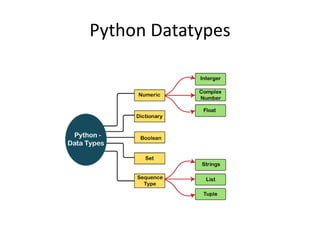
Python Datatypes
1.Int - Integer value can be any length such as
integers 10, 2, 29, -20, -150 etc.
Eg: a=5;
2. Float - Float is used to store floating-point
numbers like 1.9, 9.902, 15.2, etc.
3. complex - A complex number contains an
ordered pair, i.e., x + iy where x and y denote the
real and imaginary parts, respectively. The
complex numbers like 2.14j, 2.0 + 2.3j, etc.
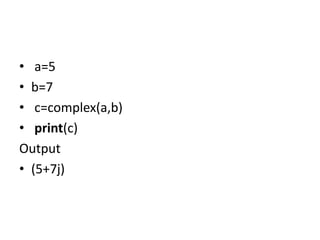
• a=5
• b=7
• c=complex(a,b)
• print(c)
Output
• (5+7j)
• Sequence Type
• The string can be defined as the sequence of
characters represented in the quotation
marks.
• Eg : str = "string value"
• List
• Python Lists are similar to arrays in C.
However, the list can contain data of different
types. The items stored in the list are
separated with a comma (,) and enclosed
within square brackets [].
• Eg: list1 = [1, "hi", "Python", 2]
• Tuple
• A tuple is similar to the list in many ways. Like
lists, tuples also contain the collection of the
items of different data types. The items are
separated with a comma (,) and enclosed in
parentheses ().
• A tuple is a read-only data structure as we can't
modify the size and value of the items of a tuple.
• Eg : tup = ("hi", "Python", 2)
• Dictionary
• Dictionary is an unordered set of a key-value
pair of items.
• The items in the dictionary are separated with
the comma (,) and enclosed in the curly braces
{}.
• Eg :
d = {1:'Jimmy', 2:'Alex', 3:'john', 4:'mike'}
• Boolean
• Python boolean type is one of the built-in data
types provided by Python, which represents one
of the two values i.e. True or False.
Eg:a = True
type(a)
Output
boolean
• Set
• Sets are used to store multiple items in a
single variable.
• A set is a collection which
is unordered, unchangeable*, and unindexed.
• sets cannot have multiple occurrences of the
same element
Eg: thisset = {"apple", "banana", "cherry"}

pythondatatypes.pptx

  • 1.
  • 2.
    • Data typesare the classification or categorization of data items. It represents the kind of value that tells what operations can be performed on a particular data. • A variable is created the moment you first assign a value to it.
  • 3.
  • 4.
    1.Int - Integervalue can be any length such as integers 10, 2, 29, -20, -150 etc. Eg: a=5; 2. Float - Float is used to store floating-point numbers like 1.9, 9.902, 15.2, etc. 3. complex - A complex number contains an ordered pair, i.e., x + iy where x and y denote the real and imaginary parts, respectively. The complex numbers like 2.14j, 2.0 + 2.3j, etc.
  • 5.
    • a=5 • b=7 •c=complex(a,b) • print(c) Output • (5+7j)
  • 6.
    • Sequence Type •The string can be defined as the sequence of characters represented in the quotation marks. • Eg : str = "string value"
  • 7.
    • List • PythonLists are similar to arrays in C. However, the list can contain data of different types. The items stored in the list are separated with a comma (,) and enclosed within square brackets []. • Eg: list1 = [1, "hi", "Python", 2]
  • 8.
    • Tuple • Atuple is similar to the list in many ways. Like lists, tuples also contain the collection of the items of different data types. The items are separated with a comma (,) and enclosed in parentheses (). • A tuple is a read-only data structure as we can't modify the size and value of the items of a tuple. • Eg : tup = ("hi", "Python", 2)
  • 9.
    • Dictionary • Dictionaryis an unordered set of a key-value pair of items. • The items in the dictionary are separated with the comma (,) and enclosed in the curly braces {}. • Eg : d = {1:'Jimmy', 2:'Alex', 3:'john', 4:'mike'}
  • 10.
    • Boolean • Pythonboolean type is one of the built-in data types provided by Python, which represents one of the two values i.e. True or False. Eg:a = True type(a) Output boolean
  • 11.
    • Set • Setsare used to store multiple items in a single variable. • A set is a collection which is unordered, unchangeable*, and unindexed. • sets cannot have multiple occurrences of the same element Eg: thisset = {"apple", "banana", "cherry"}