Python, WebRTC and You
Saúl Ibarra Corretgé

@saghul
v2
github.com/saghul
WebRTC, anyone?
Have you ever used it?
Internals, anyone?
What is WebRTC?
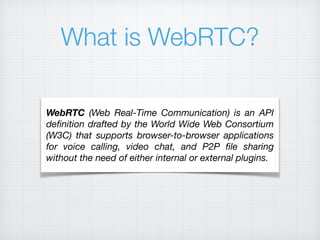
WebRTC (Web Real-Time Communication) is an API
definition drafted by the World Wide Web Consortium
(W3C) that supports browser-to-browser applications
for voice calling, video chat, and P2P file sharing
without the need of either internal or external plugins.
Well,
everyone
better
Restart
Their
Chrome
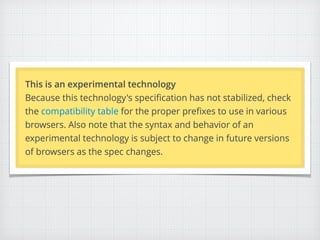
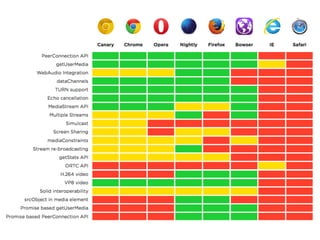
You need an adapter
Implementation in browsers is
currently inconsistent

Some APIs are still in flux
rtcninja.js
https://github.com/eface2face/rtcninja.js

Nice name, right?!
Temasys WebRTC
Plugin
Free (as in beer) plugin for IE and
Safari

http://skylink.io/plugin/
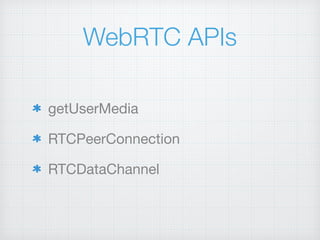
WebRTC APIs
getUserMedia

RTCPeerConnection

RTCDataChannel
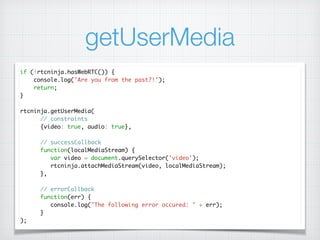
getUserMedia
if (!rtcninja.hasWebRTC()) {	
console.log('Are you from the past?!');	
return;	
}	
!
rtcninja.getUserMedia(	
// constraints	
{video: true, audio: true},	
!
// successCallback	
function(localMediaStream) {	
var video = document.querySelector('video');	
rtcninja.attachMediaStream(video, localMediaStream);	
},	
!
// errorCallback	
function(err) {	
console.log("The following error occured: " + err);	
}	
);
RTCPeerConnection
Handles streaming of media between
2 peers

Uses state of the art technology

JSEP
RTCPeerConnection (2)
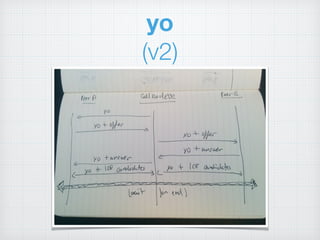
Get local media Send SDP offer
Get local media
Send SDP answer
ICE candidates
Audio / Video
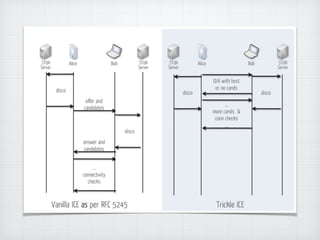
Interactive Connectivity Establishment
ICE
Helps find the best path for media

Solves NAT traversal and other
hostile network problems

Communication Consent Verification

It can trickle!
What about the
signalling?
It’s not specified!

Use SIP, XMPP or roll your own!
RTCDataChannel
P2P, message boundary based
channel for arbitrary data

Implemented using SCTP, different
reliability choices possible
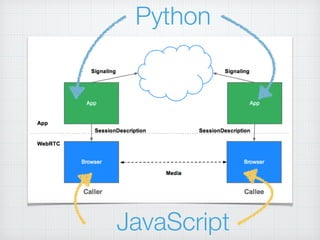
Call Roulette
Python
JavaScript
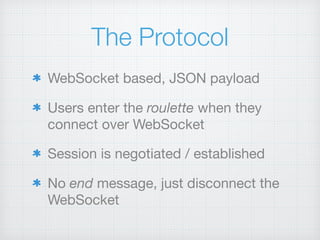
The Protocol
WebSocket based, JSON payload

Users enter the roulette when they
connect over WebSocket

Session is negotiated / established

No end message, just disconnect the
WebSocket
Saghul’s Imbecile Protocol
(v1)
yo
(v2)
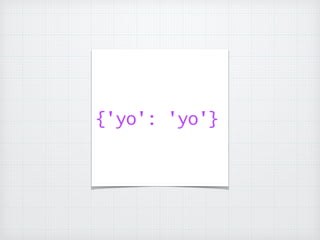
{'yo': 'yo'}
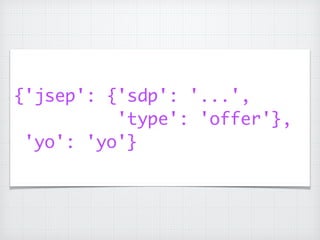
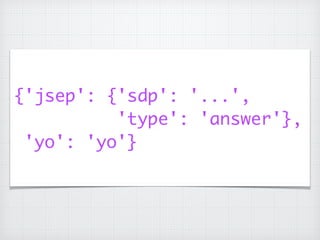
{'jsep': {'sdp': '...',	
'type': 'offer'},	
'yo': 'yo'}
{'jsep': {'sdp': '...',	
'type': 'answer'},	
'yo': 'yo'}
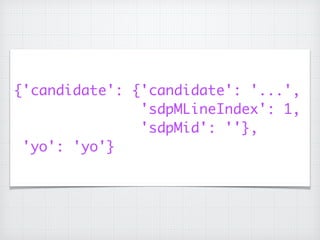
{'candidate': {'candidate': '...',	
'sdpMLineIndex': 1,	
'sdpMid': ''},	
'yo': 'yo'}
Shopping for a
framework
Python >= 3.3, because future!

WebSocket support built-in

Async, because blocking is so 2001

New, because why not?
asyncio + aiohttp
github.com/saghul/CallRoulette
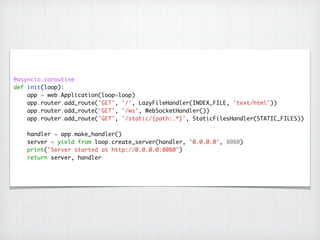
@asyncio.coroutine	
def init(loop):	
app = web.Application(loop=loop)	
app.router.add_route('GET', '/', LazyFileHandler(INDEX_FILE, 'text/html'))	
app.router.add_route('GET', '/ws', WebSocketHandler())	
app.router.add_route('GET', '/static/{path:.*}', StaticFilesHandler(STATIC_FILES))	
!
handler = app.make_handler()	
server = yield from loop.create_server(handler, '0.0.0.0', 8080)	
print("Server started at http://0.0.0.0:8080")	
return server, handler
class StaticFilesHandler:	
def __init__(self, base_path):	
self.base_path = base_path	
self.cache = {}	
!
@asyncio.coroutine	
def __call__(self, request):	
path = request.match_info['path']	
try:	
data, content_type = self.cache[path]	
except KeyError:	
full_path = os.path.join(self.base_path, path)	
try:	
with open(full_path, 'rb') as f:	
content_type, encoding = mimetypes.guess_type(full_path,	
strict=False)	
data = f.read()	
except IOError:	
log.warning('Could not open %s file' % path)	
raise web.HTTPNotFound()	
self.cache[path] = data, content_type	
log.debug('Loaded file %s (%s)' % (path, content_type))	
return web.Response(body=data, content_type=content_type)
class WebSocketHandler:	
def __init__(self):	
self.waiter = None	
!
@asyncio.coroutine	
def __call__(self, request):	
ws = web.WebSocketResponse(protocols=('callroulette-v2',))	
ws.start(request)	
!
conn = Connection(ws)	
if self.waiter is None:	
self.waiter = asyncio.Future(loop=ws._loop)	
fs = [conn.read(), self.waiter]	
done, pending = yield from asyncio.wait(fs, return_when=asyncio.FIRST_COMPLETED)	
if self.waiter not in done:	
# the connection was most likely closed	
self.waiter = None	
return ws	
other = self.waiter.result()	
self.waiter = None	
reading_task = pending.pop()

reading_task.cancel()	
asyncio.async(self.run_roulette(conn, other))	
else:	
self.waiter.set_result(conn)	
!
yield from conn.wait_closed()	
!
return ws
from jsonmodels import models, fields	
from jsonmodels.errors import ValidationError	
!
!
class StringChoiceField(fields.StringField):	
def __init__(self, choices=None, *args, **kw):	
self.choices = choices or []	
super(StringChoiceField, self).__init__(*args, **kw)	
!
def validate(self, value):	
if value not in self.choices:	
raise ValidationError('invalid choice value')	
super(StringChoiceField, self).validate(value)	
!
class Jsep(models.Base):	
type = StringChoiceField(choices=['offer', 'answer'], required=True)	
sdp = fields.StringField(required=True)	
!
class Candidate(models.Base):	
candidate = fields.StringField(required=True)	
sdpMid = fields.StringField(required=True)	
sdpMLineIndex = fields.IntField(required=True)	
!
class YoPayload(models.Base):	
yo = fields.StringField(required=True)	
jsep = fields.EmbeddedField(Jsep)	
candidate = fields.EmbeddedField(Candidate)
@asyncio.coroutine	
def run_roulette(self, peerA, peerB):	
log.info('Running roulette: %s, %s' % (peerA, peerB))	
!
@asyncio.coroutine	
def close_connections():	
yield from asyncio.wait([peerA.close(), peerB.close()],

return_when=asyncio.ALL_COMPLETED)	
!
def parse(data):	
try:	
data = json.loads(data)	
payload = YoPayload(**data)	
payload.validate()	
except Exception as e:	
log.warning('Error parsing payload: %s' % e)	
return None	
return payload
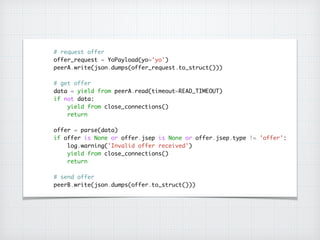
# request offer	
offer_request = YoPayload(yo='yo')	
peerA.write(json.dumps(offer_request.to_struct()))	
!
# get offer	
data = yield from peerA.read(timeout=READ_TIMEOUT)	
if not data:	
yield from close_connections()	
return	
!
offer = parse(data)	
if offer is None or offer.jsep is None or offer.jsep.type != 'offer':	
log.warning('Invalid offer received')	
yield from close_connections()	
return	
!
# send offer	
peerB.write(json.dumps(offer.to_struct()))
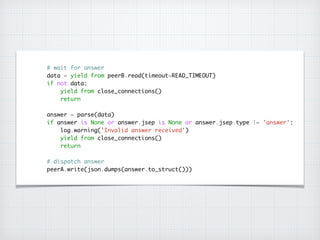
# wait for answer	
data = yield from peerB.read(timeout=READ_TIMEOUT)	
if not data:	
yield from close_connections()	
return	
!
answer = parse(data)	
if answer is None or answer.jsep is None or answer.jsep.type != 'answer':	
log.warning('Invalid answer received')	
yield from close_connections()	
return	
!
# dispatch answer	
peerA.write(json.dumps(answer.to_struct()))
# wait for candidates / end	
while True:	
peer_a_read = asyncio.async(peerA.read())	
peer_a_read.other_peer = peerB	
peer_b_read = asyncio.async(peerB.read())	
peer_b_read.other_peer = peerA	
done, pending = yield from asyncio.wait([peer_a_read, peer_b_read],	
return_when=asyncio.FIRST_COMPLETED)	
for task in pending:	
task.cancel()	
for task in done:	
data = task.result()	
if not data:	
break	
# all we can get at this point is trickled ICE candidates	
candidate = parse(data)	
if candidate is None or candidate.candidate is None:	
log.warning('Invalid candidate received!')	
break	
task.other_peer.write(json.dumps(candidate.to_struct()))	
else:	
continue	
break	
# close connections	
yield from close_connections()
In WebRTC trouble?
bettercallsaghul.com
@saghul

Python, WebRTC and You (v2)

  • 1.
    Python, WebRTC andYou Saúl Ibarra Corretgé
 @saghul v2
  • 2.
  • 3.
  • 4.
    Have you everused it?
  • 5.
  • 6.
    What is WebRTC? WebRTC(Web Real-Time Communication) is an API definition drafted by the World Wide Web Consortium (W3C) that supports browser-to-browser applications for voice calling, video chat, and P2P file sharing without the need of either internal or external plugins.
  • 10.
  • 11.
    You need anadapter Implementation in browsers is currently inconsistent Some APIs are still in flux
  • 12.
  • 13.
    Temasys WebRTC Plugin Free (asin beer) plugin for IE and Safari http://skylink.io/plugin/
  • 14.
  • 15.
    getUserMedia if (!rtcninja.hasWebRTC()) { console.log('Areyou from the past?!'); return; } ! rtcninja.getUserMedia( // constraints {video: true, audio: true}, ! // successCallback function(localMediaStream) { var video = document.querySelector('video'); rtcninja.attachMediaStream(video, localMediaStream); }, ! // errorCallback function(err) { console.log("The following error occured: " + err); } );
  • 17.
    RTCPeerConnection Handles streaming ofmedia between 2 peers Uses state of the art technology JSEP
  • 18.
    RTCPeerConnection (2) Get localmedia Send SDP offer Get local media Send SDP answer ICE candidates Audio / Video
  • 19.
  • 20.
    ICE Helps find thebest path for media Solves NAT traversal and other hostile network problems Communication Consent Verification It can trickle!
  • 22.
    What about the signalling? It’snot specified! Use SIP, XMPP or roll your own!
  • 25.
    RTCDataChannel P2P, message boundarybased channel for arbitrary data Implemented using SCTP, different reliability choices possible
  • 27.
  • 28.
  • 29.
    The Protocol WebSocket based,JSON payload Users enter the roulette when they connect over WebSocket Session is negotiated / established No end message, just disconnect the WebSocket
  • 30.
  • 31.
  • 32.
  • 33.
    {'jsep': {'sdp': '...', 'type':'offer'}, 'yo': 'yo'}
  • 34.
    {'jsep': {'sdp': '...', 'type':'answer'}, 'yo': 'yo'}
  • 35.
  • 37.
    Shopping for a framework Python>= 3.3, because future! WebSocket support built-in Async, because blocking is so 2001 New, because why not?
  • 38.
  • 39.
  • 40.
    @asyncio.coroutine def init(loop): app =web.Application(loop=loop) app.router.add_route('GET', '/', LazyFileHandler(INDEX_FILE, 'text/html')) app.router.add_route('GET', '/ws', WebSocketHandler()) app.router.add_route('GET', '/static/{path:.*}', StaticFilesHandler(STATIC_FILES)) ! handler = app.make_handler() server = yield from loop.create_server(handler, '0.0.0.0', 8080) print("Server started at http://0.0.0.0:8080") return server, handler
  • 41.
    class StaticFilesHandler: def __init__(self,base_path): self.base_path = base_path self.cache = {} ! @asyncio.coroutine def __call__(self, request): path = request.match_info['path'] try: data, content_type = self.cache[path] except KeyError: full_path = os.path.join(self.base_path, path) try: with open(full_path, 'rb') as f: content_type, encoding = mimetypes.guess_type(full_path, strict=False) data = f.read() except IOError: log.warning('Could not open %s file' % path) raise web.HTTPNotFound() self.cache[path] = data, content_type log.debug('Loaded file %s (%s)' % (path, content_type)) return web.Response(body=data, content_type=content_type)
  • 42.
    class WebSocketHandler: def __init__(self): self.waiter= None ! @asyncio.coroutine def __call__(self, request): ws = web.WebSocketResponse(protocols=('callroulette-v2',)) ws.start(request) ! conn = Connection(ws) if self.waiter is None: self.waiter = asyncio.Future(loop=ws._loop) fs = [conn.read(), self.waiter] done, pending = yield from asyncio.wait(fs, return_when=asyncio.FIRST_COMPLETED) if self.waiter not in done: # the connection was most likely closed self.waiter = None return ws other = self.waiter.result() self.waiter = None reading_task = pending.pop()
 reading_task.cancel() asyncio.async(self.run_roulette(conn, other)) else: self.waiter.set_result(conn) ! yield from conn.wait_closed() ! return ws
  • 43.
    from jsonmodels importmodels, fields from jsonmodels.errors import ValidationError ! ! class StringChoiceField(fields.StringField): def __init__(self, choices=None, *args, **kw): self.choices = choices or [] super(StringChoiceField, self).__init__(*args, **kw) ! def validate(self, value): if value not in self.choices: raise ValidationError('invalid choice value') super(StringChoiceField, self).validate(value) ! class Jsep(models.Base): type = StringChoiceField(choices=['offer', 'answer'], required=True) sdp = fields.StringField(required=True) ! class Candidate(models.Base): candidate = fields.StringField(required=True) sdpMid = fields.StringField(required=True) sdpMLineIndex = fields.IntField(required=True) ! class YoPayload(models.Base): yo = fields.StringField(required=True) jsep = fields.EmbeddedField(Jsep) candidate = fields.EmbeddedField(Candidate)
  • 44.
    @asyncio.coroutine def run_roulette(self, peerA,peerB): log.info('Running roulette: %s, %s' % (peerA, peerB)) ! @asyncio.coroutine def close_connections(): yield from asyncio.wait([peerA.close(), peerB.close()],
 return_when=asyncio.ALL_COMPLETED) ! def parse(data): try: data = json.loads(data) payload = YoPayload(**data) payload.validate() except Exception as e: log.warning('Error parsing payload: %s' % e) return None return payload
  • 45.
    # request offer offer_request= YoPayload(yo='yo') peerA.write(json.dumps(offer_request.to_struct())) ! # get offer data = yield from peerA.read(timeout=READ_TIMEOUT) if not data: yield from close_connections() return ! offer = parse(data) if offer is None or offer.jsep is None or offer.jsep.type != 'offer': log.warning('Invalid offer received') yield from close_connections() return ! # send offer peerB.write(json.dumps(offer.to_struct()))
  • 46.
    # wait foranswer data = yield from peerB.read(timeout=READ_TIMEOUT) if not data: yield from close_connections() return ! answer = parse(data) if answer is None or answer.jsep is None or answer.jsep.type != 'answer': log.warning('Invalid answer received') yield from close_connections() return ! # dispatch answer peerA.write(json.dumps(answer.to_struct()))
  • 47.
    # wait forcandidates / end while True: peer_a_read = asyncio.async(peerA.read()) peer_a_read.other_peer = peerB peer_b_read = asyncio.async(peerB.read()) peer_b_read.other_peer = peerA done, pending = yield from asyncio.wait([peer_a_read, peer_b_read], return_when=asyncio.FIRST_COMPLETED) for task in pending: task.cancel() for task in done: data = task.result() if not data: break # all we can get at this point is trickled ICE candidates candidate = parse(data) if candidate is None or candidate.candidate is None: log.warning('Invalid candidate received!') break task.other_peer.write(json.dumps(candidate.to_struct())) else: continue break # close connections yield from close_connections()
  • 49.