Copyright © 2013, Oracle and/or its affiliates. All rights reserved. Insert Information Protection Policy Classification from Slide 131
Copyright © 2013, Oracle and/or its affiliates. All rights reserved. Insert Information Protection Policy Classification from Slide 132
Building WebSocket Apps
in Java using JSR 356
Arun Gupta
blogs.oracle.com/arungupta, @arungupta
Copyright © 2013, Oracle and/or its affiliates. All rights reserved. Insert Information Protection Policy Classification from Slide 133
The preceding is intended to outline our general product direction. It is intended
for information purposes only, and may not be incorporated into any contract.
It is not a commitment to deliver any material, code, or functionality, and should
not be relied upon in making purchasing decisions. The development, release,
and timing of any features or functionality described for Oracle s products
remains at the sole discretion of Oracle.
Copyright © 2013, Oracle and/or its affiliates. All rights reserved. Insert Information Protection Policy Classification from Slide 134
Agenda
§  Primer on WebSocket
§  JSR 356: Java API for WebSocket
Copyright © 2013, Oracle and/or its affiliates. All rights reserved. Insert Information Protection Policy Classification from Slide 135
Interactive Web Sites
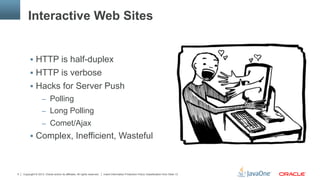
§  HTTP is half-duplex
§  HTTP is verbose
§  Hacks for Server Push
–  Polling
–  Long Polling
–  Comet/Ajax
§  Complex, Inefficient, Wasteful
Copyright © 2013, Oracle and/or its affiliates. All rights reserved. Insert Information Protection Policy Classification from Slide 136
WebSocket to the Rescue
§  TCP based, bi-directional, full-duplex messaging
§  Originally proposed as part of HTML5
§  IETF-defined Protocol: RFC 6455
–  Handshake
–  Data Transfer
§  W3C defined JavaScript API
–  Candidate Recommendation
Copyright © 2013, Oracle and/or its affiliates. All rights reserved. Insert Information Protection Policy Classification from Slide 137
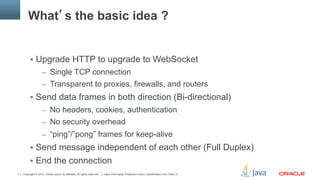
What’s the basic idea ?
§  Upgrade HTTP to upgrade to WebSocket
–  Single TCP connection
–  Transparent to proxies, firewalls, and routers
§  Send data frames in both direction (Bi-directional)
–  No headers, cookies, authentication
–  No security overhead
–  “ping”/”pong” frames for keep-alive
§  Send message independent of each other (Full Duplex)
§  End the connection
Copyright © 2013, Oracle and/or its affiliates. All rights reserved. Insert Information Protection Policy Classification from Slide 138
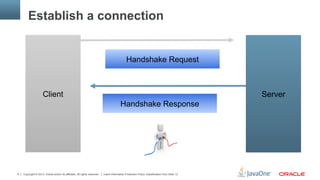
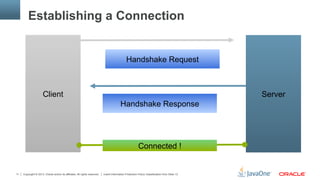
Establish a connection
Client
Handshake Request
Handshake Response
Server
Copyright © 2013, Oracle and/or its affiliates. All rights reserved. Insert Information Protection Policy Classification from Slide 139
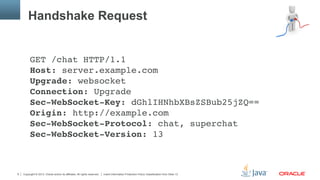
Handshake Request
GET /chat HTTP/1.1

Host: server.example.com

Upgrade: websocket

Connection: Upgrade

Sec-WebSocket-Key: dGhlIHNhbXBsZSBub25jZQ==

Origin: http://example.com

Sec-WebSocket-Protocol: chat, superchat

Sec-WebSocket-Version: 13 "
Copyright © 2013, Oracle and/or its affiliates. All rights reserved. Insert Information Protection Policy Classification from Slide 1310
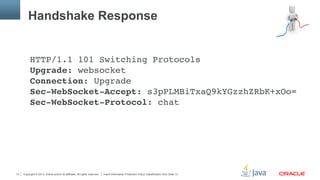
Handshake Response
HTTP/1.1 101 Switching Protocols

Upgrade: websocket

Connection: Upgrade

Sec-WebSocket-Accept: s3pPLMBiTxaQ9kYGzzhZRbK+xOo=

Sec-WebSocket-Protocol: chat "
Copyright © 2013, Oracle and/or its affiliates. All rights reserved. Insert Information Protection Policy Classification from Slide 1311
ServerClient
Handshake Request
Handshake Response
Connected !
Establishing a Connection
Copyright © 2013, Oracle and/or its affiliates. All rights reserved. Insert Information Protection Policy Classification from Slide 1312
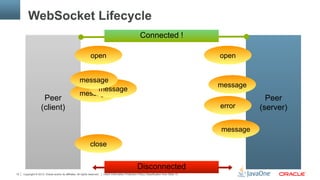
Peer
(server)
Peer
(client)
Connected !
open open
close
message
error
message
message
message
message
Disconnected
WebSocket Lifecycle
Copyright © 2013, Oracle and/or its affiliates. All rights reserved. Insert Information Protection Policy Classification from Slide 1313
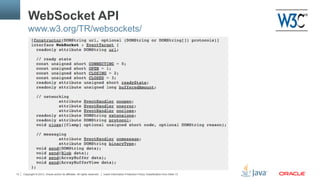
WebSocket API
www.w3.org/TR/websockets/
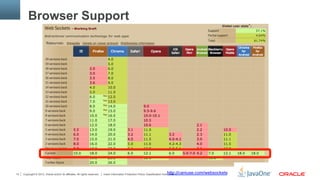
Copyright © 2013, Oracle and/or its affiliates. All rights reserved. Insert Information Protection Policy Classification from Slide 1314 http://caniuse.com/websockets
Browser Support
Copyright © 2013, Oracle and/or its affiliates. All rights reserved. Insert Information Protection Policy Classification from Slide 1315
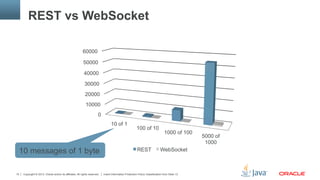
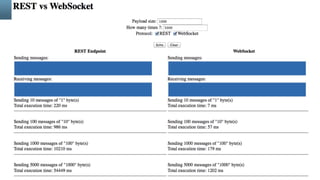
REST vs WebSocket
0
10000
20000
30000
40000
50000
60000
10 of 1
100 of 10
1000 of 100
5000 of
1000
REST WebSocket10 messages of 1 byte
Copyright © 2013, Oracle and/or its affiliates. All rights reserved. Insert Information Protection Policy Classification from Slide 1316
Copyright © 2013, Oracle and/or its affiliates. All rights reserved. Insert Information Protection Policy Classification from Slide 1317
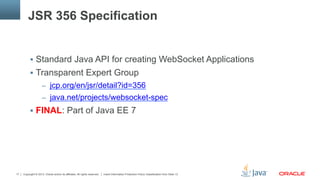
JSR 356 Specification
§  Standard Java API for creating WebSocket Applications
§  Transparent Expert Group
–  jcp.org/en/jsr/detail?id=356
–  java.net/projects/websocket-spec
§  FINAL: Part of Java EE 7
Copyright © 2013, Oracle and/or its affiliates. All rights reserved. Insert Information Protection Policy Classification from Slide 1318
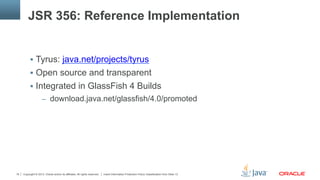
JSR 356: Reference Implementation
§  Tyrus: java.net/projects/tyrus
§  Open source and transparent
§  Integrated in GlassFish 4 Builds
–  download.java.net/glassfish/4.0/promoted
Copyright © 2013, Oracle and/or its affiliates. All rights reserved. Insert Information Protection Policy Classification from Slide 1319
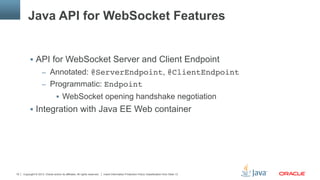
Java API for WebSocket Features
§  API for WebSocket Server and Client Endpoint
–  Annotated: @ServerEndpoint, @ClientEndpoint"
–  Programmatic: Endpoint
§  WebSocket opening handshake negotiation
§  Integration with Java EE Web container
Copyright © 2013, Oracle and/or its affiliates. All rights reserved. Insert Information Protection Policy Classification from Slide 1320
Hello World and Basics
POJO
Copyright © 2013, Oracle and/or its affiliates. All rights reserved. Insert Information Protection Policy Classification from Slide 1321
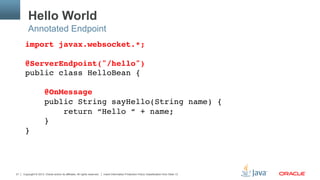
Hello World
Annotated Endpoint
import javax.websocket.*;


@ServerEndpoint("/hello")

public class HelloBean {


@OnMessage

public String sayHello(String name) {

return “Hello “ + name;

}

}"
Copyright © 2013, Oracle and/or its affiliates. All rights reserved. Insert Information Protection Policy Classification from Slide 1322
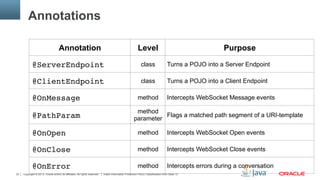
Annotations
Annotation Level Purpose
@ServerEndpoint" class Turns a POJO into a Server Endpoint
@ClientEndpoint" class Turns a POJO into a Client Endpoint
@OnMessage" method Intercepts WebSocket Message events
@PathParam"
method
parameter
Flags a matched path segment of a URI-template
@OnOpen" method Intercepts WebSocket Open events
@OnClose" method Intercepts WebSocket Close events
@OnError" method Intercepts errors during a conversation
Copyright © 2013, Oracle and/or its affiliates. All rights reserved. Insert Information Protection Policy Classification from Slide 1323
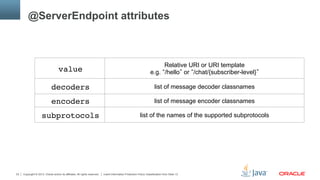
@ServerEndpoint attributes
value"
Relative URI or URI template
e.g. /hello or /chat/{subscriber-level}
decoders" list of message decoder classnames
encoders" list of message encoder classnames
subprotocols" list of the names of the supported subprotocols
Copyright © 2013, Oracle and/or its affiliates. All rights reserved. Insert Information Protection Policy Classification from Slide 1324
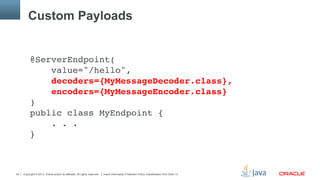
Custom Payloads
@ServerEndpoint(

value="/hello",

decoders={MyMessageDecoder.class},

encoders={MyMessageEncoder.class}

)

public class MyEndpoint {

. . .

}"
"
"
Copyright © 2013, Oracle and/or its affiliates. All rights reserved. Insert Information Protection Policy Classification from Slide 1325
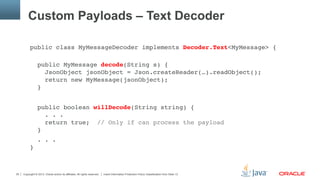
Custom Payloads – Text Decoder
public class MyMessageDecoder implements Decoder.Text<MyMessage> {"


public MyMessage decode(String s) {

JsonObject jsonObject = Json.createReader(…).readObject();

return new MyMessage(jsonObject);

}"
"
public boolean willDecode(String string) {

. . .

return true; // Only if can process the payload

}"
. . .

}"
Copyright © 2013, Oracle and/or its affiliates. All rights reserved. Insert Information Protection Policy Classification from Slide 1326
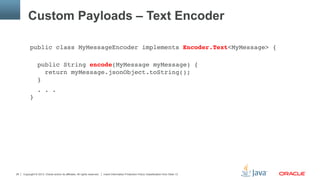
Custom Payloads – Text Encoder
public class MyMessageEncoder implements Encoder.Text<MyMessage> {"


public String encode(MyMessage myMessage) {

return myMessage.jsonObject.toString();

}"
. . .

}"
Copyright © 2013, Oracle and/or its affiliates. All rights reserved. Insert Information Protection Policy Classification from Slide 1327
Custom Payloads – Binary Decoder
public class MyMessageDecoder implements Decoder.Binary<MyMessage> {


public MyMessage decode(byte[] bytes) {

. . .

return myMessage;"
}"
public boolean willDecode(byte[] bytes) {

. . .

return true; // Only if can process the payload

}"
. . .

}"
Copyright © 2013, Oracle and/or its affiliates. All rights reserved. Insert Information Protection Policy Classification from Slide 1328
Which methods can be @OnMessage ?
§  Exactly one of the following
–  Text: String, Java primitive or equivalent class, String and boolean,
Reader, any type for which there is a decoder
–  Binary: byte[], ByteBuffer, byte[] and boolean, ByteBuffer and
boolean, InptuStream, any type for which there is a decoder
–  Pong messages: PongMessage"
§  An optional Session parameter
§  0..n String parameters annotated with @PathParam"
§  Return type: String, byte[], ByteBuffer, Java primitive or class
equivalent or any type for which there is a encoder
Copyright © 2013, Oracle and/or its affiliates. All rights reserved. Insert Information Protection Policy Classification from Slide 1329
Sample Messages
§  void m(String s);"
§  void m(Float f, @PathParam(“id”)int id);"
§  Product m(Reader reader, Session s);"
§  void m(byte[] b); or void m(ByteBuffer b);"
§  Book m(int i, Session s, @PathParam(“isbn”)String
isbn, @PathParam(“store”)String store);"
Copyright © 2013, Oracle and/or its affiliates. All rights reserved. Insert Information Protection Policy Classification from Slide 1330
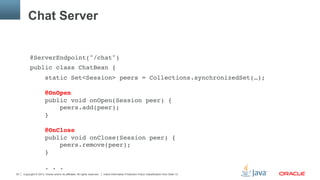
Chat Server
@ServerEndpoint("/chat")"
public class ChatBean {"
static Set<Session> peers = Collections.synchronizedSet(…);


@OnOpen

public void onOpen(Session peer) {

peers.add(peer);

}


@OnClose

public void onClose(Session peer) {

peers.remove(peer);

}


. . ."
Copyright © 2013, Oracle and/or its affiliates. All rights reserved. Insert Information Protection Policy Classification from Slide 1331
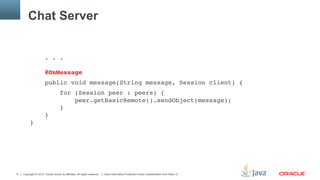
Chat Server
. . .


@OnMessage"
public void message(String message, Session client) {"
for (Session peer : peers) {

peer.getBasicRemote().sendObject(message);

}

}

}"
Copyright © 2013, Oracle and/or its affiliates. All rights reserved. Insert Information Protection Policy Classification from Slide 1332
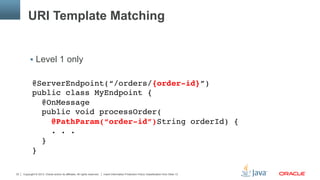
URI Template Matching
§  Level 1 only
@ServerEndpoint(“/orders/{order-id}”)

public class MyEndpoint {

@OnMessage

public void processOrder(

@PathParam(“order-id”)String orderId) {

. . .

}

}
Copyright © 2013, Oracle and/or its affiliates. All rights reserved. Insert Information Protection Policy Classification from Slide 1333
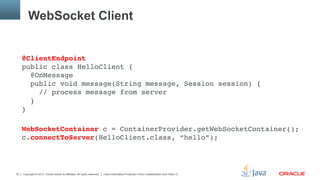
WebSocket Client
@ClientEndpoint

public class HelloClient {

@OnMessage

public void message(String message, Session session) {

// process message from server

}

}

"
WebSocketContainer c = ContainerProvider.getWebSocketContainer();

c.connectToServer(HelloClient.class, “hello”);"
"
Copyright © 2013, Oracle and/or its affiliates. All rights reserved. Insert Information Protection Policy Classification from Slide 1334
Hello World and Basics
Non-POJO
Copyright © 2013, Oracle and/or its affiliates. All rights reserved. Insert Information Protection Policy Classification from Slide 1335
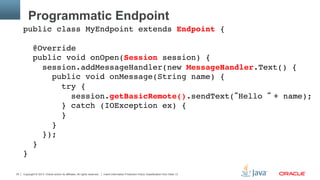
Programmatic Endpoint
public class MyEndpoint extends Endpoint {


@Override

public void onOpen(Session session) {

session.addMessageHandler(new MessageHandler.Text() {

public void onMessage(String name) {

try {

session.getBasicRemote().sendText(“Hello “ + name);

} catch (IOException ex) {

}

} 

});

}

}"
Copyright © 2013, Oracle and/or its affiliates. All rights reserved. Insert Information Protection Policy Classification from Slide 1336
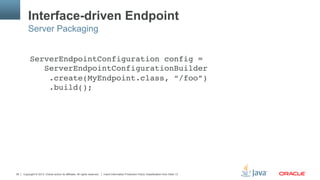
Interface-driven Endpoint
ServerEndpointConfiguration config =

ServerEndpointConfigurationBuilder

.create(MyEndpoint.class, “/foo”)

.build();"
Server Packaging
Copyright © 2013, Oracle and/or its affiliates. All rights reserved. Insert Information Protection Policy Classification from Slide 1337
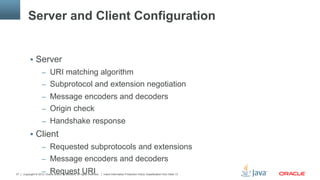
Server and Client Configuration
§  Server
–  URI matching algorithm
–  Subprotocol and extension negotiation
–  Message encoders and decoders
–  Origin check
–  Handshake response
§  Client
–  Requested subprotocols and extensions
–  Message encoders and decoders
–  Request URI
Copyright © 2013, Oracle and/or its affiliates. All rights reserved. Insert Information Protection Policy Classification from Slide 1338
Relationship with Dependency Injection
§  Full Dependency Injection support required in endpoints
–  Field, method, constructor injection
§  Interceptors permitted too
Copyright © 2013, Oracle and/or its affiliates. All rights reserved. Insert Information Protection Policy Classification from Slide 1339
Relationship with Servlet 3.1
§ Allows a portable way to upgrade HTTP request
§ New API
–  HttpServletRequest.upgrade(ProtocolHandler
handler)"
Copyright © 2013, Oracle and/or its affiliates. All rights reserved. Insert Information Protection Policy Classification from Slide 1340
Security
§  Authenticates using Servlet security mechanism during opening
handshake
–  Endpoint mapped by ws:// is protected using security model defined
using the corresponding http:// URI
§  Authorization defined using <security-constraint>"
–  TBD: Add/reuse security annotations
§  Transport Confidentiality using wss://"
–  Access allowed over encrypted connection only
Copyright © 2013, Oracle and/or its affiliates. All rights reserved. Insert Information Protection Policy Classification from Slide 1341
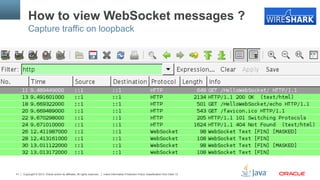
How to view WebSocket messages ?
Capture traffic on loopback
Copyright © 2013, Oracle and/or its affiliates. All rights reserved. Insert Information Protection Policy Classification from Slide 1342
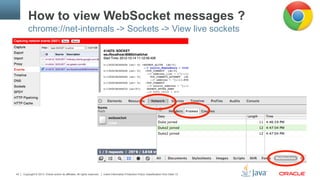
How to view WebSocket messages ?
chrome://net-internals -> Sockets -> View live sockets
Copyright © 2013, Oracle and/or its affiliates. All rights reserved. Insert Information Protection Policy Classification from Slide 1343
Resources
§  Specification
–  JSR: jcp.org/en/jsr/detail?id=356
–  Mailing Lists, JIRA, Archive: java.net/projects/websocket-spec
–  FINAL: Part of Java EE 7
§  Reference Implementation
–  Tyrus: java.net/projects/tyrus
–  Integrated in GlassFish 4 builds
Copyright © 2013, Oracle and/or its affiliates. All rights reserved. Insert Information Protection Policy Classification from Slide 1344
Q & A
Copyright © 2013, Oracle and/or its affiliates. All rights reserved. Insert Information Protection Policy Classification from Slide 1345

Java API for WebSocket 1.0: Java EE 7 and GlassFish

  • 1.
    Copyright © 2013,Oracle and/or its affiliates. All rights reserved. Insert Information Protection Policy Classification from Slide 131
  • 2.
    Copyright © 2013,Oracle and/or its affiliates. All rights reserved. Insert Information Protection Policy Classification from Slide 132 Building WebSocket Apps in Java using JSR 356 Arun Gupta blogs.oracle.com/arungupta, @arungupta
  • 3.
    Copyright © 2013,Oracle and/or its affiliates. All rights reserved. Insert Information Protection Policy Classification from Slide 133 The preceding is intended to outline our general product direction. It is intended for information purposes only, and may not be incorporated into any contract. It is not a commitment to deliver any material, code, or functionality, and should not be relied upon in making purchasing decisions. The development, release, and timing of any features or functionality described for Oracle s products remains at the sole discretion of Oracle.
  • 4.
    Copyright © 2013,Oracle and/or its affiliates. All rights reserved. Insert Information Protection Policy Classification from Slide 134 Agenda §  Primer on WebSocket §  JSR 356: Java API for WebSocket
  • 5.
    Copyright © 2013,Oracle and/or its affiliates. All rights reserved. Insert Information Protection Policy Classification from Slide 135 Interactive Web Sites §  HTTP is half-duplex §  HTTP is verbose §  Hacks for Server Push –  Polling –  Long Polling –  Comet/Ajax §  Complex, Inefficient, Wasteful
  • 6.
    Copyright © 2013,Oracle and/or its affiliates. All rights reserved. Insert Information Protection Policy Classification from Slide 136 WebSocket to the Rescue §  TCP based, bi-directional, full-duplex messaging §  Originally proposed as part of HTML5 §  IETF-defined Protocol: RFC 6455 –  Handshake –  Data Transfer §  W3C defined JavaScript API –  Candidate Recommendation
  • 7.
    Copyright © 2013,Oracle and/or its affiliates. All rights reserved. Insert Information Protection Policy Classification from Slide 137 What’s the basic idea ? §  Upgrade HTTP to upgrade to WebSocket –  Single TCP connection –  Transparent to proxies, firewalls, and routers §  Send data frames in both direction (Bi-directional) –  No headers, cookies, authentication –  No security overhead –  “ping”/”pong” frames for keep-alive §  Send message independent of each other (Full Duplex) §  End the connection
  • 8.
    Copyright © 2013,Oracle and/or its affiliates. All rights reserved. Insert Information Protection Policy Classification from Slide 138 Establish a connection Client Handshake Request Handshake Response Server
  • 9.
    Copyright © 2013,Oracle and/or its affiliates. All rights reserved. Insert Information Protection Policy Classification from Slide 139 Handshake Request GET /chat HTTP/1.1
 Host: server.example.com
 Upgrade: websocket
 Connection: Upgrade
 Sec-WebSocket-Key: dGhlIHNhbXBsZSBub25jZQ==
 Origin: http://example.com
 Sec-WebSocket-Protocol: chat, superchat
 Sec-WebSocket-Version: 13 "
  • 10.
    Copyright © 2013,Oracle and/or its affiliates. All rights reserved. Insert Information Protection Policy Classification from Slide 1310 Handshake Response HTTP/1.1 101 Switching Protocols
 Upgrade: websocket
 Connection: Upgrade
 Sec-WebSocket-Accept: s3pPLMBiTxaQ9kYGzzhZRbK+xOo=
 Sec-WebSocket-Protocol: chat "
  • 11.
    Copyright © 2013,Oracle and/or its affiliates. All rights reserved. Insert Information Protection Policy Classification from Slide 1311 ServerClient Handshake Request Handshake Response Connected ! Establishing a Connection
  • 12.
    Copyright © 2013,Oracle and/or its affiliates. All rights reserved. Insert Information Protection Policy Classification from Slide 1312 Peer (server) Peer (client) Connected ! open open close message error message message message message Disconnected WebSocket Lifecycle
  • 13.
    Copyright © 2013,Oracle and/or its affiliates. All rights reserved. Insert Information Protection Policy Classification from Slide 1313 WebSocket API www.w3.org/TR/websockets/
  • 14.
    Copyright © 2013,Oracle and/or its affiliates. All rights reserved. Insert Information Protection Policy Classification from Slide 1314 http://caniuse.com/websockets Browser Support
  • 15.
    Copyright © 2013,Oracle and/or its affiliates. All rights reserved. Insert Information Protection Policy Classification from Slide 1315 REST vs WebSocket 0 10000 20000 30000 40000 50000 60000 10 of 1 100 of 10 1000 of 100 5000 of 1000 REST WebSocket10 messages of 1 byte
  • 16.
    Copyright © 2013,Oracle and/or its affiliates. All rights reserved. Insert Information Protection Policy Classification from Slide 1316
  • 17.
    Copyright © 2013,Oracle and/or its affiliates. All rights reserved. Insert Information Protection Policy Classification from Slide 1317 JSR 356 Specification §  Standard Java API for creating WebSocket Applications §  Transparent Expert Group –  jcp.org/en/jsr/detail?id=356 –  java.net/projects/websocket-spec §  FINAL: Part of Java EE 7
  • 18.
    Copyright © 2013,Oracle and/or its affiliates. All rights reserved. Insert Information Protection Policy Classification from Slide 1318 JSR 356: Reference Implementation §  Tyrus: java.net/projects/tyrus §  Open source and transparent §  Integrated in GlassFish 4 Builds –  download.java.net/glassfish/4.0/promoted
  • 19.
    Copyright © 2013,Oracle and/or its affiliates. All rights reserved. Insert Information Protection Policy Classification from Slide 1319 Java API for WebSocket Features §  API for WebSocket Server and Client Endpoint –  Annotated: @ServerEndpoint, @ClientEndpoint" –  Programmatic: Endpoint §  WebSocket opening handshake negotiation §  Integration with Java EE Web container
  • 20.
    Copyright © 2013,Oracle and/or its affiliates. All rights reserved. Insert Information Protection Policy Classification from Slide 1320 Hello World and Basics POJO
  • 21.
    Copyright © 2013,Oracle and/or its affiliates. All rights reserved. Insert Information Protection Policy Classification from Slide 1321 Hello World Annotated Endpoint import javax.websocket.*;
 
 @ServerEndpoint("/hello")
 public class HelloBean {
 
 @OnMessage
 public String sayHello(String name) {
 return “Hello “ + name;
 }
 }"
  • 22.
    Copyright © 2013,Oracle and/or its affiliates. All rights reserved. Insert Information Protection Policy Classification from Slide 1322 Annotations Annotation Level Purpose @ServerEndpoint" class Turns a POJO into a Server Endpoint @ClientEndpoint" class Turns a POJO into a Client Endpoint @OnMessage" method Intercepts WebSocket Message events @PathParam" method parameter Flags a matched path segment of a URI-template @OnOpen" method Intercepts WebSocket Open events @OnClose" method Intercepts WebSocket Close events @OnError" method Intercepts errors during a conversation
  • 23.
    Copyright © 2013,Oracle and/or its affiliates. All rights reserved. Insert Information Protection Policy Classification from Slide 1323 @ServerEndpoint attributes value" Relative URI or URI template e.g. /hello or /chat/{subscriber-level} decoders" list of message decoder classnames encoders" list of message encoder classnames subprotocols" list of the names of the supported subprotocols
  • 24.
    Copyright © 2013,Oracle and/or its affiliates. All rights reserved. Insert Information Protection Policy Classification from Slide 1324 Custom Payloads @ServerEndpoint(
 value="/hello",
 decoders={MyMessageDecoder.class},
 encoders={MyMessageEncoder.class}
 )
 public class MyEndpoint {
 . . .
 }" " "
  • 25.
    Copyright © 2013,Oracle and/or its affiliates. All rights reserved. Insert Information Protection Policy Classification from Slide 1325 Custom Payloads – Text Decoder public class MyMessageDecoder implements Decoder.Text<MyMessage> {" 
 public MyMessage decode(String s) {
 JsonObject jsonObject = Json.createReader(…).readObject();
 return new MyMessage(jsonObject);
 }" " public boolean willDecode(String string) {
 . . .
 return true; // Only if can process the payload
 }" . . .
 }"
  • 26.
    Copyright © 2013,Oracle and/or its affiliates. All rights reserved. Insert Information Protection Policy Classification from Slide 1326 Custom Payloads – Text Encoder public class MyMessageEncoder implements Encoder.Text<MyMessage> {" 
 public String encode(MyMessage myMessage) {
 return myMessage.jsonObject.toString();
 }" . . .
 }"
  • 27.
    Copyright © 2013,Oracle and/or its affiliates. All rights reserved. Insert Information Protection Policy Classification from Slide 1327 Custom Payloads – Binary Decoder public class MyMessageDecoder implements Decoder.Binary<MyMessage> {
 
 public MyMessage decode(byte[] bytes) {
 . . .
 return myMessage;" }" public boolean willDecode(byte[] bytes) {
 . . .
 return true; // Only if can process the payload
 }" . . .
 }"
  • 28.
    Copyright © 2013,Oracle and/or its affiliates. All rights reserved. Insert Information Protection Policy Classification from Slide 1328 Which methods can be @OnMessage ? §  Exactly one of the following –  Text: String, Java primitive or equivalent class, String and boolean, Reader, any type for which there is a decoder –  Binary: byte[], ByteBuffer, byte[] and boolean, ByteBuffer and boolean, InptuStream, any type for which there is a decoder –  Pong messages: PongMessage" §  An optional Session parameter §  0..n String parameters annotated with @PathParam" §  Return type: String, byte[], ByteBuffer, Java primitive or class equivalent or any type for which there is a encoder
  • 29.
    Copyright © 2013,Oracle and/or its affiliates. All rights reserved. Insert Information Protection Policy Classification from Slide 1329 Sample Messages §  void m(String s);" §  void m(Float f, @PathParam(“id”)int id);" §  Product m(Reader reader, Session s);" §  void m(byte[] b); or void m(ByteBuffer b);" §  Book m(int i, Session s, @PathParam(“isbn”)String isbn, @PathParam(“store”)String store);"
  • 30.
    Copyright © 2013,Oracle and/or its affiliates. All rights reserved. Insert Information Protection Policy Classification from Slide 1330 Chat Server @ServerEndpoint("/chat")" public class ChatBean {" static Set<Session> peers = Collections.synchronizedSet(…);
 
 @OnOpen
 public void onOpen(Session peer) {
 peers.add(peer);
 }
 
 @OnClose
 public void onClose(Session peer) {
 peers.remove(peer);
 }
 
 . . ."
  • 31.
    Copyright © 2013,Oracle and/or its affiliates. All rights reserved. Insert Information Protection Policy Classification from Slide 1331 Chat Server . . .
 
 @OnMessage" public void message(String message, Session client) {" for (Session peer : peers) {
 peer.getBasicRemote().sendObject(message);
 }
 }
 }"
  • 32.
    Copyright © 2013,Oracle and/or its affiliates. All rights reserved. Insert Information Protection Policy Classification from Slide 1332 URI Template Matching §  Level 1 only @ServerEndpoint(“/orders/{order-id}”)
 public class MyEndpoint {
 @OnMessage
 public void processOrder(
 @PathParam(“order-id”)String orderId) {
 . . .
 }
 }
  • 33.
    Copyright © 2013,Oracle and/or its affiliates. All rights reserved. Insert Information Protection Policy Classification from Slide 1333 WebSocket Client @ClientEndpoint
 public class HelloClient {
 @OnMessage
 public void message(String message, Session session) {
 // process message from server
 }
 }
 " WebSocketContainer c = ContainerProvider.getWebSocketContainer();
 c.connectToServer(HelloClient.class, “hello”);" "
  • 34.
    Copyright © 2013,Oracle and/or its affiliates. All rights reserved. Insert Information Protection Policy Classification from Slide 1334 Hello World and Basics Non-POJO
  • 35.
    Copyright © 2013,Oracle and/or its affiliates. All rights reserved. Insert Information Protection Policy Classification from Slide 1335 Programmatic Endpoint public class MyEndpoint extends Endpoint {
 
 @Override
 public void onOpen(Session session) {
 session.addMessageHandler(new MessageHandler.Text() {
 public void onMessage(String name) {
 try {
 session.getBasicRemote().sendText(“Hello “ + name);
 } catch (IOException ex) {
 }
 } 
 });
 }
 }"
  • 36.
    Copyright © 2013,Oracle and/or its affiliates. All rights reserved. Insert Information Protection Policy Classification from Slide 1336 Interface-driven Endpoint ServerEndpointConfiguration config =
 ServerEndpointConfigurationBuilder
 .create(MyEndpoint.class, “/foo”)
 .build();" Server Packaging
  • 37.
    Copyright © 2013,Oracle and/or its affiliates. All rights reserved. Insert Information Protection Policy Classification from Slide 1337 Server and Client Configuration §  Server –  URI matching algorithm –  Subprotocol and extension negotiation –  Message encoders and decoders –  Origin check –  Handshake response §  Client –  Requested subprotocols and extensions –  Message encoders and decoders –  Request URI
  • 38.
    Copyright © 2013,Oracle and/or its affiliates. All rights reserved. Insert Information Protection Policy Classification from Slide 1338 Relationship with Dependency Injection §  Full Dependency Injection support required in endpoints –  Field, method, constructor injection §  Interceptors permitted too
  • 39.
    Copyright © 2013,Oracle and/or its affiliates. All rights reserved. Insert Information Protection Policy Classification from Slide 1339 Relationship with Servlet 3.1 § Allows a portable way to upgrade HTTP request § New API –  HttpServletRequest.upgrade(ProtocolHandler handler)"
  • 40.
    Copyright © 2013,Oracle and/or its affiliates. All rights reserved. Insert Information Protection Policy Classification from Slide 1340 Security §  Authenticates using Servlet security mechanism during opening handshake –  Endpoint mapped by ws:// is protected using security model defined using the corresponding http:// URI §  Authorization defined using <security-constraint>" –  TBD: Add/reuse security annotations §  Transport Confidentiality using wss://" –  Access allowed over encrypted connection only
  • 41.
    Copyright © 2013,Oracle and/or its affiliates. All rights reserved. Insert Information Protection Policy Classification from Slide 1341 How to view WebSocket messages ? Capture traffic on loopback
  • 42.
    Copyright © 2013,Oracle and/or its affiliates. All rights reserved. Insert Information Protection Policy Classification from Slide 1342 How to view WebSocket messages ? chrome://net-internals -> Sockets -> View live sockets
  • 43.
    Copyright © 2013,Oracle and/or its affiliates. All rights reserved. Insert Information Protection Policy Classification from Slide 1343 Resources §  Specification –  JSR: jcp.org/en/jsr/detail?id=356 –  Mailing Lists, JIRA, Archive: java.net/projects/websocket-spec –  FINAL: Part of Java EE 7 §  Reference Implementation –  Tyrus: java.net/projects/tyrus –  Integrated in GlassFish 4 builds
  • 44.
    Copyright © 2013,Oracle and/or its affiliates. All rights reserved. Insert Information Protection Policy Classification from Slide 1344 Q & A
  • 45.
    Copyright © 2013,Oracle and/or its affiliates. All rights reserved. Insert Information Protection Policy Classification from Slide 1345