@KevinVanWilder
Virtualenv
• Isolated Python environment
• Virtualenvwrapper
  $ which python
  /home/kevin/.virtualenvs/inuittest/bin/python


  $ pip install virtualenvwrapper
  $ mkproject inuittest
  ...
  (inuittest)$ which python
  /home/kevin/.virtualenvs/inuittest/bin/python

  (inuittest)$ deactivate
  $ workon inuittest
Installing libraries
 • Always work in a virtualenv
$ pip freeze
# ONE GAZILLION LIBRARIES!!!!

(inuittest)$ pip freeze
argparse==1.2.1
wsgiref==0.1.2
(inuittest)$ pip install yolk django south
(inuittest)$ yolk –l
Django          - 1.4.2        - active
Python          - 2.7.3        - active development
                                 (/usr/lib/python2.7/lib-dynload)
South           - 0.7.6        - active
argparse        - 1.2.1        - active development (/usr/lib/python2.7)
pip             - 1.2.1        - active
setuptools      - 0.6c11       - active
wsgiref         - 0.1.2        - active development (/usr/lib/python2.7)
yolk            - 0.4.3        - active
introduction


@KevinVanWilder
Hi!
•   Architecture
•   Development Practices
•   The Django Ecosystem
•   Infrastructure
•   Tools
WTH is this thing?

ARCHITECTURE OVERVIEW
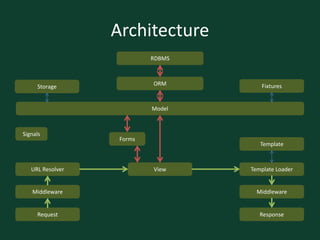
Architecture
                           RDBMS


     Storage               ORM        Fixtures


                           Model


Signals
                   Forms
                                      Template


   URL Resolver            View    Template Loader


   Middleware                        Middleware


     Request                          Response
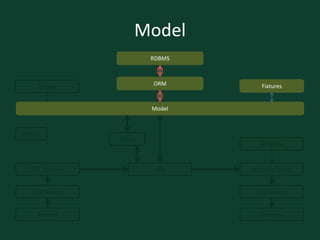
Model
                          RDBMS


     Storage              ORM        Fixtures


                          Model


Signals
                  Forms
                                     Template


   URL Resolver           View    Template Loader


   Middleware                       Middleware


     Request                         Response
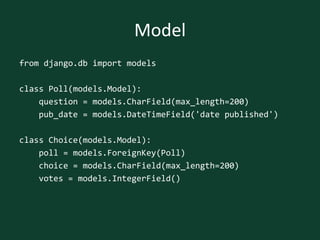
Model
from django.db import models

class Poll(models.Model):
    question = models.CharField(max_length=200)
    pub_date = models.DateTimeField('date published')

class Choice(models.Model):
    poll = models.ForeignKey(Poll)
    choice = models.CharField(max_length=200)
    votes = models.IntegerField()
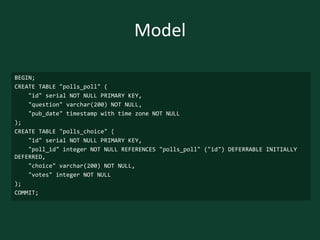
Model

BEGIN;
CREATE TABLE "polls_poll" (
    "id" serial NOT NULL PRIMARY KEY,
    "question" varchar(200) NOT NULL,
    "pub_date" timestamp with time zone NOT NULL
);
CREATE TABLE "polls_choice" (
    "id" serial NOT NULL PRIMARY KEY,
    "poll_id" integer NOT NULL REFERENCES "polls_poll" ("id") DEFERRABLE INITIALLY
DEFERRED,
    "choice" varchar(200) NOT NULL,
    "votes" integer NOT NULL
);
COMMIT;
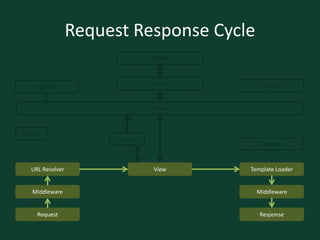
Request Response Cycle
                                RDBMS


     Storage                    ORM         Fixtures


                                Model


Signals
                        Forms
                                            Template


   URL Resolver                 View    Template Loader


   Middleware                              Middleware


     Request                                Response
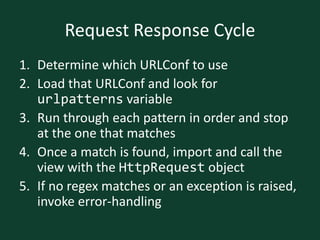
Request Response Cycle
1. Determine which URLConf to use
2. Load that URLConf and look for
   urlpatterns variable
3. Run through each pattern in order and stop
   at the one that matches
4. Once a match is found, import and call the
   view with the HttpRequest object
5. If no regex matches or an exception is raised,
   invoke error-handling
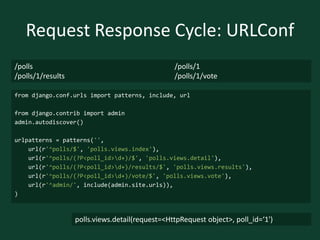
Request Response Cycle: URLConf
/polls                                           /polls/1
/polls/1/results                                 /polls/1/vote

from django.conf.urls import patterns, include, url

from django.contrib import admin
admin.autodiscover()

urlpatterns = patterns('',
    url(r'^polls/$', 'polls.views.index'),
    url(r'^polls/(?P<poll_id>d+)/$', 'polls.views.detail'),
    url(r'^polls/(?P<poll_id>d+)/results/$', 'polls.views.results'),
    url(r'^polls/(?P<poll_id>d+)/vote/$', 'polls.views.vote'),
    url(r'^admin/', include(admin.site.urls)),
)


                   polls.views.detail(request=<HttpRequest object>, poll_id=‘1')
Request Response Cycle: View


from django.shortcuts import render_to_response
from polls.models import Poll

def index(request):
    latest_poll_list = Poll.objects.all().order_by('-pub_date')[:5]
    return render_to_response('polls/index.html',
               {'latest_poll_list': latest_poll_list})
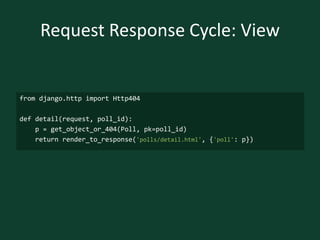
Request Response Cycle: View


from django.http import Http404

def detail(request, poll_id):
    p = get_object_or_404(Poll, pk=poll_id)
    return render_to_response('polls/detail.html', {'poll': p})
Request Response Cycle: View
from   django.shortcuts import get_object_or_404, render_to_response
from   django.http import HttpResponseRedirect, HttpResponse
from   django.core.urlresolvers import reverse
from   django.template import RequestContext
from   polls.models import Choice, Poll

def vote(request, poll_id):
    p = get_object_or_404(Poll, pk=poll_id)
    try:
           selected_choice = p.choice_set.get(pk=request.POST['choice'])
       except (KeyError, Choice.DoesNotExist):


           return render_to_response('polls/detail.html', {
               'poll': p,
               'error_message': "You didn't select a choice.",
           }, context_instance=RequestContext(request))
       else:
           selected_choice.votes += 1
           selected_choice.save()


           return HttpResponseRedirect(reverse('polls.views.results', args=(p.id,)))
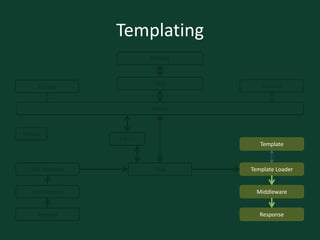
Templating
                          RDBMS


     Storage              ORM        Fixtures


                          Model


Signals
                  Forms
                                     Template


   URL Resolver           View    Template Loader


   Middleware                       Middleware


     Request                         Response
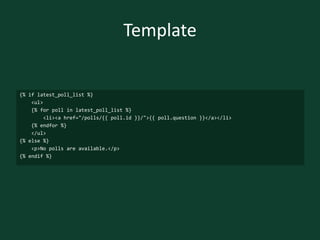
Template


{% if latest_poll_list %}
    <ul>
    {% for poll in latest_poll_list %}
         <li><a href="/polls/{{ poll.id }}/">{{ poll.question }}</a></li>
    {% endfor %}
    </ul>
{% else %}
    <p>No polls are available.</p>
{% endif %}
The django developer in its natural habitat

DJANGO ECOSYSTEM
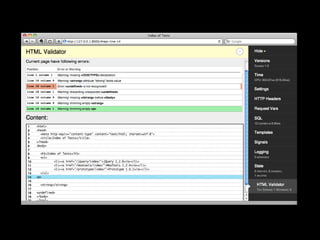
Django Debug Toolbar
• https://github.com/dcramer/django-debug-
  toolbar
• Must have for all your projects
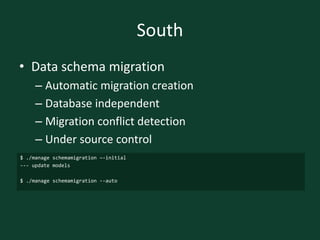
South
• Data schema migration
     – Automatic migration creation
     – Database independent
     – Migration conflict detection
     – Under source control
$ ./manage schemamigration –-initial
--- update models

$ ./manage schemamigration --auto
Celery
•   Asynchronous task queue
•   Message Passing
•   Green threads
•   RabbitMQ, Redis, MongoDB, CouchDB, …
• Search for Django
• Solr, ElasticSearch, Whoosh, Xapian
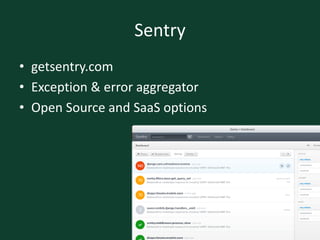
Sentry
• getsentry.com
• Exception & error aggregator
• Open Source and SaaS options
Tastypie
•   tastypieapi.org
•   Webservice API framework
•   REST
•   HATEOAS Compliant
•   Alternative to django-piston
Pinax
•   pinaxproject.com
•   Standard project layout
•   Starter projects
•   Default templates for prototyping
•   Reusable apps collection
    – Get ready...
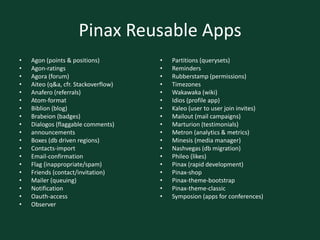
Pinax Reusable Apps
•   Agon (points & positions)         •   Partitions (querysets)
•   Agon-ratings                      •   Reminders
•   Agora (forum)                     •   Rubberstamp (permissions)
•   Aiteo (q&a, cfr. Stackoverflow)   •   Timezones
•   Anafero (referrals)               •   Wakawaka (wiki)
•   Atom-format                       •   Idios (profile app)
•   Biblion (blog)                    •   Kaleo (user to user join invites)
•   Brabeion (badges)                 •   Mailout (mail campaigns)
•   Dialogos (flaggable comments)     •   Marturion (testimonials)
•   announcements                     •   Metron (analytics & metrics)
•   Boxes (db driven regions)         •   Minesis (media manager)
•   Contacts-import                   •   Nashvegas (db migration)
•   Email-confirmation                •   Phileo (likes)
•   Flag (inappropriate/spam)         •   Pinax (rapid development)
•   Friends (contact/invitation)      •   Pinax-shop
•   Mailer (queuing)                  •   Pinax-theme-bootstrap
•   Notification                      •   Pinax-theme-classic
•   Oauth-access                      •   Symposion (apps for conferences)
•   Observer
django-extensions
• Shell_plus
  – Autoloading of the apps database models
• Additional database fields
  – AutoSlugField
  – CreationDateTimeField
  – UUIDField
  – EncryptedCharField
• DB Model graphing
• …
INFRASTRUCTURE
Application Server (AS)
Web Server Gateway Interface (WSGI)
• PEP 333 [P. J. Eby, dec 2010]
• Common ground for portable web applications
  – Routing, environment variables, load balancing,
    forwarding, post-prosessing
• 2 parts:
  – Gateway (= server)
  – Framework (= application)
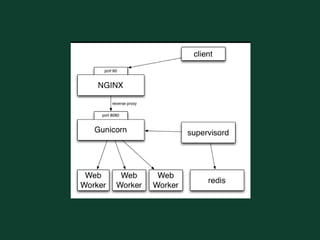
AS: gunicorn
•   “green unicorn” (cfr. green threading)
•   Pre-fork worker model
•   4-12 workers = 1000’s req/sec
•   Each worker runs an instance of your django
    project => memory
AS: uWSGI
• Protocol “uwsgi” (lowercase)
• Included in Nginx & Cherokee
• Faster than gunicorn
TOOLS
Tools
• IPython
   – Tab completion in the interpreter!
• import ipdb; ipdb.set_trace()
   – Just like pdb, but with added magic
• Fabric (fabfile.org)
   – $ fab production deploy
   – Like Capistrano but without the voodoo
• Supervisord (supervisord.org)
   – Process monitoring & controlling
QUESTIONS?
Deja vu for websites

CACHING
Cache Systems
CACHE_BACKEND = ....
   – Dummy caching
      • ‘dummy:///’
      • For development, dummy!
   – Local-Memory Caching
      • ‘locmem:///’
      • In memory caching without memcache
   – Database Caching
      • ‘db://my_cache_table’
      • When DB I/O is not a problem.
   – Filesystem Caching
      • ‘file:///var/tmp/django_cache’ # directory
      • Cache values stored in seperate files in pickled format
   – Memcache
      • ‘memcached:///127.0.0.1:112211/’
Approaches to Caching
• Per site caching (generic approach)
   – Only cache everything without GET or POST parameters
   – Only cache anonymous requests
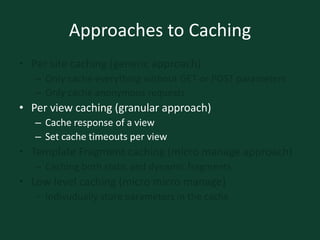
• Per view caching (granular approach)
   – Cache response of a view
   – Set cache timeouts per view
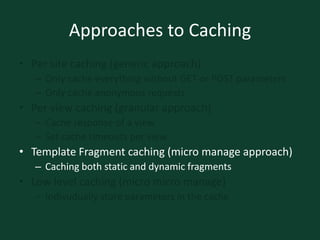
• Template Fragment caching (micro manage approach)
   – Caching both static and dynamic fragments
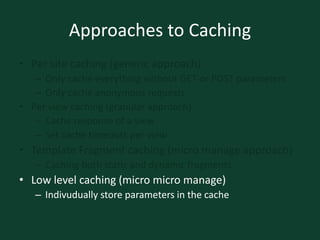
• Low level caching (micro micro manage)
   – Indivudually store parameters in the cache
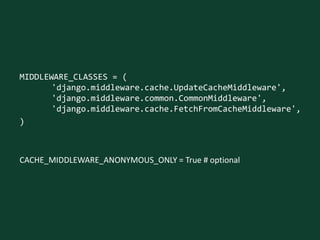
MIDDLEWARE_CLASSES = (
       'django.middleware.cache.UpdateCacheMiddleware',
       'django.middleware.common.CommonMiddleware',
       'django.middleware.cache.FetchFromCacheMiddleware',
)


CACHE_MIDDLEWARE_ANONYMOUS_ONLY = True # optional
Approaches to Caching
• Per site caching (generic approach)
   – Only cache everything without GET or POST parameters
   – Only cache anonymous requests
• Per view caching (granular approach)
   – Cache response of a view
   – Set cache timeouts per view
• Template Fragment caching (micro manage approach)
   – Caching both static and dynamic fragments
• Low level caching (micro micro manage)
   – Indivudually store parameters in the cache
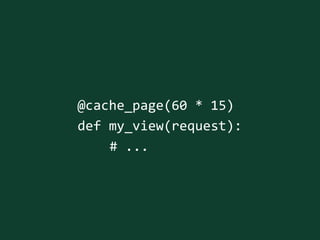
@cache_page(60 * 15)
def my_view(request):
    # ...
Approaches to Caching
• Per site caching (generic approach)
   – Only cache everything without GET or POST parameters
   – Only cache anonymous requests
• Per view caching (granular approach)
   – Cache response of a view
   – Set cache timeouts per view
• Template Fragment caching (micro manage approach)
   – Caching both static and dynamic fragments
• Low level caching (micro micro manage)
   – Indivudually store parameters in the cache
Approaches to Caching
• Per site caching (generic approach)
   – Only cache everything without GET or POST parameters
   – Only cache anonymous requests
• Per view caching (granular approach)
   – Cache response of a view
   – Set cache timeouts per view
• Template Fragment caching (micro manage approach)
   – Caching both static and dynamic fragments
• Low level caching (micro micro manage)
   – Indivudually store parameters in the cache
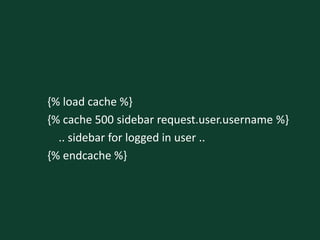
{% load cache %}
{% cache 500 sidebar request.user.username %}
  .. sidebar for logged in user ..
{% endcache %}

Python & Django TTT

  • 1.
  • 2.
    Virtualenv • Isolated Pythonenvironment • Virtualenvwrapper $ which python /home/kevin/.virtualenvs/inuittest/bin/python $ pip install virtualenvwrapper $ mkproject inuittest ... (inuittest)$ which python /home/kevin/.virtualenvs/inuittest/bin/python (inuittest)$ deactivate $ workon inuittest
  • 3.
    Installing libraries •Always work in a virtualenv $ pip freeze # ONE GAZILLION LIBRARIES!!!! (inuittest)$ pip freeze argparse==1.2.1 wsgiref==0.1.2 (inuittest)$ pip install yolk django south (inuittest)$ yolk –l Django - 1.4.2 - active Python - 2.7.3 - active development (/usr/lib/python2.7/lib-dynload) South - 0.7.6 - active argparse - 1.2.1 - active development (/usr/lib/python2.7) pip - 1.2.1 - active setuptools - 0.6c11 - active wsgiref - 0.1.2 - active development (/usr/lib/python2.7) yolk - 0.4.3 - active
  • 4.
  • 5.
    Hi! • Architecture • Development Practices • The Django Ecosystem • Infrastructure • Tools
  • 6.
    WTH is thisthing? ARCHITECTURE OVERVIEW
  • 7.
    Architecture RDBMS Storage ORM Fixtures Model Signals Forms Template URL Resolver View Template Loader Middleware Middleware Request Response
  • 8.
    Model RDBMS Storage ORM Fixtures Model Signals Forms Template URL Resolver View Template Loader Middleware Middleware Request Response
  • 9.
    Model from django.db importmodels class Poll(models.Model): question = models.CharField(max_length=200) pub_date = models.DateTimeField('date published') class Choice(models.Model): poll = models.ForeignKey(Poll) choice = models.CharField(max_length=200) votes = models.IntegerField()
  • 10.
    Model BEGIN; CREATE TABLE "polls_poll"( "id" serial NOT NULL PRIMARY KEY, "question" varchar(200) NOT NULL, "pub_date" timestamp with time zone NOT NULL ); CREATE TABLE "polls_choice" ( "id" serial NOT NULL PRIMARY KEY, "poll_id" integer NOT NULL REFERENCES "polls_poll" ("id") DEFERRABLE INITIALLY DEFERRED, "choice" varchar(200) NOT NULL, "votes" integer NOT NULL ); COMMIT;
  • 11.
    Request Response Cycle RDBMS Storage ORM Fixtures Model Signals Forms Template URL Resolver View Template Loader Middleware Middleware Request Response
  • 12.
    Request Response Cycle 1.Determine which URLConf to use 2. Load that URLConf and look for urlpatterns variable 3. Run through each pattern in order and stop at the one that matches 4. Once a match is found, import and call the view with the HttpRequest object 5. If no regex matches or an exception is raised, invoke error-handling
  • 13.
    Request Response Cycle:URLConf /polls /polls/1 /polls/1/results /polls/1/vote from django.conf.urls import patterns, include, url from django.contrib import admin admin.autodiscover() urlpatterns = patterns('', url(r'^polls/$', 'polls.views.index'), url(r'^polls/(?P<poll_id>d+)/$', 'polls.views.detail'), url(r'^polls/(?P<poll_id>d+)/results/$', 'polls.views.results'), url(r'^polls/(?P<poll_id>d+)/vote/$', 'polls.views.vote'), url(r'^admin/', include(admin.site.urls)), ) polls.views.detail(request=<HttpRequest object>, poll_id=‘1')
  • 14.
    Request Response Cycle:View from django.shortcuts import render_to_response from polls.models import Poll def index(request): latest_poll_list = Poll.objects.all().order_by('-pub_date')[:5] return render_to_response('polls/index.html', {'latest_poll_list': latest_poll_list})
  • 15.
    Request Response Cycle:View from django.http import Http404 def detail(request, poll_id): p = get_object_or_404(Poll, pk=poll_id) return render_to_response('polls/detail.html', {'poll': p})
  • 16.
    Request Response Cycle:View from django.shortcuts import get_object_or_404, render_to_response from django.http import HttpResponseRedirect, HttpResponse from django.core.urlresolvers import reverse from django.template import RequestContext from polls.models import Choice, Poll def vote(request, poll_id): p = get_object_or_404(Poll, pk=poll_id) try: selected_choice = p.choice_set.get(pk=request.POST['choice']) except (KeyError, Choice.DoesNotExist): return render_to_response('polls/detail.html', { 'poll': p, 'error_message': "You didn't select a choice.", }, context_instance=RequestContext(request)) else: selected_choice.votes += 1 selected_choice.save() return HttpResponseRedirect(reverse('polls.views.results', args=(p.id,)))
  • 17.
    Templating RDBMS Storage ORM Fixtures Model Signals Forms Template URL Resolver View Template Loader Middleware Middleware Request Response
  • 18.
    Template {% if latest_poll_list%} <ul> {% for poll in latest_poll_list %} <li><a href="/polls/{{ poll.id }}/">{{ poll.question }}</a></li> {% endfor %} </ul> {% else %} <p>No polls are available.</p> {% endif %}
  • 19.
    The django developerin its natural habitat DJANGO ECOSYSTEM
  • 20.
    Django Debug Toolbar •https://github.com/dcramer/django-debug- toolbar • Must have for all your projects
  • 22.
    South • Data schemamigration – Automatic migration creation – Database independent – Migration conflict detection – Under source control $ ./manage schemamigration –-initial --- update models $ ./manage schemamigration --auto
  • 23.
    Celery • Asynchronous task queue • Message Passing • Green threads • RabbitMQ, Redis, MongoDB, CouchDB, …
  • 24.
    • Search forDjango • Solr, ElasticSearch, Whoosh, Xapian
  • 25.
    Sentry • getsentry.com • Exception& error aggregator • Open Source and SaaS options
  • 26.
    Tastypie • tastypieapi.org • Webservice API framework • REST • HATEOAS Compliant • Alternative to django-piston
  • 27.
    Pinax • pinaxproject.com • Standard project layout • Starter projects • Default templates for prototyping • Reusable apps collection – Get ready...
  • 28.
    Pinax Reusable Apps • Agon (points & positions) • Partitions (querysets) • Agon-ratings • Reminders • Agora (forum) • Rubberstamp (permissions) • Aiteo (q&a, cfr. Stackoverflow) • Timezones • Anafero (referrals) • Wakawaka (wiki) • Atom-format • Idios (profile app) • Biblion (blog) • Kaleo (user to user join invites) • Brabeion (badges) • Mailout (mail campaigns) • Dialogos (flaggable comments) • Marturion (testimonials) • announcements • Metron (analytics & metrics) • Boxes (db driven regions) • Minesis (media manager) • Contacts-import • Nashvegas (db migration) • Email-confirmation • Phileo (likes) • Flag (inappropriate/spam) • Pinax (rapid development) • Friends (contact/invitation) • Pinax-shop • Mailer (queuing) • Pinax-theme-bootstrap • Notification • Pinax-theme-classic • Oauth-access • Symposion (apps for conferences) • Observer
  • 29.
    django-extensions • Shell_plus – Autoloading of the apps database models • Additional database fields – AutoSlugField – CreationDateTimeField – UUIDField – EncryptedCharField • DB Model graphing • …
  • 30.
  • 32.
    Application Server (AS) WebServer Gateway Interface (WSGI) • PEP 333 [P. J. Eby, dec 2010] • Common ground for portable web applications – Routing, environment variables, load balancing, forwarding, post-prosessing • 2 parts: – Gateway (= server) – Framework (= application)
  • 33.
    AS: gunicorn • “green unicorn” (cfr. green threading) • Pre-fork worker model • 4-12 workers = 1000’s req/sec • Each worker runs an instance of your django project => memory
  • 34.
    AS: uWSGI • Protocol“uwsgi” (lowercase) • Included in Nginx & Cherokee • Faster than gunicorn
  • 35.
  • 36.
    Tools • IPython – Tab completion in the interpreter! • import ipdb; ipdb.set_trace() – Just like pdb, but with added magic • Fabric (fabfile.org) – $ fab production deploy – Like Capistrano but without the voodoo • Supervisord (supervisord.org) – Process monitoring & controlling
  • 37.
  • 38.
    Deja vu forwebsites CACHING
  • 39.
    Cache Systems CACHE_BACKEND =.... – Dummy caching • ‘dummy:///’ • For development, dummy! – Local-Memory Caching • ‘locmem:///’ • In memory caching without memcache – Database Caching • ‘db://my_cache_table’ • When DB I/O is not a problem. – Filesystem Caching • ‘file:///var/tmp/django_cache’ # directory • Cache values stored in seperate files in pickled format – Memcache • ‘memcached:///127.0.0.1:112211/’
  • 40.
    Approaches to Caching •Per site caching (generic approach) – Only cache everything without GET or POST parameters – Only cache anonymous requests • Per view caching (granular approach) – Cache response of a view – Set cache timeouts per view • Template Fragment caching (micro manage approach) – Caching both static and dynamic fragments • Low level caching (micro micro manage) – Indivudually store parameters in the cache
  • 41.
    MIDDLEWARE_CLASSES = ( 'django.middleware.cache.UpdateCacheMiddleware', 'django.middleware.common.CommonMiddleware', 'django.middleware.cache.FetchFromCacheMiddleware', ) CACHE_MIDDLEWARE_ANONYMOUS_ONLY = True # optional
  • 42.
    Approaches to Caching •Per site caching (generic approach) – Only cache everything without GET or POST parameters – Only cache anonymous requests • Per view caching (granular approach) – Cache response of a view – Set cache timeouts per view • Template Fragment caching (micro manage approach) – Caching both static and dynamic fragments • Low level caching (micro micro manage) – Indivudually store parameters in the cache
  • 43.
    @cache_page(60 * 15) defmy_view(request): # ...
  • 44.
    Approaches to Caching •Per site caching (generic approach) – Only cache everything without GET or POST parameters – Only cache anonymous requests • Per view caching (granular approach) – Cache response of a view – Set cache timeouts per view • Template Fragment caching (micro manage approach) – Caching both static and dynamic fragments • Low level caching (micro micro manage) – Indivudually store parameters in the cache
  • 45.
    Approaches to Caching •Per site caching (generic approach) – Only cache everything without GET or POST parameters – Only cache anonymous requests • Per view caching (granular approach) – Cache response of a view – Set cache timeouts per view • Template Fragment caching (micro manage approach) – Caching both static and dynamic fragments • Low level caching (micro micro manage) – Indivudually store parameters in the cache
  • 46.
    {% load cache%} {% cache 500 sidebar request.user.username %} .. sidebar for logged in user .. {% endcache %}