Module 2
Data Collections – Lists, Tuples,
and Dictionaries
Loops in Python
Module 2 Loops in Python
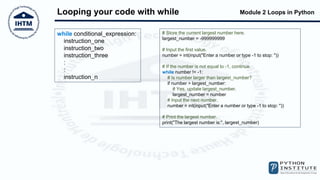
Looping your code with while
while conditional_expression:
instruction_one
instruction_two
instruction_three
:
:
instruction_n
# Store the current largest number here.
largest_number = -999999999
# Input the first value.
number = int(input("Enter a number or type -1 to stop: "))
# If the number is not equal to -1, continue.
while number != -1:
# Is number larger than largest_number?
if number > largest_number:
# Yes, update largest_number.
largest_number = number
# Input the next number.
number = int(input("Enter a number or type -1 to stop: "))
# Print the largest number.
print("The largest number is:", largest_number)
Module 2 Loops in Python
Examples
# A program that reads a sequence of numbers and counts how many numbers are even and how many are odd.
# The program terminates when zero is entered.
odd_numbers = 0
even_numbers = 0
# Read the first number.
number = int(input("Enter a number or type 0 to stop: "))
# 0 terminates execution.
while number != 0:
# Check if the number is odd.
if number % 2 == 1:
# Increase the odd_numbers counter.
odd_numbers += 1
else:
# Increase the even_numbers counter.
even_numbers += 1
# Read the next number.
number = int(input("Enter a number or type 0 to stop: "))
# Print results.
print("Odd numbers count:", odd_numbers)
print("Even numbers count:", even_numbers)
Module 2 Loops in Python
Counter variable to exit a loop
counter = 5
while counter != 0:
print("Inside the loop.", counter)
counter -= 1
print("Outside the loop.", counter)
Inside the loop. 5
Inside the loop. 4
Inside the loop. 3
Inside the loop. 2
Inside the loop. 1
Outside the loop. 0
counter = 5
while counter:
print("Inside the loop.", counter)
counter -= 1
print("Outside the loop.", counter)
Inside the loop. 5
Inside the loop. 4
Inside the loop. 3
Inside the loop. 2
Inside the loop. 1
Outside the loop. 0
Module 2 Loops in Python
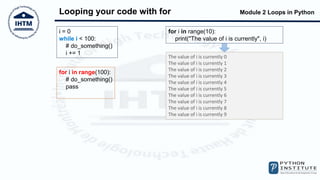
Looping your code with for
i = 0
while i < 100:
# do_something()
i += 1
for i in range(10):
print("The value of i is currently", i)
for i in range(100):
# do_something()
pass
The value of i is currently 0
The value of i is currently 1
The value of i is currently 2
The value of i is currently 3
The value of i is currently 4
The value of i is currently 5
The value of i is currently 6
The value of i is currently 7
The value of i is currently 8
The value of i is currently 9
Module 2 Loops in Python
for loop & range() with 3 arguments
for i in range(2, 8, 3):
print("The value of i is currently", i)
The value of i is currently 2
The value of i is currently 5
for i in range(1, 1):
print("The value of i is currently", i)
for i in range(2, 1):
print("The value of i is currently", i)
no output here
no output here
The range()'s second argument must be greater than the first.
Module 2 Loops in Python
break & continue statements 1
print("The break instruction:")
for i in range(1, 6):
if i == 3:
break
print("Inside the loop.", i)
print("Outside the loop.")
print("nThe continue
instruction:")
for i in range(1, 6):
if i == 3:
continue
print("Inside the loop.", i)
print("Outside the loop.")
The break instruction:
Inside the loop. 1
Inside the loop. 2
Outside the loop.
The continue instruction:
Inside the loop. 1
Inside the loop. 2
Inside the loop. 4
Inside the loop. 5
Outside the loop.
Module 2 Loops in Python
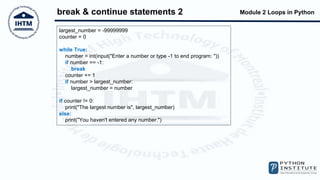
break & continue statements 2
largest_number = -99999999
counter = 0
while True:
number = int(input("Enter a number or type -1 to end program: "))
if number == -1:
break
counter += 1
if number > largest_number:
largest_number = number
if counter != 0:
print("The largest number is", largest_number)
else:
print("You haven't entered any number.")
Module 2 Loops in Python
break & continue statements 3
largest_number = -99999999
counter = 0
number = int(input("Enter a number or type -1 to end program: "))
while number != -1:
if number == -1:
continue
counter += 1
if number > largest_number:
largest_number = number
number = int(input("Enter a number or type -1 to end program: "))
if counter:
print("The largest number is", largest_number)
else:
print("You haven't entered any number.")
Module 2 Loops in Python
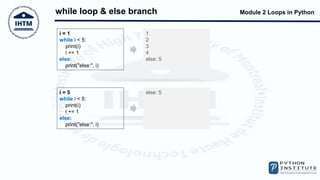
while loop & else branch
i = 1
while i < 5:
print(i)
i += 1
else:
print("else:", i)
1
2
3
4
else: 5
i = 5
while i < 5:
print(i)
i += 1
else:
print("else:", i)
else: 5
Module 2 Loops in Python
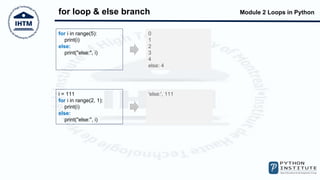
for loop & else branch
i = 111
for i in range(2, 1):
print(i)
else:
print("else:", i)
for i in range(5):
print(i)
else:
print("else:", i)
0
1
2
3
4
else: 4
'else:', 111
Module 2 Loops in Python
Key takeaways
● Two types of loops: while & for
● break & continue statements to change the flow of a loop
● while & for loops and else branch
● range() function
Module 2 Loops in Python
14. Guess the secret number
15. Counting mississippily
16. Stuck in a loop
17. The Ugly Vowel Eater
18. The Ugly Vowel Eater (1)
19. Essentials of the while loop
20. Collatz's hypothesis
LAB Practice

Python PCEP Loops

  • 1.
    Module 2 Data Collections– Lists, Tuples, and Dictionaries Loops in Python
  • 2.
    Module 2 Loopsin Python Looping your code with while while conditional_expression: instruction_one instruction_two instruction_three : : instruction_n # Store the current largest number here. largest_number = -999999999 # Input the first value. number = int(input("Enter a number or type -1 to stop: ")) # If the number is not equal to -1, continue. while number != -1: # Is number larger than largest_number? if number > largest_number: # Yes, update largest_number. largest_number = number # Input the next number. number = int(input("Enter a number or type -1 to stop: ")) # Print the largest number. print("The largest number is:", largest_number)
  • 3.
    Module 2 Loopsin Python Examples # A program that reads a sequence of numbers and counts how many numbers are even and how many are odd. # The program terminates when zero is entered. odd_numbers = 0 even_numbers = 0 # Read the first number. number = int(input("Enter a number or type 0 to stop: ")) # 0 terminates execution. while number != 0: # Check if the number is odd. if number % 2 == 1: # Increase the odd_numbers counter. odd_numbers += 1 else: # Increase the even_numbers counter. even_numbers += 1 # Read the next number. number = int(input("Enter a number or type 0 to stop: ")) # Print results. print("Odd numbers count:", odd_numbers) print("Even numbers count:", even_numbers)
  • 4.
    Module 2 Loopsin Python Counter variable to exit a loop counter = 5 while counter != 0: print("Inside the loop.", counter) counter -= 1 print("Outside the loop.", counter) Inside the loop. 5 Inside the loop. 4 Inside the loop. 3 Inside the loop. 2 Inside the loop. 1 Outside the loop. 0 counter = 5 while counter: print("Inside the loop.", counter) counter -= 1 print("Outside the loop.", counter) Inside the loop. 5 Inside the loop. 4 Inside the loop. 3 Inside the loop. 2 Inside the loop. 1 Outside the loop. 0
  • 5.
    Module 2 Loopsin Python Looping your code with for i = 0 while i < 100: # do_something() i += 1 for i in range(10): print("The value of i is currently", i) for i in range(100): # do_something() pass The value of i is currently 0 The value of i is currently 1 The value of i is currently 2 The value of i is currently 3 The value of i is currently 4 The value of i is currently 5 The value of i is currently 6 The value of i is currently 7 The value of i is currently 8 The value of i is currently 9
  • 6.
    Module 2 Loopsin Python for loop & range() with 3 arguments for i in range(2, 8, 3): print("The value of i is currently", i) The value of i is currently 2 The value of i is currently 5 for i in range(1, 1): print("The value of i is currently", i) for i in range(2, 1): print("The value of i is currently", i) no output here no output here The range()'s second argument must be greater than the first.
  • 7.
    Module 2 Loopsin Python break & continue statements 1 print("The break instruction:") for i in range(1, 6): if i == 3: break print("Inside the loop.", i) print("Outside the loop.") print("nThe continue instruction:") for i in range(1, 6): if i == 3: continue print("Inside the loop.", i) print("Outside the loop.") The break instruction: Inside the loop. 1 Inside the loop. 2 Outside the loop. The continue instruction: Inside the loop. 1 Inside the loop. 2 Inside the loop. 4 Inside the loop. 5 Outside the loop.
  • 8.
    Module 2 Loopsin Python break & continue statements 2 largest_number = -99999999 counter = 0 while True: number = int(input("Enter a number or type -1 to end program: ")) if number == -1: break counter += 1 if number > largest_number: largest_number = number if counter != 0: print("The largest number is", largest_number) else: print("You haven't entered any number.")
  • 9.
    Module 2 Loopsin Python break & continue statements 3 largest_number = -99999999 counter = 0 number = int(input("Enter a number or type -1 to end program: ")) while number != -1: if number == -1: continue counter += 1 if number > largest_number: largest_number = number number = int(input("Enter a number or type -1 to end program: ")) if counter: print("The largest number is", largest_number) else: print("You haven't entered any number.")
  • 10.
    Module 2 Loopsin Python while loop & else branch i = 1 while i < 5: print(i) i += 1 else: print("else:", i) 1 2 3 4 else: 5 i = 5 while i < 5: print(i) i += 1 else: print("else:", i) else: 5
  • 11.
    Module 2 Loopsin Python for loop & else branch i = 111 for i in range(2, 1): print(i) else: print("else:", i) for i in range(5): print(i) else: print("else:", i) 0 1 2 3 4 else: 4 'else:', 111
  • 12.
    Module 2 Loopsin Python Key takeaways ● Two types of loops: while & for ● break & continue statements to change the flow of a loop ● while & for loops and else branch ● range() function
  • 13.
    Module 2 Loopsin Python 14. Guess the secret number 15. Counting mississippily 16. Stuck in a loop 17. The Ugly Vowel Eater 18. The Ugly Vowel Eater (1) 19. Essentials of the while loop 20. Collatz's hypothesis LAB Practice