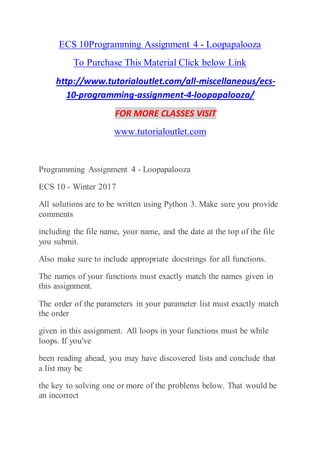
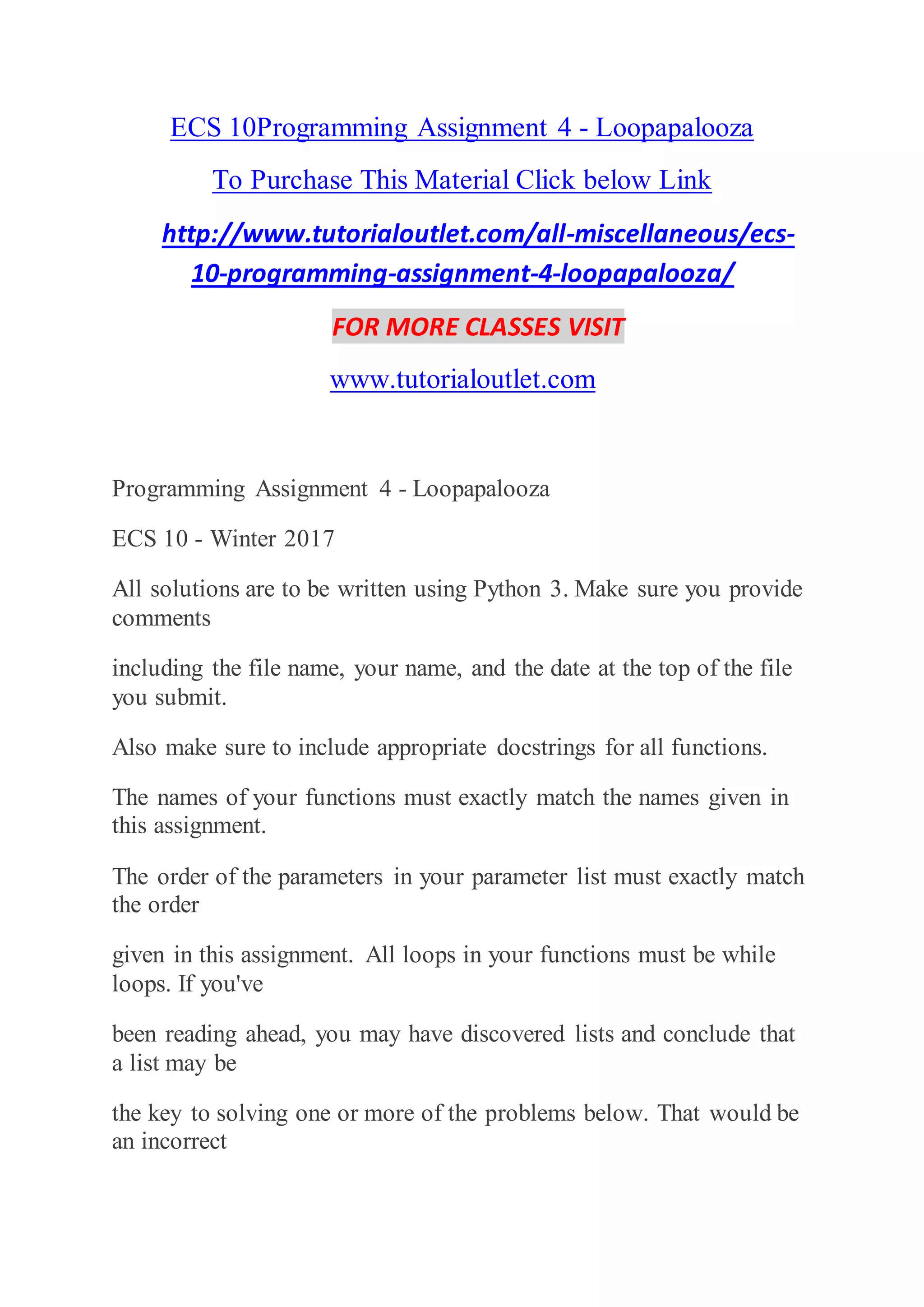
ECS 10Programming Assignment 4 - Loopapalooza
To Purchase This Material Click below Link
http://www.tutorialoutlet.com/all-miscellaneous/ecs-
10-programming-assignment-4-loopapalooza/
FOR MORE CLASSES VISIT
www.tutorialoutlet.com
Programming Assignment 4 - Loopapalooza
ECS 10 - Winter 2017
All solutions are to be written using Python 3. Make sure you provide
comments
including the file name, your name, and the date at the top of the file
you submit.
Also make sure to include appropriate docstrings for all functions.
The names of your functions must exactly match the names given in
this assignment.
The order of the parameters in your parameter list must exactly match
the order
given in this assignment. All loops in your functions must be while
loops. If you've
been reading ahead, you may have discovered lists and conclude that
a list may be
the key to solving one or more of the problems below. That would be
an incorrect
conclusion; don't use lists in this programming assignment. While
we're talking
about things you should not use, do not use the Python functions sum,
min, or max.
Please note that in all problems, the goal is to give you practice using
loops, not
finding ways to avoid them. Every solution you write for this
assignment must
make appropriate use of a while loop.
For any given problem below, you may want to write additional
functions other
than those specified for your solution. That's fine with us.
One other thing: if you haven't already done so, or even if you have,
go to our
Course Information page on SmartSite and read the section on
Academic
Misconduct. Submitting other people's work as your own, including
solutions you
may find on the Internet, is not permitted and will be referred to
Student Judicial
Affairs. Problem 1
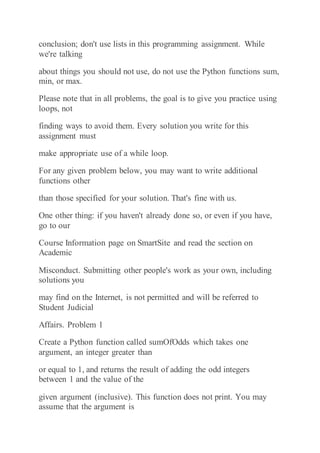
Create a Python function called sumOfOdds which takes one
argument, an integer greater than
or equal to 1, and returns the result of adding the odd integers
between 1 and the value of the
given argument (inclusive). This function does not print. You may
assume that the argument is
valid. Here are some examples of how your function should behave:
>>> sumOfOdds(1)
1
>>> sumOfOdds(2)
1
>>> sumOfOdds(3)
4
>>> sumOfOdds(4)
4
>>> sumOfOdds(5)
9
>>> sumOfOdds(100)
2500
>>> sumOfOdds(101)
2601
>>> Problem 2
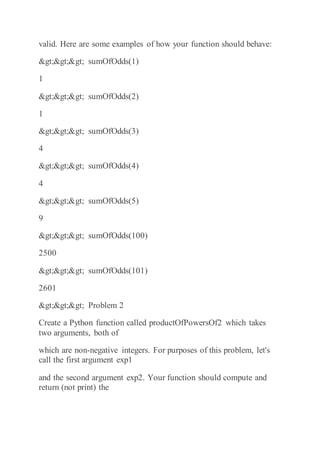
Create a Python function called productOfPowersOf2 which takes
two arguments, both of
which are non-negative integers. For purposes of this problem, let's
call the first argument exp1
and the second argument exp2. Your function should compute and
return (not print) the
product of all powers of 2 from 2exp1 to 2exp2. Here are some
examples of how your function
should behave:
>>> productOfPowersOf2(0,0)
1
>>> productOfPowersOf2(1,1)
2
>>> productOfPowersOf2(1,2)
8
>>> productOfPowersOf2(1,3)
64
>>> productOfPowersOf2(1,4)
1024
>>> productOfPowersOf2(1,5)
32768
>>> productOfPowersOf2(2,4)
512
>>> productOfPowersOf2(3,12)
37778931862957161709568
>>> Problem 3
Create a Python function called printAsterisks that expects one
argument, a nonnegative integer, and prints a row of asterisks, where
the number of asterisks is given by
the value passed as the argument. Control the printing with a while
loop, not with a
construct that looks like print("*" * n). This function does
not return any value.
Here are some examples of how your function should behave:
>>> printAsterisks(1)
*
>>> printAsterisks(2)
**
>>> printAsterisks(3)
***
>>> printAsterisks(4)
****
>>> printAsterisks(0)
>>> Problem 4
Create a Python function called printTrianglthat expects one
argument, a nonnegative integer, and prints a right triangle, where
both the height of the triangle and the
width of the base of the triangle are given by the value passed as the
argument. This
function does not return any value. Your function should use your
solution to Problem 3
in printing the triangle. Here are some examples of how your function
should behave:
>>> printTriangle(4)
*
**
***
****
>>> printTriangle(3)
*
**
***
>>> printTriangle(2)
*
**
>>> printTriangle(1)
*
>>> printTriangle(0)
>>> Problem 5
Create a function called allButMax that expects no arguments.
Instead, this function
gets its input from the user at the keyboard. The function asks the user
to enter a series of
numbers greater than or equal to zero, one at a time. The user types
end to indicate that
there are no more numbers. The function computes the sum of all the
values entered
except for the maximum value in the series. (Think of this as dropping
the highest
homework score from a series of homework scores.) The function
then both prints the
sum and returns the sum. You may assume the user inputs are valid:
they will either be a
number greater than or equal to zero, or the string end. Here are some
examples of how
your function should behave:
>>> allButMax()
Enter next number: 20
Enter next number: 30
Enter next number: 40
Enter next number: end
The sum of all values except
50.0
>>> allButMax()
Enter next number: 1.55
Enter next number: 90
Enter next number: 8.45
Enter next number: 2
Enter next number: end
The sum of all values except
12.0
>>> x = allButMax()
Enter next number: 3
Enter next number: 2
Enter next number: 1
Enter next number: end
The sum of all values except
>>> print(x)
3.0
>>> allButMax()
Enter next number: end
The sum of all values except
0 for the maximum value is: 50.0 for the maximum value is: 12.0 for
the maximum value is: 3.0 for the maximum value is: 0 Problem 6
Create a function called avgSumOfSquares that expects no arguments.
Instead, this
function gets its input from the user at the keyboard. The function
asks the user to enter a
series of numbers, one at a time. The user types end to indicate that
there are no more
numbers. The function computes the average of the sum of the
squares of all the values
entered. For example, given the values 6, -3, 4, 2, 11, 1, and -9, the
sum of the squares
would be (36 + 9 + 16 + 4 + 121 + 1 + 81) = 268. The average of the
sum of squares
would then be 268/7 = 38.285714285714285.The function then prints
the average of the
sum of the squares and returns that average. However, if end is
entered before any
values are entered, the function notifies the user that no numbers were
entered and returns
None. You may assume the user inputs are valid: they will either be a
number or the
string end. Here are some examples of how your function should
behave:
>>> avgSumOfSquares()
Enter next number: 6
Enter next number: -3
Enter next number: 4
Enter next number: 2
Enter next number: 11
Enter next number: 1
Enter next number: -9
Enter next number: end
The average of the sum of the squares is: 38.285714285714285
38.285714285714285
>>> avgSumOfSquares()
Enter next number: 3.27
Enter next number: -1.9
Enter next number: 6
Enter next number: -1
Enter next number: end
The average of the sum of the squares is: 12.825725
12.825725
>>> avgSumOfSquares()
Enter next number: end
No numbers were entered.
>>> x = avgSumOfSquares()
Enter next number: end
No numbers were entered.
>>> print(x)
None
>>> x = avgSumOfSquares()
Enter next number: -1
Enter next number: 2
Enter next number: -3
Enter next number: end
The average of the sum of the squares is: 4.666666666666667
>>> print(x)
4.666666666666667 Where to do the assignment
You can do this assignment on your own computer, or in the labs. In
either case, use the
IDLE development environment -- that's what we'll use when we
grade your program.
Put all the functions you created in a file called
"prog4.py".
Submitting the Assignment
We will be using SmartSite to turn in assignments. Go to SmartSite,
go to ECS 010, and
go to Assignments. Submit the file containing your functions as an
attachment.
Do NOT cut-and-paste your functions into a text window. Do NOT
hand in a screenshot
of your functions' output. We want one file from you:
"prog4.py".
Saving your work
If you are working in the lab, you will need to copy your program to
your own flash-drive
or save the program to your workspace on SmartSite. To save it on
flash-drive, plug the
flash-drive into the computer (your TAs or the staff in the labs can
help you figure out
how), open the flash-drive, and copy your work to it by moving the
folder with your files
from the Desktop onto the flash-drive. To copy the file to your
SmartSite workspace, go
to Workspace, select Resources, and then use the Add button next to
"MyWorkspace".

Ecs 10 programming assignment 4 loopapalooza

  • 1.
    ECS 10Programming Assignment4 - Loopapalooza To Purchase This Material Click below Link http://www.tutorialoutlet.com/all-miscellaneous/ecs- 10-programming-assignment-4-loopapalooza/ FOR MORE CLASSES VISIT www.tutorialoutlet.com Programming Assignment 4 - Loopapalooza ECS 10 - Winter 2017 All solutions are to be written using Python 3. Make sure you provide comments including the file name, your name, and the date at the top of the file you submit. Also make sure to include appropriate docstrings for all functions. The names of your functions must exactly match the names given in this assignment. The order of the parameters in your parameter list must exactly match the order given in this assignment. All loops in your functions must be while loops. If you've been reading ahead, you may have discovered lists and conclude that a list may be the key to solving one or more of the problems below. That would be an incorrect
  • 2.
    conclusion; don't uselists in this programming assignment. While we're talking about things you should not use, do not use the Python functions sum, min, or max. Please note that in all problems, the goal is to give you practice using loops, not finding ways to avoid them. Every solution you write for this assignment must make appropriate use of a while loop. For any given problem below, you may want to write additional functions other than those specified for your solution. That's fine with us. One other thing: if you haven't already done so, or even if you have, go to our Course Information page on SmartSite and read the section on Academic Misconduct. Submitting other people's work as your own, including solutions you may find on the Internet, is not permitted and will be referred to Student Judicial Affairs. Problem 1 Create a Python function called sumOfOdds which takes one argument, an integer greater than or equal to 1, and returns the result of adding the odd integers between 1 and the value of the given argument (inclusive). This function does not print. You may assume that the argument is
  • 3.
    valid. Here aresome examples of how your function should behave: >>> sumOfOdds(1) 1 >>> sumOfOdds(2) 1 >>> sumOfOdds(3) 4 >>> sumOfOdds(4) 4 >>> sumOfOdds(5) 9 >>> sumOfOdds(100) 2500 >>> sumOfOdds(101) 2601 >>> Problem 2 Create a Python function called productOfPowersOf2 which takes two arguments, both of which are non-negative integers. For purposes of this problem, let's call the first argument exp1 and the second argument exp2. Your function should compute and return (not print) the
  • 4.
    product of allpowers of 2 from 2exp1 to 2exp2. Here are some examples of how your function should behave: >>> productOfPowersOf2(0,0) 1 >>> productOfPowersOf2(1,1) 2 >>> productOfPowersOf2(1,2) 8 >>> productOfPowersOf2(1,3) 64 >>> productOfPowersOf2(1,4) 1024 >>> productOfPowersOf2(1,5) 32768 >>> productOfPowersOf2(2,4) 512 >>> productOfPowersOf2(3,12) 37778931862957161709568 >>> Problem 3 Create a Python function called printAsterisks that expects one argument, a nonnegative integer, and prints a row of asterisks, where the number of asterisks is given by
  • 5.
    the value passedas the argument. Control the printing with a while loop, not with a construct that looks like print("*" * n). This function does not return any value. Here are some examples of how your function should behave: >>> printAsterisks(1) * >>> printAsterisks(2) ** >>> printAsterisks(3) *** >>> printAsterisks(4) **** >>> printAsterisks(0) >>> Problem 4 Create a Python function called printTrianglthat expects one argument, a nonnegative integer, and prints a right triangle, where both the height of the triangle and the width of the base of the triangle are given by the value passed as the argument. This function does not return any value. Your function should use your solution to Problem 3 in printing the triangle. Here are some examples of how your function should behave:
  • 6.
    >>> printTriangle(4) * ** *** **** >>> printTriangle(3) * ** *** >>>printTriangle(2) * ** >>> printTriangle(1) * >>> printTriangle(0) >>> Problem 5 Create a function called allButMax that expects no arguments. Instead, this function gets its input from the user at the keyboard. The function asks the user to enter a series of numbers greater than or equal to zero, one at a time. The user types end to indicate that
  • 7.
    there are nomore numbers. The function computes the sum of all the values entered except for the maximum value in the series. (Think of this as dropping the highest homework score from a series of homework scores.) The function then both prints the sum and returns the sum. You may assume the user inputs are valid: they will either be a number greater than or equal to zero, or the string end. Here are some examples of how your function should behave: >>> allButMax() Enter next number: 20 Enter next number: 30 Enter next number: 40 Enter next number: end The sum of all values except 50.0 >>> allButMax() Enter next number: 1.55 Enter next number: 90 Enter next number: 8.45 Enter next number: 2 Enter next number: end
  • 8.
    The sum ofall values except 12.0 >>> x = allButMax() Enter next number: 3 Enter next number: 2 Enter next number: 1 Enter next number: end The sum of all values except >>> print(x) 3.0 >>> allButMax() Enter next number: end The sum of all values except 0 for the maximum value is: 50.0 for the maximum value is: 12.0 for the maximum value is: 3.0 for the maximum value is: 0 Problem 6 Create a function called avgSumOfSquares that expects no arguments. Instead, this function gets its input from the user at the keyboard. The function asks the user to enter a series of numbers, one at a time. The user types end to indicate that there are no more numbers. The function computes the average of the sum of the squares of all the values
  • 9.
    entered. For example,given the values 6, -3, 4, 2, 11, 1, and -9, the sum of the squares would be (36 + 9 + 16 + 4 + 121 + 1 + 81) = 268. The average of the sum of squares would then be 268/7 = 38.285714285714285.The function then prints the average of the sum of the squares and returns that average. However, if end is entered before any values are entered, the function notifies the user that no numbers were entered and returns None. You may assume the user inputs are valid: they will either be a number or the string end. Here are some examples of how your function should behave: >>> avgSumOfSquares() Enter next number: 6 Enter next number: -3 Enter next number: 4 Enter next number: 2 Enter next number: 11 Enter next number: 1 Enter next number: -9 Enter next number: end The average of the sum of the squares is: 38.285714285714285
  • 10.
    38.285714285714285 >>> avgSumOfSquares() Enter nextnumber: 3.27 Enter next number: -1.9 Enter next number: 6 Enter next number: -1 Enter next number: end The average of the sum of the squares is: 12.825725 12.825725 >>> avgSumOfSquares() Enter next number: end No numbers were entered. >>> x = avgSumOfSquares() Enter next number: end No numbers were entered. >>> print(x) None >>> x = avgSumOfSquares() Enter next number: -1 Enter next number: 2 Enter next number: -3
  • 11.
    Enter next number:end The average of the sum of the squares is: 4.666666666666667 >>> print(x) 4.666666666666667 Where to do the assignment You can do this assignment on your own computer, or in the labs. In either case, use the IDLE development environment -- that's what we'll use when we grade your program. Put all the functions you created in a file called "prog4.py". Submitting the Assignment We will be using SmartSite to turn in assignments. Go to SmartSite, go to ECS 010, and go to Assignments. Submit the file containing your functions as an attachment. Do NOT cut-and-paste your functions into a text window. Do NOT hand in a screenshot of your functions' output. We want one file from you: "prog4.py". Saving your work If you are working in the lab, you will need to copy your program to your own flash-drive or save the program to your workspace on SmartSite. To save it on flash-drive, plug the flash-drive into the computer (your TAs or the staff in the labs can help you figure out
  • 12.
    how), open theflash-drive, and copy your work to it by moving the folder with your files from the Desktop onto the flash-drive. To copy the file to your SmartSite workspace, go to Workspace, select Resources, and then use the Add button next to "MyWorkspace".