Basic Datatypes
• Datatypes: int, String, float, short, byte, long,
double, Boolean.
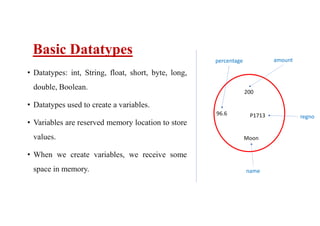
• Datatypes used to create a variables.
• Variables are reserved memory location to store
values.
• When we create variables, we receive some
space in memory.
96.6
200
P1713
Moon
name
regno
amountpercentage
Basic Datatypes
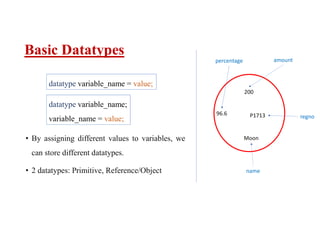
• By assigning different values to variables, we
can store different datatypes.
• 2 datatypes: Primitive, Reference/Object
96.6
200
P1713
Moon
name
regno
amountpercentage
datatype variable_name = value;
datatype variable_name;
variable_name = value;
Basic Datatypes – Primitive Data Types
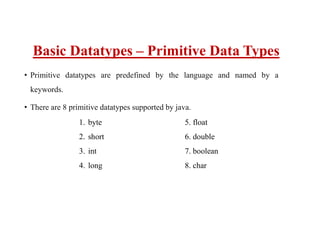
• Primitive datatypes are predefined by the language and named by a
keywords.
• There are 8 primitive datatypes supported by java.
1. byte
2. short
3. int
4. long
5. float
6. double
7. boolean
8. char
Primitive Data Types ( byte)
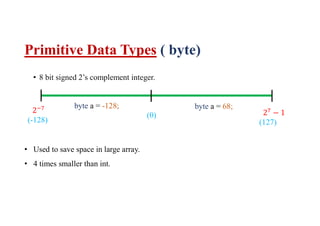
• 8 bit signed 2’s complement integer.
(-128)
(0)
• Used to save space in large array.
• 4 times smaller than int.
byte a = 68;
(127)
byte a = -128;
Primitive Data Types ( short)
• 16 bit signed 2’s complement integer.
(-32,768)
(0)
(32,767)
• Used to save space in large array.
• 2 times smaller than int.
short a = 1000;short a = -1000;
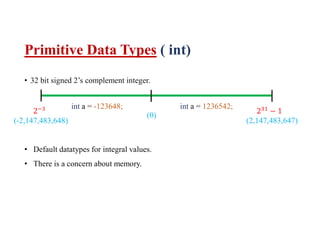
Primitive Data Types ( int)
• 32 bit signed 2’s complement integer.
(-2,147,483,648)
(0)
(2,147,483,647)
• Default datatypes for integral values.
• There is a concern about memory.
int a = 1236542;int a = -123648;
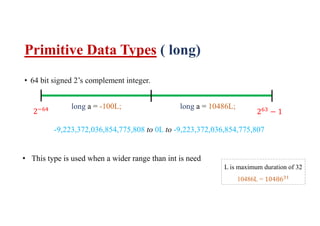
Primitive Data Types ( long)
• 64 bit signed 2’s complement integer.
• This type is used when a wider range than int is need
long a = 10486L;long a = -100L;
L is maximum duration of 32
10486L =
-9,223,372,036,854,775,808 to 0L to -9,223,372,036,854,775,807
Primitive Data Types ( float)
• single-precision 32-bit IEEE 754 floating point.
• Used to save memory in large arrays of floating point values.
• Never used for precise values such as currency.
float a = 234.5f;0.0f
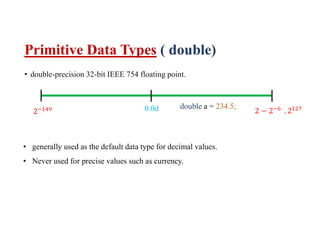
Primitive Data Types ( double)
• double-precision 32-bit IEEE 754 floating point.
• generally used as the default data type for decimal values.
• Never used for precise values such as currency.
double a = 234.5;0.0d
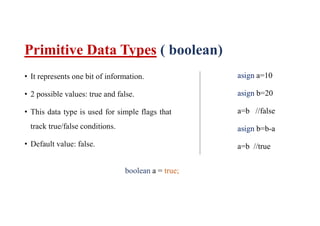
Primitive Data Types ( boolean)
• It represents one bit of information.
• 2 possible values: true and false.
• This data type is used for simple flags that
track true/false conditions.
• Default value: false.
boolean a = true;
asign a=10
asign b=20
a=b //false
asign b=b-a
a=b //true
Primitive Data Types ( char)
• 16 bit Unicode character.
• Char data type is used to store any character.
char a = ‘A’;‘u0000’
(0)
‘uffff’
(65,535 inclusive)
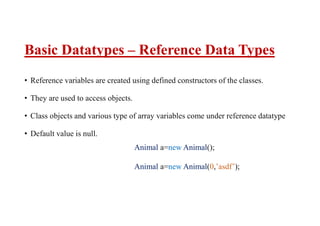
Basic Datatypes – Reference Data Types
• Reference variables are created using defined constructors of the classes.
• They are used to access objects.
• Class objects and various type of array variables come under reference datatype
• Default value is null.
Animal a=new Animal();
Animal a=new Animal(0,’asdf’);
Basic Datatypes Notation Character represented
n Newline (0x0a)
r Carriage return (0x0d)
f Formfeed (0x0c)
b Backspace (0x08)
s Space (0x20)
t tab
" Double quote
' Single quote
 backslash
ddd Octal character (ddd)
uxxxx Hexadecimal UNICODE
character (xxxx)
• Few special escape
sequences for String
and char literals

Java basic datatypes

  • 2.
    Basic Datatypes • Datatypes:int, String, float, short, byte, long, double, Boolean. • Datatypes used to create a variables. • Variables are reserved memory location to store values. • When we create variables, we receive some space in memory. 96.6 200 P1713 Moon name regno amountpercentage
  • 3.
    Basic Datatypes • Byassigning different values to variables, we can store different datatypes. • 2 datatypes: Primitive, Reference/Object 96.6 200 P1713 Moon name regno amountpercentage datatype variable_name = value; datatype variable_name; variable_name = value;
  • 4.
    Basic Datatypes –Primitive Data Types • Primitive datatypes are predefined by the language and named by a keywords. • There are 8 primitive datatypes supported by java. 1. byte 2. short 3. int 4. long 5. float 6. double 7. boolean 8. char
  • 5.
    Primitive Data Types( byte) • 8 bit signed 2’s complement integer. (-128) (0) • Used to save space in large array. • 4 times smaller than int. byte a = 68; (127) byte a = -128;
  • 6.
    Primitive Data Types( short) • 16 bit signed 2’s complement integer. (-32,768) (0) (32,767) • Used to save space in large array. • 2 times smaller than int. short a = 1000;short a = -1000;
  • 7.
    Primitive Data Types( int) • 32 bit signed 2’s complement integer. (-2,147,483,648) (0) (2,147,483,647) • Default datatypes for integral values. • There is a concern about memory. int a = 1236542;int a = -123648;
  • 8.
    Primitive Data Types( long) • 64 bit signed 2’s complement integer. • This type is used when a wider range than int is need long a = 10486L;long a = -100L; L is maximum duration of 32 10486L = -9,223,372,036,854,775,808 to 0L to -9,223,372,036,854,775,807
  • 9.
    Primitive Data Types( float) • single-precision 32-bit IEEE 754 floating point. • Used to save memory in large arrays of floating point values. • Never used for precise values such as currency. float a = 234.5f;0.0f
  • 10.
    Primitive Data Types( double) • double-precision 32-bit IEEE 754 floating point. • generally used as the default data type for decimal values. • Never used for precise values such as currency. double a = 234.5;0.0d
  • 11.
    Primitive Data Types( boolean) • It represents one bit of information. • 2 possible values: true and false. • This data type is used for simple flags that track true/false conditions. • Default value: false. boolean a = true; asign a=10 asign b=20 a=b //false asign b=b-a a=b //true
  • 12.
    Primitive Data Types( char) • 16 bit Unicode character. • Char data type is used to store any character. char a = ‘A’;‘u0000’ (0) ‘uffff’ (65,535 inclusive)
  • 13.
    Basic Datatypes –Reference Data Types • Reference variables are created using defined constructors of the classes. • They are used to access objects. • Class objects and various type of array variables come under reference datatype • Default value is null. Animal a=new Animal(); Animal a=new Animal(0,’asdf’);
  • 14.
    Basic Datatypes NotationCharacter represented n Newline (0x0a) r Carriage return (0x0d) f Formfeed (0x0c) b Backspace (0x08) s Space (0x20) t tab " Double quote ' Single quote backslash ddd Octal character (ddd) uxxxx Hexadecimal UNICODE character (xxxx) • Few special escape sequences for String and char literals