Comparisons between C and Python
Dr. R.. Kindle Edition.
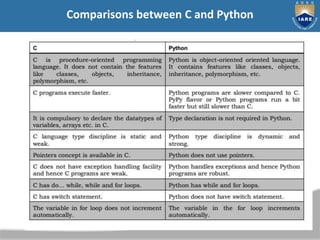
Comparisons between C and Python
Dr. R.. Kindle Edition.
UNIT -I
GuidoV
anRossum
2
Brief History of Python Language
3
• Python is a general-purpose, dynamic, interpreted high-level
programming language.
• Conceptualized in the late 1980’s.
• Created by Guido van Rossum (Netherlands) and first released in 1991.
• A descendant of ABC language.
• Open sourced from the beginning, managed by Python Software
Foundation.
• Scalable, Object oriented and functional from the beginning.
• Python versions
First version 0.9.0 in February 1991
Version 1.0 in January 1994
 Version 2.0 in October 2000
Version 3.0 in 2008
Best Programming Language
Features of Python Language
• Simple
• Easy to learn
• Open source
• High level language
• Dynamically typed
• Platform independent
• Portable
• Procedure and object oriented
Python Interactive Shell
• Python provides an interactive shell, which is used in between the user and
operating system
• In other words, Python provides a command line interface with the Python
shell known as Python interactive shell.
• Python commands are run using the Python interactive shell.
• User can work with Python shell in two modes: interactive mode and script
mode.
• Interactive mode allows the user to interact with the operating system. When
the user types any Python statement / expression, the interpreter displays the
results instantly.
• In script mode, user types a Python program in a file and then uses the
interpreter to execute the file. In interactive mode, user can’t save the
statements / expressions and need to retype once again to re-run them.
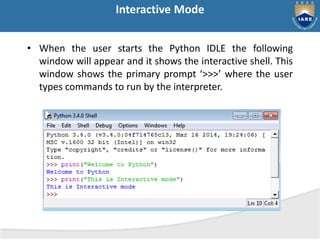
Interactive Mode
• When the user starts the Python IDLE the following
window will appear and it shows the interactive shell. This
window shows the primary prompt ‘>>>’ where the user
types commands to run by the interpreter.
Script Mode
• In this mode, user types a set of statements called a
program in a file and then save the program with
‘filename.py’ as extension. Then the interpreter is used to
execute the file contents. This mode is convenient when
the user wants to write and save multiple lines of code, so
that it can be easily modifiable and reusable.
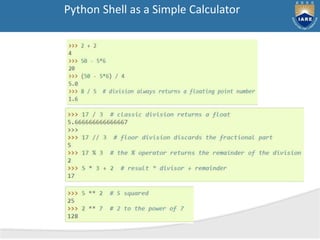
Python Shell as a Simple Calculator
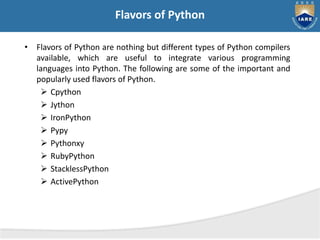
Flavors of Python
• Flavors of Python are nothing but different types of Python compilers
available, which are useful to integrate various programming
languages into Python. The following are some of the important and
popularly used flavors of Python.
 Cpython
 Jython
 IronPython
 Pypy
 Pythonxy
 RubyPython
 StacklessPython
 ActivePython
Built-in Data Types in Python
• Every programming language has the ability to create and manipulate
object / variable. In a program variables are used to store values so
that it can be used later. Every object / variable has an identity, type
and a value which it refers. Identity of an object is nothing but its
address in memory when it is created. Type or data type indicates is a
range of values and operations allowed on those values.
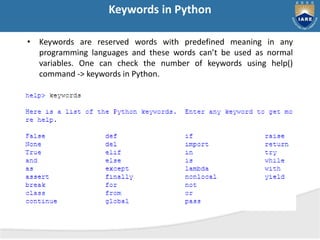
Keywords in Python
• Keywords are reserved words with predefined meaning in any
programming languages and these words can’t be used as normal
variables. One can check the number of keywords using help()
command -> keywords in Python.
Assigning values to variables
>>> a = 100 # a is integer
>>> height = 50.5 #height is float
>>> player = "Sachin" #player is string
>>> x = y = z = 10 # This statement assign 10 to x, y, z
>>> x = 5
>>> x #assigns 5 to x
>>> 5 = x #SyntaxError: can't assign to literal
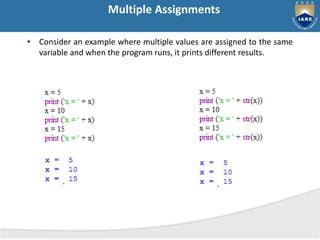
Multiple Assignments
• Consider an example where multiple values are assigned to the same
variable and when the program runs, it prints different results.
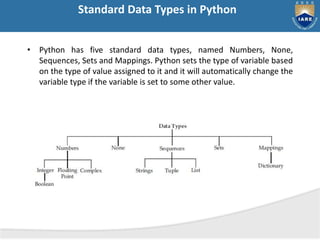
Standard Data Types in Python
• Python has five standard data types, named Numbers, None,
Sequences, Sets and Mappings. Python sets the type of variable based
on the type of value assigned to it and it will automatically change the
variable type if the variable is set to some other value.
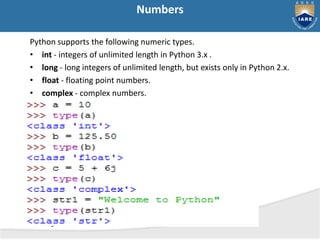
Numbers
Python supports the following numeric types.
• int - integers of unlimited length in Python 3.x .
• long - long integers of unlimited length, but exists only in Python 2.x.
• float - floating point numbers.
• complex - complex numbers.
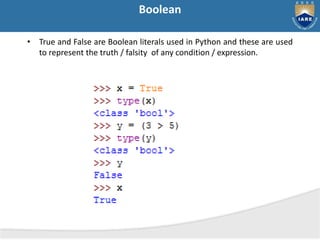
Boolean
• True and False are Boolean literals used in Python and these are used
to represent the truth / falsity of any condition / expression.
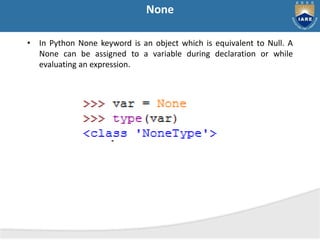
None
• In Python None keyword is an object which is equivalent to Null. A
None can be assigned to a variable during declaration or while
evaluating an expression.
Strings
• Strings are identified as group of characters represented in quotation
marks. Python allows both a pair of single and double quotes for
writing strings. Strings written in triple quotes can span multiple lines
of text. Strings in Python are immutable data type i.e. each time a
new string object is created when one makes any changes to a string.
Strings
•Python can also manipulate strings. They can be enclosed in single
quotes (‘abc’) or double quotes (“abc”) with the same result.
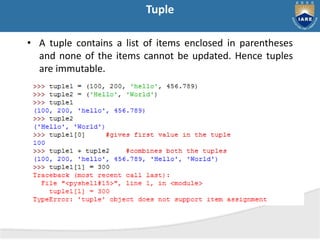
Tuple
• A tuple contains a list of items enclosed in parentheses
and none of the items cannot be updated. Hence tuples
are immutable.
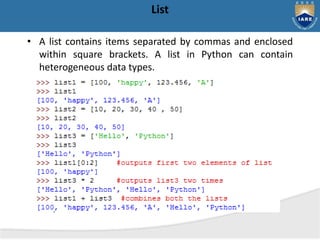
List
• A list contains items separated by commas and enclosed
within square brackets. A list in Python can contain
heterogeneous data types.
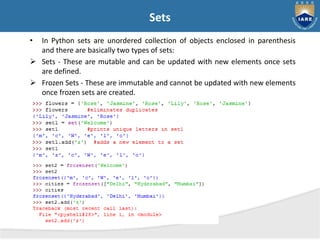
Sets
• In Python sets are unordered collection of objects enclosed in parenthesis
and there are basically two types of sets:
 Sets - These are mutable and can be updated with new elements once sets
are defined.
 Frozen Sets - These are immutable and cannot be updated with new elements
once frozen sets are created.
Dictionary
• In Python dictionary data type consists of key-value pairs and it is
enclosed by curly braces. Values can be assigned and accessed using
square brackets.

Python Data types like mutable and immutable

  • 1.
    Comparisons between Cand Python Dr. R.. Kindle Edition.
  • 2.
    Comparisons between Cand Python Dr. R.. Kindle Edition.
  • 3.
  • 4.
  • 5.
    Brief History ofPython Language 3 • Python is a general-purpose, dynamic, interpreted high-level programming language. • Conceptualized in the late 1980’s. • Created by Guido van Rossum (Netherlands) and first released in 1991. • A descendant of ABC language. • Open sourced from the beginning, managed by Python Software Foundation. • Scalable, Object oriented and functional from the beginning. • Python versions First version 0.9.0 in February 1991 Version 1.0 in January 1994  Version 2.0 in October 2000 Version 3.0 in 2008
  • 6.
  • 7.
    Features of PythonLanguage • Simple • Easy to learn • Open source • High level language • Dynamically typed • Platform independent • Portable • Procedure and object oriented
  • 8.
    Python Interactive Shell •Python provides an interactive shell, which is used in between the user and operating system • In other words, Python provides a command line interface with the Python shell known as Python interactive shell. • Python commands are run using the Python interactive shell. • User can work with Python shell in two modes: interactive mode and script mode. • Interactive mode allows the user to interact with the operating system. When the user types any Python statement / expression, the interpreter displays the results instantly. • In script mode, user types a Python program in a file and then uses the interpreter to execute the file. In interactive mode, user can’t save the statements / expressions and need to retype once again to re-run them.
  • 9.
    Interactive Mode • Whenthe user starts the Python IDLE the following window will appear and it shows the interactive shell. This window shows the primary prompt ‘>>>’ where the user types commands to run by the interpreter.
  • 10.
    Script Mode • Inthis mode, user types a set of statements called a program in a file and then save the program with ‘filename.py’ as extension. Then the interpreter is used to execute the file contents. This mode is convenient when the user wants to write and save multiple lines of code, so that it can be easily modifiable and reusable.
  • 11.
    Python Shell asa Simple Calculator
  • 12.
    Flavors of Python •Flavors of Python are nothing but different types of Python compilers available, which are useful to integrate various programming languages into Python. The following are some of the important and popularly used flavors of Python.  Cpython  Jython  IronPython  Pypy  Pythonxy  RubyPython  StacklessPython  ActivePython
  • 13.
    Built-in Data Typesin Python • Every programming language has the ability to create and manipulate object / variable. In a program variables are used to store values so that it can be used later. Every object / variable has an identity, type and a value which it refers. Identity of an object is nothing but its address in memory when it is created. Type or data type indicates is a range of values and operations allowed on those values.
  • 14.
    Keywords in Python •Keywords are reserved words with predefined meaning in any programming languages and these words can’t be used as normal variables. One can check the number of keywords using help() command -> keywords in Python.
  • 15.
    Assigning values tovariables >>> a = 100 # a is integer >>> height = 50.5 #height is float >>> player = "Sachin" #player is string >>> x = y = z = 10 # This statement assign 10 to x, y, z >>> x = 5 >>> x #assigns 5 to x >>> 5 = x #SyntaxError: can't assign to literal
  • 16.
    Multiple Assignments • Consideran example where multiple values are assigned to the same variable and when the program runs, it prints different results.
  • 17.
    Standard Data Typesin Python • Python has five standard data types, named Numbers, None, Sequences, Sets and Mappings. Python sets the type of variable based on the type of value assigned to it and it will automatically change the variable type if the variable is set to some other value.
  • 18.
    Numbers Python supports thefollowing numeric types. • int - integers of unlimited length in Python 3.x . • long - long integers of unlimited length, but exists only in Python 2.x. • float - floating point numbers. • complex - complex numbers.
  • 19.
    Boolean • True andFalse are Boolean literals used in Python and these are used to represent the truth / falsity of any condition / expression.
  • 20.
    None • In PythonNone keyword is an object which is equivalent to Null. A None can be assigned to a variable during declaration or while evaluating an expression.
  • 21.
    Strings • Strings areidentified as group of characters represented in quotation marks. Python allows both a pair of single and double quotes for writing strings. Strings written in triple quotes can span multiple lines of text. Strings in Python are immutable data type i.e. each time a new string object is created when one makes any changes to a string.
  • 22.
    Strings •Python can alsomanipulate strings. They can be enclosed in single quotes (‘abc’) or double quotes (“abc”) with the same result.
  • 23.
    Tuple • A tuplecontains a list of items enclosed in parentheses and none of the items cannot be updated. Hence tuples are immutable.
  • 24.
    List • A listcontains items separated by commas and enclosed within square brackets. A list in Python can contain heterogeneous data types.
  • 25.
    Sets • In Pythonsets are unordered collection of objects enclosed in parenthesis and there are basically two types of sets:  Sets - These are mutable and can be updated with new elements once sets are defined.  Frozen Sets - These are immutable and cannot be updated with new elements once frozen sets are created.
  • 26.
    Dictionary • In Pythondictionary data type consists of key-value pairs and it is enclosed by curly braces. Values can be assigned and accessed using square brackets.