Pythagoras TheoremPythagoras Theorem
Reminder of square numbers:
12
= 1 x 1 = 1
22
= 2 x 2 = 4
32
= 3 x 3 = 9
42
= 4 x 4 = 16
32
Base number
Index number
The index number tells us how
many times the base number
is multiplied by itself.
e.g. 34
means 3 x 3 x 3 x 3 = 81
1,4,9,16, …. are the answers to a number being squared so they
are called square numbers.
Pythagoras TheoremPythagoras Theorem
Square root means think what is multiplied by itself to
make this number?
Answer these questions:
=1
=4
=9
=16
=49
=81
=211
=001
1
2
3
4
7
9
11
10
Use your calculator to answer
these questions:
=8.5
=4.25
=169
=400
=1000
=8100
=225
=361
2.408
5.040
13
20
31.623
90
15
19
Pythagoras TheoremPythagoras Theorem
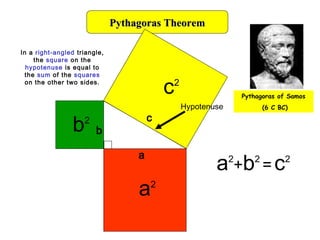
c2
b2
a2
a2
+b2
= c2
b
a
c
In a right-angled triangle,
the square on the
hypotenuse is equal to
the sum of the squares
on the other two sides.
Hypotenuse
Pythagoras of Samos
(6 C BC)
b
a
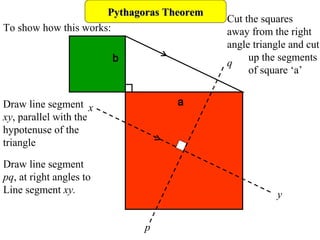
Cut the squares
away from the right
angle triangle and cut
up the segments
of square ‘a’
Draw line segment
xy, parallel with the
hypotenuse of the
triangle
x
y
q
p
Draw line segment
pq, at right angles to
Line segment xy.
Pythagoras TheoremPythagoras Theorem
To show how this works:
Now rearrange them
to look like this.
You can see that they
make a square with
length of side ‘c’.
This demonstrates that
the areas of squares
a and b
add up to be the
area of square c
a2
+b2
= c2
2 2 2
3 4x = +
2 2
3 4x = +
5 cmx =
2 2 2
5 12x = +
2 2
5 12x = +
13 cmx =
3 cm
4 cm
x
1
5 cm
12 cm
x
2
Pythagoras TheoremPythagoras Theorem
9 + 16x =
25x =
169x =
Pythagoras TheoremPythagoras Theorem
2 2 2
5 6x = +
2 2
5 6x = +
7.8 cm (1 dp)x =
2 2 2
4.6 9.8x = +
2 2
4.6 9.8x = +
10.8 cm (1 dp)x =
5 cm
6 cm
x
3
4.6
cm
9.8 cm
x
4
Pythagoras TheoremPythagoras Theorem
Now do these:
x m
9 m
11m5
11 cm
23.8 cm6
x m
7.1 cm
x cm
3.4 cm7
8
25 m
7 m
x m
2 2 2
11 9x = −
2 2
11 9x = −
6.3 m (1 dp)x =
2 2 2
23.8 11x = −
2 2
23.8 11x = −
21.1 cm (1 dp)x =
2 2 2
7.1 3.4x = +
2 2
7.1 3.4x = +
7.9 cm (1 dp)x =
2 2 2
25 7x = −
2 2
25 7x = −
24 mx =
Pythagoras TheoremPythagoras Theorem
A boat sails due East from a Harbour (H), to a marker buoy (B),15 miles away.
At B the boat turns due South and sails for 6.4 miles to a Lighthouse (L). It then
returns to harbour. What is the total distance travelled by the boat?
2 2 2
15 6.4LH = +
2 2
15 6.4LH = +
16.3 milesLH =
∴Total distance travelled = 21.4 + 16.4 = 37.7 miles
H
B
L
15 miles
6.4
miles
Pythagoras TheoremPythagoras Theorem
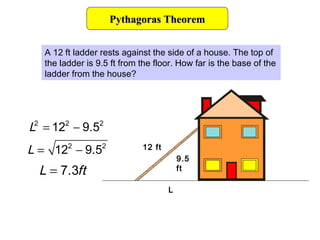
12 ft
9.5
ft
L
A 12 ft ladder rests against the side of a house. The top of
the ladder is 9.5 ft from the floor. How far is the base of the
ladder from the house?
2 2 2
12 9.5L = −
2 2
12 9.5L = −
7.3L ft=
Pythagoras
Pythagoras

Pythagoras

  • 1.
    Pythagoras TheoremPythagoras Theorem Reminderof square numbers: 12 = 1 x 1 = 1 22 = 2 x 2 = 4 32 = 3 x 3 = 9 42 = 4 x 4 = 16 32 Base number Index number The index number tells us how many times the base number is multiplied by itself. e.g. 34 means 3 x 3 x 3 x 3 = 81 1,4,9,16, …. are the answers to a number being squared so they are called square numbers.
  • 2.
    Pythagoras TheoremPythagoras Theorem Squareroot means think what is multiplied by itself to make this number? Answer these questions: =1 =4 =9 =16 =49 =81 =211 =001 1 2 3 4 7 9 11 10 Use your calculator to answer these questions: =8.5 =4.25 =169 =400 =1000 =8100 =225 =361 2.408 5.040 13 20 31.623 90 15 19
  • 3.
    Pythagoras TheoremPythagoras Theorem c2 b2 a2 a2 +b2 =c2 b a c In a right-angled triangle, the square on the hypotenuse is equal to the sum of the squares on the other two sides. Hypotenuse Pythagoras of Samos (6 C BC)
  • 4.
    b a Cut the squares awayfrom the right angle triangle and cut up the segments of square ‘a’ Draw line segment xy, parallel with the hypotenuse of the triangle x y q p Draw line segment pq, at right angles to Line segment xy. Pythagoras TheoremPythagoras Theorem To show how this works:
  • 5.
    Now rearrange them tolook like this. You can see that they make a square with length of side ‘c’. This demonstrates that the areas of squares a and b add up to be the area of square c a2 +b2 = c2
  • 6.
    2 2 2 34x = + 2 2 3 4x = + 5 cmx = 2 2 2 5 12x = + 2 2 5 12x = + 13 cmx = 3 cm 4 cm x 1 5 cm 12 cm x 2 Pythagoras TheoremPythagoras Theorem 9 + 16x = 25x = 169x =
  • 7.
    Pythagoras TheoremPythagoras Theorem 22 2 5 6x = + 2 2 5 6x = + 7.8 cm (1 dp)x = 2 2 2 4.6 9.8x = + 2 2 4.6 9.8x = + 10.8 cm (1 dp)x = 5 cm 6 cm x 3 4.6 cm 9.8 cm x 4
  • 8.
    Pythagoras TheoremPythagoras Theorem Nowdo these: x m 9 m 11m5 11 cm 23.8 cm6 x m 7.1 cm x cm 3.4 cm7 8 25 m 7 m x m 2 2 2 11 9x = − 2 2 11 9x = − 6.3 m (1 dp)x = 2 2 2 23.8 11x = − 2 2 23.8 11x = − 21.1 cm (1 dp)x = 2 2 2 7.1 3.4x = + 2 2 7.1 3.4x = + 7.9 cm (1 dp)x = 2 2 2 25 7x = − 2 2 25 7x = − 24 mx =
  • 9.
    Pythagoras TheoremPythagoras Theorem Aboat sails due East from a Harbour (H), to a marker buoy (B),15 miles away. At B the boat turns due South and sails for 6.4 miles to a Lighthouse (L). It then returns to harbour. What is the total distance travelled by the boat? 2 2 2 15 6.4LH = + 2 2 15 6.4LH = + 16.3 milesLH = ∴Total distance travelled = 21.4 + 16.4 = 37.7 miles H B L 15 miles 6.4 miles
  • 10.
    Pythagoras TheoremPythagoras Theorem 12ft 9.5 ft L A 12 ft ladder rests against the side of a house. The top of the ladder is 9.5 ft from the floor. How far is the base of the ladder from the house? 2 2 2 12 9.5L = − 2 2 12 9.5L = − 7.3L ft=