Nebular, a long-time reference
                                                                                                                package for the analysis of emission
                                                                                                                lines, started as a simple Fortran
                                                                                                                program and evolved into a
                                                                          nebular is being migrated             powerful IRAF package.
                                                                          to a new environment, to
                                                                          make it more powerful                 In essence, nebular works by
                                                                                                                solving the equilibrium equations
                                                                          and user-friendly...
                                                                                                                for an n-level atom.


                                                                                                                         These are some of the things nebular is able to compute:

                                                                                                                         - physical conditions from suitable dignostic line ratios.
                                                                                                                         - level populations, critical densities and line emissivities
                                                                                                                         - 3-zone nebula models from sets of line ratios
                                                                                                                         - dereddened line intensities
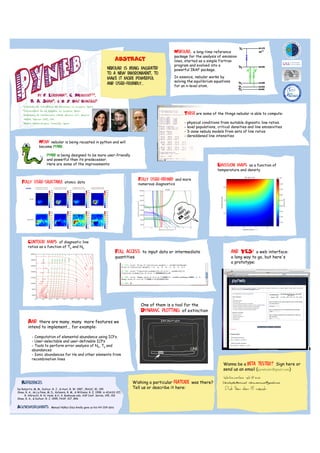
                 Now nebular is being recasted in python and will
                 become pyneb.

                        pyneb is being designed to be more user-friendly
                        and powerful than its predecessor.
                        Here are some of the improvements:                                                                                   Emission maps as a function of
                                                                                                                                             temperature and density

                                                                                             Fully user-defined and more
       Fully user-selectable atomic data                                                     numerous diagnostics


                                                                                                                       y!
                                                                                                                    he e's
                                                                                                                        r     s
                                                                                                                    t he line
                                                                                                                              !
                                                                                                                     IR too


          Contour maps of diagnostic line
          ratios as a function of Te and Ne
                                                                                Full access to input data or intermediate                               and YES! a web interface:
                                                                                quantities                                                              a long way to go, but here's
                                                                                                                                                        a prototype:


                                                                                              One of them is a tool for the
                                                                                              Dynamic plotting of extinction

          And there are many, many more features we
          intend to implement... for example:

            - Computation of elemental abundance using ICFs.
            - User-selectable and user-definable ICFs
            - Tools to perform error analysis of Ne, Te and
            abundances
            - Ionic abundances for He and other elements from
            recombination lines
                                                                                                                                                 Wanna be a beta tester? Sign here or
                                                                                                                                                 send us an email (pynebular@gmail.com)
                                                                                                                                                 Valentina Luridiana (vale AT iac.es
       References                                                                        Wishing a particular feature was there?                 ChristopheMorisset chris.morisset@gmail.com
	
  
De Robertis, M. M., Dufour, R. J., & Hunt, R. W. 1987, JRASC, 81, 195                    Tell us or describe it here:                             Dick Shaw: shaw@ AT noao.edu
Shaw, R. A., de La Pena, M. D., Katsanis, R. M., & Williams, R. E. 1998, in ADASS VII,
     R. Albrecht, R. N. Hook, & H. A. Bushouse eds, ASP Conf. Series, 145, 192
Shaw, R. A., & Dufour, R. J. 1995, PASP, 107, 896


Acknowledgments:            Manuel Núñez-Díaz kindly gave us his HH 204 data


From nebular to pynebular: a new package for the analysis of emission lines

  • 1.
    Nebular, a long-timereference package for the analysis of emission lines, started as a simple Fortran program and evolved into a nebular is being migrated powerful IRAF package. to a new environment, to make it more powerful In essence, nebular works by solving the equilibrium equations and user-friendly... for an n-level atom. These are some of the things nebular is able to compute: - physical conditions from suitable dignostic line ratios. - level populations, critical densities and line emissivities - 3-zone nebula models from sets of line ratios - dereddened line intensities Now nebular is being recasted in python and will become pyneb. pyneb is being designed to be more user-friendly and powerful than its predecessor. Here are some of the improvements: Emission maps as a function of temperature and density Fully user-defined and more Fully user-selectable atomic data numerous diagnostics y! he e's r s t he line ! IR too Contour maps of diagnostic line ratios as a function of Te and Ne Full access to input data or intermediate and YES! a web interface: quantities a long way to go, but here's a prototype: One of them is a tool for the Dynamic plotting of extinction And there are many, many more features we intend to implement... for example: - Computation of elemental abundance using ICFs. - User-selectable and user-definable ICFs - Tools to perform error analysis of Ne, Te and abundances - Ionic abundances for He and other elements from recombination lines Wanna be a beta tester? Sign here or send us an email (pynebular@gmail.com) Valentina Luridiana (vale AT iac.es References Wishing a particular feature was there? ChristopheMorisset chris.morisset@gmail.com   De Robertis, M. M., Dufour, R. J., & Hunt, R. W. 1987, JRASC, 81, 195 Tell us or describe it here: Dick Shaw: shaw@ AT noao.edu Shaw, R. A., de La Pena, M. D., Katsanis, R. M., & Williams, R. E. 1998, in ADASS VII, R. Albrecht, R. N. Hook, & H. A. Bushouse eds, ASP Conf. Series, 145, 192 Shaw, R. A., & Dufour, R. J. 1995, PASP, 107, 896 Acknowledgments: Manuel Núñez-Díaz kindly gave us his HH 204 data