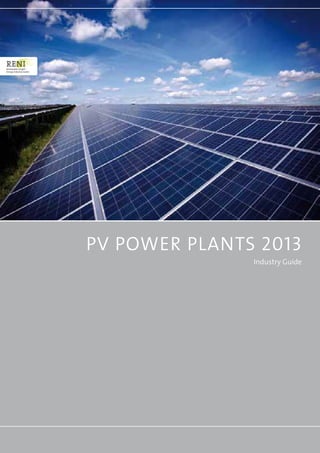
PV Power Plants 2013
Industry Guide
Industry Guide
PV Power Plants 2013
Industry Guide

Cover images
Front
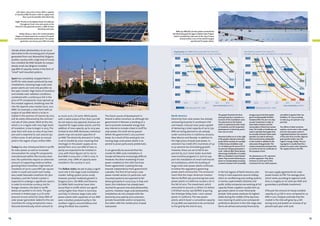
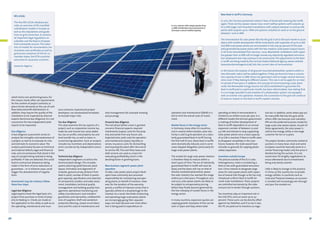
The Jännersdorf Solar Park in Brandenburg (Prignitz), which
boasts a capacity of 40.5 MW, was completed in June 2012 and
put into operation in accordance with the German Renewable
Energy Sources Act (EEG).
Photo: Tom Baerwald/Parabel AG
Back
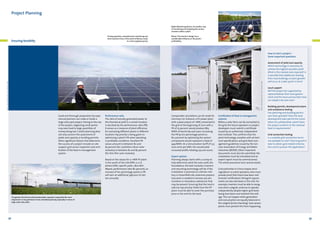
Central inverters in a large-scale PV installation
Photo: Regine Baeker/shotshop.com

3
Contents

	 4 	 Forewords
	
		 The Industry
	 8 	 Heading for New Dimensions
	 12 	National Markets
	 20 	Technology
	 28 	 Financing
	 32 	 Project Planning
	 36 	 “PV’s ability to provide grid support
is underrated”
Interview with
Dr. Winfried Hoffmann, EPIA


		 Companies
	 40	Overview
	 42	 Business Areas
	
	 44	 3E
	 45	ABB
	 46	Activ Solar
	 47	Advanced Energy
	 48	AEG Power Solutions GmbH
	 49	Alternative Antriebe &
Erneuerbare Energien
	 50	AXITEC GmbH
	 51	 Bonfiglioli Riduttori S.p.A.
	 52	 BELECTRIC Solarkraftwerke GmbH
	 54	 Dow Corning Europe SA
	 55	 F&S solar concept GmbH
	 56	 Fronius Deutschland GmbH
	 57	 GP JOULE GmbH
	 58	 Ingeteam Power Technology, S.A.
	 59	Nuevosol Energy
	 60	 Mounting Systems
	 62	 Platinum® GmbH
	 63	 Power-One
	 64	 PROFIL DU FUTUR
	 65	Schneider Electric
	 66	 skytron® energy GmbH
	 67	SMA Solar Technology AG
	 68	SolarMax
	 69	SolarWorld AG
	 70	Solectria Renewables
	 71	TÜV SÜD
		 Publishers
	 73 	Solarpraxis AG
	 74	Sunbeam GmbH

RENI – Renewables Insight
is a brand from Solarpraxis AG
and Sunbeam GmbH.

	 75 	 Important Notice, Picture Credits
	 76	Legal Information

3
Photovoltaics’ Innovative Forces

PV as a Power Player

By Karl-Heinz Remmers,
CEO of Solarpraxis AG

By Dr. Winfried Hoffmann,
President of the European Photovoltaic Industry Association (EPIA)

Dear Readers,
If a British company in the automotive
industry builds a five megawatt (MW)
solar plant on its factory roofs in the
North West of England, as happened
recently, a large amount of solar power
no longer flows into the grid. The plant
capacity covers up to 40 percent of the
company’s energy needs. This way, that
40 percent can be used at a stable price
regardless of market prices for electricity because it is produced and consumed
on site.

Another example of how energy-intensive production facilities have made
major headway when it comes to energy
self-sufficiency can be found on the
other side of the globe. In Tennessee,
USA, a PV plant produces 9.5 MW of
rated output on the premises of an
automobile factory. When the manufacturing facility operates at full capacity,
the solar power plant provides 12.5
percent of the electricity required. It can
even meet the entire energy needs if
production is ground to a halt.
These two projects show that more and
more energy-intensive companies are
now turning to the on-site production of
solar power in the megawatt range to, at
least in part, meet their energy needs.
However, what happens if the electricity
is to be consumed off site and several
megawatts of power are to be integrated
into the public grid as usual? After all, the
continued success of renewable energy
increases the risk of overloading the
power grid because sun and wind provide
fluctuating energy that does not follow
consumption.
Storage systems are the solution. They
are both an opportunity and a necessity.
On one hand, they allow for a time gap
between power production and consumption (which of course is also good
for direct consumption); on the other
hand, the energy revolution can only be
successful if renewable energy storage
systems can ease the burden on the
public power grid in the long term.
However, large-scale storage for PV
plants is not yet competitive, with the
exception of pumped storage. Specific
geographical conditions are needed for
pumped storage, which can therefore
only be implemented in a limited number
of places and, even then, this significantly
impacts the environment – decentralization is a different matter.

4

Although the technological tug of war
has only just begun and it remains to be
seen if we will combine mechanical,
electrochemical or electrical storage with
large-scale PV plants in the future, storage systems will no doubt transform the
centralized grid structure into a decentralized one. Together with an intelligent
energy management system, they pave
the way for large-scale grid integration of
photovoltaic power. Technology that is
used in various applications from load
balancing to cloud mitigation will play an
important role in the near future. The
inverter will become a flexible interface
which takes over associated system
management tasks.
Experts are still engaged in a zealous
debate when it comes to weighing up
the costs and benefits of storage technologies. Most concepts for large-scale PV
plants have not yet emerged from the
experimental stage. Small, privatelyowned PV systems will be the first to see
storage take hold, in favor of increased
direct consumption. A look at current
projects shows that storage for largescale plants is still a marginal topic and a
major challenge. That said, the industry is
already waiting in the wings – and photovoltaics will once again prove how it is
driving the energy revolution forward
thanks to its innovative force.
Best regards,

Karl-Heinz Remmers

Dear Readers,
PV is no longer a niche technology. It is
rapidly becoming an important contributor to Europe’s power system. As
large-scale PV plants provide an ever-increasing share of the continent’s
electricity, stakeholders and policymakers need to consider some new challenges, including how to integrate variable
electricity production into the grid.
While there is no denying that the PV
industry has been navigating difficult
waters over the past year or two, it is also
true that the technology is holding
steady on its course for competitiveness
against other sources of electricity. The
world’s cumulative PV capacity surpassed
an astounding 100 gigawatts (GW) in
2012 – a landmark few would have
thought possible even five years ago. And
in 2012, more than 30 GW of PV capacity
were installed globally, nearly the same
as in the record-setting year of 2011. In
some regions (e.g. Germany, Italy) there is
already today a high penetration of PV in
the distribution grid. The associated
challenges can be solved by providing
grid services from the PV systems and
sound adaptation of the future smart
grid.
But as the saying goes: With great power
comes great responsibility. The increasing
share of PV electricity in Europe’s power
system is raising a series of important
issues – mainly stemming from the
variable nature of PV electricity generation. However, as shown in the recent
EPIA report, “Connecting the Sun: Solar
photovoltaics on the road to large-scale
grid integration”, PV is already providing
solutions to these challenges.

Without a doubt, large-scale PV plants
remain an important driver of the technology’s evolution into a mature and
mainstream energy source. But it’s clear
the market is changing in important
ways. Europe’s dominance of PV in all
segments is giving way to a more balanced – and, ultimately, sustainable –
market with different regions around the
world driving different segments.
Going forward, the utility-scale segment
is expected to decline or at best stagnate
in Europe even as it booms in the Americas and Asia including China and Japan.
Under almost any scenario for the coming five years, the Asia-Pacific region
should see the largest share of new
utility-scale applications.
But the fact that the market for big PV
power plants is changing does not diminish the importance of its role in meeting
Europe’s ambitious energy and environmental goals. PV can, together with wind,
help provide up to 45 percent or Europe’s
electricity needs in 2030. With the right
policies in place, even the utility-scale
segment can grow in Europe over the
medium to long term, especially in southern Europe.
People want solar power. Even the technology’s harshest critics in the conventional energy sectors will ultimately have
to agree that under all scenarios envisioned in the coming decades, solar PV
will be a major part of Europe’s (and the
world’s) electricity mix – with electricity
gaining an increasing share in the global
future secondary energy.
Best regards,

Dr. Winfried Hoffmann

5
The Industry

P h oto : Tom Ba e rwa l d / B ELE C TR I C T ra di n g G mb H

7
Heading for New Dimensions
Ground-mounted photovoltaic
power plant in Templin (Germany):
With 1.5 million thin-film modules,
114 central inverters and a capacity
of 128 MW, the power plant plays
an important role in supplying the
wider Berlin area with electricity.

Long-term investment with low risk

The Lieberose Solar Park near Cottbus (Germany):
Covering an area of 660,000 m2, the current second
largest solar park in the world boasts 900,000 thinfilm modules and a capacity of 71 MW.

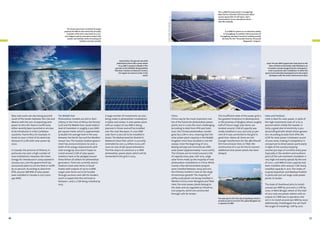
Evolution of PV capacity
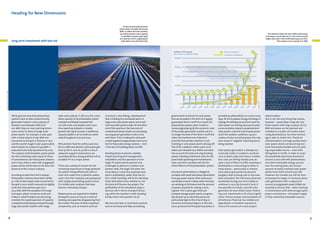
(annual and cumulative) in MW

10

Annual installations

2,

Cumulative installations

100,000

71

15

6

,0

81

80,000
40
,8

70

60,000
23

00

1,7
65

2,

23

5

2,

82

0

3,9

52

5,3
6

4

94
6

9,
52

05

30,391

29

1

31,095

17,064
6,708

7,376

0
0

200

While ground-mounted photovoltaic
systems have to date predominantly
generated medium-scale outputs of
between 500 kilowatts (kW) and
100 MW, they are now reaching dimensions similar to those of large-scale
power plants. For example, a solar park
with a rated output of 290 MW was
connected to the grid in Arizona in 2012
and the world’s largest solar power plant,
which boasts an output of 579 MW, is
expected to be fully operational by 2015.
The outputs of photovoltaic power plants
are thus achieving scales equal to those
of conventional coal-fired power stations,
and in Asia, there is even talk of gigawatt
power plants, which have so far been the
preserve of the nuclear industry.
According to data from the European
Photovoltaic Industry Association (EPIA),
31.1 GW of solar power were connected to
the grid in 2012, which amounts to slightly
more than the previous year (2011:
30.4 GW). With the exception of Europe
and Japan, where numerous small and
medium-sized PV plants are also being
installed, this rapid expansion of capacity
is predominantly being achieved through
large solar power stations with mega-

8

watt-scale outputs. In fall 2012, the cumulative capacity of all photovoltaic plants
installed worldwide exceeded the
100 GW mark, and despite some countries reporting setbacks in market
growth, the rapid increase in additional
capacity added is set to continue worldwide throughout 2013 and 2014.
EPIA predicts that the utility-scale market (2.5 MW and above) could quadruple
from 9 GW in 2012 to 37 GW in 2017, if
adequate support mechanisms are
accompanied by a strong political will to
establish PV as a major power.
There are a variety of reasons for the
increasing importance of large photovoltaic plants. Rising efficiencies, both in
solar cells made from crystalline wafers
and in thin-film modules, are juxtaposed
with rapidly plummeting system prices.
It is chiefly solar modules that have
become noticeably cheaper.
Module prices are expected to stabilize
during the course of 2013 as a result of
existing overcapacities disappearing from
the market. The price of other important
components, such as inverters and sub-

structures, is also falling, a development
that is fuelling the worldwide boom in
large-scale solar power plants and small
roof-mounted systems alike. On the other
end of the spectrum, the fuel costs of
conventional power plants are increasing,
causing power generation costs to rise
with them. This is making the solar park
market segment progressively more lucrative for financially strong investors – even
in the face of tumbling feed-in tariffs.
Deciding factor economic viability
Project planning and management,
installation and the operation of ever
larger PV power plants present new
challenges to planners, investors and
bankers alike. The larger the plant, the
more likely it is that the proposed solar
plant’s profitability, rather than the client’s credit standing, will be the deciding
factor that determines whether or not
the bank will finance the project. The
profitability of the installation plays a
decisive role in terms of project financing, while the investor’s credit standing
hardly comes into question at all.
We must also bear in mind that countries
such as Germany and Italy are slashing

1

200

2

200

3

200

4

200

5

200

government incentives for solar power
that are provided in the form of a legally
guaranteed feed-in tariff. As a result, the
photovoltaics power plant market is
increasingly playing by the economic rules
of the power generation market and it is
no longer the level of the feed-in tariff but
rather the levelized cost of electricity (LCOE) that decides whether or not
investing in solar power plants will pay off.
The LCOE is stated in either euros or US
dollars per kilowatt hour (kWh) and takes
into account the total cost of generating
power, including investment costs for the
plant itself, operating and maintenance
costs, and other variable costs for the
entire lifetime of the photovoltaic system.
At present, photovoltaics is obliged to
compete with peak load power generation
from gas power plants. Peak load occurs
worldwide around midday when factories
are working at full steam and the amount
of power required for cooling is at its
highest. This is when gas-fired and
pumped-storage power plants are generally started up, as electricity prices are
particularly high at this time of day. In
Germany and several regions in the USA,
up to 40 percent of the peak load power is

6

200

7

200

8

200

9

200

2010

2011

2012

provided by photovoltaics on some sunny
days. At the European Energy Exchange in
Leipzig, the falling procurement costs for
solar power are striking, because its yield
curve correlates closely to peak demand.
Solar power curbs the cost of peak power
and if the weather conditions cause a
surplus of solar and wind power, this may
even result in “negative” electricity prices
being reached.
Solar power generation is already economically viable in southern countries
such as Spain, Italy and Greece. Installation costs are falling steadily and, despite a lack of feed-in tariffs, investing in
photovoltaics is becoming lucrative in
many places – particularly in installations where grid parity has become
tangibly close to being met or has even
been exceeded. This trend was observed
worldwide during 2012 and is likely to
continue in 2013. By the end of 2012 it
was possible to install a 770 kW solar
generator for one million euros. Protecting such investments is of critical significance. Precise analysis and evaluation of
all technical, financial, tax-related and
legal details is therefore required to
ensure the success of a solar project.

P h oto : ju w i AG

1,4

6,

,2

Source: EPIA

P h oto : B ELE C TR I C T ra di n g G mb H

20,000

,8

16

40,000

Speed matters
Size is not the only thing that counts,
however – speed plays a big role, too:
Power plants with large outputs of 100
MW and above can be planned and
installed in a matter of months when
using photovoltaics. No other technology is able to match this. Thanks to
standardization and high quality levels,
solar power plants are becoming ever
more financially feasible and are yielding respectable returns – even with
falling feed-in tariffs. In order to cover
the worldwide electricity demand of
around 12,000 GW with photovoltaics
and other renewable energy sources
over the coming years, the annual
amount of newly installed solar power
plants must reach around 300 GW.
However, the markets are still far from
achieving this target. In Germany alone,
solar generators with a capacity of
around 200 gigawatts peak (GWp) are
required to ensure that – when working
in combination with wind energy, hydropower and biomass – the power supply
is fully covered by renewable sources.

9
P h oto : To m Ba e rwa l d

P h oto : To m Ba e rwa l d / B ELE C TR I C T ra di n g G mb H

With a rated output of 37.8 MWp, the large-scale
solar power plant in Reckahn (Brandenburg, Germany), which has a surface area greater than 98 ha,
prevents the production of more than 28,000 t of
CO2 each year.

In Lüptitz (Saxony, Germany), private individuals made investments in order to construct and
operate a joint, citizen-funded solar power plant.
The 4 MW installation was connected to the grid in
September 2011.

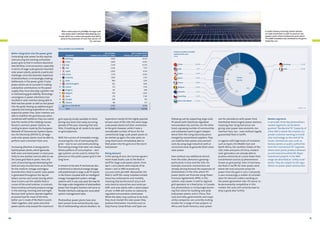
Top 15 markets 2012 worldwide

Increasing attention is being paid to
hybrid power plants, which generate
both solar and wind power in close proximity to one another and are able to use
the same grid feed-in point. Here, the
costs of purchasing and developing the
land are only incurred once, as are those
for the medium-voltage switchgear
(transformers, feed-in point). Solar power
is generated throughout the day between sunrise and sunset, during which
time it evens out the volatile feed-in
curves of the wind turbines. In contrast,
these turbines primarily produce energy
in the evening, morning and overnight.
Because both systems operate together
at partial load for most of the time,
better use is made of the feed-in point.
Taken together, solar parks and wind
power plants only exceed the maximum

10

Country

2012 newly
connected capacity (MW)

Global cumulative installed
capacity share 2012
(MW)

2012 cumulative
installed capacity (MW)

32,411

1

Germany

7,604

2

China

5,000

8,300

3

Italy

3,438

16,361


China ...................................... 8,300

4

USA

3,346

7,777

5

Japan

2,000

6,914


USA ............................................. 7,777

6

France

1,079

4,003


Japan........................................ 6,914


Spain ........................................ 5,166


France .................................... 4,003


Belgium . ............................... 2,650


Australia ................................ 2,412


Czech Rep. . .......................... 2,072


Rest of the World .......... 12,544

7

Australia

1,000

2,412

8

India

980

1,205

9

United Kingdom

952

1,829

10

Greece

912

1,536

11

Bulgaria

767

908

12

Belgium

599

2,650

13

Spain

276

5,166

14

Canada

268

765

15

Ukraine

182

373

Rest of the World
Total

grid capacity locally available to them
during very short and rarely occurring
periods of the year, meaning that very
little, if anything at all, needs to be spent
on grid expansion.
With the success of renewable energy
increasing the risk of overloading the
grids – due to sun and wind providing
fluctuating energy that does not always
follow patterns of consumption – storage systems can be used to relieve the
pressure on the public power grid in the
long term.
It remains to be seen if mechanical, electrochemical or electrical energy storage
will predominate in large-scale PV plants
in the future. Coupled with an intelligent
energy management system, storage
systems will, in any case, pave the way for
the large-scale integration of photovoltaic
power into the grid. Inverters will serve as
flexible interfaces, taking over associated
system management tasks.
Photovoltaic power plants have also
been proven to be extraordinarily capable of withstanding natural disasters. As

2,692

9,546

31,095

102,156

Superstorm Sandy hit the highly populated east coast of the USA, the area’s largescale power plants lost their connection
to the grid. However, while it took a
considerable number of hours for the
conventional large-scale power plants to
be started up again, the solar parks on
Long Island were immediately able to
feed power into the grid once the storm
had passed.
Rising demand
In the spring of 2012, the German government made drastic cuts to the feed-in
tariff for large-scale power plants. From
April 1, 2012, plants with outputs of between 1 and 10 MW received only
13.5 euro cents per kWh. Meanwhile, the
feed-in tariff (for newly installed installations) has continued to sink monthly,
meaning that by the end of 2013 it will
only stand at around ten euro cents per
kWh, and solar plants with a rated output
of over 10 MW will receive no statutorily
regulated remuneration whatsoever.
While the latter may continue to be built,
they must market the solar power they
produce themselves. Countries such as
Italy, France, Great Britain and Spain are

 	 Germany . ............................ 32,411

8%


7%

5%
4%
2%
2%
2%

Italy ........................................ 16,361

31%

7%
Global
102,156

16%
12%

Source: EPIA

Better integration into the power grids
Generating solar power locally requires
restructuring the existing centralized
power grid so that it contains decentralized facilities. Grid connection, especially
in terms of large-scale ground-mounted
solar power plants, presents a particular
challenge, since the dramatic expansion
of photovoltaics is increasingly creating
bottlenecks in the power grids. If solar
power plants are to succeed in making
substantial contributions to the power
supply, they must also play a greater role
in maintaining grid stability. Technological progress in power electronics has
resulted in solar inverters being able to
feed reactive power as well as real power
into the grids, freeing up additional grid
capacity and easing expenditure on new,
expensive power lines. Solar inverters are
able to stabilize the grid because when
combined with batteries, they can substitute the inertia of the rotating masses
found in common power stations. According to plans made by the European
Network of Transmission System Operators for Electricity (ENTSO-E), all largescale solar power plants must be able to
perform such a function from 2017.

Source: EPIA

following suit by supporting large-scale
PV plants with statutorily regulated
remuneration less and less. On the other
hand, a growing number of communities
and companies want to gain independence from the rising electricity prices
charged by conventional suppliers. They
can stabilize their power procurement
costs by using large industrial roofs or
communal areas to generate (their own)
solar power.
Even without any additional stimuli
from the state, demand is growing –
particularly in Asia and the USA. For
example, economic mechanisms are
already driving forward the expansion of
photovoltaics in the USA, where PV
power plants are financed using Power
Purchase Agreements (PPA). In this
system, solar power is sold to regional
grid operators at a fixed price. In Canada,
too, photovoltaics is increasingly becoming first choice for building new peak
load power plants, and in China, Thailand and India, governments and major
utility companies are currently inviting
tenders for a range of new projects. In
Africa and South America, solar power

vies for precedence with power from
distributed diesel engine power stations,
meaning that rising fuel prices are
giving solar power new economic momentum here, too – even without legally
guaranteed feed-in tariffs.
In regions with high levels of insolation
such as Spain, the Middle East and
North Africa, the southern States of the
USA, India and parts of China, modern
solar generators are already able to
produce electricity at a price lower than
conventional sources (a phenomenon
known as grid parity). Even in Germany,
the feed-in tariffs for solar power were
below the end consumer prices for
power from the grid in 2012. Grid parity
is also increasingly a matter of consideration for decision makers working on
the power generation side. Of course, to
be permanently competitive in this
market, the costs will certainly have to
drop a great deal further.

Market segments
In principle, three key photovoltaics
market segments can be distinguished: “Residential PV” (capacity of
a few kW) is where the investor is a
private customer wanting to install
solar technology on the roof of his
house. Commercial users such as
factory owners or public authorities
form the “commercial PV” segment,
where solar plants produce between
30 and several hundred kW. Major
investment projects in the MW
range are described as “utility-scale”
plants. They are subject to the regulations on power plant construction.

11
National Markets

Huge potential outside of Europe

Right: The Sabaranis solar park in
the village of Saint Amadou (the
department of Ariège, France)
has a rated output of 8.5 MWp.
16 inverters feed solar power into
the public grid via the plant’s own
medium-voltage transformers.

P h oto : A r eva G mb H

Solar park in Perovo (Ukraine) with a rated
output of 100 MW. The additional 800
green jobs created during the
seven-month construction period allowed
the economy to be stimulated locally

P h oto : Si G S o l a r G mb H

Left: 4 MW plant in Possidente
(Italy). A general contractor was
responsible for implementing
the solar plant during the entire
process chain.

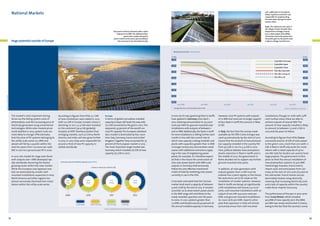
Module price trends* 2008 to 2013

€/Wp

€/Wp

3.50

Crystalline Germany
Crystalline Japan

3.00

3.00

Crystalline China
Thin-film Cds/CdTe

2.50

Thin-film a-Si/µc-Si
Thin-film a-Si

2.00

3.50

2.50
2.00
1.50

1.00

1.00

0.50

P h oto : Ac t iv S o l a r G mb H

1.50

0.50

0.00

Jan 2008

Jan 2009

Jan 2010

Jan 2011

*average offer prices on the international stock market

The market’s most important driving
forces are the falling system costs of
photovoltaics and the increasing price of
electricity generated using conventional
technologies. While solar module prices
could stabilize in 2013, system costs are
more likely to change. EPIA estimates
that the price of PV systems belonging to
the utility-scale sector (2.5 MW and
above) will fall by a quarter within the
next ten years, from 1.22 euros per watt
(W) in 2012 to 0.92 euros per W in 2022.
In 2012, the market for large solar farms
with outputs over 1 MW developed rapidly worldwide, becoming the fastest
growing sector within the solar market.
While the European and Japanese markets are dominated by smaller roofmounted installations, expansion in Asia,
North America and other regions has
almost exclusively stemmed from installations within the utility-scale sector.

According to figures from EPIA, 31.1 GW
of new installations were added in 2012,
with 17.2 GW in Europe. Europe’s share is
declining: In 2011, 22.4 GW were installed
on the continent (30.4 GW globally).
Analysts at NPD Solarbuzz predict that
emerging markets, such as China, North
America and India, will also grow further
in 2013. In 2012, they were responsible for
around a third of new PV capacity installed worldwide.

Europe
In terms of global cumulative installed
capacity, Europe still leads the way with
17.2 GW connected to the grid in 2012. This
represents 55 percent of the world’s annual PV capacity. The European photovoltaics market is dominated by four countries: Italy, Germany, France and United
Kingdom. Together they accounted for 75
percent of the European market in 2012.
The most important single market was
Germany, which installed 7.6 GW of new
capacity (7.5 GW in 2011).

Germany: annual installed capacity 2012 (MWp)
Share of installed capacity (%)

3,800
MWp

7,400
MWp

7,500
MWp

7,600
MWp

2009

2010

2011

2012

> 1,000 kWp    1,000–100 kWp    100–30 kWp    ≤ 30 kWp

A new set of rules governing feed-in tariffs
have applied in Germany since April 1,
2012, lowering remuneration to 13.5 euro
cents per kWh for ground-mounted solar
installations with outputs of between 1
and 10 MW. Additionally, the feed-in tariff
for new installations is falling further each
month in line with the current rate at
which new capacity is being installed, and
plants with capacities greater than 10 MW
no longer receive any remuneration whatsoever, with additional restrictions applying in the case of neighboring power
plants, for example. It is therefore expected that in the future the construction of
new solar power plants with MW-scale
outputs in Germany shall exclusively
follow the cost-effective investment
model of directly marketing solar power
currently in use in the USA.
It has been estimated that the German
market shall reach a capacity of between
4 and 5 GW by the end of 2013. It remains
uncertain as to what extent power plants
in the MW range will contribute to the
newly installed capacities over the years
to come. In 2012, systems greater than
2.5 MW contributed around 40 percent of
the annual installed capacity in Germany.

Jan 2012

Jan 2013

0.00

S o u r c e : S o l a r p ra xi s AG / s o lo gico

However, since PV systems with outputs
of 10 MW and more are no longer supported by a feed-in tariff, this amount is likely
to fall.
In Italy, the fact that the money made
available by the fifth Conto Energia was
used up prematurely by the start of 2012
meant that the amount of new photovoltaic capacity installed in the country fell
from 9.5 GW in 2011 to 3.4 GW in 2012.
Here, political debates have prompted a
drastic reduction in feed-in tariffs and in
the middle of 2012, the government in
Rome decided not to support any further
ground-mounted solar parks.
In addition, all solar generators with
outputs greater than 12 kW must be
entered into a plant registry in the future.
No restrictions are to be made on the
installation of smaller systems. However,
feed-in tariffs are being cut significantly:
3 kW installations will receive 23.7 euro
cents, roof-mounted installations with an
output of 200 kW 19.9 euro cents per
kWh, and ground-mounted installations
16.1 euro cents per kWh. Experts anticipate that expansion in Italy will almost
exclusively ensue from roof-mounted

installations, though on roofs with sufficient surface areas, these are able to
achieve outputs of several MW. The
amount of new capacity installed is likely
to amount to between 1.5 and 2 GW in
2013 and the years to follow.
According to figures from EPIA, France
connected around 1.8 GW of solar power
to the grid in 2012, more than 2011 with 1.1
GW. A feed-in tariff only exists for installations with a rated capacity of up to
100 kW. Calls for tenders are used to fund
large projects. The government in Paris
plans to limit the annual installation of
new photovoltaic systems to 500 MW.
Interestingly however, France had to
import solar and wind power from Germany at the start of 2012 and 2013 due to
the cold winter. French homes are predominately heated using electricity,
meaning that increasing electricity costs
and a lack of capacity within the country
made these imports necessary.
The performance of the year in 2012 came
from Great Britain, which installed
925 MW of new capacity (2011: 813 MW).
912 MW was newly constructed in Greece,
owing to the fact that the country’s sunny

S o u r c e : B u n d e s n e tzag e n tu r / S o l a r p ra xi s AG ( figu r e s a r e ro u n d e d)

12

13
climate allows photovoltaics to act as an
alternative to the increasing price of power
generated from coal. Meanwhile, Bulgaria,
another country with a high level of insolation, installed 767 MW. Despite its comparatively small size, Belgium installed
599 MW of capacity, mainly in the form of
“small” roof-mounted systems.

Turkey has also introduced feed-in tariffs
for solar power, as well as increased
remuneration for using PV components
manufactured within the country. However, the authorities require an extensive
amount of supporting evidence before
granting these incentives. High levels of
insolation of up to 1,500 kWh per square
meter in south and south-east Turkey
also create favorable conditions for photovoltaics, and the Turkish market is
expected to undergo a significant upturn.
In order to minimize currency risk for
foreign investors, the feed-in tariffs
below are quoted in US cents. The government in Ankara pays 13.3 US cents
(around 10 euro cents) for every kWh of
solar power generated. Added to this are
incentives for using components manufactured domestically, which amount to

14

P h oto : F i r st S o l a r

US grid parity with 10% Federal Investment Tax Credit (ITC)
70% debt, 30% equity, only 10% Federal ITC, no state incentives

with Federal Investment Tax Credit (ITC)
70% debt, 30% equity, with 30% Federal ITC, no state incentives

2,500

2,500

Arizona
South CA

2,250

Hawaii

North CA

$6/W

Colorado
$5/W

1,750

New Jersey

SREC Impact

1,500

$4/W

Pennsylvania

$3/W

1,250

as much as 6.2 US cents. While plants
with a rated output of less than 500 kW
do not require any approval, licenses are
required for larger power plants, and the
addition of new capacity up to 2013 was
limited to 600 MW. Moreover, individual
plants may not exceed capacities of
50 MW. The electricity demand in Turkey
is set to double by 2020, meaning that
shortages in the power supply are expected from 2017. 200 MW of new capacity are expected to be installed in
2013, with these figures set to rise to
600 MW in 2014 and 1.2 GW in 2015. In
contrast, only 2 MW of capacity were
installed in the country in 2012.
The Balkan states are yet to play a significant role in the large-scale installation
market. Falling system prices could,
however, prompt moderate growth in
Bulgaria (2012: 767 MW) and Slovenia
(117 MW). Both countries have introduced feed-in tariffs which are significantly higher than those in Germany
and Italy. In Ukraine, large-scale solar
power plants with capacities of 100 MW
were installed, predominantly in the
southern regions around Odessa and
along the Black Sea coastline.

The future course of development in
Poland is rather uncertain, as although the
government in Warsaw is working on a
law to promote renewable energy that
also intends to include a feed-in tariff for
solar power, this shall not be passed
before the government’s 2013 summer
break. As a result of the weak grid, connecting large-scale power plants is expected to prove particularly problematic.
It can generally be assumed that the
market for MW-scale installations in
Europe will become increasingly difficult.
However, the direct marketing of solar
power modeled on the USA’s Purchase
Power agreements is paving the way
towards independence from government
subsidies. The first of Germany’s solar
power market sectors (in particular roofmounted systems) are expected to fall
below grid parity in 2013/2014. In Italy and
Spain, this milestone has already been
reached for ground-mounted photovoltaic
systems. However, large-scale photovoltaic
installations do not compete with the
electricity price paid by end customers
(private households and/or companies),
but rather with the market price of peak
load power.

1,000

$1/W
$0.09

$0.13

Insolation (kWh/m2/year)

2,000

Arizona

$7/W

Installation ($/ WDC)

Insolation (kWh/m2/year)

2,250

P h oto : I B C SOLAR AG

Spain has completely stopped feed-in
tariffs for solar power produced by new
installations, meaning large-scale solar
power plants are now only possible via
the open market. High levels of insolation
and reliable solar radiation conditions,
combined with a continuous fall in the
price of PV components, have opened up
this market segment, breathing new life
into the Spanish solar market (2012: 200
MW). For example, a solar farm with an
output of 250 MW, which is to be installed in the province of Cáceres by 2015,
will be solely refinanced by the commercial sale of solar power. Work at the site,
which is in a region with very high levels
of insolation, is due to begin in 2013. The
solar farm will cover an area of 750 hectares and is expected to cost around 250
million euros. It will achieve an annual
yield in the region of 400 million kWh.

With 250 MW (AC) of solar power connected to
the electricity grid, the Agua Caliente Solar Project,
which is located 65 miles east of the city of Yuma,
Arizona (USA), is one of the world’s largest
operational PV power plants.

$0.17

Electricity prices 2012 – 2020

$0.21

$2/W

$0.25

Cost of electricity ($/kWh)

North America
Electricity from solar power has already
achieved grid parity in southwest USA
and Hawaii. Colossal solar parks capable
of delivering a total capacity of up to 750
MW are being planned or are already
under construction in California, Arizona,
New Mexico and Nevada. In addition to
the high prices of peak load power, Investment Tax Credit (ITC) incentives of up
to 30 percent are stimulating growth.
However, these are set to fall to ten
percent by 2017. Some states launched
new incentive programs in 2012 to support the installation of small roof-mounted installations, while the building of
large-scale solar power plants continues
to follow the regulations governing
power plant construction. The announcement that the major American investor
Warren Buffett was purchasing two solar
power plants in California caused a stir in
the fall of 2012. The investment, which
amounted to around 2.5 billion US dollars
(1.8 billion euros), saw Buffett acquiring
the Antelope Valley Solar 1 and 2 power
plants in California. The two power
plants, which boast a cumulative capacity
of 579 MW, are expected to be connected
to the grid by the end of 2015.

The graphs illustrate the time
when grid parity is reached as a
function of the installation costs:
The placement of the federal
states is explained by their levels
of insolation and the (expected)
development of electricity prices
from 2012 to 2018.
Placement either on or to the right
of the graphs indicates when grid
parity will be reached, for example
in New Jersey, installation costs
of 1 US dollars per W and an ITC of
ten percent will give grid parity in
2018 – without SREC (Solar Renewable Energy Certificates or Credits).
SREC are awarded in some federal
states. They commit electricity producers to incorporating increasing
amounts of power from renewable

2,000

South CA

Hawaii

North CA

$7/W

Colorado

1,750

$6/W

New Jersey

SREC Impact

1,500

$5/W

Pennsylvania

$4/W

1,250

1,000

$1/W
$0.09

$0.13

$0.17

Electricity prices 2012 – 2020

energy sources into their power
plant mix (Renewable Portfolio
Standard, RPS). The aim is to step
up solar investment in order to
lower both emissions and the
consumption of fossil and nuclear
fuels. The Credits or Certificates are
used to calculate the targets that
are actually achieved. Power plant
operators are able to refinance
their investment by selling SREC
on the market in addition to the
solar power they generate. This
creates investment incentives that
are similar to the CO2 certificates in
the European Union.

$0.21

$2/W

$3/W
$0.25

Cost of electricity ($/kWh)

S o u r c e : N aviga n t, E I A

Below: Konya, a city in the Central Anatolia
Region of Turkey, boasts the country’s first gridconnected photovoltaic power plant. The system
generates around 300,000 kWh annually.

Installation ($/ WDC)

P h oto : a l e o s o l a r D e uts ch l a n d

Right: Thanks to the highest levels of irradiance
throughout Greec, nine solar parks on the
island of Crete generate around 1.2 MW of clean
electricity each year.

P h oto : Co n e r gy

Left: Spain: solar park in Viana. With a capacity
of around 9 MW, the park is able to supply more
than 2,500 households with electricity.

and offset it against their tax
liabilities. ITC vary according
to state (e.g. ten percent or 30
percent).
The effects of both incentive
systems can be seen in the supply
price for solar power, which is
negotiated between the operator
of the solar farm and the regional
grid operator (often also the
region’s energy utility). The pricing regime is usually fixed for a
period of 10 years and is based on
the supply contract, the PPA.

Tax allowances, or ITC, represent
another approach. They allow
investors to claim part of the
investment for tax relief purposes

In the hot regions of North America, electricity is most expensive around midday,
when air conditioning and cooling systems
in homes, supermarkets, factories and
public utility companies are working at full
capacity. Power suppliers usually start up
gas power plants to cover these peak
periods. Solar power produces its highest
yields during the middle of the day, however, meaning its yield curve corresponds
perfectly to demand. In the USA, large solar
farms are almost exclusively financed by

ten-year supply agreements for solar
power known as PPA. The average price,
which varies according to regional conditions, is roughly 20 US cents per kWh and
guarantees a profitable investment.
EPIA puts the amount of newly installed
capacity at 3.3 GW in 2012, compared to 1.9
MW in 2011. Analysts estimate that the
market in the USA will grow by 4 GW
during 2013 and predict an increase of 30
percent each year until 2016.

15
P h oto : D u P o n t Ap o l lo Limi t e d /
C hi n a Ev e r b r igh t I n t e r n ati o n a l Limi t e d

The 1.3 MW PV power plant in Guangming
New District, Shenzhen (China) covers about
23,000 square feet of roof space, and is
constructed of 13,000 amorphous silicon
thin-film modules.

The Sarnia Solar Farm in Ontario (Canada)
produces 80 MW of solar electricity annually.
A portion of the site is also home to a 100acre tallgrass prairie restoration project that
creates new habitats while increasing soil
stability and water quality.

A 20 MW PV system on an industrial rooftop
in Guangdong: In southern China’s province of
Guangdong, abundant industrial rooftops provide
the basis for the “Thousand Factories, Thousand
Megawatts” program.

In Canada, the province of Ontario, in
particular, has seen a high number of
new installations. However, the Green
Energy Act introduced in 2009 expired in
January 2012, and the government has
announced plans to cut the feed-in tariffs
by 20 percent. According to data from
EPIA, around 268 MW of solar power
were installed in Canada in 2012 (2011:
497 MW).

The Middle East
Photovoltaic markets are still in their
infancy in the Horn of Africa, the Persian
Gulf and the Middle East. Saudi Arabia’s
level of insolation is roughly 2,200 kWh
per square meter, which is approximately double the average level in the area
between the North Sea and the Mediterranean Sea. The Saudian Arabian government has announced plans to cover a
tenth of its energy requirements with
solar energy by 2020 and it hopes to
install around 5 GW of solar power.
Investors have so far pledged around
three billion US dollars for photovoltaic
generators. There are currently several
medium-sized solar farms in Saudi
Arabia with outputs of up to 10 MW.
Larger solar farms are to be funded
through auctions and calls for tenders,
and it is hoped that this will lead to
between 1 and 2.2 GW being installed by
2015.

A large number of investments are also
being made in photovoltaic installations
in Qatar and Jordan. A solar power plant
with an output of 200 MW is being
planned in Oman and will be installed
over the next few years. A 1,000 MW
solar farm is also set to be installed in
Dubai. The Mohammed bin Rashid Al
Maktoum Solar Park, which is currently
estimated to cost 2.4 billion euros, will
cover an area of 48 square kilometers.
The first step is to construct a 10 MW
photovoltaic power plant, which will be
connected to the grid in 2013.

P h oto : SE DA M a l ays i a

China
China may be the most important market of the future for photovoltaic power
plants, but it is also the most challenging.
According to data from EPIA and Solarbuzz, the Chinese photovoltaic market
grew by 5 GW in 2012, meaning that the
solar power plant capacity in the Middle
Kingdom more than doubled in one fell
swoop. Since the beginning of 2012,
Beijing will pay one renminbi per kWh
solar power (approximately 11 euro cents).
The Chinese aim to install around 5 GW
of capacity every year until 2015. Large
solar farms make up the majority of new
photovoltaic installations in China. While
merely a few demonstration projects
were installed between 2009 and 2011,
the Chinese market is now on the verge
of enormous growth. The majority of
utility-scale plants are being installed in
Western China, Inner Mongolia and Tibet.
Here, the solar power plants belong to
the state and are regarded as infrastructure projects, which are constructed
through calls for tender.

The insufficient state of the power grid is
the greatest hindrance to development.
In the province of Qinghai, where roughly
half of China’s large solar farms are
located, around 1 GW of capacity was
newly installed in 2012, but only 50 percent of it was connected to the grid in
good time. Above all, there are not
enough transformers for the 380 kilovolt
(kV) transmission lines. In Tibet, the
construction of a 220 kV line to connect
additional solar power plants has been
delayed.

P h oto : Co n e r gy D e uts ch l a n d G mb H

New solar parks are also being planned
south of the border between the USA and
Mexico with the aim of exporting solar
power to the USA. Feed-in tariffs have
either recently been launched or are due
to be introduced in a few Caribbean
countries. Puerto Rico, for example, intends to cover a third of its electricity
demand of 3 GW with solar power by
2020.

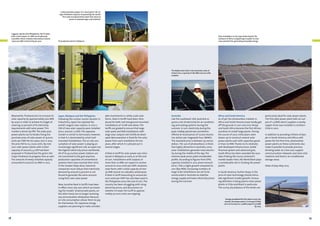
India: The 600 MW Gujarat Solar Park (close to the
Rann of Kutch at the border with Pakistan) is an
innovative concept designed by the state government to promote solar installations in which the
government allocated developed land to the project
developers with the entire infrastructure intact.

P h oto : Sky S o l a r

P h oto : F i r st S o l a r

P h oto : P h o e n ix S o l a r AG

Saudi Arabia: The ground-mounted
photovoltaic plant with a peak output
of 3.5 MW is located in Riyadh in the
grounds of the KAPSARC (King Abdullah
Petroleum Studies and Research Center),
the largest oil research center in the
world.

The solar park in the Thai city of Ayutthaya, which is
located around 70 km from the capital Bangkok, has
a capacity of 3 MW.

16

India and Thailand
India is ideal for solar power, in spite of
the high investment costs of 12 to 13
percent which inhibit the market. In
India, a great deal of electricity is produced off-grid with diesel-driven generators. According to data from EPIA, the
LCOE for solar power is between 14 and
16 euro cents, making it competitive in
comparison to diesel power, particularly
in light of the country enjoying
around 300 days of sunshine every year.
Especially in the western and southern
parts of the sub-continent, insolation is
very high and evenly spread. By the end
of 2012, 1.206 MW of solar capacity had
been installed, with around 1 GW newly
installed capacity in 2012. The states of
Gujarat, Rajasthan and Madhya Pradesh
in particular put out large-scale power
plants to tender.
The state of Jharkhand aims to install
around 500 MW by 2017 and 2.2 GW by
2020. In West Bengal, where at the start
of 2012 only one power station with an
output of 2 MW was in operation, the
aim is to install around 500 MW by 2020.
Additionally, Chhattisgarh has set itself
the target of installing 1 GW by 2017.

17
Cagayan suburbs (the Philippines): The PV plant
with a total output of 1 MW uses 6,480 polycrystalline silicon modules that produce around
1,300,000 kWh of electricity per year.

P h oto : Toyota

A demonstration project of a smart grid in the village of Rokkasho (Japan), incorporating the world’s
first wind and photovoltaic plant that stores its
power in bespoke large-scale batteries.

PV production plant in Malaysia

Solar installation on the Cape Verde Islands: The
continent of Africa is beginning to exploit its enormous potential for generating renewable energy.

Japan, Malaysia and the Philippines
Following the nuclear reactor disaster in
Fukushima, Japan has rejoined the
world’s largest solar nations. In 2012 2
GW of new solar capacity were installed
(2012: around 1.3 GW). The Japanese
market is similar to Germany’s, however,
in that it is dominated by small roofmounted installations. The on-site consumption of solar power is playing an
increasingly significant role, as Japan has
the highest electricity prices worldwide.
All of its 45 nuclear power stations are
not connected to the grid anymore,
production capacities of conventional
systems there have reached their limit.
In the Greater Tokyo Area, industrial
companies must reduce their electricity
demand by around 15 percent or are
forced to generate the same amount
using their own solar power
New, lucrative feed-in tariffs have been
in effect since July 2012 which are boosting the market. Small private plants, on
the other hand, are no longer receiving
any remuneration whatsoever because
on-site consumption allows them to pay
for themselves. Ten Japanese energy
suppliers are planning to make consider-

18

able investments in utility-scale solar
farms. Feed-in tariffs have been introduced for both roof and ground-mounted
installations of 10 kW and above. The
tariffs are graded to ensure that large
solar parks and B2B installations with
large solar outputs will chiefly be developed. Remuneration is fixed for the solar
power from each installation for ten
years, after which it is phased out in
several stages.
A feed-in tariff for solar power was introduced in Malaysia as early as at the end
of 2011. Installations with outputs of
more than 10 MW can expect to receive
around 20 euro cents per kWh. However,
solar farms with a total capacity of over
30 MW receive no subsidies whatsoever.
A feed-in tariff amounting to around 60
euro cents per kWh has also been paid in
the Philippines since the end of 2011. The
country has been struggling with rising
electricity prices, and discussions on
whether to lower the tariff to approximately 30 euro cents are ongoing.

Australia
Like the southwest USA, Australia requires a lot of electricity for air conditioning and cooling systems during the
summer. In 2011, electricity during the
peak midday period was sometimes
offered at record prices of 10,000 Australian dollars per megawatt hour (MWh).
The standard price is between 35 and 50
dollars. The use of photovoltaics is therefore highly attractive in Australia, since
solar installations generate most electricity during the middle of the day. The
extreme peak prices yield considerable
profits. According to figures from EPIA,
capacity installed in 2012 alone amounted to 1 GW, a slight growth compared to
2011 (837 MW). Increasing numbers of
large-scale installations are set to be
constructed in Australia to stabilize
energy supply and lower electricity prices
during the summer.

P h oto : St if tu n g Wo r l d F utu r e Co u n ci l

Africa and South America
As of yet, the photovoltaic markets in
Africa and South America have hardly got
off the ground. In 2011 und 2012, Kenya
and South Africa became the first African
countries to install large plants. During
the course of 2012, initial plans were
drawn up to construct several solar
power plants each with capacities greater than 70 MW. Thanks to its relatively
well developed infrastructure, stable
financial system and advanced grid,
South Africa has been awarded the accolade of being the sunny continent’s
market leader. Here, the World Bank plays
a considerable role in funding the power
plants.
In South America, further drops in the
price of solar technology should stimulate significant market growth. Increasing attention is being paid to solar power
plants in Chile and Brazil in particular.
The sunny, dry plateaus of the Andes are

Having completed the first phase in just ten
months, the power plant in La Huayca (Chile)
aims to increase its 1.4 MW output to 30 MW
by 2013.

particularly ideal for solar power plants.
The first pilot power plant with an output of 1.4 MW, which supplies a nearby
copper mine, was installed in northern
Chile in 2012.
In addition to providing millions of people in South America and Africa with
power for the first time, photovoltaic
power plants on these continents also
make it possible to provide precious
drinking water at a low cost, support
communication networks and store vital
medicine and food in air-conditioned
storage areas.
State of play: May 2013

P h oto : S o l a r p ra xi s AG / B e cky B e e tz

Meanwhile, Thailand aims to increase its
solar capacity by approximately 500 MW
by 2020 in order to achieve its target of
covering 20 percent of its electricity
requirements with solar power. This
market is driven by PPA. The state puts
power plants out to tender, fixing the
purchase price of solar power at 19 euro
cents per kWh for ten years, but in 2012,
the price fell to 15.2 euro cents. By mid2011, solar power plants with a total
capacity of around 3.4 GW had been
proposed in Thailand but the grid is the
major hindrance to progress here as well.
The amount of newly installed capacity
amounted to around 210 MW in 2012.

P h oto : T r u e n e r gy

P h oto : dpa P ic tu r e - A l l i a n c e G mb H

P h oto : Q - C e l ls I n te r n ati o n a l G mb H

The Mallee Solar Park in the Australian state of
Victoria has a capacity of 180 MW and uses CdTe
modules.

19
Technology

Crystalline modules (below) and thin-film modules
(right): Owing to the relatively high efficiency of crystalline modules, a smaller installation area is needed
per unit of output compared with thin-film modules.

Striving for increased efficiency

P h oto : To m Ba e rwa l d

Today, thin-film modules are mainly
used in large installations.

As a general rule, large-scale PV plants
equipped with thin-film modules can
produce power just as cheaply as those
constructed using crystalline modules.
The lower manufacturing costs may
therefore compensate for the increased
outlay incurred for installation.

P h oto : To m Ba e rwa l d

P h oto : To m Ba e rwa l d

terms of price per unit of output, thinfilm modules now cost the same as
crystalline modules. However, the manufacturing costs (and therefore the prices)
of solar modules with crystalline silicon
solar cells have recently fallen at a greater rate than those of thin-film solar
modules, resulting in the current market
share of thin-film technologies declining
somewhat.

Until just a few years ago, PV plants were
chiefly built from components that were
often only available in limited quantities
and PV modules were lacking in particular. This is changing as production capacities are undergoing dramatic expansion.
Today, solar power plants are planned,
installed and financed as system solutions, and at the end of this chain comes
the price per kWh of solar electricity,
which competes with that of other technologies. During the first stage of the
market launch, the solar energy price per
kWh must be lower than the feed-in
tariff in order to ensure that the PV
power plant is profitable. During the
second stage of market penetration, it is
sufficient for the price to be less than
that of conventional power generated by
coal-fired or nuclear power plants. Return
on investment is therefore determined by
the efficiency of the entire system, from
individual modules to inverters and grid
feed-in.
Crystalline silicon or thin-film
Business in MW-scale PV power plants is
dominated by crystalline silicon and
cadmium telluride. Crystalline silicon
solar cells have many advantages: Com-

20

mercial mono- and polycrystalline silicon
modules now achieve 14 to just over 20
percent efficiency. Owing to the relatively high efficiency of these modules, less
installation area is needed per unit of
output, which also means that fewer
mounting frames and cables are required. New “cast-mono” wafers achieve
similarly high efficiencies to monocrystalline solar cells thanks to the particularly cheap polycrystalline silicon wafers
employed.

is pulled from a melting crucible between
two wires. This technique facilitates the
production of ultra-thin wafers just 135
micrometers (μm) thick and eliminates
the heavy material losses that ensue
from sawing conventional silicon wafers,
which are 180 μm thick. Tandem cells
that combine crystalline wafers with
amorphous silicon coatings achieve
extremely high efficiencies with the
wafers being exceptionally thin. Novel
cells with selective emitters and rear-side
contacts are only between 100 and 120
µm thick. Bifacial cells that are also able
to absorb sunlight on the rear sides of

Innovative processes, such as the stringribbon process, may reduce manufacturing costs further. A thin ribbon of silicon

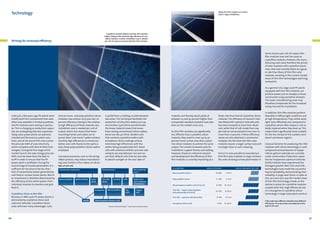
Types of solar cells

Thin-film cells

Crystalline silicon cells

Monocrystalline

Multijunction
cells **

modules and thereby boast yields of
between 25 and 30 percent higher than
comparable standard modules have also
been on the market since 2012.
As thin-film modules are significantly
less efficient than crystalline silicon
modules, they need to cover up to 30
percent more surface area than crystalline silicon modules to achieve the same
output. This entails increased costs for
installation, support frames and cabling.
However, thanks to intensive research
and development the efficiency of thinfilm modules is currently improving at a
Cell material

faster rate than that of crystalline silicon
modules. The efficiency of research modules fitted with cadmium telluride cells
has now increased to more than 18 percent, while that of cells made from copper-indium semiconductors has risen to
more than 17 percent. If these efficiency
values are also attained in commercial
modules, the fact that thin-film solar
modules require a larger surface area will
no longer have so such a bearing.
Since it is now possible to manufacture
thin-film solar modules in large numbers,
the costs of doing so have plummeted. In

Module efficiency

Surface area need for 1 kWp

Quasimono

Thin-film
silicon

Amorphous

Hybrid

CIS/CIGS

Microcrystalline

CdTe

Dye
cells*

Various III-V
semi-conductor
combinations
Organic
cells*

Micromorphous (tandem cells)
* Research, experimental stage / ** Space travel, concentrator system

14-20%

5–8 m2

Polycrystalline silicon

11–15%

7–9 m2

Micromorphous tandem cell (a-Si/μc-Si)

8–10%

10–12 m2

Thin-film – copper-indium/galliumsulfur/diselenide (CI/GS/Se)

10–12%

8–10 m2

Thin-film – cadmium telluride (CdTe)

Multicristalline

Monocrystalline silicon

9–11%
5–8%

13–20 m2

Colossal factories for producing thin-film
modules with silicon technology or with
compound semiconductors of copper
indium gallium selenide are currently
under construction. Production capacities for inexpensive cadmium telluride
(CdTe) modules have experienced the
strongest growth. Both CIGs and CdTe
technologies have made the successful
leap to bankability, demonstrating their
reliability in large solar farms. In spite of
this, 2011 and 2012 saw the market share
of thin-film technology recede, as the
decline in prices for crystalline modules
coupled with their high efficiencies led
to a resurgence of crystalline silicon
technology in large-scale plant construc-

9–11 m2

Amorphous silicon (a-Si)

In addition, thin-film modules perform
favorably in diffuse light conditions and
at high temperatures. They utilize weak
light more efficiently and, compared to
crystalline silicon, their output is not so
badly impaired when they heat up. This
makes them significantly more suitable
for the hot climate of the sunbelt, semidesert and desert regions.

Cells made from different materials have different
efficiencies. PV array surface area depends on the
type of cell used.

21
Planning phase
•	 advice when selecting components
•	 review of installation design
•	 shading analysis, grid connection
approval, yield assessment
•	 help in obtaining construction
permits
•	 review of quotations
•	 assessment of economic efficiency
Construction phase
•	 inspection and testing of received
goods
•	 inspection of components
•	 measurement of module output,
insulation testing
•	 inspection of construction
progress
•	 performance testing and
measurements for approvals
Operational phase
•	 visual installation inspection
•	 thermography
•	 sample measurements
•	 insulation testing
•	 defect detection, analysis and
assessment of damage
Monitoring
•	 technical management and
operation
•	 performance monitoring
•	 yield analysis and preparation of
operational reports
© S o l a r p ra xi s e n gi n e e r i n g

tion. Nevertheless, the new factories
being built across the world are virtually
exclusively intended for the production
of thin-film modules. Significantly smaller investment funds are required here
than for silicon cell and module manufacturing technology, so it can be expected that a growing proportion of
thin-film modules will be found in largescale plant business over the medium
term.
The temperature coefficient
The temperature coefficient indicates
the percentage by which a module’s
output will drop as its temperature
increases. With crystalline silicon modules, output falls by around 0.5 percent

22

P h oto : To m Ba e rwa l d

P h oto : To m Ba e rwa l d / S o l a r p ra xi s AG

Quality control is not only applicable
to modules, but to the entire
installation:

Quality assurance at all stages from the factory to
the construction site guarantees long-term yield
stability and operational safety.

P h oto : H ÜTTI N G ER E l e k t ro n ik G mb H + Co. KG

Measuring the temperature
coefficient

Process steps in quality control

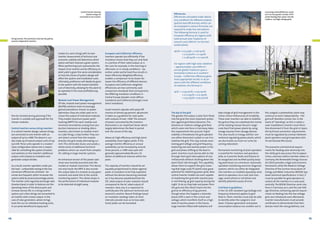
Central inverter

a system voltage (direct current, DC) of
up to 1,000 volts (V).

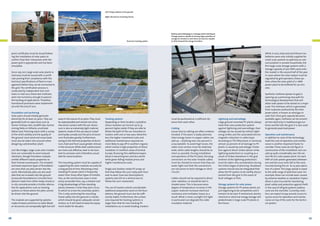
Single string inverters

1.

1.

3.
2.

DC
AC

1. PV generator
2. Generator junction box
3. DC switch
4. Inverter
5. Grid supply

4.

5.

The PV array consists of several strings of series connected modules. The whole of the installation is served by
a single central inverter.

for every degree of increase in temperature. This value is just 0.25 percent with
thin-film modules. To calculate this, the
output under standard test conditions at
a module temperature of 25 °C is used as
a starting point. To illustrate, a solar
power plant with monocrystalline solar
cells and a rated output of 1,000 kW will
only generate 800 kW, even under maximum insolation, if the solar cells’ temperature rises by 40 kelvin (K) to 65 °C. In
contrast, a power plant with the same
rated output but equipped with CdTe
solar modules will yield 900 kW.
Quality assurance from factory to
construction site
The long-term yield stability, operational
safety and thus investment security of a
photovoltaic system are primarily dependent on the longevity and reliability of the
modules and system technology used.
These qualities are examined in complex
test procedures as laid down in industry
standards or technical guidelines. test
certificates and additional quality marks
provide evidence that a module meets the
necessary requirements.

Independent institutes certify solar
modules using test samples supplied by
the manufacturers. The PV+Test (www.
pvtest.de) introduced by Solarpraxis AG
and the German Technical Inspection Association (TÜV Rheinland), on the other
hand, buys samples covertly so that
manufacturers are not able to preselect
which items are tested. Increasing importance is being attached to testing for
potential induced degradation (PID),
electroluminescence cell and module
inspection and thermography, as these
analyses reveal weak points in production and allow flaws to be detected
faster.
In addition to these types of approval
tests, spot checks at photovoltaic power
plants ensure that the manufacturer
data corresponds to the components that
are actually delivered. Such quality testing can involve different levels of complexity and cost, from visual checks and
performance measurements to electroluminescence and thermal imaging. The
purpose of testing is always to safeguard
the anticipated long-term yield and

2.

DC
AC

1. PV generator
2. DC switch
3. Inverter
4. Grid supply

3.

4.

Single-string inverters take a single string of series-connected modules. Each string has its own inverter.

minimize the risks of technical failure.
Drones are increasingly being employed
to fly over large-scale, multi-MW plants
in order to gather thermal images of the
module arrays. Solar farms with outputs
in excess of 10 MW can be inspected
using helicopters.
Extra audit
When buying a large quantity of modules, it is always sensible to place the
products delivered, their manufacturers,
as well as the components and materials used under closer scrutiny. An audit
helps to validate the results of various
module tests and estimate the risks of a
project. As certificates from different
test institutes may vary considerably,
results are more meaningful if manufacturers subject their products and
components to more stringent testing,
and not simply to that specified in the
standards. There is no such thing as
absolute security, but reasonable assessments can be made. Checklists can
also prove useful in analyzing the risks
of a product.

Standardization
At present, manufacturers supply products with highly specific features in an
attempt to make them as distinct as
possible from those of their competitors.
If the wide variety of solar modules could
be reduced through standardization, it
would open up enormous scope to bring
down the costs associated with systems
technology. This is why large project
developers are changing their strategy to
offer only standardized power plant units
comprising just one specific module type
and one particular plant design (substructure and string connection). These
modular units allow the solar plant
output to be scaled up rapidly with the
greatest of ease.
Inverters
Solar generators are a combination of
solar modules connected in series and in
parallel: Depending on the voltage of a
given solar module, up to 30 of them may
be connected in series to form a string, so
the electrical voltages of the individual
modules will add up. Connecting 20 to 30
modules in series produces a string with

In very large solar farms, it can sometimes make sense to increase the DC
voltage to 1,500 V, as this allows for lower
current in the DC cabling. Consequently,
smaller cable sizes can be used, which in
turn significantly lowers the cost of
cabling. At the same time, thermal losses
are reduced owing to the low DC current.
On the other hand, the junction boxes
must be equipped with fuses certified for
these voltages, which are more expensive
than those for lower voltages. The inverters, too, must be approved for the higher
DC input voltages, and thus require
power electronics that are designed for
such purposes. Suitable transistors are
even more expensive. The major advantage of having a higher system voltage is
the option it provides to combine solar
arrays with wind energy systems. Such
hybrid power plants take up the same
area and feed power into the grid via a
joint switching station.
Inverters regulate solar voltage and solar
power such that the solar generator will
furnish the maximum possible output,
even with constant fluctuations in temperature and insolation. They convert the
direct current generated by photovoltaic
systems into alternating current that can
be fed into the grid. While smaller systems feed single-phase power into the
low-voltage grid (grid voltage of 400 V),
larger solar power plants with outputs of
100 kW and above feed three-phase
current into either the low-voltage or medium-voltage grid, which can have a
voltage of between 20 and 50 kV, depending on the national grid standard in
a given country.
Not all inverters are suitable for every
type of module (depending on MPP
voltage window, whether or not a transformer is present and whether or not the
DC circuit is grounded). It should there-

23
P h oto : To m Ba e rwa l d

tracker (i.e. each string) with its own
inverter. Assessments of technical and
economic viability will determine which
option will best improve a given system.
When performing such assessments, the
impact of an inverter and its efficiency on
plant yield is given the same consideration
as how the choice of system design will
affect the system and installation costs.
Ultimately, preference will ideally be given
to the system with the lowest levelized
cost of electricity, allowing for the plant to
be operated in the most profitable way
possible.

fore be checked during planning if the
inverter is suitable and approved for the
chosen modules.
Central inverters versus string inverters
In a central inverter design, several strings
are connected to one inverter with an
output of up to 2 MW. The device is usually made up of several output units of say
500 kW. These units operate in a master/
slave configuration where one is responsible for controlling the system (master)
and switches on the inverter’s additional
output units (slaves) as insolation and
generator output dictate.
As a result, inverter operation under partial load – unfavorable owing to the low
conversion efficiencies achieved – becomes less frequent, which increases the
system yield by several percentage points.
The inverter units regularly exchange roles
(master/slave) in order to balance out the
operating times of the device parts and
increase service life. In a string inverter
system, just a few strings are connected to
an inverter with a lower output. In the
case of solar generators, where strings
track the sun on individual tracking units,
it can prove beneficial to equip each

24

Module Level Power Management
Of late, module level power management
(MLPM) solutions have increasingly
gained precedence. Known as power
optimizers, they are called upon to increase the output of individual modules.
They enable maximum power point
tracking (MPPT) for each module and
minimize mismatches arising from production tolerances or shading. Micro
inverters, also known as module inverters, take things a step further. They convert direct current from the module
directly into grid-ready alternating current. This eliminates losses and avoids a
whole series of additional technical
problems which can result from complex
DC cabling in large inverter systems.
An enhanced version of the power optimizer was recently launched onto the
market as module maximizer. This device
not only tracks the MPP, it also records
the output data of a module at any given
moment and sends this to the central
monitoring system. This allows drops in
the performance of individual modules
to be detected straight away.

European and Californian efficiency
Inverters operate less efficiently if low
insolation means that they can only feed
in a portion of their rated output, as is
the case, for example, in the morning or
afternoon, or in cloudy conditions – operation under partial load thus results in
lower efficiency. Weighted efficiency
enables a comparison to be drawn between the efficiency of different devices.
European and Californian weighted
efficiencies are two commonly used
comparison standards that correspond to
the differing insolation conditions in
Central Europe (weaker, more diffuse
insolation) and California (stronger, more
direct insolation).
Good inverters operate with peak efficiencies of almost 99 percent. 98 percent
is taken as a guideline for solar parks
with outputs of over 1 MW. The amount
of power consumed by the inverters
themselves is an important factor which
largely determines the feed-in period
over the course of the day.
Above all, high efficiency and high plant
availability mean higher yields: If the
average inverter efficiency or annual
availability can be increased by around
three percent, a 1 MW solar park will
generate approximately 86,000 US
dollars of additional revenue within ten
years.
The capacity of inverters should be adequately proportioned to allow regional
peaks in insolation to be fully exploited
without the devices becoming overloaded. It has become established that the
STC rated output of solar modules should
correspond to the AC rated output of
inverters. Here, too, it is important to
carefully plan the optimum technical and
economic solution. Recent findings based
on insolation readings taken at short
intervals provide clues as to how additional yields can be harvested.

Increasing conductibility has resulted in an ever greater number of PV
plants feeding their power into the
medium- and high-voltage grids.

P h oto : To m Ba e rwa l d

String inverter: The electricity is fed into the grid by
several, independent inverters.

Efficiencies
Efficiencies calculated under laboratory conditions for different outputs
(partial load efficiencies), which can
be employed in various formulae, are
required to make the calculations.
The following formula is used for
European efficiency (in regions with
total annual solar irradiance of
around 1,000 kWh/m2 on the horizontal plane):
ηEUR = 0.03 η5% + 0.06 η10%

+ 0.13 η20% + 0.1 η30%
+ 0.48 η50% + 0.2 η100%
For regions with high solar radiation
– approximately 1,200 kWh/m2
annual global irradiance upon a
horizontal surface as in southern
Europe – Californian efficiency gives
more appropriate results. In accordance with the different conditions
of radiation, the formula is:
0
ηCEC =  .04 η10% + 0.05 η20%
+ 0.12 η30% + 0.21 η50%
+ 0.53 η75%+ 0.05 η100%

The key to the grid
The greater the output a solar farm feeds
into the grid, the more important protection against grid failure becomes. The
directive on medium voltage grid feed,
which came into force in Germany, takes
this requirement into account. If grid
stability is threatened, the grid operator
can either disconnect a plant or use it to
stabilize the grid. This may include maintaining grid voltage and grid frequency,
balancing real and reactive power in the
grid and phase shifting at the feed-in
point. Inverters must also be able to ride
through short grid interruptions of 200
milliseconds without shutting down the
plant (fault ride through). This capability
allows them to support the grid, meaning that large-scale PV plants have great
potential for stabilizing power grids. New
central inverter models are even capable
of stabilizing the grid with reactive power and freeing up grid capacity during the
night. To do so, they take real power from
the grid and then feed it back into the
grid at an efficiency of 99 percent,
though when this happens a dramatic
phase shift is seen in the current and
voltage, which manifests itself as a high
level of reactive power. In the future,
large inverters fitted with batteries will

P h oto : To m Ba e rwa l d / B ELE C TR I C T ra di n g G mb H

P h oto : To m Ba e rwa l d / Sky t ro n e n e r gy G mb H

Central inverter housing:
Several strings are
connected to one inverter.

take charge of grid management in the
initial critical milliseconds of instability.
These solar inverters are able to stabilize
the grid as they can substitute the inertia
of the rotating masses found in largescale fossil fuel power plants by using
energy reserves from storage devices.
This also results in energy utilities’ conventional regulating power plants, which
are also known as must-run units, becoming redundant.
Permanent monitoring of plant operation
is essential for investors and operators
alike, as it permits faults and failures to
be recognized and rectified quickly, keeping yield losses to a minimum. Automatic
operation monitoring and error diagnosis
systems, which can either be integrated
into inverters or installed separately, send
alerts to operators via e-mail, text message, smart phone or cell phone and
identify potential causes of error.
Grid feed-in guidelines
In the US, IEEE standard 1547 (voltage and
frequency tolerance) applies to grid
feed-in. There, inverters must also be able
to identify when the subgrid is shut
down. If power generation and power
consumption balance one another out in

this subgrid, a photovoltaic plant may
continue to work independently – the
grid will therefore remain live. In the
event of “islanding”, as this is called, a
solar installation’s inverter must therefore disconnect it from the grid. In Spain,
the technical connection requirements
must be regulated by contract between
plant operators and grid operators (Art.
16 real Decreto 661/2007).
The economic and technical requirements for feeding solar electricity into
the utility grid vary across the European
Union, and even within member states. In
Germany, the Renewable Energy Sources
Act (EEG) provides a legal and economic
framework, while the Medium Voltage
Directive of the German Association of
Energy and Water Industries (BDEW) lays
down technical specifications. In fact, it
must be possible for grid operators to
control all the inverters in a solar park
centrally. The BDEW Directive came into
force in Germany 2011, and the Low Voltage Directive, containing special requirements on feeding into the low voltage
grid, was introduced soon afterwards.
Inverter manufacturers must provide
certificates to demonstrate that their
devices meet the new guidelines, and

25
Left: Fixing modules to the ground

P h oto : To m Ba e rwa l d

P h oto : To m Ba e rwa l d / Pa ra b e l AG

Right: Aluminum mounting frames

Battery park belonging to a storage system developer:
Storage systems capable of storing large quantities of
energy for minutes or even hours at most are needed
to drive forward the energy transition.

Dual-axis tracking system

plant certificates must be issued following the installation of solar parks to
confirm that their interaction with the
power grid is appropriate and has been
simulated.

Foundation and anchoring
Solar parks should reliably generate
electricity for at least 20 years. They are
generally built on open land, such as
former military sites, landfill sites, former
mining fields or hitherto unutilized
fallow land. Planning starts with a survey
of the relief, solidity and the quality of
the ground. Local wind and snow loads
must also be taken into account when
designing a photovoltaic plant.
Just like bridges, large-scale solar installations are vulnerable to wind-induced
vibrations, though frameless modules
exhibit different elastic properties to
their framed counterparts. The simplest
and least expensive types of foundation
are ones that use piles driven into the
earth. Alternatively, piles are also available that are screwed into the ground
(screw pile foundations). Concrete foundations made from either ready-mixed or
in-situ concrete provide a further alternative for applications such as tracking
systems or those where the piles cannot
be driven into the ground.
The modules are supported by systems
made of wood, aluminum or steel. Wooden structures are comparably light but will

26

P h oto : Tom Ba e rwa l d / S o l a r p ra xi s AG

Since July 2011, large-scale solar plants in
Germany must be issued with a certificate proving their compliance with the
technical specifications of feed-in management before they can be connected to
the grid. The certification process is
conducted by independent test institutes. In mid-2012, these test institutes
were not numerous enough to process
the backlog of applications. Therefore,
transitional provisions were implemented until the end of 2012.

warp in the course of 20 years. They must
be waterproofed and should not come
into direct contact with the soil. Aluminum is also an extremely light material.
Systems made of this are easy to install
and hardly corrode, but the price of aluminum fluctuates greatly. Furthermore,
owing to the thermal properties of aluminum, heat and frost cause greater stresses
in the structure. While steel substructures
are more cost-effective, steel is not resistant to corrosion and is therefore unsuitable for some locations.
The mounting system must be capable of
supporting the solar modules securely for
a long period of time. Mounting a freestanding PV power plant is frequently
easier than many other types of installation, as the construction area is more
easily accessible than, say, a slanted roof.
A big disadvantage of free-standing
plants, however, is that they lack a truss
to which to screw the assembly system.
This is why anchoring the mounting
frame safely into the ground is a factor
which should be given adequate consideration, as it will need to keep the equipment stable for decades.

Tracking systems
Depending on their location, crystalline
silicon modules can furnish up to 35
percent higher yields if they are able to
follow the path of the sun mounted on
trackers with one or two axes. Nevertheless, the higher investment costs and
additional maintenance required are
more likely to pay off in southern regions
which receive a high proportion of direct
insolation. In northern areas of Central
Europe, financing this additional expenditure is becoming less and less worthwhile given falling module prices and
higher maintenance costs.
Single axis trackers rotate PV arrays so
that they follow the sun’s daily path from
east to west. Dual axis (hemispheric)
systems also tilt on a vertical axis to
follow the sun’s movement.
The use of trackers entails considerable
additional preparation work on the foundations; the ground must also be sufficiently stable. Furthermore, the surface
area required for tracking systems is
larger than that for non-tracking PV
installations as, to avoid shading, trackers

P h oto : Tom Ba e rwa l d / Yo u n ico s

While in 2012, lead-acid and lithium-ion
batteries were only initially supplied for
small-scale systems to optimize on-site
consumption in private households, the
first large-scale storage systems with a
storage capacity of 500 kWh came onto
the market in the second half of the year.
In cases where the solar output must be
regulated by grid operators, these systems allow the solar yield of a 1 MW
power plant to be buffered for 30 minutes.

must be positioned at a sufficient distance from each other.
Cabling
Losses due to cabling are often underestimated. If the plant is badly planned,
total energy losses in copper cables can
add up – anything over one percent is
unacceptable. To avoid high losses, the
cable cross section must be relatively
wide, while cable lengths should be as
short as possible. During installation
and operation of the PV plant, the plug
connectors on the solar module cables
must be checked to ensure that they are
water tight and that the connections
are not prone to fault voltage or short
circuits.
Cables should not be exposed to direct
solar radiation, so should be laid in
shaded areas. This is because every
degree of temperature increase in the
copper material increases electrical
resistance and multiplies losses as a
result. What is more, sunlight (UV light
in particular) can degrade the cable
insulation material.

Lightning and overvoltage
Large ground-mounted PV plants always
need their own protection system
against lightning and overvoltage. Overvoltage can be caused by indirect lightening strikes and the associated electromagnetic induction in cable loops.
According to TÜV Rheinland, in Germany
almost 50 percent of all damage to PV
plants is caused by overvoltage. Protection against direct strikes (direct strike
lightning protection) or coupling as a
result of strikes elsewhere in the grid
(indirect strike lightning protection)
must be taken into consideration during
the initial stages of planning. Shutdown
systems should also be integrated that
allow the PV system to be swiftly disconnected from the grid in the event of
fault voltages or fires.
Storage systems for solar power
Storage systems for PV power plants are
just beginning to be competitive and it
remains to be seen if mechanical, electrochemical or electrical energy storage will
predominate in large-scale PV plants in
the future.

Synthetic methane (power to gas) is
opening up a promising new path for
technological development that will
allow solar power to be stored on a major
scale. The methane, which is generated
from surpluses produced by the solar
power plant, is known as wind gas or
solar fuel. Once grid capacity becomes
available again, methane can be converted into electricity in traditional gas turbines and fed into the grid. It is also used
to generate peak load power.
Operation and maintenance
In addition to costs of the technology
itself, the cost of operation and maintenance is another important factor to
consider. These costs do not figure in
construction of the installation, but can
add up quite considerably over the service life of a solar power plant. For each
kWh of solar power generated, between
one and ten euro cents fall to the costs
incurred during the 20- to 25-year operation of a plant. This large spread is owed
to the wide range of potential costs: For
example, these can include wear caused
by extreme weather or vandalism. Expenditure is also incurred for monitoring
plant safety and protection against theft.
In the case of off-grid systems, battery
costs are the real killer. Currently, investors can expect to pay around 10,000 to
14,000 euros for operation and maintenance on top of the costs for the technical system.

27
The European Energy Exchange AG (EEX) in Leipzig
(Germany) is one of Europe’s leading trading centers
for energy and energy-related products.
On some days, up to 50 percent of the power traded
on the spot market comes from renewable sources.

Low risk of default

S o l a r p ra xi s AG /A n d r ea s Sch l e g e l

Financing

Technical due diligence: Independent
engineers scrutinize the technical plant
design.

PV system price evolution (€/W)
1.90

1.90

Utility segment
(2.5 MW, ground-mounted)

€/Wp

€/Wp

1.70

1.70

1.50

1.50

1.22

P h oto : Eu ro p ea n E n e r gy Exch a n g e AG

1.30

1.18

1.30

1.16

1.11

1.08

1.06

1.10

0.90

2012

2012

2012

2012

2012

2012

1.04

2012

1.00

2012

System prices fall due to the drop in module prices.
The figures refer to the lowest drop of module prices to be anticipated.

Until 2009, manufacturing and sales of
technical components were the focus of
solar business. For this reason, photovoltaic systems were valued first and foremost according to the system costs per
kW of peak power. Now, however, photovoltaics is gaining an ever larger presence
in the energy industry, and must therefore
begin to gauge itself by the cost price per
kWh. This not only includes the system
costs, but also every bit of expenditure on
realizing the solar project, the operating
costs and financing.

be shown on that bank’s books, or they
form syndicates to spread the risk exposure. Private capital is also being used
more and more to fund solar projects.
Club deals are common, where several
banks pool a loan together as part of a
skeleton agreement, with each of them
on different terms. One of the banks
coordinates the syndicate and acts as a
contact with the client (borrower). However, with this model, the time between
application and approval is longer meaning that investment costs are higher.

Today, trade centers increasingly on
projects, financing and exploitation
rights, which makes photovoltaics attractive for the finance industry. Financing
models taken from classic manufacturing
industries are directing a significant flow
of money into the solar industry. These
include trading in turnkey projects, project rights and other forms of participation in companies that operate solar
power plants – right through to the
purchase and sale of entire power plants.

Thin-film plants are at the bottom end
of the scale in terms of investment costs,
while monocrystalline silicon parks with
tracking systems are at the upper end.
New module technologies (thin-film
silicon, CIs or CIGs) are now also increasingly being classed as creditworthy,
particularly if they are used in projects
that mix them with proven technologies
such as crystalline modules.

Banks provide financing in various ways.
They either grant project loans via their
house bank, meaning that the full risk will

28

Opportunities for financing
Financing stands or falls with the actual
annual solar power yield fed into the
grid. Usually, banks expect a return on
project investment of at least eight to

0.98

2012

0.95

2012

1.10
0.92

2012

0.90

Source: EPIA, 2012

nine percent. Private investors take between four and five percent if they conclude long-term deals where the degree
of risk is low. The strong market for largescale plants that prevailed at times in
Spain (2008), Germany (between 2010
and 2012) and Italy (2011) often created
unrealistic expectations of the returns
that solar power was able to yield. The
eurozone crisis and the withdrawal of
state subsidization are therefore forcing
photovoltaics to take a more realistic
view of things – and enabling it to exploit its long-term advantages more
successfully. Ever more investors are
recognizing the fact that the technology
has matured and the risk of default is
low. The investment, and thus the prices
it can achieve on the power market, is not
linked to the uncertainties of the oil
market. And the sun supplies its energy
for free, which gives photovoltaics a
fundamental advantage.

Thanks to the expansion of the production capacities of modules and inverters
across the globe, there are practically no
further production-related bottlenecks
that could limit the growth of photovoltaics as an industry, and solar parks in
particular. From now on, area and capital
will be the critical factors. One consequence of this is that many module
manufacturers also operate as developers of large solar parks, as technology is
usually bought directly from producers in
this business segment.

The benefit gained from minimal financial risk should not be underestimated,
especially with large solar farms. These
can be installed in small, modular units
and financed, refinanced and traded in
stages. This valuable aspect of photovol-

Levelized Cost of Energy (LCOE)
Before we are able to assess the competitiveness of photovoltaic power compared
to conventional energy sources, consideration must be given to the LCOE, which
determines precisely what costs are

taics means that it could soon drive out
solar thermal power generation. Photovoltaics is being used more and more to
create new power plant capacity, particularly in sun-rich countries of more southerly climes, where the hunger for energy
grows day by day and where technology
capable of grid-connected and standalone power generation is sought.

incurred when generating solar power.
The LCOE is stated in either euros or US
dollars per kWh and takes into account
the total cost of generating power,
including investment costs for the plant
itself, operating and maintenance costs,
and other variable costs for the entire
lifetime of the photovoltaic system.
According to the report titled “Solar
Photovoltaics Competing in the Energy
Sector” published in September 2012 by
EPIA, the cost of capital – expressed as
the weighted average cost of capital
(WACC) – is a key factor in the LCOE. The
report states that the cost of capital has
a greater impact on the LCOE than
module prices, insolation at the site and
plant lifetime.
According to EPIA, the costs of grid
expansion by solar generators must also
be quantified in the future. The same of
course applies to fossil fuel and nuclear
power plants which, to date, have only
taken into account power generation
costs. Among other reasons, the fact
that using photovoltaics no longer
involves any fuel costs means that the
costs of distributing power and operating the grid are increasingly reflected in
the calculation of electricity prices.
Equally important are the cost-lowering
effects of solar technology brought
about by intelligent inverters, battery
storage systems and on-site consumption.
No money without security
Loans are never granted without security. Examples of securities include the
transfer of ownership of the PV plant,
the transfer of rights from project contracts (delivery contracts, operating and
maintenance contracts, contracts of use
and occupation for the site, insurance
contracts), encumbrances, pledging of
the operator’s account or pledging of
shares in the business. In the past, project financing was sometimes too tight,
29
New feed-in tariff in Germany

RES-LEGAL

P h oto : To m Ba e rwa l d

The free RES-LEGAL database provides an overview of the manifold
subsidization models in Europe as
well as the stipulations and guidelines on grid connection. It contains
all important legal regulations on
subsidies and the feed-in of power
from renewable sources. The collection of models for remuneration, tax
incentives and certificates as well as
grid access comprises all the EU 27
member states, the EFTA countries
and some EU accession countries.

In 2012, systems with outputs greater than
2.5 MW contributed around 40 percent of
Germany’s annual installed capacity.

The remuneration for solar power fed into the grid is set to fall each month in accordance with market development. While small plants with capacities of up to 10 kW
and MW-scale power plants are remunerated in full, only 90 percent of the solar
yield generated by power plants with the two medium-scale power output classes
is set to be remunerated from January 1, 2014. Meanwhile, installations with capacities greater than 10 MW will no longer receive any statutorily regulated remuneration whatsoever but may continue to be constructed. The adjustments to the feedin tariffs are being made by the German Federal Network Agency, whose website
(www.bundesnetzagentur.de) lists the current rates of remuneration.

www.res-legal.eu

which led to non-performing loans. For
this reason, banks often set requirements
for the content of project contracts, or
place stricter demands on the use of cash
flow (reduced profit distribution). In
addition, they require the quality of the
installation to be inspected by external
experts (technical due diligence). It is not
uncommon for two independent yield
reports to be requested.
Due diligence
A due diligence assessment serves to
analyze the strengths and weaknesses of
a project, as well as to evaluate its risks
and estimate its economic value. The
analysis particularly focuses on technical
and material defects, legal and financial
risks, and circumstances that stand in the
way of a project being realized or being
profitable. If risks are detected, this could
lead to contractual allowances being
made in the form of price reductions or
guarantees – or in extreme cases, could
trigger the abandonment of negotiations.
Assessment may, for instance, follow
these four steps:
Legal due diligence
Legal experts check the legal basis of a
project from purchase or rental of property to feeding in. Checks are made on
the application to the utility as well as on
the operating, maintenance and insur-

30

In 2012, the German parliament voted in favor of drastically lowering the tariffs
again. There are four power classes now: small rooftop systems with outputs up
to 10 kW, larger roof-mounted installations with outputs between 10 and 40 kW,
plants with outputs up to 1 MW and systems installed on roofs or on the ground
between 1 and 10 MW.

In the future, the outputs of all ground-mounted photovoltaic systems within a
two-kilometer radius will be added together. If they are found to have a cumulative capacity of over 10 MW, these sub-generators will no longer receive remuneration, even if they belong to different owners. This rule is set to apply for an interim period of two years. In addition, the concept of commissioning a solar plant
under the Renewable Energy Sources Act (EEG) established to guarantee the
feed-in tariff paid in a particular month, has been reformulated, now stating that
it is no longer possible to put modules of a photovoltaic system not equipped
with an inverter into operation. However, the connection to the grid will continue
to have no impact on the feed-in tariff a system receives.

ance contracts. Experienced project
developers use standardized templates
to exclude major risks.
Tax due diligence
This step examines the tax aspects of a
project, such as corporation income tax,
trade tax and income tax, value added
tax, tax on profits, real property tax and
land transfer tax, as well as taxes incurred during operation. Such an analysis
includes tax incentives and depreciations
and is carried out by independent consultants.
Technical due diligence
Independent engineers scrutinize the
technical plant design. This includes:
system planning (yield forecast, plant
layout, inclination and alignment of
modules, ground survey, distance from
feed-in point, number of feed-in points,
grid capacity), specification and selection
of components, tenders and order placement, installation, technical quality
management and building quality management, operational monitoring and
safety, manufacturers’ and installers’
guarantees and warranties, creditworthiness of suppliers, theft and vandalism
protection (fencing, closed circuit television) and the costs of maintenance and

land management (for example mowing
and pruning).
Financial due diligence
The last phase before a loan is granted
concerns financial aspects: required
investments (capex), costs for the property and yields from any future sale,
Expected solar yield, costs for operation
and maintenance (opex), liquidity reserves, insurance, costs for dismantling
and recycling the plant after the end of
its service life. The cash flow, taxes and
debt services are used as a basis for
evaluating profitability, which is the
deciding factor in granting loans.
New business segment: power plant
operation
To date, solar power plant project developers have commonly also assumed
responsibility for maintaining and operating plants on behalf of investors. However, for the duration of the warranty
period, a conflict of interests arises that is
typically settled at a disadvantage to the
investor. As a result, the fields of planning
and operating large-scale power plants
are increasingly going their separate
ways, not least because ever more attention is being paid to expenditure on

operation and maintenance (OM) in a
bid to limit the overall costs of investment.
Market forces in the energy sector
In Germany, many other EU countries,
and in several others besides, solar electricity is sold to grid operators at a statutorily guaranteed feed-in tariff. During
the first half of 2012, these feed-in tariffs
were dramatically reduced, and in some
cases stopped altogether, particularly for
large-scale power plants.
The market for large solar power stations
is therefore likely to mature within a
short space of time. The era of statutorily
guaranteed feed-in tariffs will soon be
dead, and the dawn will rise on that of
directly marketed photovoltaic power.
the solar industry has reached this stage
within just a few years. Throughout 2012
and 2013, solar power plants are likely to
be subject to compensatory pricing
before they finally become governed by
the free interplay of market forces in the
energy sector.
In many countries, expansion quotas are
capping growth. Examples of this can be
seen in Spain and Italy, where total

spending on feed-in remuneration is
limited to six million euros per year. In a
different model, the German government
is making all further development of
feed-in tariffs dependent on an annual
expansion corridor of between 2.5 and
3.5 GW, and intends to stop supporting
solar power plants once a total capacity
of 52 GW is reached. If feed-in tariffs were
to disappear completely in the near
future, however, the state would have
virtually no grounds for capping photovoltaic expansion.
Incentives outside Europe
The picture outside of the EU is also
heterogeneous. India is considering a
feed-in law with guaranteed remuneration. China intends to designate large
areas for solar power plants with capacities of several GW, though so far has only
introduced uniform feed-in tariffs for
small-scale installations. There, projects
are controlled exclusively by the state
and put out to tender through auctions.

tive tax. In addition, some states pay out
for every kWh fed into the grid, while
others offer tax bonuses and subsidies.
PPA are the preferred business model for
large-scale solar power plants. As part of
these agreements, the solar power is
sold to one energy utility or one large
customer for ten or 15 years.
The project tenders commonly invited at
auctions in many Asian, Arab and some
European countries basically work on a
similar financing model, only the price is
decided during the auction. It is not
uncommon for lengthy negotiations to
ensue afterwards due to investments
being only barely covered.
Little is likely to change in this practice
in China, as the country has no private
energy utilities. In countries such as
India and Thailand, however, an economic mindset will increasingly win through
and spur the markets on.

Tax incentives play an important role in
the USA (ITC), and can reach up to 30
percent. These sums can be directly offset
against tax liabilities, and if no tax is due,
the ITC are paid out to investors as nega-

31
P h oto : To m Ba e rwa l d / L e bh e rz

Project Planning
Right: Monitoring devices are another way
of monitoring and analyzing the various
inverters within a plant.
During operation, comprehensive monitoring and
short reaction times in the event of failures result
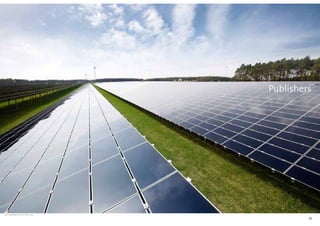
in a short payback period.

Ensuring feasibilty

Below: The inverters’ design has a

considerable influence on the plant’s
profitability.

P h oto : To m Ba e rwa l d / B ELE C TR I C T ra di n g G mb H

P h oto : To m Ba e rwa l d / B ELE C TR I C Tra di n g G mb H

How to start a project –
Some important questions

Good and thorough preparation by experienced planners can make or break a
large solar park project. Owing to the size
of the project, neglecting small points
may soon lead to large quantities of
money being lost. Careful planning does
not only concern the assessment of
yields and capacity or building permits.
Other significant factors that determine
the success of a project include on-site
support, grid access inspection and certification of the feed-in management
system.

P h oto : Tom Ba e rwa l d / B e l e c t r ic

Based on the values for a 1 MW PV plant
in the south of the USA (PPA: 0.2 US
dollars/kWh, specific yield: 1,800 Wh/
Wpeak, performance ratio 80 percent), an
increase of ten percentage points in PR
will earn an additional 396,000 US dollars annually.

The greater the level at which photovoltaic capacity is expanded, the more
important it is for grid feed-in to be controlled precisely, especially in terms of
large-scale solar parks.

32

Performance ratio
The ratio of actually generated power to
the theoretical yield in a certain location
is decribed by the performance ratio (PR).
It serves as a measure of plant efficiency
for evaluating different plants in different
locations Top priority is being given to
optimizing a plant’s PR when operating
in profitable conditions. Excellent PR
values amount to between 80 and
83 percent (for crystalline silicon solar
modules) or between 82 and 85 percent
(for thin-film solar modules).

Comparable calculations can be made for
Germany. For instance, a PV power plant
with a peak output of 1 MW, connected to
the grid at the beginning of 2010 with a
PR of 75 percent, would produce 863
MWh of electricity each year. Increasing
the PR by ten percentage points to
82.5 percent by optimizing the system
components would represent a total of
949 MWh. At a remuneration tariff of 13.5
euro cents per kWh, this would yield
increased profits totaling 232,200 euros.
Expert opinion
Planning always starts with a survey to
help determine what the solar yield, the
foundations, the best modules, inverters
and mounting technology will be. If the
installation is planned on a former military or brownfield site, extensive preparatory work is needed to remove any ammunition or hazardous substances that
may be present. Ensuring that the land is
safe has top priority. Yields from the PV
plant must be able to cover the purchase
price or the rent for the land.

Certification of feed-in management
systems
Before a solar farm can be connected to
the grid, the future operators or project
developers must submit a certificate
issued by an authorized, independent
test institute. This confirms that the
plant technology complies with all technical specifications and grid-feed management guidelines issued by the German Association of Energy and Water
Industries (BDEW). Other important
documents must also be submitted, the
installation must be simulated and an
expert report must be commissioned.
The whole procedure lasts several weeks.

Assessment of yield and capacity
Which technology is necessary to
achieve the highest possible yield?
What is the module area required? Is
it possible that additional shading
from new buildings or plant growth
will occur at a later point in time?
Local support
Will the project be supported by
representatives from local government and the local community? How
can skeptics be won over?
Building permits, development plans
and compliance testing
Has planning and building permission been granted? Does the land
development plan permit the installation of a photovoltaic plant? Does
the project conform to the national
feed-in requirements?
Grid connection testing
Is a suitable grid connection terminal available on site? How long will it
take to obtain grid-related information and to process the application?

Grid authorities in China impose strict
regulations on plant operators, who must
provide proof that these have been met
(inverter certification). Stringent requirements are also laid down in the USA. For
example, inverters must be able to recognize when subgrids continue to operate
independently despite higher grid levels
being shut down and maintain the voltage. This can happen when generation
and consumption are equally balanced in
the subgrid (active islanding). Solar power
plants must prevent this from happening.

33
P h oto : To m Ba e rwa l d / s ky t ro n e n e r gy G mb H

Monitoring systems
increase the lifetime of
solar plants and allow
malfunctions to be
detected promptly.

The turnkey implementation of large PV
installations poses great logistical challenges to
project planners.

Installation of monitoring hardware
on site

Possible contact and cable resistance
means that the correct cabling of solar
power plants is essential due to the threat
of efficiency losses.

34

Early involvement of utilities
Rough technical planning is followed by
submitting the feed-in application to the
local utility. This has the purpose of determining the location of the entry point
and whether it will actually be possible
to feed the projected yield into the grid.
Involving grid operators in planning at as
early a stage as possible is therefore a
must. If it is later discovered that additional investment is needed for grid
feed-in, this can become very costly and
jeopardize the entire project. If there are
several possible entry points, the most
cost-efficient point will be selected – no
matter which part of the costs must be
paid for by the plant investor, and which
by the utility. The basic principle is: Grid
connection costs must be borne by the
investor, grid development costs by the
utility. The utility also sets specific parameters for keeping the grid stable when
power is fed in. The sooner grid operators
are involved in the planning process, the
quicker and more smoothly different
connection scenarios, and the costs
associated with them, can be investigated to find the optimum solution.

P h oto : To m Ba e rwa l d

Monitoring
The operation of a solar park also necessitates great care. First of all, the smooth
running of the plant must be ensured to
avoid any interruptions. A sophisticated
plant monitoring system will document
operation, providing the basis for quarterly reports to investors and helping to
identify the causes of any shortfalls.
Faults at the entry point or the inverter
are particularly critical, and engineers
must respond quickly to minimize any
yield losses. Since modern inverters provide remote monitoring options, faults do
not always require a trip to the site.

A word on logistics
Solar parks are complex building sites
covering a large surface area. Transport
logistics for modules alone requires
careful planning. Crystalline modules, for
example, are delivered in containers of
500 each (appr. 100 kW). A solar park with
a capacity of 25 MW requires around 250
containers which can only be moved
using designated lifting equipment
(cranes, forklift trucks, etc.). Just-in-time
delivery is vital to avoid costs for idle
periods. The handling of modules – especially frameless modules – in particular
calls for extreme care so as to avoid
breakage or damage.

P h oto : Tom Ba e rwa l d / Sky t ro n

P h oto : To m Ba e rwa l d / Pa ra b e l AG

P h oto : To m Ba e rwa l d / Pa ra b e l AG

P h oto : To m Ba e rwa l d / s ky tro n e n e r gy G mb H

Regularly checking plants on
site is essential.

Regular checks
PV plants in the MW range also require
regular checks by staff. Regular visual
checks, on-site thermal imaging, remote
monitoring of strings and inverters as
well as the evaluation and storage of
data are indispensable. Operation and
maintenance costs account for between
three and five percent of the solar yield. If
well planned and executed, they can
increase the yield by a significant
amount. To enable inspections to be
carried out in a single day, it can make
sense to employ helicopters or service
drones.

Protection against theft
Ground-mounted systems need to be
protected from theft and vandalism, the
minimum requirements being a fence
with climb-over protection and a secured
access gate. Video monitoring and microwave or infrared sensor barriers with
alarms via cable or radio complete the
security concept. Of course, costs and
benefits must be weighed up against
each other in each individual case. Investment in such equipment will have paid
for itself if it prevents just one occurrence
of large-scale module theft. In the event
of such theft, not only components are
lost; consequential damage to the electrical system is common, as are significant
yield losses. If such occurrences become
frequent, there is a risk that insurance
cover will be withdrawn, meaning that
the investment will no longer be protected. At the very least, costs will be incurred
to fit expensive anti-theft systems or
employ additional security staff.

Theft protection provided by
video monitoring

35
“PV’s ability to provide grid support is underrated”

An interview with Dr. Winfried Hoffmann,
President, European Photovoltaic Industry Association

P h oto : E P I A

P h oto : F i r st S o l a r

PV systems of all sizes can provide
grid support services.

Large photovoltaic systems with more
than one up to several tens of MW of
power have gained growing market
shares in the photovoltaics industry.
What role do they play in restructuring
the European energy sector?
It’s clear that the latest changes in national regulatory frameworks do not
favour the development of large groundmounted systems. In the short term, we
should not expect dramatic development
of this segment in the established markets. But with the continuous effort of
the industry to decrease the cost of PV
technology (and, as a consequence, its
generation cost), large plants remain an
important option for the decarbonisation
of the EU electricity sector in the medium-to-long term. But this requires a
redesign of electricity markets in order to
ensure the profitability of such largescale installations.

36

Large solar parks are able to stabilize
the grid. How important is it for the
rapid change in the system of electricity
supply?
Well, these services are certainly necessary if we want to move from a fossil or
nuclear-based, heavily centralized system
to a clean, safe decentralized one. As PV
increasingly becomes a player in the
power system, it will have to provide
more services to the grid. We are already
working in close collaboration with DSOs
and TSOs on the role of PV in the future
power mix and also during the transition.
With the support of our members EPIA is
working on EU-financed projects like PV
GRID or REserviceS that will help the
transition. PV’s existing ability to provide
significant grid support capabilities – including active power reduction, fault
ride-through, and voltage support – is
vastly underrated.

With increasing level of active power in
the grid from solar parks or wind farms
it might be more important to feed in
reactive power. Which role can solar
parks play in order to reduce the costs
for new high-voltage or medium-voltage cables?
PV systems of all sizes can provide grid
support services. The main advantages of
large plants are the lower cost to provide
the service and the ease of implementing
communication. PV can participate in system operation either at the distribution
or the transmission level. But it requires a
cost-effective communication infrastrcuture, new system operation strategies
that take advantage of PV’s capabilities, a
better interaction between DSOs and a
better understanding of what PV can provide. The effective use of PV capabilities
can effectively reduce the need to extend
the exisiting grid infrastructure.

Superstorm Sandy made it clear: The
solar fields are the first generators
returning to the grid after a blackout or
shut-down of the grid in case of hazard
or disaster. Do they diminish the risk of
blackouts at all?
As EPIA showed in its “Connecting the
Sun” report, large-scale PV integration in
the European grid is technically feasible
with a high level of security of supply,
even under the most extreme weather
and load conditions. With the right measures and investments in place, system
reliability can be ensured. The concept of
back start or restoration plans – restarting the system after a black out – is really
complex. Currently PV is not integrated in
such plans and is requested to disconnect during events. In a future with a lot
of PV and with the development of the
right measures, PV could serve as an
emergency generation technology during
critical events and help to restore the
grids.

The most powerful voice of
photovoltaics in Europe
EPIA – the European Photovoltaic
Industry Association – represents
members active along the whole solar
PV value chain: from silicon, cells and
module production to systems development and PV electricity generation
as well as marketing and sales. EPIA’s
mission is to give its global membership a distinct and effective voice in the
European market, especially in the EU.

EPIA – European Photovoltaic
Industry Association
Renewable Energy House
Rue d’Arlon 63–67
1040 Brussels
Belgium
Phone: +32 (2) 4653884
Fax: +32 (2) 4001010
info@epia.org
www.epia.org

37
Companies

P h oto : Tom Ba e rwa l d / Pa ra b e l AG

39
Overview

Companies and brands presented at a glance (in order of appearance)

page 44

page 45

page 46

page 60

page 62

page 63

A E
2

2

page 47

page 49

page 64

page 65

page 66

page 50

page 51

page 52

page 67

page 68

page 69

page 54

page 55

page 56

page 70

page 71

page 74

page 57

40

page 48

page 58

page 59

page 75

41
Business Areas

44 3E

P h oto : To m Ba e rwa l d

x

x

x
x

x
x

x
x x x
x x x

x

x
x

x

49 Alternative Antriebe 
Erneuerbare Energien

x

50 AXITEC GmbH
52 BELECTRIC Solarkraftwerke GmbH

x
x

51 Bonfiglioli Riduttori S.p.A.

x x
x
x

x

x

x
x
x

x x x

x

x

x

x

58 Ingeteam Power Technology, S.A.
60 Mounting Systems Group

x
x

59 Nuevosol Energy
62 Platinum® GmbH

x
x

63 Power-One

66 skytron® energy GmbH

x
x

x
x

68 SolarMax
70 Solectria Renewables
71 TÜV SÜD

42

x

x

x
x

x
x
x x x
x x x x
x
x
x
x
x x
x x
x
x

x

x

67 SMA Solar Technology AG
69 SolarWorld AG

x
x
x

x

64 PROFIL DU FUTUR
65 Schneider Electric

x

x

56 Fronius Deutschland GmbH
57 GP JOULE GmbH

x x x x x

x

54 Dow Corning Corporation
55 FS solar concept GmbH

Consultant

Certifier

Logistics

IT solutions

Power plant control

Grid integration

Operation and maintainance

Component suppliers

PV monitoring systems

Mounting systems

Tracking systems

Storage systems

Thin-film manufacturing

x
x

47 Advanced Energy
48 AEG Power Solutions GmbH

Crytalline module
manufacturing

x

45 ABB
46 Activ Solar

Inverter/inverter systems

Company

System integrator/project
developer/turnkey solutions

Page

Companies (in alphabetical order)

x x
x
x
x

x

43
3E

ABB

Technical Consultancy and Software Services for Sustainable Energy

Bankable ABB Central Inverters for Large-Scale PV Power Plants

The SynaptiQ PV
monitoring and reporting
software, powered by 3E

3E is an independent technical advisor
specialized in renewable energy and
energy performance optimization. We
provide expert consultancy services and
software products throughout the full
project life-cycle.

3E
Vaartstraat 61
1000 Brussels
Belgium
Phone:  +32 (0)2 217 58 68
Fax:  +32 (0)2 219 79 89
claire.grandadam@3E.eu
www.3E.eu
Founded: 1999
110 employees

44

Since 1999, 3E has focused on serving
investors, project developers and
product developers with technical
expertise to reduce risk and optimize
performance throughout the full
life-cycle of PV parks. Operating from
Brussels (HQ), Toulouse, Milan, Istanbul,
Beijing and Cape Town, the company has
a project track record of more than 15
years in over 30 countries, and is a
trusted partner for the major lenders
and equity providers in the global
renewable energy market.
In photovoltaics, 3E provides expert
consultancy services, including
resource modeling, development
guidance, system engineering, tech­
nology assessments, due diligence and
risk mitigation strategy, in addition to
system monitoring and reporting tools.
We have worked on ground-mounted
and rooftop systems from 10 kWp to
multi-megawatt projects, including
utility-scale projects of up to 75 MWp.
We have helped our clients to reduce
risk and optimize the performance of
their projects in Belgium, France, Italy,
Greece, Croatia, South Africa and
several other countries. We have also

Bankability is of extreme importance
when choosing a solar inverter supplier,
especially for large-scale PV plants.
ABB central inverters meet all bankability requirements, making them a choice
that you can confidently trust.

carried out factory audits and assessments on over 45 PV module manufacturers in China, Europe, India and
Japan.
SynaptiQ, 3E’s monitoring and multistakeholder reporting software platform,
is designed for performance optimization of multi-brand and multi-technology solar portfolios. SynaptiQ is a flexible
and intelligent software tool, compatible
with a very wide range of hardware
devices (inverters, loggers, SCADA, etc.).
The platform is already connected to
over 1,000,000 components in utilityscale PV parks in ten countries.
Our consultancy and software services
are enhanced and strengthened by an
in-house research and innovation lab,
specialized in modeling and data
analysis. Bridging the gap between RD
and the market, 3E combines this
in-house innovation, partnerships with
leading RD centers and a thorough
understanding of practical industry
needs to continuously offer high-performance, cost-effective services and
products.

ABB’s compact turnkey megawatt
station (top right)
ABB’s successful central inverter series, the PVS800,
confidently meets your bankability requirements
(top left).
Global production capabilities are a key ingredient
for bankability (bottom right).

ABB Oy, Power Conversion
Hiomotie 13
00380 Helsinki
Finland
Phone:  +358 (0)10 22 11
feedbackmaster.solar@fi.abb.com
www.abb.com/solar
Founded: formed in 1988, merger of Swiss and
Swedish engineering companies with
predecessors founded in 1883 and 1891
145,000 employees (ABB Group)

During the last ten years, ABB has
delivered over 100 GW of power converters on the same platform that is used for
ABB central inverters, which, after only a
few years on the market, have now nearly
reached 1 GW of installed capacity.
ABB’s successful central inverter series,
rated from 100 to 1,000 kW, is designed
for multi-megawatt photovoltaic (PV)
power plants. The inverters give a high
overall efficiency coupled with a compact
and easy-to-maintain design. The
1,000 kW central inverter has a maximum efficiency of 98.8% and a European
Efficiency rating of 98.6%. This, together
with a very low auxiliary power consumption of only 630 W, results in the
outstanding overall efficiency of our
inverters. In addition, the wide temperature range and altitude rating, as well as
a modular DC input layout, provide much
greater flexibility for system integrators.

Power density is almost 20% higher than
earlier central inverters, allowing savings
to be made in installation space and
transportation costs. Also, thanks to the
inverters’ certificates and advanced,
flexible grid-support functions, ABB
central inverters meet all applicable
network connection requirements.
ABB also supplies a megawatt station
which is a turnkey solution for largescale solar power generation. The
megawatt station houses all electrical
equipment needed to rapidly connect a
PV power plant to a medium voltage
(MV) electricity grid. All components are
from ABB’s proven technology portfolio,
providing high efficiency and reliability
in a compact, easy-to-maintain unit.
In the end, your choice of inverter comes
down to what makes you most confident about meeting your return on
investment (ROI) goals. ABB central
inverters do just that, with bankable
credentials that you can trust.

45
Activ Solar

Advanced Energy

A Global Company Focused on the Development and
Manufacture of Solar-Based Technology

ENERGY DELIVERED™
AE’s power stations generate
electricity dependably, optimize
Levelized Cost of Energy (LCOE) and
help stabilize grid operation.

150 MW solar project utilizing AE’s 2 MW
integrated skid solutions
82.65 MWp Ohotnikovo solar power station
(Crimea, Ukraine), one of the largest
solar parks in Eastern Europe (left)
105.56 MWp Perovo solar power station
(Crimea, Ukraine), one of the largest
solar parks in the world (above)

Vienna-based Activ Solar is a solar
industry pioneer focusing on emerging
solar markets, where it has built some of
the world’s largest photovoltaic
installations.
Activ Solar’s main business areas include
the development, financing and
completion of large-scale photovoltaic
installations in emerging solar markets,
as well as the production of polysilicon
at a wholly-owned semiconductor plant
in Ukraine.

Activ Solar GmbH
Wipplingerstraße 35
1010 Vienna
Austria
Phone:  +43 (0)1 253 31 61 50
Fax:  +43 (0)1 253 31 61 60
info@activsolar.com
www.activsolar.com
Founded: 2008
1,700 employees

46

Project development
•	significant track record of solar developments and technical know-how to
select and carry out projects with the
highest expected returns
•	own equity to co-invest, enabling
project risks to be shared
•	pipeline of processes typically performed with local partners to make
projects shovel ready
Financial solutions
•	background in finance  investments
with strong track record in energy
MA and project finance
•	strong track record in securing project
finance from commercial banks and
ECAs, and in obtaining vendor finance
•	broad network of international and
local investors to facilitate exits, if
needed
Asset management
•	team with extensive experience in
maximizing value and returns of
operational portfolios
•	management and maintenance
of parks
•	current assets under management
of 400+ MW

EPC
•	engineering team with proven track
record of designing optimal large-scale
utility PV parks
•	excellent relationships with major
bankable suppliers and “buying power”
thanks to large procurement volumes
(approximately 400+ MW over two
years)
•	construction management capacity
worldwide
Facts  figures
•	established in Vienna, Austria, in 2008
•	over 1,700 professionals worldwide
•	over 400 MW of utility-scale projects
developed, financed and put into operation to date
•	long-standing relationships with multiple tier one suppliers
•	ranked globally as a top five developer
of large-scale solar PV projects
•	developed, financed and constructed
some of the world’s largest solar PV
power stations

AE’s solar energy business delivers
highly reliable inverters, complementary
Balance of System (BoS) products, and
robust Operations and Maintenance
(OM) services that allow its customers
to secure more solar projects and
increase their earnings.

Solar plant in Vermont State, USA

AE Solar Energy
20720 Brinson Blvd.
Bend, OR 97701
USA
Phone:  +1 877 312-3832
Fax:  +1 541 312-3840
sales.support@aei.com
www.advanced-energy.com/solarenergy
Founded: 1981
1,500 employees

Customer experience
AE Solar Energy enables utility-scale and
commercial solar project stakeholders to
offer system owners a lower Levelized
Cost of Energy (LCOE) and confidence
their PV system will deliver on long-term
production goals. With more than
30 years of leadership delivering innovative energy solutions, combined with a
legendary reputation for customer
service and a strong balance sheet,
AE Solar Energy is a trusted partner for
solar project developers, EPC companies,
financiers and beneficiaries around the
globe.
Innovation
AE is never satisfied: From our roots in
reliability and LCOE to continually improving our quality, systems and people,
we ensure that energy is delivered,
period. We pioneer improvements in

distributed generation, grid interactivity
performance, utility interactive functionality, and energy management solutions.
ENERGY DELIVERED™
AE delivers highly reliable and efficient
inverters designed with an architecture
optimized to deliver the lowest possible
LCOE. Our simplified BoS solutions reduce system design support, project
management time and increase savings
on installation. Simply put, AE delivers
life-cycle performance.
Solar site services
AE delivers whole-site operations and
maintenance service plans that increase
the reliability of customers’ PV systems.
AE global services are dedicated to
responding quickly to issues, whether
that means rolling a truck, providing
phone support or anything in between.
We provide application engineering
support and warranties for up to 20
years, partnering with customers for the
entire project life-cycle.

47
AEG Power Solutions GmbH

A E

Alternative Antriebe
 Erneuerbare Energien

HIGH-VALUE SOLAR POWER
GENERATING PRODUCTS AND SERVICES

2

2

Quality Control Safeguards Sustainable Yields
Eastern Europe,  300 MW
AEG PS provided complete electrical systems for
several PV power plants.

AEG Power Solutions –
Competence Center Warstein-Belecke

Central Inverter Protect PV.800

AEG Power Solutions GmbH
Emil-Siepmann-Straße 32
59581 Warstein-Belecke
Germany
Phone:  +49 (0)2902 763-141
Fax:  +49 (0)2902 763-1201
solar@aegps.com
www.aegps.com
Founded: 1946
Turnover: 368 million euros (2012, worldwide)
 1,600 employees (2012, worldwide)

48

Building on its proven track record in
supplying utilities and grid operators with
reliable, fully-compliant solutions, the
Protect PV.250, PV.500, PV.630, and PV.800
solar inverters from AEG PS provide
quality and efficiency for large-scale PV
installations. With an efficiency of more
than 98% and compliance with European
and American standards, AEG PS solar
inverters exceed the expectations of their
power class. The innovative FPGA circuits
ensure the flexible, precise and rapid
control needed to meet virtually all
national grid standards.
In addition to solar inverters,
AEG Power Solutions offers two completely integrated stations. The first is
the TKS-C container solution, which
includes Protect PV solar inverters along
with a medium-voltage transformer,
switch-gear, and a monitoring, measurement and control system. The second is
the Compact Station, which places the
solar inverters in metal housings that
are separate from the transformer,
switch-gear, and MMC system. These
single-source solutions ensure smooth
PV power plant operation, in close
cooperation with grid operators.

Both integrated systems include
intelligent combiner boxes installed in
the PV array’s field. These combiner
boxes are fully integrated via communication links to field sensors for temperature, radiation and weather, and the
collected data is stored in data loggers.
The monitoring software, from our
subsidiary skytron energy, called
PVGuard, ensures that the status
updates needed by PV plant operators
are always available over the Internet.
Backed by decades of field experience,
AEG Power Solutions has built its
worldwide service reputation by
constantly exceeding customer expectations throughout the product lifespan.
AEG Power Solutions’ service starts right
from the beginning of any project
installation. Clients can rely on AEG PS
for service and support over the entire
life-cycle of the plant. With facilities
across Europe, the Middle East, Asia,
China and North and South America,
AEG Power Solutions is on hand for
collaboration with all potential partners,
including EPCs, consultants, operators
and investors.

Reduction in yield resulting from shading
caused by plant growth (top left and right)
Reduction in yield resulting from shading
caused by the system itself (left middle)
Burnt off plug connector and damaged DC
cables (left bottom)

Alternative Antriebe  Erneuerbare Energien
Ing.-Büro Dürschner
Anna-Rosenthal-Weg 21
91052 Erlangen
Germany
Phone:  +49 (0)9131 303 222
Mobile: +49 (0)178 499 6363

The engineering office Alternative
­Antriebe  Erneuerbare Energien has a
wide range of clients, including system
buyers (investors) and sellers (system
constructors and operators), as well as
money-lending institutions (banks).
The company’s founder, graduate engineer (Diplom-Ingenieur) Christian
Dürschner, looks back on many years of
experience as a project engineer and
independent expert in photovoltaic
systems. He founded the consultancy
firm Alternative Antriebe, which focuses
on solar cars, electric cars and hybrid
vehicles, as early as in 1995, before expanding it into Alternative Antriebe 
Erneuerbare Energien, an engineering
office specializing in photovoltaics, in
2000. Certified as having expertise in
photovoltaic systems by the German
Technical Inspection Association (TÜV),
the office mainly draws up objective and
impartial reports for small, medium and
large-scale PV plants.

Our range of services from A to Z:
•	analysis of yield reductions
•	comparison of actual and nominal
yields
•	creation and evaluation of yield
forecasts and yield reports
•	damage reports and damage
evaluations
•	expert opinions for court cases
•	I-V curve measurements of modules
and strings
•	inspections using electroluminescence
and/or thermal imaging cameras
•	profitabiltiy calculations
•	quality assurance of construction
processes
•	support with EEG commissioning
•	support with technical acceptance
•	technical due diligence
•	valuation of existing plants
•	and much more...
Benefit from our long-standing
experience in PV!

Fax:  +49 (0)9131 303 566
solare_zukunft@fen-net.de
www.pv-gutachter.de
www.solar-buch.de

49
AXITEC GmbH

Bonfiglioli Riduttori S.p.A.

A Leading Module Manufacturer with Headquarters in Germany and
Worldwide Production Locations

Bonfiglioli – Partner in Large Projects. Worldwide.
Parvomay, Bulgaria: SunEdison
60 MW PV field entirely equipped
with Bonfiglioli RPS TL inverters

Bonfiglioli RPS Station

Spain: utility power plant (right)
Spain: Expo Zaragoza 2008 (top left)
Germany: system installed on logistics center roof
in Hamburg (bottom left)

12 years manufacturer’s warranty

Brands of AXITEC: “Made in Asia”, “Made in Europe”

AXITEC GmbH
Otto-Lilienthal-Straße 5
71034 Böblingen
Germany
Phone:  +49 (0)7031 6288-5186
info@axitecsolar.com
www.axitecsolar.com
Founded: 2001
20 employees

50

With 300 MWp of solar modules installed
across the globe, German company
AXITEC GmbH has been established for
years as a high-performance and quality
module manufacturer.
AXITEC GmbH was established in 2001
and has been one of the leading global
manufacturers of quality solar modules
for years. The core expertise covers the
complete process chain for solar modules from development and manufacturing through quality assurance to sales
and service.
High-performance solar modules by
AXITEC are sold all over the world under
two different brands. They are manufactured in accordance with their respective
labels – “Made in Europe” and “Made in
Asia” – in the respective production
facilities of certified OEM partners. AXITEC
grants identical warranties for all of them:
• positive tolerances
• twelve-year manufacturer’s warranty
•  xclusive linear AXITEC performance
e
guarantee
Global production processes
Years of close partnerships with several
OEM manufacturers enable AXITEC to

Bonfiglioli manufactures and designs
power conversion systems from 3 MW
turnkey solutions down to 30 kW
compact devices, for medium-to-large
commercial and utility-scale installations.

always use the latest technology in the
manufacture of solar modules, making it
one of the leading global providers in
terms of technology and cost. AXITEC
customers can therefore purchase solar
panels with an excellent price-performance ratio.
Quality assurance and certification
AXITEC solar modules are certified according to all international standards,
e.g. IEC, UL, MCS and CEC. Additionally, all
solar modules are certified according to
IEC 61701 (Salt Mist Corrosion Test) and
IEC 62716 (Ammonia Corrosion Test). As a
result, all AXITEC solar modules can be
mounted next to the sea and on agricultural roofs, including those of pigsties.
Global branch offices
AXITEC has branch offices in Italy, the
USA and Brazil. Additionally, AXITEC solar
modules are available worldwide from
renowned distributors, whose objective
is to appeal to customers and demonstrate the products’ technology.
References and installations
All over the globe, AXITEC solar modules
successfully produce clean energy.

Puertollano, Spain (51 MW): the world’s
largest PV field in 2008, equipped with
Bonfiglioli inverters

Bonfiglioli Riduttori S.p.A.
Via Giovanni XXIII, 7/A
40012 Lippo di Calderara di Reno – Bologna
Italy
Phone:  +39 0516 473-111
Fax: 
+39 0516 473-126
photovoltaic@bonfiglioli.com
www.bonfiglioli.com
Founded: 1956
3,300 employees

Thanks to the global nature of its
distribution network and a wide range
of high efficiency solutions, prestigious
international engineering, procurement
and construction contractors (EPCC) and
independent power producers (IPP)
trust Bonfiglioli to supply the inverters
needed for large-scale photovoltaic
installations in Europe, Asia and North
America. In 2008, Bonfiglioli supplied its
solutions to the world’s largest photovoltaic field at the time (51 MW), which
is located in Spain. In 2010, Bonfiglioli
supplied the inverters for one of
Europe’s largest PV fields (70 MW) in
Italy and in 2012, a 60 MW PV field
equipped with Bonfiglioli inverters
came on line in Bulgaria. Its long history
and consolidated international presence
make the company a reliable and
bankable investor, and have allowed the
Bonfiglioli Group to contribute to the
start-up of major installations in
emerging markets.

Bonfiglioli’s RPS Stations, which are
available in a vast range of power
ratings from 280 to 3,100 kW, provide
turnkey solutions for the complete
photovoltaic field management of all
large-scale ground installations. RPS
Stations are produced and tested
directly at the plant to ensure the
highest standards of quality and
efficiency alongside reduced costs. As a
result, customers can take delivery of a
fully equipped, ready-to-connect
system in impressively short times.
The RPS TL modular inverters at the
heart of every Bonfiglioli RPS Station
guarantee the highest system yields
and excellent international grid code
compatibility, thanks to the modular
engineering and German technology
that distinguish all Bonfiglioli inverters.
An in-depth understanding of markets
and market dynamics, 17 commercial
subsidiaries, four photovoltaic production centers on three continents and a
wide range of high-tech inverters make
Bonfiglioli a long-standing and riskless
industry player for photovoltaic field
developments anywhere in the world.

51
BELECTRIC Solarkraftwerke GmbH
Solar Power Plant Templin with
First Solar modules, 128.4 MWp (left)
The world’s first solar power plant
operating at 1,500 V DC voltage (top right)
BELECTRIC’s in-house RD division (middle right)
BELECTRIC employs over 500 construction
workers worldwide (bottom right).

Photovoltaics 3.0: Made for Efficiency

Solar Power Plant Puyloubier, 6,495 MWp;
constructed for EDF Energies Nouvelles

Powerful, efficient and grid friendly:
With the 3.0 MegaWattBlock,
B
­ ELECTRIC is setting new standards in
solar power production.
On a par with the functionality of large
conventional power plants, BELECTRIC’s
grid stabilizing power plant technology
makes it possible to intelligently
integrate renewable energy sources
into existing power grids. This means
that grid expansion caused by renewable energy can be kept to a bare
minimum.

BELECTRIC Solarkraftwerke GmbH
Wadenbrunner Straße 10
97509 Kolitzheim
Germany
Phone:  +49 (0)9385 9804-0
Fax:  +49 (0)9385 9804-590
info@belectric.com
www.belectric.com
Founded: 2001

52

We design energy
BELECTRIC is one of the world´s leading
companies in the development and
construction of ground-mounted solar
power plants and roof-mounted
photovoltaic systems. As an international corporation, BELECTRIC has
permanent offices in more than
20 countries, meaning it is able to reach
almost every part of the globe. In 2012,
BELECTRIC achieved a historic milestone
by becoming the first systems integrator in the world to install 1 GW of solar
power.

BELECTRIC designs, manufactures and
constructs photovoltaic systems. The
company offers a wide spectrum of
solar energy solutions, ranging from
utility-scale solar power plants to
photovoltaic rooftop installations and
solar-optimized e-mobility charging
boxes. Engineers and technicians
conduct interdisciplinary research in all
areas of photovoltaics and develop
innovative technology that forms the
basis for the environmentally friendly
power supply of our future. In 2012, the
company looked back at a success story
involving 100 patented innovations in
the field of photovoltaics, and since
being founded has implemented over
2,700 photovoltaic rooftop installations
and more than 200 solar power plants
worldwide.
BELECTRIC realizes photovoltaic
solutions with a degree of almost 100%
vertical integration along the value
chain. This relates especially to the area
of complex solar power plants and
ranges from systems engineering and
the manufacture of balance of system
(BoS) components, through to OM

service packages. BELECTRIC consistently promotes photovoltaic modules with
modern thin-film technology and has
established long-term joint ventures
with leading manufacturers in this field.
By covering and optimizing virtually all
areas of the solar business, BELECTRIC
achieves the lowest levelized cost of
energy (LCOE) in the photovoltaics
business.
3.0 MegaWattBlock: reliable
technology full of innovation
With a design that focuses on standardization, optimization and grid integration, we build solutions that perfectly
match our customers’ demands and the
world’s energy needs. All of these are
combined in the 3.0 MegaWattBlock.
BELECTRIC has a successful history of
product evolution with its 2.0/2.5 MegaWattBlock and is taking the same
approach with the new 3.0 MegaWattBlock. The high power generating unit
has been developed to construct top
performance utility-scale solar power
plants. The standardized modular
design was formed with a simple goal

in mind: to create a solar power plant
that delivers power at the lowest
possible cost. Designed with the aims
of saving resources, fast construction
and reliable operation, the new unit is
synonymous with an optimum costbenefit ratio.
Proving its technological leadership
once again, BELECTRIC operates the
3.0 MegaWattBlock at a voltage of
1,500 V. The new system uses the full
power bandwidth defined by the EU’s
Low Voltage Directive, enabling efficient
grid integration and significant cost
reduction at the same time.
New technology: for a stable power grid
The new generation of photovoltaic systems produces solar power that is
commercially viable in relation to fossil
energy sources and provides additional
grid services. Today, BELECTRIC already
uses innovative power plant technology
that can stabilize our power network
night and day. This generates new
capacities for renewable energy sources
and prevents the additional construction of new transmission line routes.

With the 3.0 MegaWattBlock,
B
­ ELECTRIC provides an essential
component for sustainably stabilizing
power grids. The solution comprises an
intelligent control unit that can be used
to smoothly integrate the new product
range into worldwide power grids and
combine them with conventional power
plants. This new technology contributes
significantly to improving grid stability
for operators and consumers, as well as
establishing photovoltaics as a decisive
part of the energy mix and making the
costly extension of the power grid
redundant.
BELECTRIC – The Better Electric

Solar Power Plant Bochow with
Solar Frontier modules, 28.8 MWp

53
Dow Corning Corporation

FS solar concept GmbH

Reliable Silicon Solutions for Solar PV

Complete Solar Solutions – Made in Germany

Unleash the solar power of silicon
As the PV industry assumes an increasingly important role in meeting the world’s
energy needs, Dow Corning Corporation is
committed to helping the industry grow
and succeed.
Dow Corning Corporation provides
silicon-based solutions across the PV
value chain, including feedstocks and a
wide range of other material options,
improving the performance and durability of finished solar modules.

Dow Corning Corporation
Corporate Center
P.O. Box 994
Midland, MI 48686
USA
Phone:  +1 989 496-7881
Fax:  +1 989 496-6731
solar.solutions@dowcorning.com
www.dowcorning.com/solar
Founded: 1943
Turnover: 6.43 billion USD
12,000 employees (worldwide)

54

A growing portfolio of solutions
As a leading materials supplier to the PV
industry, our goal is to help our customers
grow through innovation and material
solutions across the entire solar value
chain. Our portfolio of solutions includes:
•	silicon feedstock
•	conductive adhesives, coatings and
cell applications
•	silicone encapsulants
•	junction box adhesives and potting
agents
•	silicone sealants and adhesives for
module finishing
•	structural sealants for module
installation

Investing in the success of
the PV industry
Our long-term commitment to sustainability and to providing solutions to the
PV industry is demonstrated by major
investments in Solar Solutions Application Centers around the world.
Dow Corning’s state-of-the-art PV module and solar cell application centers
enable close collaboration with industry
leaders and testing and application
development to be carried out on site.
Driven by innovation and fueled by
70 years of talent, expertise and capabilities, Dow Corning delivers silicones,
silicon-based technology and high-performance products that help create
more reliable solar systems to increase
the number of kilowatt hours of output
and profitability.
You can learn more about Dow Corning
Solar Solutions and view our virtual
trade show at dowcorning.com/solar or
e-mail solar.solutions@dowcorning.com.

Schwege solar park (top left):
36,000 modules – 8,254 kWp output
Lüneburg solar park (bottom left):
11,264 modules – 2,703.36 kWp output
Saerbeck bioenergy park (top right):
23,920 modules – 5,740.80 kWp output
Inden solar park (bottom right):
16,236 modules – 3,815 kWp output

FS solar concept GmbH
Otto-Lilienthal-Straße 34
53879 Euskirchen
Germany
Phone:  +49 (0)2251 1482-0
Fax:  +49 (0)2251 1482-111
info@fs-sun.de
www.fs-sun.com
Founded: 2007
Turnover: 75 million euros (2011)
50 employees + 250 service technicians

Having already installed more than
1,500 solar power plants, FS is one of
the most important plant engineers
across Europe.
Institutional investors, family-run offices
as well as utility and public utility
companies rank among our clients.
FS solar specializes in the planning,
development and subsequent construction of solar parks worldwide.
Top priority is given to ensuring that all
of the company’s power plants fulfill
high quality requirements, with everything right down to the smallest detail
being regulated by RAL certification.
Extensive final acceptance inspections
ensure that each system is in full
working order, meets technical regulations and operates fault-free.
In addition to exceptional technical
expertise, the company also offers legally
compliant plant operation models.
In a further department, FS solar’s
engineers and technicians develop
bespoke, finely-tuned solutions for
roof-mounted installations. The roof
covering is examined and the amount of
shading evaluated during an on-site
meeting.

Following this, customized plans for the
entire system are drawn up in close
collaboration with the plant operator.
The range of services is rounded off by
comprehensive plant monitoring, a
24-hour emergency service and a
sustainable maintenance system. On
request, FS solar can also act as
technical plant managers for institutional investors.
At FS solar, quality “Made in Germany”
remains a guarantee for a secure
investment.

55
Fronius Deutschland GmbH

GP JOULE GmbH

Fronius: Reliable Solar Solutions

The Field-Grown Specialists – Success Is in Our Nature
Energy quartet in Pompogne:
four areas with a total of 40 MW

Inverter room at the PV power plant in
Eberstalzell (Austria), 1.1 MW, 9 Fronius Agilo 100.0

Decentralized inverter concept for east-west
orientation, 2.1 MW, 148 Fronius IG Plus 150

Series-ready hydrogen storage system from H-TEC

State-of-the-art technology in high-performance electronics, the use of
high-capacity processors and the
interconnection of stand-alone devices
are the keys to success for Fronius.

Fronius production plant  logistic center in
Sattledt (Austria)

Fronius Deutschland GmbH
Am Stockgraben 3
36119 Neuhof-Dorfborn
Germany
Phone:  +49 (0)6655 91694-0
Fax:  +49 (0)6655 91694-50
pv-sales-germany@fronius.com
www.fronius.de
Founded: 1993
210 employees

56

Fronius, with its headquarters based in
Austria, has been conducting research
into new technologies for converting
electrical energy since 1945. That means
more than 60 years of experience, progress and constant innovation. Its outstanding products and services have
made Fronius a technology leader on the
world market.
The German subsidiary – Fronius
Deutschland GmbH – was founded in
1993. Its headquarters are based in
Neuhof, located in the heart of Germany.
There, all three Fronius divisions, Solar
Electronics, Battery Charging Systems
and Welding Technology, are consolidated under one roof.
Quality and high-tech
Fronius’ solar electronics division has
been in existence since 1992 and its
products are sold through a global network of sales partners. The division devel-

GP JOULE specializes in megawatt-class
power plants. Solar is the main focus
area, although the company also
successfully implements wind and
biomass projects.

ops and produces high-powered inverters
for mains-connected solar power plants
of any size. The product range is rounded
off with an extensive selection of components for professional plant monitoring,
data visualization and analysis.
In the development of PV inverters,
Fronius has thought out new technologies, searched for innovative solutions
and found completely new answers. The
result: highly functional mains-connected inverters, which interact optimally
with all solar modules.
From open-field PV power plants with a
challenging topographic structure to
complex rooftop systems – Fronius
provides individual systems which reduce the cost of ownership. Low maintenance, minimized downtime and a
longer lifespan of the implemented solar
electronics are the result. This guarantees stability of yield and an attractive
return on investment from the project.
Fronius inverters are perfectly suited to
solar systems in the upper megawatt
range, as they ensure economical
operation with maximum yield.

Solar park in Bosbüll with a total of 15.6 MW

GP Joule GmbH
Cecilienkoog 16
25821 Reussenkoege
Germany
Phone:  +49 (0)4671 6074-0
Fax:  +49 (0)4671 6074-199
info@gp-joule.de
www.gp-joule.de
Founded: 2009

Ove Petersen, CEO, defines the vision
behind GP JOULE: “Our strength doesn’t
only lie in plant construction. We also
specialize in solutions for the future. We
are certain that 100% renewable energy
is a realistic goal and can show you how
to achieve it in just a few years.”
The company is headquartered in North
Germany. In addition to sites in the
south of the country, GP JOULE is also
represented in France, Italy, the USA and
Canada, and is active in projects all over
the world.

and can even provide turnkey plants on
request. The business’s investment
division is dedicated to the successful
combination of ecology and economy.
The company also offers a high-quality
range of technical and commercial
services for solar and wind parks that
guarantee long-term stable yields.
Better today than tomorrow:
energy solutions
GP JOULE is constantly striving for
progress, and not just in its future
concepts division. Its series-ready
storage solution using hydrogen
technology was presented in 2012 in
cooperation with the subsidiary H-TEC:
the PEM-electrolyser provides a key to
the future of renewable energy.

Good prospects: ecology meets economy
The major advantage of the expert
energy company lies in the way it
accompanies projects along the entire
value chain. From development, planning and finance, to plant construction,
GP JOULE offers all necessary services

100 employees

57
Ingeteam Power Technology, S.A.

Nuevosol Energy

“The formula of the new energy: i + c”

Mount Your Investments on Intelligent Structures

Right: 70 MW PV power plant in Rovigo (Italy)
powered with 60 IngeconR Sun Power Max inverters
Above: Off-grid PV installation in Indonesia
powered with IngeconR Hybrid inverters
Below: IngeconR Sun Power Max Outdoor
up to 1 MW inverter

Ingeteam, S.A.
Corporate Headquarters
Parque Tecnológico de Bizkaia, Edificio 106
48170 Zamudio-Bizkaia
Spain
Phone:  +34 944 039-710
Fax:  +34 944 039-800
www.ingeteam.com
Ingeteam Power Technology, S.A.
Energy Division Headquarters
Avda. Ciudad de la Innovación, 13
31621 Sarriguren (Navarra)
Spain
Phone:  +34 948 288-000
Fax:  +34 948 288-001
solar.energy@ingeteam.com
www.ingeteam.com
Founded: 1972 (Ingeteam Group)
3,000 employees (Ingeteam Group, worldwide)

58

At Ingeteam each project is addressed
from the concept of i+c – innovation to
develop the optimal solution and
commitment to provide an
excellent service.
With manufacturing facilities in Spain,
China and the USA, and subsidiaries in
Germany, Italy, France, the USA, the
Czech Republic, Poland, Brazil, Mexico,
South Africa, China, Chile and India,
I
­ ngeteam can satisfy the needs of its
clients worldwide. Furthermore,
I
­ ngeteam’s Service Division provides
operation and maintenance services to
solar PV installations worldwide.
In the field of solar energy, Ingeteam has
already overcome technology, and regulatory and integration roadblocks to
offer holistic electrical equipment solutions in many solar installations operating throughout the world.
Ingeteam’s latest innovations include
the new IngeconR Sun Power Max
1 MW central inverter for large-scale PV
installations, which reaches an output
power of 1,019 kW and a maximum
efficiency of 98.8%. In order to meet

households’ new energy needs,
I
­ ngeteam has also just presented the
Ingeteam Smart House concept, a
global energy management solution
for residential and industrial use that
allows for increased on-site consumption. Moreover, Ingeteam has launched
the new IngeconR Sun 1Play (2.5 to
10 kW) and IngeconR Sun 3Play (10 to
40 kW) inverter families with improved
features that include higher efficiency
levels. Finally, the IngeconR Sun Training platform offers a wide range of
on-site training courses and live webinars aimed at professionals in the PV
sector.
Ingeteam is a global corporation specialized in six different sectors (energy,
industry, marine, traction, basic technologies and services) that are all customer
oriented and based on power and control electronics, electrical machines and
application engineering. Thanks to its
division-based structure and sustainable
growth policy, Ingeteam enjoys a privileged, competitive position and has
strongly established itself as one of the
leading companies in the electronics and
electrotechnical sector.

Left: Single-poled fixed mount structure, 20 MW
Top right: Two-poled fixed mount
structure, 6.35 MW
Bottom right: Single-poled fixed mount
structure, 25 MW

Nuevosol Energy is a leading provider of
optimized mounting solutions with over
150 MW of installations to date. Through
optimal solutions, it has fostered grid
parity in emerging solar industries like
India.
Definite solutions addressing
infinite possibilities
Nuevosol’s portfolio includes mounting
solutions encompassing all segments.
Our philosophy of mounting structures
rests in the triumvirate of customization,
standardization and innovation.

Nuevosol Energy Private Limited
Plot No 409, Road No 81,
Phase 3, Jubilee Hills
Hyderabad 500033
India
Phone:  +91 40 23551006
Phone:  +91 40 2359 2222
Fax:  +91 40 23551007
info@nuevo-sol.com
www.nuevosol.co.in
50 employees

Optimized mounting at
competitive pricing
Nuevosol’s mounting solutions are a
result of multifaceted optimization to
create globally competitive solutions.
Intelligent structures with
impeccable quality
A highly integrated design process with
contributions from the RD, manufacturing and installation teams results in
intelligent structures, which can
withstand wind loads of more than 180
km/h and resist harsh environments for
25 years.

Ground-mounted solutions
Nuevo ULTIMA: For mega power plants
available with adjustable tilt and
contour adapting models.
Lowering costs – fostering grid parity
We believe in finding an optimal solution
to achieve grid parity, with leaner designs
and lower costs for commissioning.
Global compliance
Our design team is experienced in
producing globally compliant structures
following country specific codes and
standards.
Why choose Nuevosol?
•	150 MW of installations in diverse
settings such as deserts, coastal areas,
extremely humid regions, areas prone
to corrosion and undulating ground
•	global clientele including juwi Renewable Energy, Azure Power, Solairedirect,
Waaree Energies, Refex Energy, EMMVEE Solar and Premier Solar
•	ten-year warranty
•	designs simulated and tested using
sophisticated tools and prototyping
•	designed for ease of assembly on site
to achieve a pace of 2 MW per day

59
Mounting Systems Group

the base for solar power
Mounting structures as the base of every PV power plant

Sigma I, the specialist on uneven terrain

Sigma II, the space-saving open terrain professional

Omega, when size matters

Representation office
France
Company subsidiary
Mounting Systems, Inc.

Headquarters
Mounting Systems GmbH

Responsibilities
Germany
USA
France
UK

Sigma II open terrain system,
reference: Eberswalde, Germany,
84.5 MWp, 2010–2011

With 20 years of market expertise,
ISO-certified Mounting Systems GmbH
is one of the world’s leading developers
and manufacturers of photovoltaic
substructures.

Mounting Systems GmbH
Mittenwalder Straße 9a
15834 Rangsdorf

The comprehensive product portfolio
includes several fastening systems and
components for photovoltaic and solar
thermal installations. The international
company provides innovative and customized solutions for large commercial
open terrain projects and solutions for
residential and commercial on-roof,
in-roof and flat-roof systems, alongside
leading-edge technology, professional
project support and flexible production
capabilities in aluminum processing.
Mounting Systems’ products are delivered from the company’s sites in Rangsdorf and West Sacramento to over 50
different countries.

Germany
Phone:  +49 (0)33708 529-0
Fax:  +49 (0)33708 529-199
info@mounting-systems.com
www.mounting-systems.com
Founded: 1993
250 employees
USA Office

Mounting Systems, Inc.
820 Riverside Parkway
West Sacramento, CA 95605
Phone (toll free): +1 855 731 9996
Fax:  +1 916 287 2269
info@mounting-systems.us
www.mounting-systems.us

60

In 2010, Mounting Systems opened a
representative office in Lyon, France.
Since 2011, the company has established
its own sales and production site in West
Sacramento, USA. An additional representative office has been available to
customers in Milton Keynes, Great Britain, since March 2012. Further international subsidiaries are planned.

Top: Mounting Systems GmbH,
Rangsdorf, near Berlin, Germany
Bottom: Mounting Systems, Inc.,
West Sacramento, California, USA

Mounting Systems –
the expert for PV power plants
“Our day-to-day ambition is to develop,
produce and supply innovative products,

Representation office
United Kingdom

system solutions and services to all
customers, especially in the PV power
plant market,” says Helge Tost, Director
of Sales  Marketing. “We provide customized product solutions – quickly,
with proven structural analysis and an
accurate price/performance ratio. Our
highly experienced project team creates
fastening systems for large PV power
plants for any terrain using concrete
foundations, earth screws or the ramming post system to meet our customers’ needs. Mounting Systems makes PV
power plants happen, because we are
the base for solar power.”
Omega – when size matters
Omega was specially designed for use in
large photovoltaic systems in harsh
ground and soil conditions with strong
wind and heavy snow loads. The modules can be arranged in any number of
rows and columns on the module table
in an area of up to 45 m2 (portrait and
landscape orientation).
•	True innovation: short installation
times guaranteed
•	Environmental win-win: Minimum
module elevation of one meter above
ground surface prevents waste and

Locations throughout the world

allows secondary use of the terrain as
pasture land
Sigma I – the specialist on
uneven terrain
Sigma I was designed as a ground
mounting system for installations where
cost is of primary concern. Whether
portrait or landscape, the system is also
well-suited for framed and unframed
modules. The use of driven piles eliminates the need to level the ground and
makes the Sigma I system aesthetically
pleasing and economical – ideal for large
projects.
•	Intelligent design allows installation
on uneven terrain parallel to the
ground surface
•	Time and cost savings from use of
driven piles and high level of pre-assembly
Sigma II – the space-saving open
terrain professional
Sigma II allows the arrangement of
several rows of modules either in portrait or landscape orientation. Depending on the project requirements, the
Sigma II system is connected to the
ground with driven piles, screw founda-

From top to bottom:
•	 Sigma I open terrain system, reference:
Laudenbach, Germany, 11.15 MWp, 2010
•	 Sigma II open terrain system, reference:
Boulder Valley Church, USA, 200 kWp, 2011
•	 Omega open terrain system, reference:
El Calaveron, Spain, 2 MWp, 2008

tions or foot plates on concrete foundations. The system is characterized by a
simple, functional design and reduced
use of tools during assembly on site. For
large projects, this means high cost
savings with respect to assembly time.
•	Maximum installation cost reduction
through optimized installation time
•	Easy dismantling allows for re-use or
regeneration of terrain

61
PLATINUM® GmbH

Power-One

PLATINUM®: The premium brand for photovoltaic inverters

Power-One: A World Leader in Energy Efficient Power Solutions

Eco-electricity and happy hens.
Environment in two important projects:
an open field PV plant combined with
a free-range poultry farm.
PLATINUM® supplied 174 inverters (model: 7200 TL)

Power-One Italy S.p.A.

Ultra installation

PLATINUM® inverter manufacturing plant

The champion of its class –
the PLATINUM® R3 inverter

PLATINUM® GmbH
Pfannerstraße 75
88239 Wangen
Germany
Phone:  +49 (0)7522 73-700
Fax:  +49 (0)7522 73-710
platinum@diehl-controls.com
www.platinum-nes.com
90 employees

62

The PLATINUM® brand offers outstanding
inverter technology at the highest level of
performance. The patented DIVE® technology, SiC components and RAC-MPP®,
which quickly finds the optimum working
point, make PLATINUM® inverters one of
the best of their kind with a peak efficiency of more than 98%. Thanks to the innovative DUAL-X® technology, the latest
model – the PLATINUM® R3 – even
achieves a peak efficiency of 98.4%, and is
particularly low maintenance due to its
pure convection cooling.
PLATINUM® offers string inverters in the
power range of 2–22 kW to ensure it can
provide the right solution for every system
size. These inverters are manufactured in
Wangen im Allgäu, Germany, to the
highest industrial quality. The failure rate
is particularly low due to intensive, sixstage quality testing, which ensures the
robustness and reliability of PLATINUM®
inverters. The result: totally robust and
viable system components. The ten-year
ex-works warranty and the option to
extend it to 20 years for the majority of all
products comes as standard with all
PLATINUM® products.

In addition to inverters, the PLATINUM®
product portfolio also comprises intelligent monitoring devices to monitor the
power output of photovoltaic systems.
PLATINUM® offers the WebMaster Home
to optimize private consumption. It controls and visualizes any number of consumers, thereby allowing for intelligent
energy management. PLATINUM® also
supplements its system of high-quality
solar technology with the PLATINUM®
battery, which stores solar energy reliably
and makes it available around the clock.
PLATINUM® thus helps its users to achieve
greater self-sufficiency in private power
supplies and relieves the burden on national grids. The PLATINUM® battery is
available in sizes ranging from Basic to
XXL with a battery capacity of 4.6 kWh to
41 kWh and is compatible with all
P
­ LATINUM® photovoltaic systems or can
be integrated into existing systems.
PLATINUM® places emphasis on customer
service as well as product quality. The
company therefore runs regular training
events for dealers, sales staff and installation engineers in its headquarters in
Wangen im Allgäu.

Power-One is the second largest
designer and manufacturer of photovoltaic inverters worldwide. The company
offers a diverse range of inverters to
meet the needs of every installation –
from residential applications to largescale solar parks.

Aurora Plus and Ultra inverters

Power-One
Italy Facility
Via S. Giorgio, 642
52028 Terranuova Bracciolini
Italy
Phone:  +39 055 9195-1
sales.italy@power-one.com
www.power-one.com
Founded: 1973
Turnover: 1.02 billion USD (globally, FY 2012)
3,231 employees (2012, worldwide)

With 40 years of experience in the
global power electronics industry,
P
­ ower-One benefits from a unique level
of expertise in terms of innovation,
quality and service. Over the past four
years, the company has continuously
expanded its global footprint, setting up
manufacturing, sales, service, and design
facilities in Asia, Europe and North
America. ­ ower-One’s aim is to continuP
ously improve its market penetration
and performance throughout the world.
While the demand for utility-scale solar
parks is shifting to the emerging
PV markets, Power-One is prepared to
meet both the requirements of developed and emerging counties with its
central inverter solutions. Its AURORA
ULTRA central inverter family with an
output of up to 1.5 MVA is one of the
best solutions in its class, offering an

innovative circuit topology, a passive
liquid cooling system and a robust IP65
enclosure. Due to its modular design
concept with an output of 690 V AC, the
central inverter ensures easy installation and maintenance as well as
maximum energy harvesting with an
efficiency of up to 98.7%.
In order to also meet the future demands of large utilities, Power-One is
constantly striving to improve its central
inverters. The company is, for example,
currently developing a novel voltage
source inverter topology with additional
grid services, which helps to increase the
hosting capacity and stability of the grid.
Moreover, Power-One is also looking into
evolving markets, such as energy
storage, and is using its long-standing
experience to develop new best-in-class
devices, helping to ensure our future
energy supply.
Power-One also boasts one of the
broadest portfolios in the inverter
market for large-scale decentralized
plants, offering three-phase string
inverters ranging from 6 kW to 27.6 kW
that guarantee high energy yields.

63
PROFIL DU FUTUR

Schneider Electric

Steel Structures  Foundations for
PV Power Plants around the Globe

The Global Specialist in Energy Management
Les Mees2, 10 MW power plant
installation in France

Magnelis®: The first metallic coating offering warranties against corrosion
even on cut edges. 25-years warranty for solar applications.

PROFIL DU FUTUR: competitive and
guaranteed structures for all soils and
climatic conditions
Magnelis®: the first metallic coating
offering corrosion protection even on
cut edges in harsh environments
25-years warranty for solar applications

Structure for a 5.6 MWp plant in a cyclonic region
(La Réunion) under installation (top)
Ground-mounted structure for a 3.2 MWp plant in
Spain (bottom)

PROFIL DU FUTUR
8 rue de Fortschwihr BP 83
68180 Horbourg-Wihr
France
Phone:  +33 (0)3 89 20 77 00
Fax:  +33 (0)3 89 20 77 01
profil@profildufutur.com
www.arcelormittal.com/profildufutur
www.arcelormittal.com/industry/Magnelis
Founded: 2006 (ArcelorMittal Group)
Approx. 260,000 employees (Group)

64

PROFIL DU FUTUR, a company belonging
to the ArcelorMittal Group, is an expert
in structural design and profiling for the
construction market. Taking its industrial
range of profiles as a basis (Multibeam,
PSB, CE or U shaped), PROFIL DU FUTUR
designs and manufactures structures for
ground-mounted PV plants.
Foundation solutions are adapted to all
soil types and use rammed or anchored
poles depending on the ground’s characteristics.
Each project is engineered on the basis of:
•	single-pole or dual-pole structures
•	climatic  geological conditions
•	Eurocodes’ static  dynamic calculations
PROFIL DU FUTUR offers short lead times
thanks to an integrated supply chain and
a dedicated engineering office.
PROFIL DU FUTUR works with approved
installation partners.

Magnelis®
Magnelis® is an innovative zinc-­
aluminum-magnesium coating that
offers protection in the harshest
environments for solar racking and
foundation systems.
•	Superior against corrosion in comparison with other metallic coatings:
Available in thicknesses of up to
6.0 mm, Magnelis® offers ultimate
corrosion resistance in aggressive
environments that is far superior to
that of other metallic coatings thanks
to the addition of 3% magnesium.
•	Superior edge protection:
Magnesium  aluminum elements
combined in the coating layer create a
thin protective film that protects cut
edges from corrosion.
•	Excellent workability:
Folding, drawing or punching.
ArcelorMittal:
your partner around the world
From products to tailor-made solutions,
the ArcelorMittal Group is a global partner for all PV projects, thanks to its Flat
Carbon Europe and Distribution  Solutions divisions, its International Construction Project teams  agencies network.

Schneider Electric provides complete
solutions from PV panel output to grid
connection, including monitoring and
control, as well as operation and
maintenance services.

Schneider Electric SA
35 rue Joseph Monier
92506 Rueil-Malmaison
France
Phone:  +33 141 297-000
Fax: +33 141 297-100
www.schneider-electric.com/solar
Founded: 1836
Turnover: 24 billion euros (2012)
140,000 employees

With 40+ years of experience in power
conversion design and manufacturing,
Schneider Electric is a Fortune 500
company that has been in business for
more than 175 years. We’ve been
manufacturing solar inverters since
1999, ranking us among the longest
suppliers of such solutions on the
market. Our presence in over 100 countries enables us to offer best-in-class
balance-of-system solutions that meet
local standards and benefit from local
service capabilities, practically anywhere
in the world.

Our solutions include:
•	PV Box, a pre-wired, factory-integrated
power conversion substation that
includes the new Conext Core XC
three-phase grid tie inverters, DC
combiner boxes, a LV/MV step-up
transformer and a medium-voltage
switchgear.
•	Conext Control, an intelligent and
evolutive monitoring and control
solution from string to grid.
•	Array Box, a string combiner box
installed between the PV modules
and the inverter.
•	Customized grid-tie substations
enabling an efficient connection to
the electric grid.
Schneider Electric products are present
at every step of the power conversion
chain, helping customers get the most
efficient solar harvest from their
installations thanks to qualified and
reliable integrated solutions.
For more information about
Schneider Electric and renewable energy
solutions, please visit
www.schneider-electric.com/solar

65
skytron® energy GmbH

SMA Solar Technology AG

OUR INNOVATION FOR YOUR BENEFIT

SMA Solar Technology – Energy that Changes
Reliable first-class quality: SMA system
solutions for utility-scale PV power plants

PVGuard® supervision platform –
quick overview of all plants and comparison
of important real-time data (left)

Inverters are the control centers
of every PV power plant.

ArrayGuard® FH combiner box
with single PV string protection,
which monitors string currents at 100 ms

How long does it take to find a coin on a
football pitch? Even on a surface area of
several football pitches, you should lose
neither time nor money.
With skytron® energy – Protected
investments. Secured yields. Maximized
profits.

ArrayGuard® FH fuse holders for easy-to-handle fuse
replacement – fuses on each single PV string

skytron® energy GmbH
Ernst-Augustin-Straße 12
12489 Berlin
Germany
Phone: +49 (0)30 688 3159-0
Fax: +49 (0)30 688 3159-99
info@skytron-energy.com
www.skytron-energy.com
Founded: 1977
86 employees

66

How can our energy generation be
shaped in a sustainable and profitable
way? Providing the answers to this
question has been the constant focus of
all our operations for 36 years, ever since
graduates from the Technical University
of Berlin founded the Wuseltronik
collective at the end of the 1970s and
developed their initial visions for the
systematic and cost-efficient use of
renewable energy.
The pioneering spirit of those days is
very much alive at the present-day
headquarters of skytron® energy in the
Berlin-Adlershof Science and Technology
Park. Then as now, we consider working
closely with scientific research as well as
focusing on practical solutions to be
essential in this fast-growing industry.

Our long-term experience ensures
reliable plant monitoring at PV power
plants throughout the world. Our power
plant control technology and control
room software now permanently watch
over more than 3.7 GWp of installed PV
output. We customize each installation
to match the configuration of every
individual plant – from precise stringcurrent measurements right through to
the control room presentation, thus
allowing for effective supervision of your
remote assets. Moreover, skytron®
energy provides a complete OM
solution.
Our system is compatible with all
stan­ ard inverters on the market,
d
allowing it to be readily adapted to fit
your facilities – and to expand with
them. In this way your investment costs
are protected and the cost-effectiveness
of your plant is maintained.
The visions of the early days have been
transformed into cutting-edge components for PV power plants in the MW
sector, which are exactly what the
market is looking for. Ensuring your
success is at the heart of what we do.

The SMA Group is the world market
leader in solar inverters and an energy
management group that provides
innovative key technologies for future
power supply systems.

Unique worldwide: SMA Test Center for
central inverters with a climatic chamber
for extreme scenarios

SMA Solar Technology AG
Sonnenallee 1
34266 Niestetal
Germany
Phone:  +49 (0)561 9522-0
Fax:  +49 (0)561 9522-100
info@SMA.de
www.SMA.de
Founded: 1981
Turnover: 1.5 billion euros
 5,000 employees

More than 30 years of experience and PV
power plant projects in the megawatt
range in more than 30 countries show
our outstanding PV system expertise.
SMA employs more than 5,000 people
and maintains 90 service stations worldwide. 1,000 dedicated PV experts in RD
work daily on the optimization and
development of new products and
technologies.
PV power plants are optimally equipped
with powerful outdoor devices from the
Sunny Central CP XT inverter series. With
an efficiency of 98%, the Sunny Central
900CP XT is the most efficient representative of this family. The SMA Transformer Compact Stations, including PV optimized transformers conforming to the
international IEC standard, are ready for
global application. As a turnkey medium-voltage solution, the SMA Transformer Compact Station can be used for
all global voltage levels and enables

flexible project planning and fast project
kickoffs.
As a pioneer in grid integration, SMA
offers tailor-made solutions worldwide
that fulfill the rising demands of PV
power plants. With their outstanding
functions, SMA inverters play a central
role in guaranteeing grid stability and
actively managing PV power plants.
In addition to highest efficiency and low
on-site consumption, SMA central inverters are designed for extreme environmental conditions. Only inverters with
excellent technical properties, which
operate in a smooth and uninterrupted
manner over a long period of time, will
guarantee the long-term success of PV
projects in the sunbelt and climatically
challenging regions of the world.
Large-scale PV power plants continue to
present attractive long-term investment
opportunities to investors, power plant
operators and banks. To realize stable
cash-flows of such projects, SMA central
inverters as the core components of
every PV power plant, secure maximum
energy output and financial yields.

67
SolarMax

SolarWorld AG

Swiss quality by Sputnik Engineering

state-of-the-art technology you can trust

SolarMax inverters ensure high yields
in PV power plants worldwide.

SolarMax supports clients during
planning and commissioning as well as
throughout the plant’s entire life cycle.

Sputnik Engineering AG
Länggasse 85
2504 Biel/Bienne
Switzerland
Phone: +41 32 346 56 00
Fax: +41 32 346 56 09
info@solarmax.com
www.solarmax.com
Founded: 1991
360 employees (2012)

68

With its SolarMax brand, the Swiss
company Sputnik Engineering AG has
been using solar power for more than
20 years. SolarMax is making a valuable
contribution to protecting the environment and generating renewable energy,
thanks to highly efficient Swiss quality
inverters. Regardless of whether the PV
plant is realized with central or string
inverters, the high performance and
reliability of SolarMax products ensures
high yields year after year.
Today the company ranks as one of the
leaders in the international market for
grid-connected solar inverters and has
made a crucial contribution to the
success of solar energy utilization. And
because SolarMax thinks and acts in
terms of sustainability, it is already
seeking tomorrow’s solutions today.
SolarMax has much expertise when it
comes to large projects and has already
overseen a large number of multi-MW
projects around the world. SolarMax
inverter and data communication
products continue to meet increasingly
more demanding grid requirements and
make a huge contribution to grid

Solar plant in Biederbach/Germany (left)
SunPark® in Cincinnati/USA (top right)
Roof-top installation in Orlando/USA (bottom right)

stability. Inverters significantly influence
each PV plant’s Levelized Costs of Energy
(LCoE) in many ways. With this in mind,
SolarMax develops high-efficiency
inverter solutions with outstanding
uptimes and long maintenance cycles.
The flexible products and services meet
investors’ specific requirements and
fulfill challenging performance ratio
requirements.
With long-standing experience, the
company is a competent and reliable
partner for utility-scale projects all over
the world. Clients will be supported with
assistance and advice during planning
and commissioning as well as throughout the plant’s entire life cycle.

SolarWorld AG
Martin-Luther-King-Str. 24
53175 Bonn
Germany
Phone:  +49 (0)228 55920-0
Fax:  +49 (0)228 55920-99
service@solarworld.de
www.solarworld.com
Founded: 1988
Approx. 3,300 employees (worldwide)
Solarparc AG
Phone: +49 (0)228 55920-600
info@solarparc.de
www.solarparc.de

The SolarWorld AG Group is a leading
provider of quality solar power technology. We cover the entire value chain,
from manufacturing crystalline solar
modules to providing PV systems. Our
core business is the manufacturing of
crystalline solar modules and providing
PV system solutions, which are sold
through our strong distribution network.
Through our 100% subsidiary
S
­ olarparc AG we can deliver utility-scale
turnkey PV parks including project
finance and full-service OM.
SolarWorld delivers real solutions
At SolarWorld, we make the most of
available space to generate clean energy.
Our range of turnkey solutions includes
everything from sophisticated rooftop
installations to utility-scale, groundmounted PV systems. SolarWorld’s
superior quality design ensures the
highest energy yields and performance.
You can be sure to achieve the best
possible return, no matter whether you
invest in SolarWorld modules, balance of
plant, turnkey solutions or full EPC service. With our expertly installed highperformance modules, you will enjoy
exceptional yields and returns.

We also provide customized mounting
structures for all kinds of solar applications, using high-quality core materials
such as aluminum and stainless steel to
guarantee maximum stability and a long
service life. Let us help you design your
ideal solution.
Powering the future
By placing your trust in SolarWorld, you
are forming a partnership with an experienced and well-respected company,
thereby laying a solid foundation for
your investment. We will draft a detailed
site plan and shading analysis for your
project to calculate your potential yield.
Sunny prospects are guaranteed for
operators and investors alike, thanks to
our professional system design services,
which are essential for determining a
system’s cost-effectiveness and operational reliability. Our sales representatives and certified specialist partners will
ensure you enjoy one of the best customer supports that Germany has to
offer. SolarWorld is also active across the
globe, with locations in France, Spain,
the USA, Africa and Asia. Because after
all, high-performance solar technology
always pays off, no matter where you are
in the world.

69
Solectria Renewables

TÜV Süd

PV Inverters – Built for the Real World

TÜV SÜD. Ensuring Bankability – Optimizing PV Performance.
TÜV SÜD. Choose certainty. Add value.

Our utility-scale inverters power utility-scale
installations in North America.

Our PVI 50-100KW inverters maintain
the highest CEC efficiences.

Solectria Renewables’ SGI 500XT

Solectria Renewables, LLC
360 Merrimack Street, Bldg 9
Lawrence, MA 01843
USA
Phone:  +1 978 683-9700
Fax:  +1 978 683-9702
inverters@solectria.com
www.solectria.com
www.solrenview.com
Founded: 2005
175 employees

70

Solectria Renewables is a leading
USA-based grid-tied PV inverter
manufacturer. Our versatile, high-­
efficiency products provide solutions
from 1 kW systems to multi-megawatt
solar farms. Our products are backed by
over 20 years of power electronics and
inverter experience, and are supported
by world-class warranties. All of our
commercial and utility-scale inverters
are manufactured in the USA, are ARRA
and Ontario FIT Content compliant, and
listed to UL 1741/IEEE 1547.
Industry leading technology
Solectria inverters offer best-in-class
efficiencies to maximize production and
ROI. Our inverters are customizable and
offer a variety of options, such as integrated DC breakers, that result in flexible
and cost-effective system designs.
Reliable performance
Solectria inverters are built to last for the
lifetime of your power plant, providing high
performance in any climate. Our unique
inverter architecture minimizes hardware
complexity and points of failure, resulting in
high levels of uptime and simplifying field
service and OM.

World-class service and support
All Solectria inverters come with a standard five- or ten-year warranty that can
be extended to 20 years; optional PM
plans and 99% uptime guarantees are
available. Our customer service department is available 24/7/365 and is staffed
by a highly technical, qualified team.
Product line at a glance:
•	MSS 1–2 MW: Megawatt Solar Stations,
utility-scale directly to medium-voltage
solution, including 1–4 SGI inverters
•	SGI 500XT: SMARTGRID 500 kW utilityscale, external transformer inverter,
98% CEC efficiency
•	SGI 225–500: SMARTGRID inverters,
225–500 kW, 97.5% CEC efficiency
•	PVI 10–100KW: commercial inverters,
10–100 kW, configuration options
•	PVI 1800–7500: single-phase residential inverters, 1.8–7.5 kW
•	String combiners: optional DC disconnectors, surge arrestors, positive
grounding and stainless steel or fiberglass enclosures
•	SolrenView web-based monitoring:
inverter direct, revenue grade, sub-array, agency reporting, XML feed, weather and cellular options

TÜV SÜD offers fully customized and integrated
solutions along the entire value chain. We ensure
bankability of projects and optimized performance.
The TÜV SÜD Certification Mark – synony­ ous
m
with quality and safety – delivering confidence
worldwide.

TÜV SÜD
Westendstraße 199
80686 Munich
Germany
Phone:  +49 (0)89 5791-0
pv@tuev-sued.com
www.tuv-sud.com/pv
19,000 employees

TÜV SÜD was established in Germany
more than 145 years ago with the aim of
protecting people, the environment and
property against the possible adverse
effects of technology. Today, the
company provides testing, certification,
inspection and training services to a
myriad of industries. Our world class
expertise allows us to help our business
partners to manage risk and deliver
confidence to end consumers via a
network of 19,000 employees across
600 locations worldwide.
Clients can rely on TÜV SÜD’s multidisciplinary approach and complete solutions, which cover the whole value chain
from the manufacturing of modules and
components through the investment
process to operation and decommissioning. TÜV SÜD provides in-depth knowledge and experience to help clients
manage risk, assuring that their business operations will run at optimized
performance and maximum efficiency.
TÜV SÜD provides a range of assessment, inspection and certification
services for PV investors, developers,
EPC contractors, operators, manufactur-

ers and importers. Our Certification
Marks or expert reports adhere to local
and global safety and performance
requirements.
Our experienced inspectors monitor and
examine the supply chain of components during pre-shipment and postshipment inspections. They evaluate the
bankability of both the products and the
proposed facilities. Aspects of our
assessment and inspection services may
include initial site assessment, feasibility
studies, energy yield evaluation,
technical due diligence, construction
and financial monitoring, monitoring of
the yearly energy production and
performance ratio evaluation, and
diagnostics of malfunctions. Investors
can depend on our expert opinion with
regards to the reliability and feasibility
of design and network compatibility.
TÜV SÜD experts also advise clients on
complex engineering solutions for
integrating PV elements into buildings
(BIPV). Additionally, TÜV SÜD is able to
support clients with training and
management system certification
services.

71
Publishers

P h oto : Tom Ba e rwa l d / B e l e c t r ic T ra d ing G m bH

73
Solarpraxis AG

Sunbeam Communications

Engineering, Conferences and Publishing for Renewable Energy

Communications for the European Renewable Energy Market

B2B magazines and industry guides:
The publication range of Solarpraxis includes
the complete spectrum of renewable energy.

Solarenergie in Deutschland
Solar Energy in Germany

Solarwärme
Informationen für Vermieter

The engineering department generates
up-to-date knowledge.
Drei Jahre
Bundesverband Solarwirtschaft

Solar – so heizt man heute

Sunbeam combines high-quality
communication services with expertise
in technologies and markets
in the field of renewables.

Solarpraxis AG is one of the leading
knowledge service providers in
the renewable energy sector. Since 1998
the Berlin-based company has been
providing clients with expertise and
professional service in the fields of
engineering, conference organization
and publishing.

Solarpraxis conferences:
valued industry platforms

Solarpraxis AG
Zinnowitzer Straße 1
10115 Berlin
Germany
Phone:  +49 (0)30 726296-300
Fax:  +49 (0)30 726296-309
info@solarpraxis.de
w
 ww.solarpraxis.de
Founded: 1998
Turnover: 6 million euros
70 employees

74

Engineering
The engineering division generates
up-to-date knowledge, which is then
prepared for and presented to manufacturers, wholesalers, planners and trade
professionals in a targeted, project-specific manner. Whether in the area of photovoltaics, solar thermal technology,
heat pumps or pellets, clients receive
expert and reliable support for reporting, large-scale solar projects, technical
documentation, training, expert hotlines
and customer service.
Conferences
The conference division focuses on
organizing high-quality industry events
for decision-makers both in Germany
and abroad. These events are substantiated, relevant to the market and customer-oriented. Using specialist lectures and

topical panel discussions, the division
provides practical knowledge on market
performance, finance and politics. The
events are organized in Europe, Asia,
North America and in the Middle East.

Sunbeam offers technically oriented
communication services perfectly
tailored to the dynamic environment of
the European renewable
energy market.

in relevant listings for the content management system TYPO3. Two team members are also the authors of renowned
specialist books on the design and implementation of web presentations.

Publishing
The third and final component of the
company’s service portfolio is its
publishing department, which boasts
two international brands, “pv magazine”
and RENI | Renewables Insight.
Since its initial publication in 2008,
“pv magazine” has evolved into the top
international photovoltaics magazine for
decision-makers. With a global, Chinese
and German edition, “pv magazine” is
expanding its position as a know­ edge
l
provider. The media portfolio includes
print magazines, e-papers, websites and
daily newsletters.
The multilingual industry reports under RENI | Renewables Insight respond to
the demand for high-quality industry and
technology guides. In collaboration with
professional associations, information on
technology and markets is provided and
companies are given an opportunity to
communicate expert knowledge about
their products and services.

Since 1998, Sunbeam has been providing
in-depth market knowledge and excellent contacts with industry associations
and the media. We offer our expertise in
the following domain areas:

Design
Sunbeam values visual communications
as a key success factor in the renewable
energy market, and thus offers comprehensive expertise in presenting complex
matters to technically oriented target
groups. In our work for companies,
associations and governmental departments we specialize in editorial design
for periodical magazines, high-quality
brochures and extensive industry guides.

As a full-service partner we
support you in managing your
cross-media communications.

Sunbeam GmbH
Zinnowitzer Straße 1
10115 Berlin
Germany
Phone:  +49 (0)30 72 62 96-300
Fax:  +49 (0)30 72 62 96-309
info@sunbeam-communications.com
www.sunbeam-communications.com
Founded: 1998
Turnover: 1.4 million euros
1
 9 employees

Communications
With over fifteen years of experience in
renewable energy, Sunbeam has acquired expertise in all relevant technologies as well as an extensive media network in the field. The company has
successfully conducted a variety of campaigns for governmental departments
and offers a wide spectrum of services to
corporate clients, ranging from PR concepts and consultancy to the complete
management of all press contacts.
New media
Sunbeam is one of the leading German
agencies for information-oriented, accessible websites. The agency has won a
prestigious BIENE award and ranks top

Added value
Sunbeam operates through all media
channels connected to public relations,
new media and design. Clients benefit
from our experience both in the management of individual formats and the creation of integrated marketing solutions.
Examples of this cross-media approach
include our widely distributed press reports on solar, wind and bioenergy (“PresseTrend”) and various services for print to
web and/or social media publishing.

75
Important Notice, Picture Credits

Important notice
This brochure, all parts thereof and the
website are protected by copyright. The
reproduction, alteration and any other
type of use of the brochure or parts
thereof, except for purely private purposes, is prohibited except with the prior
approval of Solarpraxis AG. This shall
apply in particular to reproduction/
copies, translations, microfilming and
storage in electronic systems.
The citing of text by media representatives and political decision-makers is
expressly desired and does not require
prior approval, provided that the source
of any text used is also cited.
The texts and illustrations in this brochure were produced with the greatest
possible care and to the best of the
author’s knowledge. As errors cannot be
ruled out and both texts and illustrations are subject to change, we draw
your attention to the following: Solar­
praxis AG gives no guarantee with regard to the timeliness, accuracy, completeness or quality of the information
provided in this brochure. Solarpraxis AG
accepts no liability for damages, material or non-material, which are incurred
through the use or non-use of the information provided or which are caused
directly or indirectly by the use of erroneous and incomplete information,
except where deliberate or grossly negligent culpability may be proven. Company entries are the sole responsibility of
the respective company.

76

Picture credits
COVER
s
 ee inside front cover
the INDUSTRY
see captions
COMPANIES, PUBLISHERS
The illustrations were supplied by the
company/association under whose
heading they are published,
unless otherwise stated.
Infographics and tables
©
 Solarpraxis AG,
unless otherwise stated

Legal Information

Published by
Solarpraxis AG
Zinnowitzer Straße 1
10115 Berlin
Germany
Phone: + 49 (0)30 72 62 96 - 300
Fax: + 49 (0)30 72 62 96 - 309
Email: info@solarpraxis.de
Web: www.solarpraxis.com
Responsible under the
German Press Act:
K
 arl-Heinz Remmers
© May 2013, Solarpraxis AG

Idea and concept
Solarpraxis AG
Project management/
Editor “The Industry”
Solarpraxis AG/Dr. Roland Ernst
Editor “Companies”
Solarpraxis AG/Ute Bartels
Editorial assistance
Katharina Malchow,
Sandra Steinmetz,
Cornelia Walter
“The Industry” author
Heiko Schwarzburger
“The Industry” technical proofreading
Christian Dürschner
“The Industry” translation
Übersetzungsbüro Peschel
Layout  composition
Sunbeam GmbH/derMarkstein.de
Photo editor  image processing
Tom Baerwald
Infographics
derMarkstein.de
Website design by
Sunbeam GmbH
Printed by
Druckhaus Berlin-Mitte GmbH
Booklet website
www.pv-power-plants.com

77
Best practice and expertise since 1998

Your gateway to the solar sector
Quality for Photovoltaics 2013
Berlin, Germany | 12 September 2013

March 2014

Solar Industry Summit –
Middle East 2013

PV Project Implementation
Conference – China 2014

Dubai, United Arab Emirates | 06 November 2013

Shanghai, China | March 2014

14th Forum Solarpraxis

Thin-Film Industry Forum 2014

Berlin, Germany | 21 – 22 November 2013

Berlin, Germany | April 2014

PV System Technology Forum –
EU 2014

Photo: Tom Baerwald

PV Power Plants – EU 2014

Dusseldorf, Germany | 09 – 10 October 2013
10.05.13 16:49

Berlin, Germany | 18 February 2014

Solar meets Glass
Anz.Messemotiv-quer.indd 1

SMEThermal 2014

Energy Storage – International
Summit for the Storage of
Renewable Energies

February 2014

Dusseldorf, Germany | 25 – 27 March 2014

www.solarpraxis.com/engineering

Bankability of PV Projects
Environmental impact studies (eg. glint and glare reports)
Grid connection consulting
Yield assessment reports
Quality assurance reports
Our independent third party reports are accepted by all major European banks.

powered by
For further information please contact

78 Mr. Christian Steinberg, +49 (0) 30-726296-342, christian.steinberg@solarpraxis.de

www.solarpraxis.com
79
EU PVSEC 2013
28th European Photovoltaic Solar Energy
Conference and Exhibition

The World´s Largest
Exhibition for the Solar Industry
Messe München, Germany
Intersolar Europe gives you an insider advantage on cutting-edge
information about the dynamic markets of the solar industry
Connect with 1,500 international exhibitors
Learn everything about the latest innovations
Keep up with future trends for continued business success
Get inspired!

© Thorsten Schmitt

Parc des Expositions Paris Nord Villepinte
Paris, France
Conference
Exhibition

30 Sep – 04 Oct 2013
01 Oct – 03 Oct 2013

www.photovoltaic-conference.com
www.photovoltaic-exhibition.com

Top information for your
visit in Munich, Germany
publishing

Photovoltaics is becoming increasingly inex­
pensive. In contrast, the prices for electricity
from conventional power plants are climb­
ing. This is making the solar farm market
segment progressively more lucrative for fi­
nancially strong investors. Photovoltaics of­
fers a profitable, long-term investment with
comparatively low risk.
“PV Power Plants” is the first industry gui­
de to focus exclusively on utility-scale solar
power plants, and is aimed at system inte­
grators, distributors, project developers, top
planners and investors. Besides corporate
portraits, it includes an overview of interna­
tional market conditions and developments
in technology, and depicts crucial issues re­
lated to planning and financing.
www.pv-power-plants.com

supported by

recommended by

climate-neutral

PV Power Plant 2013

  • 1.
    PV Power Plants2013 Industry Guide Industry Guide
  • 2.
    PV Power Plants2013 Industry Guide Cover images Front The Jännersdorf Solar Park in Brandenburg (Prignitz), which boasts a capacity of 40.5 MW, was completed in June 2012 and put into operation in accordance with the German Renewable Energy Sources Act (EEG). Photo: Tom Baerwald/Parabel AG Back Central inverters in a large-scale PV installation Photo: Regine Baeker/shotshop.com 3
  • 3.
    Contents 4 Forewords The Industry 8 Heading for New Dimensions 12 National Markets 20 Technology 28 Financing 32 Project Planning 36 “PV’s ability to provide grid support is underrated” Interview with Dr. Winfried Hoffmann, EPIA Companies 40 Overview 42 Business Areas 44 3E 45 ABB 46 Activ Solar 47 Advanced Energy 48 AEG Power Solutions GmbH 49 Alternative Antriebe & Erneuerbare Energien 50 AXITEC GmbH 51 Bonfiglioli Riduttori S.p.A. 52 BELECTRIC Solarkraftwerke GmbH 54 Dow Corning Europe SA 55 F&S solar concept GmbH 56 Fronius Deutschland GmbH 57 GP JOULE GmbH 58 Ingeteam Power Technology, S.A. 59 Nuevosol Energy 60 Mounting Systems 62 Platinum® GmbH 63 Power-One 64 PROFIL DU FUTUR 65 Schneider Electric 66 skytron® energy GmbH 67 SMA Solar Technology AG 68 SolarMax 69 SolarWorld AG 70 Solectria Renewables 71 TÜV SÜD Publishers 73 Solarpraxis AG 74 Sunbeam GmbH RENI – Renewables Insight is a brand from Solarpraxis AG and Sunbeam GmbH. 75 Important Notice, Picture Credits 76 Legal Information 3
  • 4.
    Photovoltaics’ Innovative Forces PVas a Power Player By Karl-Heinz Remmers, CEO of Solarpraxis AG By Dr. Winfried Hoffmann, President of the European Photovoltaic Industry Association (EPIA) Dear Readers, If a British company in the automotive industry builds a five megawatt (MW) solar plant on its factory roofs in the North West of England, as happened recently, a large amount of solar power no longer flows into the grid. The plant capacity covers up to 40 percent of the company’s energy needs. This way, that 40 percent can be used at a stable price regardless of market prices for electricity because it is produced and consumed on site. Another example of how energy-intensive production facilities have made major headway when it comes to energy self-sufficiency can be found on the other side of the globe. In Tennessee, USA, a PV plant produces 9.5 MW of rated output on the premises of an automobile factory. When the manufacturing facility operates at full capacity, the solar power plant provides 12.5 percent of the electricity required. It can even meet the entire energy needs if production is ground to a halt. These two projects show that more and more energy-intensive companies are now turning to the on-site production of solar power in the megawatt range to, at least in part, meet their energy needs. However, what happens if the electricity is to be consumed off site and several megawatts of power are to be integrated into the public grid as usual? After all, the continued success of renewable energy increases the risk of overloading the power grid because sun and wind provide fluctuating energy that does not follow consumption. Storage systems are the solution. They are both an opportunity and a necessity. On one hand, they allow for a time gap between power production and consumption (which of course is also good for direct consumption); on the other hand, the energy revolution can only be successful if renewable energy storage systems can ease the burden on the public power grid in the long term. However, large-scale storage for PV plants is not yet competitive, with the exception of pumped storage. Specific geographical conditions are needed for pumped storage, which can therefore only be implemented in a limited number of places and, even then, this significantly impacts the environment – decentralization is a different matter. 4 Although the technological tug of war has only just begun and it remains to be seen if we will combine mechanical, electrochemical or electrical storage with large-scale PV plants in the future, storage systems will no doubt transform the centralized grid structure into a decentralized one. Together with an intelligent energy management system, they pave the way for large-scale grid integration of photovoltaic power. Technology that is used in various applications from load balancing to cloud mitigation will play an important role in the near future. The inverter will become a flexible interface which takes over associated system management tasks. Experts are still engaged in a zealous debate when it comes to weighing up the costs and benefits of storage technologies. Most concepts for large-scale PV plants have not yet emerged from the experimental stage. Small, privatelyowned PV systems will be the first to see storage take hold, in favor of increased direct consumption. A look at current projects shows that storage for largescale plants is still a marginal topic and a major challenge. That said, the industry is already waiting in the wings – and photovoltaics will once again prove how it is driving the energy revolution forward thanks to its innovative force. Best regards, Karl-Heinz Remmers Dear Readers, PV is no longer a niche technology. It is rapidly becoming an important contributor to Europe’s power system. As large-scale PV plants provide an ever-increasing share of the continent’s electricity, stakeholders and policymakers need to consider some new challenges, including how to integrate variable electricity production into the grid. While there is no denying that the PV industry has been navigating difficult waters over the past year or two, it is also true that the technology is holding steady on its course for competitiveness against other sources of electricity. The world’s cumulative PV capacity surpassed an astounding 100 gigawatts (GW) in 2012 – a landmark few would have thought possible even five years ago. And in 2012, more than 30 GW of PV capacity were installed globally, nearly the same as in the record-setting year of 2011. In some regions (e.g. Germany, Italy) there is already today a high penetration of PV in the distribution grid. The associated challenges can be solved by providing grid services from the PV systems and sound adaptation of the future smart grid. But as the saying goes: With great power comes great responsibility. The increasing share of PV electricity in Europe’s power system is raising a series of important issues – mainly stemming from the variable nature of PV electricity generation. However, as shown in the recent EPIA report, “Connecting the Sun: Solar photovoltaics on the road to large-scale grid integration”, PV is already providing solutions to these challenges. Without a doubt, large-scale PV plants remain an important driver of the technology’s evolution into a mature and mainstream energy source. But it’s clear the market is changing in important ways. Europe’s dominance of PV in all segments is giving way to a more balanced – and, ultimately, sustainable – market with different regions around the world driving different segments. Going forward, the utility-scale segment is expected to decline or at best stagnate in Europe even as it booms in the Americas and Asia including China and Japan. Under almost any scenario for the coming five years, the Asia-Pacific region should see the largest share of new utility-scale applications. But the fact that the market for big PV power plants is changing does not diminish the importance of its role in meeting Europe’s ambitious energy and environmental goals. PV can, together with wind, help provide up to 45 percent or Europe’s electricity needs in 2030. With the right policies in place, even the utility-scale segment can grow in Europe over the medium to long term, especially in southern Europe. People want solar power. Even the technology’s harshest critics in the conventional energy sectors will ultimately have to agree that under all scenarios envisioned in the coming decades, solar PV will be a major part of Europe’s (and the world’s) electricity mix – with electricity gaining an increasing share in the global future secondary energy. Best regards, Dr. Winfried Hoffmann 5
  • 5.
    The Industry P hoto : Tom Ba e rwa l d / B ELE C TR I C T ra di n g G mb H 7
  • 6.
    Heading for NewDimensions Ground-mounted photovoltaic power plant in Templin (Germany): With 1.5 million thin-film modules, 114 central inverters and a capacity of 128 MW, the power plant plays an important role in supplying the wider Berlin area with electricity. Long-term investment with low risk The Lieberose Solar Park near Cottbus (Germany): Covering an area of 660,000 m2, the current second largest solar park in the world boasts 900,000 thinfilm modules and a capacity of 71 MW. Evolution of PV capacity (annual and cumulative) in MW 10 Annual installations 2, Cumulative installations 100,000 71 15 6 ,0 81 80,000 40 ,8 70 60,000 23 00 1,7 65 2, 23 5 2, 82 0 3,9 52 5,3 6 4 94 6 9, 52 05 30,391 29 1 31,095 17,064 6,708 7,376 0 0 200 While ground-mounted photovoltaic systems have to date predominantly generated medium-scale outputs of between 500 kilowatts (kW) and 100 MW, they are now reaching dimensions similar to those of large-scale power plants. For example, a solar park with a rated output of 290 MW was connected to the grid in Arizona in 2012 and the world’s largest solar power plant, which boasts an output of 579 MW, is expected to be fully operational by 2015. The outputs of photovoltaic power plants are thus achieving scales equal to those of conventional coal-fired power stations, and in Asia, there is even talk of gigawatt power plants, which have so far been the preserve of the nuclear industry. According to data from the European Photovoltaic Industry Association (EPIA), 31.1 GW of solar power were connected to the grid in 2012, which amounts to slightly more than the previous year (2011: 30.4 GW). With the exception of Europe and Japan, where numerous small and medium-sized PV plants are also being installed, this rapid expansion of capacity is predominantly being achieved through large solar power stations with mega- 8 watt-scale outputs. In fall 2012, the cumulative capacity of all photovoltaic plants installed worldwide exceeded the 100 GW mark, and despite some countries reporting setbacks in market growth, the rapid increase in additional capacity added is set to continue worldwide throughout 2013 and 2014. EPIA predicts that the utility-scale market (2.5 MW and above) could quadruple from 9 GW in 2012 to 37 GW in 2017, if adequate support mechanisms are accompanied by a strong political will to establish PV as a major power. There are a variety of reasons for the increasing importance of large photovoltaic plants. Rising efficiencies, both in solar cells made from crystalline wafers and in thin-film modules, are juxtaposed with rapidly plummeting system prices. It is chiefly solar modules that have become noticeably cheaper. Module prices are expected to stabilize during the course of 2013 as a result of existing overcapacities disappearing from the market. The price of other important components, such as inverters and sub- structures, is also falling, a development that is fuelling the worldwide boom in large-scale solar power plants and small roof-mounted systems alike. On the other end of the spectrum, the fuel costs of conventional power plants are increasing, causing power generation costs to rise with them. This is making the solar park market segment progressively more lucrative for financially strong investors – even in the face of tumbling feed-in tariffs. Deciding factor economic viability Project planning and management, installation and the operation of ever larger PV power plants present new challenges to planners, investors and bankers alike. The larger the plant, the more likely it is that the proposed solar plant’s profitability, rather than the client’s credit standing, will be the deciding factor that determines whether or not the bank will finance the project. The profitability of the installation plays a decisive role in terms of project financing, while the investor’s credit standing hardly comes into question at all. We must also bear in mind that countries such as Germany and Italy are slashing 1 200 2 200 3 200 4 200 5 200 government incentives for solar power that are provided in the form of a legally guaranteed feed-in tariff. As a result, the photovoltaics power plant market is increasingly playing by the economic rules of the power generation market and it is no longer the level of the feed-in tariff but rather the levelized cost of electricity (LCOE) that decides whether or not investing in solar power plants will pay off. The LCOE is stated in either euros or US dollars per kilowatt hour (kWh) and takes into account the total cost of generating power, including investment costs for the plant itself, operating and maintenance costs, and other variable costs for the entire lifetime of the photovoltaic system. At present, photovoltaics is obliged to compete with peak load power generation from gas power plants. Peak load occurs worldwide around midday when factories are working at full steam and the amount of power required for cooling is at its highest. This is when gas-fired and pumped-storage power plants are generally started up, as electricity prices are particularly high at this time of day. In Germany and several regions in the USA, up to 40 percent of the peak load power is 6 200 7 200 8 200 9 200 2010 2011 2012 provided by photovoltaics on some sunny days. At the European Energy Exchange in Leipzig, the falling procurement costs for solar power are striking, because its yield curve correlates closely to peak demand. Solar power curbs the cost of peak power and if the weather conditions cause a surplus of solar and wind power, this may even result in “negative” electricity prices being reached. Solar power generation is already economically viable in southern countries such as Spain, Italy and Greece. Installation costs are falling steadily and, despite a lack of feed-in tariffs, investing in photovoltaics is becoming lucrative in many places – particularly in installations where grid parity has become tangibly close to being met or has even been exceeded. This trend was observed worldwide during 2012 and is likely to continue in 2013. By the end of 2012 it was possible to install a 770 kW solar generator for one million euros. Protecting such investments is of critical significance. Precise analysis and evaluation of all technical, financial, tax-related and legal details is therefore required to ensure the success of a solar project. P h oto : ju w i AG 1,4 6, ,2 Source: EPIA P h oto : B ELE C TR I C T ra di n g G mb H 20,000 ,8 16 40,000 Speed matters Size is not the only thing that counts, however – speed plays a big role, too: Power plants with large outputs of 100 MW and above can be planned and installed in a matter of months when using photovoltaics. No other technology is able to match this. Thanks to standardization and high quality levels, solar power plants are becoming ever more financially feasible and are yielding respectable returns – even with falling feed-in tariffs. In order to cover the worldwide electricity demand of around 12,000 GW with photovoltaics and other renewable energy sources over the coming years, the annual amount of newly installed solar power plants must reach around 300 GW. However, the markets are still far from achieving this target. In Germany alone, solar generators with a capacity of around 200 gigawatts peak (GWp) are required to ensure that – when working in combination with wind energy, hydropower and biomass – the power supply is fully covered by renewable sources. 9
  • 7.
    P h oto: To m Ba e rwa l d P h oto : To m Ba e rwa l d / B ELE C TR I C T ra di n g G mb H With a rated output of 37.8 MWp, the large-scale solar power plant in Reckahn (Brandenburg, Germany), which has a surface area greater than 98 ha, prevents the production of more than 28,000 t of CO2 each year. In Lüptitz (Saxony, Germany), private individuals made investments in order to construct and operate a joint, citizen-funded solar power plant. The 4 MW installation was connected to the grid in September 2011. Top 15 markets 2012 worldwide Increasing attention is being paid to hybrid power plants, which generate both solar and wind power in close proximity to one another and are able to use the same grid feed-in point. Here, the costs of purchasing and developing the land are only incurred once, as are those for the medium-voltage switchgear (transformers, feed-in point). Solar power is generated throughout the day between sunrise and sunset, during which time it evens out the volatile feed-in curves of the wind turbines. In contrast, these turbines primarily produce energy in the evening, morning and overnight. Because both systems operate together at partial load for most of the time, better use is made of the feed-in point. Taken together, solar parks and wind power plants only exceed the maximum 10 Country 2012 newly connected capacity (MW) Global cumulative installed capacity share 2012 (MW) 2012 cumulative installed capacity (MW) 32,411 1 Germany 7,604 2 China 5,000 8,300 3 Italy 3,438 16,361 China ...................................... 8,300 4 USA 3,346 7,777 5 Japan 2,000 6,914 USA ............................................. 7,777 6 France 1,079 4,003 Japan........................................ 6,914 Spain ........................................ 5,166 France .................................... 4,003 Belgium . ............................... 2,650 Australia ................................ 2,412 Czech Rep. . .......................... 2,072 Rest of the World .......... 12,544 7 Australia 1,000 2,412 8 India 980 1,205 9 United Kingdom 952 1,829 10 Greece 912 1,536 11 Bulgaria 767 908 12 Belgium 599 2,650 13 Spain 276 5,166 14 Canada 268 765 15 Ukraine 182 373 Rest of the World Total grid capacity locally available to them during very short and rarely occurring periods of the year, meaning that very little, if anything at all, needs to be spent on grid expansion. With the success of renewable energy increasing the risk of overloading the grids – due to sun and wind providing fluctuating energy that does not always follow patterns of consumption – storage systems can be used to relieve the pressure on the public power grid in the long term. It remains to be seen if mechanical, electrochemical or electrical energy storage will predominate in large-scale PV plants in the future. Coupled with an intelligent energy management system, storage systems will, in any case, pave the way for the large-scale integration of photovoltaic power into the grid. Inverters will serve as flexible interfaces, taking over associated system management tasks. Photovoltaic power plants have also been proven to be extraordinarily capable of withstanding natural disasters. As 2,692 9,546 31,095 102,156 Superstorm Sandy hit the highly populated east coast of the USA, the area’s largescale power plants lost their connection to the grid. However, while it took a considerable number of hours for the conventional large-scale power plants to be started up again, the solar parks on Long Island were immediately able to feed power into the grid once the storm had passed. Rising demand In the spring of 2012, the German government made drastic cuts to the feed-in tariff for large-scale power plants. From April 1, 2012, plants with outputs of between 1 and 10 MW received only 13.5 euro cents per kWh. Meanwhile, the feed-in tariff (for newly installed installations) has continued to sink monthly, meaning that by the end of 2013 it will only stand at around ten euro cents per kWh, and solar plants with a rated output of over 10 MW will receive no statutorily regulated remuneration whatsoever. While the latter may continue to be built, they must market the solar power they produce themselves. Countries such as Italy, France, Great Britain and Spain are   Germany . ............................ 32,411 8% 7% 5% 4% 2% 2% 2% Italy ........................................ 16,361 31% 7% Global 102,156 16% 12% Source: EPIA Better integration into the power grids Generating solar power locally requires restructuring the existing centralized power grid so that it contains decentralized facilities. Grid connection, especially in terms of large-scale ground-mounted solar power plants, presents a particular challenge, since the dramatic expansion of photovoltaics is increasingly creating bottlenecks in the power grids. If solar power plants are to succeed in making substantial contributions to the power supply, they must also play a greater role in maintaining grid stability. Technological progress in power electronics has resulted in solar inverters being able to feed reactive power as well as real power into the grids, freeing up additional grid capacity and easing expenditure on new, expensive power lines. Solar inverters are able to stabilize the grid because when combined with batteries, they can substitute the inertia of the rotating masses found in common power stations. According to plans made by the European Network of Transmission System Operators for Electricity (ENTSO-E), all largescale solar power plants must be able to perform such a function from 2017. Source: EPIA following suit by supporting large-scale PV plants with statutorily regulated remuneration less and less. On the other hand, a growing number of communities and companies want to gain independence from the rising electricity prices charged by conventional suppliers. They can stabilize their power procurement costs by using large industrial roofs or communal areas to generate (their own) solar power. Even without any additional stimuli from the state, demand is growing – particularly in Asia and the USA. For example, economic mechanisms are already driving forward the expansion of photovoltaics in the USA, where PV power plants are financed using Power Purchase Agreements (PPA). In this system, solar power is sold to regional grid operators at a fixed price. In Canada, too, photovoltaics is increasingly becoming first choice for building new peak load power plants, and in China, Thailand and India, governments and major utility companies are currently inviting tenders for a range of new projects. In Africa and South America, solar power vies for precedence with power from distributed diesel engine power stations, meaning that rising fuel prices are giving solar power new economic momentum here, too – even without legally guaranteed feed-in tariffs. In regions with high levels of insolation such as Spain, the Middle East and North Africa, the southern States of the USA, India and parts of China, modern solar generators are already able to produce electricity at a price lower than conventional sources (a phenomenon known as grid parity). Even in Germany, the feed-in tariffs for solar power were below the end consumer prices for power from the grid in 2012. Grid parity is also increasingly a matter of consideration for decision makers working on the power generation side. Of course, to be permanently competitive in this market, the costs will certainly have to drop a great deal further. Market segments In principle, three key photovoltaics market segments can be distinguished: “Residential PV” (capacity of a few kW) is where the investor is a private customer wanting to install solar technology on the roof of his house. Commercial users such as factory owners or public authorities form the “commercial PV” segment, where solar plants produce between 30 and several hundred kW. Major investment projects in the MW range are described as “utility-scale” plants. They are subject to the regulations on power plant construction. 11
  • 8.
    National Markets Huge potentialoutside of Europe Right: The Sabaranis solar park in the village of Saint Amadou (the department of Ariège, France) has a rated output of 8.5 MWp. 16 inverters feed solar power into the public grid via the plant’s own medium-voltage transformers. P h oto : A r eva G mb H Solar park in Perovo (Ukraine) with a rated output of 100 MW. The additional 800 green jobs created during the seven-month construction period allowed the economy to be stimulated locally P h oto : Si G S o l a r G mb H Left: 4 MW plant in Possidente (Italy). A general contractor was responsible for implementing the solar plant during the entire process chain. Module price trends* 2008 to 2013 €/Wp €/Wp 3.50 Crystalline Germany Crystalline Japan 3.00 3.00 Crystalline China Thin-film Cds/CdTe 2.50 Thin-film a-Si/µc-Si Thin-film a-Si 2.00 3.50 2.50 2.00 1.50 1.00 1.00 0.50 P h oto : Ac t iv S o l a r G mb H 1.50 0.50 0.00 Jan 2008 Jan 2009 Jan 2010 Jan 2011 *average offer prices on the international stock market The market’s most important driving forces are the falling system costs of photovoltaics and the increasing price of electricity generated using conventional technologies. While solar module prices could stabilize in 2013, system costs are more likely to change. EPIA estimates that the price of PV systems belonging to the utility-scale sector (2.5 MW and above) will fall by a quarter within the next ten years, from 1.22 euros per watt (W) in 2012 to 0.92 euros per W in 2022. In 2012, the market for large solar farms with outputs over 1 MW developed rapidly worldwide, becoming the fastest growing sector within the solar market. While the European and Japanese markets are dominated by smaller roofmounted installations, expansion in Asia, North America and other regions has almost exclusively stemmed from installations within the utility-scale sector. According to figures from EPIA, 31.1 GW of new installations were added in 2012, with 17.2 GW in Europe. Europe’s share is declining: In 2011, 22.4 GW were installed on the continent (30.4 GW globally). Analysts at NPD Solarbuzz predict that emerging markets, such as China, North America and India, will also grow further in 2013. In 2012, they were responsible for around a third of new PV capacity installed worldwide. Europe In terms of global cumulative installed capacity, Europe still leads the way with 17.2 GW connected to the grid in 2012. This represents 55 percent of the world’s annual PV capacity. The European photovoltaics market is dominated by four countries: Italy, Germany, France and United Kingdom. Together they accounted for 75 percent of the European market in 2012. The most important single market was Germany, which installed 7.6 GW of new capacity (7.5 GW in 2011). Germany: annual installed capacity 2012 (MWp) Share of installed capacity (%) 3,800 MWp 7,400 MWp 7,500 MWp 7,600 MWp 2009 2010 2011 2012 > 1,000 kWp    1,000–100 kWp    100–30 kWp    ≤ 30 kWp A new set of rules governing feed-in tariffs have applied in Germany since April 1, 2012, lowering remuneration to 13.5 euro cents per kWh for ground-mounted solar installations with outputs of between 1 and 10 MW. Additionally, the feed-in tariff for new installations is falling further each month in line with the current rate at which new capacity is being installed, and plants with capacities greater than 10 MW no longer receive any remuneration whatsoever, with additional restrictions applying in the case of neighboring power plants, for example. It is therefore expected that in the future the construction of new solar power plants with MW-scale outputs in Germany shall exclusively follow the cost-effective investment model of directly marketing solar power currently in use in the USA. It has been estimated that the German market shall reach a capacity of between 4 and 5 GW by the end of 2013. It remains uncertain as to what extent power plants in the MW range will contribute to the newly installed capacities over the years to come. In 2012, systems greater than 2.5 MW contributed around 40 percent of the annual installed capacity in Germany. Jan 2012 Jan 2013 0.00 S o u r c e : S o l a r p ra xi s AG / s o lo gico However, since PV systems with outputs of 10 MW and more are no longer supported by a feed-in tariff, this amount is likely to fall. In Italy, the fact that the money made available by the fifth Conto Energia was used up prematurely by the start of 2012 meant that the amount of new photovoltaic capacity installed in the country fell from 9.5 GW in 2011 to 3.4 GW in 2012. Here, political debates have prompted a drastic reduction in feed-in tariffs and in the middle of 2012, the government in Rome decided not to support any further ground-mounted solar parks. In addition, all solar generators with outputs greater than 12 kW must be entered into a plant registry in the future. No restrictions are to be made on the installation of smaller systems. However, feed-in tariffs are being cut significantly: 3 kW installations will receive 23.7 euro cents, roof-mounted installations with an output of 200 kW 19.9 euro cents per kWh, and ground-mounted installations 16.1 euro cents per kWh. Experts anticipate that expansion in Italy will almost exclusively ensue from roof-mounted installations, though on roofs with sufficient surface areas, these are able to achieve outputs of several MW. The amount of new capacity installed is likely to amount to between 1.5 and 2 GW in 2013 and the years to follow. According to figures from EPIA, France connected around 1.8 GW of solar power to the grid in 2012, more than 2011 with 1.1 GW. A feed-in tariff only exists for installations with a rated capacity of up to 100 kW. Calls for tenders are used to fund large projects. The government in Paris plans to limit the annual installation of new photovoltaic systems to 500 MW. Interestingly however, France had to import solar and wind power from Germany at the start of 2012 and 2013 due to the cold winter. French homes are predominately heated using electricity, meaning that increasing electricity costs and a lack of capacity within the country made these imports necessary. The performance of the year in 2012 came from Great Britain, which installed 925 MW of new capacity (2011: 813 MW). 912 MW was newly constructed in Greece, owing to the fact that the country’s sunny S o u r c e : B u n d e s n e tzag e n tu r / S o l a r p ra xi s AG ( figu r e s a r e ro u n d e d) 12 13
  • 9.
    climate allows photovoltaicsto act as an alternative to the increasing price of power generated from coal. Meanwhile, Bulgaria, another country with a high level of insolation, installed 767 MW. Despite its comparatively small size, Belgium installed 599 MW of capacity, mainly in the form of “small” roof-mounted systems. Turkey has also introduced feed-in tariffs for solar power, as well as increased remuneration for using PV components manufactured within the country. However, the authorities require an extensive amount of supporting evidence before granting these incentives. High levels of insolation of up to 1,500 kWh per square meter in south and south-east Turkey also create favorable conditions for photovoltaics, and the Turkish market is expected to undergo a significant upturn. In order to minimize currency risk for foreign investors, the feed-in tariffs below are quoted in US cents. The government in Ankara pays 13.3 US cents (around 10 euro cents) for every kWh of solar power generated. Added to this are incentives for using components manufactured domestically, which amount to 14 P h oto : F i r st S o l a r US grid parity with 10% Federal Investment Tax Credit (ITC) 70% debt, 30% equity, only 10% Federal ITC, no state incentives with Federal Investment Tax Credit (ITC) 70% debt, 30% equity, with 30% Federal ITC, no state incentives 2,500 2,500 Arizona South CA 2,250 Hawaii North CA $6/W Colorado $5/W 1,750 New Jersey SREC Impact 1,500 $4/W Pennsylvania $3/W 1,250 as much as 6.2 US cents. While plants with a rated output of less than 500 kW do not require any approval, licenses are required for larger power plants, and the addition of new capacity up to 2013 was limited to 600 MW. Moreover, individual plants may not exceed capacities of 50 MW. The electricity demand in Turkey is set to double by 2020, meaning that shortages in the power supply are expected from 2017. 200 MW of new capacity are expected to be installed in 2013, with these figures set to rise to 600 MW in 2014 and 1.2 GW in 2015. In contrast, only 2 MW of capacity were installed in the country in 2012. The Balkan states are yet to play a significant role in the large-scale installation market. Falling system prices could, however, prompt moderate growth in Bulgaria (2012: 767 MW) and Slovenia (117 MW). Both countries have introduced feed-in tariffs which are significantly higher than those in Germany and Italy. In Ukraine, large-scale solar power plants with capacities of 100 MW were installed, predominantly in the southern regions around Odessa and along the Black Sea coastline. The future course of development in Poland is rather uncertain, as although the government in Warsaw is working on a law to promote renewable energy that also intends to include a feed-in tariff for solar power, this shall not be passed before the government’s 2013 summer break. As a result of the weak grid, connecting large-scale power plants is expected to prove particularly problematic. It can generally be assumed that the market for MW-scale installations in Europe will become increasingly difficult. However, the direct marketing of solar power modeled on the USA’s Purchase Power agreements is paving the way towards independence from government subsidies. The first of Germany’s solar power market sectors (in particular roofmounted systems) are expected to fall below grid parity in 2013/2014. In Italy and Spain, this milestone has already been reached for ground-mounted photovoltaic systems. However, large-scale photovoltaic installations do not compete with the electricity price paid by end customers (private households and/or companies), but rather with the market price of peak load power. 1,000 $1/W $0.09 $0.13 Insolation (kWh/m2/year) 2,000 Arizona $7/W Installation ($/ WDC) Insolation (kWh/m2/year) 2,250 P h oto : I B C SOLAR AG Spain has completely stopped feed-in tariffs for solar power produced by new installations, meaning large-scale solar power plants are now only possible via the open market. High levels of insolation and reliable solar radiation conditions, combined with a continuous fall in the price of PV components, have opened up this market segment, breathing new life into the Spanish solar market (2012: 200 MW). For example, a solar farm with an output of 250 MW, which is to be installed in the province of Cáceres by 2015, will be solely refinanced by the commercial sale of solar power. Work at the site, which is in a region with very high levels of insolation, is due to begin in 2013. The solar farm will cover an area of 750 hectares and is expected to cost around 250 million euros. It will achieve an annual yield in the region of 400 million kWh. With 250 MW (AC) of solar power connected to the electricity grid, the Agua Caliente Solar Project, which is located 65 miles east of the city of Yuma, Arizona (USA), is one of the world’s largest operational PV power plants. $0.17 Electricity prices 2012 – 2020 $0.21 $2/W $0.25 Cost of electricity ($/kWh) North America Electricity from solar power has already achieved grid parity in southwest USA and Hawaii. Colossal solar parks capable of delivering a total capacity of up to 750 MW are being planned or are already under construction in California, Arizona, New Mexico and Nevada. In addition to the high prices of peak load power, Investment Tax Credit (ITC) incentives of up to 30 percent are stimulating growth. However, these are set to fall to ten percent by 2017. Some states launched new incentive programs in 2012 to support the installation of small roof-mounted installations, while the building of large-scale solar power plants continues to follow the regulations governing power plant construction. The announcement that the major American investor Warren Buffett was purchasing two solar power plants in California caused a stir in the fall of 2012. The investment, which amounted to around 2.5 billion US dollars (1.8 billion euros), saw Buffett acquiring the Antelope Valley Solar 1 and 2 power plants in California. The two power plants, which boast a cumulative capacity of 579 MW, are expected to be connected to the grid by the end of 2015. The graphs illustrate the time when grid parity is reached as a function of the installation costs: The placement of the federal states is explained by their levels of insolation and the (expected) development of electricity prices from 2012 to 2018. Placement either on or to the right of the graphs indicates when grid parity will be reached, for example in New Jersey, installation costs of 1 US dollars per W and an ITC of ten percent will give grid parity in 2018 – without SREC (Solar Renewable Energy Certificates or Credits). SREC are awarded in some federal states. They commit electricity producers to incorporating increasing amounts of power from renewable 2,000 South CA Hawaii North CA $7/W Colorado 1,750 $6/W New Jersey SREC Impact 1,500 $5/W Pennsylvania $4/W 1,250 1,000 $1/W $0.09 $0.13 $0.17 Electricity prices 2012 – 2020 energy sources into their power plant mix (Renewable Portfolio Standard, RPS). The aim is to step up solar investment in order to lower both emissions and the consumption of fossil and nuclear fuels. The Credits or Certificates are used to calculate the targets that are actually achieved. Power plant operators are able to refinance their investment by selling SREC on the market in addition to the solar power they generate. This creates investment incentives that are similar to the CO2 certificates in the European Union. $0.21 $2/W $3/W $0.25 Cost of electricity ($/kWh) S o u r c e : N aviga n t, E I A Below: Konya, a city in the Central Anatolia Region of Turkey, boasts the country’s first gridconnected photovoltaic power plant. The system generates around 300,000 kWh annually. Installation ($/ WDC) P h oto : a l e o s o l a r D e uts ch l a n d Right: Thanks to the highest levels of irradiance throughout Greec, nine solar parks on the island of Crete generate around 1.2 MW of clean electricity each year. P h oto : Co n e r gy Left: Spain: solar park in Viana. With a capacity of around 9 MW, the park is able to supply more than 2,500 households with electricity. and offset it against their tax liabilities. ITC vary according to state (e.g. ten percent or 30 percent). The effects of both incentive systems can be seen in the supply price for solar power, which is negotiated between the operator of the solar farm and the regional grid operator (often also the region’s energy utility). The pricing regime is usually fixed for a period of 10 years and is based on the supply contract, the PPA. Tax allowances, or ITC, represent another approach. They allow investors to claim part of the investment for tax relief purposes In the hot regions of North America, electricity is most expensive around midday, when air conditioning and cooling systems in homes, supermarkets, factories and public utility companies are working at full capacity. Power suppliers usually start up gas power plants to cover these peak periods. Solar power produces its highest yields during the middle of the day, however, meaning its yield curve corresponds perfectly to demand. In the USA, large solar farms are almost exclusively financed by ten-year supply agreements for solar power known as PPA. The average price, which varies according to regional conditions, is roughly 20 US cents per kWh and guarantees a profitable investment. EPIA puts the amount of newly installed capacity at 3.3 GW in 2012, compared to 1.9 MW in 2011. Analysts estimate that the market in the USA will grow by 4 GW during 2013 and predict an increase of 30 percent each year until 2016. 15
  • 10.
    P h oto: D u P o n t Ap o l lo Limi t e d / C hi n a Ev e r b r igh t I n t e r n ati o n a l Limi t e d The 1.3 MW PV power plant in Guangming New District, Shenzhen (China) covers about 23,000 square feet of roof space, and is constructed of 13,000 amorphous silicon thin-film modules. The Sarnia Solar Farm in Ontario (Canada) produces 80 MW of solar electricity annually. A portion of the site is also home to a 100acre tallgrass prairie restoration project that creates new habitats while increasing soil stability and water quality. A 20 MW PV system on an industrial rooftop in Guangdong: In southern China’s province of Guangdong, abundant industrial rooftops provide the basis for the “Thousand Factories, Thousand Megawatts” program. In Canada, the province of Ontario, in particular, has seen a high number of new installations. However, the Green Energy Act introduced in 2009 expired in January 2012, and the government has announced plans to cut the feed-in tariffs by 20 percent. According to data from EPIA, around 268 MW of solar power were installed in Canada in 2012 (2011: 497 MW). The Middle East Photovoltaic markets are still in their infancy in the Horn of Africa, the Persian Gulf and the Middle East. Saudi Arabia’s level of insolation is roughly 2,200 kWh per square meter, which is approximately double the average level in the area between the North Sea and the Mediterranean Sea. The Saudian Arabian government has announced plans to cover a tenth of its energy requirements with solar energy by 2020 and it hopes to install around 5 GW of solar power. Investors have so far pledged around three billion US dollars for photovoltaic generators. There are currently several medium-sized solar farms in Saudi Arabia with outputs of up to 10 MW. Larger solar farms are to be funded through auctions and calls for tenders, and it is hoped that this will lead to between 1 and 2.2 GW being installed by 2015. A large number of investments are also being made in photovoltaic installations in Qatar and Jordan. A solar power plant with an output of 200 MW is being planned in Oman and will be installed over the next few years. A 1,000 MW solar farm is also set to be installed in Dubai. The Mohammed bin Rashid Al Maktoum Solar Park, which is currently estimated to cost 2.4 billion euros, will cover an area of 48 square kilometers. The first step is to construct a 10 MW photovoltaic power plant, which will be connected to the grid in 2013. P h oto : SE DA M a l ays i a China China may be the most important market of the future for photovoltaic power plants, but it is also the most challenging. According to data from EPIA and Solarbuzz, the Chinese photovoltaic market grew by 5 GW in 2012, meaning that the solar power plant capacity in the Middle Kingdom more than doubled in one fell swoop. Since the beginning of 2012, Beijing will pay one renminbi per kWh solar power (approximately 11 euro cents). The Chinese aim to install around 5 GW of capacity every year until 2015. Large solar farms make up the majority of new photovoltaic installations in China. While merely a few demonstration projects were installed between 2009 and 2011, the Chinese market is now on the verge of enormous growth. The majority of utility-scale plants are being installed in Western China, Inner Mongolia and Tibet. Here, the solar power plants belong to the state and are regarded as infrastructure projects, which are constructed through calls for tender. The insufficient state of the power grid is the greatest hindrance to development. In the province of Qinghai, where roughly half of China’s large solar farms are located, around 1 GW of capacity was newly installed in 2012, but only 50 percent of it was connected to the grid in good time. Above all, there are not enough transformers for the 380 kilovolt (kV) transmission lines. In Tibet, the construction of a 220 kV line to connect additional solar power plants has been delayed. P h oto : Co n e r gy D e uts ch l a n d G mb H New solar parks are also being planned south of the border between the USA and Mexico with the aim of exporting solar power to the USA. Feed-in tariffs have either recently been launched or are due to be introduced in a few Caribbean countries. Puerto Rico, for example, intends to cover a third of its electricity demand of 3 GW with solar power by 2020. India: The 600 MW Gujarat Solar Park (close to the Rann of Kutch at the border with Pakistan) is an innovative concept designed by the state government to promote solar installations in which the government allocated developed land to the project developers with the entire infrastructure intact. P h oto : Sky S o l a r P h oto : F i r st S o l a r P h oto : P h o e n ix S o l a r AG Saudi Arabia: The ground-mounted photovoltaic plant with a peak output of 3.5 MW is located in Riyadh in the grounds of the KAPSARC (King Abdullah Petroleum Studies and Research Center), the largest oil research center in the world. The solar park in the Thai city of Ayutthaya, which is located around 70 km from the capital Bangkok, has a capacity of 3 MW. 16 India and Thailand India is ideal for solar power, in spite of the high investment costs of 12 to 13 percent which inhibit the market. In India, a great deal of electricity is produced off-grid with diesel-driven generators. According to data from EPIA, the LCOE for solar power is between 14 and 16 euro cents, making it competitive in comparison to diesel power, particularly in light of the country enjoying around 300 days of sunshine every year. Especially in the western and southern parts of the sub-continent, insolation is very high and evenly spread. By the end of 2012, 1.206 MW of solar capacity had been installed, with around 1 GW newly installed capacity in 2012. The states of Gujarat, Rajasthan and Madhya Pradesh in particular put out large-scale power plants to tender. The state of Jharkhand aims to install around 500 MW by 2017 and 2.2 GW by 2020. In West Bengal, where at the start of 2012 only one power station with an output of 2 MW was in operation, the aim is to install around 500 MW by 2020. Additionally, Chhattisgarh has set itself the target of installing 1 GW by 2017. 17
  • 11.
    Cagayan suburbs (thePhilippines): The PV plant with a total output of 1 MW uses 6,480 polycrystalline silicon modules that produce around 1,300,000 kWh of electricity per year. P h oto : Toyota A demonstration project of a smart grid in the village of Rokkasho (Japan), incorporating the world’s first wind and photovoltaic plant that stores its power in bespoke large-scale batteries. PV production plant in Malaysia Solar installation on the Cape Verde Islands: The continent of Africa is beginning to exploit its enormous potential for generating renewable energy. Japan, Malaysia and the Philippines Following the nuclear reactor disaster in Fukushima, Japan has rejoined the world’s largest solar nations. In 2012 2 GW of new solar capacity were installed (2012: around 1.3 GW). The Japanese market is similar to Germany’s, however, in that it is dominated by small roofmounted installations. The on-site consumption of solar power is playing an increasingly significant role, as Japan has the highest electricity prices worldwide. All of its 45 nuclear power stations are not connected to the grid anymore, production capacities of conventional systems there have reached their limit. In the Greater Tokyo Area, industrial companies must reduce their electricity demand by around 15 percent or are forced to generate the same amount using their own solar power New, lucrative feed-in tariffs have been in effect since July 2012 which are boosting the market. Small private plants, on the other hand, are no longer receiving any remuneration whatsoever because on-site consumption allows them to pay for themselves. Ten Japanese energy suppliers are planning to make consider- 18 able investments in utility-scale solar farms. Feed-in tariffs have been introduced for both roof and ground-mounted installations of 10 kW and above. The tariffs are graded to ensure that large solar parks and B2B installations with large solar outputs will chiefly be developed. Remuneration is fixed for the solar power from each installation for ten years, after which it is phased out in several stages. A feed-in tariff for solar power was introduced in Malaysia as early as at the end of 2011. Installations with outputs of more than 10 MW can expect to receive around 20 euro cents per kWh. However, solar farms with a total capacity of over 30 MW receive no subsidies whatsoever. A feed-in tariff amounting to around 60 euro cents per kWh has also been paid in the Philippines since the end of 2011. The country has been struggling with rising electricity prices, and discussions on whether to lower the tariff to approximately 30 euro cents are ongoing. Australia Like the southwest USA, Australia requires a lot of electricity for air conditioning and cooling systems during the summer. In 2011, electricity during the peak midday period was sometimes offered at record prices of 10,000 Australian dollars per megawatt hour (MWh). The standard price is between 35 and 50 dollars. The use of photovoltaics is therefore highly attractive in Australia, since solar installations generate most electricity during the middle of the day. The extreme peak prices yield considerable profits. According to figures from EPIA, capacity installed in 2012 alone amounted to 1 GW, a slight growth compared to 2011 (837 MW). Increasing numbers of large-scale installations are set to be constructed in Australia to stabilize energy supply and lower electricity prices during the summer. P h oto : St if tu n g Wo r l d F utu r e Co u n ci l Africa and South America As of yet, the photovoltaic markets in Africa and South America have hardly got off the ground. In 2011 und 2012, Kenya and South Africa became the first African countries to install large plants. During the course of 2012, initial plans were drawn up to construct several solar power plants each with capacities greater than 70 MW. Thanks to its relatively well developed infrastructure, stable financial system and advanced grid, South Africa has been awarded the accolade of being the sunny continent’s market leader. Here, the World Bank plays a considerable role in funding the power plants. In South America, further drops in the price of solar technology should stimulate significant market growth. Increasing attention is being paid to solar power plants in Chile and Brazil in particular. The sunny, dry plateaus of the Andes are Having completed the first phase in just ten months, the power plant in La Huayca (Chile) aims to increase its 1.4 MW output to 30 MW by 2013. particularly ideal for solar power plants. The first pilot power plant with an output of 1.4 MW, which supplies a nearby copper mine, was installed in northern Chile in 2012. In addition to providing millions of people in South America and Africa with power for the first time, photovoltaic power plants on these continents also make it possible to provide precious drinking water at a low cost, support communication networks and store vital medicine and food in air-conditioned storage areas. State of play: May 2013 P h oto : S o l a r p ra xi s AG / B e cky B e e tz Meanwhile, Thailand aims to increase its solar capacity by approximately 500 MW by 2020 in order to achieve its target of covering 20 percent of its electricity requirements with solar power. This market is driven by PPA. The state puts power plants out to tender, fixing the purchase price of solar power at 19 euro cents per kWh for ten years, but in 2012, the price fell to 15.2 euro cents. By mid2011, solar power plants with a total capacity of around 3.4 GW had been proposed in Thailand but the grid is the major hindrance to progress here as well. The amount of newly installed capacity amounted to around 210 MW in 2012. P h oto : T r u e n e r gy P h oto : dpa P ic tu r e - A l l i a n c e G mb H P h oto : Q - C e l ls I n te r n ati o n a l G mb H The Mallee Solar Park in the Australian state of Victoria has a capacity of 180 MW and uses CdTe modules. 19
  • 12.
    Technology Crystalline modules (below)and thin-film modules (right): Owing to the relatively high efficiency of crystalline modules, a smaller installation area is needed per unit of output compared with thin-film modules. Striving for increased efficiency P h oto : To m Ba e rwa l d Today, thin-film modules are mainly used in large installations. As a general rule, large-scale PV plants equipped with thin-film modules can produce power just as cheaply as those constructed using crystalline modules. The lower manufacturing costs may therefore compensate for the increased outlay incurred for installation. P h oto : To m Ba e rwa l d P h oto : To m Ba e rwa l d terms of price per unit of output, thinfilm modules now cost the same as crystalline modules. However, the manufacturing costs (and therefore the prices) of solar modules with crystalline silicon solar cells have recently fallen at a greater rate than those of thin-film solar modules, resulting in the current market share of thin-film technologies declining somewhat. Until just a few years ago, PV plants were chiefly built from components that were often only available in limited quantities and PV modules were lacking in particular. This is changing as production capacities are undergoing dramatic expansion. Today, solar power plants are planned, installed and financed as system solutions, and at the end of this chain comes the price per kWh of solar electricity, which competes with that of other technologies. During the first stage of the market launch, the solar energy price per kWh must be lower than the feed-in tariff in order to ensure that the PV power plant is profitable. During the second stage of market penetration, it is sufficient for the price to be less than that of conventional power generated by coal-fired or nuclear power plants. Return on investment is therefore determined by the efficiency of the entire system, from individual modules to inverters and grid feed-in. Crystalline silicon or thin-film Business in MW-scale PV power plants is dominated by crystalline silicon and cadmium telluride. Crystalline silicon solar cells have many advantages: Com- 20 mercial mono- and polycrystalline silicon modules now achieve 14 to just over 20 percent efficiency. Owing to the relatively high efficiency of these modules, less installation area is needed per unit of output, which also means that fewer mounting frames and cables are required. New “cast-mono” wafers achieve similarly high efficiencies to monocrystalline solar cells thanks to the particularly cheap polycrystalline silicon wafers employed. is pulled from a melting crucible between two wires. This technique facilitates the production of ultra-thin wafers just 135 micrometers (μm) thick and eliminates the heavy material losses that ensue from sawing conventional silicon wafers, which are 180 μm thick. Tandem cells that combine crystalline wafers with amorphous silicon coatings achieve extremely high efficiencies with the wafers being exceptionally thin. Novel cells with selective emitters and rear-side contacts are only between 100 and 120 µm thick. Bifacial cells that are also able to absorb sunlight on the rear sides of Innovative processes, such as the stringribbon process, may reduce manufacturing costs further. A thin ribbon of silicon Types of solar cells Thin-film cells Crystalline silicon cells Monocrystalline Multijunction cells ** modules and thereby boast yields of between 25 and 30 percent higher than comparable standard modules have also been on the market since 2012. As thin-film modules are significantly less efficient than crystalline silicon modules, they need to cover up to 30 percent more surface area than crystalline silicon modules to achieve the same output. This entails increased costs for installation, support frames and cabling. However, thanks to intensive research and development the efficiency of thinfilm modules is currently improving at a Cell material faster rate than that of crystalline silicon modules. The efficiency of research modules fitted with cadmium telluride cells has now increased to more than 18 percent, while that of cells made from copper-indium semiconductors has risen to more than 17 percent. If these efficiency values are also attained in commercial modules, the fact that thin-film solar modules require a larger surface area will no longer have so such a bearing. Since it is now possible to manufacture thin-film solar modules in large numbers, the costs of doing so have plummeted. In Module efficiency Surface area need for 1 kWp Quasimono Thin-film silicon Amorphous Hybrid CIS/CIGS Microcrystalline CdTe Dye cells* Various III-V semi-conductor combinations Organic cells* Micromorphous (tandem cells) * Research, experimental stage / ** Space travel, concentrator system 14-20% 5–8 m2 Polycrystalline silicon 11–15% 7–9 m2 Micromorphous tandem cell (a-Si/μc-Si) 8–10% 10–12 m2 Thin-film – copper-indium/galliumsulfur/diselenide (CI/GS/Se) 10–12% 8–10 m2 Thin-film – cadmium telluride (CdTe) Multicristalline Monocrystalline silicon 9–11% 5–8% 13–20 m2 Colossal factories for producing thin-film modules with silicon technology or with compound semiconductors of copper indium gallium selenide are currently under construction. Production capacities for inexpensive cadmium telluride (CdTe) modules have experienced the strongest growth. Both CIGs and CdTe technologies have made the successful leap to bankability, demonstrating their reliability in large solar farms. In spite of this, 2011 and 2012 saw the market share of thin-film technology recede, as the decline in prices for crystalline modules coupled with their high efficiencies led to a resurgence of crystalline silicon technology in large-scale plant construc- 9–11 m2 Amorphous silicon (a-Si) In addition, thin-film modules perform favorably in diffuse light conditions and at high temperatures. They utilize weak light more efficiently and, compared to crystalline silicon, their output is not so badly impaired when they heat up. This makes them significantly more suitable for the hot climate of the sunbelt, semidesert and desert regions. Cells made from different materials have different efficiencies. PV array surface area depends on the type of cell used. 21
  • 13.
    Planning phase • advicewhen selecting components • review of installation design • shading analysis, grid connection approval, yield assessment • help in obtaining construction permits • review of quotations • assessment of economic efficiency Construction phase • inspection and testing of received goods • inspection of components • measurement of module output, insulation testing • inspection of construction progress • performance testing and measurements for approvals Operational phase • visual installation inspection • thermography • sample measurements • insulation testing • defect detection, analysis and assessment of damage Monitoring • technical management and operation • performance monitoring • yield analysis and preparation of operational reports © S o l a r p ra xi s e n gi n e e r i n g tion. Nevertheless, the new factories being built across the world are virtually exclusively intended for the production of thin-film modules. Significantly smaller investment funds are required here than for silicon cell and module manufacturing technology, so it can be expected that a growing proportion of thin-film modules will be found in largescale plant business over the medium term. The temperature coefficient The temperature coefficient indicates the percentage by which a module’s output will drop as its temperature increases. With crystalline silicon modules, output falls by around 0.5 percent 22 P h oto : To m Ba e rwa l d P h oto : To m Ba e rwa l d / S o l a r p ra xi s AG Quality control is not only applicable to modules, but to the entire installation: Quality assurance at all stages from the factory to the construction site guarantees long-term yield stability and operational safety. P h oto : H ÜTTI N G ER E l e k t ro n ik G mb H + Co. KG Measuring the temperature coefficient Process steps in quality control Central inverter a system voltage (direct current, DC) of up to 1,000 volts (V). Single string inverters 1. 1. 3. 2. DC AC 1. PV generator 2. Generator junction box 3. DC switch 4. Inverter 5. Grid supply 4. 5. The PV array consists of several strings of series connected modules. The whole of the installation is served by a single central inverter. for every degree of increase in temperature. This value is just 0.25 percent with thin-film modules. To calculate this, the output under standard test conditions at a module temperature of 25 °C is used as a starting point. To illustrate, a solar power plant with monocrystalline solar cells and a rated output of 1,000 kW will only generate 800 kW, even under maximum insolation, if the solar cells’ temperature rises by 40 kelvin (K) to 65 °C. In contrast, a power plant with the same rated output but equipped with CdTe solar modules will yield 900 kW. Quality assurance from factory to construction site The long-term yield stability, operational safety and thus investment security of a photovoltaic system are primarily dependent on the longevity and reliability of the modules and system technology used. These qualities are examined in complex test procedures as laid down in industry standards or technical guidelines. test certificates and additional quality marks provide evidence that a module meets the necessary requirements. Independent institutes certify solar modules using test samples supplied by the manufacturers. The PV+Test (www. pvtest.de) introduced by Solarpraxis AG and the German Technical Inspection Association (TÜV Rheinland), on the other hand, buys samples covertly so that manufacturers are not able to preselect which items are tested. Increasing importance is being attached to testing for potential induced degradation (PID), electroluminescence cell and module inspection and thermography, as these analyses reveal weak points in production and allow flaws to be detected faster. In addition to these types of approval tests, spot checks at photovoltaic power plants ensure that the manufacturer data corresponds to the components that are actually delivered. Such quality testing can involve different levels of complexity and cost, from visual checks and performance measurements to electroluminescence and thermal imaging. The purpose of testing is always to safeguard the anticipated long-term yield and 2. DC AC 1. PV generator 2. DC switch 3. Inverter 4. Grid supply 3. 4. Single-string inverters take a single string of series-connected modules. Each string has its own inverter. minimize the risks of technical failure. Drones are increasingly being employed to fly over large-scale, multi-MW plants in order to gather thermal images of the module arrays. Solar farms with outputs in excess of 10 MW can be inspected using helicopters. Extra audit When buying a large quantity of modules, it is always sensible to place the products delivered, their manufacturers, as well as the components and materials used under closer scrutiny. An audit helps to validate the results of various module tests and estimate the risks of a project. As certificates from different test institutes may vary considerably, results are more meaningful if manufacturers subject their products and components to more stringent testing, and not simply to that specified in the standards. There is no such thing as absolute security, but reasonable assessments can be made. Checklists can also prove useful in analyzing the risks of a product. Standardization At present, manufacturers supply products with highly specific features in an attempt to make them as distinct as possible from those of their competitors. If the wide variety of solar modules could be reduced through standardization, it would open up enormous scope to bring down the costs associated with systems technology. This is why large project developers are changing their strategy to offer only standardized power plant units comprising just one specific module type and one particular plant design (substructure and string connection). These modular units allow the solar plant output to be scaled up rapidly with the greatest of ease. Inverters Solar generators are a combination of solar modules connected in series and in parallel: Depending on the voltage of a given solar module, up to 30 of them may be connected in series to form a string, so the electrical voltages of the individual modules will add up. Connecting 20 to 30 modules in series produces a string with In very large solar farms, it can sometimes make sense to increase the DC voltage to 1,500 V, as this allows for lower current in the DC cabling. Consequently, smaller cable sizes can be used, which in turn significantly lowers the cost of cabling. At the same time, thermal losses are reduced owing to the low DC current. On the other hand, the junction boxes must be equipped with fuses certified for these voltages, which are more expensive than those for lower voltages. The inverters, too, must be approved for the higher DC input voltages, and thus require power electronics that are designed for such purposes. Suitable transistors are even more expensive. The major advantage of having a higher system voltage is the option it provides to combine solar arrays with wind energy systems. Such hybrid power plants take up the same area and feed power into the grid via a joint switching station. Inverters regulate solar voltage and solar power such that the solar generator will furnish the maximum possible output, even with constant fluctuations in temperature and insolation. They convert the direct current generated by photovoltaic systems into alternating current that can be fed into the grid. While smaller systems feed single-phase power into the low-voltage grid (grid voltage of 400 V), larger solar power plants with outputs of 100 kW and above feed three-phase current into either the low-voltage or medium-voltage grid, which can have a voltage of between 20 and 50 kV, depending on the national grid standard in a given country. Not all inverters are suitable for every type of module (depending on MPP voltage window, whether or not a transformer is present and whether or not the DC circuit is grounded). It should there- 23
  • 14.
    P h oto: To m Ba e rwa l d tracker (i.e. each string) with its own inverter. Assessments of technical and economic viability will determine which option will best improve a given system. When performing such assessments, the impact of an inverter and its efficiency on plant yield is given the same consideration as how the choice of system design will affect the system and installation costs. Ultimately, preference will ideally be given to the system with the lowest levelized cost of electricity, allowing for the plant to be operated in the most profitable way possible. fore be checked during planning if the inverter is suitable and approved for the chosen modules. Central inverters versus string inverters In a central inverter design, several strings are connected to one inverter with an output of up to 2 MW. The device is usually made up of several output units of say 500 kW. These units operate in a master/ slave configuration where one is responsible for controlling the system (master) and switches on the inverter’s additional output units (slaves) as insolation and generator output dictate. As a result, inverter operation under partial load – unfavorable owing to the low conversion efficiencies achieved – becomes less frequent, which increases the system yield by several percentage points. The inverter units regularly exchange roles (master/slave) in order to balance out the operating times of the device parts and increase service life. In a string inverter system, just a few strings are connected to an inverter with a lower output. In the case of solar generators, where strings track the sun on individual tracking units, it can prove beneficial to equip each 24 Module Level Power Management Of late, module level power management (MLPM) solutions have increasingly gained precedence. Known as power optimizers, they are called upon to increase the output of individual modules. They enable maximum power point tracking (MPPT) for each module and minimize mismatches arising from production tolerances or shading. Micro inverters, also known as module inverters, take things a step further. They convert direct current from the module directly into grid-ready alternating current. This eliminates losses and avoids a whole series of additional technical problems which can result from complex DC cabling in large inverter systems. An enhanced version of the power optimizer was recently launched onto the market as module maximizer. This device not only tracks the MPP, it also records the output data of a module at any given moment and sends this to the central monitoring system. This allows drops in the performance of individual modules to be detected straight away. European and Californian efficiency Inverters operate less efficiently if low insolation means that they can only feed in a portion of their rated output, as is the case, for example, in the morning or afternoon, or in cloudy conditions – operation under partial load thus results in lower efficiency. Weighted efficiency enables a comparison to be drawn between the efficiency of different devices. European and Californian weighted efficiencies are two commonly used comparison standards that correspond to the differing insolation conditions in Central Europe (weaker, more diffuse insolation) and California (stronger, more direct insolation). Good inverters operate with peak efficiencies of almost 99 percent. 98 percent is taken as a guideline for solar parks with outputs of over 1 MW. The amount of power consumed by the inverters themselves is an important factor which largely determines the feed-in period over the course of the day. Above all, high efficiency and high plant availability mean higher yields: If the average inverter efficiency or annual availability can be increased by around three percent, a 1 MW solar park will generate approximately 86,000 US dollars of additional revenue within ten years. The capacity of inverters should be adequately proportioned to allow regional peaks in insolation to be fully exploited without the devices becoming overloaded. It has become established that the STC rated output of solar modules should correspond to the AC rated output of inverters. Here, too, it is important to carefully plan the optimum technical and economic solution. Recent findings based on insolation readings taken at short intervals provide clues as to how additional yields can be harvested. Increasing conductibility has resulted in an ever greater number of PV plants feeding their power into the medium- and high-voltage grids. P h oto : To m Ba e rwa l d String inverter: The electricity is fed into the grid by several, independent inverters. Efficiencies Efficiencies calculated under laboratory conditions for different outputs (partial load efficiencies), which can be employed in various formulae, are required to make the calculations. The following formula is used for European efficiency (in regions with total annual solar irradiance of around 1,000 kWh/m2 on the horizontal plane): ηEUR = 0.03 η5% + 0.06 η10% + 0.13 η20% + 0.1 η30% + 0.48 η50% + 0.2 η100% For regions with high solar radiation – approximately 1,200 kWh/m2 annual global irradiance upon a horizontal surface as in southern Europe – Californian efficiency gives more appropriate results. In accordance with the different conditions of radiation, the formula is: 0 ηCEC = .04 η10% + 0.05 η20% + 0.12 η30% + 0.21 η50% + 0.53 η75%+ 0.05 η100% The key to the grid The greater the output a solar farm feeds into the grid, the more important protection against grid failure becomes. The directive on medium voltage grid feed, which came into force in Germany, takes this requirement into account. If grid stability is threatened, the grid operator can either disconnect a plant or use it to stabilize the grid. This may include maintaining grid voltage and grid frequency, balancing real and reactive power in the grid and phase shifting at the feed-in point. Inverters must also be able to ride through short grid interruptions of 200 milliseconds without shutting down the plant (fault ride through). This capability allows them to support the grid, meaning that large-scale PV plants have great potential for stabilizing power grids. New central inverter models are even capable of stabilizing the grid with reactive power and freeing up grid capacity during the night. To do so, they take real power from the grid and then feed it back into the grid at an efficiency of 99 percent, though when this happens a dramatic phase shift is seen in the current and voltage, which manifests itself as a high level of reactive power. In the future, large inverters fitted with batteries will P h oto : To m Ba e rwa l d / B ELE C TR I C T ra di n g G mb H P h oto : To m Ba e rwa l d / Sky t ro n e n e r gy G mb H Central inverter housing: Several strings are connected to one inverter. take charge of grid management in the initial critical milliseconds of instability. These solar inverters are able to stabilize the grid as they can substitute the inertia of the rotating masses found in largescale fossil fuel power plants by using energy reserves from storage devices. This also results in energy utilities’ conventional regulating power plants, which are also known as must-run units, becoming redundant. Permanent monitoring of plant operation is essential for investors and operators alike, as it permits faults and failures to be recognized and rectified quickly, keeping yield losses to a minimum. Automatic operation monitoring and error diagnosis systems, which can either be integrated into inverters or installed separately, send alerts to operators via e-mail, text message, smart phone or cell phone and identify potential causes of error. Grid feed-in guidelines In the US, IEEE standard 1547 (voltage and frequency tolerance) applies to grid feed-in. There, inverters must also be able to identify when the subgrid is shut down. If power generation and power consumption balance one another out in this subgrid, a photovoltaic plant may continue to work independently – the grid will therefore remain live. In the event of “islanding”, as this is called, a solar installation’s inverter must therefore disconnect it from the grid. In Spain, the technical connection requirements must be regulated by contract between plant operators and grid operators (Art. 16 real Decreto 661/2007). The economic and technical requirements for feeding solar electricity into the utility grid vary across the European Union, and even within member states. In Germany, the Renewable Energy Sources Act (EEG) provides a legal and economic framework, while the Medium Voltage Directive of the German Association of Energy and Water Industries (BDEW) lays down technical specifications. In fact, it must be possible for grid operators to control all the inverters in a solar park centrally. The BDEW Directive came into force in Germany 2011, and the Low Voltage Directive, containing special requirements on feeding into the low voltage grid, was introduced soon afterwards. Inverter manufacturers must provide certificates to demonstrate that their devices meet the new guidelines, and 25
  • 15.
    Left: Fixing modulesto the ground P h oto : To m Ba e rwa l d P h oto : To m Ba e rwa l d / Pa ra b e l AG Right: Aluminum mounting frames Battery park belonging to a storage system developer: Storage systems capable of storing large quantities of energy for minutes or even hours at most are needed to drive forward the energy transition. Dual-axis tracking system plant certificates must be issued following the installation of solar parks to confirm that their interaction with the power grid is appropriate and has been simulated. Foundation and anchoring Solar parks should reliably generate electricity for at least 20 years. They are generally built on open land, such as former military sites, landfill sites, former mining fields or hitherto unutilized fallow land. Planning starts with a survey of the relief, solidity and the quality of the ground. Local wind and snow loads must also be taken into account when designing a photovoltaic plant. Just like bridges, large-scale solar installations are vulnerable to wind-induced vibrations, though frameless modules exhibit different elastic properties to their framed counterparts. The simplest and least expensive types of foundation are ones that use piles driven into the earth. Alternatively, piles are also available that are screwed into the ground (screw pile foundations). Concrete foundations made from either ready-mixed or in-situ concrete provide a further alternative for applications such as tracking systems or those where the piles cannot be driven into the ground. The modules are supported by systems made of wood, aluminum or steel. Wooden structures are comparably light but will 26 P h oto : Tom Ba e rwa l d / S o l a r p ra xi s AG Since July 2011, large-scale solar plants in Germany must be issued with a certificate proving their compliance with the technical specifications of feed-in management before they can be connected to the grid. The certification process is conducted by independent test institutes. In mid-2012, these test institutes were not numerous enough to process the backlog of applications. Therefore, transitional provisions were implemented until the end of 2012. warp in the course of 20 years. They must be waterproofed and should not come into direct contact with the soil. Aluminum is also an extremely light material. Systems made of this are easy to install and hardly corrode, but the price of aluminum fluctuates greatly. Furthermore, owing to the thermal properties of aluminum, heat and frost cause greater stresses in the structure. While steel substructures are more cost-effective, steel is not resistant to corrosion and is therefore unsuitable for some locations. The mounting system must be capable of supporting the solar modules securely for a long period of time. Mounting a freestanding PV power plant is frequently easier than many other types of installation, as the construction area is more easily accessible than, say, a slanted roof. A big disadvantage of free-standing plants, however, is that they lack a truss to which to screw the assembly system. This is why anchoring the mounting frame safely into the ground is a factor which should be given adequate consideration, as it will need to keep the equipment stable for decades. Tracking systems Depending on their location, crystalline silicon modules can furnish up to 35 percent higher yields if they are able to follow the path of the sun mounted on trackers with one or two axes. Nevertheless, the higher investment costs and additional maintenance required are more likely to pay off in southern regions which receive a high proportion of direct insolation. In northern areas of Central Europe, financing this additional expenditure is becoming less and less worthwhile given falling module prices and higher maintenance costs. Single axis trackers rotate PV arrays so that they follow the sun’s daily path from east to west. Dual axis (hemispheric) systems also tilt on a vertical axis to follow the sun’s movement. The use of trackers entails considerable additional preparation work on the foundations; the ground must also be sufficiently stable. Furthermore, the surface area required for tracking systems is larger than that for non-tracking PV installations as, to avoid shading, trackers P h oto : Tom Ba e rwa l d / Yo u n ico s While in 2012, lead-acid and lithium-ion batteries were only initially supplied for small-scale systems to optimize on-site consumption in private households, the first large-scale storage systems with a storage capacity of 500 kWh came onto the market in the second half of the year. In cases where the solar output must be regulated by grid operators, these systems allow the solar yield of a 1 MW power plant to be buffered for 30 minutes. must be positioned at a sufficient distance from each other. Cabling Losses due to cabling are often underestimated. If the plant is badly planned, total energy losses in copper cables can add up – anything over one percent is unacceptable. To avoid high losses, the cable cross section must be relatively wide, while cable lengths should be as short as possible. During installation and operation of the PV plant, the plug connectors on the solar module cables must be checked to ensure that they are water tight and that the connections are not prone to fault voltage or short circuits. Cables should not be exposed to direct solar radiation, so should be laid in shaded areas. This is because every degree of temperature increase in the copper material increases electrical resistance and multiplies losses as a result. What is more, sunlight (UV light in particular) can degrade the cable insulation material. Lightning and overvoltage Large ground-mounted PV plants always need their own protection system against lightning and overvoltage. Overvoltage can be caused by indirect lightening strikes and the associated electromagnetic induction in cable loops. According to TÜV Rheinland, in Germany almost 50 percent of all damage to PV plants is caused by overvoltage. Protection against direct strikes (direct strike lightning protection) or coupling as a result of strikes elsewhere in the grid (indirect strike lightning protection) must be taken into consideration during the initial stages of planning. Shutdown systems should also be integrated that allow the PV system to be swiftly disconnected from the grid in the event of fault voltages or fires. Storage systems for solar power Storage systems for PV power plants are just beginning to be competitive and it remains to be seen if mechanical, electrochemical or electrical energy storage will predominate in large-scale PV plants in the future. Synthetic methane (power to gas) is opening up a promising new path for technological development that will allow solar power to be stored on a major scale. The methane, which is generated from surpluses produced by the solar power plant, is known as wind gas or solar fuel. Once grid capacity becomes available again, methane can be converted into electricity in traditional gas turbines and fed into the grid. It is also used to generate peak load power. Operation and maintenance In addition to costs of the technology itself, the cost of operation and maintenance is another important factor to consider. These costs do not figure in construction of the installation, but can add up quite considerably over the service life of a solar power plant. For each kWh of solar power generated, between one and ten euro cents fall to the costs incurred during the 20- to 25-year operation of a plant. This large spread is owed to the wide range of potential costs: For example, these can include wear caused by extreme weather or vandalism. Expenditure is also incurred for monitoring plant safety and protection against theft. In the case of off-grid systems, battery costs are the real killer. Currently, investors can expect to pay around 10,000 to 14,000 euros for operation and maintenance on top of the costs for the technical system. 27
  • 16.
    The European EnergyExchange AG (EEX) in Leipzig (Germany) is one of Europe’s leading trading centers for energy and energy-related products. On some days, up to 50 percent of the power traded on the spot market comes from renewable sources. Low risk of default S o l a r p ra xi s AG /A n d r ea s Sch l e g e l Financing Technical due diligence: Independent engineers scrutinize the technical plant design. PV system price evolution (€/W) 1.90 1.90 Utility segment (2.5 MW, ground-mounted) €/Wp €/Wp 1.70 1.70 1.50 1.50 1.22 P h oto : Eu ro p ea n E n e r gy Exch a n g e AG 1.30 1.18 1.30 1.16 1.11 1.08 1.06 1.10 0.90 2012 2012 2012 2012 2012 2012 1.04 2012 1.00 2012 System prices fall due to the drop in module prices. The figures refer to the lowest drop of module prices to be anticipated. Until 2009, manufacturing and sales of technical components were the focus of solar business. For this reason, photovoltaic systems were valued first and foremost according to the system costs per kW of peak power. Now, however, photovoltaics is gaining an ever larger presence in the energy industry, and must therefore begin to gauge itself by the cost price per kWh. This not only includes the system costs, but also every bit of expenditure on realizing the solar project, the operating costs and financing. be shown on that bank’s books, or they form syndicates to spread the risk exposure. Private capital is also being used more and more to fund solar projects. Club deals are common, where several banks pool a loan together as part of a skeleton agreement, with each of them on different terms. One of the banks coordinates the syndicate and acts as a contact with the client (borrower). However, with this model, the time between application and approval is longer meaning that investment costs are higher. Today, trade centers increasingly on projects, financing and exploitation rights, which makes photovoltaics attractive for the finance industry. Financing models taken from classic manufacturing industries are directing a significant flow of money into the solar industry. These include trading in turnkey projects, project rights and other forms of participation in companies that operate solar power plants – right through to the purchase and sale of entire power plants. Thin-film plants are at the bottom end of the scale in terms of investment costs, while monocrystalline silicon parks with tracking systems are at the upper end. New module technologies (thin-film silicon, CIs or CIGs) are now also increasingly being classed as creditworthy, particularly if they are used in projects that mix them with proven technologies such as crystalline modules. Banks provide financing in various ways. They either grant project loans via their house bank, meaning that the full risk will 28 Opportunities for financing Financing stands or falls with the actual annual solar power yield fed into the grid. Usually, banks expect a return on project investment of at least eight to 0.98 2012 0.95 2012 1.10 0.92 2012 0.90 Source: EPIA, 2012 nine percent. Private investors take between four and five percent if they conclude long-term deals where the degree of risk is low. The strong market for largescale plants that prevailed at times in Spain (2008), Germany (between 2010 and 2012) and Italy (2011) often created unrealistic expectations of the returns that solar power was able to yield. The eurozone crisis and the withdrawal of state subsidization are therefore forcing photovoltaics to take a more realistic view of things – and enabling it to exploit its long-term advantages more successfully. Ever more investors are recognizing the fact that the technology has matured and the risk of default is low. The investment, and thus the prices it can achieve on the power market, is not linked to the uncertainties of the oil market. And the sun supplies its energy for free, which gives photovoltaics a fundamental advantage. Thanks to the expansion of the production capacities of modules and inverters across the globe, there are practically no further production-related bottlenecks that could limit the growth of photovoltaics as an industry, and solar parks in particular. From now on, area and capital will be the critical factors. One consequence of this is that many module manufacturers also operate as developers of large solar parks, as technology is usually bought directly from producers in this business segment. The benefit gained from minimal financial risk should not be underestimated, especially with large solar farms. These can be installed in small, modular units and financed, refinanced and traded in stages. This valuable aspect of photovol- Levelized Cost of Energy (LCOE) Before we are able to assess the competitiveness of photovoltaic power compared to conventional energy sources, consideration must be given to the LCOE, which determines precisely what costs are taics means that it could soon drive out solar thermal power generation. Photovoltaics is being used more and more to create new power plant capacity, particularly in sun-rich countries of more southerly climes, where the hunger for energy grows day by day and where technology capable of grid-connected and standalone power generation is sought. incurred when generating solar power. The LCOE is stated in either euros or US dollars per kWh and takes into account the total cost of generating power, including investment costs for the plant itself, operating and maintenance costs, and other variable costs for the entire lifetime of the photovoltaic system. According to the report titled “Solar Photovoltaics Competing in the Energy Sector” published in September 2012 by EPIA, the cost of capital – expressed as the weighted average cost of capital (WACC) – is a key factor in the LCOE. The report states that the cost of capital has a greater impact on the LCOE than module prices, insolation at the site and plant lifetime. According to EPIA, the costs of grid expansion by solar generators must also be quantified in the future. The same of course applies to fossil fuel and nuclear power plants which, to date, have only taken into account power generation costs. Among other reasons, the fact that using photovoltaics no longer involves any fuel costs means that the costs of distributing power and operating the grid are increasingly reflected in the calculation of electricity prices. Equally important are the cost-lowering effects of solar technology brought about by intelligent inverters, battery storage systems and on-site consumption. No money without security Loans are never granted without security. Examples of securities include the transfer of ownership of the PV plant, the transfer of rights from project contracts (delivery contracts, operating and maintenance contracts, contracts of use and occupation for the site, insurance contracts), encumbrances, pledging of the operator’s account or pledging of shares in the business. In the past, project financing was sometimes too tight, 29
  • 17.
    New feed-in tariffin Germany RES-LEGAL P h oto : To m Ba e rwa l d The free RES-LEGAL database provides an overview of the manifold subsidization models in Europe as well as the stipulations and guidelines on grid connection. It contains all important legal regulations on subsidies and the feed-in of power from renewable sources. The collection of models for remuneration, tax incentives and certificates as well as grid access comprises all the EU 27 member states, the EFTA countries and some EU accession countries. In 2012, systems with outputs greater than 2.5 MW contributed around 40 percent of Germany’s annual installed capacity. The remuneration for solar power fed into the grid is set to fall each month in accordance with market development. While small plants with capacities of up to 10 kW and MW-scale power plants are remunerated in full, only 90 percent of the solar yield generated by power plants with the two medium-scale power output classes is set to be remunerated from January 1, 2014. Meanwhile, installations with capacities greater than 10 MW will no longer receive any statutorily regulated remuneration whatsoever but may continue to be constructed. The adjustments to the feedin tariffs are being made by the German Federal Network Agency, whose website (www.bundesnetzagentur.de) lists the current rates of remuneration. www.res-legal.eu which led to non-performing loans. For this reason, banks often set requirements for the content of project contracts, or place stricter demands on the use of cash flow (reduced profit distribution). In addition, they require the quality of the installation to be inspected by external experts (technical due diligence). It is not uncommon for two independent yield reports to be requested. Due diligence A due diligence assessment serves to analyze the strengths and weaknesses of a project, as well as to evaluate its risks and estimate its economic value. The analysis particularly focuses on technical and material defects, legal and financial risks, and circumstances that stand in the way of a project being realized or being profitable. If risks are detected, this could lead to contractual allowances being made in the form of price reductions or guarantees – or in extreme cases, could trigger the abandonment of negotiations. Assessment may, for instance, follow these four steps: Legal due diligence Legal experts check the legal basis of a project from purchase or rental of property to feeding in. Checks are made on the application to the utility as well as on the operating, maintenance and insur- 30 In 2012, the German parliament voted in favor of drastically lowering the tariffs again. There are four power classes now: small rooftop systems with outputs up to 10 kW, larger roof-mounted installations with outputs between 10 and 40 kW, plants with outputs up to 1 MW and systems installed on roofs or on the ground between 1 and 10 MW. In the future, the outputs of all ground-mounted photovoltaic systems within a two-kilometer radius will be added together. If they are found to have a cumulative capacity of over 10 MW, these sub-generators will no longer receive remuneration, even if they belong to different owners. This rule is set to apply for an interim period of two years. In addition, the concept of commissioning a solar plant under the Renewable Energy Sources Act (EEG) established to guarantee the feed-in tariff paid in a particular month, has been reformulated, now stating that it is no longer possible to put modules of a photovoltaic system not equipped with an inverter into operation. However, the connection to the grid will continue to have no impact on the feed-in tariff a system receives. ance contracts. Experienced project developers use standardized templates to exclude major risks. Tax due diligence This step examines the tax aspects of a project, such as corporation income tax, trade tax and income tax, value added tax, tax on profits, real property tax and land transfer tax, as well as taxes incurred during operation. Such an analysis includes tax incentives and depreciations and is carried out by independent consultants. Technical due diligence Independent engineers scrutinize the technical plant design. This includes: system planning (yield forecast, plant layout, inclination and alignment of modules, ground survey, distance from feed-in point, number of feed-in points, grid capacity), specification and selection of components, tenders and order placement, installation, technical quality management and building quality management, operational monitoring and safety, manufacturers’ and installers’ guarantees and warranties, creditworthiness of suppliers, theft and vandalism protection (fencing, closed circuit television) and the costs of maintenance and land management (for example mowing and pruning). Financial due diligence The last phase before a loan is granted concerns financial aspects: required investments (capex), costs for the property and yields from any future sale, Expected solar yield, costs for operation and maintenance (opex), liquidity reserves, insurance, costs for dismantling and recycling the plant after the end of its service life. The cash flow, taxes and debt services are used as a basis for evaluating profitability, which is the deciding factor in granting loans. New business segment: power plant operation To date, solar power plant project developers have commonly also assumed responsibility for maintaining and operating plants on behalf of investors. However, for the duration of the warranty period, a conflict of interests arises that is typically settled at a disadvantage to the investor. As a result, the fields of planning and operating large-scale power plants are increasingly going their separate ways, not least because ever more attention is being paid to expenditure on operation and maintenance (OM) in a bid to limit the overall costs of investment. Market forces in the energy sector In Germany, many other EU countries, and in several others besides, solar electricity is sold to grid operators at a statutorily guaranteed feed-in tariff. During the first half of 2012, these feed-in tariffs were dramatically reduced, and in some cases stopped altogether, particularly for large-scale power plants. The market for large solar power stations is therefore likely to mature within a short space of time. The era of statutorily guaranteed feed-in tariffs will soon be dead, and the dawn will rise on that of directly marketed photovoltaic power. the solar industry has reached this stage within just a few years. Throughout 2012 and 2013, solar power plants are likely to be subject to compensatory pricing before they finally become governed by the free interplay of market forces in the energy sector. In many countries, expansion quotas are capping growth. Examples of this can be seen in Spain and Italy, where total spending on feed-in remuneration is limited to six million euros per year. In a different model, the German government is making all further development of feed-in tariffs dependent on an annual expansion corridor of between 2.5 and 3.5 GW, and intends to stop supporting solar power plants once a total capacity of 52 GW is reached. If feed-in tariffs were to disappear completely in the near future, however, the state would have virtually no grounds for capping photovoltaic expansion. Incentives outside Europe The picture outside of the EU is also heterogeneous. India is considering a feed-in law with guaranteed remuneration. China intends to designate large areas for solar power plants with capacities of several GW, though so far has only introduced uniform feed-in tariffs for small-scale installations. There, projects are controlled exclusively by the state and put out to tender through auctions. tive tax. In addition, some states pay out for every kWh fed into the grid, while others offer tax bonuses and subsidies. PPA are the preferred business model for large-scale solar power plants. As part of these agreements, the solar power is sold to one energy utility or one large customer for ten or 15 years. The project tenders commonly invited at auctions in many Asian, Arab and some European countries basically work on a similar financing model, only the price is decided during the auction. It is not uncommon for lengthy negotiations to ensue afterwards due to investments being only barely covered. Little is likely to change in this practice in China, as the country has no private energy utilities. In countries such as India and Thailand, however, an economic mindset will increasingly win through and spur the markets on. Tax incentives play an important role in the USA (ITC), and can reach up to 30 percent. These sums can be directly offset against tax liabilities, and if no tax is due, the ITC are paid out to investors as nega- 31
  • 18.
    P h oto: To m Ba e rwa l d / L e bh e rz Project Planning Right: Monitoring devices are another way of monitoring and analyzing the various inverters within a plant. During operation, comprehensive monitoring and short reaction times in the event of failures result in a short payback period. Ensuring feasibilty Below: The inverters’ design has a considerable influence on the plant’s profitability. P h oto : To m Ba e rwa l d / B ELE C TR I C T ra di n g G mb H P h oto : To m Ba e rwa l d / B ELE C TR I C Tra di n g G mb H How to start a project – Some important questions Good and thorough preparation by experienced planners can make or break a large solar park project. Owing to the size of the project, neglecting small points may soon lead to large quantities of money being lost. Careful planning does not only concern the assessment of yields and capacity or building permits. Other significant factors that determine the success of a project include on-site support, grid access inspection and certification of the feed-in management system. P h oto : Tom Ba e rwa l d / B e l e c t r ic Based on the values for a 1 MW PV plant in the south of the USA (PPA: 0.2 US dollars/kWh, specific yield: 1,800 Wh/ Wpeak, performance ratio 80 percent), an increase of ten percentage points in PR will earn an additional 396,000 US dollars annually. The greater the level at which photovoltaic capacity is expanded, the more important it is for grid feed-in to be controlled precisely, especially in terms of large-scale solar parks. 32 Performance ratio The ratio of actually generated power to the theoretical yield in a certain location is decribed by the performance ratio (PR). It serves as a measure of plant efficiency for evaluating different plants in different locations Top priority is being given to optimizing a plant’s PR when operating in profitable conditions. Excellent PR values amount to between 80 and 83 percent (for crystalline silicon solar modules) or between 82 and 85 percent (for thin-film solar modules). Comparable calculations can be made for Germany. For instance, a PV power plant with a peak output of 1 MW, connected to the grid at the beginning of 2010 with a PR of 75 percent, would produce 863 MWh of electricity each year. Increasing the PR by ten percentage points to 82.5 percent by optimizing the system components would represent a total of 949 MWh. At a remuneration tariff of 13.5 euro cents per kWh, this would yield increased profits totaling 232,200 euros. Expert opinion Planning always starts with a survey to help determine what the solar yield, the foundations, the best modules, inverters and mounting technology will be. If the installation is planned on a former military or brownfield site, extensive preparatory work is needed to remove any ammunition or hazardous substances that may be present. Ensuring that the land is safe has top priority. Yields from the PV plant must be able to cover the purchase price or the rent for the land. Certification of feed-in management systems Before a solar farm can be connected to the grid, the future operators or project developers must submit a certificate issued by an authorized, independent test institute. This confirms that the plant technology complies with all technical specifications and grid-feed management guidelines issued by the German Association of Energy and Water Industries (BDEW). Other important documents must also be submitted, the installation must be simulated and an expert report must be commissioned. The whole procedure lasts several weeks. Assessment of yield and capacity Which technology is necessary to achieve the highest possible yield? What is the module area required? Is it possible that additional shading from new buildings or plant growth will occur at a later point in time? Local support Will the project be supported by representatives from local government and the local community? How can skeptics be won over? Building permits, development plans and compliance testing Has planning and building permission been granted? Does the land development plan permit the installation of a photovoltaic plant? Does the project conform to the national feed-in requirements? Grid connection testing Is a suitable grid connection terminal available on site? How long will it take to obtain grid-related information and to process the application? Grid authorities in China impose strict regulations on plant operators, who must provide proof that these have been met (inverter certification). Stringent requirements are also laid down in the USA. For example, inverters must be able to recognize when subgrids continue to operate independently despite higher grid levels being shut down and maintain the voltage. This can happen when generation and consumption are equally balanced in the subgrid (active islanding). Solar power plants must prevent this from happening. 33
  • 19.
    P h oto: To m Ba e rwa l d / s ky t ro n e n e r gy G mb H Monitoring systems increase the lifetime of solar plants and allow malfunctions to be detected promptly. The turnkey implementation of large PV installations poses great logistical challenges to project planners. Installation of monitoring hardware on site Possible contact and cable resistance means that the correct cabling of solar power plants is essential due to the threat of efficiency losses. 34 Early involvement of utilities Rough technical planning is followed by submitting the feed-in application to the local utility. This has the purpose of determining the location of the entry point and whether it will actually be possible to feed the projected yield into the grid. Involving grid operators in planning at as early a stage as possible is therefore a must. If it is later discovered that additional investment is needed for grid feed-in, this can become very costly and jeopardize the entire project. If there are several possible entry points, the most cost-efficient point will be selected – no matter which part of the costs must be paid for by the plant investor, and which by the utility. The basic principle is: Grid connection costs must be borne by the investor, grid development costs by the utility. The utility also sets specific parameters for keeping the grid stable when power is fed in. The sooner grid operators are involved in the planning process, the quicker and more smoothly different connection scenarios, and the costs associated with them, can be investigated to find the optimum solution. P h oto : To m Ba e rwa l d Monitoring The operation of a solar park also necessitates great care. First of all, the smooth running of the plant must be ensured to avoid any interruptions. A sophisticated plant monitoring system will document operation, providing the basis for quarterly reports to investors and helping to identify the causes of any shortfalls. Faults at the entry point or the inverter are particularly critical, and engineers must respond quickly to minimize any yield losses. Since modern inverters provide remote monitoring options, faults do not always require a trip to the site. A word on logistics Solar parks are complex building sites covering a large surface area. Transport logistics for modules alone requires careful planning. Crystalline modules, for example, are delivered in containers of 500 each (appr. 100 kW). A solar park with a capacity of 25 MW requires around 250 containers which can only be moved using designated lifting equipment (cranes, forklift trucks, etc.). Just-in-time delivery is vital to avoid costs for idle periods. The handling of modules – especially frameless modules – in particular calls for extreme care so as to avoid breakage or damage. P h oto : Tom Ba e rwa l d / Sky t ro n P h oto : To m Ba e rwa l d / Pa ra b e l AG P h oto : To m Ba e rwa l d / Pa ra b e l AG P h oto : To m Ba e rwa l d / s ky tro n e n e r gy G mb H Regularly checking plants on site is essential. Regular checks PV plants in the MW range also require regular checks by staff. Regular visual checks, on-site thermal imaging, remote monitoring of strings and inverters as well as the evaluation and storage of data are indispensable. Operation and maintenance costs account for between three and five percent of the solar yield. If well planned and executed, they can increase the yield by a significant amount. To enable inspections to be carried out in a single day, it can make sense to employ helicopters or service drones. Protection against theft Ground-mounted systems need to be protected from theft and vandalism, the minimum requirements being a fence with climb-over protection and a secured access gate. Video monitoring and microwave or infrared sensor barriers with alarms via cable or radio complete the security concept. Of course, costs and benefits must be weighed up against each other in each individual case. Investment in such equipment will have paid for itself if it prevents just one occurrence of large-scale module theft. In the event of such theft, not only components are lost; consequential damage to the electrical system is common, as are significant yield losses. If such occurrences become frequent, there is a risk that insurance cover will be withdrawn, meaning that the investment will no longer be protected. At the very least, costs will be incurred to fit expensive anti-theft systems or employ additional security staff. Theft protection provided by video monitoring 35
  • 20.
    “PV’s ability toprovide grid support is underrated” An interview with Dr. Winfried Hoffmann, President, European Photovoltaic Industry Association P h oto : E P I A P h oto : F i r st S o l a r PV systems of all sizes can provide grid support services. Large photovoltaic systems with more than one up to several tens of MW of power have gained growing market shares in the photovoltaics industry. What role do they play in restructuring the European energy sector? It’s clear that the latest changes in national regulatory frameworks do not favour the development of large groundmounted systems. In the short term, we should not expect dramatic development of this segment in the established markets. But with the continuous effort of the industry to decrease the cost of PV technology (and, as a consequence, its generation cost), large plants remain an important option for the decarbonisation of the EU electricity sector in the medium-to-long term. But this requires a redesign of electricity markets in order to ensure the profitability of such largescale installations. 36 Large solar parks are able to stabilize the grid. How important is it for the rapid change in the system of electricity supply? Well, these services are certainly necessary if we want to move from a fossil or nuclear-based, heavily centralized system to a clean, safe decentralized one. As PV increasingly becomes a player in the power system, it will have to provide more services to the grid. We are already working in close collaboration with DSOs and TSOs on the role of PV in the future power mix and also during the transition. With the support of our members EPIA is working on EU-financed projects like PV GRID or REserviceS that will help the transition. PV’s existing ability to provide significant grid support capabilities – including active power reduction, fault ride-through, and voltage support – is vastly underrated. With increasing level of active power in the grid from solar parks or wind farms it might be more important to feed in reactive power. Which role can solar parks play in order to reduce the costs for new high-voltage or medium-voltage cables? PV systems of all sizes can provide grid support services. The main advantages of large plants are the lower cost to provide the service and the ease of implementing communication. PV can participate in system operation either at the distribution or the transmission level. But it requires a cost-effective communication infrastrcuture, new system operation strategies that take advantage of PV’s capabilities, a better interaction between DSOs and a better understanding of what PV can provide. The effective use of PV capabilities can effectively reduce the need to extend the exisiting grid infrastructure. Superstorm Sandy made it clear: The solar fields are the first generators returning to the grid after a blackout or shut-down of the grid in case of hazard or disaster. Do they diminish the risk of blackouts at all? As EPIA showed in its “Connecting the Sun” report, large-scale PV integration in the European grid is technically feasible with a high level of security of supply, even under the most extreme weather and load conditions. With the right measures and investments in place, system reliability can be ensured. The concept of back start or restoration plans – restarting the system after a black out – is really complex. Currently PV is not integrated in such plans and is requested to disconnect during events. In a future with a lot of PV and with the development of the right measures, PV could serve as an emergency generation technology during critical events and help to restore the grids. The most powerful voice of photovoltaics in Europe EPIA – the European Photovoltaic Industry Association – represents members active along the whole solar PV value chain: from silicon, cells and module production to systems development and PV electricity generation as well as marketing and sales. EPIA’s mission is to give its global membership a distinct and effective voice in the European market, especially in the EU. EPIA – European Photovoltaic Industry Association Renewable Energy House Rue d’Arlon 63–67 1040 Brussels Belgium Phone: +32 (2) 4653884 Fax: +32 (2) 4001010 info@epia.org www.epia.org 37
  • 21.
    Companies P h oto: Tom Ba e rwa l d / Pa ra b e l AG 39
  • 22.
    Overview Companies and brandspresented at a glance (in order of appearance) page 44 page 45 page 46 page 60 page 62 page 63 A E 2 2 page 47 page 49 page 64 page 65 page 66 page 50 page 51 page 52 page 67 page 68 page 69 page 54 page 55 page 56 page 70 page 71 page 74 page 57 40 page 48 page 58 page 59 page 75 41
  • 23.
    Business Areas 44 3E Ph oto : To m Ba e rwa l d x x x x x x x x x x x x x x x x x 49 Alternative Antriebe Erneuerbare Energien x 50 AXITEC GmbH 52 BELECTRIC Solarkraftwerke GmbH x x 51 Bonfiglioli Riduttori S.p.A. x x x x x x x x x x x x x x x x 58 Ingeteam Power Technology, S.A. 60 Mounting Systems Group x x 59 Nuevosol Energy 62 Platinum® GmbH x x 63 Power-One 66 skytron® energy GmbH x x x x 68 SolarMax 70 Solectria Renewables 71 TÜV SÜD 42 x x x x x x x x x x x x x x x x x x x x x x x x x 67 SMA Solar Technology AG 69 SolarWorld AG x x x x 64 PROFIL DU FUTUR 65 Schneider Electric x x 56 Fronius Deutschland GmbH 57 GP JOULE GmbH x x x x x x 54 Dow Corning Corporation 55 FS solar concept GmbH Consultant Certifier Logistics IT solutions Power plant control Grid integration Operation and maintainance Component suppliers PV monitoring systems Mounting systems Tracking systems Storage systems Thin-film manufacturing x x 47 Advanced Energy 48 AEG Power Solutions GmbH Crytalline module manufacturing x 45 ABB 46 Activ Solar Inverter/inverter systems Company System integrator/project developer/turnkey solutions Page Companies (in alphabetical order) x x x x x x 43
  • 24.
    3E ABB Technical Consultancy andSoftware Services for Sustainable Energy Bankable ABB Central Inverters for Large-Scale PV Power Plants The SynaptiQ PV monitoring and reporting software, powered by 3E 3E is an independent technical advisor specialized in renewable energy and energy performance optimization. We provide expert consultancy services and software products throughout the full project life-cycle. 3E Vaartstraat 61 1000 Brussels Belgium Phone:  +32 (0)2 217 58 68 Fax:  +32 (0)2 219 79 89 claire.grandadam@3E.eu www.3E.eu Founded: 1999 110 employees 44 Since 1999, 3E has focused on serving investors, project developers and product developers with technical expertise to reduce risk and optimize performance throughout the full life-cycle of PV parks. Operating from Brussels (HQ), Toulouse, Milan, Istanbul, Beijing and Cape Town, the company has a project track record of more than 15 years in over 30 countries, and is a trusted partner for the major lenders and equity providers in the global renewable energy market. In photovoltaics, 3E provides expert consultancy services, including resource modeling, development guidance, system engineering, tech­ nology assessments, due diligence and risk mitigation strategy, in addition to system monitoring and reporting tools. We have worked on ground-mounted and rooftop systems from 10 kWp to multi-megawatt projects, including utility-scale projects of up to 75 MWp. We have helped our clients to reduce risk and optimize the performance of their projects in Belgium, France, Italy, Greece, Croatia, South Africa and several other countries. We have also Bankability is of extreme importance when choosing a solar inverter supplier, especially for large-scale PV plants. ABB central inverters meet all bankability requirements, making them a choice that you can confidently trust. carried out factory audits and assessments on over 45 PV module manufacturers in China, Europe, India and Japan. SynaptiQ, 3E’s monitoring and multistakeholder reporting software platform, is designed for performance optimization of multi-brand and multi-technology solar portfolios. SynaptiQ is a flexible and intelligent software tool, compatible with a very wide range of hardware devices (inverters, loggers, SCADA, etc.). The platform is already connected to over 1,000,000 components in utilityscale PV parks in ten countries. Our consultancy and software services are enhanced and strengthened by an in-house research and innovation lab, specialized in modeling and data analysis. Bridging the gap between RD and the market, 3E combines this in-house innovation, partnerships with leading RD centers and a thorough understanding of practical industry needs to continuously offer high-performance, cost-effective services and products. ABB’s compact turnkey megawatt station (top right) ABB’s successful central inverter series, the PVS800, confidently meets your bankability requirements (top left). Global production capabilities are a key ingredient for bankability (bottom right). ABB Oy, Power Conversion Hiomotie 13 00380 Helsinki Finland Phone:  +358 (0)10 22 11 feedbackmaster.solar@fi.abb.com www.abb.com/solar Founded: formed in 1988, merger of Swiss and Swedish engineering companies with predecessors founded in 1883 and 1891 145,000 employees (ABB Group) During the last ten years, ABB has delivered over 100 GW of power converters on the same platform that is used for ABB central inverters, which, after only a few years on the market, have now nearly reached 1 GW of installed capacity. ABB’s successful central inverter series, rated from 100 to 1,000 kW, is designed for multi-megawatt photovoltaic (PV) power plants. The inverters give a high overall efficiency coupled with a compact and easy-to-maintain design. The 1,000 kW central inverter has a maximum efficiency of 98.8% and a European Efficiency rating of 98.6%. This, together with a very low auxiliary power consumption of only 630 W, results in the outstanding overall efficiency of our inverters. In addition, the wide temperature range and altitude rating, as well as a modular DC input layout, provide much greater flexibility for system integrators. Power density is almost 20% higher than earlier central inverters, allowing savings to be made in installation space and transportation costs. Also, thanks to the inverters’ certificates and advanced, flexible grid-support functions, ABB central inverters meet all applicable network connection requirements. ABB also supplies a megawatt station which is a turnkey solution for largescale solar power generation. The megawatt station houses all electrical equipment needed to rapidly connect a PV power plant to a medium voltage (MV) electricity grid. All components are from ABB’s proven technology portfolio, providing high efficiency and reliability in a compact, easy-to-maintain unit. In the end, your choice of inverter comes down to what makes you most confident about meeting your return on investment (ROI) goals. ABB central inverters do just that, with bankable credentials that you can trust. 45
  • 25.
    Activ Solar Advanced Energy AGlobal Company Focused on the Development and Manufacture of Solar-Based Technology ENERGY DELIVERED™ AE’s power stations generate electricity dependably, optimize Levelized Cost of Energy (LCOE) and help stabilize grid operation. 150 MW solar project utilizing AE’s 2 MW integrated skid solutions 82.65 MWp Ohotnikovo solar power station (Crimea, Ukraine), one of the largest solar parks in Eastern Europe (left) 105.56 MWp Perovo solar power station (Crimea, Ukraine), one of the largest solar parks in the world (above) Vienna-based Activ Solar is a solar industry pioneer focusing on emerging solar markets, where it has built some of the world’s largest photovoltaic installations. Activ Solar’s main business areas include the development, financing and completion of large-scale photovoltaic installations in emerging solar markets, as well as the production of polysilicon at a wholly-owned semiconductor plant in Ukraine. Activ Solar GmbH Wipplingerstraße 35 1010 Vienna Austria Phone:  +43 (0)1 253 31 61 50 Fax:  +43 (0)1 253 31 61 60 info@activsolar.com www.activsolar.com Founded: 2008 1,700 employees 46 Project development • significant track record of solar developments and technical know-how to select and carry out projects with the highest expected returns • own equity to co-invest, enabling project risks to be shared • pipeline of processes typically performed with local partners to make projects shovel ready Financial solutions • background in finance investments with strong track record in energy MA and project finance • strong track record in securing project finance from commercial banks and ECAs, and in obtaining vendor finance • broad network of international and local investors to facilitate exits, if needed Asset management • team with extensive experience in maximizing value and returns of operational portfolios • management and maintenance of parks • current assets under management of 400+ MW EPC • engineering team with proven track record of designing optimal large-scale utility PV parks • excellent relationships with major bankable suppliers and “buying power” thanks to large procurement volumes (approximately 400+ MW over two years) • construction management capacity worldwide Facts figures • established in Vienna, Austria, in 2008 • over 1,700 professionals worldwide • over 400 MW of utility-scale projects developed, financed and put into operation to date • long-standing relationships with multiple tier one suppliers • ranked globally as a top five developer of large-scale solar PV projects • developed, financed and constructed some of the world’s largest solar PV power stations AE’s solar energy business delivers highly reliable inverters, complementary Balance of System (BoS) products, and robust Operations and Maintenance (OM) services that allow its customers to secure more solar projects and increase their earnings. Solar plant in Vermont State, USA AE Solar Energy 20720 Brinson Blvd. Bend, OR 97701 USA Phone:  +1 877 312-3832 Fax:  +1 541 312-3840 sales.support@aei.com www.advanced-energy.com/solarenergy Founded: 1981 1,500 employees Customer experience AE Solar Energy enables utility-scale and commercial solar project stakeholders to offer system owners a lower Levelized Cost of Energy (LCOE) and confidence their PV system will deliver on long-term production goals. With more than 30 years of leadership delivering innovative energy solutions, combined with a legendary reputation for customer service and a strong balance sheet, AE Solar Energy is a trusted partner for solar project developers, EPC companies, financiers and beneficiaries around the globe. Innovation AE is never satisfied: From our roots in reliability and LCOE to continually improving our quality, systems and people, we ensure that energy is delivered, period. We pioneer improvements in distributed generation, grid interactivity performance, utility interactive functionality, and energy management solutions. ENERGY DELIVERED™ AE delivers highly reliable and efficient inverters designed with an architecture optimized to deliver the lowest possible LCOE. Our simplified BoS solutions reduce system design support, project management time and increase savings on installation. Simply put, AE delivers life-cycle performance. Solar site services AE delivers whole-site operations and maintenance service plans that increase the reliability of customers’ PV systems. AE global services are dedicated to responding quickly to issues, whether that means rolling a truck, providing phone support or anything in between. We provide application engineering support and warranties for up to 20 years, partnering with customers for the entire project life-cycle. 47
  • 26.
    AEG Power SolutionsGmbH A E Alternative Antriebe Erneuerbare Energien HIGH-VALUE SOLAR POWER GENERATING PRODUCTS AND SERVICES 2 2 Quality Control Safeguards Sustainable Yields Eastern Europe, 300 MW AEG PS provided complete electrical systems for several PV power plants. AEG Power Solutions – Competence Center Warstein-Belecke Central Inverter Protect PV.800 AEG Power Solutions GmbH Emil-Siepmann-Straße 32 59581 Warstein-Belecke Germany Phone:  +49 (0)2902 763-141 Fax:  +49 (0)2902 763-1201 solar@aegps.com www.aegps.com Founded: 1946 Turnover: 368 million euros (2012, worldwide)  1,600 employees (2012, worldwide) 48 Building on its proven track record in supplying utilities and grid operators with reliable, fully-compliant solutions, the Protect PV.250, PV.500, PV.630, and PV.800 solar inverters from AEG PS provide quality and efficiency for large-scale PV installations. With an efficiency of more than 98% and compliance with European and American standards, AEG PS solar inverters exceed the expectations of their power class. The innovative FPGA circuits ensure the flexible, precise and rapid control needed to meet virtually all national grid standards. In addition to solar inverters, AEG Power Solutions offers two completely integrated stations. The first is the TKS-C container solution, which includes Protect PV solar inverters along with a medium-voltage transformer, switch-gear, and a monitoring, measurement and control system. The second is the Compact Station, which places the solar inverters in metal housings that are separate from the transformer, switch-gear, and MMC system. These single-source solutions ensure smooth PV power plant operation, in close cooperation with grid operators. Both integrated systems include intelligent combiner boxes installed in the PV array’s field. These combiner boxes are fully integrated via communication links to field sensors for temperature, radiation and weather, and the collected data is stored in data loggers. The monitoring software, from our subsidiary skytron energy, called PVGuard, ensures that the status updates needed by PV plant operators are always available over the Internet. Backed by decades of field experience, AEG Power Solutions has built its worldwide service reputation by constantly exceeding customer expectations throughout the product lifespan. AEG Power Solutions’ service starts right from the beginning of any project installation. Clients can rely on AEG PS for service and support over the entire life-cycle of the plant. With facilities across Europe, the Middle East, Asia, China and North and South America, AEG Power Solutions is on hand for collaboration with all potential partners, including EPCs, consultants, operators and investors. Reduction in yield resulting from shading caused by plant growth (top left and right) Reduction in yield resulting from shading caused by the system itself (left middle) Burnt off plug connector and damaged DC cables (left bottom) Alternative Antriebe Erneuerbare Energien Ing.-Büro Dürschner Anna-Rosenthal-Weg 21 91052 Erlangen Germany Phone:  +49 (0)9131 303 222 Mobile: +49 (0)178 499 6363 The engineering office Alternative ­Antriebe Erneuerbare Energien has a wide range of clients, including system buyers (investors) and sellers (system constructors and operators), as well as money-lending institutions (banks). The company’s founder, graduate engineer (Diplom-Ingenieur) Christian Dürschner, looks back on many years of experience as a project engineer and independent expert in photovoltaic systems. He founded the consultancy firm Alternative Antriebe, which focuses on solar cars, electric cars and hybrid vehicles, as early as in 1995, before expanding it into Alternative Antriebe Erneuerbare Energien, an engineering office specializing in photovoltaics, in 2000. Certified as having expertise in photovoltaic systems by the German Technical Inspection Association (TÜV), the office mainly draws up objective and impartial reports for small, medium and large-scale PV plants. Our range of services from A to Z: • analysis of yield reductions • comparison of actual and nominal yields • creation and evaluation of yield forecasts and yield reports • damage reports and damage evaluations • expert opinions for court cases • I-V curve measurements of modules and strings • inspections using electroluminescence and/or thermal imaging cameras • profitabiltiy calculations • quality assurance of construction processes • support with EEG commissioning • support with technical acceptance • technical due diligence • valuation of existing plants • and much more... Benefit from our long-standing experience in PV! Fax:  +49 (0)9131 303 566 solare_zukunft@fen-net.de www.pv-gutachter.de www.solar-buch.de 49
  • 27.
    AXITEC GmbH Bonfiglioli RiduttoriS.p.A. A Leading Module Manufacturer with Headquarters in Germany and Worldwide Production Locations Bonfiglioli – Partner in Large Projects. Worldwide. Parvomay, Bulgaria: SunEdison 60 MW PV field entirely equipped with Bonfiglioli RPS TL inverters Bonfiglioli RPS Station Spain: utility power plant (right) Spain: Expo Zaragoza 2008 (top left) Germany: system installed on logistics center roof in Hamburg (bottom left) 12 years manufacturer’s warranty Brands of AXITEC: “Made in Asia”, “Made in Europe” AXITEC GmbH Otto-Lilienthal-Straße 5 71034 Böblingen Germany Phone:  +49 (0)7031 6288-5186 info@axitecsolar.com www.axitecsolar.com Founded: 2001 20 employees 50 With 300 MWp of solar modules installed across the globe, German company AXITEC GmbH has been established for years as a high-performance and quality module manufacturer. AXITEC GmbH was established in 2001 and has been one of the leading global manufacturers of quality solar modules for years. The core expertise covers the complete process chain for solar modules from development and manufacturing through quality assurance to sales and service. High-performance solar modules by AXITEC are sold all over the world under two different brands. They are manufactured in accordance with their respective labels – “Made in Europe” and “Made in Asia” – in the respective production facilities of certified OEM partners. AXITEC grants identical warranties for all of them: • positive tolerances • twelve-year manufacturer’s warranty • xclusive linear AXITEC performance e guarantee Global production processes Years of close partnerships with several OEM manufacturers enable AXITEC to Bonfiglioli manufactures and designs power conversion systems from 3 MW turnkey solutions down to 30 kW compact devices, for medium-to-large commercial and utility-scale installations. always use the latest technology in the manufacture of solar modules, making it one of the leading global providers in terms of technology and cost. AXITEC customers can therefore purchase solar panels with an excellent price-performance ratio. Quality assurance and certification AXITEC solar modules are certified according to all international standards, e.g. IEC, UL, MCS and CEC. Additionally, all solar modules are certified according to IEC 61701 (Salt Mist Corrosion Test) and IEC 62716 (Ammonia Corrosion Test). As a result, all AXITEC solar modules can be mounted next to the sea and on agricultural roofs, including those of pigsties. Global branch offices AXITEC has branch offices in Italy, the USA and Brazil. Additionally, AXITEC solar modules are available worldwide from renowned distributors, whose objective is to appeal to customers and demonstrate the products’ technology. References and installations All over the globe, AXITEC solar modules successfully produce clean energy. Puertollano, Spain (51 MW): the world’s largest PV field in 2008, equipped with Bonfiglioli inverters Bonfiglioli Riduttori S.p.A. Via Giovanni XXIII, 7/A 40012 Lippo di Calderara di Reno – Bologna Italy Phone:  +39 0516 473-111 Fax:  +39 0516 473-126 photovoltaic@bonfiglioli.com www.bonfiglioli.com Founded: 1956 3,300 employees Thanks to the global nature of its distribution network and a wide range of high efficiency solutions, prestigious international engineering, procurement and construction contractors (EPCC) and independent power producers (IPP) trust Bonfiglioli to supply the inverters needed for large-scale photovoltaic installations in Europe, Asia and North America. In 2008, Bonfiglioli supplied its solutions to the world’s largest photovoltaic field at the time (51 MW), which is located in Spain. In 2010, Bonfiglioli supplied the inverters for one of Europe’s largest PV fields (70 MW) in Italy and in 2012, a 60 MW PV field equipped with Bonfiglioli inverters came on line in Bulgaria. Its long history and consolidated international presence make the company a reliable and bankable investor, and have allowed the Bonfiglioli Group to contribute to the start-up of major installations in emerging markets. Bonfiglioli’s RPS Stations, which are available in a vast range of power ratings from 280 to 3,100 kW, provide turnkey solutions for the complete photovoltaic field management of all large-scale ground installations. RPS Stations are produced and tested directly at the plant to ensure the highest standards of quality and efficiency alongside reduced costs. As a result, customers can take delivery of a fully equipped, ready-to-connect system in impressively short times. The RPS TL modular inverters at the heart of every Bonfiglioli RPS Station guarantee the highest system yields and excellent international grid code compatibility, thanks to the modular engineering and German technology that distinguish all Bonfiglioli inverters. An in-depth understanding of markets and market dynamics, 17 commercial subsidiaries, four photovoltaic production centers on three continents and a wide range of high-tech inverters make Bonfiglioli a long-standing and riskless industry player for photovoltaic field developments anywhere in the world. 51
  • 28.
    BELECTRIC Solarkraftwerke GmbH SolarPower Plant Templin with First Solar modules, 128.4 MWp (left) The world’s first solar power plant operating at 1,500 V DC voltage (top right) BELECTRIC’s in-house RD division (middle right) BELECTRIC employs over 500 construction workers worldwide (bottom right). Photovoltaics 3.0: Made for Efficiency Solar Power Plant Puyloubier, 6,495 MWp; constructed for EDF Energies Nouvelles Powerful, efficient and grid friendly: With the 3.0 MegaWattBlock, B ­ ELECTRIC is setting new standards in solar power production. On a par with the functionality of large conventional power plants, BELECTRIC’s grid stabilizing power plant technology makes it possible to intelligently integrate renewable energy sources into existing power grids. This means that grid expansion caused by renewable energy can be kept to a bare minimum. BELECTRIC Solarkraftwerke GmbH Wadenbrunner Straße 10 97509 Kolitzheim Germany Phone:  +49 (0)9385 9804-0 Fax:  +49 (0)9385 9804-590 info@belectric.com www.belectric.com Founded: 2001 52 We design energy BELECTRIC is one of the world´s leading companies in the development and construction of ground-mounted solar power plants and roof-mounted photovoltaic systems. As an international corporation, BELECTRIC has permanent offices in more than 20 countries, meaning it is able to reach almost every part of the globe. In 2012, BELECTRIC achieved a historic milestone by becoming the first systems integrator in the world to install 1 GW of solar power. BELECTRIC designs, manufactures and constructs photovoltaic systems. The company offers a wide spectrum of solar energy solutions, ranging from utility-scale solar power plants to photovoltaic rooftop installations and solar-optimized e-mobility charging boxes. Engineers and technicians conduct interdisciplinary research in all areas of photovoltaics and develop innovative technology that forms the basis for the environmentally friendly power supply of our future. In 2012, the company looked back at a success story involving 100 patented innovations in the field of photovoltaics, and since being founded has implemented over 2,700 photovoltaic rooftop installations and more than 200 solar power plants worldwide. BELECTRIC realizes photovoltaic solutions with a degree of almost 100% vertical integration along the value chain. This relates especially to the area of complex solar power plants and ranges from systems engineering and the manufacture of balance of system (BoS) components, through to OM service packages. BELECTRIC consistently promotes photovoltaic modules with modern thin-film technology and has established long-term joint ventures with leading manufacturers in this field. By covering and optimizing virtually all areas of the solar business, BELECTRIC achieves the lowest levelized cost of energy (LCOE) in the photovoltaics business. 3.0 MegaWattBlock: reliable technology full of innovation With a design that focuses on standardization, optimization and grid integration, we build solutions that perfectly match our customers’ demands and the world’s energy needs. All of these are combined in the 3.0 MegaWattBlock. BELECTRIC has a successful history of product evolution with its 2.0/2.5 MegaWattBlock and is taking the same approach with the new 3.0 MegaWattBlock. The high power generating unit has been developed to construct top performance utility-scale solar power plants. The standardized modular design was formed with a simple goal in mind: to create a solar power plant that delivers power at the lowest possible cost. Designed with the aims of saving resources, fast construction and reliable operation, the new unit is synonymous with an optimum costbenefit ratio. Proving its technological leadership once again, BELECTRIC operates the 3.0 MegaWattBlock at a voltage of 1,500 V. The new system uses the full power bandwidth defined by the EU’s Low Voltage Directive, enabling efficient grid integration and significant cost reduction at the same time. New technology: for a stable power grid The new generation of photovoltaic systems produces solar power that is commercially viable in relation to fossil energy sources and provides additional grid services. Today, BELECTRIC already uses innovative power plant technology that can stabilize our power network night and day. This generates new capacities for renewable energy sources and prevents the additional construction of new transmission line routes. With the 3.0 MegaWattBlock, B ­ ELECTRIC provides an essential component for sustainably stabilizing power grids. The solution comprises an intelligent control unit that can be used to smoothly integrate the new product range into worldwide power grids and combine them with conventional power plants. This new technology contributes significantly to improving grid stability for operators and consumers, as well as establishing photovoltaics as a decisive part of the energy mix and making the costly extension of the power grid redundant. BELECTRIC – The Better Electric Solar Power Plant Bochow with Solar Frontier modules, 28.8 MWp 53
  • 29.
    Dow Corning Corporation FSsolar concept GmbH Reliable Silicon Solutions for Solar PV Complete Solar Solutions – Made in Germany Unleash the solar power of silicon As the PV industry assumes an increasingly important role in meeting the world’s energy needs, Dow Corning Corporation is committed to helping the industry grow and succeed. Dow Corning Corporation provides silicon-based solutions across the PV value chain, including feedstocks and a wide range of other material options, improving the performance and durability of finished solar modules. Dow Corning Corporation Corporate Center P.O. Box 994 Midland, MI 48686 USA Phone:  +1 989 496-7881 Fax:  +1 989 496-6731 solar.solutions@dowcorning.com www.dowcorning.com/solar Founded: 1943 Turnover: 6.43 billion USD 12,000 employees (worldwide) 54 A growing portfolio of solutions As a leading materials supplier to the PV industry, our goal is to help our customers grow through innovation and material solutions across the entire solar value chain. Our portfolio of solutions includes: • silicon feedstock • conductive adhesives, coatings and cell applications • silicone encapsulants • junction box adhesives and potting agents • silicone sealants and adhesives for module finishing • structural sealants for module installation Investing in the success of the PV industry Our long-term commitment to sustainability and to providing solutions to the PV industry is demonstrated by major investments in Solar Solutions Application Centers around the world. Dow Corning’s state-of-the-art PV module and solar cell application centers enable close collaboration with industry leaders and testing and application development to be carried out on site. Driven by innovation and fueled by 70 years of talent, expertise and capabilities, Dow Corning delivers silicones, silicon-based technology and high-performance products that help create more reliable solar systems to increase the number of kilowatt hours of output and profitability. You can learn more about Dow Corning Solar Solutions and view our virtual trade show at dowcorning.com/solar or e-mail solar.solutions@dowcorning.com. Schwege solar park (top left): 36,000 modules – 8,254 kWp output Lüneburg solar park (bottom left): 11,264 modules – 2,703.36 kWp output Saerbeck bioenergy park (top right): 23,920 modules – 5,740.80 kWp output Inden solar park (bottom right): 16,236 modules – 3,815 kWp output FS solar concept GmbH Otto-Lilienthal-Straße 34 53879 Euskirchen Germany Phone:  +49 (0)2251 1482-0 Fax:  +49 (0)2251 1482-111 info@fs-sun.de www.fs-sun.com Founded: 2007 Turnover: 75 million euros (2011) 50 employees + 250 service technicians Having already installed more than 1,500 solar power plants, FS is one of the most important plant engineers across Europe. Institutional investors, family-run offices as well as utility and public utility companies rank among our clients. FS solar specializes in the planning, development and subsequent construction of solar parks worldwide. Top priority is given to ensuring that all of the company’s power plants fulfill high quality requirements, with everything right down to the smallest detail being regulated by RAL certification. Extensive final acceptance inspections ensure that each system is in full working order, meets technical regulations and operates fault-free. In addition to exceptional technical expertise, the company also offers legally compliant plant operation models. In a further department, FS solar’s engineers and technicians develop bespoke, finely-tuned solutions for roof-mounted installations. The roof covering is examined and the amount of shading evaluated during an on-site meeting. Following this, customized plans for the entire system are drawn up in close collaboration with the plant operator. The range of services is rounded off by comprehensive plant monitoring, a 24-hour emergency service and a sustainable maintenance system. On request, FS solar can also act as technical plant managers for institutional investors. At FS solar, quality “Made in Germany” remains a guarantee for a secure investment. 55
  • 30.
    Fronius Deutschland GmbH GPJOULE GmbH Fronius: Reliable Solar Solutions The Field-Grown Specialists – Success Is in Our Nature Energy quartet in Pompogne: four areas with a total of 40 MW Inverter room at the PV power plant in Eberstalzell (Austria), 1.1 MW, 9 Fronius Agilo 100.0 Decentralized inverter concept for east-west orientation, 2.1 MW, 148 Fronius IG Plus 150 Series-ready hydrogen storage system from H-TEC State-of-the-art technology in high-performance electronics, the use of high-capacity processors and the interconnection of stand-alone devices are the keys to success for Fronius. Fronius production plant logistic center in Sattledt (Austria) Fronius Deutschland GmbH Am Stockgraben 3 36119 Neuhof-Dorfborn Germany Phone:  +49 (0)6655 91694-0 Fax:  +49 (0)6655 91694-50 pv-sales-germany@fronius.com www.fronius.de Founded: 1993 210 employees 56 Fronius, with its headquarters based in Austria, has been conducting research into new technologies for converting electrical energy since 1945. That means more than 60 years of experience, progress and constant innovation. Its outstanding products and services have made Fronius a technology leader on the world market. The German subsidiary – Fronius Deutschland GmbH – was founded in 1993. Its headquarters are based in Neuhof, located in the heart of Germany. There, all three Fronius divisions, Solar Electronics, Battery Charging Systems and Welding Technology, are consolidated under one roof. Quality and high-tech Fronius’ solar electronics division has been in existence since 1992 and its products are sold through a global network of sales partners. The division devel- GP JOULE specializes in megawatt-class power plants. Solar is the main focus area, although the company also successfully implements wind and biomass projects. ops and produces high-powered inverters for mains-connected solar power plants of any size. The product range is rounded off with an extensive selection of components for professional plant monitoring, data visualization and analysis. In the development of PV inverters, Fronius has thought out new technologies, searched for innovative solutions and found completely new answers. The result: highly functional mains-connected inverters, which interact optimally with all solar modules. From open-field PV power plants with a challenging topographic structure to complex rooftop systems – Fronius provides individual systems which reduce the cost of ownership. Low maintenance, minimized downtime and a longer lifespan of the implemented solar electronics are the result. This guarantees stability of yield and an attractive return on investment from the project. Fronius inverters are perfectly suited to solar systems in the upper megawatt range, as they ensure economical operation with maximum yield. Solar park in Bosbüll with a total of 15.6 MW GP Joule GmbH Cecilienkoog 16 25821 Reussenkoege Germany Phone:  +49 (0)4671 6074-0 Fax:  +49 (0)4671 6074-199 info@gp-joule.de www.gp-joule.de Founded: 2009 Ove Petersen, CEO, defines the vision behind GP JOULE: “Our strength doesn’t only lie in plant construction. We also specialize in solutions for the future. We are certain that 100% renewable energy is a realistic goal and can show you how to achieve it in just a few years.” The company is headquartered in North Germany. In addition to sites in the south of the country, GP JOULE is also represented in France, Italy, the USA and Canada, and is active in projects all over the world. and can even provide turnkey plants on request. The business’s investment division is dedicated to the successful combination of ecology and economy. The company also offers a high-quality range of technical and commercial services for solar and wind parks that guarantee long-term stable yields. Better today than tomorrow: energy solutions GP JOULE is constantly striving for progress, and not just in its future concepts division. Its series-ready storage solution using hydrogen technology was presented in 2012 in cooperation with the subsidiary H-TEC: the PEM-electrolyser provides a key to the future of renewable energy. Good prospects: ecology meets economy The major advantage of the expert energy company lies in the way it accompanies projects along the entire value chain. From development, planning and finance, to plant construction, GP JOULE offers all necessary services 100 employees 57
  • 31.
    Ingeteam Power Technology,S.A. Nuevosol Energy “The formula of the new energy: i + c” Mount Your Investments on Intelligent Structures Right: 70 MW PV power plant in Rovigo (Italy) powered with 60 IngeconR Sun Power Max inverters Above: Off-grid PV installation in Indonesia powered with IngeconR Hybrid inverters Below: IngeconR Sun Power Max Outdoor up to 1 MW inverter Ingeteam, S.A. Corporate Headquarters Parque Tecnológico de Bizkaia, Edificio 106 48170 Zamudio-Bizkaia Spain Phone:  +34 944 039-710 Fax:  +34 944 039-800 www.ingeteam.com Ingeteam Power Technology, S.A. Energy Division Headquarters Avda. Ciudad de la Innovación, 13 31621 Sarriguren (Navarra) Spain Phone:  +34 948 288-000 Fax:  +34 948 288-001 solar.energy@ingeteam.com www.ingeteam.com Founded: 1972 (Ingeteam Group) 3,000 employees (Ingeteam Group, worldwide) 58 At Ingeteam each project is addressed from the concept of i+c – innovation to develop the optimal solution and commitment to provide an excellent service. With manufacturing facilities in Spain, China and the USA, and subsidiaries in Germany, Italy, France, the USA, the Czech Republic, Poland, Brazil, Mexico, South Africa, China, Chile and India, I ­ ngeteam can satisfy the needs of its clients worldwide. Furthermore, I ­ ngeteam’s Service Division provides operation and maintenance services to solar PV installations worldwide. In the field of solar energy, Ingeteam has already overcome technology, and regulatory and integration roadblocks to offer holistic electrical equipment solutions in many solar installations operating throughout the world. Ingeteam’s latest innovations include the new IngeconR Sun Power Max 1 MW central inverter for large-scale PV installations, which reaches an output power of 1,019 kW and a maximum efficiency of 98.8%. In order to meet households’ new energy needs, I ­ ngeteam has also just presented the Ingeteam Smart House concept, a global energy management solution for residential and industrial use that allows for increased on-site consumption. Moreover, Ingeteam has launched the new IngeconR Sun 1Play (2.5 to 10 kW) and IngeconR Sun 3Play (10 to 40 kW) inverter families with improved features that include higher efficiency levels. Finally, the IngeconR Sun Training platform offers a wide range of on-site training courses and live webinars aimed at professionals in the PV sector. Ingeteam is a global corporation specialized in six different sectors (energy, industry, marine, traction, basic technologies and services) that are all customer oriented and based on power and control electronics, electrical machines and application engineering. Thanks to its division-based structure and sustainable growth policy, Ingeteam enjoys a privileged, competitive position and has strongly established itself as one of the leading companies in the electronics and electrotechnical sector. Left: Single-poled fixed mount structure, 20 MW Top right: Two-poled fixed mount structure, 6.35 MW Bottom right: Single-poled fixed mount structure, 25 MW Nuevosol Energy is a leading provider of optimized mounting solutions with over 150 MW of installations to date. Through optimal solutions, it has fostered grid parity in emerging solar industries like India. Definite solutions addressing infinite possibilities Nuevosol’s portfolio includes mounting solutions encompassing all segments. Our philosophy of mounting structures rests in the triumvirate of customization, standardization and innovation. Nuevosol Energy Private Limited Plot No 409, Road No 81, Phase 3, Jubilee Hills Hyderabad 500033 India Phone:  +91 40 23551006 Phone:  +91 40 2359 2222 Fax:  +91 40 23551007 info@nuevo-sol.com www.nuevosol.co.in 50 employees Optimized mounting at competitive pricing Nuevosol’s mounting solutions are a result of multifaceted optimization to create globally competitive solutions. Intelligent structures with impeccable quality A highly integrated design process with contributions from the RD, manufacturing and installation teams results in intelligent structures, which can withstand wind loads of more than 180 km/h and resist harsh environments for 25 years. Ground-mounted solutions Nuevo ULTIMA: For mega power plants available with adjustable tilt and contour adapting models. Lowering costs – fostering grid parity We believe in finding an optimal solution to achieve grid parity, with leaner designs and lower costs for commissioning. Global compliance Our design team is experienced in producing globally compliant structures following country specific codes and standards. Why choose Nuevosol? • 150 MW of installations in diverse settings such as deserts, coastal areas, extremely humid regions, areas prone to corrosion and undulating ground • global clientele including juwi Renewable Energy, Azure Power, Solairedirect, Waaree Energies, Refex Energy, EMMVEE Solar and Premier Solar • ten-year warranty • designs simulated and tested using sophisticated tools and prototyping • designed for ease of assembly on site to achieve a pace of 2 MW per day 59
  • 32.
    Mounting Systems Group thebase for solar power Mounting structures as the base of every PV power plant Sigma I, the specialist on uneven terrain Sigma II, the space-saving open terrain professional Omega, when size matters Representation office France Company subsidiary Mounting Systems, Inc. Headquarters Mounting Systems GmbH Responsibilities Germany USA France UK Sigma II open terrain system, reference: Eberswalde, Germany, 84.5 MWp, 2010–2011 With 20 years of market expertise, ISO-certified Mounting Systems GmbH is one of the world’s leading developers and manufacturers of photovoltaic substructures. Mounting Systems GmbH Mittenwalder Straße 9a 15834 Rangsdorf The comprehensive product portfolio includes several fastening systems and components for photovoltaic and solar thermal installations. The international company provides innovative and customized solutions for large commercial open terrain projects and solutions for residential and commercial on-roof, in-roof and flat-roof systems, alongside leading-edge technology, professional project support and flexible production capabilities in aluminum processing. Mounting Systems’ products are delivered from the company’s sites in Rangsdorf and West Sacramento to over 50 different countries. Germany Phone:  +49 (0)33708 529-0 Fax:  +49 (0)33708 529-199 info@mounting-systems.com www.mounting-systems.com Founded: 1993 250 employees USA Office Mounting Systems, Inc. 820 Riverside Parkway West Sacramento, CA 95605 Phone (toll free): +1 855 731 9996 Fax:  +1 916 287 2269 info@mounting-systems.us www.mounting-systems.us 60 In 2010, Mounting Systems opened a representative office in Lyon, France. Since 2011, the company has established its own sales and production site in West Sacramento, USA. An additional representative office has been available to customers in Milton Keynes, Great Britain, since March 2012. Further international subsidiaries are planned. Top: Mounting Systems GmbH, Rangsdorf, near Berlin, Germany Bottom: Mounting Systems, Inc., West Sacramento, California, USA Mounting Systems – the expert for PV power plants “Our day-to-day ambition is to develop, produce and supply innovative products, Representation office United Kingdom system solutions and services to all customers, especially in the PV power plant market,” says Helge Tost, Director of Sales Marketing. “We provide customized product solutions – quickly, with proven structural analysis and an accurate price/performance ratio. Our highly experienced project team creates fastening systems for large PV power plants for any terrain using concrete foundations, earth screws or the ramming post system to meet our customers’ needs. Mounting Systems makes PV power plants happen, because we are the base for solar power.” Omega – when size matters Omega was specially designed for use in large photovoltaic systems in harsh ground and soil conditions with strong wind and heavy snow loads. The modules can be arranged in any number of rows and columns on the module table in an area of up to 45 m2 (portrait and landscape orientation). • True innovation: short installation times guaranteed • Environmental win-win: Minimum module elevation of one meter above ground surface prevents waste and Locations throughout the world allows secondary use of the terrain as pasture land Sigma I – the specialist on uneven terrain Sigma I was designed as a ground mounting system for installations where cost is of primary concern. Whether portrait or landscape, the system is also well-suited for framed and unframed modules. The use of driven piles eliminates the need to level the ground and makes the Sigma I system aesthetically pleasing and economical – ideal for large projects. • Intelligent design allows installation on uneven terrain parallel to the ground surface • Time and cost savings from use of driven piles and high level of pre-assembly Sigma II – the space-saving open terrain professional Sigma II allows the arrangement of several rows of modules either in portrait or landscape orientation. Depending on the project requirements, the Sigma II system is connected to the ground with driven piles, screw founda- From top to bottom: • Sigma I open terrain system, reference: Laudenbach, Germany, 11.15 MWp, 2010 • Sigma II open terrain system, reference: Boulder Valley Church, USA, 200 kWp, 2011 • Omega open terrain system, reference: El Calaveron, Spain, 2 MWp, 2008 tions or foot plates on concrete foundations. The system is characterized by a simple, functional design and reduced use of tools during assembly on site. For large projects, this means high cost savings with respect to assembly time. • Maximum installation cost reduction through optimized installation time • Easy dismantling allows for re-use or regeneration of terrain 61
  • 33.
    PLATINUM® GmbH Power-One PLATINUM®: Thepremium brand for photovoltaic inverters Power-One: A World Leader in Energy Efficient Power Solutions Eco-electricity and happy hens. Environment in two important projects: an open field PV plant combined with a free-range poultry farm. PLATINUM® supplied 174 inverters (model: 7200 TL) Power-One Italy S.p.A. Ultra installation PLATINUM® inverter manufacturing plant The champion of its class – the PLATINUM® R3 inverter PLATINUM® GmbH Pfannerstraße 75 88239 Wangen Germany Phone:  +49 (0)7522 73-700 Fax:  +49 (0)7522 73-710 platinum@diehl-controls.com www.platinum-nes.com 90 employees 62 The PLATINUM® brand offers outstanding inverter technology at the highest level of performance. The patented DIVE® technology, SiC components and RAC-MPP®, which quickly finds the optimum working point, make PLATINUM® inverters one of the best of their kind with a peak efficiency of more than 98%. Thanks to the innovative DUAL-X® technology, the latest model – the PLATINUM® R3 – even achieves a peak efficiency of 98.4%, and is particularly low maintenance due to its pure convection cooling. PLATINUM® offers string inverters in the power range of 2–22 kW to ensure it can provide the right solution for every system size. These inverters are manufactured in Wangen im Allgäu, Germany, to the highest industrial quality. The failure rate is particularly low due to intensive, sixstage quality testing, which ensures the robustness and reliability of PLATINUM® inverters. The result: totally robust and viable system components. The ten-year ex-works warranty and the option to extend it to 20 years for the majority of all products comes as standard with all PLATINUM® products. In addition to inverters, the PLATINUM® product portfolio also comprises intelligent monitoring devices to monitor the power output of photovoltaic systems. PLATINUM® offers the WebMaster Home to optimize private consumption. It controls and visualizes any number of consumers, thereby allowing for intelligent energy management. PLATINUM® also supplements its system of high-quality solar technology with the PLATINUM® battery, which stores solar energy reliably and makes it available around the clock. PLATINUM® thus helps its users to achieve greater self-sufficiency in private power supplies and relieves the burden on national grids. The PLATINUM® battery is available in sizes ranging from Basic to XXL with a battery capacity of 4.6 kWh to 41 kWh and is compatible with all P ­ LATINUM® photovoltaic systems or can be integrated into existing systems. PLATINUM® places emphasis on customer service as well as product quality. The company therefore runs regular training events for dealers, sales staff and installation engineers in its headquarters in Wangen im Allgäu. Power-One is the second largest designer and manufacturer of photovoltaic inverters worldwide. The company offers a diverse range of inverters to meet the needs of every installation – from residential applications to largescale solar parks. Aurora Plus and Ultra inverters Power-One Italy Facility Via S. Giorgio, 642 52028 Terranuova Bracciolini Italy Phone:  +39 055 9195-1 sales.italy@power-one.com www.power-one.com Founded: 1973 Turnover: 1.02 billion USD (globally, FY 2012) 3,231 employees (2012, worldwide) With 40 years of experience in the global power electronics industry, P ­ ower-One benefits from a unique level of expertise in terms of innovation, quality and service. Over the past four years, the company has continuously expanded its global footprint, setting up manufacturing, sales, service, and design facilities in Asia, Europe and North America. ­ ower-One’s aim is to continuP ously improve its market penetration and performance throughout the world. While the demand for utility-scale solar parks is shifting to the emerging PV markets, Power-One is prepared to meet both the requirements of developed and emerging counties with its central inverter solutions. Its AURORA ULTRA central inverter family with an output of up to 1.5 MVA is one of the best solutions in its class, offering an innovative circuit topology, a passive liquid cooling system and a robust IP65 enclosure. Due to its modular design concept with an output of 690 V AC, the central inverter ensures easy installation and maintenance as well as maximum energy harvesting with an efficiency of up to 98.7%. In order to also meet the future demands of large utilities, Power-One is constantly striving to improve its central inverters. The company is, for example, currently developing a novel voltage source inverter topology with additional grid services, which helps to increase the hosting capacity and stability of the grid. Moreover, Power-One is also looking into evolving markets, such as energy storage, and is using its long-standing experience to develop new best-in-class devices, helping to ensure our future energy supply. Power-One also boasts one of the broadest portfolios in the inverter market for large-scale decentralized plants, offering three-phase string inverters ranging from 6 kW to 27.6 kW that guarantee high energy yields. 63
  • 34.
    PROFIL DU FUTUR SchneiderElectric Steel Structures Foundations for PV Power Plants around the Globe The Global Specialist in Energy Management Les Mees2, 10 MW power plant installation in France Magnelis®: The first metallic coating offering warranties against corrosion even on cut edges. 25-years warranty for solar applications. PROFIL DU FUTUR: competitive and guaranteed structures for all soils and climatic conditions Magnelis®: the first metallic coating offering corrosion protection even on cut edges in harsh environments 25-years warranty for solar applications Structure for a 5.6 MWp plant in a cyclonic region (La Réunion) under installation (top) Ground-mounted structure for a 3.2 MWp plant in Spain (bottom) PROFIL DU FUTUR 8 rue de Fortschwihr BP 83 68180 Horbourg-Wihr France Phone:  +33 (0)3 89 20 77 00 Fax:  +33 (0)3 89 20 77 01 profil@profildufutur.com www.arcelormittal.com/profildufutur www.arcelormittal.com/industry/Magnelis Founded: 2006 (ArcelorMittal Group) Approx. 260,000 employees (Group) 64 PROFIL DU FUTUR, a company belonging to the ArcelorMittal Group, is an expert in structural design and profiling for the construction market. Taking its industrial range of profiles as a basis (Multibeam, PSB, CE or U shaped), PROFIL DU FUTUR designs and manufactures structures for ground-mounted PV plants. Foundation solutions are adapted to all soil types and use rammed or anchored poles depending on the ground’s characteristics. Each project is engineered on the basis of: • single-pole or dual-pole structures • climatic geological conditions • Eurocodes’ static dynamic calculations PROFIL DU FUTUR offers short lead times thanks to an integrated supply chain and a dedicated engineering office. PROFIL DU FUTUR works with approved installation partners. Magnelis® Magnelis® is an innovative zinc-­ aluminum-magnesium coating that offers protection in the harshest environments for solar racking and foundation systems. • Superior against corrosion in comparison with other metallic coatings: Available in thicknesses of up to 6.0 mm, Magnelis® offers ultimate corrosion resistance in aggressive environments that is far superior to that of other metallic coatings thanks to the addition of 3% magnesium. • Superior edge protection: Magnesium aluminum elements combined in the coating layer create a thin protective film that protects cut edges from corrosion. • Excellent workability: Folding, drawing or punching. ArcelorMittal: your partner around the world From products to tailor-made solutions, the ArcelorMittal Group is a global partner for all PV projects, thanks to its Flat Carbon Europe and Distribution Solutions divisions, its International Construction Project teams agencies network. Schneider Electric provides complete solutions from PV panel output to grid connection, including monitoring and control, as well as operation and maintenance services. Schneider Electric SA 35 rue Joseph Monier 92506 Rueil-Malmaison France Phone:  +33 141 297-000 Fax: +33 141 297-100 www.schneider-electric.com/solar Founded: 1836 Turnover: 24 billion euros (2012) 140,000 employees With 40+ years of experience in power conversion design and manufacturing, Schneider Electric is a Fortune 500 company that has been in business for more than 175 years. We’ve been manufacturing solar inverters since 1999, ranking us among the longest suppliers of such solutions on the market. Our presence in over 100 countries enables us to offer best-in-class balance-of-system solutions that meet local standards and benefit from local service capabilities, practically anywhere in the world. Our solutions include: • PV Box, a pre-wired, factory-integrated power conversion substation that includes the new Conext Core XC three-phase grid tie inverters, DC combiner boxes, a LV/MV step-up transformer and a medium-voltage switchgear. • Conext Control, an intelligent and evolutive monitoring and control solution from string to grid. • Array Box, a string combiner box installed between the PV modules and the inverter. • Customized grid-tie substations enabling an efficient connection to the electric grid. Schneider Electric products are present at every step of the power conversion chain, helping customers get the most efficient solar harvest from their installations thanks to qualified and reliable integrated solutions. For more information about Schneider Electric and renewable energy solutions, please visit www.schneider-electric.com/solar 65
  • 35.
    skytron® energy GmbH SMASolar Technology AG OUR INNOVATION FOR YOUR BENEFIT SMA Solar Technology – Energy that Changes Reliable first-class quality: SMA system solutions for utility-scale PV power plants PVGuard® supervision platform – quick overview of all plants and comparison of important real-time data (left) Inverters are the control centers of every PV power plant. ArrayGuard® FH combiner box with single PV string protection, which monitors string currents at 100 ms How long does it take to find a coin on a football pitch? Even on a surface area of several football pitches, you should lose neither time nor money. With skytron® energy – Protected investments. Secured yields. Maximized profits. ArrayGuard® FH fuse holders for easy-to-handle fuse replacement – fuses on each single PV string skytron® energy GmbH Ernst-Augustin-Straße 12 12489 Berlin Germany Phone: +49 (0)30 688 3159-0 Fax: +49 (0)30 688 3159-99 info@skytron-energy.com www.skytron-energy.com Founded: 1977 86 employees 66 How can our energy generation be shaped in a sustainable and profitable way? Providing the answers to this question has been the constant focus of all our operations for 36 years, ever since graduates from the Technical University of Berlin founded the Wuseltronik collective at the end of the 1970s and developed their initial visions for the systematic and cost-efficient use of renewable energy. The pioneering spirit of those days is very much alive at the present-day headquarters of skytron® energy in the Berlin-Adlershof Science and Technology Park. Then as now, we consider working closely with scientific research as well as focusing on practical solutions to be essential in this fast-growing industry. Our long-term experience ensures reliable plant monitoring at PV power plants throughout the world. Our power plant control technology and control room software now permanently watch over more than 3.7 GWp of installed PV output. We customize each installation to match the configuration of every individual plant – from precise stringcurrent measurements right through to the control room presentation, thus allowing for effective supervision of your remote assets. Moreover, skytron® energy provides a complete OM solution. Our system is compatible with all stan­ ard inverters on the market, d allowing it to be readily adapted to fit your facilities – and to expand with them. In this way your investment costs are protected and the cost-effectiveness of your plant is maintained. The visions of the early days have been transformed into cutting-edge components for PV power plants in the MW sector, which are exactly what the market is looking for. Ensuring your success is at the heart of what we do. The SMA Group is the world market leader in solar inverters and an energy management group that provides innovative key technologies for future power supply systems. Unique worldwide: SMA Test Center for central inverters with a climatic chamber for extreme scenarios SMA Solar Technology AG Sonnenallee 1 34266 Niestetal Germany Phone:  +49 (0)561 9522-0 Fax:  +49 (0)561 9522-100 info@SMA.de www.SMA.de Founded: 1981 Turnover: 1.5 billion euros 5,000 employees More than 30 years of experience and PV power plant projects in the megawatt range in more than 30 countries show our outstanding PV system expertise. SMA employs more than 5,000 people and maintains 90 service stations worldwide. 1,000 dedicated PV experts in RD work daily on the optimization and development of new products and technologies. PV power plants are optimally equipped with powerful outdoor devices from the Sunny Central CP XT inverter series. With an efficiency of 98%, the Sunny Central 900CP XT is the most efficient representative of this family. The SMA Transformer Compact Stations, including PV optimized transformers conforming to the international IEC standard, are ready for global application. As a turnkey medium-voltage solution, the SMA Transformer Compact Station can be used for all global voltage levels and enables flexible project planning and fast project kickoffs. As a pioneer in grid integration, SMA offers tailor-made solutions worldwide that fulfill the rising demands of PV power plants. With their outstanding functions, SMA inverters play a central role in guaranteeing grid stability and actively managing PV power plants. In addition to highest efficiency and low on-site consumption, SMA central inverters are designed for extreme environmental conditions. Only inverters with excellent technical properties, which operate in a smooth and uninterrupted manner over a long period of time, will guarantee the long-term success of PV projects in the sunbelt and climatically challenging regions of the world. Large-scale PV power plants continue to present attractive long-term investment opportunities to investors, power plant operators and banks. To realize stable cash-flows of such projects, SMA central inverters as the core components of every PV power plant, secure maximum energy output and financial yields. 67
  • 36.
    SolarMax SolarWorld AG Swiss qualityby Sputnik Engineering state-of-the-art technology you can trust SolarMax inverters ensure high yields in PV power plants worldwide. SolarMax supports clients during planning and commissioning as well as throughout the plant’s entire life cycle. Sputnik Engineering AG Länggasse 85 2504 Biel/Bienne Switzerland Phone: +41 32 346 56 00 Fax: +41 32 346 56 09 info@solarmax.com www.solarmax.com Founded: 1991 360 employees (2012) 68 With its SolarMax brand, the Swiss company Sputnik Engineering AG has been using solar power for more than 20 years. SolarMax is making a valuable contribution to protecting the environment and generating renewable energy, thanks to highly efficient Swiss quality inverters. Regardless of whether the PV plant is realized with central or string inverters, the high performance and reliability of SolarMax products ensures high yields year after year. Today the company ranks as one of the leaders in the international market for grid-connected solar inverters and has made a crucial contribution to the success of solar energy utilization. And because SolarMax thinks and acts in terms of sustainability, it is already seeking tomorrow’s solutions today. SolarMax has much expertise when it comes to large projects and has already overseen a large number of multi-MW projects around the world. SolarMax inverter and data communication products continue to meet increasingly more demanding grid requirements and make a huge contribution to grid Solar plant in Biederbach/Germany (left) SunPark® in Cincinnati/USA (top right) Roof-top installation in Orlando/USA (bottom right) stability. Inverters significantly influence each PV plant’s Levelized Costs of Energy (LCoE) in many ways. With this in mind, SolarMax develops high-efficiency inverter solutions with outstanding uptimes and long maintenance cycles. The flexible products and services meet investors’ specific requirements and fulfill challenging performance ratio requirements. With long-standing experience, the company is a competent and reliable partner for utility-scale projects all over the world. Clients will be supported with assistance and advice during planning and commissioning as well as throughout the plant’s entire life cycle. SolarWorld AG Martin-Luther-King-Str. 24 53175 Bonn Germany Phone:  +49 (0)228 55920-0 Fax:  +49 (0)228 55920-99 service@solarworld.de www.solarworld.com Founded: 1988 Approx. 3,300 employees (worldwide) Solarparc AG Phone: +49 (0)228 55920-600 info@solarparc.de www.solarparc.de The SolarWorld AG Group is a leading provider of quality solar power technology. We cover the entire value chain, from manufacturing crystalline solar modules to providing PV systems. Our core business is the manufacturing of crystalline solar modules and providing PV system solutions, which are sold through our strong distribution network. Through our 100% subsidiary S ­ olarparc AG we can deliver utility-scale turnkey PV parks including project finance and full-service OM. SolarWorld delivers real solutions At SolarWorld, we make the most of available space to generate clean energy. Our range of turnkey solutions includes everything from sophisticated rooftop installations to utility-scale, groundmounted PV systems. SolarWorld’s superior quality design ensures the highest energy yields and performance. You can be sure to achieve the best possible return, no matter whether you invest in SolarWorld modules, balance of plant, turnkey solutions or full EPC service. With our expertly installed highperformance modules, you will enjoy exceptional yields and returns. We also provide customized mounting structures for all kinds of solar applications, using high-quality core materials such as aluminum and stainless steel to guarantee maximum stability and a long service life. Let us help you design your ideal solution. Powering the future By placing your trust in SolarWorld, you are forming a partnership with an experienced and well-respected company, thereby laying a solid foundation for your investment. We will draft a detailed site plan and shading analysis for your project to calculate your potential yield. Sunny prospects are guaranteed for operators and investors alike, thanks to our professional system design services, which are essential for determining a system’s cost-effectiveness and operational reliability. Our sales representatives and certified specialist partners will ensure you enjoy one of the best customer supports that Germany has to offer. SolarWorld is also active across the globe, with locations in France, Spain, the USA, Africa and Asia. Because after all, high-performance solar technology always pays off, no matter where you are in the world. 69
  • 37.
    Solectria Renewables TÜV Süd PVInverters – Built for the Real World TÜV SÜD. Ensuring Bankability – Optimizing PV Performance. TÜV SÜD. Choose certainty. Add value. Our utility-scale inverters power utility-scale installations in North America. Our PVI 50-100KW inverters maintain the highest CEC efficiences. Solectria Renewables’ SGI 500XT Solectria Renewables, LLC 360 Merrimack Street, Bldg 9 Lawrence, MA 01843 USA Phone:  +1 978 683-9700 Fax:  +1 978 683-9702 inverters@solectria.com www.solectria.com www.solrenview.com Founded: 2005 175 employees 70 Solectria Renewables is a leading USA-based grid-tied PV inverter manufacturer. Our versatile, high-­ efficiency products provide solutions from 1 kW systems to multi-megawatt solar farms. Our products are backed by over 20 years of power electronics and inverter experience, and are supported by world-class warranties. All of our commercial and utility-scale inverters are manufactured in the USA, are ARRA and Ontario FIT Content compliant, and listed to UL 1741/IEEE 1547. Industry leading technology Solectria inverters offer best-in-class efficiencies to maximize production and ROI. Our inverters are customizable and offer a variety of options, such as integrated DC breakers, that result in flexible and cost-effective system designs. Reliable performance Solectria inverters are built to last for the lifetime of your power plant, providing high performance in any climate. Our unique inverter architecture minimizes hardware complexity and points of failure, resulting in high levels of uptime and simplifying field service and OM. World-class service and support All Solectria inverters come with a standard five- or ten-year warranty that can be extended to 20 years; optional PM plans and 99% uptime guarantees are available. Our customer service department is available 24/7/365 and is staffed by a highly technical, qualified team. Product line at a glance: • MSS 1–2 MW: Megawatt Solar Stations, utility-scale directly to medium-voltage solution, including 1–4 SGI inverters • SGI 500XT: SMARTGRID 500 kW utilityscale, external transformer inverter, 98% CEC efficiency • SGI 225–500: SMARTGRID inverters, 225–500 kW, 97.5% CEC efficiency • PVI 10–100KW: commercial inverters, 10–100 kW, configuration options • PVI 1800–7500: single-phase residential inverters, 1.8–7.5 kW • String combiners: optional DC disconnectors, surge arrestors, positive grounding and stainless steel or fiberglass enclosures • SolrenView web-based monitoring: inverter direct, revenue grade, sub-array, agency reporting, XML feed, weather and cellular options TÜV SÜD offers fully customized and integrated solutions along the entire value chain. We ensure bankability of projects and optimized performance. The TÜV SÜD Certification Mark – synony­ ous m with quality and safety – delivering confidence worldwide. TÜV SÜD Westendstraße 199 80686 Munich Germany Phone:  +49 (0)89 5791-0 pv@tuev-sued.com www.tuv-sud.com/pv 19,000 employees TÜV SÜD was established in Germany more than 145 years ago with the aim of protecting people, the environment and property against the possible adverse effects of technology. Today, the company provides testing, certification, inspection and training services to a myriad of industries. Our world class expertise allows us to help our business partners to manage risk and deliver confidence to end consumers via a network of 19,000 employees across 600 locations worldwide. Clients can rely on TÜV SÜD’s multidisciplinary approach and complete solutions, which cover the whole value chain from the manufacturing of modules and components through the investment process to operation and decommissioning. TÜV SÜD provides in-depth knowledge and experience to help clients manage risk, assuring that their business operations will run at optimized performance and maximum efficiency. TÜV SÜD provides a range of assessment, inspection and certification services for PV investors, developers, EPC contractors, operators, manufactur- ers and importers. Our Certification Marks or expert reports adhere to local and global safety and performance requirements. Our experienced inspectors monitor and examine the supply chain of components during pre-shipment and postshipment inspections. They evaluate the bankability of both the products and the proposed facilities. Aspects of our assessment and inspection services may include initial site assessment, feasibility studies, energy yield evaluation, technical due diligence, construction and financial monitoring, monitoring of the yearly energy production and performance ratio evaluation, and diagnostics of malfunctions. Investors can depend on our expert opinion with regards to the reliability and feasibility of design and network compatibility. TÜV SÜD experts also advise clients on complex engineering solutions for integrating PV elements into buildings (BIPV). Additionally, TÜV SÜD is able to support clients with training and management system certification services. 71
  • 38.
    Publishers P h oto: Tom Ba e rwa l d / B e l e c t r ic T ra d ing G m bH 73
  • 39.
    Solarpraxis AG Sunbeam Communications Engineering,Conferences and Publishing for Renewable Energy Communications for the European Renewable Energy Market B2B magazines and industry guides: The publication range of Solarpraxis includes the complete spectrum of renewable energy. Solarenergie in Deutschland Solar Energy in Germany Solarwärme Informationen für Vermieter The engineering department generates up-to-date knowledge. Drei Jahre Bundesverband Solarwirtschaft Solar – so heizt man heute Sunbeam combines high-quality communication services with expertise in technologies and markets in the field of renewables. Solarpraxis AG is one of the leading knowledge service providers in the renewable energy sector. Since 1998 the Berlin-based company has been providing clients with expertise and professional service in the fields of engineering, conference organization and publishing. Solarpraxis conferences: valued industry platforms Solarpraxis AG Zinnowitzer Straße 1 10115 Berlin Germany Phone:  +49 (0)30 726296-300 Fax:  +49 (0)30 726296-309 info@solarpraxis.de w ww.solarpraxis.de Founded: 1998 Turnover: 6 million euros 70 employees 74 Engineering The engineering division generates up-to-date knowledge, which is then prepared for and presented to manufacturers, wholesalers, planners and trade professionals in a targeted, project-specific manner. Whether in the area of photovoltaics, solar thermal technology, heat pumps or pellets, clients receive expert and reliable support for reporting, large-scale solar projects, technical documentation, training, expert hotlines and customer service. Conferences The conference division focuses on organizing high-quality industry events for decision-makers both in Germany and abroad. These events are substantiated, relevant to the market and customer-oriented. Using specialist lectures and topical panel discussions, the division provides practical knowledge on market performance, finance and politics. The events are organized in Europe, Asia, North America and in the Middle East. Sunbeam offers technically oriented communication services perfectly tailored to the dynamic environment of the European renewable energy market. in relevant listings for the content management system TYPO3. Two team members are also the authors of renowned specialist books on the design and implementation of web presentations. Publishing The third and final component of the company’s service portfolio is its publishing department, which boasts two international brands, “pv magazine” and RENI | Renewables Insight. Since its initial publication in 2008, “pv magazine” has evolved into the top international photovoltaics magazine for decision-makers. With a global, Chinese and German edition, “pv magazine” is expanding its position as a know­ edge l provider. The media portfolio includes print magazines, e-papers, websites and daily newsletters. The multilingual industry reports under RENI | Renewables Insight respond to the demand for high-quality industry and technology guides. In collaboration with professional associations, information on technology and markets is provided and companies are given an opportunity to communicate expert knowledge about their products and services. Since 1998, Sunbeam has been providing in-depth market knowledge and excellent contacts with industry associations and the media. We offer our expertise in the following domain areas: Design Sunbeam values visual communications as a key success factor in the renewable energy market, and thus offers comprehensive expertise in presenting complex matters to technically oriented target groups. In our work for companies, associations and governmental departments we specialize in editorial design for periodical magazines, high-quality brochures and extensive industry guides. As a full-service partner we support you in managing your cross-media communications. Sunbeam GmbH Zinnowitzer Straße 1 10115 Berlin Germany Phone:  +49 (0)30 72 62 96-300 Fax:  +49 (0)30 72 62 96-309 info@sunbeam-communications.com www.sunbeam-communications.com Founded: 1998 Turnover: 1.4 million euros 1 9 employees Communications With over fifteen years of experience in renewable energy, Sunbeam has acquired expertise in all relevant technologies as well as an extensive media network in the field. The company has successfully conducted a variety of campaigns for governmental departments and offers a wide spectrum of services to corporate clients, ranging from PR concepts and consultancy to the complete management of all press contacts. New media Sunbeam is one of the leading German agencies for information-oriented, accessible websites. The agency has won a prestigious BIENE award and ranks top Added value Sunbeam operates through all media channels connected to public relations, new media and design. Clients benefit from our experience both in the management of individual formats and the creation of integrated marketing solutions. Examples of this cross-media approach include our widely distributed press reports on solar, wind and bioenergy (“PresseTrend”) and various services for print to web and/or social media publishing. 75
  • 40.
    Important Notice, PictureCredits Important notice This brochure, all parts thereof and the website are protected by copyright. The reproduction, alteration and any other type of use of the brochure or parts thereof, except for purely private purposes, is prohibited except with the prior approval of Solarpraxis AG. This shall apply in particular to reproduction/ copies, translations, microfilming and storage in electronic systems. The citing of text by media representatives and political decision-makers is expressly desired and does not require prior approval, provided that the source of any text used is also cited. The texts and illustrations in this brochure were produced with the greatest possible care and to the best of the author’s knowledge. As errors cannot be ruled out and both texts and illustrations are subject to change, we draw your attention to the following: Solar­ praxis AG gives no guarantee with regard to the timeliness, accuracy, completeness or quality of the information provided in this brochure. Solarpraxis AG accepts no liability for damages, material or non-material, which are incurred through the use or non-use of the information provided or which are caused directly or indirectly by the use of erroneous and incomplete information, except where deliberate or grossly negligent culpability may be proven. Company entries are the sole responsibility of the respective company. 76 Picture credits COVER s ee inside front cover the INDUSTRY see captions COMPANIES, PUBLISHERS The illustrations were supplied by the company/association under whose heading they are published, unless otherwise stated. Infographics and tables © Solarpraxis AG, unless otherwise stated Legal Information Published by Solarpraxis AG Zinnowitzer Straße 1 10115 Berlin Germany Phone: + 49 (0)30 72 62 96 - 300 Fax: + 49 (0)30 72 62 96 - 309 Email: info@solarpraxis.de Web: www.solarpraxis.com Responsible under the German Press Act: K arl-Heinz Remmers © May 2013, Solarpraxis AG Idea and concept Solarpraxis AG Project management/ Editor “The Industry” Solarpraxis AG/Dr. Roland Ernst Editor “Companies” Solarpraxis AG/Ute Bartels Editorial assistance Katharina Malchow, Sandra Steinmetz, Cornelia Walter “The Industry” author Heiko Schwarzburger “The Industry” technical proofreading Christian Dürschner “The Industry” translation Übersetzungsbüro Peschel Layout composition Sunbeam GmbH/derMarkstein.de Photo editor image processing Tom Baerwald Infographics derMarkstein.de Website design by Sunbeam GmbH Printed by Druckhaus Berlin-Mitte GmbH Booklet website www.pv-power-plants.com 77
  • 41.
    Best practice andexpertise since 1998 Your gateway to the solar sector Quality for Photovoltaics 2013 Berlin, Germany | 12 September 2013 March 2014 Solar Industry Summit – Middle East 2013 PV Project Implementation Conference – China 2014 Dubai, United Arab Emirates | 06 November 2013 Shanghai, China | March 2014 14th Forum Solarpraxis Thin-Film Industry Forum 2014 Berlin, Germany | 21 – 22 November 2013 Berlin, Germany | April 2014 PV System Technology Forum – EU 2014 Photo: Tom Baerwald PV Power Plants – EU 2014 Dusseldorf, Germany | 09 – 10 October 2013 10.05.13 16:49 Berlin, Germany | 18 February 2014 Solar meets Glass Anz.Messemotiv-quer.indd 1 SMEThermal 2014 Energy Storage – International Summit for the Storage of Renewable Energies February 2014 Dusseldorf, Germany | 25 – 27 March 2014 www.solarpraxis.com/engineering Bankability of PV Projects Environmental impact studies (eg. glint and glare reports) Grid connection consulting Yield assessment reports Quality assurance reports Our independent third party reports are accepted by all major European banks. powered by For further information please contact 78 Mr. Christian Steinberg, +49 (0) 30-726296-342, christian.steinberg@solarpraxis.de www.solarpraxis.com 79
  • 42.
    EU PVSEC 2013 28thEuropean Photovoltaic Solar Energy Conference and Exhibition The World´s Largest Exhibition for the Solar Industry Messe München, Germany Intersolar Europe gives you an insider advantage on cutting-edge information about the dynamic markets of the solar industry Connect with 1,500 international exhibitors Learn everything about the latest innovations Keep up with future trends for continued business success Get inspired! © Thorsten Schmitt Parc des Expositions Paris Nord Villepinte Paris, France Conference Exhibition 30 Sep – 04 Oct 2013 01 Oct – 03 Oct 2013 www.photovoltaic-conference.com www.photovoltaic-exhibition.com Top information for your visit in Munich, Germany
  • 43.
    publishing Photovoltaics is becomingincreasingly inex­ pensive. In contrast, the prices for electricity from conventional power plants are climb­ ing. This is making the solar farm market segment progressively more lucrative for fi­ nancially strong investors. Photovoltaics of­ fers a profitable, long-term investment with comparatively low risk. “PV Power Plants” is the first industry gui­ de to focus exclusively on utility-scale solar power plants, and is aimed at system inte­ grators, distributors, project developers, top planners and investors. Besides corporate portraits, it includes an overview of interna­ tional market conditions and developments in technology, and depicts crucial issues re­ lated to planning and financing. www.pv-power-plants.com supported by recommended by climate-neutral