
The designations employed and the presentation of material in this information product do not imply the expression of any opinion whatsoever
on the part of the Food and Agriculture Organization of the United Nations (FAO) concerning the legal or development status of any country,
territory, city or area or of its authorities, or concerning the delimitation of its frontiers or boundaries. The mention of specific companies or
products of manufacturers,whether or not these have been patented,does not imply that these have been endorsed or recommended by FAO
in preference to others of a similar nature that are not mentioned.
The views expressed in this information product are those of the author(s) and do not necessarily reflect the views or policies of FAO.
ISBN 978-92-5-107741-2 (print)
E-ISBN 978-92-5-107743-6 (PDF)
© FAO 2013
FAO encourages the use, reproduction and dissemination of material in this information product. Except where otherwise indicated, material
may be copied, downloaded and printed for private study, research and teaching purposes, or for use in non-commercial products or services,
provided that appropriate acknowledgement of FAO as the source and copyright holder is given and that FAO’s endorsement of users’ views,
products or services is not implied in any way.
All requests for translation and adaptation rights, and for resale and other commercial use rights should be made via www.fao.org/contact-
us/licence-request or addressed to copyright@fao.org.
FAO information products are available on the FAO website (www.fao.org/publications) and can be purchased through publications-
sales@fao.org.
About this document
ThisToolkit was produced as part of the FoodWastage Footprint project of the Natural Resources Management and Environment Department,
managed by Nadia El-Hage Scialabba and funded by Germany.Mathilde Iweins and Gaia Pisani undertook the best-practices research,by build-
ing on the on-line database to which many website users contributed and FAOLEX.Special thanks go to Noemi Nemes,Tristram Stuart,Clément
Tostivin and Alessandra Tomassi who contributed with ideas and data, as well as to Nancy Hart and Francesca Lucci for editing and designing
the Toolkit.
toolkit.xps:Layout 1 13/06/13 11.44 Pagina 3
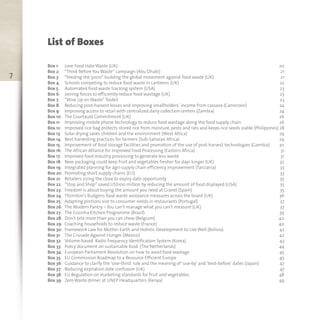
List of Boxes
7
Abbreviations
9
Introduction
11
Definition
15
Impact of food wastage on natural resources and implications for food wastage reduction
15
Main impact of food wastage on natural resources
15
The impact of food wastage on natural resources increases along the food supply chain
17
The food wastage hotspots along the supply chain vary geographically
17
The production of some products consumes more natural resources than others
17
Challenges of natural resources savings from reduction of food wastage
19
Tips for reducing food wastage
20
Raising awareness about food wastage
20
Developing communication campaigns
21
Promoting food wastage audits
22
Improving communication along the supply chain to match demand and supply of food
25
Improving organization within institutions
25
Improving communication between the different stakeholders in the supply chain
26
Developing improved food harvest, storage, processing, transportation and retailing processes
28
Improving harvest techniques and post-harvest storage
29
Improving processing techniques
31
Improving packaging
32
Improving transportation
33
Improving retailing
35
Improving quantity planning for food services
37
Improving consumption habits
39
Implementing legislation to lower food wastage
41
Implementing policy frameworks and strategies to reduce harvest and post-harvest losses
42
Implementing legislation to prevent and reduce food wastege
43
Revising regulation on ‘best-before’ and ‘use-by’ dates
47
Revising regulation on aesthetic requirements for fruit and vegetables
49
Regulating unfair practices in the retail supply chain
50
Content
7
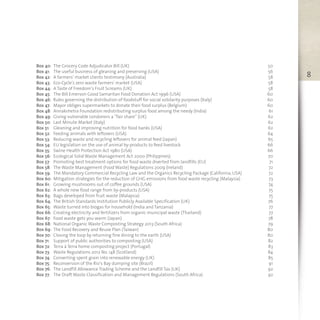
List of Boxes
Box 1: Love Food Hate Waste (UK) 20
Box 2: “Think Before You Waste” campaign (Abu Dhabi) 21
Box 3: “Feeding the 5000” building the global movement against food waste (UK) 21
Box 4: Schools competing to reduce food waste in canteens (UK) 22
Box 5: Automated food waste tracking system (USA) 23
Box 6: Joining forces to efficiently reduce food wastage (UK) 23
Box 7: “Wise Up on Waste” Toolkit 23
Box 8: Reducing post-harvest losses and improving smallholders’ income from cassava (Cameroon) 24
Box 9: Improving access to retail with centralized dairy collection centers (Zambia) 24
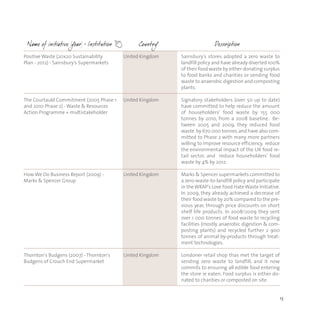
Box 10: The Courtauld Commitment (UK) 26
Box 11: Improving mobile phone technology to reduce food wastage along the food supply chain 26
Box 12: Improved rice bag protects stored rice from moisture, pests and rats and keeps rice seeds viable (Philippines) 28
Box 13: Solar drying saves children and the environment (West Africa) 29
Box 14: Best harvesting practices for farmers (Sub-Saharan Africa) 29
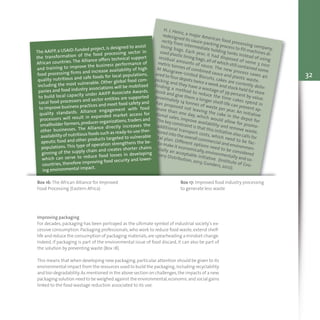
Box 15: Improvement of food storage facilities and promotion of the use of post-harvest technologies (Gambia) 30
Box 16: The African Alliance for Improved Food Processing (Eastern Africa) 31
Box 17: Improved food industry processing to generate less waste 31
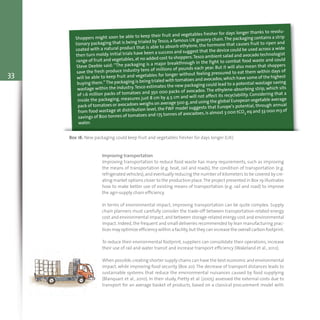
Box 18: New packaging could keep fruit and vegetables fresher for days longer (UK) 32
Box 19: Integrated planning for agri-supply chain efficiency improvement (Tanzania) 33
Box 20: Promoting short supply chains (EU) 33
Box 21: Retailers sizing the close to expiry date opportunity 35
Box 22: “Stop and Shop” saved US$100 million by reducing the amount of food displayed (USA) 35
Box 23: Freedom is about buying the amount you need at Granel (Spain) 35
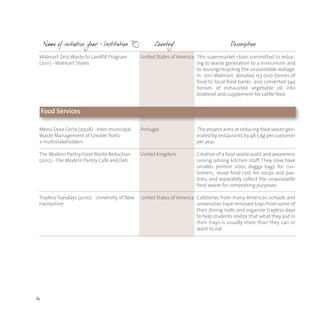
Box 24: Thornton’s Budgens food waste avoidance measures across the board (UK) 36
Box 25: Adapting portions size to consumer needs in restaurants (Portugal) 37
Box 26: The Modern Pantry – You can’t manage what you can’t measure (UK) 37
Box 27: The Cozinha Kitchen Programme (Brazil) 39
Box 28: Don’t bite more than you can chew (Belgium) 40
Box 29: Coaching households to reduce waste (France) 40
Box 30: Framework Law for Mother Earth and Holistic Development to Live Well (Bolivia) 42
Box 31: The Crusade Against Hunger (Mexico) 42
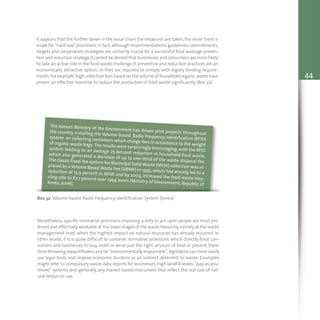
Box 32: Volume-based Radio Frequency Identification System (Korea) 43
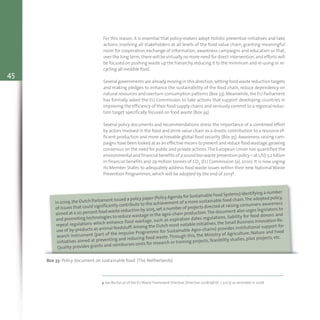
Box 33: Policy document on sustainable food (The Netherlands) 44
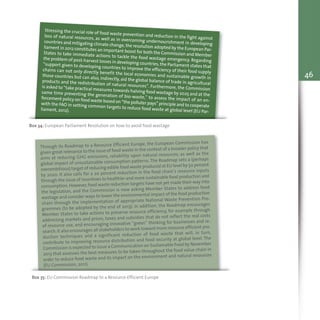
Box 34: European Parliament Resolution on how to avoid food wastage 45
Box 35: EU Commission Roadmap to a Resource-Efficient Europe 45
Box 36: Guidance to clarify the ‘one-third’ rule and the meaning of ‘use-by’ and ‘best-before’ dates (Japan) 47
Box 37: Reducing expiration date confusion (UK) 47
Box 38: EU Regulation on marketing standards for fruit and vegetables 48
Box 39: Zero Waste dinner at UNEP Headquarters (Kenya) 49
8
Box 40: The Grocery Code Adjudicator Bill (UK) 50
Box 41: The useful business of gleaning and preserving (USA) 56
Box 42: A farmers’ market clients testimony (Australia) 58
Box 43: Eco-Cycle's zero waste farmers' market (USA) 58
Box 44: A Taste of Freedom’s Fruit Screams (UK) 58
Box 45: The Bill Emerson Good Samaritan Food Donation Act 1996 (USA) 60
Box 46: Rules governing the distribution of foodstuff for social solidarity purposes (Italy) 60
Box 47: Mayor obliges supermarkets to donate their food surplus (Belgium) 60
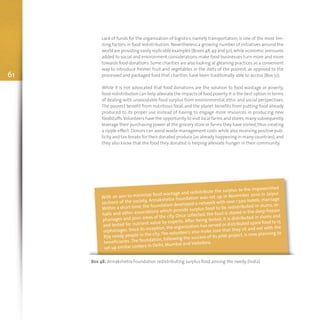
Box 48: Annakshetra Foundation redistributing surplus food among the needy (India) 61
Box 49: Giving vulnerable Londoners a “fair share” (UK) 62
Box 50: Last Minute Market (Italy) 62
Box 51: Gleaning and improving nutrition for food banks (USA) 62
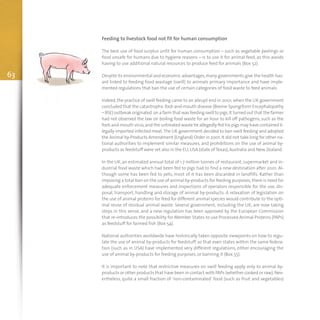
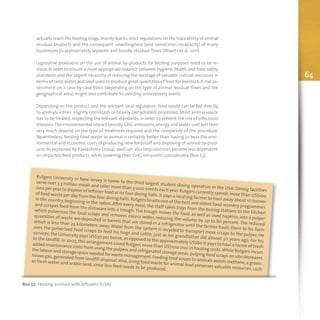
Box 52: Feeding animals with leftovers (USA) 64
Box 53: Reducing waste and recycling leftovers for animal feed (Japan) 65
Box 54: EU legislation on the use of animal by-products to feed livestock 66
Box 55: Swine Health Protection Act 1980 (USA) 66
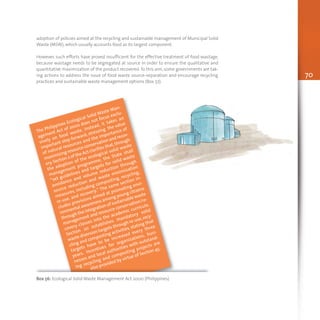
Box 56: Ecological Solid Waste Management Act 2000 (Philippines) 70
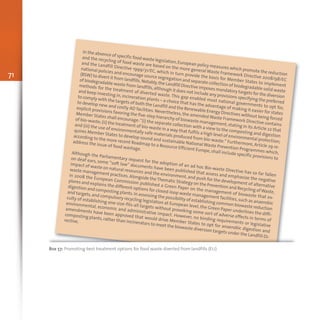
Box 57: Promoting best treatment options for food waste diverted from landfills (EU) 71
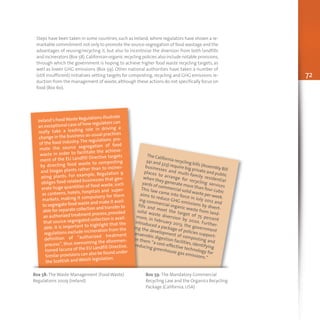
Box 58: The Waste Management (Food Waste) Regulations 2009 (Ireland) 72
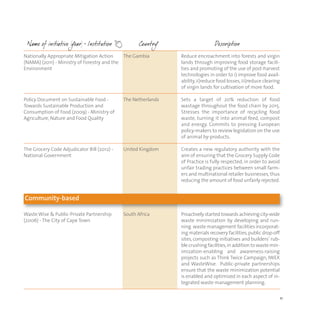
Box 59: The Mandatory Commercial Recycling Law and the Organics Recycling Package (California, USA) 72
Box 60: Mitigation strategies for the reduction of GHG emissions from food waste recycling (Malaysia) 73
Box 61: Growing mushrooms out of coffee grounds (USA) 74
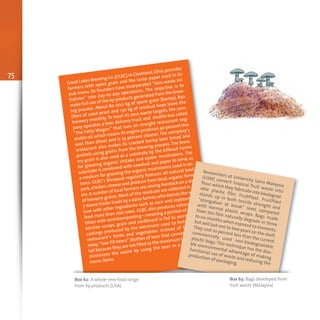
Box 62: A whole new food range from by-products (USA) 75
Box 63: Bags developed from fruit waste (Malaysia) 75
Box 64: The British Standards Institution Publicly Available Specification (UK) 76
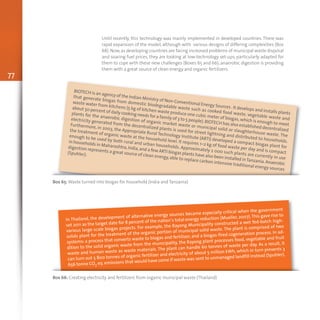
Box 65: Waste turned into biogas for household (India and Tanzania) 77
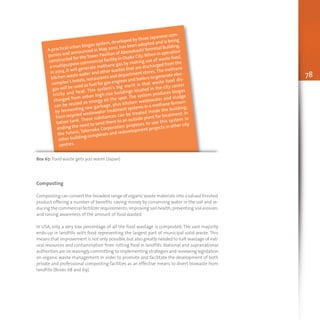
Box 66: Creating electricity and fertilizers from organic municipal waste (Thailand) 77
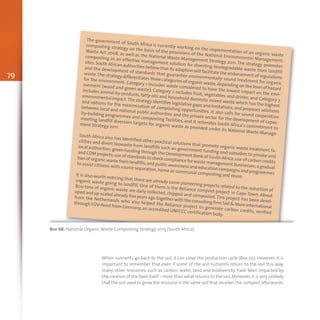
Box 67: Food waste gets you warm (Japan) 78
Box 68: National Organic Waste Composting Strategy 2013 (South Africa) 79
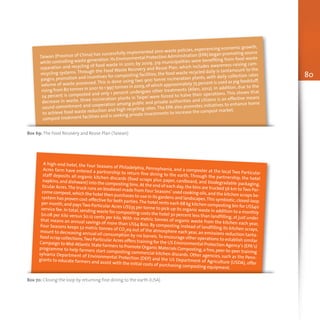
Box 69: The Food Recovery and Reuse Plan (Taiwan) 80
Box 70: Closing the loop by returning fine dining to the earth (USA) 80
Box 71: Support of public authorities to composting (USA) 82
Box 72: Terra à Terra home composting project (Portugal) 83
Box 73: Waste Regulations 2012 No. 148 (Scotland) 84
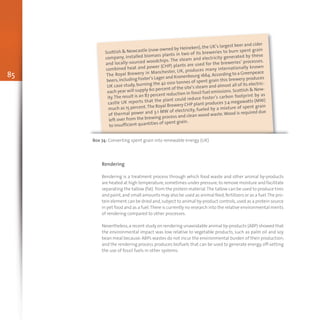
Box 74: Converting spent grain into renewable energy (UK) 85
Box 75: Reconversion of the Rio’s Bay dumping site (Brazil) 91
Box 76: The Landfill Allowance Trading Scheme and the Landfill Tax (UK) 92
Box 77: The Draft Waste Classification and Management Regulations (South Africa) 92
9
Abbreviations
ABP
AD
AIIFP
ARTI
BSE
BSI PAS
BSW
CAA
CDM
DEFRA
EC
EP
EPA
ETS
EU
FWF
GAIA
GHG
GSCOP
IFAD
IPCC
IVC
LA
Animal By-Product
Anaerobic Digestion
African Alliance for Improved Food Processing
Appropriate Rural Technology Institute
Bovine Spongiform Encephalopathy
British Standards Institution Publicly Available Specification
Biodegradable Solid Waste
Consumer Affairs Agency
Clean Development Mechanism
Department for Environment, Food and Rural Affairs
European Commission
European Parliament
Environmental Protection Agency
Emission Trading Scheme
European Union
Food Wastage Footprint
Global Alliance for Incinerator Alternatives
Greenhouse Gas
Grocery Supply Code of Practice
International Fund for Agricultural Development
Intergovernmental Panel on Climate Change
In-Vessel Composting
Local Authorities
10
LATS
MSW
NAMA
NGO
OECD
OFT
OIE
PAP
RFID
SPS
TMR
TSE
UK
UN
UNEP
UNFCCC
USA
SAGCOT
UTP
WFD
WHO
WRAP
WTO
Landfill Allowance Trading Scheme
Municipal Solid Waste
Nationally Appropriate Mitigation Action
Non-Governmental Organization
Organization for Economic Cooperation and Development
Office of Fair Trading
International Office of Epizootics
Processed Animal Protein
Radio Frequency Identification System
Sanitary and Phytosanitary Measures
Total Mixed Rations
Transmissible Spongiform Encephalopathy
United kingdom
United Nations
United Nations Environment Programme
United Nations Framework Convention on Climate Change
United States of America
Southern Agricultural Growth Corridor for Tanzania
Unfair Trading Practices
Waste Framework Directive
World Health Organization
Waste and Resource Action Programme
World Trade Organization
Food loss: refers to a decrease in mass (dry matter quantity) or nutritional value (quality) offood that was originally intended for human consumption. These losses are mainly causedby inefficiencies in the food supply chains, such as poor infrastructure and logistics, lack oftechnology, insufficient skills, knowledge and management capacity of supply chain actorsand lack of access to markets. In addition, natural disasters play a role.Food waste: refers to food appropriate for human consumption being discarded, whether ornot after it is kept beyond its expiry date or left to spoil.Often this is because food has spoiledbut it can be for other reasons such as oversupply due to markets, or individual consumershopping/eating habits.
Food wastage: refers to any food lost by deterioration or discard. Thus, the term “wastage”encompasses both food loss and food waste.
11
Introduction
One-third of all food produced in the world is lost or wasted from farm to fork, according to
estimates calculated by FAO (2011).This wastage not only has an enormous negative impact
on the global economy and food availability, it also has major environmental impacts. The
direct economic cost of food wastage of agricultural products (excluding fish and seafood),
based on producer prices only,is about 750 billion USD,equivalent to the GDP of Switzerland.
The aim of the Toolkit is to showcase concrete examples of good practices for food loss and
waste reduction,while pointing to information sources,guidelines and pledges favoring food
wastage reduction.The inspirational examples featured throughout thisToolkit demonstrate
that everyone,from individual households and producers,through governments,to large food
industries, can make choices that will ultimately lead to sustainable consumption and pro-
duction patterns, and thus, a better world for all.
In recent years,food waste has become a widely-recognized global shame.A number of cam-
paign groups have coalesced around the issue,pushing it further up the public agenda,while
various governments have adopted policies to address the problem and companies have
made pledges to reduce food wastage and, in some cases, measurable improvements have
been made. However, while legislation and policies have been generated in many countries
to incentivize better food waste management, such as through avoidance of landfill, this
should be distinguished from pre-waste solutions aiming to actually reduce food wastage.
12
Although initiatives to reduce food wastage certainly deserve support, there is also chance
that some may have unintended social, economic and/or environmental impacts. One aim
of thisToolkit is to present different best practices and tips for reducing food wastage,looking
specifically at the often overlooked cost of wastage in terms of natural resource use and, in
turn, the environmental benefits of reducing that wastage.
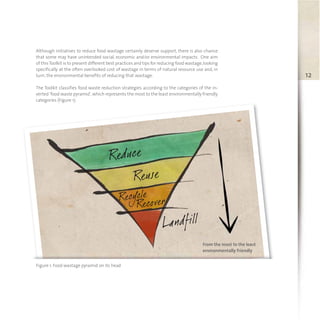
The Toolkit classifies food waste reduction strategies according to the categories of the in-
verted ‘food waste pyramid’,which represents the most to the least environmentally friendly
categories (Figure 1).
From the most to the least
environmentally friendly
Figure 1. Food wastage pyramid on its head
13
Reduce. As the impact of food production on natural resources is enormous and increases
while the food progresses on the food value chain, reducing food wastage is by far the best
way of reducing the waste of natural resources. For example, if the supply-demand balance
can be better adjusted on the front end, it means not using the natural resources to produce
the food in the first place,thus avoiding pressure on natural resources,or using them for other
purposes.
Reuse. In the event a food surplus is produced,the best option is to keep it in the human food
chain.This may call for finding secondary markets or donating it to feed vulnerable members
of society,so that it conserves its original purpose and prevents the use of additional resources
to grow more food. If the food is not fit for human consumption, the next best option is to
divert it for livestock feed,thus conserving resources that would otherwise be used to produce
commercial feedstuff.
Recycle/Recover. The main recycling and recovering options are by-product recycling, anaer-
obic digestion,composting,incineration with energy recovery and rendering.All these options
allow energy or nutrients to be recovered, thus representing a significant advantage over
landfill.
Landfill. Landfilling organic waste causes emission of gases such as methane (a very potent
greenhouse gas) and potentially pollutes soil and water, let alone odour and other societal
nuisance.Landfills should be the last resort option for food waste management,especially in
a context of increased land scarcity for Earth citizens.
This toolkit explains each of these categories in more detail,along with good practices around
the world.
toolkit.xps:Layout 1 13/06/13 11.44 Pagina 13
15
Definition
Preventing food waste reduces the use of resources required for food production,labour and dis-
posal costs,and reduces all the environmental,economic and social impacts linked to food waste
disposal. Prevention is the most efficient way to deal with food wastage, as it is about limiting
foodwastage on the front end,while the other categoriesare about foodwastage management.
Impact of food wastage on natural resources and implications for food
wastage reduction
The Food Wastage Footprint (FWF) project that inspired this Toolkit calculates the impact of
food wastage on natural resources such as water,land and biodiversity.This includes the nat-
ural resources used across the food chain, from growing to distributing food which is finally
not eaten, the impact of food wastage disposal on natural resources, and the impact of GHG
emissions from food wastage on the atmosphere. The FWF model results point to the im-
mense potential for preserving natural resources through reducing food wastage.
Main impacts of food wastage on natural resources
Including the GHG emissions from land use changes associated with food production (such as
the destruction of the Amazon rainforest to provide more farmland) dramatically increases the
estimatesof theglobalcarbonfootprint offoodwastagebut thiscategoryofemissionsisdifficult
to calculate.The global carbon footprint of food wastage - excluding land use change - has been
estimatedat 3.3GtonnesofCO2 equivalent.If thefoodwhichisproducedannually,but not eaten,
were a country, it would rank number three in the world for greenhouse gas emissions, behind
the USA and China.This is more than double the total GHG emissions of all road transportation
in the USA in 2010 ( 1.5 Gtonnes of CO2 equivalent) and triple the EU (0.9 Gtonnes of CO2 eq).
The global blue water footprint1 of food wastage,which refers to consumption of surface and
groundwater during food production, is about 250 km3. This corresponds to the water dis-
charge of the Volga River during an entire year. The blue water footprint of food wastage is
higher than any country’s blue water footprint for consumption of agricultural product.
The global land occupation footprint of food wastage, which is the total hectares used to
grow food ends up being wasted,was about 1.4 billion hectares in 2007.This figure represents
1 The blue water footprint refers to consumption of surface and groundwater resources along the supply chain of a
product. The term “consumption” refers to one of the following cases: water evaporates; water is incorporated into
the product;water does not return to the same catchment area,for example,it is returned to another catchment area
or the sea; water does not return in the same period, for example, it is withdrawn in a scarce period and returned in a
wet period.
16
a land area larger than Canada or China and is only superseded by the size of the Russian Fed-
eration. It is also important to note that a major part of food wastage at the agricultural pro-
duction stage seems to happen in regions where soils are experiencing a medium to strong
land degradation.These regions are also usually the poorest ones, those where a land degra-
dation cycle is threatening food security of the most vulnerable population.
Thebiodiversityfootprint offoodwastageisalsoconsiderable.Farming,includinglandconversion
and intensification, is a major threat for biodiversity worldwide. The threats are mainly due to
cropproductionrather thanlivestock production(70 percent and33percent respectively).Inboth
cases,biodiversity loss is considerably larger in Latin America,Asia (except Japan) and Africa than
in Europe,Oceania,Canada and the USA.This could be partly explained by the fact that tropical
countries have more biodiversity-dense environments,regardless of management intensity.
In addition to its footprints,food wastage has both a financial and a social cost,not to mention
its contribution to global hunger. In addition to the monetary value of the food itself (i.e. the
value of the product at the production stage during which it was wasted), the natural re-
sources embedded in the wasted food also have a value. Plus,given the increasing scarcity of
global resources,such as land and water, the price of natural resources is going to increase in
future.In many countries,water and land already have high costs and GHG emissions lead to
climatic changes which can have major economical implications. FAO is currently evaluating
these costs linked to food wastage, in order to demonstrate the tremendous economic ben-
efits of reducing food wastage.
The high social price is due to food wastage depleting resources on which the poorest are most
dependent.Inaddition to thewasteofwaterandotherlimitedresourcesembeddedin thewasted
food,if rich countries wasted less,it would liberate agricultural land and other resources to grow
something else,including food such as cereals that could contribute to much needed global sup-
plies.This sequence is most obvious for internationally traded commodities such as wheat, and
lessobvious,but stillapplicable, forfreshproducegrownandpurchasedwithinindividualnations.
Furthermore, wasting food in rich countries contributes directly to global hunger. Whether
rich or poor, all countries buy food from the same global market of internationally traded
commodities. If rich countries buy hundreds of millions of tonnes of food they end-up wast-
ing,they are removing food from the market which could have remained there for other coun-
tries to buy. By raising demand for these commodities, rich countries also contribute to price,
which makes them less affordable for poorer nations.
In order to tackle food wastage effectively, it is important to understand where the wastage
hotspots are, both along the value chain and geographically, as well as which types of food
commodity wastage have the greatest impact in terms of natural resources.
17
The impact of food wastage on natural resources increases along the food supply
chain
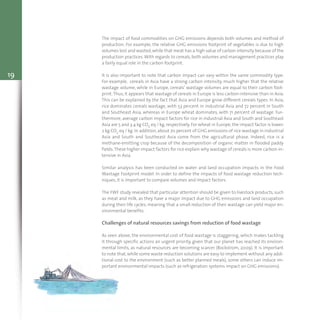
When food wastage occurs at a given phase of the food supply chain (see Figure 2), three
types of impacts must be considered:
v impacts on the phase of production itself;
v impacts on the previous phases of production, if any (e.g. agricultural inputs);
v impacts associated with the end-of-life of the wasted food.
When considering the entire lifecycle of a food product, the production phase has the largest
impact on natural resources.However,each phase has additional environmental impacts.This
means that the further along the supply chain a product is lost or wasted, the higher its en-
vironmental cost or impact.This implies that the further down one is in the supply chain (e.g.
consumption), the highest is the food wastage footprint.
The food wastage hotspots along the supply chain vary geographically
Depending on the country, food wastage happens at different stages of the supply chain. In-
deed,food wastage in developing countries tends to occur higher upstream (agricultural pro-
duction, post-harvest handling and storage) while in developed countries, food wastage
occurs mostly during the production, processing, distribution and consumption phases2.
In low-income regions, food wastage is mostly caused by financial constraints; that is, when
producers are unable to purchase inputs,or have structural limitations that affect harvest tech-
niques, storage facilities, infrastructure, cooling chains, packaging and marketing systems.
These limitations, along with climatic conditions favourable to food spoilage, lead to large
amounts of food losses.In middle and high-income regions,food wastage is caused by wasteful
practices in the food industry and by consumers (both households and catering services).The
food industry has strict retail cosmetic standards related to size and appearance and can cancel
forecast orders,while insufficient purchase planning,as well as confusion over expiration date
labelling, foster high food wastage. The different factors that facilitate food wastage are im-
portant to understand in order to better target food wastage reduction strategies.
The production of some products consumes more natural resources than others
Not all commodities are wasted in the same amounts,nor do they require the same amount
of natural resources to be produced.For instance,growing a tomato (13 litres of water) is much
less water intensive than producing a beefsteak ( 7 000 litres of water).
2 Although there is a lack of data when it comes to farm waste, current estimates for Europe indicate that at least the
20 percent of fruit and vegetables is wasted before it leaves the farm (FAO, 2011).
18
Figure 2. Food wastage along the supply chain
19
The impact of food commodities on GHG emissions depends both volumes and method of
production. For example, the relative GHG emissions footprint of vegetables is due to high
volumes lost and wasted,while that meat has a high value of carbon intensity because of the
production practices.With regards to cereals, both volumes and management practices play
a fairly equal role in the carbon footprint.
It is also important to note that carbon impact can vary within the same commodity type.
For example, cereals in Asia have a strong carbon intensity, much higher that the relative
wastage volume, while in Europe, cereals’ wastage volumes are equal to their carbon foot-
print.Thus, it appears that wastage of cereals in Europe is less carbon-intensive than in Asia.
This can be explained by the fact that Asia and Europe grow different cereals types. In Asia,
rice dominates cereals wastage, with 53 percent in industrial Asia and 72 percent in South
and Southeast Asia, whereas in Europe wheat dominates, with 71 percent of wastage. Fur-
thermore, average carbon impact factors for rice in industrial Asia and South and Southeast
Asia are 5 and 3.4 kg CO2 eq / kg, respectively. For wheat in Europe, the impact factor is lower:
2 kg CO2 eq / kg. In addition, about 70 percent of GHG emissions of rice wastage in industrial
Asia and South and Southeast Asia come from the agricultural phase. Indeed, rice is a
methane-emitting crop because of the decomposition of organic matter in flooded paddy
fields.These higher impact factors for rice explain why wastage of cereals is more carbon-in-
tensive in Asia.
Similar analysis has been conducted on water and land occupation impacts in the Food
Wastage Footprint model. In order to define the impacts of food wastage reduction tech-
niques, it is important to compare volumes and impact factors.
The FWF study revealed that particular attention should be given to livestock products, such
as meat and milk, as they have a major impact due to GHG emissions and land occupation
during their life cycles, meaning that a small reduction of their wastage can yield major en-
vironmental benefits.
Challenges of natural resources savings from reduction of food wastage
As seen above, the environmental cost of food wastage is staggering, which makes tackling
it through specific actions an urgent priority, given that our planet has reached its environ-
mental limits, as natural resources are becoming scarcer (Rockstrom, 2009). It is important
to note that,while some waste reduction solutions are easy to implement without any addi-
tional cost to the environment (such as better planned meals), some others can induce im-
portant environmental impacts (such as refrigeration systems impact on GHG emissions).
20
Possible wastage reduction options,therefore,need to consider the following important ques-
tions:
v Would the food wastage reduction technique under consideration have its own impact
on natural resources (i.e. GHG emission, water , land and biodiversity use)?
v How would this impact compare to simply letting the food get wasted and producing
new food?
v Is the food wastage reduction technique acceptable economically and culturally?The eco-
nomic factor is often the first one to be considered,but the social/cultural factor also con-
stitutes an obstacle when the proposed waste reduction technique induces changes in
cultural patterns.
Tips for reducing food wastage
Raising awareness about food wastage
Rigorous data on the scale of food wastage across the supply chain is currently lacking.This
is primarily due to the lack of a universal method of measuring food waste at the country
level and across the different levels of the food production and consumption.Equally,nations
and corporations are under no obligation to report their food wastage data.Thus,reliance on
self-reporting methods at the consumer and corporate level and use of proxy or anecdotal
data for the measurement of food waste globally mean that the food wastage figures cur-
rently available do most likely underestimate the real numbers.This also makes it difficult to
estimate the environmental impact of food wastage, which is often overlooked when calcu-
lating the actual impacts of food wastage. As stated in the introduction, major communica-
tion campaigns are needed to raise awareness of the issue and move stakeholders across the
food supply chain towards taking specific actions.
Retailers and food-related businesses have undertaken voluntary projects to gather and report
food waste data, although many governments have yet to take steps towards compulsory
food waste data reporting for businesses. Some countries do have legislation requiring large
manufacturers and retailers to report solid waste data. For example, UK has enacted the In-
tegrated Pollution Prevention and Control Regulations, and the Ministry of the Environment
andWater Resources in Singapore will require large commercial premises to report their waste
data from 2014. But as yet, nothing has been specifically provided in relation to food waste.
In addition to a lack of food wastage data at global level,there are often misconceptions about
the environmental impact of food wastage. Indeed, it is common to hear sentences such as
“organic food waste isn’t really bad for the environment as it goes back to the soil”.This type
of statement is wrong for several reasons: unless compost is created from waste, no part of
the waste goes back to the soil, all of the natural resources used to create the food are defi-
21
nitely wasted,and even if it is organic,any food waste decomposition has a very high methane
emission rates, a greenhouse effect some 25 times stronger than CO2 emissions. Uneaten
food that ends-up rotting in landfills, the single largest component of most countries’ mu-
nicipal solid waste,accounts for as much as 25 percent of national methane emissions.There-
fore, a better understanding of wastage amounts and patterns by all stakeholders is much
needed all along the supply chain.The examples presented below show that a better under-
standing of actual food wastage does lead to its reduction.
Developing communication campaigns
Many public and private actors have started campaigning against food waste with growing
success, governments have partnered with civil society to launch campaigns to reduce food
waste and reuse food when waste wasn’t avoidable, and multiple events such as public ban-
quets have been organized all over Europe to raise awareness among businesses, govern-
ments and the public on the levels of food wastage internationally, as well as showcase the
positive solutions to the issue (see Boxes 1-3 for details on these activities). Seeing people
queuing in the snow for a hot meal based on food that would have otherwise be wasted is
quite a strong image when thinking that we might often not think twice before throwing
away perfectly good food at home.Retailers have also started campaigns on better shopping
and better food management at home. For example, the retailer Sainsbury’s provides advice
on how to properly store produce and launched a Love Your Leftovers campaign, which in-
cludes a page on their web site providing recipes and ideas on how to utilize left-over food.
Awareness raising is a key step for food wastage reduction, as it creates the necessary levels
of public pressure that will lead to the change that we need to see in the food industry when
it comes to specific actions against food wastage. Food businesses have no choice but to re-
spond to consumer demand. Raising awareness of food wastage creates the demand for a
new product, namely food wastage avoidance, which will result in the more rapid take-up of
the proposed food waste solutions.
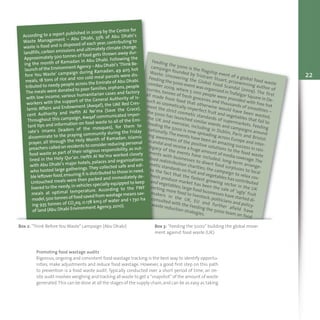
Box 1: Love Food Hate Waste (UK)
WRAP, a UK funded body focusing on reducing waste, was established as a not-for-profit company in 2000.
Its’ two priorities are minimizing resource use and diverting priority materials from landfill. An awareness
campaign started in 2009 with the aim to raise awareness on the need to reduce food waste.It involves prac-
tical tips on how to reduce consumer and household food waste to achieve environmental and economic ben-
efits. WRAP estimates that it has been instrumental in: helping the UK recycling and reprocessing sector to
quadruple in size between 2000 and 2008; diverting 670 000 tonnes of food from landfill, saving consumers
over US$1 billion a year;and stopping the growth in household packaging waste.WRAP estimates that 1 tonne
of food waste avoided equals to 4.5 tonnes of avoided emissions. This means that over 3 million tonnes of
CO2eq emissions have been avoided between 2000 and 2008.
Feeding the 5000 is the flagship event of a global food waste
campaign founded by Tristram Stuart, prizewinning author of
Waste: Uncovering the Global Food Scandal (2009). The first
Feeding the 5000 event was organized inTrafalgar Square in De-
cember 2009, where 5 000 people were provided with free hot
curries, tonnes of fresh groceries and thousands of smoothies –
all made from food that otherwise would have been wasted,
such as cosmetically imperfect fruit and vegetables that fail to
meet the strict cosmetic standards of supermarkets. Feeding
the 5000 has launched similar events and campaigns around
the UK and overseas, including in Dublin, Paris and Bristol.
Feeding the 5000 is now spreading across Europe and inter-
nationally.The events have been an amazing success in rais-
ing awareness of the positive solutions to the food waste
scandal and receive a huge amount of media coverage.The
legacy of the events have included: long-term arrange-
ments with businesses to divert food surpluses to local
food redistribution charities; the campaign to relax cos-
metic standards on fruit and vegetables has contributed
to the fact that the fastest growing sector in the UK
fresh produce market has been the sale of ‘ugly’ fruit
and vegetables;large food businesses have started di-
verting more food to livestock; politicians and policy-
makers in the UK, EU and further afield have
consulted with the Feeding the 5000 team on food
waste reduction strategies.
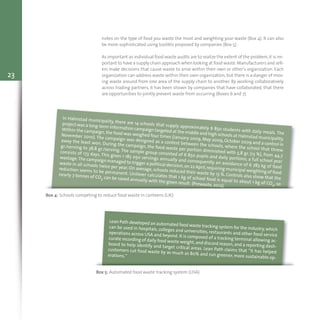
Box 2: "Think Before You Waste" campaign (Abu Dhabi) Box 3: “Feeding the 5000” building the global move-
ment against food waste (UK)
According to a report published in 2009 by the Centre for
Waste Management – Abu Dhabi, 33% of Abu Dhabi’s
waste is food and is disposed of each year, contributing to
landfills, carbon emissions and ultimately climate change.
Approximately 500 tonnes of food gets thrown away dur-
ing the month of Ramadan in Abu Dhabi. Following the
launch of the Environment Agency – Abu Dhabi‘s ‘Think Be-
fore You Waste’ campaign during Ramadan, 49 405 hot
meals, 18 tons of rice and 100 cold meal parcels were dis-
tributed to needy people across the Emirate of Abu Dhabi.
The meals were donated to poor families, orphans, people
with low income, various humanitarian cases and factory
workers with the support of the General Authority of Is-
lamic Affairs and Endowment (Awqaf), the UAE Red Cres-
cent Authority and Hefth Al Ne’ma (Save the Grace).
Throughout this campaign, Awqaf communicated impor-
tant tips and information on food waste to all of the Emi-
rate’s imams (leaders of the mosques), for them to
disseminate to the praying community during the Friday
prayer, all through the Holy Month of Ramadan. Islamic
preachers called on residents to consider reducing personal
food waste as part of their religious responsibility, as out-
lined in the Holy Qur'an. Hefth Al Ne’ma worked closely
with Abu Dhabi’s major hotels, palaces and organizations
who hosted large gatherings. They collected safe and edi-
ble leftover food,ensuring it is distributed to those in need.
Untouched meals were then packed and immediately de-
livered to the needy,in vehicles specially equipped to keep
meals at optimal temperature. According to the FWF
model,500 tonnes of food saved from wastage means sav-
ing 935 tonnes of CO2eq, 0.178 km3 of water and 1 730 ha
of land (Abu Dhabi Environment Agency, 2010).
Promoting food wastage audits
Rigorous, ongoing and consistent food wastage tracking is the best way to identify opportu-
nities, make adjustments and reduce food wastage. However, a good first step on this path
to prevention is a food waste audit. Typically conducted over a short period of time, an on-
site audit involves weighing and tracking all waste to get a “snapshot” of the amount of waste
generated.This can be done at all the stages of the supply chain,and can be as easy as taking
22
23
notes on the type of food you waste the most and weighting your waste (Box 4). It can also
be more sophisticated using toolikts proposed by companies (Box 5).
As important as individual food waste audits are to realize the extent of the problem,it is im-
portant to have a supply chain approach when looking at food waste.Manufacturers and sell-
ers make decisions that cause waste to arise within their own or other’s organization. Each
organization can address waste within their own organization, but there is a danger of mov-
ing waste around from one area of the supply chain to another. By working collaboratively
across trading partners, it has been shown by companies that have collaborated, that there
are opportunities to jointly prevent waste from occurring (Boxes 6 and 7).
Box 4: Schools competing to reduce food waste in canteens (UK)
In Halmstad municipality, there are 14 schools that supply approximately 6 850 students with daily meals. The
project was a long-term information campaign targeted at the middle and high schools at Halmstad municipality.
Within the campaign, the food was weighed four times (January 2009, May 2009, October 2009 and a control in
November 2010). The campaign was designed as a contest between the schools, where the school that threw
away the least won. During the campaign, the food waste per portion diminished with 5,8 gr. (13 %), from 44,7
gr./serving to 38,8 gr./serving. The sample group consisted of 6 850 pupils and daily portions; a full school year
consists of 173 days. This gives 1 185 050 servings annually and consequently an avoidance of 6 783 kg of food
wastage.The campaign managed to trigger a political decision,on 22 April,requiring municipal weighting of food
waste in all schools twice per year. On average, schools reduced their waste by 13 %. Controls also show that the
reduction seems to be permanent. Unilever calculates that 1 kg of school food is equal to about 1 kg of CO2, so
nearly 7 tonnes of CO2 can be saved annually with the given result (Prewaste, 2012).
Box 5: Automated food waste tracking system (USA)
Lean Path developed an automated food waste tracking system for the industry,whichcan be used in hospitals, colleges and universities, restaurants and other food service
operations across USA and beyond. It is composed of a tracking terminal allowing ac-curate recording of daily food waste weight,and discard reason,and a reporting dash-
board to help identify and target critical areas. Lean Path claims that “it has helpedcustomers cut food waste by as much as 80% and run greener, more sustainable op-erations.”
24
Box 6: Joining forces to efficiently reduce food wastage (UK)
Using the principles and tools from the Efficient Consumer Response (ECR) Supply Chain Waste Prevention guide
2012, Mark&Spencer (M&S) and Uniq, one of its key supplier, managed to dramatically reduce their food wastage.
Uniq produced some 90 million of the 1.6 billion sandwiches bought on-the-go in the UK in 2010. Previous research
has suggested that sandwiches have a high level of waste in excess of 5%.The short shelf-life of sandwiches,coupled
with unpredictable demand from consumers due, for example, to the weather and other factors, can lead to high
levels of waste. After having assessed the main areas of food waste, the team decided to:
• review stock requirements at product group level, initially based on previous days sales and weather forecasts;
• re-align orders for each group vs. planned estimate by reviewing waste, sell-outs and progressive sales;
• use a newly developed commitment sheet to enter and review orders at line level;
• re-align line level estimates and review against finalized order;
• make amendment to finalized order as recommended by a new sheet.
In addition,new routines were introduced,including regular meetings to discuss product performance,order fluctu-
ation, manual amends, trends and future estimates and daily discussions between planners and M&S team around
planned orders. As a result of the actions reported above,M&S and Uniq saved 129 tonnes of food waste in 2010 and
expected to save a further 170 tonnes during 2011. By obtaining a fuller understanding of the contribution made by
all sandwich lines and taking action together to review the range, both M&S and Uniq have seen a substantial re-
duction in their costs and significant environmental gains have been made.According toWRAP,in the UK every tonne
of food waste avoided in this way is also worth 4.5 tonnes of avoided CO2 emissions,which is equivalent to the capita
CO2 emission in Argentina (Institute of Grocery Distribution, 2013).
Box 7: “Wise Up on Waste” Toolkit
Unilever Food Solutions have partnered with the Sustainable Restaurant Association to create a complete waste audit
and waste reducing toolkit.The process is structured in two stages.The first one is to carry out an audit using the online
toolkits developed by the initiative, which help caterers and chefs monitor where waste occurs in the kitchen. There
are also case studies on how other businesses have used the toolkit in the past and a Food Waste data tracking sheet
which helps linking the catering outlet’s food waste management to key performance indicators. Within the Smart
Staff section, there is a range of posters available to utilize around the kitchen to highlight awareness and enable
kitchen staff to monitor progress. ‘Purchasing tools' are also available to enable staff manage stock and allow to buy
more efficiently.The Mise en Place and recipe tools provide recipe templates which, as well as providing a simple way
to standardize recipes, can also be utilized for shopping lists. More importantly, the 'event efficiency tool' helps plan
menus, whilst tracking costs.The final element is on plate waste awareness and efficient monitoring.
25
Dairy produce is highly susceptible to loss, owing to a lack of
technology such as refrigeration and pasteurization on farms
and in markets. In Zambia, the Japanese government, Care In-
ternational,and the US Agency for International Development
(USAID),in collaboration with local businesses and stakehold-
ers,have helped establish rural milk collection centers.Small-
holder cattle producers who had never engaged in milk
trade now deliver their surplus milk to the collection cen-
ters, which are equipped with cooling facilities that allow
the milk to be sold on the market to processors, and ulti-
mately to create a self-sustaining business that increases
farmers’ income and the availability of locally produced
milk (USAID/Zambia, 2005).
Box 8: Reducing post-harvest losses and improving
smallholders’ income from cassava (Cameroon)
Box 9: Improving access to retail with
centralized dairy collection centers (Zambia)
An effort to improve competitiveness of the cassava chain
in Cameroon identified the fragmentation of smallholder
supplies sent to the market as one of the bottlenecks that
needed to be addressed.The quality varied from produce
to producer, so wholesalers did not have a homogenous
stock, and often the collecting points were not easily
reachable.With support and capacity building from FAO,
the producers organized and established quality control
and logistics mechanisms and, as a result, wholesalers
now use public transport to pick-up graded produce and
make payments at agreed stops along the Akonolinga-
Yaoundé highway.These mechanisms have resulted in im-
proved quality control, fewer product rejections by
wholesalers, and increased income for both producers
and buyers (FAO, 2012).
Improving communication along the supply chain to match demand and supply of
food
The discrepancy between demand and supply, a major cause of food wastage, ranges from
farmers not finding a market for their products and leaving them rot in the field, to mothers
cooking for five family members while only 3 actually show-up for dinner, to supermarkets
downsizing product orders at the last minute, leaving producers with unsalable products.
Due to mis-communication and perverse signals and incentives all along the supply chain,
food is lost or wasted and,together with it,all the natural resources used to create it.Tackling
food wastage requires better communication between the different parts of the supply chain
to better balance the demand and the offer,such as farmers discussing production with their
neighbors and establishing a harvesting calendar to prevent flooding the market.
Improving organization within institutions
As the African saying goes “if you want to go fast go alone,if you want to go far go together”.
Joining forces via farmers cooperatives or professional associations can greatly help reduce
food losses by increasing understanding of the market and enabling more efficient planning
(Boxes 8 and 9),lowering individual vulnerability that comes with environmental and market
fluctuations, improving efficiency through economy of scale, or creating a dynamic environ-
ment to share innovative food wastage reduction techniques (Box 10).
26
Improving communication between the different stakeholders in the supply chain
The different actors involved in the food supply chain (e.g.producers,food processors,retailers,
consumers) are heavily interdependent and their actions and practices influence each other’s
decisions.
Rejection of food products on the basis of aesthetic or safety concerns is often cited as the major
cause of food losses and waste.For example,farmers often have to discard between 20 and 40
percent of their fresh produce because it doesn’t meet the cosmetic specification of retailers.
Waste due to overproduction – when a manufacturer makes more of a product than the super-
market can actually sell – can reach up to 56 percent of a company’s total output (meaning
more food wasted than sold),while a baseline of 5–7 percent is considered by many inevitable.
This waste typically occurs when a supermarket makes what is known as a “forecast order” of
say,1 million assorted sandwiches,a week in advance.However,the supermarket won’t confirm
the order before,at best,24 hours before delivery date.The manufacturer has to produce all the
sandwiches in advance to meet the deadline but the supermarket will very often lower the
order.The manufacturer then ends-up with pallet loads of fresh sandwiches and no one to sell
them to. Finding a last minute buyer is extremely difficult and even impossible if the sand-
wiches packages bear the brand name of the supermarket.And the supermarkets often forbid
the manufacturers to give the unsold lot to food charities to avoid having their brand name
possibly being sold on the grey market. And,as this type of waste happens with finished prod-
ucts, all the energy and resources used to making them is lost, which makes it all the more
wasteful (Stuart,2009).This example highlights the power relationships between the different
links of the chain;farmers and manufacturers often depend on supermarkets for their income,
as they are their main clients. Interventions by the public and policy-makers are needed to re-
balance the power game within the food supply chain (see Box 40).
Supply chain efficiency could be greatly improved by enhancing communication among the dif-
ferent stakeholders.Remaining in constant dialogue with buyers not only helps agro-enterprises
manage the risks they face when buying from smallholders,it also contributes to producer or-
ganizations’ understanding of buyers’ sourcing decisions (FAO, 2012). In addition to increasing
business among the parties, sustained dialogue also helps reduce product rejection by buyers
and,at the same time,increases the stability of the offer for the buyer.Box 11 illustrates options
along the supply chain to improve communication among stakeholders to reduce food wastage.
Box 10: The Courtauld Commitment (UK)
The Courtauld Commitment calls for improving resource efficiency and reducing the carbon and wider environmental
impact of the UK grocery retail sector. It supports the UK’s policy goal of a “zero waste economy” and the objectives
of the Climate Change Act to reduce greenhouse gas emissions by 34 percent by 2020 and 80 percent by 2050.WRAP
is responsible for the agreement and works in partnership with leading retailers, brand owners, manufacturers and
suppliers who sign up and support the delivery of the targets. Its Phase 1, launched in 2005, looked at new solutions
and technologies so that less food and primary packaging ended-up as household waste. Phase 2, launched in 2010,
moves away from solely weight-based targets and aims to achieve more sustainable use of resources over the lifecycle
of products and throughout the whole supply chain.Signatories have grown from 29 major retailers and brand own-
ers at the launch of Phase 2 to 53 today, including Sainsbury’s, Marks & Spencer, Coca Cola and Danone.The targets
are to: reduce the weight, increase recycling rates and increase the recycled content of all grocery packaging, as ap-
propriate, in order to reduce the carbon impact of grocery packaging by 10 percent; reduce UK household food and
drink waste by 4 percent; and reduce traditional grocery product and packaging waste in the grocery supply chain
by 5 percent,including both solid and liquid wastes.During the four years of Phase 1,the programme saved 1.2 million
tonnes of food and packaging waste, with a monetary value over US$3.1 billion, and 3.3 million tonnes of CO2. First-
year progress results of Phase 2 (released in December 2011) show that signatories are already halfway to achieving
the packaging reduction target and three-quarters of the way to reaching the household food waste objectives.
27
Box 11: Improving mobile phone technology to reduce food wastage along the food supply chain
Better communication, via mobile phone, can reduce food wastage and GHG emissions, according to a 2011
study published byVodafone.The study focused on four opportunities where mobile technology can be used
to manage the food supply chain more efficiently:
• smart logistics: using mobile devices to collect data on the location, speed and route of food distribution
trucks,helping distributors improve fleet management;
• traceability and tracking system:using mobile devices to record movements of items through the agricul-
tural supply chain,from farms to shops;
• mobile management of supplier networks:agricultural field agents visiting farms using mobile phones to
record data on farm conditions and expected yields;
• mobile management of distribution networks: retailers using mobile phones to keep records of sales of
agricultural inputs like seeds,fertilizer and chemicals.
Accenture and Vodafone have estimated that these opportunities have the potential to increase agricultural
income by an estimated US$138 billion across 26 countries by 2020. This represents an 11 percent increase
against theforecast for that yearandasignificant proportionwillbegainedoutsideofEurope.Furtherbenefits
could include reducing CO2-equivalent emissions by nearly 5 mega tonnes (Mt) and reducing freshwater with-
drawals for agricultural irrigation by 6 percent by 2020.This is based on a total of around 549 million antici-
pated connections of users to the individual services across the 12 opportunities (Vodafone/Accenture (2011).
28
Developing improved food harvest,storage,processing,transportation and retailing
processes
Food losses that occur during harvest, post-harvest, and processing phases are most likely in
developing countries,due to poor infrastructure,low levels of technology and low investment
in the food production systems. In developed countries, food waste mostly occurs further
along the supply chain, at the retailing and consumption levels.
Food losses during harvest and storage translate into lost income for farmers and into higher
prices for consumers,but also have a big environmental cost,as most of the natural resources
are used at the beginning of the supply chain. Reducing losses could therefore have an im-
mediate and significant positive impact on livelihoods, food security and natural resources.
Both the private and public sectors need to increase investments in infrastructure,transporta-
tion, processing and packaging. To this aim, international organizations strive to promote
sound cooperation between institutional actors and the private sector, in order to develop
strategies and joint investment planning to enhance techniques and knowledge in developing
countries and provide backing for implementation (see FAO, 2012).
Governments role is to work on regulating risk and implementing biosecurity policies that
are often crucial to maximizing crop yield and natural resources efficiency, and on reducing
pre-harvest losses. Establishing national sanitary and phyto-sanitary (SPS) standards would
facilitate access to international market and reduction of losses due to the rejection of large
amounts of food destined for the export market. In this regard, it is noteworthy that several
inter-governmental organizations, including FAO, WHO, OIE, WTO and the World Bank, have
established a partnership through which they have developed Standards and Trade Develop-
ment Facilities (STDF). STDFs build the capacity of developing countries to implement SPS
measures smoothly and enhance their accessibility to the international market (FAO, 2005).
Developed countries efforts are crucial in developing processing techniques to reduce
wastage, enhancing retailing planning and improving consumer behavior. The adoption of
guidelines and recommendations aimed at preventing avoidable wastage and encouraging
businesses to adopt more resource-efficient production patterns. Besides, new regulations
that,for instance,remove quality requirements regarding appearance and over-zealous safety
standards, would certainly be helpful in avoiding unnecessary discards and lower the envi-
ronmental impact of the post-harvest processing chain.
Some examples of what could be done along the supply chain, as well as significant policy
frameworks and institutional initiatives are presented below.
29
Improving harvest techniques and post-harvest storage
Harvest losses have several causes,including timing of the harvest,as well as harvesting tech-
niques, equipment and conditions. For example, harvesting fruits on high trees with a hook
and a catching bag on a pole prevents the fruit falling to the ground and bruising. Lettuce,
cabbage, sweet pepper, eggplant, melons and bananas are better harvested using cutting
tools.Ideally,harvesting should take place when the crop and the climate are coolest and the
plant has the highest moisture content.Yet,sometimes,poor farmers must harvest crops too
early due to food deficiency, or their desperate need for cash during the second half of the
agricultural season. As a result, the food loses both nutritional and economic value, and may
be wasted if it is not suitable for consumption.
It is the same thing for post-harvest losses. Fresh products such as fruits, vegetables, meat
and fish straight from the farm,or after the catch,can spoil quickly in hot climates due to lack
of infrastructure for transportation,storage,cooling and markets (Rolle,2006).New technolo-
gies have been developed to improve storage (Box 12) as have green technologies, such as
solar dryers that improve the lifetime of products in storage and,in turn,increase food security
and economic benefits for the producers (Box 13).
Improving food availability and reducing waste can often be a matter of directing resources
to training farmers in best practices, without even the need for capital expenditure (Box 14).
Governments have also funded remarkable projects to stress the strong interconnection be-
tween post-harvest loss reduction, the preservation of natural resources and the reduction
of GHG emissions from agriculture (Box 15).
Over the last few decades, FAO has led major work on post-harvest losses. Its Information
Network on Post-harvest Operations (INPhO)Website is a great resource for practitioners and
trainers on the issues, and on solutions linked to harvest and post-harvest losses.
Box 12: Improved rice bag protects stored rice from moisture, pests and rats and keeps rice seeds viable (Philippines)
A rice storage bag that blocks the flow of both oxygen and water vapor has had a great result for rice farmers,who often deal with post-
harvest losses of up to 15 percent of the harvest, as well as loss of nutritional quality. Developed by the International Rice Research
Institute (IRRI), the bag enables farmers to safely store their seeds for 9–12 months without reducing germination rates. The bag also
keeps away insects and rats without using chemicals and increases the percentage of whole rice grains recovered after milling by around
10 percent.A Filipino farmer,who found that his rice grains broke from moisture and suffered pest infestations during 7-month storage,
tested the new bags and reported that after keeping the harvest in the bags for 10 months,“the seeds were 100 percent viable,and none
were wasted." IRRI initiated and facilitates National Post-harvest Learning Alliances to embrace public and private stakeholders with an
interest in, and mandate to, establish local supply chains for technologies. Through Postharvest Learning Alliance, IRRI is assisting in
settingupand traininglocaldistributorsinnew technologiesforreducingpost-harvest losses.TheFWFmodelcalculated that,inSoutheast
Asia, the carbon footprint of rice cultivation is particularly high, as rice is a methane-emitting crop, because of the decomposition of
organic matter in flooded paddy fields.Therefore, reducing post-harvest loss by 15 percent has a significant climate change mitigation
effect (International Rice Research Institute,2012).
toolkit.xps:Layout 1 13/06/13 11.45 Pagina 29
30
Box 13: Solar drying saves children and the environment (West Africa)
Reducing post-harvest loss of mangoes by using greenhouse model solar dryers is a promising strategy to help combat
vitamin A deficiency in French-speaking West Africa and, in turn, reduce child mortality. Typically, the annual post-
harvest loss of rich mangoes in the region exceeds 100 000 tonnes. However, in a study, 3.75 tonnes of fresh mangoes
were dried using a solar dryer to a final moisture content of 10 percent to 12 percent, yielding 360 kg dried mango.The
product analysis revealed 4 000 (+/-500) microg beta carotene per 100 grammes and 3 680 (+/-150) microg beta
carotene per 100 grammes after 2 and 6 months of storage,respectively.Thus,one greenhouse solar dryer is capable of
reducing post-harvest mango waste by 3.75 tonnes, providing up to 1.15 million retinol activity equivalents of dietary
vitamin A.The use of this technology that requires solar energy and manpower has the potential of increasing dietary
vitamin A supply in the Region by up to 27 000-fold.Moreover,mango is a fruit that is well liked by the local population,
which increases the likelihood of its ready acceptance (Rankins, Sathe & Spicer, 2008). Using solar energy to reduce
food wastage can go a long way towards the reduction of greenhouse gases emissions; the FWF model estimates that,
if only one dryer can save 3.75 tons of mangoes,reducing mangoes loss from the Region can potentially save 0.86 tonnes
of CO2eq and 1 133m3 of water.
Box 14: Best harvesting practices for farmers (Sub-Saharan Africa)
Not only do the African staples cassava and yam have a short shelf life, there is little tradition of transforming them intomore stable products such as flour,so they rot in the barns of the hungry.The sweet potato – the world’s seventh most im-portant food crop – has a high water content, making it more prone to decay than dried cereals. In rich countries that haveadvanced storage facilities, sweet potatoes can be kept for up to one year, whereas in sub-Saharan Africa, as much as 79percent of a stored tuber crop can be lost during the same period of time. Nevertheless, careful design of storage systems,as well as measures such as removing stems from the tops of the potatoes, have been shown to improve recovery of thecrop by up to 48 percent. Recent work has helped identify the exact point in the crop’s maturity (at 105 days) that it is bestto harvest the tubers to maximize productivity,nutritional quality,storage properties and consumer acceptability.Changingthe way African farmers harvest tubers can help them feed their families while at the same time opening up new oppor-tunities to capitalize on the growing demand for fresh produce in urban centres.They often have no dedicated storage fa-cilities and,instead,keep potatoes on earthen floors in their mud and thatched huts where they can be exposed to sunlight.This can lead to significant losses due to greening and sprouting, especially when doors are regularly opened and closedduring the day.Cold storage of tubers as practiced by large-scale growers worldwide may not be an appropriate or affordabletechnology for these farmers, so a viable alternative is to leave crops in the ground for longer periods after maturity, andto harvest them in batches sequentially,rather than all at once.This can help distribute farm labor inputs and income whilehelping to meet quality standards for commercial sales.One study in South Africa compared losses from traditional harvestsstored in farmers’ stores with sequential harvesting, leaving potatoes in the ground for up to six weeks after maturity. Inthe best instances, sequential harvesting cut wastage from 37 percent of the harvest down to just 11 percent – a 71 percentreduction in losses.On average throughout the year,8 percent of the entire crop was saved through sequential harvesting.
31
Box 15: Improvement of food storage facilities and promotion of the use
of post-harvest technologies (Gambia)
The Gambia’s Departments of Agriculture and Energy have adopted a holistic ap-proach to address a number of environment-related issues of primary importance,such as climate change mitigation and adaptation,reduction of GHG emissions,post-
harvest losses,food security and sustainable development.In establishing the Nation-
ally Appropriate Mitigation Action (NAMA) Programme, the Gambia has committedto wide investments to improve transportation infrastructure and the allocation of
funds to support research to address adverse trends in the farming system.But NAMAalso includes a project aimed at promoting and facilitating the use of post-harvestand food processing technologies to reduce food losses and enhance quality-foodavailability,thus reducing the need to convert virgin lands and forests for farming and,
in turn, the emission of GHGs.The proposed project is to take place between 2012 and2025,with an overall cost of US$ 3.25 million covering,inter alia,capacity building andthe improvement of sustainable technologies for cooling, cleaning, sorting and pack-
ing harvested food. NAMA identifies a number of issues and the related potential so-lutions. Some examples regard the protection of premature grazing, appropriate
harvesting,storage,and utilization and preservation techniques to reduce food losses(Government of the Gambia, 2012).
Improving processing techniques
Lack of processing facilities causes high food losses in developing countries. In many situa-
tions,the food processing industry doesn’t have the capacity to process and preserve enough
fresh farm produce to meet the demand. Part of the problem stems from the seasonality of
production and the cost of investing in processing facilities that will not be used year-round
(FAO, 2011). In developing countries, investment and capacity-building initiatives (Box 16) are
key to improving processing facilities. In developed countries, processing facilities are also a
major source of waste. This happens mainly during trimming, which removes both edible
portions (e.g. skin, fat, peels, end pieces) and inedible portions (e.g. bones, pits) from food.
Over-production, product and packaging, as well as technical malfunctions, can also cause
processing losses, though these may be difficult to avoid.In some cases, trimming at the pro-
cessing stage, rather than by the end user, may be more efficient in terms of quantity lost
and potential use of scrap by-products (Gunders, 2012).
The efficiencies of processing also vary widely by product. A study byWRAP (2010), estimates
that food manufacturers lose about 16 percent of their raw materials during manufacturing,
amounting to 23 percent of total food losses produced by manufacturing, distribution, retail
operations and households.Innovative techniques can cut down on this waste (Box 17).How-
ever, it is important to consider the potential environmental impact of these techniques
themselves, as discussed earlier in the section on challenges.
H. J. Heinz, a major American food processing company,
redesigned its sauce-packing process to fill machines di-
rectly from intermediate holding tanks instead of using
lining bags. Each year, it had disposed of some 3 000
used plastic lining bags,all of which still contained some
residual amounts of sauce. The new process saves 40
metric tonnes of combined sauce and plastic waste.
At Musgrave–United Biscuits, cakes are currently deliv-
ered to four depots twice a week and stock-held for store
picking and they have a wastage of 39 percent by value.
Finding a method to reduce the time cakes spend in
stock and give them a longer shelf-life can prevent ap-
proximately 14 tonnes of waste per year. An initiative
has proposed not leaving the cake in the depot for
more than one day, which would allow for promo-
tional sales, improve availability and remove waste.
The key constraint is that this initiative also calls for
additional transport costs, which need to be fac-
tored into the overall commercial and environmen-
tal plan. Different options need to be considered
to make it economically,environmentally and so-
cially an acceptable initiative (Institute of Gro-
cery Distribution, 2013; Gunders, 2012).
Box 16: The African Alliance for Improved
Food Processing (Eastern Africa)
Box 17: Improved food industry processing
to generate less waste
The AAIFP, a USAID-funded project, is designed to assist
the transformation of the food processing sector in
African countries. The Alliance offers technical support
and training to improve the business performance of
food processing firms and increase availability of high
quality nutritious and safe foods for local populations,
including the most vulnerable. Other global food com-
panies and food industry associations will be mobilized
to build local capacity under AAIFP Associate Awards.
Local food processors and sector entities are supported
to improve business practices and meet food safety and
quality standards. Alliance engagement with food
processors will result in expanded market access for
smallholder farmers,producer organizations,traders and
other businesses. The Alliance directly increases the
availability of nutritious foods such as ready-to-use ther-
apeutic food and other products targeted to vulnerable
populations. This type of operation strengthens the be-
ginning of the supply chain and creates shorter chains
which can serve to reduce food losses in developing
countries, therefore improving food security and lower-
ing environmental impact.
Improving packaging
For decades, packaging has been portrayed as the ultimate symbol of industrial society’s ex-
cessive consumption. Packaging professionals, who work to reduce food waste, extend shelf-
life and reduce the consumption of packaging materials,are spearheading a mindset change.
Indeed, if packaging is part of the environmental issue of food discard, it can also be part of
the solution by preventing waste (Box 18).
This means that when developing new packaging,particular attention should be given to its
environmental impact from the resources used to build the packaging,including recyclability
and bio-degradability.As mentioned in the above section on challenges,the impacts of a new
packaging solution need to be weighed against the environmental,economic and social gains
linked to the food wastage reduction associated to its use.
32
33
Box 18: New packaging could keep fruit and vegetables fresher for days longer (UK)
Shoppers might soon be able to keep their fruit and vegetables fresher for days longer thanks to revolu-
tionary packaging that is being trialed by Tesco, a famous UK grocery chain.The packaging contains a strip
coated with a natural product that is able to absorb ethylene, the hormone that causes fruit to ripen and
then turn moldy. Initial trials have been a success and suggest that the device could be used across a wide
range of fruit and vegetables,at no added cost to shoppers.Tesco ambient salad and avocado technologist
Steve Deeble said: “The packaging is a major breakthrough in the fight to combat food waste and could
save the fresh produce industry tens of millions of pounds each year. But it will also mean that shoppers
will be able to keep fruit and vegetables for longer without feeling pressured to eat them within days of
buying them.”The packaging is being trialed with tomatoes and avocados,which have some of the highest
wastage within the industry.Tesco estimates the new packaging could lead to a potential wastage saving
of 1.6 million packs of tomatoes and 350 000 packs of avocados. The ethylene-absorbing strip, which sits
inside the packaging, measures just 8 cm by 4.5 cm and will not affect its recyclability. Considering that a
pack of tomatoes or avocadoes weighs on average 500 g,and using the global European vegetable average
from food wastage at distribution level, the FWF model suggests that Europe’s potential, through annual
savings of 800 tonnes of tomatoes and 175 tonnes of avocadoes,is almost 3 000 tCO2 eq and 33 000 m3 of
water.
Improving transportation
Improving transportation to reduce food waste has many requirements, such as improving
the means of transportation (e.g. boat, rail and roads), the condition of transportation (e.g.
refrigerated vehicles),and eventually reducing the number of kilometers to be covered by cre-
ating market options closer to the production place.The project presented in Box 19 illustrates
how to make better use of existing means of transportation (e.g. rail and road) to improve
the agri-supply chain efficiency.
In terms of environmental impact, improving transportation can be quite complex. Supply
chain planners must carefully consider the trade-off between transportation-related energy
cost and environmental impact,and between storage-related energy cost and environmental
impact. Indeed, the frequent and small deliveries recommended by lean manufacturing prac-
tices may optimize efficiency within a facility,but they can increase the overall carbon footprint.
To reduce their environmental footprint, suppliers can consolidate their operations, increase
their use of rail and water transit and increase transport efficiency (Wakeland et al., 2012).
When possible,creating shorter supply chains can have the best economic and environmental
impact, while improving food security (Box 20).The decrease of transport distances leads to
sustainable systems that reduce the environmental nuisances caused by food supplying
(Blanquart et al., 2010). In their study, Pretty et al. (2005) assessed the external costs due to
transport for an average basket of products, based on a classical procurement model with
34
long supply chains.It found that consumers would pay 3 percent more if environmental costs
were taken into account in the final price3.But if these products originate from within 20 km
of the place of consumption, environmental costs would be 90 percent lower. In addition, re-
cent studies have found that the producers involved in short chains tend to have more envi-
ronmentally friendly practices,notably to meet the consumers demand for “greener” products
(Spanu, 2008).
However, more detailed studies are necessary to determine how much short chains actually
improve environmental performance. For example, Carlsson-Kanyama (1997) found that dis-
tance is only one of the parameters that determine the ecological impact of transport. It is
also important to consider,for example,transport modes,the type of fuel used and the filling
rate of the vehicles.
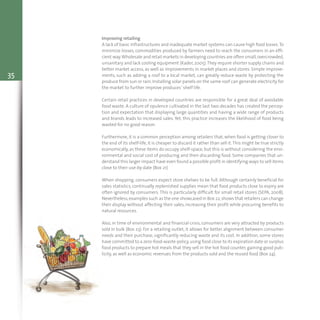
Dacian Cioloş, European Commissioner for Agri-
culture and Rural Development,opened a confer-
ence in Brussels, on 20 April 2012, stating that
“short supply chains have too long been over-
looked.Yet, available data show that already, de-
spite the lack of recognition and support, 15
percent of EU farms sell more than half of their
produce locally. (…) I am convinced that selling a
larger part of agricultural produce locally will
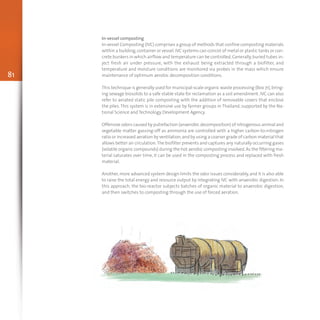
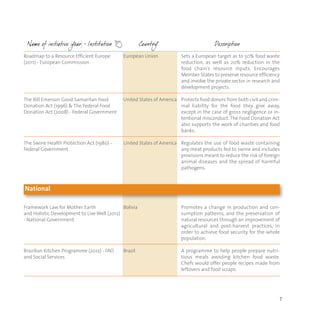
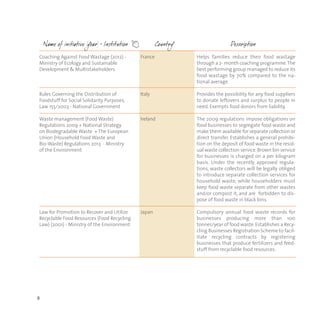
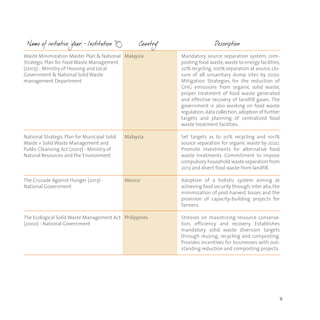
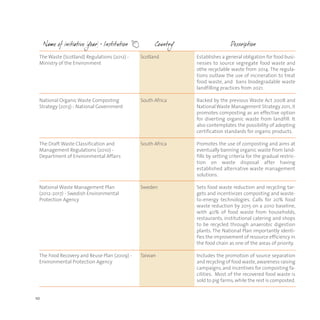
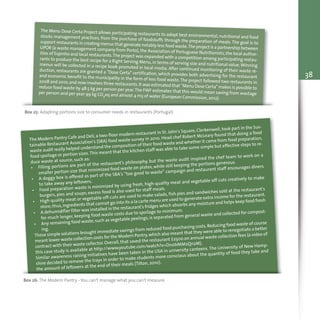
bring concrete solutions to many of the chal-
lenges facing our society: solutions for con-
sumers who, value the quality, wealth and
traditions of farm products;solutions for the eco-
nomic health of the farming sector. Even if they
will not become the norm, or anything like it,
short supply chains do create extra value
added, which is much needed. Solutions to
problems of waste. Energy waste caused by
unnecessary transport of goods; waste of
food lost at different stages of the supply
chain.We must get a better understanding
of this type of marketing.We need to redis-
cover it" (Cioloş, 2012).
Box 19: Integrated planning for agri-supply chain
efficiency improvement (Tanzania)
Box 20: Promoting short supply chains (EU)
The Southern Agricultural Growth Corridor ofTanzania (SAGCOT)
is an agricultural partnership designed to improve agricultural
productivity,food security and livelihoods inTanzania.Initiated at
the World Economic Forum Africa Summit in May 2010, it then
launched its SAGCOT Investment Blueprint, nationally by Prime
Minister Pinda,in Dar el Salaam,and internationally by H.E. Pres-
ident Kikwete at the 2011World Economic Forum in Davos.The In-
vestment Blueprint showcases investment opportunities in the
corridor and lays-out a framework of institutions and activities
required to reap development potential. SAGCOT has the poten-
tial to make a serious and significant impact by bringing together
government, business, donor partners and the farming commu-
nity to pool resources and work together towards a common goal.
It is a comprehensive and inclusive initiative. By addressing the
entire agricultural supply chain, the SAGCOT approach goes be-
yond raising agricultural productivity and ensures the necessary
infrastructure, policy environment and access to knowledge to
create an efficient, well-functioning agricultural supply chain.
SAGCOT covers approximately one-third of mainland Tanzania,
extending North and South of the central rail, road and power
“backbone” that runs from Dar es Salaam to the Northern areas
of Zambia and Malawi.
3 This additional cost is mainly made up of public subsidies for agriculture (US$ 1.43), agricultural externalities (US$
1.25),road freight transport for retailing (US$ 1.17) and the transport of products once they’ve been bought by customers
(US$ 0.63).
35
Improving retailing
A lack of basic infrastructures and inadequate market systems can cause high food losses.To
minimize losses, commodities produced by farmers need to reach the consumers in an effi-
cient way.Wholesale and retail markets in developing countries are often small,overcrowded,
unsanitary and lack cooling equipment (Kader, 2005).They require shorter supply chains and
better market access, as well as improvements in market places and stores. Simple improve-
ments, such as adding a roof to a local market, can greatly reduce waste by protecting the
produce from sun or rain. Installing solar panels on the same roof can generate electricity for
the market to further improve produces’ shelf life.
Certain retail practices in developed countries are responsible for a great deal of avoidable
food waste. A culture of opulence cultivated in the last two decades has created the percep-
tion and expectation that displaying large quantities and having a wide range of products
and brands leads to increased sales. Yet, this practice increases the likelihood of food being
wasted for no good reason.
Furthermore, it is a common perception among retailers that, when food is getting closer to
the end of its shelf-life, it is cheaper to discard it rather than sell it.This might be true strictly
economically, as these items do occupy shelf-space, but this is without considering the envi-
ronmental and social cost of producing and then discarding food. Some companies that un-
derstand this larger impact have even found a possible profit in identifying ways to sell items
close to their use-by date (Box 21).
When shopping, consumers expect store shelves to be full. Although certainly beneficial for
sales statistics, continually replenished supplies mean that food products close to expiry are
often ignored by consumers. This is particularly difficult for small retail stores (SEPA, 2008).
Nevertheless,examples such as the one showcased in Box 22,shows that retailers can change
their display without affecting their sales, increasing their profit while procuring benefits to
natural resources.
Also, in time of environmental and financial crisis, consumers are very attracted by products
sold in bulk (Box 23). For a retailing outlet, it allows for better alignment between consumer
needs and their purchase, significantly reducing waste and its cost. In addition, some stores
have committed to a zero-food-waste-policy,using food close to its expiration date or surplus
food products to prepare hot meals that they sell in the hot food counter, gaining good pub-
licity, as well as economic revenues from the products sold and the reused food (Box 24).
36
Box 21: Retailers sizing the close to expiry date opportunity
Some American retailers have seen the potential economic opportunity of making themost of their products coming closer to their end dates and initiated operations such
as: cooking fresh food close to their expiration date and selling them as already pre-
pared meal such as roasted chicken; offering discounted prices on food close to their
expiration date. The popular California, grocery store Berkeley Bowl estimates it sells
US$1 500 per day of produce off its bargain shelf, which offers bags of damaged or
nearly expired produce for US$0.99 (Gunders, 2012).
Box 22: “Stop and Shop” saved US$100 million by reducing the amount of food displayed (USA)
Analyzing product loss can lead to big savings.In 2008,Stop and Shop/Giant Landover,
a US$16 billion grocery chain with more than 550 stores,was able to save an estimated
annual US$100 million by conducting a thorough analysis of freshness, product loss
and customer purchases in all of its perishables departments.In the end,the “pile ‘em
high,watch ‘em fly” philosophy did not ring true.The analysis,which began with prod-
uct displays, discovered alternatives to overflowing displays, as well as whole stock-
keeping units that weren’t necessary. It also found that overfilled displays led to
spoilage on the shelf, customers were displeased with the spoiled product, and it re-
quired more staff handling to sort out the damaged items. Customers did not notice
reduced choice and less-full displays and, in fact, their satisfaction rose, as produce
was on average three days fresher than before (Gunders, 2012).
Box 23: Freedom is about buying the amount you need at Granel (Spain)
Granel is a chain of stores in Spain where customers can buy any kind of cereal, dry fruit, spice, pasta, rice, honey, soap,
oil, etc., mainly in bulk.The concept of the shop is very simple: just buy what you need not what they want you to buy
(minimum amount of 5 grammes). Customers choose if they want 20 g, 200 g or 2 kg, according to what they plan to
cook and what they can afford. In a normal market, one can only choose between two or three sizes, while the choice
when buying in bulk is unlimited.The customers of this shop range from environmentally aware people who want to
eat healthy and with little packaging, to victims of the economic crisis in Spain who can buy more variety with fewer
resources thanks to this flexible system. For the price of 1 kg of rice in a traditional supermarket,in Granel they can buy
250 g of rice, some herbs, a bit of olive oil, some dried tomatoes and mushrooms, 250 g of muesli for breakfast and
some dry fruits such as locally sourced almond. The waste generated with this system is really low or zero. By buying
only what one needs, this system avoids a lot of food wastage, considering that 60 percent of food waste is caused by
bad planning when shopping. In addition, the optional packaging offered by Granel is minimal and fully recyclable or
compostable or customers can bring their own packaging to do proper ZeroWaste shopping.Saving on packaging ma-
terial and food itself saves natural resources, avoids GHG emissions, saves water and land and preserves biodiversity.
37
Box 24: Thornton’s Budgens food waste avoidance measures across the board (UK)
Thornton's Budgens is an independently owned retail store in Lon-
don’s Crouch End that has taken measures to reduce its food waste
across the board.The store has already reached its target of send-
ing zero food waste to landfill.Store owner AndrewThornton's am-
bition is to ensure that all edible food that enters his store ends-up
being eaten:
• Since October 2011, the supermarket has an in-store hot food
counter. An in-house chef, uses fresh ingredients from the
store's shelves such as parsnips,peppers,aubergines and pulses
that are approaching their sell-by date or are unlikely to be
sold. He prepares delicious, fresh and nutritious meals like
tagines, soups, curries and pickles. This has given the store a
new market outlet for surplus food products. Bob's curries are
very popular with customers,which means that this is an extra
source of revenue for the store with very low costs.
• Edible food surplus from the store that cannot be sold is do-
nated to FoodCycle, a charity that runs a nearby community
cafe.FoodCycle picks up the surplus food on a weekly basis and
uses it to create nutritious meals for local communities. The
cafe operates on a “pay what you can” scheme so everyone can
enjoy a filling three-course meal.
• The store also hosts Food from the Sky on its rooftop – a com-
munity project growing organic fruit and vegetables that are
then sold in store.Non-edible food waste from the store is used
to make compost for the garden,creating a closed loop system
and providing hyper local food products, travelling only 10 me-
tres from soil to shelf.
Improving quantity planning for food services
Food services,both public and private,are a major source of food waste as:food is usually pre-
cooked, based on consumption prediction and can’t be kept for a long time; and consumers
are usually served standard plates, usually larger than their eating needs. In order to reduce
food waste, food services are taking actions, such as only what is still available when getting
closer to the closing hour, cooking everything on demand or offering better sized portions
(Box 25). Preventing consumers from ordering more than they can eat or offering boxes for
leftovers can significantly reduce food wastage (Box 26).
38
Box 25: Adapting portions size to consumer needs in restaurants (Portugal)
The Menu Dose Certa Project allows participating restaurants to adopt best environmental, nutritional and foodstocks management practices, from the purchase of foodstuffs through the preparation of meals. The goal is tosupport restaurants in creating menus that generate notably less food waste.The project is a partnership betweenLIPOR (a waste management company from Porto), the Association of Portuguese Nutritionists, the local author-ities of Espinho and local restaurants.The project was expanded with a competition among participating restau-rants to produce the best recipe for a Right Serving Menu,in terms of serving size and nutritional value.Winningmenus will be collected in a recipe book promoted in local media. After continued monitoring of their waste re-duction, restaurants are granted a "Dose Certa" certification, which provides both advertising for the restaurantand economic benefit to the municipality in the form of less food waste.The project followed two restaurants in2008 and 2010,and now involves three restaurants.It was estimated that "Menu Dose Certa" makes is possible toreduce food waste by 48.5 kg per person per year.The FWF estimates that this would mean saving from wastageper person and per year 99 kg CO2eq and almost 4 m3 of water (European Commission,2012).
Box 26: The Modern Pantry - You can't manage what you can't measure
The Modern Pantry Cafe and Deli,a two-floor modern restaurant in St.John's Square,Clerkenwell, took part in the Sus-
tainable Restaurant Association's (SRA) food waste survey in 2010. Head chef Robert McLeary found that doing a food
waste audit really helped understand the composition of their food waste and whether it came from food preparation,
food spoilage or portion sizes.This meant that the kitchen staff was able to take some simple but effective steps to re-
duce waste at source, such as:
• Filling portions are part of the restaurant's philosophy, but the waste audit inspired the chef team to work on a
smaller portion size that minimized food waste on plates, while still keeping the portions generous.
• A doggy box is offered as part of the SRA's “too good to waste” campaign and restaurant staff encourages diners
to take away any leftovers.
• Food preparation waste is minimized by using fresh, high-quality meat and vegetable off cuts creatively to make
burgers, pies and soups; excess food is also used for staff meals.
• High quality meat or vegetable off-cuts are used to make salads, fish pies and sandwiches sold at the restaurant's
store;thus,ingredients that cannot go into its a la carte menu are used to generate extra income for the restaurant.
• A dehumidifier filter was installed in the restaurant's fridges which absorbs any moisture and helps keep food fresh
for much longer, keeping food waste costs due to spoilage to minimum.
• Any remaining food waste,such as vegetable peelings,is separated from general waste and collected for compost-
ing.
These simple solutions brought immediate savings from reduced food purchasing costs.Reducing food waste of course
meant lower waste collection costs for the Modern Pantry,which also meant that they were able to renegotiate a better
contract with their waste collector.Overall,that saved the restaurant £2500 on annual waste collection fees (a video of
this case study is available at http://www.youtube.com/watch?v=Dn0bMM2Qn2M).
Similar awareness raising initiatives have been taken in the USA in university canteens.The University of New Hamp-
shire decided to remove the trays in order to make students more conscious about the quantity of food they take and
the amount of leftovers at the end of their meals (Tilton, 2010).
39
Improving consumption habits
In developed countries,a significant part of total food wastage occurs at consumer level,and
in some countries, this is a trend that continues to rise. In France, it is estimated that food
wastage has doubled since 1947. Potential explanations range from increasing urbanization,
consumer detachment from the reality of producing food (time, labor and environmental
costs),retail practices that encourage overbuying (such as buy-one-get-one-free offers) to the
fact that food occupies a decreasing place in the household budget, from 38 percent in 1960
to 25 percent in 2007 in France.This gives the impression that wasting food is relatively cheap
and has minor consequences. At the same time, the environmental cost of generating food
increases, as natural resources are getting scarce globally. It is therefore key to bring about a
cultural change.Integrating environmental considerations into food wastage awareness cam-
paigns could be a powerful agent of change.This constitutes a pressing issue also in emerging
countries (Box 27).
Thanks to a number of communications campaigns,food wastage is rapidly rising in the pub-
lic agenda. Several public and private stakeholders have developed campaigns with the goal
of educating people around the global problem of food waste and the positive solutions. It is
possible to find tips on reducing consumption adapted to any situation from schools (Box 28)
to households and catering establishments,where consumers can now ask for more adapted
portions and take-away bags.
The list below (EU Commission (a), 2011) gives an overview of possible tips to reduce food
wastage at the household level when purchasing and consuming food:
v Write a list! Menu plan your meals for a week. Check the ingredients in your fridge and
cupboards, then write a shopping list for just the extras you need.
v Sticktothelist!Takeyourlist withyouandsticktoit whenyou'reinthestore.Don't betempted
by offers and don't shop when you're hungry;you'll come back with more than you need.
v Buy ugly fruits and vegetables. They are perfectly good to be consumed and you are indi-
cating your willingness to go over the aesthetic barriers which could go a long way to save
a large quantities of fruits and vegetables from the bin.
v Keep a healthy fridge. Check that the seals on your fridge are good and check the fridge
temperature too. Food needs to be stored between 1 and 5 degrees Celsius for maximum
freshness and longevity.
v Don't throw it away! Fruit that is just going soft can be made into smoothies or fruit pies.
Vegetables that are starting to wilt can be made into soup.
v Learn to understand the sell-by and best-before dates. These are often simply manufac-
turers’ suggestions for peak quality and are not strict indicators of whether the food is
still safe for consumption.
v Use up your leftovers. Instead of scraping leftovers into the bin, why not use them for to-
morrow's ingredients? A bit of tuna could be added to pasta and made into a pasta bake.
40
A tablespoon of cooked vegetables can be the base for a crock pot meal. Several book and
booklet are dedicated to re-using leftovers.
v Rotate.When you buy new food from the store,bring all the older items in your cupboards
and fridge to the front.Put the new food towards the back and you run less risk of finding
something moldy at the back of your food stores!
v Serve small amounts. Serve small amounts of food with the understanding that everybody
can come back for more once they've cleared their plate.This is especially helpful for chil-
dren, who rarely estimate how much they can eat at once. Any leftovers can be cooled,
stored in the fridge and used another day.
v Buy what you need. Buy loose fruits and vegetables instead of prepacked, then you can
buy exactly the amount you need. Choose meats and cheese from a deli so that you can
buy what you want.
v Freeze! If you only eat a small amount of bread, then freeze it when you get home and
take out a few slices a couple of hours before you need them. Likewise, batch cook foods
so that you have meals ready for those evenings when you are too tired to cook.
v Turn it into garden food. Some food waste is unavoidable, so why not set up a compost
bin for fruit and vegetable peelings. In a few months you will end up with rich, valuable
compost for your plants.If you have cooked food waste,then a kitchen composter (bokashi
bin) will do the trick. Just feed it with your scraps (you can even put fish and meat in it),
sprinkle over a layer of special microbes and leave to ferment. The resulting product can
be used on houseplants and in the garden.
It has been shown that this type of campaign both impacts food wastage reduction (Box 29)
and allows the preservation of precious natural resources.
Box 27: The Cozinha Kitchen Programme (Brazil)
Established in 2008, SESI's Programa Cozinha Brasil (Brazilian Kitchen Programme) teaches people to prepare af-fordable, nutritious meals, while at the same time avoiding food waste in the kitchen. Targeted in particular topoor and vulnerable households, the programme teaches participants to use all parts of food, rather than justtossing items such as stems,seeds or leaves in the bin.Mobile learning kitchens pair nutritionists with chefs whooffer recipes that meet nutrition goals but also please food tastes,while respecting regional food preferences,pro-duce and cooking techniques.The FAO Director-General José Graziano da Silva and President of SESI's governingNational Council,Jair Meneguelli,signed an agreement which commits the two organizations to working togetherto adapt the model for deployment elsewhere in Latin America and Africa. "Each year 1.3 billion metric tonnes offood goes to waste.By promoting food and education we can reduce this waste and improve diets," said Grazianoda Silva. Added Meneguelli: "The Programa Cozinha Brasil is a model that has worked very well for us at home,and with FAO's support I am confident that it can be adapted to local contexts and cultures and will have a positiveimpact in people's lives."
41
The French NGO France Nature Environ-
ment launched the “coaching against
food wastage” campaign, which coached
30 French families to reduce their food
waste over two months, using basic prin-
ciples such as the ones described above.
While the national average of food waste
per person per year is 20 kg, the best per-
forming group managed to reduce it to 6
kg,representing a 70 percent reduction of
food wastage. This can have major impli-
cations for the environment (France Na-
ture Environnement, 2012).
Zero Waste Scotland (WWF, 2011) esti-
mated that, in Scotland, avoiding 1 kg of
food waste could avoid waste of 1 000
litres of water and emissions of 3.8 kg
CO2 eq.Considering impacts on land use
change could avoid a further 0.9kg CO2
eq.
Box 28: Don’t bite more than you can
chew (Belgium)
Box 29: Coaching households to reduce
waste (France)
In Belgium, the Institut Bruxellois pour la
Gestion de l’Environnement (IBGE), a pub-
lic administration of the Brussels area, de-
signed a guide for teachers with 8–10 year
old pupils,to introduce ideas of food waste
prevention including measurement of food
consumption, discussion of consequences
and measures for improvement (Institut
Bruxellois Pour la Gestion de l’Environ-
nement, 2008).
Implementing legislation to lower food wastage
The link between food wastage and political action is as sensitive as complex. Effective policy
needs to be based on a holistic, flexible approach which focuses on the involvement of stake-
holders at all levels of the food value chain and invests in raising awareness, enhancing coop-
eration at global level and increasing the sense of responsibility of a range of actors – from
farmers to producers and from policy-makers to consumers.It goes without saying that legis-
lators will have to adopt a range of measures which may vary from broad policy frameworks
to statements of intent and commitments,from “soft law” measures,such as recommendation
and guidelines, to more incisive legislation, such as directives, regulations and statutory acts.
This section presents examples of governmental measures taken worldwide to tackle the
issue of food wastage and encourage actions to prevent and reduce both post-harvest losses
and food waste.
42
Implementing policy frameworks and strategies to reduce harvest and post-harvest losses
At the first stages of the food chain, the use of very basic agriculture technologies, lack of
competence and expertise, and weak or non-existent biosecurity measures usually are the
major causes of crop production losses. Poor hygiene protocols and standards, as well as lack
of adequate post-harvest facilities also contribute to cause huge amount of food losses, no-
tably in developing countries.
In this context, national and local authorities need to take appropriate and incisive action to
develop recommendation and policy strategies for effectively reducing food losses at the ear-
liest stage of the production chain. Governments often fail to recognize the significance of
the issue and, in extreme cases, widespread corruption among authorities and actors of the
food-supply chain worsens the scenario and hinder actions.
An optimization of pre- and post-harvest conditions through adequate funding, training for
strengthening capacities and policy frameworks would dramatically increase crop production,
resource efficiency and accessibility to food, thus significantly reducing food and environ-
mental losses.
Public investments in infrastructures, regulations that manage the biological and environ-
mental risks arising from pest attacks,sound agricultural policies,guidelines on best harvest-
ing and post-harvesting sustainable practices, as well as the adoption of sanitary protocols
are among the basic measures that governments urgently need to take if they intend to tackle
the food security challenge, enhance livelihoods of rural communities and preserve the nat-
ural resources of their territory.
For a long time, the aforementioned issues have been largely overlooked, although changes
have been recorded in some countries and public authorities are slowly taking first steps to-
wards the development of holistic strategies and the adoption of programmes and campaigns
meant to reverse the current food loss trend.In addition to the notable commitment of Gam-
bia within its NAMA program (Box 15 above), remarkable initiatives have come from Latin
America, where new bills and policies promote cooperation among authorities, businesses
and farmers,and technical and legal tools prevent and reduce post-harvest losses,as a means
to reduce the unsustainable exploitation of natural resources (Box 30), as well as to enhance
food security (Box 31).
An important signal also came from the 2012 Rio+20 Summit (United Nations Conference on
Sustainable Development), where Heads of State and international organizations expressed
commitments to take urgent actions within the “Zero Hunger Challenge” launched by Sec-
retary-General Ban Ki-moon in order to support dissemination of knowledge,enhance biose-
curity practices and enable small farmers to make investments in more advanced
43
The Mexican government has recently
adopted a new policy in order to im-
plement a holistic system for the
achievement of food security at na-
tional level.The strategy aims at,inter
alia, minimizing post-harvest losses
and food waste during the processing,
storage, transport, distribution and
trading stages, as well as enhancing
farmers’ knowledge and harvesting
techniques.
Box 30: Framework Law for Mother Earth and
Holistic Development to Live Well (Bolivia)
Box 31: The Crusade Against Hunger
(Mexico)
This exceptional law is unique in that it confers legal rights upon
“Mother Earth” as a collective subject of public interest [Article
4(1)(a)]. Besides the establishment of general principles of precau-
tion,“environmental responsibility” of human beings,social and cli-
mate justice,and preservation of biodiversity and natural resources,
the law promotes a change in production and consumption pat-
terns, the sustainability and efficiency of agricultural practices and
the development of best post-harvest practices in order to maxi-
mize the use of resources (thus decreasing the need for further
land) and achieve food security for the whole population. Further-
more, the Law of Mother Earth encourages the recovery and reuse
of food and energy, and promotes the adoption of institutional,
technical and legal tools to prevent,minimize and reduce waste pro-
duction.
technologies and equipment, and ultimately grant them easier access to the international
market. The Conference meetings also lifted up the importance of promoting responsible
consumption for the ultimate success of the campaign.
Implementing legislation to prevent and reduce food wastege
In developed countries, efforts center on adopting new policy frameworks and legislation in
order to decrease the food waste produced further down the value chain, namely at the pro-
cessing,retailing,marketing and consumer levels.In developed countries,where consumerist
habits are becoming less and less sustainable,and the wastage of food has for long time not
been perceived as a problematic issue,the main difficulty lies precisely in changing production
and consumption patterns,raising awareness among consumers,businesses and other stake-
holders,and finding options to invert the trend that would be both environmentally and eco-
nomically feasible and advantageous.
toolkit.xps:Layout 1 13/06/13 11.45 Pagina 43
44
It appears that the further down in the value chain the measures are taken, the more there is
scope for “hard law” provisions.In fact,although recommendations,guidelines,commitments,
targets and cooperation strategies are certainly crucial for a successful food wastage preven-
tion and reduction strategy,it cannot be denied that businesses and consumers are more likely
to take an active role in the food waste challenge if:preventive and reduction practices are an
economically attractive option; or they are required to comply with legally binding require-
ments.For example,high collection fees based on the volume of household organic waste have
proven an effective incentive to reduce the production of food waste significantly (Box 32).
Box 32: Volume-based Radio Frequency Identification System (Korea)
The Korean Ministry of the Environment has driven pilot projects throughoutthe country, installing the Volume-based Radio Frequency Identification (RFID)system on collecting containers which charge fees in accordance to the weightof organic waste bags.The results were surprisingly encouraging,with the RFIDsystem leading to an average 25 percent reduction in household food waste,which also generated a decrease of up to one-third of the waste disposal fee.The classic fixed-fee system for Municipal Solid Waste (MSW) collection was re-placed by a Volume Based Waste Fee (VBWF) in 1995, which had already led to areduction of 13.9 percent in MSW and by 2004, increased the food waste recy-cling rate to 67.7 percent over 1994 levels (Ministry of Environment, Republic ofKorea, 2006).
Nonetheless, specific normative provisions imposing a duty to act upon people are most pre-
ferred and effectively workable at the lower stages of the waste hierarchy,namely at the waste
management level, when the highest impact on natural resources has already occurred. In
other words, if it is quite difficult to conceive normative provisions which directly force con-
sumers and businesses to buy, order or serve just the right amount of food or prevent them
from throwing away leftovers and be “environmentally responsible”,legislators can more easily
use legal tools and impose economic burdens as an indirect deterrent to waste. Examples
might refer to compulsory waste data reports for businesses, high landfill levies, “pay-as-you-
throw” systems and, generally, any market-based instrument that reflect the real cost of nat-
ural resources use.
45
For this reason, it is essential that policy-makers adopt holistic preventive initiatives and take
actions involving all stakeholders at all levels of the food value chain, granting meaningful
room for cooperation, exchange of information, awareness campaigns and education so that,
over the long term,there will be virtually no more need for direct intervention,and efforts will
be focused on pushing waste up the hierarchy,reducing it to the minimum and re-using or re-
cycling all inedible food.
Several governments are already moving in this direction,setting food waste reduction targets
and making pledges to enhance the sustainability of the food chain, reduce dependency on
natural resources and overturn consumption patterns (Box 33).Meanwhile,the EU Parliament
has formally asked the EU Commission to take actions that support developing countries in
improving the efficiency of their food supply chains and seriously commit to a regional reduc-
tion target specifically focused on food waste (Box 34).
Several policy documents and recommendations stress the importance of a combined effort
by actors involved in the food and drink value chain as a drastic contribution to a resource ef-
ficient production and more achievable global food security (Box 35). Awareness raising cam-
paigns have been looked at as an effective means to prevent and reduce food wastage,growing
consensus on the need for public and private actions.The European Union has quantified the
environmental and financial benefits of a sound bio-waste prevention policy – at US$ 5.2 billion
in financial benefits and 29 million tonnes of CO2 (EU Commission (a), 2010). It is now urging
its Member States to adequately address food waste issues within their new National Waste
Prevention Programmes, which will be adopted by the end of 20134.
Box 33: Policy document on sustainable food (The Netherlands)
In 2009,the Dutch Parliament issued a policy paper (Policy Agenda for Sustainable Food Systems) identifying a number
of issues that could significantly contribute to the achievement of a more sustainable food chain.The adopted policy,
aimed at a 20 percent food waste reduction by 2015,set a number of projects directed at raising consumers awareness
and promoting technologies to reduce wastage in the agro-chain production.The document also urges legislators to
repeal regulations which enhance food wastage, such as expiration dates regulations, liability for food donors and
use of by-products as animal feedstuff. Among the Dutch most notable initiatives, the Small Business Innovation Re-
search instrument (part of the Impulse Programme for Sustainable Agro-chains) provides institutional support for
initiatives aimed at preventing and reducing food waste.Through this, the Ministry of Agriculture, Nature and Food
Quality provides grants and reimburses costs for research or training projects, feasibility studies, pilot projects, etc.
4 See Recital 30 of the EU Waste Framework Directive (Directive 2008/98/EC L 312/3) as amended in 2008.
46
Box 34: European Parliament Resolution on how to avoid food wastage
Stressing the crucial role of food waste prevention and reduction in the fight against
loss of natural resources, as well as in overcoming undernourishment in developing
countries and mitigating climate change,the resolution adopted by the European Par-
liament in 2012 constitutes an important boost for both the Commission and Member
States to take immediate actions to tackle the food wastage emergency. Regardingthe problem of post-harvest losses in developing countries,the Parliament states that
“support given to developing countries to improve the efficiency of their food supplychains can not only directly benefit the local economies and sustainable growth in
those countries but can also, indirectly, aid the global balance of trade in agriculturalproducts and the redistribution of natural resources”. Furthermore, the Commission
is asked to “take practical measures towards halving food wastage by 2025 and at thesame time preventing the generation of bio-waste,” to assess the impact of an en-forcement policy on food waste based on “the polluter pays” principle and to cooperatewith the FAO in setting common targets to reduce food waste at global level (EU Par-
liament, 2012).
Box 35: EU Commission Roadmap to a Resource-Efficient Europe
Through its Roadmap to a Resource Efficient Europe, the European Commission has
given great relevance to the issue of food waste in the context of a broader policy that
aims at reducing GHG emissions, reliability upon natural resources, as well as the
global impact of unsustainable consumption patterns. The Roadmap sets a (perhaps
overambitious) target of reducing edible food waste produced at EU level by 50 percent
by 2020. It also calls for a 20 percent reduction in the food chain’s resource inputs
through the issue of incentives to healthier and more sustainable food production and
consumption.However,food waste reduction targets have not yet made their way into
the legislation, and the Commission is now asking Member States to address food
wastage and consider ways to lower the environmental impact of the food production
chain through the implementation of appropriate National Waste Prevention Pro-
grammes (to be adopted by the end of 2013). In addition, the Roadmap encourages
Member States to take actions to preserve resource efficiency, for example through
addressing markets and prices, taxes and subsidies that do not reflect the real costs
of resource use, and encouraging innovative “green” thinking for businesses and re-
search.It also encourages all stakeholders to work toward more resource efficient pro-
duction techniques and a significant reduction of food waste that will, in turn,
contribute to improving resource distribution and food security at global level. The
Commission is expected to issue a Communication on Sustainable Food by November
2013 that assesses the best measures to be taken throughout the food value chain in
order to reduce food waste and its impact on the environment and natural resources
(EU Commission, 2011).
47
Revising regulation on ‘best-before’ and ‘use-by’ dates
Expiration date labeling standards for food constitute a major bone of contention in the cru-
sade against food waste. Legislators (especially in developed countries) have adopted over-
zealous safety standards for expiration date labeling and are now being asked to revise the
relevant regulations, as well as issue clearer and more flexible guidelines for businesses and
consumers.The goal is to avoid uncertainty over the meaning of “use-by” and “best-before”
dates and, ultimately, reduce the tremendous amount of waste due to the confusion gener-
ated among consumers over food expiration dates.
In fact, a national survey conducted in the U.K. has shown that only half of the consumers
identify the use-by date as the best indicator for food safety (Growth from Knowledge,2009).
Furthermore, the research has found that up to 20 percent of household food waste is due to
consumer misunderstanding of date labels.
In addition,a considerable amount of food waste is to be linked to a common practice among
food businesses – the so called “rule of the one-third”.According to this rule,processed foods
must reach the suppliers in up to one-third of their shelf-life time,in order to allow consumers
to have a wide choice of very fresh products relatively far from the expiration date.If products
fail to be delivered by the first third of their shelf-life, many retailers will reject the delivery
and return the items to producers,thus creating unnecessary wastage of absolutely safe and
quality food.
This situation has led some governments to undertake a revision of both distribution/retailing
practices (Box 36) and the use of date labels in an attempt to avoid confusion among con-
sumers and reduce food wastage along the value chain.Furthermore,in its recently approved
Resolution (Box 34 above), the European Parliament asked the Commission to take a number
of measures in order to reduce food waste upstream, such as dual-date labeling (sell-by and
use-by), and discounted sale of foods close to their expiry date and of damaged goods5, as
well as improved instructions for consumers on how to best store perishable products. How-
ever,it should be borne in mind that sell-by and display-until indications have been shown to
create confusion among consumers, therefore their ban would certainly contribute to a sig-
nificant reduction of waste (Box 37).
5 Point 30 of the European Parliament Resolution on how to avoid food wastage: strategies for a more efficient food
chain in the EU (2011/2175(INI)).
48
Box 36: Guidance to clarify the ‘one-third’ rule and the meaning
of ‘use-by’ and ‘best-before’ dates (Japan)
In April 2011, the Japanese Consumer Affairs Agency (CAA) issued a revised version of
its “ Question & Answer” document for labeling of processed food in order to clarify:
the issues of “use-by” and “best-before” dates; and the voluntary nature of the “one-
third rule”.The document,mostly meant for businesses,promotes the listing of infor-
mation for storage conditions and other best practices to facilitate consumer
understanding of food labels. The Japanese Ministry of Economy, Trade and Industry
recently involved 40 food retailers, producers and wholesalers in a remarkable initia-
tive aimed at enhancing cooperation among businesses to ease food quality standards
and improving communication between businesses and consumers so as to make a
common effort to reduce food waste throughout the value chain.The participants also
agreed to ease the “one-third” rule and propose flexible rules in order to tailor delivery
schedules to the specific characteristics of each category of products.
Box 37: Reducing expiration date confusion (UK)
The UK Department for Environment, Food and Rural Affairs (DEFRA) has recently is-
sued a revised version of its Guidance on the application of date labels to food (2011)
aimed at clarifying the meaning of each food label.The guidance is meant to give con-
sumers better understanding of the difference between the several labels and the
consequence of eating a given product after the date displayed on the package, and
to help businesses decide whether to use the “best-before” or the “use-by” date. It
also provides examples of best practices for businesses,explains the meaning of “sell-
by” and “display-until” dates,clarifying that there is no legal requirement for their ap-
plication and encouraging businesses to explore alternative methods for stock control.
It further specifies that “use-by” labels refer to the safety of the product and are in-
tended for highly perishable foods, e.g. milk or yogurt, whereas ”best-before” relates
to the peak quality of the product, meaning that the food will still be safe to eat after
that date although some particular characteristics such as taste,texture or appearance
may be altered. The revised guidance does not put any legally binding provisions on
food business operators,or amend the national or regional legislation.The legally bind-
ing provisions are found in the General Food Law Regulation (EC) 178/2002 and the Di-
rective 2000/13/EC (DEFRA (a), 2011).
49
Revising regulation on aesthetic requirements for fruit and vegetables
One of the major regulatory obstacles to the implementation of an effective waste prevention
strategy is constituted by the existence of more or less strict quality and aesthetic require-
ments for fresh fruit and vegetables regarding the shape and size of the latter.Such selective
standards are imposed on a compulsory basis by regulations so as to differentiate between
premium, first and second class quality products. They also result from agreements among
farmers, producers and retailers, mainly to satisfy consumers’ demand of perfectly shaped
and “good-looking” fruits. As a result, an incredible amount of absolutely tasty and safe food
is thrown away before reaching the supermarkets only because of appearance.
One of the most convincing arguments against these regulations and agreements is clearly
that standards (notably regulatory ones) should be based on safety rather than quality. Fur-
thermore,consumers should be able to base their purchasing choices on the nutritional value
of fruit and vegetables and be free to opt for “wonky” fruits at a lower price.These are some
of the issues that the Commission was asked to consider when reviewing the regulation on
aesthetic requirements for fruit and vegetables (Box 38).
Some supermarkets have begun relaxing their standards on fruit appearance, selling mis-
shaped items for a reduced price and helping raise consumers awareness that ugly does not
mean bad. Many initiatives have been promoted that raise awareness of the great potential
of reducing appearance standards to reduce post-harvest losses mainly (but not only) in de-
veloping countries (Box 39).
A common effort by both legislators and retailers is needed to phase out these “quality” re-
quirements which, in turn, will dramatically cut down food waste and enable farmers to re-
duce their post-harvest losses to the minimum. This also calls for awareness campaigns to
be promoted by governments and businesses in order to spur consumers to opt for sustain-
able purchasing practices.
Box 38: EU Regulation on marketing standards for fruit and vegetables
The European Union quality standards set for the import and purchase of fruit and vegetables in Regulation(EC) 1580/2007 has now been replaced by Regulation 1221/2008 (as amended by Regulation 543/2011).Thenew document introduces two types of marketing standards: specific market standards will be applied toa number of fruit and vegetables (reduced from 36 to 10) such as apples, citrus, pears, strawberries andtomatoes,and general marketing standards which will apply to all the other fruits and vegetables.The newregulation also provides that Member States can exempt products from specific market standards as longas they are labeled as “products intended for processing” or equivalent wording.
50
Box 39: Zero Waste dinner at UNEP Headquarters (Kenya)
At a special dinner held in Nairobi in February 2012, delegates andministers from all over the world were served a delicious five-course meal prepared with products harvested in Kenya and des-tined to the export market but rejected by UK supermarkets. Thedinner was held in connection with Universal Session of the UNEPGoverning Council and Global Ministerial Forum (GC-GMF) inNairobi to highlight the food loss emergency. Experts affirm thatsimilar “rejecting” practices, based on aesthetic criteria and last-minute order reduction, happen worldwide on a regular basiswhich places an enormous and unjustified burden on small farm-ers who must bear the costs of the losses themselves. All the left-overs of this dinner were then donated to a local developmentorganization, to support its feeding project in a local primaryschool.This provided a great opportunity for authorities to ask pol-icy-makers and retailers to revise and relax their standards andtake common actions in order to make sure that perfectly edibleand nutritious “ugly” food does is not wasted unnecessarily, pe-nalizing farmers, people who are not granted adequate access tofood, and the environment.
Regulating unfair practices in the retail supply chain
Unfair Trading Practices (UTPs) are practices that grossly deviate from good commercial con-
duct and are contrary to good faith and fair dealing (EU Commission,2013).In the food sector,
UTPs have clearly detrimental effects on the weaker actors of the supply chain,namely small
farmers, especially in developing countries. Big retail companies and multinational suppliers
have stronger bargaining position than farmers, who usually have no choice but to accept
burdensome contractual terms proposed by the retailers, due to the fear of not concluding
the contract or being cut out of the business.
Such unfair provisions might allow last minute unilateral changes in the agreed amount of
food to be supplied, or allow retailers to reject food they consider unsuitable for selling, such
as mis-shapen fruit and vegetables, because it would not meet consumer expectations and
51
Box 40: The Grocery Code Adjudicator Bill (UK)
The Groceries Code Adjudicator Bill,which passed in the UK Parliament in
late 2012,creates a new regulator linked to the Office of FairTrading (OFT),
whose duty is to ensure that the statutory Groceries Supply Code of Prac-
tice (GSCOP) is adhered to properly. The GSCOP was created by the UK
Competition Commission to ensure fair dealing between large supermar-
kets and their suppliers. In particular, the Code aims to protect farmers,
including indirect suppliers in developing countries, from unfair trading
practices of large retail buyers, including protecting them from having to
bear the unpredictable costs of waste caused by supermarket buying poli-
cies, such as last minute cancellation of forecast orders. The Adjudicator
will have the power to name and shame and, in some cases, fine retailers
whose policies are in breach of the GSCOP.
choice.These business-to-business unfair practices have several consequences including loss
of revenue for farmers and waste of human and natural resources. However,for the purpose
of this paper, the most relevant consequences are wastage of perfectly edible food and the
production of unnecessary surplus.
Although there might be space to create a secondary market for the rejected food, the UTPs
should be totally eradicated considering the high social,economic and environmental implica-
tions of these practices.To this aim,many governments are already creating specific platforms
aiming at implementing policies and fair practices guidelines and enforce mechanisms to solve
the issue of UTPs (Box 40). In January 2013, the European Commission issued a Green Paper on
UTPs to assess the extent of the problem and to spur Member States to implement and enforce
stricter national rules to guarantee fairer and more balanced trading practices (EC,2013).
53
Definition
Reuse is usually defined as using an object or material again,either for its original purpose or for a
similar purpose, without significantly altering the physical form of the object or material.What
distinguishesreusingandrecyclingisthat thelatteraltersthephysicalformofanobjectormaterial.
Reuse is generally preferred to recycling because it consumes less energy and resources than recy-
cling.Reusingfoodwastemainlyinvolvesredistributingit toalternativemarketsand,forexample,
using surplus for new business options,for charities,to clearance houses,or for animal feed.
Impact on natural resources
Reuse vs Reduce
As already shown above, the major impact of food wastage, in terms of natural resources use,
happens at the agricultural production stage. The further down the supply chain the food
wastage happens.the more natural resources already have been used and,therefore,the higher
the wastage of natural resources. Governments, policy-makers and industries primarily focus
on reusing and recycling and recovering in order to divert as much food waste as possible from
landfills and comply with regulatory waste recycling and GHG emissions reduction targets.
However,in terms of reducing the environmental,social and economic impacts of food wastage,
avoiding food wastage in the first place has much greater potential of resource efficiency sav-
ings than just improving the management and disposal of food wastage after it occurs.
Reuse vs Recycle
Redistributing food fit for human consumption to lower income individuals before it is lost
or wasted is a better option than using it to feed animals. This is undoubtedly correct from
an ethical and social perspective, considering the high and rising numbers of hungry people
in both developed and developing countries.Reuse,and to a lesser extent recycle,are favorable
from an environmental point of view, as it avoids putting additional stress on natural re-
sources to produce biomass for animal feed or energy feedstock.The “worst” of the two reuse
options (i.e. feeding animals) is compared below with the “best” of the recovery options (i.e.
energy from anaerobic digestion).
Sending food waste to anaerobic digestion nominally replaces conventional fossil fuel energy
sources, so that the carbon savings are represented by the greenhouse gases that would have
been emitted by generating the same amount of energy conventionally. On the other side, the
carbon saved by giving food waste to pigs comes from avoiding to produce conventional pig feed
made from grainsandpulses,whichrequires tractors tobe driven,land tobe ploughedandagro-
chemicals to be manufactured. It appears that feeding swill is 63 percent more efficient than
sending food waste for anaerobic digestion.
55
Using food waste as livestock feed has the potential to create revenue and jobs.In countries such
as Japan and South Korea, businesses have been established to collect and process food waste
and sell it to farmers. Before the ban, European pig farmers were paid to take food waste away
from businesses.One farmer,for example,was paid US$ 11 per tonne of food waste he would col-
lect.He then blended with other ingredients and sold on to other pig farmers for up to US$ 245
per tonne,earning up to US$ 1.2 millions per year.All of this came to an end in 2001.Instead,food
businessesnowpayfromUS$92 tooverUS$154per tonne todisposeof theirfoodwaste–costing
the food industry across Europe millions of euros a year (Stuart,2009).
One food manufacturer in England reported saving the equivalent of over US$ 154 000 a year by
selling its bread waste as livestock feed for US$ 30 per tonne,instead of paying an anaerobic di-
gestion plant US$ 123 per tonne to dispose of it (Stuart,2009).
Theenvironmentalandeconomicbenefitsoffeedingfoodwaste tolivestockseemstriking.How-
ever, the practice was banned in Europe following the 2001 disease (Bovine Spongiform En-
cephalopathy – BSE) outbreak in Britain which had devastating effects on the European meat
industry.As discussed further below,using swill to feed livestock is thought to have been the ori-
gin of the outbreak, which led the EU to ban the practice of feeding any type of catering waste
to livestock.As a result,most pigs today are fed on food that humans could eat – including crops
such as soya,maize and wheat whose production contributes to deforestation and global warm-
ing – while at the same time, millions of tonnes of food waste not fit for human consumption
that could be fed to animals goes to anaerobic digestion, incineration or landfill.When surplus
food is properly heat-treated (cooked), any organisms that might otherwise cause disease are
killed,making it safe to feed to animals.With due caution,a return to the traditional practice of
feedingwastefood topigswouldhavemajorsocial,environmentalandeconomicbenefits,which
are difficult to overlook.
Tips for reusing food wastage
Developing markets for products which wouldn’t have stayed in the food chain
otherwise
Gleaning unharvested produce
Gleaning is the practice of gathering crops that would otherwise be left in the fields to rot or
ploughed under after harvest. Crops can be left in the fields for multiple reasons, ranging
from failing to meet strict retail cosmetic standards,to overproduction in the more developed
countries, to poor planning and market access issues in developing countries.
56
Box 41: The useful business of gleaning and preserving (USA)
Learning that every year farmers plough under almost 50 percent of what they growwhen market conditions make them unprofitable to harvest, pack and ship, a Cali-fornia man saw an enormous surplus of organic produce and an eager market look-ing to buy it, but a scarcity of good distribution options. He teamed up with Bi-RiteMarket and several other California businesses to create minimally processed,shelf-stable products out of this extra produce. He bought the surplus produce at a re-duced price from California farmers,in an effort to “capture the food at its very bestmoment,” preserve it,and sell it under their new label:The Gleaning Project.One ofthe Gleaning Project’s first experiments was green garlic, a crop that’s less perish-able than most,making it the perfect starter crop.After buying 127 kg of green garlicat US$2.75 per half kilo – US$0.50 lower than the target price but high enough forthe farmer to pay for labour and still make a profit.The project sent the main portionto a nearby commercial kitchen where it became 260 jars of green garlic pesto. Asmaller portion went to local preservers, where they turned it into 85 jars of greengarlic pickles. Now, both products are being sold at Bi-Rite for US$9.99 per jar. Ac-cording to Bain, “each of the partners got pretty close to equal portions of the finalsale price of the product.” No one will see big money this year,but without the proj-ect, that 127 kg of green garlic would have become fertilizer in the fields. Plans areunderway to turn apricots into jam and August’s booming tomato crop into sauceand then to look back and determine which products were most successful.The pro-ject’s success hinges on a number of factors and players, highlighting the intercon-nectedness and unpredictability of a local food system.The farmer may have only afew days to alert Bi-Rite of a surplus, and then there will be the need to find a com-mercial kitchen that can handle the pickling or preserving. Because many commer-cial kitchens have multiple week-long waiting lists, the companies associated withthe project will play a crucial role by providing the space and skills for pickling onextremely short notice. The FWF model estimates, based on the average footprintof vegetables in the USA at the production phase,that saving 127 kg of garlic is equiv-alent to avoiding 306 kg CO2eq and wasting 12 m3 of water (Shanker, 2012).
Most of the farmers consider that “nothing is lost when you turn something under; it just
goes back into the dirt. Loss comes when money has been spent to pick something, wash it,
pack it, refrigerate it, and put it in a box, then take it out of the box and throw it away.” But
even if these are standard costs to farmers,all the energy and natural resources,such as water
and land, used to grow these crops won’t be recovered while they have a real societal cost.
Businesses see an opportunity in being able to purchase food left in the field at a reduced
rate and developing new food value chains (Box 41) while farmers can benefit from additional
income.
Developing markets for products rejected by retailers but still good to be consumed
Most of the time, when products drop-out of the food supply chain while they are still per-
fectly fit to be sold and eaten, it is due to aesthetic criteria or lack of demand compared to
the offer. Alternative market opportunities such as farmer markets (Boxes 42 and 43) or new
supply chain activities (Box 44) are being developed to use these resources. This type of ini-
tiative has multiple benefits: economic (making a profit out of the product), social (giving
buyers a feeling of good conscience and creating social links) and environmental (keeping all
the resources used to create the product from going to waste and avoiding using additional
resources to create a new product). The short supply chains created by farmers’ market are
also particularly environmentally-friendly.
Even in richer countries, a large part of the crops could not be marketed if farmers markets
were not available. Indeed, farmer markets are good outlets for products which don’t neces-
sarily fit the supermarkets standards but are still entirely and safely edible. The testimony
from Australia on farmers’ markets showcases some of their multiple benefits (Box 42).
57
58
The Boulder, Colorado, farmers' market is
a ZeroWaste market patronized by 15 000
customers a day. Everything sold at the
market is either compostable or recycla-
ble.Instead of waste bins,the market uses
“Zero Waste Stations” consisting of two
bins, one for compostable items and an-
other for recyclables. Eco-Cycle, a non-
profit recycling and Zero Waste service
provider, manages the waste stream.
Under the contract with Eco-Cycle, ven-
dors are required to use bioplastics. Eco-
Cycle purchases the bioplastics in bulk
and then resells them to the vendors,thus
ensuring that the prices are similar to
those paid for the petro-plastic items
used previously. Eco-Cycle delivers the
compostable material to A-1 Organics, a
privately owned and operated compost-
ing operation.
Box 42: A farmers’ market clients
testimony (Australia)
Box 43: Eco-Cycle's zero waste farmers'
market (USA)
Shoppers at farmers’ markets in Australia
affirm that they waste less of what they
buy there because the produce seem to be
fresher and to last a lot longer, meaning
that less is thrown-out.They also say that
the general quality of farmers’ market
produce is higher so, for example, they
chop out less green or brown parts from
the farmers’ market potatoes than from
the supermarket ones. So, while the gross
price per kilogram might be higher at
farmer’s markets, the net (usable) price is
much closer, or even lower. Farmers’ mar-
ket clients also appreciate the taste of pro-
duce more that its look, while aesthetics
are key for supermarket shoppers.
Following the success of Feeding the 5000, the same UK team has created a longer-term venture, making a viable product from fruit that would otherwise have goneto waste. A Taste of Freedom is a social and environmental venture that hinges ona novel sugar-free ice cream alternative called Fruit Screams,made from wholesomefruit that would otherwise have been wasted. A Taste of Freedom has also inventeda unique ice-cream cone made from 100 percent pure dried fruit, all from producethat would otherwise have been wasted.They sell and deliver with a specially mod-ified ice cream van,which is being converted to run off methane created from rottingfood waste. A Taste of Freedom targets schools, particularly in low-income areas,where students have pronounced nutritional deficiencies. Each school is offered acomplete educational,interactive experience encompassing food waste,healthy eat-ing and sustainability issues.
Box 44: A Taste of Freedom’s Fruit Screams (UK)
59
Redistributing food to the ones in need
In recent years,a growing number of food businesses along the supply chain began donating
surplus food, which would have been wasted otherwise, to people in need. At present, the
amount of food redistributed to charities that feed people remains a tiny fraction of the edible
surplus food available globally,due to the fact that food redistribution faces a number of bar-
riers. This means that a lot of work still needs to be done by public and private stakeholders
to smooth this process.
In terms of the factors holding food donors back, retailers are largely influenced by the idea
that it is cheaper and easier to send wastage to the landfill, although higher landfill taxes
are now working as a deterrent. There is also the potential development of a black market,
which could shrink the client base of the donor and damage its image.
However, the factor that has most restrained businesses from donating food surplus is un-
doubtedly the risk of being held legally liable in case of intoxication, illness or other injury
due to the consumption of (mishandled) donated food.In order to incentivize food donations
and avoid, at the same time, great quantities of still perfectly edible food to be thrown away,
many governments have implemented acts and regulations aimed at protecting food donors
from criminal and civil liability should the product – given away in good faith – cause any in-
jury to a person.
The best known case of regulation for the mitigation of donors’ liability is certainly the Amer-
ican Good Samaritan Food Donation Act 1996 (Box 45),but similar provisions can be found in
other legislations, such as the Australian Civil Liabilities Amendment (Food Donations) Act
2005, the Canadian Donation of Food Act 1994 and the Italian Good Samaritan Law (Box 46).
In 2011,a group of British parlamentarians proposed the adoption of a FoodWaste Bill requir-
ing food companies to take steps for the reduction of their food waste and for the redistrib-
ution of surplus to food banks. The proposed bill would also make provisions on liability
exemption for food donors,as in the US Act.Notwithstanding the success of the first reading
in March 2012, the bill did not complete its passage through UK Parliament before the end of
the session.
In other countries, where normative acts have failed to be approved, local authorities have
taken measures to encourage and sometimes compel food-related businesses and retailers
to donate the unsold or discarded food to local charities and food banks (Box 47).
Box 45: The Bill Emerson Good Samaritan Food Donation Act 1996 (USA)
This act protects food donors from both “civil and criminal liability arising from the
nature,age,packaging or condition of apparently wholesome food or apparently fit
grocery products.”This means that food donors will not be liable for what they give
away,except in cases of gross negligence or intentional misconduct.This bill is now
backed by the Federal Food Donation Act 2008, which contains provisions aimed at
supporting the work of food banks and charities that collect food and redistribute
it to needy people, while it reiterates the exemption from liability for donors. Also,
large companies are allowed to deduct the cost of the donated food against tax.
Furthermore,community food providers,local authorities and health agencies usu-
ally offer a number of solutions and hints for donors to protect themselves from li-
ability claims through, for example, establishing operational standards, handling
procedures and sound product tracking systems.They also issue guidelines and ma-
terial to train staff and volunteers on the best ways to ensure that donated food
stays fresh and safe until consumed.For example,the state of Minnesota has estab-
lished the ‘Food Safety Guidelines for Onsite Feeding Locations, Food Shelves and
Food Banks’ that duly guides community food providers.
The Mayor of the small municipality of
Herstal, Belgium, has added a condition
for supermarkets to receive an environ-
mental permit. The condition obliges
them to donate their surplus food to food
banks.If they refuse or fail to comply,their
environmental permit would be with-
drawn. This made people aware of the
enormous quantities of food wasted
daily in every supermarket.The initiative
has been welcomed by most supermar-
kets of the municipality.
Box 46: Rules governing the distribution of
foodstuff for social solidarity purposes (Italy)
Box 47: Mayor obliges supermarkets
to donate their food surplus (Belgium)
In 2003,the Italian Parliament approved a
law that enables schools, supermarkets,
canteens and restaurants to donate all
their leftovers and surplus to people in
need. Notably, the law (Law of 25 June
2003, n. 155) exempts food donors from
any burden regarding the issue of infor-
mation after the delivery of food to chari-
ties and food banks, and from liability for
the storage, transport and use of donated
food.
60
Lack of funds for the organization of logistics, namely transportation, is one of the most lim-
iting factors in food redistribution. Nevertheless, a growing number of initiatives around the
world are providing easily replicable examples (Boxes 48,49 and 50),while economic pressures
added to social and environment considerations make food businesses turn more and more
towards food donations.Some charities are also looking at gleaning practices as a convenient
way to introduce fresher fruit and vegetables in the diets of the poorest, as opposed to the
processed and packaged food that charities have been traditionally able to access (Box 51).
While it is not advocated that food donations are the solution to food wastage or poverty,
food redistribution can help alleviate the impacts of food poverty.It is the best option in terms
of dealing with unavoidable food surplus from environmental, ethic and social perspectives.
The poorest benefit from nutritious food, and the planet benefits from putting food already
produced to its proper use instead of having to engage more resources in producing new
foodstuffs.Volunteers have the opportunity to visit local farms and stores;many subsequently
leverage their purchasing power at the grocery store or farms they have visited,thus creating
a ripple effect. Donors can avoid waste management costs while also receiving positive pub-
licity and tax breaks for their donated produce (as already happening in many countries),and
they also know that the food they donated is helping alleviate hunger in their community.
61
Box 48: Annakshetra Foundation redistributing surplus food among the needy (India)
With an aim to minimize food wastage and redistribute the surplus to the impoverished
sections of the society, Annakshetra Foundation was-set up in November 2010 in Jaipur.
Within a short time, the foundation developed a network with over 1 500 hotels, marriage
halls and other associations which provide surplus food to be redistributed in slums, or-
phanages and poor areas of the city. Once collected, the food is stored in the deep freezer
and tested for nutrient value by experts. After being tested, it is distributed in slums and
orphanages. Since its inception, the organization has served or distributed spare food to 15
879 needy people in the city. The volunteers also make sure that they sit and eat with the
beneficiaries.The foundation, following the success of its pilot project, is now planning to
set up similar centers in Delhi, Mumbai and Vadodara.
In March 2010, the Mayor of London
announced that the London Waste
and Recycling Board would be work-
ing with the FareShare Community
Food Network,a charity specialized in
the collection of food waste that is
past its date limit but still edible.
Thanks to the municipality sup-
port through a US$636 000 grant,
FareShare constructed a ware-
house to hold the food products
and distribute meals to the un-
derprivileged population of Lon-
don. FareShare has operated as
an independent charity since
2004, with 17 locations around
the UK. The Community Food
Network includes over 700
local charities and organiza-
tions which receive FareShare
food and other support. The
redistribution of food al-
ready helped businesses re-
duce carbon emissions by 13
950 tonnes in 2008–2009.
Thanks to the new ware-
house, almost 800 tonnes
of food will be diverted
from London’s waste
stream, and over 3 500
tonnes of CO2
eq will be
kept from entering Lon-
don’s atmosphere. This
new depot will supply
almost 30 charities with
food by the end of its
first year – the equiva-
lent of over 800 000
meals for the vulnera-
ble.
62
Parker Farms in Oak Grove,Virginia,USA,
has welcomed gleaning groups since the
late 1980s, to gather what is left after
harvests. According to the farm man-
ager, the biggest value to the farm is
that product raised for the purpose of
consumption is actually consumed. He
also explained that much of the food
gleaners do gather was initially left be-
hind for purely cosmetic reasons – a
curved cucumber or a sparse ear of
corn, even though once sliced, no one
would ever know it once was curved.
During warmer months,groups from
Bread for the City's programme
called Glean for the City travel to
Parker Farms with volunteers to
gather discarded or overlooked
produce, sometimes collecting
up to 900 kg in a single trip.This
collection of different kind of
produce such as apples, sweet
corn, squash and broccoli
greatly improve the nutri-
tional content of food shel-
ter meals,while making the
best use of the natural re-
sources used to create
this food.The FWF model
calculates that, given
the average footprint of
vegetables in USA at
the production level,saving 900 kg of pro-duce is equivalent tosaving 2 173 kgCO2eq and 85 000m3 of water .
Last Minute Market (LMM) is a proj-
ect that links shops and producers
who have unsold food which would
otherwise be discarded,with people
and charities that need food. Origi-
nating in Bologna, it is active in
more than 40 Italian towns, with
two new projects under develop-
ment in Argentina and Brazil. LMM
offers services to enterprises and in-
stitutions in order to prevent and
reduce waste production at its ori-
gin.It also develops innovative serv-
ices for the recovery and reuse of
unsold goods. In 2008, nearly 170
tonnes of good edible food was re-
cuperated from supermarkets alone
through LMM, with a value of US$
840 000. Quantitative and qualita-
tive data analysis has shown that
LMM brings about environmental,
economic and social benefits. If
LMM Food were adopted nation-
wide in Italian supermarkets, small
shops and cash and carry shops,the
recuperated products would be
worth more than US$ 1.2 billions.
Furthermore, these products could
provide three meals a day to 636
000 people, or a total of some 580
million meals a year.It is also impor-
tant to underline that – by not
sending these products to the land-
fill, 291 393 tonnes of CO2eq emis-
sions could be spared.
Box 49: Giving vulnerable
Londoners a “fair share” (UK)
Box 50: Last Minute
Market (Italy)
Box 51: Gleaning and improving
nutrition for food banks (USA)
63
Feeding to livestock food not fit for human consumption
The best use of food surplus unfit for human consumption – such as vegetable peelings or
food unsafe for humans due to hygiene reasons – is to use it for animal feed, as this avoids
having to use additional natural resources to produce feed for animals (Box 52).
Despite its environmental and economic advantages,many governments give the health haz-
ard linked to feeding food wastage (swill) to animals primary importance and have imple-
mented regulations that ban the use of certain categories of food waste to feed animals.
Indeed, the practice of swill feeding came to an abrupt end in 2001, when the UK government
concluded that the catastrophic foot-and-mouth disease (Bovine Spongiform Encephalopathy
– BSE) outbreak originated on a farm that was feeding swill to pigs.It turned out that the farmer
had not observed the law on boiling food waste for an hour to kill off pathogens, such as the
foot-and-mouth virus,and the untreated waste he allegedly fed his pigs may have contained il-
legally imported infected meat.The UK government decided to ban swill feeding and adopted
the Animal by-Products Amendment (England) Order in 2001. It did not take long for other na-
tional authorities to implement similar measures, and prohibitions on the use of animal by-
products as feedstuff were set also in the EU,USA (state of Texas),Australia and New Zealand.
In the UK, an estimated annual total of 1.7 million tonnes of restaurant, supermarket and in-
dustrial food waste which had been fed to pigs had to find a new destination after 2001. Al-
though some has been fed to pets, most of it has been discarded in landfills. Rather than
imposing a total ban on the use of animal by-products for feeding purposes, there is need for
adequate enforcement measures and inspections of operators responsible for the use, dis-
posal, transport, handling and storage of animal by-products. A relaxation of legislation on
the use of animal proteins for feed for different animal species would contribute to the opti-
mal reuse of residual animal waste. Several government, including the UK, are now taking
steps in this sense, and a new regulation has been approved by the European Commission
that re-introduces the possibility for Member States to use Processed Animal Proteins (PAPs)
as feedstuff for farmed fish (Box 54).
National authorities worldwide have historically taken opposite viewpoints on how to regu-
late the use of animal by-products for feedstuff, so that even states within the same federa-
tion (such as in USA) have implemented very different regulations, either encouraging the
use of animal by-products for feeding purposes, or banning it (Box 55).
It is important to note that restrictive measures on swill feeding apply only to animal by-
products or other products that have been in contact with PAPs (whether cooked or raw).Nev-
ertheless, quite a small fraction of ‘non-contaminated’ food (such as fruit and vegetables)
64
actually reach the feeding stage,mainly due to strict regulations on the traceability of animal
residual products and the consequent unwillingness (and sometimes incapacity) of many
businesses to appropriately separate and bundle residual flows (Waarts et al. 2011).
Legislative provisions on the use of animal by-products for feeding purposes need to be re-
vised,in order to ensure a more appropriate balance between hygiene,health and food safety
standards and the urgent necessity of reducing the wastage of valuable natural resources in
terms of land,water and land used to produce great quantities of feed for livestock. A risk as-
sessment on a case-by-case basis (depending on the type of animal residual flows and the
geographical area), might also contribute to avoiding unnecessary waste.
Depending on the product and the relevant local regulation, food waste can be fed directly
to animals, either slightly (sterilized) or heavily (dehydrated) processed. Most animal waste
has to be treated, respecting the relevant standards, in order to prevent the risk of infectious
diseases.The environmental impact (mostly GHG emissions,energy and water use) will then
very much depend on the type of treatment required and the complexity of the procedure.
Nevertheless, feeding food waste to animal is certainly better than having to bear the envi-
ronmental and economic costs of producing new feedstuff and disposing of animal by-prod-
ucts.As explained by Kawashima (2004),swill can also help countries become less dependent
on imported feed products, while lowering their GHG emissions considerably (Box 53).
Box 52: Feeding animals with leftovers (USA)
Rutgers University in New Jersey is home to the third largest student dining operation in the USA. Dining facilities
serve over 3.3 million meals and cater more than 5 000 events each year. Rutgers currently spends more than US$100
000 per year to dispose of leftover food at its four dining halls.It pays a local pig farmer to haul away about 10 tonnes
of food waste per day from the four dining halls.Rutgers boasts one of the best and oldest food recovery programmes
in the country, beginning in the 1960s. After every meal, the staff takes trays from the busing stations to the kitchen
and scrapes food from the dishware into a trough.The trough moves the food, as well as used napkins, into a pulper
which pulverizes the food scraps and removes excess water, reducing the volume by up to 80 percent. The reduced
quantities of waste are deposited in barrels that are stored in a refrigerator until the farmer hauls them to his farm
which is less than 24 kilometers away. Water from the system is recycled to transport more scraps to the pulper. He
uses the pulverized food scraps to feed his hogs and cattle, just as his grandfather did almost 50 years ago. For his
services,the University pays US$30 per tonne,as opposed to the approximately US$60 it pays to haul a tonne of trash
to the landfill. In 2007, this arrangement saved Rutgers more than US$100 000 in hauling costs.While Rutgers incurs
added maintenance costs from using the pulpers and refrigerated storage areas,pulping food scraps on site decreases
the labour and storage space needed for waste management.Feeding food scraps to animals avoids methane,a green-
house gas, generated from landfill disposal. Also, using food waste for animal feed preserves valuable resources, such
as fresh water and arable land, since less feed needs to be produced.
65
Box 53: Reducing waste and recycling leftovers for animal feed (Japan)
Food waste used to be well utilized as animal feed in Japan. However, it has declined due
to the introduction of commercial concentrate feed and high performance exotic breeds,a
strategy seeking more efficient production,and due to a change in lifestyle.While the food
industry’s by-products that do not fluctuate in quality and quantity are being used as a
part of dried concentrate feed, or total mixed rations, the quality of most food waste fluc-
tuates considerably and its safety is of concern. Consequently,its use as animal feed is lim-
ited and,as a result,wastes have been incinerated and put into landfill.This process induces
emissions of GHGs and toxic substances such as dioxin and heavy metals. Each year,Japan
food waste totals 20 million tonnes, of which 3 percent is used for fertilizer and 5 percent
for feed. Moreover, self-sufficiency of food in Japan is only 40 percent. The very low self-
sufficiency of animal feed (only 20 percent) is one of the major reasons for this high per-
centage and the poorly balanced feed supply makes the livestock sector unsustainable.
In order to alleviate the environmental burden of treating food waste and to reduce Japan’s
dependency on imported feedstuff,in 2001,the government adopted the Law for Promotion
to Recover and Utilize Recyclable Food Resources (so called Food Recycling Law),which was
revised in 2007.This provides mandatory recycling targets for food-related businesses (e.g.
85 percent for food manufacturers) and encourages them to reuse their food wastage as
raw material for animal feed or fertilizer. The law’s guidelines state: “Since it is the most
effective way to utilize the nutrition or calorific value of the recycled food, besides con-
tributing to [Japan’s] self-sufficiency ratio for feed,it is important to make processing feed
[from food waste] a priority.”While pig farmers in other parts of the world are being bank-
rupt by the high cost of animal feed, Japan’s pig farmers are being given a cheap, environ-
mentally-friendly alternative.Businesses are now more aware of the great amount of food
they discard,as well as of the economic and environmental advantages of reusing food for
feeding purposes. In fact, the cost of recycled animal feed is about 50 percent lower than
conventionally produced feed.
Inspired by this new law and frustrated with dumping loads of discarded food every day, a
former garbage truck driver, started a food recycling company, Agri Gaia System, Japan's
largest maker of recycled animal feed. His drivers cart truckloads of rice balls, sandwiches
and milk discarded by over 2 thousands 7-Eleven stores to his factory on the outskirts of
Tokyo, where the food scraps are turned into dry and liquid animal feed for pigs and chick-
ens.The feed is not used for cattle or sheep because of strict health regulations that were
imposed to prevent mad cow disease.Materials not suitable for animal feed are composted
or processed into methane gas to be used as supplementary fuel for the mill.The Agri Gaia
System plant has a daily processing capacity of 255 tonnes which has only a fraction (one-
seventh) of the CO2 emissions of the 200-tonne incineration plant that had burned the
food waste.
66
Box 54: EU legislation on the use of animal by-products to feed livestock
The EU has clearly been particularly active on taking appropriate measures in order to prevent and control the
threat of transmissible spongiform encephalopathies (TSEs) since the BSE (Mad Cow Disease) outbreak in 2001.
At that time,the EU implemented very strict measures through EU Regulation No 999/2001,laying down rules
for the prevention, control and eradication of TSEs.This was followed shortly by specific restrictive provisions
on the use of animal by-products for feeding purposes as laid down in Regulation No 1774/2002 (now repealed
by the new Regulation 1069/2009). Article 11 [Restriction on use] of Regulation 1069/2009 generally prohibits
the use of PAPs for animal feeding,the only derogation being provided by article 18 [Special feeding purposes]
which contemplates the possibility of feeding animal by-products to zoo/circus animals,fur and wild animals,
dogs and cats and, in some circumstances (e.g. biodiversity conservation purposes), protected birds and other
endangered species).Nevertheless,in January 2013,the Commission has approved Regulation No 56/2013 which
repeals Regulation No 999/2001 and provides a partial derogation to the ban on the use of PAPs for feeding
purposes in the aquaculture sector.The new regulation, which will come into force in June 2013, re-authorizes
PAPs derived from non-ruminant farmed animals to be used as feed for farmed fish (animal by-products can
include fish, the only exception being provided by the principle of no cannibalism – that is fish cannot be fed
waste of same species). Feed has to be treated in specific processing plants and transported in specific con-
tainers in order to avoid contamination with feedstuff for cattle.
Box 55: Swine Health Protection Act 1980 (USA)
The US Federal Swine Health Protection Act regulates the use of animal by-product for swine feed and includes
provisions, so as to reduce the risk of foreign animal diseases and the spread of harmful pathogens. It provides
that animal waste or non-animal products that had contact with raw or improperly cooked meat products must
be properly treated and cooked before being fed to swine.The Act leaves wide room for individual states to es-
tablish their own regulation,resulting in implementation of converse legislation.For instance,California,Nevada,
New Jersey and North Carolina have adopted relaxed regulations with provisions similar to the one contained
in the federal law, while other states, such as Georgia, Illinois,Wisconsin and Iowa, have chosen not to allow the
use of any kind of animal by-products for feeding purposes. Prior to the BSE outbreak in 2001, the highest per-
centage of waste-fed animals in USA was found inTexas,Florida and New Jersey,which on their own constituted
the 50 percent of the total. However, many states imposed temporary or permanent bans on feeding animal
waste to swine; for example, the 2001 Texas Swine-Feeding Law’ provisions were then relaxed by the exception
mentioned under Section 165.026 on Feeding garbage to swine of theTexas Agriculture Code,which allows feed-
ing PAPs to swine under certain circumstances.On the other hand,some other states have adopted more relaxed
standards and allow animal waste to be fed to swine (provided that all the necessary treatment to prevent the
transmission of diseases have been taken in accordance to the Swine Health Protection Act),with the exception
of the no cannibalism principle (e.g. bill recently approved by the California Assembly Committee on Agricul-
ture).
69
Definition
Recyclingmeansturningwasteintoanewsubstanceorproduct,suchascompost, whilerecovering
impliestheproductionofenergyfromwaste(i.e.throughanaerobicdigestion).Thiscategorythere-
fore comprises processing of wastage into nutrient and/or energy.
Impact on natural resources
When food wastage arrives at the stage where it must be recycled or recovered, it means that
all the natural resources used to produce the food in the first place have been lost.These natural
resources cannot be saved. Although some energy and nutrients could be recovered to avoid a
higher environmental impact,it will only be a small fraction of the energy expended in growing,
processing and transporting the food. For example, putting a tonne of tomatoes through an
anaerobic digester would recover less than 0.75 percent of the emissions released in producing
them in the first place. From a global warming perspective, that means it is at least 130 times
better to avoid growing the tomatoes than to turn them into gas (Stuart,2009).
Nevertheless, recycling or recovering food wastage is preferable to disposing it of in landfills,
where degradation is responsible for high methane (a very potent GHG) emissions, as well as
for considerable soil and water pollution. Anaerobic digesters have the double advantage of
producing clean energy out of food waste and avoiding further GHG emissions. The decom-
posed residual waste left after the anaerobic digestion can be used as a “green” fertilizer and
could potentially replace many industrial nitrogen fertilizers.
As composting doesn’t harness power, it is usually considered less efficient than anaerobic di-
gestion. Nonetheless, compost breaks down the organic matter aerobically, releasing carbon
dioxide rather than methane, and can be used to replace fertilizers. It is therefore considered
better than landfill but it needs to be properly aerated to avoid producing ammonia, or even
methane emissions.
Tips for food wastage recycling and recovering
In previous sections, the crucial role of governments and policy-makers has been highlighted
with regards food wastage reduction,through appropriate frameworks and public and private
participation and cooperation. In this context, regulators have long been engaged in efforts
to develop sustainable waste management programmes,promoting and incentivizing source
segregation of recyclable materials, recovery technologies/infrastructures (i.e. alternative
waste management options) and energy recovery solutions, so as to maximize resource effi-
ciency (Box 56),reduce disposal costs and achieve greater rates of renewable energy and GHG
sequestration targets. In the last few years, the attention has been mainly focused on the
The Philippines Ecological Solid Waste Man-
agement Act of 2000 does not focus exclu-
sively on food waste. Instead, it takes an
important step forward, stressing the value
of natural resources and the importance of
maximizing resource conservation and recov-
ery.Section 2 of the Act clarifies that,through
the adoption of the ecological solid waste
management programme, the State shall
“set guidelines and targets for solid waste
avoidance and volume reduction through
source reduction and waste minimization
measures, including composting, recycling,
re-use, and recovery.” The same section in-
cludes provisions aimed at promoting envi-
ronmental awareness among young citizens
through the integration of sustainable waste
management and resource conservation/re-
covery classes into the academic curricula.
Section 20 establishes mandatory solid
waste diversion targets through re-use,recy-
cling and composting activities, stating that
targets have to be increased every three
years. Incentives for organizations, busi-
nesses and local authorities with outstand-
ing recycling and composting projects are
also provided by virtue of Section 45.
70
adoption of policies aimed at the recycling and sustainable management of Municipal Solid
Waste (MSW), which usually accounts food as its largest component.
However, such efforts have proved insufficient for the effective treatment of food wastage,
because wastage needs to be segregated at source in order to ensure the qualitative and
quantitative maximization of the product recovered.To this aim, some governments are tak-
ing actions to address the issue of food waste source-separation and encourage recycling
practices and sustainable waste management options (Box 57).
Box 56: Ecological Solid Waste Management Act 2000 (Philippines)
71
In the absence of specific food waste legislation,European policy measures which promote the reduction
and the recycling of food waste are based on the more general Waste Framework Directive 2008/98/EC
and the Landfill Directive 1999/31/EC, which in turn provide the basis for Member States to implement
national policies and encourage source segregation and separate collection of biodegradable solid waste
(BSW) to divert it from landfills.Notably,the Landfill Directive imposes mandatory targets for the diversion
of biodegradable waste from landfills,although it does not include any provisions specifying the preferred
methods for the treatment of diverted waste. This gap enabled most national governments to opt for,
and keep investing in,incineration plants – a choice that has the advantage of making it easier for states
to comply with the targets of both the Landfill and the Renewable Energy Directives without being forced
to develop new and costly AD facilities. Nevertheless, the amended Waste Framework Directive contains
explicit provisions favoring the five-step hierarchy of biowaste management,stating in its Article 22 that
Member States shall encourage:“(i) the separate collection with a view to the composting and digestion
of bio-waste;(ii) the treatment of bio-waste in a way that fulfils a high level of environmental protection;
and (iii) the use of environmentally safe materials produced from bio-waste.” Furthermore, Article 29 re-
quires Member States to develop sound and sustainable National Waste Prevention Programmes which,
according to the more recent Roadmap to a Resource Efficient Europe, shall include specific provisions to
address the issue of food wastage.
Although the Parliamentary request for the adoption of an ad hoc Bio-waste Directive has so far fallen
on deaf ears, some “soft law” documents have been published that assess and emphasize the negative
impact of waste on natural resources and the environment,and push for the development of alternative
waste management practices.Alongside theThematic Strategy on the Prevention and Recycling ofWaste,
in 2008 the European Commission published a Green Paper on the management of biowaste that ex-
plores and explains the different options for closed-loop waste management facilities,such as anaerobic
digestion and composting plants.In assessing the possibility of establishing common biowaste reduction
and targets,and compulsory recycling legislation at European level, the Green Paper underlines the diffi-
culty of establishing one-size-fits-all targets without provoking some sort of adverse effects in terms of
environmental, economic and administrative impact. However, no binding requirements or legislative
amendments have been approved that would drive Member States to opt for anaerobic digestion and
composting plants,rather than incinerators to meet the biowaste diversion targets under the Landfill Di-
rective.
Box 57: Promoting best treatment options for food waste diverted from landfills (EU)
72
Steps have been taken in some countries, such as Ireland, where regulators have shown a re-
markable commitment not only to promote the source-segregation of food wastage and the
advantages of reusing/recycling it, but also to incentivize the diversion from both landfills
and incinerators (Box 58).Californian organic recycling policies also include notable provisions,
through which the government is hoping to achieve higher food waste recycling targets, as
well as lower GHG emissions (Box 59). Other national authorities have taken a number of
(still insufficient) initiatives setting targets for composting, recycling and GHG emissions re-
duction from the management of waste, although these actions do not specifically focus on
food (Box 60).
The California recycling bills (Assembly Bill
341 and 323) require big private and public
businesses and multi-family residential
places to arrange for recycling services
when they generate more than four cubic
yards of commercial solid waste per week.
This law came into force in July 2012 and
aims to reduce GHG emissions by divert-
ing commercial organic waste from land-
fills and meet the target of 75 percent
solid waste diversion by 2020. Further-
more, in February 2013, the government
introduced a package of policies support-
ing the development of composting and
anaerobic digestion facilities, identifying
in them “a cost-effective technology for
reducing greenhouse gas emissions.”
Box 58: The Waste Management (Food Waste)
Regulations 2009 (Ireland)
Box 59: The Mandatory Commercial
Recycling Law and the Organics Recycling
Package (California, USA)
Ireland’s FoodWaste Regulations illustrate
an exceptional case of how regulators can
really take a leading role in driving a
change in the business-as-usual practices
of the food industry.The regulations pro-
mote the source segregation of food
waste in order to facilitate the achieve-
ment of the EU Landfill Directive targets
by directing food waste to composting
and biogas plants rather than to inciner-
ating plants. For example, Regulation 9
obliges food-related businesses that gen-
erate huge quantities of food waste, such
as canteens, hotels, hospitals and super-
markets, making it compulsory for them
to segregate food waste and make it avail-
able for separate collection and transfer to
an authorized treatment process,provided
that source-segregated collection is avail-
able. It is important to highlight that the
regulations exclude incineration from the
definition of “authorized treatment
process”, thus overcoming the aforemen-
tioned lacuna of the EU Landfill Directive.
Similar provisions can also be found under
the Scottish and Welsh legislation.
Through the National Strategic Plan for Municipal Solid Waste, the government of Malaysia has
set targets of 20 percent recycling and 100 percent separation at source for organic wastes by 2020.
It is especially noteworthy considering that food waste constitutes approximately 50–60 percent
of the total solid waste in major cities. However, implementation of a sound plan for minimizing
and sustainably recycling food waste faces obstacles,due to: the lack of landfill taxes and manda-
tory waste separation at source;low collection fees;allocation of the greatest part of public funds
to the collection of waste; weak enforcement; and limited coordination among stakeholders (Pa-
pargyropoulou, 2010). As a result, effective food waste segregation and recycling systems are still
lacking, so food waste is currently disposed of in landfill with other organic wastes (Hamid et al.,
2012). However, recent governmental actions seem to be encouraging. They are oriented toward
allocating investments for the proper implementation of the SolidWaste Management and Public
Cleansing Act 2007, funding alternative food waste treatments and Clean Development Mecha-
nism (CDM) projects.The government has also committed to impose compulsory household waste
separation in 2013,so as to facilitate separate treatment of organic waste in composting and anaer-
obic digestion plants. Furthermore, the Strategic Plan includes a number of mitigation strategies
for the reduction of GHG emissions from the waste sector, which include reduction of organic
waste generation,proper treatment/recycling of organic waste so as to minimize the amount dis-
posed of, and appropriate landfilling management in order to ensure that GHG emissions from
the site are properly captured.In its Second National Communication to the UNFCCC, the Ministry
of Natural Resources and Environment committed to implement a number of green measures by
2020 through the Strategic Plan, the Waste Minimization Master Plan and the Action Plan, such
as: composting food wastes; landfill gas CDM projects; and sending waste to energy recovery fa-
cilities.
Box 60: Mitigation strategies for the reduction of GHG emissions from food waste recycling (Malaysia)
73
74
Such measures represent a starting point for the gradual adoption of sound holistic frame-
works and the implementation of appropriate regulations that spur - and bind,where neces-
sary - businesses and households to restrain the production of food waste and recycle the
unavoidable part of it.Governments are also to support sustainable waste management prac-
tices and ensure that adequate incentives are provided for the development of anaerobic di-
gestion plants and composting installations that treat food scraps as a resource rather than
waste.
Recreating food from by-products and food waste
As discussed above, recuperating as much nutrients and energy from the food wastage as
possible is important for preventing the need to use additional primary natural resources. It
is possible to use food waste as a substrate to grow new food (Box 61),so that new soil nutri-
ents will not be used, or to recycle food waste into new edible food (Box 62). Other options
include recycling food waste into inedible products,which,even if it is less desirable,still saves
key primary natural resources from being used (Box 63).
Gourmet mushrooms grow and flourish in recycled coffee grounds;
thus, waste from one industry could be fertile ground for another.
That has been the case with two Northern California companies;in
fact, Back to the Roots grows its mushroom using coffee grounds
from Peet's Coffee & Tea. In order to use leftover mushroom sub-
strate for composting, the company developed an all-natural, sus-
tainable, soil amendment entirely from the company’s waste.
Recently, it has introduced its organic MycoRootBoost fertilizer,
made from mushroom mycelium.Back to the Roots has also created
a Grow-Your-Own Mushroom Garden,so people can grow their own
gourmet mushrooms at home.What started as a small-scale farm
supplying local restaurants and a few groceries expanded to include
the mushroom kits now sold at 1 000 retail centers nationally. In
2011, Back to the Roots collected, diverted and reused almost half a
million kg of coffee grounds from Peet's Coffee &Tea and began col-
lecting tofu and the waste from its processing, called okara, from
Hodo Soy, spent grains and hops from Linden Street Brewery, and
spent tea leaves from Numi Tea.
Box 61: Growing mushrooms out of coffee grounds (USA)
75
Great Lakes Brewing Co.(GLBC) in Cleveland,Ohio,provides
farmers with spent grain and the scrap paper used in its
pub menu. Its founders have incorporated “zero waste ini-
tiatives” into day-to-day operations. The objective is to
make full use of the by-products generated from the brew-
ing process. About 80 000 kg of spent grain (barley), 850
liters of used yeast and 130 kg of residual hops leave the
brewery monthly. To meet its zero waste targets, the com-
pany operates a beer delivery truck and shuttle bus called
“The Fatty Wagon” that runs on straight restaurant veg-
etable oil,which means its engine produces 40 percent less
soot than diesel and is 25 percent cleaner. The company's
restaurant also makes its cracked barley beer bread and
pretzels using grains from the brewing process. The brew-
ery grain is also used as a substrate by the Killbuck Farms
for growing organic shitake and oyster mushrooms. The
substrate is combined with sawdust and paper to serve as
a medium for growing the organic mushrooms used in en-
trees. GLBC's Brewpub regularly features all-natural beef,
pork,chicken,cheese and produce from local,organic farm-
ers.A number of local farmers are raising livestock on a diet
of brewery grains. Most of the residuals are collected in 6–
7-tonne trailer loads by a dairy farmer,who blends the mix-
ture with other ingredients such as corn and soybeans, to
feed more than 200 cows. GLBC also produces natural fer-
tilizer with vermicomposting – meaning a portion of paper,
kitchen scraps, grain and cardboard is fed to worms. The
castings produced by the wormsare used to fertilize the
restaurant’s herbs and vegetables. Instead of throwing
away “low-fill beers” (bottles of beer that cannot go to re-
tail because they are not filled to the maximum level),GLBC
minimizes the waste by using the beer in a number of
menu items.
Researchers at University Sains Malaysia
(USM) convert tropical fruit waste into
flour,which they fabricate into biodegrad-
able plastic film, FruitPlast. FruitPlast
stands up in both tensile strength and
“elongation at break” level, compared
with normal plastic wraps. Bags made
from the film naturally degrade in three
to six months when exposed to elements,
but will last one to two years on the shelf.
They cost 10 percent less than the current
commercially used non-biodegradable
plastic bags. This technique has the dou-
ble environmental advantage of making
functional use of waste and reducing the
production of packaging.
Box 62: A whole new food range
from by-products (USA)
Box 63: Bags developed from
fruit waste (Malaysia)
76
Anaerobic digestion
In anaerobic digestion, food waste is microbiologically broken down in enclosed containers
in the near absence of oxygen.The process produces two main outputs:digestate,which can
be used instead of fossil fuel-intensive fertilizers, and biogas which can be used to generate
vehicle fuel,heat or electricity,or it can be refined and directly injected into the gas grid.Each
of these outputs has a different degree of environmental benefit, and may be more or less
exploitable, depending on the plant location. In any case, the combination of both digestate
and biogas means that anaerobic digestion is environmentally preferable to composting
(DEFRA (b), 2011).
Several governments have found that anaerobic digestion presents a convenient way to divert
waste from landfills,and national standards bodies are developing standards that will remove
major barriers to the development of anaerobic digestion technologies and markets for di-
gested materials (Box 64).The development of anaerobic digestion plants makes it easier for
states to meet the targets set for increasing the share of renewable energies and for diverting
biowaste from landfills and avoiding incineration.Construction and maintenance of anaerobic
digesters is expensive and requires subsides. In the UK, where anaerobic digestion is already
eligible for financial support under the Renewables Obligation and the Renewable Heat In-
centive, the Department of Transports is planning to introduce financial support to biofuels
produced from waste that is double its support for less sustainable crop-based biofuels
(DEFRA, 2011).
Box 64: The British Standards Institution Publicly Available Specification (UK)
The BSI PAS 110 is supporting creation of a sound market for digested materials by setting minimum
requirements that will enable businesses to demonstrate the high quality of bio-fertilizers and the con-
trol and management techniques (Quality Management System) used for anaerobic digestion.In coun-
tries that have adopted Anaerobic Digestion Quality Protocols, it might be possible for businesses
producing biofertilizer that conforms to the PAS requirements to be exempted from provisions of en-
vironmental and waste management regulations.The BSI PAS document provides wide guidelines for
businesses that assist them in managing anaerobic digestion procedures, from the separation of ma-
terials to the processing, validation, labeling and placement of the final products on the market.
77
Until recently, this technology was mainly implemented in developed countries. There was
rapid expansion of the model, although with various designs of differing complexities (Box
68). Now,as developing countries are facing increased problems of municipal waste disposal
and soaring fuel prices, they are looking at low-technology set-ups, particularly adapted for
them to cope with these new challenges (Boxes 65 and 66); anaerobic digestion is providing
them with a great source of clean energy and organic fertilizers.
Box 65: Waste turned into biogas for household (India and Tanzania)
BIOTECH is an agency of the Indian Ministry of Non-Conventional Energy Sources .It develops and installs plants
that generate biogas from domestic biodegradable waste such as cooked food waste, vegetable waste and
waste water from kitchens (5 kg of kitchen waste produce one cubic meter of biogas, which is enough to meet
about 50 percent of daily cooking needs for a family of 3 to 5 people).BIOTECH has also established decentralized
plants for the anaerobic digestion of organic market waste or municipal solid or slaughterhouse waste. The
electricity generated from the decentralized plants is used for street lightning and distributed to households.
Furthermore, in 2003, the Appropriate Rural Technology Institute (ARTI) developed a compact biogas plant for
the treatment of organic waste at the household level. It requires 1–2 kg of food waste per day and is compact
enough to be used by both rural and urban households. Approximately 2 000 such plants are currently in use
in households in Maharashtra,India,and a few ARTI biogas plants have also been installed inTanzania.Anaerobic
digestion represents a great source of clean energy,able to replace carbon intensive traditional energy sources
(Spuhler).
Box 66: Creating electricity and fertilizers from organic municipal waste (Thailand)
In Thailand, the development of alternative energy sources became especially critical when the government
set 2011 as the target date for 8 percent of the nation’s total energy reduction (Mueller, 2007).This gave rise to
various large-scale biogas projects. For example, the Rayong Municipality constructed a wet fed-batch high-
solids plant for the treatment of the organic portion of municipal solid waste. The plant is comprised of two
systems: a process that converts waste to biogas and fertilizer, and a biogas-fired cogeneration process. In ad-
dition to the solid organic waste from the municipality, the Rayong plant processes food, vegetable and fruit
waste and human waste as waste materials. The plant can handle 60 tonnes of waste per day. As a result, it
can turn out 5 800 tonnes of organic fertilizer and electricity of about 5 million kWh, which in turn prevents 3
656 tonne CO2 eq. emissions that would have come if waste was sent to unmanaged landfill instead (Spuhler).
78
A practical urban biogas system,developed by three Japanese com-
panies and announced in May 2010, has been adopted and is being
constructed for theTower Pavilion of AbenobashiTerminal Building,
a multipurpose commercial facility in Osaka City.When in operation
in 2014, it will generate methane gas by making use of waste food,
kitchen waste water and other wastes that are discharged from the
complex’s hotels,restaurants and department stores.The methane
gas will be used as fuel for gas engines and boilers to generate elec-
tricity and heat. This system’s big merit is that waste food dis-
charged from urban high-rise buildings located in the city center
can be reused as energy on the spot. The system produces biogas
by fermenting raw garbage, plus kitchen wastewater and sludge
from recycled wastewater treatment systems in a methane fermen-
tation tank. These substances can be treated inside the building,
ending the need to send them to an outside plant for treatment. In
the future, Takenaka Corporation proposes to use this system in
other building complexes and redevelopment projects in other city
centres.
Box 67: Food waste gets you warm (Japan)
Composting
Composting can convert the broadest range of organic waste materials into a valued finished
product offering a number of benefits: saving money by conserving water in the soil and re-
ducing the commercial fertilizer requirements;improving soil health;preventing soil erosion;
and raising awareness of the amount of food wasted.
In USA, only a very low percentage of all the food wastage is composted. The vast majority
ends-up in landfills with food representing the largest part of municipal solid waste. This
means that improvement is not only possible,but also greatly needed to halt wastage of nat-
ural resources and contamination from rotting food in landfills. National and supranational
authorities are increasingly committing to implementing strategies and reviewing legislation
on organic waste management in order to promote and facilitate the development of both
private and professional composting facilities as an effective means to divert biowaste from
landfills (Boxes 68 and 69).
79
The government of South Africa is currently working on the implementation of an organic waste
composting strategy on the basis of the provisions of the National Environmental Management:
Waste Act 2008, as well as the National Waste Management Strategy 2011. The strategy promotes
composting as an effective management solution for diverting biodegradable waste from landfill
sites.South African authorities believe that its adoption will facilitate the endorsement of regulations
and the development of standards that guarantee environmentally sound treatment for organic
waste.The strategy differentiates three categories of organic waste,depending on the level of hazard
for the environment: Category 1 includes waste considered to have the lowest impact on the envi-
ronment (wood and green waste); Category 2 includes fruit, vegetables and drinks; and Category 3
includes animal by-products, fatty oils and household domestic mixed waste which has the highest
environmental impact.The strategy identifies legislative gaps and limitations,and proposes solutions
and options for the maximization of composting opportunities. It also calls for sound cooperation
between local and national public authorities and the private sector for the development of capac-
ity-building programmes and composting facilities, and it reiterates South Africa’s commitment to
meeting landfill diversion targets for organic waste as provided under its National Waste Manage-
ment Strategy 2011.
South Africa also has identified other practical solutions that promote organic waste treatment fa-
cilities and divert biowaste from landfills such as: government funding and subsidies to private and
local authorities;green funding through the Development Bank of South Africa;use of carbon credits
and CDM projects;use of standards to check compliance for waste management businesses;a gradual
ban of organic waste from landfills;and public awareness and education campaigns and programmes
to assist citizens with source separation, home or communal composting and reuse.It is also worth noticing that there are already some pioneering projects related to the reduction of
organic waste going to landfill. One of them is the Reliance compost project in Cape Town. About
800 tons of organic waste are daily collected, chipped and composted. This project has been devel-
oped and up-scaled already five years ago together with the consulting firm Soil & More International
from the Netherlands who also helped the Reliance project to generate carbon credits, verified
through TÜV-Nord from Germany, an accredited UNFCCC certification body.
Box 68: National Organic Waste Composting Strategy 2013 (South Africa)
When nutrients go back to the soil, it can close the production cycle (Box 70). However, it is
important to remember that even if some of the soil nutrients return to the soil this way,
many other resources, such as carbon, water, land and biodiversity, have been impacted by
the creation of the food itself – more than what returns to the soil.Moreover,it is very unlikely
that the soil used to grow the resource is the same soil that receives the compost afterwards.
80
Box 69: The Food Recovery and Reuse Plan (Taiwan)
Taiwan (Province of China) has successfully implemented zero-waste policies, experiencing economic growth,
while controlling waste generation.Its Environmental Protection Administration (EPA) began promoting source
separation and recycling of food waste in 2001; by 2009, 319 municipalities were benefiting from food waste
recycling systems. Through the Food Waste Recovery and Reuse Plan, which includes awareness-raising cam-
paigns, promotion and incentives for composting facilities, the food waste recycled daily is tantamount to the
volume of waste processed. This is done using two 900 tonne incineration plants, with daily collection rates
rising from 80 tonnes in 2001 to 1 997 tonnes in 2009,of which approximately 75 percent is used as pig feedstuff,
24 percent is composted and only 1 percent undergoes other treatments (Allen, 2012). In addition, due to the
decrease in waste, three incineration plants in Taipei were forced to halve their operations. This shows that
sound commitment and cooperation among public and private authorities and citizens is an effective means
to achieve food waste reduction and high recycling rates. The EPA also promotes initiatives to enhance home
compost treatment facilities and is seeking private investments to increase the compost market.
Box 70: Closing the loop by returning fine dining to the earth (USA)
A high-end hotel, the Four Seasons of Philadelphia, Pennsylvania, and a composter at the local Two Particular
Acres farm have entered a partnership to return fine dining to the earth. Through the partnership, the hotel
staff deposits all organic kitchen discards (food scraps plus paper, cardboard, and biodegradable packaging,
napkins,and dishware) into the composting bins.At the end of each day,the bins are trucked 56 km toTwo Par-
ticular Acres.The truck runs on biodiesel made from Four Seasons’ used cooking oils,and the kitchen scraps be-
come compost,which the hotel then purchases to use in its gardens and landscapes.This symbiotic,closed-loop
system has proven cost-effective for both parties.The hotel rents each 68 kg kitchen composting bin for US$40
per month,and pays Two Particular Acres US$35 per tonne to pick-up its organic waste in addition to a monthly
service fee.In total,sending waste for composting costs the hotel 30 percent less than landfilling,at just under
$0.08 per kilo versus $0.12 cents per kilo. With 110 metric tonnes of organic waste from the kitchen each year,
that means an annual savings of more than US$4 800. By composting instead of landfilling its kitchen scraps,
Four Seasons keeps 52 metric tonnes of CO2eq out of the atmosphere each year, an emissions reduction tanta-
mount to decreasing annual oil consumption by 110 barrels.To encourage other operations to establish similar
food scrap collections,Two Particular Acres offers training for the US Environmental Protection Agency’s (EPA’s)
Campaign to Mid-Atlantic State Farmers to Promote Organic Materials Composting,a free,peer-to-peer training
programme to help farmers start composting commercial kitchen discards. Other agencies, such as the Penn-
sylvania Department of Environmental Protection (DEP) and the US Department of Agriculture (USDA), offer
grants to educate farmers and assist with the initial costs of purchasing composting equipment.
81
In-vessel composting
In-vessel Composting (IVC) comprises a group of methods that confine composting materials
within a building,container or vessel.IVC systems can consist of metal or plastic tanks or con-
crete bunkers in which airflow and temperature can be controlled.Generally,buried tubes in-
ject fresh air under pressure, with the exhaust being extracted through a biofilter, and
temperature and moisture conditions are monitored via probes in the mass which ensure
maintenance of optimum aerobic decomposition conditions.
This technique is generally used for municipal-scale organic waste processing (Box 71),bring-
ing sewage biosolids to a safe stable state for reclamation as a soil amendment. IVC can also
refer to aerated static pile composting with the addition of removable covers that enclose
the piles.This system is in extensive use by farmer groups in Thailand, supported by the Na-
tional Science and Technology Development Agency.
Offensive odors caused by putrefaction (anaerobic decomposition) of nitrogenous animal and
vegetable matter gassing-off as ammonia are controlled with a higher carbon-to-nitrogen
ratio or increased aeration by ventilation,and by using a coarser grade of carbon material that
allows better air circulation.The biofilter prevents and captures any naturally occurring gases
(volatile organic compounds) during the hot aerobic composting involved.As the filtering ma-
terial saturates over time, it can be used in the composting process and replaced with fresh
material.
Another, more advanced system design limits the odor issues considerably, and it is also able
to raise the total energy and resource output by integrating IVC with anaerobic digestion. In
this approach, the bio-reactor subjects batches of organic material to anaerobic digestion,
and then switches to composting through the use of forced aeration.
82
In 1989, California passed a law requiring municipalities to divert 50 percent of
waste from landfills by 2000, or else, pay US$10 000 a day in fines. In 2006, the
city of San Francisco directed its contracted waste hauler, Recology, to institute
the Commercial Recycling Discount,giving businesses a break of up to 75 percent
on their trash bills for recycling and composting.In 2009,the San Francisco Board
of Supervisors adopted the Mandatory Recycling and Composting Ordinance (No.
100/09) requiring every property in the city to participate in recycling and com-
posting programmes.San Francisco was the first North American city to pass leg-
islation compelling all households to separate both recyclable and compostable
waste,with a goal of 75 percent diversion by 2010 and zero waste by 2020.Asking
residents to separate their food waste has fostered a new era of awareness.The
programme now recycles nearly 220 000 tonnes of organic waste annually, pro-
ducing compost utilized by area farms,vineyards and residents.The Recology pro-
gramme began in 1996 and,by 2011,it had composted more than 907 000 tonnes
of food scraps and vegetative waste from San Francisco residences and busi-
nesses. In 2010, 400 000 tonnes of trash went to landfill, the lowest in history,
and the total has drastically decreased by 80 percent,as compared to 1996 level.
Collection of compostable material has increased from about 400 to 600 tonnes
a day.Nutrient-rich compost created by the municipal programme is made avail-
able to area organic farmers and wine producers,helping to reduce resource con-
sumption in agriculture. According to Recology, the CO2 emissions avoided were
tantamount to removing all traffic that traverses the Bay Bridge for 777 days.
Box 71: Support of public authorities to composting (USA)
Home composting
Home composting offers high environmental benefits as an alternative to peat-based com-
posts. Home composting can potentially divert up to 150 kg of waste per household per year
from local collection authorities.Local authorities should therefore consider promoting home
composting (Box 72) alongside their other collection schemes. A simple Internet search on
home composting yields a multitude of home composting guides adapted to different users’
particular situations. This does not mean that composting ranks above other options in the
food waste hierarchy, but it should complement them (DEFRA (b), 2011).
Not all domestic food waste is suitable for home composting, e.g. cooked food or foodstuffs
of animal origin,which may attract vermin.Other systems,including anaerobic digestion and
in-vessel composting, are able to handle wider ranges of food.
83
Lipor is the service responsible for the management of around 480 000 tonnes of municipal solid waste
per year in the 16 municipalities of Greater Porto.Lipor also promotes home composting,makes subsidized
composting bins available, and provides training in composting, as well as other ways of managing
biowaste such as on-site composting in schools,companies and other institutions.The programme targets
the placement of 10 000 composting bins. Its Terra à Terra home composting project promotes organic
waste reduction at households, schools, institutions and companies of the area’s municipalities. The 10
000 composting bins are given to the participants who attend a three-hour free composting session.
Lipor provides continuous assistance to the participants through answering the phone or giving assis-
tance at the residences.The real cost of a compost bin is around US$53 and is financed partly by Lipor and
partly by the EU Cohesion Fund – which promotes and funds projects in the fields of the environment
and trans-European infrastructure. Lipor has so far distributed more than 6 200 composting bins, with
each bin responsible for reducing more than 480 kg of biowaste a year.This project has the potential to
reduce biowaste by about 4 800 tonnes a year, assuming that 10 000 compost bins are distributed and
properly used. Lipor aims to prevent the emission of 845 tonne CO2 eq per year, as 1 tonne of incinerated
biowaste equals 0,17 tonne of CO2eq (Dohogne).
Box 72: Terra à Terra home composting project (Portugal)
Incineration with energy recovery
Food waste is combustible,but its high moisture content makes it better suited for anaerobic
digestion.Research suggests that composting remains preferable to combustion with energy
recovery.In addition,in terms of electricity generated,incinerators are less efficient than coal-
fired power stations. Nevertheless, as a renewable material, food wastage replaces the com-
bustion of fossil fuels when energy is recovered, and so even in incineration facilities which
only recover electricity, it still offers some environmental benefit.
Incinerating plants offer an attractive alternative to landfills for countries with limited land
availability and countries that need to comply with waste-to-landfill reduction targets. For
example,this solution has been the most popular in the EU,where member states have found
incineration a convenient and well-established option for meeting the requirements set under
its landfill and the renewable energy directives.Many countries that have banned (or consid-
84
The Scottish Waste Regulations, approved in May 2012, established a general obligation for food busi-
nesses to source-segregate the biodegradable waste they produce and make it available for separate col-
lection and recycling. In addition,businesses are expected to present metal,glass,paper,plastic and food
for separate collection by 1 January 2014.Most importantly,the regulations require businesses to prepare
their food waste for recycling in authorized facilities.In this case,authorized treatment calls for processing,
transformation or use as raw material in an authorized facility “other than incineration.” Big food busi-
nesses – those that produce more than 50 kg of food waste per week – are required to provide separately
collected food waste starting from 1 January 2014. Smaller businesses – those that produce more than 5
kg of food waste per week – will follow starting from 1 January 2016.There are exceptions for food business
located in rural areas and small businesses with up to 5 kg food waste production. Looking ahead, a ban
on biodegradable waste landfilling practices will come into effect from 1 January 2021.
Similar provisions had already come into force in 2009 in Ireland with the Waste Management (Food
Waste) Regulations 2009 (S.I. No. 508 of 2009).
Box 73: Waste Regulations 2012 No. 148 (Scotland)
erably reduced) municipal solid waste from landfills now rely increasingly on incineration. In
Sweden, for instance, incinerating rates increased from 28 percent in 2001 to 37 percent in
2007.
New incinerating plants are being planned or are under construction worldwide, in spite of
the number of problematic implications they have been shown to generate at economic, so-
cial and environmental levels.Economic implications include the high cost of planning,build-
ing and operating incinerators. The social and environmental aspects are highly interlinked
and usually concern the impact of harmful pollutants and ashes not only on health, but also
on the quality of air, soil, water and the landscape.
Nevertheless, some national authorities are considering implementing regulations that call
for diverting all the separately collected biodegradable waste from both landfills and incin-
erating plants. In fact, this has already been implemented in Scotland and Ireland (see Box
73). This kind of legislation would have great consequences on the impact of food wastage
on the environment and would shift investments to greener and more sustainable and envi-
ronmentally advantageous waste management technologies, notably anaerobic digestion
and composting plants.
85
Scottish & Newcastle (now owned by Heineken), the UK’s largest beer and cider
company, installed biomass plants in two of its breweries to burn spent grain
and locally-sourced woodchips. The steam and electricity generated by these
combined heat and power (CHP) plants are used for the breweries’ processes.
The Royal Brewery in Manchester, UK, produces many internationally known
beers,including Foster’s Lager and Kronenbourg 1664.According to a Greenpeace
UK case study, burning the 42 000 tonnes of spent grain this brewery produces
each year will supply 60 percent of the site’s steam and almost all of its electric-
ity.The result is an 87 percent reduction in fossil fuel emissions. Scottish & New-
castle UK reports that the plant could reduce Foster’s carbon footprint by as
much as 15 percent.The Royal Brewery CHP plant produces 7.4 megawatts (MW)
of thermal power and 3.1 MW of electricity, fueled by a mixture of spent grain
left over from the brewing process and clean wood waste.Wood is required due
to insufficient quantities of spent grain.
Box 74: Converting spent grain into renewable energy (UK)
Rendering
Rendering is a treatment process through which food waste and other animal by-products
are heated at high temperature,sometimes under pressure,to remove moisture and facilitate
separating the tallow (fat) from the protein material.The tallow can be used to produce tires
and paint,and small amounts may also be used as animal feed,fertilizers or as a fuel.The pro-
tein element can be dried and,subject to animal by-product controls,used as a protein source
in pet food and as a fuel.There is currently no research into the relative environmental merits
of rendering compared to other processes.
Nevertheless,a recent study on rendering unavoidable animal by-products (ABP) showed that
the environmental impact was low relative to vegetable products, such as palm oil and soy
bean meal because:ABPs wastes do not incur the environmental burden of their production;
and the rendering process produces biofuels that can be used to generate energy,off-setting
the use of fossil fuels in other systems.
87
Landfilling should be considered only as a last resort, as it has multiple environmental, social
and economic negative impacts. However, it remains the primary waste disposal strategy in-
ternationally. Landfilling can consist of burying or dumping waste, which have worse envi-
ronmental impact than incineration.
Impact on natural resources
Once organic waste is deposited in a landfill, microorganisms begin to consume the carbon it
contains, causing decomposition. Under the anaerobic conditions prevalent in landfills,
methane-producing bacteria will develop. As bacteria decompose organic matter over time,
methane (approximately 50 percent),carbon dioxide (approximately 50 percent) and other trace
amounts of gaseous compounds (< 1 percent) are generated and form landfill gas.The amount
of degradable organic matter within food waste is much higher than in average municipal solid
waste,which contains only minimal organic material.In other words,under the same conditions,
1 kg of food waste will generate more methane (CH4) than 1 kg of average municipal solid waste.
Methane emissions from landfill represent the largest source of GHG emissions from the waste
sector,contributing around 700 Mt CO2 eq (UNEP,2010). At global level,the environmental im-
pact of incineration is minor compared with landfilling,as it contributes around 40 Mt CO2 eq.
Direct emissions from facilities are predominantly fossil and biogenic CO2. There are also low
emissions of CH4 and N2O,which are determined according to the type of technology and com-
bustion conditions.The amounts of fossil and biogenic carbon in the waste input vary signifi-
cantly among countries,regions and even facilities.
Uncontrolled landfills (or illegal dumping) are a potential source of alteration and degradation
of different systems that make-up the natural environment (i.e. atmosphere, land, water) and

can also incubate disease and infection which have repercussions on human health. Gases es-
caping from landfills contain toxic pollutants that have serious effects on health and climate.
They are the largest global source of human-created methane emissions, a toxic GHG that is
25 to 72 times more potent than carbon dioxide. Because of these implications, it was first de-
cided to bury the waste taking all the necessary measures, so as to mitigate and minimize the
environmental impact of landfilling. Later on, it was thought that burning waste through in-
cinerating plants would be a better solution in terms of environmental impact, compared to
landfilling.
Both burying and dumping sites occupy precious land surface, impacting natural ecosystems
and preventing productive uses of the lands.Dumping landfills are usually less controlled than
burying ones (considered as more advanced) and are associated with higher environmental
footprints.For example,the following considerations must be taken into account when locating
a controlled landfill:
88
v distances from the boundary of the landfill to residential and recreational areas,waterways,
bodies of water and other agricultural or urban areas;
v existence of groundwater,coastal water or nature reserves in the area;
v geological and hydro-geological conditions of the area;
v risk of flooding,subsidence and landslides in the landfill site;
v protection of natural or cultural heritage of the area.
However, the legislation allows a landfill to be authorized if the corrective measures taken in-
dicate that there will not be a serious risk to the environment.The EU Landfill Directive, for in-
stance,obligates operators of landfill sites to capture the gasses the landfill produces,and reuse
or flare them.
When choosing a location, the first consideration is finding a location that reduces their visual
impact.This requires placing them far enough from populated areas but with adequate acces-
sibility, due to the traffic they generate. Not being near towns also reduces noise, unpleasant
odors and dust.
The second consideration calls for finding an area with impervious materials (such as clay) to
prevent waste from contaminating soil and ground and surface water.This layer of waterproof
material becomes a natural geological barrier, but, according to the laws of countries such as
Spain, it must have a thickness equal to or greater than 1 m. However, the preservation of soil
and water cannot be based solely on this natural waterproofing. This means the waste must
rest on a drainage layer,such as gravel,in order to carry out the gathering of leachates generated
by the trash. This residual liquid, as well as with rainwater that enters the landfill basin, have
been contaminated by the presence of the leachate,which means that,once collected,it must
be treated. An artificial impervious liner that covers the entire landfill basin (not required for
inert waste landfills) must be placed below the drainage layer. If the natural geological barrier
does not meet the minimum requirements, an artificial geological barrier (impermeable) – at
least 0.5 meters thick – should be added.
Prior to final disposal,compaction is required.This gains space by removing much of the water
that waste contains (which has to be collected and processed),and also has the positive impact
of decreasing the leachate generated in the landfill basin.
Uncontrolled landfills also face the peril of occasional ignition of accumulated waste. At con-
trolled landfills, accumulation has to be orderly and, periodically, layers of material have to be
put on top of the waste to reduce odor and deter birds,insects and rodents (which avoids pos-
sible sources of infection),minimize the dispersion of the waste by wind,and reduce the risk of
forest fires and air pollution due to the fumes of burning garbage.In addition,the site must be
fenced to keep out animals and restrict access to authorized personnel. However, these buried
89
wastes generate biogas,due to fermentation,which can cause explosions.To avoid explosions,
the gases must be channeled to the surface of the basin by means of a network of stacks. Leg-
islation states that this gas has to be harnessed to create energy,or it has to be burned.The so-
lution depends largely on the size of the plant and the amount of waste treated, which will
determine if the use of the gas is viable. In some cases, the only goal of the stacks is to allow
these gases free exit to the atmosphere.
The landfilling dilemma
Although the negative impact of dumping landfills on the environment is well known and has
led to the closing of some of them (Box 75),some countries such as USA are reluctant to follow
the EU example of anaerobic digestion to replace the controlled landfills.Economically speaking,
anaerobic digestion is very expensive and needs subsidies and constant waste supply to be ef-
ficient – yet the same arguments might be used against the construction of new incineration
plants. Some others advance environmental concerns, such as the emission of GHGs, and fear
that promotion of anaerobic digestion will divert attention from recycling.Nevertheless,several
studies have shown that countries,such as Denmark and Germany,which are expanding their
waste-to-energy capacity,also have the highest recycling rates,as only the material that cannot
be recycled is burned.Also,as discussed above,landfills have enormous environmental footprints
without the advantage of energy recovery.
New regulations and market-based instruments can drive changes
At governmental and policy-making levels,the main challenge is to adopt policies and imple-
ment legislation with a vision that food should never reach the landfilling level, as it consti-
tutes a precious element which could help save natural resources and reduce the
environmental impact of human activities.Public authorities have adopted different solutions,
which mirror disparate visions on what means are most effective in driving a change. Hence,
most governments have opted for market-based instruments (such as green taxes, landfill
levies and high waste collection fees), as effective tools to reduce structural distortions and
make waste management options reflect the real cost of natural resources (Box 76). Other
governments have invested, or are considering investing, in a more radical choice, namely a
ban on biodegradable waste to landfills (Box 77).
However, landfill bans can hardly be considered silver bullets, as they would require sound
and well-settled alternative waste management infrastructures,as well as perfectly efficient
waste collection services and source-separation for each kind of biodegradable waste.Unfor-
tunately, these conditions are practically non-existent, even in the more organized countries,
which means that more balanced and mixed options should be considered at least in the
short-term, in order to avoid landfill bans that will merely lead to a switch to incinerators.
90
Jardim Gramacho, the world’s largest open-air garbage dump, located in Rio
de Janeiro, was closed in June 2012 after 34 years of operation. Described by
Britain’s Independent newspaper as a “seaside mountain of trash,” Grama-
cho had long been an eyesore for environmentalists and experts,bearing ev-
idence to bad urban planning and negligence. The dump was situated near
the second-largest bay in Brazil, Guanabara Bay. Once clean and sparkling,
over the years the bay had been severely polluted by massive leaks from the
dump as it sagged underneath waste. Opened in 1978, the dump was estab-
lished on unstable ground, an eco-sensitive marshland. For almost 20 years,
there were practically no check-ups or supervision from the government. In
addition, no floor lining had been included in the construction to prevent
toxic waste leakage. As the organic waste rotted,it oozed juices that trickled
into the waters of the bay which over the three decades,added up to tonnes.
Today, Gramacho holds about 60 million tonnes of garbage. Of course, the
site cannot just be erased or relocated,but an alternate plan has been devel-
oped to use energy created by decomposing waste.This consists of catching
the carbon dioxide and methane emanating from the rubbish in more than
200 wells, then piping the gases to Seropedica, a facility of Petrobras which
is a state-controlled energy company. This time, a three-layer seal has been
installed to prevent the severe waste leaks which plagued the site in the past.
Sensors are also used to determine whether any abnormality is taking place
in the soil of the new site.The facility operators don’t exclude the possibility
of leaks,but say these will be caught,reprocessed and used as recycled water.
About 20 percent of the area’s carbon dioxide emissions are caused by rot-
ting waste. Forecasts predict the new plan for Gramacho will reduce these
by some 1 400 tonnes each year.Carbon credit and biogas sales are projected
to net around $232 million in 15 years.A percentage of that will contribute to
payments to Gramacho’s former workers and their job placement training.
Box 75: Reconversion of the Rio’s Bay dumping site (Brazil)
91
Efforts should focus on making source separation of food (and other biodegradable) waste
easier, viable and economically convenient both for businesses and households.This is a cru-
cial step, considering that, without separating it at source, food waste will certainly end-up
in incinerating plants and will not be suitable for recycling and composting.To this aim, local
authorities should invest in efficient and frequent separate collection services and facilities,
subsidize home composting and anaerobic digestion plants and,at the same time,gradually
increase landfill tax rates for mixed biodegradable waste.In addition,the revenue granted by
collection and landfill taxes may well be invested precisely in anaerobic digestion and com-
posting projects.
Finally, it remains to be seen to what extent the recent inclusion of the waste sector (landfill
operators) in the carbon market of the Emission Trading Scheme (examples can be found in
the EU and New Zealand) will work as a deterrent,or encourage the private and public sectors
to shift their investments on alternative waste-to-energy management options. The role of
Clean Development Mechanism projects both in developing and developed countries should
also be further explored.
The key is to avoid having policies and subsidies that promote solutions based in the lower
tiers of the food wastage hierarchy. Priority should always be given to reduction options. If
the landfill-versus- anaerobic digestion debate seems to favor anaerobic digestion in most
cases, it is important to underline that anaerobic digestion subsidies and the zero-waste-to-
landfill policies have a tendency to focus on food wastage management rather than reduc-
tion.This trend should be reversed.
92
In order to facilitate compliance with the EU Landfill Directive targets and provisions,the British government
adopted theWaste and EmissionTrading Act in 2003,which established a cap-and-trade scheme.It imposed
obligations on local authorities for the limitation of the total amount of bio-municipal waste to be landfilled,
somewhat mirroring the one created for CO2 emissions under the EmissionTrading Scheme (ETS).The scheme
would allocate a certain number of allowances (each one corresponding to 1 tonne of bio-municipal waste)
to each local authority.The allowances would gradually decrease year-on-year for the duration of the scheme,
which is set to last through 2020.Like the ETS,also under the Landfill AllowanceTrading Scheme (LATS),local
authorities are allowed to trade their allowances, bank them for future use, or borrow up to 5 percent from
their own future allowances. Since 2010, the price for each extra allowance has been set at US$233.
Following the 2011 Government Waste Review, the British government announced that LATS would be with-
drawn after the 2012/2013 scheme year in England,as it is no longer considered to have any significant effect
on landfill diversion.LATS is a unique and very attractive model for governments committed to gradually de-
creasing the amount of biodegradable waste that ends-up in landfills. In fact, creating a waste market and
establishing a waste price may well work as an effective deterrent, constituting a real financial burden for
both businesses and local governments with undue costs for waste treatment. In other countries, however,
many landfill allowances have looked at incinerators as the easiest way to meet LATS obligations,so that the
fundamental issue of shifting investments on alternative and more sustainable waste management options
remains open. In England as in the rest of the UK, the key deterrent for landfilling diversion is the landfill
tax, which is increasing towards US$124 per tonne in 2014/2015.
Box 76: The Landfill Allowance Trading Scheme and the Landfill Tax (UK)
The South Africa Waste Management Strategy 2011/2012 sets a number of ambitious goals that the na-tional government is willing to meet in the short term, notably by 2016, including a 25 percent diversionof recyclables from landfills,with the ultimate aim of phasing out biodegradable waste landfilling.Amongthe laudable initiatives taken by the Department of Environmental Affairs, the project for the develop-ment of Draft Waste Classification and Management Regulations not only promotes composting as aneffective means of diverting biodegradable (thus also food) waste from landfills, but importantly aimsat eventually banning organic waste from landfills by setting criteria for a gradual restriction on wastedisposal once alternative management solutions are established and largely available.
Box 77: The Draft Waste Classification and Management Regulations (South Africa)
93
Conclusion
This Toolkit has illustrated how and to what extent the huge amount of food lost and wasted
throughout the value chain at global level is negatively impacting the global environment,nat-
ural resource availability and the climate.It has shown that the greatest environmental impact
of food wastage occurs in the lower tiers of the food chain,which uses natural resources to pro-
duce food and also require further energy and resources to reuse, redistribute, process and re-
cycle surplus food.
The Toolkit has explored grassroots initiatives, campaigns, policy actions and legislative meas-
ures that have already been adopted,but also analyses the potential of future actions to man-
age food wastage issues. These include efforts that promote the prevention, minimization,
recycling and sustainable management of food wastage among all stakeholders,from farmers
to consumers,and from businesses to policy-makers and legislators.
In developing countries, the main challenges are chiefly related to the reduction of food losses,
due to poor (pre)harvesting practices and inappropriate post-harvest technologies (storage and
transport) and trading practices.The solutions identified include building a sound cooperation
between public and private sectors for investing in new infrastructures, as well as capacity-
building projects on best harvest and post-harvest practices. Attention has been raised on the
role of sanitary protocols that ensure proper food control and avoid losses due to the rejection
of shipments on the basis of sanitary and phyto-sanitary measures set at international level;
this would facilitate smallholders access to the global markets.
In developed countries, governments are exploring the potential impact of different policy op-
tions for the minimization of food waste. Due to unsustainable production and consumption
habits,industrialized countries have had major responsibility for wasted food and its impact on
natural resources. Here, most preventive actions focus on raising awareness of the issue and
spurring consumers and businesses to invert the current trends, looking at environmentally
and economically feasible solutions to food waste.
Some governments have recognized the prominence of the issue and have adopted policies ac-
cordingly, whereas individual private sector enterprises have taken a number of measures,
mainly on a voluntary basis, in order to reduce their food wastage.Voluntary registration plat-
forms have been established to collect data and monitor food wastage flows, while national
and even supranational authorities have implemented legislation and committed to wastage
prevention and recycling targets. If met sensibly, these targets would reduce the amount of
food waste ending-up in landfills and,consequently,the GHG emissions they produce,while re-
ducing their negative impact on natural resources and the environment.
94
Although all these initiatives are laudable and certainly constitute a starting point, the Toolkit
hints to the inadequacy and insufficiency of most of the measures so far taken. Until now, very
littlelegislationhasbeengenerated toaddressfoodwastespecifically,and thenumerousexistent
policies have mainly been adopted in the absence of statutory powers.Efforts have been mostly
focused on incentivizing alternative and more sustainable waste management options,such as
the avoidance of landfilling or incinerating.However,they have had only marginal benefits,com-
pared with the enormous impact of avoiding the food wastage of food in the first place.
Indeed,sound food wastage prevention actions are crucial for reducing dependency on natural
resources.The high complexity of the issue, together with the broad range of actors involved,
requires a larger and more coordinated effort to drive a concrete change in effective prevention
and reduction of food wastage. There is no single and perfect solution to the problem, which
means that different policy options might work better through a holistic approach that calls
for actions to be taken by all the stakeholders and at all levels of the food value chain.This ap-
proach would grant meaningful room for cooperation,exchange of information and best prac-
tices, and implementation of awareness campaigns and education on purchase planning and
alternative use of surplus food.
Sound and comprehensive frameworks and prevention/reduction strategies might include:
v linking investments and public funding in the private sector to prevention targets, for in-
stance by withdrawing allocated funds or imposing penalties on businesses that don’t meet
the targets;
v improving consumer information to avoid confusion on date labeling;
v removing normative barriers,such as stringent liability provisions for food donors and aes-
thetic quality requirements, that should be superseded by safety standards;
v implementing policies and guidelines and enforcing mechanisms to eradicate the use of
unfair trading practices and guarantee more balanced business-to-business relationships;
v revising provisions on the use of animal by-products for feeding purposes.
Nevertheless, no matter what strategies are taken, some part of the food produced will even-
tually end-up being wasted, such as inedible parts of fruit and vegetables, or expired or con-
taminated products. At this stage, it is necessary to ensure that this waste is recycled or
managed in the most sustainable way in order to reduce its impact on the environment and
possibly gain some benefit in terms of energy recovered and GHG emissions avoided. To this
aim,governments should encourage and support investments in anaerobic digestion and com-
posting technologies, fund research programmes to assess the environmental impact of each
food waste management option, and actively engage citizens in sound source separation (e.g.
96
References and Further Reading
Abu Dhabi Environment Agency, 2010. EAD’s ‘Think Before You Waste’ Campaign Reaches Out
to 49,405 People (available at https://www.ead.ae/en/news/thin.befor.youwaste.aspx).
Allen,C.2012.Taiwan.Community Action Leads GovernmentTowards ZeroWaste,Global Alliance
for Incinerator Alternatives (GAIA).
Artiuch, P. & Kornstein, S. 2012. Sustainable Approaches to Reducing Food Waste in India, Mas-
sachusetts Institute of Technology.
Beddington, J., Asaduzzaman, M., Clark, M., Fernandez, A., Guillou, M., Jahn, M., Erda, L., Mamo,
T.,Van Bo,N.,Nobre,C.A.,Scholes,R.,Sharma,R.&Wakhungu,J.2012.Achieving food security in
the face of climate change. Final report from the Commission on Sustainable Agriculture and
Climate Change. CGIAR Research Program on Climate Change, Agriculture and Food Security
(CCAFS). Copenhagen,Denmark. (Available at www.ccafs.cgiar.org/commission )
Bellarby, J., Foereid, B., Hastings, A. and Smith, P. 2008. Cool Farming: Climate Impacts of Agri-
culture and Mitigation Potential, Greenpeace International, Amsterdam (available at
http://www.greenpeace.at/uploads/media/Cool_Farming_Report_Final_web.pdf )
Blanquart,C.,Goncalves,A.,Kebir,L.,Petit,C.,Traversac & J.B.Vandenbossche L. 2010.The Logistic
leverages of short food supply chains performance in terms of sustainability.In 12thWorld Con-
ference on Transport Research – Lisboa (Portugal).
CaliforniaAssemblyCommitteeonAgriculture. Billavailableat http://www.leginfo.ca.gov/pub/11-
12/bill/asm/ab_2651-2700/ab_2681_cfa_20120417_102227_asm_comm.html
Carlsson-Kanyama,A. 1997.Weighted average source points and distances for consumption ori-
gin-tools for environmental impact analysis?,Ecological Economics,23(1):15-23.
Chua,K.H.,Sahid,E.J.M.& Leong,Y.P.,2011.Sustainable Municipal SolidWaste Management and
GHG Abatement in Malaysia. Green & Energy Management 4(2).
Cioloş, D., 2012. Local Farming and Short Supply Chains: Enhancing the Local Dimension of the
Common Agricultural Policy, available at http://ec.europa.eu/commission_2010-
2014/ciolos/headlines/news/2012/04/20120420_en.htm.
Dalgaard,R.,Schmidt,J.,Halberg,N.,Christensen,P.,Thrane,M.,and Pengue,W.A.,2008.LCA of
Soybean Meal,Int. J. Life Cycle Anal. 13,(3),pp. 240 – 254.
97
DEFRA & DECC,2011.Anaerobic Digestion Strategy and Action Plan.A Commitment to Increasing
Energy from Waste through Anaerobic Digestion, (available at https://www.gov.uk/govern-
ment/uploads/system/uploads/attachment_data/file/69400/anaerobic-digestion-strat-
action-plan.pdf )
DEFRA (a), 2011. Guidance on the Application of Date Labels to Food, available at
https://www.gov.uk/government/uploads/system/uploads/attachment_data/file/69316/pb132
629-food-date-labelling-110915.pdf .
DEFRA (b). 2011. Applying the Waste Hierarchy: Evidence Summary. (Available at
https://www.gov.uk/government/publications/applying-the-waste-hierarchy-evidence-
summary)
DEFRA,2010.Enhancing Participation in KitchenWaste Collections:International Review of over-
seas Experience,Waste & Resources Evidence Programme (WR0209).
DEFRA, 2011. Government Review of Waste Policy in England. (available at
https://www.gov.uk/government/uploads/system/uploads/attachment_data/file/69401/pb135
40-waste-policy-review110614.pdf )
Dohogne, J.J., Inventory of Good Practices Regarding (Bio-)Waste Minimization in Europe, Mini
Waste,Availableat http://www.miniwaste.eu/mediastore/fckEditor/file/Miniwaste_good_prac-
tices_inventory.pdf .
EU Commission (a),2010.Communication on Future Steps in Bio-Waste Management in the Eu-
ropean Union,COM(2010) 235.
EU Commission DG ENV, 2008. Guidelines on the Preparation of Food Waste Prevention Pro-
grammes,ENV.G.4/FRA/2008/0112.
EU Commission DG ENV,2010. Preparatory Study on FoodWaste Across EU 27. Final Report
EU Commission DG ENV, 2012.Waste Prevention – Handbook: Guidelines on Waste Prevention
Programmes.
EU Commission,2010.The Common Agricultural policyTowards 2020:Meeting the Food,Natural
Resources and Territorial Challenges on the Future,COM(2010) 672.
98
EU Commission (a), 2011. Questions and Answers on Food Waste Minimisation and Food Pack-
aging Optimisation,MEMO/11/598.(Available at http://europa.eu/rapid/press-release_MEMO-
11-598_en.htm#PR_metaPressRelease_bottom ).
EU Commission,2011. Roadmap to a Resource Efficient Europe. Communication from the Com-
mission to the European Parliament,the Council,the European Economic and Social Committee
of the Regions,COM(2011) 571.
EU Commission, 2012. Waste Prevention Best Practices Factsheets, available at
http://ec.europa.eu/environment/waste/prevention/practices.htm .
EU Commission.2013.Green Paper on UnfairTrading Practices in the Business-to-Business Food
and Non-Food Supply Chain in Europe,COM/2013/037 Final
EU Committee on Agriculture and Rural Development,2010.Report on Fair Revenues for farmers:
a Better Functioning Food Supply Chain in Europe,(2009/2237(INI)).
EU Parliament, 2012. Resolution on how to Avoid Food Wastage: Strategies for a More Efficient
Food Chain in the EU,(2011/2175(INI))
EU Retail Forum for Sustainability,2012.Waste Minimisation,Issue Paper 10.
European Environmental Press, 2009. Waste: should Landfill Be Banned? (Available at
http://eep.org/EEP2009/News/Customer-release/Waste--Should-landfill-be-banned--.aspx )
FAO & WHO Food Standards Programme – Codex Alimentarius Commission, 2005. Capacity
Building in Food Safety and Quality,Twenty-eighth Session,FAO HQ Rome,4-9 July 2005.
FAO, 2005. Horticultural Marketing (Extension guide available at
http://www.fao.org/docrep/008/a0185e/a0185e00.htm#Contents )
FAO, 2011. Global Food Losses and Waste. Extent, Causes and Prevention. (available at
http://www.fao.org/docrep/014/mb060e/mb060e00.pdf)
FAO,2012.Theroleofproducerorganizationsinreducingfoodlossandwaste. InternationalYearof
Cooperatives,Issue Brief Series (available at http://www.fao.org/docrep/016/ap409e/ap409e.pdf)
Fehr,M.,Calçado,M.D.R.& Romão,D.C. 2002.The Basis of a Policy for Minimizing and Recycling
FoodWaste,Env Science & Policy 5,pp. 247-253
Finn, S.M., 2011. A Public-Private Initiative to Reduce Food Waste: A Framework for Local Com-
munities,Graduate Studies Journal of organizational Dynamics,1(1) Art. 3.
France Nature Environnement, 2012. Gaspillage Alimentaire: Operation ‘Coaching’, available at
http://www.fne.asso.fr/fr/nos-dossiers/dechets/gaspillage-alimentaire.html .
Government of the Gambia, 2012. Nationally Appropriate Mitigation Actions, available at
http://unfccc.int/files/focus/application/pdf/nama_foc_prop_gambia.pdf .
Growth from Knowledge, 2009. Public Attitudes to Food Issues, available at http://tna.eu-
roparchive.org/20111116080332/http://www.food.gov.uk/multimedia/pdfs/publicattitudesto-
food.pdf .
Gunders,D. 2012.Wasted:How America is Losing Up to 40 Percent of its Food From Farm to Fork.
Issue paper IP:12-06-B. USA. Natural Resources Defense Council.
Hamid, A., Ahmad, A., Ibrahim, M.H. & Rahman N. 2012. Food Waste Management in Malaysia
– Current Situation and Future Management Options,Journal of Industrial Research &Technol-
ogy 2(1),pp. 36-39.
http://www.eclac.org/dmaah/noticias/discursos/3/14283/03_en.pdf
Institut Bruxellois Pour la Gestion de l’Environment, (2008). Gaspillage Alimentaire – Les Yeux
Plus Gros Que le Ventre, available at http://documentation.bruxellesenvironnement.be/docu-
ments/IF_Ecoles_prof_GA8-10_Gaspillage_alimentaire_FR.pdf .
Institute of Grocery Distribution,2013.Supply ChainWaste Prevention Guide – From Factory In-
Gate to Till. (available at http://www.igd.com/our-expertise/Supply-chain/Sustainable-
supply-chains/2661/Supply-Chain-Waste-Prevention-Guide-2012-from-factory-in-gate-to-till/Ca
se-Studies/Supply-Chain-Waste-Prevention-Guide-Case-Studies/).
International Rice Research Institute, (2012). Super Bags to Thwart Rice Wastage Now
Available to Filipino Farmers, Annual Report, available at http://irri.org/index.php?op-
tion=com_k2&view=item&id=12247:super-bags-to-thwart-rice-wastage-now-available-
to-filipino-farmers&lang=en).
Kader,A.A.,2005.Increasing Food Availability by Reducing Post-harvest Losses of Fresh Produce,
Proc. 5th Int.Post-harvest Symp. Acta Hortic. 682,ISHS
99
100
Kawashima,T.2004.The Use of FoodWaste as a Protein Source for Animal Feed - Current Status
and Technological Development in Japan. In Protein Sources for the Animal Feed Industry, FAO.
(available at http://www.bvsde.paho.org/bvsacd/cd43/jfood.pdf )
Kwang-yim,K.2003.Volume-BasedWaste Fee System in Korea,Korea Environmental Policy bul-
letin,update version of Issue 1,Vol. 1,2003 (January 2006).
Lamb,G. & Fountain,L. 2010. An Investigation into FoodWaste Management,Waste in Action.
Lundqvist,J.,de Fraiture,C.& Molen,D. 2008.SavingWater:From Field to Fork – Curbing Losses
andWastage in the Food Chain,SIWI Policy Brief,SIWI:4-36
Ministry of Agriculture, Nature and Food Quality of The Netherlands. 2010. Fact Sheet: Food
Waste in The Netherlands.
Ministry of Environment – Republic of Korea. 2006.Volume-Based Waste Fee System in Korea,
Korea Environmental Policy Bulletin (update version) 1(1)
Ministry of Natural Resources and Environment Malaysia.2011.Second National Communication
to the UNFCCC.
Mueller,C.2007.Anaerobic Digestion of Biodegradable SolidWaste in Low- and Middle-Income
Countries. Swiss Federal Institute of Aquatic Science (EAWAG), Department of Water and Sani-
tation in Developing Countries (SANDEC)
OECD,2004.GreenTax Reforms in OECD Countries:an Overview,available at Papargyropoulou,
E. 2010. For the Love of Food:Malaysian foodWaste Issues,CIWM Journal,October Edition (30).
Pretty, J.N., Ball, A.S., Lang T. & Morison J.I.L. 2005. Farm Costs and Food Miles:an Assessment of
the Full Cost of the UKWeekly Food Basket. Food Policy 30(1):1-19.
Prewaste, 2012. Feasibility Study on Reducing the Amount of Food Waste in Schools, Tampere
Regional Solid Waste Management Ltd. (available at http://www.acrplus.org/upload/docu-
ments/webpage/Projects/Pre-waste/Tampere_waste-prevention-feasibility-study.pdf).
Rankins,J.,Sathe,S.K.& Spicer,M.T. 2008.Solar drying of mangoes:preservation of an important
source of vitamin A in French-speakingWest Africa,J Am diet Assoc. 108(6):986-90
Rolle,R.S. 2006.Improving Post-harvest Management and Marketing in the Asia-Pacific Region:
Issues and Challenges.In Post-harvest Management of Fruit and Vegetables in the Asia-Pacific
Region,pp. 23-32. APO,ISBN:92-833-7051-1
Sang-Arun, J., Heng, C.K., Pasomsouk, K. & Sharp, A. 2010. Promoting Sustainable Use of Waste
Biomass in Cambodia,Lao People’s Democratic Republic andThailand:Combining Food Security,
Bio-Energy and Climate Protection Benefits, Asia-Pacific network for Global Change Research,
CBA2010-01CMY
Segrè. A., Falasconi, L., Morganti, E. 2010. Last Minute Market. Increasing the Economic, Social
and Environmental Value of Unsold Products in the Food Chain. In Waldron, K., Moates, G. &
Faulds,C.,Total Food. Sustainability of the Agri-food Chain. RSC Cambridge.
SEPA. 2008. Svinn I livsmedelskedjan – möjligheter till minskade mängder. Swedish Environ-
mental Protection Agency (SEPA),Bromma,Sweden,ISBN 978-91-620-5885-2
Shanker, D., 2012. Saving Surplus: Gleaned Foods Make it to the Grocery Shelf, available at
http://grist.org/sustainable-food/saving-surplus-gleaned-foods-make-it-to-the-grocery-shelf/.
Spanu A. 2008. La Pratique des Circuits Courts par les Agriculteurs Favorise-telle l’Adoption de
Pratiques Agricoles Plus Respectueuses de l’Environnement? Cas du Bassin de Consommation
de Rennes,Ecole Nationale Supérieure d'Agronomie de Rennes,FRCIVAM Bretagne.
Spuhler, D., Anaerobic Digestion (Organic Waste), Sustainable Sanitation and Water Manage-
ment, available at http://www.sswm.info/category/implementation-tools/wastewater-
treatment/hardware/solid-waste/anaerobic-digestion-organic- .
Stenmarck,A.,Hanssen,O.J.,Silvennoinen,K.,Katajajuuri,J.&Werge,M.2011.InitiativesonPreven-
tionofFoodWasteintheRetailandWholesaleTrades.(availableathttp://www.norden.org/en/pub-
lications/publikationer/2011-548 )
Stuart,T. 2009. Waste:Uncovering the Global Food Scandal. London,Penguin Books.
Tilton, J., 2010. Removing Trays Reduce Waste, Mother Nature Network. Available at
http://www.mnn.com/local-reports/new-hampshire/local-blog/removing-trays-reduces-waste.
UN General Assembly,2012.Resolution 66/288The FutureWeWant,Sixty-sixth Session,Agenda
Item 19,A/RES/66/288
UNEP,2011.Waste.InvestinginEnergyandResourceEfficiency,InTheGreenEconomyReport,(avail-
ableat http://www.unep.org/greeneconomy/Portals/88/documents/ger/ger_final_dec_2011/8.0-
WAS-Waste.pdf)
101
102
UNEP,2012.TheCriticalRoleofGlobalFoodConsumptionPatternsinAchievingSustainableFoodSys-
tems and Food for All, Discussion Paper available at http://www.unep.org/resourceefficiency/Por-
tals/24147/scp/agri-food/pdf/Role_of_Global_Food_Consumption_Patterns_A_UNEP_Discussion_Pa
per.pdf
Unilever Food Solutions,Wise Up on Waste Toolkit. Available at http://www.unileverfoodsolu-
tions.co.uk/our-services/your-kitchen/wiseuponfoodwaste/tools .
USAID/Zambia, 2005. Milk Collection Centers Alliance, (available at http://gda.usaid.gov/al-
liances/detail.asp?s=SVHTWWJYBVBXBPDSHGDMHRBQYLYTQYNT&id=92&t=dairy_collec-
tion_).
Vodafone/Accenture,2011.Connected Agriculture –The Role of Mobile in Driving Efficiency and
Sustainability in the Food and Agriculture Value Chain. Available at
http://www.vodafone.com/content/dam/vodafone/about/sustainability/2011/pdf/connected_a
griculture.pdf
Waarts, Y., Eppink, M.M., Oosterkamp, E.B., Hiller, S., van der Sluis, A.A. & Timmermans, A.J.M.
2011.Reducing FoodWaste:Obstacles Experienced in Legislation and Regulations.LEI Report,The
Hague.
Wakeland, W., Cholette, S. & Venkat K. 2012. Food Transportation Issues and Reducing Carbon
Footprint.In GreenTechnologies in Food Production and Processing,J.I.Boye andY.Arcand (eds.),
Food Engineering Series,pp. 211-236
Wallace, J. 2007. Easy on the Oil :Policy Options for a Smaller Waistline and a Lighter Footprint,
Adelaide :South Australian Department of Premier and Cabinet.
Wilson,C.L.,2013.Establishment of aWorld Food Preservation Center,Agriculture & Food Security,
2(1)
WRAP. 2010. Waste Arising in the Supply of Food and Drink to U.K. Households. Available at
http://www.wrap.org.uk/content/wastearisings-supply-food-and-drink-uk-households
WRI. 2012. Climate Analysis Indicators Tool,(available at http://www.wri.org/project/cait).
toolkit.xps:Layout 1 13/06/13 11.46 Pagina 102
1
Supranational
Appropriate Food Packaging Solutions
for Developing Countries (2011) - FAO
Global Food Losses and Food Waste (2011) -
FAO
Wise Up on Food Waste (2011) -
Unilever Food Solutions & Sustainable
Restaurants Association
African Alliance for Improved Food
Processing (2012) - US Agency
for International Development
& Multistakeholders
Stop Food Waste (2012) -
European Commission
International
International
International
Eastern Africa countries
European Union
Identifies packaging solutions and technolo-
gies in developing countries so as to con-
tribute to the prevention and reduction of
global food losses at production,post-harvest,
distribution, processing and retail stages.
Identifies causes of food losses and food
waste and provides waste prevention and re-
duction guidelines and good practice exam-
ples for different stakeholders.
Creation of a waste audit and a waste reduc-
tion toolkit,including tips to help caterers and
chefs monitor their kitchen food waste, and
consumers reduce their food waste at home.
The toolkit includes information on how to
conduct waste reviews/monitoring and staff
training.
Offers technical support and capacity building
projects to improve performance of food com-
panies and help them access the international
market by meeting quality and safety stan-
dards.
Tips to help food waste reduction at house-
hold level.
2
Guidelines on the Preparation of Food Waste
Prevention Programmes (2011) -
European Commission
Tips and Advice on How to Create an Efficient
Waste Prevention Programme (2012) -
The European Environmental Bureau
European Union
European Union
Guidelines for national policy-makers to best
develop the required National Waste Preven-
tion Programmes. Also useful for waste man-
agement organizations, food businesses,
institutions and environment agencies. The
sector-based approach adopted focuses on
the key producers of food waste in each sector,
proposing a number of best prevention tech-
niques for each case.
Lists legal obligations and opportunities al-
ready existing for waste prevention,giving ad-
vice on how to best plan a waste prevention
programme, what indicators to use and what
intruments to mix.
National
Don't Bite Off More Than You Can Chew
(2008) - Brussels Institute for Environmental
Management
Guidelines for the Transfer of Food to Social
Institutions (2011) - Ministry for Food,
Agriculture and Consumer Protection
National Guidelines on Prevention and
Minimization of Municipal Waste (2006) &
Waste Prevention and Minimization Data-
base (2004) - Ministry for the Environment /
National Waste Observatory &
Federambiente
Belgium
Germany
Italy
A guide for teachers and pupils between eight
and ten years of age on food waste preven-
tion, including measurement of food con-
sumption,discussions on the consequences of
food wastage and involvement of children in
food waste reduction activities.
Provides guidelines and information about
legal issues for companies,institutions and in-
dividuals willing to donate their surplus food
for redistribution among people in need.
An operational guide dedicated to administra-
tors and managers of local public environ-
mental services to help them design and
initiate waste (including food) prevention pol-
icy and actions. Proposes successful preven-
tion experiences and guidelines.
3
Less Food Waste More Profit: a Guide
to Minimising Food Waste in the Catering
Sector (2010) - Environmental
Protection Agency
Revision of Questions & Answers Document
for Labeling Processed Food (2011) -
Consumer Affairs Agency
EUREST Services (2009) - EUREST Food
Services
The Food Industry Sustainability Strategy
(FISS) Champions' Group on Waste (2006) -
DEFRA Public-Private Partnership
Ireland
Japan
Sweden
United Kingdom
On Federambiente website,it is also possible to
access a useful database on waste prevention
andminimization containing goodexamplesof
regulatory/legislativemeasures,economic tools
and voluntary agreements.
Guide for prevention and reduction of food
waste from catering facilities through better
food management. It illustrates what regula-
tions apply and gives tips on the prevention of
food waste.
The Revision Document clarifies the definition
of 'use-by' and 'best before' dates and the vol-
untary nature of the "one-third rule". It also
promotes the listing of information for stor-
age conditions and other best practices to fa-
cilitate consumers' understanding of food
labels.
All the company's units (mainly restaurants)
have committed to reducing their food
wastage (both in the kitchen and by guests),
preparing and disseminating guidelines for
staff and consumers on the negative impact
of food waste and some tips on how to reduce
and use leftovers. After a year, the amount of
food waste decreased from 7.8 to 5.8 tonnes
per day, calculated as a daily reduction of CO2
from 16.1 to 12 tonnes.
Aims at improving the sustainability of the
food industry's performance by encouraging
the adoption of best practices. The Champi-
ons' group set a food and packaging waste re-
duction as to 3% a year over 5 years from a
2006 baseline.The FISS further provides best
4
Love Your Leftovers Campaign (2010)
& Make Your Roast Go Further (2013) -
Sainsbury's Supermarket
Food Waste Collection Guidance (2009) -
Waste & Resources Action Programme
Guidance on the Application of Date
Labels to Food (2011) - Department for
Environment, Food and Rural Affairs
Managing Food Waste in the National Health
System (2005) - Department of Health
United Kingdom
United Kingdom
United Kingdom
United Kingdom
practices guidelines and an assessment and
constant review of waste efficiency Key Per-
formance Indicators and waste production
data.
Sainsbury's stores have launched an initiative
to raise awareness among consumers on the
issue of food waste and encourage them to
make wise shopping planning and good use
of the leftovers of their Sunday roast dinner,
giving tips and proposing ideas for cooking
delicious Monday lunchboxes.
Guidance on food separate collection of food
waste for recycling.Supports local authorities
in opting for sustainable management op-
tions in order to divert food waste from land-
fill. Describes different options and systems
for collecting food waste at source, and high-
lights potential planning and implementing
issues.
This revised version of the guidelines is meant
to shed light on the meaning of each date
label on foodstuff.It also provides examples of
best practices for businesses for the choice of
the most appropriate label.
Best practice guidance relating to the cost-ef-
fective management and reduction of food
waste in healthcare facilities' catering serv-
ices. Provides guidance on identifying food
waste causes, reducing the volume of food
supplied but not served in catering services
and developing tools to monitor food waste
flows.
5
Supply Chain Waste Prevention Guide -
From Factory In-Gate to Till (2013) -
The Institute of Grocery Distribution
Wasted: How America is Losing Up to 40
Percent of its Food from Farm to Fork
to Landfill (2012) - Natural Resources
Defense Council
Food Waste Prevention and Reduction
Strategies - Environmental Protection
Agency
United Kingdom
United States of America
Identifies the key areas on which businesses
can work to decrease their production of
waste, includes case studies and waste man-
agement options for each type of business
and provides a waste prevention toolkit for
manufacturers and sellers in order for the lat-
ter to improve the sustainability of their busi-
nesses and take initiative.
Describes the nature and extent of food
wastage from harvest to waste management
levels and proposes ideas for increasing effi-
ciency and reducing losses/waste throughout
the value chain, with tips and suggestions for
farmers, businesses, consumers and policy-
makers.
This web page provide guidelines for food
wastage prevention and reduction at house-
hold level,as well as information on tax reduc-
tion and alternative food waste collection and
management options for businesses.
Community-based
A Short Guide to Food Waste Management
Best Practices (2012) - LeanPath Oregon
Supermarket Composting Handbook (2005)
- Massachusetts Department of
Environmental Protection -
Bureau of Waste Prevention
United States of America
Presents Ideas to reduce, reuse and recycle
food waste, through monitoring of many sus-
tainable initiatives in the food supply chain.It
also proposes a waste-tracking system for
food businesses to help monitor food waste
production and reduction.
Step-by-step technical guidance for super-
markets to better develop composting pro-
grammes and select the most appropriate
collection and recycling facilities.
6
Food Safety Guidelines for On-Site Feeding
Locations, Food Shelves and Food Banks
(2003) - Minnesota Departments of Health
and Agriculture
United States of America
International
European Union
European Union
Offers hints for food donors to protect them-
selves from liability claims,provides guidance
for staff and volunteers on how to best ensure
that donated food stays fresh and safe until
consumed.
Zero Hunger Challenge (2012) -
United Nations
Regulation (EC) 1221/2008 (as amended by
Reg 543/2011) on Marketing Standards for
Fruit and Vegetables -
European Commission
EU Legislation on Animal By-Products -
European Commission
FAO, IFAD, WFP, UNICEF and UNEP have sup-
ported the global commitment of the UN to
achieve a zero rate of food waste in order to
significantly contribute to the fight against
hunger.
Introduces differentiated marketing stan-
dards (a specific and a general one) depending
on the type of fruit/vegetable, and reduces
the number of fruit and vegetables listed in
the "specific" standard list.
EU law prohibits the use of animal-by prod-
ucts for feeding purposes (Regulations
99/2001 and 1069/2009). However, the new
Regulation 56/2013 provides a partial deroga-
tion and authorizes the use of animal by-prod-
ucts from non-ruminant farmed animals for
feeding farmed fish.
Supranational
7
Roadmap to a Resource Efficient Europe
(2011) - European Commission
The Bill Emerson Good Samaritan Food
Donation Act (1996) & The Federal Food
Donation Act (2008) - Federal Government
The Swine Health Protection Act (1980) -
Federal Government
European Union
United States of America
Sets a European target as to 50% food waste
reduction, as well as 20% reduction in the
food chain's resource inputs. Encourages
Member States to preserve resource efficiency
and involve the private sector in research and
development projects.
Protects food donors from both civil and crim-
inal liability for the food they give away,
except in the case of gross negligence or in-
tentional misconduct.The Food Donation Act
also supports the work of charities and food
banks.
Regulates the use of food waste containing
any meat products fed to swine and includes
provisions meant to reduce the risk of foreign
animal diseases and the spread of harmful
pathogens.
Framework Law for Mother Earth
and Holistic Development to Live Well (2012)
- National Government
Brazilian Kitchen Programme (2012) - FAO
and Social Services
Bolivia
Brazil
Promotes a change in production and con-
sumption patterns, and the preservation of
natural resources through an improvement of
agricultural and post-harvest practices, in
order to achieve food security for the whole
population.
A programme to help people prepare nutri-
tious meals avoiding kitchen food waste.
Chefs would offer people recipes made from
leftovers and food scraps.
National
8
Coaching Against Food Wastage (2012) -
Ministry of Ecology and Sustainable
Development & Multistakeholders
Rules Governing the Distribution of
Foodstuff for Social Solidarity Purposes,
Law 155/2003 - National Government
Waste management (Food Waste)
Regulations 2009 + National Strategy
on Biodegradable Waste + The European
Union (Household Food Waste and
Bio-Waste) Regulations 2013 - Ministry
of the Environment
Law for Promotion to Recover and Utilize
Recyclable Food Resources (Food Recycling
Law) (2001) - Ministry of the Environment
France
Italy
Ireland
Japan
Helps families reduce their food wastage
through a 2- month coaching programme.The
best performing group managed to reduce its
food wastage by 70% compared to the na-
tional average.
Provides the possibility for any food suppliers
to donate leftovers and surplus to people in
need. Exempts food donors from liability.
The 2009 regulations impose obligations on
food businesses to segregate food waste and
make them available for separate collection or
direct transfer. Establishes a general prohibi-
tion on the deposit of food waste in the resid-
ual waste collection service.Brown bin service
for businesses is charged on a per kilogram
basis. Under the recently approved regula-
tions, waste collectors will be legally obliged
to introduce separate collection services for
household waste, while householders must
keep food waste separate from other wastes
and/or compost it, and are forbidden to dis-
pose of food waste in black bins.
Compulsory annual food waste records for
businesses producing more than 100
tonnes/year of food waste.Establishes a Recy-
cling Businesses Registration Scheme to facil-
itate recycling contracts by registering
businesses that produce fertilizers and feed-
stuff from recyclable food resources.
9
Waste Minimization Master Plan & National
Strategic Plan for Food Waste Management
(2005) - Ministry of Housing and Local
Government & National Solid Waste
management Department
National Strategic Plan for Municipal Solid
Waste + Solid Waste Management and
Public Cleansing Act (2007) - Ministry of
Natural Resources and the Environment
The Crusade Against Hunger (2013) -
National Government
The Ecological Solid Waste Management Act
(2000) - National Government
Malaysia
Malaysia
Mexico
Philippines
Mandatory source separation system, com-
posting food waste,waste to energy facilities,
20% recycling,100% separation at source,clo-
sure of all unsanitary dump sites by 2020.
Mitigation Strategies for the reduction of
GHG emissions from organic solid waste,
proper treatment of food waste generated
and effective recovery of landfill gases. The
government is also working on food waste
regulation,data collection,adoption of further
targets and planning of centralized food
waste treatment facilities.
Set targets as to 20% recycling and 100%
source separation for organic waste by 2020.
Promote investments for alternative food
waste treatments. Commitment to impose
compulsory household waste separation from
2013 and divert food waste from landfill.
Adoption of a holistic system aiming at
achieving food security through,inter alia,the
minimization of post-harvest losses and the
provision of capacity-building projects for
farmers.
Stresses on maximizing resource conserva-
tion, efficiency and recovery. Establishes
mandatory solid waste diversion targets
through reusing, recycling and composting.
Provides incentives for businesses with out-
standing reduction and composting projects.
10
The Waste (Scotland) Regulations (2012) -
Ministry of the Environment
National Organic Waste Composting
Strategy (2013) - National Government
The Draft Waste Classification and
Management Regulations (2010) -
Department of Environmental Affairs
National Waste Management Plan
(2012-2017) - Swedish Environmental
Protection Agency
The Food Recovery and Reuse Plan (2009) -
Environmental Protection Agency
Scotland
South Africa
South Africa
Sweden
Taiwan
Establishes a general obligation for food busi-
nesses to source segregate food waste and
othe recyclable waste from 2014. The regula-
tions outlaw the use of incineration to treat
food waste, and bans biodegradable waste
landfilling practices from 2021.
Backed by the previous Waste Act 2008 and
NationalWaste Management Strategy 2011,it
promotes composting as an effective option
for diverting organic waste from landfill. It
also contemplates the possibility of adopting
certification standards for organic products.
Promotes the use of composting and aims at
eventually banning organic waste from land-
fills by setting criteria for the gradual restric-
tion on waste disposal after having
established alternative waste management
solutions.
Sets food waste reduction and recycling tar-
gets and incentivizes composting and waste-
to-energy technologies. Calls for 20% food
waste reduction by 2015 on a 2010 baseline,
with 40% of food waste from households,
restaurants, institutional catering and shops
to be recycled through anaerobic digestion
plants. The National Plan importantly identi-
fies the improvement of resource efficiency in
the food chain as one of the areas of priority.
Includes the promotion of source separation
and recycling of food waste,awareness raising
campaigns,and incentives for composting fa-
cilities. Most of the recovered food waste is
sold to pig farms,while the rest is composted.
11
Waste Wise & Public-Private Partnership
(2006) - The City of Cape Town
South Africa Proactively started towards achieving city-wide
waste minimization by developing and run-
ning waste management facilities incorporat-
ing materials recovery facilities,public drop-off
sites, composting initiatives and builders’ rub-
ble crushing facilities,in addition to waste min-
imization-enabling and awareness-raising
projects such as Think Twice Campaign, IWEX
and WasteWise. Public-private partnerships
ensure that the waste minimization potential
is enabled and optimized in each aspect of in-
tegrated waste management planning.
Nationally Appropriate Mitigation Action
(NAMA) (2011) - Ministry of Forestry and the
Environment
Policy Document on Sustainable Food -
Towards Sustainable Production and
Consumption of Food (2009) - Ministry of
Agriculture, Nature and Food Quality
The Grocery Code Adjudicator Bill (2012) -
National Government
The Gambia
The Netherlands
United Kingdom
Reduce encroachment into forests and virgin
lands through improving food storage facili-
ties and promoting of the use of post-harvest
technologies in order to i) improve food avail-
ability,ii)reduce food losses,iii)reduce clearing
of virgin lands for cultivation of more food.
Sets a target of 20% reduction of food
wastage throughout the food chain by 2015.
Stresses the importance of recycling food
waste, turning it into animal feed, compost
and energy. Commits to pressing European
policy-makers to review legislation on the use
of animal by-products.
Creates a new regulatory authority with the
aim of ensuring that the Grocery Supply Code
of Practice is fully respected, in order to avoid
unfair trading practices between small farm-
ers and multinational retailer businesses,thus
reducing the amount of food unfairly rejected.
Community-based
12
The Mandatory Commercial Recycling Law
& The Organics Recycling Package
(2012/2013) - Government of California
United States of America Establish obligations for businesses and house-
holders to separately collect food waste, with
the final aim of reducing GHG emissions from
solid waste diversion as to 75% by 2020. Pro-
mote the development of composting and
anaerobic digestion plants.
Buy Food Not Packaging (2011) - Granel Spain Sells a number of products (mainly foodstuff
but also soaps) in bulk, giving customers the
chance to buy only what they need (minimum
amount is 5g).
Food Industry
Retailers
Food and Drink Federation Five Fold
Environmental Ambition (2010) -
Food and Drink Federation
Zero Waste Initiatives in Brewery (2003) -
Great Lakes Brewing Co.
United Kingdom
United States of America
Food and Drink Federation's members have
committed to individual food waste reduction
targets, as well as to monitoring their waste
production and diverting it from landfill. The
ultimate aim is to send zero food waste to
landfill by 2015.
Recycles spent brewing grain for a number of
purposes, such as animal feed, compost and
growing mushrooms.
13
Positive Waste (20x20 Sustainability
Plan - 2012) - Sainsbury's Supermarkets
The Courtauld Commitment (2005 Phase 1
and 2010 Phase 2) - Waste & Resources
Action Programme + multistakeholder
How We Do Business Report (2009) -
Marks & Spencer Group
Thornton's Budgens (2007) - Thornton's
Budgens of Crouch End Supermarket
United Kingdom
United Kingdom
United Kingdom
United Kingdom
Sainsbury's stores adopted a zero waste to
landfill policy and have already diverted 100%
of their food waste by either donating surplus
to food banks and charities or sending food
waste to anaerobic digestion and composting
plants.
Signatory stakeholders (over 50 up to date)
have committed to help reduce the amount
of householders' food waste by 155 000
tonnes by 2010, from a 2008 baseline. Be-
tween 2005 and 2009, they reduced food
waste by 670 000 tonnes,and have also com-
mitted to Phase 2 with many more partners
willing to improve resource efficiency, reduce
the environmental impact of the UK food re-
tail sector, and reduce householders' food
waste by 4% by 2012.
Marks & Spencer supermarkets committed to
a zero-waste-to-landfill policy and participate
in theWRAP's Love Food HateWaste Initiative.
In 2009, they already achieved a decrease of
their food waste by 20% compared to the pre-
vious year, through price discounts on short
shelf life products. In 2008/2009 they sent
over 1 000 tonnes of food waste to recycling
facilities (mostly anaerobic digestion & com-
posting plants) and recycled further 2 900
tonnes of animal by-products through treat-
ment technologies.
Londoner retail shop thas met the target of
sending zero waste to landfill, and it now
commits to ensuring all edible food entering
the store ie eaten. Food surplus is either do-
nated to charities or composted on site.
14
Menu Dose Certa (2008) - Inter-municipal
Waste Management of Greater Porto
+ multistakeholders
The Modern Pantry Food Waste Reduction
(2012) - The Modern Pantry Cafè and Deli
Trayless Tuesdays (2010) - University of New
Hampshire
Portugal
United Kingdom
United States of America
The project aims at reducing food waste gen-
erated by restaurants by 48.5 kg per customer
per year.
Creation of a food waste audit and awareness
raising among kitchen staff. They now have
smaller portion sizes, doggy bags for cus-
tomers, reuse food cuts for soups and pas-
tries, and separately collect the unavoidable
food waste for composting purposes.
Cafeterias from many American schools and
universities have removed trays from some of
their dining halls and organize trayless days
to help students realize that what they put in
their trays is usually more than they can or
want to eat.
Walmart Zero Waste to Landfill Program
(2011) - Walmart Stores
United States of America This supermarket chain committed to reduc-
ing to waste generation to a miniumum and
to reusing/recycling the unavoidable watage.
In 2011 Walmart donated 153 000 tonnes of
food to local food banks and converted 544
tonnes of exhausted vegetable oil into
biodiesel and supplement for cattle feed.
Food Services
I3342E/1/06.13
ISBN 978-92-5-107741-2
9 7 8 9 2 5 1 0 7 7 4 1 2
www.fao.org/nr/sustainability
toolkit.xps:Layout 1 13/06/13 11.57 Pagina 1

Reduce food wastag

  • 2.
    The designations employedand the presentation of material in this information product do not imply the expression of any opinion whatsoever on the part of the Food and Agriculture Organization of the United Nations (FAO) concerning the legal or development status of any country, territory, city or area or of its authorities, or concerning the delimitation of its frontiers or boundaries. The mention of specific companies or products of manufacturers,whether or not these have been patented,does not imply that these have been endorsed or recommended by FAO in preference to others of a similar nature that are not mentioned. The views expressed in this information product are those of the author(s) and do not necessarily reflect the views or policies of FAO. ISBN 978-92-5-107741-2 (print) E-ISBN 978-92-5-107743-6 (PDF) © FAO 2013 FAO encourages the use, reproduction and dissemination of material in this information product. Except where otherwise indicated, material may be copied, downloaded and printed for private study, research and teaching purposes, or for use in non-commercial products or services, provided that appropriate acknowledgement of FAO as the source and copyright holder is given and that FAO’s endorsement of users’ views, products or services is not implied in any way. All requests for translation and adaptation rights, and for resale and other commercial use rights should be made via www.fao.org/contact- us/licence-request or addressed to copyright@fao.org. FAO information products are available on the FAO website (www.fao.org/publications) and can be purchased through publications- sales@fao.org. About this document ThisToolkit was produced as part of the FoodWastage Footprint project of the Natural Resources Management and Environment Department, managed by Nadia El-Hage Scialabba and funded by Germany.Mathilde Iweins and Gaia Pisani undertook the best-practices research,by build- ing on the on-line database to which many website users contributed and FAOLEX.Special thanks go to Noemi Nemes,Tristram Stuart,Clément Tostivin and Alessandra Tomassi who contributed with ideas and data, as well as to Nancy Hart and Francesca Lucci for editing and designing the Toolkit. toolkit.xps:Layout 1 13/06/13 11.44 Pagina 3
  • 4.
    List of Boxes 7 Abbreviations 9 Introduction 11 Definition 15 Impactof food wastage on natural resources and implications for food wastage reduction 15 Main impact of food wastage on natural resources 15 The impact of food wastage on natural resources increases along the food supply chain 17 The food wastage hotspots along the supply chain vary geographically 17 The production of some products consumes more natural resources than others 17 Challenges of natural resources savings from reduction of food wastage 19 Tips for reducing food wastage 20 Raising awareness about food wastage 20 Developing communication campaigns 21 Promoting food wastage audits 22 Improving communication along the supply chain to match demand and supply of food 25 Improving organization within institutions 25 Improving communication between the different stakeholders in the supply chain 26 Developing improved food harvest, storage, processing, transportation and retailing processes 28 Improving harvest techniques and post-harvest storage 29 Improving processing techniques 31 Improving packaging 32 Improving transportation 33 Improving retailing 35 Improving quantity planning for food services 37 Improving consumption habits 39 Implementing legislation to lower food wastage 41 Implementing policy frameworks and strategies to reduce harvest and post-harvest losses 42 Implementing legislation to prevent and reduce food wastege 43 Revising regulation on ‘best-before’ and ‘use-by’ dates 47 Revising regulation on aesthetic requirements for fruit and vegetables 49 Regulating unfair practices in the retail supply chain 50 Content
  • 6.
    7 List of Boxes Box1: Love Food Hate Waste (UK) 20 Box 2: “Think Before You Waste” campaign (Abu Dhabi) 21 Box 3: “Feeding the 5000” building the global movement against food waste (UK) 21 Box 4: Schools competing to reduce food waste in canteens (UK) 22 Box 5: Automated food waste tracking system (USA) 23 Box 6: Joining forces to efficiently reduce food wastage (UK) 23 Box 7: “Wise Up on Waste” Toolkit 23 Box 8: Reducing post-harvest losses and improving smallholders’ income from cassava (Cameroon) 24 Box 9: Improving access to retail with centralized dairy collection centers (Zambia) 24 Box 10: The Courtauld Commitment (UK) 26 Box 11: Improving mobile phone technology to reduce food wastage along the food supply chain 26 Box 12: Improved rice bag protects stored rice from moisture, pests and rats and keeps rice seeds viable (Philippines) 28 Box 13: Solar drying saves children and the environment (West Africa) 29 Box 14: Best harvesting practices for farmers (Sub-Saharan Africa) 29 Box 15: Improvement of food storage facilities and promotion of the use of post-harvest technologies (Gambia) 30 Box 16: The African Alliance for Improved Food Processing (Eastern Africa) 31 Box 17: Improved food industry processing to generate less waste 31 Box 18: New packaging could keep fruit and vegetables fresher for days longer (UK) 32 Box 19: Integrated planning for agri-supply chain efficiency improvement (Tanzania) 33 Box 20: Promoting short supply chains (EU) 33 Box 21: Retailers sizing the close to expiry date opportunity 35 Box 22: “Stop and Shop” saved US$100 million by reducing the amount of food displayed (USA) 35 Box 23: Freedom is about buying the amount you need at Granel (Spain) 35 Box 24: Thornton’s Budgens food waste avoidance measures across the board (UK) 36 Box 25: Adapting portions size to consumer needs in restaurants (Portugal) 37 Box 26: The Modern Pantry – You can’t manage what you can’t measure (UK) 37 Box 27: The Cozinha Kitchen Programme (Brazil) 39 Box 28: Don’t bite more than you can chew (Belgium) 40 Box 29: Coaching households to reduce waste (France) 40 Box 30: Framework Law for Mother Earth and Holistic Development to Live Well (Bolivia) 42 Box 31: The Crusade Against Hunger (Mexico) 42 Box 32: Volume-based Radio Frequency Identification System (Korea) 43 Box 33: Policy document on sustainable food (The Netherlands) 44 Box 34: European Parliament Resolution on how to avoid food wastage 45 Box 35: EU Commission Roadmap to a Resource-Efficient Europe 45 Box 36: Guidance to clarify the ‘one-third’ rule and the meaning of ‘use-by’ and ‘best-before’ dates (Japan) 47 Box 37: Reducing expiration date confusion (UK) 47 Box 38: EU Regulation on marketing standards for fruit and vegetables 48 Box 39: Zero Waste dinner at UNEP Headquarters (Kenya) 49
  • 7.
    8 Box 40: TheGrocery Code Adjudicator Bill (UK) 50 Box 41: The useful business of gleaning and preserving (USA) 56 Box 42: A farmers’ market clients testimony (Australia) 58 Box 43: Eco-Cycle's zero waste farmers' market (USA) 58 Box 44: A Taste of Freedom’s Fruit Screams (UK) 58 Box 45: The Bill Emerson Good Samaritan Food Donation Act 1996 (USA) 60 Box 46: Rules governing the distribution of foodstuff for social solidarity purposes (Italy) 60 Box 47: Mayor obliges supermarkets to donate their food surplus (Belgium) 60 Box 48: Annakshetra Foundation redistributing surplus food among the needy (India) 61 Box 49: Giving vulnerable Londoners a “fair share” (UK) 62 Box 50: Last Minute Market (Italy) 62 Box 51: Gleaning and improving nutrition for food banks (USA) 62 Box 52: Feeding animals with leftovers (USA) 64 Box 53: Reducing waste and recycling leftovers for animal feed (Japan) 65 Box 54: EU legislation on the use of animal by-products to feed livestock 66 Box 55: Swine Health Protection Act 1980 (USA) 66 Box 56: Ecological Solid Waste Management Act 2000 (Philippines) 70 Box 57: Promoting best treatment options for food waste diverted from landfills (EU) 71 Box 58: The Waste Management (Food Waste) Regulations 2009 (Ireland) 72 Box 59: The Mandatory Commercial Recycling Law and the Organics Recycling Package (California, USA) 72 Box 60: Mitigation strategies for the reduction of GHG emissions from food waste recycling (Malaysia) 73 Box 61: Growing mushrooms out of coffee grounds (USA) 74 Box 62: A whole new food range from by-products (USA) 75 Box 63: Bags developed from fruit waste (Malaysia) 75 Box 64: The British Standards Institution Publicly Available Specification (UK) 76 Box 65: Waste turned into biogas for household (India and Tanzania) 77 Box 66: Creating electricity and fertilizers from organic municipal waste (Thailand) 77 Box 67: Food waste gets you warm (Japan) 78 Box 68: National Organic Waste Composting Strategy 2013 (South Africa) 79 Box 69: The Food Recovery and Reuse Plan (Taiwan) 80 Box 70: Closing the loop by returning fine dining to the earth (USA) 80 Box 71: Support of public authorities to composting (USA) 82 Box 72: Terra à Terra home composting project (Portugal) 83 Box 73: Waste Regulations 2012 No. 148 (Scotland) 84 Box 74: Converting spent grain into renewable energy (UK) 85 Box 75: Reconversion of the Rio’s Bay dumping site (Brazil) 91 Box 76: The Landfill Allowance Trading Scheme and the Landfill Tax (UK) 92 Box 77: The Draft Waste Classification and Management Regulations (South Africa) 92
  • 8.
    9 Abbreviations ABP AD AIIFP ARTI BSE BSI PAS BSW CAA CDM DEFRA EC EP EPA ETS EU FWF GAIA GHG GSCOP IFAD IPCC IVC LA Animal By-Product AnaerobicDigestion African Alliance for Improved Food Processing Appropriate Rural Technology Institute Bovine Spongiform Encephalopathy British Standards Institution Publicly Available Specification Biodegradable Solid Waste Consumer Affairs Agency Clean Development Mechanism Department for Environment, Food and Rural Affairs European Commission European Parliament Environmental Protection Agency Emission Trading Scheme European Union Food Wastage Footprint Global Alliance for Incinerator Alternatives Greenhouse Gas Grocery Supply Code of Practice International Fund for Agricultural Development Intergovernmental Panel on Climate Change In-Vessel Composting Local Authorities
  • 9.
    10 LATS MSW NAMA NGO OECD OFT OIE PAP RFID SPS TMR TSE UK UN UNEP UNFCCC USA SAGCOT UTP WFD WHO WRAP WTO Landfill Allowance TradingScheme Municipal Solid Waste Nationally Appropriate Mitigation Action Non-Governmental Organization Organization for Economic Cooperation and Development Office of Fair Trading International Office of Epizootics Processed Animal Protein Radio Frequency Identification System Sanitary and Phytosanitary Measures Total Mixed Rations Transmissible Spongiform Encephalopathy United kingdom United Nations United Nations Environment Programme United Nations Framework Convention on Climate Change United States of America Southern Agricultural Growth Corridor for Tanzania Unfair Trading Practices Waste Framework Directive World Health Organization Waste and Resource Action Programme World Trade Organization
  • 10.
    Food loss: refersto a decrease in mass (dry matter quantity) or nutritional value (quality) offood that was originally intended for human consumption. These losses are mainly causedby inefficiencies in the food supply chains, such as poor infrastructure and logistics, lack oftechnology, insufficient skills, knowledge and management capacity of supply chain actorsand lack of access to markets. In addition, natural disasters play a role.Food waste: refers to food appropriate for human consumption being discarded, whether ornot after it is kept beyond its expiry date or left to spoil.Often this is because food has spoiledbut it can be for other reasons such as oversupply due to markets, or individual consumershopping/eating habits. Food wastage: refers to any food lost by deterioration or discard. Thus, the term “wastage”encompasses both food loss and food waste. 11 Introduction One-third of all food produced in the world is lost or wasted from farm to fork, according to estimates calculated by FAO (2011).This wastage not only has an enormous negative impact on the global economy and food availability, it also has major environmental impacts. The direct economic cost of food wastage of agricultural products (excluding fish and seafood), based on producer prices only,is about 750 billion USD,equivalent to the GDP of Switzerland. The aim of the Toolkit is to showcase concrete examples of good practices for food loss and waste reduction,while pointing to information sources,guidelines and pledges favoring food wastage reduction.The inspirational examples featured throughout thisToolkit demonstrate that everyone,from individual households and producers,through governments,to large food industries, can make choices that will ultimately lead to sustainable consumption and pro- duction patterns, and thus, a better world for all. In recent years,food waste has become a widely-recognized global shame.A number of cam- paign groups have coalesced around the issue,pushing it further up the public agenda,while various governments have adopted policies to address the problem and companies have made pledges to reduce food wastage and, in some cases, measurable improvements have been made. However, while legislation and policies have been generated in many countries to incentivize better food waste management, such as through avoidance of landfill, this should be distinguished from pre-waste solutions aiming to actually reduce food wastage.
  • 11.
    12 Although initiatives toreduce food wastage certainly deserve support, there is also chance that some may have unintended social, economic and/or environmental impacts. One aim of thisToolkit is to present different best practices and tips for reducing food wastage,looking specifically at the often overlooked cost of wastage in terms of natural resource use and, in turn, the environmental benefits of reducing that wastage. The Toolkit classifies food waste reduction strategies according to the categories of the in- verted ‘food waste pyramid’,which represents the most to the least environmentally friendly categories (Figure 1). From the most to the least environmentally friendly Figure 1. Food wastage pyramid on its head
  • 12.
    13 Reduce. As theimpact of food production on natural resources is enormous and increases while the food progresses on the food value chain, reducing food wastage is by far the best way of reducing the waste of natural resources. For example, if the supply-demand balance can be better adjusted on the front end, it means not using the natural resources to produce the food in the first place,thus avoiding pressure on natural resources,or using them for other purposes. Reuse. In the event a food surplus is produced,the best option is to keep it in the human food chain.This may call for finding secondary markets or donating it to feed vulnerable members of society,so that it conserves its original purpose and prevents the use of additional resources to grow more food. If the food is not fit for human consumption, the next best option is to divert it for livestock feed,thus conserving resources that would otherwise be used to produce commercial feedstuff. Recycle/Recover. The main recycling and recovering options are by-product recycling, anaer- obic digestion,composting,incineration with energy recovery and rendering.All these options allow energy or nutrients to be recovered, thus representing a significant advantage over landfill. Landfill. Landfilling organic waste causes emission of gases such as methane (a very potent greenhouse gas) and potentially pollutes soil and water, let alone odour and other societal nuisance.Landfills should be the last resort option for food waste management,especially in a context of increased land scarcity for Earth citizens. This toolkit explains each of these categories in more detail,along with good practices around the world. toolkit.xps:Layout 1 13/06/13 11.44 Pagina 13
  • 14.
    15 Definition Preventing food wastereduces the use of resources required for food production,labour and dis- posal costs,and reduces all the environmental,economic and social impacts linked to food waste disposal. Prevention is the most efficient way to deal with food wastage, as it is about limiting foodwastage on the front end,while the other categoriesare about foodwastage management. Impact of food wastage on natural resources and implications for food wastage reduction The Food Wastage Footprint (FWF) project that inspired this Toolkit calculates the impact of food wastage on natural resources such as water,land and biodiversity.This includes the nat- ural resources used across the food chain, from growing to distributing food which is finally not eaten, the impact of food wastage disposal on natural resources, and the impact of GHG emissions from food wastage on the atmosphere. The FWF model results point to the im- mense potential for preserving natural resources through reducing food wastage. Main impacts of food wastage on natural resources Including the GHG emissions from land use changes associated with food production (such as the destruction of the Amazon rainforest to provide more farmland) dramatically increases the estimatesof theglobalcarbonfootprint offoodwastagebut thiscategoryofemissionsisdifficult to calculate.The global carbon footprint of food wastage - excluding land use change - has been estimatedat 3.3GtonnesofCO2 equivalent.If thefoodwhichisproducedannually,but not eaten, were a country, it would rank number three in the world for greenhouse gas emissions, behind the USA and China.This is more than double the total GHG emissions of all road transportation in the USA in 2010 ( 1.5 Gtonnes of CO2 equivalent) and triple the EU (0.9 Gtonnes of CO2 eq). The global blue water footprint1 of food wastage,which refers to consumption of surface and groundwater during food production, is about 250 km3. This corresponds to the water dis- charge of the Volga River during an entire year. The blue water footprint of food wastage is higher than any country’s blue water footprint for consumption of agricultural product. The global land occupation footprint of food wastage, which is the total hectares used to grow food ends up being wasted,was about 1.4 billion hectares in 2007.This figure represents 1 The blue water footprint refers to consumption of surface and groundwater resources along the supply chain of a product. The term “consumption” refers to one of the following cases: water evaporates; water is incorporated into the product;water does not return to the same catchment area,for example,it is returned to another catchment area or the sea; water does not return in the same period, for example, it is withdrawn in a scarce period and returned in a wet period.
  • 15.
    16 a land arealarger than Canada or China and is only superseded by the size of the Russian Fed- eration. It is also important to note that a major part of food wastage at the agricultural pro- duction stage seems to happen in regions where soils are experiencing a medium to strong land degradation.These regions are also usually the poorest ones, those where a land degra- dation cycle is threatening food security of the most vulnerable population. Thebiodiversityfootprint offoodwastageisalsoconsiderable.Farming,includinglandconversion and intensification, is a major threat for biodiversity worldwide. The threats are mainly due to cropproductionrather thanlivestock production(70 percent and33percent respectively).Inboth cases,biodiversity loss is considerably larger in Latin America,Asia (except Japan) and Africa than in Europe,Oceania,Canada and the USA.This could be partly explained by the fact that tropical countries have more biodiversity-dense environments,regardless of management intensity. In addition to its footprints,food wastage has both a financial and a social cost,not to mention its contribution to global hunger. In addition to the monetary value of the food itself (i.e. the value of the product at the production stage during which it was wasted), the natural re- sources embedded in the wasted food also have a value. Plus,given the increasing scarcity of global resources,such as land and water, the price of natural resources is going to increase in future.In many countries,water and land already have high costs and GHG emissions lead to climatic changes which can have major economical implications. FAO is currently evaluating these costs linked to food wastage, in order to demonstrate the tremendous economic ben- efits of reducing food wastage. The high social price is due to food wastage depleting resources on which the poorest are most dependent.Inaddition to thewasteofwaterandotherlimitedresourcesembeddedin thewasted food,if rich countries wasted less,it would liberate agricultural land and other resources to grow something else,including food such as cereals that could contribute to much needed global sup- plies.This sequence is most obvious for internationally traded commodities such as wheat, and lessobvious,but stillapplicable, forfreshproducegrownandpurchasedwithinindividualnations. Furthermore, wasting food in rich countries contributes directly to global hunger. Whether rich or poor, all countries buy food from the same global market of internationally traded commodities. If rich countries buy hundreds of millions of tonnes of food they end-up wast- ing,they are removing food from the market which could have remained there for other coun- tries to buy. By raising demand for these commodities, rich countries also contribute to price, which makes them less affordable for poorer nations. In order to tackle food wastage effectively, it is important to understand where the wastage hotspots are, both along the value chain and geographically, as well as which types of food commodity wastage have the greatest impact in terms of natural resources.
  • 16.
    17 The impact offood wastage on natural resources increases along the food supply chain When food wastage occurs at a given phase of the food supply chain (see Figure 2), three types of impacts must be considered: v impacts on the phase of production itself; v impacts on the previous phases of production, if any (e.g. agricultural inputs); v impacts associated with the end-of-life of the wasted food. When considering the entire lifecycle of a food product, the production phase has the largest impact on natural resources.However,each phase has additional environmental impacts.This means that the further along the supply chain a product is lost or wasted, the higher its en- vironmental cost or impact.This implies that the further down one is in the supply chain (e.g. consumption), the highest is the food wastage footprint. The food wastage hotspots along the supply chain vary geographically Depending on the country, food wastage happens at different stages of the supply chain. In- deed,food wastage in developing countries tends to occur higher upstream (agricultural pro- duction, post-harvest handling and storage) while in developed countries, food wastage occurs mostly during the production, processing, distribution and consumption phases2. In low-income regions, food wastage is mostly caused by financial constraints; that is, when producers are unable to purchase inputs,or have structural limitations that affect harvest tech- niques, storage facilities, infrastructure, cooling chains, packaging and marketing systems. These limitations, along with climatic conditions favourable to food spoilage, lead to large amounts of food losses.In middle and high-income regions,food wastage is caused by wasteful practices in the food industry and by consumers (both households and catering services).The food industry has strict retail cosmetic standards related to size and appearance and can cancel forecast orders,while insufficient purchase planning,as well as confusion over expiration date labelling, foster high food wastage. The different factors that facilitate food wastage are im- portant to understand in order to better target food wastage reduction strategies. The production of some products consumes more natural resources than others Not all commodities are wasted in the same amounts,nor do they require the same amount of natural resources to be produced.For instance,growing a tomato (13 litres of water) is much less water intensive than producing a beefsteak ( 7 000 litres of water). 2 Although there is a lack of data when it comes to farm waste, current estimates for Europe indicate that at least the 20 percent of fruit and vegetables is wasted before it leaves the farm (FAO, 2011).
  • 17.
    18 Figure 2. Foodwastage along the supply chain
  • 18.
    19 The impact offood commodities on GHG emissions depends both volumes and method of production. For example, the relative GHG emissions footprint of vegetables is due to high volumes lost and wasted,while that meat has a high value of carbon intensity because of the production practices.With regards to cereals, both volumes and management practices play a fairly equal role in the carbon footprint. It is also important to note that carbon impact can vary within the same commodity type. For example, cereals in Asia have a strong carbon intensity, much higher that the relative wastage volume, while in Europe, cereals’ wastage volumes are equal to their carbon foot- print.Thus, it appears that wastage of cereals in Europe is less carbon-intensive than in Asia. This can be explained by the fact that Asia and Europe grow different cereals types. In Asia, rice dominates cereals wastage, with 53 percent in industrial Asia and 72 percent in South and Southeast Asia, whereas in Europe wheat dominates, with 71 percent of wastage. Fur- thermore, average carbon impact factors for rice in industrial Asia and South and Southeast Asia are 5 and 3.4 kg CO2 eq / kg, respectively. For wheat in Europe, the impact factor is lower: 2 kg CO2 eq / kg. In addition, about 70 percent of GHG emissions of rice wastage in industrial Asia and South and Southeast Asia come from the agricultural phase. Indeed, rice is a methane-emitting crop because of the decomposition of organic matter in flooded paddy fields.These higher impact factors for rice explain why wastage of cereals is more carbon-in- tensive in Asia. Similar analysis has been conducted on water and land occupation impacts in the Food Wastage Footprint model. In order to define the impacts of food wastage reduction tech- niques, it is important to compare volumes and impact factors. The FWF study revealed that particular attention should be given to livestock products, such as meat and milk, as they have a major impact due to GHG emissions and land occupation during their life cycles, meaning that a small reduction of their wastage can yield major en- vironmental benefits. Challenges of natural resources savings from reduction of food wastage As seen above, the environmental cost of food wastage is staggering, which makes tackling it through specific actions an urgent priority, given that our planet has reached its environ- mental limits, as natural resources are becoming scarcer (Rockstrom, 2009). It is important to note that,while some waste reduction solutions are easy to implement without any addi- tional cost to the environment (such as better planned meals), some others can induce im- portant environmental impacts (such as refrigeration systems impact on GHG emissions).
  • 19.
    20 Possible wastage reductionoptions,therefore,need to consider the following important ques- tions: v Would the food wastage reduction technique under consideration have its own impact on natural resources (i.e. GHG emission, water , land and biodiversity use)? v How would this impact compare to simply letting the food get wasted and producing new food? v Is the food wastage reduction technique acceptable economically and culturally?The eco- nomic factor is often the first one to be considered,but the social/cultural factor also con- stitutes an obstacle when the proposed waste reduction technique induces changes in cultural patterns. Tips for reducing food wastage Raising awareness about food wastage Rigorous data on the scale of food wastage across the supply chain is currently lacking.This is primarily due to the lack of a universal method of measuring food waste at the country level and across the different levels of the food production and consumption.Equally,nations and corporations are under no obligation to report their food wastage data.Thus,reliance on self-reporting methods at the consumer and corporate level and use of proxy or anecdotal data for the measurement of food waste globally mean that the food wastage figures cur- rently available do most likely underestimate the real numbers.This also makes it difficult to estimate the environmental impact of food wastage, which is often overlooked when calcu- lating the actual impacts of food wastage. As stated in the introduction, major communica- tion campaigns are needed to raise awareness of the issue and move stakeholders across the food supply chain towards taking specific actions. Retailers and food-related businesses have undertaken voluntary projects to gather and report food waste data, although many governments have yet to take steps towards compulsory food waste data reporting for businesses. Some countries do have legislation requiring large manufacturers and retailers to report solid waste data. For example, UK has enacted the In- tegrated Pollution Prevention and Control Regulations, and the Ministry of the Environment andWater Resources in Singapore will require large commercial premises to report their waste data from 2014. But as yet, nothing has been specifically provided in relation to food waste. In addition to a lack of food wastage data at global level,there are often misconceptions about the environmental impact of food wastage. Indeed, it is common to hear sentences such as “organic food waste isn’t really bad for the environment as it goes back to the soil”.This type of statement is wrong for several reasons: unless compost is created from waste, no part of the waste goes back to the soil, all of the natural resources used to create the food are defi-
  • 20.
    21 nitely wasted,and evenif it is organic,any food waste decomposition has a very high methane emission rates, a greenhouse effect some 25 times stronger than CO2 emissions. Uneaten food that ends-up rotting in landfills, the single largest component of most countries’ mu- nicipal solid waste,accounts for as much as 25 percent of national methane emissions.There- fore, a better understanding of wastage amounts and patterns by all stakeholders is much needed all along the supply chain.The examples presented below show that a better under- standing of actual food wastage does lead to its reduction. Developing communication campaigns Many public and private actors have started campaigning against food waste with growing success, governments have partnered with civil society to launch campaigns to reduce food waste and reuse food when waste wasn’t avoidable, and multiple events such as public ban- quets have been organized all over Europe to raise awareness among businesses, govern- ments and the public on the levels of food wastage internationally, as well as showcase the positive solutions to the issue (see Boxes 1-3 for details on these activities). Seeing people queuing in the snow for a hot meal based on food that would have otherwise be wasted is quite a strong image when thinking that we might often not think twice before throwing away perfectly good food at home.Retailers have also started campaigns on better shopping and better food management at home. For example, the retailer Sainsbury’s provides advice on how to properly store produce and launched a Love Your Leftovers campaign, which in- cludes a page on their web site providing recipes and ideas on how to utilize left-over food. Awareness raising is a key step for food wastage reduction, as it creates the necessary levels of public pressure that will lead to the change that we need to see in the food industry when it comes to specific actions against food wastage. Food businesses have no choice but to re- spond to consumer demand. Raising awareness of food wastage creates the demand for a new product, namely food wastage avoidance, which will result in the more rapid take-up of the proposed food waste solutions. Box 1: Love Food Hate Waste (UK) WRAP, a UK funded body focusing on reducing waste, was established as a not-for-profit company in 2000. Its’ two priorities are minimizing resource use and diverting priority materials from landfill. An awareness campaign started in 2009 with the aim to raise awareness on the need to reduce food waste.It involves prac- tical tips on how to reduce consumer and household food waste to achieve environmental and economic ben- efits. WRAP estimates that it has been instrumental in: helping the UK recycling and reprocessing sector to quadruple in size between 2000 and 2008; diverting 670 000 tonnes of food from landfill, saving consumers over US$1 billion a year;and stopping the growth in household packaging waste.WRAP estimates that 1 tonne of food waste avoided equals to 4.5 tonnes of avoided emissions. This means that over 3 million tonnes of CO2eq emissions have been avoided between 2000 and 2008.
  • 21.
    Feeding the 5000is the flagship event of a global food waste campaign founded by Tristram Stuart, prizewinning author of Waste: Uncovering the Global Food Scandal (2009). The first Feeding the 5000 event was organized inTrafalgar Square in De- cember 2009, where 5 000 people were provided with free hot curries, tonnes of fresh groceries and thousands of smoothies – all made from food that otherwise would have been wasted, such as cosmetically imperfect fruit and vegetables that fail to meet the strict cosmetic standards of supermarkets. Feeding the 5000 has launched similar events and campaigns around the UK and overseas, including in Dublin, Paris and Bristol. Feeding the 5000 is now spreading across Europe and inter- nationally.The events have been an amazing success in rais- ing awareness of the positive solutions to the food waste scandal and receive a huge amount of media coverage.The legacy of the events have included: long-term arrange- ments with businesses to divert food surpluses to local food redistribution charities; the campaign to relax cos- metic standards on fruit and vegetables has contributed to the fact that the fastest growing sector in the UK fresh produce market has been the sale of ‘ugly’ fruit and vegetables;large food businesses have started di- verting more food to livestock; politicians and policy- makers in the UK, EU and further afield have consulted with the Feeding the 5000 team on food waste reduction strategies. Box 2: "Think Before You Waste" campaign (Abu Dhabi) Box 3: “Feeding the 5000” building the global move- ment against food waste (UK) According to a report published in 2009 by the Centre for Waste Management – Abu Dhabi, 33% of Abu Dhabi’s waste is food and is disposed of each year, contributing to landfills, carbon emissions and ultimately climate change. Approximately 500 tonnes of food gets thrown away dur- ing the month of Ramadan in Abu Dhabi. Following the launch of the Environment Agency – Abu Dhabi‘s ‘Think Be- fore You Waste’ campaign during Ramadan, 49 405 hot meals, 18 tons of rice and 100 cold meal parcels were dis- tributed to needy people across the Emirate of Abu Dhabi. The meals were donated to poor families, orphans, people with low income, various humanitarian cases and factory workers with the support of the General Authority of Is- lamic Affairs and Endowment (Awqaf), the UAE Red Cres- cent Authority and Hefth Al Ne’ma (Save the Grace). Throughout this campaign, Awqaf communicated impor- tant tips and information on food waste to all of the Emi- rate’s imams (leaders of the mosques), for them to disseminate to the praying community during the Friday prayer, all through the Holy Month of Ramadan. Islamic preachers called on residents to consider reducing personal food waste as part of their religious responsibility, as out- lined in the Holy Qur'an. Hefth Al Ne’ma worked closely with Abu Dhabi’s major hotels, palaces and organizations who hosted large gatherings. They collected safe and edi- ble leftover food,ensuring it is distributed to those in need. Untouched meals were then packed and immediately de- livered to the needy,in vehicles specially equipped to keep meals at optimal temperature. According to the FWF model,500 tonnes of food saved from wastage means sav- ing 935 tonnes of CO2eq, 0.178 km3 of water and 1 730 ha of land (Abu Dhabi Environment Agency, 2010). Promoting food wastage audits Rigorous, ongoing and consistent food wastage tracking is the best way to identify opportu- nities, make adjustments and reduce food wastage. However, a good first step on this path to prevention is a food waste audit. Typically conducted over a short period of time, an on- site audit involves weighing and tracking all waste to get a “snapshot” of the amount of waste generated.This can be done at all the stages of the supply chain,and can be as easy as taking 22
  • 22.
    23 notes on thetype of food you waste the most and weighting your waste (Box 4). It can also be more sophisticated using toolikts proposed by companies (Box 5). As important as individual food waste audits are to realize the extent of the problem,it is im- portant to have a supply chain approach when looking at food waste.Manufacturers and sell- ers make decisions that cause waste to arise within their own or other’s organization. Each organization can address waste within their own organization, but there is a danger of mov- ing waste around from one area of the supply chain to another. By working collaboratively across trading partners, it has been shown by companies that have collaborated, that there are opportunities to jointly prevent waste from occurring (Boxes 6 and 7). Box 4: Schools competing to reduce food waste in canteens (UK) In Halmstad municipality, there are 14 schools that supply approximately 6 850 students with daily meals. The project was a long-term information campaign targeted at the middle and high schools at Halmstad municipality. Within the campaign, the food was weighed four times (January 2009, May 2009, October 2009 and a control in November 2010). The campaign was designed as a contest between the schools, where the school that threw away the least won. During the campaign, the food waste per portion diminished with 5,8 gr. (13 %), from 44,7 gr./serving to 38,8 gr./serving. The sample group consisted of 6 850 pupils and daily portions; a full school year consists of 173 days. This gives 1 185 050 servings annually and consequently an avoidance of 6 783 kg of food wastage.The campaign managed to trigger a political decision,on 22 April,requiring municipal weighting of food waste in all schools twice per year. On average, schools reduced their waste by 13 %. Controls also show that the reduction seems to be permanent. Unilever calculates that 1 kg of school food is equal to about 1 kg of CO2, so nearly 7 tonnes of CO2 can be saved annually with the given result (Prewaste, 2012). Box 5: Automated food waste tracking system (USA) Lean Path developed an automated food waste tracking system for the industry,whichcan be used in hospitals, colleges and universities, restaurants and other food service operations across USA and beyond. It is composed of a tracking terminal allowing ac-curate recording of daily food waste weight,and discard reason,and a reporting dash- board to help identify and target critical areas. Lean Path claims that “it has helpedcustomers cut food waste by as much as 80% and run greener, more sustainable op-erations.”
  • 23.
    24 Box 6: Joiningforces to efficiently reduce food wastage (UK) Using the principles and tools from the Efficient Consumer Response (ECR) Supply Chain Waste Prevention guide 2012, Mark&Spencer (M&S) and Uniq, one of its key supplier, managed to dramatically reduce their food wastage. Uniq produced some 90 million of the 1.6 billion sandwiches bought on-the-go in the UK in 2010. Previous research has suggested that sandwiches have a high level of waste in excess of 5%.The short shelf-life of sandwiches,coupled with unpredictable demand from consumers due, for example, to the weather and other factors, can lead to high levels of waste. After having assessed the main areas of food waste, the team decided to: • review stock requirements at product group level, initially based on previous days sales and weather forecasts; • re-align orders for each group vs. planned estimate by reviewing waste, sell-outs and progressive sales; • use a newly developed commitment sheet to enter and review orders at line level; • re-align line level estimates and review against finalized order; • make amendment to finalized order as recommended by a new sheet. In addition,new routines were introduced,including regular meetings to discuss product performance,order fluctu- ation, manual amends, trends and future estimates and daily discussions between planners and M&S team around planned orders. As a result of the actions reported above,M&S and Uniq saved 129 tonnes of food waste in 2010 and expected to save a further 170 tonnes during 2011. By obtaining a fuller understanding of the contribution made by all sandwich lines and taking action together to review the range, both M&S and Uniq have seen a substantial re- duction in their costs and significant environmental gains have been made.According toWRAP,in the UK every tonne of food waste avoided in this way is also worth 4.5 tonnes of avoided CO2 emissions,which is equivalent to the capita CO2 emission in Argentina (Institute of Grocery Distribution, 2013). Box 7: “Wise Up on Waste” Toolkit Unilever Food Solutions have partnered with the Sustainable Restaurant Association to create a complete waste audit and waste reducing toolkit.The process is structured in two stages.The first one is to carry out an audit using the online toolkits developed by the initiative, which help caterers and chefs monitor where waste occurs in the kitchen. There are also case studies on how other businesses have used the toolkit in the past and a Food Waste data tracking sheet which helps linking the catering outlet’s food waste management to key performance indicators. Within the Smart Staff section, there is a range of posters available to utilize around the kitchen to highlight awareness and enable kitchen staff to monitor progress. ‘Purchasing tools' are also available to enable staff manage stock and allow to buy more efficiently.The Mise en Place and recipe tools provide recipe templates which, as well as providing a simple way to standardize recipes, can also be utilized for shopping lists. More importantly, the 'event efficiency tool' helps plan menus, whilst tracking costs.The final element is on plate waste awareness and efficient monitoring.
  • 24.
    25 Dairy produce ishighly susceptible to loss, owing to a lack of technology such as refrigeration and pasteurization on farms and in markets. In Zambia, the Japanese government, Care In- ternational,and the US Agency for International Development (USAID),in collaboration with local businesses and stakehold- ers,have helped establish rural milk collection centers.Small- holder cattle producers who had never engaged in milk trade now deliver their surplus milk to the collection cen- ters, which are equipped with cooling facilities that allow the milk to be sold on the market to processors, and ulti- mately to create a self-sustaining business that increases farmers’ income and the availability of locally produced milk (USAID/Zambia, 2005). Box 8: Reducing post-harvest losses and improving smallholders’ income from cassava (Cameroon) Box 9: Improving access to retail with centralized dairy collection centers (Zambia) An effort to improve competitiveness of the cassava chain in Cameroon identified the fragmentation of smallholder supplies sent to the market as one of the bottlenecks that needed to be addressed.The quality varied from produce to producer, so wholesalers did not have a homogenous stock, and often the collecting points were not easily reachable.With support and capacity building from FAO, the producers organized and established quality control and logistics mechanisms and, as a result, wholesalers now use public transport to pick-up graded produce and make payments at agreed stops along the Akonolinga- Yaoundé highway.These mechanisms have resulted in im- proved quality control, fewer product rejections by wholesalers, and increased income for both producers and buyers (FAO, 2012). Improving communication along the supply chain to match demand and supply of food The discrepancy between demand and supply, a major cause of food wastage, ranges from farmers not finding a market for their products and leaving them rot in the field, to mothers cooking for five family members while only 3 actually show-up for dinner, to supermarkets downsizing product orders at the last minute, leaving producers with unsalable products. Due to mis-communication and perverse signals and incentives all along the supply chain, food is lost or wasted and,together with it,all the natural resources used to create it.Tackling food wastage requires better communication between the different parts of the supply chain to better balance the demand and the offer,such as farmers discussing production with their neighbors and establishing a harvesting calendar to prevent flooding the market. Improving organization within institutions As the African saying goes “if you want to go fast go alone,if you want to go far go together”. Joining forces via farmers cooperatives or professional associations can greatly help reduce food losses by increasing understanding of the market and enabling more efficient planning (Boxes 8 and 9),lowering individual vulnerability that comes with environmental and market fluctuations, improving efficiency through economy of scale, or creating a dynamic environ- ment to share innovative food wastage reduction techniques (Box 10).
  • 25.
    26 Improving communication betweenthe different stakeholders in the supply chain The different actors involved in the food supply chain (e.g.producers,food processors,retailers, consumers) are heavily interdependent and their actions and practices influence each other’s decisions. Rejection of food products on the basis of aesthetic or safety concerns is often cited as the major cause of food losses and waste.For example,farmers often have to discard between 20 and 40 percent of their fresh produce because it doesn’t meet the cosmetic specification of retailers. Waste due to overproduction – when a manufacturer makes more of a product than the super- market can actually sell – can reach up to 56 percent of a company’s total output (meaning more food wasted than sold),while a baseline of 5–7 percent is considered by many inevitable. This waste typically occurs when a supermarket makes what is known as a “forecast order” of say,1 million assorted sandwiches,a week in advance.However,the supermarket won’t confirm the order before,at best,24 hours before delivery date.The manufacturer has to produce all the sandwiches in advance to meet the deadline but the supermarket will very often lower the order.The manufacturer then ends-up with pallet loads of fresh sandwiches and no one to sell them to. Finding a last minute buyer is extremely difficult and even impossible if the sand- wiches packages bear the brand name of the supermarket.And the supermarkets often forbid the manufacturers to give the unsold lot to food charities to avoid having their brand name possibly being sold on the grey market. And,as this type of waste happens with finished prod- ucts, all the energy and resources used to making them is lost, which makes it all the more wasteful (Stuart,2009).This example highlights the power relationships between the different links of the chain;farmers and manufacturers often depend on supermarkets for their income, as they are their main clients. Interventions by the public and policy-makers are needed to re- balance the power game within the food supply chain (see Box 40). Supply chain efficiency could be greatly improved by enhancing communication among the dif- ferent stakeholders.Remaining in constant dialogue with buyers not only helps agro-enterprises manage the risks they face when buying from smallholders,it also contributes to producer or- ganizations’ understanding of buyers’ sourcing decisions (FAO, 2012). In addition to increasing business among the parties, sustained dialogue also helps reduce product rejection by buyers and,at the same time,increases the stability of the offer for the buyer.Box 11 illustrates options along the supply chain to improve communication among stakeholders to reduce food wastage.
  • 26.
    Box 10: TheCourtauld Commitment (UK) The Courtauld Commitment calls for improving resource efficiency and reducing the carbon and wider environmental impact of the UK grocery retail sector. It supports the UK’s policy goal of a “zero waste economy” and the objectives of the Climate Change Act to reduce greenhouse gas emissions by 34 percent by 2020 and 80 percent by 2050.WRAP is responsible for the agreement and works in partnership with leading retailers, brand owners, manufacturers and suppliers who sign up and support the delivery of the targets. Its Phase 1, launched in 2005, looked at new solutions and technologies so that less food and primary packaging ended-up as household waste. Phase 2, launched in 2010, moves away from solely weight-based targets and aims to achieve more sustainable use of resources over the lifecycle of products and throughout the whole supply chain.Signatories have grown from 29 major retailers and brand own- ers at the launch of Phase 2 to 53 today, including Sainsbury’s, Marks & Spencer, Coca Cola and Danone.The targets are to: reduce the weight, increase recycling rates and increase the recycled content of all grocery packaging, as ap- propriate, in order to reduce the carbon impact of grocery packaging by 10 percent; reduce UK household food and drink waste by 4 percent; and reduce traditional grocery product and packaging waste in the grocery supply chain by 5 percent,including both solid and liquid wastes.During the four years of Phase 1,the programme saved 1.2 million tonnes of food and packaging waste, with a monetary value over US$3.1 billion, and 3.3 million tonnes of CO2. First- year progress results of Phase 2 (released in December 2011) show that signatories are already halfway to achieving the packaging reduction target and three-quarters of the way to reaching the household food waste objectives. 27 Box 11: Improving mobile phone technology to reduce food wastage along the food supply chain Better communication, via mobile phone, can reduce food wastage and GHG emissions, according to a 2011 study published byVodafone.The study focused on four opportunities where mobile technology can be used to manage the food supply chain more efficiently: • smart logistics: using mobile devices to collect data on the location, speed and route of food distribution trucks,helping distributors improve fleet management; • traceability and tracking system:using mobile devices to record movements of items through the agricul- tural supply chain,from farms to shops; • mobile management of supplier networks:agricultural field agents visiting farms using mobile phones to record data on farm conditions and expected yields; • mobile management of distribution networks: retailers using mobile phones to keep records of sales of agricultural inputs like seeds,fertilizer and chemicals. Accenture and Vodafone have estimated that these opportunities have the potential to increase agricultural income by an estimated US$138 billion across 26 countries by 2020. This represents an 11 percent increase against theforecast for that yearandasignificant proportionwillbegainedoutsideofEurope.Furtherbenefits could include reducing CO2-equivalent emissions by nearly 5 mega tonnes (Mt) and reducing freshwater with- drawals for agricultural irrigation by 6 percent by 2020.This is based on a total of around 549 million antici- pated connections of users to the individual services across the 12 opportunities (Vodafone/Accenture (2011).
  • 27.
    28 Developing improved foodharvest,storage,processing,transportation and retailing processes Food losses that occur during harvest, post-harvest, and processing phases are most likely in developing countries,due to poor infrastructure,low levels of technology and low investment in the food production systems. In developed countries, food waste mostly occurs further along the supply chain, at the retailing and consumption levels. Food losses during harvest and storage translate into lost income for farmers and into higher prices for consumers,but also have a big environmental cost,as most of the natural resources are used at the beginning of the supply chain. Reducing losses could therefore have an im- mediate and significant positive impact on livelihoods, food security and natural resources. Both the private and public sectors need to increase investments in infrastructure,transporta- tion, processing and packaging. To this aim, international organizations strive to promote sound cooperation between institutional actors and the private sector, in order to develop strategies and joint investment planning to enhance techniques and knowledge in developing countries and provide backing for implementation (see FAO, 2012). Governments role is to work on regulating risk and implementing biosecurity policies that are often crucial to maximizing crop yield and natural resources efficiency, and on reducing pre-harvest losses. Establishing national sanitary and phyto-sanitary (SPS) standards would facilitate access to international market and reduction of losses due to the rejection of large amounts of food destined for the export market. In this regard, it is noteworthy that several inter-governmental organizations, including FAO, WHO, OIE, WTO and the World Bank, have established a partnership through which they have developed Standards and Trade Develop- ment Facilities (STDF). STDFs build the capacity of developing countries to implement SPS measures smoothly and enhance their accessibility to the international market (FAO, 2005). Developed countries efforts are crucial in developing processing techniques to reduce wastage, enhancing retailing planning and improving consumer behavior. The adoption of guidelines and recommendations aimed at preventing avoidable wastage and encouraging businesses to adopt more resource-efficient production patterns. Besides, new regulations that,for instance,remove quality requirements regarding appearance and over-zealous safety standards, would certainly be helpful in avoiding unnecessary discards and lower the envi- ronmental impact of the post-harvest processing chain. Some examples of what could be done along the supply chain, as well as significant policy frameworks and institutional initiatives are presented below.
  • 28.
    29 Improving harvest techniquesand post-harvest storage Harvest losses have several causes,including timing of the harvest,as well as harvesting tech- niques, equipment and conditions. For example, harvesting fruits on high trees with a hook and a catching bag on a pole prevents the fruit falling to the ground and bruising. Lettuce, cabbage, sweet pepper, eggplant, melons and bananas are better harvested using cutting tools.Ideally,harvesting should take place when the crop and the climate are coolest and the plant has the highest moisture content.Yet,sometimes,poor farmers must harvest crops too early due to food deficiency, or their desperate need for cash during the second half of the agricultural season. As a result, the food loses both nutritional and economic value, and may be wasted if it is not suitable for consumption. It is the same thing for post-harvest losses. Fresh products such as fruits, vegetables, meat and fish straight from the farm,or after the catch,can spoil quickly in hot climates due to lack of infrastructure for transportation,storage,cooling and markets (Rolle,2006).New technolo- gies have been developed to improve storage (Box 12) as have green technologies, such as solar dryers that improve the lifetime of products in storage and,in turn,increase food security and economic benefits for the producers (Box 13). Improving food availability and reducing waste can often be a matter of directing resources to training farmers in best practices, without even the need for capital expenditure (Box 14). Governments have also funded remarkable projects to stress the strong interconnection be- tween post-harvest loss reduction, the preservation of natural resources and the reduction of GHG emissions from agriculture (Box 15). Over the last few decades, FAO has led major work on post-harvest losses. Its Information Network on Post-harvest Operations (INPhO)Website is a great resource for practitioners and trainers on the issues, and on solutions linked to harvest and post-harvest losses. Box 12: Improved rice bag protects stored rice from moisture, pests and rats and keeps rice seeds viable (Philippines) A rice storage bag that blocks the flow of both oxygen and water vapor has had a great result for rice farmers,who often deal with post- harvest losses of up to 15 percent of the harvest, as well as loss of nutritional quality. Developed by the International Rice Research Institute (IRRI), the bag enables farmers to safely store their seeds for 9–12 months without reducing germination rates. The bag also keeps away insects and rats without using chemicals and increases the percentage of whole rice grains recovered after milling by around 10 percent.A Filipino farmer,who found that his rice grains broke from moisture and suffered pest infestations during 7-month storage, tested the new bags and reported that after keeping the harvest in the bags for 10 months,“the seeds were 100 percent viable,and none were wasted." IRRI initiated and facilitates National Post-harvest Learning Alliances to embrace public and private stakeholders with an interest in, and mandate to, establish local supply chains for technologies. Through Postharvest Learning Alliance, IRRI is assisting in settingupand traininglocaldistributorsinnew technologiesforreducingpost-harvest losses.TheFWFmodelcalculated that,inSoutheast Asia, the carbon footprint of rice cultivation is particularly high, as rice is a methane-emitting crop, because of the decomposition of organic matter in flooded paddy fields.Therefore, reducing post-harvest loss by 15 percent has a significant climate change mitigation effect (International Rice Research Institute,2012). toolkit.xps:Layout 1 13/06/13 11.45 Pagina 29
  • 29.
    30 Box 13: Solardrying saves children and the environment (West Africa) Reducing post-harvest loss of mangoes by using greenhouse model solar dryers is a promising strategy to help combat vitamin A deficiency in French-speaking West Africa and, in turn, reduce child mortality. Typically, the annual post- harvest loss of rich mangoes in the region exceeds 100 000 tonnes. However, in a study, 3.75 tonnes of fresh mangoes were dried using a solar dryer to a final moisture content of 10 percent to 12 percent, yielding 360 kg dried mango.The product analysis revealed 4 000 (+/-500) microg beta carotene per 100 grammes and 3 680 (+/-150) microg beta carotene per 100 grammes after 2 and 6 months of storage,respectively.Thus,one greenhouse solar dryer is capable of reducing post-harvest mango waste by 3.75 tonnes, providing up to 1.15 million retinol activity equivalents of dietary vitamin A.The use of this technology that requires solar energy and manpower has the potential of increasing dietary vitamin A supply in the Region by up to 27 000-fold.Moreover,mango is a fruit that is well liked by the local population, which increases the likelihood of its ready acceptance (Rankins, Sathe & Spicer, 2008). Using solar energy to reduce food wastage can go a long way towards the reduction of greenhouse gases emissions; the FWF model estimates that, if only one dryer can save 3.75 tons of mangoes,reducing mangoes loss from the Region can potentially save 0.86 tonnes of CO2eq and 1 133m3 of water. Box 14: Best harvesting practices for farmers (Sub-Saharan Africa) Not only do the African staples cassava and yam have a short shelf life, there is little tradition of transforming them intomore stable products such as flour,so they rot in the barns of the hungry.The sweet potato – the world’s seventh most im-portant food crop – has a high water content, making it more prone to decay than dried cereals. In rich countries that haveadvanced storage facilities, sweet potatoes can be kept for up to one year, whereas in sub-Saharan Africa, as much as 79percent of a stored tuber crop can be lost during the same period of time. Nevertheless, careful design of storage systems,as well as measures such as removing stems from the tops of the potatoes, have been shown to improve recovery of thecrop by up to 48 percent. Recent work has helped identify the exact point in the crop’s maturity (at 105 days) that it is bestto harvest the tubers to maximize productivity,nutritional quality,storage properties and consumer acceptability.Changingthe way African farmers harvest tubers can help them feed their families while at the same time opening up new oppor-tunities to capitalize on the growing demand for fresh produce in urban centres.They often have no dedicated storage fa-cilities and,instead,keep potatoes on earthen floors in their mud and thatched huts where they can be exposed to sunlight.This can lead to significant losses due to greening and sprouting, especially when doors are regularly opened and closedduring the day.Cold storage of tubers as practiced by large-scale growers worldwide may not be an appropriate or affordabletechnology for these farmers, so a viable alternative is to leave crops in the ground for longer periods after maturity, andto harvest them in batches sequentially,rather than all at once.This can help distribute farm labor inputs and income whilehelping to meet quality standards for commercial sales.One study in South Africa compared losses from traditional harvestsstored in farmers’ stores with sequential harvesting, leaving potatoes in the ground for up to six weeks after maturity. Inthe best instances, sequential harvesting cut wastage from 37 percent of the harvest down to just 11 percent – a 71 percentreduction in losses.On average throughout the year,8 percent of the entire crop was saved through sequential harvesting.
  • 30.
    31 Box 15: Improvementof food storage facilities and promotion of the use of post-harvest technologies (Gambia) The Gambia’s Departments of Agriculture and Energy have adopted a holistic ap-proach to address a number of environment-related issues of primary importance,such as climate change mitigation and adaptation,reduction of GHG emissions,post- harvest losses,food security and sustainable development.In establishing the Nation- ally Appropriate Mitigation Action (NAMA) Programme, the Gambia has committedto wide investments to improve transportation infrastructure and the allocation of funds to support research to address adverse trends in the farming system.But NAMAalso includes a project aimed at promoting and facilitating the use of post-harvestand food processing technologies to reduce food losses and enhance quality-foodavailability,thus reducing the need to convert virgin lands and forests for farming and, in turn, the emission of GHGs.The proposed project is to take place between 2012 and2025,with an overall cost of US$ 3.25 million covering,inter alia,capacity building andthe improvement of sustainable technologies for cooling, cleaning, sorting and pack- ing harvested food. NAMA identifies a number of issues and the related potential so-lutions. Some examples regard the protection of premature grazing, appropriate harvesting,storage,and utilization and preservation techniques to reduce food losses(Government of the Gambia, 2012). Improving processing techniques Lack of processing facilities causes high food losses in developing countries. In many situa- tions,the food processing industry doesn’t have the capacity to process and preserve enough fresh farm produce to meet the demand. Part of the problem stems from the seasonality of production and the cost of investing in processing facilities that will not be used year-round (FAO, 2011). In developing countries, investment and capacity-building initiatives (Box 16) are key to improving processing facilities. In developed countries, processing facilities are also a major source of waste. This happens mainly during trimming, which removes both edible portions (e.g. skin, fat, peels, end pieces) and inedible portions (e.g. bones, pits) from food. Over-production, product and packaging, as well as technical malfunctions, can also cause processing losses, though these may be difficult to avoid.In some cases, trimming at the pro- cessing stage, rather than by the end user, may be more efficient in terms of quantity lost and potential use of scrap by-products (Gunders, 2012). The efficiencies of processing also vary widely by product. A study byWRAP (2010), estimates that food manufacturers lose about 16 percent of their raw materials during manufacturing, amounting to 23 percent of total food losses produced by manufacturing, distribution, retail operations and households.Innovative techniques can cut down on this waste (Box 17).How- ever, it is important to consider the potential environmental impact of these techniques themselves, as discussed earlier in the section on challenges.
  • 31.
    H. J. Heinz,a major American food processing company, redesigned its sauce-packing process to fill machines di- rectly from intermediate holding tanks instead of using lining bags. Each year, it had disposed of some 3 000 used plastic lining bags,all of which still contained some residual amounts of sauce. The new process saves 40 metric tonnes of combined sauce and plastic waste. At Musgrave–United Biscuits, cakes are currently deliv- ered to four depots twice a week and stock-held for store picking and they have a wastage of 39 percent by value. Finding a method to reduce the time cakes spend in stock and give them a longer shelf-life can prevent ap- proximately 14 tonnes of waste per year. An initiative has proposed not leaving the cake in the depot for more than one day, which would allow for promo- tional sales, improve availability and remove waste. The key constraint is that this initiative also calls for additional transport costs, which need to be fac- tored into the overall commercial and environmen- tal plan. Different options need to be considered to make it economically,environmentally and so- cially an acceptable initiative (Institute of Gro- cery Distribution, 2013; Gunders, 2012). Box 16: The African Alliance for Improved Food Processing (Eastern Africa) Box 17: Improved food industry processing to generate less waste The AAIFP, a USAID-funded project, is designed to assist the transformation of the food processing sector in African countries. The Alliance offers technical support and training to improve the business performance of food processing firms and increase availability of high quality nutritious and safe foods for local populations, including the most vulnerable. Other global food com- panies and food industry associations will be mobilized to build local capacity under AAIFP Associate Awards. Local food processors and sector entities are supported to improve business practices and meet food safety and quality standards. Alliance engagement with food processors will result in expanded market access for smallholder farmers,producer organizations,traders and other businesses. The Alliance directly increases the availability of nutritious foods such as ready-to-use ther- apeutic food and other products targeted to vulnerable populations. This type of operation strengthens the be- ginning of the supply chain and creates shorter chains which can serve to reduce food losses in developing countries, therefore improving food security and lower- ing environmental impact. Improving packaging For decades, packaging has been portrayed as the ultimate symbol of industrial society’s ex- cessive consumption. Packaging professionals, who work to reduce food waste, extend shelf- life and reduce the consumption of packaging materials,are spearheading a mindset change. Indeed, if packaging is part of the environmental issue of food discard, it can also be part of the solution by preventing waste (Box 18). This means that when developing new packaging,particular attention should be given to its environmental impact from the resources used to build the packaging,including recyclability and bio-degradability.As mentioned in the above section on challenges,the impacts of a new packaging solution need to be weighed against the environmental,economic and social gains linked to the food wastage reduction associated to its use. 32
  • 32.
    33 Box 18: Newpackaging could keep fruit and vegetables fresher for days longer (UK) Shoppers might soon be able to keep their fruit and vegetables fresher for days longer thanks to revolu- tionary packaging that is being trialed by Tesco, a famous UK grocery chain.The packaging contains a strip coated with a natural product that is able to absorb ethylene, the hormone that causes fruit to ripen and then turn moldy. Initial trials have been a success and suggest that the device could be used across a wide range of fruit and vegetables,at no added cost to shoppers.Tesco ambient salad and avocado technologist Steve Deeble said: “The packaging is a major breakthrough in the fight to combat food waste and could save the fresh produce industry tens of millions of pounds each year. But it will also mean that shoppers will be able to keep fruit and vegetables for longer without feeling pressured to eat them within days of buying them.”The packaging is being trialed with tomatoes and avocados,which have some of the highest wastage within the industry.Tesco estimates the new packaging could lead to a potential wastage saving of 1.6 million packs of tomatoes and 350 000 packs of avocados. The ethylene-absorbing strip, which sits inside the packaging, measures just 8 cm by 4.5 cm and will not affect its recyclability. Considering that a pack of tomatoes or avocadoes weighs on average 500 g,and using the global European vegetable average from food wastage at distribution level, the FWF model suggests that Europe’s potential, through annual savings of 800 tonnes of tomatoes and 175 tonnes of avocadoes,is almost 3 000 tCO2 eq and 33 000 m3 of water. Improving transportation Improving transportation to reduce food waste has many requirements, such as improving the means of transportation (e.g. boat, rail and roads), the condition of transportation (e.g. refrigerated vehicles),and eventually reducing the number of kilometers to be covered by cre- ating market options closer to the production place.The project presented in Box 19 illustrates how to make better use of existing means of transportation (e.g. rail and road) to improve the agri-supply chain efficiency. In terms of environmental impact, improving transportation can be quite complex. Supply chain planners must carefully consider the trade-off between transportation-related energy cost and environmental impact,and between storage-related energy cost and environmental impact. Indeed, the frequent and small deliveries recommended by lean manufacturing prac- tices may optimize efficiency within a facility,but they can increase the overall carbon footprint. To reduce their environmental footprint, suppliers can consolidate their operations, increase their use of rail and water transit and increase transport efficiency (Wakeland et al., 2012). When possible,creating shorter supply chains can have the best economic and environmental impact, while improving food security (Box 20).The decrease of transport distances leads to sustainable systems that reduce the environmental nuisances caused by food supplying (Blanquart et al., 2010). In their study, Pretty et al. (2005) assessed the external costs due to transport for an average basket of products, based on a classical procurement model with
  • 33.
    34 long supply chains.Itfound that consumers would pay 3 percent more if environmental costs were taken into account in the final price3.But if these products originate from within 20 km of the place of consumption, environmental costs would be 90 percent lower. In addition, re- cent studies have found that the producers involved in short chains tend to have more envi- ronmentally friendly practices,notably to meet the consumers demand for “greener” products (Spanu, 2008). However, more detailed studies are necessary to determine how much short chains actually improve environmental performance. For example, Carlsson-Kanyama (1997) found that dis- tance is only one of the parameters that determine the ecological impact of transport. It is also important to consider,for example,transport modes,the type of fuel used and the filling rate of the vehicles. Dacian Cioloş, European Commissioner for Agri- culture and Rural Development,opened a confer- ence in Brussels, on 20 April 2012, stating that “short supply chains have too long been over- looked.Yet, available data show that already, de- spite the lack of recognition and support, 15 percent of EU farms sell more than half of their produce locally. (…) I am convinced that selling a larger part of agricultural produce locally will bring concrete solutions to many of the chal- lenges facing our society: solutions for con- sumers who, value the quality, wealth and traditions of farm products;solutions for the eco- nomic health of the farming sector. Even if they will not become the norm, or anything like it, short supply chains do create extra value added, which is much needed. Solutions to problems of waste. Energy waste caused by unnecessary transport of goods; waste of food lost at different stages of the supply chain.We must get a better understanding of this type of marketing.We need to redis- cover it" (Cioloş, 2012). Box 19: Integrated planning for agri-supply chain efficiency improvement (Tanzania) Box 20: Promoting short supply chains (EU) The Southern Agricultural Growth Corridor ofTanzania (SAGCOT) is an agricultural partnership designed to improve agricultural productivity,food security and livelihoods inTanzania.Initiated at the World Economic Forum Africa Summit in May 2010, it then launched its SAGCOT Investment Blueprint, nationally by Prime Minister Pinda,in Dar el Salaam,and internationally by H.E. Pres- ident Kikwete at the 2011World Economic Forum in Davos.The In- vestment Blueprint showcases investment opportunities in the corridor and lays-out a framework of institutions and activities required to reap development potential. SAGCOT has the poten- tial to make a serious and significant impact by bringing together government, business, donor partners and the farming commu- nity to pool resources and work together towards a common goal. It is a comprehensive and inclusive initiative. By addressing the entire agricultural supply chain, the SAGCOT approach goes be- yond raising agricultural productivity and ensures the necessary infrastructure, policy environment and access to knowledge to create an efficient, well-functioning agricultural supply chain. SAGCOT covers approximately one-third of mainland Tanzania, extending North and South of the central rail, road and power “backbone” that runs from Dar es Salaam to the Northern areas of Zambia and Malawi. 3 This additional cost is mainly made up of public subsidies for agriculture (US$ 1.43), agricultural externalities (US$ 1.25),road freight transport for retailing (US$ 1.17) and the transport of products once they’ve been bought by customers (US$ 0.63).
  • 34.
    35 Improving retailing A lackof basic infrastructures and inadequate market systems can cause high food losses.To minimize losses, commodities produced by farmers need to reach the consumers in an effi- cient way.Wholesale and retail markets in developing countries are often small,overcrowded, unsanitary and lack cooling equipment (Kader, 2005).They require shorter supply chains and better market access, as well as improvements in market places and stores. Simple improve- ments, such as adding a roof to a local market, can greatly reduce waste by protecting the produce from sun or rain. Installing solar panels on the same roof can generate electricity for the market to further improve produces’ shelf life. Certain retail practices in developed countries are responsible for a great deal of avoidable food waste. A culture of opulence cultivated in the last two decades has created the percep- tion and expectation that displaying large quantities and having a wide range of products and brands leads to increased sales. Yet, this practice increases the likelihood of food being wasted for no good reason. Furthermore, it is a common perception among retailers that, when food is getting closer to the end of its shelf-life, it is cheaper to discard it rather than sell it.This might be true strictly economically, as these items do occupy shelf-space, but this is without considering the envi- ronmental and social cost of producing and then discarding food. Some companies that un- derstand this larger impact have even found a possible profit in identifying ways to sell items close to their use-by date (Box 21). When shopping, consumers expect store shelves to be full. Although certainly beneficial for sales statistics, continually replenished supplies mean that food products close to expiry are often ignored by consumers. This is particularly difficult for small retail stores (SEPA, 2008). Nevertheless,examples such as the one showcased in Box 22,shows that retailers can change their display without affecting their sales, increasing their profit while procuring benefits to natural resources. Also, in time of environmental and financial crisis, consumers are very attracted by products sold in bulk (Box 23). For a retailing outlet, it allows for better alignment between consumer needs and their purchase, significantly reducing waste and its cost. In addition, some stores have committed to a zero-food-waste-policy,using food close to its expiration date or surplus food products to prepare hot meals that they sell in the hot food counter, gaining good pub- licity, as well as economic revenues from the products sold and the reused food (Box 24).
  • 35.
    36 Box 21: Retailerssizing the close to expiry date opportunity Some American retailers have seen the potential economic opportunity of making themost of their products coming closer to their end dates and initiated operations such as: cooking fresh food close to their expiration date and selling them as already pre- pared meal such as roasted chicken; offering discounted prices on food close to their expiration date. The popular California, grocery store Berkeley Bowl estimates it sells US$1 500 per day of produce off its bargain shelf, which offers bags of damaged or nearly expired produce for US$0.99 (Gunders, 2012). Box 22: “Stop and Shop” saved US$100 million by reducing the amount of food displayed (USA) Analyzing product loss can lead to big savings.In 2008,Stop and Shop/Giant Landover, a US$16 billion grocery chain with more than 550 stores,was able to save an estimated annual US$100 million by conducting a thorough analysis of freshness, product loss and customer purchases in all of its perishables departments.In the end,the “pile ‘em high,watch ‘em fly” philosophy did not ring true.The analysis,which began with prod- uct displays, discovered alternatives to overflowing displays, as well as whole stock- keeping units that weren’t necessary. It also found that overfilled displays led to spoilage on the shelf, customers were displeased with the spoiled product, and it re- quired more staff handling to sort out the damaged items. Customers did not notice reduced choice and less-full displays and, in fact, their satisfaction rose, as produce was on average three days fresher than before (Gunders, 2012). Box 23: Freedom is about buying the amount you need at Granel (Spain) Granel is a chain of stores in Spain where customers can buy any kind of cereal, dry fruit, spice, pasta, rice, honey, soap, oil, etc., mainly in bulk.The concept of the shop is very simple: just buy what you need not what they want you to buy (minimum amount of 5 grammes). Customers choose if they want 20 g, 200 g or 2 kg, according to what they plan to cook and what they can afford. In a normal market, one can only choose between two or three sizes, while the choice when buying in bulk is unlimited.The customers of this shop range from environmentally aware people who want to eat healthy and with little packaging, to victims of the economic crisis in Spain who can buy more variety with fewer resources thanks to this flexible system. For the price of 1 kg of rice in a traditional supermarket,in Granel they can buy 250 g of rice, some herbs, a bit of olive oil, some dried tomatoes and mushrooms, 250 g of muesli for breakfast and some dry fruits such as locally sourced almond. The waste generated with this system is really low or zero. By buying only what one needs, this system avoids a lot of food wastage, considering that 60 percent of food waste is caused by bad planning when shopping. In addition, the optional packaging offered by Granel is minimal and fully recyclable or compostable or customers can bring their own packaging to do proper ZeroWaste shopping.Saving on packaging ma- terial and food itself saves natural resources, avoids GHG emissions, saves water and land and preserves biodiversity.
  • 36.
    37 Box 24: Thornton’sBudgens food waste avoidance measures across the board (UK) Thornton's Budgens is an independently owned retail store in Lon- don’s Crouch End that has taken measures to reduce its food waste across the board.The store has already reached its target of send- ing zero food waste to landfill.Store owner AndrewThornton's am- bition is to ensure that all edible food that enters his store ends-up being eaten: • Since October 2011, the supermarket has an in-store hot food counter. An in-house chef, uses fresh ingredients from the store's shelves such as parsnips,peppers,aubergines and pulses that are approaching their sell-by date or are unlikely to be sold. He prepares delicious, fresh and nutritious meals like tagines, soups, curries and pickles. This has given the store a new market outlet for surplus food products. Bob's curries are very popular with customers,which means that this is an extra source of revenue for the store with very low costs. • Edible food surplus from the store that cannot be sold is do- nated to FoodCycle, a charity that runs a nearby community cafe.FoodCycle picks up the surplus food on a weekly basis and uses it to create nutritious meals for local communities. The cafe operates on a “pay what you can” scheme so everyone can enjoy a filling three-course meal. • The store also hosts Food from the Sky on its rooftop – a com- munity project growing organic fruit and vegetables that are then sold in store.Non-edible food waste from the store is used to make compost for the garden,creating a closed loop system and providing hyper local food products, travelling only 10 me- tres from soil to shelf. Improving quantity planning for food services Food services,both public and private,are a major source of food waste as:food is usually pre- cooked, based on consumption prediction and can’t be kept for a long time; and consumers are usually served standard plates, usually larger than their eating needs. In order to reduce food waste, food services are taking actions, such as only what is still available when getting closer to the closing hour, cooking everything on demand or offering better sized portions (Box 25). Preventing consumers from ordering more than they can eat or offering boxes for leftovers can significantly reduce food wastage (Box 26).
  • 37.
    38 Box 25: Adaptingportions size to consumer needs in restaurants (Portugal) The Menu Dose Certa Project allows participating restaurants to adopt best environmental, nutritional and foodstocks management practices, from the purchase of foodstuffs through the preparation of meals. The goal is tosupport restaurants in creating menus that generate notably less food waste.The project is a partnership betweenLIPOR (a waste management company from Porto), the Association of Portuguese Nutritionists, the local author-ities of Espinho and local restaurants.The project was expanded with a competition among participating restau-rants to produce the best recipe for a Right Serving Menu,in terms of serving size and nutritional value.Winningmenus will be collected in a recipe book promoted in local media. After continued monitoring of their waste re-duction, restaurants are granted a "Dose Certa" certification, which provides both advertising for the restaurantand economic benefit to the municipality in the form of less food waste.The project followed two restaurants in2008 and 2010,and now involves three restaurants.It was estimated that "Menu Dose Certa" makes is possible toreduce food waste by 48.5 kg per person per year.The FWF estimates that this would mean saving from wastageper person and per year 99 kg CO2eq and almost 4 m3 of water (European Commission,2012). Box 26: The Modern Pantry - You can't manage what you can't measure The Modern Pantry Cafe and Deli,a two-floor modern restaurant in St.John's Square,Clerkenwell, took part in the Sus- tainable Restaurant Association's (SRA) food waste survey in 2010. Head chef Robert McLeary found that doing a food waste audit really helped understand the composition of their food waste and whether it came from food preparation, food spoilage or portion sizes.This meant that the kitchen staff was able to take some simple but effective steps to re- duce waste at source, such as: • Filling portions are part of the restaurant's philosophy, but the waste audit inspired the chef team to work on a smaller portion size that minimized food waste on plates, while still keeping the portions generous. • A doggy box is offered as part of the SRA's “too good to waste” campaign and restaurant staff encourages diners to take away any leftovers. • Food preparation waste is minimized by using fresh, high-quality meat and vegetable off cuts creatively to make burgers, pies and soups; excess food is also used for staff meals. • High quality meat or vegetable off-cuts are used to make salads, fish pies and sandwiches sold at the restaurant's store;thus,ingredients that cannot go into its a la carte menu are used to generate extra income for the restaurant. • A dehumidifier filter was installed in the restaurant's fridges which absorbs any moisture and helps keep food fresh for much longer, keeping food waste costs due to spoilage to minimum. • Any remaining food waste,such as vegetable peelings,is separated from general waste and collected for compost- ing. These simple solutions brought immediate savings from reduced food purchasing costs.Reducing food waste of course meant lower waste collection costs for the Modern Pantry,which also meant that they were able to renegotiate a better contract with their waste collector.Overall,that saved the restaurant £2500 on annual waste collection fees (a video of this case study is available at http://www.youtube.com/watch?v=Dn0bMM2Qn2M). Similar awareness raising initiatives have been taken in the USA in university canteens.The University of New Hamp- shire decided to remove the trays in order to make students more conscious about the quantity of food they take and the amount of leftovers at the end of their meals (Tilton, 2010).
  • 38.
    39 Improving consumption habits Indeveloped countries,a significant part of total food wastage occurs at consumer level,and in some countries, this is a trend that continues to rise. In France, it is estimated that food wastage has doubled since 1947. Potential explanations range from increasing urbanization, consumer detachment from the reality of producing food (time, labor and environmental costs),retail practices that encourage overbuying (such as buy-one-get-one-free offers) to the fact that food occupies a decreasing place in the household budget, from 38 percent in 1960 to 25 percent in 2007 in France.This gives the impression that wasting food is relatively cheap and has minor consequences. At the same time, the environmental cost of generating food increases, as natural resources are getting scarce globally. It is therefore key to bring about a cultural change.Integrating environmental considerations into food wastage awareness cam- paigns could be a powerful agent of change.This constitutes a pressing issue also in emerging countries (Box 27). Thanks to a number of communications campaigns,food wastage is rapidly rising in the pub- lic agenda. Several public and private stakeholders have developed campaigns with the goal of educating people around the global problem of food waste and the positive solutions. It is possible to find tips on reducing consumption adapted to any situation from schools (Box 28) to households and catering establishments,where consumers can now ask for more adapted portions and take-away bags. The list below (EU Commission (a), 2011) gives an overview of possible tips to reduce food wastage at the household level when purchasing and consuming food: v Write a list! Menu plan your meals for a week. Check the ingredients in your fridge and cupboards, then write a shopping list for just the extras you need. v Sticktothelist!Takeyourlist withyouandsticktoit whenyou'reinthestore.Don't betempted by offers and don't shop when you're hungry;you'll come back with more than you need. v Buy ugly fruits and vegetables. They are perfectly good to be consumed and you are indi- cating your willingness to go over the aesthetic barriers which could go a long way to save a large quantities of fruits and vegetables from the bin. v Keep a healthy fridge. Check that the seals on your fridge are good and check the fridge temperature too. Food needs to be stored between 1 and 5 degrees Celsius for maximum freshness and longevity. v Don't throw it away! Fruit that is just going soft can be made into smoothies or fruit pies. Vegetables that are starting to wilt can be made into soup. v Learn to understand the sell-by and best-before dates. These are often simply manufac- turers’ suggestions for peak quality and are not strict indicators of whether the food is still safe for consumption. v Use up your leftovers. Instead of scraping leftovers into the bin, why not use them for to- morrow's ingredients? A bit of tuna could be added to pasta and made into a pasta bake.
  • 39.
    40 A tablespoon ofcooked vegetables can be the base for a crock pot meal. Several book and booklet are dedicated to re-using leftovers. v Rotate.When you buy new food from the store,bring all the older items in your cupboards and fridge to the front.Put the new food towards the back and you run less risk of finding something moldy at the back of your food stores! v Serve small amounts. Serve small amounts of food with the understanding that everybody can come back for more once they've cleared their plate.This is especially helpful for chil- dren, who rarely estimate how much they can eat at once. Any leftovers can be cooled, stored in the fridge and used another day. v Buy what you need. Buy loose fruits and vegetables instead of prepacked, then you can buy exactly the amount you need. Choose meats and cheese from a deli so that you can buy what you want. v Freeze! If you only eat a small amount of bread, then freeze it when you get home and take out a few slices a couple of hours before you need them. Likewise, batch cook foods so that you have meals ready for those evenings when you are too tired to cook. v Turn it into garden food. Some food waste is unavoidable, so why not set up a compost bin for fruit and vegetable peelings. In a few months you will end up with rich, valuable compost for your plants.If you have cooked food waste,then a kitchen composter (bokashi bin) will do the trick. Just feed it with your scraps (you can even put fish and meat in it), sprinkle over a layer of special microbes and leave to ferment. The resulting product can be used on houseplants and in the garden. It has been shown that this type of campaign both impacts food wastage reduction (Box 29) and allows the preservation of precious natural resources. Box 27: The Cozinha Kitchen Programme (Brazil) Established in 2008, SESI's Programa Cozinha Brasil (Brazilian Kitchen Programme) teaches people to prepare af-fordable, nutritious meals, while at the same time avoiding food waste in the kitchen. Targeted in particular topoor and vulnerable households, the programme teaches participants to use all parts of food, rather than justtossing items such as stems,seeds or leaves in the bin.Mobile learning kitchens pair nutritionists with chefs whooffer recipes that meet nutrition goals but also please food tastes,while respecting regional food preferences,pro-duce and cooking techniques.The FAO Director-General José Graziano da Silva and President of SESI's governingNational Council,Jair Meneguelli,signed an agreement which commits the two organizations to working togetherto adapt the model for deployment elsewhere in Latin America and Africa. "Each year 1.3 billion metric tonnes offood goes to waste.By promoting food and education we can reduce this waste and improve diets," said Grazianoda Silva. Added Meneguelli: "The Programa Cozinha Brasil is a model that has worked very well for us at home,and with FAO's support I am confident that it can be adapted to local contexts and cultures and will have a positiveimpact in people's lives."
  • 40.
    41 The French NGOFrance Nature Environ- ment launched the “coaching against food wastage” campaign, which coached 30 French families to reduce their food waste over two months, using basic prin- ciples such as the ones described above. While the national average of food waste per person per year is 20 kg, the best per- forming group managed to reduce it to 6 kg,representing a 70 percent reduction of food wastage. This can have major impli- cations for the environment (France Na- ture Environnement, 2012). Zero Waste Scotland (WWF, 2011) esti- mated that, in Scotland, avoiding 1 kg of food waste could avoid waste of 1 000 litres of water and emissions of 3.8 kg CO2 eq.Considering impacts on land use change could avoid a further 0.9kg CO2 eq. Box 28: Don’t bite more than you can chew (Belgium) Box 29: Coaching households to reduce waste (France) In Belgium, the Institut Bruxellois pour la Gestion de l’Environnement (IBGE), a pub- lic administration of the Brussels area, de- signed a guide for teachers with 8–10 year old pupils,to introduce ideas of food waste prevention including measurement of food consumption, discussion of consequences and measures for improvement (Institut Bruxellois Pour la Gestion de l’Environ- nement, 2008). Implementing legislation to lower food wastage The link between food wastage and political action is as sensitive as complex. Effective policy needs to be based on a holistic, flexible approach which focuses on the involvement of stake- holders at all levels of the food value chain and invests in raising awareness, enhancing coop- eration at global level and increasing the sense of responsibility of a range of actors – from farmers to producers and from policy-makers to consumers.It goes without saying that legis- lators will have to adopt a range of measures which may vary from broad policy frameworks to statements of intent and commitments,from “soft law” measures,such as recommendation and guidelines, to more incisive legislation, such as directives, regulations and statutory acts. This section presents examples of governmental measures taken worldwide to tackle the issue of food wastage and encourage actions to prevent and reduce both post-harvest losses and food waste.
  • 41.
    42 Implementing policy frameworksand strategies to reduce harvest and post-harvest losses At the first stages of the food chain, the use of very basic agriculture technologies, lack of competence and expertise, and weak or non-existent biosecurity measures usually are the major causes of crop production losses. Poor hygiene protocols and standards, as well as lack of adequate post-harvest facilities also contribute to cause huge amount of food losses, no- tably in developing countries. In this context, national and local authorities need to take appropriate and incisive action to develop recommendation and policy strategies for effectively reducing food losses at the ear- liest stage of the production chain. Governments often fail to recognize the significance of the issue and, in extreme cases, widespread corruption among authorities and actors of the food-supply chain worsens the scenario and hinder actions. An optimization of pre- and post-harvest conditions through adequate funding, training for strengthening capacities and policy frameworks would dramatically increase crop production, resource efficiency and accessibility to food, thus significantly reducing food and environ- mental losses. Public investments in infrastructures, regulations that manage the biological and environ- mental risks arising from pest attacks,sound agricultural policies,guidelines on best harvest- ing and post-harvesting sustainable practices, as well as the adoption of sanitary protocols are among the basic measures that governments urgently need to take if they intend to tackle the food security challenge, enhance livelihoods of rural communities and preserve the nat- ural resources of their territory. For a long time, the aforementioned issues have been largely overlooked, although changes have been recorded in some countries and public authorities are slowly taking first steps to- wards the development of holistic strategies and the adoption of programmes and campaigns meant to reverse the current food loss trend.In addition to the notable commitment of Gam- bia within its NAMA program (Box 15 above), remarkable initiatives have come from Latin America, where new bills and policies promote cooperation among authorities, businesses and farmers,and technical and legal tools prevent and reduce post-harvest losses,as a means to reduce the unsustainable exploitation of natural resources (Box 30), as well as to enhance food security (Box 31). An important signal also came from the 2012 Rio+20 Summit (United Nations Conference on Sustainable Development), where Heads of State and international organizations expressed commitments to take urgent actions within the “Zero Hunger Challenge” launched by Sec- retary-General Ban Ki-moon in order to support dissemination of knowledge,enhance biose- curity practices and enable small farmers to make investments in more advanced
  • 42.
    43 The Mexican governmenthas recently adopted a new policy in order to im- plement a holistic system for the achievement of food security at na- tional level.The strategy aims at,inter alia, minimizing post-harvest losses and food waste during the processing, storage, transport, distribution and trading stages, as well as enhancing farmers’ knowledge and harvesting techniques. Box 30: Framework Law for Mother Earth and Holistic Development to Live Well (Bolivia) Box 31: The Crusade Against Hunger (Mexico) This exceptional law is unique in that it confers legal rights upon “Mother Earth” as a collective subject of public interest [Article 4(1)(a)]. Besides the establishment of general principles of precau- tion,“environmental responsibility” of human beings,social and cli- mate justice,and preservation of biodiversity and natural resources, the law promotes a change in production and consumption pat- terns, the sustainability and efficiency of agricultural practices and the development of best post-harvest practices in order to maxi- mize the use of resources (thus decreasing the need for further land) and achieve food security for the whole population. Further- more, the Law of Mother Earth encourages the recovery and reuse of food and energy, and promotes the adoption of institutional, technical and legal tools to prevent,minimize and reduce waste pro- duction. technologies and equipment, and ultimately grant them easier access to the international market. The Conference meetings also lifted up the importance of promoting responsible consumption for the ultimate success of the campaign. Implementing legislation to prevent and reduce food wastege In developed countries, efforts center on adopting new policy frameworks and legislation in order to decrease the food waste produced further down the value chain, namely at the pro- cessing,retailing,marketing and consumer levels.In developed countries,where consumerist habits are becoming less and less sustainable,and the wastage of food has for long time not been perceived as a problematic issue,the main difficulty lies precisely in changing production and consumption patterns,raising awareness among consumers,businesses and other stake- holders,and finding options to invert the trend that would be both environmentally and eco- nomically feasible and advantageous. toolkit.xps:Layout 1 13/06/13 11.45 Pagina 43
  • 43.
    44 It appears thatthe further down in the value chain the measures are taken, the more there is scope for “hard law” provisions.In fact,although recommendations,guidelines,commitments, targets and cooperation strategies are certainly crucial for a successful food wastage preven- tion and reduction strategy,it cannot be denied that businesses and consumers are more likely to take an active role in the food waste challenge if:preventive and reduction practices are an economically attractive option; or they are required to comply with legally binding require- ments.For example,high collection fees based on the volume of household organic waste have proven an effective incentive to reduce the production of food waste significantly (Box 32). Box 32: Volume-based Radio Frequency Identification System (Korea) The Korean Ministry of the Environment has driven pilot projects throughoutthe country, installing the Volume-based Radio Frequency Identification (RFID)system on collecting containers which charge fees in accordance to the weightof organic waste bags.The results were surprisingly encouraging,with the RFIDsystem leading to an average 25 percent reduction in household food waste,which also generated a decrease of up to one-third of the waste disposal fee.The classic fixed-fee system for Municipal Solid Waste (MSW) collection was re-placed by a Volume Based Waste Fee (VBWF) in 1995, which had already led to areduction of 13.9 percent in MSW and by 2004, increased the food waste recy-cling rate to 67.7 percent over 1994 levels (Ministry of Environment, Republic ofKorea, 2006). Nonetheless, specific normative provisions imposing a duty to act upon people are most pre- ferred and effectively workable at the lower stages of the waste hierarchy,namely at the waste management level, when the highest impact on natural resources has already occurred. In other words, if it is quite difficult to conceive normative provisions which directly force con- sumers and businesses to buy, order or serve just the right amount of food or prevent them from throwing away leftovers and be “environmentally responsible”,legislators can more easily use legal tools and impose economic burdens as an indirect deterrent to waste. Examples might refer to compulsory waste data reports for businesses, high landfill levies, “pay-as-you- throw” systems and, generally, any market-based instrument that reflect the real cost of nat- ural resources use.
  • 44.
    45 For this reason,it is essential that policy-makers adopt holistic preventive initiatives and take actions involving all stakeholders at all levels of the food value chain, granting meaningful room for cooperation, exchange of information, awareness campaigns and education so that, over the long term,there will be virtually no more need for direct intervention,and efforts will be focused on pushing waste up the hierarchy,reducing it to the minimum and re-using or re- cycling all inedible food. Several governments are already moving in this direction,setting food waste reduction targets and making pledges to enhance the sustainability of the food chain, reduce dependency on natural resources and overturn consumption patterns (Box 33).Meanwhile,the EU Parliament has formally asked the EU Commission to take actions that support developing countries in improving the efficiency of their food supply chains and seriously commit to a regional reduc- tion target specifically focused on food waste (Box 34). Several policy documents and recommendations stress the importance of a combined effort by actors involved in the food and drink value chain as a drastic contribution to a resource ef- ficient production and more achievable global food security (Box 35). Awareness raising cam- paigns have been looked at as an effective means to prevent and reduce food wastage,growing consensus on the need for public and private actions.The European Union has quantified the environmental and financial benefits of a sound bio-waste prevention policy – at US$ 5.2 billion in financial benefits and 29 million tonnes of CO2 (EU Commission (a), 2010). It is now urging its Member States to adequately address food waste issues within their new National Waste Prevention Programmes, which will be adopted by the end of 20134. Box 33: Policy document on sustainable food (The Netherlands) In 2009,the Dutch Parliament issued a policy paper (Policy Agenda for Sustainable Food Systems) identifying a number of issues that could significantly contribute to the achievement of a more sustainable food chain.The adopted policy, aimed at a 20 percent food waste reduction by 2015,set a number of projects directed at raising consumers awareness and promoting technologies to reduce wastage in the agro-chain production.The document also urges legislators to repeal regulations which enhance food wastage, such as expiration dates regulations, liability for food donors and use of by-products as animal feedstuff. Among the Dutch most notable initiatives, the Small Business Innovation Re- search instrument (part of the Impulse Programme for Sustainable Agro-chains) provides institutional support for initiatives aimed at preventing and reducing food waste.Through this, the Ministry of Agriculture, Nature and Food Quality provides grants and reimburses costs for research or training projects, feasibility studies, pilot projects, etc. 4 See Recital 30 of the EU Waste Framework Directive (Directive 2008/98/EC L 312/3) as amended in 2008.
  • 45.
    46 Box 34: EuropeanParliament Resolution on how to avoid food wastage Stressing the crucial role of food waste prevention and reduction in the fight against loss of natural resources, as well as in overcoming undernourishment in developing countries and mitigating climate change,the resolution adopted by the European Par- liament in 2012 constitutes an important boost for both the Commission and Member States to take immediate actions to tackle the food wastage emergency. Regardingthe problem of post-harvest losses in developing countries,the Parliament states that “support given to developing countries to improve the efficiency of their food supplychains can not only directly benefit the local economies and sustainable growth in those countries but can also, indirectly, aid the global balance of trade in agriculturalproducts and the redistribution of natural resources”. Furthermore, the Commission is asked to “take practical measures towards halving food wastage by 2025 and at thesame time preventing the generation of bio-waste,” to assess the impact of an en-forcement policy on food waste based on “the polluter pays” principle and to cooperatewith the FAO in setting common targets to reduce food waste at global level (EU Par- liament, 2012). Box 35: EU Commission Roadmap to a Resource-Efficient Europe Through its Roadmap to a Resource Efficient Europe, the European Commission has given great relevance to the issue of food waste in the context of a broader policy that aims at reducing GHG emissions, reliability upon natural resources, as well as the global impact of unsustainable consumption patterns. The Roadmap sets a (perhaps overambitious) target of reducing edible food waste produced at EU level by 50 percent by 2020. It also calls for a 20 percent reduction in the food chain’s resource inputs through the issue of incentives to healthier and more sustainable food production and consumption.However,food waste reduction targets have not yet made their way into the legislation, and the Commission is now asking Member States to address food wastage and consider ways to lower the environmental impact of the food production chain through the implementation of appropriate National Waste Prevention Pro- grammes (to be adopted by the end of 2013). In addition, the Roadmap encourages Member States to take actions to preserve resource efficiency, for example through addressing markets and prices, taxes and subsidies that do not reflect the real costs of resource use, and encouraging innovative “green” thinking for businesses and re- search.It also encourages all stakeholders to work toward more resource efficient pro- duction techniques and a significant reduction of food waste that will, in turn, contribute to improving resource distribution and food security at global level. The Commission is expected to issue a Communication on Sustainable Food by November 2013 that assesses the best measures to be taken throughout the food value chain in order to reduce food waste and its impact on the environment and natural resources (EU Commission, 2011).
  • 46.
    47 Revising regulation on‘best-before’ and ‘use-by’ dates Expiration date labeling standards for food constitute a major bone of contention in the cru- sade against food waste. Legislators (especially in developed countries) have adopted over- zealous safety standards for expiration date labeling and are now being asked to revise the relevant regulations, as well as issue clearer and more flexible guidelines for businesses and consumers.The goal is to avoid uncertainty over the meaning of “use-by” and “best-before” dates and, ultimately, reduce the tremendous amount of waste due to the confusion gener- ated among consumers over food expiration dates. In fact, a national survey conducted in the U.K. has shown that only half of the consumers identify the use-by date as the best indicator for food safety (Growth from Knowledge,2009). Furthermore, the research has found that up to 20 percent of household food waste is due to consumer misunderstanding of date labels. In addition,a considerable amount of food waste is to be linked to a common practice among food businesses – the so called “rule of the one-third”.According to this rule,processed foods must reach the suppliers in up to one-third of their shelf-life time,in order to allow consumers to have a wide choice of very fresh products relatively far from the expiration date.If products fail to be delivered by the first third of their shelf-life, many retailers will reject the delivery and return the items to producers,thus creating unnecessary wastage of absolutely safe and quality food. This situation has led some governments to undertake a revision of both distribution/retailing practices (Box 36) and the use of date labels in an attempt to avoid confusion among con- sumers and reduce food wastage along the value chain.Furthermore,in its recently approved Resolution (Box 34 above), the European Parliament asked the Commission to take a number of measures in order to reduce food waste upstream, such as dual-date labeling (sell-by and use-by), and discounted sale of foods close to their expiry date and of damaged goods5, as well as improved instructions for consumers on how to best store perishable products. How- ever,it should be borne in mind that sell-by and display-until indications have been shown to create confusion among consumers, therefore their ban would certainly contribute to a sig- nificant reduction of waste (Box 37). 5 Point 30 of the European Parliament Resolution on how to avoid food wastage: strategies for a more efficient food chain in the EU (2011/2175(INI)).
  • 47.
    48 Box 36: Guidanceto clarify the ‘one-third’ rule and the meaning of ‘use-by’ and ‘best-before’ dates (Japan) In April 2011, the Japanese Consumer Affairs Agency (CAA) issued a revised version of its “ Question & Answer” document for labeling of processed food in order to clarify: the issues of “use-by” and “best-before” dates; and the voluntary nature of the “one- third rule”.The document,mostly meant for businesses,promotes the listing of infor- mation for storage conditions and other best practices to facilitate consumer understanding of food labels. The Japanese Ministry of Economy, Trade and Industry recently involved 40 food retailers, producers and wholesalers in a remarkable initia- tive aimed at enhancing cooperation among businesses to ease food quality standards and improving communication between businesses and consumers so as to make a common effort to reduce food waste throughout the value chain.The participants also agreed to ease the “one-third” rule and propose flexible rules in order to tailor delivery schedules to the specific characteristics of each category of products. Box 37: Reducing expiration date confusion (UK) The UK Department for Environment, Food and Rural Affairs (DEFRA) has recently is- sued a revised version of its Guidance on the application of date labels to food (2011) aimed at clarifying the meaning of each food label.The guidance is meant to give con- sumers better understanding of the difference between the several labels and the consequence of eating a given product after the date displayed on the package, and to help businesses decide whether to use the “best-before” or the “use-by” date. It also provides examples of best practices for businesses,explains the meaning of “sell- by” and “display-until” dates,clarifying that there is no legal requirement for their ap- plication and encouraging businesses to explore alternative methods for stock control. It further specifies that “use-by” labels refer to the safety of the product and are in- tended for highly perishable foods, e.g. milk or yogurt, whereas ”best-before” relates to the peak quality of the product, meaning that the food will still be safe to eat after that date although some particular characteristics such as taste,texture or appearance may be altered. The revised guidance does not put any legally binding provisions on food business operators,or amend the national or regional legislation.The legally bind- ing provisions are found in the General Food Law Regulation (EC) 178/2002 and the Di- rective 2000/13/EC (DEFRA (a), 2011).
  • 48.
    49 Revising regulation onaesthetic requirements for fruit and vegetables One of the major regulatory obstacles to the implementation of an effective waste prevention strategy is constituted by the existence of more or less strict quality and aesthetic require- ments for fresh fruit and vegetables regarding the shape and size of the latter.Such selective standards are imposed on a compulsory basis by regulations so as to differentiate between premium, first and second class quality products. They also result from agreements among farmers, producers and retailers, mainly to satisfy consumers’ demand of perfectly shaped and “good-looking” fruits. As a result, an incredible amount of absolutely tasty and safe food is thrown away before reaching the supermarkets only because of appearance. One of the most convincing arguments against these regulations and agreements is clearly that standards (notably regulatory ones) should be based on safety rather than quality. Fur- thermore,consumers should be able to base their purchasing choices on the nutritional value of fruit and vegetables and be free to opt for “wonky” fruits at a lower price.These are some of the issues that the Commission was asked to consider when reviewing the regulation on aesthetic requirements for fruit and vegetables (Box 38). Some supermarkets have begun relaxing their standards on fruit appearance, selling mis- shaped items for a reduced price and helping raise consumers awareness that ugly does not mean bad. Many initiatives have been promoted that raise awareness of the great potential of reducing appearance standards to reduce post-harvest losses mainly (but not only) in de- veloping countries (Box 39). A common effort by both legislators and retailers is needed to phase out these “quality” re- quirements which, in turn, will dramatically cut down food waste and enable farmers to re- duce their post-harvest losses to the minimum. This also calls for awareness campaigns to be promoted by governments and businesses in order to spur consumers to opt for sustain- able purchasing practices. Box 38: EU Regulation on marketing standards for fruit and vegetables The European Union quality standards set for the import and purchase of fruit and vegetables in Regulation(EC) 1580/2007 has now been replaced by Regulation 1221/2008 (as amended by Regulation 543/2011).Thenew document introduces two types of marketing standards: specific market standards will be applied toa number of fruit and vegetables (reduced from 36 to 10) such as apples, citrus, pears, strawberries andtomatoes,and general marketing standards which will apply to all the other fruits and vegetables.The newregulation also provides that Member States can exempt products from specific market standards as longas they are labeled as “products intended for processing” or equivalent wording.
  • 49.
    50 Box 39: ZeroWaste dinner at UNEP Headquarters (Kenya) At a special dinner held in Nairobi in February 2012, delegates andministers from all over the world were served a delicious five-course meal prepared with products harvested in Kenya and des-tined to the export market but rejected by UK supermarkets. Thedinner was held in connection with Universal Session of the UNEPGoverning Council and Global Ministerial Forum (GC-GMF) inNairobi to highlight the food loss emergency. Experts affirm thatsimilar “rejecting” practices, based on aesthetic criteria and last-minute order reduction, happen worldwide on a regular basiswhich places an enormous and unjustified burden on small farm-ers who must bear the costs of the losses themselves. All the left-overs of this dinner were then donated to a local developmentorganization, to support its feeding project in a local primaryschool.This provided a great opportunity for authorities to ask pol-icy-makers and retailers to revise and relax their standards andtake common actions in order to make sure that perfectly edibleand nutritious “ugly” food does is not wasted unnecessarily, pe-nalizing farmers, people who are not granted adequate access tofood, and the environment. Regulating unfair practices in the retail supply chain Unfair Trading Practices (UTPs) are practices that grossly deviate from good commercial con- duct and are contrary to good faith and fair dealing (EU Commission,2013).In the food sector, UTPs have clearly detrimental effects on the weaker actors of the supply chain,namely small farmers, especially in developing countries. Big retail companies and multinational suppliers have stronger bargaining position than farmers, who usually have no choice but to accept burdensome contractual terms proposed by the retailers, due to the fear of not concluding the contract or being cut out of the business. Such unfair provisions might allow last minute unilateral changes in the agreed amount of food to be supplied, or allow retailers to reject food they consider unsuitable for selling, such as mis-shapen fruit and vegetables, because it would not meet consumer expectations and
  • 50.
    51 Box 40: TheGrocery Code Adjudicator Bill (UK) The Groceries Code Adjudicator Bill,which passed in the UK Parliament in late 2012,creates a new regulator linked to the Office of FairTrading (OFT), whose duty is to ensure that the statutory Groceries Supply Code of Prac- tice (GSCOP) is adhered to properly. The GSCOP was created by the UK Competition Commission to ensure fair dealing between large supermar- kets and their suppliers. In particular, the Code aims to protect farmers, including indirect suppliers in developing countries, from unfair trading practices of large retail buyers, including protecting them from having to bear the unpredictable costs of waste caused by supermarket buying poli- cies, such as last minute cancellation of forecast orders. The Adjudicator will have the power to name and shame and, in some cases, fine retailers whose policies are in breach of the GSCOP. choice.These business-to-business unfair practices have several consequences including loss of revenue for farmers and waste of human and natural resources. However,for the purpose of this paper, the most relevant consequences are wastage of perfectly edible food and the production of unnecessary surplus. Although there might be space to create a secondary market for the rejected food, the UTPs should be totally eradicated considering the high social,economic and environmental implica- tions of these practices.To this aim,many governments are already creating specific platforms aiming at implementing policies and fair practices guidelines and enforce mechanisms to solve the issue of UTPs (Box 40). In January 2013, the European Commission issued a Green Paper on UTPs to assess the extent of the problem and to spur Member States to implement and enforce stricter national rules to guarantee fairer and more balanced trading practices (EC,2013).
  • 52.
    53 Definition Reuse is usuallydefined as using an object or material again,either for its original purpose or for a similar purpose, without significantly altering the physical form of the object or material.What distinguishesreusingandrecyclingisthat thelatteraltersthephysicalformofanobjectormaterial. Reuse is generally preferred to recycling because it consumes less energy and resources than recy- cling.Reusingfoodwastemainlyinvolvesredistributingit toalternativemarketsand,forexample, using surplus for new business options,for charities,to clearance houses,or for animal feed. Impact on natural resources Reuse vs Reduce As already shown above, the major impact of food wastage, in terms of natural resources use, happens at the agricultural production stage. The further down the supply chain the food wastage happens.the more natural resources already have been used and,therefore,the higher the wastage of natural resources. Governments, policy-makers and industries primarily focus on reusing and recycling and recovering in order to divert as much food waste as possible from landfills and comply with regulatory waste recycling and GHG emissions reduction targets. However,in terms of reducing the environmental,social and economic impacts of food wastage, avoiding food wastage in the first place has much greater potential of resource efficiency sav- ings than just improving the management and disposal of food wastage after it occurs. Reuse vs Recycle Redistributing food fit for human consumption to lower income individuals before it is lost or wasted is a better option than using it to feed animals. This is undoubtedly correct from an ethical and social perspective, considering the high and rising numbers of hungry people in both developed and developing countries.Reuse,and to a lesser extent recycle,are favorable from an environmental point of view, as it avoids putting additional stress on natural re- sources to produce biomass for animal feed or energy feedstock.The “worst” of the two reuse options (i.e. feeding animals) is compared below with the “best” of the recovery options (i.e. energy from anaerobic digestion). Sending food waste to anaerobic digestion nominally replaces conventional fossil fuel energy sources, so that the carbon savings are represented by the greenhouse gases that would have been emitted by generating the same amount of energy conventionally. On the other side, the carbon saved by giving food waste to pigs comes from avoiding to produce conventional pig feed made from grainsandpulses,whichrequires tractors tobe driven,land tobe ploughedandagro- chemicals to be manufactured. It appears that feeding swill is 63 percent more efficient than sending food waste for anaerobic digestion.
  • 54.
    55 Using food wasteas livestock feed has the potential to create revenue and jobs.In countries such as Japan and South Korea, businesses have been established to collect and process food waste and sell it to farmers. Before the ban, European pig farmers were paid to take food waste away from businesses.One farmer,for example,was paid US$ 11 per tonne of food waste he would col- lect.He then blended with other ingredients and sold on to other pig farmers for up to US$ 245 per tonne,earning up to US$ 1.2 millions per year.All of this came to an end in 2001.Instead,food businessesnowpayfromUS$92 tooverUS$154per tonne todisposeof theirfoodwaste–costing the food industry across Europe millions of euros a year (Stuart,2009). One food manufacturer in England reported saving the equivalent of over US$ 154 000 a year by selling its bread waste as livestock feed for US$ 30 per tonne,instead of paying an anaerobic di- gestion plant US$ 123 per tonne to dispose of it (Stuart,2009). Theenvironmentalandeconomicbenefitsoffeedingfoodwaste tolivestockseemstriking.How- ever, the practice was banned in Europe following the 2001 disease (Bovine Spongiform En- cephalopathy – BSE) outbreak in Britain which had devastating effects on the European meat industry.As discussed further below,using swill to feed livestock is thought to have been the ori- gin of the outbreak, which led the EU to ban the practice of feeding any type of catering waste to livestock.As a result,most pigs today are fed on food that humans could eat – including crops such as soya,maize and wheat whose production contributes to deforestation and global warm- ing – while at the same time, millions of tonnes of food waste not fit for human consumption that could be fed to animals goes to anaerobic digestion, incineration or landfill.When surplus food is properly heat-treated (cooked), any organisms that might otherwise cause disease are killed,making it safe to feed to animals.With due caution,a return to the traditional practice of feedingwastefood topigswouldhavemajorsocial,environmentalandeconomicbenefits,which are difficult to overlook. Tips for reusing food wastage Developing markets for products which wouldn’t have stayed in the food chain otherwise Gleaning unharvested produce Gleaning is the practice of gathering crops that would otherwise be left in the fields to rot or ploughed under after harvest. Crops can be left in the fields for multiple reasons, ranging from failing to meet strict retail cosmetic standards,to overproduction in the more developed countries, to poor planning and market access issues in developing countries.
  • 55.
    56 Box 41: Theuseful business of gleaning and preserving (USA) Learning that every year farmers plough under almost 50 percent of what they growwhen market conditions make them unprofitable to harvest, pack and ship, a Cali-fornia man saw an enormous surplus of organic produce and an eager market look-ing to buy it, but a scarcity of good distribution options. He teamed up with Bi-RiteMarket and several other California businesses to create minimally processed,shelf-stable products out of this extra produce. He bought the surplus produce at a re-duced price from California farmers,in an effort to “capture the food at its very bestmoment,” preserve it,and sell it under their new label:The Gleaning Project.One ofthe Gleaning Project’s first experiments was green garlic, a crop that’s less perish-able than most,making it the perfect starter crop.After buying 127 kg of green garlicat US$2.75 per half kilo – US$0.50 lower than the target price but high enough forthe farmer to pay for labour and still make a profit.The project sent the main portionto a nearby commercial kitchen where it became 260 jars of green garlic pesto. Asmaller portion went to local preservers, where they turned it into 85 jars of greengarlic pickles. Now, both products are being sold at Bi-Rite for US$9.99 per jar. Ac-cording to Bain, “each of the partners got pretty close to equal portions of the finalsale price of the product.” No one will see big money this year,but without the proj-ect, that 127 kg of green garlic would have become fertilizer in the fields. Plans areunderway to turn apricots into jam and August’s booming tomato crop into sauceand then to look back and determine which products were most successful.The pro-ject’s success hinges on a number of factors and players, highlighting the intercon-nectedness and unpredictability of a local food system.The farmer may have only afew days to alert Bi-Rite of a surplus, and then there will be the need to find a com-mercial kitchen that can handle the pickling or preserving. Because many commer-cial kitchens have multiple week-long waiting lists, the companies associated withthe project will play a crucial role by providing the space and skills for pickling onextremely short notice. The FWF model estimates, based on the average footprintof vegetables in the USA at the production phase,that saving 127 kg of garlic is equiv-alent to avoiding 306 kg CO2eq and wasting 12 m3 of water (Shanker, 2012).
  • 56.
    Most of thefarmers consider that “nothing is lost when you turn something under; it just goes back into the dirt. Loss comes when money has been spent to pick something, wash it, pack it, refrigerate it, and put it in a box, then take it out of the box and throw it away.” But even if these are standard costs to farmers,all the energy and natural resources,such as water and land, used to grow these crops won’t be recovered while they have a real societal cost. Businesses see an opportunity in being able to purchase food left in the field at a reduced rate and developing new food value chains (Box 41) while farmers can benefit from additional income. Developing markets for products rejected by retailers but still good to be consumed Most of the time, when products drop-out of the food supply chain while they are still per- fectly fit to be sold and eaten, it is due to aesthetic criteria or lack of demand compared to the offer. Alternative market opportunities such as farmer markets (Boxes 42 and 43) or new supply chain activities (Box 44) are being developed to use these resources. This type of ini- tiative has multiple benefits: economic (making a profit out of the product), social (giving buyers a feeling of good conscience and creating social links) and environmental (keeping all the resources used to create the product from going to waste and avoiding using additional resources to create a new product). The short supply chains created by farmers’ market are also particularly environmentally-friendly. Even in richer countries, a large part of the crops could not be marketed if farmers markets were not available. Indeed, farmer markets are good outlets for products which don’t neces- sarily fit the supermarkets standards but are still entirely and safely edible. The testimony from Australia on farmers’ markets showcases some of their multiple benefits (Box 42). 57
  • 57.
    58 The Boulder, Colorado,farmers' market is a ZeroWaste market patronized by 15 000 customers a day. Everything sold at the market is either compostable or recycla- ble.Instead of waste bins,the market uses “Zero Waste Stations” consisting of two bins, one for compostable items and an- other for recyclables. Eco-Cycle, a non- profit recycling and Zero Waste service provider, manages the waste stream. Under the contract with Eco-Cycle, ven- dors are required to use bioplastics. Eco- Cycle purchases the bioplastics in bulk and then resells them to the vendors,thus ensuring that the prices are similar to those paid for the petro-plastic items used previously. Eco-Cycle delivers the compostable material to A-1 Organics, a privately owned and operated compost- ing operation. Box 42: A farmers’ market clients testimony (Australia) Box 43: Eco-Cycle's zero waste farmers' market (USA) Shoppers at farmers’ markets in Australia affirm that they waste less of what they buy there because the produce seem to be fresher and to last a lot longer, meaning that less is thrown-out.They also say that the general quality of farmers’ market produce is higher so, for example, they chop out less green or brown parts from the farmers’ market potatoes than from the supermarket ones. So, while the gross price per kilogram might be higher at farmer’s markets, the net (usable) price is much closer, or even lower. Farmers’ mar- ket clients also appreciate the taste of pro- duce more that its look, while aesthetics are key for supermarket shoppers. Following the success of Feeding the 5000, the same UK team has created a longer-term venture, making a viable product from fruit that would otherwise have goneto waste. A Taste of Freedom is a social and environmental venture that hinges ona novel sugar-free ice cream alternative called Fruit Screams,made from wholesomefruit that would otherwise have been wasted. A Taste of Freedom has also inventeda unique ice-cream cone made from 100 percent pure dried fruit, all from producethat would otherwise have been wasted.They sell and deliver with a specially mod-ified ice cream van,which is being converted to run off methane created from rottingfood waste. A Taste of Freedom targets schools, particularly in low-income areas,where students have pronounced nutritional deficiencies. Each school is offered acomplete educational,interactive experience encompassing food waste,healthy eat-ing and sustainability issues. Box 44: A Taste of Freedom’s Fruit Screams (UK)
  • 58.
    59 Redistributing food tothe ones in need In recent years,a growing number of food businesses along the supply chain began donating surplus food, which would have been wasted otherwise, to people in need. At present, the amount of food redistributed to charities that feed people remains a tiny fraction of the edible surplus food available globally,due to the fact that food redistribution faces a number of bar- riers. This means that a lot of work still needs to be done by public and private stakeholders to smooth this process. In terms of the factors holding food donors back, retailers are largely influenced by the idea that it is cheaper and easier to send wastage to the landfill, although higher landfill taxes are now working as a deterrent. There is also the potential development of a black market, which could shrink the client base of the donor and damage its image. However, the factor that has most restrained businesses from donating food surplus is un- doubtedly the risk of being held legally liable in case of intoxication, illness or other injury due to the consumption of (mishandled) donated food.In order to incentivize food donations and avoid, at the same time, great quantities of still perfectly edible food to be thrown away, many governments have implemented acts and regulations aimed at protecting food donors from criminal and civil liability should the product – given away in good faith – cause any in- jury to a person. The best known case of regulation for the mitigation of donors’ liability is certainly the Amer- ican Good Samaritan Food Donation Act 1996 (Box 45),but similar provisions can be found in other legislations, such as the Australian Civil Liabilities Amendment (Food Donations) Act 2005, the Canadian Donation of Food Act 1994 and the Italian Good Samaritan Law (Box 46). In 2011,a group of British parlamentarians proposed the adoption of a FoodWaste Bill requir- ing food companies to take steps for the reduction of their food waste and for the redistrib- ution of surplus to food banks. The proposed bill would also make provisions on liability exemption for food donors,as in the US Act.Notwithstanding the success of the first reading in March 2012, the bill did not complete its passage through UK Parliament before the end of the session. In other countries, where normative acts have failed to be approved, local authorities have taken measures to encourage and sometimes compel food-related businesses and retailers to donate the unsold or discarded food to local charities and food banks (Box 47).
  • 59.
    Box 45: TheBill Emerson Good Samaritan Food Donation Act 1996 (USA) This act protects food donors from both “civil and criminal liability arising from the nature,age,packaging or condition of apparently wholesome food or apparently fit grocery products.”This means that food donors will not be liable for what they give away,except in cases of gross negligence or intentional misconduct.This bill is now backed by the Federal Food Donation Act 2008, which contains provisions aimed at supporting the work of food banks and charities that collect food and redistribute it to needy people, while it reiterates the exemption from liability for donors. Also, large companies are allowed to deduct the cost of the donated food against tax. Furthermore,community food providers,local authorities and health agencies usu- ally offer a number of solutions and hints for donors to protect themselves from li- ability claims through, for example, establishing operational standards, handling procedures and sound product tracking systems.They also issue guidelines and ma- terial to train staff and volunteers on the best ways to ensure that donated food stays fresh and safe until consumed.For example,the state of Minnesota has estab- lished the ‘Food Safety Guidelines for Onsite Feeding Locations, Food Shelves and Food Banks’ that duly guides community food providers. The Mayor of the small municipality of Herstal, Belgium, has added a condition for supermarkets to receive an environ- mental permit. The condition obliges them to donate their surplus food to food banks.If they refuse or fail to comply,their environmental permit would be with- drawn. This made people aware of the enormous quantities of food wasted daily in every supermarket.The initiative has been welcomed by most supermar- kets of the municipality. Box 46: Rules governing the distribution of foodstuff for social solidarity purposes (Italy) Box 47: Mayor obliges supermarkets to donate their food surplus (Belgium) In 2003,the Italian Parliament approved a law that enables schools, supermarkets, canteens and restaurants to donate all their leftovers and surplus to people in need. Notably, the law (Law of 25 June 2003, n. 155) exempts food donors from any burden regarding the issue of infor- mation after the delivery of food to chari- ties and food banks, and from liability for the storage, transport and use of donated food. 60
  • 60.
    Lack of fundsfor the organization of logistics, namely transportation, is one of the most lim- iting factors in food redistribution. Nevertheless, a growing number of initiatives around the world are providing easily replicable examples (Boxes 48,49 and 50),while economic pressures added to social and environment considerations make food businesses turn more and more towards food donations.Some charities are also looking at gleaning practices as a convenient way to introduce fresher fruit and vegetables in the diets of the poorest, as opposed to the processed and packaged food that charities have been traditionally able to access (Box 51). While it is not advocated that food donations are the solution to food wastage or poverty, food redistribution can help alleviate the impacts of food poverty.It is the best option in terms of dealing with unavoidable food surplus from environmental, ethic and social perspectives. The poorest benefit from nutritious food, and the planet benefits from putting food already produced to its proper use instead of having to engage more resources in producing new foodstuffs.Volunteers have the opportunity to visit local farms and stores;many subsequently leverage their purchasing power at the grocery store or farms they have visited,thus creating a ripple effect. Donors can avoid waste management costs while also receiving positive pub- licity and tax breaks for their donated produce (as already happening in many countries),and they also know that the food they donated is helping alleviate hunger in their community. 61 Box 48: Annakshetra Foundation redistributing surplus food among the needy (India) With an aim to minimize food wastage and redistribute the surplus to the impoverished sections of the society, Annakshetra Foundation was-set up in November 2010 in Jaipur. Within a short time, the foundation developed a network with over 1 500 hotels, marriage halls and other associations which provide surplus food to be redistributed in slums, or- phanages and poor areas of the city. Once collected, the food is stored in the deep freezer and tested for nutrient value by experts. After being tested, it is distributed in slums and orphanages. Since its inception, the organization has served or distributed spare food to 15 879 needy people in the city. The volunteers also make sure that they sit and eat with the beneficiaries.The foundation, following the success of its pilot project, is now planning to set up similar centers in Delhi, Mumbai and Vadodara.
  • 61.
    In March 2010,the Mayor of London announced that the London Waste and Recycling Board would be work- ing with the FareShare Community Food Network,a charity specialized in the collection of food waste that is past its date limit but still edible. Thanks to the municipality sup- port through a US$636 000 grant, FareShare constructed a ware- house to hold the food products and distribute meals to the un- derprivileged population of Lon- don. FareShare has operated as an independent charity since 2004, with 17 locations around the UK. The Community Food Network includes over 700 local charities and organiza- tions which receive FareShare food and other support. The redistribution of food al- ready helped businesses re- duce carbon emissions by 13 950 tonnes in 2008–2009. Thanks to the new ware- house, almost 800 tonnes of food will be diverted from London’s waste stream, and over 3 500 tonnes of CO2 eq will be kept from entering Lon- don’s atmosphere. This new depot will supply almost 30 charities with food by the end of its first year – the equiva- lent of over 800 000 meals for the vulnera- ble. 62 Parker Farms in Oak Grove,Virginia,USA, has welcomed gleaning groups since the late 1980s, to gather what is left after harvests. According to the farm man- ager, the biggest value to the farm is that product raised for the purpose of consumption is actually consumed. He also explained that much of the food gleaners do gather was initially left be- hind for purely cosmetic reasons – a curved cucumber or a sparse ear of corn, even though once sliced, no one would ever know it once was curved. During warmer months,groups from Bread for the City's programme called Glean for the City travel to Parker Farms with volunteers to gather discarded or overlooked produce, sometimes collecting up to 900 kg in a single trip.This collection of different kind of produce such as apples, sweet corn, squash and broccoli greatly improve the nutri- tional content of food shel- ter meals,while making the best use of the natural re- sources used to create this food.The FWF model calculates that, given the average footprint of vegetables in USA at the production level,saving 900 kg of pro-duce is equivalent tosaving 2 173 kgCO2eq and 85 000m3 of water . Last Minute Market (LMM) is a proj- ect that links shops and producers who have unsold food which would otherwise be discarded,with people and charities that need food. Origi- nating in Bologna, it is active in more than 40 Italian towns, with two new projects under develop- ment in Argentina and Brazil. LMM offers services to enterprises and in- stitutions in order to prevent and reduce waste production at its ori- gin.It also develops innovative serv- ices for the recovery and reuse of unsold goods. In 2008, nearly 170 tonnes of good edible food was re- cuperated from supermarkets alone through LMM, with a value of US$ 840 000. Quantitative and qualita- tive data analysis has shown that LMM brings about environmental, economic and social benefits. If LMM Food were adopted nation- wide in Italian supermarkets, small shops and cash and carry shops,the recuperated products would be worth more than US$ 1.2 billions. Furthermore, these products could provide three meals a day to 636 000 people, or a total of some 580 million meals a year.It is also impor- tant to underline that – by not sending these products to the land- fill, 291 393 tonnes of CO2eq emis- sions could be spared. Box 49: Giving vulnerable Londoners a “fair share” (UK) Box 50: Last Minute Market (Italy) Box 51: Gleaning and improving nutrition for food banks (USA)
  • 62.
    63 Feeding to livestockfood not fit for human consumption The best use of food surplus unfit for human consumption – such as vegetable peelings or food unsafe for humans due to hygiene reasons – is to use it for animal feed, as this avoids having to use additional natural resources to produce feed for animals (Box 52). Despite its environmental and economic advantages,many governments give the health haz- ard linked to feeding food wastage (swill) to animals primary importance and have imple- mented regulations that ban the use of certain categories of food waste to feed animals. Indeed, the practice of swill feeding came to an abrupt end in 2001, when the UK government concluded that the catastrophic foot-and-mouth disease (Bovine Spongiform Encephalopathy – BSE) outbreak originated on a farm that was feeding swill to pigs.It turned out that the farmer had not observed the law on boiling food waste for an hour to kill off pathogens, such as the foot-and-mouth virus,and the untreated waste he allegedly fed his pigs may have contained il- legally imported infected meat.The UK government decided to ban swill feeding and adopted the Animal by-Products Amendment (England) Order in 2001. It did not take long for other na- tional authorities to implement similar measures, and prohibitions on the use of animal by- products as feedstuff were set also in the EU,USA (state of Texas),Australia and New Zealand. In the UK, an estimated annual total of 1.7 million tonnes of restaurant, supermarket and in- dustrial food waste which had been fed to pigs had to find a new destination after 2001. Al- though some has been fed to pets, most of it has been discarded in landfills. Rather than imposing a total ban on the use of animal by-products for feeding purposes, there is need for adequate enforcement measures and inspections of operators responsible for the use, dis- posal, transport, handling and storage of animal by-products. A relaxation of legislation on the use of animal proteins for feed for different animal species would contribute to the opti- mal reuse of residual animal waste. Several government, including the UK, are now taking steps in this sense, and a new regulation has been approved by the European Commission that re-introduces the possibility for Member States to use Processed Animal Proteins (PAPs) as feedstuff for farmed fish (Box 54). National authorities worldwide have historically taken opposite viewpoints on how to regu- late the use of animal by-products for feedstuff, so that even states within the same federa- tion (such as in USA) have implemented very different regulations, either encouraging the use of animal by-products for feeding purposes, or banning it (Box 55). It is important to note that restrictive measures on swill feeding apply only to animal by- products or other products that have been in contact with PAPs (whether cooked or raw).Nev- ertheless, quite a small fraction of ‘non-contaminated’ food (such as fruit and vegetables)
  • 63.
    64 actually reach thefeeding stage,mainly due to strict regulations on the traceability of animal residual products and the consequent unwillingness (and sometimes incapacity) of many businesses to appropriately separate and bundle residual flows (Waarts et al. 2011). Legislative provisions on the use of animal by-products for feeding purposes need to be re- vised,in order to ensure a more appropriate balance between hygiene,health and food safety standards and the urgent necessity of reducing the wastage of valuable natural resources in terms of land,water and land used to produce great quantities of feed for livestock. A risk as- sessment on a case-by-case basis (depending on the type of animal residual flows and the geographical area), might also contribute to avoiding unnecessary waste. Depending on the product and the relevant local regulation, food waste can be fed directly to animals, either slightly (sterilized) or heavily (dehydrated) processed. Most animal waste has to be treated, respecting the relevant standards, in order to prevent the risk of infectious diseases.The environmental impact (mostly GHG emissions,energy and water use) will then very much depend on the type of treatment required and the complexity of the procedure. Nevertheless, feeding food waste to animal is certainly better than having to bear the envi- ronmental and economic costs of producing new feedstuff and disposing of animal by-prod- ucts.As explained by Kawashima (2004),swill can also help countries become less dependent on imported feed products, while lowering their GHG emissions considerably (Box 53). Box 52: Feeding animals with leftovers (USA) Rutgers University in New Jersey is home to the third largest student dining operation in the USA. Dining facilities serve over 3.3 million meals and cater more than 5 000 events each year. Rutgers currently spends more than US$100 000 per year to dispose of leftover food at its four dining halls.It pays a local pig farmer to haul away about 10 tonnes of food waste per day from the four dining halls.Rutgers boasts one of the best and oldest food recovery programmes in the country, beginning in the 1960s. After every meal, the staff takes trays from the busing stations to the kitchen and scrapes food from the dishware into a trough.The trough moves the food, as well as used napkins, into a pulper which pulverizes the food scraps and removes excess water, reducing the volume by up to 80 percent. The reduced quantities of waste are deposited in barrels that are stored in a refrigerator until the farmer hauls them to his farm which is less than 24 kilometers away. Water from the system is recycled to transport more scraps to the pulper. He uses the pulverized food scraps to feed his hogs and cattle, just as his grandfather did almost 50 years ago. For his services,the University pays US$30 per tonne,as opposed to the approximately US$60 it pays to haul a tonne of trash to the landfill. In 2007, this arrangement saved Rutgers more than US$100 000 in hauling costs.While Rutgers incurs added maintenance costs from using the pulpers and refrigerated storage areas,pulping food scraps on site decreases the labour and storage space needed for waste management.Feeding food scraps to animals avoids methane,a green- house gas, generated from landfill disposal. Also, using food waste for animal feed preserves valuable resources, such as fresh water and arable land, since less feed needs to be produced.
  • 64.
    65 Box 53: Reducingwaste and recycling leftovers for animal feed (Japan) Food waste used to be well utilized as animal feed in Japan. However, it has declined due to the introduction of commercial concentrate feed and high performance exotic breeds,a strategy seeking more efficient production,and due to a change in lifestyle.While the food industry’s by-products that do not fluctuate in quality and quantity are being used as a part of dried concentrate feed, or total mixed rations, the quality of most food waste fluc- tuates considerably and its safety is of concern. Consequently,its use as animal feed is lim- ited and,as a result,wastes have been incinerated and put into landfill.This process induces emissions of GHGs and toxic substances such as dioxin and heavy metals. Each year,Japan food waste totals 20 million tonnes, of which 3 percent is used for fertilizer and 5 percent for feed. Moreover, self-sufficiency of food in Japan is only 40 percent. The very low self- sufficiency of animal feed (only 20 percent) is one of the major reasons for this high per- centage and the poorly balanced feed supply makes the livestock sector unsustainable. In order to alleviate the environmental burden of treating food waste and to reduce Japan’s dependency on imported feedstuff,in 2001,the government adopted the Law for Promotion to Recover and Utilize Recyclable Food Resources (so called Food Recycling Law),which was revised in 2007.This provides mandatory recycling targets for food-related businesses (e.g. 85 percent for food manufacturers) and encourages them to reuse their food wastage as raw material for animal feed or fertilizer. The law’s guidelines state: “Since it is the most effective way to utilize the nutrition or calorific value of the recycled food, besides con- tributing to [Japan’s] self-sufficiency ratio for feed,it is important to make processing feed [from food waste] a priority.”While pig farmers in other parts of the world are being bank- rupt by the high cost of animal feed, Japan’s pig farmers are being given a cheap, environ- mentally-friendly alternative.Businesses are now more aware of the great amount of food they discard,as well as of the economic and environmental advantages of reusing food for feeding purposes. In fact, the cost of recycled animal feed is about 50 percent lower than conventionally produced feed. Inspired by this new law and frustrated with dumping loads of discarded food every day, a former garbage truck driver, started a food recycling company, Agri Gaia System, Japan's largest maker of recycled animal feed. His drivers cart truckloads of rice balls, sandwiches and milk discarded by over 2 thousands 7-Eleven stores to his factory on the outskirts of Tokyo, where the food scraps are turned into dry and liquid animal feed for pigs and chick- ens.The feed is not used for cattle or sheep because of strict health regulations that were imposed to prevent mad cow disease.Materials not suitable for animal feed are composted or processed into methane gas to be used as supplementary fuel for the mill.The Agri Gaia System plant has a daily processing capacity of 255 tonnes which has only a fraction (one- seventh) of the CO2 emissions of the 200-tonne incineration plant that had burned the food waste.
  • 65.
    66 Box 54: EUlegislation on the use of animal by-products to feed livestock The EU has clearly been particularly active on taking appropriate measures in order to prevent and control the threat of transmissible spongiform encephalopathies (TSEs) since the BSE (Mad Cow Disease) outbreak in 2001. At that time,the EU implemented very strict measures through EU Regulation No 999/2001,laying down rules for the prevention, control and eradication of TSEs.This was followed shortly by specific restrictive provisions on the use of animal by-products for feeding purposes as laid down in Regulation No 1774/2002 (now repealed by the new Regulation 1069/2009). Article 11 [Restriction on use] of Regulation 1069/2009 generally prohibits the use of PAPs for animal feeding,the only derogation being provided by article 18 [Special feeding purposes] which contemplates the possibility of feeding animal by-products to zoo/circus animals,fur and wild animals, dogs and cats and, in some circumstances (e.g. biodiversity conservation purposes), protected birds and other endangered species).Nevertheless,in January 2013,the Commission has approved Regulation No 56/2013 which repeals Regulation No 999/2001 and provides a partial derogation to the ban on the use of PAPs for feeding purposes in the aquaculture sector.The new regulation, which will come into force in June 2013, re-authorizes PAPs derived from non-ruminant farmed animals to be used as feed for farmed fish (animal by-products can include fish, the only exception being provided by the principle of no cannibalism – that is fish cannot be fed waste of same species). Feed has to be treated in specific processing plants and transported in specific con- tainers in order to avoid contamination with feedstuff for cattle. Box 55: Swine Health Protection Act 1980 (USA) The US Federal Swine Health Protection Act regulates the use of animal by-product for swine feed and includes provisions, so as to reduce the risk of foreign animal diseases and the spread of harmful pathogens. It provides that animal waste or non-animal products that had contact with raw or improperly cooked meat products must be properly treated and cooked before being fed to swine.The Act leaves wide room for individual states to es- tablish their own regulation,resulting in implementation of converse legislation.For instance,California,Nevada, New Jersey and North Carolina have adopted relaxed regulations with provisions similar to the one contained in the federal law, while other states, such as Georgia, Illinois,Wisconsin and Iowa, have chosen not to allow the use of any kind of animal by-products for feeding purposes. Prior to the BSE outbreak in 2001, the highest per- centage of waste-fed animals in USA was found inTexas,Florida and New Jersey,which on their own constituted the 50 percent of the total. However, many states imposed temporary or permanent bans on feeding animal waste to swine; for example, the 2001 Texas Swine-Feeding Law’ provisions were then relaxed by the exception mentioned under Section 165.026 on Feeding garbage to swine of theTexas Agriculture Code,which allows feed- ing PAPs to swine under certain circumstances.On the other hand,some other states have adopted more relaxed standards and allow animal waste to be fed to swine (provided that all the necessary treatment to prevent the transmission of diseases have been taken in accordance to the Swine Health Protection Act),with the exception of the no cannibalism principle (e.g. bill recently approved by the California Assembly Committee on Agricul- ture).
  • 68.
    69 Definition Recyclingmeansturningwasteintoanewsubstanceorproduct,suchascompost, whilerecovering impliestheproductionofenergyfromwaste(i.e.throughanaerobicdigestion).Thiscategorythere- fore comprisesprocessing of wastage into nutrient and/or energy. Impact on natural resources When food wastage arrives at the stage where it must be recycled or recovered, it means that all the natural resources used to produce the food in the first place have been lost.These natural resources cannot be saved. Although some energy and nutrients could be recovered to avoid a higher environmental impact,it will only be a small fraction of the energy expended in growing, processing and transporting the food. For example, putting a tonne of tomatoes through an anaerobic digester would recover less than 0.75 percent of the emissions released in producing them in the first place. From a global warming perspective, that means it is at least 130 times better to avoid growing the tomatoes than to turn them into gas (Stuart,2009). Nevertheless, recycling or recovering food wastage is preferable to disposing it of in landfills, where degradation is responsible for high methane (a very potent GHG) emissions, as well as for considerable soil and water pollution. Anaerobic digesters have the double advantage of producing clean energy out of food waste and avoiding further GHG emissions. The decom- posed residual waste left after the anaerobic digestion can be used as a “green” fertilizer and could potentially replace many industrial nitrogen fertilizers. As composting doesn’t harness power, it is usually considered less efficient than anaerobic di- gestion. Nonetheless, compost breaks down the organic matter aerobically, releasing carbon dioxide rather than methane, and can be used to replace fertilizers. It is therefore considered better than landfill but it needs to be properly aerated to avoid producing ammonia, or even methane emissions. Tips for food wastage recycling and recovering In previous sections, the crucial role of governments and policy-makers has been highlighted with regards food wastage reduction,through appropriate frameworks and public and private participation and cooperation. In this context, regulators have long been engaged in efforts to develop sustainable waste management programmes,promoting and incentivizing source segregation of recyclable materials, recovery technologies/infrastructures (i.e. alternative waste management options) and energy recovery solutions, so as to maximize resource effi- ciency (Box 56),reduce disposal costs and achieve greater rates of renewable energy and GHG sequestration targets. In the last few years, the attention has been mainly focused on the
  • 69.
    The Philippines EcologicalSolid Waste Man- agement Act of 2000 does not focus exclu- sively on food waste. Instead, it takes an important step forward, stressing the value of natural resources and the importance of maximizing resource conservation and recov- ery.Section 2 of the Act clarifies that,through the adoption of the ecological solid waste management programme, the State shall “set guidelines and targets for solid waste avoidance and volume reduction through source reduction and waste minimization measures, including composting, recycling, re-use, and recovery.” The same section in- cludes provisions aimed at promoting envi- ronmental awareness among young citizens through the integration of sustainable waste management and resource conservation/re- covery classes into the academic curricula. Section 20 establishes mandatory solid waste diversion targets through re-use,recy- cling and composting activities, stating that targets have to be increased every three years. Incentives for organizations, busi- nesses and local authorities with outstand- ing recycling and composting projects are also provided by virtue of Section 45. 70 adoption of policies aimed at the recycling and sustainable management of Municipal Solid Waste (MSW), which usually accounts food as its largest component. However, such efforts have proved insufficient for the effective treatment of food wastage, because wastage needs to be segregated at source in order to ensure the qualitative and quantitative maximization of the product recovered.To this aim, some governments are tak- ing actions to address the issue of food waste source-separation and encourage recycling practices and sustainable waste management options (Box 57). Box 56: Ecological Solid Waste Management Act 2000 (Philippines)
  • 70.
    71 In the absenceof specific food waste legislation,European policy measures which promote the reduction and the recycling of food waste are based on the more general Waste Framework Directive 2008/98/EC and the Landfill Directive 1999/31/EC, which in turn provide the basis for Member States to implement national policies and encourage source segregation and separate collection of biodegradable solid waste (BSW) to divert it from landfills.Notably,the Landfill Directive imposes mandatory targets for the diversion of biodegradable waste from landfills,although it does not include any provisions specifying the preferred methods for the treatment of diverted waste. This gap enabled most national governments to opt for, and keep investing in,incineration plants – a choice that has the advantage of making it easier for states to comply with the targets of both the Landfill and the Renewable Energy Directives without being forced to develop new and costly AD facilities. Nevertheless, the amended Waste Framework Directive contains explicit provisions favoring the five-step hierarchy of biowaste management,stating in its Article 22 that Member States shall encourage:“(i) the separate collection with a view to the composting and digestion of bio-waste;(ii) the treatment of bio-waste in a way that fulfils a high level of environmental protection; and (iii) the use of environmentally safe materials produced from bio-waste.” Furthermore, Article 29 re- quires Member States to develop sound and sustainable National Waste Prevention Programmes which, according to the more recent Roadmap to a Resource Efficient Europe, shall include specific provisions to address the issue of food wastage. Although the Parliamentary request for the adoption of an ad hoc Bio-waste Directive has so far fallen on deaf ears, some “soft law” documents have been published that assess and emphasize the negative impact of waste on natural resources and the environment,and push for the development of alternative waste management practices.Alongside theThematic Strategy on the Prevention and Recycling ofWaste, in 2008 the European Commission published a Green Paper on the management of biowaste that ex- plores and explains the different options for closed-loop waste management facilities,such as anaerobic digestion and composting plants.In assessing the possibility of establishing common biowaste reduction and targets,and compulsory recycling legislation at European level, the Green Paper underlines the diffi- culty of establishing one-size-fits-all targets without provoking some sort of adverse effects in terms of environmental, economic and administrative impact. However, no binding requirements or legislative amendments have been approved that would drive Member States to opt for anaerobic digestion and composting plants,rather than incinerators to meet the biowaste diversion targets under the Landfill Di- rective. Box 57: Promoting best treatment options for food waste diverted from landfills (EU)
  • 71.
    72 Steps have beentaken in some countries, such as Ireland, where regulators have shown a re- markable commitment not only to promote the source-segregation of food wastage and the advantages of reusing/recycling it, but also to incentivize the diversion from both landfills and incinerators (Box 58).Californian organic recycling policies also include notable provisions, through which the government is hoping to achieve higher food waste recycling targets, as well as lower GHG emissions (Box 59). Other national authorities have taken a number of (still insufficient) initiatives setting targets for composting, recycling and GHG emissions re- duction from the management of waste, although these actions do not specifically focus on food (Box 60). The California recycling bills (Assembly Bill 341 and 323) require big private and public businesses and multi-family residential places to arrange for recycling services when they generate more than four cubic yards of commercial solid waste per week. This law came into force in July 2012 and aims to reduce GHG emissions by divert- ing commercial organic waste from land- fills and meet the target of 75 percent solid waste diversion by 2020. Further- more, in February 2013, the government introduced a package of policies support- ing the development of composting and anaerobic digestion facilities, identifying in them “a cost-effective technology for reducing greenhouse gas emissions.” Box 58: The Waste Management (Food Waste) Regulations 2009 (Ireland) Box 59: The Mandatory Commercial Recycling Law and the Organics Recycling Package (California, USA) Ireland’s FoodWaste Regulations illustrate an exceptional case of how regulators can really take a leading role in driving a change in the business-as-usual practices of the food industry.The regulations pro- mote the source segregation of food waste in order to facilitate the achieve- ment of the EU Landfill Directive targets by directing food waste to composting and biogas plants rather than to inciner- ating plants. For example, Regulation 9 obliges food-related businesses that gen- erate huge quantities of food waste, such as canteens, hotels, hospitals and super- markets, making it compulsory for them to segregate food waste and make it avail- able for separate collection and transfer to an authorized treatment process,provided that source-segregated collection is avail- able. It is important to highlight that the regulations exclude incineration from the definition of “authorized treatment process”, thus overcoming the aforemen- tioned lacuna of the EU Landfill Directive. Similar provisions can also be found under the Scottish and Welsh legislation.
  • 72.
    Through the NationalStrategic Plan for Municipal Solid Waste, the government of Malaysia has set targets of 20 percent recycling and 100 percent separation at source for organic wastes by 2020. It is especially noteworthy considering that food waste constitutes approximately 50–60 percent of the total solid waste in major cities. However, implementation of a sound plan for minimizing and sustainably recycling food waste faces obstacles,due to: the lack of landfill taxes and manda- tory waste separation at source;low collection fees;allocation of the greatest part of public funds to the collection of waste; weak enforcement; and limited coordination among stakeholders (Pa- pargyropoulou, 2010). As a result, effective food waste segregation and recycling systems are still lacking, so food waste is currently disposed of in landfill with other organic wastes (Hamid et al., 2012). However, recent governmental actions seem to be encouraging. They are oriented toward allocating investments for the proper implementation of the SolidWaste Management and Public Cleansing Act 2007, funding alternative food waste treatments and Clean Development Mecha- nism (CDM) projects.The government has also committed to impose compulsory household waste separation in 2013,so as to facilitate separate treatment of organic waste in composting and anaer- obic digestion plants. Furthermore, the Strategic Plan includes a number of mitigation strategies for the reduction of GHG emissions from the waste sector, which include reduction of organic waste generation,proper treatment/recycling of organic waste so as to minimize the amount dis- posed of, and appropriate landfilling management in order to ensure that GHG emissions from the site are properly captured.In its Second National Communication to the UNFCCC, the Ministry of Natural Resources and Environment committed to implement a number of green measures by 2020 through the Strategic Plan, the Waste Minimization Master Plan and the Action Plan, such as: composting food wastes; landfill gas CDM projects; and sending waste to energy recovery fa- cilities. Box 60: Mitigation strategies for the reduction of GHG emissions from food waste recycling (Malaysia) 73
  • 73.
    74 Such measures representa starting point for the gradual adoption of sound holistic frame- works and the implementation of appropriate regulations that spur - and bind,where neces- sary - businesses and households to restrain the production of food waste and recycle the unavoidable part of it.Governments are also to support sustainable waste management prac- tices and ensure that adequate incentives are provided for the development of anaerobic di- gestion plants and composting installations that treat food scraps as a resource rather than waste. Recreating food from by-products and food waste As discussed above, recuperating as much nutrients and energy from the food wastage as possible is important for preventing the need to use additional primary natural resources. It is possible to use food waste as a substrate to grow new food (Box 61),so that new soil nutri- ents will not be used, or to recycle food waste into new edible food (Box 62). Other options include recycling food waste into inedible products,which,even if it is less desirable,still saves key primary natural resources from being used (Box 63). Gourmet mushrooms grow and flourish in recycled coffee grounds; thus, waste from one industry could be fertile ground for another. That has been the case with two Northern California companies;in fact, Back to the Roots grows its mushroom using coffee grounds from Peet's Coffee & Tea. In order to use leftover mushroom sub- strate for composting, the company developed an all-natural, sus- tainable, soil amendment entirely from the company’s waste. Recently, it has introduced its organic MycoRootBoost fertilizer, made from mushroom mycelium.Back to the Roots has also created a Grow-Your-Own Mushroom Garden,so people can grow their own gourmet mushrooms at home.What started as a small-scale farm supplying local restaurants and a few groceries expanded to include the mushroom kits now sold at 1 000 retail centers nationally. In 2011, Back to the Roots collected, diverted and reused almost half a million kg of coffee grounds from Peet's Coffee &Tea and began col- lecting tofu and the waste from its processing, called okara, from Hodo Soy, spent grains and hops from Linden Street Brewery, and spent tea leaves from Numi Tea. Box 61: Growing mushrooms out of coffee grounds (USA)
  • 74.
    75 Great Lakes BrewingCo.(GLBC) in Cleveland,Ohio,provides farmers with spent grain and the scrap paper used in its pub menu. Its founders have incorporated “zero waste ini- tiatives” into day-to-day operations. The objective is to make full use of the by-products generated from the brew- ing process. About 80 000 kg of spent grain (barley), 850 liters of used yeast and 130 kg of residual hops leave the brewery monthly. To meet its zero waste targets, the com- pany operates a beer delivery truck and shuttle bus called “The Fatty Wagon” that runs on straight restaurant veg- etable oil,which means its engine produces 40 percent less soot than diesel and is 25 percent cleaner. The company's restaurant also makes its cracked barley beer bread and pretzels using grains from the brewing process. The brew- ery grain is also used as a substrate by the Killbuck Farms for growing organic shitake and oyster mushrooms. The substrate is combined with sawdust and paper to serve as a medium for growing the organic mushrooms used in en- trees. GLBC's Brewpub regularly features all-natural beef, pork,chicken,cheese and produce from local,organic farm- ers.A number of local farmers are raising livestock on a diet of brewery grains. Most of the residuals are collected in 6– 7-tonne trailer loads by a dairy farmer,who blends the mix- ture with other ingredients such as corn and soybeans, to feed more than 200 cows. GLBC also produces natural fer- tilizer with vermicomposting – meaning a portion of paper, kitchen scraps, grain and cardboard is fed to worms. The castings produced by the wormsare used to fertilize the restaurant’s herbs and vegetables. Instead of throwing away “low-fill beers” (bottles of beer that cannot go to re- tail because they are not filled to the maximum level),GLBC minimizes the waste by using the beer in a number of menu items. Researchers at University Sains Malaysia (USM) convert tropical fruit waste into flour,which they fabricate into biodegrad- able plastic film, FruitPlast. FruitPlast stands up in both tensile strength and “elongation at break” level, compared with normal plastic wraps. Bags made from the film naturally degrade in three to six months when exposed to elements, but will last one to two years on the shelf. They cost 10 percent less than the current commercially used non-biodegradable plastic bags. This technique has the dou- ble environmental advantage of making functional use of waste and reducing the production of packaging. Box 62: A whole new food range from by-products (USA) Box 63: Bags developed from fruit waste (Malaysia)
  • 75.
    76 Anaerobic digestion In anaerobicdigestion, food waste is microbiologically broken down in enclosed containers in the near absence of oxygen.The process produces two main outputs:digestate,which can be used instead of fossil fuel-intensive fertilizers, and biogas which can be used to generate vehicle fuel,heat or electricity,or it can be refined and directly injected into the gas grid.Each of these outputs has a different degree of environmental benefit, and may be more or less exploitable, depending on the plant location. In any case, the combination of both digestate and biogas means that anaerobic digestion is environmentally preferable to composting (DEFRA (b), 2011). Several governments have found that anaerobic digestion presents a convenient way to divert waste from landfills,and national standards bodies are developing standards that will remove major barriers to the development of anaerobic digestion technologies and markets for di- gested materials (Box 64).The development of anaerobic digestion plants makes it easier for states to meet the targets set for increasing the share of renewable energies and for diverting biowaste from landfills and avoiding incineration.Construction and maintenance of anaerobic digesters is expensive and requires subsides. In the UK, where anaerobic digestion is already eligible for financial support under the Renewables Obligation and the Renewable Heat In- centive, the Department of Transports is planning to introduce financial support to biofuels produced from waste that is double its support for less sustainable crop-based biofuels (DEFRA, 2011). Box 64: The British Standards Institution Publicly Available Specification (UK) The BSI PAS 110 is supporting creation of a sound market for digested materials by setting minimum requirements that will enable businesses to demonstrate the high quality of bio-fertilizers and the con- trol and management techniques (Quality Management System) used for anaerobic digestion.In coun- tries that have adopted Anaerobic Digestion Quality Protocols, it might be possible for businesses producing biofertilizer that conforms to the PAS requirements to be exempted from provisions of en- vironmental and waste management regulations.The BSI PAS document provides wide guidelines for businesses that assist them in managing anaerobic digestion procedures, from the separation of ma- terials to the processing, validation, labeling and placement of the final products on the market.
  • 76.
    77 Until recently, thistechnology was mainly implemented in developed countries. There was rapid expansion of the model, although with various designs of differing complexities (Box 68). Now,as developing countries are facing increased problems of municipal waste disposal and soaring fuel prices, they are looking at low-technology set-ups, particularly adapted for them to cope with these new challenges (Boxes 65 and 66); anaerobic digestion is providing them with a great source of clean energy and organic fertilizers. Box 65: Waste turned into biogas for household (India and Tanzania) BIOTECH is an agency of the Indian Ministry of Non-Conventional Energy Sources .It develops and installs plants that generate biogas from domestic biodegradable waste such as cooked food waste, vegetable waste and waste water from kitchens (5 kg of kitchen waste produce one cubic meter of biogas, which is enough to meet about 50 percent of daily cooking needs for a family of 3 to 5 people).BIOTECH has also established decentralized plants for the anaerobic digestion of organic market waste or municipal solid or slaughterhouse waste. The electricity generated from the decentralized plants is used for street lightning and distributed to households. Furthermore, in 2003, the Appropriate Rural Technology Institute (ARTI) developed a compact biogas plant for the treatment of organic waste at the household level. It requires 1–2 kg of food waste per day and is compact enough to be used by both rural and urban households. Approximately 2 000 such plants are currently in use in households in Maharashtra,India,and a few ARTI biogas plants have also been installed inTanzania.Anaerobic digestion represents a great source of clean energy,able to replace carbon intensive traditional energy sources (Spuhler). Box 66: Creating electricity and fertilizers from organic municipal waste (Thailand) In Thailand, the development of alternative energy sources became especially critical when the government set 2011 as the target date for 8 percent of the nation’s total energy reduction (Mueller, 2007).This gave rise to various large-scale biogas projects. For example, the Rayong Municipality constructed a wet fed-batch high- solids plant for the treatment of the organic portion of municipal solid waste. The plant is comprised of two systems: a process that converts waste to biogas and fertilizer, and a biogas-fired cogeneration process. In ad- dition to the solid organic waste from the municipality, the Rayong plant processes food, vegetable and fruit waste and human waste as waste materials. The plant can handle 60 tonnes of waste per day. As a result, it can turn out 5 800 tonnes of organic fertilizer and electricity of about 5 million kWh, which in turn prevents 3 656 tonne CO2 eq. emissions that would have come if waste was sent to unmanaged landfill instead (Spuhler).
  • 77.
    78 A practical urbanbiogas system,developed by three Japanese com- panies and announced in May 2010, has been adopted and is being constructed for theTower Pavilion of AbenobashiTerminal Building, a multipurpose commercial facility in Osaka City.When in operation in 2014, it will generate methane gas by making use of waste food, kitchen waste water and other wastes that are discharged from the complex’s hotels,restaurants and department stores.The methane gas will be used as fuel for gas engines and boilers to generate elec- tricity and heat. This system’s big merit is that waste food dis- charged from urban high-rise buildings located in the city center can be reused as energy on the spot. The system produces biogas by fermenting raw garbage, plus kitchen wastewater and sludge from recycled wastewater treatment systems in a methane fermen- tation tank. These substances can be treated inside the building, ending the need to send them to an outside plant for treatment. In the future, Takenaka Corporation proposes to use this system in other building complexes and redevelopment projects in other city centres. Box 67: Food waste gets you warm (Japan) Composting Composting can convert the broadest range of organic waste materials into a valued finished product offering a number of benefits: saving money by conserving water in the soil and re- ducing the commercial fertilizer requirements;improving soil health;preventing soil erosion; and raising awareness of the amount of food wasted. In USA, only a very low percentage of all the food wastage is composted. The vast majority ends-up in landfills with food representing the largest part of municipal solid waste. This means that improvement is not only possible,but also greatly needed to halt wastage of nat- ural resources and contamination from rotting food in landfills. National and supranational authorities are increasingly committing to implementing strategies and reviewing legislation on organic waste management in order to promote and facilitate the development of both private and professional composting facilities as an effective means to divert biowaste from landfills (Boxes 68 and 69).
  • 78.
    79 The government ofSouth Africa is currently working on the implementation of an organic waste composting strategy on the basis of the provisions of the National Environmental Management: Waste Act 2008, as well as the National Waste Management Strategy 2011. The strategy promotes composting as an effective management solution for diverting biodegradable waste from landfill sites.South African authorities believe that its adoption will facilitate the endorsement of regulations and the development of standards that guarantee environmentally sound treatment for organic waste.The strategy differentiates three categories of organic waste,depending on the level of hazard for the environment: Category 1 includes waste considered to have the lowest impact on the envi- ronment (wood and green waste); Category 2 includes fruit, vegetables and drinks; and Category 3 includes animal by-products, fatty oils and household domestic mixed waste which has the highest environmental impact.The strategy identifies legislative gaps and limitations,and proposes solutions and options for the maximization of composting opportunities. It also calls for sound cooperation between local and national public authorities and the private sector for the development of capac- ity-building programmes and composting facilities, and it reiterates South Africa’s commitment to meeting landfill diversion targets for organic waste as provided under its National Waste Manage- ment Strategy 2011. South Africa also has identified other practical solutions that promote organic waste treatment fa- cilities and divert biowaste from landfills such as: government funding and subsidies to private and local authorities;green funding through the Development Bank of South Africa;use of carbon credits and CDM projects;use of standards to check compliance for waste management businesses;a gradual ban of organic waste from landfills;and public awareness and education campaigns and programmes to assist citizens with source separation, home or communal composting and reuse.It is also worth noticing that there are already some pioneering projects related to the reduction of organic waste going to landfill. One of them is the Reliance compost project in Cape Town. About 800 tons of organic waste are daily collected, chipped and composted. This project has been devel- oped and up-scaled already five years ago together with the consulting firm Soil & More International from the Netherlands who also helped the Reliance project to generate carbon credits, verified through TÜV-Nord from Germany, an accredited UNFCCC certification body. Box 68: National Organic Waste Composting Strategy 2013 (South Africa) When nutrients go back to the soil, it can close the production cycle (Box 70). However, it is important to remember that even if some of the soil nutrients return to the soil this way, many other resources, such as carbon, water, land and biodiversity, have been impacted by the creation of the food itself – more than what returns to the soil.Moreover,it is very unlikely that the soil used to grow the resource is the same soil that receives the compost afterwards.
  • 79.
    80 Box 69: TheFood Recovery and Reuse Plan (Taiwan) Taiwan (Province of China) has successfully implemented zero-waste policies, experiencing economic growth, while controlling waste generation.Its Environmental Protection Administration (EPA) began promoting source separation and recycling of food waste in 2001; by 2009, 319 municipalities were benefiting from food waste recycling systems. Through the Food Waste Recovery and Reuse Plan, which includes awareness-raising cam- paigns, promotion and incentives for composting facilities, the food waste recycled daily is tantamount to the volume of waste processed. This is done using two 900 tonne incineration plants, with daily collection rates rising from 80 tonnes in 2001 to 1 997 tonnes in 2009,of which approximately 75 percent is used as pig feedstuff, 24 percent is composted and only 1 percent undergoes other treatments (Allen, 2012). In addition, due to the decrease in waste, three incineration plants in Taipei were forced to halve their operations. This shows that sound commitment and cooperation among public and private authorities and citizens is an effective means to achieve food waste reduction and high recycling rates. The EPA also promotes initiatives to enhance home compost treatment facilities and is seeking private investments to increase the compost market. Box 70: Closing the loop by returning fine dining to the earth (USA) A high-end hotel, the Four Seasons of Philadelphia, Pennsylvania, and a composter at the local Two Particular Acres farm have entered a partnership to return fine dining to the earth. Through the partnership, the hotel staff deposits all organic kitchen discards (food scraps plus paper, cardboard, and biodegradable packaging, napkins,and dishware) into the composting bins.At the end of each day,the bins are trucked 56 km toTwo Par- ticular Acres.The truck runs on biodiesel made from Four Seasons’ used cooking oils,and the kitchen scraps be- come compost,which the hotel then purchases to use in its gardens and landscapes.This symbiotic,closed-loop system has proven cost-effective for both parties.The hotel rents each 68 kg kitchen composting bin for US$40 per month,and pays Two Particular Acres US$35 per tonne to pick-up its organic waste in addition to a monthly service fee.In total,sending waste for composting costs the hotel 30 percent less than landfilling,at just under $0.08 per kilo versus $0.12 cents per kilo. With 110 metric tonnes of organic waste from the kitchen each year, that means an annual savings of more than US$4 800. By composting instead of landfilling its kitchen scraps, Four Seasons keeps 52 metric tonnes of CO2eq out of the atmosphere each year, an emissions reduction tanta- mount to decreasing annual oil consumption by 110 barrels.To encourage other operations to establish similar food scrap collections,Two Particular Acres offers training for the US Environmental Protection Agency’s (EPA’s) Campaign to Mid-Atlantic State Farmers to Promote Organic Materials Composting,a free,peer-to-peer training programme to help farmers start composting commercial kitchen discards. Other agencies, such as the Penn- sylvania Department of Environmental Protection (DEP) and the US Department of Agriculture (USDA), offer grants to educate farmers and assist with the initial costs of purchasing composting equipment.
  • 80.
    81 In-vessel composting In-vessel Composting(IVC) comprises a group of methods that confine composting materials within a building,container or vessel.IVC systems can consist of metal or plastic tanks or con- crete bunkers in which airflow and temperature can be controlled.Generally,buried tubes in- ject fresh air under pressure, with the exhaust being extracted through a biofilter, and temperature and moisture conditions are monitored via probes in the mass which ensure maintenance of optimum aerobic decomposition conditions. This technique is generally used for municipal-scale organic waste processing (Box 71),bring- ing sewage biosolids to a safe stable state for reclamation as a soil amendment. IVC can also refer to aerated static pile composting with the addition of removable covers that enclose the piles.This system is in extensive use by farmer groups in Thailand, supported by the Na- tional Science and Technology Development Agency. Offensive odors caused by putrefaction (anaerobic decomposition) of nitrogenous animal and vegetable matter gassing-off as ammonia are controlled with a higher carbon-to-nitrogen ratio or increased aeration by ventilation,and by using a coarser grade of carbon material that allows better air circulation.The biofilter prevents and captures any naturally occurring gases (volatile organic compounds) during the hot aerobic composting involved.As the filtering ma- terial saturates over time, it can be used in the composting process and replaced with fresh material. Another, more advanced system design limits the odor issues considerably, and it is also able to raise the total energy and resource output by integrating IVC with anaerobic digestion. In this approach, the bio-reactor subjects batches of organic material to anaerobic digestion, and then switches to composting through the use of forced aeration.
  • 81.
    82 In 1989, Californiapassed a law requiring municipalities to divert 50 percent of waste from landfills by 2000, or else, pay US$10 000 a day in fines. In 2006, the city of San Francisco directed its contracted waste hauler, Recology, to institute the Commercial Recycling Discount,giving businesses a break of up to 75 percent on their trash bills for recycling and composting.In 2009,the San Francisco Board of Supervisors adopted the Mandatory Recycling and Composting Ordinance (No. 100/09) requiring every property in the city to participate in recycling and com- posting programmes.San Francisco was the first North American city to pass leg- islation compelling all households to separate both recyclable and compostable waste,with a goal of 75 percent diversion by 2010 and zero waste by 2020.Asking residents to separate their food waste has fostered a new era of awareness.The programme now recycles nearly 220 000 tonnes of organic waste annually, pro- ducing compost utilized by area farms,vineyards and residents.The Recology pro- gramme began in 1996 and,by 2011,it had composted more than 907 000 tonnes of food scraps and vegetative waste from San Francisco residences and busi- nesses. In 2010, 400 000 tonnes of trash went to landfill, the lowest in history, and the total has drastically decreased by 80 percent,as compared to 1996 level. Collection of compostable material has increased from about 400 to 600 tonnes a day.Nutrient-rich compost created by the municipal programme is made avail- able to area organic farmers and wine producers,helping to reduce resource con- sumption in agriculture. According to Recology, the CO2 emissions avoided were tantamount to removing all traffic that traverses the Bay Bridge for 777 days. Box 71: Support of public authorities to composting (USA) Home composting Home composting offers high environmental benefits as an alternative to peat-based com- posts. Home composting can potentially divert up to 150 kg of waste per household per year from local collection authorities.Local authorities should therefore consider promoting home composting (Box 72) alongside their other collection schemes. A simple Internet search on home composting yields a multitude of home composting guides adapted to different users’ particular situations. This does not mean that composting ranks above other options in the food waste hierarchy, but it should complement them (DEFRA (b), 2011). Not all domestic food waste is suitable for home composting, e.g. cooked food or foodstuffs of animal origin,which may attract vermin.Other systems,including anaerobic digestion and in-vessel composting, are able to handle wider ranges of food.
  • 82.
    83 Lipor is theservice responsible for the management of around 480 000 tonnes of municipal solid waste per year in the 16 municipalities of Greater Porto.Lipor also promotes home composting,makes subsidized composting bins available, and provides training in composting, as well as other ways of managing biowaste such as on-site composting in schools,companies and other institutions.The programme targets the placement of 10 000 composting bins. Its Terra à Terra home composting project promotes organic waste reduction at households, schools, institutions and companies of the area’s municipalities. The 10 000 composting bins are given to the participants who attend a three-hour free composting session. Lipor provides continuous assistance to the participants through answering the phone or giving assis- tance at the residences.The real cost of a compost bin is around US$53 and is financed partly by Lipor and partly by the EU Cohesion Fund – which promotes and funds projects in the fields of the environment and trans-European infrastructure. Lipor has so far distributed more than 6 200 composting bins, with each bin responsible for reducing more than 480 kg of biowaste a year.This project has the potential to reduce biowaste by about 4 800 tonnes a year, assuming that 10 000 compost bins are distributed and properly used. Lipor aims to prevent the emission of 845 tonne CO2 eq per year, as 1 tonne of incinerated biowaste equals 0,17 tonne of CO2eq (Dohogne). Box 72: Terra à Terra home composting project (Portugal) Incineration with energy recovery Food waste is combustible,but its high moisture content makes it better suited for anaerobic digestion.Research suggests that composting remains preferable to combustion with energy recovery.In addition,in terms of electricity generated,incinerators are less efficient than coal- fired power stations. Nevertheless, as a renewable material, food wastage replaces the com- bustion of fossil fuels when energy is recovered, and so even in incineration facilities which only recover electricity, it still offers some environmental benefit. Incinerating plants offer an attractive alternative to landfills for countries with limited land availability and countries that need to comply with waste-to-landfill reduction targets. For example,this solution has been the most popular in the EU,where member states have found incineration a convenient and well-established option for meeting the requirements set under its landfill and the renewable energy directives.Many countries that have banned (or consid-
  • 83.
    84 The Scottish WasteRegulations, approved in May 2012, established a general obligation for food busi- nesses to source-segregate the biodegradable waste they produce and make it available for separate col- lection and recycling. In addition,businesses are expected to present metal,glass,paper,plastic and food for separate collection by 1 January 2014.Most importantly,the regulations require businesses to prepare their food waste for recycling in authorized facilities.In this case,authorized treatment calls for processing, transformation or use as raw material in an authorized facility “other than incineration.” Big food busi- nesses – those that produce more than 50 kg of food waste per week – are required to provide separately collected food waste starting from 1 January 2014. Smaller businesses – those that produce more than 5 kg of food waste per week – will follow starting from 1 January 2016.There are exceptions for food business located in rural areas and small businesses with up to 5 kg food waste production. Looking ahead, a ban on biodegradable waste landfilling practices will come into effect from 1 January 2021. Similar provisions had already come into force in 2009 in Ireland with the Waste Management (Food Waste) Regulations 2009 (S.I. No. 508 of 2009). Box 73: Waste Regulations 2012 No. 148 (Scotland) erably reduced) municipal solid waste from landfills now rely increasingly on incineration. In Sweden, for instance, incinerating rates increased from 28 percent in 2001 to 37 percent in 2007. New incinerating plants are being planned or are under construction worldwide, in spite of the number of problematic implications they have been shown to generate at economic, so- cial and environmental levels.Economic implications include the high cost of planning,build- ing and operating incinerators. The social and environmental aspects are highly interlinked and usually concern the impact of harmful pollutants and ashes not only on health, but also on the quality of air, soil, water and the landscape. Nevertheless, some national authorities are considering implementing regulations that call for diverting all the separately collected biodegradable waste from both landfills and incin- erating plants. In fact, this has already been implemented in Scotland and Ireland (see Box 73). This kind of legislation would have great consequences on the impact of food wastage on the environment and would shift investments to greener and more sustainable and envi- ronmentally advantageous waste management technologies, notably anaerobic digestion and composting plants.
  • 84.
    85 Scottish & Newcastle(now owned by Heineken), the UK’s largest beer and cider company, installed biomass plants in two of its breweries to burn spent grain and locally-sourced woodchips. The steam and electricity generated by these combined heat and power (CHP) plants are used for the breweries’ processes. The Royal Brewery in Manchester, UK, produces many internationally known beers,including Foster’s Lager and Kronenbourg 1664.According to a Greenpeace UK case study, burning the 42 000 tonnes of spent grain this brewery produces each year will supply 60 percent of the site’s steam and almost all of its electric- ity.The result is an 87 percent reduction in fossil fuel emissions. Scottish & New- castle UK reports that the plant could reduce Foster’s carbon footprint by as much as 15 percent.The Royal Brewery CHP plant produces 7.4 megawatts (MW) of thermal power and 3.1 MW of electricity, fueled by a mixture of spent grain left over from the brewing process and clean wood waste.Wood is required due to insufficient quantities of spent grain. Box 74: Converting spent grain into renewable energy (UK) Rendering Rendering is a treatment process through which food waste and other animal by-products are heated at high temperature,sometimes under pressure,to remove moisture and facilitate separating the tallow (fat) from the protein material.The tallow can be used to produce tires and paint,and small amounts may also be used as animal feed,fertilizers or as a fuel.The pro- tein element can be dried and,subject to animal by-product controls,used as a protein source in pet food and as a fuel.There is currently no research into the relative environmental merits of rendering compared to other processes. Nevertheless,a recent study on rendering unavoidable animal by-products (ABP) showed that the environmental impact was low relative to vegetable products, such as palm oil and soy bean meal because:ABPs wastes do not incur the environmental burden of their production; and the rendering process produces biofuels that can be used to generate energy,off-setting the use of fossil fuels in other systems.
  • 86.
    87 Landfilling should beconsidered only as a last resort, as it has multiple environmental, social and economic negative impacts. However, it remains the primary waste disposal strategy in- ternationally. Landfilling can consist of burying or dumping waste, which have worse envi- ronmental impact than incineration. Impact on natural resources Once organic waste is deposited in a landfill, microorganisms begin to consume the carbon it contains, causing decomposition. Under the anaerobic conditions prevalent in landfills, methane-producing bacteria will develop. As bacteria decompose organic matter over time, methane (approximately 50 percent),carbon dioxide (approximately 50 percent) and other trace amounts of gaseous compounds (< 1 percent) are generated and form landfill gas.The amount of degradable organic matter within food waste is much higher than in average municipal solid waste,which contains only minimal organic material.In other words,under the same conditions, 1 kg of food waste will generate more methane (CH4) than 1 kg of average municipal solid waste. Methane emissions from landfill represent the largest source of GHG emissions from the waste sector,contributing around 700 Mt CO2 eq (UNEP,2010). At global level,the environmental im- pact of incineration is minor compared with landfilling,as it contributes around 40 Mt CO2 eq. Direct emissions from facilities are predominantly fossil and biogenic CO2. There are also low emissions of CH4 and N2O,which are determined according to the type of technology and com- bustion conditions.The amounts of fossil and biogenic carbon in the waste input vary signifi- cantly among countries,regions and even facilities. Uncontrolled landfills (or illegal dumping) are a potential source of alteration and degradation of different systems that make-up the natural environment (i.e. atmosphere, land, water) and can also incubate disease and infection which have repercussions on human health. Gases es- caping from landfills contain toxic pollutants that have serious effects on health and climate. They are the largest global source of human-created methane emissions, a toxic GHG that is 25 to 72 times more potent than carbon dioxide. Because of these implications, it was first de- cided to bury the waste taking all the necessary measures, so as to mitigate and minimize the environmental impact of landfilling. Later on, it was thought that burning waste through in- cinerating plants would be a better solution in terms of environmental impact, compared to landfilling. Both burying and dumping sites occupy precious land surface, impacting natural ecosystems and preventing productive uses of the lands.Dumping landfills are usually less controlled than burying ones (considered as more advanced) and are associated with higher environmental footprints.For example,the following considerations must be taken into account when locating a controlled landfill:
  • 87.
    88 v distances fromthe boundary of the landfill to residential and recreational areas,waterways, bodies of water and other agricultural or urban areas; v existence of groundwater,coastal water or nature reserves in the area; v geological and hydro-geological conditions of the area; v risk of flooding,subsidence and landslides in the landfill site; v protection of natural or cultural heritage of the area. However, the legislation allows a landfill to be authorized if the corrective measures taken in- dicate that there will not be a serious risk to the environment.The EU Landfill Directive, for in- stance,obligates operators of landfill sites to capture the gasses the landfill produces,and reuse or flare them. When choosing a location, the first consideration is finding a location that reduces their visual impact.This requires placing them far enough from populated areas but with adequate acces- sibility, due to the traffic they generate. Not being near towns also reduces noise, unpleasant odors and dust. The second consideration calls for finding an area with impervious materials (such as clay) to prevent waste from contaminating soil and ground and surface water.This layer of waterproof material becomes a natural geological barrier, but, according to the laws of countries such as Spain, it must have a thickness equal to or greater than 1 m. However, the preservation of soil and water cannot be based solely on this natural waterproofing. This means the waste must rest on a drainage layer,such as gravel,in order to carry out the gathering of leachates generated by the trash. This residual liquid, as well as with rainwater that enters the landfill basin, have been contaminated by the presence of the leachate,which means that,once collected,it must be treated. An artificial impervious liner that covers the entire landfill basin (not required for inert waste landfills) must be placed below the drainage layer. If the natural geological barrier does not meet the minimum requirements, an artificial geological barrier (impermeable) – at least 0.5 meters thick – should be added. Prior to final disposal,compaction is required.This gains space by removing much of the water that waste contains (which has to be collected and processed),and also has the positive impact of decreasing the leachate generated in the landfill basin. Uncontrolled landfills also face the peril of occasional ignition of accumulated waste. At con- trolled landfills, accumulation has to be orderly and, periodically, layers of material have to be put on top of the waste to reduce odor and deter birds,insects and rodents (which avoids pos- sible sources of infection),minimize the dispersion of the waste by wind,and reduce the risk of forest fires and air pollution due to the fumes of burning garbage.In addition,the site must be fenced to keep out animals and restrict access to authorized personnel. However, these buried
  • 88.
    89 wastes generate biogas,dueto fermentation,which can cause explosions.To avoid explosions, the gases must be channeled to the surface of the basin by means of a network of stacks. Leg- islation states that this gas has to be harnessed to create energy,or it has to be burned.The so- lution depends largely on the size of the plant and the amount of waste treated, which will determine if the use of the gas is viable. In some cases, the only goal of the stacks is to allow these gases free exit to the atmosphere. The landfilling dilemma Although the negative impact of dumping landfills on the environment is well known and has led to the closing of some of them (Box 75),some countries such as USA are reluctant to follow the EU example of anaerobic digestion to replace the controlled landfills.Economically speaking, anaerobic digestion is very expensive and needs subsidies and constant waste supply to be ef- ficient – yet the same arguments might be used against the construction of new incineration plants. Some others advance environmental concerns, such as the emission of GHGs, and fear that promotion of anaerobic digestion will divert attention from recycling.Nevertheless,several studies have shown that countries,such as Denmark and Germany,which are expanding their waste-to-energy capacity,also have the highest recycling rates,as only the material that cannot be recycled is burned.Also,as discussed above,landfills have enormous environmental footprints without the advantage of energy recovery. New regulations and market-based instruments can drive changes At governmental and policy-making levels,the main challenge is to adopt policies and imple- ment legislation with a vision that food should never reach the landfilling level, as it consti- tutes a precious element which could help save natural resources and reduce the environmental impact of human activities.Public authorities have adopted different solutions, which mirror disparate visions on what means are most effective in driving a change. Hence, most governments have opted for market-based instruments (such as green taxes, landfill levies and high waste collection fees), as effective tools to reduce structural distortions and make waste management options reflect the real cost of natural resources (Box 76). Other governments have invested, or are considering investing, in a more radical choice, namely a ban on biodegradable waste to landfills (Box 77). However, landfill bans can hardly be considered silver bullets, as they would require sound and well-settled alternative waste management infrastructures,as well as perfectly efficient waste collection services and source-separation for each kind of biodegradable waste.Unfor- tunately, these conditions are practically non-existent, even in the more organized countries, which means that more balanced and mixed options should be considered at least in the short-term, in order to avoid landfill bans that will merely lead to a switch to incinerators.
  • 89.
    90 Jardim Gramacho, theworld’s largest open-air garbage dump, located in Rio de Janeiro, was closed in June 2012 after 34 years of operation. Described by Britain’s Independent newspaper as a “seaside mountain of trash,” Grama- cho had long been an eyesore for environmentalists and experts,bearing ev- idence to bad urban planning and negligence. The dump was situated near the second-largest bay in Brazil, Guanabara Bay. Once clean and sparkling, over the years the bay had been severely polluted by massive leaks from the dump as it sagged underneath waste. Opened in 1978, the dump was estab- lished on unstable ground, an eco-sensitive marshland. For almost 20 years, there were practically no check-ups or supervision from the government. In addition, no floor lining had been included in the construction to prevent toxic waste leakage. As the organic waste rotted,it oozed juices that trickled into the waters of the bay which over the three decades,added up to tonnes. Today, Gramacho holds about 60 million tonnes of garbage. Of course, the site cannot just be erased or relocated,but an alternate plan has been devel- oped to use energy created by decomposing waste.This consists of catching the carbon dioxide and methane emanating from the rubbish in more than 200 wells, then piping the gases to Seropedica, a facility of Petrobras which is a state-controlled energy company. This time, a three-layer seal has been installed to prevent the severe waste leaks which plagued the site in the past. Sensors are also used to determine whether any abnormality is taking place in the soil of the new site.The facility operators don’t exclude the possibility of leaks,but say these will be caught,reprocessed and used as recycled water. About 20 percent of the area’s carbon dioxide emissions are caused by rot- ting waste. Forecasts predict the new plan for Gramacho will reduce these by some 1 400 tonnes each year.Carbon credit and biogas sales are projected to net around $232 million in 15 years.A percentage of that will contribute to payments to Gramacho’s former workers and their job placement training. Box 75: Reconversion of the Rio’s Bay dumping site (Brazil)
  • 90.
    91 Efforts should focuson making source separation of food (and other biodegradable) waste easier, viable and economically convenient both for businesses and households.This is a cru- cial step, considering that, without separating it at source, food waste will certainly end-up in incinerating plants and will not be suitable for recycling and composting.To this aim, local authorities should invest in efficient and frequent separate collection services and facilities, subsidize home composting and anaerobic digestion plants and,at the same time,gradually increase landfill tax rates for mixed biodegradable waste.In addition,the revenue granted by collection and landfill taxes may well be invested precisely in anaerobic digestion and com- posting projects. Finally, it remains to be seen to what extent the recent inclusion of the waste sector (landfill operators) in the carbon market of the Emission Trading Scheme (examples can be found in the EU and New Zealand) will work as a deterrent,or encourage the private and public sectors to shift their investments on alternative waste-to-energy management options. The role of Clean Development Mechanism projects both in developing and developed countries should also be further explored. The key is to avoid having policies and subsidies that promote solutions based in the lower tiers of the food wastage hierarchy. Priority should always be given to reduction options. If the landfill-versus- anaerobic digestion debate seems to favor anaerobic digestion in most cases, it is important to underline that anaerobic digestion subsidies and the zero-waste-to- landfill policies have a tendency to focus on food wastage management rather than reduc- tion.This trend should be reversed.
  • 91.
    92 In order tofacilitate compliance with the EU Landfill Directive targets and provisions,the British government adopted theWaste and EmissionTrading Act in 2003,which established a cap-and-trade scheme.It imposed obligations on local authorities for the limitation of the total amount of bio-municipal waste to be landfilled, somewhat mirroring the one created for CO2 emissions under the EmissionTrading Scheme (ETS).The scheme would allocate a certain number of allowances (each one corresponding to 1 tonne of bio-municipal waste) to each local authority.The allowances would gradually decrease year-on-year for the duration of the scheme, which is set to last through 2020.Like the ETS,also under the Landfill AllowanceTrading Scheme (LATS),local authorities are allowed to trade their allowances, bank them for future use, or borrow up to 5 percent from their own future allowances. Since 2010, the price for each extra allowance has been set at US$233. Following the 2011 Government Waste Review, the British government announced that LATS would be with- drawn after the 2012/2013 scheme year in England,as it is no longer considered to have any significant effect on landfill diversion.LATS is a unique and very attractive model for governments committed to gradually de- creasing the amount of biodegradable waste that ends-up in landfills. In fact, creating a waste market and establishing a waste price may well work as an effective deterrent, constituting a real financial burden for both businesses and local governments with undue costs for waste treatment. In other countries, however, many landfill allowances have looked at incinerators as the easiest way to meet LATS obligations,so that the fundamental issue of shifting investments on alternative and more sustainable waste management options remains open. In England as in the rest of the UK, the key deterrent for landfilling diversion is the landfill tax, which is increasing towards US$124 per tonne in 2014/2015. Box 76: The Landfill Allowance Trading Scheme and the Landfill Tax (UK) The South Africa Waste Management Strategy 2011/2012 sets a number of ambitious goals that the na-tional government is willing to meet in the short term, notably by 2016, including a 25 percent diversionof recyclables from landfills,with the ultimate aim of phasing out biodegradable waste landfilling.Amongthe laudable initiatives taken by the Department of Environmental Affairs, the project for the develop-ment of Draft Waste Classification and Management Regulations not only promotes composting as aneffective means of diverting biodegradable (thus also food) waste from landfills, but importantly aimsat eventually banning organic waste from landfills by setting criteria for a gradual restriction on wastedisposal once alternative management solutions are established and largely available. Box 77: The Draft Waste Classification and Management Regulations (South Africa)
  • 92.
    93 Conclusion This Toolkit hasillustrated how and to what extent the huge amount of food lost and wasted throughout the value chain at global level is negatively impacting the global environment,nat- ural resource availability and the climate.It has shown that the greatest environmental impact of food wastage occurs in the lower tiers of the food chain,which uses natural resources to pro- duce food and also require further energy and resources to reuse, redistribute, process and re- cycle surplus food. The Toolkit has explored grassroots initiatives, campaigns, policy actions and legislative meas- ures that have already been adopted,but also analyses the potential of future actions to man- age food wastage issues. These include efforts that promote the prevention, minimization, recycling and sustainable management of food wastage among all stakeholders,from farmers to consumers,and from businesses to policy-makers and legislators. In developing countries, the main challenges are chiefly related to the reduction of food losses, due to poor (pre)harvesting practices and inappropriate post-harvest technologies (storage and transport) and trading practices.The solutions identified include building a sound cooperation between public and private sectors for investing in new infrastructures, as well as capacity- building projects on best harvest and post-harvest practices. Attention has been raised on the role of sanitary protocols that ensure proper food control and avoid losses due to the rejection of shipments on the basis of sanitary and phyto-sanitary measures set at international level; this would facilitate smallholders access to the global markets. In developed countries, governments are exploring the potential impact of different policy op- tions for the minimization of food waste. Due to unsustainable production and consumption habits,industrialized countries have had major responsibility for wasted food and its impact on natural resources. Here, most preventive actions focus on raising awareness of the issue and spurring consumers and businesses to invert the current trends, looking at environmentally and economically feasible solutions to food waste. Some governments have recognized the prominence of the issue and have adopted policies ac- cordingly, whereas individual private sector enterprises have taken a number of measures, mainly on a voluntary basis, in order to reduce their food wastage.Voluntary registration plat- forms have been established to collect data and monitor food wastage flows, while national and even supranational authorities have implemented legislation and committed to wastage prevention and recycling targets. If met sensibly, these targets would reduce the amount of food waste ending-up in landfills and,consequently,the GHG emissions they produce,while re- ducing their negative impact on natural resources and the environment.
  • 93.
    94 Although all theseinitiatives are laudable and certainly constitute a starting point, the Toolkit hints to the inadequacy and insufficiency of most of the measures so far taken. Until now, very littlelegislationhasbeengenerated toaddressfoodwastespecifically,and thenumerousexistent policies have mainly been adopted in the absence of statutory powers.Efforts have been mostly focused on incentivizing alternative and more sustainable waste management options,such as the avoidance of landfilling or incinerating.However,they have had only marginal benefits,com- pared with the enormous impact of avoiding the food wastage of food in the first place. Indeed,sound food wastage prevention actions are crucial for reducing dependency on natural resources.The high complexity of the issue, together with the broad range of actors involved, requires a larger and more coordinated effort to drive a concrete change in effective prevention and reduction of food wastage. There is no single and perfect solution to the problem, which means that different policy options might work better through a holistic approach that calls for actions to be taken by all the stakeholders and at all levels of the food value chain.This ap- proach would grant meaningful room for cooperation,exchange of information and best prac- tices, and implementation of awareness campaigns and education on purchase planning and alternative use of surplus food. Sound and comprehensive frameworks and prevention/reduction strategies might include: v linking investments and public funding in the private sector to prevention targets, for in- stance by withdrawing allocated funds or imposing penalties on businesses that don’t meet the targets; v improving consumer information to avoid confusion on date labeling; v removing normative barriers,such as stringent liability provisions for food donors and aes- thetic quality requirements, that should be superseded by safety standards; v implementing policies and guidelines and enforcing mechanisms to eradicate the use of unfair trading practices and guarantee more balanced business-to-business relationships; v revising provisions on the use of animal by-products for feeding purposes. Nevertheless, no matter what strategies are taken, some part of the food produced will even- tually end-up being wasted, such as inedible parts of fruit and vegetables, or expired or con- taminated products. At this stage, it is necessary to ensure that this waste is recycled or managed in the most sustainable way in order to reduce its impact on the environment and possibly gain some benefit in terms of energy recovered and GHG emissions avoided. To this aim,governments should encourage and support investments in anaerobic digestion and com- posting technologies, fund research programmes to assess the environmental impact of each food waste management option, and actively engage citizens in sound source separation (e.g.
  • 95.
    96 References and FurtherReading Abu Dhabi Environment Agency, 2010. EAD’s ‘Think Before You Waste’ Campaign Reaches Out to 49,405 People (available at https://www.ead.ae/en/news/thin.befor.youwaste.aspx). Allen,C.2012.Taiwan.Community Action Leads GovernmentTowards ZeroWaste,Global Alliance for Incinerator Alternatives (GAIA). Artiuch, P. & Kornstein, S. 2012. Sustainable Approaches to Reducing Food Waste in India, Mas- sachusetts Institute of Technology. Beddington, J., Asaduzzaman, M., Clark, M., Fernandez, A., Guillou, M., Jahn, M., Erda, L., Mamo, T.,Van Bo,N.,Nobre,C.A.,Scholes,R.,Sharma,R.&Wakhungu,J.2012.Achieving food security in the face of climate change. Final report from the Commission on Sustainable Agriculture and Climate Change. CGIAR Research Program on Climate Change, Agriculture and Food Security (CCAFS). Copenhagen,Denmark. (Available at www.ccafs.cgiar.org/commission ) Bellarby, J., Foereid, B., Hastings, A. and Smith, P. 2008. Cool Farming: Climate Impacts of Agri- culture and Mitigation Potential, Greenpeace International, Amsterdam (available at http://www.greenpeace.at/uploads/media/Cool_Farming_Report_Final_web.pdf ) Blanquart,C.,Goncalves,A.,Kebir,L.,Petit,C.,Traversac & J.B.Vandenbossche L. 2010.The Logistic leverages of short food supply chains performance in terms of sustainability.In 12thWorld Con- ference on Transport Research – Lisboa (Portugal). CaliforniaAssemblyCommitteeonAgriculture. Billavailableat http://www.leginfo.ca.gov/pub/11- 12/bill/asm/ab_2651-2700/ab_2681_cfa_20120417_102227_asm_comm.html Carlsson-Kanyama,A. 1997.Weighted average source points and distances for consumption ori- gin-tools for environmental impact analysis?,Ecological Economics,23(1):15-23. Chua,K.H.,Sahid,E.J.M.& Leong,Y.P.,2011.Sustainable Municipal SolidWaste Management and GHG Abatement in Malaysia. Green & Energy Management 4(2). Cioloş, D., 2012. Local Farming and Short Supply Chains: Enhancing the Local Dimension of the Common Agricultural Policy, available at http://ec.europa.eu/commission_2010- 2014/ciolos/headlines/news/2012/04/20120420_en.htm. Dalgaard,R.,Schmidt,J.,Halberg,N.,Christensen,P.,Thrane,M.,and Pengue,W.A.,2008.LCA of Soybean Meal,Int. J. Life Cycle Anal. 13,(3),pp. 240 – 254.
  • 96.
    97 DEFRA & DECC,2011.AnaerobicDigestion Strategy and Action Plan.A Commitment to Increasing Energy from Waste through Anaerobic Digestion, (available at https://www.gov.uk/govern- ment/uploads/system/uploads/attachment_data/file/69400/anaerobic-digestion-strat- action-plan.pdf ) DEFRA (a), 2011. Guidance on the Application of Date Labels to Food, available at https://www.gov.uk/government/uploads/system/uploads/attachment_data/file/69316/pb132 629-food-date-labelling-110915.pdf . DEFRA (b). 2011. Applying the Waste Hierarchy: Evidence Summary. (Available at https://www.gov.uk/government/publications/applying-the-waste-hierarchy-evidence- summary) DEFRA,2010.Enhancing Participation in KitchenWaste Collections:International Review of over- seas Experience,Waste & Resources Evidence Programme (WR0209). DEFRA, 2011. Government Review of Waste Policy in England. (available at https://www.gov.uk/government/uploads/system/uploads/attachment_data/file/69401/pb135 40-waste-policy-review110614.pdf ) Dohogne, J.J., Inventory of Good Practices Regarding (Bio-)Waste Minimization in Europe, Mini Waste,Availableat http://www.miniwaste.eu/mediastore/fckEditor/file/Miniwaste_good_prac- tices_inventory.pdf . EU Commission (a),2010.Communication on Future Steps in Bio-Waste Management in the Eu- ropean Union,COM(2010) 235. EU Commission DG ENV, 2008. Guidelines on the Preparation of Food Waste Prevention Pro- grammes,ENV.G.4/FRA/2008/0112. EU Commission DG ENV,2010. Preparatory Study on FoodWaste Across EU 27. Final Report EU Commission DG ENV, 2012.Waste Prevention – Handbook: Guidelines on Waste Prevention Programmes. EU Commission,2010.The Common Agricultural policyTowards 2020:Meeting the Food,Natural Resources and Territorial Challenges on the Future,COM(2010) 672.
  • 97.
    98 EU Commission (a),2011. Questions and Answers on Food Waste Minimisation and Food Pack- aging Optimisation,MEMO/11/598.(Available at http://europa.eu/rapid/press-release_MEMO- 11-598_en.htm#PR_metaPressRelease_bottom ). EU Commission,2011. Roadmap to a Resource Efficient Europe. Communication from the Com- mission to the European Parliament,the Council,the European Economic and Social Committee of the Regions,COM(2011) 571. EU Commission, 2012. Waste Prevention Best Practices Factsheets, available at http://ec.europa.eu/environment/waste/prevention/practices.htm . EU Commission.2013.Green Paper on UnfairTrading Practices in the Business-to-Business Food and Non-Food Supply Chain in Europe,COM/2013/037 Final EU Committee on Agriculture and Rural Development,2010.Report on Fair Revenues for farmers: a Better Functioning Food Supply Chain in Europe,(2009/2237(INI)). EU Parliament, 2012. Resolution on how to Avoid Food Wastage: Strategies for a More Efficient Food Chain in the EU,(2011/2175(INI)) EU Retail Forum for Sustainability,2012.Waste Minimisation,Issue Paper 10. European Environmental Press, 2009. Waste: should Landfill Be Banned? (Available at http://eep.org/EEP2009/News/Customer-release/Waste--Should-landfill-be-banned--.aspx ) FAO & WHO Food Standards Programme – Codex Alimentarius Commission, 2005. Capacity Building in Food Safety and Quality,Twenty-eighth Session,FAO HQ Rome,4-9 July 2005. FAO, 2005. Horticultural Marketing (Extension guide available at http://www.fao.org/docrep/008/a0185e/a0185e00.htm#Contents ) FAO, 2011. Global Food Losses and Waste. Extent, Causes and Prevention. (available at http://www.fao.org/docrep/014/mb060e/mb060e00.pdf) FAO,2012.Theroleofproducerorganizationsinreducingfoodlossandwaste. InternationalYearof Cooperatives,Issue Brief Series (available at http://www.fao.org/docrep/016/ap409e/ap409e.pdf) Fehr,M.,Calçado,M.D.R.& Romão,D.C. 2002.The Basis of a Policy for Minimizing and Recycling FoodWaste,Env Science & Policy 5,pp. 247-253
  • 98.
    Finn, S.M., 2011.A Public-Private Initiative to Reduce Food Waste: A Framework for Local Com- munities,Graduate Studies Journal of organizational Dynamics,1(1) Art. 3. France Nature Environnement, 2012. Gaspillage Alimentaire: Operation ‘Coaching’, available at http://www.fne.asso.fr/fr/nos-dossiers/dechets/gaspillage-alimentaire.html . Government of the Gambia, 2012. Nationally Appropriate Mitigation Actions, available at http://unfccc.int/files/focus/application/pdf/nama_foc_prop_gambia.pdf . Growth from Knowledge, 2009. Public Attitudes to Food Issues, available at http://tna.eu- roparchive.org/20111116080332/http://www.food.gov.uk/multimedia/pdfs/publicattitudesto- food.pdf . Gunders,D. 2012.Wasted:How America is Losing Up to 40 Percent of its Food From Farm to Fork. Issue paper IP:12-06-B. USA. Natural Resources Defense Council. Hamid, A., Ahmad, A., Ibrahim, M.H. & Rahman N. 2012. Food Waste Management in Malaysia – Current Situation and Future Management Options,Journal of Industrial Research &Technol- ogy 2(1),pp. 36-39. http://www.eclac.org/dmaah/noticias/discursos/3/14283/03_en.pdf Institut Bruxellois Pour la Gestion de l’Environment, (2008). Gaspillage Alimentaire – Les Yeux Plus Gros Que le Ventre, available at http://documentation.bruxellesenvironnement.be/docu- ments/IF_Ecoles_prof_GA8-10_Gaspillage_alimentaire_FR.pdf . Institute of Grocery Distribution,2013.Supply ChainWaste Prevention Guide – From Factory In- Gate to Till. (available at http://www.igd.com/our-expertise/Supply-chain/Sustainable- supply-chains/2661/Supply-Chain-Waste-Prevention-Guide-2012-from-factory-in-gate-to-till/Ca se-Studies/Supply-Chain-Waste-Prevention-Guide-Case-Studies/). International Rice Research Institute, (2012). Super Bags to Thwart Rice Wastage Now Available to Filipino Farmers, Annual Report, available at http://irri.org/index.php?op- tion=com_k2&view=item&id=12247:super-bags-to-thwart-rice-wastage-now-available- to-filipino-farmers&lang=en). Kader,A.A.,2005.Increasing Food Availability by Reducing Post-harvest Losses of Fresh Produce, Proc. 5th Int.Post-harvest Symp. Acta Hortic. 682,ISHS 99
  • 99.
    100 Kawashima,T.2004.The Use ofFoodWaste as a Protein Source for Animal Feed - Current Status and Technological Development in Japan. In Protein Sources for the Animal Feed Industry, FAO. (available at http://www.bvsde.paho.org/bvsacd/cd43/jfood.pdf ) Kwang-yim,K.2003.Volume-BasedWaste Fee System in Korea,Korea Environmental Policy bul- letin,update version of Issue 1,Vol. 1,2003 (January 2006). Lamb,G. & Fountain,L. 2010. An Investigation into FoodWaste Management,Waste in Action. Lundqvist,J.,de Fraiture,C.& Molen,D. 2008.SavingWater:From Field to Fork – Curbing Losses andWastage in the Food Chain,SIWI Policy Brief,SIWI:4-36 Ministry of Agriculture, Nature and Food Quality of The Netherlands. 2010. Fact Sheet: Food Waste in The Netherlands. Ministry of Environment – Republic of Korea. 2006.Volume-Based Waste Fee System in Korea, Korea Environmental Policy Bulletin (update version) 1(1) Ministry of Natural Resources and Environment Malaysia.2011.Second National Communication to the UNFCCC. Mueller,C.2007.Anaerobic Digestion of Biodegradable SolidWaste in Low- and Middle-Income Countries. Swiss Federal Institute of Aquatic Science (EAWAG), Department of Water and Sani- tation in Developing Countries (SANDEC) OECD,2004.GreenTax Reforms in OECD Countries:an Overview,available at Papargyropoulou, E. 2010. For the Love of Food:Malaysian foodWaste Issues,CIWM Journal,October Edition (30). Pretty, J.N., Ball, A.S., Lang T. & Morison J.I.L. 2005. Farm Costs and Food Miles:an Assessment of the Full Cost of the UKWeekly Food Basket. Food Policy 30(1):1-19. Prewaste, 2012. Feasibility Study on Reducing the Amount of Food Waste in Schools, Tampere Regional Solid Waste Management Ltd. (available at http://www.acrplus.org/upload/docu- ments/webpage/Projects/Pre-waste/Tampere_waste-prevention-feasibility-study.pdf). Rankins,J.,Sathe,S.K.& Spicer,M.T. 2008.Solar drying of mangoes:preservation of an important source of vitamin A in French-speakingWest Africa,J Am diet Assoc. 108(6):986-90 Rolle,R.S. 2006.Improving Post-harvest Management and Marketing in the Asia-Pacific Region: Issues and Challenges.In Post-harvest Management of Fruit and Vegetables in the Asia-Pacific Region,pp. 23-32. APO,ISBN:92-833-7051-1
  • 100.
    Sang-Arun, J., Heng,C.K., Pasomsouk, K. & Sharp, A. 2010. Promoting Sustainable Use of Waste Biomass in Cambodia,Lao People’s Democratic Republic andThailand:Combining Food Security, Bio-Energy and Climate Protection Benefits, Asia-Pacific network for Global Change Research, CBA2010-01CMY Segrè. A., Falasconi, L., Morganti, E. 2010. Last Minute Market. Increasing the Economic, Social and Environmental Value of Unsold Products in the Food Chain. In Waldron, K., Moates, G. & Faulds,C.,Total Food. Sustainability of the Agri-food Chain. RSC Cambridge. SEPA. 2008. Svinn I livsmedelskedjan – möjligheter till minskade mängder. Swedish Environ- mental Protection Agency (SEPA),Bromma,Sweden,ISBN 978-91-620-5885-2 Shanker, D., 2012. Saving Surplus: Gleaned Foods Make it to the Grocery Shelf, available at http://grist.org/sustainable-food/saving-surplus-gleaned-foods-make-it-to-the-grocery-shelf/. Spanu A. 2008. La Pratique des Circuits Courts par les Agriculteurs Favorise-telle l’Adoption de Pratiques Agricoles Plus Respectueuses de l’Environnement? Cas du Bassin de Consommation de Rennes,Ecole Nationale Supérieure d'Agronomie de Rennes,FRCIVAM Bretagne. Spuhler, D., Anaerobic Digestion (Organic Waste), Sustainable Sanitation and Water Manage- ment, available at http://www.sswm.info/category/implementation-tools/wastewater- treatment/hardware/solid-waste/anaerobic-digestion-organic- . Stenmarck,A.,Hanssen,O.J.,Silvennoinen,K.,Katajajuuri,J.&Werge,M.2011.InitiativesonPreven- tionofFoodWasteintheRetailandWholesaleTrades.(availableathttp://www.norden.org/en/pub- lications/publikationer/2011-548 ) Stuart,T. 2009. Waste:Uncovering the Global Food Scandal. London,Penguin Books. Tilton, J., 2010. Removing Trays Reduce Waste, Mother Nature Network. Available at http://www.mnn.com/local-reports/new-hampshire/local-blog/removing-trays-reduces-waste. UN General Assembly,2012.Resolution 66/288The FutureWeWant,Sixty-sixth Session,Agenda Item 19,A/RES/66/288 UNEP,2011.Waste.InvestinginEnergyandResourceEfficiency,InTheGreenEconomyReport,(avail- ableat http://www.unep.org/greeneconomy/Portals/88/documents/ger/ger_final_dec_2011/8.0- WAS-Waste.pdf) 101
  • 101.
    102 UNEP,2012.TheCriticalRoleofGlobalFoodConsumptionPatternsinAchievingSustainableFoodSys- tems and Foodfor All, Discussion Paper available at http://www.unep.org/resourceefficiency/Por- tals/24147/scp/agri-food/pdf/Role_of_Global_Food_Consumption_Patterns_A_UNEP_Discussion_Pa per.pdf Unilever Food Solutions,Wise Up on Waste Toolkit. Available at http://www.unileverfoodsolu- tions.co.uk/our-services/your-kitchen/wiseuponfoodwaste/tools . USAID/Zambia, 2005. Milk Collection Centers Alliance, (available at http://gda.usaid.gov/al- liances/detail.asp?s=SVHTWWJYBVBXBPDSHGDMHRBQYLYTQYNT&id=92&t=dairy_collec- tion_). Vodafone/Accenture,2011.Connected Agriculture –The Role of Mobile in Driving Efficiency and Sustainability in the Food and Agriculture Value Chain. Available at http://www.vodafone.com/content/dam/vodafone/about/sustainability/2011/pdf/connected_a griculture.pdf Waarts, Y., Eppink, M.M., Oosterkamp, E.B., Hiller, S., van der Sluis, A.A. & Timmermans, A.J.M. 2011.Reducing FoodWaste:Obstacles Experienced in Legislation and Regulations.LEI Report,The Hague. Wakeland, W., Cholette, S. & Venkat K. 2012. Food Transportation Issues and Reducing Carbon Footprint.In GreenTechnologies in Food Production and Processing,J.I.Boye andY.Arcand (eds.), Food Engineering Series,pp. 211-236 Wallace, J. 2007. Easy on the Oil :Policy Options for a Smaller Waistline and a Lighter Footprint, Adelaide :South Australian Department of Premier and Cabinet. Wilson,C.L.,2013.Establishment of aWorld Food Preservation Center,Agriculture & Food Security, 2(1) WRAP. 2010. Waste Arising in the Supply of Food and Drink to U.K. Households. Available at http://www.wrap.org.uk/content/wastearisings-supply-food-and-drink-uk-households WRI. 2012. Climate Analysis Indicators Tool,(available at http://www.wri.org/project/cait). toolkit.xps:Layout 1 13/06/13 11.46 Pagina 102
  • 105.
    1 Supranational Appropriate Food PackagingSolutions for Developing Countries (2011) - FAO Global Food Losses and Food Waste (2011) - FAO Wise Up on Food Waste (2011) - Unilever Food Solutions & Sustainable Restaurants Association African Alliance for Improved Food Processing (2012) - US Agency for International Development & Multistakeholders Stop Food Waste (2012) - European Commission International International International Eastern Africa countries European Union Identifies packaging solutions and technolo- gies in developing countries so as to con- tribute to the prevention and reduction of global food losses at production,post-harvest, distribution, processing and retail stages. Identifies causes of food losses and food waste and provides waste prevention and re- duction guidelines and good practice exam- ples for different stakeholders. Creation of a waste audit and a waste reduc- tion toolkit,including tips to help caterers and chefs monitor their kitchen food waste, and consumers reduce their food waste at home. The toolkit includes information on how to conduct waste reviews/monitoring and staff training. Offers technical support and capacity building projects to improve performance of food com- panies and help them access the international market by meeting quality and safety stan- dards. Tips to help food waste reduction at house- hold level.
  • 106.
    2 Guidelines on thePreparation of Food Waste Prevention Programmes (2011) - European Commission Tips and Advice on How to Create an Efficient Waste Prevention Programme (2012) - The European Environmental Bureau European Union European Union Guidelines for national policy-makers to best develop the required National Waste Preven- tion Programmes. Also useful for waste man- agement organizations, food businesses, institutions and environment agencies. The sector-based approach adopted focuses on the key producers of food waste in each sector, proposing a number of best prevention tech- niques for each case. Lists legal obligations and opportunities al- ready existing for waste prevention,giving ad- vice on how to best plan a waste prevention programme, what indicators to use and what intruments to mix. National Don't Bite Off More Than You Can Chew (2008) - Brussels Institute for Environmental Management Guidelines for the Transfer of Food to Social Institutions (2011) - Ministry for Food, Agriculture and Consumer Protection National Guidelines on Prevention and Minimization of Municipal Waste (2006) & Waste Prevention and Minimization Data- base (2004) - Ministry for the Environment / National Waste Observatory & Federambiente Belgium Germany Italy A guide for teachers and pupils between eight and ten years of age on food waste preven- tion, including measurement of food con- sumption,discussions on the consequences of food wastage and involvement of children in food waste reduction activities. Provides guidelines and information about legal issues for companies,institutions and in- dividuals willing to donate their surplus food for redistribution among people in need. An operational guide dedicated to administra- tors and managers of local public environ- mental services to help them design and initiate waste (including food) prevention pol- icy and actions. Proposes successful preven- tion experiences and guidelines.
  • 107.
    3 Less Food WasteMore Profit: a Guide to Minimising Food Waste in the Catering Sector (2010) - Environmental Protection Agency Revision of Questions & Answers Document for Labeling Processed Food (2011) - Consumer Affairs Agency EUREST Services (2009) - EUREST Food Services The Food Industry Sustainability Strategy (FISS) Champions' Group on Waste (2006) - DEFRA Public-Private Partnership Ireland Japan Sweden United Kingdom On Federambiente website,it is also possible to access a useful database on waste prevention andminimization containing goodexamplesof regulatory/legislativemeasures,economic tools and voluntary agreements. Guide for prevention and reduction of food waste from catering facilities through better food management. It illustrates what regula- tions apply and gives tips on the prevention of food waste. The Revision Document clarifies the definition of 'use-by' and 'best before' dates and the vol- untary nature of the "one-third rule". It also promotes the listing of information for stor- age conditions and other best practices to fa- cilitate consumers' understanding of food labels. All the company's units (mainly restaurants) have committed to reducing their food wastage (both in the kitchen and by guests), preparing and disseminating guidelines for staff and consumers on the negative impact of food waste and some tips on how to reduce and use leftovers. After a year, the amount of food waste decreased from 7.8 to 5.8 tonnes per day, calculated as a daily reduction of CO2 from 16.1 to 12 tonnes. Aims at improving the sustainability of the food industry's performance by encouraging the adoption of best practices. The Champi- ons' group set a food and packaging waste re- duction as to 3% a year over 5 years from a 2006 baseline.The FISS further provides best
  • 108.
    4 Love Your LeftoversCampaign (2010) & Make Your Roast Go Further (2013) - Sainsbury's Supermarket Food Waste Collection Guidance (2009) - Waste & Resources Action Programme Guidance on the Application of Date Labels to Food (2011) - Department for Environment, Food and Rural Affairs Managing Food Waste in the National Health System (2005) - Department of Health United Kingdom United Kingdom United Kingdom United Kingdom practices guidelines and an assessment and constant review of waste efficiency Key Per- formance Indicators and waste production data. Sainsbury's stores have launched an initiative to raise awareness among consumers on the issue of food waste and encourage them to make wise shopping planning and good use of the leftovers of their Sunday roast dinner, giving tips and proposing ideas for cooking delicious Monday lunchboxes. Guidance on food separate collection of food waste for recycling.Supports local authorities in opting for sustainable management op- tions in order to divert food waste from land- fill. Describes different options and systems for collecting food waste at source, and high- lights potential planning and implementing issues. This revised version of the guidelines is meant to shed light on the meaning of each date label on foodstuff.It also provides examples of best practices for businesses for the choice of the most appropriate label. Best practice guidance relating to the cost-ef- fective management and reduction of food waste in healthcare facilities' catering serv- ices. Provides guidance on identifying food waste causes, reducing the volume of food supplied but not served in catering services and developing tools to monitor food waste flows.
  • 109.
    5 Supply Chain WastePrevention Guide - From Factory In-Gate to Till (2013) - The Institute of Grocery Distribution Wasted: How America is Losing Up to 40 Percent of its Food from Farm to Fork to Landfill (2012) - Natural Resources Defense Council Food Waste Prevention and Reduction Strategies - Environmental Protection Agency United Kingdom United States of America United States of America Identifies the key areas on which businesses can work to decrease their production of waste, includes case studies and waste man- agement options for each type of business and provides a waste prevention toolkit for manufacturers and sellers in order for the lat- ter to improve the sustainability of their busi- nesses and take initiative. Describes the nature and extent of food wastage from harvest to waste management levels and proposes ideas for increasing effi- ciency and reducing losses/waste throughout the value chain, with tips and suggestions for farmers, businesses, consumers and policy- makers. This web page provide guidelines for food wastage prevention and reduction at house- hold level,as well as information on tax reduc- tion and alternative food waste collection and management options for businesses. Community-based A Short Guide to Food Waste Management Best Practices (2012) - LeanPath Oregon Supermarket Composting Handbook (2005) - Massachusetts Department of Environmental Protection - Bureau of Waste Prevention United States of America United States of America Presents Ideas to reduce, reuse and recycle food waste, through monitoring of many sus- tainable initiatives in the food supply chain.It also proposes a waste-tracking system for food businesses to help monitor food waste production and reduction. Step-by-step technical guidance for super- markets to better develop composting pro- grammes and select the most appropriate collection and recycling facilities.
  • 110.
    6 Food Safety Guidelinesfor On-Site Feeding Locations, Food Shelves and Food Banks (2003) - Minnesota Departments of Health and Agriculture United States of America International European Union European Union Offers hints for food donors to protect them- selves from liability claims,provides guidance for staff and volunteers on how to best ensure that donated food stays fresh and safe until consumed. Zero Hunger Challenge (2012) - United Nations Regulation (EC) 1221/2008 (as amended by Reg 543/2011) on Marketing Standards for Fruit and Vegetables - European Commission EU Legislation on Animal By-Products - European Commission FAO, IFAD, WFP, UNICEF and UNEP have sup- ported the global commitment of the UN to achieve a zero rate of food waste in order to significantly contribute to the fight against hunger. Introduces differentiated marketing stan- dards (a specific and a general one) depending on the type of fruit/vegetable, and reduces the number of fruit and vegetables listed in the "specific" standard list. EU law prohibits the use of animal-by prod- ucts for feeding purposes (Regulations 99/2001 and 1069/2009). However, the new Regulation 56/2013 provides a partial deroga- tion and authorizes the use of animal by-prod- ucts from non-ruminant farmed animals for feeding farmed fish. Supranational
  • 111.
    7 Roadmap to aResource Efficient Europe (2011) - European Commission The Bill Emerson Good Samaritan Food Donation Act (1996) & The Federal Food Donation Act (2008) - Federal Government The Swine Health Protection Act (1980) - Federal Government European Union United States of America United States of America Sets a European target as to 50% food waste reduction, as well as 20% reduction in the food chain's resource inputs. Encourages Member States to preserve resource efficiency and involve the private sector in research and development projects. Protects food donors from both civil and crim- inal liability for the food they give away, except in the case of gross negligence or in- tentional misconduct.The Food Donation Act also supports the work of charities and food banks. Regulates the use of food waste containing any meat products fed to swine and includes provisions meant to reduce the risk of foreign animal diseases and the spread of harmful pathogens. Framework Law for Mother Earth and Holistic Development to Live Well (2012) - National Government Brazilian Kitchen Programme (2012) - FAO and Social Services Bolivia Brazil Promotes a change in production and con- sumption patterns, and the preservation of natural resources through an improvement of agricultural and post-harvest practices, in order to achieve food security for the whole population. A programme to help people prepare nutri- tious meals avoiding kitchen food waste. Chefs would offer people recipes made from leftovers and food scraps. National
  • 112.
    8 Coaching Against FoodWastage (2012) - Ministry of Ecology and Sustainable Development & Multistakeholders Rules Governing the Distribution of Foodstuff for Social Solidarity Purposes, Law 155/2003 - National Government Waste management (Food Waste) Regulations 2009 + National Strategy on Biodegradable Waste + The European Union (Household Food Waste and Bio-Waste) Regulations 2013 - Ministry of the Environment Law for Promotion to Recover and Utilize Recyclable Food Resources (Food Recycling Law) (2001) - Ministry of the Environment France Italy Ireland Japan Helps families reduce their food wastage through a 2- month coaching programme.The best performing group managed to reduce its food wastage by 70% compared to the na- tional average. Provides the possibility for any food suppliers to donate leftovers and surplus to people in need. Exempts food donors from liability. The 2009 regulations impose obligations on food businesses to segregate food waste and make them available for separate collection or direct transfer. Establishes a general prohibi- tion on the deposit of food waste in the resid- ual waste collection service.Brown bin service for businesses is charged on a per kilogram basis. Under the recently approved regula- tions, waste collectors will be legally obliged to introduce separate collection services for household waste, while householders must keep food waste separate from other wastes and/or compost it, and are forbidden to dis- pose of food waste in black bins. Compulsory annual food waste records for businesses producing more than 100 tonnes/year of food waste.Establishes a Recy- cling Businesses Registration Scheme to facil- itate recycling contracts by registering businesses that produce fertilizers and feed- stuff from recyclable food resources.
  • 113.
    9 Waste Minimization MasterPlan & National Strategic Plan for Food Waste Management (2005) - Ministry of Housing and Local Government & National Solid Waste management Department National Strategic Plan for Municipal Solid Waste + Solid Waste Management and Public Cleansing Act (2007) - Ministry of Natural Resources and the Environment The Crusade Against Hunger (2013) - National Government The Ecological Solid Waste Management Act (2000) - National Government Malaysia Malaysia Mexico Philippines Mandatory source separation system, com- posting food waste,waste to energy facilities, 20% recycling,100% separation at source,clo- sure of all unsanitary dump sites by 2020. Mitigation Strategies for the reduction of GHG emissions from organic solid waste, proper treatment of food waste generated and effective recovery of landfill gases. The government is also working on food waste regulation,data collection,adoption of further targets and planning of centralized food waste treatment facilities. Set targets as to 20% recycling and 100% source separation for organic waste by 2020. Promote investments for alternative food waste treatments. Commitment to impose compulsory household waste separation from 2013 and divert food waste from landfill. Adoption of a holistic system aiming at achieving food security through,inter alia,the minimization of post-harvest losses and the provision of capacity-building projects for farmers. Stresses on maximizing resource conserva- tion, efficiency and recovery. Establishes mandatory solid waste diversion targets through reusing, recycling and composting. Provides incentives for businesses with out- standing reduction and composting projects.
  • 114.
    10 The Waste (Scotland)Regulations (2012) - Ministry of the Environment National Organic Waste Composting Strategy (2013) - National Government The Draft Waste Classification and Management Regulations (2010) - Department of Environmental Affairs National Waste Management Plan (2012-2017) - Swedish Environmental Protection Agency The Food Recovery and Reuse Plan (2009) - Environmental Protection Agency Scotland South Africa South Africa Sweden Taiwan Establishes a general obligation for food busi- nesses to source segregate food waste and othe recyclable waste from 2014. The regula- tions outlaw the use of incineration to treat food waste, and bans biodegradable waste landfilling practices from 2021. Backed by the previous Waste Act 2008 and NationalWaste Management Strategy 2011,it promotes composting as an effective option for diverting organic waste from landfill. It also contemplates the possibility of adopting certification standards for organic products. Promotes the use of composting and aims at eventually banning organic waste from land- fills by setting criteria for the gradual restric- tion on waste disposal after having established alternative waste management solutions. Sets food waste reduction and recycling tar- gets and incentivizes composting and waste- to-energy technologies. Calls for 20% food waste reduction by 2015 on a 2010 baseline, with 40% of food waste from households, restaurants, institutional catering and shops to be recycled through anaerobic digestion plants. The National Plan importantly identi- fies the improvement of resource efficiency in the food chain as one of the areas of priority. Includes the promotion of source separation and recycling of food waste,awareness raising campaigns,and incentives for composting fa- cilities. Most of the recovered food waste is sold to pig farms,while the rest is composted.
  • 115.
    11 Waste Wise &Public-Private Partnership (2006) - The City of Cape Town South Africa Proactively started towards achieving city-wide waste minimization by developing and run- ning waste management facilities incorporat- ing materials recovery facilities,public drop-off sites, composting initiatives and builders’ rub- ble crushing facilities,in addition to waste min- imization-enabling and awareness-raising projects such as Think Twice Campaign, IWEX and WasteWise. Public-private partnerships ensure that the waste minimization potential is enabled and optimized in each aspect of in- tegrated waste management planning. Nationally Appropriate Mitigation Action (NAMA) (2011) - Ministry of Forestry and the Environment Policy Document on Sustainable Food - Towards Sustainable Production and Consumption of Food (2009) - Ministry of Agriculture, Nature and Food Quality The Grocery Code Adjudicator Bill (2012) - National Government The Gambia The Netherlands United Kingdom Reduce encroachment into forests and virgin lands through improving food storage facili- ties and promoting of the use of post-harvest technologies in order to i) improve food avail- ability,ii)reduce food losses,iii)reduce clearing of virgin lands for cultivation of more food. Sets a target of 20% reduction of food wastage throughout the food chain by 2015. Stresses the importance of recycling food waste, turning it into animal feed, compost and energy. Commits to pressing European policy-makers to review legislation on the use of animal by-products. Creates a new regulatory authority with the aim of ensuring that the Grocery Supply Code of Practice is fully respected, in order to avoid unfair trading practices between small farm- ers and multinational retailer businesses,thus reducing the amount of food unfairly rejected. Community-based
  • 116.
    12 The Mandatory CommercialRecycling Law & The Organics Recycling Package (2012/2013) - Government of California United States of America Establish obligations for businesses and house- holders to separately collect food waste, with the final aim of reducing GHG emissions from solid waste diversion as to 75% by 2020. Pro- mote the development of composting and anaerobic digestion plants. Buy Food Not Packaging (2011) - Granel Spain Sells a number of products (mainly foodstuff but also soaps) in bulk, giving customers the chance to buy only what they need (minimum amount is 5g). Food Industry Retailers Food and Drink Federation Five Fold Environmental Ambition (2010) - Food and Drink Federation Zero Waste Initiatives in Brewery (2003) - Great Lakes Brewing Co. United Kingdom United States of America Food and Drink Federation's members have committed to individual food waste reduction targets, as well as to monitoring their waste production and diverting it from landfill. The ultimate aim is to send zero food waste to landfill by 2015. Recycles spent brewing grain for a number of purposes, such as animal feed, compost and growing mushrooms.
  • 117.
    13 Positive Waste (20x20Sustainability Plan - 2012) - Sainsbury's Supermarkets The Courtauld Commitment (2005 Phase 1 and 2010 Phase 2) - Waste & Resources Action Programme + multistakeholder How We Do Business Report (2009) - Marks & Spencer Group Thornton's Budgens (2007) - Thornton's Budgens of Crouch End Supermarket United Kingdom United Kingdom United Kingdom United Kingdom Sainsbury's stores adopted a zero waste to landfill policy and have already diverted 100% of their food waste by either donating surplus to food banks and charities or sending food waste to anaerobic digestion and composting plants. Signatory stakeholders (over 50 up to date) have committed to help reduce the amount of householders' food waste by 155 000 tonnes by 2010, from a 2008 baseline. Be- tween 2005 and 2009, they reduced food waste by 670 000 tonnes,and have also com- mitted to Phase 2 with many more partners willing to improve resource efficiency, reduce the environmental impact of the UK food re- tail sector, and reduce householders' food waste by 4% by 2012. Marks & Spencer supermarkets committed to a zero-waste-to-landfill policy and participate in theWRAP's Love Food HateWaste Initiative. In 2009, they already achieved a decrease of their food waste by 20% compared to the pre- vious year, through price discounts on short shelf life products. In 2008/2009 they sent over 1 000 tonnes of food waste to recycling facilities (mostly anaerobic digestion & com- posting plants) and recycled further 2 900 tonnes of animal by-products through treat- ment technologies. Londoner retail shop thas met the target of sending zero waste to landfill, and it now commits to ensuring all edible food entering the store ie eaten. Food surplus is either do- nated to charities or composted on site.
  • 118.
    14 Menu Dose Certa(2008) - Inter-municipal Waste Management of Greater Porto + multistakeholders The Modern Pantry Food Waste Reduction (2012) - The Modern Pantry Cafè and Deli Trayless Tuesdays (2010) - University of New Hampshire Portugal United Kingdom United States of America The project aims at reducing food waste gen- erated by restaurants by 48.5 kg per customer per year. Creation of a food waste audit and awareness raising among kitchen staff. They now have smaller portion sizes, doggy bags for cus- tomers, reuse food cuts for soups and pas- tries, and separately collect the unavoidable food waste for composting purposes. Cafeterias from many American schools and universities have removed trays from some of their dining halls and organize trayless days to help students realize that what they put in their trays is usually more than they can or want to eat. Walmart Zero Waste to Landfill Program (2011) - Walmart Stores United States of America This supermarket chain committed to reduc- ing to waste generation to a miniumum and to reusing/recycling the unavoidable watage. In 2011 Walmart donated 153 000 tonnes of food to local food banks and converted 544 tonnes of exhausted vegetable oil into biodiesel and supplement for cattle feed. Food Services
  • 119.
    I3342E/1/06.13 ISBN 978-92-5-107741-2 9 78 9 2 5 1 0 7 7 4 1 2 www.fao.org/nr/sustainability toolkit.xps:Layout 1 13/06/13 11.57 Pagina 1