PV Module
Simulink models
ECEN 2060
Spring 2008
2ECEN2060
Simulink models of PV modules
Vpv
Insolation
Ipv
Ppv
PV module (V)
PV1
Ipv
Insolation
Vpv
Ppv
PV module (I)
PV1
Current-input PV module Voltage input PV module
Inputs:
• PV current IPV [A]
• Insolation [W/m2
]
Outputs:
• PV voltage VPV [V]
• PV output power Ppv [W]
This model is well suited for the case
when modules are connected in
series and share the same current
Inputs:
• PV voltage VPV [V]
• Insolation [W/m2
]
Outputs:
• PV current IPV [A]
• PV output power Ppv [W]
This model is well suited for the case
when modules are connected in
parallel and share the same voltage
Model parameters, in both cases, are the standard
PV module data-sheet parameters:
• short-circuit current Isc
• open-circuit voltage Voc
• rated current IR at maximum power point (MPP)
• rated voltage VR at MPP
under standard test conditions (1kW/m2, 1.5 AM,
25oC). A bypass diode (a single diode across the
entire module) can be included. Temperature
effects are not modeled.
3ECEN2060
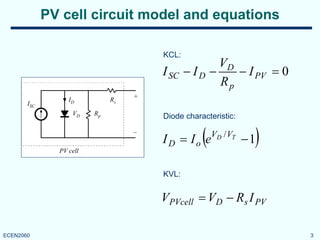
PV cell circuit model and equations
PV cell
+
_
Rs
RpVD
IDISC
0=−−− PV
p
D
DSC I
R
V
II
( )1/
−= TD VV
oD eII
PVsDPVcell IRVV −=
KCL:
Diode characteristic:
KVL:
4ECEN2060
2
Ppv
1
Vpv
Switch
Saturation
Rs
Rs
Product
Io*(exp(u/Vt)-1)
PN-junction characteristic
Ns
Ns
max
MinMax
G
Insolation to
current gain
Diode
Constant
-Vt*log((u/Io)+1)
By-pass diode
f (z) z
Solve
f(z) = 0
Algebraic Constraint
1/Rp
1/Rp
2
Insolation
1
Ipv
Isc
Ipv
Ipv
Vd Vpv cell
Id
Vd/Rp
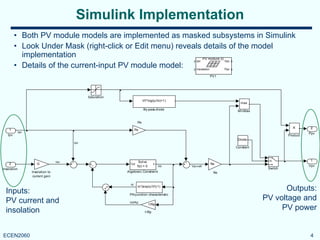
Simulink Implementation
• Both PV module models are implemented as masked subsystems in Simulink
• Look Under Mask (right-click or Edit menu) reveals details of the model
implementation
• Details of the current-input PV module model:
Ipv
Insolation
Vpv
Ppv
PV module (I)
PV1
Inputs:
PV current and
insolation
Outputs:
PV voltage and
PV power
5ECEN2060
2
Ppv
1
Vpv
Switch
Saturation
Rs
Rs
Product
Io*(exp(u/Vt)-1)
PN-junction characteristic
Ns
Ns
max
MinMax
G
Insolation to
current gain
Diode
Constant
-Vt*log((u/Io)+1)
By-pass diode
f (z) z
Solve
f(z) = 0
Algebraic Constraint
1/Rp
1/Rp
2
Insolation
1
Ipv
Isc
Ipv
Ipv
Vd Vpv cell
Id
Vd/Rp
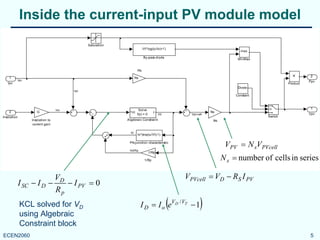
Inside the current-input PV module model
0=−−− PV
p
D
DSC I
R
V
II
KCL solved for VD
using Algebraic
Constraint block
( )1/
−= TD VV
oD eII
PVSDPVcell IRVV −=
PVcellsPV VNV =
seriesincellsofnumber=sN
6ECEN2060
2
Ppv
1
Vpv
Switch
Saturation
Rs
Rs
Product
Io*(exp(u/Vt)-1)
PN-junction characteristic
Ns
Ns
max
MinMax
G
Insolation to
current gain
Diode
Constant
-Vt*log((u/Io)+1)
By-pass diode
f (z) z
Solve
f(z) = 0
Algebraic Constraint
1/Rp
1/Rp
2
Insolation
1
Ipv
Isc
Ipv
Ipv
Vd Vpv cell
Id
Vd/Rp
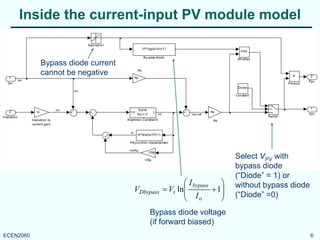
Inside the current-input PV module model








+= 1ln
o
bypass
tDbypass
I
I
VV
Bypass diode current
cannot be negative
Bypass diode voltage
(if forward biased)
Select VPV with
bypass diode
(“Diode” = 1) or
without bypass diode
(“Diode” =0)
7ECEN2060
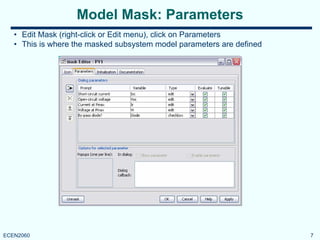
Model Mask: Parameters
• Edit Mask (right-click or Edit menu), click on Parameters
• This is where the masked subsystem model parameters are defined
8ECEN2060
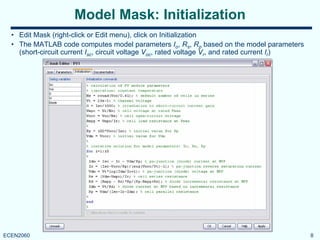
Model Mask: Initialization
• Edit Mask (right-click or Edit menu), click on Initialization
• The MATLAB code computes model parameters Io, Rs, Rp based on the model parameters
(short-circuit current Isc, circuit voltage Voc, rated voltage Vr, and rated current Ir)
9ECEN2060
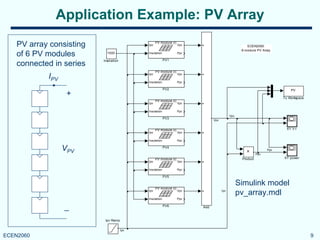
Application Example: PV Array
ECEN2060
6-module PV Array
XY power
XY V-I
PV
To Workspace
Product
Ipv
Insolation
Vpv
Ppv
PV module (I)
PV6
Ipv
Insolation
Vpv
Ppv
PV module (I)
PV5
Ipv
Insolation
Vpv
Ppv
PV module (I)
PV4
Ipv
Insolation
Vpv
Ppv
PV module (I)
PV3
Ipv
Insolation
Vpv
Ppv
PV module (I)
PV2
Ipv
Insolation
Vpv
Ppv
PV module (I)
PV1
Ipv Ramp
1000
Insolation
Add
Ipv
Ipv
Vpv
Vpv
Ppv
Ppv
PV array consisting
of 6 PV modules
connected in series
+
_
VPV
IPV
Simulink model
pv_array.mdl
10ECEN2060
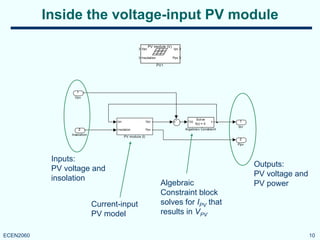
Inside the voltage-input PV module
2
Ppv
1
Ipv
Ipv
Insolation
Vpv
Ppv
PV module (I)
f (z) z
Solve
f(z) = 0
Algebraic Constraint2
Insolation
1
Vpv
Vpv
Insolation
Ipv
Ppv
PV module (V)
PV1
Inputs:
PV voltage and
insolation
Outputs:
PV voltage and
PV power
Current-input
PV model
Algebraic
Constraint block
solves for IPV that
results in VPV
11ECEN2060
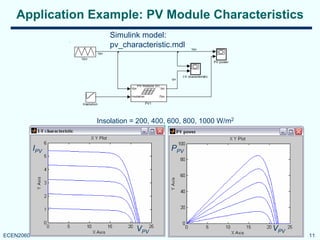
Application Example: PV Module Characteristics
Vpv
Vpv
Insolation
Ipv
Ppv
PV module (V)
PV1
PV power
Insolation
I-V characteristic
Vpv
Vpv
Ipv
Simulink model:
pv_characteristic.mdl
IPV PPV
VPVVPV
Insolation = 200, 400, 600, 800, 1000 W/m2

PV_module_model

  • 1.
  • 2.
    2ECEN2060 Simulink models ofPV modules Vpv Insolation Ipv Ppv PV module (V) PV1 Ipv Insolation Vpv Ppv PV module (I) PV1 Current-input PV module Voltage input PV module Inputs: • PV current IPV [A] • Insolation [W/m2 ] Outputs: • PV voltage VPV [V] • PV output power Ppv [W] This model is well suited for the case when modules are connected in series and share the same current Inputs: • PV voltage VPV [V] • Insolation [W/m2 ] Outputs: • PV current IPV [A] • PV output power Ppv [W] This model is well suited for the case when modules are connected in parallel and share the same voltage Model parameters, in both cases, are the standard PV module data-sheet parameters: • short-circuit current Isc • open-circuit voltage Voc • rated current IR at maximum power point (MPP) • rated voltage VR at MPP under standard test conditions (1kW/m2, 1.5 AM, 25oC). A bypass diode (a single diode across the entire module) can be included. Temperature effects are not modeled.
  • 3.
    3ECEN2060 PV cell circuitmodel and equations PV cell + _ Rs RpVD IDISC 0=−−− PV p D DSC I R V II ( )1/ −= TD VV oD eII PVsDPVcell IRVV −= KCL: Diode characteristic: KVL:
  • 4.
    4ECEN2060 2 Ppv 1 Vpv Switch Saturation Rs Rs Product Io*(exp(u/Vt)-1) PN-junction characteristic Ns Ns max MinMax G Insolation to currentgain Diode Constant -Vt*log((u/Io)+1) By-pass diode f (z) z Solve f(z) = 0 Algebraic Constraint 1/Rp 1/Rp 2 Insolation 1 Ipv Isc Ipv Ipv Vd Vpv cell Id Vd/Rp Simulink Implementation • Both PV module models are implemented as masked subsystems in Simulink • Look Under Mask (right-click or Edit menu) reveals details of the model implementation • Details of the current-input PV module model: Ipv Insolation Vpv Ppv PV module (I) PV1 Inputs: PV current and insolation Outputs: PV voltage and PV power
  • 5.
    5ECEN2060 2 Ppv 1 Vpv Switch Saturation Rs Rs Product Io*(exp(u/Vt)-1) PN-junction characteristic Ns Ns max MinMax G Insolation to currentgain Diode Constant -Vt*log((u/Io)+1) By-pass diode f (z) z Solve f(z) = 0 Algebraic Constraint 1/Rp 1/Rp 2 Insolation 1 Ipv Isc Ipv Ipv Vd Vpv cell Id Vd/Rp Inside the current-input PV module model 0=−−− PV p D DSC I R V II KCL solved for VD using Algebraic Constraint block ( )1/ −= TD VV oD eII PVSDPVcell IRVV −= PVcellsPV VNV = seriesincellsofnumber=sN
  • 6.
    6ECEN2060 2 Ppv 1 Vpv Switch Saturation Rs Rs Product Io*(exp(u/Vt)-1) PN-junction characteristic Ns Ns max MinMax G Insolation to currentgain Diode Constant -Vt*log((u/Io)+1) By-pass diode f (z) z Solve f(z) = 0 Algebraic Constraint 1/Rp 1/Rp 2 Insolation 1 Ipv Isc Ipv Ipv Vd Vpv cell Id Vd/Rp Inside the current-input PV module model         += 1ln o bypass tDbypass I I VV Bypass diode current cannot be negative Bypass diode voltage (if forward biased) Select VPV with bypass diode (“Diode” = 1) or without bypass diode (“Diode” =0)
  • 7.
    7ECEN2060 Model Mask: Parameters •Edit Mask (right-click or Edit menu), click on Parameters • This is where the masked subsystem model parameters are defined
  • 8.
    8ECEN2060 Model Mask: Initialization •Edit Mask (right-click or Edit menu), click on Initialization • The MATLAB code computes model parameters Io, Rs, Rp based on the model parameters (short-circuit current Isc, circuit voltage Voc, rated voltage Vr, and rated current Ir)
  • 9.
    9ECEN2060 Application Example: PVArray ECEN2060 6-module PV Array XY power XY V-I PV To Workspace Product Ipv Insolation Vpv Ppv PV module (I) PV6 Ipv Insolation Vpv Ppv PV module (I) PV5 Ipv Insolation Vpv Ppv PV module (I) PV4 Ipv Insolation Vpv Ppv PV module (I) PV3 Ipv Insolation Vpv Ppv PV module (I) PV2 Ipv Insolation Vpv Ppv PV module (I) PV1 Ipv Ramp 1000 Insolation Add Ipv Ipv Vpv Vpv Ppv Ppv PV array consisting of 6 PV modules connected in series + _ VPV IPV Simulink model pv_array.mdl
  • 10.
    10ECEN2060 Inside the voltage-inputPV module 2 Ppv 1 Ipv Ipv Insolation Vpv Ppv PV module (I) f (z) z Solve f(z) = 0 Algebraic Constraint2 Insolation 1 Vpv Vpv Insolation Ipv Ppv PV module (V) PV1 Inputs: PV voltage and insolation Outputs: PV voltage and PV power Current-input PV model Algebraic Constraint block solves for IPV that results in VPV
  • 11.
    11ECEN2060 Application Example: PVModule Characteristics Vpv Vpv Insolation Ipv Ppv PV module (V) PV1 PV power Insolation I-V characteristic Vpv Vpv Ipv Simulink model: pv_characteristic.mdl IPV PPV VPVVPV Insolation = 200, 400, 600, 800, 1000 W/m2