Language Style &
Register
Group 5
Sociolinguistics
Nabila Amalia Putri (202206023)
Kris Widiyanti (202206013)
Moch. Firdaus (202206016)
Dalifah Cindy Nuraisyah
(202206004)
OUR TEAM
Language
Style
01
The Definition & Types of Language Style
Language Style
Brown defines style as “a term that refers to consistent and rather
enduring tendencies or preferences within an individual.” Therefore,
styles are those general characteristics of intellectual functioning (and
personality type, as well) that especially pertain to one as an
individual, that differentiate one from someone else.
Keraf says, language style is a way to express the idea with special
language show the writer’s soul, spirit and concert (the use of
vocabulary).
From those statements above, the language style means different
way in communicating with other.
In sociolinguistics, language styles refer to the ways individuals vary
their speech depending on social context, audience, and purpose.
Sociolinguistics
—The Types of Language
Style
The main types of language styles are :
Formal Style, Informal Style, Colloquial
Style, Slang, Jargon, Vernacular, Pidgin and
Creole, Register.
Sociolinguistics
The Types of Language Style
Formal Style Informal Style
.This style is characterized
by a high level of formality
and is used in professional,
academic, and official
settings. It includes careful
grammar, complex
sentence structures, and a
precise choice of words.
Examples include academic
writing, official reports,
and formal speeches.
This style is relaxed and casual,
often used in everyday
conversations with friends,
family, and peers. It includes
colloquial language, slang,
contractions, and a
conversational tone. Examples
include personal letters, text
messages, and casual
conversations..
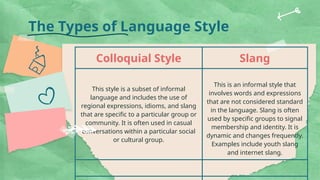
The Types of Language Style
Colloquial Style Slang
This style is a subset of informal
language and includes the use of
regional expressions, idioms, and slang
that are specific to a particular group or
community. It is often used in casual
conversations within a particular social
or cultural group.
This is an informal style that
involves words and expressions
that are not considered standard
in the language. Slang is often
used by specific groups to signal
membership and identity. It is
dynamic and changes frequently.
Examples include youth slang
and internet slang.
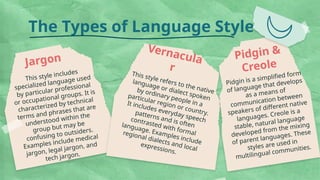
The Types of Language Style
Jargon
This style includes
specialized language used
by particular professional
or occupational groups. It is
characterized by technical
terms and phrases that are
understood within the
group but may be
confusing to outsiders.
Examples include medical
jargon, legal jargon, and
tech jargon.
Vernacula
r
This style refers to the native
language or dialect spoken
by ordinary people in a
particular region or country.
It includes everyday speech
patterns and is often
contrasted with formal
language. Examples include
regional dialects and local
expressions.
Pidgin &
Creole
Pidgin is a simplified form
of language that develops
as a means of
communication between
speakers of different native
languages. Creole is a
stable, natural language
developed from the mixing
of parent languages. These
styles are used in
multilingual communities.
The Types of Language Style
Register
● While often used interchangeably with style,
register specifically refers to variations in
language use based on context, such as formal,
informal, consultative, casual, and intimate
registers.
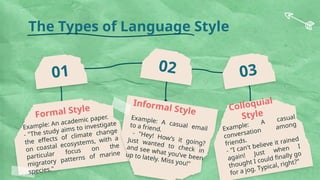
The Types of Language Style
Formal Style
Example: An academic paper.
- "The study aims to investigate
the effects of climate change
on coastal ecosystems, with a
particular focus on the
migratory patterns of marine
species."
01
Informal Style
Example: A casual email
to a friend.
- "Hey! How’s it going?
Just wanted to check in
and see what you’ve been
up to lately. Miss you!"
02
Colloquial
Style
Example: A casual
conversation
among
friends.
- "I can't believe it rained
again! Just when I
thought I could finally go
for a jog. Typical, right?"
03
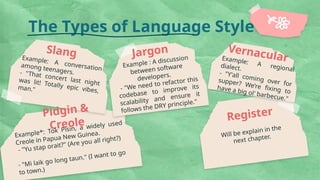
The Types of Language Style
Pidgin &
Creole
Example*: Tok Pisin, a widely used
Creole in Papua New Guinea.
- "Yu stap orait?" (Are you all right?)
- "Mi laik go long taun." (I want to go
to town.)
Slang
Example: A conversation
among teenagers.
- "That concert last night
was lit! Totally epic vibes,
man."
Jargon
Example : A discussion
between software
developers.
- "We need to refactor this
codebase to improve its
scalability and ensure it
follows the DRY principle."
Vernacular
Example: A regional
dialect.
- "Y'all coming over for
supper? We’re fixing to
have a big ol' barbecue."
Register
Will be explain in the
next chapter.
The Definition & Types of Language Register
02
LANGUAGE
REGISTER
Language Register
● The register was a set of language items that are
associated with occupation or social groups. .
● The register also involves features, such as syntactic
reduction and inversion of normal word order in the
sentence.
● In linguistic analysis, different styles of language are
technically called registers.
● Register refers to properties within a language variety
that associates language with a given situation.
● In sociolinguistics, language registers refer to the
variations in language use depending on context,
audience, purpose, and social setting. Sociolinguistics
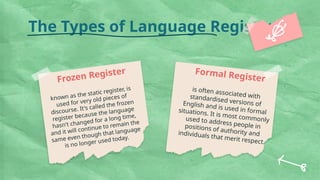
The Types of Language Register
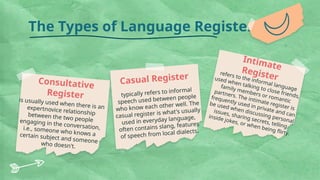
known as the static register, is
used for very old pieces of
discourse. It's called the frozen
register because the language
hasn't changed for a long time,
and it will continue to remain the
same even though that language
is no longer used today.
Frozen Register Formal Register
is often associated with
standardised versions of
English and is used in formal
situations. It is most commonly
used to address people in
positions of authority and
individuals that merit respect.
The Types of Language Register
Consultative
Register
is usually used when there is an
expertnovice relationship
between the two people
engaging in the conversation,
i.e., someone who knows a
certain subject and someone
who doesn't.
Casual Register
typically refers to informal
speech used between people
who know each other well. The
casual register is what's usually
used in everyday language,
often contains slang, features
of speech from local dialects.
Intimate
Register
refers to the informal language
used when talking to close friends,
family members or romantic
partners. The intimate register is
frequently used in private and can
be used when discussing personal
issues, sharing secrets, telling
inside jokes, or when being flirty.
The Types of Language Register
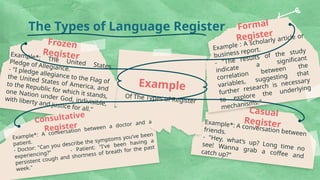
Casual
Register
Example*: A conversation between
friends.
- "Hey, what’s up? Long time no
see! Wanna grab a coffee and
catch up?"
Formal
Register
Example : A scholarly article or
business report.
- "The results of the study
indicate a significant
correlation between the
variables, suggesting that
further research is necessary
to explore the underlying
mechanisms."
Frozen
Register
Example*: The United States
Pledge of Allegiance.
- "I pledge allegiance to the Flag of
the United States of America, and
to the Republic for which it stands,
one Nation under God, indivisible,
with liberty and justice for all."
Consultative
Register
Example*: A conversation between a doctor and a
patient.
- Doctor: "Can you describe the symptoms you’ve been
experiencing?" - Patient: "I've been having a
persistent cough and shortness of breath for the past
week."
Example
Of The Types of Register
Intimate
Register
Example : A private conversation between
partners.
- "I love you more than words can say. You
make me feel so complete."
Conclusion
03
Style vs Register
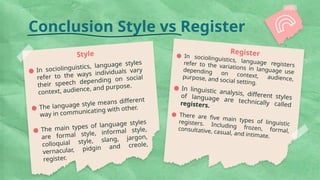
Conclusion Style vs Register
Style
● In sociolinguistics, language styles
refer to the ways individuals vary
their speech depending on social
context, audience, and purpose.
● The language style means different
way in communicating with other.
● The main types of language styles
are formal style, informal style,
colloquial style, slang, jargon,
vernacular, pidgin and creole,
register.
Register
● In sociolinguistics, language registers
refer to the variations in language use
depending on context, audience,
purpose, and social setting.
● In linguistic analysis, different styles
of language are technically called
registers.
● There are five main types of linguistic
registers. Including frozen, formal,
consultative, casual, and intimate.
Thank
You

GROUP 5 SOCIOLINGUISTIC.pptx SOCIOLINGUISTICS

  • 1.
  • 2.
    Nabila Amalia Putri(202206023) Kris Widiyanti (202206013) Moch. Firdaus (202206016) Dalifah Cindy Nuraisyah (202206004) OUR TEAM
  • 3.
    Language Style 01 The Definition &Types of Language Style
  • 4.
    Language Style Brown definesstyle as “a term that refers to consistent and rather enduring tendencies or preferences within an individual.” Therefore, styles are those general characteristics of intellectual functioning (and personality type, as well) that especially pertain to one as an individual, that differentiate one from someone else. Keraf says, language style is a way to express the idea with special language show the writer’s soul, spirit and concert (the use of vocabulary). From those statements above, the language style means different way in communicating with other. In sociolinguistics, language styles refer to the ways individuals vary their speech depending on social context, audience, and purpose. Sociolinguistics
  • 5.
    —The Types ofLanguage Style The main types of language styles are : Formal Style, Informal Style, Colloquial Style, Slang, Jargon, Vernacular, Pidgin and Creole, Register. Sociolinguistics
  • 6.
    The Types ofLanguage Style Formal Style Informal Style .This style is characterized by a high level of formality and is used in professional, academic, and official settings. It includes careful grammar, complex sentence structures, and a precise choice of words. Examples include academic writing, official reports, and formal speeches. This style is relaxed and casual, often used in everyday conversations with friends, family, and peers. It includes colloquial language, slang, contractions, and a conversational tone. Examples include personal letters, text messages, and casual conversations..
  • 7.
    The Types ofLanguage Style Colloquial Style Slang This style is a subset of informal language and includes the use of regional expressions, idioms, and slang that are specific to a particular group or community. It is often used in casual conversations within a particular social or cultural group. This is an informal style that involves words and expressions that are not considered standard in the language. Slang is often used by specific groups to signal membership and identity. It is dynamic and changes frequently. Examples include youth slang and internet slang.
  • 8.
    The Types ofLanguage Style Jargon This style includes specialized language used by particular professional or occupational groups. It is characterized by technical terms and phrases that are understood within the group but may be confusing to outsiders. Examples include medical jargon, legal jargon, and tech jargon. Vernacula r This style refers to the native language or dialect spoken by ordinary people in a particular region or country. It includes everyday speech patterns and is often contrasted with formal language. Examples include regional dialects and local expressions. Pidgin & Creole Pidgin is a simplified form of language that develops as a means of communication between speakers of different native languages. Creole is a stable, natural language developed from the mixing of parent languages. These styles are used in multilingual communities.
  • 9.
    The Types ofLanguage Style Register ● While often used interchangeably with style, register specifically refers to variations in language use based on context, such as formal, informal, consultative, casual, and intimate registers.
  • 10.
    The Types ofLanguage Style Formal Style Example: An academic paper. - "The study aims to investigate the effects of climate change on coastal ecosystems, with a particular focus on the migratory patterns of marine species." 01 Informal Style Example: A casual email to a friend. - "Hey! How’s it going? Just wanted to check in and see what you’ve been up to lately. Miss you!" 02 Colloquial Style Example: A casual conversation among friends. - "I can't believe it rained again! Just when I thought I could finally go for a jog. Typical, right?" 03
  • 11.
    The Types ofLanguage Style Pidgin & Creole Example*: Tok Pisin, a widely used Creole in Papua New Guinea. - "Yu stap orait?" (Are you all right?) - "Mi laik go long taun." (I want to go to town.) Slang Example: A conversation among teenagers. - "That concert last night was lit! Totally epic vibes, man." Jargon Example : A discussion between software developers. - "We need to refactor this codebase to improve its scalability and ensure it follows the DRY principle." Vernacular Example: A regional dialect. - "Y'all coming over for supper? We’re fixing to have a big ol' barbecue." Register Will be explain in the next chapter.
  • 12.
    The Definition &Types of Language Register 02 LANGUAGE REGISTER
  • 13.
    Language Register ● Theregister was a set of language items that are associated with occupation or social groups. . ● The register also involves features, such as syntactic reduction and inversion of normal word order in the sentence. ● In linguistic analysis, different styles of language are technically called registers. ● Register refers to properties within a language variety that associates language with a given situation. ● In sociolinguistics, language registers refer to the variations in language use depending on context, audience, purpose, and social setting. Sociolinguistics
  • 14.
    The Types ofLanguage Register known as the static register, is used for very old pieces of discourse. It's called the frozen register because the language hasn't changed for a long time, and it will continue to remain the same even though that language is no longer used today. Frozen Register Formal Register is often associated with standardised versions of English and is used in formal situations. It is most commonly used to address people in positions of authority and individuals that merit respect.
  • 15.
    The Types ofLanguage Register Consultative Register is usually used when there is an expertnovice relationship between the two people engaging in the conversation, i.e., someone who knows a certain subject and someone who doesn't. Casual Register typically refers to informal speech used between people who know each other well. The casual register is what's usually used in everyday language, often contains slang, features of speech from local dialects. Intimate Register refers to the informal language used when talking to close friends, family members or romantic partners. The intimate register is frequently used in private and can be used when discussing personal issues, sharing secrets, telling inside jokes, or when being flirty.
  • 16.
    The Types ofLanguage Register Casual Register Example*: A conversation between friends. - "Hey, what’s up? Long time no see! Wanna grab a coffee and catch up?" Formal Register Example : A scholarly article or business report. - "The results of the study indicate a significant correlation between the variables, suggesting that further research is necessary to explore the underlying mechanisms." Frozen Register Example*: The United States Pledge of Allegiance. - "I pledge allegiance to the Flag of the United States of America, and to the Republic for which it stands, one Nation under God, indivisible, with liberty and justice for all." Consultative Register Example*: A conversation between a doctor and a patient. - Doctor: "Can you describe the symptoms you’ve been experiencing?" - Patient: "I've been having a persistent cough and shortness of breath for the past week." Example Of The Types of Register
  • 17.
    Intimate Register Example : Aprivate conversation between partners. - "I love you more than words can say. You make me feel so complete."
  • 18.
  • 19.
    Conclusion Style vsRegister Style ● In sociolinguistics, language styles refer to the ways individuals vary their speech depending on social context, audience, and purpose. ● The language style means different way in communicating with other. ● The main types of language styles are formal style, informal style, colloquial style, slang, jargon, vernacular, pidgin and creole, register. Register ● In sociolinguistics, language registers refer to the variations in language use depending on context, audience, purpose, and social setting. ● In linguistic analysis, different styles of language are technically called registers. ● There are five main types of linguistic registers. Including frozen, formal, consultative, casual, and intimate.
  • 20.