Puritan Beliefs and the
Salem Witch Trials
Junior English
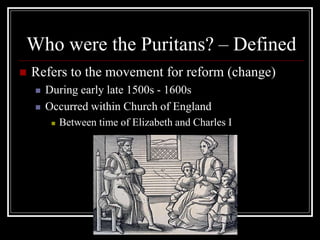
Who were the Puritans? – Defined
 Refers to the movement for reform (change)
 During early late 1500s - 1600s
 Occurred within Church of England
 Between time of Elizabeth and Charles I
Who were the Puritans?
 Wanted to rid Church of
Catholic influence
 Built upon ideas of John
Calvin
 Meant Church had no
supreme authority over God
 God, alone, decided fate;
church had no control over
destiny
 James and son Charles I
had disputes with
parliament (congress;
make laws)
 Dissolved parliament
 Puritans in favor of
parliament
 Charles I demanded that
those that did not support
Anglican Church be killed
 Religious persecution began
for the Puritans
Leaving England
 Severed themselves from new Anglican Church
 Left for new world in 1620
 Established Massachusetts
Bay Colony
New World—New Beginning
 City upon a Hill Theory:
 New MA Colony would be a place of complete reform
 God would be found in scripture and a stern work ethic
Puritans - Education
 Strong belief in education was established to read
Bible
 First public school founded in 1635
 Harvard College became an icon for educating ministers
 1647: Act passed ensured every town (of 100+
population) would attend grammar school for
free
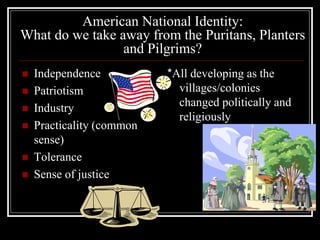
American National Identity:
What do we take away from the Puritans, Planters
and Pilgrims?
 Independence
 Patriotism
 Industry
 Practicality (common
sense)
 Tolerance
 Sense of justice
*All developing as the
villages/colonies
changed politically and
religiously
American National Identity:
What do we take away from the Puritans, Planters
and Pilgrims?
 Were first to build upon idea of the American
Dream
 Idea that a new path could be forged and goals
attained
 Inherited emphasis on
 Hard work
 Strong sense of religion
 Duty to country
 Freedom from oppression
Puritan Goals, Practices
& Beliefs
 Sought to cleanse culture of corrupt, sinful
practices
 Believed civil government should strictly
enforce public morality by prohibiting vices
 Wished to purge (cleanse) churches of every
vestige of Roman Catholic ritual and practice
Puritan Goals, Practices
& Beliefs
 Church had no supreme authority over God
 Worship services were
 Simple
 Often long
 Learned sermons
 Clergy expounded passages from Bible
Puritan Goals, Practices
& Beliefs
 Membership was limited to the “visibly godly”
 Those who lead sober (moderate), upright lives
 Strict standards for admission to their churches
 Each person applying for membership had to testify
publicly to his/her experience of
conversion
Conversion and Predestination
 Believed human beings were innately sinful;
depraved
 God would spare small number of “elect”
individuals
 Corrupt mankind justly deserved the fate of hellfire
Was Predestination Unfair?
 God was a distinctly undemocratic sort of deity
 God offered no incentive for upright moral
behavior
 Calvinist theology denied human beings any
free will
 BUT……….
So Why Did So Many Believe?
 Was a “comfortable doctrine”
 If you believed yourself “saved”
 Changes of 15th and 16th centuries
were unsettling and people needed:
 Social order
 Intellectual and moral certainty
 Spiritual consolation
Doctrine of Predestination
answered these needs
 Offered a wider message:
 God had a plan for all of human history
 Good would triumph over evil
Doctrine of Predestination
answered these needs
 Every person in human history had predestined
role to play
 Life was meaningful
 Strivings and sufferings produced
peace and security (a heaven on earth)
How Did Predestination Influence the Lives of
the Puritans?
 Strove to reshape society and government to
agree with the will of God
 Strove to lead godly, disciplined lives
 Believed mastering evil inclinations provided
evidence they ranked among the “elect”
How Did Predestination Influence the Lives of
the Puritans?
 Receive salvation through God’s mercy
 Leading godly, moral life was an encouraging
sign of receiving the grace of God, thus
salvation
 BUT behavior was NOT the cause of their salvation
 Gaining greater reassurance of salvation was
important
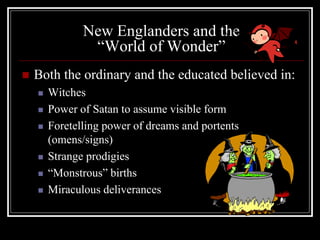
New Englanders and the
“World of Wonder”
 Both the ordinary and the educated believed in:
 Witches
 Power of Satan to assume visible form
 Foretelling power of dreams and portents
(omens/signs)
 Strange prodigies
 “Monstrous” births
 Miraculous deliverances
And all of this leaves them ripe for
the mass hysteria we call…..
Salem Witch Trials
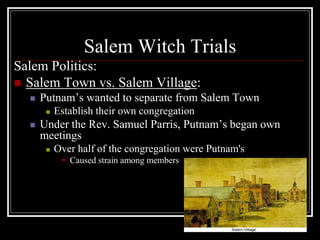
Salem Politics:
 Salem Town vs. Salem Village:
 Putnam’s wanted to separate from Salem Town
 Establish their own congregation
 Under the Rev. Samuel Parris, Putnam’s began own
meetings
 Over half of the congregation were Putnam's
 Caused strain among members
Salem Witch Trials
Salem Politics:
 Rev. Samuel Parris
 Forced to rely solely on volunteer contributions
 Because a faction denied paying him any money due to
the “perks” he was receiving from the Putnam's
 Eventually, faction would demand to be separate from
Putnam's congregation (unsuccessful)
Salem Witch Trials
Salem Politics:
 Puritan Play time
 Rev. Parris opposed any games
 Fear that idleness would allow the devil to enter hearts
 Reading was a popular past time
 Bible, books about witch craft, prophecy and fortune
telling
 Children would practice the incantations and divinations for fun
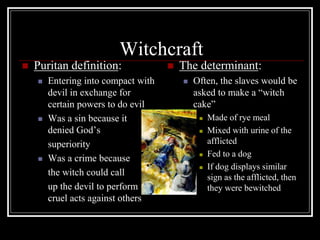
Witchcraft
 Puritan definition:
 Entering into compact with
devil in exchange for
certain powers to do evil
 Was a sin because it
denied God’s
superiority
 Was a crime because
the witch could call
up the devil to perform
cruel acts against others
 The determinant:
 Often, the slaves would be
asked to make a “witch
cake”
 Made of rye meal
 Mixed with urine of the
afflicted
 Fed to a dog
 If dog displays similar
sign as the afflicted, then
they were bewitched
The Accused
 Group of girls caught
dancing in woods with
Tituba, a slave
 They feign sickness and
possession
 Among the group
 Daughter of Rev. Parris
 Daughter of Tomas and
Anne Putnam
 Who demands that
the possessors be
found and punished
The Accused
Sarah Osbourne – An elderly,
non-church going woman
Sarah Good – A
homeless woman who
begged door to door
Tituba – A slave from
Barbados
Martha Corey – Accused
because of poor standing in
the community
Rebecca Nurse – 71, a
kind and generous lady, sher
esponded when accused “What sin
has God found in me un-repented
of that He should lay such an
affliction upon me in my old age?”
John and Elizabeth
Proctor Farmers
whose servant, Mary
Warren accused them
of witchcraft because
John knew the girls
were lying and
requested that the girls
be harshly punished
Rev. John
Burroughs – Accused
because left position
over a salary dispute.
Called the “Black
Minister”
The following are the first accused by the girls:
The First Hangings
 End of 1692, over 200 people
jailed and standing accused of
witchcraft
 Bridget Bishop – Found poppets
with missing head in her home
 Sarah Good, Sarah Wilds,
Elizabeth How, Susannah
Martin and Rebecca Nurse
Nurse states to Rev. Nayes, “I am
no more a witch than you a
wizard, and if you take away my
life God will give you blood to
drink”
 George Burroughs – Able
to recite the Lord’s prayer
 John Proctor, George
Jacobs, John Willard
and Martha Carrier –
were all hanged
 Elizabeth Proctor was not
hanged because she was
pregnant
The Madness Begins to Die
 Eventually, town begins to
question validity of trials and
girls accusations
 Began when people of good
standing in community are put to
death
 George Burroughs prayer
 Mary Easty’s letter
 Giles Corey’s refusal to stand trail
 Giles Corey – Is crushed to
death and says “more weight”
when he dies
 Mary Easty – Writes letter to
court demanding innocence and
questioning girls authority over
the court
 Mather states, “It were better
that ten suspected witches
should escape than that one
innocent person should be
dissolved.”
 Last trial was held in January
1693
 Total – 19 people were hung and
one crushed to death
The Aftermath
 The few remaining –
 Many left in jail because they could not afford to pay fine to
be released
 Crops, fields, livestock, homes, meeting houses all fell, due
to abandonment
 Many felt that God was punishing them for executing
innocent people
 Joseph Green – Once Rev. Parris is thrown out of Salem, Green
manages to bring everyone back together
 The accused sat down with accuser
 Many were excommunicated, many returned to the church

Puritans_condensed.ppt

  • 1.
    Puritan Beliefs andthe Salem Witch Trials Junior English
  • 2.
    Who were thePuritans? – Defined  Refers to the movement for reform (change)  During early late 1500s - 1600s  Occurred within Church of England  Between time of Elizabeth and Charles I
  • 3.
    Who were thePuritans?  Wanted to rid Church of Catholic influence  Built upon ideas of John Calvin  Meant Church had no supreme authority over God  God, alone, decided fate; church had no control over destiny  James and son Charles I had disputes with parliament (congress; make laws)  Dissolved parliament  Puritans in favor of parliament  Charles I demanded that those that did not support Anglican Church be killed  Religious persecution began for the Puritans
  • 4.
    Leaving England  Severedthemselves from new Anglican Church  Left for new world in 1620  Established Massachusetts Bay Colony
  • 5.
    New World—New Beginning City upon a Hill Theory:  New MA Colony would be a place of complete reform  God would be found in scripture and a stern work ethic
  • 6.
    Puritans - Education Strong belief in education was established to read Bible  First public school founded in 1635  Harvard College became an icon for educating ministers  1647: Act passed ensured every town (of 100+ population) would attend grammar school for free
  • 7.
    American National Identity: Whatdo we take away from the Puritans, Planters and Pilgrims?  Independence  Patriotism  Industry  Practicality (common sense)  Tolerance  Sense of justice *All developing as the villages/colonies changed politically and religiously
  • 8.
    American National Identity: Whatdo we take away from the Puritans, Planters and Pilgrims?  Were first to build upon idea of the American Dream  Idea that a new path could be forged and goals attained  Inherited emphasis on  Hard work  Strong sense of religion  Duty to country  Freedom from oppression
  • 9.
    Puritan Goals, Practices &Beliefs  Sought to cleanse culture of corrupt, sinful practices  Believed civil government should strictly enforce public morality by prohibiting vices  Wished to purge (cleanse) churches of every vestige of Roman Catholic ritual and practice
  • 10.
    Puritan Goals, Practices &Beliefs  Church had no supreme authority over God  Worship services were  Simple  Often long  Learned sermons  Clergy expounded passages from Bible
  • 11.
    Puritan Goals, Practices &Beliefs  Membership was limited to the “visibly godly”  Those who lead sober (moderate), upright lives  Strict standards for admission to their churches  Each person applying for membership had to testify publicly to his/her experience of conversion
  • 12.
    Conversion and Predestination Believed human beings were innately sinful; depraved  God would spare small number of “elect” individuals  Corrupt mankind justly deserved the fate of hellfire
  • 13.
    Was Predestination Unfair? God was a distinctly undemocratic sort of deity  God offered no incentive for upright moral behavior  Calvinist theology denied human beings any free will  BUT……….
  • 14.
    So Why DidSo Many Believe?  Was a “comfortable doctrine”  If you believed yourself “saved”  Changes of 15th and 16th centuries were unsettling and people needed:  Social order  Intellectual and moral certainty  Spiritual consolation
  • 15.
    Doctrine of Predestination answeredthese needs  Offered a wider message:  God had a plan for all of human history  Good would triumph over evil
  • 16.
    Doctrine of Predestination answeredthese needs  Every person in human history had predestined role to play  Life was meaningful  Strivings and sufferings produced peace and security (a heaven on earth)
  • 17.
    How Did PredestinationInfluence the Lives of the Puritans?  Strove to reshape society and government to agree with the will of God  Strove to lead godly, disciplined lives  Believed mastering evil inclinations provided evidence they ranked among the “elect”
  • 18.
    How Did PredestinationInfluence the Lives of the Puritans?  Receive salvation through God’s mercy  Leading godly, moral life was an encouraging sign of receiving the grace of God, thus salvation  BUT behavior was NOT the cause of their salvation  Gaining greater reassurance of salvation was important
  • 19.
    New Englanders andthe “World of Wonder”  Both the ordinary and the educated believed in:  Witches  Power of Satan to assume visible form  Foretelling power of dreams and portents (omens/signs)  Strange prodigies  “Monstrous” births  Miraculous deliverances
  • 20.
    And all ofthis leaves them ripe for the mass hysteria we call…..
  • 21.
    Salem Witch Trials SalemPolitics:  Salem Town vs. Salem Village:  Putnam’s wanted to separate from Salem Town  Establish their own congregation  Under the Rev. Samuel Parris, Putnam’s began own meetings  Over half of the congregation were Putnam's  Caused strain among members
  • 22.
    Salem Witch Trials SalemPolitics:  Rev. Samuel Parris  Forced to rely solely on volunteer contributions  Because a faction denied paying him any money due to the “perks” he was receiving from the Putnam's  Eventually, faction would demand to be separate from Putnam's congregation (unsuccessful)
  • 23.
    Salem Witch Trials SalemPolitics:  Puritan Play time  Rev. Parris opposed any games  Fear that idleness would allow the devil to enter hearts  Reading was a popular past time  Bible, books about witch craft, prophecy and fortune telling  Children would practice the incantations and divinations for fun
  • 24.
    Witchcraft  Puritan definition: Entering into compact with devil in exchange for certain powers to do evil  Was a sin because it denied God’s superiority  Was a crime because the witch could call up the devil to perform cruel acts against others  The determinant:  Often, the slaves would be asked to make a “witch cake”  Made of rye meal  Mixed with urine of the afflicted  Fed to a dog  If dog displays similar sign as the afflicted, then they were bewitched
  • 25.
    The Accused  Groupof girls caught dancing in woods with Tituba, a slave  They feign sickness and possession  Among the group  Daughter of Rev. Parris  Daughter of Tomas and Anne Putnam  Who demands that the possessors be found and punished
  • 26.
    The Accused Sarah Osbourne– An elderly, non-church going woman Sarah Good – A homeless woman who begged door to door Tituba – A slave from Barbados Martha Corey – Accused because of poor standing in the community Rebecca Nurse – 71, a kind and generous lady, sher esponded when accused “What sin has God found in me un-repented of that He should lay such an affliction upon me in my old age?” John and Elizabeth Proctor Farmers whose servant, Mary Warren accused them of witchcraft because John knew the girls were lying and requested that the girls be harshly punished Rev. John Burroughs – Accused because left position over a salary dispute. Called the “Black Minister” The following are the first accused by the girls:
  • 27.
    The First Hangings End of 1692, over 200 people jailed and standing accused of witchcraft  Bridget Bishop – Found poppets with missing head in her home  Sarah Good, Sarah Wilds, Elizabeth How, Susannah Martin and Rebecca Nurse Nurse states to Rev. Nayes, “I am no more a witch than you a wizard, and if you take away my life God will give you blood to drink”  George Burroughs – Able to recite the Lord’s prayer  John Proctor, George Jacobs, John Willard and Martha Carrier – were all hanged  Elizabeth Proctor was not hanged because she was pregnant
  • 28.
    The Madness Beginsto Die  Eventually, town begins to question validity of trials and girls accusations  Began when people of good standing in community are put to death  George Burroughs prayer  Mary Easty’s letter  Giles Corey’s refusal to stand trail  Giles Corey – Is crushed to death and says “more weight” when he dies  Mary Easty – Writes letter to court demanding innocence and questioning girls authority over the court  Mather states, “It were better that ten suspected witches should escape than that one innocent person should be dissolved.”  Last trial was held in January 1693  Total – 19 people were hung and one crushed to death
  • 29.
    The Aftermath  Thefew remaining –  Many left in jail because they could not afford to pay fine to be released  Crops, fields, livestock, homes, meeting houses all fell, due to abandonment  Many felt that God was punishing them for executing innocent people  Joseph Green – Once Rev. Parris is thrown out of Salem, Green manages to bring everyone back together  The accused sat down with accuser  Many were excommunicated, many returned to the church