International Journal of Next-Generation Networks (IJNGN) Vol.3, No.4, December 2011
DOI : 10.5121/ijngn.2011.3403 33
PURGING OF UNTRUSTWORTHY
RECOMMENDATIONS FROM A GRID
P. Suresh Kumar1
, P. Sateesh Kumar2
and S. Ramachandram3
1
Department of MCA, KITS, Warangal
peddojusuresh@gmail.com
2
Department of E&C E, IIT, Roorkee
sateesh@ieee.org
3
Department of CSE, OU, Hyderabad
ABSTRACT
In grid computing, trust has massive significance. There is lot of research to propose various models in
providing trusted resource sharing mechanisms. The trust is a belief or perception that various
researchers have tried to correlate with some computational model. Trust on any entity can be direct or
indirect. Direct trust is the impact of either first impression over the entity or acquired during some direct
interaction. Indirect trust is the trust may be due to either reputation gained or recommendations received
from various recommenders of a particular domain in a grid or any other domain outside that grid or
outside that grid itself. Unfortunately, malicious indirect trust leads to the misuse of valuable resources of
the grid. This paper proposes the mechanism of identifying and purging the untrustworthy
recommendations in the grid environment. Through the obtained results, we show the way of purging of
untrustworthy entities.
KEYWORDS
Grid computing, trust, direct trust, indirect trust, and untrustworthy entities.
1. INTRODUCTION
Grid computing has emerged as an important and popular new field as an extension of distributed
computing with more focus on high performance computing and resource sharing [1]. Modern
science and technology, such as High Energy and Nuclear Physics, Astronomy, Climate and
Materials science, are increasingly collaborative and span wide disciplinary and geographical
areas. They often demand huge resources of computing, storage, and instruments, which
individual research institutes could not possess [2]. With the success of World Wide Web, more
emphasis in research was on providing scientific collaborations and cross organizational
collaborations including various application providers, service providers, storage providers,
business environments with B2B partners. The widely deployed Internet links geographically
distributed resources and makes resource and data sharing possible. Security is one of the key
issues in such resource and data sharing environment in a grid. In particular, all the nodes
contained in the grid may not be trustworthy. Trust has been defined as an assured reliance on
the character, ability, or strength on someone or something [3]. Some of the nodes may be
fraudulent or malicious. Resource sharing or having transactions in such an unpredicted
International Journal of Next-Generation Networks (IJNGN) Vol.3, No.4, December 2011
34
environment may lead to adversity. Reliability of the grid transactions is decided by the
trustworthiness of the nodes that interact in the grid. Majority of the recent research in grid
computing is focused on identification of trustworthy nodes in the grid. This paper aims to
identify the untrustworthy transactions in the grid environment and proposes the method to
eliminate them in order not to participate in the transactions.
Many approaches have been proposed to deal with trust management [3]. Traditional approaches
of establishing a trust relationship are regulation, self-regulation, third-party certification, and
security technology. Inadequacies in traditional techniques lead to the evolvement of reputation-
based approach for trust management. Reputation, being a social concept, has been defined as the
confidence in the ability of a specific subject to fulfil a certain task. An extended study has been
done by many researchers to apply the concept of reputation to establish trust among the
communicating parties [4]. This paper will use the reputation-based approach of trust
management in its proposed method. Trustworthiness in the proposed model is evaluated based
on direct experience (direct trust) encountered on the service provider by the service initiator and
the reputation received due to feedback or recommendations from the fellow service providers or
service initiators. A method is proposed to eliminate the unreliable feedbacks from the reputation
information received by the service initiator.
Remaining parts of the paper is organized as follows: Section 2 presents recently reported related
work in the literature. Proposed technique of eliminating the untrustworthy grid transactions is
described in Section 3. In Section 4, various tuning factors chosen for simulation of the grid are
provided and results are produced and analyzed. Finally, Section 5 concludes the paper.
2. RELATED WORK
Various models have been proposed using reputation trust in grid environment [5]. Some of the
recent models are discussed in this section.
Vivekananth [6] proposed a behavior based trust model which shows the behavior conformity and
concentrated on behavior of entities in different domains, in different contexts. The total trust is
calculated using direct trust and indirect trust. The behaviour was tracked using a tracking
module. Based on experiences with the entities, an entity trust level is increased or decreased. A
penalty factor is levied for malicious behavior. The trust factor between two entities may depend
on penalty, context and time. The penalty factor ranges between 0 and 1. A threshold value is
used and if the total trust is greater than the required trust then the resource is allocated. In our
proposed method, we have adapted the similar idea of penalizing the untrustworthy entities.
Srivaramangai et al [7] proposed a trust model to improve reliability in grid. According to their
model, reputation based systems can be used in grid to improve the reliability of transactions and
reliability is achieved by establishing mutual trust between the initiator and the provider. Indirect
trust is taken as the measure from the reputation score of other entities. Unreliable feedbacks are
eliminated using Spearman’s rank correlation method. In our proposed model, we have adapted
the usage of rank correlation method to eliminating the untrustworthy entities. However, we have
adapted Kendall’s rank correlation method instead of Spearman, as it is proved to be the better
method in such typical environments.
Wang Meng et al [8] proposed a Dynamic Grid Trust Model named DyGridTrust which is based
on recommendation credibility. This model suggested a way to distinguish honest and dishonest
recommendation and adjust the weight of trust evaluation dynamically. This model defines
various participating nodes in the grid as sponsor node, goal node and recommended node. In our
proposed model, we have adapted the way of giving the weights and credibility to the entities.
International Journal of Next-Generation Networks (IJNGN) Vol.3, No.4, December 2011
35
Gao Ying et al [9] proposed a layered trust model based on behavior to enhance grid security and
extensibility. This model is based on the problem in open service grids to establish trust
relationship among different domains. The authors have proposed an algorithm to adjust trust
relationships between domains based on entities interactions and also proposed a technique to
process recommendation trust. In our proposed model, we have adapted the usage of domains.
Various other models are also proposed which are somehow connected to the models discussed
earlier. Some of them are briefed. Kai Wei Shaohua Tang [10] proposed a multi-level trust
evaluation model based on direct search in which grid service providers need to evaluate and
manage the trust of all users. Tie-Yan Li et al [11] proposed a two-level trust model in which the
upper level defines the trust relationships among virtual organizations in a distributed manner and
the lower level justifies the trust values within a grid domain. Yuan Lin et al [12] designed a
model by adding asymmetric users’ behaviors reflecting users’ characteristics (both the subjective
and objective). Huang Wenming et al [13] studied the characteristics of the two classes of true
and false recommendation. Shashi Bhanwar et al [14] proposed a trust model for by computing
reputation and trustworthiness of the transacting domain on the basis of number of past
transactions and rated feedback score.
3. PROPOSED MODEL
The proposed model aims to evaluate the trust relationship between two entities based on either
due to information directly available about the other entity and/or due to the reputation
information received from different types of entities present in that domain or grid.
3.1. Architecture
We have considered three cases in the proposed model.
i. Intra-Domain Intra-Grid Environment: An entity is interested to utilize the resources
present in that domain in which it is residing. In this domain, all the entities will follow the
same access controls. This environment is presented in Figure l.
Figure 1: Intra-Domain Intra-Grid Environment
ii. Inter-Domain Intra-Grid Environment: An entity is interested to utilize the resources
present in different domain than in which it is residing, however, in the same grid. In this
situation, the domains will have different access controls. This environment is presented
in Figure 2.
Figure 2: Inter-Domain Intra-Grid Environment
A
B
C D
E
F
G
D1
A
B
C D
E
F
G H
I
J
M L
O
K
N
International Journal of Next-Generation Networks (IJNGN) Vol.3, No.4, December 2011
36
iii. Inter-Grid Environment: An entity is interested to utilize the resources present in
different domain of different grid than in which domain of a grid it is residing. In this
situation, the domains may have similar or different access controls but are part of
different grids. This environment is presented in Figure 3.
Figure 3: Inter-Grid Environment
3.2. Evaluation of Trust
The total trust level of an entity is the sum of direct trust and indirect (recommendation/
reputation) trust received due to the previous interactions. Evaluation of trust in this model has
been explained for the architecture discussed in Section 3.1, as per the following procedure.
3.2.1. Direct Trust
For a specific context Ci (one of the three situations of a grid), domain Di can utilize resources or
deploy services using domain Dj's resources and hence a direct relationship will exist between
these two domains. Since a direct trust relationship is asymmetric, each of these two domains
involved in this direct relationship will have its own interpretation of how well or how bad this
direct trust relationship is. Direct trust has been evaluated based on first impression or direct
experience with the opponent party and usually it is rated between 0 and l. A value 0 represents a
very poor trust and a value 1 represents an extremely high trust. There are many variations in
adapting initial reputation such as based on majority behavior, and assigning the initial reputation
based on default value or evaluation of new comer by other grid providers. However, selecting
the default value for a new comer is proved to provide best results [7] in terms of fairness and
accuracy. A matter of question is what default value should be assigned. Assigning the value 0
may never give a chance for the new host to be allocated as the existing hosts with high first
impression will be chosen always. Assigning a value 1 may be a case is likely that a malicious
node is given a chance. A good choice of selecting the default value would be an average. For
further interactions direct trust can be taken as its previous reputation value which was calculated
in last interaction.
3.2.2. Reputation Trust
When an entity in domain Di wants to have an interaction with another entity in domain Dj, in
addition to the direct trust relationship, Di can rely on recommendations from other domains
about Dj (i.e., asking for the reputation of Dj) either from same or different domain of same grid
R
G
A
B
C D
E
F
H
O
N
M
L
K
I
J
P Q
T
U
S
V
W
X
Z
YD1 D2
D3
D4
Grid 1
Grid 2
International Journal of Next-Generation Networks (IJNGN) Vol.3, No.4, December 2011
37
or from different grid. Reputation of an entity in Dj can be estimated based on the
recommendations of the entities from the other domains of the same or different domains in the
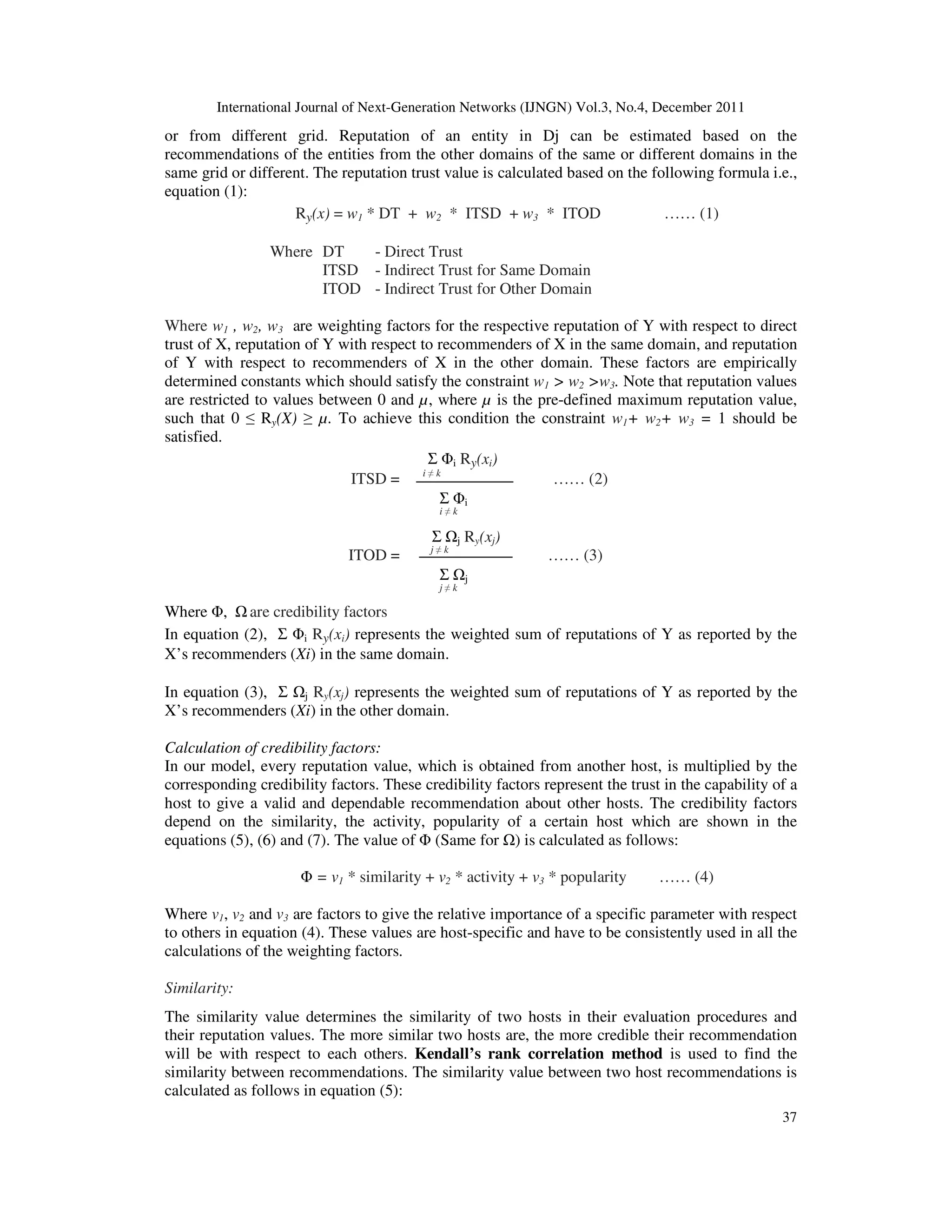
same grid or different. The reputation trust value is calculated based on the following formula i.e.,
equation (1):
Ry(x) = w1 * DT + w2 * ITSD + w3 * ITOD …… (1)
Where DT - Direct Trust
ITSD - Indirect Trust for Same Domain
ITOD - Indirect Trust for Other Domain
Where w1 , w2, w3 are weighting factors for the respective reputation of Y with respect to direct
trust of X, reputation of Y with respect to recommenders of X in the same domain, and reputation
of Y with respect to recommenders of X in the other domain. These factors are empirically
determined constants which should satisfy the constraint w1 > w2 >w3. Note that reputation values
are restricted to values between 0 and µ, where µ is the pre-defined maximum reputation value,
such that 0 ≤ Ry(X) ≥ µ. To achieve this condition the constraint w1+ w2+ w3 = 1 should be
satisfied.
Σ Φi Ry(xi)
ITSD = i ≠ k
…… (2)
Σ Φi
i ≠ k
Σ j Ry(xj)
ITOD = j ≠ k
…… (3)
Σ j
j ≠ k
Where Φ, are credibility factors
In equation (2), Σ Φi Ry(xi) represents the weighted sum of reputations of Y as reported by the
X’s recommenders (Xi) in the same domain.
In equation (3), Σ j Ry(xj) represents the weighted sum of reputations of Y as reported by the
X’s recommenders (Xi) in the other domain.
Calculation of credibility factors:
In our model, every reputation value, which is obtained from another host, is multiplied by the
corresponding credibility factors. These credibility factors represent the trust in the capability of a
host to give a valid and dependable recommendation about other hosts. The credibility factors
depend on the similarity, the activity, popularity of a certain host which are shown in the
equations (5), (6) and (7). The value of Φ (Same for ) is calculated as follows:
Φ = v1 * similarity + v2 * activity + v3 * popularity …… (4)
Where v1, v2 and v3 are factors to give the relative importance of a specific parameter with respect
to others in equation (4). These values are host-specific and have to be consistently used in all the
calculations of the weighting factors.
Similarity:
The similarity value determines the similarity of two hosts in their evaluation procedures and
their reputation values. The more similar two hosts are, the more credible their recommendation
will be with respect to each others. Kendall’s rank correlation method is used to find the
similarity between recommendations. The similarity value between two host recommendations is
calculated as follows in equation (5):
International Journal of Next-Generation Networks (IJNGN) Vol.3, No.4, December 2011
38
2 * [d∆ (s1, s2)]
Similarity = 1 - …… (5)
n (n-1)
In order to compare two ordered sets (on the same set of objects), the approach of this similarity
is to count the number of different pairs between these two ordered sets. This number gives a
distance between sets called the symmetric difference distance (the symmetric difference is a set
operation which associates to two sets the set of elements that belong to only one set). The
symmetric difference distance between two sets of ordered pairs s1 and s2 is denoted by d∆
(s1, s2). And n is the number of hosts present in the domain.
Based on the similarity between two host recommendations, if one host is giving different
recommendations compared to other hosts, then it is giving untrustworthy information. So, in
next visit this untrustworthy entities can be purged and reliable transactions can be done with the
help of this model.
Activity:
The activity value reflects the level of activity of a certain host in the past interval of time t1. The
more active a host is, the more up-to-date and accurate are its reputation values from its direct
experiences and from its received reputation values. Activity is calculated as the fraction of
interactions a host performed in the past t1 with respect to the other hosts, of all interactions;
however, to keep hosts from “lying”, we will calculate the total number of interactions of a host
from the other hosts’ reputation vectors.
Number of interactions by recommenders of a host X
Activity = …… (6)
Total number interactions by all recommenders
Popularity:
The popularity value is a measure of how much a host is liked and how much its services are
asked for in the system. The popularity of a host is calculated as the fraction of interactions other
hosts have done with this specific host, of all interactions:
Number of interactions with initiator
Popularity = …… (7)
Total number interactions with all other hosts
Based on the above formulas mentioned in equations (1), (2), (3) and (4), the reputation of the
host can be calculated. If the calculated reputation is greater than the minimum threshold value
the job will be assigned to y. Otherwise it will be rejected. After the transaction is over the
reputation table will be updated by taking the new value. The decaying factor, mentioned in
equation (8) is considered for modifying the reputation of each entity with time.
Effect of decaying factor:
As time passes by, a host reputation with respect to other hosts typically changes to an unknown
state if little or no interaction occurs between them. When a Host Z receives a request (from Host
X) for reputation information about Host Y, it modifies its reputation information relative to Y by
using decaying factor and then sends the result to the requesting host.
Ry(z) = final value + (final value – initial value ) * τ …… (8)
International Journal of Next-Generation Networks (IJNGN) Vol.3, No.4, December 2011
39
Where τ decay factor which varies is based on time factor. If t is the current time and t0 is the time
at which the last transaction taken place then the calculation of τ is as follows.
τ= 1 if t– t0 < 1 month
τ= 0.75 if 1< t– t0 < 2
τ= 0.5 if 2< t– t0 < 3
τ= 0 if t– t0 > 3
Effect of Threshold values:
The step that follows the calculation of the reputation of a certain host is to determine trust, by
associating to the host the label “trustworthy” or “untrustworthy”. This can be determined by
introducing two threshold values η and ξ, referred to as the absolute trust and absolute mistrust
thresholds, respectively. Three cases are considered:
• If RY( X) ≥ η Y can be trusted
• If RY( X) ≤ ξ Y cannot be trusted
• If ξ ≥ RY(X) ≥ η Y can be considered as either trustworthy or untrustworthy depending
on how paranoid or trusting host X is.
µ
Complete Trustable
η
Ry(x) Trust based on Threshold
ξ Complete Un-Trustable
0
Time
Figure 4: Threshold values based on reputation values
4. RESULTS
The experimentation is done to purge the untrustworthy entities from the grid. We have
considered two grids, 4 domains and 15 entities. Among 15 entities some entities are giving
unreliable information which causes wrong allocation of resources to an entity. We have taken 15
entities and same experiment is executed 10 times, which gives variation in the results. In this
experiment we have found some entities are behaving maliciously and giving untrustworthy
information. We have shown our results in Table 1, in which entities E, J are giving
untrustworthy information. Entities E and J are malicious and because of their malicious nature,
these entities are giving different results compared to other entities.
We have compared our results with the previous model [7], in which new model identified the
untrustworthiness of the entities E and J, where existing model accepting E and J. These two
entities E and J can be purged to get reliable transactions and to allocate resources for trustworthy
entities only. So, based on the results obtained, our model is giving better results compared to
existing model.
International Journal of Next-Generation Networks (IJNGN) Vol.3, No.4, December 2011
40
Table 1: comparison of new model with existing model
Initiator Provider TS1
Existing
Model
TS2
Proposed
Model
B I 1.827 NO 1.505 NO
C E 2.395 YES 1.981 NO
C I 1.885 NO 0.79 NO
D N 1.852 NO 1.407 NO
H G 2.248 YES 2.696 YES
H N 2.337 YES 2.725 YES
I M 1.588 NO 1.438 NO
J M 2.751 YES 1.147 NO
M F 1.761 NO 1.643 NO
N A 2.455 NO 2.476 NO
5. CONCLUSION
In this paper, we proposed a model for trust evaluation in grid environment which will purge the
untrustworthy transactions. This model is a reputation-based trust evaluation model having direct
and indirect (recommendation/reputation) trust values. In our model, unlike other models, we
have considered feedbacks from various domains like intra-domain, inter-domain in intra-grid
and also from inter-grid. We have also adapted a better ranking algorithm, Kendall’s rank order
correlation algorithm, is used to select the nodes with higher reputation. This way always the
nodes with bad feedback are quarantined for a particular period of time. Results indicate that the
trust evaluation becomes more robust in this model. This model is giving better results compared
to the existing model. The future work is aimed at comparing the same model with other existing
models. It is also aimed to evaluate the model in various other aspects to check its robustness.
REFERENCES
[1] IBM Red Book, “Fundamentals of Grid Computing”, REDP-3613-00
[2] I. Foster, C. Kesselman, and S. Tuecke. “The Anatomy of the Grid: Enabling Scalable Virtual
Organizations”. International Journal of High Performance Computing Applications, 15(3):2001,
Page(s): 200–222.
[3] Chen, Meili, Geist, Al, Bernholdt, David E., Chanchio, Kasidit, and Million, Daniel L. “The Design
and Prototype of RUDA, a Distributed Grid Accounting System”. International Journal of Critical
Infrastructures, 4 (3), 2008, Page(s): 296-307
[4] M. Waidner (editor), Special Theme: Information Security, Ercim News, No 49, 2002.
[5] P. Suresh Kumar, P. Sateesh Kumar, S. Ramachandram, Recent Trust Models in Grid, International
Journal of Theoretical and Applied Information Technology, Vol. 26, No. 1, April, 2011, Page(s): 64-
68.
[6] Vivekananth.P “A Behavior Based Trust Model for Grid Security”, International Journal of Computer
Applications, Volume 5– No.6, August 2010.
[7] Renagaramanujam Srinivasan and Srivaramangai P. “A Comprehensive Trust Model for Improved
Reliability in Grid.”, International Journal of Computer Applications Volume5-No.7, August 2010.
Page(s): 1-4.
International Journal of Next-Generation Networks (IJNGN) Vol.3, No.4, December 2011
41
[8] Wang Meng; Hongxia Xia; Huazhu Song, “A Dynamic Trust Model Based on Recommendation
Credibility in Grid Domain”, International Conference CiSE, 2009, Page(s): 1 – 4.
[9] Gao Ying; Zhan Jiang, “A layered trust model based on behavior in service grid“, 2nd
International
Conference ICACC, 2010, Page(s): 511 – 515.
[10] Kai Wei; Shaohua Tang, “A Multi-level Trust Evaluation Model Based on D-S Theory for Grid”,
International Conference CIS '09. 2009, Page(s): 411 – 415.
[11] Tie-Yan Li, Huafei Zhu, Kwok-Yan Lam: A Novel Two-Level Trust Model for Grid. ICICS 2003.
[12] Yuan Lin; Siwei Luo; Zhan Gao, “A Recommender Trust Model Based Behavior in Grid”, Second
International Conference FITME '09, 2009, Page(s): 568 – 571.
[13] Wenming Huang; Peizhi Wen; Xianli Zeng; Zhenrong Deng, “A Trust Rating Model of
Recommendation in Grid”, Fifth International Joint Conference NCM '09, 2009, Page(s): 1982 –
1985.
[14] Bhanwar, S.; Bawa, S, “Establishing and Evaluating Trust in a Grid Environment”, 10th International
Symposium ISPAN’09, 2009, Page(s): 674 – 678.

PURGING OF UNTRUSTWORTHY RECOMMENDATIONS FROM A GRID

  • 1.
    International Journal ofNext-Generation Networks (IJNGN) Vol.3, No.4, December 2011 DOI : 10.5121/ijngn.2011.3403 33 PURGING OF UNTRUSTWORTHY RECOMMENDATIONS FROM A GRID P. Suresh Kumar1 , P. Sateesh Kumar2 and S. Ramachandram3 1 Department of MCA, KITS, Warangal peddojusuresh@gmail.com 2 Department of E&C E, IIT, Roorkee sateesh@ieee.org 3 Department of CSE, OU, Hyderabad ABSTRACT In grid computing, trust has massive significance. There is lot of research to propose various models in providing trusted resource sharing mechanisms. The trust is a belief or perception that various researchers have tried to correlate with some computational model. Trust on any entity can be direct or indirect. Direct trust is the impact of either first impression over the entity or acquired during some direct interaction. Indirect trust is the trust may be due to either reputation gained or recommendations received from various recommenders of a particular domain in a grid or any other domain outside that grid or outside that grid itself. Unfortunately, malicious indirect trust leads to the misuse of valuable resources of the grid. This paper proposes the mechanism of identifying and purging the untrustworthy recommendations in the grid environment. Through the obtained results, we show the way of purging of untrustworthy entities. KEYWORDS Grid computing, trust, direct trust, indirect trust, and untrustworthy entities. 1. INTRODUCTION Grid computing has emerged as an important and popular new field as an extension of distributed computing with more focus on high performance computing and resource sharing [1]. Modern science and technology, such as High Energy and Nuclear Physics, Astronomy, Climate and Materials science, are increasingly collaborative and span wide disciplinary and geographical areas. They often demand huge resources of computing, storage, and instruments, which individual research institutes could not possess [2]. With the success of World Wide Web, more emphasis in research was on providing scientific collaborations and cross organizational collaborations including various application providers, service providers, storage providers, business environments with B2B partners. The widely deployed Internet links geographically distributed resources and makes resource and data sharing possible. Security is one of the key issues in such resource and data sharing environment in a grid. In particular, all the nodes contained in the grid may not be trustworthy. Trust has been defined as an assured reliance on the character, ability, or strength on someone or something [3]. Some of the nodes may be fraudulent or malicious. Resource sharing or having transactions in such an unpredicted
  • 2.
    International Journal ofNext-Generation Networks (IJNGN) Vol.3, No.4, December 2011 34 environment may lead to adversity. Reliability of the grid transactions is decided by the trustworthiness of the nodes that interact in the grid. Majority of the recent research in grid computing is focused on identification of trustworthy nodes in the grid. This paper aims to identify the untrustworthy transactions in the grid environment and proposes the method to eliminate them in order not to participate in the transactions. Many approaches have been proposed to deal with trust management [3]. Traditional approaches of establishing a trust relationship are regulation, self-regulation, third-party certification, and security technology. Inadequacies in traditional techniques lead to the evolvement of reputation- based approach for trust management. Reputation, being a social concept, has been defined as the confidence in the ability of a specific subject to fulfil a certain task. An extended study has been done by many researchers to apply the concept of reputation to establish trust among the communicating parties [4]. This paper will use the reputation-based approach of trust management in its proposed method. Trustworthiness in the proposed model is evaluated based on direct experience (direct trust) encountered on the service provider by the service initiator and the reputation received due to feedback or recommendations from the fellow service providers or service initiators. A method is proposed to eliminate the unreliable feedbacks from the reputation information received by the service initiator. Remaining parts of the paper is organized as follows: Section 2 presents recently reported related work in the literature. Proposed technique of eliminating the untrustworthy grid transactions is described in Section 3. In Section 4, various tuning factors chosen for simulation of the grid are provided and results are produced and analyzed. Finally, Section 5 concludes the paper. 2. RELATED WORK Various models have been proposed using reputation trust in grid environment [5]. Some of the recent models are discussed in this section. Vivekananth [6] proposed a behavior based trust model which shows the behavior conformity and concentrated on behavior of entities in different domains, in different contexts. The total trust is calculated using direct trust and indirect trust. The behaviour was tracked using a tracking module. Based on experiences with the entities, an entity trust level is increased or decreased. A penalty factor is levied for malicious behavior. The trust factor between two entities may depend on penalty, context and time. The penalty factor ranges between 0 and 1. A threshold value is used and if the total trust is greater than the required trust then the resource is allocated. In our proposed method, we have adapted the similar idea of penalizing the untrustworthy entities. Srivaramangai et al [7] proposed a trust model to improve reliability in grid. According to their model, reputation based systems can be used in grid to improve the reliability of transactions and reliability is achieved by establishing mutual trust between the initiator and the provider. Indirect trust is taken as the measure from the reputation score of other entities. Unreliable feedbacks are eliminated using Spearman’s rank correlation method. In our proposed model, we have adapted the usage of rank correlation method to eliminating the untrustworthy entities. However, we have adapted Kendall’s rank correlation method instead of Spearman, as it is proved to be the better method in such typical environments. Wang Meng et al [8] proposed a Dynamic Grid Trust Model named DyGridTrust which is based on recommendation credibility. This model suggested a way to distinguish honest and dishonest recommendation and adjust the weight of trust evaluation dynamically. This model defines various participating nodes in the grid as sponsor node, goal node and recommended node. In our proposed model, we have adapted the way of giving the weights and credibility to the entities.
  • 3.
    International Journal ofNext-Generation Networks (IJNGN) Vol.3, No.4, December 2011 35 Gao Ying et al [9] proposed a layered trust model based on behavior to enhance grid security and extensibility. This model is based on the problem in open service grids to establish trust relationship among different domains. The authors have proposed an algorithm to adjust trust relationships between domains based on entities interactions and also proposed a technique to process recommendation trust. In our proposed model, we have adapted the usage of domains. Various other models are also proposed which are somehow connected to the models discussed earlier. Some of them are briefed. Kai Wei Shaohua Tang [10] proposed a multi-level trust evaluation model based on direct search in which grid service providers need to evaluate and manage the trust of all users. Tie-Yan Li et al [11] proposed a two-level trust model in which the upper level defines the trust relationships among virtual organizations in a distributed manner and the lower level justifies the trust values within a grid domain. Yuan Lin et al [12] designed a model by adding asymmetric users’ behaviors reflecting users’ characteristics (both the subjective and objective). Huang Wenming et al [13] studied the characteristics of the two classes of true and false recommendation. Shashi Bhanwar et al [14] proposed a trust model for by computing reputation and trustworthiness of the transacting domain on the basis of number of past transactions and rated feedback score. 3. PROPOSED MODEL The proposed model aims to evaluate the trust relationship between two entities based on either due to information directly available about the other entity and/or due to the reputation information received from different types of entities present in that domain or grid. 3.1. Architecture We have considered three cases in the proposed model. i. Intra-Domain Intra-Grid Environment: An entity is interested to utilize the resources present in that domain in which it is residing. In this domain, all the entities will follow the same access controls. This environment is presented in Figure l. Figure 1: Intra-Domain Intra-Grid Environment ii. Inter-Domain Intra-Grid Environment: An entity is interested to utilize the resources present in different domain than in which it is residing, however, in the same grid. In this situation, the domains will have different access controls. This environment is presented in Figure 2. Figure 2: Inter-Domain Intra-Grid Environment A B C D E F G D1 A B C D E F G H I J M L O K N
  • 4.
    International Journal ofNext-Generation Networks (IJNGN) Vol.3, No.4, December 2011 36 iii. Inter-Grid Environment: An entity is interested to utilize the resources present in different domain of different grid than in which domain of a grid it is residing. In this situation, the domains may have similar or different access controls but are part of different grids. This environment is presented in Figure 3. Figure 3: Inter-Grid Environment 3.2. Evaluation of Trust The total trust level of an entity is the sum of direct trust and indirect (recommendation/ reputation) trust received due to the previous interactions. Evaluation of trust in this model has been explained for the architecture discussed in Section 3.1, as per the following procedure. 3.2.1. Direct Trust For a specific context Ci (one of the three situations of a grid), domain Di can utilize resources or deploy services using domain Dj's resources and hence a direct relationship will exist between these two domains. Since a direct trust relationship is asymmetric, each of these two domains involved in this direct relationship will have its own interpretation of how well or how bad this direct trust relationship is. Direct trust has been evaluated based on first impression or direct experience with the opponent party and usually it is rated between 0 and l. A value 0 represents a very poor trust and a value 1 represents an extremely high trust. There are many variations in adapting initial reputation such as based on majority behavior, and assigning the initial reputation based on default value or evaluation of new comer by other grid providers. However, selecting the default value for a new comer is proved to provide best results [7] in terms of fairness and accuracy. A matter of question is what default value should be assigned. Assigning the value 0 may never give a chance for the new host to be allocated as the existing hosts with high first impression will be chosen always. Assigning a value 1 may be a case is likely that a malicious node is given a chance. A good choice of selecting the default value would be an average. For further interactions direct trust can be taken as its previous reputation value which was calculated in last interaction. 3.2.2. Reputation Trust When an entity in domain Di wants to have an interaction with another entity in domain Dj, in addition to the direct trust relationship, Di can rely on recommendations from other domains about Dj (i.e., asking for the reputation of Dj) either from same or different domain of same grid R G A B C D E F H O N M L K I J P Q T U S V W X Z YD1 D2 D3 D4 Grid 1 Grid 2
  • 5.
    International Journal ofNext-Generation Networks (IJNGN) Vol.3, No.4, December 2011 37 or from different grid. Reputation of an entity in Dj can be estimated based on the recommendations of the entities from the other domains of the same or different domains in the same grid or different. The reputation trust value is calculated based on the following formula i.e., equation (1): Ry(x) = w1 * DT + w2 * ITSD + w3 * ITOD …… (1) Where DT - Direct Trust ITSD - Indirect Trust for Same Domain ITOD - Indirect Trust for Other Domain Where w1 , w2, w3 are weighting factors for the respective reputation of Y with respect to direct trust of X, reputation of Y with respect to recommenders of X in the same domain, and reputation of Y with respect to recommenders of X in the other domain. These factors are empirically determined constants which should satisfy the constraint w1 > w2 >w3. Note that reputation values are restricted to values between 0 and µ, where µ is the pre-defined maximum reputation value, such that 0 ≤ Ry(X) ≥ µ. To achieve this condition the constraint w1+ w2+ w3 = 1 should be satisfied. Σ Φi Ry(xi) ITSD = i ≠ k …… (2) Σ Φi i ≠ k Σ j Ry(xj) ITOD = j ≠ k …… (3) Σ j j ≠ k Where Φ, are credibility factors In equation (2), Σ Φi Ry(xi) represents the weighted sum of reputations of Y as reported by the X’s recommenders (Xi) in the same domain. In equation (3), Σ j Ry(xj) represents the weighted sum of reputations of Y as reported by the X’s recommenders (Xi) in the other domain. Calculation of credibility factors: In our model, every reputation value, which is obtained from another host, is multiplied by the corresponding credibility factors. These credibility factors represent the trust in the capability of a host to give a valid and dependable recommendation about other hosts. The credibility factors depend on the similarity, the activity, popularity of a certain host which are shown in the equations (5), (6) and (7). The value of Φ (Same for ) is calculated as follows: Φ = v1 * similarity + v2 * activity + v3 * popularity …… (4) Where v1, v2 and v3 are factors to give the relative importance of a specific parameter with respect to others in equation (4). These values are host-specific and have to be consistently used in all the calculations of the weighting factors. Similarity: The similarity value determines the similarity of two hosts in their evaluation procedures and their reputation values. The more similar two hosts are, the more credible their recommendation will be with respect to each others. Kendall’s rank correlation method is used to find the similarity between recommendations. The similarity value between two host recommendations is calculated as follows in equation (5):
  • 6.
    International Journal ofNext-Generation Networks (IJNGN) Vol.3, No.4, December 2011 38 2 * [d∆ (s1, s2)] Similarity = 1 - …… (5) n (n-1) In order to compare two ordered sets (on the same set of objects), the approach of this similarity is to count the number of different pairs between these two ordered sets. This number gives a distance between sets called the symmetric difference distance (the symmetric difference is a set operation which associates to two sets the set of elements that belong to only one set). The symmetric difference distance between two sets of ordered pairs s1 and s2 is denoted by d∆ (s1, s2). And n is the number of hosts present in the domain. Based on the similarity between two host recommendations, if one host is giving different recommendations compared to other hosts, then it is giving untrustworthy information. So, in next visit this untrustworthy entities can be purged and reliable transactions can be done with the help of this model. Activity: The activity value reflects the level of activity of a certain host in the past interval of time t1. The more active a host is, the more up-to-date and accurate are its reputation values from its direct experiences and from its received reputation values. Activity is calculated as the fraction of interactions a host performed in the past t1 with respect to the other hosts, of all interactions; however, to keep hosts from “lying”, we will calculate the total number of interactions of a host from the other hosts’ reputation vectors. Number of interactions by recommenders of a host X Activity = …… (6) Total number interactions by all recommenders Popularity: The popularity value is a measure of how much a host is liked and how much its services are asked for in the system. The popularity of a host is calculated as the fraction of interactions other hosts have done with this specific host, of all interactions: Number of interactions with initiator Popularity = …… (7) Total number interactions with all other hosts Based on the above formulas mentioned in equations (1), (2), (3) and (4), the reputation of the host can be calculated. If the calculated reputation is greater than the minimum threshold value the job will be assigned to y. Otherwise it will be rejected. After the transaction is over the reputation table will be updated by taking the new value. The decaying factor, mentioned in equation (8) is considered for modifying the reputation of each entity with time. Effect of decaying factor: As time passes by, a host reputation with respect to other hosts typically changes to an unknown state if little or no interaction occurs between them. When a Host Z receives a request (from Host X) for reputation information about Host Y, it modifies its reputation information relative to Y by using decaying factor and then sends the result to the requesting host. Ry(z) = final value + (final value – initial value ) * τ …… (8)
  • 7.
    International Journal ofNext-Generation Networks (IJNGN) Vol.3, No.4, December 2011 39 Where τ decay factor which varies is based on time factor. If t is the current time and t0 is the time at which the last transaction taken place then the calculation of τ is as follows. τ= 1 if t– t0 < 1 month τ= 0.75 if 1< t– t0 < 2 τ= 0.5 if 2< t– t0 < 3 τ= 0 if t– t0 > 3 Effect of Threshold values: The step that follows the calculation of the reputation of a certain host is to determine trust, by associating to the host the label “trustworthy” or “untrustworthy”. This can be determined by introducing two threshold values η and ξ, referred to as the absolute trust and absolute mistrust thresholds, respectively. Three cases are considered: • If RY( X) ≥ η Y can be trusted • If RY( X) ≤ ξ Y cannot be trusted • If ξ ≥ RY(X) ≥ η Y can be considered as either trustworthy or untrustworthy depending on how paranoid or trusting host X is. µ Complete Trustable η Ry(x) Trust based on Threshold ξ Complete Un-Trustable 0 Time Figure 4: Threshold values based on reputation values 4. RESULTS The experimentation is done to purge the untrustworthy entities from the grid. We have considered two grids, 4 domains and 15 entities. Among 15 entities some entities are giving unreliable information which causes wrong allocation of resources to an entity. We have taken 15 entities and same experiment is executed 10 times, which gives variation in the results. In this experiment we have found some entities are behaving maliciously and giving untrustworthy information. We have shown our results in Table 1, in which entities E, J are giving untrustworthy information. Entities E and J are malicious and because of their malicious nature, these entities are giving different results compared to other entities. We have compared our results with the previous model [7], in which new model identified the untrustworthiness of the entities E and J, where existing model accepting E and J. These two entities E and J can be purged to get reliable transactions and to allocate resources for trustworthy entities only. So, based on the results obtained, our model is giving better results compared to existing model.
  • 8.
    International Journal ofNext-Generation Networks (IJNGN) Vol.3, No.4, December 2011 40 Table 1: comparison of new model with existing model Initiator Provider TS1 Existing Model TS2 Proposed Model B I 1.827 NO 1.505 NO C E 2.395 YES 1.981 NO C I 1.885 NO 0.79 NO D N 1.852 NO 1.407 NO H G 2.248 YES 2.696 YES H N 2.337 YES 2.725 YES I M 1.588 NO 1.438 NO J M 2.751 YES 1.147 NO M F 1.761 NO 1.643 NO N A 2.455 NO 2.476 NO 5. CONCLUSION In this paper, we proposed a model for trust evaluation in grid environment which will purge the untrustworthy transactions. This model is a reputation-based trust evaluation model having direct and indirect (recommendation/reputation) trust values. In our model, unlike other models, we have considered feedbacks from various domains like intra-domain, inter-domain in intra-grid and also from inter-grid. We have also adapted a better ranking algorithm, Kendall’s rank order correlation algorithm, is used to select the nodes with higher reputation. This way always the nodes with bad feedback are quarantined for a particular period of time. Results indicate that the trust evaluation becomes more robust in this model. This model is giving better results compared to the existing model. The future work is aimed at comparing the same model with other existing models. It is also aimed to evaluate the model in various other aspects to check its robustness. REFERENCES [1] IBM Red Book, “Fundamentals of Grid Computing”, REDP-3613-00 [2] I. Foster, C. Kesselman, and S. Tuecke. “The Anatomy of the Grid: Enabling Scalable Virtual Organizations”. International Journal of High Performance Computing Applications, 15(3):2001, Page(s): 200–222. [3] Chen, Meili, Geist, Al, Bernholdt, David E., Chanchio, Kasidit, and Million, Daniel L. “The Design and Prototype of RUDA, a Distributed Grid Accounting System”. International Journal of Critical Infrastructures, 4 (3), 2008, Page(s): 296-307 [4] M. Waidner (editor), Special Theme: Information Security, Ercim News, No 49, 2002. [5] P. Suresh Kumar, P. Sateesh Kumar, S. Ramachandram, Recent Trust Models in Grid, International Journal of Theoretical and Applied Information Technology, Vol. 26, No. 1, April, 2011, Page(s): 64- 68. [6] Vivekananth.P “A Behavior Based Trust Model for Grid Security”, International Journal of Computer Applications, Volume 5– No.6, August 2010. [7] Renagaramanujam Srinivasan and Srivaramangai P. “A Comprehensive Trust Model for Improved Reliability in Grid.”, International Journal of Computer Applications Volume5-No.7, August 2010. Page(s): 1-4.
  • 9.
    International Journal ofNext-Generation Networks (IJNGN) Vol.3, No.4, December 2011 41 [8] Wang Meng; Hongxia Xia; Huazhu Song, “A Dynamic Trust Model Based on Recommendation Credibility in Grid Domain”, International Conference CiSE, 2009, Page(s): 1 – 4. [9] Gao Ying; Zhan Jiang, “A layered trust model based on behavior in service grid“, 2nd International Conference ICACC, 2010, Page(s): 511 – 515. [10] Kai Wei; Shaohua Tang, “A Multi-level Trust Evaluation Model Based on D-S Theory for Grid”, International Conference CIS '09. 2009, Page(s): 411 – 415. [11] Tie-Yan Li, Huafei Zhu, Kwok-Yan Lam: A Novel Two-Level Trust Model for Grid. ICICS 2003. [12] Yuan Lin; Siwei Luo; Zhan Gao, “A Recommender Trust Model Based Behavior in Grid”, Second International Conference FITME '09, 2009, Page(s): 568 – 571. [13] Wenming Huang; Peizhi Wen; Xianli Zeng; Zhenrong Deng, “A Trust Rating Model of Recommendation in Grid”, Fifth International Joint Conference NCM '09, 2009, Page(s): 1982 – 1985. [14] Bhanwar, S.; Bawa, S, “Establishing and Evaluating Trust in a Grid Environment”, 10th International Symposium ISPAN’09, 2009, Page(s): 674 – 678.