The	
  Art	
  and	
  Zen	
  of	
  Managing	
  Nagios	
  with	
  Puppet
Michael	
  Merideth	
  -­‐	
  VictorOps
Why	
  Manage	
  Nagios	
  with	
  Puppet?
• Mind	
  the	
  gaps	
  
• Keep	
  the	
  config	
  readable	
  
• Good	
  intro	
  to	
  key	
  Puppet	
  features
Key	
  Puppet	
  Features
• Exported	
  Resources	
  
• Hiera	
  
• Inline	
  Templates	
  
• Facter	
  
• Nagios	
  Resource	
  Types	
  
• Puppet	
  Forge
Key	
  Puppet	
  Features
Exported	
  Resources:	
  
• Resources	
  get	
  defined	
  on	
  one	
  
host,	
  and	
  “collected”	
  on	
  another	
  
• Requires	
  the	
  use	
  of	
  PuppetDB	
  
• Saves	
  having	
  to	
  use	
  shared	
  
storage	
  or	
  insecure	
  file	
  transfers	
  
• Keeps	
  the	
  number	
  of	
  config	
  files	
  
low
	
  	
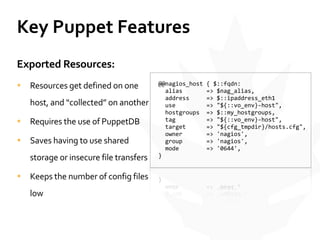
  @@nagios_host	
  {	
  $::fqdn:	


  alias	


  =>	
  $nag_alias,	


  address	


  =>	
  $::ipaddress_eth1	


  use	


  =>	
  "${::vo_env}-­‐host",	


  hostgroups	
  	
  =>	
  $::my_hostgroups,	


  tag	


  =>	
  "${::vo_env}-­‐host",	


  target	


  =>	
  "${cfg_tmpdir}/hosts.cfg",	


  owner	


  =>	
  'nagios',	


  group	


  =>	
  'nagios',	


  mode	


  =>	
  '0644',	


  }	
  
Key	
  Puppet	
  Features
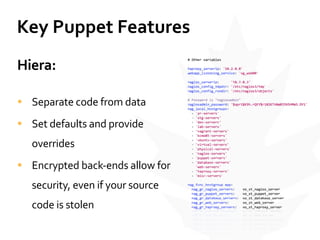
Hiera:	
  
• Separate	
  code	
  from	
  data	
  
• Set	
  defaults	
  and	
  provide	
  
overrides	
  
• Encrypted	
  back-­‐ends	
  allow	
  for	
  
security,	
  even	
  if	
  your	
  source	
  
code	
  is	
  stolen
Key	
  Puppet	
  Features
Inline	
  Templates:	
  
• Not	
  just	
  for	
  file	
  content	
  
• Allows	
  the	
  use	
  of	
  native	
  Ruby	
  code	
  within	
  
Puppet	
  policy
inline_template(	
  '<%=	
  Hash[scope.to_hash.select{	
  |k,v|	
  k	
  =~	
  /nag_gr_/	
  &&	
  v	
  }].keys.join(",")	
  %>'	
  )
Key	
  Puppet	
  Features
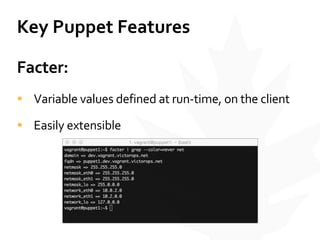
Facter:	
  
• Variable	
  values	
  defined	
  at	
  run-­‐time,	
  on	
  the	
  client	
  
• Easily	
  extensible
Key	
  Puppet	
  Features
Nagios	
  Resource	
  Types:	
  
• Makes	
  creating	
  Nagios	
  configs	
  
simple	
  
• Enforces	
  correct	
  syntax	
  
• Not	
  suitable	
  for	
  every	
  config	
  in	
  
every	
  file
Key	
  Puppet	
  Features
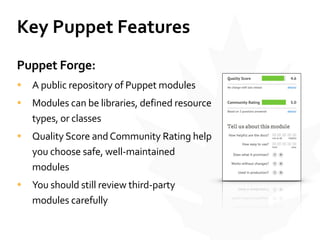
Puppet	
  Forge:	
  
• A	
  public	
  repository	
  of	
  Puppet	
  modules	
  
• Modules	
  can	
  be	
  libraries,	
  defined	
  resource	
  
types,	
  or	
  classes	
  
• Quality	
  Score	
  and	
  Community	
  Rating	
  help	
  
you	
  choose	
  safe,	
  well-­‐maintained	
  
modules	
  
• You	
  should	
  still	
  review	
  third-­‐party	
  
modules	
  carefully
Why	
  Not	
  Use	
  an	
  Existing	
  Module?
There	
  are	
  several	
  user-­‐submitted	
  Nagios	
  modules	
  in	
  
the	
  Forge,	
  but	
  I	
  wanted	
  one	
  that	
  would:	
  
• Automatically	
  add	
  new	
  hosts	
  
• Provision	
  some	
  services	
  within	
  other	
  modules	
  
• Automatically	
  remove	
  decommissioned	
  hosts	
  
• Make	
  use	
  of	
  host	
  and	
  service	
  groups
Putting	
  It	
  All	
  Together
Hiera	
  and	
  Facter	
  define	
  the	
  variables	
  
• Sane	
  defaults	
  for	
  most	
  values	
  
• Environment-­‐specific	
  overrides	
  (dev,	
  stage,	
  prod)	
  
• Site-­‐specific	
  overrides	
  for	
  different	
  datacenters
Putting	
  It	
  All	
  Together
Monitored	
  hosts	
  build	
  their	
  own	
  config	
  
• Hostgroup	
  membership	
  is	
  determined	
  in	
  the	
  client	
  context	
  
• Other	
  facts	
  integrate	
  into	
  the	
  host	
  definition	
  
• NRPE	
  config	
  built	
  from	
  a	
  common	
  template	
  
• Client	
  puppet	
  run	
  exports	
  resources
Putting	
  It	
  All	
  Together
Some	
  service	
  definitions	
  get	
  embedded	
  in	
  the	
  
manifest	
  for	
  that	
  service	
  
• A	
  change	
  to	
  a	
  service	
  may	
  mean	
  a	
  change	
  to	
  how	
  
you	
  monitor	
  it	
  
• Manage	
  that	
  all	
  in	
  one	
  place	
  
• profile::vo_webserver	
  provides	
  an	
  example
Putting	
  It	
  All	
  Together
Some	
  service	
  definitions	
  are	
  done	
  with	
  templates	
  
• Not	
  everything	
  needs	
  to	
  get	
  built	
  dynamically	
  
• Some	
  services	
  are	
  monitored	
  on	
  all	
  hosts	
  
• Less	
  dynamic	
  config	
  means	
  shorter	
  catalog	
  compilation	
  
• Templates	
  can	
  be	
  easier	
  to	
  debug
Ugly	
  Hack	
  Alert
Dynamic	
  files	
  built	
  every	
  run,	
  installed	
  if	
  there’s	
  a	
  diff	
  
• Allows	
  keeping	
  backup	
  directories	
  with	
  previous	
  versions	
  of	
  the	
  
configs	
  
• Allows	
  automatic	
  removal	
  of	
  decommissioned	
  hosts	
  
• Prevents	
  excessive	
  Nagios	
  restarts
Vagrant	
  
• AWESOME	
  way	
  to	
  test	
  Puppet	
  code	
  as	
  
you	
  develop	
  
Github	
  repository	
  
• Contains	
  Vagrantfile	
  and	
  complete	
  
Puppet	
  policy	
  
• github.com/victorops/puppet-­‐nagios
The	
  Demo	
  Environment	
  
Demo	
  Time!
Running low on slides, so it must be…
The	
  Demo	
  Environment	
  
github.com/victorops/puppet-­‐nagios	
  
• Check	
  it	
  out!	
  
• Contribute!	
  
• Or	
  fork	
  it!	
  
• Help	
  work	
  towards	
  a	
  Puppet	
  Forge	
  module:	
  
• Parameterize	
  the	
  class	
  
• More	
  types	
  of	
  config	
  resources	
  
• Cross	
  platform	
  support	
  
• Documentation

Puppet Camp Denver 2015: Nagios Management With Puppet

  • 1.
    The  Art  and  Zen  of  Managing  Nagios  with  Puppet Michael  Merideth  -­‐  VictorOps
  • 2.
    Why  Manage  Nagios  with  Puppet? • Mind  the  gaps   • Keep  the  config  readable   • Good  intro  to  key  Puppet  features
  • 3.
    Key  Puppet  Features •Exported  Resources   • Hiera   • Inline  Templates   • Facter   • Nagios  Resource  Types   • Puppet  Forge
  • 4.
    Key  Puppet  Features Exported  Resources:   • Resources  get  defined  on  one   host,  and  “collected”  on  another   • Requires  the  use  of  PuppetDB   • Saves  having  to  use  shared   storage  or  insecure  file  transfers   • Keeps  the  number  of  config  files   low    @@nagios_host  {  $::fqdn:          alias              =>  $nag_alias,          address          =>  $::ipaddress_eth1          use                  =>  "${::vo_env}-­‐host",          hostgroups    =>  $::my_hostgroups,          tag                  =>  "${::vo_env}-­‐host",          target            =>  "${cfg_tmpdir}/hosts.cfg",          owner              =>  'nagios',          group              =>  'nagios',          mode                =>  '0644',      }  
  • 5.
    Key  Puppet  Features Hiera:   • Separate  code  from  data   • Set  defaults  and  provide   overrides   • Encrypted  back-­‐ends  allow  for   security,  even  if  your  source   code  is  stolen
  • 6.
    Key  Puppet  Features Inline  Templates:   • Not  just  for  file  content   • Allows  the  use  of  native  Ruby  code  within   Puppet  policy inline_template(  '<%=  Hash[scope.to_hash.select{  |k,v|  k  =~  /nag_gr_/  &&  v  }].keys.join(",")  %>'  )
  • 7.
    Key  Puppet  Features Facter:   • Variable  values  defined  at  run-­‐time,  on  the  client   • Easily  extensible
  • 8.
    Key  Puppet  Features Nagios  Resource  Types:   • Makes  creating  Nagios  configs   simple   • Enforces  correct  syntax   • Not  suitable  for  every  config  in   every  file
  • 9.
    Key  Puppet  Features Puppet  Forge:   • A  public  repository  of  Puppet  modules   • Modules  can  be  libraries,  defined  resource   types,  or  classes   • Quality  Score  and  Community  Rating  help   you  choose  safe,  well-­‐maintained   modules   • You  should  still  review  third-­‐party   modules  carefully
  • 10.
    Why  Not  Use  an  Existing  Module? There  are  several  user-­‐submitted  Nagios  modules  in   the  Forge,  but  I  wanted  one  that  would:   • Automatically  add  new  hosts   • Provision  some  services  within  other  modules   • Automatically  remove  decommissioned  hosts   • Make  use  of  host  and  service  groups
  • 11.
    Putting  It  All  Together Hiera  and  Facter  define  the  variables   • Sane  defaults  for  most  values   • Environment-­‐specific  overrides  (dev,  stage,  prod)   • Site-­‐specific  overrides  for  different  datacenters
  • 12.
    Putting  It  All  Together Monitored  hosts  build  their  own  config   • Hostgroup  membership  is  determined  in  the  client  context   • Other  facts  integrate  into  the  host  definition   • NRPE  config  built  from  a  common  template   • Client  puppet  run  exports  resources
  • 13.
    Putting  It  All  Together Some  service  definitions  get  embedded  in  the   manifest  for  that  service   • A  change  to  a  service  may  mean  a  change  to  how   you  monitor  it   • Manage  that  all  in  one  place   • profile::vo_webserver  provides  an  example
  • 14.
    Putting  It  All  Together Some  service  definitions  are  done  with  templates   • Not  everything  needs  to  get  built  dynamically   • Some  services  are  monitored  on  all  hosts   • Less  dynamic  config  means  shorter  catalog  compilation   • Templates  can  be  easier  to  debug
  • 15.
    Ugly  Hack  Alert Dynamic  files  built  every  run,  installed  if  there’s  a  diff   • Allows  keeping  backup  directories  with  previous  versions  of  the   configs   • Allows  automatic  removal  of  decommissioned  hosts   • Prevents  excessive  Nagios  restarts
  • 16.
    Vagrant   • AWESOME  way  to  test  Puppet  code  as   you  develop   Github  repository   • Contains  Vagrantfile  and  complete   Puppet  policy   • github.com/victorops/puppet-­‐nagios The  Demo  Environment  
  • 17.
    Demo  Time! Running lowon slides, so it must be…
  • 18.
    The  Demo  Environment   github.com/victorops/puppet-­‐nagios   • Check  it  out!   • Contribute!   • Or  fork  it!   • Help  work  towards  a  Puppet  Forge  module:   • Parameterize  the  class   • More  types  of  config  resources   • Cross  platform  support   • Documentation