A Silent Lesson On AbsoluteValue
 Click on the options below in order to move
through the lab.
Definition of AbsoluteValue
Basic AbsoluteValue Problems
Intermediate AbsoluteValue Problems
Advanced AbsoluteValue Problems
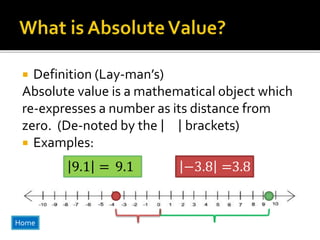
 Definition (Lay-man’s)
Absolute value is a mathematical object which
re-expresses a number as its distance from
zero. (De-noted by the brackets)
 Examples:
9.1 = 9.1 −3.8 =3.8
Home
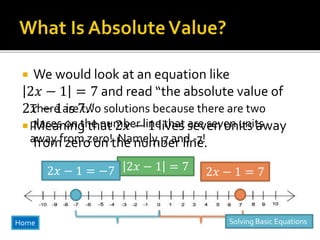
 We would look at an equation like
2𝑥 − 1 = 7 and read “the absolute value of
2𝑥 − 1 is 7.”
 Meaning that 2𝑥 − 1 lives seven units away
from zero on the number line.
2𝑥 − 1 = 7 2𝑥 − 1 = 72𝑥 − 1 = −7
There are two solutions because there are two
places on the number line that are seven units
away from zero! Namely, 7 and -7!
Home Solving Basic Equations
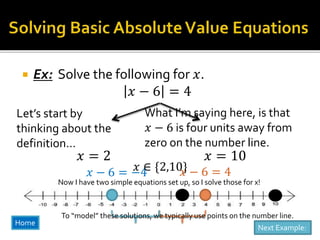
 Ex: Solve the following for 𝑥.
𝑥 − 6 = 4
Let’s start by
thinking about the
definition…
What I’m saying here, is that
𝑥 − 6 is four units away from
zero on the number line.
𝑥 − 6 = 4𝑥 − 6 = −4
Now I have two simple equations set up, so I solve those for x!
𝑥 = 2 𝑥 = 10
𝑥 ∈ {2,10}
Home
To “model” these solutions, we typically use points on the number line.
Next Example:
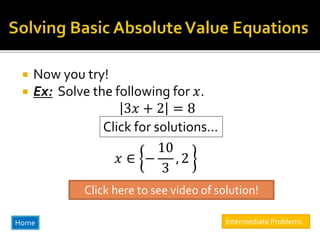
 Now you try!
 Ex: Solve the following for 𝑥.
3𝑥 + 2 = 8
Click for solutions…
𝑥 ∈ −
10
3
, 2
Home
Click here to see video of solution!
Intermediate Problems
Home Intermediate Problems
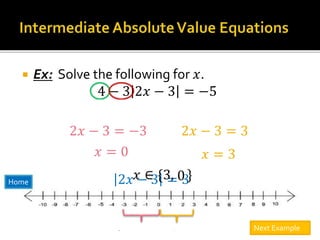
 Ex: Solve the following for 𝑥.
4 − 3 2𝑥 − 3 = −5
We need to get the
absolute value portion of
the equation by itself, then
it’s a simple problem!
Ultimately, we want to get
rid of the 4and the -3.
The trick is just getting the
order right!
Since the -3 is multiplying, let’s get rid
of that last. So we’ll get rid of the 4
first! We do this be subtracting.
−4 −4
−3 2𝑥 − 3 = −9
Now, we want to get rid of the -3 that
is multiplying, so we divide both sides
by -3.
−3 −3
2𝑥 − 3 = 3
2𝑥 − 3 = 32𝑥 − 3 = −3
𝑥 = 3𝑥 = 0
𝑥 ∈ {3, −}0Home
Next Example
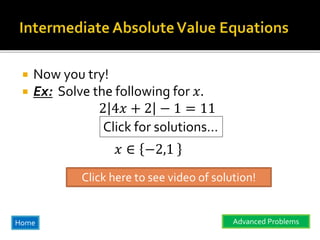
 Now you try!
 Ex: Solve the following for 𝑥.
2 4𝑥 + 2 − 1 = 11
Click for solutions…
𝑥 ∈ −2,1
Click here to see video of solution!
Home Advanced Problems
 Truth be told, these questions aren’t any
different from the intermediate questions
there’s just fractions involved.
Home
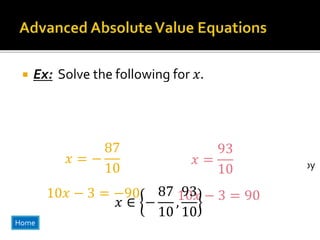
 Ex: Solve the following for 𝑥.
2
2
3
𝑥 −
1
5
+ 1 = 13
Don’t freak out at the fractions! Just
do what you know how to do first!
Get the absolute value expression by
itself first!
−1 +1
2
2
3
𝑥 −
1
5
= 12
−1
2 2
2
3
𝑥 −
1
5
= 6
Let’s get rid of all of
the fractions at once!
We do this by multiplying both sides of
the equations by the smallest number
three an five (the denominators) have in
common.
2
3
𝑥 −
1
5
= −6
2
3
𝑥 −
1
5
= 6
Since 3, and 5 have nothing in common we multiply both equations by 15!
15( ) 15( )( )15 ( )15
30
3
𝑥 −
15
5
= −90
30
3
𝑥 −
15
5
= 90
10𝑥 − 3 = 9010𝑥 − 3 = −90
𝑥 = −
87
10
𝑥 =
93
10
𝑥 ∈ −
87
10
,
93
10
Home
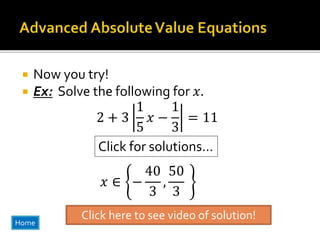
 Now you try!
 Ex: Solve the following for 𝑥.
2 + 3
1
5
𝑥 −
1
3
= 11
Click for solutions…
𝑥 ∈ −
40
3
,
50
3
Click here to see video of solution!
Home
Home
 You’ve just finished the lab! Hopefully you’ve
built sufficient skill to start solving some
really challenging problems.
Home

Absolutevaluelab

  • 1.
    A Silent LessonOn AbsoluteValue
  • 2.
     Click onthe options below in order to move through the lab. Definition of AbsoluteValue Basic AbsoluteValue Problems Intermediate AbsoluteValue Problems Advanced AbsoluteValue Problems
  • 3.
     Definition (Lay-man’s) Absolutevalue is a mathematical object which re-expresses a number as its distance from zero. (De-noted by the brackets)  Examples: 9.1 = 9.1 −3.8 =3.8 Home
  • 4.
     We wouldlook at an equation like 2𝑥 − 1 = 7 and read “the absolute value of 2𝑥 − 1 is 7.”  Meaning that 2𝑥 − 1 lives seven units away from zero on the number line. 2𝑥 − 1 = 7 2𝑥 − 1 = 72𝑥 − 1 = −7 There are two solutions because there are two places on the number line that are seven units away from zero! Namely, 7 and -7! Home Solving Basic Equations
  • 5.
     Ex: Solvethe following for 𝑥. 𝑥 − 6 = 4 Let’s start by thinking about the definition… What I’m saying here, is that 𝑥 − 6 is four units away from zero on the number line. 𝑥 − 6 = 4𝑥 − 6 = −4 Now I have two simple equations set up, so I solve those for x! 𝑥 = 2 𝑥 = 10 𝑥 ∈ {2,10} Home To “model” these solutions, we typically use points on the number line. Next Example:
  • 6.
     Now youtry!  Ex: Solve the following for 𝑥. 3𝑥 + 2 = 8 Click for solutions… 𝑥 ∈ − 10 3 , 2 Home Click here to see video of solution! Intermediate Problems
  • 7.
  • 8.
     Ex: Solvethe following for 𝑥. 4 − 3 2𝑥 − 3 = −5 We need to get the absolute value portion of the equation by itself, then it’s a simple problem! Ultimately, we want to get rid of the 4and the -3. The trick is just getting the order right! Since the -3 is multiplying, let’s get rid of that last. So we’ll get rid of the 4 first! We do this be subtracting. −4 −4 −3 2𝑥 − 3 = −9 Now, we want to get rid of the -3 that is multiplying, so we divide both sides by -3. −3 −3 2𝑥 − 3 = 3 2𝑥 − 3 = 32𝑥 − 3 = −3 𝑥 = 3𝑥 = 0 𝑥 ∈ {3, −}0Home Next Example
  • 9.
     Now youtry!  Ex: Solve the following for 𝑥. 2 4𝑥 + 2 − 1 = 11 Click for solutions… 𝑥 ∈ −2,1 Click here to see video of solution! Home Advanced Problems
  • 10.
  • 11.
     Truth betold, these questions aren’t any different from the intermediate questions there’s just fractions involved. Home
  • 12.
     Ex: Solvethe following for 𝑥. 2 2 3 𝑥 − 1 5 + 1 = 13 Don’t freak out at the fractions! Just do what you know how to do first! Get the absolute value expression by itself first! −1 +1 2 2 3 𝑥 − 1 5 = 12 −1 2 2 2 3 𝑥 − 1 5 = 6 Let’s get rid of all of the fractions at once! We do this by multiplying both sides of the equations by the smallest number three an five (the denominators) have in common. 2 3 𝑥 − 1 5 = −6 2 3 𝑥 − 1 5 = 6 Since 3, and 5 have nothing in common we multiply both equations by 15! 15( ) 15( )( )15 ( )15 30 3 𝑥 − 15 5 = −90 30 3 𝑥 − 15 5 = 90 10𝑥 − 3 = 9010𝑥 − 3 = −90 𝑥 = − 87 10 𝑥 = 93 10 𝑥 ∈ − 87 10 , 93 10 Home
  • 13.
     Now youtry!  Ex: Solve the following for 𝑥. 2 + 3 1 5 𝑥 − 1 3 = 11 Click for solutions… 𝑥 ∈ − 40 3 , 50 3 Click here to see video of solution! Home
  • 14.
  • 15.
     You’ve justfinished the lab! Hopefully you’ve built sufficient skill to start solving some really challenging problems. Home