Songwriting skills - Chords Chords are one of the basic building blocks of music.  They are groups of notes  made up of 1, 3 and 5 based on a root note from the scale. Chords create the “Harmony” in the music, and direct the melody.  They create the direction in the music
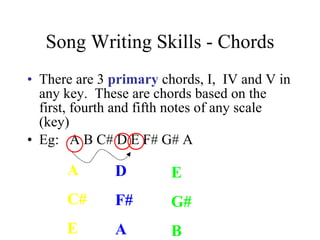
Song Writing Skills - Chords There are 3  primary  chords, I,  IV and V in any key.  These are chords based on the first, fourth and fifth notes of any scale (key) Eg:  A B C# D E F# G# A A C# E D F# A E G# B
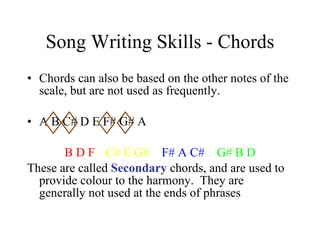
Song Writing Skills - Chords Chords can also be based on the other notes of the scale, but are not used as frequently. A B C# D E F# G# A B D F   C# E G#   F# A C#   G# B D These are called  Secondary  chords, and are used to provide colour to the harmony.  They are generally not used at the ends of phrases
Song Writing Skills - Chords There are 2 major types of Chords,  Major  and  Minor. The  Primary  Chords are Major, and are described as bright or happy sounding. Most of the  Secondary  Chords are Minor and are described as dark or sad sounding.
Song Writing Skills - Chords Cadences.  A cadence is a selection of chords which end sections, like a full stop after a sentence.  There are a wide variety of cadences, however the two most important are called “Perfect” and “Plagal”  Perfect is a V - I  cadence (Major) Plagal is a IV - I cadence. (Major)
Song Writing Skills - Chords Practical Activity Load up Band in a Box on the Mac computers, and insert primary chords in the key of  D Major  in random order. At the end of each 8 bars, place a  cadence , Plagal or Perfect  (G - D)  ( A - D) Now substitute some chords (not at the ends of a phrase) for  secondary  chords in D Major (these will be minor chords, so will need to have an “m” placed after them to tell the computer what to do. Press Play, and try varying the style.  You have just written a chord progression in D Major.
Song Writing Skills: Melody In the same way as Chords are based on a Key (scale) so too are ‘melodies’.  Whether you choose to use a scale or not, your ear will naturally move to a set of pitches that you are familiar with, from a technical point of view, (for writing chords etc) it makes sense to “Know” what group of notes  your ear has chosen.
Song Writing Skills - Melody Helpful Hints for writing a melody.  Use “Repetition” (same thing over and over)  Use a small group of notes (most pop and rock songs don’t have a full scale, only a few notes, not usually more than 5)  Your pitch (for your melody) should follow the “meaning of the words”  Eg, if you are singing about lost love, melodies going down, reflecting a “sad emotional state” or new love, melodies going up etc. A song about dancing should have notes that “dance” around between higher and lower etc.
Song Writing Skills: Harmony Putting Chords with your melody is based on a very simple principle.  “  Only use chords that have your “Melody Note” in them” .  If your melody note (the note sung) is an “A” then you must find a chord that has an “A” in it.  Examples would be:  D (D F# A)  ,  A (A C# E) ,  F  (F A C)  etc.
Melody Activity:  You are to create a melody for the following words:  “ Some where there’s music,  How faint the tune,  Some where there’s heaven,  How high the moon.” -  Use only 4 -5  pitches from the D Major Scale.  Tap a rhythm for the words against a beat.  Record it using Cubasis on one note, and adjust in harmony assistant (or up to 5 notes on the keyboard)  Quantize it to “16ths” to tidy up the rhythm.  Export as a midi and open in harmony assistant, “Print it”  On your printed score, work out which chord to use for the first and middle note of each bar.  (D, G, A,  em, f#m, bm, c#m )
Song Writing Skills:  Melody Construction. Where to start with a “new” melody.  You can plan a melody just like a  “Building”   1.  Choose a small group of notes that are side by side, and alternate between them (scalic) 2.  Start with a “Leap” and follow with step by step movement (balanced Angular / Scalic)  3.  Use note from the chord / 1,3,5 (Triadic) 4. Use any of these in a combination together.
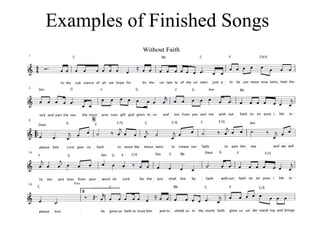
Examples of Finished Songs
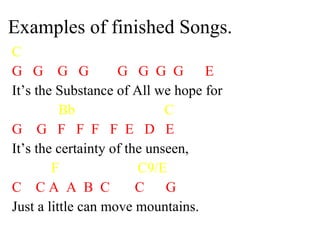
Examples of finished Songs. C G  G  G  G  G  G  G  G  E It’s the Substance of All we hope for Bb  C G  G  F  F  F  F  E  D  E It’s the certainty of the unseen,  F  C9/E C  C A  A  B  C  C  G Just a little can move mountains.

Song writing skills Chords

  • 1.
    Songwriting skills -Chords Chords are one of the basic building blocks of music. They are groups of notes made up of 1, 3 and 5 based on a root note from the scale. Chords create the “Harmony” in the music, and direct the melody. They create the direction in the music
  • 2.
    Song Writing Skills- Chords There are 3 primary chords, I, IV and V in any key. These are chords based on the first, fourth and fifth notes of any scale (key) Eg: A B C# D E F# G# A A C# E D F# A E G# B
  • 3.
    Song Writing Skills- Chords Chords can also be based on the other notes of the scale, but are not used as frequently. A B C# D E F# G# A B D F C# E G# F# A C# G# B D These are called Secondary chords, and are used to provide colour to the harmony. They are generally not used at the ends of phrases
  • 4.
    Song Writing Skills- Chords There are 2 major types of Chords, Major and Minor. The Primary Chords are Major, and are described as bright or happy sounding. Most of the Secondary Chords are Minor and are described as dark or sad sounding.
  • 5.
    Song Writing Skills- Chords Cadences. A cadence is a selection of chords which end sections, like a full stop after a sentence. There are a wide variety of cadences, however the two most important are called “Perfect” and “Plagal” Perfect is a V - I cadence (Major) Plagal is a IV - I cadence. (Major)
  • 6.
    Song Writing Skills- Chords Practical Activity Load up Band in a Box on the Mac computers, and insert primary chords in the key of D Major in random order. At the end of each 8 bars, place a cadence , Plagal or Perfect (G - D) ( A - D) Now substitute some chords (not at the ends of a phrase) for secondary chords in D Major (these will be minor chords, so will need to have an “m” placed after them to tell the computer what to do. Press Play, and try varying the style. You have just written a chord progression in D Major.
  • 7.
    Song Writing Skills:Melody In the same way as Chords are based on a Key (scale) so too are ‘melodies’. Whether you choose to use a scale or not, your ear will naturally move to a set of pitches that you are familiar with, from a technical point of view, (for writing chords etc) it makes sense to “Know” what group of notes your ear has chosen.
  • 8.
    Song Writing Skills- Melody Helpful Hints for writing a melody. Use “Repetition” (same thing over and over) Use a small group of notes (most pop and rock songs don’t have a full scale, only a few notes, not usually more than 5) Your pitch (for your melody) should follow the “meaning of the words” Eg, if you are singing about lost love, melodies going down, reflecting a “sad emotional state” or new love, melodies going up etc. A song about dancing should have notes that “dance” around between higher and lower etc.
  • 9.
    Song Writing Skills:Harmony Putting Chords with your melody is based on a very simple principle. “ Only use chords that have your “Melody Note” in them” . If your melody note (the note sung) is an “A” then you must find a chord that has an “A” in it. Examples would be: D (D F# A) , A (A C# E) , F (F A C) etc.
  • 10.
    Melody Activity: You are to create a melody for the following words: “ Some where there’s music, How faint the tune, Some where there’s heaven, How high the moon.” - Use only 4 -5 pitches from the D Major Scale. Tap a rhythm for the words against a beat. Record it using Cubasis on one note, and adjust in harmony assistant (or up to 5 notes on the keyboard) Quantize it to “16ths” to tidy up the rhythm. Export as a midi and open in harmony assistant, “Print it” On your printed score, work out which chord to use for the first and middle note of each bar. (D, G, A, em, f#m, bm, c#m )
  • 11.
    Song Writing Skills: Melody Construction. Where to start with a “new” melody. You can plan a melody just like a “Building” 1. Choose a small group of notes that are side by side, and alternate between them (scalic) 2. Start with a “Leap” and follow with step by step movement (balanced Angular / Scalic) 3. Use note from the chord / 1,3,5 (Triadic) 4. Use any of these in a combination together.
  • 12.
  • 13.
    Examples of finishedSongs. C G G G G G G G G E It’s the Substance of All we hope for Bb C G G F F F F E D E It’s the certainty of the unseen, F C9/E C C A A B C C G Just a little can move mountains.