2 PRELIMINARES
Esta publicación se terminó de imprimir durante el mes de junio de 2012.
Diseñada en Dirección Académica del Colegio de Bachilleres del Estado de Sonora
Blvd. Agustín de Vildósola; Sector Sur. Hermosillo, Sonora, México
La edición consta de 1,146 ejemplares.
COLEGIO DE BACHILLERES
DEL ESTADO DE SONORA
Director General
Profr. Julio Alfonso Martínez Romero
Director Académico
Dr. Manuel Valenzuela Valenzuela
Director de Administración y Finanzas
C.P. Jesús Urbano Limón Tapia
Director de Planeación
Ing. Raúl Leonel Durazo Amaya
WRITTEN ENGLISH COMMUNICATION 1
Módulo de Aprendizaje.
Copyright ©, 2010 por Colegio de Bachilleres
del Estado de Sonora
todos los derechos reservados.
Tercera edición 2012. Impreso en México.
DIRECCIÓN ACADÉMICA
Departamento de Desarrollo Curricular
Blvd. Agustín de Vildósola, Sector Sur
Hermosillo, Sonora. México. C.P. 83280
COMISIÓN ELABORADORA:
Elaborador:
Edna Elinora Soto Gracia
Revisión Disciplinaria:
Lydia Lagarda Sánchez
Corrección de Estilo:
Diana Patricia Lugo Peñúñuri
Apoyo Metodológico:
Jesús Moisés Galaz Duarte
Supervisión Académica:
Mtra. Luz María Grijalva Díaz
Diseño:
Joaquín Rivas Samaniego
María Jesús Jiménez Duarte
Edición:
Cynthia Deyanira Meneses Avalos
Coordinación Técnica:
Claudia Yolanda Lugo Peñúñuri
Diana Irene Valenzuela López
Coordinación General:
Dr. Manuel Valenzuela Valenzuela
3
PRELIMINARES
Ubicación Curricular
COMPONENTE:
FORMACIÓN PARA EL
TRABAJO
CAPACITACIÓN PARA EL
TRABAJO:
IDIOMAS (INGLÉS)
HORAS SEMANALES:
04
CRÉDITOS:
03
DATOS DEL ALUMNO
DATOS DEL ALUMNO
DATOS DEL ALUMNO
DATOS DEL ALUMNO
Nombre: _______________________________________________________________
Plantel: __________________________________________________________________
Grupo: _________________ Turno: _____________ Teléfono:___________________
E-mail: _________________________________________________________________
Domicilio: ______________________________________________________________
_______________________________________________________________________
4 PRELIMINARES
5
PRELIMINARES
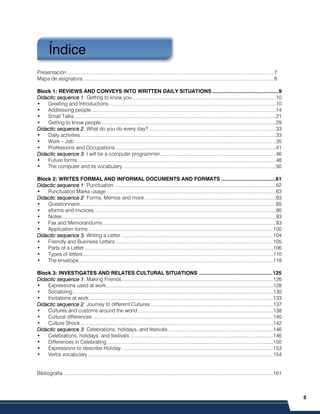
Presentación ..................................................................................................................................................... 7
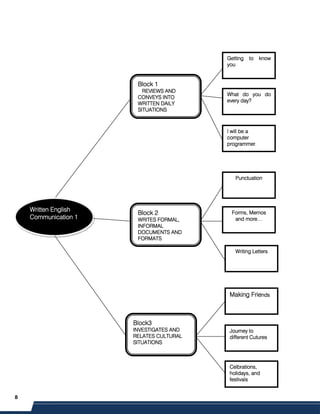
Mapa de asignatura.......................................................................................................................................... 8
Block 1: REVIEWS AND CONVEYS INTO WRITTEN DAILY SITUATIONS ............................................9
Didactic sequence 1
Didactic sequence 1
Didactic sequence 1
Didactic sequence 1: Getting to know you ........................................................................................................10
• Greeting and Introductions.........................................................................................................................10
• Addressing people......................................................................................................................................14
• Small Talks..................................................................................................................................................21
• Getting to know people...............................................................................................................................29
Didactic sequence
Didactic sequence
Didactic sequence
Didactic sequence 2
2
2
2: What do you do every day? ............................................................................................33
• Daily activities..............................................................................................................................................33
• Work – Job ..................................................................................................................................................35
• Professions and Occupations ....................................................................................................................41
Didactic sequence 3
Didactic sequence 3
Didactic sequence 3
Didactic sequence 3: I will be a computer programmer....................................................................................46
• Future forms................................................................................................................................................48
• The computer and its vocabulary...............................................................................................................50
Block 2: WRITES FORMAL AND INFORMAL DOCUMENTS AND FORMATS ....................................61
Didactic sequence 1
Didactic sequence 1
Didactic sequence 1
Didactic sequence 1: Punctuation .....................................................................................................................62
• Punctuation Marks usage...........................................................................................................................63
Didactic sequence
Didactic sequence
Didactic sequence
Didactic sequence 2
2
2
2: Forms, Memos and more…............................................................................................83
• Questionnaire..............................................................................................................................................85
• eforms and invoices....................................................................................................................................90
• Notes...........................................................................................................................................................93
• Fax and Memorandums..............................................................................................................................93
• Application forms......................................................................................................................................100
Didactic sequence
Didactic sequence
Didactic sequence
Didactic sequence 3
3
3
3: Writing a Letter ..............................................................................................................104
• Friendly and Business Letters ..................................................................................................................105
• Parts of a Letter.........................................................................................................................................106
• Types of letters..........................................................................................................................................110
• The envelope.............................................................................................................................................118
Block 3: INVESTIGATES AND RELATES CULTURAL SITUATIONS .................................................125
Didactic sequence 1
Didactic sequence 1
Didactic sequence 1
Didactic sequence 1: Making Friends..............................................................................................................126
• Expressions used at work.........................................................................................................................128
• Socializing .................................................................................................................................................130
• Invitations at work .....................................................................................................................................133
Didactic sequence
Didactic sequence
Didactic sequence
Didactic sequence 2
2
2
2: Journey to different Cultures.........................................................................................137
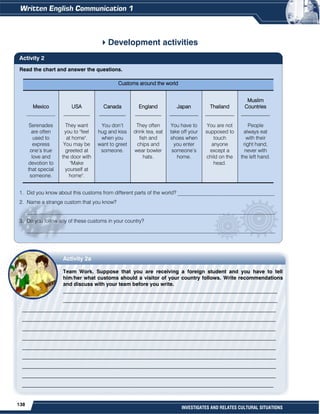
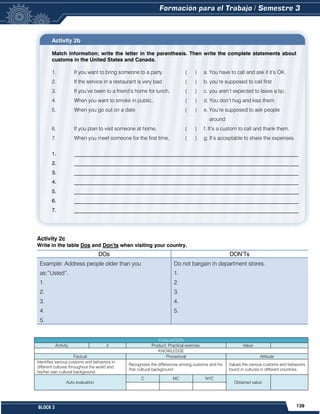
• Cultures and customs around the world ..................................................................................................138
• Cultural differences...................................................................................................................................140
• Culture Shock............................................................................................................................................142
Didactic sequence
Didactic sequence
Didactic sequence
Didactic sequence 3
3
3
3: Celebrations, holidays, and festivals ............................................................................146
• Celebrations, holidays, and festivals........................................................................................................146
• Differences in Celebrating ........................................................................................................................150
• Expressions to describe Holiday..............................................................................................................153
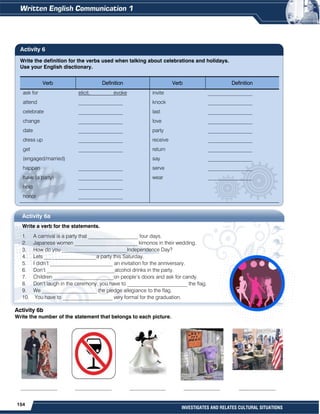
• Verbs vocabulary ......................................................................................................................................154
Bibliografía ........................................................................................................................................................161
Índice
6 PRELIMINARES
7
PRELIMINARES
“Una competencia es la integración de habilidades, conocimientos y actitudes en un contexto específico”.
El enfoque en competencias considera que los conocimientos por sí mismos no son lo más importante, sino el uso
que se hace de ellos en situaciones específicas de la vida personal, social y profesional. De este modo, las
competencias requieren una base sólida de conocimientos y ciertas habilidades, los cuales se integran para un
mismo propósito en un determinado contexto
El presente Módulo de Aprendizaje de la asignatura Written English Communication 1, es una herramienta de suma
importancia, que propiciará tu desarrollo como persona visionaria, competente e innovadora, características que se
establecen en los objetivos de la Reforma Integral de Educación Media Superior que actualmente se está
implementando a nivel nacional.
El Módulo de aprendizaje es uno de los apoyos didácticos que el Colegio de Bachilleres te ofrece con la intención de
estar acorde a los nuevos tiempos, a las nuevas políticas educativas, además de lo que demandan los escenarios
local, nacional e internacional; el módulo se encuentra organizado a través de bloques de aprendizaje y secuencias
didácticas. Una secuencia didáctica es un conjunto de actividades, organizadas en tres momentos: Inicio, desarrollo y
cierre. En el inicio desarrollarás actividades que te permitirán identificar y recuperar las experiencias, los saberes, las
preconcepciones y los conocimientos que ya has adquirido a través de tu formación, mismos que te ayudarán a
abordar con facilidad el tema que se presenta en el desarrollo, donde realizarás actividades que introducen nuevos
conocimientos dándote la oportunidad de contextualizarlos en situaciones de la vida cotidiana, con la finalidad de que
tu aprendizaje sea significativo.
Posteriormente se encuentra el momento de cierre de la secuencia didáctica, donde integrarás todos los saberes que
realizaste en las actividades de inicio y desarrollo.
En todas las actividades de los tres momentos se consideran los saberes conceptuales, procedimentales y
actitudinales. De acuerdo a las características y del propósito de las actividades, éstas se desarrollan de forma
individual, binas o equipos.
Para el desarrollo del trabajo deberás utilizar diversos recursos, desde material bibliográfico, videos, investigación de
campo, etc.
La retroalimentación de tus conocimientos es de suma importancia, de ahí que se te invita a participar de forma activa,
de esta forma aclararás dudas o bien fortalecerás lo aprendido; además en este momento, el docente podrá tener una
visión general del logro de los aprendizajes del grupo.
Recuerda que la evaluación en el enfoque en competencias es un proceso continuo, que permite recabar evidencias a
través de tu trabajo, donde se tomarán en cuenta los tres saberes: el conceptual, procedimental y actitudinal con el
propósito de que apoyado por tu maestro mejores el aprendizaje. Es necesario que realices la autoevaluación, este
ejercicio permite que valores tu actuación y reconozcas tus posibilidades, limitaciones y cambios necesarios para
mejorar tu aprendizaje.
Así también, es recomendable la coevaluación, proceso donde de manera conjunta valoran su actuación, con la
finalidad de fomentar la participación, reflexión y crítica ante situaciones de sus aprendizajes, promoviendo las
actitudes de responsabilidad e integración del grupo.
Nuestra sociedad necesita individuos a nivel medio superior con conocimientos, habilidades, actitudes y valores, que
les permitan integrarse y desarrollarse de manera satisfactoria en el mundo social, profesional y laboral. Para que
contribuyas en ello, es indispensable que asumas una nueva visión y actitud en cuanto a tu rol, es decir, de ser
receptor de contenidos, ahora construirás tu propio conocimiento a través de la problematización y contextualización
de los mismos, situación que te permitirá: Aprender a conocer, aprender a hacer, aprender a ser y aprender a vivir
juntos.
Presentación
8 PRELIMINARES
Block 1
Block 1
Block 1
Block 1
REVIEWS AND
REVIEWS AND
REVIEWS AND
REVIEWS AND
CONVEYS INTO
CONVEYS INTO
CONVEYS INTO
CONVEYS INTO
WRITTEN DAILY
WRITTEN DAILY
WRITTEN DAILY
WRITTEN DAILY
SITUATIONS
SITUATIONS
SITUATIONS
SITUATIONS
Block 2
Block 2
Block 2
Block 2
WRITES FORMAL,
WRITES FORMAL,
WRITES FORMAL,
WRITES FORMAL,
INFORMAL
INFORMAL
INFORMAL
INFORMAL
DOCUMENTS AND
DOCUMENTS AND
DOCUMENTS AND
DOCUMENTS AND
FORMATS
FORMATS
FORMATS
FORMATS
Block3
Block3
Block3
Block3
INVESTIGATES AND
INVESTIGATES AND
INVESTIGATES AND
INVESTIGATES AND
RELATES CULTURAL
RELATES CULTURAL
RELATES CULTURAL
RELATES CULTURAL
SITUATIONS
SITUATIONS
SITUATIONS
SITUATIONS
Written English
Written English
Written English
Written English
Communication 1
Communication 1
Communication 1
Communication 1
Getting to know
Getting to know
Getting to know
Getting to know
you
you
you
you
What do you do
What do you do
What do you do
What do you do
every day?
every day?
every day?
every day?
I will be a
I will be a
I will be a
I will be a
computer
computer
computer
computer
programmer.
programmer.
programmer.
programmer.
Punctuation
Punctuation
Punctuation
Punctuation
Forms, Memos
Forms, Memos
Forms, Memos
Forms, Memos
and
and
and
and more…
more…
more…
more…
Writing Letters
Writing Letters
Writing Letters
Writing Letters
Making Frie
Making Frie
Making Frie
Making Friends
nds
nds
nds
Journey to
Journey to
Journey to
Journey to
different Cutures
different Cutures
different Cutures
different Cutures
Celbrations,
Celbrations,
Celbrations,
Celbrations,
holidays, and
holidays, and
holidays, and
holidays, and
festivals
festivals
festivals
festivals
Bloque 1. Reviews and conveys into written daily situations.
Time assigned: 20 hours.
Competencias Profesionales:
1. Realiza comprensiones oral y auditiva de diversos tipos de texto en otro idioma.
2. Realiza comprensión escrita y de lectura de diversos tipos de texto en otro idioma.
3. Realiza expresión o producción oral en otro idioma.
4. Realiza interacción oral en otro idioma.
5. Realiza expresión o producción escrita de diversos tipos de texto en otro idioma.
Unidad de competencia:
Describe situaciones de la vida cotidiana de manera oral y escrita en los contextos personal,
familiar, laboral y social.
Atributos a desarrollar en el bloque:
4.1 Expresa ideas y conceptos mediante representaciones lingüísticas, matemáticas o gráficas.
4.2 Aplica distintas estrategias comunicativas según quienes sean sus interlocutores, el contexto en
el que se encuentra y los objetivos que persigue.
4.3 Identifica las ideas claves en un texto o discurso oral e infiere conclusiones a partir de ellas.
4.4 Se comunica en una segunda lengua en situaciones cotidianas.
4.5 Maneja las tecnologías de la información y la comunicación para obtener información y expresar
ideas.
6.4 Estructura ideas y argumentos de manera clara, coherente y sintética.
7.1 Define metas y da seguimiento a sus procesos de construcción de conocimiento.
8.2 Aporta puntos de vista con apertura y considera los de otras personas de manera reflexiva.
10.3 Asume que el respeto de las diferencias es el principio de integración y de convivencia en los
contextos local, nacional e internacional.
10 REVIEWS AND CONVEYS INTO WRITTEN DAILY SITUATIONS
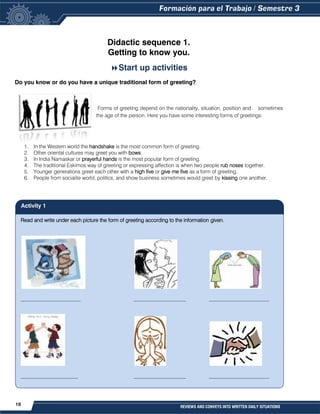
Read and write under each picture the form of greeting according to the information given.
_______________________ ____________________ _______________________
______________________ ____________________ _______________________
Didactic sequence 1.
Getting to know you.

Start up activities
Do you know or do you have a unique traditional form of greeting?
Forms of greeting depend on the nationality, situation, position and sometimes
the age of the person. Here you have some interesting forms of greetings:
1. In the Western world the handshake is the most common form of greeting.
2. Other oriental cultures may greet you with bows.
3. In India Namaskar or prayerful hands is the most popular form of greeting.
4. The traditional Eskimos way of greeting or expressing affection is when two people rub noses together.
5. Younger generations greet each other with a high five or give me five as a form of greeting.
6. People from socialite world, politics, and show business sometimes would greet by kissing one another.
Activity 1
11
BLOCK 1
Activity 1a
Draw two other forms of greeting that you know.
Activity 1b
Answer the questions.
What is the traditional form of greeting in your country?
_____________________________________________________________________________________________
Do you use the same form of greeting at school and at home?
_____________________________________________________________________________________________
Which of the above forms of greeting do you think is the most formal?
_____________________________________________________________________________________________
Which of the above forms of greeting do you think is the most casual?
_____________________________________________________________________________________________
Do you know other form of greeting that young people use? Write the name.
_____________________________________________________________________________________________
EVALUATION
Activity 1 Product: Diagnosis and Reading Activity. Value:
KNOWLEDGE
Factual Procedural Attitude
Identifies different vocabulary and types of
gestures used when greeting people in various
parts of the world.
Adds cultural knowledge and new vocabulary as well
as gestures used when greeting people in various
parts of the world.
Shows respect for different cultures
and identify her/his own.
Co evaluation
C MC NYC
Obtained value:
12 REVIEWS AND CONVEYS INTO WRITTEN DAILY SITUATIONS
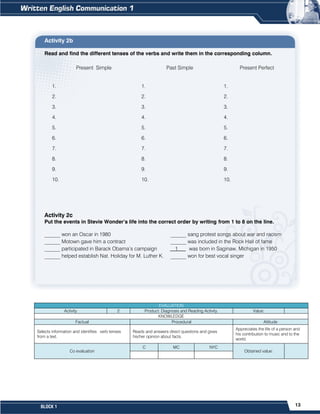
Read the biography and answer the questions.
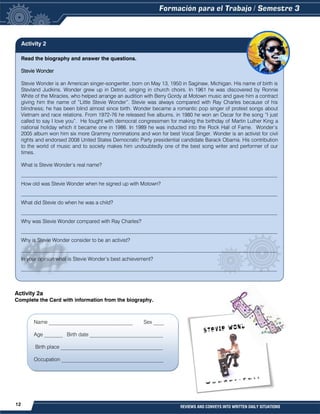
Stevie Wonder
Stevie Wonder is an American singer-songwriter, born on May 13, 1950 in Saginaw, Michigan. His name of birth is
Stevland Judkins. Wonder grew up in Detroit, singing in church choirs. In 1961 he was discovered by Ronnie
White of the Miracles, who helped arrange an audition with Berry Gordy at Motown music and gave him a contract
giving him the name of “Little Stevie Wonder”. Stevie was always compared with Ray Charles because of his
blindness; he has been blind almost since birth. Wonder became a romantic pop singer of protest songs about
Vietnam and race relations. From 1972-76 he released five albums, in 1980 he won an Oscar for the song “I just
called to say I love you”. He fought with democrat congressmen for making the birthday of Martin Luther King a
national holiday which it became one in 1986. In 1989 he was inducted into the Rock Hall of Fame. Wonder’s
2005 album won him six more Grammy nominations and won for best Vocal Singer. Wonder is an activist for civil
rights and endorsed 2008 United States Democratic Party presidential candidate Barack Obama. His contribution
to the world of music and to society makes him undoubtedly one of the best song writer and performer of our
times.
What is Stevie Wonder’s real name?
__________________________________________________________________________________________________
How old was Stevie Wonder when he signed up with Motown?
__________________________________________________________________________________________________
What did Stevie do when he was a child?
__________________________________________________________________________________________________
Why was Stevie Wonder compared with Ray Charles?
__________________________________________________________________________________________________
Why is Stevie Wonder consider to be an activist?
__________________________________________________________________________________________________
In your opinion what is Stevie Wonder’s best achievement?
__________________________________________________________________________________________________
Activity 2a
Complete the Card with information from the biography.
Name ________________________________ Sex ____
Age _______ Birth date ____________________________
Birth place _______________________________________
Occupation _______________________________________
Activity 2
13
BLOCK 1
Activity 2b
Read and find the different tenses of the verbs and write them in the corresponding column.
Activity 2c
Put the events in Stevie Wonder’s life into the correct order by writing from 1 to 8 on the line.
______ won an Oscar in 1980 ______ sang protest songs about war and racism
______ Motown gave him a contract ______ was included in the Rock Hall of fame
______ participated in Barack Obama’s campaign 1 was born in Saginaw, Michigan in 1950
______ helped establish Nat. Holiday for M. Luther K. ______ won for best vocal singer
Present Simple Past Simple Present Perfect
1. 1. 1.
2. 2. 2.
3. 3. 3.
4. 4. 4.
5. 5. 5.
6. 6. 6.
7. 7. 7.
8. 8. 8.
9. 9. 9.
10. 10. 10.
EVALUATION
Activity 2 Product: Diagnosis and Reading Activity. Value:
KNOWLEDGE
Factual Procedural Attitude
Selects information and identifies verb tenses
from a text.
Reads and answers direct questions and gives
his/her opinion about facts.
Appreciates the life of a person and
his contribution to music and to the
world.
Co evaluation
C MC NYC
Obtained value:
14 REVIEWS AND CONVEYS INTO WRITTEN DAILY SITUATIONS
Development activities
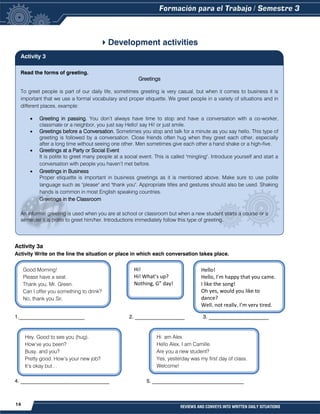
Activity 3a
Activity Write on the line the situation or place in which each conversation takes place.
1._________________________ 2. ___________________ 3. _______________________
4. __________________________________ 5. ___________________________________
Good Morning!
Please have a seat.
Thank you, Mr. Green.
Can I offer you something to drink?
No, thank you Sir.
Hi!
Hi! What’s up?
Nothing, G” day!
Hello!
Hello, I’m happy that you came.
I like the song!
Oh yes, would you like to
dance?
Well, not really, I’m very tired.
Hey. Good to see you (hug).
How’ve you been?
Busy, and you?
Pretty good. How’s your new job?
It’s okay but…
Hi am Alex.
Hello Alex, I am Camille.
Are you a new student?
Yes, yesterday was my first day of class.
Welcome!
Read the forms of greeting.
Greetings
To greet people is part of our daily life, sometimes greeting is very casual, but when it comes to business it is
important that we use a formal vocabulary and proper etiquette. We greet people in a variety of situations and in
different places, example:
 Greeting in passing. You don’t always have time to stop and have a conversation with a co-worker,
classmate or a neighbor, you just say Hello! say Hi! or just smile.
 Greetings before a Conversation. Sometimes you stop and talk for a minute as you say hello. This type of
greeting is followed by a conversation. Close friends often hug when they greet each other, especially
after a long time without seeing one other. Men sometimes give each other a hand shake or a high-five.
 Greetings at a Party or Social Event
It is polite to greet many people at a social event. This is called "mingling". Introduce yourself and start a
conversation with people you haven’t met before.
 Greetings in Business
Proper etiquette is important in business greetings as it is mentioned above. Make sure to use polite
language such as "please" and "thank you". Appropriate titles and gestures should also be used. Shaking
hands is common in most English speaking countries.
Greetings in the Classroom
An informal greeting is used when you are at school or classroom but when a new student starts a course or a
semester it is polite to greet him/her. Introductions immediately follow this type of greeting.
Activity 3
15
BLOCK 1
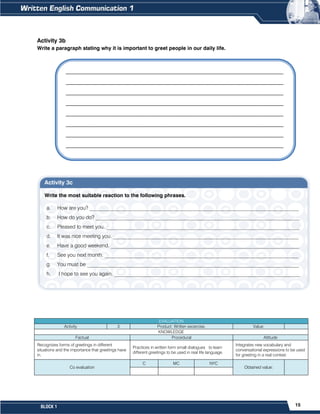
Activity 3b
Write a paragraph stating why it is important to greet people in our daily life.
Activity 3c
Write the most suitable reaction to the following phrases.
a. How are you? ________________________________________________________________________________
b. How do you do? ______________________________________________________________________________
c. Pleased to meet you. __________________________________________________________________________
d. It was nice meeting you. _______________________________________________________________________
e. Have a good weekend. ________________________________________________________________________
f. See you next month. __________________________________________________________________________
g. You must be _________________________________________________________________________________
h. I hope to see you again. _______________________________________________________________________
EVALUATION
Activity 3 Product: Written excercise. Value:
KNOWLEDGE
Factual Procedural Attitude
Recognizes forms of greetings in different
situations and the importance that greetings have
in.
Practices in written form small dialogues to learn
different greetings to be used in real life language.
Integrates new vocabulary and
conversational expressions to be used
for greeting in a real context.
Co evaluation
C MC NYC
Obtained value:
____________________________________________________________________________
____________________________________________________________________________
____________________________________________________________________________
____________________________________________________________________________
____________________________________________________________________________
____________________________________________________________________________
____________________________________________________________________________
____________________________________________________________________________
____________________________________________________________________________
________________________________________________
16 REVIEWS AND CONVEYS INTO WRITTEN DAILY SITUATIONS
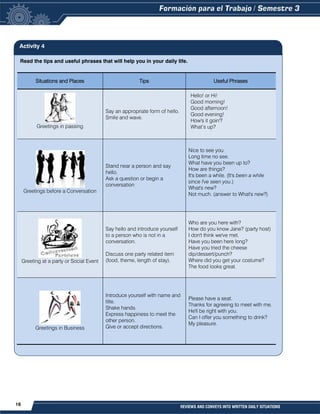
Read the tips and useful phrases that will help you in your daily life.
Situations and Places Tips Useful Phrases
Greetings in passing
Say an appropriate form of hello.
Smile and wave.
Hello! or Hi!
Good morning!
Good afternoon!
Good evening!
How's it goin'?
What’s up?
Greetings before a Conversation
Stand near a person and say
hello.
Ask a question or begin a
conversation
Nice to see you.
Long time no see.
What have you been up to?
How are things?
It's been a while. (It's been a while
since I've seen you.)
What's new?
Not much. (answer to What's new?)
Greeting at a party or Social Event
Say hello and introduce yourself
to a person who is not in a
conversation.
Discuss one party related item
(food, theme, length of stay).
Who are you here with?
How do you know Jane? (party host)
I don't think we've met.
Have you been here long?
Have you tried the cheese
dip/dessert/punch?
Where did you get your costume?
The food looks great.
Greetings in Business
Introduce yourself with name and
title.
Shake hands.
Express happiness to meet the
other person.
Give or accept directions.
Please have a seat.
Thanks for agreeing to meet with me.
He'll be right with you.
Can I offer you something to drink?
My pleasure.
Activity 4
17
BLOCK 1
Activity 4a
Choose 3 situations or place and write small dialogues using the tips and useful phrases from the chart.
Dialogue 1
Situation or place ___________________
Dialogue 2
Situation or place __________________
Dialogue 3
Situation or place____________________
18 REVIEWS AND CONVEYS INTO WRITTEN DAILY SITUATIONS
Activity 4b
Write the useful phrase that you would use in the following situations.
1. When you arrive to school and walk next to the principal.
_____________________________________________________________________________________________
2. When you are at a party and someone introduce you to her/his friend.
_____________________________________________________________________________________________
3. When you are shopping and meet with an old friend.
_____________________________________________________________________________________________
4. When you are in a bus stop and someone smile at you.
_____________________________________________________________________________________________
5. When you are at a party and someone stands next to you.
_____________________________________________________________________________________________
Activity 4c
Write an F if the phrase or statement is formal, Write a C if the phrase or statement is casual.
a. How are you? __________
b. How do you do? __________
c. Excuse me, are you Albert Lennon? __________
d. Sorry, I don’t know your name. __________
e. Hi everybody. My name’s Alex Harris. __________
f. May I introduce myself? __________
g. This is Caroline. __________
h. Let me introduce you to Caroline So. __________
i. Goodbye. It’s been very interesting talking to you. __________
j. See you. I really had a good time. __________
k. I got to go now. __________
l. I’m afraid I must be going soon. __________
EVALUATION
Activity 4 Product: Written dialogues. Value:
KNOWLEDGE
Factual Procedural Attitude
. Writes small dialogues using different forms of
greetings according to the place or situation.
Reads information to write small dialogues using
different forms of greetings, tips, and phrases useful
in daily life.
Integrates new vocabulary and
conversational expressions to be used
for greeting in a real context
Co evaluation
C MC NYC
Obtained value:
19
BLOCK 1
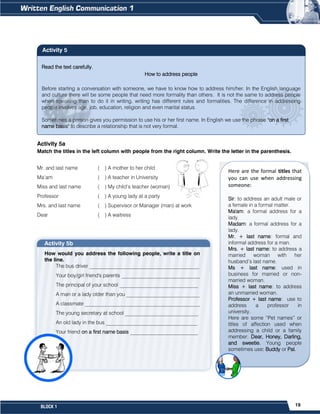
Activity 5a
Match the titles in the left column with people from the right column. Write the letter in the parenthesis.
Mr. and last name ( ) A mother to her child
Ma’am ( ) A teacher in University
Miss and last name ( ) My child’s teacher (woman)
Professor ( ) A young lady at a party
Mrs. and last name ( ) Supervisor or Manager (man) at work
Dear ( ) A waitress
Activity 5b
How would you address the following people, write a title on
the line.
The bus driver __________________________________________
Your boy/girl friend's parents ______________________________
The principal of your school ______________________________
A man or a lady older than you ____________________________
A classmate ____________________________________________
The young secretary at school ____________________________
An old lady in the bus ___________________________________
Your friend on a first name basis __________________________
Here are the formal titles that
you can use when addressing
someone:
Sir: to address an adult male or
a female in a formal matter.
Ma'am: a formal address for a
lady.
Madam: a formal address for a
lady.
Mr. + last name: formal and
informal address for a man.
Mrs. + last name: to address a
married woman with her
husband’s last name.
Ms + last name: used in
business for married or non-
married woman.
Miss + last name: to address
an unmarried woman.
Professor + last name: use to
address a professor in
university.
Here are some “Pet names” or
titles of affection used when
addressing a child or a family
member: Dear, Honey, Darling,
and sweetie. Young people
sometimes use: Buddy or Pal.
Read the text carefully.
How to address people
Before starting a conversation with someone, we have to know how to address him/her. In the English language
and culture there will be some people that need more formality than others. It is not the same to address people
when speaking than to do it in writing, writing has different rules and formalities. The difference in addressing
people involves age, job, education, religion and even marital status.
Sometimes a person gives you permission to use his or her first name. In English we use the phrase "on a first
name basis" to describe a relationship that is not very formal.
Activity 5
20 REVIEWS AND CONVEYS INTO WRITTEN DAILY SITUATIONS
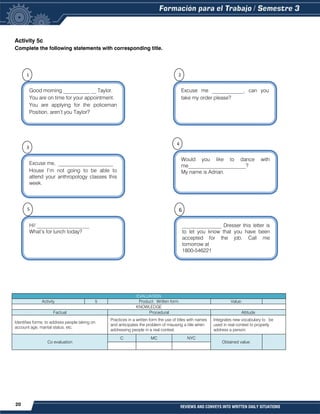
Activity 5c
Complete the following statements with corresponding title.
EVALUATION
Activity 5 Product: Written form. Value:
KNOWLEDGE
Factual Procedural Attitude
Identifies forms to address people taking on
account age, marital status, etc.
Practices in a written form the use of titles with names
and anticipates the problem of misusing a title when
addressing people in a real context.
Integrates new vocabulary to be
used in real context to properly
address a person.
Co evaluation
C MC NYC
Obtained value:
1 2
3
4
5
Good morning __________ __ Taylor.
You are on time for your appointment.
You are applying for the policeman
Position, aren’t you Taylor?
Excuse me ____________, can you
take my order please?
Excuse me, _____________________
House I’m not going to be able to
attend your anthropology classes this
week.
Would you like to dance with
me______________________?
My name is Adrian.
Hi! ____________________
What’s for lunch today?
_______________ Dresser this letter is
to let you know that you have been
accepted for the job. Call me
tomorrow at
1800-546221
6
21
BLOCK 1
If you want to write about the best films visit:
http://www.oscars.org/index.html
Weather
-Kind of chilly this morning, isn’t it?
-What a beautiful morning. A bit windy but
beautiful.
-It’s never that hot at this time of the year.
-It’s been raining for weeks. Is this never going -to
end?
Family
A: How’s Janet doing? I haven’t seen her for
ages.
B: Oh, she’s fine. Se just got a job.
A: That’s great news. We should get together one
of these days
B: Sure. That’d be great. …
Sports
A: Did you see the game last
night?
B: No, I missed it. Was it a good
game?
Films
A: Have you seen “Avatar”? We went to see
it last night.
B: How was it?
A: Pat thought it was hilarious, but I was a
bit disappointed.
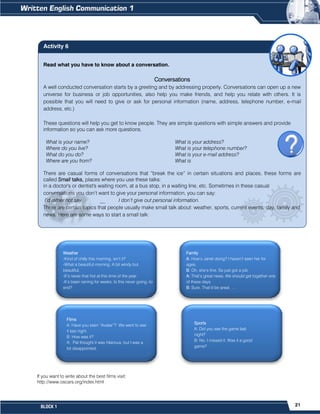
Read what you have to know about a conversation.
Conversations
A well conducted conversation starts by a greeting and by addressing properly. Conversations can open up a new
universe for business or job opportunities, also help you make friends, and help you relate with others. It is
possible that you will need to give or ask for personal information (name, address, telephone number, e-mail
address, etc.)
These questions will help you get to know people. They are simple questions with simple answers and provide
information so you can ask more questions.
What is your name? What is your address?
Where do you live? What is your telephone number?
What do you do? What is your e-mail address?
Where are you from? What is
There are casual forms of conversations that “break the ice” in certain situations and places, these forms are
called Small talks, places where you use these talks:
in a doctor's or dentist's waiting room, at a bus stop, in a waiting line, etc. Sometimes in these casual
conversations you don’t want to give your personal information, you can say:
I’d rather not say. __ I don’t give out personal information.
There are certain topics that people usually make small talk about: weather, sports, current events, day, family and
news. Here are some ways to start a small talk:
Activity 6
22 REVIEWS AND CONVEYS INTO WRITTEN DAILY SITUATIONS
Activity 6a
Write questions for each statement.
1. ___________________________________________________________________________________________?
I Study and work for an insurance company.
2. ___________________________________________________________________________________________?
My name is Albert but you can call me Al.
3. ___________________________________________________________________________________________?
I am from Douglas but I’ve lived in Agua Prieta for 4 years.
4. ___________________________________________________________________________________________?
I don’t give up personal information, I’m sorry.
5. ___________________________________________________________________________________________?
I have two but you can write me at vip4@gmail.com
Activity 6b
Write, what you would say in the following situations.
1. You get into a book store. Greet the people in there and ask for a book.
___________________________________________________________________________________
____________________________________________________________________________________________
____________________________________________________________________________________________
2. You are at a party with your friends. You are introduced to one person. Greet him/her and make an
invitation for a drink.
____________________________________________________________________________________________
____________________________________________________________________________________________
____________________________________________________________________________________________
3. You are at a meeting. Introduce one of your colleagues to your boss.
____________________________________________________________________________________________
____________________________________________________________________________________________
____________________________________________________________________________________________
EVALUATION
Activity 6 Product: Written exercise. Value:
KNOWLEDGE
Factual Procedural Attitude
Recognizes the use of WH questions to obtain
information in a conversation.
Applies the correct WH questions when asking and
answering questions in exercises, and to be used in
situations where it is needed.
Appreciates the use of the language
to be applied in a real context.
Co evaluation
C MC NYC
Obtained value:
23
BLOCK 1
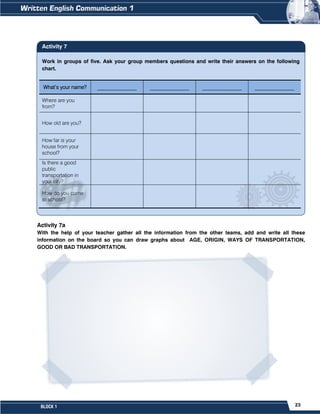
Activity 7a
With the help of your teacher gather all the information from the other teams, add and write all these
information on the board so you can draw graphs about AGE, ORIGIN, WAYS OF TRANSPORTATION,
GOOD OR BAD TRANSPORTATION.
Work in groups of five. Ask your group members questions and write their answers on the following
chart.
What’s your name? _______________ _______________ _______________ _______________
Where are you
from?
How old are you?
How far is your
house from your
school?
Is there a good
public
transportation in
your city?
How do you come
to school?
Activity 7
24 REVIEWS AND CONVEYS INTO WRITTEN DAILY SITUATIONS
EVALUATION
Activity 7 Product: Graphs. Value:
KNOWLEDGE
Factual Procedural Attitude
Selects classmates’ information for making
graphs.
Practices oral and written skill by asking questions to
classmates to obtain information for making graphs.
Participates with classmates
interchanging information by asking
and answering questions and
interchanging graphs.
Co evaluation
C MC NYC
Obtained value:
25
BLOCK 1
Activity 8a
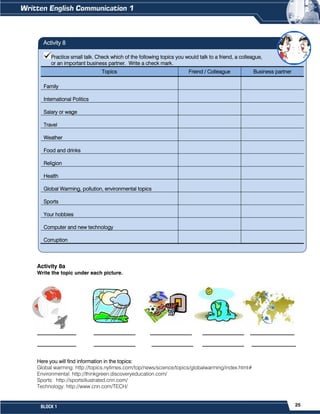
Write the topic under each picture.
_______________ ________________ ________________ ________________ _________________
_______________ ________________ ________________ ________________ _________________
Here you will find information in the topics:
Global warming: http://topics.nytimes.com/top/news/science/topics/globalwarming/index.html#
Environmental: http://thinkgreen.discoveryeducation.com/
Sports: http://sportsillustrated.cnn.com/
Technology: http://www.cnn.com/TECH/
Practice small talk. Check which of the following topics you would talk to a friend, a colleague,
or an important business partner. Write a check mark.
Topics Friend / Colleague Business partner
Family
International Politics
Salary or wage
Travel
Weather
Food and drinks
Religion
Health
Global Warming, pollution, environmental topics
Sports
Your hobbies
Computer and new technology
Corruption
Activity 8
26 REVIEWS AND CONVEYS INTO WRITTEN DAILY SITUATIONS
Activity 8b
Pair work. Discuss with your classmate which of the above topics is the most used nowadays. Write a
dialogue about this topic.
A.
B.
A.
B.
A.
B.
A.
B.
A.
B.
A.
B.
A.
B.
A.
B.
Activity 8c
Act out the dialogue in front of the class.
EVALUATION
Activity 8 Product: Written dialogue. Value:
KNOWLEDGE
Factual Procedural Attitude
Identifies topics in a small talk useful in the writing
of dialogues.
Integrates the topics to the formation of dialogues
using the studied structures and forms.
Shows respect and creativity when
working with his/her partner.
Co evaluation
C MC NYC
Obtained value:
27
BLOCK 1
Read de conversation and answer the question.
Julia: Nina! Hey, Nina! How’s it going?
Nina: Julia! Hi! I’m fine. How’re you?
Julia: Fine, thanks. Nina, this is Isabella, Isabella this is my friend Nina.
Isabella: Nice to meet you.
Nina: Nice to meet you too. Are you from around here?
Isabella: No, I’m from Hermosillo.
Nina: Oh, that’s interesting. Hermosillo is the capital of Sonora, isn’t it?
Isabella: Yes, that’s right. How about you? What’s your hometown?
Nina: I’m from Birmingham, Michigan.
Isabella: Oh, really? Is that a big city?
Nina: No, it is a small suburb in the state of Detroit. The population is 19,291
as of the 2000 census.
What is the population in Hermosillo?
Julia: It’s really a big city. There are over 700,000 people in Hermosillo.
Nina: Wow! That’s a lot of people!
Isabella: it is. But there’s good public transportation, so it isn’t bad.
Nina: So, isn’t it hard to get from your house to your University?
Isabella: No, I just take the bus and I get there in just 15 minutes.
Nina: By the way! I have to run to take the bus. See you guys
later.
Isabella: Bye, Nina.
Julia: Take care, Nina.
Nina: You too. Bye.
1. Where is Isabella from? _________________________________________________________________________
2. Is Isabella from a small town? ____________________________________________________________________
3. Where is Nina from? ____________________________________________________________________________
4. Is Nina from a small town? What is the population? __________________________________________________
5. Why does Isabella think that it isn’t bad to live in Hermosillo? __________________________________________
__________________________________________________________________________________________________
Activity 9
28 REVIEWS AND CONVEYS INTO WRITTEN DAILY SITUATIONS
Activity 9a
Write the long forms and contractions you find in the conversation.
How is it going? How’s it going?
___________________ ___________________
___________________ ___________________
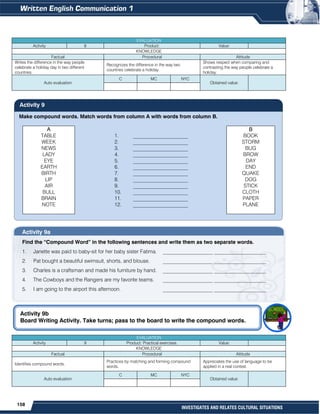
___________________ ___________________
___________________ ____________________
___________________ ___________________
___________________ ____________________
Activity 9b
Circle the letter of the correct answer.
1. Who is Nina?
a. Isabella’s cousin
b. Julia’s friend
c. Julia’s cousin
2. What does Isabella say about Hermosillo?
a. It has a good library
b. It has good public transportation
c. It has about 20,000 people
3. What does Nina say about Birmingham?
a. It’s a big city
b. It’s the Capital of Detroit
c. It has about 20,000 people
EVALUATION
Activity 9 Product: Practice excercise. Value:
KNOWLEDGE
Factual Procedural Attitude
Identifies short /long form contractions as well as
new vocabulary.
Practices contractions, new vocabulary, and identifies
facts in reading comprehension task.
Appreciates the use of the language
to be applied in a real context.
Co evaluation
C MC NYC
Obtained value:
Contractions are a way to
combine words. When you
put the two words together
by dropping letters and then
replace it with apostrophe (’)
Example:
Long Form
Contraction
I am from Hermosillo
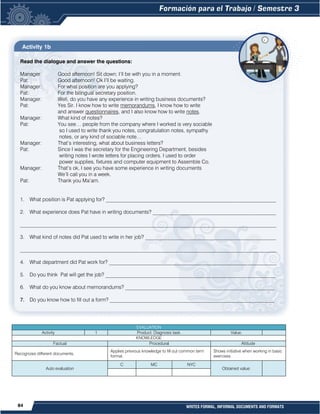
I’m from Hermosillo
Do not use contractions for
short answers.
Are you from Guaymas?
Yes, I am. (Not: Yes I’m)
29
BLOCK 1
Closing activities
EVALUATION
Activity 10 Product: Chain map. Value:
KNOWLEDGE
Factual Procedural Attitude
Orders in a map the steps that
take to get to a conversation.
Elaborates a chain map integrating the steps
required to get to a good conversation.
Integrates his/her previous
knowledge organized in a map.
Co evaluation
C MC NYC
Obtained value:
To get to know a person you have to know some facts about her/his life, you have to ask for personal
information, address properly, greet according to the situation or place. Organize in a map the steps
that take to finally get to a conversation. Remember that mapping makes it easier to organize a process
or a sequence; it helps you remember what you have to do.
Example of a Chain map
Activity 10
30 REVIEWS AND CONVEYS INTO WRITTEN DAILY SITUATIONS
EVALUATION
Activity 11 Product: Dialogue. Value:
KNOWLEDGE
Factual Procedural Attitude
Writes a dialogue based on a previous one,
using his/her own information.
Creates a dialogue using her/his own information
using all the structures and
Vocabulary learnt.
Co evaluation
C MC NYC
Obtained value:
Use the conversation from a previous page to write your own conversation, this time
using your own words and ideas. Make a team of 4, choose the best conversation and
present it in class.
Activity 11
31
BLOCK 1
Activity 12
Social Quiz: Choose the best possible response. Write the letter on the right line. Then interchange
the results with your partners.
1. Hi, how are you? 1. _______
a. Fine, thanks. And you?
b. I’m Mike.
c. Not too bad.
2. Meet my friend Jack. 2. _______
a. Nice to meet you.
b. What time?
c. How do you do?
3. How was your flight? 3. _______
a. It was all right.
b. Yes, of course.
c. The plane was a bit late but it didn’t matter.
4. Would you like to look around the company? 4. _______
a. No, it’s none of my business.
b. That’d be lovely.
c. Yes, I’d love to.
5. Would you prefer orange or cranberry juice? 5. _______
a. Yes, of course.
b. I don’t want.
c. I don’t mind.
6. I’m terribly sorry about the delay. 6. _______
a. Don’t worry about it.
b. You should be.
c. You’re welcome.
7. Thank you very much. 7. _______
a. Here you are.
b. Don’t mention it.
c. Welcome.
8. My sister has had an accident. 8. _______
a. Really?
b. I’m sorry to hear that. Is she all right?
c. I’m sorry to hear that. Is the car OK?
EVALUATION
Activity 12 Product: Quiz. Value:
KNOWLEDGE
Factual Procedural Attitude
Selects the possible response and recognizes
its use in small talks.
Practices for socializing in a real context.
Shows openness when receiving
feedback.
Co evaluation
C MC NYC
Obtained value:
32 REVIEWS AND CONVEYS INTO WRITTEN DAILY SITUATIONS
EVALUATION
Activity 13 Product: Report. Value:
KNOWLEDGE
Factual Procedural Attitude
Analyzes lyrics from a classic song, identifies
verb tenses and integrates vocabulary to
his/her daily use.
Investigates in the internet a song, identifies verb
tenses and acquire new vocabulary for her/his
daily use of the language.
Values the use of the standard
English vocabulary.
Co evaluation
C MC NYC
Obtained value:
Search in the internet for the classic song “Getting to know you” that was written for a
movie many years ago. Write the lyrics. Underline the Present Simple tense and circle
the Present Progressive tense.
Activity 13
33
BLOCK 1
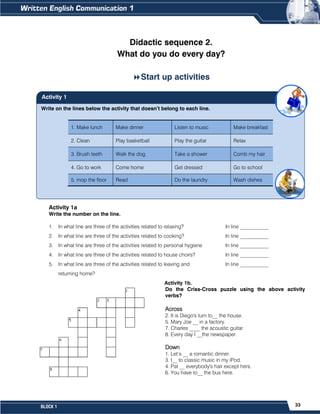
Write on the lines below the activity that doesn’t belong to each line.
1. Make lunch Make dinner Listen to music Make breakfast
2. Clean Play basketball Play the guitar Relax
3. Brush teeth Walk the dog Take a shower Comb my hair
4. Go to work Come home Get dressed Go to school
5. mop the floor Read Do the laundry Wash dishes
1. ____________________________ 4. _____________________________
2. ____________________________ 5. _____________________________
3. ____________________________
Activity 1
Didactic sequence 2.
What do you do every day?
Start up activities
Activity 1a
Write the number on the line.
1. In what line are three of the activities related to relaxing? In line ___________
2. In what line are three of the activities related to cooking? In line ___________
3. In what line are three of the activities related to personal hygiene In line ___________
4. In what line are three of the activities related to house choirs? In line ___________
5. In what line are three of the activities related to leaving and In line ___________
returning home?
Activity 1b.
Do the Criss-Cross puzzle using the above activity
verbs?
Across
2. It is Diego's turn to__ the house.
5. Mary Joe __ in a factory.
7. Charles ____ the acoustic guitar.
8. Every day I __the newspaper.
Down
1. Let’s __ a romantic dinner.
3. I__ to classic music in my iPod.
4. Pat __ everybody's hair except hers.
6. You have to__ the bus here.
34 REVIEWS AND CONVEYS INTO WRITTEN DAILY SITUATIONS
Activity 1c
Match the underlined household chores verbs to the object needed for the action.
Write the number on the left line.
_____ To sweep the office floor 1. Vacuum
_____ To wash the office floor 2. Window cleaner
_____ To clean windows and mirrors 3. Garbage can
_____ To clean the wall-to-wall carpet 4. Paper towels
_____ To wipe spilled liquid/to 5. Broom
dry hands
_____ To put the trash in 6. Sponge mop
Activity 1d
Write your daily or weekly household chores (verbs) on the lines.
____________________ ____________________
____________________ ____________________
____________________ ____________________
____________________ ____________________
____________________ ____________________
EVALUATION
Activity 1 Product: Producer excercises. Value:
KNOWLEDGE
Factual Procedural Attitude
Identifies and understand the use of the
Present simple needed to conduct activities of
daily living related to different topics as: work,
household and leisure activities.
Demonstrates the ability to understand basic
information needed to conduct activities of daily
living.
Shows initiative and interest by
working in class.
Co evaluation
C MC NYC
Obtained value:
35
BLOCK 1
Development activities
Read the Conversation and answer the questions.
Mary Joe: Where do you work Camille?
Camille: I work for a Travel Agency.
Mary Joe: Oh! Really? What do you do there?
Camille: I am a guide. I take people on tours to
different sight in Sonora.
Mary Joe: That sounds interesting!
Camille: Yes is a great job. I love it, and what do you do?
Mary Joe: I’m in engineer school, and I have a part-time job, too.
Camille: Where do you work?
Mary Joe: In a Factory.
Camille: Which Factory?
Mary Joe: Meca S.A. Is not as interesting as your job, besides
It takes me an hour to get home from work.
Camille: Why don’t you come with me in one of the tours?
Mary Joe: It would be very exciting! Where would we go exactly?
Camille: The route starts at Ures, then following the river we get
to Baviacora and to the main attraction, the thermal spring waters.
Mary Joe: Where is that?
Camille: It is in Aconchi, a very popular natural spa.
Mary Joe: Do you visit all those places? How interesting.
Camille: Yes, we usually visit 4 more places and finish the tour in Cananea.
Mary Joe: When is the next “Rio Sonora Route” going to be?
Camille: I’ll send you a schedule and a triptych with all the information.
Mary Joe: Ok, let me know so I can make plans.
What does Camille do at work?
__________________________________________________________________________________________________
__________________________________________________________________________________________________
How does Camille like her job?
__________________________________________________________________________________________________
Does Mary Joe like her job?
__________________________________________________________________________________________________
Where does Camille invite Mary Joe?
__________________________________________________________________________________________________
Where are the thermal spring waters?
__________________________________________________________________________________________________
What plans do they have?
__________________________________________________________________________________________________
Activity 2
36 REVIEWS AND CONVEYS INTO WRITTEN DAILY SITUATIONS
Grammar Point
Activity 2
Review the grammar with your teacher.
Activity 2a
Complete the Conversations.
a. What __________you __________?
b. I am a student I study business.
a. And __________ do you __________ to school?
b. I __________to University of Sonora.
a. __________ do you like your classes?
b. I __________ them a lot.
a. What __________ Alex do?
b. He is a teacher. He _______________ mathematics at
a school in Obregon city.
a. And what about Frederick? Where __________ he work?
b. He _______________ for an editing company
a. What __________ he do, exactly?
b. He _______________ publications.
Simple Present WH-questions Statements
I/You He
/She
We/They
do does
work works
go goes
have has
take takes
study
Studies
eat eats
play plays
visit visits
make makes
clean cleans
What do you do?
Where do you work?
Where do you go to
school?
How do you like your
school?
What does he do?
Where does she work?
Where does he go every
day?
What does he study?
I am a student.
I work in/at a restaurant.
I go to university of Sonora.
I like it very much.
He is an engineer.
She works for Ford Company.
He goes to the library every day.
He studies accounting.
37
BLOCK 1
Activity 2b
Complete the question in each conversation.
1. Where _______________ you work?
I work in a department store.
2. What _______________ she do?
She is a computer programmer.
3. Where does Caroline _______________ to school?
She goes to IA University.
4. How _______________ does she like the classes?
She likes them very much.
5. When _______________ you walk your dog?
I walk my dog every afternoon.
a. What _______________ your brother __________?
b. He is an accountant. He ___________ for a construction
company.
a. What __________ he do?
b. He _______________ in the payroll department.
a. _______________ He likes his job?
b. He says that he ____________ it.
EVALUATION
Activity 2 Product: Grammar review. Value:
KNOWLEDGE
Factual Procedural Attitude
Identifies the use of Wh questions and auxiliary
Do in the present tense used in activities of
daily living.
Practices simple present Wh-questions with the
auxiliary Do and statements using I, you, he, and
she.
Values his/her charming state sights
and integrates new vocabulary to
his/her knowledge.
Co evaluation
C MC NYC
Obtained value:
38 REVIEWS AND CONVEYS INTO WRITTEN DAILY SITUATIONS
Activity 3
Search on the web for more information about the “Rio Sonora Route” make a schedule of a trip Giving
all the information that Camille wants to give to Mary Joe (in the conversation in activity 2). Write it on a
separate paper and paste it here.
EVALUATION
Activity 3 Product: Schedule. Value:
KNOWLEDGE
Factual Procedural Attitude
Writes a schedule based on the information
taken from the internet and integrates different
topics vocabulary to his/her knowledge.
Elaborates a schedule based on a reading from
the internet. Uses a reading comprehension
strategy.
Integrates the use of technology to
search for information as he/she
values the beautiful great attractions
in Sonora.
Co evaluation
C MC NYC
Obtained value:
Information at: http://www.gotosonora.com/rio-sonora-route.htm
http://www.sonoraturismo.gob.mx/ruta-rio-sonora.htm
39
BLOCK 1
Activity 4a
Write sentences describing each job, using he or she.
Activity 4b
Write a description of what you do.
A teacher works in a school. She has a classroom, she works long hours. She helps people learn.
I am a student. I go …
What do they do? What do you know about these jobs?
Complete this chart.
A teacher Nurse Engineer
Works in a school
Has a classroom
Works long hours
Helps people learn
Activity 4
40 REVIEWS AND CONVEYS INTO WRITTEN DAILY SITUATIONS
Activity 4c
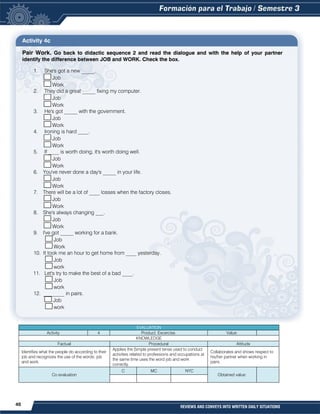
Pair Work. Go back to didactic sequence 2 and read the dialogue and with the help of your partner
identify the difference between JOB and WORK. Check the box.
1. She's got a new _____.
Job
Work
2. They did a great _____ fixing my computer.
Job
Work
3. He's got _____ with the government.
Job
Work
4. Ironing is hard ____.
Job
Work
5. If ____ is worth doing, it's worth doing well.
Job
Work
6. You've never done a day's _____ in your life.
Job
Work
7. There will be a lot of ____ losses when the factory closes.
Job
Work
8. She's always changing ___.
Job
Work
9. I've got _____ working for a bank.
Job
Work
10. It took me an hour to get home from ____ yesterday.
Job
work
11. Let's try to make the best of a bad ____.
Job
work
12. ________ in pairs.
Job
work
EVALUATION
Activity 4 Product: Excercise. Value:
KNOWLEDGE
Factual Procedural Attitude
Identifies what the people do according to their
job and recognizes the use of the words: job
and work.
Applies the Simple present tense used to conduct
activities related to professions and occupations at
the same time uses the word job and work
correctly.
Collaborates and shows respect to
his/her partner when working in
pairs.
Co evaluation
C MC NYC
Obtained value:
41
BLOCK 1
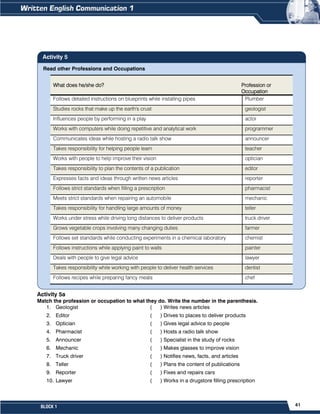
Activity 5a
Match the profession or occupation to what they do. Write the number in the parenthesis.
1. Geologist ( ) Writes news articles
2. Editor ( ) Drives to places to deliver products
3. Optician ( ) Gives legal advice to people
4. Pharmacist ( ) Hosts a radio talk show
5. Announcer ( ) Specialist in the study of rocks
6. Mechanic ( ) Makes glasses to improve vision
7. Truck driver ( ) Notifies news, facts, and articles
8. Teller ( ) Plans the content of publications
9. Reporter ( ) Fixes and repairs cars
10. Lawyer ( ) Works in a drugstore filling prescription
Read other Professions and Occupations
What does he/she do? Profession or
Occupation
Follows detailed instructions on blueprints while installing pipes Plumber
Studies rocks that make up the earth's crust geologist
Influences people by performing in a play actor
Works with computers while doing repetitive and analytical work programmer
Communicates ideas while hosting a radio talk show announcer
Takes responsibility for helping people learn teacher
Works with people to help improve their vision optician
Takes responsibility to plan the contents of a publication editor
Expresses facts and ideas through written news articles reporter
Follows strict standards when filling a prescription pharmacist
Meets strict standards when repairing an automobile mechanic
Takes responsibility for handling large amounts of money teller
Works under stress while driving long distances to deliver products truck driver
Grows vegetable crops involving many changing duties farmer
Follows set standards while conducting experiments in a chemical laboratory chemist
Follows instructions while applying paint to walls painter
Deals with people to give legal advice lawyer
Takes responsibility while working with people to deliver health services dentist
Follows recipes while preparing fancy meals chef
Activity 5
42 REVIEWS AND CONVEYS INTO WRITTEN DAILY SITUATIONS
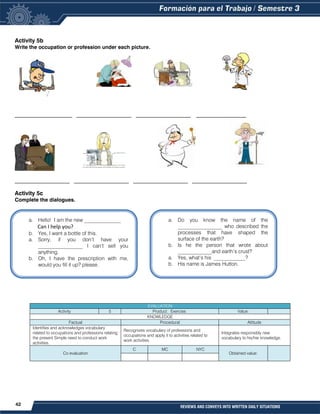
Activity 5b
Write the occupation or profession under each picture.
______________________ _____________________ _____________________ ___________________
_____________________ _____________________ _____________________ _____________________
Activity 5c
Complete the dialogues.
EVALUATION
Activity 5 Product: Exercise. Value:
KNOWLEDGE
Factual Procedural Attitude
Identifies and acknowledges vocabulary
related to occupations and professions relating
the present Simple need to conduct work
activities.
Recognizes vocabulary of professions and
occupations and apply it to activities related to
work activities.
Integrates responsibly new
vocabulary to his/her knowledge.
Co evaluation
C MC NYC
Obtained value:
a. Hello! I am the new ______________
Can I help you?
b. Yes, I want a bottle of this.
a. Sorry, if you don’t have your
_________________ I can’t sell you
anything.
b. Oh, I have the prescription with me,
would you fill it up? please.
a. Do you know the name of the
_________________ who described the
processes that have shaped the
surface of the earth?
b. Is he the person that wrote about
_____________and earth’s crust?
a. Yes, what’s his ____________?
b. His name is James Hutton.
James hutton
43
BLOCK 1
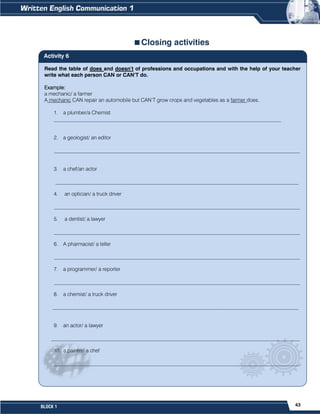
Closing activities
Read the table of does and doesn’t of professions and occupations and with the help of your teacher
write what each person CAN or CAN’T do.
Example:
a mechanic/ a farmer
A mechanic CAN repair an automobile but CAN’T grow crops and vegetables as a farmer does.
1. a plumber/a Chemist
_______________________________________________________________________________________
2. a geologist/ an editor
______________________________________________________________________________________________
3. a chef/an actor
_____________________________________________________________________________________________
4. an optician/ a truck driver
______________________________________________________________________________________________
5. a dentist/ a lawyer
______________________________________________________________________________________________
6. A pharmacist/ a teller
______________________________________________________________________________________________
7. a programmer/ a reporter
______________________________________________________________________________________________
8. a chemist/ a truck driver
______________________________________________________________________________________________
9. an actor/ a lawyer
_______________________________________________________________________________________________
10. a painter/ a chef
_______________________________________________________________________________________________
Activity 6
44 REVIEWS AND CONVEYS INTO WRITTEN DAILY SITUATIONS
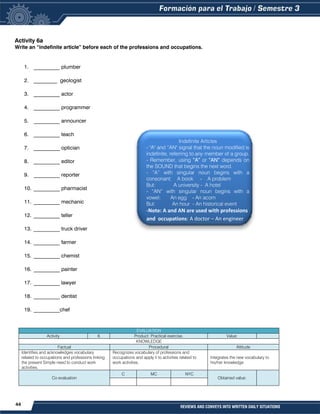
Activity 6a
Write an “indefinite article” before each of the professions and occupations.
1. __________ plumber
2. _________ geologist
3. __________ actor
4. __________ programmer
5. __________ announcer
6. __________ teach
7. __________ optician
8. __________ editor
9. __________ reporter
10. __________ pharmacist
11. __________ mechanic
12. __________ teller
13. __________ truck driver
14. __________ farmer
15. __________ chemist
16. __________ painter
17. __________ lawyer
18. __________ dentist
19. __________chef
EVALUATION
Activity 6 Product: Practical exercise. Value:
KNOWLEDGE
Factual Procedural Attitude
Identifies and acknowledges vocabulary
related to occupations and professions linking
the present Simple need to conduct work
activities.
Recognizes vocabulary of professions and
occupations and apply it to activities related to
work activities.
Integrates the new vocabulary to
his/her knowledge.
Co evaluation
C MC NYC
Obtained value:
Indefinite Articles
- "A" and “AN" signal that the noun modified is
indefinite, referring to any member of a group.
- Remember, using “A” or “AN” depends on
the SOUND that begins the next word.
- “A” with singular noun begins with a
consonant: A book - A problem
But: A university - A hotel
- “AN” with singular noun begins with a
vowel: An egg - An acorn
But: An hour - An historical event
-Note: A and AN are used with professions
and occupations: A doctor – An engineer
 a
+
s
i
n
g
u
l
a
r
n
o
u
n
b
e
g
i
45
BLOCK 1
Identifies and understand the use of the Present simple needed to conduct activities of daily
living related to different topics as: work, household and leisure activities.
 Describe your hobbies and interests in a simple way
 Ask and answer simple questions on familiar topics and about personal details
 Make and respond to simple statements
http://www.clafoti.com/imagenes/articles.htm
 Discusses the differences between indefinite articles (a/an) and definite
46 REVIEWS AND CONVEYS INTO WRITTEN DAILY SITUATIONS
Didactic sequence 3.
I will be a computer programmer.
Start up activities
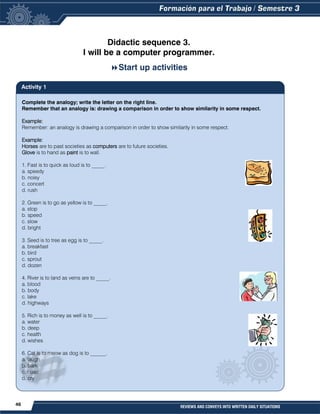
Complete the analogy; write the letter on the right line.
Remember that an analogy is: drawing a comparison in order to show similarity in some respect.
Example:
Remember: an analogy is drawing a comparison in order to show similarity in some respect.
Example:
Horses are to past societies as computers are to future societies.
Glove is to hand as paint is to wall.
1. Fast is to quick as loud is to _____.
a. speedy
b. noisy
c. concert
d. rush
2. Green is to go as yellow is to _____.
a. stop
b. speed
c. slow
d. bright
3. Seed is to tree as egg is to _____.
a. breakfast
b. bird
c. sprout
d. dozen
4. River is to land as veins are to _____.
a. blood
b. body
c. lake
d. highways
5. Rich is to money as well is to _____.
a. water
b. deep
c. health
d. wishes
6. Cat is to meow as dog is to ______.
a. laugh
b. bark
c. cuac
d. cry
Activity 1
47
BLOCK 1
Activity 1a
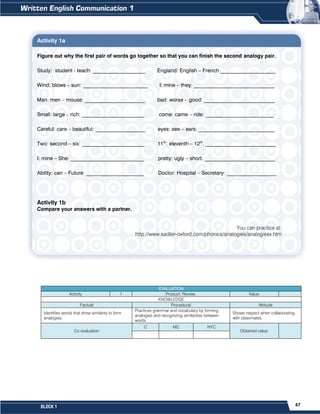
Figure out why the first pair of words go together so that you can finish the second analogy pair.
Study: student - teach: ____________________ England: English – French _____________________
Wind: blows – sun: _________________________ I: mine – they: _______________________________
Man: men – mouse: _______________________ bad: worse – good: ___________________________
Small: large – rich: ________________________ come: came – ride: __________________________
Careful: care – beautiful: ___________________ eyes: see – ears: _____________________________
Two: second – six: ________________________ 11th
: eleventh – 12th
. ___________________________
I: mine – She: ____________________________ pretty: ugly – short: ___________________________
Ability: can – Future: ______________________ Doctor: Hospital – Secretary: ___________________
Activity 1b
Compare your answers with a partner.
You can practice at:
http://www.sadlier-oxford.com/phonics/analogies/analogiesx.htm
EVALUATION
Activity 1 Product: Review. Value:
KNOWLEDGE
Factual Procedural Attitude
Identifies words that show similarity to form
analogies.
Practices grammar and vocabulary by forming
analogies and recognizing similarities between
words.
Shows respect when collaborating
with classmates.
Co evaluation
C MC NYC
Obtained value:
48 REVIEWS AND CONVEYS INTO WRITTEN DAILY SITUATIONS
Development activities
Activity 2a
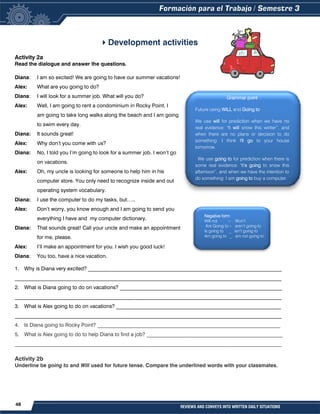
Read the dialogue and answer the questions.
Diana: I am so excited! We are going to have our summer vacations!
Alex: What are you going to do?
Diana: I will look for a summer job. What will you do?
Alex: Well, I am going to rent a condominium in Rocky Point. I
am going to take long walks along the beach and I am going
to swim every day.
Diana: It sounds great!
Alex: Why don’t you come with us?
Diana: No, I told you I’m going to look for a summer job. I won’t go
on vacations.
Alex: Oh, my uncle is looking for someone to help him in his
computer store. You only need to recognize inside and out
operating system vocabulary.
Diana: I use the computer to do my tasks, but…..
Alex: Don’t worry, you know enough and I am going to send you
everything I have and my computer dictionary.
Diana: That sounds great! Call your uncle and make an appointment
for me, please.
Alex: I’ll make an appointment for you. I wish you good luck!
Diana: You too, have a nice vacation.
1. Why is Diana very excited? __________________________________________________________________________
______________________________________________________________________________________________________
2. What is Diana going to do on vacations? ______________________________________________________________
______________________________________________________________________________________________________
3. What is Alex going to do on vacations? _______________________________________________________________
______________________________________________________________________________________________________
4. Is Diana going to Rocky Point? ______________________________________________________________________
5. What is Alex going to do to help Diana to find a job? ____________________________________________________
______________________________________________________________________________________________________
Activity 2b
Underline be going to and Will used for future tense. Compare the underlined words with your classmates.
Grammar point
Future using WILL and Going to
We use will for prediction when we have no
real evidence: "It will snow this winter”, and
when there are no plans or decision to do
something: I think I'll go to your house
tomorrow.
We use going to for prediction when there is
some real evidence: "It's going to snow this
afternoon”, and when we have the intention to
do something: I am going to buy a computer.
Negative form
Will not – Won’t
Are Going to – aren’t going to
Is going to _ isn’t going to
Am going to _ am not going to
49
BLOCK 1
Activity 2c
Complete the conversation with appropriate form of be going to or will.
A: Have you made any vacation plans?
B: Well, I’ve decided on one thing.
I ____________________ go to Navojoa.
A: That’s great! how long?
B: I ___________________be away for a week.
I only have five days vacation.
A: So, when are you leaving?
B: I’m not sure. I ____________ probably leave
around the end of June. I won’t have long term vacations.
A: And where _________ you _______________go?
B: I guess I ___________ go to Tucson.
A: _________ you ______________go with anyone?
B: No, I ________________travel alone.
Activity 2d
Think about your next vacation. Write answers to these questions. (If you already have plans, use be
going to. If you don’t have fixed plans, use will. Use negative forms if necessary).
1. How are you going to spend your next vacations? _______________________________________________
____________________________________________________________________________________________
2. Are you going to go anywhere? _______________________________________________________________
3. When are you going to take your vacations? ____________________________________________________
4. What are you going to do? ___________________________________________________________________
____________________________________________________________________________________________
5. Are you going to travel with your family?________________________________________________________
EVALUATION
Activity 2 Product: Written excersice. Value:
KNOWLEDGE
Factual Procedural Attitude
Identifies the grammar structure “be going to”
and the modal “will”.
Demonstrates the ability to use and identify proper
future forms.
Shows respect when working
individually and in a collaborative
setting.
Co evaluation
C MC NYC
Obtained value:
50 REVIEWS AND CONVEYS INTO WRITTEN DAILY SITUATIONS
What Diana needs to know about Computer System.
Dictionary Use
Activity 3
Look for the meaning of the following words in the Computer Dictionary.
Hard drive ____________________________________________________________________________________________
______________________________________________________________________________________________________
Windows______________________________________________________________________________________________
______________________________________________________________________________________________________
Operating system ______________________________________________________________________________________
______________________________________________________________________________________________________
______________________________________________________________________________________________________
Upgraded ____________________________________________________________________________________________
______________________________________________________________________________________________________
Graphics _____________________________________________________________________________________________
BIOS _________________________________________________________________________________________________
System8______________________________________________________________________________________________
______________________________________________________________________________________________________
User friendly __________________________________________________________________________________________
DOS _________________________________________________________________________________________________
Essential _____________________________________________________________________________________________
You can find a computer dictionary at: http://www.computer-dictionary-online.org/
http://library.thinkquest.org/C0113882/diction.shtml
51
BLOCK 1
Activity 3a
Do the Criss-Cross puzzle using the computer system words above.
Down
1. Media device used to permanently store all data.
2. A software or hardware device designed to make the use of
computer easy.
3. Allows a user to work easily with many programs and view
multiple programs.
4. It describes updating a software program.
5. Basic input/output system.
6. A digitized version of a photograph.
7. Disk operating system.
Across
8. Software program that enables the hardware to
communicate and operate with the computer.
Activity 3b
Learn more about Microsoft Windows quick links, since windows is one of the most common operating
systems (OS) used today - particularly by students like you.
Menu bar
Title bar
Toolbar
Minimize
Maximize / Resize
Close
Vertical scroll bar
Status bar
Horizontal scroll bar
Sizing handle
52 REVIEWS AND CONVEYS INTO WRITTEN DAILY SITUATIONS
Activity 3c
Answers the questions.
Are the names of the quick links the same in your language? __________________________________________________
Do you name the quick links in Spanish or English? _________________________________________________________
In what bar do you find the resize link? _____________________________________________________________________
What do you find in the Menu Bar? ________________________________________________________________________
______________________________________________________________________________________________________
When do you use the vertical scroll bar? ___________________________________________________________________
______________________________________________________________________________________________________
Play and learn more about computers: http://www.computerlabkids.com/parts.htm
EVALUATION
Activity 3 Product: Practice. Value:
KNOWLEDGE
Factual Procedural Attitude
Defines and distinguishes computer
information and vocabulary.
Integrates new vocabulary to be used when
working with new operating systems.
Integrates vocabulary to her/his
knowledge the use of the dictionary.
Co evaluation
C MC NYC
Obtained value:
53
BLOCK 1
Read Carefully.
Dos and Don’ts of Computer Care
Computers need special care and attention in order to perform properly and safely. There are several
specialized tasks such as defragmenting, scanning and reformatting that computer experts can do to keep the
internal system of a computer working well. However, we'll leave these tasks to the experts for now and
concentrate on some daily do's and don'ts that any computer user should know.
This may seem like a simple topic, but computers require special cleaning even on the outside. Keeping your
system free of dust, dirt and liquids is the first step to computer care. There are some general tips that you
should always remember:
 You must never spray your monitor screen (or any other computer component) with glass cleaner.
Instead, you may spray a lint-free cloth lightly with glass cleaner and then clean the screen.
 Computer components should be kept as dust-free as possible.
 For safety reasons, you must never use your computer during a storm.
 You must keep all liquids and food items away from your computer.
 You should install, use, and regularly update virus software.
 You must never open an e-mail attachment unless you know and trust the person who sent it.
 You must not accept downloads from Internet sites that you don't know and trust.
Following these guidelines should help you to take good care of your computer system, so that you can get
lots of enjoyment from it.
Activity 4
Grammar Point
Activity 4a
Write a statement from the reading that means:
Ability: _________________________________________________________________________________________
Obligation: _____________________________________________________________________________________
Advice: ________________________________________________________________________________________
Option: ________________________________________________________________________________________
Modal Verbs
Modal verbs give additional information about the mood of the main verb that follows it.
They help to incorporate or add the level of necessity:
Modal verbs Negative form
Must = obligation, requirement, and no choice. Must not mustn’t
Should = recommendation or advice. Should not shouldn’t
Can/could = ability. Cannot can’t
Could not couldn’t
May/might = option, choice, or possibility. May not __
May= Permission Might not __
54 REVIEWS AND CONVEYS INTO WRITTEN DAILY SITUATIONS
Activity 4b
Read the statements and answer TRUE or FALSE on the lines.
1. You may not use the computer during storm. ______________
2. Spray your computer with household cleanser to keep it clean. ______________
3. Spilling liquids in your computer won’t hurt it. ______________
4. Keeping your computer dust-free can help it last longer. ______________
5. .The computer won’t be damage while I eat chocolate. ______________
6. Downloading from internet sites could expose your
computer to dangerous viruses. ______________
7. Opening an e-mail attachment could download a virus into
your computer system. ______________
8. Canned air can be used to clean your computer keyboard. ______________
9. Your mouse should never need cleaning. ______________
10. You should remove the computer cover monthly to clean inside. ______________
Activity 4c.
Fill in the spaces with the right modal verbs.
1 I ______________________speak English very fluently. Ability (negative modal)
2 He doesn't sing very well now, but he _______________sing
beautifully when he was a child.
Past ability
3 You ____________ eat those mushrooms; they
___________be poisonous.
Advice (negative modal)
Possibility
4 I ______________ write English well, but I have trouble
speaking.
Ability
5 You __________________ pay the rent tomorrow. The owner
is very strict about paying on time.
Obligation
6 Jenny's ring is enormous! It _______________ cost a fortune. Possibility
7
__________________ I borrow your car this weekend?
Permission
8 You _______________have at least a bachelor's degree to
apply.
Obligation
EVALUATION
Activity 4 Product: Exercise. Value:
KNOWLEDGE
Factual Procedural Attitude
Identifies the “Modal Auxiliaries” in a text and
defines the level of necessity.
Applies the “Modal Auxiliaries” identifying the level of
necessity.
Shows respect when working
individually and in a collaborative
setting.
Co evaluation
C MC NYC
Obtained value:
55
BLOCK 1
Closing activities
Microsoft Windows quick links.
Activity 5a
Look at the computer parts and answer the questions.
1. The______________________________ moves the cursor around the
screen.
2. The _____________________________ allows you to see what you
are doing in the computer
3. The _____________________________ allows you to save
information from the computer
4. The _____________________________ lets you burn and save
information from the computer.
5. The _____________________________ transfers data from a computer onto paper.
EVALUATION
Activity 5 Product: Exercise. Value:
KNOWLEDGE
Factual Procedural Attitude
Identifies computer information and
vocabulary.
Applies computer vocabulary and identifies
present tense verbs in third person.
Shows respect when working
individually and in a collaborative
setting.
Co evaluation
C MC NYC
Obtained value:
Choose the corresponding word from the box for each sentence.
Recycle Bin – Task bar – Start menu – icon - tool bar – little bar – control panel
1. The start menu and the clock are found on the _________________________________.
2. An _________________________________ is a small picture that links to a file or program.
3. At the top of each window the __________________contains the title and buttons to close.
4. You put things in the _____________________________ that you don’t longer use or want
5. The ________________________________ contains important system controls.
6. The ___________________________below the menu, contains icons that allow you to
perform specific tasks.
7. The ___________________________contains a menu with the words: log off, installed programs, my
music, etc.
Activity 5
56 REVIEWS AND CONVEYS INTO WRITTEN DAILY SITUATIONS
Activity 6
Complete the statements with the appropriate future form.
A:
B:
A:
B:
A:
B.
A:
B:
A:
B:
A:
B:
A:
B:
A:
A
B.
A.
B
A.
B.
A.
B.
A.
B.
A.
B.
A.
B.
A.
How old are you, Charlie?
I'm eighteen years old. But I _______________________to be nineteen on January
6th
.
That's next Friday! What _______________________________________to do?
Belem ____________________________________to take me to a restaurant.
Nice ! ___________________she ________________to order a birthday cake? The
waiters_______ probably _______________to sing "Happy Birthday" to me. It's so
embarrassing!
Oh, I bet it_________________________________ to be fun.
I don't know. I hope so. When's your birthday?
It's in September.
September what?
September 8th
.
And __________________you _____________________to be eighteen?
I'm eighteen now. I _______________________________to be nineteen.
Oh. So, do you have any plans?
Well, my birthday is on a Saturday this year, so I __________________________ to have a party. And, I'm
going to invite you and Belem. Will you come?
B:Well, I think I will. Belem will probably come, too.
Activity 6b
Write a similar dialogue givng information about your friend’s and your own birthday.
57
BLOCK 1
Activity 6c
Choose the correct future form in parenthesis and write it on the line.
1. Peter (is / is going to be) fifty next Friday. _____________________
2. Oh no! I've broken the vase. What (am I going to say / will I say)?
________________________________
3. Jack (is having / will have) a dinner party next Saturday. _______________________________
4. By the time you arrive, I'll (have been / be) working for two hours.
_______________________________
5. John hasn't eaten. - (I will make / I am going to make) him a sandwich.___________________
6. We'll go out for dinner when he (gets in / will get in). ___________________________________
7. Unless he arrives soon, we (will not go/ are not going) to the party. ______________________
8. (I will be studying / I will have studied) at 9 tomorrow evening. __________________________
9. (We will have finished / We will finish) by 9 o'clock. ____________________________________
10. Look at those clouds! It (is going to rain / will rain)! ____________________________________
EVALUATION
Activity 6 Product: Written dialogues. Value:
KNOWLEDGE
Factual Procedural Attitude
Identifies the future forms: will – be going to.
Applies and practices the appropriate future forms
to be used in his/her real context.
Values the correct use of
grammar.
Co evaluation
C MC NYC
Obtained value:
58 REVIEWS AND CONVEYS INTO WRITTEN DAILY SITUATIONS
Activity 7. The Future Computer
1. Investigate about “Future Computers” and write a report. How will they be like? What will they do?
_______________________________________________________________
_______________________________________________________________
_______________________________________________________________
_______________________________________________________________
_______________________________________________________________
_______________________________________________________________
_______________________________________________________________
_______________________________________________________________
_______________________________________________________________
_______________________________________________________________
_______________________________________________________________
_______________________________________________________________
_______________________________________________________________
_______________________________________________________________
_______________________________________________________________
_______________________________________________________________
_______________________________________________________________
_______________________________________________________________
_______________________________________________________________
_______________________________________________________________
_______________________________________________________________
_______________________________________________________________
_______________________________________________________________
EVALUATION
Activity 7 Product: Report. Value:
KNOWLEDGE
Factual Procedural Attitude
Recognizes the use of the future form and
verifies his/her writing skills.
Searches for information using reading
comprehension strategies that will help him/her to
write a report.
Appreciates the information to be
used in a written report.
Co evaluation
C MC NYC
Obtained value:
59
BLOCK 1
The Evolution of the Computer
Activity 8
Search for information….(OPTION) ABOUT COMPUTER EVOLUTION. Then, look at the picture below and
write the images in chronological order according to their development. (size, speed, parts, etc.)
1940s_________________________________________________________________________________________________
______________________________________________________________________________________________________
______________________________________________________________________________________________________
______________________________________________________________________________________________________
______________________________________________________________________________________________________
______________________________________________________________________________________________________
______________________________________________________________________________________________________
______________________________________________________________________________________________________
Computer of the future __________________________________________________________________________________
______________________________________________________________________________________________________
EVALUATION
Activity 8 Product: Report. Value:
KNOWLEDGE
Factual Procedural Attitude
Organizes information in chronological order.
Reads information about computer evolution to be
register in chronological order.
Shows respect when working
individually and in a collaborative
setting.
Co evaluation
C MC NYC
Obtained value:
60 REVIEWS AND CONVEYS INTO WRITTEN DAILY SITUATIONS
Competencias Disciplinares básicas:
1. Realiza comprensiones oral y auditiva de diversos tipos de texto en otro idioma.
2. Realiza comprensión escrita y de lectura de diversos tipos de texto en otro idioma.
3. Realiza expresión o producción oral en otro idioma.
4. Realiza interacción oral en otro idioma.
5. Realiza expresión o producción escrita de diversos tipos de texto en otro idioma.
Unidad de competencia:
Escribe documentos formales e informales y responde correctamente a documentos y
formatos empleando vocabulario y estructuras gramaticales en Inglés.
Durante el presente bloque se busca desarrollar los siguientes atributos de las
competencias genéricas:
4.1 Expresa ideas y conceptos mediante representaciones lingüísticas, matemáticas o
gráficas.
4.2 Aplica distintas estrategias comunicativas según quienes sean sus interlocutores, el
contexto en el que se encuentra y los objetivos que persigue.
4.3 Identifica las ideas claves en un texto o discurso oral e infiere conclusiones a partir
de ellas.
4.4 Se comunica en una segunda lengua en situaciones cotidianas.
4.5 Maneja las tecnologías de la información y la comunicación para obtener
información y expresar ideas.
6.4 Estructura ideas y argumentos de manera clara, coherente y sintética.
7.1 Define metas y da seguimiento a sus procesos de construcción de conocimiento.
8.2 Aporta puntos de vista con apertura y considera los de otras personas de manera
reflexiva.
10.3 Asume que el respeto de las diferencias es el principio de integración y de
convivencia en los contextos local, nacional e internacional.
BLOCK 2. Writes formal and informal documents and formats.
Time assigned: 20 hours.
62 WRITES FORMAL, INFORMAL DOCUMENTS AND FORMATS
Unscramble punctuation mark words. Write each name on the line.
Didactic Sequence 1.
Punctuation.
Start up activities
? nioquset kram
_____________________________________________
! Claamextion noitpn
____________________________________________
, momac
_____________________________________________
. deprio
____________________________________________
@ gisn ta
_____________________________________________
Hckec karm
_____________________________________________
“ tatquoion mkar
_____________________________________________
: ooncl
_____________________________________________
; secolmion
_____________________________________________
( ) Parhesesent
_________________________________________
EVALUATION
Activity 1 Product: Diagnosis. Value:
KNOWLEDGE
Factual Procedural Attitude
Recognizes punctuation marks. Recognizes punctuation marks by ordering words
and by looking for the resemblance of signs.
Shows initiative when working in basic
exercises.
Auto evaluation
C MC NYC
Obtained value:
Activity 1
Activity 1a
What punctuation marks were used to draw this face?
Nose ___________________________________________
Beard __________________________________________
Ears ___________________________________________
Hair ___________________________________________
EYES ___________________________________________
63
BLOQUE 2
Development activities
Punctuation.
Punctuation marks are used to help understand the meaning of a sentence. They are symbols that are used to aid the
clarity and comprehension of written language. Punctuation is very important, especially when used well— can make
our intended meaning clear. Reviewing the rules of punctuation marks usage will help you understand the way
sentences are built.
PUNCTUATION RULES EXAMPLE
.
Period
1. The period is known as end mark. This
punctuation mark shows where a sentence ends. It
is used in declarative or imperative sentences.
2. Use a period after abbreviations and initials.
1. Hermosillo is an interesting city.
-Send me a return letter.
-Chomsky N. is a famous Linguist.
2. Ford Co.
,
Comma
1. Commas separate items in a series also it
separates compound sentences.
2. Do not use commas to separate items in series
when they are connected by and - or.
3. Use comma after an introductory sentence.
4. Use comma to separate adjectives that come
before a noun.
5. Also Use comma after yes, no, well, when they
introduce a sentence.
6. Use comma after using interrupting or transition
words
(list of transition words in the following pages).
7. Use comma when a name of a person or direct
address is used in a sentence.
8. Use comma in business letters, when writing the
dates, in the closing, between cities and states, and
in addresses.
1-Frederick, Edna, Marina,
Richard, Albert, and Bernie are
members of the Soto Family.
2. Do you prefer chicken or meat
sandwich?
-He reads books about art and
history and music.
3. When the evening came, we set
the -table for dinner.
4. My friend is a tall, slim, and
blond girl.
5. Yes, I understand the meaning.
6. I’m going to run in the N.Y.
marathon, by the way, are you
going with me?
-I, however, admit my errors.
7. Excuse me, Sir, may I come in?
Did you call me, Adrian?
8. March 21, 2010
Yours truly,
Nogales, AZ
;
Semicolon
1. Semicolons are used to connect sentences
related in thought, they indicate a pause and an
idea, the pause is long but not as long as the pause
indicated by a period.
2. Use semicolon to join statements when the
second word begins with a transitions word.
1. My vacation was fun; I needed
a vacation very much.
2. You didn’t come; therefore, we
didn’t watch the movies.
:
Colons
1. Colons are used after a salutation in business
letters.
2. between hours and minutes in time.
3. Before a list or an explanation.
1.Dear Sir:
2. See you at 8:00 P.M.
3.The committee now includes
the following people:
the major the chief police
the fire chief
(….)
Parentheses
Parenthesis in singular, are used in pairs to separate
text from other text without destroying the meaning
of a sentence and tO INCLUDE material that you want
to de-emphasize
- The song “Yesterday” was
composed by Paul McCartney
(one of the Beatles).
- Alamos (located in Sonora) is
very famous for its festivals.
64 WRITES FORMAL, INFORMAL DOCUMENTS AND FORMATS
Activity 2
Add periods and commas where necessary. Rewrite the sentences on the lines.
A. Please bring me a menu I thing I’ll have a hamburger yogurt and coffee
______________________________________________________________________________________
B. Yes buy the ingredients Buy cake mix frosting and chocolate chips
______________________________________________________________________________________
C. No I don’t think Pele was his real name
______________________________________________________________________________________
D. There are business letter friendly letters formal and informal letter
______________________________________________________________________________________
E. J F Kennedy was assassinated in Dallas Texas
______________________________________________________________________________________
F. Monday May 24 2005 was a great day in my life
______________________________________________________________________________________
Activity 2a
Add colons or semicolons to the sentences, rewrite them on the lines.
A. At the library, I went to the History section Mary went to the fiction section.
__________________________________________________________________________________
B. Use the following ingredients tomatoes, onion and potatoes.
______________________________________________________________________________________
C. The baseball game begins at 3 00 this Sunday the football game begins at 2
______________________________________________________________________________________
D. Empalme is located at the south of Sonora Nogales is located at the north.
______________________________________________________________________________________
E. In Mexico, we use the following source or energy gas, oil and electricity.
______________________________________________________________________________________
65
BLOQUE 2
Activity 2b
You can read in the chart the many uses that the comma has.
Write an example for each use.
1. Writing dates: ____________________________________________
2. separate items: __________________________________________
______________________________________________________
3. After yes, no sentences:___________________________________
4. After introductory sentence: _____________________________________________________________________
5. After a transition word:__________________________________________________________________________
Activity 2c
Using Commas. Decide which sentence is Correct, write a checkmark ( ) on the right line.
I opened the door, but no-one was there. _____
But I opened the door, no-one was there. _____
The car broke down so, I had to walk. _____
The car broke down, so I had to walk. _____
We must have more money time, workers and equipment to complete the project. _____
We must have more money, time, workers and equipment to complete the project. _____
I like plants, I want a large garden. _____
I want a large garden because I like plants. _____
I switched on the computer, started up Firefox, and went to my favorite Web site. _____
I switched on the computer, started up Firefox and went to my favorite Web site. _____
Although, we have no money, we're still happy. _____
We're still happy, although we have no money. _____
Stephen Harper, Barack Obama, and Felipe Calderon, are going to have a meeting in Ottawa. _____
Stephen Harper, Barack Obama, and Felipe Calderon are going to have a meeting in Ottawa. _____
I cancelled the class because, only three students came. _____
I cancelled the class because only three students came. _____
Mary has a car, a motorbike, and a bicycle. _____
Mary has a car, a motorbike, a bicycle _____
My mother ordered fish, my father ordered steak, and I asked for a vegetable dish. _____
My mother ordered fish, my father ordered steak and, I asked for a vegetable dish. _____
Don't use commas where you should use
a full-stop (.). If the words could stand
alone as a proper sentence then you
need to put a full-stop or a joining word
('and', 'but' etc) in and not a comma.
Yesterday I went to work, walked the dog,
went shopping and washed the car.
66 WRITES FORMAL, INFORMAL DOCUMENTS AND FORMATS
Activity 3
Pair work. Insert COMMAS wherever you think they belong. Twelve commas are missing. Read the
paragraph aloud to your partner and then have your partner read aloud to you. This will help to be able to
hear where commas are needed.
The Least Successful Car
In 1957 Ford produced the car of the decade--the Edsel. Half of
the models sold proved to be spectacularly defective. If lucky the
proud owner of an Edsel could enjoy any or all of the following
features: doors that wouldn't close hoods and trunks that wouldn't
open batteries that went dead horns that stuck hubcaps that
dropped off paint that peeled transmissions that seized up brakes
that failed and push buttons that couldn't be pushed even with
three people trying. In a stroke of marketing genius the Edsel one
of the largest and most lavish cars ever built coincided with rising
public interest in economy cars.
EVALUATION
Activity 2 Product: Punctuation practice. Value:
KNOWLEDGE
Factual Procedural Attitude
Identifies punctuation marks, uses and rules.
Recognizes and applies the correct use of commas
and semicolons.
Integrates the rules of punctuation
marks to her/his knowledge.
Auto evaluation
C MC NYC
Obtained value:
after all besides
however in fact
for instance to tell the truth
for example in my opinion
by the way on the other hand
furthermore in addition
What are transition words?
Transition words and phrases help make
clear connections between ideas and see
that sentences and paragraphs flow
together smoothly, making them easier to
read.
67
BLOQUE 2
Activity 3a
Insert colons and commas where necessary. Write in the parenthesis the number of commas and
colons that are needed.
1. Your dedicated reader requires three props a book a light and a comfortable chair.
(_____colons, ____ commas).
2. Here are the most common names of girls born after 1990 Anne Joan Crystal and Linda.
(_____ colons, _____ commas).
3. Criminals will always have a source for guns the black market. (_____ colons, ____ commas).
4. My mother always said "An apple a day keeps the doctor away." (_____colons, ____ commas).
5. Everything pointed to one conclusion he was insane. (_____colons, ____ commas).
6. Males' favorite activities are eating watching TV and fixing things around the house.
(_____ colons, ____ commas).
7. Last year was a bad time for Jane she lost her cat moved to a new town and got the mumps.
(_____colons, ____ commas).
8. I was always terrified when I heard that announcement on TV "It's 6 30. Do you know where your children
are?" (_____ colons, ____ commas).
Activity 3b
Board writing activity. Discuss in class the number of
commas and colons you needed. With the help of your
teacher take turns to write the sentences on the board.
68 WRITES FORMAL, INFORMAL DOCUMENTS AND FORMATS
Activity 3c
Using Colons and Semi-Colons.
Go to web page: http://web2.uvcs.uvic.ca/elc/StudyZone/410/grammar/colons1.htm
Download, practice and print. Post the exercise here.
 
EVALUATION
Activity 3 Product: Punctuation practice. Value:
KNOWLEDGE
Factual Procedural Attitude
Identifies punctuation marks, uses and rules.
Recognizes and applies the correct use of commas
colons and semicolons.
Shows respect for partners when
passing to the board and accepts
feedback
Auto evaluation
C MC NYC
Obtained value:
69
BLOQUE 2
Development activities
PUNCTUATION RULES EXAMPLE
@
The @ on keyboards and in email addresses is
called the "at sign."
riobravo@yahoo.com
simson9@gmail.com
( ‘ )
Apostrophe
The apostrophe is used to form the possessive of
noun, it also indicates the omission of a letter in
contractions.
That is Albert’s i-pod.
We’ll graduate in two more years.
ABC
Capital Letters
1.Capital letters must be used when writing proper
nouns, like a particular person, place, or thing,
Also names of days, months, holidays, languages,
nationalities, must be capitalized.
2. Capitalize names of streets, boulevards, clubs,
companies, organizations, business, and
institutions.
3. capitalize the first word in a sentence and the
first
word of a direct quotation.
4. Capitalize the first word in a letter salutation, the
names or titles of a person addressed and the fist
word in a letter closing.
1. The Kenyan, Martin Lel, won the
2007 New York City Marathon on
Sunday November 4, 2007.
The Mexican Adrian Corrales ran
in the New York City Marathon
with an official time of 3:48 hrs.
2. She lives on Fifth Street.
We drove all the way Rosales
Boulevard.
3. The Marathon began at 10:10
A.M.
He replied “It is not true”.
4. Dear Sir: / Sincerely yours,
-
Hyphen
Hyphens (-) are used to divide a word at the end of
a line, they are used at the end of a line, with
compound numbers, and fractions.
Nogales is located at the north of
the State of Sonora in the Country
-Mexico.
There is a custom office at
kilometer twenty – one.
&
Ampersand
An ampersand is a symbol that means "and." You & I is a song.
(__)
Dash
A dash is used instead of a colon (:) before a list of
people or things, when you want to emphasis the
information. Is used to conclude a list of elements.
-All the high schools were at the
conference ____ Cobach, Cetis,
Cecites, UVM, and all private high
school.
-Gelatin, cream, cream cheese
___ all go in this rich dessert
Check Mark
A check mark is used to note that something has
been done or is correct. Mexican citizen
“… ”
Quotation Marks
1. Quotations are used to enclose a person’s exact
word, use a comma after the quotation. If periods,
question, and exclamation marks, are part of a
quotation, they are place inside the quotation marks.
2. Use quotations when using titles.
3. Don’t use quotations with a indirect question
1. “Come with me,” said my
mother.
2. Song: “Yesterday” -
-Poem: “Hope”
3. My father whishes that he could
go to Cancun.
70 WRITES FORMAL, INFORMAL DOCUMENTS AND FORMATS
Activity 4
Choose the corresponding punctuation mark for each sentence and write the number in the
parenthesis.
( ) Separates information into readable units. 1. a hyphen
( ) Goes at the end of a sentence. 2. A comma
( ) Indicates that a list, quotation or summary is about to follow. 3. A period
( ) Separates two complete but closely linked sentences. 4. A colon
( ) Indicates either a contraction or a possessive. 5. A semicolon
( ) Links two or more words so that they work as one idea. 6, an apostrophe
Activity 4a
Write the statements using (‘) contractions. Check with your teacher and
classmates.
Example: My husband's cousin has got a house in Alamos. My husband’s cousin’s got a
house in Alamos.
A. I would like to.
_________________________________________________________________________
B. You had better not!
__________________________________________________________________________
C. It should not matter.
_____________________________________________________________________________
D. That is the truth, is it not?
__________________________________________________________________________
E. I am late, am I not?
__________________________________________________________________________
F. Your father will fix it, will he not?
__________________________________________________________________________
G. I have, but he has not.
__________________________________________________________________________
H. Angela's cat would never have done that!
__________________________________________________________________________
71
BLOQUE 2
Activity 4b
Insert quotation marks and make corrections where necessary. Rewrite the sentences.
1. Maggie said, Blow it out your ear, Nick. _________________________________________________________
2. Hey! Nick said. What did I do to deserve that? ____________________________________________________
3. Commitment to you is just a joke. ______________________________________________________________
4. The opening is the most haunting part of the story Family Affair.
____________________________________________________________________________________________
5. Do you know the words to November Rain?______________________________________________________
6. Flint says, the iguana is the most noble of animals. _______________________________________________
Activity 4c
Insert apostrophes where necessary. Rewrite the sentences.
1. Iguanas are fascinating creatures. ______________________________________________________________
2. What is the schools mascot? __________________________________________________________________
3. Its not an iguana, thats for sure. ________________________________________________________________
4. The students top choice was a spider. __________________________________________________________
5. The student was on the six oclock news.________________________________________________________
6. I can't believe its all happening. ________________________________________________________________
7. Sallys and Janes little iguana started the whole thing. _____________________________________________
8. This could only happen in the 90s. _____________________________________________________________
Activity 4d
Board writing activity.
Compare with your classmates the rewritten sentences and with the help of your teacher take turns
to write the sentences on the board.
72 WRITES FORMAL, INFORMAL DOCUMENTS AND FORMATS
Activity 4e
Punctuate with periods, question marks, colons and semi-colons.
• Greece has many ancient and magnificent places Athens, Sparta, Crete and Delphi
• We were all going to the mall we had decided to visit a couple of stores Sears, J C Penny’s , and Dillard’s.
• Don’t you think that going to San Carlos takes too much time
• We did not find the money however, we did find the briefcase.
• The team played terribly we couldn’t even score a goal.
• Tiger W decided to follow his instincts.
• Some plants do not need oil They perch in trees.
• Nogales Magdalena Hermosillo Obregon Navojoa are in the state of Sonora.
• I didn’t go out on vacations I had a good time at home.
• First third and fifth semester participated in the conference.
• I like orange juice coffee and toast for breakfast
Play the game using commas: http://www.bbc.co.uk/skillswise/words/grammar/punctuation/commas/game.shtml
EVALUATION
Activity 4 Product: Punctuation practice. Value:
KNOWLEDGE
Factual Procedural Attitude
Identifies punctuation marks, uses and rules.
Recognizes and applies the correct use of
punctuation marks and expresses knowledge on the
board.
Shows respect for partners when
passing to the board and accepts
feedback.
Auto evaluation
C MC NYC
Obtained value:
Think of punctuation and mechanics in terms
of driving your car. Punctuation and
mechanics provide direction and signal the
information to which you need to pay
attention.
73
BLOQUE 2
Activity 5
Read the paragraph and answer the questions.
The @ Sign
In some languages @ is simply called "at," in others, a wide variety of interesting nicknames have been
developed for this little symbol. Most are based on the shape of the character, others are more abstract. Some
are original and unique; for example in Dutch is called “Apestaartje” that means monkey’s tail. Others are
derived from other languages. Some have ancient antecedents; others are still "works in progress." (Internet
users in Sri Lanka are even now trying to decide what to call @). In some countries, a variety of idiosyncratic
names have appeared simultaneously, while in others, government bureaucracies are charged with selecting an
"official" term.
1. What is the name of the “at” sign in your language? _____________________________________
2. Do you think that “Apestaartje” in Dutch is an original name? ______________________________
3. What is the relation of the “Apestaartje” word to the shape of the “at” sign?
_______________________________________________________________________________
4. How do the internet users in Sri Lanka call the “at” sign?__________________________________
Insert dashes and parentheses, where necessary. Also insert commas, if necessary.
1. Honesty decency integrity generosity these were the ideals by which she desired to live.
2. Some outstanding actors Robert Redford and Paul Newman among them have shared star billing in at least
one film.
3. Everything pointed to one conclusion he was incredibly incurably insane.
4. Stupid predictable and formulaic television shows destroy our ability to think.
5. I wonder if are you happy?
6. My first thought when I saw Mel Gibson aside from utter terror was an overwhelming desire to impress him.
7. The average life-span of an iguana now about ten years has not significantly changed in the last one hundred
years.
8. Good hygiene requires 1 clean skin 2 clean teeth and 3 clean hair.
9. Through the use of the Aptitude Test SAT colleges determine which students they will admit.
10. Mel Gibson is an actor director.
11. You may respond by letter and or by e-mail.
12. In the first essay of C.S. Lewis's book, Edmund betrays Lucy 24.
Activity 5a
74 WRITES FORMAL, INFORMAL DOCUMENTS AND FORMATS
Activity 5b
Compare with your classmates.
Total number of PARENTHESIS: __________ Total number of COMMAS: __________
Total number of DASHES: _______________
Activity 5c
Write the correct punctuation, choosing from parentheses, colons and dashes.
Minnie didn't like her name. When she was little, playmates frequently called her "Minnie Mouse."
They also called her other names ____"Skinny Minnie," "Minnow," "Money," and Manny." As she grew older,
Minnie felt even more disadvantaged by her name. She felt that other women _____ with names like Mary or
Carolyn or Elizabeth _____ were taken much more seriously. She also thought that her name sounded far too
childish for a person with an M.B.A. degree and ten years of experience in the business world. What she didn't
realize _____ while others did _____ was that her name had "staying power." Once others learned her name
_____ at business meetings, conventions, or other professional gatherings _____ they didn't forget.
Activity 5d
Read the paragraph and answer the questions.
1. Why didn’t Minnie like her name? _______________________________________________________________
____________________________________________________________________________________________
2. What happened as she grew older? ____________________________________________________________
____________________________________________________________________________________________
3. Why did others realize that her name had “staying power”? _________________________________________
EVALUATION
Activity 5 Product: Punctuation practice. Value:
KNOWLEDGE
Factual Procedural Attitude
Identifies punctuation marks, uses and rules.
Recognizes and applies the correct use of new
punctuation marks.
Integrates the rules of new
punctuation marks to her/his
knowledge.
Auto evaluation C MC NYC Obtained value:
75
BLOQUE 2
Capitalization
Activity 6
Identify and circle the letters that should be capitalized.
1. i visited mr. smith, the chairman of the board, on september 10.
2. president smith gave a speech in which he said "resigning is not an option."
3. may i visit the oval office, president?
4. he loved the book, which was called "a day in france."
5. the federal bureau of investigations (f.b.i.) looks into crimes, and the bureau also protects america.
6. i am originally from the south of Mexico but now i live in Nogales.
7. my courses this semester include english, science, and math 100.
8. the state board collects state and federal taxes.
9. september and october are the prettiest months of autumn.
10. the book, "the big red dog" is a hit among children: they enjoy reading about the dogs adventures.
Activity 6a
Complete the table with the capitalized words in the sentences above. Number one is given as an example.
Sentence
Proper Nouns
(person, places,
things)
Dates
(days, months,
holidays, languages,
nations, nationalities)
First word in a
sentence and in a
direct quotation
Salutation, titles of a
person
1.
2.
3.
4.
5.
6.
7.
8.
9.
10.
I, Smith September Mr., Chairman
76 WRITES FORMAL, INFORMAL DOCUMENTS AND FORMATS
Activity 6b
Identify and circle the letters that should be capitalized.
1. I have never had a teacher, who makes things as clear as does teacher jimenez.
2. The parroquia church is one of the most beautiful church buildings in the city.
3. I'm taking math, english, psychology, and art history.
4. She went to college in the south, and then went to a graduate school in the east.
5. I bought some bonds of central vermont public service company because, I think it's a good company.
6. The Hermosillo building is one of the tallest buildings in the city.
7. A school president has a tough job today, according to president ibarra.
8. All of the senators listened to the explanation by senator lopez.
9. I think dad is coming to the play, and perhaps my cousin and my sister will come too.
10. He celebrated on the 16th
of september, but had to get back to work on the seventeenth.
Activity 6c
Complete the table with the capitalized words in the sentences above.
Sentence
Proper Nouns
(person, places,
things)
Dates
(days, months,
holidays,languages,
nations, nationalities)
First word in a
sentence and in a
direct quotation
Salutation, titles of a
person
1.
2.
3.
4.
5.
6.
7.
8.
9.
10.
77
BLOQUE 2
Activity 6d
Rewrite the following sentences using proper capitalization.
1. Orson wells mercury theater radio broadcast of “the wars of the worlds” caused mass panic and hysteria on
October 30, 1938.
2. Cruises on the caribbean make stops at the islands of babrbados, trinidad, and jamaica.
3. My friend, omar mireles, has studied hard at cornell university.
For practicing, Capitalization quiz: http://www.quia.com/quiz/113746.html?AP_rand=1788734577
Practice and print: http://www.ezschool.com/EZSheets/Writing/Capitalize/sheet3.html
EVALUATION
Activity 6 Product: Texts capitalization. Value:
KNOWLEDGE
Factual Procedural Attitude
Identifies the mechanic of capitalization.
Recognizes and applies the correct use of upper and
lower case letters.
Integrates the rules when using upper
and lower case letters.
Auto evaluation
C MC NYC
Obtained value:
78 WRITES FORMAL, INFORMAL DOCUMENTS AND FORMATS
Activity 7
Investigate on the web the story of the ampersand (&) and write it here.
EVALUATION
Activity 7 Product: Report. Value:
KNOWLEDGE
Factual Procedural Attitude
Writes a story of a very used symbol. Searches for the story of the ampersand symbol.
Integrates knowledge by searching
and writing about a symbol used as a
punctuation mark.
Auto evaluation
C MC NYC
Obtained value:
79
BLOQUE 2
B.
When he was discovered on september 19
1991, Iceman wore a coat of grass and shoes
made from the skins of bear and deer
Scientists who examined samples from the
mummy say he is about 5300 years old They
found signs of his last meal, which consisted of
wheat bread and some meat, in his stomach
Iceman is now on display at south tyrol
Museum of Archaeology in italy. The exhibit is
kept at a constant temperature of 21 degrees
Activity 8
Team work. Identify and circle the punctuation and capitalization errors, review the work with your team as
you rewrite the paragraphs.
____________________________________________________
____________________________________________________
____________________________________________________
____________________________________________________
____________________________________________________
____________________________________________________
____________________________________________________
____________________________________________________
____________________________________________________
____________________________________________________
____________________________________________________
____________________________________________________
____________________________________________________
____________________________________________________
____________________________________________________
____________________________________________________
____________________________________________________
____________________________________________________
____________________________________________________
____________________________________________________

EVALUATION
Activity 8 Product: Punctuation practice. Value:
KNOWLEDGE
Factual Procedural Attitude
Identifies missing punctuation in paragraphs.
Writes and comments with partners the missing
punctuation in paragraphs.
Shows initiative and openness to the
feedback given by partners.
Auto evaluation
C MC NYC
Obtained value:
A.
California becomes a state in september 1850
Today it is the most populous state, with large
cities like San francisco San diego and Los
angeles. Only the states of alaska and texas
are bigger in size than california. California,
which borders the country of Mexico, is often
called "the Golden State." Do you know about
Californias tallest and oldest citizens? The state
s redwood trees grow to be 370 feet tall and
live more than 1000 years
Activity 8b
Review the paragraphs with your teacher.
Paragraph A needs: 8 Capital letters, 3 commas, 2 periods and 2 apostrophes.
Paragraph B needs: 4 Capital letters, 2 commas and 3 periods.
80 WRITES FORMAL, INFORMAL DOCUMENTS AND FORMATS
Organize information of “Punctuations Marks” in a map.
Closing activities
EVALUATION
Activity 9 Product: A map. Value:
KNOWLEDGE
Factual Procedural Attitude
Organizes in a map: rules, usage and examples
of punctuation marks.
Elaborates a map integrating all the information of
PUNCTUATION MARKS.
Integrates the acquire information of
punctuation marks organized in a
map.
Auto evaluation
C MC NYC
Obtained value:
Activity 9
81
BLOQUE 2
Activity 10
Insert periods, commas, semicolons, apostrophes, quotation marks, colons, dashes, or parentheses where
they are required.
Coffee
Brewed coffee is the most widely consumed beverage in the world. The trade in coffee beans alone amounts to
well over $6000000000 a year and the total volume of beans traded exceeds 4250000 tons a year. Its believed
that the beverage was introduced into Arabia in the fifteenth century AD probably by Ethiopians. By the middle or
late sixteenth century the Arabs had introduced the beverage to the Europeans. The French Italians and other
Europeans incorporated coffee into their diets by the seventeenth century. Only after the Boston Tea Party 1773
did Americans begin drinking coffee in large quantities. Now though the US is one of the top coffee- consuming
countries consumption having been spurred on by familiar advertising claims:” Good till the last drop “, Rich
hearty aroma, Always rich never bitter.
Produced from the fruit of an evergreen tree coffee is grown primarily in Latin America, especially in Chiapas
Mexico southern Asia and Africa. Coffee trees require a hot climate high humidity rich soil with good drainage
and partial shade. The beans are usually roasted in ovens a chemical process that releases the beans essential
oil caffeol which gives coffee its distinctive aroma.
Now there are very innovative concepts around this product- like cafes coffee parlors and coffee shops- where
you can enjoy a delicious cup of coffee while you chat with friends. In Sonora we can enjoy a cup of coffee in
Starbucks D’volada café and Caffenio.
Activity 10a
Discuss with your partner the number of missing punctuation.
a. Periods: _____ e. apostrophes : _____
b. Commas: _____ f. Quotation marks: _____
a. Semicolons: _____ g. Dashes: _____
a. Colons: _____ h. Parenthesis: _____
EVALUATION
Activity 10 Product: Punctuated text. Value:
KNOWLEDGE
Factual Procedural Attitude
Identifies missing punctuation marks. Applies Punctuation marks where required
Integrates the acquire information of
punctuation to be used in different
texts.
Auto evaluation
C MC NYC
Obtained value:
82 WRITES FORMAL, INFORMAL DOCUMENTS AND FORMATS
Activity 11
For this activity follow the steps:
Step 1: Get in teams and read the paragraph.
Victor Borge (1909-2000) known as “The Clown Prince of Denmark”, is a very famous pianist, comedian, and
conductor. Victor said: “When we read or write we use punctuation marks in order to underline the meaning of
our sentences. We don’t use it when we speak, why not integrate punctuation marks in our speech and we
can underline what we intend to convey to each other”. So he invented the “Phonetic Punctuation” routines, in
which he recites a story, with full punctuation (comma, period, exclamation mark, etc.) as exaggerated
onomatopoeic sounds.
Step 2: Watch the following videos:
Victor Borge, Phonetic Punctuation.
http://www.youtube.com/watch?v=lF4qii8S3gw
http://www.youtube.com/watch?v=N7L02tCNi0I&feature=related
Listen to the audio http://www.kor.dk/borge/b-mus-1.htm
Step 3: Team Practice
Choose a story; taking turns recite a paragraph using Borge’s.
“Phonetic Punctuation” practice making the sounds as
exaggerated as he does.
Step 4: Team presentation
Taking turns, in front of the class present your story using
“Phonetic Punctuation”.
EVALUATION
Activity 11 Product: Oral presentation. Value:
KNOWLEDGE
Factual Procedural Attitude
Integrates knowledge to prepare a presentation.
Reads and obtains information to be integrated in an
oral presentation.
Performs in front of the class reciting a
story using phonetic punctuation.
Auto evaluation
C MC NYC
Obtained value:
83
BLOQUE 2
How much do you know about documents? Write the letter in the corresponding parenthesis.
Didactic Sequence 2.
Start up activity
Activity 1a
Fill in the common term format.
1. Questionnaire ( )
2. Notes ( )
3. eFORM ( )
4. Invoice ( )
5. Fax Format ( )
6. Memorandums ( )
a) A form that is filled out when
sending documents over te
telephone.
b) A commercial document used by a
seller to a buyer.
c) This document follows a friendly
letter form.
d) This document eliminates the cost
of printing, storing and distributing.
e) This document can have open or
close qestions.
f) This document is used to send
announcements, instructions,
statements and informal reports.
Activity 1
84 WRITES FORMAL, INFORMAL DOCUMENTS AND FORMATS
Activity 1b

EVALUATION
Activity 1 Product: Diagnosis task. Value:
KNOWLEDGE
Factual Procedural Attitude
Recognizes different documents.
Applies previous knowledge to fill out common term
format.
Shows initiative when working in basic
exercises.
Auto evaluation
C MC NYC
Obtained value:
Read the dialogue and answer the questions:
Manager: Good afternoon! Sit down; I’ll be with you in a moment.
Pat: Good afternoon! Ok I’ll be waiting.
Manager: For what position are you applying?
Pat: For the bilingual secretary position.
Manager: Well, do you have any experience in writing business documents?
Pat: Yes Sir. I know how to write memorandums, I know how to write
and answer questionnaires, and I also know how to write notes.
Manager: What kind of notes?
Pat: You see… people from the company where I worked is very sociable
so I used to write thank you notes, congratulation notes, sympathy
notes, or any kind of sociable note…
Manager: That’s interesting, what about business letters?
Pat: Since I was the secretary for the Engineering Department, besides
writing notes I wrote letters for placing orders. I used to order
power supplies, fixtures and computer equipment to Assemble Co.
Manager: That’s ok, I see you have some experience in writing documents
We’ll call you in a week.
Pat: Thank you Ma’am.
1. What position is Pat applying for? _________________________________________________________________
2. What experience does Pat have in writing documents? _______________________________________________
__________________________________________________________________________________________________
3. What kind of notes did Pat used to write in her job? __________________________________________________
__________________________________________________________________________________________________
4. What department did Pat work for? ________________________________________________________________
5. Do you think Pat will get the job? _________________________________________________________________
6. What do you know about memorandums? _________________________________________________________
7. Do you know how to fill out a form? _______________________________________________________________
85
BLOQUE 2
Development activities
Forms, Memos and more…
Writing effectively allows you to express your ideas clearly and coherently, and it is an essential part of corresponding
with others in the workforce. In the academic and professional world, being able to write well is a key to being
successful in nearly every field.
Most jobs require writing documents—e-mails, forms, letters, memos, reports, analyses, and the list goes on. The
ability to write well is essential in obtaining a job, performing the job, and being promoted. Those who do not write well
and who make obvious grammar, spelling, and punctuation errors are at a disadvantage in the corporate world.
There are formal and informal documents: Formal documents are the ones used when a company is doing business.
Formal documents have a layout to follow.
Informal documents are sent to a friend or relative. They have less rigid structure focusing more on the content.
Here are some formal and informal documents:
Example of Close format questionnaire:
Questionnaire
Questionnaires are a good source to gain information from a large number of people in a structured
way according to specific questions.
Questionnaires can be very simple or very complex. There are two types of questionnaires:
Close format questionnaires, people answer yes or no, good or poor which give little useful
information.
Example: Do you like action movies? ___YES ___NO
How would you rate the Hotel service? Good – Poor
Open format questionnaires, People answer a series of questions thatprovide more useful Information.
Example: What is the purpose of the visit to this country? _________
Applications are filled out the same way questionnaires are filled out.
People write their personal information for specific purpose, they may be:
employment application, rental, employment, membership, business or credit application.
86 WRITES FORMAL, INFORMAL DOCUMENTS AND FORMATS
Activity 2
With the help of your teacher create a Close Format Questionnaire with tick boxes or multiple choice
answers and write it here. Have a classmate answer the questions.
Questionnaire
87
BLOQUE 2
Answer the Open format questionnaire. This questionnaire is answered at the beginning of a school
semester, so your teacher will get to know you better.
Students interest Inventory
Name____________________________________________________________________________________________
Adults that live with me are:
Name: ___________________________________________________________________________________________
Brothers and Sisters:
Name: ____________________________________________________________________ Age: __________________
Special Friends:
___________________________________________ _____________________________________________
___________________________________________ _____________________________________________
What I like to do most at home: ______________________________________________________________________
__________________________________________________________________________________________________
These are my favorite hobbies: _______________________________________________________________________
This is my favorite book: ____________________________________________________________________________
This is my favorite TV show: _________________________________________________________________________
If I had one wish, I would want to _____________________________________________________________________
__________________________________________________________________________________________________
School would be better if ____________________________________________________________________________
This is what my teacher did last year that I liked most: ___________________________________________________
__________________________________________________________________________________________________
This is what my teacher did last year that I liked least: ___________________________________________________
__________________________________________________________________________________________________
EVALUATION
Activity 2 Product: Questionnaires practice. Value:
KNOWLEDGE
Factual Procedural Attitude
Recognizes “Close and Open format
questionnaire”.
Practices the filling out of “Close and Open format
questionnaires”.
Shows initiative when working in basic
exercises.
Auto evaluation
C MC NYC
Obtained value:
Activity 2a
88 WRITES FORMAL, INFORMAL DOCUMENTS AND FORMATS
Activity 3
Team work. Make teams of three. Complete the questions and answer them. Then, ask those questions to
your classmates. Write your classmate’s answers in student 1 and student 2 columns. In number seven,
write any question you want to ask your partners. Make a question!
QUESTIONS YOU STUDENT 1 STUDENT 2
1. What is your name?
2. Where ___ ___ ______?
3. ___ ___ have brothers
or
sisters?
4. What ___ ____ favorite
sports?
5. ___ many languages
____ you speak?
6. What ___ ____ like doing
in your free time?
7.
8. What ___ ___ like doing
on weekends?
10. What kind of music ___
___ like?
11. What ___ ____ favorite
colors?
12. What ___ ____ favorite
type of
clothes?
13. What ___ ____ wearing
now?
14. What ____ ____
teacher
wearing?
15. What ___ ___ eat last
night?
16. Where ____ ____ go on
your last vacation?
17. ___ ____ married?
18. _____ ______ children
_____ you have?
19. Why ___ you learning
English?
20. Where would you like
going on vacation?
89
BLOQUE 2
Activity 3a
Discuss question number four with other teams. Count the students who like basketball,
volleyball, soccer, etc. Make a graph and present it in class.
Example of Questions:
How many students in your team like Basketball?
How many students in your team like volleyball?
How many students in your team like board skating?
How many students in your team like baseball?
How many students in your team like …?
EVALUATION
Activity 3 Product: Graph presentation. Value:
KNOWLEDGE
Factual Procedural Attitude
Organizes a graph presentation writing questions
and then integrating the results in the graph.
Practices mix-tenses by completing questionnaire’s
questions; discusses results with other teams, and
reports results.
Collaborates with classmates when
working in teams.
Co evaluation
C MC NYC
Obtained value:
90 WRITES FORMAL, INFORMAL DOCUMENTS AND FORMATS
More Forms
eFORM
An eForm is a form where people participate in
business or service processes. The information can be
recorded and calculated on the computer, stored
electronically, then send and e-mailed or printed easily.
They are typically used to place orders or provide
feedback. An eForm eliminates the cost of printing,
storing, and distributing. A digital certificate and an
internet explorer 5.5 is required for companies to use an
eForm.
INVOICE
An invoice or bill is a commercial document issued by a
seller to a buyer, indicating the product, quantities, and
agreed prices for products or services with which the
seller has already provided the buyer. The term invoice
indicates money owed or money owing.
91
BLOQUE 2
Activity 4
Search in the internet for a blank eForm, fill it out, print it, and post it here.
92 WRITES FORMAL, INFORMAL DOCUMENTS AND FORMATS
Activity 4a
Download an invoice, fill it out, print it, and post it here.
www.invoice-templates.com
EVALUATION
Activity 4 Product: Legal Documents presentation. Value:
KNOWLEDGE
Factual Procedural Attitude
Recognizes formal documents.
Uses technology to practice filling out formal
documents.
Integrates the use of technology when
practicing formal documents.
Auto evaluation
C MC NYC
Obtained value:
93
BLOQUE 2
Activity 5
Write on the line the type of “Thank you note”.
1. Business Thanks 2. Birthday thanks 3. Funeral thanks 4. Dinner thanks
____________________________________________ _____________________________________________
____________________________________________ _____________________________________________
Notes
A note is a short letter such as: thank you note, invitation note, congratulation note,
sympathy note, social note, etc. A note follows a friendly letter format; it has a heading
containing only the date, salutation, body, closing, and signature.
An invitation note should tell all the information of the event, where, and when the event will take place. The
notes contain these initials at the bottom: R.S.V.P. This is an abbreviation for the French phrase meaning
“please respond”. An invitation has to be answered stating why the invitation is accepted or rejected.
A social note is called bread and butter note when it is used to thank a host or hostess after staying at their
home.
Other kinds of notes are important reminders taken in an office inhandwriting, therefore it is important to
have a notepad on the desk.
Dear Friends,
Just wanted to thank you again for dinner the
other night. It was so thoughtful of you to turn
our night out into a birthday celebration for
me. You shouldn't have... but I'm certainly
glad you did! What a nice surprise.
Thank you so much. We're very lucky to have
you as friends and neighbors!
Signature ______________
______________________________________
Sincerely,
Hi [Boss' Name],
Just wanted to thank you for the pay increase.
I enjoy working at [Company Name] and truly
appreciate your confidence and support.
Regards, ____________________
Your presence at ______ memorial service
was greatly appreciated. It meant a great deal
to us to see you there. Thank you.
Sincerely,
The Family of _______________
Dear Jana and Ray,
Thanks so much for dinner last night! The
food was fabulous and those wines were
outstanding. Thanks for sharing them with us!
It was so nice to finally catch up. Let's put
another date on the calendar soon. Does the
29th work for you?
Signature ___________________
94 WRITES FORMAL, INFORMAL DOCUMENTS AND FORMATS
There are etiquette “Thank you notes” DON’Ts. Make sure you don’t commit these “Thank you note” etiquette errors.
Activity 5a
Go to the web page, find, read, learn and write the rules.
http://www.thank-you-note-samples.com/etiquette-and-thank-you-notes.html
1.
2.
3.
4.
5.
6.
7.
8.
9.
10.
EVALUATION
Activity 5 Product: Written Notes. Value:
KNOWLEDGE
Factual Procedural Attitude
Recognizes and selects different kind of notes.
Reports and recognizes the “Thank you note”
etiquette rules.
Shows initiative when working in basic
exercises.
Auto evaluation
C MC NYC
Obtained value:
95
BLOQUE 2
Activity 6
Write notes: Write a NOTE to a manager of a company inviting him/her to a conference about “Development
in office machines”. Remember that the NOTE must follow a friendly letter format.
Your company is having an annual banquet, on December 15, at 7p.m. Write an Invitation note to all the
executives. The banquet will be held at the “Holiday Restaurant”. Include a request for response (R.S.V.P.)
by November 24th
.
EVALUATION
Activity 6 Product: Written Notes. Value:
KNOWLEDGE
Factual Procedural Attitude
Selects information for writing business notes.
Writes business notes following a friendly letter format
and rules of etiquette.
Shows initiative when working in basic
exercises.
Auto evaluation
C MC NYC
Obtained value:
Other notes:
For building better business relationships, pay attention to the details and send
a handwritten note, examples:
 It was an honor to work with you today. I look forward to a long and
dynamic working relationship. We will speak again soon.
 Mr. ______ it was a pleasure to meet you today. I look forward to the
opportunity of serving you and your family.
96 WRITES FORMAL, INFORMAL DOCUMENTS AND FORMATS
Activity 7
Fill out the “Fax Format”, write name of recipient, sender and message
Fax format
Fax, short name for facsimile is a telecommunication technology used to transfer copies of
documents to people at large distance over the telephone network.
A fax machine consists of three parts, a scanner, a modem, and a telephone.
A Fax format must be filled out to send it with the documents giving the name of the recipient, the
sender, and a message with information of the documents being sent.
Even though this system of fax is still used there is a new fully functional way of receiving faxes to
email. Fax-mail function allows you to receive faxes as e-mail with either PDF or TIFF attachments.
This Internet faxing technology has many advantages:
No fax machine, no maintenance, no paper, toner expenditure, possible repairs, etc
Just the fax
To:______________________________________________________
From: ___________________________________________________
Pages (including this one):___________________________________
Cover Message:____________________________________________
________________________________________________________
______________________________________________________________
______________________________________________________________
______________________________________________________________
______________________________________________________________
______________________________________________________________
______________________________________________________________
97
BLOQUE 2
Recognize the parts of the Fax and practice capitalization in the format on the right.
Fax Fax
To: jennifer smith From: john miller To: From:
Fax: Pages: 1 Fax: Pages: 1
Phone: Date: february 4th, 2011 Phone:
Date: 4th,
2011
Re: Postponed business trip Re: Postponed business trip
hello jennifer, ,
thank you for calling this morning to reschedule for calling this to reschedule
our meeting. i was sorry to hear that your our . was sorry to hear that your
business trip to new york has been postponed, to has been postponed,
but am looking forward to seeing you in march but am looking forward to seeing in .
my colleague, laura, will pick you up from jfk at
, , will pick you up from
at
10:00 on monday, march sixth and bring you to 10:00 on and bring to
your hotel. your .
why don’t we plan to have lunch together that don’t plan to have together that
afternoon? we can catch up on news and ? can catch up on and
i will fill you in on the project development. will fill you in on .
please let me know and i will reserve a table
let me know and will reserve a
at tavern on the green in central park. at in .
i am looking forward to seeing you, am looking forward to seeing ,
john
EVALUATION
Activity 7 Product: Written report. Value:
KNOWLEDGE
Factual Procedural Attitude
Recognizes parts and uses of the fax.
Registers and recognizes the parts of the fax and
practices capitalization.
Shows initiative when working in basic
exercises.
Auto evaluation
C MC NYC
Obtained value:
Activity 7a
98 WRITES FORMAL, INFORMAL DOCUMENTS AND FORMATS
Activity 8
Write a Memorandum: as a secretary to the administrative department of
North-West Company, you are asking the employees to let you know by this
week if they will attend the anniversary dinner on September 6, so you can
make the reservations at a local restaurant
Memorandum
Business people frequently must communicate in writing with employees of their own company.
The primary purpose of in-house correspondence is to share information. The form commonly
used to short, relatively informal messages is the Memorandum or memos. The uses of memos
include announcements, instructions, statements, and informal reports.
Memorandums could be typed or written, even though it is an informal way to communicate, the
content should be polite, brief and with no spelling errors. The message begins with the same
information used for e-mails.
TO: (name of recipient)
FROM: (name of sender)
DATE:
SUBJECT:
Memos are not usually signed. The writer’s initials are typed below the message.
Memorandum
To:
CC:
From:
Date:
Re: [subject]
99
BLOQUE 2
Activity 8a
Write TRUE or FALSE. Discuss with your classmates.
1. The term "memorandum" can be used instead of "memo". ___________
2. A memo is generally as formal as a written letter. ___________
3. The tone of a memo is generally friendly as it is a communication
between colleagues. ___________
4. Keep the memo concise and to the point. ___________
5. Use a short thank you to finish the memo. ___________
6. The word TO is used for the sender. ___________
7. The writer’s initials are typed on top of the message. ___________
8. The word FROM is used for the sender. ___________
9. Memorandums can be only typed. ___________
10. Memorandums are used in classrooms. ___________
EVALUATION
Activity 8 Product: Exercises. Value:
KNOWLEDGE
Factual Procedural Attitude
Recognizes the use and lay-out of a
memorandum.
Writes memorandums following formats, choosing
purpose and message.
Shows respects and participates with
classmates.
Auto evaluation
C MC NYC
Obtained value:
100 WRITES FORMAL, INFORMAL DOCUMENTS AND FORMATS
Closing activities
Activity 9
Fill out the following credit application with your personal information.
CREDIT APPLICATION
First Name Initial Last Name
Address
(street name & number required)
City State Zip
Home
Phone - -
Business
Phone - -
Cell / Other
Phone - -
You authorize us to contact you at any number you provide.
Email
Address
Yes! I want to receive email updates from you and authorize you to provide my email address to
your store so that I can receive special offers and updates.
Annual
Income
From All
Sources $
.00
*Alimony, child support or separate maintenance income need not be disclosed unless relied upon for
credit.
Length of
Time at
Current
Address
(in years)
Residence
Complete if at current residence for less than 2 years:
Previous
Address
Previous
City
Previous
State
Previous Zip
101
BLOQUE 2
Activity 9a
Pair Work. Ask your partner for information and fill out the “Employment application form” for him/her.
EDUCATION
Name of School City/State
Did you
graduate?
If No, # of
years left to
graduate
If Yes, date of
Graduation
Degree
received
Major
High School: Yes No
GED: Yes No
Other School: Yes No
College: Yes No
College: Yes No
College: Yes No
Other credentials/ licenses/ professional affiliations, etc., which are relevant to the job(s) for which you are applying.
SKILLS: Please list technical skills, clerical skills, trade skills, etc., relevant to this position.
Position Applying
For:
JOB #:
Name (Last, First, Middle): Other names under which
you have attended school or
been employed:
Street Address: City, State & Zip:
Social Security Number: Home Phone: Work Phone: Other Phone:
Are you eligible to work in the United
States?
Yes No
Are you 18 years of age or older? Yes No If NO, what is your current age?
Are you currently employed at
(company)?
Yes No If YES, what is your current job title & department?
Have you ever been employed by
(company)?
Yes No If YES, dates of employment & reason for leaving:
Are you related to any current
(company employee)?
Yes No If YES, their name & their relationship to you?
If required for position, do you have a
valid driver’s license?
Yes No If YES, State of issuance, license #, and expiration
date:
How did you learn about this employment opportunity at ? Check all that apply: Ad in newspaper
Job Bulletin (Posting) /Walk-in Website Dept. of Labor Ad in magazine
Referral by employee Other:
102 WRITES FORMAL, INFORMAL DOCUMENTS AND FORMATS
What do you remember about documents? Choose and underline the correct answer.
1. Questionnaires, notes, invoices, eForm are:
a) Tests in school
a) Documents used in an office
b) Formats to fill out in a store
2. This document is to gain information according
to specific questions.
a) Questionnaire
a) Invoice
b) Memorandum
3. The __ gives little useful information in a
questionnaire.
a) Complex format
b) Open question format
c) Close question format
4. They are short letters to invite, give thanks,
congratulate, or greet people.
a) Invoice
b) Memorandum
c) Notes
5. What do the initials R.S.V.P. mean in an
invitation?
a) Please come
b) Please call
c) Please respond
6. The “bread and butter note” is to:
a) Give thanks for an invitation
b) Give thanks to a host or hostess
c) Give thanks in a social note
7. This document is recorded and calculated on the
computer.
a) Invoice
b) Memorandum
c) eForm
8. Where is the eForm mostly used?
a) In stores
b) In schools
c) In business
9. To use eForms______ are required.
a) A computer and internet
b) a computer and a printer
c) a digital certification and Internet explorer 5.5.
10. Why are NOTES important when taken in an office?
a) because they remind
b) because they give thanks
c) because they congratulate
EVALUATION
Activity 9 Product: Filled out Application forms. Value:
KNOWLEDGE
Factual Procedural Attitude
Asks and writes information to be used in different
application forms.
Practices the fill out of different questionnaires using
his/her own or classmates’ personal information.
Shows respect when working with
classmate.
Co evaluation
C MC NYC
Obtained value:
The questions to be asked are already written in the
employment application form.
Other questions to be asked:
 Do you have a “Social Security Number?
 What position are you applying for?
 Did you go to High School?
 Did you get your “General Education Diploma?”
The same questions are asked in an employment interview.
Activity 10
103
BLOQUE 2
11. This is a commercial document:
a) invoice
b) memorandum
c) eForm
12. Who provides an INVOICE?
a) the seller
b) the buyer
c) the product
13. What does the term invoice indicates?
a) quantity
b) prices for products
c) money owed or money owing
14. Forms used when copies are being transfer by
telecommunication?
a) application formats
b) fax formats
c) rental formats
15. The parts of a fax machine are?
a) scanner, modem, and telephones
b) telephone and answering machine
c) telephone, and modem
16. The parts of a Fax format are:
a) Recipient, sender, and message
b) Recorder and telephone
c) Copier machine and telephone
17. Where are Memorandums sent?
a) from company to company
b) inside the company
c) inside the office
18. The Memorandum is ___________ message.
a) a short formal
b) a short informal
c) a long formal
19. Memorandums can be:
a) only typed
b) only handwritten
c) typed or hand written
20. The difference between a Memorandum and a
Business letter is that:
a) They don’t have a sender’s name
b) They don’t have a signature
c) They don’t have a recipient’s name
Activity 11
Compile examples of each document that you have studied, present it to your teacher in
a PORTFOLIO OF EVIDENCE.
The PoE must contain: Notes, memorandums, questionnaires, applications, eForms,
invoices, and fax formats. (It could be a virtual portfolio, your teacher will tell you).
EVALUATION
Activity 10 Product: Review Questionnaire. Value:
KNOWLEDGE
Factual Procedural Attitude
Recognizes the use and purpose of formal and
informal documents.
Demonstrate knowledge when choosing multiple
choice answers.
Shows initiative when working in basic
exercises.
Auto evaluation
C MC NYC Obtained value:
EVALUATION
Activity 11 Product: Portfolio of Evidence. Value:
KNOWLEDGE
Factual Procedural Attitude
Organizes material to be presented at the end of
the sequence.
Elaborates a “Portfolio” to be presented at the end of
the sequence.
Integrates his/her knowledge through
a “Portfolio”.
Auto evaluation
C MC NYC
Obtained value:
Activity 10 (continuation)
104 WRITES FORMAL, INFORMAL DOCUMENTS AND FORMATS
Didactic Sequence 3.
Writing a letter.
Start up activities
Activity 1
How much do you know about writing a “Business Letter”? Write the corresponding
letter in the parenthesis.
1. An effective letter uses ( ) a. "To Whom It May Concern”
2. Salutation in a letter ( ) b. would, in favor, of will
3. First paragraph contains ( ) c. short, simple sentences and
4. Final paragraph contains ( ) straightforward vocabulary.
5. Closing example ( ) d. Dear Sir or Madam:
6. When you don't know ( ) e. a friendly greeting
The name of a person write, ( ) f. reminders and notes on enclosures
7. Use polite modals like: ( ) g. Yours sincerely,
8. Example of closing ( ) h. Feel free to contact me …
Activity 1a
The following questions ask you to think about letters and the reasons people write them.
1. Why do people write letters?
__________________________________________________________________________________________
2. What are some specific events or purposes when letter writing is important or expected?
__________________________________________________________________________________________
3. When would sending a letter be more appropriate or convenient than using another means of
communication?
__________________________________________________________________________________________
4. Letters can be written in different styles or formats. What are the two main formats for writing letters?
__________________________________________________________________________________________
5. What benefits result from following a specified format when writing a letter?
__________________________________________________________________________________________
6. With the growing popularity of e-mail, IMs, and text messages some people speculate that letter writing
will become a thing of the past. What is your opinion? Will letter writing remain as a vital part of business
and personal communications?
__________________________________________________________________________________________
105
BLOQUE 2
Friendly and business letters
A FRIENDLY LETTER or personal letter is a way to communicate with a friend or
relative. A friendly letter is similar to a conversation. Friendly letters have five parts:
Heading, Salutation, Body, Closing and Signature, (a postscript is optional).
A BUSINESS LETTER is more formal than a friendly letter. Business letters have
eight parts: Return address or Letterhead, Date, Address of recipient or Inside
address, Salutation, Body, Complimentary close, Signature, and Name typed.
Letters play an important part in the business world, often through letters,
decisions may be favorable or unfavorable.
Development activities
Writing a letter.
EVALUATION
Activity 1 Product: Diagnosis. Value:
KNOWLEDGE
Factual Procedural Attitude
Recognizes styles, formats, purpose, and
importance for writing letters.
Applies previous knowledge about business letters to
answer questions and matching items.
Shows initiative when working in basic
exercises.
Auto evaluation
C MC NYC
Obtained value:
106 WRITES FORMAL, INFORMAL DOCUMENTS AND FORMATS
Friendly Letter Business Letter
Activity 2
Write the letterhead, inside address, and salutation for the following business letter.
From: Colegio de Bachilleres del Estado de Sonora, school address, city and state
To: The National Education Association, 1201 16th
Street, N.W., Washington D.C. 200036.
Parts of a letter
Return address or letterhead: Address of the sender.
Date: Always write: Month- Day- Year is conventional in many countries. Write out the month instead
of using numbers (e.g. January 5th
, 2011).
Salutation: Use Ms. for women and Mr. for men. Use Mrs. if you are 100% sure that a woman is
married. Under less formal circumstances, it may be acceptable to address a person by his or her
first name. When you don't know the name of a person and cannot find this information out you may
write, "To Whom It May Concern". It is standard to use a comma (colon in North America) after the
salutation.
Body: First paragraph, in most types of business letter it is common to use a friendly greeting in the
first sentence of the letter.
Second paragraph, go into greater detail about your main point.
Final paragraph, your last paragraph should include requests, reminders, and notes on
enclosures.
Closing: Use a comma between the closing and your handwritten name (or typed in an email). If you
do not use a comma or colon in your salutation, leave out the comma after the closing phrase.
Signature
Name: Typed or printed.
107
BLOQUE 2
Activity 2a
Write the letterhead, inside address, salutation, closing and signature for the following business letter.
From: your name, home address
To: The American Basic Science Club, Inc., 501 East Crockett Street, San Antonio TX 78202
Activity 2b
Write the heading, salutation, closing and signature for the following FRIENDLY letter.
Notice the difference between business and friendly letters!
Tips for writing a letter
 Ask direct questions.
 Double-check gender and spelling of names.
 Use active voice whenever possible.
 Use polite modals (would is better than will).
 Always refer to yourself as "I".
 Don't use "we" unless it is clear exactly who
the pronoun refers to.
 Rewrite any sentence or request that sounds vague.
 Don't forget to include the date.
108 WRITES FORMAL, INFORMAL DOCUMENTS AND FORMATS
EVALUATION
Activity 2 Product: Written letters. Value:
KNOWLEDGE
Factual Procedural Attitude
Recognizes the difference between a business
letter - friendly letter and their parts.
Uses heading, salutation, closing and signature in
business and friendly letters.
Integrates new knowledge
collaborating in class.
Auto evaluation
C MC NYC
Obtained value:
Write the parts of a business letter for each of the numbers in the table below.
Sonora Technical Services
121 Rio Sonora Ave.
Obregon, Sonora (1)
May 24, 2010 (2)
Brian Eno, Chief Engineer (3)
Carolina Chemical Products
3434 Pond View Lane
Durham, NC 27708
Dear Mr. Eno: (4)
Enclosed is the final report on our installment of pollution control equipment at Easter Chemical Company, which
we send with Easter’s Permission. Please call me collect (5) (ext. 1206) or email me at the address below if I can
answer any questions.
Sincerely, (6)
Nora Cassidy (7)
Technical Services Manager
ncassidy@company.com
Enclosure: Report
1. _________________________
2. _________________________
3. _________________________
4. ________________________
5. ________________________
6. ________________________
Activity 2c
109
BLOQUE 2
Activity 3
Decide where each item belongs in a letter. Choose the part of the letter from the box and write it on
the right line.
1. It was so nice to spend time with you last weekend! ______________________
2. Ms. Sanchez: ______________________
3. Cleveland, Ohio 44137 ______________________
4. Thank you, ______________________
5. If you give me a chance, I believe I… ______________________
6. February 24th
, 2011 ______________________
7. Dear Shiloh, ______________________
8. We are planning on taking a vacation… ______________________
9. Write soon, ______________________
10. Jacob Silverstein ______________________
11. I would like to schedule a time to ______________________
12. Happy Holidays, ______________________
13. Mr. Brunstein: ______________________
14. Sincerely, ______________________
15. Hi Marta! ______________________
16. There is a meeting scheduled for January ______________________
17. October 24, 2011 ______________________
18. Enclose you will find… ______________________
19. I’ll appreciate what you do for me. ______________________
20. I write this letter just to … ______________________
HEADING - GREETING - BODY - CLOSING - SIGNATURE
EVALUATION
Activity 3 Product: Exercises. Value:
KNOWLEDGE
Factual Procedural Attitude
Recognizes the parts of a business and friendly
letter.
Recognizes heading, greetings, salutation, closing
and signature in business and friendly letters.
Shows initiative when working in basic
exercises.
Auto evaluation
C MC NYC
Obtained value:
110 WRITES FORMAL, INFORMAL DOCUMENTS AND FORMATS
Example of “Types of Letters”
State a complain Letter Inquire Letter
Types of Letters
In a letter we should write as much as we talk. We have to consider what is involved in a good
letter: A good letter is one that is carefully planned.
 A good letter is brief and to the point.
 A good letter is one that is accurate in every detail.
 A good letter is attractive in appearance and in proper form.
There are different purposes for writing a business letter, they are classified according to their
purpose into:
Transmittal letter are used when a secretary sends certain documents such as: contracts, deeds,
legal documents, speeches, etc.
Place an order letter is used to order merchandise. It should be clear and brief.
State a complain letter should be brief and polite but you should state clearly the reason for the
complain.
Recommendation letter or reference letter recommends someone for employment. You must be
familiar with the applicant’s abilities to offer an evaluation.
Inquiry letters seek for information, assistance, or merchandise, in this letter you must give the
subject and reason for your inquire.
November 24, 2010
Mr. Joseph A. . Smith
239 Obregon Avenue
Nogales, Sonora
Dear Sir:
If you have driven past my home, you have
noticed, I am sure, the large holes in the middle of the
road near my gate. I wrote three letters to Mr. Rogers,
who is in charge of the roads, advising him that the
road is in bad shape; but I have not had an answer to
any of my letters.
May I solicit your help as Mayor to get our
road paved or at least patched?
Sincerely yours,
________________________
July 15, 2010
Mr. Albert Fence
43 Grand Avenue
Nogales, Arizona
Gentleman:
I believe that some time ago you published a
booklet, “An Office Manager’s Guide for the Selection
of New Office equipment.”
This booklet should be helpful in selecting
equipment for our new branch office in Ford Co. If it is
still available, will you please send me a copy.
Sincerely yours,
Charlie Brown
_________________________
111
BLOQUE 2
Recommendation Letter Transmittal Letter
Activity 4
Match the columns. Choose the correct information and write the number in the parenthesis.
Transmittal letter ( )
Friendly letter ( )
Placing an order letter ( )
Business letter ( )
Inquire letter ( )
Reference letter ( )
Complain letter ( )
1. Inside address
2. Recommends someone
3. States a complain
4. Asks for documents
5. Personal Letter
6. Orders merchandise
7. Asks for information
January 6, 2010
Mr. Adrian Field
45 Second Street
Detroit, Michigan
Dear Professor Fields:
Two copies of the talk Mr. Preston delivered to the
company for the Advancement of Management are
enclosed.
We are happy to fill this request. If you should
desire additional copies for classroom use in the course
you are giving for the company employees, please do
not hesitate to let us hear from you.
Sincerely yours,
Fatima Grace
April 7, 2010
Mr. Jack Green
568 San Carlos Avenue
Hermosillo, Sonora
Dear Mr. Green:
This letter will introduce to you my colleague
and neighbour, Henry Nelson. Henry is interested in
going into sales work, a field in which he majored in
college.
I seem to remember that you were looking for
someone to take over your Sonora territory. I believe
he would be able to handle the job nicely.
I shall appreciate anything you can do for
Henry.
I hope that everything is going well with you.
Sincerely yours
112 WRITES FORMAL, INFORMAL DOCUMENTS AND FORMATS
Activity 4a
Punctuate the following letter for placing an order also write the Letterhead giving your name,
address, city and state. Close the letter with your Signature.
_______________________________________
_______________________________________
_______________________________________
_______________________________________
Radio Shack Company
42 West Mariposa Road
Nogales Arizona
Gentlemen
Please send me the following batteries advertised in the New Day newspaper of December 10 2010
1 government surplus brand new nickel-cadmium cell
1 government surplus nickel-cadmium motor-starting cell
A money order for $80 00 (eighty dollars) is enclosed the amount includes 3 00 (three dollars) for handling.
Sincerely yours
________________________________________
(Your name)
113
BLOQUE 2
Activity 4b
Write a letter for placing an order, Use your own information.
Salutations and Closings of a letter
Read the following charts carefully. It will help you when you write letters.
Very Formal Formal Less formal Friendly
SALUTATION
Sir:
Madam:
My dear Madam:
My dear Sir.
Dear Sir:
Dear Madam:
Gentlemen:
Dear Mr. George
Dear Mrs. George
Dear Friend,
Dear Sofia,
CLOSING
Respectfully yours,
Yours respectfully,
Yours truly,
Very truly yours,
Sincerely yours,
Yours sincerely,
Cordially,
Warm regards,
Your Friend,
Best luck,
All the best,
Best wishes,
EVALUATION
Activity 4 Product: Written letters. Value:
KNOWLEDGE
Factual Procedural Attitude
Recognizes types of business letters and the
purpose for writing them.
Recognizes the different types of letters and practices
the writing of some of them.
Shows initiative when working in basic
exercises.
Auto evaluation
C MC NYC
Obtained value:
114 WRITES FORMAL, INFORMAL DOCUMENTS AND FORMATS
Activity 5
Read and get familiar with the vocabulary in the table.
Business Letter Vocabulary
Attachment Extra document or image that is added to an email.
Block format
Most common business letter format, single spaced, all paragraphs begin at the left
margin.
Body The content of the letter; between the salutation and signature.
Bullets Small dark dots used to set off items in an unnumbered list.
Certified mail
Important letters that sender pays extra postage for in order to receive a notice of
receipt.
Concise Gets to the point quickly.
Confidential,
personal
Private
Direct mail, junk mail Marketing letters addressed to a large audience.
Enclosure Extra document or image included with a letter.
Formal Uses set formatting and business language, opposite of casual.
Format The set up or organization of a document.
Indent Extra spaces (usually 5) at the beginning of a paragraph.
Informal Casual
Justified margins Straight and even text always begins at the same place.
Memorandum
(memo)
Document sent within a company (internal) presented in short form.
Modified block
format
Left justified as block format, but date and closing are centered.
Postage The cost of sending a letter through the Post Office.
Recipient The person who receives the letter.
Semi-block format Paragraphs are indented, not left-justified.
Single spaced Format where no blanks lines are left in-between lines of text.
115
BLOQUE 2
Activity 5a
Read and answer the questions.
About Format and Font
When writing business letters, you must pay special attention to the format used. The most common layout of a
business letter is known as full block format. Using this format, the entire letter is left justified and single spaced except
for a double space between paragraphs. Another widely utilized format is known as modified block format. In this type,
the body of the letter is left justified and single-spaced. However, for the date and closing, tab to the center point and
begin to type.
Another important factor in the readability of a letter is the font. The generally accepted font is Times New Roman, size
12, although other fonts such as Arial may be used.
Full Block Business Letter Modified Block Business Letter
1. What is the difference between the Full Block format and Modified Block format?
______________________________________________________________________________________________________
______________________________________________________________________________________________________
2. Which one is the most common layout format?
______________________________________________________________________________________________________
3. Are letters written double or single space?
______________________________________________________________________________________________________
4. Where is the date written in a Modified Block format letter?
______________________________________________________________________________________________________
5. What is the font mostly used in a letter?
______________________________________________________________________________________________________
116 WRITES FORMAL, INFORMAL DOCUMENTS AND FORMATS
Pair Work. Study the business letter vocabulary with your partner for 15 minutes.
Take turns, ask and let your partner answer the questions. Example:
Your question: What is the set up or organization of a document?
Your partner's answer: Format
Activity 5b
Your Partner You
Right Wrong
1. _______ _______
2. _______ _______
3. _______ _______
4. _______ _______
5. _______ _______
6. _______ _______
7. _______ _______
8. _______ _______
9. _______ _______
10. _______ _______
TOTAL _______ _______
Right Wrong
1. _______ _______
2. _______ _______
3. _______ _______
4. _______ _______
5. _______ _______
6. _______ _______
7. _______ _______
8. _______ _______
9. _______ _______
10. _______ _______
TOTAL _______ _______
EVALUATION
Activity 5 Product: Filled out questionnaires. Value:
KNOWLEDGE
Factual Procedural Attitude
Recognizes vocabulary, layouts, and font of a
business letter.
Practices with a partner the meaning of business
letter vocabulary and applies knowledge to answer
questions about font and format of a letter.
Integrates new vocabulary and new
knowledge about format and font for
writing letters at the same time that
collaborates and shows respect to
his/her partner when working in pairs.
Co evaluation
C MC NYC
Obtained value:
117
BLOQUE 2
Activity 6
In the web site giving below you will find a letter generator. Create your own letter, print it and hand
it over to your teacher or post it here.
http://www.readwritethink.org/materials/letter_generator/
EVALUATION
Activity 6 Product: Written letters. Value:
KNOWLEDGE
Factual Procedural Attitude
Writes a letter following information from a
generator in the internet.
Elaborates and creates a letter from a generator in a
web page.
Integrates the use of technology using
information to create a letter.
Auto evaluation
C MC NYC
Obtained value:
118 WRITES FORMAL, INFORMAL DOCUMENTS AND FORMATS
The Envelope
An envelope is addressed to mail the letter. The envelope must have a
mailing address and return address. The mailing address includes the
recipient name, address, city, state, and zip code, or inside address; the
return address includes your name and complete address as the return
address written in the letter.
If proper care is taken while addressing an envelope, the letter will reach
the correct destination and in time.
Ensure the correct zip code is mentioned as this
makes the delivery easier and quicker.
Write the complete name of the person to avoid
any kind of confusion.
Before writing the address make sure it is
complete and correct.
119
BLOQUE 2
Write a letter using salutation, tips, parts of the letter, and using the following information.
Two months ago, you ordered a one-year subscription to a magazine and enclosed a check for $24.00. You have
received no response and no magazines. The check has not cleared the bank. Write a letter to the magazine
explaining the problem and stating what action you would like the magazine to take.
Activity 7
_____________________________________________
____________________________________________
____________________________________________
____________________________________________
____________________________________________
120 WRITES FORMAL, INFORMAL DOCUMENTS AND FORMATS
Activity 7a
Address an envelope for one of the letters you wrote on activity 6.
Activity 7b
Address an envelope for the letter you wrote on activity 7.
EVALUATION
Activity 7 Product: Filled out questionnaires. Value:
KNOWLEDGE
Factual Procedural Attitude
Identifies the information used to write a letter and
to address an envelope.
Uses the correct information to write a letter and to
address an envelope for sending business mail
Shows initiative and uses appropriate
information when writing a letter and
addressing an envelope.
Auto evaluation
C MC NYC
Obtained value:
____________________________
____________________________
____________________________
___________________________________________
___________________________________________
___________________________________________
____________________________
____________________________
____________________________
___________________________________________
___________________________________________
___________________________________________
121
BLOQUE 2
Pair work. Choose TRUE or FALSE for the following statements. Check
Compare answers with your partner.
Activity 8
Closing activities
1. With block format, all new paragraphs are indented.
True
False
2. In business letters a salutation is generally followed by a comma or a colon
True
False
3. Business letters should be simple and easy to read.
True
False
4. It is advisable to check two times the spelling of a name.
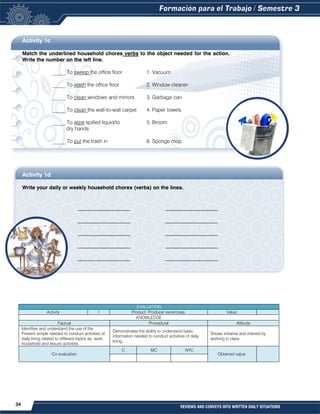
True
False
5. The date on a business letter should appear after the salutation.
True
False
6. An "Enclosure" note should appear below the typed name of the sender at the end of the letter.
True
False
7. The first paragraph of a business letter includes a friendly greeting in the first sentence.
True
False
8. Contact information generally appears in the closing paragraph of the letter.
True
False
9. Identifying the audience is one of the first steps in planning a business letter.
True
False
10.It is considered standard formatting to include the recipient's address before the salutation in a business letter.
True
False
11.When writing business letters, you must not pay special attention to the format used.
True
False
12.The generally accepted font is Times New Roman, size 12.
True
False
122 WRITES FORMAL, INFORMAL DOCUMENTS AND FORMATS
Activity 8a
Write DOs and DON’Ts of writing letters. Number one is given as an example
DOs DON’Ts
1. Write out the month instead of using
numbers (e.g. November 24th
, 2011).
2.
3.
4.
5.
6.
7.
8.
9.
10.
1. Under less formal circumstances, it may
not be acceptable to address a person by
his or her first name.
2.
3.
4.
5.
6.
7.
8.
9.
10.
EVALUATION
Activity 8 Product: Filled out questionnaires. Value:
KNOWLEDGE
Factual Procedural Attitude
Recognizes information used to write letters and
identifies what must and mustn’t be done.
Applies the acquired knowledge in true or false
questionnaire and reviews what must and mustn’t be
done when writing a letter.
Participates with classmates
interchanging information by asking
and answering questions.
Auto evaluation
C MC NYC
Obtained value:
123
BLOQUE 2
Activity 9
Now that you have studied the parts of the letter, and after reading all the information, write the
following type of letters in separate papers and hand them over to your teacher in A PORTFOLIO.
(The information is optional. You may use other information).
a. Letter of Transmittal; send legal documents (deeds, contracts, etc) to a lawyer needed at the
company you work for.
b. Letter of Inquiry; ask for the new catalogue.
c. Reference letter; recommend a friend for a job in an Italian restaurant.
d. Place an order letter; order a lap-tap or a computer to Office Depot or to other office equipment
store.
e. State a complain letter; write a letter stating a reason for your complain to any government office or
department.
You will find examples of “Business Letters: http://www.isampleletter.com/
EVALUATION
Activity 9 Product: Filled out questionnaires. Value:
KNOWLEDGE
Factual Procedural Attitude
Organizes material to be presented at the end of the
sequence.
Elaborates a “Portfolio” to be presented at the end of
the sequence.
Integrates his/her knowledge through a
“Portfolio”.
Auto evaluation
C MC NYC
Obtained value:
124 WRITES FORMAL, INFORMAL DOCUMENTS AND FORMATS
Time assigned: 20 hours.
Competencias Profesionales:
 Realiza comprensiones oral y auditiva de diversos tipos de texto en otro idioma.
 Realiza comprensión escrita y de lectura de diversos tipos de texto en otro idioma.
 Realiza expresión o producción oral en otro idioma.
 Realiza interacción oral en otro idioma.
 Realiza expresión o producción escrita de diversos tipos de texto en otro idioma.
Unidad de competencia:
Socializa en la vida laboral y cotidiana y describe por escrito días festivos, costumbres y eventos
especiales de otros países.
Atributos a desarrollar en el bloque:
4.1 Expresa ideas y conceptos mediante representaciones lingüísticas, matemáticas o gráficas.
4.2 Aplica distintas estrategias comunicativas según quienes sean sus interlocutores, el contexto
en el que se encuentra y los objetivos que persigue.
4.3 Identifica las ideas claves en un texto o discurso oral e infiere conclusiones a partir de ellas.
4.4 Se comunica en una segunda lengua en situaciones cotidianas.
4.5 Maneja las tecnologías de la información y la comunicación para obtener información y
expresar ideas.
6.4 Estructura ideas y argumentos de manera clara, coherente y sintética.
7.1 Define metas y da seguimiento a sus procesos de construcción de conocimiento.
8.2 Aporta puntos de vista con apertura y considera los de otras personas de manera reflexiva.
10.3 Asume que el respeto de las diferencias es el principio de integración y de convivencia en los
contextos local, nacional e internacional.
BLOCK 3. Investigates and relates cultural situations.
126
INVESTIGATES AND RELATES CULTURAL SITUATIONS
Pair Work. Do you make “Quick friends”? Take turns using this quiz to interview each other. Then score
your answers and find out which category best describes each of you. Check ( ) your answer.
1. You go to a big party. Do you wait for people to come and introduce themselves to you?
a. ______ No. I go and introduce myself.
b. ______ Yes, I wait for people to introduce themselves.
2. When you are meeting a person for the first time, after saying a hello...
a. ______ I try to talk about common interest, etc.
b. ______ I wait awkwardly for the other person to take the talk forward.
3. In a party, you normally occupy the corner seats looking for old friends.
a. ______ No, I mingle around making new friends too.
b. ______ Yes, old buddies are best to be with.
4. When you meet someone for the first time, you speak after giving a lot of thought.
a. ______ No, I speak spontaneously.
b. ______ Yes, I think about my words and sentences.
5. If you find nothing common between yourself and your new acquaintance (stranger), you
a. ______ Still maintain contact.
b. ______ Drop the idea of being friends.
6. Are you equally comfortable conversing with men and women?
a. ______ Yes, totally.
b. ______ Not, totally.
7. Do you have a lot of friends who are known to you only on a hi-bye basis?
a. ______ Yes.
b. ______ No.
Scoring
More A answers: You make friends very quickly. This is an admirable quality. You are an extrovert.
More b. Answers: You do not make friends so quickly. It takes time for you to make new friends. Try shedding
your inhibitions and become more outgoing.
Didactic Sequence 1.
Making Friends.
Start up activities


EVALUATION
Activity 1 Product: Questionnaire. Value:
KNOWLEDGE
Factual Procedural Attitude
Comprehends and involves the use of simple
present sentences to express truths and facts.
Searches and understand general ideas in an
exercise related to the topic.
Shows openness to feedback made
by the teams.
Auto evaluation
C MC NYC
Obtained value:
Activity 1
127
BLOCK 3
Activity 2
Read carefully and answer the questions.
Mary: I hear you are going to work in Detroit.
Nina: Yes, it’s a beautiful place, I am very excited.
There is only one thing.
Mary: What?
Nina: Well, it’s too far from home. I’d miss my family.
Mary: I don’t think I’d mind moving to a foreign country.
Nina: Yeah, but wouldn’t you miss your friends?
Mary: Sure, for a while, but I’d make new ones.
Nina: You certainly sound very confident.
Mary: You know, actually, there is one thing I’d miss.
Nina: What’s that?
Mary: Parties.
Nina: I won’t. There are two other things I am worried about : how to socialize with colleagues at work.
Mary: And the other?
Nina: The job possitions in the organization I am working for.
Mary: Don’t worry! Every company has organization diagrams and there are booklets in which you can find
customs, how to socialize, to start and end conversations.
Nina: Where can I find those booklets?
Mary: I’ll give you one with articles that will help you a lot.
Nina: Ok, I’ll appreciate it very much.
1. What are the three things that Nina is worried about? ________________________________________,
_____________________________________, ________________________________________________.
2. Is Nina happy for having a job in Detroit? ___________________________________________________
3. Would Mary miss her friends if she moved to another country? _________________________________
4. Where does Mary suggest Nina to find information in how to start a conversation with colleagues?
______________________________________________________________________________________
5. Where is Nina going to get the booklets? ___________________________________________________
Development activities
Activity 2a
Pair work. Answer the questions.Take turns asking and answering questions with your partner.
1. If you could live in a foreign country, what country would you like to live in? Why? In ______________,
because ______________________________________________________________________________
2. What do you think you would enjoy the most about living in a foreigh country?
______________________________________________________________________________________
______________________________________________________________________________________
?
128
INVESTIGATES AND RELATES CULTURAL SITUATIONS
Activity 2b
Read the expressions and with the help of your teacher write if is a Greeting, Introduction, or
Goodbye.
Expressions used at work
 Thank you for all your help. _______________
 How are you? _______________
 Excuse me, are you Mrs. Kramer? _______________
 Sorry, I don’t know your name. _______________
 May I introduce myself? _______________
 Hi everybody. My name’s Alex Sellers. _______________
 Thank you for coming! _______________
 Let me introduce you to Mary Higgins. _______________
 Goodbye. It’s been very interesting talking to you. _______________
 See you. I really had a good time. _______________
 I got to go now. _______________
 I’m afraid I must be going soon. _______________
 How are things? _______________
 How was your weekend? _______________
 How is it going? _______________
 Have a good trip/flight. _______________
 Enjoy the rest of your stay. _______________
 I hope to see you again. _______________
 Have a good weekend! _______________
 It’s been a very useful meeting. _______________
Activity 2c
Pair Work. Write the most suitable questions to the following answers. Then practice with your
partner.
a. ___________________________________________________________________________? Can’t complain!
b.__________________________________________________________________. Hope to see you again, too.
c. ________________________________________________________________________? We enjoyed it a lot.
d. __________________________________________________________________It was nice meeting you, too.
e. ____________________________________________________________. Oh no, thank you for the invitation.
f. ____________________________________________________________. I also think the meeting was useful.
g. ________________________________________________________________________ Yes, I’m Mr. Munguia.
h. ________________________________________________________________________Oh! My name is Rose.
129
BLOCK 3
Activity 2d
Pair work. Complete and practice the dialogues with your partner.
Dialogue 1
Alex: Albert! Good to see you again. ____________ are things?
Albert: Hello, Alex. Fine, thanks. Pretty busy, as always, I suppose.
Can I introduce you to a colleague of
___________, Adrian Winston? Adrian, this is Alex Farrell.
Adrian: Nice to meet you, Ms Farrell.
Alex: Nice to meet you, too. ____________, call me Alex.
Adrian: Then you ____________ call me Adrian.
Dialogue 2
Charles: Hello, Charles Evans. Mind if I join you?
Mary Joe: Oh, ______________ not. Mary Joe Richards.
Charles: ______________ to meet you, Mary Joe.
So how are you finding the conference so far?
Mary Joe:Actually, I’ve only arrived this morning.
Charles: All right. We got to go ______________.
Mary Joe: Oh yes, the _______________ is going to start.
Dialogue 3.
Activity 2e
Write a dialogue with expressions used at work.
_____________________________________________________________________________________________
_____________________________________________________________________________________________
_____________________________________________________________________________________________
_____________________________________________________________________________________________
_____________________________________________________________________________________________
_____________________________________________________________________________________________
EVALUATION
Activity 2 Product: Written dialogue. Value:
KNOWLEDGE
Factual Procedural Attitude
Identifies expressions for greetings, introductions
and farewells to be used in the work place.
Practices making statements or asking questions with
pre-selected expressions and vocabulary.
Integrates expressions that can be
helpful for social and working life to
his/her knowledge.
Auto evaluation
C MC NYC
Obtained value:
130
INVESTIGATES AND RELATES CULTURAL SITUATIONS
Read the expressions for “Socializing” at work.
Making Contact Keeping the conversation going Getting away
Mind if I join you? Do you often travel to USA?
If you’ll excuse me, I have to make
a phone call.
Excuse me, have we met? What do you do, by the way?
If you’ll excuse me, I must go and
say hello to someone.
Excuse me, you must be? What line of business are you in?
Would you excuse me, I’ll be right
back.
I really enjoyed your speech.
For what department/company
are you working?
See you later, I have to go.
Are you giving a speech? Can I get you a drink? It’s late, I must go now.
Activity 3a
You’re at a reception at an international conference in New York.
Make questions using the words offered below and then think of possible answers.
Example:
Mind/ join you?
Q: (Do you) Mind if I join you?
A: Please, do.
Giving a speech?
Q ______________________________________________________________________________________________?
A: _______________________________________________________________________________________________
So, what/ you do?
Q: ______________________________________________________________________________________________?
A: _______________________________________________________________________________________________
What/ your line of business?
Q: ______________________________________________________________________________________________?
A: _______________________________________________________________________________________________
Can/ get/ drink?
Q: ______________________________________________________________________________________________?
A: _______________________________________________________________________________________________
Enjoying the conference?
Q: ______________________________________________________________________________________________?
A: _______________________________________________________________________________________________
Excuse me a moment?
Q: ______________________________________________________________________________________________?
A: _______________________________________________________________________________________________
What department/company work?
Q: ______________________________________________________________________________________________?
A: _______________________________________________________________________________________________
Activity 3
131
BLOCK 3
Activity 3b
You're at a conference party. Match the comments and replies. Write the letter in the parenthesis.
Comment Reply
1. It’s an interesting conference, isn’t it? ( ) a. That’s right. I live in Guadalajara.
2. How’s business? ( ) b. Don’t worry. I’ll have some soda.
3. Cheers! ( ) c. Thanks. They look delicious.
4. You must try one of these. ( ) d. Yes please. I’ll have another one.
5. Sorry, I didn’t catch your name. ( ) e. You’re very kind but I’ll walk back.
6. Would you like another drink? ( ) f. It’s Caroline. Caroline So.
7. You’re from Jalisco, Mexico, aren’t you? ( ) g. Cheers!
8. I must get going. ( ) h. See you tomorrow.
9. Let me give you a lift back to your hotel. ( ) i. Very good, thank you.
10. I’m afraid there’s no more orange juice. ( ) j. Yes, it is.
EVALUATION
Activity 3 Product: Practical exercises. Value:
KNOWLEDGE
Factual Procedural Attitude
Identifies expressions for socializing at the work
place.
Practices making statements or asking questions with
pre-selected expressions and vocabulary.
Integrates expressions to his/her
knowledge helpful for social and
working life
Auto evaluation
C MC NYC
Obtained value:
Activity 3c
Suppose this is your first day at work, you are at the “coffee break,” make a dialogue with one of your
new colleagues. (Use expressions from exercise 3, 3a, and 3b).
A:___________________________________________________________________________________________
B:___________________________________________________________________________________________
A:___________________________________________________________________________________________
B:___________________________________________________________________________________________
A:___________________________________________________________________________________________
B:___________________________________________________________________________________________
A:___________________________________________________________________________________________
B:___________________________________________________________________________________________
132
INVESTIGATES AND RELATES CULTURAL SITUATIONS
Team Work. Read the Article, discuss it with your partners, and answer the questions.
The Art of Conversation
In many cultures there are still a good number of people who can't seem to hold up a conversation. If you want to
learn about the art of conversation and how to easily communicate with anyone, read on!
 Tip # 1: Be Natural.
You don't have to pretend to be someone else just to get a good conversation flowing. In fact, pretending to be
someone you're not only serves to bring your confident points down.
 Tip # 2: Read Up.
Perfecting the art of conversation takes time and effort. One way to do this is by reading up. Reading the paper
every day, for example, feeds your mind
 Tip # 3: Give and Take.
Remember that the art of conversation is a two-way street. You're not there to listen to all of their woes for an hour.
You're not there to talk about your stupid day for an hour either.
Conversation needs participation from both parties
The art of conversation is not difficult. All it takes is an open mind and practice to do it well.
Article taken from: esl teachersboard
1. Can you hold up a conversation with someone you just met? _________________________________________
2. What does tip #1 mean by “pretending to be someone else”? _______________________________________
___________________________________________________________________________________________________
3. Does pretending to be someone else help in a conversation? ________________________________________
4. What is the advice in tip #2? ____________________________________________________________________
___________________________________________________________________________________________________
5. What does tip #3 mean by “two-way street”? ______________________________________________________
___________________________________________________________________________________________________
6. What aren’t you supposed to do during an hour? ___________________________________________________
___________________________________________________________________________________________________
7. What does the word “Woes” mean in tip #3? ______________________________________________________
___________________________________________________________________________________________________
EVALUATION
Activity 4 Product: Written exercise. Value:
KNOWLEDGE
Factual Procedural Attitude
Recognizes the importance of communicating
with others.
Reads the article to infer questions and expresses
his/her opinion to classmates.
Values and acknowledges
conversation as an art.
Auto evaluation
C MC NYC
Obtained value:
Activity 4
133
BLOCK 3
Read and answer the questions.
Invitations at work
Invite co-workers to have dinner or go out may encourage team spirit. Invitations may be usually informal and
often oral, but tell the time and place: "Will you come over Tuesday evening at 8:00?" it is important that you go
and be punctual. The host expects you to call as soon as possible if you must cancel. It is considered rude to
simply not show up. If you are not interested in the invitation, it is better to politely refuse the date or appointment
in the beginning. Refusing a date is not considered rude in the United States.
1. Why do you thing an invitation will encourage team spirit? _________________________________________
___________________________________________________________________________________________
2. Why is it considered rude not to show up when you are invited? ____________________________________
___________________________________________________________________________________________
3. What does the word “Refusing” mean? _________________________________________________________
___________________________________________________________________________________________
Expressions for Invitations
Inviting Accepting Setting the details Declining
 Perhaps you would
like to have dinner
at my home.
 What about going
out for a meal?
 Shall we meet later
tonight to discuss it
over dinner?
 Why not join us for
a drink?
 That’s very kind of
you.
 Thank you for
inviting me.
 I’d like that very
much.
 I’d be delighted to
come.
 Thanks.
 That’s/ What a good
idea.
 That sounds good/
fun.
 What time should I
come?
 Where shall we
meet?
 Shall I pick you up?
 Thank you very much,
but I’m afraid I can’t
come.
 No, thank you/ thanks
but I won’t be here.
 I’m all right, thanks.
 I can manage.
Activity 5a
Rearrange the words to make sentences.
1. Would/ like/ join/ you/ for/ lunch/ us/ to? _________________________________________________________
____________________________________________________________________________________________
2. There’s/ nice/ a really/ just round/ place/ the corner.
________________________________________________________________________________________________
________________________________________________________________________________________________
3. Shall/ meet/ we/ over/ dinner/ to discuss it/ later? _________________________________________________
____________________________________________________________________________________________
4. Why/ join/ for/ a drink/ us/ not?_________________________________________________________________
____________________________________________________________________________________________
Activity 5
134
INVESTIGATES AND RELATES CULTURAL SITUATIONS
Activity 5b
In what situations would you use these expressions? Inviting, Accepting, Setting the
details, Declining.
a. No, thanks.
That’s very kind of you, but ... _______________________________________________________________
b I was wondering if you would like to join us for a meal?
What about going out for a coffee? _____________________________________________________________
c Shall we meet at half past seven?
Say at half past seven. _______________________________________________________________
d Yes, please.
Thank you. That’d be very nice. _______________________________________________________________
e. I’m all right, thanks.
I can manage, thank you. _______________________________________________________________
Activity 5c
How would you do the following? Use expressions from the table.
a. Invite an important business partner for a meal: ____________________________________________________
________________________________________________________________________________________________
b. Say sorry because you can’t come: _____________________________________________________________
________________________________________________________________________________________________
c. Accept an invitation politely: ___________________________________________________________________
________________________________________________________________________________________________
d. Accept an invitation in a less formal way: ________________________________________________________
________________________________________________________________________________________________
e. Ask about the time and place of your meeting ____________________________________________________
________________________________________________________________________________________________
EVALUATION
Activity 5 Product: Practical exercise. Value:
KNOWLEDGE
Factual Procedural Attitude
Recognizes the importance of invitations in the
working field and the benefits that can be
received.
Applies vocabulary and expressions when
practicing invitations.
Integrates new vocabulary and
conversational expressions to be used
when making invitations in a real context.
Auto evaluation
C MC NYC
Obtained value:
135
BLOCK 3
Activity 6
Write a dialogue with a colleague, use greetings, socializing, and invitations expressions
A: __________________________________________________________________________________________
B: __________________________________________________________________________________________
A: __________________________________________________________________________________________
B: __________________________________________________________________________________________
A: __________________________________________________________________________________________
B: __________________________________________________________________________________________
A: __________________________________________________________________________________________
B: __________________________________________________________________________________________
A: __________________________________________________________________________________________
B: __________________________________________________________________________________________
A: __________________________________________________________________________________________
B: __________________________________________________________________________________________
A: __________________________________________________________________________________________
Closing activities
EVALUATION
Activity 6 Product: Dialogue written practice. Value:
KNOWLEDGE
Factual Procedural Attitude
Writes a dialogue, review the vocabulary and
expressions acquired.
Recognizes vocabulary and expressions to be
applied in real situations.
Integrates new vocabulary and
conversational expressions to be used
when making invitations in a real context.
Auto evaluation
C MC NYC
Obtained value:
136
INVESTIGATES AND RELATES CULTURAL SITUATIONS
Complete the dialogues.
Dialogue 1
A: Good to see you again. ________________ are things?
B: Doing ____________________, how are you?
A: Fine, thank ___________________.
B: Hey! I was thinking, there’s a really nice _______________________________
just a few minutes from here. Would you _____________ to have lunch there?
A: I’d love to.
B: Where shall we _________________?
A: See you outside my office building.
Dialogue 2
Lin: Dan! Good to see you again. ____________ are things?
Dan: Hello, Lin. Fine, thanks. Pretty busy, as always, I suppose. Can I introduce you to a colleague of
____________, Peter Winston? Peter, this is Lin Farrell.
Peter: Nice to meet you, Ms Farrell.
Lin: Nice to meet you, too. ____________, call me Lin.
Peter: Then you ____________ call me Peter.
Activity 7a
Write a SOCIALIZING expression (making contact, keeping the conversation, or a getting away).
1. ____________________________________________________________________________________________?
No, sit down, there is an empty seat.
2. ____________________________________________________________________________________________?
I come twice a year to visit my grand-parents.
3. ____________________________________________________________________________________________?
No thank you, I’m drinking lemonade.
4. ____________________________________________________________________________________________?
See you then. Say hello for me, too.
5. ____________________________________________________________________________________________?
I’m working for Continental Co.
EVALUATION
Activity 7 Product: Practical exercise. Value:
KNOWLEDGE
Factual Procedural Attitude
Writes dialogues, makes questions, reviews the
vocabulary and expressions acquired.
Recognizes vocabulary and expressions to
complete dialogues and makes questions.
Integrates new vocabulary and
conversational expressions to be used at
real situations.
Auto evaluation
C MC NYC
Obtained value:
Activity 7
137
BLOCK 3
CHECK YOUR CULTURE. There are different customs and behaviors throughout the world. Check ( )
the statements that are true in your country. Mark with an X the ones that are not true.
( ) It’s a custom to take off your shoes before you enter someone’s home.
( ) You are supposed to call first if you plan to visit someone at home.
( ) When you smoke in public, you must ask the people near you for permission.
( ) It’s OK to blow your nose in public.
( ) Students call their teachers by their first name.
( ) When you are invited to a friend’s house, is a custom to bring a small gift.
( ) It’s all right to chew gum while talking to someone.
( ) Friends kiss on the cheek when they meet.
( ) It’s OK to kiss in public places.
( ) It’s OK to spit on the floor.
( ) People dress appropriately for a romantic dinner.
( ) People give the seat to the elder in the bus or train.
Didactic Sequence 2.
Journey to different Cultures.
Start up activity
EVALUATION
Activity 1 Product: Questionnaire. Value:
KNOWLEDGE
Factual Procedural Attitude
Identifies various customs and behaviors in
his/her own cultural background.
Recognizes and checks the statements that apply
to his/her own cultural background.
Values the various customs and behaviors
found in cultures around the world.
Auto evaluation
C MC NYC
Obtained value:
Activity 1
138
INVESTIGATES AND RELATES CULTURAL SITUATIONS
Read the chart and answer the questions.
Customs around the world
Mexico
___________
Serenades
are often
used to
express
one’s true
love and
devotion to
that special
someone.
USA
__________
They want
you to "feel
at home".
You may be
greeted at
the door with
"Make
yourself at
home".
Canada
__________
You don’t
hug and kiss
when you
want to greet
someone.
England
__________
They often
drink tea, eat
fish and
chips and
wear bowler
hats.
Japan
___________
You have to
take off your
shoes when
you enter
someone’s
home.
Thailand
___________
You are not
supposed to
touch
anyone
except a
child on the
head.
Muslim
Countries
___________
People
always eat
with their
right hand,
never with
the left hand.
1. Did you know about this customs from different parts of the world? _____________________________________
2. Name a strange custom that you know?
_______________________________________________________________________________________________
3. Do you follow any of these customs in your country?
_______________________________________________________________________________________________
Development activities
Activity 2a
Team Work. Suppose that you are receiving a foreign student and you have to tell
him/her what customs should a visitor of your country follows. Write recommendations
and discuss with your team before you write.
__________________________________________________________________________________
__________________________________________________________________________________
_________________________________________________________________________________________________
_________________________________________________________________________________________________
_________________________________________________________________________________________________
_________________________________________________________________________________________________
_________________________________________________________________________________________________
_________________________________________________________________________________________________
_________________________________________________________________________________________________
_________________________________________________________________________________________________
________________________________________________________________________________________________
Activity 2
139
BLOCK 3
Activity 2b
Match information; write the letter in the parenthesis. Then write the complete statements about
customs in the United States and Canada.
1. If you want to bring someone to a party ( ) a. You have to call and ask if it’s OK.
2. If the service in a restaurant is very bad ( ) b. you’re supposed to call first
3. If you’ve been to a friend’s home for lunch, ( ) c. you aren’t expected to leave a tip.
4. When you want to smoke in public, ( ) d. You don’t hug and kiss them.
5. When you go out on a date ( ) e. You’re supposed to ask people
around
6. If you plan to visit someone at home, ( ) f. It’s a custom to call and thank them.
7. When you meet someone for the first time, ( ) g. It’s acceptable to share the expenses.
1. ______________________________________________________________________________________
2. ______________________________________________________________________________________
3. ______________________________________________________________________________________
4. ______________________________________________________________________________________
5. ______________________________________________________________________________________
6. ______________________________________________________________________________________
7. ______________________________________________________________________________________
Activity 2c
Write in the table Dos and Don’ts when visiting your country.
DOs DON’Ts
Example: Address people older than you
as:”Usted”.
1.
2.
3.
4.
5.
Do not bargain in department stores.
1.
2.
3.
4.
5.
EVALUATION
Activity 2 Product: Practical exercise. Value:
KNOWLEDGE
Factual Procedural Attitude
Identifies various customs and behaviors in
different cultures throughout the world and
his/her own cultural background.
Recognizes the differences among customs and his
/her cultural background.
Values the various customs and behaviors
found in cultures in different countries.
Auto evaluation
C MC NYC
Obtained value:
140
INVESTIGATES AND RELATES CULTURAL SITUATIONS
Write a report about “Customs and Culture Tips” for English speaking Countries. Paste your report.
You’ll find information in the following pages: http://www.cesl.arizona.edu/custom.html
http://www.woodlands-junior.kent.sch.uk/customs/
Activity 4
Read about culture in India and answer the questions.
Cultural perspective: India is a multilingual, pluralistic and multi-ethnic country. Indian culture is
unique due to its spiritual values. India is a diverse country with many Gods, languages,
cultures and religions. India has a rich tradition of peaceful social co- habitation, tolerance,
harmony, and respect for elders, nature worship, strong family values, art, craft and hospitality.
Children from all over the world would learn to live better by imbibing Indian family value of
love and service. Indian yoga and meditation practices are popular all over the globe. The
Indian philosophy of Geeta is now being taught to management trainees in Oxford and
Stanford. The Indian classical tradition of music and dance is a much evolved form of artistic
expression.
EVALUATION
Activity 3 Product: Cultural report. Value:
KNOWLEDGE
Factual Procedural Attitude
Identifies various customs and behaviors in
different cultures throughout the world and
his/her own cultural background.
Recognizes the differences among customs and his
/her cultural background.
Values the various customs and behaviors
found in cultures in different countries.
Auto evaluation
C MC NYC
Obtained value:
Activity 3
141
BLOCK 3
Activity 4 (continuation)
1. Why is Indian culture unique?
___________________________________________________________________________________________
2. What’s India rich tradition?
___________________________________________________________________________________________
3. What family values should children from all over the world acquire?
___________________________________________________________________________________________
4. What Indian practices are very popular around the world?
___________________________________________________________________________________________
5. In what aspects are Indian and Mexican Culture alike?
___________________________________________________________________________________________
Activity 4a
Pair work. Answer the questions, then take turns and ask your partner.
1. Would you like to live in “India”?
____________________________________________________________________________________________
2. What do you like most about this country?
____________________________________________________________________________________________
3. Which of these customs does your culture follow?
____________________________________________________________________________________________
4. Why do you think people have these customs?
____________________________________________________________________________________________
5. Do you know any famous Indian person known around the world?
____________________________________________________________________________________________
Activity 4b
Fill in the table. Compare Indian Culture with culture in your country.
India Your Country
Language Multilingual
Religion Many religions
Values
Respect for the elder, nature ____________,
Strong _______ values, love and _________
Practice Yoga and ____________________________.
Classical traditions Music and ___________________________
142
INVESTIGATES AND RELATES CULTURAL SITUATIONS
Team work. What do you know about “Culture shock”? Work in teams, answer the questions and
discuss them with partners.
Culture shock is described as the physical and emotional discomfort one
suffers when coming to live in another country or a place different from the
place of origin. Often, the way that we lived before is not accepted as or
considered as normal in the new place. Everything is different, for example,
not speaking the language, not knowing how to use banking machines, not
knowing how to use the telephone and so forth.
Well, I think generally speaking, we could say that there are four stages to
culture shock. First of all, the "honeymoon" stage. To the visitor, everything
seems new, quaint, and novel. The food, the surroundings, the buildings
produces a feeling of euphoria: a desire to look around, to experiment, and
to explore.
The next stage is the "horror" stage, where the newness wears off, and the visitor sees the country from a different
light, and often begins to criticize the country, the life, and the values of the people.
The next stage, we could say, is the "humor" stage, where people begin to reflect back and laugh at their
mistakes in the earlier stages.
And the final stage, we could say, is the "home" stage where people begin to feel at home, enjoy living in that
foreign country.
Reading taken from Randall’s Sites
1. How does a person view the new culture in the first stage of culture shock?
Everyone is watching me.
I want to go home.
Wow. Everything is different.
2. What are the symptoms of the second stage of culture shock?
People tend to withdraw from society.
People try to integrate into the culture.
People criticize the people and culture.
3. What is the third stage of culture shock?
The humor stage
The hunting stage
The homeless stage
EVALUATION
Activity 4 Product: Recognition of differences among cultures. Value:
KNOWLEDGE
Factual Procedural Attitude
Identifies various customs and behaviors in
different cultures throughout the world and
his/her own cultural background.
Recognizes the differences among customs and his
/her cultural background.
Values the various customs and behaviors
found in cultures in different countries.
Auto evaluation
C MC NYC
Obtained value:
Activity 5
143
BLOCK 3
4. What statement by the visitor best describes the "home" stage?
I’m glad to be returning to my own country.
These people love their families and homes.
I really enjoy living among the people here.
5. What is the best title for this mini-lecture?
How to adjust to Culture Shock.
The Stages of Culture Shock.
The cause of Culture shock.
Activity 5a
Dictionary activity. Write the meanings of the following words.
1. Discomfort _____________________________ 5. Criticize _____________________________
2. Honeymoon _____________________________ 6. Values _____________________________
3. Surroundings _____________________________ 7. Mistakes _____________________________
4. Newness _____________________________ 8. Withdraw _____________________________
Activity 5b
Write the stage of “Culture shock” that this person is living.
a. She loves the city and she is making plans to walk around the place.
_____________________________________________________________________________________________
b. Frederick wants to stay home, relax, and watch a new movie.
_____________________________________________________________________________________________
c. Everybody was making fun of the first day when they arrived to the city.
_____________________________________________________________________________________________
d. The teacher is “home sick”, she wants to go back to her school town.
_____________________________________________________________________________________________
e. I don’t like the food, there’s no entertainment, there’s no place to go on Sundays.
_____________________________________________________________________________________________
EVALUATION
Activity 5 Product: Practical exercises. Value:
KNOWLEDGE
Factual Procedural Attitude
Comprehends what people suffer when moving
to another country and encounter a different
culture.
Reads to infer answers and understands about
culture shock.
Values the various customs and behaviors
found in cultures in other countries.
Auto evaluation
C MC NYC
Obtained value:
Activity 5 (continuation)
144
INVESTIGATES AND RELATES CULTURAL SITUATIONS
Activity 6
Answer these questions about the customs in your country. Write complete sentences.
1. What should you take with you when you are invited to someone’s home?
When you________________________________________________________________________________
2. When you meet someone for the first time, what should you do?
When you _______________________________________________________________________________
3. If you eat in a restaurant, how much do you leave for tip?
If you ___________________________________________________________________________________
4. What do you do if a friend gets engaged?
If a friend ________________________________________________________________________________
5. What does your family usually do when a relative graduates from high school?
When a relative ___________________________________________________________________________
Closing activities
Activity 6a
Write about the customs in 7 different parts of the world.
Customs around the world
EVALUATION
Activity 6 Product: Practical exercises. Value:
KNOWLEDGE
Factual Procedural Attitude
Writes about various customs and behaviors in
different cultures throughout the world.
Recognizes the differences among customs.
Values the various customs and behaviors
found in cultures in different countries.
Auto evaluation
C MC NYC
Obtained value:
145
BLOCK 3
Choose a country, investigate and write a report about its culture, language, customs, food, education,
etc. Paste your report here.
You can find information: http://www.topics-mag.com/internatl/holidays/festivals.htm
EVALUATION
Activity 7 Product: Investigation report. Value:
KNOWLEDGE
Factual Procedural Attitude
Writes about various customs, behaviors, food,
and language from other country.
Recognizes customs, behaviors, food, languge,
values, etc. from other country.
Values the various customs and behaviors
found in other countries’ cultures.
Auto evaluation
C MC NYC
Obtained value:
Activity 7
146
INVESTIGATES AND RELATES CULTURAL SITUATIONS
Read and answer the questions:
1. What do Mexicans celebrate the “Fifth of May”? ____________________________________________________
_____________________________________________________________________________________________
2. How do you celebrate the “Fifth of May” in your city? ________________________________________________
_____________________________________________________________________________________________
3. What do Americans celebrate in “Thanksgiving Day”? _______________________________________________
_____________________________________________________________________________________________
Didactic sequence 3.
Celebrations, holidays and festivals.
Start up activity
Activity 1
“Fifth of May” is a
celebration of the
Battle of Puebla.
The Battle of
Puebla took place
when France was
trying to invade
Mexico. Mexico
won and that is
why “Cinco de
Mayo” is a
popular
celebration today.
The first American
“Thanksgiving”
was celebrated in
1621 to
commemorate
the harvest
collected by the
Plymouth Colony
after a harsh
winter.
Now, American
and Canadian
families celebrate
thanksgiving by
preparing large
meals. They
usually roast a
turkey, bake pies,
and cook
vegetables.
Working people
and their labor
unions in most of
the countries of
the world
celebrate the
social and
economic
achievements of
the international
labor movement.
“Mayday” usually
sees organized
street marches by
millions of
workers.
“Chinese New
Year” starts with
the New Moon on
the first day of the
New Year and
ends on the full
moon 15 days
later. The Chinese
celebration is a
family affair, a
time of reunion
and thanksgiving.
”Independence
Day” honors the
birthday of the
United States of
America and the
adoption of the
Declaration of
Independence on
July 4, 1776. It's a
day of picnics and
patriotic parades, a
night of concerts
and fireworks.
147
BLOCK 3
4. How do American and Canadian families celebrate “Thanksgiving Day”? _______________________________
______________________________________________________________________________________________
5. Do you celebrate “May Day” in your country? _______________________________________________________
6. How do working people celebrate “May Day” in part of the world? _____________________________________
______________________________________________________________________________________________
7. How is “Chinese New Year” celebrated? ___________________________________________________________
______________________________________________________________________________________________
8. When do Americans celebrate “Independence Day”? ________________________________________________
9. What do Americans celebrate on “Independence Day”? ______________________________________________
10. Do you celebrate “Independence Day? ____________________________________________________________
1. What do Mexicans celebrate the “Fifth of May”? ______________________________________________
_________________________________________________________________________________________
2. How do you celebrate the “Fifth of May” in your city? _________________________________________
_________________________________________________________________________________________
3. What do Americans celebrate in “Thanksgiving Day”? ________________________________________
_________________________________________________________________________________________
Activity 1a
Answer the Festivals crossword puzzle.
Down
1. Festival
celebrated on
October 31st.
2. The day when
you were born is
your…
3. A very important
festival in China.
4. Father of
Christmas.
6. Festival on
Spring.
Across
5. Festival on
February 14th
7. Festival on
December 25th
Activity 1b
Discuss with your classmates. Which of these festivities do you celebrate in your country?
EVALUATION
Activity 1 Product: Practical exercises. Value:
KNOWLEDGE
Factual Procedural Attitude
Identifies special days and annual events-
celebrations, holidays, and festivals.
Practices describing customs and events in his/her
or other countries.
Collaborates and appreciates the use of
language to be applied in a real context.
Auto evaluation
C MC NYC
Obtained value:
Activity 1 (continuation)
148
INVESTIGATES AND RELATES CULTURAL SITUATIONS
Read the dialogue and learn about “Independence Day” in USA.
Albert: Next week is “Independence Day”. It’s on the fourth of
July.
Nina: So what do you do on Independence Day?
We also have an Independence Day in Mexico.
Albert: Well, It’s a day when everyone spends the day
outdoors.
Most towns have parades with marching band. The
people at te parades wave American flags. In the
afternoon people have a cook-out and then play
volleyball or baseball with friends and family.
Nina: Hmm, sounds interesting!
Albert: But it’s not just that. The most spectacular part of the
day comes late in the evening. Then it is time for a big
firework display to celebrate American Independence.
Nina: So, what are you going to do this fourth of July in the
evening?
Albert: My family and I are going to the firework display in
Patagonia Park.
Would you like to go with us?
Nina: Sure. I’d love to.
Albert: I’ll pick you up at five. Then you can tell us about your
Independence day in Mexico.
Activity 2a Pair Work.
Practice the conversation in pairs.
Development activities
Activity 2b
Write the meaning of the compound words.
1. Outdoors _____________________ 3. Firework _____________________
2. Cook out _____________________ 4. Pick up _____________________
Activity 2c
Write questions for the answers.
1. _________________________________________________________________________________________?
On the fourth of July.
2. _________________________________________________________________________________________?
They usually spend it outside.
3. _________________________________________________________________________________________?
They have parades with marching bands.
4. _________________________________________________________________________________________?
In the evening.
5. _________________________________________________________________________________________?
They are going to the firework display in Patagonia Park.
Activity 2
A compound word is made
when two words are joined to
form a new word.
Hyphenated form: six-pack
Open Form: full moon
Close form: keyboard
149
BLOCK 3
Activity 2d
Write a report about “Independence Day” in Mexico. When is it? How do you celebrate it? Etc.
Paste your report here.
EVALUATION
Activity 2 Product: Role play practice, a report. Value:
KNOWLEDGE
Factual Procedural Attitude
Identifies special days and annual events-
celebrations, holidays, and festivals.
Practices describing independence day in his/her or
other countries.
Values the various customs and behaviors
found in other countries’ cultures.
Auto evaluation
C MC NYC
Obtained value:
150
INVESTIGATES AND RELATES CULTURAL SITUATIONS
Use the Compare/Contrast Organizer to write the differences and similarities between Independence
day in Mexico and the United States.
Mexican and American Independence.Celebrations.
EVALUATION
Activity 3 Product: Compare and contrast activity. Value:
KNOWLEDGE
Factual Procedural Attitude
Writes the difference in the way people
celebrate independence day in two different
countries.
Recognizes the difference in the way two countries
celebrate independence day.
Shows respect when comparing and
contrasting the way people celebrate a
holiday.
Auto evaluation
C MC NYC
Obtained value:
Activity 3
Mexican Independence American Independence
How are they alike?
How are they different?
__________________________________________________________________________________________
__________________________________________________________________________________________
__________________________________________________________________________________________
__________________________________________________________________________________________
__________________________________________________________________________________________
________________________________
________________________________
________________________________
________________________________
________________________________
________________________________
________________________________
________________________________
________________________________
________________________________
________________________________
________________________________
________________________________
________________________________
________________________________
________________________________
________________________________
________________________________
151
BLOCK 3
Investigate and write two important celebrations for each month in Mexico and The United States.
Holidays in America: http://www.infoplease.com/spot/holidays.html#tha
Holidays in Mexico: http://www.mexonline.com/holiday.htm
MONTH MEXICAN CELEBRATION AMERICAN CELEBRATION
January
• 3rd. Monday. Martin Luther King’s
Birthday.
•
February
March
April
May
June
July
• 4th
. Independence day
•
August
September
• 16th
. IndependenceDay
•
October
November
December
EVALUATION
Activity 4 Product: Festivities investigation. Value:
KNOWLEDGE
Factual Procedural Attitude
Identifies special days and annual events-
celebrations, holidays, and festivals.
Practices describing dates of events in his/her or
other countries.
Shows respect when comparing and
contrasting dates of holidays.
Auto evaluation
C MC NYC
Obtained value:
Activity 4
152
INVESTIGATES AND RELATES CULTURAL SITUATIONS
How much do you know about these festivities from around the world? Complete the
sentences from column A with information from column B. Write the letter in the
parenthesis.
1. Mexican celebration on March 21st ( ) a. holy week, end of 40-day Lent period.
2. Important celebration for Chinese ( ) b. President Benito Juarez’ birthday.
3. This week includes Good Friday ( ) c. people give presents to love ones.
and Easter Sunday
4. Valentine’s Day is a day when… ( ) d. many countries honor workers.
5. July 14 is the day when… ( ) e. Halloween, October 31.
6. May day is a day when… ( ) f. in Ireland
7. Kids dress up in costumes in… ( ) g. French celebrate their revolution.
8. They celebrate Saint Patrick's Day ( ) h. is New Year.
Activity 5a
Pair work. Discuss with your partner and write about holidays and celebrations
around the world.
Example:
1. Christmas in India - In India they decorate banana or mango trees. They also light small oil-burning
lamps as Christmas decorations.
2. New Year in Mexico- ________________________________________________________________________
__________________________________________________________________________________________
3. Independence day in ________________________________________________________________________
__________________________________________________________________________________________
4. __________________________________________________________________________________________
__________________________________________________________________________________________
5. __________________________________________________________________________________________
__________________________________________________________________________________________
6. __________________________________________________________________________________________
__________________________________________________________________________________________
Activity 5
153
BLOCK 3
Activity 5c
Complete these sentences with information of your own.
1. Summer is a season when students _____________________________________________________
_____________________________________________________________________________________
2. Mother’s day is the day when ___________________________________________________________
_____________________________________________________________________________________
3. Christmas around the world is __________________________________________________________
_____________________________________________________________________________________
4. Spring is the time of the year when ______________________________________________________
_____________________________________________________________________________________
5. A birthday is a _______________________________________________________________________
_____________________________________________________________________________________
Activity 5d
Complete the statements. Match columns by writing the letter in the parenthesis.
1. Birthday parties is a day ( ) a. when Americans eat turkey.
2. Halloween is a day ( ) b. when people eat “Chiles en nogada”.
3. Thanksgiving is a day ( ) c. when Irish people wear green.
4. Mexican independence is ( ) d. when people receive presents.
5. St. Patrick’s day is ( ) e. when children go “trick-or treating.”
EVALUATION
Activity 5 Product: Practical exercises. Value:
KNOWLEDGE
Factual Procedural Attitude
Identifies special days and annual events-
celebrations, holidays, and festivals.
Practices describing customs and events in
his/her or other countries.
Engages in a conversation with a classmate
in a proactive and empathic attitude.
Auto evaluation
C MC NYC
Obtained value:
Expressions to describe holidays, festivals, and celebrations:
is a day/a night when… Example: A wedding anniversary is a time
is the day when… when married people celebrate.
A… is a time when…
Before… Brazilians celebrate a Carnival
After… before lent.
When…
Activity 5b
Board writing activity. Take turns; pass to the board and write the sentences.
154
INVESTIGATES AND RELATES CULTURAL SITUATIONS
Write the definition for the verbs used when talking about celebrations and holidays.
Use your English disctionary.
Verb Definition Verb Definition
ask for elicit, evoke
attend _________________
celebrate _________________
change _________________
date _________________
dress up _________________
get _________________
(engaged/married)
happen _________________
have (a party) _________________
hold _________________
honor _________________
invite _________________
knock _________________
last _________________
love _________________
party _________________
receive _________________
return _________________
say _________________
serve _________________
wear _________________
Activity 6a
Write a verb for the statements.
1. A carnival is a party that ___________________ four days.
2. Japanese women ________________________ kimonos in their wedding.
3. How do you _________________________Independence Day?
4. Lets ____________________a party this Saturday.
5. I didn’t ________________________ an invitation for the anniversary.
6. Don’t __________________________alcohol drinks in the party.
7. Children _______________________on people’s doors and ask for candy.
8. Don’t laugh in the ceremony; you have to _______________________ the flag.
9. We _____________________ the pledge allegiance to the flag.
10. You have to ___________________ very formal for the graduation.
Activity 6b
Write the number of the statement that belongs to each picture.
______________ ______________ ______________ ______________ ______________
Activity 6
155
BLOCK 3
Activity 6c
Choose verbs from the table and write statements.
1. ____________________________________________________________________________________.
2. ____________________________________________________________________________________.
3. ____________________________________________________________________________________.
4. ____________________________________________________________________________________.
5. ____________________________________________________________________________________.
6. ____________________________________________________________________________________.
7. ____________________________________________________________________________________.
8. ____________________________________________________________________________________.
9. ____________________________________________________________________________________.
10. ____________________________________________________________________________________.
EVALUATION
Activity 6 Product: Practical exercises. Value:
KNOWLEDGE
Factual Procedural Attitude
Identifies verbs to be used to talk about special
days and annual events- celebrations, holidays,
and festivals.
Practices using verbs to describe customs and
events in his/her or other countries.
Appreciates the use of the grammar to be
applied in a real context.
Auto evaluation
C MC NYC
Obtained value:
156
INVESTIGATES AND RELATES CULTURAL SITUATIONS
Team work. Get in teams of three. Take turns asking and answering questions. Write the answer in the chart.
Question You Student 1 Student 2
What’s the most
interesting holiday in
your country?
When is it?
How do people
celebrate it?
What special food do
you eat?
What do you like most
about it?
What else do people
do?
Activity 7a
Go around the classroom and ask the other teams for the result of the first question. Take notes and
draw a chart.
Chart for the most interesting “Holiday” in the country.
Activity 7
157
BLOCK 3
Activity 8
Use the Compare/Contrast Organizer to write the differences and similarities between a “Holiday” from
two countries (You have an example in activity 3).
Activity 7b
Write about the favorite holiday or festival of one of your classmates. (Student 1 or Student 2).
Closing activities
EVALUATION
Activity 7 Product: Practical exercises. Value:
KNOWLEDGE
Factual Procedural Attitude
Identifies special days and annual events-
celebrations, holidays, and festivals.
Practices describing customs and events in
his/her or other countries.
Shows respect when writing and talking
about customs and ways people celebrate
holidays.
Auto evaluation
C MC NYC
Obtained value:
158
INVESTIGATES AND RELATES CULTURAL SITUATIONS
Make compound words. Match words from column A with words from column B.
A
TABLE
WEEK
NEWS
LADY
EYE
EARTH
BIRTH
LIP
AIR
BULL
BRAIN
NOTE
1. _____________________
2. _____________________
3. _____________________
4. _____________________
5. _____________________
6. _____________________
7. _____________________
8. _____________________
9. _____________________
10. _____________________
11. _____________________
12. _____________________
B
BOOK
STORM
BUG
BROW
DAY
END
QUAKE
DOG
STICK
CLOTH
PAPER
PLANE
Activity 9a
Find the “Compound Word” in the following sentences and write them as two separate words.
1. Janette was paid to baby-sit for her baby sister Fatima. ___________________ ____________________
2. Pat bought a beautiful swimsuit, shorts, and blouse. ___________________ ____________________
3. Charles is a craftsman and made his furniture by hand. ___________________ ____________________
4. The Cowboys and the Rangers are my favorite teams. ___________________ ____________________
5. I am going to the airport this afternoon. ___________________ ____________________
EVALUATION
Activity 8 Product: Value:
KNOWLEDGE
Factual Procedural Attitude
Writes the difference in the way people
celebrate a holiday day in two different
countries.
Recognizes the difference in the way two
countries celebrate a holiday.
Shows respect when comparing and
contrasting the way people celebrate a
holiday.
Auto evaluation
C MC NYC
Obtained value:
EVALUATION
Activity 9 Product: Practical exercises. Value:
KNOWLEDGE
Factual Procedural Attitude
Identifies compound words.
Practices by matching and forming compound
words.
Appreciates the use of language to be
applied in a real context.
Auto evaluation
C MC NYC
Obtained value:
Activity 9
Activity 9b
Board Writing Activity. Take turns; pass to the board to write the compound words.
sentences.
159
BLOCK 3
Write a complete report about Christmas traditions in different countries. Hand the report to your
teacher or paste it here. Remember that there are lots of Christmas traditions that are practiced by a
number of countries all over the world during the holiday season. These traditions can be as diverse as
the culture and religious practices of each and every country in the world.
You can find information that can help you at:
http://www.santas.net/aroundtheworld.htm
http://www.soon.org.uk/country/christmas.htm
EVALUATION
Activity 10 Product: Report. Value:
KNOWLEDGE
Factual Procedural Attitude
Identifies compound words.
Practices by matching and forming compound
words.
Appreciates the use of language to be
applied in a real context.
Auto evaluation
C MC NYC
Obtained value:
Activity 10
160
INVESTIGATES AND RELATES CULTURAL SITUATIONS
Activity 11
Choose a “Holiday” or festivity in your country or other country that you prefer and elaborate a
brochure promoting cultural, artistic, and sports events. Present the brochure to your teacher, to the
class, and paste it here.
EVALUATION
Activity 11 Product: Brochure. Value:
KNOWLEDGE
Factual Procedural Attitude
Writes a brochure promoting cultural, artistic,
and sports events of a particular country.
Recognizes by writing a brochure the cultural,
artistic and sports event of a particular country
Values the holidays, festivities and how they
are celebrated around the world.
Auto evaluation
C MC NYC
Obtained value:
161
BLOCK 3
Bibliography
Richards Jack C. 1999. “New Interchange Teacher’s Edition 2” Cambridge University Press.
Richard Jack C. 1999. “New Interchange Teacher’s Edition 3” Cambridge University Press,
Thrush Emily, Blass Laurie, Baldwin Robert. 2002. “Interactions Access Listening/Speaking”. McGraw-
Hill/Contemporaries. New York, New NY.
Aaron Jane E. 2006. “The Little Brown Essential Handbook”. Pearson Longman.
Colegio de Bachilleres del Estado de Sonora. 2007. “Taller de Redacción para Negocios” Dirección Académica de
Colegio de Bachilleres de Estado de Sonora. Hermosillo, Sonora.
Electronic Sources:
http:wwwgotosonora.com/rio-sonora-route.htm. Retrieved April 2010.
http:www.sonraturismo.gob.mx/ Retrieved April 2010.
www.eslteachersboard.com/ Retrieved April 2010.

WRITTEN ENGLISH COMMUNICATION 1

  • 2.
    2 PRELIMINARES Esta publicaciónse terminó de imprimir durante el mes de junio de 2012. Diseñada en Dirección Académica del Colegio de Bachilleres del Estado de Sonora Blvd. Agustín de Vildósola; Sector Sur. Hermosillo, Sonora, México La edición consta de 1,146 ejemplares. COLEGIO DE BACHILLERES DEL ESTADO DE SONORA Director General Profr. Julio Alfonso Martínez Romero Director Académico Dr. Manuel Valenzuela Valenzuela Director de Administración y Finanzas C.P. Jesús Urbano Limón Tapia Director de Planeación Ing. Raúl Leonel Durazo Amaya WRITTEN ENGLISH COMMUNICATION 1 Módulo de Aprendizaje. Copyright ©, 2010 por Colegio de Bachilleres del Estado de Sonora todos los derechos reservados. Tercera edición 2012. Impreso en México. DIRECCIÓN ACADÉMICA Departamento de Desarrollo Curricular Blvd. Agustín de Vildósola, Sector Sur Hermosillo, Sonora. México. C.P. 83280 COMISIÓN ELABORADORA: Elaborador: Edna Elinora Soto Gracia Revisión Disciplinaria: Lydia Lagarda Sánchez Corrección de Estilo: Diana Patricia Lugo Peñúñuri Apoyo Metodológico: Jesús Moisés Galaz Duarte Supervisión Académica: Mtra. Luz María Grijalva Díaz Diseño: Joaquín Rivas Samaniego María Jesús Jiménez Duarte Edición: Cynthia Deyanira Meneses Avalos Coordinación Técnica: Claudia Yolanda Lugo Peñúñuri Diana Irene Valenzuela López Coordinación General: Dr. Manuel Valenzuela Valenzuela
  • 3.
    3 PRELIMINARES Ubicación Curricular COMPONENTE: FORMACIÓN PARAEL TRABAJO CAPACITACIÓN PARA EL TRABAJO: IDIOMAS (INGLÉS) HORAS SEMANALES: 04 CRÉDITOS: 03 DATOS DEL ALUMNO DATOS DEL ALUMNO DATOS DEL ALUMNO DATOS DEL ALUMNO Nombre: _______________________________________________________________ Plantel: __________________________________________________________________ Grupo: _________________ Turno: _____________ Teléfono:___________________ E-mail: _________________________________________________________________ Domicilio: ______________________________________________________________ _______________________________________________________________________
  • 4.
  • 5.
    5 PRELIMINARES Presentación ..................................................................................................................................................... 7 Mapade asignatura.......................................................................................................................................... 8 Block 1: REVIEWS AND CONVEYS INTO WRITTEN DAILY SITUATIONS ............................................9 Didactic sequence 1 Didactic sequence 1 Didactic sequence 1 Didactic sequence 1: Getting to know you ........................................................................................................10 • Greeting and Introductions.........................................................................................................................10 • Addressing people......................................................................................................................................14 • Small Talks..................................................................................................................................................21 • Getting to know people...............................................................................................................................29 Didactic sequence Didactic sequence Didactic sequence Didactic sequence 2 2 2 2: What do you do every day? ............................................................................................33 • Daily activities..............................................................................................................................................33 • Work – Job ..................................................................................................................................................35 • Professions and Occupations ....................................................................................................................41 Didactic sequence 3 Didactic sequence 3 Didactic sequence 3 Didactic sequence 3: I will be a computer programmer....................................................................................46 • Future forms................................................................................................................................................48 • The computer and its vocabulary...............................................................................................................50 Block 2: WRITES FORMAL AND INFORMAL DOCUMENTS AND FORMATS ....................................61 Didactic sequence 1 Didactic sequence 1 Didactic sequence 1 Didactic sequence 1: Punctuation .....................................................................................................................62 • Punctuation Marks usage...........................................................................................................................63 Didactic sequence Didactic sequence Didactic sequence Didactic sequence 2 2 2 2: Forms, Memos and more…............................................................................................83 • Questionnaire..............................................................................................................................................85 • eforms and invoices....................................................................................................................................90 • Notes...........................................................................................................................................................93 • Fax and Memorandums..............................................................................................................................93 • Application forms......................................................................................................................................100 Didactic sequence Didactic sequence Didactic sequence Didactic sequence 3 3 3 3: Writing a Letter ..............................................................................................................104 • Friendly and Business Letters ..................................................................................................................105 • Parts of a Letter.........................................................................................................................................106 • Types of letters..........................................................................................................................................110 • The envelope.............................................................................................................................................118 Block 3: INVESTIGATES AND RELATES CULTURAL SITUATIONS .................................................125 Didactic sequence 1 Didactic sequence 1 Didactic sequence 1 Didactic sequence 1: Making Friends..............................................................................................................126 • Expressions used at work.........................................................................................................................128 • Socializing .................................................................................................................................................130 • Invitations at work .....................................................................................................................................133 Didactic sequence Didactic sequence Didactic sequence Didactic sequence 2 2 2 2: Journey to different Cultures.........................................................................................137 • Cultures and customs around the world ..................................................................................................138 • Cultural differences...................................................................................................................................140 • Culture Shock............................................................................................................................................142 Didactic sequence Didactic sequence Didactic sequence Didactic sequence 3 3 3 3: Celebrations, holidays, and festivals ............................................................................146 • Celebrations, holidays, and festivals........................................................................................................146 • Differences in Celebrating ........................................................................................................................150 • Expressions to describe Holiday..............................................................................................................153 • Verbs vocabulary ......................................................................................................................................154 Bibliografía ........................................................................................................................................................161 Índice
  • 6.
  • 7.
    7 PRELIMINARES “Una competencia esla integración de habilidades, conocimientos y actitudes en un contexto específico”. “Una competencia es la integración de habilidades, conocimientos y actitudes en un contexto específico”. “Una competencia es la integración de habilidades, conocimientos y actitudes en un contexto específico”. “Una competencia es la integración de habilidades, conocimientos y actitudes en un contexto específico”. El enfoque en competencias considera que los conocimientos por sí mismos no son lo más importante, sino el uso que se hace de ellos en situaciones específicas de la vida personal, social y profesional. De este modo, las competencias requieren una base sólida de conocimientos y ciertas habilidades, los cuales se integran para un mismo propósito en un determinado contexto El presente Módulo de Aprendizaje de la asignatura Written English Communication 1, es una herramienta de suma importancia, que propiciará tu desarrollo como persona visionaria, competente e innovadora, características que se establecen en los objetivos de la Reforma Integral de Educación Media Superior que actualmente se está implementando a nivel nacional. El Módulo de aprendizaje es uno de los apoyos didácticos que el Colegio de Bachilleres te ofrece con la intención de estar acorde a los nuevos tiempos, a las nuevas políticas educativas, además de lo que demandan los escenarios local, nacional e internacional; el módulo se encuentra organizado a través de bloques de aprendizaje y secuencias didácticas. Una secuencia didáctica es un conjunto de actividades, organizadas en tres momentos: Inicio, desarrollo y cierre. En el inicio desarrollarás actividades que te permitirán identificar y recuperar las experiencias, los saberes, las preconcepciones y los conocimientos que ya has adquirido a través de tu formación, mismos que te ayudarán a abordar con facilidad el tema que se presenta en el desarrollo, donde realizarás actividades que introducen nuevos conocimientos dándote la oportunidad de contextualizarlos en situaciones de la vida cotidiana, con la finalidad de que tu aprendizaje sea significativo. Posteriormente se encuentra el momento de cierre de la secuencia didáctica, donde integrarás todos los saberes que realizaste en las actividades de inicio y desarrollo. En todas las actividades de los tres momentos se consideran los saberes conceptuales, procedimentales y actitudinales. De acuerdo a las características y del propósito de las actividades, éstas se desarrollan de forma individual, binas o equipos. Para el desarrollo del trabajo deberás utilizar diversos recursos, desde material bibliográfico, videos, investigación de campo, etc. La retroalimentación de tus conocimientos es de suma importancia, de ahí que se te invita a participar de forma activa, de esta forma aclararás dudas o bien fortalecerás lo aprendido; además en este momento, el docente podrá tener una visión general del logro de los aprendizajes del grupo. Recuerda que la evaluación en el enfoque en competencias es un proceso continuo, que permite recabar evidencias a través de tu trabajo, donde se tomarán en cuenta los tres saberes: el conceptual, procedimental y actitudinal con el propósito de que apoyado por tu maestro mejores el aprendizaje. Es necesario que realices la autoevaluación, este ejercicio permite que valores tu actuación y reconozcas tus posibilidades, limitaciones y cambios necesarios para mejorar tu aprendizaje. Así también, es recomendable la coevaluación, proceso donde de manera conjunta valoran su actuación, con la finalidad de fomentar la participación, reflexión y crítica ante situaciones de sus aprendizajes, promoviendo las actitudes de responsabilidad e integración del grupo. Nuestra sociedad necesita individuos a nivel medio superior con conocimientos, habilidades, actitudes y valores, que les permitan integrarse y desarrollarse de manera satisfactoria en el mundo social, profesional y laboral. Para que contribuyas en ello, es indispensable que asumas una nueva visión y actitud en cuanto a tu rol, es decir, de ser receptor de contenidos, ahora construirás tu propio conocimiento a través de la problematización y contextualización de los mismos, situación que te permitirá: Aprender a conocer, aprender a hacer, aprender a ser y aprender a vivir juntos. Presentación
  • 8.
    8 PRELIMINARES Block 1 Block1 Block 1 Block 1 REVIEWS AND REVIEWS AND REVIEWS AND REVIEWS AND CONVEYS INTO CONVEYS INTO CONVEYS INTO CONVEYS INTO WRITTEN DAILY WRITTEN DAILY WRITTEN DAILY WRITTEN DAILY SITUATIONS SITUATIONS SITUATIONS SITUATIONS Block 2 Block 2 Block 2 Block 2 WRITES FORMAL, WRITES FORMAL, WRITES FORMAL, WRITES FORMAL, INFORMAL INFORMAL INFORMAL INFORMAL DOCUMENTS AND DOCUMENTS AND DOCUMENTS AND DOCUMENTS AND FORMATS FORMATS FORMATS FORMATS Block3 Block3 Block3 Block3 INVESTIGATES AND INVESTIGATES AND INVESTIGATES AND INVESTIGATES AND RELATES CULTURAL RELATES CULTURAL RELATES CULTURAL RELATES CULTURAL SITUATIONS SITUATIONS SITUATIONS SITUATIONS Written English Written English Written English Written English Communication 1 Communication 1 Communication 1 Communication 1 Getting to know Getting to know Getting to know Getting to know you you you you What do you do What do you do What do you do What do you do every day? every day? every day? every day? I will be a I will be a I will be a I will be a computer computer computer computer programmer. programmer. programmer. programmer. Punctuation Punctuation Punctuation Punctuation Forms, Memos Forms, Memos Forms, Memos Forms, Memos and and and and more… more… more… more… Writing Letters Writing Letters Writing Letters Writing Letters Making Frie Making Frie Making Frie Making Friends nds nds nds Journey to Journey to Journey to Journey to different Cutures different Cutures different Cutures different Cutures Celbrations, Celbrations, Celbrations, Celbrations, holidays, and holidays, and holidays, and holidays, and festivals festivals festivals festivals
  • 9.
    Bloque 1. Reviewsand conveys into written daily situations. Time assigned: 20 hours. Competencias Profesionales: 1. Realiza comprensiones oral y auditiva de diversos tipos de texto en otro idioma. 2. Realiza comprensión escrita y de lectura de diversos tipos de texto en otro idioma. 3. Realiza expresión o producción oral en otro idioma. 4. Realiza interacción oral en otro idioma. 5. Realiza expresión o producción escrita de diversos tipos de texto en otro idioma. Unidad de competencia: Describe situaciones de la vida cotidiana de manera oral y escrita en los contextos personal, familiar, laboral y social. Atributos a desarrollar en el bloque: 4.1 Expresa ideas y conceptos mediante representaciones lingüísticas, matemáticas o gráficas. 4.2 Aplica distintas estrategias comunicativas según quienes sean sus interlocutores, el contexto en el que se encuentra y los objetivos que persigue. 4.3 Identifica las ideas claves en un texto o discurso oral e infiere conclusiones a partir de ellas. 4.4 Se comunica en una segunda lengua en situaciones cotidianas. 4.5 Maneja las tecnologías de la información y la comunicación para obtener información y expresar ideas. 6.4 Estructura ideas y argumentos de manera clara, coherente y sintética. 7.1 Define metas y da seguimiento a sus procesos de construcción de conocimiento. 8.2 Aporta puntos de vista con apertura y considera los de otras personas de manera reflexiva. 10.3 Asume que el respeto de las diferencias es el principio de integración y de convivencia en los contextos local, nacional e internacional.
  • 10.
    10 REVIEWS ANDCONVEYS INTO WRITTEN DAILY SITUATIONS Read and write under each picture the form of greeting according to the information given. _______________________ ____________________ _______________________ ______________________ ____________________ _______________________ Didactic sequence 1. Getting to know you.  Start up activities Do you know or do you have a unique traditional form of greeting? Forms of greeting depend on the nationality, situation, position and sometimes the age of the person. Here you have some interesting forms of greetings: 1. In the Western world the handshake is the most common form of greeting. 2. Other oriental cultures may greet you with bows. 3. In India Namaskar or prayerful hands is the most popular form of greeting. 4. The traditional Eskimos way of greeting or expressing affection is when two people rub noses together. 5. Younger generations greet each other with a high five or give me five as a form of greeting. 6. People from socialite world, politics, and show business sometimes would greet by kissing one another. Activity 1
  • 11.
    11 BLOCK 1 Activity 1a Drawtwo other forms of greeting that you know. Activity 1b Answer the questions. What is the traditional form of greeting in your country? _____________________________________________________________________________________________ Do you use the same form of greeting at school and at home? _____________________________________________________________________________________________ Which of the above forms of greeting do you think is the most formal? _____________________________________________________________________________________________ Which of the above forms of greeting do you think is the most casual? _____________________________________________________________________________________________ Do you know other form of greeting that young people use? Write the name. _____________________________________________________________________________________________ EVALUATION Activity 1 Product: Diagnosis and Reading Activity. Value: KNOWLEDGE Factual Procedural Attitude Identifies different vocabulary and types of gestures used when greeting people in various parts of the world. Adds cultural knowledge and new vocabulary as well as gestures used when greeting people in various parts of the world. Shows respect for different cultures and identify her/his own. Co evaluation C MC NYC Obtained value:
  • 12.
    12 REVIEWS ANDCONVEYS INTO WRITTEN DAILY SITUATIONS Read the biography and answer the questions. Stevie Wonder Stevie Wonder is an American singer-songwriter, born on May 13, 1950 in Saginaw, Michigan. His name of birth is Stevland Judkins. Wonder grew up in Detroit, singing in church choirs. In 1961 he was discovered by Ronnie White of the Miracles, who helped arrange an audition with Berry Gordy at Motown music and gave him a contract giving him the name of “Little Stevie Wonder”. Stevie was always compared with Ray Charles because of his blindness; he has been blind almost since birth. Wonder became a romantic pop singer of protest songs about Vietnam and race relations. From 1972-76 he released five albums, in 1980 he won an Oscar for the song “I just called to say I love you”. He fought with democrat congressmen for making the birthday of Martin Luther King a national holiday which it became one in 1986. In 1989 he was inducted into the Rock Hall of Fame. Wonder’s 2005 album won him six more Grammy nominations and won for best Vocal Singer. Wonder is an activist for civil rights and endorsed 2008 United States Democratic Party presidential candidate Barack Obama. His contribution to the world of music and to society makes him undoubtedly one of the best song writer and performer of our times. What is Stevie Wonder’s real name? __________________________________________________________________________________________________ How old was Stevie Wonder when he signed up with Motown? __________________________________________________________________________________________________ What did Stevie do when he was a child? __________________________________________________________________________________________________ Why was Stevie Wonder compared with Ray Charles? __________________________________________________________________________________________________ Why is Stevie Wonder consider to be an activist? __________________________________________________________________________________________________ In your opinion what is Stevie Wonder’s best achievement? __________________________________________________________________________________________________ Activity 2a Complete the Card with information from the biography. Name ________________________________ Sex ____ Age _______ Birth date ____________________________ Birth place _______________________________________ Occupation _______________________________________ Activity 2
  • 13.
    13 BLOCK 1 Activity 2b Readand find the different tenses of the verbs and write them in the corresponding column. Activity 2c Put the events in Stevie Wonder’s life into the correct order by writing from 1 to 8 on the line. ______ won an Oscar in 1980 ______ sang protest songs about war and racism ______ Motown gave him a contract ______ was included in the Rock Hall of fame ______ participated in Barack Obama’s campaign 1 was born in Saginaw, Michigan in 1950 ______ helped establish Nat. Holiday for M. Luther K. ______ won for best vocal singer Present Simple Past Simple Present Perfect 1. 1. 1. 2. 2. 2. 3. 3. 3. 4. 4. 4. 5. 5. 5. 6. 6. 6. 7. 7. 7. 8. 8. 8. 9. 9. 9. 10. 10. 10. EVALUATION Activity 2 Product: Diagnosis and Reading Activity. Value: KNOWLEDGE Factual Procedural Attitude Selects information and identifies verb tenses from a text. Reads and answers direct questions and gives his/her opinion about facts. Appreciates the life of a person and his contribution to music and to the world. Co evaluation C MC NYC Obtained value:
  • 14.
    14 REVIEWS ANDCONVEYS INTO WRITTEN DAILY SITUATIONS Development activities Activity 3a Activity Write on the line the situation or place in which each conversation takes place. 1._________________________ 2. ___________________ 3. _______________________ 4. __________________________________ 5. ___________________________________ Good Morning! Please have a seat. Thank you, Mr. Green. Can I offer you something to drink? No, thank you Sir. Hi! Hi! What’s up? Nothing, G” day! Hello! Hello, I’m happy that you came. I like the song! Oh yes, would you like to dance? Well, not really, I’m very tired. Hey. Good to see you (hug). How’ve you been? Busy, and you? Pretty good. How’s your new job? It’s okay but… Hi am Alex. Hello Alex, I am Camille. Are you a new student? Yes, yesterday was my first day of class. Welcome! Read the forms of greeting. Greetings To greet people is part of our daily life, sometimes greeting is very casual, but when it comes to business it is important that we use a formal vocabulary and proper etiquette. We greet people in a variety of situations and in different places, example:  Greeting in passing. You don’t always have time to stop and have a conversation with a co-worker, classmate or a neighbor, you just say Hello! say Hi! or just smile.  Greetings before a Conversation. Sometimes you stop and talk for a minute as you say hello. This type of greeting is followed by a conversation. Close friends often hug when they greet each other, especially after a long time without seeing one other. Men sometimes give each other a hand shake or a high-five.  Greetings at a Party or Social Event It is polite to greet many people at a social event. This is called "mingling". Introduce yourself and start a conversation with people you haven’t met before.  Greetings in Business Proper etiquette is important in business greetings as it is mentioned above. Make sure to use polite language such as "please" and "thank you". Appropriate titles and gestures should also be used. Shaking hands is common in most English speaking countries. Greetings in the Classroom An informal greeting is used when you are at school or classroom but when a new student starts a course or a semester it is polite to greet him/her. Introductions immediately follow this type of greeting. Activity 3
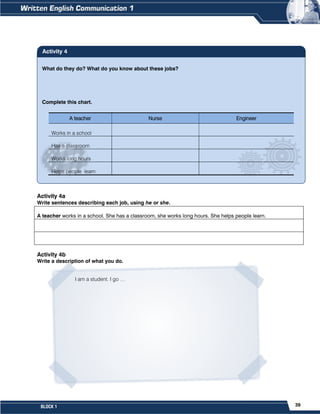
  • 15.
    15 BLOCK 1 Activity 3b Writea paragraph stating why it is important to greet people in our daily life. Activity 3c Write the most suitable reaction to the following phrases. a. How are you? ________________________________________________________________________________ b. How do you do? ______________________________________________________________________________ c. Pleased to meet you. __________________________________________________________________________ d. It was nice meeting you. _______________________________________________________________________ e. Have a good weekend. ________________________________________________________________________ f. See you next month. __________________________________________________________________________ g. You must be _________________________________________________________________________________ h. I hope to see you again. _______________________________________________________________________ EVALUATION Activity 3 Product: Written excercise. Value: KNOWLEDGE Factual Procedural Attitude Recognizes forms of greetings in different situations and the importance that greetings have in. Practices in written form small dialogues to learn different greetings to be used in real life language. Integrates new vocabulary and conversational expressions to be used for greeting in a real context. Co evaluation C MC NYC Obtained value: ____________________________________________________________________________ ____________________________________________________________________________ ____________________________________________________________________________ ____________________________________________________________________________ ____________________________________________________________________________ ____________________________________________________________________________ ____________________________________________________________________________ ____________________________________________________________________________ ____________________________________________________________________________ ________________________________________________
  • 16.
    16 REVIEWS ANDCONVEYS INTO WRITTEN DAILY SITUATIONS Read the tips and useful phrases that will help you in your daily life. Situations and Places Tips Useful Phrases Greetings in passing Say an appropriate form of hello. Smile and wave. Hello! or Hi! Good morning! Good afternoon! Good evening! How's it goin'? What’s up? Greetings before a Conversation Stand near a person and say hello. Ask a question or begin a conversation Nice to see you. Long time no see. What have you been up to? How are things? It's been a while. (It's been a while since I've seen you.) What's new? Not much. (answer to What's new?) Greeting at a party or Social Event Say hello and introduce yourself to a person who is not in a conversation. Discuss one party related item (food, theme, length of stay). Who are you here with? How do you know Jane? (party host) I don't think we've met. Have you been here long? Have you tried the cheese dip/dessert/punch? Where did you get your costume? The food looks great. Greetings in Business Introduce yourself with name and title. Shake hands. Express happiness to meet the other person. Give or accept directions. Please have a seat. Thanks for agreeing to meet with me. He'll be right with you. Can I offer you something to drink? My pleasure. Activity 4
  • 17.
    17 BLOCK 1 Activity 4a Choose3 situations or place and write small dialogues using the tips and useful phrases from the chart. Dialogue 1 Situation or place ___________________ Dialogue 2 Situation or place __________________ Dialogue 3 Situation or place____________________
  • 18.
    18 REVIEWS ANDCONVEYS INTO WRITTEN DAILY SITUATIONS Activity 4b Write the useful phrase that you would use in the following situations. 1. When you arrive to school and walk next to the principal. _____________________________________________________________________________________________ 2. When you are at a party and someone introduce you to her/his friend. _____________________________________________________________________________________________ 3. When you are shopping and meet with an old friend. _____________________________________________________________________________________________ 4. When you are in a bus stop and someone smile at you. _____________________________________________________________________________________________ 5. When you are at a party and someone stands next to you. _____________________________________________________________________________________________ Activity 4c Write an F if the phrase or statement is formal, Write a C if the phrase or statement is casual. a. How are you? __________ b. How do you do? __________ c. Excuse me, are you Albert Lennon? __________ d. Sorry, I don’t know your name. __________ e. Hi everybody. My name’s Alex Harris. __________ f. May I introduce myself? __________ g. This is Caroline. __________ h. Let me introduce you to Caroline So. __________ i. Goodbye. It’s been very interesting talking to you. __________ j. See you. I really had a good time. __________ k. I got to go now. __________ l. I’m afraid I must be going soon. __________ EVALUATION Activity 4 Product: Written dialogues. Value: KNOWLEDGE Factual Procedural Attitude . Writes small dialogues using different forms of greetings according to the place or situation. Reads information to write small dialogues using different forms of greetings, tips, and phrases useful in daily life. Integrates new vocabulary and conversational expressions to be used for greeting in a real context Co evaluation C MC NYC Obtained value:
  • 19.
    19 BLOCK 1 Activity 5a Matchthe titles in the left column with people from the right column. Write the letter in the parenthesis. Mr. and last name ( ) A mother to her child Ma’am ( ) A teacher in University Miss and last name ( ) My child’s teacher (woman) Professor ( ) A young lady at a party Mrs. and last name ( ) Supervisor or Manager (man) at work Dear ( ) A waitress Activity 5b How would you address the following people, write a title on the line. The bus driver __________________________________________ Your boy/girl friend's parents ______________________________ The principal of your school ______________________________ A man or a lady older than you ____________________________ A classmate ____________________________________________ The young secretary at school ____________________________ An old lady in the bus ___________________________________ Your friend on a first name basis __________________________ Here are the formal titles that you can use when addressing someone: Sir: to address an adult male or a female in a formal matter. Ma'am: a formal address for a lady. Madam: a formal address for a lady. Mr. + last name: formal and informal address for a man. Mrs. + last name: to address a married woman with her husband’s last name. Ms + last name: used in business for married or non- married woman. Miss + last name: to address an unmarried woman. Professor + last name: use to address a professor in university. Here are some “Pet names” or titles of affection used when addressing a child or a family member: Dear, Honey, Darling, and sweetie. Young people sometimes use: Buddy or Pal. Read the text carefully. How to address people Before starting a conversation with someone, we have to know how to address him/her. In the English language and culture there will be some people that need more formality than others. It is not the same to address people when speaking than to do it in writing, writing has different rules and formalities. The difference in addressing people involves age, job, education, religion and even marital status. Sometimes a person gives you permission to use his or her first name. In English we use the phrase "on a first name basis" to describe a relationship that is not very formal. Activity 5
  • 20.
    20 REVIEWS ANDCONVEYS INTO WRITTEN DAILY SITUATIONS Activity 5c Complete the following statements with corresponding title. EVALUATION Activity 5 Product: Written form. Value: KNOWLEDGE Factual Procedural Attitude Identifies forms to address people taking on account age, marital status, etc. Practices in a written form the use of titles with names and anticipates the problem of misusing a title when addressing people in a real context. Integrates new vocabulary to be used in real context to properly address a person. Co evaluation C MC NYC Obtained value: 1 2 3 4 5 Good morning __________ __ Taylor. You are on time for your appointment. You are applying for the policeman Position, aren’t you Taylor? Excuse me ____________, can you take my order please? Excuse me, _____________________ House I’m not going to be able to attend your anthropology classes this week. Would you like to dance with me______________________? My name is Adrian. Hi! ____________________ What’s for lunch today? _______________ Dresser this letter is to let you know that you have been accepted for the job. Call me tomorrow at 1800-546221 6
  • 21.
    21 BLOCK 1 If youwant to write about the best films visit: http://www.oscars.org/index.html Weather -Kind of chilly this morning, isn’t it? -What a beautiful morning. A bit windy but beautiful. -It’s never that hot at this time of the year. -It’s been raining for weeks. Is this never going -to end? Family A: How’s Janet doing? I haven’t seen her for ages. B: Oh, she’s fine. Se just got a job. A: That’s great news. We should get together one of these days B: Sure. That’d be great. … Sports A: Did you see the game last night? B: No, I missed it. Was it a good game? Films A: Have you seen “Avatar”? We went to see it last night. B: How was it? A: Pat thought it was hilarious, but I was a bit disappointed. Read what you have to know about a conversation. Conversations A well conducted conversation starts by a greeting and by addressing properly. Conversations can open up a new universe for business or job opportunities, also help you make friends, and help you relate with others. It is possible that you will need to give or ask for personal information (name, address, telephone number, e-mail address, etc.) These questions will help you get to know people. They are simple questions with simple answers and provide information so you can ask more questions. What is your name? What is your address? Where do you live? What is your telephone number? What do you do? What is your e-mail address? Where are you from? What is There are casual forms of conversations that “break the ice” in certain situations and places, these forms are called Small talks, places where you use these talks: in a doctor's or dentist's waiting room, at a bus stop, in a waiting line, etc. Sometimes in these casual conversations you don’t want to give your personal information, you can say: I’d rather not say. __ I don’t give out personal information. There are certain topics that people usually make small talk about: weather, sports, current events, day, family and news. Here are some ways to start a small talk: Activity 6
  • 22.
    22 REVIEWS ANDCONVEYS INTO WRITTEN DAILY SITUATIONS Activity 6a Write questions for each statement. 1. ___________________________________________________________________________________________? I Study and work for an insurance company. 2. ___________________________________________________________________________________________? My name is Albert but you can call me Al. 3. ___________________________________________________________________________________________? I am from Douglas but I’ve lived in Agua Prieta for 4 years. 4. ___________________________________________________________________________________________? I don’t give up personal information, I’m sorry. 5. ___________________________________________________________________________________________? I have two but you can write me at vip4@gmail.com Activity 6b Write, what you would say in the following situations. 1. You get into a book store. Greet the people in there and ask for a book. ___________________________________________________________________________________ ____________________________________________________________________________________________ ____________________________________________________________________________________________ 2. You are at a party with your friends. You are introduced to one person. Greet him/her and make an invitation for a drink. ____________________________________________________________________________________________ ____________________________________________________________________________________________ ____________________________________________________________________________________________ 3. You are at a meeting. Introduce one of your colleagues to your boss. ____________________________________________________________________________________________ ____________________________________________________________________________________________ ____________________________________________________________________________________________ EVALUATION Activity 6 Product: Written exercise. Value: KNOWLEDGE Factual Procedural Attitude Recognizes the use of WH questions to obtain information in a conversation. Applies the correct WH questions when asking and answering questions in exercises, and to be used in situations where it is needed. Appreciates the use of the language to be applied in a real context. Co evaluation C MC NYC Obtained value:
  • 23.
    23 BLOCK 1 Activity 7a Withthe help of your teacher gather all the information from the other teams, add and write all these information on the board so you can draw graphs about AGE, ORIGIN, WAYS OF TRANSPORTATION, GOOD OR BAD TRANSPORTATION. Work in groups of five. Ask your group members questions and write their answers on the following chart. What’s your name? _______________ _______________ _______________ _______________ Where are you from? How old are you? How far is your house from your school? Is there a good public transportation in your city? How do you come to school? Activity 7
  • 24.
    24 REVIEWS ANDCONVEYS INTO WRITTEN DAILY SITUATIONS EVALUATION Activity 7 Product: Graphs. Value: KNOWLEDGE Factual Procedural Attitude Selects classmates’ information for making graphs. Practices oral and written skill by asking questions to classmates to obtain information for making graphs. Participates with classmates interchanging information by asking and answering questions and interchanging graphs. Co evaluation C MC NYC Obtained value:
  • 25.
    25 BLOCK 1 Activity 8a Writethe topic under each picture. _______________ ________________ ________________ ________________ _________________ _______________ ________________ ________________ ________________ _________________ Here you will find information in the topics: Global warming: http://topics.nytimes.com/top/news/science/topics/globalwarming/index.html# Environmental: http://thinkgreen.discoveryeducation.com/ Sports: http://sportsillustrated.cnn.com/ Technology: http://www.cnn.com/TECH/ Practice small talk. Check which of the following topics you would talk to a friend, a colleague, or an important business partner. Write a check mark. Topics Friend / Colleague Business partner Family International Politics Salary or wage Travel Weather Food and drinks Religion Health Global Warming, pollution, environmental topics Sports Your hobbies Computer and new technology Corruption Activity 8
  • 26.
    26 REVIEWS ANDCONVEYS INTO WRITTEN DAILY SITUATIONS Activity 8b Pair work. Discuss with your classmate which of the above topics is the most used nowadays. Write a dialogue about this topic. A. B. A. B. A. B. A. B. A. B. A. B. A. B. A. B. Activity 8c Act out the dialogue in front of the class. EVALUATION Activity 8 Product: Written dialogue. Value: KNOWLEDGE Factual Procedural Attitude Identifies topics in a small talk useful in the writing of dialogues. Integrates the topics to the formation of dialogues using the studied structures and forms. Shows respect and creativity when working with his/her partner. Co evaluation C MC NYC Obtained value:
  • 27.
    27 BLOCK 1 Read deconversation and answer the question. Julia: Nina! Hey, Nina! How’s it going? Nina: Julia! Hi! I’m fine. How’re you? Julia: Fine, thanks. Nina, this is Isabella, Isabella this is my friend Nina. Isabella: Nice to meet you. Nina: Nice to meet you too. Are you from around here? Isabella: No, I’m from Hermosillo. Nina: Oh, that’s interesting. Hermosillo is the capital of Sonora, isn’t it? Isabella: Yes, that’s right. How about you? What’s your hometown? Nina: I’m from Birmingham, Michigan. Isabella: Oh, really? Is that a big city? Nina: No, it is a small suburb in the state of Detroit. The population is 19,291 as of the 2000 census. What is the population in Hermosillo? Julia: It’s really a big city. There are over 700,000 people in Hermosillo. Nina: Wow! That’s a lot of people! Isabella: it is. But there’s good public transportation, so it isn’t bad. Nina: So, isn’t it hard to get from your house to your University? Isabella: No, I just take the bus and I get there in just 15 minutes. Nina: By the way! I have to run to take the bus. See you guys later. Isabella: Bye, Nina. Julia: Take care, Nina. Nina: You too. Bye. 1. Where is Isabella from? _________________________________________________________________________ 2. Is Isabella from a small town? ____________________________________________________________________ 3. Where is Nina from? ____________________________________________________________________________ 4. Is Nina from a small town? What is the population? __________________________________________________ 5. Why does Isabella think that it isn’t bad to live in Hermosillo? __________________________________________ __________________________________________________________________________________________________ Activity 9
  • 28.
    28 REVIEWS ANDCONVEYS INTO WRITTEN DAILY SITUATIONS Activity 9a Write the long forms and contractions you find in the conversation. How is it going? How’s it going? ___________________ ___________________ ___________________ ___________________ ___________________ ___________________ ___________________ ____________________ ___________________ ___________________ ___________________ ____________________ Activity 9b Circle the letter of the correct answer. 1. Who is Nina? a. Isabella’s cousin b. Julia’s friend c. Julia’s cousin 2. What does Isabella say about Hermosillo? a. It has a good library b. It has good public transportation c. It has about 20,000 people 3. What does Nina say about Birmingham? a. It’s a big city b. It’s the Capital of Detroit c. It has about 20,000 people EVALUATION Activity 9 Product: Practice excercise. Value: KNOWLEDGE Factual Procedural Attitude Identifies short /long form contractions as well as new vocabulary. Practices contractions, new vocabulary, and identifies facts in reading comprehension task. Appreciates the use of the language to be applied in a real context. Co evaluation C MC NYC Obtained value: Contractions are a way to combine words. When you put the two words together by dropping letters and then replace it with apostrophe (’) Example: Long Form Contraction I am from Hermosillo I’m from Hermosillo Do not use contractions for short answers. Are you from Guaymas? Yes, I am. (Not: Yes I’m)
  • 29.
    29 BLOCK 1 Closing activities EVALUATION Activity10 Product: Chain map. Value: KNOWLEDGE Factual Procedural Attitude Orders in a map the steps that take to get to a conversation. Elaborates a chain map integrating the steps required to get to a good conversation. Integrates his/her previous knowledge organized in a map. Co evaluation C MC NYC Obtained value: To get to know a person you have to know some facts about her/his life, you have to ask for personal information, address properly, greet according to the situation or place. Organize in a map the steps that take to finally get to a conversation. Remember that mapping makes it easier to organize a process or a sequence; it helps you remember what you have to do. Example of a Chain map Activity 10
  • 30.
    30 REVIEWS ANDCONVEYS INTO WRITTEN DAILY SITUATIONS EVALUATION Activity 11 Product: Dialogue. Value: KNOWLEDGE Factual Procedural Attitude Writes a dialogue based on a previous one, using his/her own information. Creates a dialogue using her/his own information using all the structures and Vocabulary learnt. Co evaluation C MC NYC Obtained value: Use the conversation from a previous page to write your own conversation, this time using your own words and ideas. Make a team of 4, choose the best conversation and present it in class. Activity 11
  • 31.
    31 BLOCK 1 Activity 12 SocialQuiz: Choose the best possible response. Write the letter on the right line. Then interchange the results with your partners. 1. Hi, how are you? 1. _______ a. Fine, thanks. And you? b. I’m Mike. c. Not too bad. 2. Meet my friend Jack. 2. _______ a. Nice to meet you. b. What time? c. How do you do? 3. How was your flight? 3. _______ a. It was all right. b. Yes, of course. c. The plane was a bit late but it didn’t matter. 4. Would you like to look around the company? 4. _______ a. No, it’s none of my business. b. That’d be lovely. c. Yes, I’d love to. 5. Would you prefer orange or cranberry juice? 5. _______ a. Yes, of course. b. I don’t want. c. I don’t mind. 6. I’m terribly sorry about the delay. 6. _______ a. Don’t worry about it. b. You should be. c. You’re welcome. 7. Thank you very much. 7. _______ a. Here you are. b. Don’t mention it. c. Welcome. 8. My sister has had an accident. 8. _______ a. Really? b. I’m sorry to hear that. Is she all right? c. I’m sorry to hear that. Is the car OK? EVALUATION Activity 12 Product: Quiz. Value: KNOWLEDGE Factual Procedural Attitude Selects the possible response and recognizes its use in small talks. Practices for socializing in a real context. Shows openness when receiving feedback. Co evaluation C MC NYC Obtained value:
  • 32.
    32 REVIEWS ANDCONVEYS INTO WRITTEN DAILY SITUATIONS EVALUATION Activity 13 Product: Report. Value: KNOWLEDGE Factual Procedural Attitude Analyzes lyrics from a classic song, identifies verb tenses and integrates vocabulary to his/her daily use. Investigates in the internet a song, identifies verb tenses and acquire new vocabulary for her/his daily use of the language. Values the use of the standard English vocabulary. Co evaluation C MC NYC Obtained value: Search in the internet for the classic song “Getting to know you” that was written for a movie many years ago. Write the lyrics. Underline the Present Simple tense and circle the Present Progressive tense. Activity 13
  • 33.
    33 BLOCK 1 Write onthe lines below the activity that doesn’t belong to each line. 1. Make lunch Make dinner Listen to music Make breakfast 2. Clean Play basketball Play the guitar Relax 3. Brush teeth Walk the dog Take a shower Comb my hair 4. Go to work Come home Get dressed Go to school 5. mop the floor Read Do the laundry Wash dishes 1. ____________________________ 4. _____________________________ 2. ____________________________ 5. _____________________________ 3. ____________________________ Activity 1 Didactic sequence 2. What do you do every day? Start up activities Activity 1a Write the number on the line. 1. In what line are three of the activities related to relaxing? In line ___________ 2. In what line are three of the activities related to cooking? In line ___________ 3. In what line are three of the activities related to personal hygiene In line ___________ 4. In what line are three of the activities related to house choirs? In line ___________ 5. In what line are three of the activities related to leaving and In line ___________ returning home? Activity 1b. Do the Criss-Cross puzzle using the above activity verbs? Across 2. It is Diego's turn to__ the house. 5. Mary Joe __ in a factory. 7. Charles ____ the acoustic guitar. 8. Every day I __the newspaper. Down 1. Let’s __ a romantic dinner. 3. I__ to classic music in my iPod. 4. Pat __ everybody's hair except hers. 6. You have to__ the bus here.
  • 34.
    34 REVIEWS ANDCONVEYS INTO WRITTEN DAILY SITUATIONS Activity 1c Match the underlined household chores verbs to the object needed for the action. Write the number on the left line. _____ To sweep the office floor 1. Vacuum _____ To wash the office floor 2. Window cleaner _____ To clean windows and mirrors 3. Garbage can _____ To clean the wall-to-wall carpet 4. Paper towels _____ To wipe spilled liquid/to 5. Broom dry hands _____ To put the trash in 6. Sponge mop Activity 1d Write your daily or weekly household chores (verbs) on the lines. ____________________ ____________________ ____________________ ____________________ ____________________ ____________________ ____________________ ____________________ ____________________ ____________________ EVALUATION Activity 1 Product: Producer excercises. Value: KNOWLEDGE Factual Procedural Attitude Identifies and understand the use of the Present simple needed to conduct activities of daily living related to different topics as: work, household and leisure activities. Demonstrates the ability to understand basic information needed to conduct activities of daily living. Shows initiative and interest by working in class. Co evaluation C MC NYC Obtained value:
  • 35.
    35 BLOCK 1 Development activities Readthe Conversation and answer the questions. Mary Joe: Where do you work Camille? Camille: I work for a Travel Agency. Mary Joe: Oh! Really? What do you do there? Camille: I am a guide. I take people on tours to different sight in Sonora. Mary Joe: That sounds interesting! Camille: Yes is a great job. I love it, and what do you do? Mary Joe: I’m in engineer school, and I have a part-time job, too. Camille: Where do you work? Mary Joe: In a Factory. Camille: Which Factory? Mary Joe: Meca S.A. Is not as interesting as your job, besides It takes me an hour to get home from work. Camille: Why don’t you come with me in one of the tours? Mary Joe: It would be very exciting! Where would we go exactly? Camille: The route starts at Ures, then following the river we get to Baviacora and to the main attraction, the thermal spring waters. Mary Joe: Where is that? Camille: It is in Aconchi, a very popular natural spa. Mary Joe: Do you visit all those places? How interesting. Camille: Yes, we usually visit 4 more places and finish the tour in Cananea. Mary Joe: When is the next “Rio Sonora Route” going to be? Camille: I’ll send you a schedule and a triptych with all the information. Mary Joe: Ok, let me know so I can make plans. What does Camille do at work? __________________________________________________________________________________________________ __________________________________________________________________________________________________ How does Camille like her job? __________________________________________________________________________________________________ Does Mary Joe like her job? __________________________________________________________________________________________________ Where does Camille invite Mary Joe? __________________________________________________________________________________________________ Where are the thermal spring waters? __________________________________________________________________________________________________ What plans do they have? __________________________________________________________________________________________________ Activity 2
  • 36.
    36 REVIEWS ANDCONVEYS INTO WRITTEN DAILY SITUATIONS Grammar Point Activity 2 Review the grammar with your teacher. Activity 2a Complete the Conversations. a. What __________you __________? b. I am a student I study business. a. And __________ do you __________ to school? b. I __________to University of Sonora. a. __________ do you like your classes? b. I __________ them a lot. a. What __________ Alex do? b. He is a teacher. He _______________ mathematics at a school in Obregon city. a. And what about Frederick? Where __________ he work? b. He _______________ for an editing company a. What __________ he do, exactly? b. He _______________ publications. Simple Present WH-questions Statements I/You He /She We/They do does work works go goes have has take takes study Studies eat eats play plays visit visits make makes clean cleans What do you do? Where do you work? Where do you go to school? How do you like your school? What does he do? Where does she work? Where does he go every day? What does he study? I am a student. I work in/at a restaurant. I go to university of Sonora. I like it very much. He is an engineer. She works for Ford Company. He goes to the library every day. He studies accounting.
  • 37.
    37 BLOCK 1 Activity 2b Completethe question in each conversation. 1. Where _______________ you work? I work in a department store. 2. What _______________ she do? She is a computer programmer. 3. Where does Caroline _______________ to school? She goes to IA University. 4. How _______________ does she like the classes? She likes them very much. 5. When _______________ you walk your dog? I walk my dog every afternoon. a. What _______________ your brother __________? b. He is an accountant. He ___________ for a construction company. a. What __________ he do? b. He _______________ in the payroll department. a. _______________ He likes his job? b. He says that he ____________ it. EVALUATION Activity 2 Product: Grammar review. Value: KNOWLEDGE Factual Procedural Attitude Identifies the use of Wh questions and auxiliary Do in the present tense used in activities of daily living. Practices simple present Wh-questions with the auxiliary Do and statements using I, you, he, and she. Values his/her charming state sights and integrates new vocabulary to his/her knowledge. Co evaluation C MC NYC Obtained value:
  • 38.
    38 REVIEWS ANDCONVEYS INTO WRITTEN DAILY SITUATIONS Activity 3 Search on the web for more information about the “Rio Sonora Route” make a schedule of a trip Giving all the information that Camille wants to give to Mary Joe (in the conversation in activity 2). Write it on a separate paper and paste it here. EVALUATION Activity 3 Product: Schedule. Value: KNOWLEDGE Factual Procedural Attitude Writes a schedule based on the information taken from the internet and integrates different topics vocabulary to his/her knowledge. Elaborates a schedule based on a reading from the internet. Uses a reading comprehension strategy. Integrates the use of technology to search for information as he/she values the beautiful great attractions in Sonora. Co evaluation C MC NYC Obtained value: Information at: http://www.gotosonora.com/rio-sonora-route.htm http://www.sonoraturismo.gob.mx/ruta-rio-sonora.htm
  • 39.
    39 BLOCK 1 Activity 4a Writesentences describing each job, using he or she. Activity 4b Write a description of what you do. A teacher works in a school. She has a classroom, she works long hours. She helps people learn. I am a student. I go … What do they do? What do you know about these jobs? Complete this chart. A teacher Nurse Engineer Works in a school Has a classroom Works long hours Helps people learn Activity 4
  • 40.
    40 REVIEWS ANDCONVEYS INTO WRITTEN DAILY SITUATIONS Activity 4c Pair Work. Go back to didactic sequence 2 and read the dialogue and with the help of your partner identify the difference between JOB and WORK. Check the box. 1. She's got a new _____. Job Work 2. They did a great _____ fixing my computer. Job Work 3. He's got _____ with the government. Job Work 4. Ironing is hard ____. Job Work 5. If ____ is worth doing, it's worth doing well. Job Work 6. You've never done a day's _____ in your life. Job Work 7. There will be a lot of ____ losses when the factory closes. Job Work 8. She's always changing ___. Job Work 9. I've got _____ working for a bank. Job Work 10. It took me an hour to get home from ____ yesterday. Job work 11. Let's try to make the best of a bad ____. Job work 12. ________ in pairs. Job work EVALUATION Activity 4 Product: Excercise. Value: KNOWLEDGE Factual Procedural Attitude Identifies what the people do according to their job and recognizes the use of the words: job and work. Applies the Simple present tense used to conduct activities related to professions and occupations at the same time uses the word job and work correctly. Collaborates and shows respect to his/her partner when working in pairs. Co evaluation C MC NYC Obtained value:
  • 41.
    41 BLOCK 1 Activity 5a Matchthe profession or occupation to what they do. Write the number in the parenthesis. 1. Geologist ( ) Writes news articles 2. Editor ( ) Drives to places to deliver products 3. Optician ( ) Gives legal advice to people 4. Pharmacist ( ) Hosts a radio talk show 5. Announcer ( ) Specialist in the study of rocks 6. Mechanic ( ) Makes glasses to improve vision 7. Truck driver ( ) Notifies news, facts, and articles 8. Teller ( ) Plans the content of publications 9. Reporter ( ) Fixes and repairs cars 10. Lawyer ( ) Works in a drugstore filling prescription Read other Professions and Occupations What does he/she do? Profession or Occupation Follows detailed instructions on blueprints while installing pipes Plumber Studies rocks that make up the earth's crust geologist Influences people by performing in a play actor Works with computers while doing repetitive and analytical work programmer Communicates ideas while hosting a radio talk show announcer Takes responsibility for helping people learn teacher Works with people to help improve their vision optician Takes responsibility to plan the contents of a publication editor Expresses facts and ideas through written news articles reporter Follows strict standards when filling a prescription pharmacist Meets strict standards when repairing an automobile mechanic Takes responsibility for handling large amounts of money teller Works under stress while driving long distances to deliver products truck driver Grows vegetable crops involving many changing duties farmer Follows set standards while conducting experiments in a chemical laboratory chemist Follows instructions while applying paint to walls painter Deals with people to give legal advice lawyer Takes responsibility while working with people to deliver health services dentist Follows recipes while preparing fancy meals chef Activity 5
  • 42.
    42 REVIEWS ANDCONVEYS INTO WRITTEN DAILY SITUATIONS Activity 5b Write the occupation or profession under each picture. ______________________ _____________________ _____________________ ___________________ _____________________ _____________________ _____________________ _____________________ Activity 5c Complete the dialogues. EVALUATION Activity 5 Product: Exercise. Value: KNOWLEDGE Factual Procedural Attitude Identifies and acknowledges vocabulary related to occupations and professions relating the present Simple need to conduct work activities. Recognizes vocabulary of professions and occupations and apply it to activities related to work activities. Integrates responsibly new vocabulary to his/her knowledge. Co evaluation C MC NYC Obtained value: a. Hello! I am the new ______________ Can I help you? b. Yes, I want a bottle of this. a. Sorry, if you don’t have your _________________ I can’t sell you anything. b. Oh, I have the prescription with me, would you fill it up? please. a. Do you know the name of the _________________ who described the processes that have shaped the surface of the earth? b. Is he the person that wrote about _____________and earth’s crust? a. Yes, what’s his ____________? b. His name is James Hutton. James hutton
  • 43.
    43 BLOCK 1 Closing activities Readthe table of does and doesn’t of professions and occupations and with the help of your teacher write what each person CAN or CAN’T do. Example: a mechanic/ a farmer A mechanic CAN repair an automobile but CAN’T grow crops and vegetables as a farmer does. 1. a plumber/a Chemist _______________________________________________________________________________________ 2. a geologist/ an editor ______________________________________________________________________________________________ 3. a chef/an actor _____________________________________________________________________________________________ 4. an optician/ a truck driver ______________________________________________________________________________________________ 5. a dentist/ a lawyer ______________________________________________________________________________________________ 6. A pharmacist/ a teller ______________________________________________________________________________________________ 7. a programmer/ a reporter ______________________________________________________________________________________________ 8. a chemist/ a truck driver ______________________________________________________________________________________________ 9. an actor/ a lawyer _______________________________________________________________________________________________ 10. a painter/ a chef _______________________________________________________________________________________________ Activity 6
  • 44.
    44 REVIEWS ANDCONVEYS INTO WRITTEN DAILY SITUATIONS Activity 6a Write an “indefinite article” before each of the professions and occupations. 1. __________ plumber 2. _________ geologist 3. __________ actor 4. __________ programmer 5. __________ announcer 6. __________ teach 7. __________ optician 8. __________ editor 9. __________ reporter 10. __________ pharmacist 11. __________ mechanic 12. __________ teller 13. __________ truck driver 14. __________ farmer 15. __________ chemist 16. __________ painter 17. __________ lawyer 18. __________ dentist 19. __________chef EVALUATION Activity 6 Product: Practical exercise. Value: KNOWLEDGE Factual Procedural Attitude Identifies and acknowledges vocabulary related to occupations and professions linking the present Simple need to conduct work activities. Recognizes vocabulary of professions and occupations and apply it to activities related to work activities. Integrates the new vocabulary to his/her knowledge. Co evaluation C MC NYC Obtained value: Indefinite Articles - "A" and “AN" signal that the noun modified is indefinite, referring to any member of a group. - Remember, using “A” or “AN” depends on the SOUND that begins the next word. - “A” with singular noun begins with a consonant: A book - A problem But: A university - A hotel - “AN” with singular noun begins with a vowel: An egg - An acorn But: An hour - An historical event -Note: A and AN are used with professions and occupations: A doctor – An engineer  a + s i n g u l a r n o u n b e g i
  • 45.
    45 BLOCK 1 Identifies andunderstand the use of the Present simple needed to conduct activities of daily living related to different topics as: work, household and leisure activities.  Describe your hobbies and interests in a simple way  Ask and answer simple questions on familiar topics and about personal details  Make and respond to simple statements http://www.clafoti.com/imagenes/articles.htm  Discusses the differences between indefinite articles (a/an) and definite
  • 46.
    46 REVIEWS ANDCONVEYS INTO WRITTEN DAILY SITUATIONS Didactic sequence 3. I will be a computer programmer. Start up activities Complete the analogy; write the letter on the right line. Remember that an analogy is: drawing a comparison in order to show similarity in some respect. Example: Remember: an analogy is drawing a comparison in order to show similarity in some respect. Example: Horses are to past societies as computers are to future societies. Glove is to hand as paint is to wall. 1. Fast is to quick as loud is to _____. a. speedy b. noisy c. concert d. rush 2. Green is to go as yellow is to _____. a. stop b. speed c. slow d. bright 3. Seed is to tree as egg is to _____. a. breakfast b. bird c. sprout d. dozen 4. River is to land as veins are to _____. a. blood b. body c. lake d. highways 5. Rich is to money as well is to _____. a. water b. deep c. health d. wishes 6. Cat is to meow as dog is to ______. a. laugh b. bark c. cuac d. cry Activity 1
  • 47.
    47 BLOCK 1 Activity 1a Figureout why the first pair of words go together so that you can finish the second analogy pair. Study: student - teach: ____________________ England: English – French _____________________ Wind: blows – sun: _________________________ I: mine – they: _______________________________ Man: men – mouse: _______________________ bad: worse – good: ___________________________ Small: large – rich: ________________________ come: came – ride: __________________________ Careful: care – beautiful: ___________________ eyes: see – ears: _____________________________ Two: second – six: ________________________ 11th : eleventh – 12th . ___________________________ I: mine – She: ____________________________ pretty: ugly – short: ___________________________ Ability: can – Future: ______________________ Doctor: Hospital – Secretary: ___________________ Activity 1b Compare your answers with a partner. You can practice at: http://www.sadlier-oxford.com/phonics/analogies/analogiesx.htm EVALUATION Activity 1 Product: Review. Value: KNOWLEDGE Factual Procedural Attitude Identifies words that show similarity to form analogies. Practices grammar and vocabulary by forming analogies and recognizing similarities between words. Shows respect when collaborating with classmates. Co evaluation C MC NYC Obtained value:
  • 48.
    48 REVIEWS ANDCONVEYS INTO WRITTEN DAILY SITUATIONS Development activities Activity 2a Read the dialogue and answer the questions. Diana: I am so excited! We are going to have our summer vacations! Alex: What are you going to do? Diana: I will look for a summer job. What will you do? Alex: Well, I am going to rent a condominium in Rocky Point. I am going to take long walks along the beach and I am going to swim every day. Diana: It sounds great! Alex: Why don’t you come with us? Diana: No, I told you I’m going to look for a summer job. I won’t go on vacations. Alex: Oh, my uncle is looking for someone to help him in his computer store. You only need to recognize inside and out operating system vocabulary. Diana: I use the computer to do my tasks, but….. Alex: Don’t worry, you know enough and I am going to send you everything I have and my computer dictionary. Diana: That sounds great! Call your uncle and make an appointment for me, please. Alex: I’ll make an appointment for you. I wish you good luck! Diana: You too, have a nice vacation. 1. Why is Diana very excited? __________________________________________________________________________ ______________________________________________________________________________________________________ 2. What is Diana going to do on vacations? ______________________________________________________________ ______________________________________________________________________________________________________ 3. What is Alex going to do on vacations? _______________________________________________________________ ______________________________________________________________________________________________________ 4. Is Diana going to Rocky Point? ______________________________________________________________________ 5. What is Alex going to do to help Diana to find a job? ____________________________________________________ ______________________________________________________________________________________________________ Activity 2b Underline be going to and Will used for future tense. Compare the underlined words with your classmates. Grammar point Future using WILL and Going to We use will for prediction when we have no real evidence: "It will snow this winter”, and when there are no plans or decision to do something: I think I'll go to your house tomorrow. We use going to for prediction when there is some real evidence: "It's going to snow this afternoon”, and when we have the intention to do something: I am going to buy a computer. Negative form Will not – Won’t Are Going to – aren’t going to Is going to _ isn’t going to Am going to _ am not going to
  • 49.
    49 BLOCK 1 Activity 2c Completethe conversation with appropriate form of be going to or will. A: Have you made any vacation plans? B: Well, I’ve decided on one thing. I ____________________ go to Navojoa. A: That’s great! how long? B: I ___________________be away for a week. I only have five days vacation. A: So, when are you leaving? B: I’m not sure. I ____________ probably leave around the end of June. I won’t have long term vacations. A: And where _________ you _______________go? B: I guess I ___________ go to Tucson. A: _________ you ______________go with anyone? B: No, I ________________travel alone. Activity 2d Think about your next vacation. Write answers to these questions. (If you already have plans, use be going to. If you don’t have fixed plans, use will. Use negative forms if necessary). 1. How are you going to spend your next vacations? _______________________________________________ ____________________________________________________________________________________________ 2. Are you going to go anywhere? _______________________________________________________________ 3. When are you going to take your vacations? ____________________________________________________ 4. What are you going to do? ___________________________________________________________________ ____________________________________________________________________________________________ 5. Are you going to travel with your family?________________________________________________________ EVALUATION Activity 2 Product: Written excersice. Value: KNOWLEDGE Factual Procedural Attitude Identifies the grammar structure “be going to” and the modal “will”. Demonstrates the ability to use and identify proper future forms. Shows respect when working individually and in a collaborative setting. Co evaluation C MC NYC Obtained value:
  • 50.
    50 REVIEWS ANDCONVEYS INTO WRITTEN DAILY SITUATIONS What Diana needs to know about Computer System. Dictionary Use Activity 3 Look for the meaning of the following words in the Computer Dictionary. Hard drive ____________________________________________________________________________________________ ______________________________________________________________________________________________________ Windows______________________________________________________________________________________________ ______________________________________________________________________________________________________ Operating system ______________________________________________________________________________________ ______________________________________________________________________________________________________ ______________________________________________________________________________________________________ Upgraded ____________________________________________________________________________________________ ______________________________________________________________________________________________________ Graphics _____________________________________________________________________________________________ BIOS _________________________________________________________________________________________________ System8______________________________________________________________________________________________ ______________________________________________________________________________________________________ User friendly __________________________________________________________________________________________ DOS _________________________________________________________________________________________________ Essential _____________________________________________________________________________________________ You can find a computer dictionary at: http://www.computer-dictionary-online.org/ http://library.thinkquest.org/C0113882/diction.shtml
  • 51.
    51 BLOCK 1 Activity 3a Dothe Criss-Cross puzzle using the computer system words above. Down 1. Media device used to permanently store all data. 2. A software or hardware device designed to make the use of computer easy. 3. Allows a user to work easily with many programs and view multiple programs. 4. It describes updating a software program. 5. Basic input/output system. 6. A digitized version of a photograph. 7. Disk operating system. Across 8. Software program that enables the hardware to communicate and operate with the computer. Activity 3b Learn more about Microsoft Windows quick links, since windows is one of the most common operating systems (OS) used today - particularly by students like you. Menu bar Title bar Toolbar Minimize Maximize / Resize Close Vertical scroll bar Status bar Horizontal scroll bar Sizing handle
  • 52.
    52 REVIEWS ANDCONVEYS INTO WRITTEN DAILY SITUATIONS Activity 3c Answers the questions. Are the names of the quick links the same in your language? __________________________________________________ Do you name the quick links in Spanish or English? _________________________________________________________ In what bar do you find the resize link? _____________________________________________________________________ What do you find in the Menu Bar? ________________________________________________________________________ ______________________________________________________________________________________________________ When do you use the vertical scroll bar? ___________________________________________________________________ ______________________________________________________________________________________________________ Play and learn more about computers: http://www.computerlabkids.com/parts.htm EVALUATION Activity 3 Product: Practice. Value: KNOWLEDGE Factual Procedural Attitude Defines and distinguishes computer information and vocabulary. Integrates new vocabulary to be used when working with new operating systems. Integrates vocabulary to her/his knowledge the use of the dictionary. Co evaluation C MC NYC Obtained value:
  • 53.
    53 BLOCK 1 Read Carefully. Dosand Don’ts of Computer Care Computers need special care and attention in order to perform properly and safely. There are several specialized tasks such as defragmenting, scanning and reformatting that computer experts can do to keep the internal system of a computer working well. However, we'll leave these tasks to the experts for now and concentrate on some daily do's and don'ts that any computer user should know. This may seem like a simple topic, but computers require special cleaning even on the outside. Keeping your system free of dust, dirt and liquids is the first step to computer care. There are some general tips that you should always remember:  You must never spray your monitor screen (or any other computer component) with glass cleaner. Instead, you may spray a lint-free cloth lightly with glass cleaner and then clean the screen.  Computer components should be kept as dust-free as possible.  For safety reasons, you must never use your computer during a storm.  You must keep all liquids and food items away from your computer.  You should install, use, and regularly update virus software.  You must never open an e-mail attachment unless you know and trust the person who sent it.  You must not accept downloads from Internet sites that you don't know and trust. Following these guidelines should help you to take good care of your computer system, so that you can get lots of enjoyment from it. Activity 4 Grammar Point Activity 4a Write a statement from the reading that means: Ability: _________________________________________________________________________________________ Obligation: _____________________________________________________________________________________ Advice: ________________________________________________________________________________________ Option: ________________________________________________________________________________________ Modal Verbs Modal verbs give additional information about the mood of the main verb that follows it. They help to incorporate or add the level of necessity: Modal verbs Negative form Must = obligation, requirement, and no choice. Must not mustn’t Should = recommendation or advice. Should not shouldn’t Can/could = ability. Cannot can’t Could not couldn’t May/might = option, choice, or possibility. May not __ May= Permission Might not __
  • 54.
    54 REVIEWS ANDCONVEYS INTO WRITTEN DAILY SITUATIONS Activity 4b Read the statements and answer TRUE or FALSE on the lines. 1. You may not use the computer during storm. ______________ 2. Spray your computer with household cleanser to keep it clean. ______________ 3. Spilling liquids in your computer won’t hurt it. ______________ 4. Keeping your computer dust-free can help it last longer. ______________ 5. .The computer won’t be damage while I eat chocolate. ______________ 6. Downloading from internet sites could expose your computer to dangerous viruses. ______________ 7. Opening an e-mail attachment could download a virus into your computer system. ______________ 8. Canned air can be used to clean your computer keyboard. ______________ 9. Your mouse should never need cleaning. ______________ 10. You should remove the computer cover monthly to clean inside. ______________ Activity 4c. Fill in the spaces with the right modal verbs. 1 I ______________________speak English very fluently. Ability (negative modal) 2 He doesn't sing very well now, but he _______________sing beautifully when he was a child. Past ability 3 You ____________ eat those mushrooms; they ___________be poisonous. Advice (negative modal) Possibility 4 I ______________ write English well, but I have trouble speaking. Ability 5 You __________________ pay the rent tomorrow. The owner is very strict about paying on time. Obligation 6 Jenny's ring is enormous! It _______________ cost a fortune. Possibility 7 __________________ I borrow your car this weekend? Permission 8 You _______________have at least a bachelor's degree to apply. Obligation EVALUATION Activity 4 Product: Exercise. Value: KNOWLEDGE Factual Procedural Attitude Identifies the “Modal Auxiliaries” in a text and defines the level of necessity. Applies the “Modal Auxiliaries” identifying the level of necessity. Shows respect when working individually and in a collaborative setting. Co evaluation C MC NYC Obtained value:
  • 55.
    55 BLOCK 1 Closing activities MicrosoftWindows quick links. Activity 5a Look at the computer parts and answer the questions. 1. The______________________________ moves the cursor around the screen. 2. The _____________________________ allows you to see what you are doing in the computer 3. The _____________________________ allows you to save information from the computer 4. The _____________________________ lets you burn and save information from the computer. 5. The _____________________________ transfers data from a computer onto paper. EVALUATION Activity 5 Product: Exercise. Value: KNOWLEDGE Factual Procedural Attitude Identifies computer information and vocabulary. Applies computer vocabulary and identifies present tense verbs in third person. Shows respect when working individually and in a collaborative setting. Co evaluation C MC NYC Obtained value: Choose the corresponding word from the box for each sentence. Recycle Bin – Task bar – Start menu – icon - tool bar – little bar – control panel 1. The start menu and the clock are found on the _________________________________. 2. An _________________________________ is a small picture that links to a file or program. 3. At the top of each window the __________________contains the title and buttons to close. 4. You put things in the _____________________________ that you don’t longer use or want 5. The ________________________________ contains important system controls. 6. The ___________________________below the menu, contains icons that allow you to perform specific tasks. 7. The ___________________________contains a menu with the words: log off, installed programs, my music, etc. Activity 5
  • 56.
    56 REVIEWS ANDCONVEYS INTO WRITTEN DAILY SITUATIONS Activity 6 Complete the statements with the appropriate future form. A: B: A: B: A: B. A: B: A: B: A: B: A: B: A: A B. A. B A. B. A. B. A. B. A. B. A. B. A. How old are you, Charlie? I'm eighteen years old. But I _______________________to be nineteen on January 6th . That's next Friday! What _______________________________________to do? Belem ____________________________________to take me to a restaurant. Nice ! ___________________she ________________to order a birthday cake? The waiters_______ probably _______________to sing "Happy Birthday" to me. It's so embarrassing! Oh, I bet it_________________________________ to be fun. I don't know. I hope so. When's your birthday? It's in September. September what? September 8th . And __________________you _____________________to be eighteen? I'm eighteen now. I _______________________________to be nineteen. Oh. So, do you have any plans? Well, my birthday is on a Saturday this year, so I __________________________ to have a party. And, I'm going to invite you and Belem. Will you come? B:Well, I think I will. Belem will probably come, too. Activity 6b Write a similar dialogue givng information about your friend’s and your own birthday.
  • 57.
    57 BLOCK 1 Activity 6c Choosethe correct future form in parenthesis and write it on the line. 1. Peter (is / is going to be) fifty next Friday. _____________________ 2. Oh no! I've broken the vase. What (am I going to say / will I say)? ________________________________ 3. Jack (is having / will have) a dinner party next Saturday. _______________________________ 4. By the time you arrive, I'll (have been / be) working for two hours. _______________________________ 5. John hasn't eaten. - (I will make / I am going to make) him a sandwich.___________________ 6. We'll go out for dinner when he (gets in / will get in). ___________________________________ 7. Unless he arrives soon, we (will not go/ are not going) to the party. ______________________ 8. (I will be studying / I will have studied) at 9 tomorrow evening. __________________________ 9. (We will have finished / We will finish) by 9 o'clock. ____________________________________ 10. Look at those clouds! It (is going to rain / will rain)! ____________________________________ EVALUATION Activity 6 Product: Written dialogues. Value: KNOWLEDGE Factual Procedural Attitude Identifies the future forms: will – be going to. Applies and practices the appropriate future forms to be used in his/her real context. Values the correct use of grammar. Co evaluation C MC NYC Obtained value:
  • 58.
    58 REVIEWS ANDCONVEYS INTO WRITTEN DAILY SITUATIONS Activity 7. The Future Computer 1. Investigate about “Future Computers” and write a report. How will they be like? What will they do? _______________________________________________________________ _______________________________________________________________ _______________________________________________________________ _______________________________________________________________ _______________________________________________________________ _______________________________________________________________ _______________________________________________________________ _______________________________________________________________ _______________________________________________________________ _______________________________________________________________ _______________________________________________________________ _______________________________________________________________ _______________________________________________________________ _______________________________________________________________ _______________________________________________________________ _______________________________________________________________ _______________________________________________________________ _______________________________________________________________ _______________________________________________________________ _______________________________________________________________ _______________________________________________________________ _______________________________________________________________ _______________________________________________________________ EVALUATION Activity 7 Product: Report. Value: KNOWLEDGE Factual Procedural Attitude Recognizes the use of the future form and verifies his/her writing skills. Searches for information using reading comprehension strategies that will help him/her to write a report. Appreciates the information to be used in a written report. Co evaluation C MC NYC Obtained value:
  • 59.
    59 BLOCK 1 The Evolutionof the Computer Activity 8 Search for information….(OPTION) ABOUT COMPUTER EVOLUTION. Then, look at the picture below and write the images in chronological order according to their development. (size, speed, parts, etc.) 1940s_________________________________________________________________________________________________ ______________________________________________________________________________________________________ ______________________________________________________________________________________________________ ______________________________________________________________________________________________________ ______________________________________________________________________________________________________ ______________________________________________________________________________________________________ ______________________________________________________________________________________________________ ______________________________________________________________________________________________________ Computer of the future __________________________________________________________________________________ ______________________________________________________________________________________________________ EVALUATION Activity 8 Product: Report. Value: KNOWLEDGE Factual Procedural Attitude Organizes information in chronological order. Reads information about computer evolution to be register in chronological order. Shows respect when working individually and in a collaborative setting. Co evaluation C MC NYC Obtained value:
  • 60.
    60 REVIEWS ANDCONVEYS INTO WRITTEN DAILY SITUATIONS
  • 61.
    Competencias Disciplinares básicas: 1.Realiza comprensiones oral y auditiva de diversos tipos de texto en otro idioma. 2. Realiza comprensión escrita y de lectura de diversos tipos de texto en otro idioma. 3. Realiza expresión o producción oral en otro idioma. 4. Realiza interacción oral en otro idioma. 5. Realiza expresión o producción escrita de diversos tipos de texto en otro idioma. Unidad de competencia: Escribe documentos formales e informales y responde correctamente a documentos y formatos empleando vocabulario y estructuras gramaticales en Inglés. Durante el presente bloque se busca desarrollar los siguientes atributos de las competencias genéricas: 4.1 Expresa ideas y conceptos mediante representaciones lingüísticas, matemáticas o gráficas. 4.2 Aplica distintas estrategias comunicativas según quienes sean sus interlocutores, el contexto en el que se encuentra y los objetivos que persigue. 4.3 Identifica las ideas claves en un texto o discurso oral e infiere conclusiones a partir de ellas. 4.4 Se comunica en una segunda lengua en situaciones cotidianas. 4.5 Maneja las tecnologías de la información y la comunicación para obtener información y expresar ideas. 6.4 Estructura ideas y argumentos de manera clara, coherente y sintética. 7.1 Define metas y da seguimiento a sus procesos de construcción de conocimiento. 8.2 Aporta puntos de vista con apertura y considera los de otras personas de manera reflexiva. 10.3 Asume que el respeto de las diferencias es el principio de integración y de convivencia en los contextos local, nacional e internacional. BLOCK 2. Writes formal and informal documents and formats. Time assigned: 20 hours.
  • 62.
    62 WRITES FORMAL,INFORMAL DOCUMENTS AND FORMATS Unscramble punctuation mark words. Write each name on the line. Didactic Sequence 1. Punctuation. Start up activities ? nioquset kram _____________________________________________ ! Claamextion noitpn ____________________________________________ , momac _____________________________________________ . deprio ____________________________________________ @ gisn ta _____________________________________________ Hckec karm _____________________________________________ “ tatquoion mkar _____________________________________________ : ooncl _____________________________________________ ; secolmion _____________________________________________ ( ) Parhesesent _________________________________________ EVALUATION Activity 1 Product: Diagnosis. Value: KNOWLEDGE Factual Procedural Attitude Recognizes punctuation marks. Recognizes punctuation marks by ordering words and by looking for the resemblance of signs. Shows initiative when working in basic exercises. Auto evaluation C MC NYC Obtained value: Activity 1 Activity 1a What punctuation marks were used to draw this face? Nose ___________________________________________ Beard __________________________________________ Ears ___________________________________________ Hair ___________________________________________ EYES ___________________________________________
  • 63.
    63 BLOQUE 2 Development activities Punctuation. Punctuationmarks are used to help understand the meaning of a sentence. They are symbols that are used to aid the clarity and comprehension of written language. Punctuation is very important, especially when used well— can make our intended meaning clear. Reviewing the rules of punctuation marks usage will help you understand the way sentences are built. PUNCTUATION RULES EXAMPLE . Period 1. The period is known as end mark. This punctuation mark shows where a sentence ends. It is used in declarative or imperative sentences. 2. Use a period after abbreviations and initials. 1. Hermosillo is an interesting city. -Send me a return letter. -Chomsky N. is a famous Linguist. 2. Ford Co. , Comma 1. Commas separate items in a series also it separates compound sentences. 2. Do not use commas to separate items in series when they are connected by and - or. 3. Use comma after an introductory sentence. 4. Use comma to separate adjectives that come before a noun. 5. Also Use comma after yes, no, well, when they introduce a sentence. 6. Use comma after using interrupting or transition words (list of transition words in the following pages). 7. Use comma when a name of a person or direct address is used in a sentence. 8. Use comma in business letters, when writing the dates, in the closing, between cities and states, and in addresses. 1-Frederick, Edna, Marina, Richard, Albert, and Bernie are members of the Soto Family. 2. Do you prefer chicken or meat sandwich? -He reads books about art and history and music. 3. When the evening came, we set the -table for dinner. 4. My friend is a tall, slim, and blond girl. 5. Yes, I understand the meaning. 6. I’m going to run in the N.Y. marathon, by the way, are you going with me? -I, however, admit my errors. 7. Excuse me, Sir, may I come in? Did you call me, Adrian? 8. March 21, 2010 Yours truly, Nogales, AZ ; Semicolon 1. Semicolons are used to connect sentences related in thought, they indicate a pause and an idea, the pause is long but not as long as the pause indicated by a period. 2. Use semicolon to join statements when the second word begins with a transitions word. 1. My vacation was fun; I needed a vacation very much. 2. You didn’t come; therefore, we didn’t watch the movies. : Colons 1. Colons are used after a salutation in business letters. 2. between hours and minutes in time. 3. Before a list or an explanation. 1.Dear Sir: 2. See you at 8:00 P.M. 3.The committee now includes the following people: the major the chief police the fire chief (….) Parentheses Parenthesis in singular, are used in pairs to separate text from other text without destroying the meaning of a sentence and tO INCLUDE material that you want to de-emphasize - The song “Yesterday” was composed by Paul McCartney (one of the Beatles). - Alamos (located in Sonora) is very famous for its festivals.
  • 64.
    64 WRITES FORMAL,INFORMAL DOCUMENTS AND FORMATS Activity 2 Add periods and commas where necessary. Rewrite the sentences on the lines. A. Please bring me a menu I thing I’ll have a hamburger yogurt and coffee ______________________________________________________________________________________ B. Yes buy the ingredients Buy cake mix frosting and chocolate chips ______________________________________________________________________________________ C. No I don’t think Pele was his real name ______________________________________________________________________________________ D. There are business letter friendly letters formal and informal letter ______________________________________________________________________________________ E. J F Kennedy was assassinated in Dallas Texas ______________________________________________________________________________________ F. Monday May 24 2005 was a great day in my life ______________________________________________________________________________________ Activity 2a Add colons or semicolons to the sentences, rewrite them on the lines. A. At the library, I went to the History section Mary went to the fiction section. __________________________________________________________________________________ B. Use the following ingredients tomatoes, onion and potatoes. ______________________________________________________________________________________ C. The baseball game begins at 3 00 this Sunday the football game begins at 2 ______________________________________________________________________________________ D. Empalme is located at the south of Sonora Nogales is located at the north. ______________________________________________________________________________________ E. In Mexico, we use the following source or energy gas, oil and electricity. ______________________________________________________________________________________
  • 65.
    65 BLOQUE 2 Activity 2b Youcan read in the chart the many uses that the comma has. Write an example for each use. 1. Writing dates: ____________________________________________ 2. separate items: __________________________________________ ______________________________________________________ 3. After yes, no sentences:___________________________________ 4. After introductory sentence: _____________________________________________________________________ 5. After a transition word:__________________________________________________________________________ Activity 2c Using Commas. Decide which sentence is Correct, write a checkmark ( ) on the right line. I opened the door, but no-one was there. _____ But I opened the door, no-one was there. _____ The car broke down so, I had to walk. _____ The car broke down, so I had to walk. _____ We must have more money time, workers and equipment to complete the project. _____ We must have more money, time, workers and equipment to complete the project. _____ I like plants, I want a large garden. _____ I want a large garden because I like plants. _____ I switched on the computer, started up Firefox, and went to my favorite Web site. _____ I switched on the computer, started up Firefox and went to my favorite Web site. _____ Although, we have no money, we're still happy. _____ We're still happy, although we have no money. _____ Stephen Harper, Barack Obama, and Felipe Calderon, are going to have a meeting in Ottawa. _____ Stephen Harper, Barack Obama, and Felipe Calderon are going to have a meeting in Ottawa. _____ I cancelled the class because, only three students came. _____ I cancelled the class because only three students came. _____ Mary has a car, a motorbike, and a bicycle. _____ Mary has a car, a motorbike, a bicycle _____ My mother ordered fish, my father ordered steak, and I asked for a vegetable dish. _____ My mother ordered fish, my father ordered steak and, I asked for a vegetable dish. _____ Don't use commas where you should use a full-stop (.). If the words could stand alone as a proper sentence then you need to put a full-stop or a joining word ('and', 'but' etc) in and not a comma. Yesterday I went to work, walked the dog, went shopping and washed the car.
  • 66.
    66 WRITES FORMAL,INFORMAL DOCUMENTS AND FORMATS Activity 3 Pair work. Insert COMMAS wherever you think they belong. Twelve commas are missing. Read the paragraph aloud to your partner and then have your partner read aloud to you. This will help to be able to hear where commas are needed. The Least Successful Car In 1957 Ford produced the car of the decade--the Edsel. Half of the models sold proved to be spectacularly defective. If lucky the proud owner of an Edsel could enjoy any or all of the following features: doors that wouldn't close hoods and trunks that wouldn't open batteries that went dead horns that stuck hubcaps that dropped off paint that peeled transmissions that seized up brakes that failed and push buttons that couldn't be pushed even with three people trying. In a stroke of marketing genius the Edsel one of the largest and most lavish cars ever built coincided with rising public interest in economy cars. EVALUATION Activity 2 Product: Punctuation practice. Value: KNOWLEDGE Factual Procedural Attitude Identifies punctuation marks, uses and rules. Recognizes and applies the correct use of commas and semicolons. Integrates the rules of punctuation marks to her/his knowledge. Auto evaluation C MC NYC Obtained value: after all besides however in fact for instance to tell the truth for example in my opinion by the way on the other hand furthermore in addition What are transition words? Transition words and phrases help make clear connections between ideas and see that sentences and paragraphs flow together smoothly, making them easier to read.
  • 67.
    67 BLOQUE 2 Activity 3a Insertcolons and commas where necessary. Write in the parenthesis the number of commas and colons that are needed. 1. Your dedicated reader requires three props a book a light and a comfortable chair. (_____colons, ____ commas). 2. Here are the most common names of girls born after 1990 Anne Joan Crystal and Linda. (_____ colons, _____ commas). 3. Criminals will always have a source for guns the black market. (_____ colons, ____ commas). 4. My mother always said "An apple a day keeps the doctor away." (_____colons, ____ commas). 5. Everything pointed to one conclusion he was insane. (_____colons, ____ commas). 6. Males' favorite activities are eating watching TV and fixing things around the house. (_____ colons, ____ commas). 7. Last year was a bad time for Jane she lost her cat moved to a new town and got the mumps. (_____colons, ____ commas). 8. I was always terrified when I heard that announcement on TV "It's 6 30. Do you know where your children are?" (_____ colons, ____ commas). Activity 3b Board writing activity. Discuss in class the number of commas and colons you needed. With the help of your teacher take turns to write the sentences on the board.
  • 68.
    68 WRITES FORMAL,INFORMAL DOCUMENTS AND FORMATS Activity 3c Using Colons and Semi-Colons. Go to web page: http://web2.uvcs.uvic.ca/elc/StudyZone/410/grammar/colons1.htm Download, practice and print. Post the exercise here.   EVALUATION Activity 3 Product: Punctuation practice. Value: KNOWLEDGE Factual Procedural Attitude Identifies punctuation marks, uses and rules. Recognizes and applies the correct use of commas colons and semicolons. Shows respect for partners when passing to the board and accepts feedback Auto evaluation C MC NYC Obtained value:
  • 69.
    69 BLOQUE 2 Development activities PUNCTUATIONRULES EXAMPLE @ The @ on keyboards and in email addresses is called the "at sign." riobravo@yahoo.com simson9@gmail.com ( ‘ ) Apostrophe The apostrophe is used to form the possessive of noun, it also indicates the omission of a letter in contractions. That is Albert’s i-pod. We’ll graduate in two more years. ABC Capital Letters 1.Capital letters must be used when writing proper nouns, like a particular person, place, or thing, Also names of days, months, holidays, languages, nationalities, must be capitalized. 2. Capitalize names of streets, boulevards, clubs, companies, organizations, business, and institutions. 3. capitalize the first word in a sentence and the first word of a direct quotation. 4. Capitalize the first word in a letter salutation, the names or titles of a person addressed and the fist word in a letter closing. 1. The Kenyan, Martin Lel, won the 2007 New York City Marathon on Sunday November 4, 2007. The Mexican Adrian Corrales ran in the New York City Marathon with an official time of 3:48 hrs. 2. She lives on Fifth Street. We drove all the way Rosales Boulevard. 3. The Marathon began at 10:10 A.M. He replied “It is not true”. 4. Dear Sir: / Sincerely yours, - Hyphen Hyphens (-) are used to divide a word at the end of a line, they are used at the end of a line, with compound numbers, and fractions. Nogales is located at the north of the State of Sonora in the Country -Mexico. There is a custom office at kilometer twenty – one. & Ampersand An ampersand is a symbol that means "and." You & I is a song. (__) Dash A dash is used instead of a colon (:) before a list of people or things, when you want to emphasis the information. Is used to conclude a list of elements. -All the high schools were at the conference ____ Cobach, Cetis, Cecites, UVM, and all private high school. -Gelatin, cream, cream cheese ___ all go in this rich dessert Check Mark A check mark is used to note that something has been done or is correct. Mexican citizen “… ” Quotation Marks 1. Quotations are used to enclose a person’s exact word, use a comma after the quotation. If periods, question, and exclamation marks, are part of a quotation, they are place inside the quotation marks. 2. Use quotations when using titles. 3. Don’t use quotations with a indirect question 1. “Come with me,” said my mother. 2. Song: “Yesterday” - -Poem: “Hope” 3. My father whishes that he could go to Cancun.
  • 70.
    70 WRITES FORMAL,INFORMAL DOCUMENTS AND FORMATS Activity 4 Choose the corresponding punctuation mark for each sentence and write the number in the parenthesis. ( ) Separates information into readable units. 1. a hyphen ( ) Goes at the end of a sentence. 2. A comma ( ) Indicates that a list, quotation or summary is about to follow. 3. A period ( ) Separates two complete but closely linked sentences. 4. A colon ( ) Indicates either a contraction or a possessive. 5. A semicolon ( ) Links two or more words so that they work as one idea. 6, an apostrophe Activity 4a Write the statements using (‘) contractions. Check with your teacher and classmates. Example: My husband's cousin has got a house in Alamos. My husband’s cousin’s got a house in Alamos. A. I would like to. _________________________________________________________________________ B. You had better not! __________________________________________________________________________ C. It should not matter. _____________________________________________________________________________ D. That is the truth, is it not? __________________________________________________________________________ E. I am late, am I not? __________________________________________________________________________ F. Your father will fix it, will he not? __________________________________________________________________________ G. I have, but he has not. __________________________________________________________________________ H. Angela's cat would never have done that! __________________________________________________________________________
  • 71.
    71 BLOQUE 2 Activity 4b Insertquotation marks and make corrections where necessary. Rewrite the sentences. 1. Maggie said, Blow it out your ear, Nick. _________________________________________________________ 2. Hey! Nick said. What did I do to deserve that? ____________________________________________________ 3. Commitment to you is just a joke. ______________________________________________________________ 4. The opening is the most haunting part of the story Family Affair. ____________________________________________________________________________________________ 5. Do you know the words to November Rain?______________________________________________________ 6. Flint says, the iguana is the most noble of animals. _______________________________________________ Activity 4c Insert apostrophes where necessary. Rewrite the sentences. 1. Iguanas are fascinating creatures. ______________________________________________________________ 2. What is the schools mascot? __________________________________________________________________ 3. Its not an iguana, thats for sure. ________________________________________________________________ 4. The students top choice was a spider. __________________________________________________________ 5. The student was on the six oclock news.________________________________________________________ 6. I can't believe its all happening. ________________________________________________________________ 7. Sallys and Janes little iguana started the whole thing. _____________________________________________ 8. This could only happen in the 90s. _____________________________________________________________ Activity 4d Board writing activity. Compare with your classmates the rewritten sentences and with the help of your teacher take turns to write the sentences on the board.
  • 72.
    72 WRITES FORMAL,INFORMAL DOCUMENTS AND FORMATS Activity 4e Punctuate with periods, question marks, colons and semi-colons. • Greece has many ancient and magnificent places Athens, Sparta, Crete and Delphi • We were all going to the mall we had decided to visit a couple of stores Sears, J C Penny’s , and Dillard’s. • Don’t you think that going to San Carlos takes too much time • We did not find the money however, we did find the briefcase. • The team played terribly we couldn’t even score a goal. • Tiger W decided to follow his instincts. • Some plants do not need oil They perch in trees. • Nogales Magdalena Hermosillo Obregon Navojoa are in the state of Sonora. • I didn’t go out on vacations I had a good time at home. • First third and fifth semester participated in the conference. • I like orange juice coffee and toast for breakfast Play the game using commas: http://www.bbc.co.uk/skillswise/words/grammar/punctuation/commas/game.shtml EVALUATION Activity 4 Product: Punctuation practice. Value: KNOWLEDGE Factual Procedural Attitude Identifies punctuation marks, uses and rules. Recognizes and applies the correct use of punctuation marks and expresses knowledge on the board. Shows respect for partners when passing to the board and accepts feedback. Auto evaluation C MC NYC Obtained value: Think of punctuation and mechanics in terms of driving your car. Punctuation and mechanics provide direction and signal the information to which you need to pay attention.
  • 73.
    73 BLOQUE 2 Activity 5 Readthe paragraph and answer the questions. The @ Sign In some languages @ is simply called "at," in others, a wide variety of interesting nicknames have been developed for this little symbol. Most are based on the shape of the character, others are more abstract. Some are original and unique; for example in Dutch is called “Apestaartje” that means monkey’s tail. Others are derived from other languages. Some have ancient antecedents; others are still "works in progress." (Internet users in Sri Lanka are even now trying to decide what to call @). In some countries, a variety of idiosyncratic names have appeared simultaneously, while in others, government bureaucracies are charged with selecting an "official" term. 1. What is the name of the “at” sign in your language? _____________________________________ 2. Do you think that “Apestaartje” in Dutch is an original name? ______________________________ 3. What is the relation of the “Apestaartje” word to the shape of the “at” sign? _______________________________________________________________________________ 4. How do the internet users in Sri Lanka call the “at” sign?__________________________________ Insert dashes and parentheses, where necessary. Also insert commas, if necessary. 1. Honesty decency integrity generosity these were the ideals by which she desired to live. 2. Some outstanding actors Robert Redford and Paul Newman among them have shared star billing in at least one film. 3. Everything pointed to one conclusion he was incredibly incurably insane. 4. Stupid predictable and formulaic television shows destroy our ability to think. 5. I wonder if are you happy? 6. My first thought when I saw Mel Gibson aside from utter terror was an overwhelming desire to impress him. 7. The average life-span of an iguana now about ten years has not significantly changed in the last one hundred years. 8. Good hygiene requires 1 clean skin 2 clean teeth and 3 clean hair. 9. Through the use of the Aptitude Test SAT colleges determine which students they will admit. 10. Mel Gibson is an actor director. 11. You may respond by letter and or by e-mail. 12. In the first essay of C.S. Lewis's book, Edmund betrays Lucy 24. Activity 5a
  • 74.
    74 WRITES FORMAL,INFORMAL DOCUMENTS AND FORMATS Activity 5b Compare with your classmates. Total number of PARENTHESIS: __________ Total number of COMMAS: __________ Total number of DASHES: _______________ Activity 5c Write the correct punctuation, choosing from parentheses, colons and dashes. Minnie didn't like her name. When she was little, playmates frequently called her "Minnie Mouse." They also called her other names ____"Skinny Minnie," "Minnow," "Money," and Manny." As she grew older, Minnie felt even more disadvantaged by her name. She felt that other women _____ with names like Mary or Carolyn or Elizabeth _____ were taken much more seriously. She also thought that her name sounded far too childish for a person with an M.B.A. degree and ten years of experience in the business world. What she didn't realize _____ while others did _____ was that her name had "staying power." Once others learned her name _____ at business meetings, conventions, or other professional gatherings _____ they didn't forget. Activity 5d Read the paragraph and answer the questions. 1. Why didn’t Minnie like her name? _______________________________________________________________ ____________________________________________________________________________________________ 2. What happened as she grew older? ____________________________________________________________ ____________________________________________________________________________________________ 3. Why did others realize that her name had “staying power”? _________________________________________ EVALUATION Activity 5 Product: Punctuation practice. Value: KNOWLEDGE Factual Procedural Attitude Identifies punctuation marks, uses and rules. Recognizes and applies the correct use of new punctuation marks. Integrates the rules of new punctuation marks to her/his knowledge. Auto evaluation C MC NYC Obtained value:
  • 75.
    75 BLOQUE 2 Capitalization Activity 6 Identifyand circle the letters that should be capitalized. 1. i visited mr. smith, the chairman of the board, on september 10. 2. president smith gave a speech in which he said "resigning is not an option." 3. may i visit the oval office, president? 4. he loved the book, which was called "a day in france." 5. the federal bureau of investigations (f.b.i.) looks into crimes, and the bureau also protects america. 6. i am originally from the south of Mexico but now i live in Nogales. 7. my courses this semester include english, science, and math 100. 8. the state board collects state and federal taxes. 9. september and october are the prettiest months of autumn. 10. the book, "the big red dog" is a hit among children: they enjoy reading about the dogs adventures. Activity 6a Complete the table with the capitalized words in the sentences above. Number one is given as an example. Sentence Proper Nouns (person, places, things) Dates (days, months, holidays, languages, nations, nationalities) First word in a sentence and in a direct quotation Salutation, titles of a person 1. 2. 3. 4. 5. 6. 7. 8. 9. 10. I, Smith September Mr., Chairman
  • 76.
    76 WRITES FORMAL,INFORMAL DOCUMENTS AND FORMATS Activity 6b Identify and circle the letters that should be capitalized. 1. I have never had a teacher, who makes things as clear as does teacher jimenez. 2. The parroquia church is one of the most beautiful church buildings in the city. 3. I'm taking math, english, psychology, and art history. 4. She went to college in the south, and then went to a graduate school in the east. 5. I bought some bonds of central vermont public service company because, I think it's a good company. 6. The Hermosillo building is one of the tallest buildings in the city. 7. A school president has a tough job today, according to president ibarra. 8. All of the senators listened to the explanation by senator lopez. 9. I think dad is coming to the play, and perhaps my cousin and my sister will come too. 10. He celebrated on the 16th of september, but had to get back to work on the seventeenth. Activity 6c Complete the table with the capitalized words in the sentences above. Sentence Proper Nouns (person, places, things) Dates (days, months, holidays,languages, nations, nationalities) First word in a sentence and in a direct quotation Salutation, titles of a person 1. 2. 3. 4. 5. 6. 7. 8. 9. 10.
  • 77.
    77 BLOQUE 2 Activity 6d Rewritethe following sentences using proper capitalization. 1. Orson wells mercury theater radio broadcast of “the wars of the worlds” caused mass panic and hysteria on October 30, 1938. 2. Cruises on the caribbean make stops at the islands of babrbados, trinidad, and jamaica. 3. My friend, omar mireles, has studied hard at cornell university. For practicing, Capitalization quiz: http://www.quia.com/quiz/113746.html?AP_rand=1788734577 Practice and print: http://www.ezschool.com/EZSheets/Writing/Capitalize/sheet3.html EVALUATION Activity 6 Product: Texts capitalization. Value: KNOWLEDGE Factual Procedural Attitude Identifies the mechanic of capitalization. Recognizes and applies the correct use of upper and lower case letters. Integrates the rules when using upper and lower case letters. Auto evaluation C MC NYC Obtained value:
  • 78.
    78 WRITES FORMAL,INFORMAL DOCUMENTS AND FORMATS Activity 7 Investigate on the web the story of the ampersand (&) and write it here. EVALUATION Activity 7 Product: Report. Value: KNOWLEDGE Factual Procedural Attitude Writes a story of a very used symbol. Searches for the story of the ampersand symbol. Integrates knowledge by searching and writing about a symbol used as a punctuation mark. Auto evaluation C MC NYC Obtained value:
  • 79.
    79 BLOQUE 2 B. When hewas discovered on september 19 1991, Iceman wore a coat of grass and shoes made from the skins of bear and deer Scientists who examined samples from the mummy say he is about 5300 years old They found signs of his last meal, which consisted of wheat bread and some meat, in his stomach Iceman is now on display at south tyrol Museum of Archaeology in italy. The exhibit is kept at a constant temperature of 21 degrees Activity 8 Team work. Identify and circle the punctuation and capitalization errors, review the work with your team as you rewrite the paragraphs. ____________________________________________________ ____________________________________________________ ____________________________________________________ ____________________________________________________ ____________________________________________________ ____________________________________________________ ____________________________________________________ ____________________________________________________ ____________________________________________________ ____________________________________________________ ____________________________________________________ ____________________________________________________ ____________________________________________________ ____________________________________________________ ____________________________________________________ ____________________________________________________ ____________________________________________________ ____________________________________________________ ____________________________________________________ ____________________________________________________  EVALUATION Activity 8 Product: Punctuation practice. Value: KNOWLEDGE Factual Procedural Attitude Identifies missing punctuation in paragraphs. Writes and comments with partners the missing punctuation in paragraphs. Shows initiative and openness to the feedback given by partners. Auto evaluation C MC NYC Obtained value: A. California becomes a state in september 1850 Today it is the most populous state, with large cities like San francisco San diego and Los angeles. Only the states of alaska and texas are bigger in size than california. California, which borders the country of Mexico, is often called "the Golden State." Do you know about Californias tallest and oldest citizens? The state s redwood trees grow to be 370 feet tall and live more than 1000 years Activity 8b Review the paragraphs with your teacher. Paragraph A needs: 8 Capital letters, 3 commas, 2 periods and 2 apostrophes. Paragraph B needs: 4 Capital letters, 2 commas and 3 periods.
  • 80.
    80 WRITES FORMAL,INFORMAL DOCUMENTS AND FORMATS Organize information of “Punctuations Marks” in a map. Closing activities EVALUATION Activity 9 Product: A map. Value: KNOWLEDGE Factual Procedural Attitude Organizes in a map: rules, usage and examples of punctuation marks. Elaborates a map integrating all the information of PUNCTUATION MARKS. Integrates the acquire information of punctuation marks organized in a map. Auto evaluation C MC NYC Obtained value: Activity 9
  • 81.
    81 BLOQUE 2 Activity 10 Insertperiods, commas, semicolons, apostrophes, quotation marks, colons, dashes, or parentheses where they are required. Coffee Brewed coffee is the most widely consumed beverage in the world. The trade in coffee beans alone amounts to well over $6000000000 a year and the total volume of beans traded exceeds 4250000 tons a year. Its believed that the beverage was introduced into Arabia in the fifteenth century AD probably by Ethiopians. By the middle or late sixteenth century the Arabs had introduced the beverage to the Europeans. The French Italians and other Europeans incorporated coffee into their diets by the seventeenth century. Only after the Boston Tea Party 1773 did Americans begin drinking coffee in large quantities. Now though the US is one of the top coffee- consuming countries consumption having been spurred on by familiar advertising claims:” Good till the last drop “, Rich hearty aroma, Always rich never bitter. Produced from the fruit of an evergreen tree coffee is grown primarily in Latin America, especially in Chiapas Mexico southern Asia and Africa. Coffee trees require a hot climate high humidity rich soil with good drainage and partial shade. The beans are usually roasted in ovens a chemical process that releases the beans essential oil caffeol which gives coffee its distinctive aroma. Now there are very innovative concepts around this product- like cafes coffee parlors and coffee shops- where you can enjoy a delicious cup of coffee while you chat with friends. In Sonora we can enjoy a cup of coffee in Starbucks D’volada café and Caffenio. Activity 10a Discuss with your partner the number of missing punctuation. a. Periods: _____ e. apostrophes : _____ b. Commas: _____ f. Quotation marks: _____ a. Semicolons: _____ g. Dashes: _____ a. Colons: _____ h. Parenthesis: _____ EVALUATION Activity 10 Product: Punctuated text. Value: KNOWLEDGE Factual Procedural Attitude Identifies missing punctuation marks. Applies Punctuation marks where required Integrates the acquire information of punctuation to be used in different texts. Auto evaluation C MC NYC Obtained value:
  • 82.
    82 WRITES FORMAL,INFORMAL DOCUMENTS AND FORMATS Activity 11 For this activity follow the steps: Step 1: Get in teams and read the paragraph. Victor Borge (1909-2000) known as “The Clown Prince of Denmark”, is a very famous pianist, comedian, and conductor. Victor said: “When we read or write we use punctuation marks in order to underline the meaning of our sentences. We don’t use it when we speak, why not integrate punctuation marks in our speech and we can underline what we intend to convey to each other”. So he invented the “Phonetic Punctuation” routines, in which he recites a story, with full punctuation (comma, period, exclamation mark, etc.) as exaggerated onomatopoeic sounds. Step 2: Watch the following videos: Victor Borge, Phonetic Punctuation. http://www.youtube.com/watch?v=lF4qii8S3gw http://www.youtube.com/watch?v=N7L02tCNi0I&feature=related Listen to the audio http://www.kor.dk/borge/b-mus-1.htm Step 3: Team Practice Choose a story; taking turns recite a paragraph using Borge’s. “Phonetic Punctuation” practice making the sounds as exaggerated as he does. Step 4: Team presentation Taking turns, in front of the class present your story using “Phonetic Punctuation”. EVALUATION Activity 11 Product: Oral presentation. Value: KNOWLEDGE Factual Procedural Attitude Integrates knowledge to prepare a presentation. Reads and obtains information to be integrated in an oral presentation. Performs in front of the class reciting a story using phonetic punctuation. Auto evaluation C MC NYC Obtained value:
  • 83.
    83 BLOQUE 2 How muchdo you know about documents? Write the letter in the corresponding parenthesis. Didactic Sequence 2. Start up activity Activity 1a Fill in the common term format. 1. Questionnaire ( ) 2. Notes ( ) 3. eFORM ( ) 4. Invoice ( ) 5. Fax Format ( ) 6. Memorandums ( ) a) A form that is filled out when sending documents over te telephone. b) A commercial document used by a seller to a buyer. c) This document follows a friendly letter form. d) This document eliminates the cost of printing, storing and distributing. e) This document can have open or close qestions. f) This document is used to send announcements, instructions, statements and informal reports. Activity 1
  • 84.
    84 WRITES FORMAL,INFORMAL DOCUMENTS AND FORMATS Activity 1b  EVALUATION Activity 1 Product: Diagnosis task. Value: KNOWLEDGE Factual Procedural Attitude Recognizes different documents. Applies previous knowledge to fill out common term format. Shows initiative when working in basic exercises. Auto evaluation C MC NYC Obtained value: Read the dialogue and answer the questions: Manager: Good afternoon! Sit down; I’ll be with you in a moment. Pat: Good afternoon! Ok I’ll be waiting. Manager: For what position are you applying? Pat: For the bilingual secretary position. Manager: Well, do you have any experience in writing business documents? Pat: Yes Sir. I know how to write memorandums, I know how to write and answer questionnaires, and I also know how to write notes. Manager: What kind of notes? Pat: You see… people from the company where I worked is very sociable so I used to write thank you notes, congratulation notes, sympathy notes, or any kind of sociable note… Manager: That’s interesting, what about business letters? Pat: Since I was the secretary for the Engineering Department, besides writing notes I wrote letters for placing orders. I used to order power supplies, fixtures and computer equipment to Assemble Co. Manager: That’s ok, I see you have some experience in writing documents We’ll call you in a week. Pat: Thank you Ma’am. 1. What position is Pat applying for? _________________________________________________________________ 2. What experience does Pat have in writing documents? _______________________________________________ __________________________________________________________________________________________________ 3. What kind of notes did Pat used to write in her job? __________________________________________________ __________________________________________________________________________________________________ 4. What department did Pat work for? ________________________________________________________________ 5. Do you think Pat will get the job? _________________________________________________________________ 6. What do you know about memorandums? _________________________________________________________ 7. Do you know how to fill out a form? _______________________________________________________________
  • 85.
    85 BLOQUE 2 Development activities Forms,Memos and more… Writing effectively allows you to express your ideas clearly and coherently, and it is an essential part of corresponding with others in the workforce. In the academic and professional world, being able to write well is a key to being successful in nearly every field. Most jobs require writing documents—e-mails, forms, letters, memos, reports, analyses, and the list goes on. The ability to write well is essential in obtaining a job, performing the job, and being promoted. Those who do not write well and who make obvious grammar, spelling, and punctuation errors are at a disadvantage in the corporate world. There are formal and informal documents: Formal documents are the ones used when a company is doing business. Formal documents have a layout to follow. Informal documents are sent to a friend or relative. They have less rigid structure focusing more on the content. Here are some formal and informal documents: Example of Close format questionnaire: Questionnaire Questionnaires are a good source to gain information from a large number of people in a structured way according to specific questions. Questionnaires can be very simple or very complex. There are two types of questionnaires: Close format questionnaires, people answer yes or no, good or poor which give little useful information. Example: Do you like action movies? ___YES ___NO How would you rate the Hotel service? Good – Poor Open format questionnaires, People answer a series of questions thatprovide more useful Information. Example: What is the purpose of the visit to this country? _________ Applications are filled out the same way questionnaires are filled out. People write their personal information for specific purpose, they may be: employment application, rental, employment, membership, business or credit application.
  • 86.
    86 WRITES FORMAL,INFORMAL DOCUMENTS AND FORMATS Activity 2 With the help of your teacher create a Close Format Questionnaire with tick boxes or multiple choice answers and write it here. Have a classmate answer the questions. Questionnaire
  • 87.
    87 BLOQUE 2 Answer theOpen format questionnaire. This questionnaire is answered at the beginning of a school semester, so your teacher will get to know you better. Students interest Inventory Name____________________________________________________________________________________________ Adults that live with me are: Name: ___________________________________________________________________________________________ Name: ___________________________________________________________________________________________ Name: ___________________________________________________________________________________________ Name: ___________________________________________________________________________________________ Brothers and Sisters: Name: ____________________________________________________________________ Age: __________________ Name: ____________________________________________________________________ Age: __________________ Name: ____________________________________________________________________ Age: __________________ Special Friends: ___________________________________________ _____________________________________________ ___________________________________________ _____________________________________________ What I like to do most at home: ______________________________________________________________________ __________________________________________________________________________________________________ These are my favorite hobbies: _______________________________________________________________________ This is my favorite book: ____________________________________________________________________________ This is my favorite TV show: _________________________________________________________________________ If I had one wish, I would want to _____________________________________________________________________ __________________________________________________________________________________________________ School would be better if ____________________________________________________________________________ This is what my teacher did last year that I liked most: ___________________________________________________ __________________________________________________________________________________________________ This is what my teacher did last year that I liked least: ___________________________________________________ __________________________________________________________________________________________________ EVALUATION Activity 2 Product: Questionnaires practice. Value: KNOWLEDGE Factual Procedural Attitude Recognizes “Close and Open format questionnaire”. Practices the filling out of “Close and Open format questionnaires”. Shows initiative when working in basic exercises. Auto evaluation C MC NYC Obtained value: Activity 2a
  • 88.
    88 WRITES FORMAL,INFORMAL DOCUMENTS AND FORMATS Activity 3 Team work. Make teams of three. Complete the questions and answer them. Then, ask those questions to your classmates. Write your classmate’s answers in student 1 and student 2 columns. In number seven, write any question you want to ask your partners. Make a question! QUESTIONS YOU STUDENT 1 STUDENT 2 1. What is your name? 2. Where ___ ___ ______? 3. ___ ___ have brothers or sisters? 4. What ___ ____ favorite sports? 5. ___ many languages ____ you speak? 6. What ___ ____ like doing in your free time? 7. 8. What ___ ___ like doing on weekends? 10. What kind of music ___ ___ like? 11. What ___ ____ favorite colors? 12. What ___ ____ favorite type of clothes? 13. What ___ ____ wearing now? 14. What ____ ____ teacher wearing? 15. What ___ ___ eat last night? 16. Where ____ ____ go on your last vacation? 17. ___ ____ married? 18. _____ ______ children _____ you have? 19. Why ___ you learning English? 20. Where would you like going on vacation?
  • 89.
    89 BLOQUE 2 Activity 3a Discussquestion number four with other teams. Count the students who like basketball, volleyball, soccer, etc. Make a graph and present it in class. Example of Questions: How many students in your team like Basketball? How many students in your team like volleyball? How many students in your team like board skating? How many students in your team like baseball? How many students in your team like …? EVALUATION Activity 3 Product: Graph presentation. Value: KNOWLEDGE Factual Procedural Attitude Organizes a graph presentation writing questions and then integrating the results in the graph. Practices mix-tenses by completing questionnaire’s questions; discusses results with other teams, and reports results. Collaborates with classmates when working in teams. Co evaluation C MC NYC Obtained value:
  • 90.
    90 WRITES FORMAL,INFORMAL DOCUMENTS AND FORMATS More Forms eFORM An eForm is a form where people participate in business or service processes. The information can be recorded and calculated on the computer, stored electronically, then send and e-mailed or printed easily. They are typically used to place orders or provide feedback. An eForm eliminates the cost of printing, storing, and distributing. A digital certificate and an internet explorer 5.5 is required for companies to use an eForm. INVOICE An invoice or bill is a commercial document issued by a seller to a buyer, indicating the product, quantities, and agreed prices for products or services with which the seller has already provided the buyer. The term invoice indicates money owed or money owing.
  • 91.
    91 BLOQUE 2 Activity 4 Searchin the internet for a blank eForm, fill it out, print it, and post it here.
  • 92.
    92 WRITES FORMAL,INFORMAL DOCUMENTS AND FORMATS Activity 4a Download an invoice, fill it out, print it, and post it here. www.invoice-templates.com EVALUATION Activity 4 Product: Legal Documents presentation. Value: KNOWLEDGE Factual Procedural Attitude Recognizes formal documents. Uses technology to practice filling out formal documents. Integrates the use of technology when practicing formal documents. Auto evaluation C MC NYC Obtained value:
  • 93.
    93 BLOQUE 2 Activity 5 Writeon the line the type of “Thank you note”. 1. Business Thanks 2. Birthday thanks 3. Funeral thanks 4. Dinner thanks ____________________________________________ _____________________________________________ ____________________________________________ _____________________________________________ Notes A note is a short letter such as: thank you note, invitation note, congratulation note, sympathy note, social note, etc. A note follows a friendly letter format; it has a heading containing only the date, salutation, body, closing, and signature. An invitation note should tell all the information of the event, where, and when the event will take place. The notes contain these initials at the bottom: R.S.V.P. This is an abbreviation for the French phrase meaning “please respond”. An invitation has to be answered stating why the invitation is accepted or rejected. A social note is called bread and butter note when it is used to thank a host or hostess after staying at their home. Other kinds of notes are important reminders taken in an office inhandwriting, therefore it is important to have a notepad on the desk. Dear Friends, Just wanted to thank you again for dinner the other night. It was so thoughtful of you to turn our night out into a birthday celebration for me. You shouldn't have... but I'm certainly glad you did! What a nice surprise. Thank you so much. We're very lucky to have you as friends and neighbors! Signature ______________ ______________________________________ Sincerely, Hi [Boss' Name], Just wanted to thank you for the pay increase. I enjoy working at [Company Name] and truly appreciate your confidence and support. Regards, ____________________ Your presence at ______ memorial service was greatly appreciated. It meant a great deal to us to see you there. Thank you. Sincerely, The Family of _______________ Dear Jana and Ray, Thanks so much for dinner last night! The food was fabulous and those wines were outstanding. Thanks for sharing them with us! It was so nice to finally catch up. Let's put another date on the calendar soon. Does the 29th work for you? Signature ___________________
  • 94.
    94 WRITES FORMAL,INFORMAL DOCUMENTS AND FORMATS There are etiquette “Thank you notes” DON’Ts. Make sure you don’t commit these “Thank you note” etiquette errors. Activity 5a Go to the web page, find, read, learn and write the rules. http://www.thank-you-note-samples.com/etiquette-and-thank-you-notes.html 1. 2. 3. 4. 5. 6. 7. 8. 9. 10. EVALUATION Activity 5 Product: Written Notes. Value: KNOWLEDGE Factual Procedural Attitude Recognizes and selects different kind of notes. Reports and recognizes the “Thank you note” etiquette rules. Shows initiative when working in basic exercises. Auto evaluation C MC NYC Obtained value:
  • 95.
    95 BLOQUE 2 Activity 6 Writenotes: Write a NOTE to a manager of a company inviting him/her to a conference about “Development in office machines”. Remember that the NOTE must follow a friendly letter format. Your company is having an annual banquet, on December 15, at 7p.m. Write an Invitation note to all the executives. The banquet will be held at the “Holiday Restaurant”. Include a request for response (R.S.V.P.) by November 24th . EVALUATION Activity 6 Product: Written Notes. Value: KNOWLEDGE Factual Procedural Attitude Selects information for writing business notes. Writes business notes following a friendly letter format and rules of etiquette. Shows initiative when working in basic exercises. Auto evaluation C MC NYC Obtained value: Other notes: For building better business relationships, pay attention to the details and send a handwritten note, examples:  It was an honor to work with you today. I look forward to a long and dynamic working relationship. We will speak again soon.  Mr. ______ it was a pleasure to meet you today. I look forward to the opportunity of serving you and your family.
  • 96.
    96 WRITES FORMAL,INFORMAL DOCUMENTS AND FORMATS Activity 7 Fill out the “Fax Format”, write name of recipient, sender and message Fax format Fax, short name for facsimile is a telecommunication technology used to transfer copies of documents to people at large distance over the telephone network. A fax machine consists of three parts, a scanner, a modem, and a telephone. A Fax format must be filled out to send it with the documents giving the name of the recipient, the sender, and a message with information of the documents being sent. Even though this system of fax is still used there is a new fully functional way of receiving faxes to email. Fax-mail function allows you to receive faxes as e-mail with either PDF or TIFF attachments. This Internet faxing technology has many advantages: No fax machine, no maintenance, no paper, toner expenditure, possible repairs, etc Just the fax To:______________________________________________________ From: ___________________________________________________ Pages (including this one):___________________________________ Cover Message:____________________________________________ ________________________________________________________ ______________________________________________________________ ______________________________________________________________ ______________________________________________________________ ______________________________________________________________ ______________________________________________________________ ______________________________________________________________
  • 97.
    97 BLOQUE 2 Recognize theparts of the Fax and practice capitalization in the format on the right. Fax Fax To: jennifer smith From: john miller To: From: Fax: Pages: 1 Fax: Pages: 1 Phone: Date: february 4th, 2011 Phone: Date: 4th, 2011 Re: Postponed business trip Re: Postponed business trip hello jennifer, , thank you for calling this morning to reschedule for calling this to reschedule our meeting. i was sorry to hear that your our . was sorry to hear that your business trip to new york has been postponed, to has been postponed, but am looking forward to seeing you in march but am looking forward to seeing in . my colleague, laura, will pick you up from jfk at , , will pick you up from at 10:00 on monday, march sixth and bring you to 10:00 on and bring to your hotel. your . why don’t we plan to have lunch together that don’t plan to have together that afternoon? we can catch up on news and ? can catch up on and i will fill you in on the project development. will fill you in on . please let me know and i will reserve a table let me know and will reserve a at tavern on the green in central park. at in . i am looking forward to seeing you, am looking forward to seeing , john EVALUATION Activity 7 Product: Written report. Value: KNOWLEDGE Factual Procedural Attitude Recognizes parts and uses of the fax. Registers and recognizes the parts of the fax and practices capitalization. Shows initiative when working in basic exercises. Auto evaluation C MC NYC Obtained value: Activity 7a
  • 98.
    98 WRITES FORMAL,INFORMAL DOCUMENTS AND FORMATS Activity 8 Write a Memorandum: as a secretary to the administrative department of North-West Company, you are asking the employees to let you know by this week if they will attend the anniversary dinner on September 6, so you can make the reservations at a local restaurant Memorandum Business people frequently must communicate in writing with employees of their own company. The primary purpose of in-house correspondence is to share information. The form commonly used to short, relatively informal messages is the Memorandum or memos. The uses of memos include announcements, instructions, statements, and informal reports. Memorandums could be typed or written, even though it is an informal way to communicate, the content should be polite, brief and with no spelling errors. The message begins with the same information used for e-mails. TO: (name of recipient) FROM: (name of sender) DATE: SUBJECT: Memos are not usually signed. The writer’s initials are typed below the message. Memorandum To: CC: From: Date: Re: [subject]
  • 99.
    99 BLOQUE 2 Activity 8a WriteTRUE or FALSE. Discuss with your classmates. 1. The term "memorandum" can be used instead of "memo". ___________ 2. A memo is generally as formal as a written letter. ___________ 3. The tone of a memo is generally friendly as it is a communication between colleagues. ___________ 4. Keep the memo concise and to the point. ___________ 5. Use a short thank you to finish the memo. ___________ 6. The word TO is used for the sender. ___________ 7. The writer’s initials are typed on top of the message. ___________ 8. The word FROM is used for the sender. ___________ 9. Memorandums can be only typed. ___________ 10. Memorandums are used in classrooms. ___________ EVALUATION Activity 8 Product: Exercises. Value: KNOWLEDGE Factual Procedural Attitude Recognizes the use and lay-out of a memorandum. Writes memorandums following formats, choosing purpose and message. Shows respects and participates with classmates. Auto evaluation C MC NYC Obtained value:
  • 100.
    100 WRITES FORMAL,INFORMAL DOCUMENTS AND FORMATS Closing activities Activity 9 Fill out the following credit application with your personal information. CREDIT APPLICATION First Name Initial Last Name Address (street name & number required) City State Zip Home Phone - - Business Phone - - Cell / Other Phone - - You authorize us to contact you at any number you provide. Email Address Yes! I want to receive email updates from you and authorize you to provide my email address to your store so that I can receive special offers and updates. Annual Income From All Sources $ .00 *Alimony, child support or separate maintenance income need not be disclosed unless relied upon for credit. Length of Time at Current Address (in years) Residence Complete if at current residence for less than 2 years: Previous Address Previous City Previous State Previous Zip
  • 101.
    101 BLOQUE 2 Activity 9a PairWork. Ask your partner for information and fill out the “Employment application form” for him/her. EDUCATION Name of School City/State Did you graduate? If No, # of years left to graduate If Yes, date of Graduation Degree received Major High School: Yes No GED: Yes No Other School: Yes No College: Yes No College: Yes No College: Yes No Other credentials/ licenses/ professional affiliations, etc., which are relevant to the job(s) for which you are applying. SKILLS: Please list technical skills, clerical skills, trade skills, etc., relevant to this position. Position Applying For: JOB #: Name (Last, First, Middle): Other names under which you have attended school or been employed: Street Address: City, State & Zip: Social Security Number: Home Phone: Work Phone: Other Phone: Are you eligible to work in the United States? Yes No Are you 18 years of age or older? Yes No If NO, what is your current age? Are you currently employed at (company)? Yes No If YES, what is your current job title & department? Have you ever been employed by (company)? Yes No If YES, dates of employment & reason for leaving: Are you related to any current (company employee)? Yes No If YES, their name & their relationship to you? If required for position, do you have a valid driver’s license? Yes No If YES, State of issuance, license #, and expiration date: How did you learn about this employment opportunity at ? Check all that apply: Ad in newspaper Job Bulletin (Posting) /Walk-in Website Dept. of Labor Ad in magazine Referral by employee Other:
  • 102.
    102 WRITES FORMAL,INFORMAL DOCUMENTS AND FORMATS What do you remember about documents? Choose and underline the correct answer. 1. Questionnaires, notes, invoices, eForm are: a) Tests in school a) Documents used in an office b) Formats to fill out in a store 2. This document is to gain information according to specific questions. a) Questionnaire a) Invoice b) Memorandum 3. The __ gives little useful information in a questionnaire. a) Complex format b) Open question format c) Close question format 4. They are short letters to invite, give thanks, congratulate, or greet people. a) Invoice b) Memorandum c) Notes 5. What do the initials R.S.V.P. mean in an invitation? a) Please come b) Please call c) Please respond 6. The “bread and butter note” is to: a) Give thanks for an invitation b) Give thanks to a host or hostess c) Give thanks in a social note 7. This document is recorded and calculated on the computer. a) Invoice b) Memorandum c) eForm 8. Where is the eForm mostly used? a) In stores b) In schools c) In business 9. To use eForms______ are required. a) A computer and internet b) a computer and a printer c) a digital certification and Internet explorer 5.5. 10. Why are NOTES important when taken in an office? a) because they remind b) because they give thanks c) because they congratulate EVALUATION Activity 9 Product: Filled out Application forms. Value: KNOWLEDGE Factual Procedural Attitude Asks and writes information to be used in different application forms. Practices the fill out of different questionnaires using his/her own or classmates’ personal information. Shows respect when working with classmate. Co evaluation C MC NYC Obtained value: The questions to be asked are already written in the employment application form. Other questions to be asked:  Do you have a “Social Security Number?  What position are you applying for?  Did you go to High School?  Did you get your “General Education Diploma?” The same questions are asked in an employment interview. Activity 10
  • 103.
    103 BLOQUE 2 11. Thisis a commercial document: a) invoice b) memorandum c) eForm 12. Who provides an INVOICE? a) the seller b) the buyer c) the product 13. What does the term invoice indicates? a) quantity b) prices for products c) money owed or money owing 14. Forms used when copies are being transfer by telecommunication? a) application formats b) fax formats c) rental formats 15. The parts of a fax machine are? a) scanner, modem, and telephones b) telephone and answering machine c) telephone, and modem 16. The parts of a Fax format are: a) Recipient, sender, and message b) Recorder and telephone c) Copier machine and telephone 17. Where are Memorandums sent? a) from company to company b) inside the company c) inside the office 18. The Memorandum is ___________ message. a) a short formal b) a short informal c) a long formal 19. Memorandums can be: a) only typed b) only handwritten c) typed or hand written 20. The difference between a Memorandum and a Business letter is that: a) They don’t have a sender’s name b) They don’t have a signature c) They don’t have a recipient’s name Activity 11 Compile examples of each document that you have studied, present it to your teacher in a PORTFOLIO OF EVIDENCE. The PoE must contain: Notes, memorandums, questionnaires, applications, eForms, invoices, and fax formats. (It could be a virtual portfolio, your teacher will tell you). EVALUATION Activity 10 Product: Review Questionnaire. Value: KNOWLEDGE Factual Procedural Attitude Recognizes the use and purpose of formal and informal documents. Demonstrate knowledge when choosing multiple choice answers. Shows initiative when working in basic exercises. Auto evaluation C MC NYC Obtained value: EVALUATION Activity 11 Product: Portfolio of Evidence. Value: KNOWLEDGE Factual Procedural Attitude Organizes material to be presented at the end of the sequence. Elaborates a “Portfolio” to be presented at the end of the sequence. Integrates his/her knowledge through a “Portfolio”. Auto evaluation C MC NYC Obtained value: Activity 10 (continuation)
  • 104.
    104 WRITES FORMAL,INFORMAL DOCUMENTS AND FORMATS Didactic Sequence 3. Writing a letter. Start up activities Activity 1 How much do you know about writing a “Business Letter”? Write the corresponding letter in the parenthesis. 1. An effective letter uses ( ) a. "To Whom It May Concern” 2. Salutation in a letter ( ) b. would, in favor, of will 3. First paragraph contains ( ) c. short, simple sentences and 4. Final paragraph contains ( ) straightforward vocabulary. 5. Closing example ( ) d. Dear Sir or Madam: 6. When you don't know ( ) e. a friendly greeting The name of a person write, ( ) f. reminders and notes on enclosures 7. Use polite modals like: ( ) g. Yours sincerely, 8. Example of closing ( ) h. Feel free to contact me … Activity 1a The following questions ask you to think about letters and the reasons people write them. 1. Why do people write letters? __________________________________________________________________________________________ 2. What are some specific events or purposes when letter writing is important or expected? __________________________________________________________________________________________ 3. When would sending a letter be more appropriate or convenient than using another means of communication? __________________________________________________________________________________________ 4. Letters can be written in different styles or formats. What are the two main formats for writing letters? __________________________________________________________________________________________ 5. What benefits result from following a specified format when writing a letter? __________________________________________________________________________________________ 6. With the growing popularity of e-mail, IMs, and text messages some people speculate that letter writing will become a thing of the past. What is your opinion? Will letter writing remain as a vital part of business and personal communications? __________________________________________________________________________________________
  • 105.
    105 BLOQUE 2 Friendly andbusiness letters A FRIENDLY LETTER or personal letter is a way to communicate with a friend or relative. A friendly letter is similar to a conversation. Friendly letters have five parts: Heading, Salutation, Body, Closing and Signature, (a postscript is optional). A BUSINESS LETTER is more formal than a friendly letter. Business letters have eight parts: Return address or Letterhead, Date, Address of recipient or Inside address, Salutation, Body, Complimentary close, Signature, and Name typed. Letters play an important part in the business world, often through letters, decisions may be favorable or unfavorable. Development activities Writing a letter. EVALUATION Activity 1 Product: Diagnosis. Value: KNOWLEDGE Factual Procedural Attitude Recognizes styles, formats, purpose, and importance for writing letters. Applies previous knowledge about business letters to answer questions and matching items. Shows initiative when working in basic exercises. Auto evaluation C MC NYC Obtained value:
  • 106.
    106 WRITES FORMAL,INFORMAL DOCUMENTS AND FORMATS Friendly Letter Business Letter Activity 2 Write the letterhead, inside address, and salutation for the following business letter. From: Colegio de Bachilleres del Estado de Sonora, school address, city and state To: The National Education Association, 1201 16th Street, N.W., Washington D.C. 200036. Parts of a letter Return address or letterhead: Address of the sender. Date: Always write: Month- Day- Year is conventional in many countries. Write out the month instead of using numbers (e.g. January 5th , 2011). Salutation: Use Ms. for women and Mr. for men. Use Mrs. if you are 100% sure that a woman is married. Under less formal circumstances, it may be acceptable to address a person by his or her first name. When you don't know the name of a person and cannot find this information out you may write, "To Whom It May Concern". It is standard to use a comma (colon in North America) after the salutation. Body: First paragraph, in most types of business letter it is common to use a friendly greeting in the first sentence of the letter. Second paragraph, go into greater detail about your main point. Final paragraph, your last paragraph should include requests, reminders, and notes on enclosures. Closing: Use a comma between the closing and your handwritten name (or typed in an email). If you do not use a comma or colon in your salutation, leave out the comma after the closing phrase. Signature Name: Typed or printed.
  • 107.
    107 BLOQUE 2 Activity 2a Writethe letterhead, inside address, salutation, closing and signature for the following business letter. From: your name, home address To: The American Basic Science Club, Inc., 501 East Crockett Street, San Antonio TX 78202 Activity 2b Write the heading, salutation, closing and signature for the following FRIENDLY letter. Notice the difference between business and friendly letters! Tips for writing a letter  Ask direct questions.  Double-check gender and spelling of names.  Use active voice whenever possible.  Use polite modals (would is better than will).  Always refer to yourself as "I".  Don't use "we" unless it is clear exactly who the pronoun refers to.  Rewrite any sentence or request that sounds vague.  Don't forget to include the date.
  • 108.
    108 WRITES FORMAL,INFORMAL DOCUMENTS AND FORMATS EVALUATION Activity 2 Product: Written letters. Value: KNOWLEDGE Factual Procedural Attitude Recognizes the difference between a business letter - friendly letter and their parts. Uses heading, salutation, closing and signature in business and friendly letters. Integrates new knowledge collaborating in class. Auto evaluation C MC NYC Obtained value: Write the parts of a business letter for each of the numbers in the table below. Sonora Technical Services 121 Rio Sonora Ave. Obregon, Sonora (1) May 24, 2010 (2) Brian Eno, Chief Engineer (3) Carolina Chemical Products 3434 Pond View Lane Durham, NC 27708 Dear Mr. Eno: (4) Enclosed is the final report on our installment of pollution control equipment at Easter Chemical Company, which we send with Easter’s Permission. Please call me collect (5) (ext. 1206) or email me at the address below if I can answer any questions. Sincerely, (6) Nora Cassidy (7) Technical Services Manager ncassidy@company.com Enclosure: Report 1. _________________________ 2. _________________________ 3. _________________________ 4. ________________________ 5. ________________________ 6. ________________________ Activity 2c
  • 109.
    109 BLOQUE 2 Activity 3 Decidewhere each item belongs in a letter. Choose the part of the letter from the box and write it on the right line. 1. It was so nice to spend time with you last weekend! ______________________ 2. Ms. Sanchez: ______________________ 3. Cleveland, Ohio 44137 ______________________ 4. Thank you, ______________________ 5. If you give me a chance, I believe I… ______________________ 6. February 24th , 2011 ______________________ 7. Dear Shiloh, ______________________ 8. We are planning on taking a vacation… ______________________ 9. Write soon, ______________________ 10. Jacob Silverstein ______________________ 11. I would like to schedule a time to ______________________ 12. Happy Holidays, ______________________ 13. Mr. Brunstein: ______________________ 14. Sincerely, ______________________ 15. Hi Marta! ______________________ 16. There is a meeting scheduled for January ______________________ 17. October 24, 2011 ______________________ 18. Enclose you will find… ______________________ 19. I’ll appreciate what you do for me. ______________________ 20. I write this letter just to … ______________________ HEADING - GREETING - BODY - CLOSING - SIGNATURE EVALUATION Activity 3 Product: Exercises. Value: KNOWLEDGE Factual Procedural Attitude Recognizes the parts of a business and friendly letter. Recognizes heading, greetings, salutation, closing and signature in business and friendly letters. Shows initiative when working in basic exercises. Auto evaluation C MC NYC Obtained value:
  • 110.
    110 WRITES FORMAL,INFORMAL DOCUMENTS AND FORMATS Example of “Types of Letters” State a complain Letter Inquire Letter Types of Letters In a letter we should write as much as we talk. We have to consider what is involved in a good letter: A good letter is one that is carefully planned.  A good letter is brief and to the point.  A good letter is one that is accurate in every detail.  A good letter is attractive in appearance and in proper form. There are different purposes for writing a business letter, they are classified according to their purpose into: Transmittal letter are used when a secretary sends certain documents such as: contracts, deeds, legal documents, speeches, etc. Place an order letter is used to order merchandise. It should be clear and brief. State a complain letter should be brief and polite but you should state clearly the reason for the complain. Recommendation letter or reference letter recommends someone for employment. You must be familiar with the applicant’s abilities to offer an evaluation. Inquiry letters seek for information, assistance, or merchandise, in this letter you must give the subject and reason for your inquire. November 24, 2010 Mr. Joseph A. . Smith 239 Obregon Avenue Nogales, Sonora Dear Sir: If you have driven past my home, you have noticed, I am sure, the large holes in the middle of the road near my gate. I wrote three letters to Mr. Rogers, who is in charge of the roads, advising him that the road is in bad shape; but I have not had an answer to any of my letters. May I solicit your help as Mayor to get our road paved or at least patched? Sincerely yours, ________________________ July 15, 2010 Mr. Albert Fence 43 Grand Avenue Nogales, Arizona Gentleman: I believe that some time ago you published a booklet, “An Office Manager’s Guide for the Selection of New Office equipment.” This booklet should be helpful in selecting equipment for our new branch office in Ford Co. If it is still available, will you please send me a copy. Sincerely yours, Charlie Brown _________________________
  • 111.
    111 BLOQUE 2 Recommendation LetterTransmittal Letter Activity 4 Match the columns. Choose the correct information and write the number in the parenthesis. Transmittal letter ( ) Friendly letter ( ) Placing an order letter ( ) Business letter ( ) Inquire letter ( ) Reference letter ( ) Complain letter ( ) 1. Inside address 2. Recommends someone 3. States a complain 4. Asks for documents 5. Personal Letter 6. Orders merchandise 7. Asks for information January 6, 2010 Mr. Adrian Field 45 Second Street Detroit, Michigan Dear Professor Fields: Two copies of the talk Mr. Preston delivered to the company for the Advancement of Management are enclosed. We are happy to fill this request. If you should desire additional copies for classroom use in the course you are giving for the company employees, please do not hesitate to let us hear from you. Sincerely yours, Fatima Grace April 7, 2010 Mr. Jack Green 568 San Carlos Avenue Hermosillo, Sonora Dear Mr. Green: This letter will introduce to you my colleague and neighbour, Henry Nelson. Henry is interested in going into sales work, a field in which he majored in college. I seem to remember that you were looking for someone to take over your Sonora territory. I believe he would be able to handle the job nicely. I shall appreciate anything you can do for Henry. I hope that everything is going well with you. Sincerely yours
  • 112.
    112 WRITES FORMAL,INFORMAL DOCUMENTS AND FORMATS Activity 4a Punctuate the following letter for placing an order also write the Letterhead giving your name, address, city and state. Close the letter with your Signature. _______________________________________ _______________________________________ _______________________________________ _______________________________________ Radio Shack Company 42 West Mariposa Road Nogales Arizona Gentlemen Please send me the following batteries advertised in the New Day newspaper of December 10 2010 1 government surplus brand new nickel-cadmium cell 1 government surplus nickel-cadmium motor-starting cell A money order for $80 00 (eighty dollars) is enclosed the amount includes 3 00 (three dollars) for handling. Sincerely yours ________________________________________ (Your name)
  • 113.
    113 BLOQUE 2 Activity 4b Writea letter for placing an order, Use your own information. Salutations and Closings of a letter Read the following charts carefully. It will help you when you write letters. Very Formal Formal Less formal Friendly SALUTATION Sir: Madam: My dear Madam: My dear Sir. Dear Sir: Dear Madam: Gentlemen: Dear Mr. George Dear Mrs. George Dear Friend, Dear Sofia, CLOSING Respectfully yours, Yours respectfully, Yours truly, Very truly yours, Sincerely yours, Yours sincerely, Cordially, Warm regards, Your Friend, Best luck, All the best, Best wishes, EVALUATION Activity 4 Product: Written letters. Value: KNOWLEDGE Factual Procedural Attitude Recognizes types of business letters and the purpose for writing them. Recognizes the different types of letters and practices the writing of some of them. Shows initiative when working in basic exercises. Auto evaluation C MC NYC Obtained value:
  • 114.
    114 WRITES FORMAL,INFORMAL DOCUMENTS AND FORMATS Activity 5 Read and get familiar with the vocabulary in the table. Business Letter Vocabulary Attachment Extra document or image that is added to an email. Block format Most common business letter format, single spaced, all paragraphs begin at the left margin. Body The content of the letter; between the salutation and signature. Bullets Small dark dots used to set off items in an unnumbered list. Certified mail Important letters that sender pays extra postage for in order to receive a notice of receipt. Concise Gets to the point quickly. Confidential, personal Private Direct mail, junk mail Marketing letters addressed to a large audience. Enclosure Extra document or image included with a letter. Formal Uses set formatting and business language, opposite of casual. Format The set up or organization of a document. Indent Extra spaces (usually 5) at the beginning of a paragraph. Informal Casual Justified margins Straight and even text always begins at the same place. Memorandum (memo) Document sent within a company (internal) presented in short form. Modified block format Left justified as block format, but date and closing are centered. Postage The cost of sending a letter through the Post Office. Recipient The person who receives the letter. Semi-block format Paragraphs are indented, not left-justified. Single spaced Format where no blanks lines are left in-between lines of text.
  • 115.
    115 BLOQUE 2 Activity 5a Readand answer the questions. About Format and Font When writing business letters, you must pay special attention to the format used. The most common layout of a business letter is known as full block format. Using this format, the entire letter is left justified and single spaced except for a double space between paragraphs. Another widely utilized format is known as modified block format. In this type, the body of the letter is left justified and single-spaced. However, for the date and closing, tab to the center point and begin to type. Another important factor in the readability of a letter is the font. The generally accepted font is Times New Roman, size 12, although other fonts such as Arial may be used. Full Block Business Letter Modified Block Business Letter 1. What is the difference between the Full Block format and Modified Block format? ______________________________________________________________________________________________________ ______________________________________________________________________________________________________ 2. Which one is the most common layout format? ______________________________________________________________________________________________________ 3. Are letters written double or single space? ______________________________________________________________________________________________________ 4. Where is the date written in a Modified Block format letter? ______________________________________________________________________________________________________ 5. What is the font mostly used in a letter? ______________________________________________________________________________________________________
  • 116.
    116 WRITES FORMAL,INFORMAL DOCUMENTS AND FORMATS Pair Work. Study the business letter vocabulary with your partner for 15 minutes. Take turns, ask and let your partner answer the questions. Example: Your question: What is the set up or organization of a document? Your partner's answer: Format Activity 5b Your Partner You Right Wrong 1. _______ _______ 2. _______ _______ 3. _______ _______ 4. _______ _______ 5. _______ _______ 6. _______ _______ 7. _______ _______ 8. _______ _______ 9. _______ _______ 10. _______ _______ TOTAL _______ _______ Right Wrong 1. _______ _______ 2. _______ _______ 3. _______ _______ 4. _______ _______ 5. _______ _______ 6. _______ _______ 7. _______ _______ 8. _______ _______ 9. _______ _______ 10. _______ _______ TOTAL _______ _______ EVALUATION Activity 5 Product: Filled out questionnaires. Value: KNOWLEDGE Factual Procedural Attitude Recognizes vocabulary, layouts, and font of a business letter. Practices with a partner the meaning of business letter vocabulary and applies knowledge to answer questions about font and format of a letter. Integrates new vocabulary and new knowledge about format and font for writing letters at the same time that collaborates and shows respect to his/her partner when working in pairs. Co evaluation C MC NYC Obtained value:
  • 117.
    117 BLOQUE 2 Activity 6 Inthe web site giving below you will find a letter generator. Create your own letter, print it and hand it over to your teacher or post it here. http://www.readwritethink.org/materials/letter_generator/ EVALUATION Activity 6 Product: Written letters. Value: KNOWLEDGE Factual Procedural Attitude Writes a letter following information from a generator in the internet. Elaborates and creates a letter from a generator in a web page. Integrates the use of technology using information to create a letter. Auto evaluation C MC NYC Obtained value:
  • 118.
    118 WRITES FORMAL,INFORMAL DOCUMENTS AND FORMATS The Envelope An envelope is addressed to mail the letter. The envelope must have a mailing address and return address. The mailing address includes the recipient name, address, city, state, and zip code, or inside address; the return address includes your name and complete address as the return address written in the letter. If proper care is taken while addressing an envelope, the letter will reach the correct destination and in time. Ensure the correct zip code is mentioned as this makes the delivery easier and quicker. Write the complete name of the person to avoid any kind of confusion. Before writing the address make sure it is complete and correct.
  • 119.
    119 BLOQUE 2 Write aletter using salutation, tips, parts of the letter, and using the following information. Two months ago, you ordered a one-year subscription to a magazine and enclosed a check for $24.00. You have received no response and no magazines. The check has not cleared the bank. Write a letter to the magazine explaining the problem and stating what action you would like the magazine to take. Activity 7 _____________________________________________ ____________________________________________ ____________________________________________ ____________________________________________ ____________________________________________
  • 120.
    120 WRITES FORMAL,INFORMAL DOCUMENTS AND FORMATS Activity 7a Address an envelope for one of the letters you wrote on activity 6. Activity 7b Address an envelope for the letter you wrote on activity 7. EVALUATION Activity 7 Product: Filled out questionnaires. Value: KNOWLEDGE Factual Procedural Attitude Identifies the information used to write a letter and to address an envelope. Uses the correct information to write a letter and to address an envelope for sending business mail Shows initiative and uses appropriate information when writing a letter and addressing an envelope. Auto evaluation C MC NYC Obtained value: ____________________________ ____________________________ ____________________________ ___________________________________________ ___________________________________________ ___________________________________________ ____________________________ ____________________________ ____________________________ ___________________________________________ ___________________________________________ ___________________________________________
  • 121.
    121 BLOQUE 2 Pair work.Choose TRUE or FALSE for the following statements. Check Compare answers with your partner. Activity 8 Closing activities 1. With block format, all new paragraphs are indented. True False 2. In business letters a salutation is generally followed by a comma or a colon True False 3. Business letters should be simple and easy to read. True False 4. It is advisable to check two times the spelling of a name. True False 5. The date on a business letter should appear after the salutation. True False 6. An "Enclosure" note should appear below the typed name of the sender at the end of the letter. True False 7. The first paragraph of a business letter includes a friendly greeting in the first sentence. True False 8. Contact information generally appears in the closing paragraph of the letter. True False 9. Identifying the audience is one of the first steps in planning a business letter. True False 10.It is considered standard formatting to include the recipient's address before the salutation in a business letter. True False 11.When writing business letters, you must not pay special attention to the format used. True False 12.The generally accepted font is Times New Roman, size 12. True False
  • 122.
    122 WRITES FORMAL,INFORMAL DOCUMENTS AND FORMATS Activity 8a Write DOs and DON’Ts of writing letters. Number one is given as an example DOs DON’Ts 1. Write out the month instead of using numbers (e.g. November 24th , 2011). 2. 3. 4. 5. 6. 7. 8. 9. 10. 1. Under less formal circumstances, it may not be acceptable to address a person by his or her first name. 2. 3. 4. 5. 6. 7. 8. 9. 10. EVALUATION Activity 8 Product: Filled out questionnaires. Value: KNOWLEDGE Factual Procedural Attitude Recognizes information used to write letters and identifies what must and mustn’t be done. Applies the acquired knowledge in true or false questionnaire and reviews what must and mustn’t be done when writing a letter. Participates with classmates interchanging information by asking and answering questions. Auto evaluation C MC NYC Obtained value:
  • 123.
    123 BLOQUE 2 Activity 9 Nowthat you have studied the parts of the letter, and after reading all the information, write the following type of letters in separate papers and hand them over to your teacher in A PORTFOLIO. (The information is optional. You may use other information). a. Letter of Transmittal; send legal documents (deeds, contracts, etc) to a lawyer needed at the company you work for. b. Letter of Inquiry; ask for the new catalogue. c. Reference letter; recommend a friend for a job in an Italian restaurant. d. Place an order letter; order a lap-tap or a computer to Office Depot or to other office equipment store. e. State a complain letter; write a letter stating a reason for your complain to any government office or department. You will find examples of “Business Letters: http://www.isampleletter.com/ EVALUATION Activity 9 Product: Filled out questionnaires. Value: KNOWLEDGE Factual Procedural Attitude Organizes material to be presented at the end of the sequence. Elaborates a “Portfolio” to be presented at the end of the sequence. Integrates his/her knowledge through a “Portfolio”. Auto evaluation C MC NYC Obtained value:
  • 124.
    124 WRITES FORMAL,INFORMAL DOCUMENTS AND FORMATS
  • 125.
    Time assigned: 20hours. Competencias Profesionales:  Realiza comprensiones oral y auditiva de diversos tipos de texto en otro idioma.  Realiza comprensión escrita y de lectura de diversos tipos de texto en otro idioma.  Realiza expresión o producción oral en otro idioma.  Realiza interacción oral en otro idioma.  Realiza expresión o producción escrita de diversos tipos de texto en otro idioma. Unidad de competencia: Socializa en la vida laboral y cotidiana y describe por escrito días festivos, costumbres y eventos especiales de otros países. Atributos a desarrollar en el bloque: 4.1 Expresa ideas y conceptos mediante representaciones lingüísticas, matemáticas o gráficas. 4.2 Aplica distintas estrategias comunicativas según quienes sean sus interlocutores, el contexto en el que se encuentra y los objetivos que persigue. 4.3 Identifica las ideas claves en un texto o discurso oral e infiere conclusiones a partir de ellas. 4.4 Se comunica en una segunda lengua en situaciones cotidianas. 4.5 Maneja las tecnologías de la información y la comunicación para obtener información y expresar ideas. 6.4 Estructura ideas y argumentos de manera clara, coherente y sintética. 7.1 Define metas y da seguimiento a sus procesos de construcción de conocimiento. 8.2 Aporta puntos de vista con apertura y considera los de otras personas de manera reflexiva. 10.3 Asume que el respeto de las diferencias es el principio de integración y de convivencia en los contextos local, nacional e internacional. BLOCK 3. Investigates and relates cultural situations.
  • 126.
    126 INVESTIGATES AND RELATESCULTURAL SITUATIONS Pair Work. Do you make “Quick friends”? Take turns using this quiz to interview each other. Then score your answers and find out which category best describes each of you. Check ( ) your answer. 1. You go to a big party. Do you wait for people to come and introduce themselves to you? a. ______ No. I go and introduce myself. b. ______ Yes, I wait for people to introduce themselves. 2. When you are meeting a person for the first time, after saying a hello... a. ______ I try to talk about common interest, etc. b. ______ I wait awkwardly for the other person to take the talk forward. 3. In a party, you normally occupy the corner seats looking for old friends. a. ______ No, I mingle around making new friends too. b. ______ Yes, old buddies are best to be with. 4. When you meet someone for the first time, you speak after giving a lot of thought. a. ______ No, I speak spontaneously. b. ______ Yes, I think about my words and sentences. 5. If you find nothing common between yourself and your new acquaintance (stranger), you a. ______ Still maintain contact. b. ______ Drop the idea of being friends. 6. Are you equally comfortable conversing with men and women? a. ______ Yes, totally. b. ______ Not, totally. 7. Do you have a lot of friends who are known to you only on a hi-bye basis? a. ______ Yes. b. ______ No. Scoring More A answers: You make friends very quickly. This is an admirable quality. You are an extrovert. More b. Answers: You do not make friends so quickly. It takes time for you to make new friends. Try shedding your inhibitions and become more outgoing. Didactic Sequence 1. Making Friends. Start up activities   EVALUATION Activity 1 Product: Questionnaire. Value: KNOWLEDGE Factual Procedural Attitude Comprehends and involves the use of simple present sentences to express truths and facts. Searches and understand general ideas in an exercise related to the topic. Shows openness to feedback made by the teams. Auto evaluation C MC NYC Obtained value: Activity 1
  • 127.
    127 BLOCK 3 Activity 2 Readcarefully and answer the questions. Mary: I hear you are going to work in Detroit. Nina: Yes, it’s a beautiful place, I am very excited. There is only one thing. Mary: What? Nina: Well, it’s too far from home. I’d miss my family. Mary: I don’t think I’d mind moving to a foreign country. Nina: Yeah, but wouldn’t you miss your friends? Mary: Sure, for a while, but I’d make new ones. Nina: You certainly sound very confident. Mary: You know, actually, there is one thing I’d miss. Nina: What’s that? Mary: Parties. Nina: I won’t. There are two other things I am worried about : how to socialize with colleagues at work. Mary: And the other? Nina: The job possitions in the organization I am working for. Mary: Don’t worry! Every company has organization diagrams and there are booklets in which you can find customs, how to socialize, to start and end conversations. Nina: Where can I find those booklets? Mary: I’ll give you one with articles that will help you a lot. Nina: Ok, I’ll appreciate it very much. 1. What are the three things that Nina is worried about? ________________________________________, _____________________________________, ________________________________________________. 2. Is Nina happy for having a job in Detroit? ___________________________________________________ 3. Would Mary miss her friends if she moved to another country? _________________________________ 4. Where does Mary suggest Nina to find information in how to start a conversation with colleagues? ______________________________________________________________________________________ 5. Where is Nina going to get the booklets? ___________________________________________________ Development activities Activity 2a Pair work. Answer the questions.Take turns asking and answering questions with your partner. 1. If you could live in a foreign country, what country would you like to live in? Why? In ______________, because ______________________________________________________________________________ 2. What do you think you would enjoy the most about living in a foreigh country? ______________________________________________________________________________________ ______________________________________________________________________________________ ?
  • 128.
    128 INVESTIGATES AND RELATESCULTURAL SITUATIONS Activity 2b Read the expressions and with the help of your teacher write if is a Greeting, Introduction, or Goodbye. Expressions used at work  Thank you for all your help. _______________  How are you? _______________  Excuse me, are you Mrs. Kramer? _______________  Sorry, I don’t know your name. _______________  May I introduce myself? _______________  Hi everybody. My name’s Alex Sellers. _______________  Thank you for coming! _______________  Let me introduce you to Mary Higgins. _______________  Goodbye. It’s been very interesting talking to you. _______________  See you. I really had a good time. _______________  I got to go now. _______________  I’m afraid I must be going soon. _______________  How are things? _______________  How was your weekend? _______________  How is it going? _______________  Have a good trip/flight. _______________  Enjoy the rest of your stay. _______________  I hope to see you again. _______________  Have a good weekend! _______________  It’s been a very useful meeting. _______________ Activity 2c Pair Work. Write the most suitable questions to the following answers. Then practice with your partner. a. ___________________________________________________________________________? Can’t complain! b.__________________________________________________________________. Hope to see you again, too. c. ________________________________________________________________________? We enjoyed it a lot. d. __________________________________________________________________It was nice meeting you, too. e. ____________________________________________________________. Oh no, thank you for the invitation. f. ____________________________________________________________. I also think the meeting was useful. g. ________________________________________________________________________ Yes, I’m Mr. Munguia. h. ________________________________________________________________________Oh! My name is Rose.
  • 129.
    129 BLOCK 3 Activity 2d Pairwork. Complete and practice the dialogues with your partner. Dialogue 1 Alex: Albert! Good to see you again. ____________ are things? Albert: Hello, Alex. Fine, thanks. Pretty busy, as always, I suppose. Can I introduce you to a colleague of ___________, Adrian Winston? Adrian, this is Alex Farrell. Adrian: Nice to meet you, Ms Farrell. Alex: Nice to meet you, too. ____________, call me Alex. Adrian: Then you ____________ call me Adrian. Dialogue 2 Charles: Hello, Charles Evans. Mind if I join you? Mary Joe: Oh, ______________ not. Mary Joe Richards. Charles: ______________ to meet you, Mary Joe. So how are you finding the conference so far? Mary Joe:Actually, I’ve only arrived this morning. Charles: All right. We got to go ______________. Mary Joe: Oh yes, the _______________ is going to start. Dialogue 3. Activity 2e Write a dialogue with expressions used at work. _____________________________________________________________________________________________ _____________________________________________________________________________________________ _____________________________________________________________________________________________ _____________________________________________________________________________________________ _____________________________________________________________________________________________ _____________________________________________________________________________________________ EVALUATION Activity 2 Product: Written dialogue. Value: KNOWLEDGE Factual Procedural Attitude Identifies expressions for greetings, introductions and farewells to be used in the work place. Practices making statements or asking questions with pre-selected expressions and vocabulary. Integrates expressions that can be helpful for social and working life to his/her knowledge. Auto evaluation C MC NYC Obtained value:
  • 130.
    130 INVESTIGATES AND RELATESCULTURAL SITUATIONS Read the expressions for “Socializing” at work. Making Contact Keeping the conversation going Getting away Mind if I join you? Do you often travel to USA? If you’ll excuse me, I have to make a phone call. Excuse me, have we met? What do you do, by the way? If you’ll excuse me, I must go and say hello to someone. Excuse me, you must be? What line of business are you in? Would you excuse me, I’ll be right back. I really enjoyed your speech. For what department/company are you working? See you later, I have to go. Are you giving a speech? Can I get you a drink? It’s late, I must go now. Activity 3a You’re at a reception at an international conference in New York. Make questions using the words offered below and then think of possible answers. Example: Mind/ join you? Q: (Do you) Mind if I join you? A: Please, do. Giving a speech? Q ______________________________________________________________________________________________? A: _______________________________________________________________________________________________ So, what/ you do? Q: ______________________________________________________________________________________________? A: _______________________________________________________________________________________________ What/ your line of business? Q: ______________________________________________________________________________________________? A: _______________________________________________________________________________________________ Can/ get/ drink? Q: ______________________________________________________________________________________________? A: _______________________________________________________________________________________________ Enjoying the conference? Q: ______________________________________________________________________________________________? A: _______________________________________________________________________________________________ Excuse me a moment? Q: ______________________________________________________________________________________________? A: _______________________________________________________________________________________________ What department/company work? Q: ______________________________________________________________________________________________? A: _______________________________________________________________________________________________ Activity 3
  • 131.
    131 BLOCK 3 Activity 3b You'reat a conference party. Match the comments and replies. Write the letter in the parenthesis. Comment Reply 1. It’s an interesting conference, isn’t it? ( ) a. That’s right. I live in Guadalajara. 2. How’s business? ( ) b. Don’t worry. I’ll have some soda. 3. Cheers! ( ) c. Thanks. They look delicious. 4. You must try one of these. ( ) d. Yes please. I’ll have another one. 5. Sorry, I didn’t catch your name. ( ) e. You’re very kind but I’ll walk back. 6. Would you like another drink? ( ) f. It’s Caroline. Caroline So. 7. You’re from Jalisco, Mexico, aren’t you? ( ) g. Cheers! 8. I must get going. ( ) h. See you tomorrow. 9. Let me give you a lift back to your hotel. ( ) i. Very good, thank you. 10. I’m afraid there’s no more orange juice. ( ) j. Yes, it is. EVALUATION Activity 3 Product: Practical exercises. Value: KNOWLEDGE Factual Procedural Attitude Identifies expressions for socializing at the work place. Practices making statements or asking questions with pre-selected expressions and vocabulary. Integrates expressions to his/her knowledge helpful for social and working life Auto evaluation C MC NYC Obtained value: Activity 3c Suppose this is your first day at work, you are at the “coffee break,” make a dialogue with one of your new colleagues. (Use expressions from exercise 3, 3a, and 3b). A:___________________________________________________________________________________________ B:___________________________________________________________________________________________ A:___________________________________________________________________________________________ B:___________________________________________________________________________________________ A:___________________________________________________________________________________________ B:___________________________________________________________________________________________ A:___________________________________________________________________________________________ B:___________________________________________________________________________________________
  • 132.
    132 INVESTIGATES AND RELATESCULTURAL SITUATIONS Team Work. Read the Article, discuss it with your partners, and answer the questions. The Art of Conversation In many cultures there are still a good number of people who can't seem to hold up a conversation. If you want to learn about the art of conversation and how to easily communicate with anyone, read on!  Tip # 1: Be Natural. You don't have to pretend to be someone else just to get a good conversation flowing. In fact, pretending to be someone you're not only serves to bring your confident points down.  Tip # 2: Read Up. Perfecting the art of conversation takes time and effort. One way to do this is by reading up. Reading the paper every day, for example, feeds your mind  Tip # 3: Give and Take. Remember that the art of conversation is a two-way street. You're not there to listen to all of their woes for an hour. You're not there to talk about your stupid day for an hour either. Conversation needs participation from both parties The art of conversation is not difficult. All it takes is an open mind and practice to do it well. Article taken from: esl teachersboard 1. Can you hold up a conversation with someone you just met? _________________________________________ 2. What does tip #1 mean by “pretending to be someone else”? _______________________________________ ___________________________________________________________________________________________________ 3. Does pretending to be someone else help in a conversation? ________________________________________ 4. What is the advice in tip #2? ____________________________________________________________________ ___________________________________________________________________________________________________ 5. What does tip #3 mean by “two-way street”? ______________________________________________________ ___________________________________________________________________________________________________ 6. What aren’t you supposed to do during an hour? ___________________________________________________ ___________________________________________________________________________________________________ 7. What does the word “Woes” mean in tip #3? ______________________________________________________ ___________________________________________________________________________________________________ EVALUATION Activity 4 Product: Written exercise. Value: KNOWLEDGE Factual Procedural Attitude Recognizes the importance of communicating with others. Reads the article to infer questions and expresses his/her opinion to classmates. Values and acknowledges conversation as an art. Auto evaluation C MC NYC Obtained value: Activity 4
  • 133.
    133 BLOCK 3 Read andanswer the questions. Invitations at work Invite co-workers to have dinner or go out may encourage team spirit. Invitations may be usually informal and often oral, but tell the time and place: "Will you come over Tuesday evening at 8:00?" it is important that you go and be punctual. The host expects you to call as soon as possible if you must cancel. It is considered rude to simply not show up. If you are not interested in the invitation, it is better to politely refuse the date or appointment in the beginning. Refusing a date is not considered rude in the United States. 1. Why do you thing an invitation will encourage team spirit? _________________________________________ ___________________________________________________________________________________________ 2. Why is it considered rude not to show up when you are invited? ____________________________________ ___________________________________________________________________________________________ 3. What does the word “Refusing” mean? _________________________________________________________ ___________________________________________________________________________________________ Expressions for Invitations Inviting Accepting Setting the details Declining  Perhaps you would like to have dinner at my home.  What about going out for a meal?  Shall we meet later tonight to discuss it over dinner?  Why not join us for a drink?  That’s very kind of you.  Thank you for inviting me.  I’d like that very much.  I’d be delighted to come.  Thanks.  That’s/ What a good idea.  That sounds good/ fun.  What time should I come?  Where shall we meet?  Shall I pick you up?  Thank you very much, but I’m afraid I can’t come.  No, thank you/ thanks but I won’t be here.  I’m all right, thanks.  I can manage. Activity 5a Rearrange the words to make sentences. 1. Would/ like/ join/ you/ for/ lunch/ us/ to? _________________________________________________________ ____________________________________________________________________________________________ 2. There’s/ nice/ a really/ just round/ place/ the corner. ________________________________________________________________________________________________ ________________________________________________________________________________________________ 3. Shall/ meet/ we/ over/ dinner/ to discuss it/ later? _________________________________________________ ____________________________________________________________________________________________ 4. Why/ join/ for/ a drink/ us/ not?_________________________________________________________________ ____________________________________________________________________________________________ Activity 5
  • 134.
    134 INVESTIGATES AND RELATESCULTURAL SITUATIONS Activity 5b In what situations would you use these expressions? Inviting, Accepting, Setting the details, Declining. a. No, thanks. That’s very kind of you, but ... _______________________________________________________________ b I was wondering if you would like to join us for a meal? What about going out for a coffee? _____________________________________________________________ c Shall we meet at half past seven? Say at half past seven. _______________________________________________________________ d Yes, please. Thank you. That’d be very nice. _______________________________________________________________ e. I’m all right, thanks. I can manage, thank you. _______________________________________________________________ Activity 5c How would you do the following? Use expressions from the table. a. Invite an important business partner for a meal: ____________________________________________________ ________________________________________________________________________________________________ b. Say sorry because you can’t come: _____________________________________________________________ ________________________________________________________________________________________________ c. Accept an invitation politely: ___________________________________________________________________ ________________________________________________________________________________________________ d. Accept an invitation in a less formal way: ________________________________________________________ ________________________________________________________________________________________________ e. Ask about the time and place of your meeting ____________________________________________________ ________________________________________________________________________________________________ EVALUATION Activity 5 Product: Practical exercise. Value: KNOWLEDGE Factual Procedural Attitude Recognizes the importance of invitations in the working field and the benefits that can be received. Applies vocabulary and expressions when practicing invitations. Integrates new vocabulary and conversational expressions to be used when making invitations in a real context. Auto evaluation C MC NYC Obtained value:
  • 135.
    135 BLOCK 3 Activity 6 Writea dialogue with a colleague, use greetings, socializing, and invitations expressions A: __________________________________________________________________________________________ B: __________________________________________________________________________________________ A: __________________________________________________________________________________________ B: __________________________________________________________________________________________ A: __________________________________________________________________________________________ B: __________________________________________________________________________________________ A: __________________________________________________________________________________________ B: __________________________________________________________________________________________ A: __________________________________________________________________________________________ B: __________________________________________________________________________________________ A: __________________________________________________________________________________________ B: __________________________________________________________________________________________ A: __________________________________________________________________________________________ Closing activities EVALUATION Activity 6 Product: Dialogue written practice. Value: KNOWLEDGE Factual Procedural Attitude Writes a dialogue, review the vocabulary and expressions acquired. Recognizes vocabulary and expressions to be applied in real situations. Integrates new vocabulary and conversational expressions to be used when making invitations in a real context. Auto evaluation C MC NYC Obtained value:
  • 136.
    136 INVESTIGATES AND RELATESCULTURAL SITUATIONS Complete the dialogues. Dialogue 1 A: Good to see you again. ________________ are things? B: Doing ____________________, how are you? A: Fine, thank ___________________. B: Hey! I was thinking, there’s a really nice _______________________________ just a few minutes from here. Would you _____________ to have lunch there? A: I’d love to. B: Where shall we _________________? A: See you outside my office building. Dialogue 2 Lin: Dan! Good to see you again. ____________ are things? Dan: Hello, Lin. Fine, thanks. Pretty busy, as always, I suppose. Can I introduce you to a colleague of ____________, Peter Winston? Peter, this is Lin Farrell. Peter: Nice to meet you, Ms Farrell. Lin: Nice to meet you, too. ____________, call me Lin. Peter: Then you ____________ call me Peter. Activity 7a Write a SOCIALIZING expression (making contact, keeping the conversation, or a getting away). 1. ____________________________________________________________________________________________? No, sit down, there is an empty seat. 2. ____________________________________________________________________________________________? I come twice a year to visit my grand-parents. 3. ____________________________________________________________________________________________? No thank you, I’m drinking lemonade. 4. ____________________________________________________________________________________________? See you then. Say hello for me, too. 5. ____________________________________________________________________________________________? I’m working for Continental Co. EVALUATION Activity 7 Product: Practical exercise. Value: KNOWLEDGE Factual Procedural Attitude Writes dialogues, makes questions, reviews the vocabulary and expressions acquired. Recognizes vocabulary and expressions to complete dialogues and makes questions. Integrates new vocabulary and conversational expressions to be used at real situations. Auto evaluation C MC NYC Obtained value: Activity 7
  • 137.
    137 BLOCK 3 CHECK YOURCULTURE. There are different customs and behaviors throughout the world. Check ( ) the statements that are true in your country. Mark with an X the ones that are not true. ( ) It’s a custom to take off your shoes before you enter someone’s home. ( ) You are supposed to call first if you plan to visit someone at home. ( ) When you smoke in public, you must ask the people near you for permission. ( ) It’s OK to blow your nose in public. ( ) Students call their teachers by their first name. ( ) When you are invited to a friend’s house, is a custom to bring a small gift. ( ) It’s all right to chew gum while talking to someone. ( ) Friends kiss on the cheek when they meet. ( ) It’s OK to kiss in public places. ( ) It’s OK to spit on the floor. ( ) People dress appropriately for a romantic dinner. ( ) People give the seat to the elder in the bus or train. Didactic Sequence 2. Journey to different Cultures. Start up activity EVALUATION Activity 1 Product: Questionnaire. Value: KNOWLEDGE Factual Procedural Attitude Identifies various customs and behaviors in his/her own cultural background. Recognizes and checks the statements that apply to his/her own cultural background. Values the various customs and behaviors found in cultures around the world. Auto evaluation C MC NYC Obtained value: Activity 1
  • 138.
    138 INVESTIGATES AND RELATESCULTURAL SITUATIONS Read the chart and answer the questions. Customs around the world Mexico ___________ Serenades are often used to express one’s true love and devotion to that special someone. USA __________ They want you to "feel at home". You may be greeted at the door with "Make yourself at home". Canada __________ You don’t hug and kiss when you want to greet someone. England __________ They often drink tea, eat fish and chips and wear bowler hats. Japan ___________ You have to take off your shoes when you enter someone’s home. Thailand ___________ You are not supposed to touch anyone except a child on the head. Muslim Countries ___________ People always eat with their right hand, never with the left hand. 1. Did you know about this customs from different parts of the world? _____________________________________ 2. Name a strange custom that you know? _______________________________________________________________________________________________ 3. Do you follow any of these customs in your country? _______________________________________________________________________________________________ Development activities Activity 2a Team Work. Suppose that you are receiving a foreign student and you have to tell him/her what customs should a visitor of your country follows. Write recommendations and discuss with your team before you write. __________________________________________________________________________________ __________________________________________________________________________________ _________________________________________________________________________________________________ _________________________________________________________________________________________________ _________________________________________________________________________________________________ _________________________________________________________________________________________________ _________________________________________________________________________________________________ _________________________________________________________________________________________________ _________________________________________________________________________________________________ _________________________________________________________________________________________________ ________________________________________________________________________________________________ Activity 2
  • 139.
    139 BLOCK 3 Activity 2b Matchinformation; write the letter in the parenthesis. Then write the complete statements about customs in the United States and Canada. 1. If you want to bring someone to a party ( ) a. You have to call and ask if it’s OK. 2. If the service in a restaurant is very bad ( ) b. you’re supposed to call first 3. If you’ve been to a friend’s home for lunch, ( ) c. you aren’t expected to leave a tip. 4. When you want to smoke in public, ( ) d. You don’t hug and kiss them. 5. When you go out on a date ( ) e. You’re supposed to ask people around 6. If you plan to visit someone at home, ( ) f. It’s a custom to call and thank them. 7. When you meet someone for the first time, ( ) g. It’s acceptable to share the expenses. 1. ______________________________________________________________________________________ 2. ______________________________________________________________________________________ 3. ______________________________________________________________________________________ 4. ______________________________________________________________________________________ 5. ______________________________________________________________________________________ 6. ______________________________________________________________________________________ 7. ______________________________________________________________________________________ Activity 2c Write in the table Dos and Don’ts when visiting your country. DOs DON’Ts Example: Address people older than you as:”Usted”. 1. 2. 3. 4. 5. Do not bargain in department stores. 1. 2. 3. 4. 5. EVALUATION Activity 2 Product: Practical exercise. Value: KNOWLEDGE Factual Procedural Attitude Identifies various customs and behaviors in different cultures throughout the world and his/her own cultural background. Recognizes the differences among customs and his /her cultural background. Values the various customs and behaviors found in cultures in different countries. Auto evaluation C MC NYC Obtained value:
  • 140.
    140 INVESTIGATES AND RELATESCULTURAL SITUATIONS Write a report about “Customs and Culture Tips” for English speaking Countries. Paste your report. You’ll find information in the following pages: http://www.cesl.arizona.edu/custom.html http://www.woodlands-junior.kent.sch.uk/customs/ Activity 4 Read about culture in India and answer the questions. Cultural perspective: India is a multilingual, pluralistic and multi-ethnic country. Indian culture is unique due to its spiritual values. India is a diverse country with many Gods, languages, cultures and religions. India has a rich tradition of peaceful social co- habitation, tolerance, harmony, and respect for elders, nature worship, strong family values, art, craft and hospitality. Children from all over the world would learn to live better by imbibing Indian family value of love and service. Indian yoga and meditation practices are popular all over the globe. The Indian philosophy of Geeta is now being taught to management trainees in Oxford and Stanford. The Indian classical tradition of music and dance is a much evolved form of artistic expression. EVALUATION Activity 3 Product: Cultural report. Value: KNOWLEDGE Factual Procedural Attitude Identifies various customs and behaviors in different cultures throughout the world and his/her own cultural background. Recognizes the differences among customs and his /her cultural background. Values the various customs and behaviors found in cultures in different countries. Auto evaluation C MC NYC Obtained value: Activity 3
  • 141.
    141 BLOCK 3 Activity 4(continuation) 1. Why is Indian culture unique? ___________________________________________________________________________________________ 2. What’s India rich tradition? ___________________________________________________________________________________________ 3. What family values should children from all over the world acquire? ___________________________________________________________________________________________ 4. What Indian practices are very popular around the world? ___________________________________________________________________________________________ 5. In what aspects are Indian and Mexican Culture alike? ___________________________________________________________________________________________ Activity 4a Pair work. Answer the questions, then take turns and ask your partner. 1. Would you like to live in “India”? ____________________________________________________________________________________________ 2. What do you like most about this country? ____________________________________________________________________________________________ 3. Which of these customs does your culture follow? ____________________________________________________________________________________________ 4. Why do you think people have these customs? ____________________________________________________________________________________________ 5. Do you know any famous Indian person known around the world? ____________________________________________________________________________________________ Activity 4b Fill in the table. Compare Indian Culture with culture in your country. India Your Country Language Multilingual Religion Many religions Values Respect for the elder, nature ____________, Strong _______ values, love and _________ Practice Yoga and ____________________________. Classical traditions Music and ___________________________
  • 142.
    142 INVESTIGATES AND RELATESCULTURAL SITUATIONS Team work. What do you know about “Culture shock”? Work in teams, answer the questions and discuss them with partners. Culture shock is described as the physical and emotional discomfort one suffers when coming to live in another country or a place different from the place of origin. Often, the way that we lived before is not accepted as or considered as normal in the new place. Everything is different, for example, not speaking the language, not knowing how to use banking machines, not knowing how to use the telephone and so forth. Well, I think generally speaking, we could say that there are four stages to culture shock. First of all, the "honeymoon" stage. To the visitor, everything seems new, quaint, and novel. The food, the surroundings, the buildings produces a feeling of euphoria: a desire to look around, to experiment, and to explore. The next stage is the "horror" stage, where the newness wears off, and the visitor sees the country from a different light, and often begins to criticize the country, the life, and the values of the people. The next stage, we could say, is the "humor" stage, where people begin to reflect back and laugh at their mistakes in the earlier stages. And the final stage, we could say, is the "home" stage where people begin to feel at home, enjoy living in that foreign country. Reading taken from Randall’s Sites 1. How does a person view the new culture in the first stage of culture shock? Everyone is watching me. I want to go home. Wow. Everything is different. 2. What are the symptoms of the second stage of culture shock? People tend to withdraw from society. People try to integrate into the culture. People criticize the people and culture. 3. What is the third stage of culture shock? The humor stage The hunting stage The homeless stage EVALUATION Activity 4 Product: Recognition of differences among cultures. Value: KNOWLEDGE Factual Procedural Attitude Identifies various customs and behaviors in different cultures throughout the world and his/her own cultural background. Recognizes the differences among customs and his /her cultural background. Values the various customs and behaviors found in cultures in different countries. Auto evaluation C MC NYC Obtained value: Activity 5
  • 143.
    143 BLOCK 3 4. Whatstatement by the visitor best describes the "home" stage? I’m glad to be returning to my own country. These people love their families and homes. I really enjoy living among the people here. 5. What is the best title for this mini-lecture? How to adjust to Culture Shock. The Stages of Culture Shock. The cause of Culture shock. Activity 5a Dictionary activity. Write the meanings of the following words. 1. Discomfort _____________________________ 5. Criticize _____________________________ 2. Honeymoon _____________________________ 6. Values _____________________________ 3. Surroundings _____________________________ 7. Mistakes _____________________________ 4. Newness _____________________________ 8. Withdraw _____________________________ Activity 5b Write the stage of “Culture shock” that this person is living. a. She loves the city and she is making plans to walk around the place. _____________________________________________________________________________________________ b. Frederick wants to stay home, relax, and watch a new movie. _____________________________________________________________________________________________ c. Everybody was making fun of the first day when they arrived to the city. _____________________________________________________________________________________________ d. The teacher is “home sick”, she wants to go back to her school town. _____________________________________________________________________________________________ e. I don’t like the food, there’s no entertainment, there’s no place to go on Sundays. _____________________________________________________________________________________________ EVALUATION Activity 5 Product: Practical exercises. Value: KNOWLEDGE Factual Procedural Attitude Comprehends what people suffer when moving to another country and encounter a different culture. Reads to infer answers and understands about culture shock. Values the various customs and behaviors found in cultures in other countries. Auto evaluation C MC NYC Obtained value: Activity 5 (continuation)
  • 144.
    144 INVESTIGATES AND RELATESCULTURAL SITUATIONS Activity 6 Answer these questions about the customs in your country. Write complete sentences. 1. What should you take with you when you are invited to someone’s home? When you________________________________________________________________________________ 2. When you meet someone for the first time, what should you do? When you _______________________________________________________________________________ 3. If you eat in a restaurant, how much do you leave for tip? If you ___________________________________________________________________________________ 4. What do you do if a friend gets engaged? If a friend ________________________________________________________________________________ 5. What does your family usually do when a relative graduates from high school? When a relative ___________________________________________________________________________ Closing activities Activity 6a Write about the customs in 7 different parts of the world. Customs around the world EVALUATION Activity 6 Product: Practical exercises. Value: KNOWLEDGE Factual Procedural Attitude Writes about various customs and behaviors in different cultures throughout the world. Recognizes the differences among customs. Values the various customs and behaviors found in cultures in different countries. Auto evaluation C MC NYC Obtained value:
  • 145.
    145 BLOCK 3 Choose acountry, investigate and write a report about its culture, language, customs, food, education, etc. Paste your report here. You can find information: http://www.topics-mag.com/internatl/holidays/festivals.htm EVALUATION Activity 7 Product: Investigation report. Value: KNOWLEDGE Factual Procedural Attitude Writes about various customs, behaviors, food, and language from other country. Recognizes customs, behaviors, food, languge, values, etc. from other country. Values the various customs and behaviors found in other countries’ cultures. Auto evaluation C MC NYC Obtained value: Activity 7
  • 146.
    146 INVESTIGATES AND RELATESCULTURAL SITUATIONS Read and answer the questions: 1. What do Mexicans celebrate the “Fifth of May”? ____________________________________________________ _____________________________________________________________________________________________ 2. How do you celebrate the “Fifth of May” in your city? ________________________________________________ _____________________________________________________________________________________________ 3. What do Americans celebrate in “Thanksgiving Day”? _______________________________________________ _____________________________________________________________________________________________ Didactic sequence 3. Celebrations, holidays and festivals. Start up activity Activity 1 “Fifth of May” is a celebration of the Battle of Puebla. The Battle of Puebla took place when France was trying to invade Mexico. Mexico won and that is why “Cinco de Mayo” is a popular celebration today. The first American “Thanksgiving” was celebrated in 1621 to commemorate the harvest collected by the Plymouth Colony after a harsh winter. Now, American and Canadian families celebrate thanksgiving by preparing large meals. They usually roast a turkey, bake pies, and cook vegetables. Working people and their labor unions in most of the countries of the world celebrate the social and economic achievements of the international labor movement. “Mayday” usually sees organized street marches by millions of workers. “Chinese New Year” starts with the New Moon on the first day of the New Year and ends on the full moon 15 days later. The Chinese celebration is a family affair, a time of reunion and thanksgiving. ”Independence Day” honors the birthday of the United States of America and the adoption of the Declaration of Independence on July 4, 1776. It's a day of picnics and patriotic parades, a night of concerts and fireworks.
  • 147.
    147 BLOCK 3 4. Howdo American and Canadian families celebrate “Thanksgiving Day”? _______________________________ ______________________________________________________________________________________________ 5. Do you celebrate “May Day” in your country? _______________________________________________________ 6. How do working people celebrate “May Day” in part of the world? _____________________________________ ______________________________________________________________________________________________ 7. How is “Chinese New Year” celebrated? ___________________________________________________________ ______________________________________________________________________________________________ 8. When do Americans celebrate “Independence Day”? ________________________________________________ 9. What do Americans celebrate on “Independence Day”? ______________________________________________ 10. Do you celebrate “Independence Day? ____________________________________________________________ 1. What do Mexicans celebrate the “Fifth of May”? ______________________________________________ _________________________________________________________________________________________ 2. How do you celebrate the “Fifth of May” in your city? _________________________________________ _________________________________________________________________________________________ 3. What do Americans celebrate in “Thanksgiving Day”? ________________________________________ _________________________________________________________________________________________ Activity 1a Answer the Festivals crossword puzzle. Down 1. Festival celebrated on October 31st. 2. The day when you were born is your… 3. A very important festival in China. 4. Father of Christmas. 6. Festival on Spring. Across 5. Festival on February 14th 7. Festival on December 25th Activity 1b Discuss with your classmates. Which of these festivities do you celebrate in your country? EVALUATION Activity 1 Product: Practical exercises. Value: KNOWLEDGE Factual Procedural Attitude Identifies special days and annual events- celebrations, holidays, and festivals. Practices describing customs and events in his/her or other countries. Collaborates and appreciates the use of language to be applied in a real context. Auto evaluation C MC NYC Obtained value: Activity 1 (continuation)
  • 148.
    148 INVESTIGATES AND RELATESCULTURAL SITUATIONS Read the dialogue and learn about “Independence Day” in USA. Albert: Next week is “Independence Day”. It’s on the fourth of July. Nina: So what do you do on Independence Day? We also have an Independence Day in Mexico. Albert: Well, It’s a day when everyone spends the day outdoors. Most towns have parades with marching band. The people at te parades wave American flags. In the afternoon people have a cook-out and then play volleyball or baseball with friends and family. Nina: Hmm, sounds interesting! Albert: But it’s not just that. The most spectacular part of the day comes late in the evening. Then it is time for a big firework display to celebrate American Independence. Nina: So, what are you going to do this fourth of July in the evening? Albert: My family and I are going to the firework display in Patagonia Park. Would you like to go with us? Nina: Sure. I’d love to. Albert: I’ll pick you up at five. Then you can tell us about your Independence day in Mexico. Activity 2a Pair Work. Practice the conversation in pairs. Development activities Activity 2b Write the meaning of the compound words. 1. Outdoors _____________________ 3. Firework _____________________ 2. Cook out _____________________ 4. Pick up _____________________ Activity 2c Write questions for the answers. 1. _________________________________________________________________________________________? On the fourth of July. 2. _________________________________________________________________________________________? They usually spend it outside. 3. _________________________________________________________________________________________? They have parades with marching bands. 4. _________________________________________________________________________________________? In the evening. 5. _________________________________________________________________________________________? They are going to the firework display in Patagonia Park. Activity 2 A compound word is made when two words are joined to form a new word. Hyphenated form: six-pack Open Form: full moon Close form: keyboard
  • 149.
    149 BLOCK 3 Activity 2d Writea report about “Independence Day” in Mexico. When is it? How do you celebrate it? Etc. Paste your report here. EVALUATION Activity 2 Product: Role play practice, a report. Value: KNOWLEDGE Factual Procedural Attitude Identifies special days and annual events- celebrations, holidays, and festivals. Practices describing independence day in his/her or other countries. Values the various customs and behaviors found in other countries’ cultures. Auto evaluation C MC NYC Obtained value:
  • 150.
    150 INVESTIGATES AND RELATESCULTURAL SITUATIONS Use the Compare/Contrast Organizer to write the differences and similarities between Independence day in Mexico and the United States. Mexican and American Independence.Celebrations. EVALUATION Activity 3 Product: Compare and contrast activity. Value: KNOWLEDGE Factual Procedural Attitude Writes the difference in the way people celebrate independence day in two different countries. Recognizes the difference in the way two countries celebrate independence day. Shows respect when comparing and contrasting the way people celebrate a holiday. Auto evaluation C MC NYC Obtained value: Activity 3 Mexican Independence American Independence How are they alike? How are they different? __________________________________________________________________________________________ __________________________________________________________________________________________ __________________________________________________________________________________________ __________________________________________________________________________________________ __________________________________________________________________________________________ ________________________________ ________________________________ ________________________________ ________________________________ ________________________________ ________________________________ ________________________________ ________________________________ ________________________________ ________________________________ ________________________________ ________________________________ ________________________________ ________________________________ ________________________________ ________________________________ ________________________________ ________________________________
  • 151.
    151 BLOCK 3 Investigate andwrite two important celebrations for each month in Mexico and The United States. Holidays in America: http://www.infoplease.com/spot/holidays.html#tha Holidays in Mexico: http://www.mexonline.com/holiday.htm MONTH MEXICAN CELEBRATION AMERICAN CELEBRATION January • 3rd. Monday. Martin Luther King’s Birthday. • February March April May June July • 4th . Independence day • August September • 16th . IndependenceDay • October November December EVALUATION Activity 4 Product: Festivities investigation. Value: KNOWLEDGE Factual Procedural Attitude Identifies special days and annual events- celebrations, holidays, and festivals. Practices describing dates of events in his/her or other countries. Shows respect when comparing and contrasting dates of holidays. Auto evaluation C MC NYC Obtained value: Activity 4
  • 152.
    152 INVESTIGATES AND RELATESCULTURAL SITUATIONS How much do you know about these festivities from around the world? Complete the sentences from column A with information from column B. Write the letter in the parenthesis. 1. Mexican celebration on March 21st ( ) a. holy week, end of 40-day Lent period. 2. Important celebration for Chinese ( ) b. President Benito Juarez’ birthday. 3. This week includes Good Friday ( ) c. people give presents to love ones. and Easter Sunday 4. Valentine’s Day is a day when… ( ) d. many countries honor workers. 5. July 14 is the day when… ( ) e. Halloween, October 31. 6. May day is a day when… ( ) f. in Ireland 7. Kids dress up in costumes in… ( ) g. French celebrate their revolution. 8. They celebrate Saint Patrick's Day ( ) h. is New Year. Activity 5a Pair work. Discuss with your partner and write about holidays and celebrations around the world. Example: 1. Christmas in India - In India they decorate banana or mango trees. They also light small oil-burning lamps as Christmas decorations. 2. New Year in Mexico- ________________________________________________________________________ __________________________________________________________________________________________ 3. Independence day in ________________________________________________________________________ __________________________________________________________________________________________ 4. __________________________________________________________________________________________ __________________________________________________________________________________________ 5. __________________________________________________________________________________________ __________________________________________________________________________________________ 6. __________________________________________________________________________________________ __________________________________________________________________________________________ Activity 5
  • 153.
    153 BLOCK 3 Activity 5c Completethese sentences with information of your own. 1. Summer is a season when students _____________________________________________________ _____________________________________________________________________________________ 2. Mother’s day is the day when ___________________________________________________________ _____________________________________________________________________________________ 3. Christmas around the world is __________________________________________________________ _____________________________________________________________________________________ 4. Spring is the time of the year when ______________________________________________________ _____________________________________________________________________________________ 5. A birthday is a _______________________________________________________________________ _____________________________________________________________________________________ Activity 5d Complete the statements. Match columns by writing the letter in the parenthesis. 1. Birthday parties is a day ( ) a. when Americans eat turkey. 2. Halloween is a day ( ) b. when people eat “Chiles en nogada”. 3. Thanksgiving is a day ( ) c. when Irish people wear green. 4. Mexican independence is ( ) d. when people receive presents. 5. St. Patrick’s day is ( ) e. when children go “trick-or treating.” EVALUATION Activity 5 Product: Practical exercises. Value: KNOWLEDGE Factual Procedural Attitude Identifies special days and annual events- celebrations, holidays, and festivals. Practices describing customs and events in his/her or other countries. Engages in a conversation with a classmate in a proactive and empathic attitude. Auto evaluation C MC NYC Obtained value: Expressions to describe holidays, festivals, and celebrations: is a day/a night when… Example: A wedding anniversary is a time is the day when… when married people celebrate. A… is a time when… Before… Brazilians celebrate a Carnival After… before lent. When… Activity 5b Board writing activity. Take turns; pass to the board and write the sentences.
  • 154.
    154 INVESTIGATES AND RELATESCULTURAL SITUATIONS Write the definition for the verbs used when talking about celebrations and holidays. Use your English disctionary. Verb Definition Verb Definition ask for elicit, evoke attend _________________ celebrate _________________ change _________________ date _________________ dress up _________________ get _________________ (engaged/married) happen _________________ have (a party) _________________ hold _________________ honor _________________ invite _________________ knock _________________ last _________________ love _________________ party _________________ receive _________________ return _________________ say _________________ serve _________________ wear _________________ Activity 6a Write a verb for the statements. 1. A carnival is a party that ___________________ four days. 2. Japanese women ________________________ kimonos in their wedding. 3. How do you _________________________Independence Day? 4. Lets ____________________a party this Saturday. 5. I didn’t ________________________ an invitation for the anniversary. 6. Don’t __________________________alcohol drinks in the party. 7. Children _______________________on people’s doors and ask for candy. 8. Don’t laugh in the ceremony; you have to _______________________ the flag. 9. We _____________________ the pledge allegiance to the flag. 10. You have to ___________________ very formal for the graduation. Activity 6b Write the number of the statement that belongs to each picture. ______________ ______________ ______________ ______________ ______________ Activity 6
  • 155.
    155 BLOCK 3 Activity 6c Chooseverbs from the table and write statements. 1. ____________________________________________________________________________________. 2. ____________________________________________________________________________________. 3. ____________________________________________________________________________________. 4. ____________________________________________________________________________________. 5. ____________________________________________________________________________________. 6. ____________________________________________________________________________________. 7. ____________________________________________________________________________________. 8. ____________________________________________________________________________________. 9. ____________________________________________________________________________________. 10. ____________________________________________________________________________________. EVALUATION Activity 6 Product: Practical exercises. Value: KNOWLEDGE Factual Procedural Attitude Identifies verbs to be used to talk about special days and annual events- celebrations, holidays, and festivals. Practices using verbs to describe customs and events in his/her or other countries. Appreciates the use of the grammar to be applied in a real context. Auto evaluation C MC NYC Obtained value:
  • 156.
    156 INVESTIGATES AND RELATESCULTURAL SITUATIONS Team work. Get in teams of three. Take turns asking and answering questions. Write the answer in the chart. Question You Student 1 Student 2 What’s the most interesting holiday in your country? When is it? How do people celebrate it? What special food do you eat? What do you like most about it? What else do people do? Activity 7a Go around the classroom and ask the other teams for the result of the first question. Take notes and draw a chart. Chart for the most interesting “Holiday” in the country. Activity 7
  • 157.
    157 BLOCK 3 Activity 8 Usethe Compare/Contrast Organizer to write the differences and similarities between a “Holiday” from two countries (You have an example in activity 3). Activity 7b Write about the favorite holiday or festival of one of your classmates. (Student 1 or Student 2). Closing activities EVALUATION Activity 7 Product: Practical exercises. Value: KNOWLEDGE Factual Procedural Attitude Identifies special days and annual events- celebrations, holidays, and festivals. Practices describing customs and events in his/her or other countries. Shows respect when writing and talking about customs and ways people celebrate holidays. Auto evaluation C MC NYC Obtained value:
  • 158.
    158 INVESTIGATES AND RELATESCULTURAL SITUATIONS Make compound words. Match words from column A with words from column B. A TABLE WEEK NEWS LADY EYE EARTH BIRTH LIP AIR BULL BRAIN NOTE 1. _____________________ 2. _____________________ 3. _____________________ 4. _____________________ 5. _____________________ 6. _____________________ 7. _____________________ 8. _____________________ 9. _____________________ 10. _____________________ 11. _____________________ 12. _____________________ B BOOK STORM BUG BROW DAY END QUAKE DOG STICK CLOTH PAPER PLANE Activity 9a Find the “Compound Word” in the following sentences and write them as two separate words. 1. Janette was paid to baby-sit for her baby sister Fatima. ___________________ ____________________ 2. Pat bought a beautiful swimsuit, shorts, and blouse. ___________________ ____________________ 3. Charles is a craftsman and made his furniture by hand. ___________________ ____________________ 4. The Cowboys and the Rangers are my favorite teams. ___________________ ____________________ 5. I am going to the airport this afternoon. ___________________ ____________________ EVALUATION Activity 8 Product: Value: KNOWLEDGE Factual Procedural Attitude Writes the difference in the way people celebrate a holiday day in two different countries. Recognizes the difference in the way two countries celebrate a holiday. Shows respect when comparing and contrasting the way people celebrate a holiday. Auto evaluation C MC NYC Obtained value: EVALUATION Activity 9 Product: Practical exercises. Value: KNOWLEDGE Factual Procedural Attitude Identifies compound words. Practices by matching and forming compound words. Appreciates the use of language to be applied in a real context. Auto evaluation C MC NYC Obtained value: Activity 9 Activity 9b Board Writing Activity. Take turns; pass to the board to write the compound words. sentences.
  • 159.
    159 BLOCK 3 Write acomplete report about Christmas traditions in different countries. Hand the report to your teacher or paste it here. Remember that there are lots of Christmas traditions that are practiced by a number of countries all over the world during the holiday season. These traditions can be as diverse as the culture and religious practices of each and every country in the world. You can find information that can help you at: http://www.santas.net/aroundtheworld.htm http://www.soon.org.uk/country/christmas.htm EVALUATION Activity 10 Product: Report. Value: KNOWLEDGE Factual Procedural Attitude Identifies compound words. Practices by matching and forming compound words. Appreciates the use of language to be applied in a real context. Auto evaluation C MC NYC Obtained value: Activity 10
  • 160.
    160 INVESTIGATES AND RELATESCULTURAL SITUATIONS Activity 11 Choose a “Holiday” or festivity in your country or other country that you prefer and elaborate a brochure promoting cultural, artistic, and sports events. Present the brochure to your teacher, to the class, and paste it here. EVALUATION Activity 11 Product: Brochure. Value: KNOWLEDGE Factual Procedural Attitude Writes a brochure promoting cultural, artistic, and sports events of a particular country. Recognizes by writing a brochure the cultural, artistic and sports event of a particular country Values the holidays, festivities and how they are celebrated around the world. Auto evaluation C MC NYC Obtained value:
  • 161.
    161 BLOCK 3 Bibliography Richards JackC. 1999. “New Interchange Teacher’s Edition 2” Cambridge University Press. Richard Jack C. 1999. “New Interchange Teacher’s Edition 3” Cambridge University Press, Thrush Emily, Blass Laurie, Baldwin Robert. 2002. “Interactions Access Listening/Speaking”. McGraw- Hill/Contemporaries. New York, New NY. Aaron Jane E. 2006. “The Little Brown Essential Handbook”. Pearson Longman. Colegio de Bachilleres del Estado de Sonora. 2007. “Taller de Redacción para Negocios” Dirección Académica de Colegio de Bachilleres de Estado de Sonora. Hermosillo, Sonora. Electronic Sources: http:wwwgotosonora.com/rio-sonora-route.htm. Retrieved April 2010. http:www.sonraturismo.gob.mx/ Retrieved April 2010. www.eslteachersboard.com/ Retrieved April 2010.