Coordinación bilingüe

Isabel Pérez Torres

Plantilla de unidad AICLE
Asignatura:
Título de la unidad

MUSICA

Profesor: Belén Álvarez García

Pulse,	
  Accent	
  and	
  Rhythm

Curso / Nivel

1º ESO

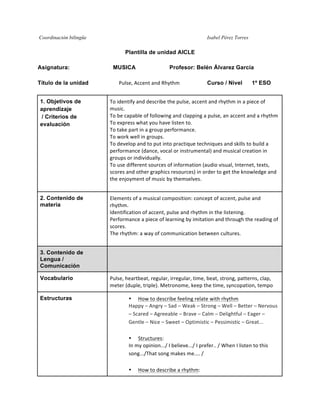
1. Objetivos de
aprendizaje
/ Criterios de
evaluación

To	
  identify	
  and	
  describe	
  the	
  pulse,	
  accent	
  and	
  rhythm	
  in	
  a	
  piece	
  of	
  
music.	
  
To	
  be	
  capable	
  of	
  following	
  and	
  clapping	
  a	
  pulse,	
  an	
  accent	
  and	
  a	
  rhythm	
  
To	
  express	
  what	
  you	
  have	
  listen	
  to.	
  
To	
  take	
  part	
  in	
  a	
  group	
  performance.	
  
To	
  work	
  well	
  in	
  groups.	
  
To	
  develop	
  and	
  to	
  put	
  into	
  practique	
  techniques	
  and	
  skills	
  to	
  build	
  a	
  
performance	
  (dance,	
  vocal	
  or	
  instrumental)	
  and	
  musical	
  creation	
  in	
  
groups	
  or	
  individually.	
  
To	
  use	
  different	
  sources	
  of	
  information	
  (audio	
  visual,	
  Internet,	
  texts,	
  
scores	
  and	
  other	
  graphics	
  resources)	
  in	
  order	
  to	
  get	
  the	
  knowledge	
  and	
  
the	
  enjoyment	
  of	
  music	
  by	
  themselves.	
  

2. Contenido de
materia

Elements	
  of	
  a	
  musical	
  composition:	
  concept	
  of	
  accent,	
  pulse	
  and	
  
rhythm.	
  
Identification	
  of	
  accent,	
  pulse	
  and	
  rhythm	
  in	
  the	
  listening.	
  
Performance	
  a	
  piece	
  of	
  learning	
  by	
  imitation	
  and	
  through	
  the	
  reading	
  of	
  
scores.	
  
The	
  rhythm:	
  a	
  way	
  of	
  communication	
  between	
  cultures.	
  

3. Contenido de
Lengua /
Comunicación
Vocabulario
Estructuras

Pulse,	
  heartbeat,	
  regular,	
  irregular,	
  time,	
  beat,	
  strong,	
  patterns,	
  clap,	
  
meter	
  (duple,	
  triple).	
  Metronome,	
  keep	
  the	
  time,	
  syncopation,	
  tempo
• How	
  to	
  describe	
  feeling	
  relate	
  with	
  rhythm	
  
Happy	
  –	
  Angry	
  –	
  Sad	
  –	
  Weak	
  –	
  Strong	
  –	
  Well	
  –	
  Better	
  –	
  Nervous	
  
–	
  Scared	
  –	
  Agreeable	
  –	
  Brave	
  –	
  Calm	
  –	
  Delightful	
  –	
  Eager	
  –	
  
Gentle	
  –	
  Nice	
  –	
  Sweet	
  –	
  Optimistic	
  –	
  Pessimistic	
  –	
  Great...	


• Structures:	
  
In	
  my	
  opinion.../	
  I	
  believe.../	
  I	
  prefer..	
  /	
  When	
  I	
  listen	
  to	
  this	
  
song.../That	
  song	
  makes	
  me....	
  /	


• How	
  to	
  describe	
  a	
  rhythm:	
  	
  
Coordinación bilingüe

Isabel Pérez Torres

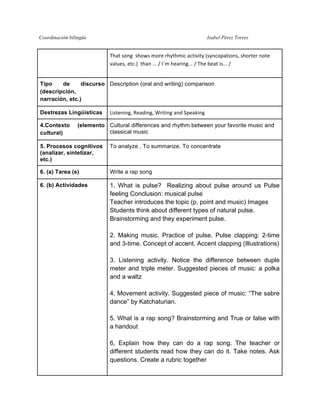
That	
  song	
  	
  shows	
  more	
  rhythmic	
  activity	
  (syncopations,	
  shorter	
  note	
  
values,	
  etc.)	
  	
  than	
  ...	
  /	
  I´m	
  hearing...	
  /	
  The	
  beat	
  is...	
  /	
  	
  
Tipo
de
discurso Description (oral and writing) comparison
(descripción,
narración, etc.)
Destrezas Lingüísticas
4.Contexto
cultural)

Listening,	
  Reading,	
  Writing	
  and	
  Speaking

(elemento Cultural differences and rhythm between your favorite music and
classical music

5. Procesos cognitivos
(analizar, sintetizar,
etc.)

To analyze , To summarize, To concentrate

6. (a) Tarea (s)

Write a rap song

6. (b) Actividades

1. What is pulse? Realizing about pulse around us Pulse
feeling Conclusion: musical pulse
Teacher introduces the topic (p. point and music) Images
Students think about different types of natural pulse.
Brainstorming and they experiment pulse.
2. Making music. Practice of pulse. Pulse clapping: 2-time
and 3-time. Concept of accent. Accent clapping (Illustrations)
3. Listening activity. Notice the difference between duple
meter and triple meter. Suggested pieces of music: a polka
and a waltz
4. Movement activity. Suggested piece of music: “The sabre
dance” by Katchaturian.
5. What is a rap song? Brainstorming and True or false with
a handout
6, Explain how they can do a rap song. The teacher or
different students read how they can do it. Take notes. Ask
questions. Create a rubric together
Coordinación bilingüe

Isabel Pérez Torres

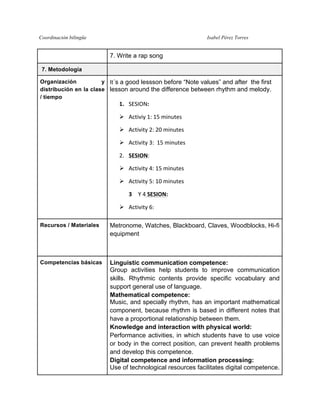
7. Write a rap song
7. Metodología
Organización
y It´s a good lessson before “Note values” and after the first
distribución en la clase lesson around the difference between rhythm and melody.
/ tiempo

1. SESION:	


Ø Activiy	
  1:	
  15	
  minutes	
  	
  
Ø Activity	
  2:	
  20	
  minutes	
  	
  
Ø Activity	
  3:	
  	
  15	
  minutes	
  
2. SESION:	
  	
  
Ø Activity	
  4:	
  15	
  minutes	
  	
  
Ø Activity	
  5:	
  10	
  minutes	
  
3 Y	
  4	
  SESION:	
  	
  
Ø Activity	
  6:	
  
Recursos / Materiales

Metronome, Watches, Blackboard, Claves, Woodblocks, Hi-fi
equipment

Competencias básicas

Linguistic communication competence:
Group activities help students to improve communication
skills. Rhythmic contents provide specific vocabulary and
support general use of language.
Mathematical competence:
Music, and specially rhythm, has an important mathematical
component, because rhythm is based in different notes that
have a proportional relationship between them.
Knowledge and interaction with physical world:
Performance activities, in which students have to use voice
or body in the correct position, can prevent health problems
and develop this competence.
Digital competence and information processing:
Use of technological resources facilitates digital competence.
Coordinación bilingüe

Isabel Pérez Torres

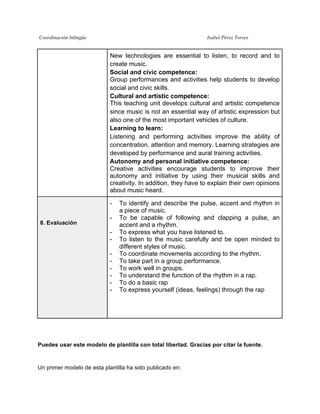
New technologies are essential to listen, to record and to
create music.
Social and civic competence:
Group performances and activities help students to develop
social and civic skills.
Cultural and artistic competence:
This teaching unit develops cultural and artistic competence
since music is not an essential way of artistic expression but
also one of the most important vehicles of culture.
Learning to learn:
Listening and performing activities improve the ability of
concentration, attention and memory. Learning strategies are
developed by performance and aural training activities.
Autonomy and personal initiative competence:
Creative activities encourage students to improve their
autonomy and initiative by using their musical skills and
creativity. In addition, they have to explain their own opinions
about music heard.
8. Evaluación

-

To identify and describe the pulse, accent and rhythm in
a piece of music.
To be capable of following and clapping a pulse, an
accent and a rhythm.
To express what you have listened to.
To listen to the music carefully and be open minded to
different styles of music.
To coordinate movements according to the rhythm.
To take part in a group performance.
To work well in groups.
To understand the function of the rhythm in a rap.
To do a basic rap
To express yourself (ideas, feelings) through the rap

Puedes usar este modelo de plantilla con total libertad. Gracias por citar la fuente.

Un primer modelo de esta plantilla ha sido publicado en:
Coordinación bilingüe

Isabel Pérez Torres

Pérez Torres, I. 2009. "Apuntes sobre los principios y características de la metodología AICLE" en V.
Pavón, J. Ávila (eds.), Aplicaciones didácticas para la enseñanza integrada de lengua y contenidos.
Sevilla: Consejería de Educación de la Junta de Andalucía-Universidad de Córdoba.171-180.

Está basada sobre todo en la experiencia práctica a la hora de diseñar unidades y
conversaciones con expertos y compañeros. También he tenido en cuenta la teoría de las 4 Cs
de Do Coyle, expuesto en numerosas publicaciones como por ejemplo: Coyle, D., Hood, P. and
Marsh, D., 2010. Content and Language Integrated Learning. Cambridge University Press.

Pulse, accent and rhythm

  • 1.
    Coordinación bilingüe Isabel PérezTorres Plantilla de unidad AICLE Asignatura: Título de la unidad MUSICA Profesor: Belén Álvarez García Pulse,  Accent  and  Rhythm Curso / Nivel 1º ESO 1. Objetivos de aprendizaje / Criterios de evaluación To  identify  and  describe  the  pulse,  accent  and  rhythm  in  a  piece  of   music.   To  be  capable  of  following  and  clapping  a  pulse,  an  accent  and  a  rhythm   To  express  what  you  have  listen  to.   To  take  part  in  a  group  performance.   To  work  well  in  groups.   To  develop  and  to  put  into  practique  techniques  and  skills  to  build  a   performance  (dance,  vocal  or  instrumental)  and  musical  creation  in   groups  or  individually.   To  use  different  sources  of  information  (audio  visual,  Internet,  texts,   scores  and  other  graphics  resources)  in  order  to  get  the  knowledge  and   the  enjoyment  of  music  by  themselves.   2. Contenido de materia Elements  of  a  musical  composition:  concept  of  accent,  pulse  and   rhythm.   Identification  of  accent,  pulse  and  rhythm  in  the  listening.   Performance  a  piece  of  learning  by  imitation  and  through  the  reading  of   scores.   The  rhythm:  a  way  of  communication  between  cultures.   3. Contenido de Lengua / Comunicación Vocabulario Estructuras Pulse,  heartbeat,  regular,  irregular,  time,  beat,  strong,  patterns,  clap,   meter  (duple,  triple).  Metronome,  keep  the  time,  syncopation,  tempo • How  to  describe  feeling  relate  with  rhythm   Happy  –  Angry  –  Sad  –  Weak  –  Strong  –  Well  –  Better  –  Nervous   –  Scared  –  Agreeable  –  Brave  –  Calm  –  Delightful  –  Eager  –   Gentle  –  Nice  –  Sweet  –  Optimistic  –  Pessimistic  –  Great...     • Structures:   In  my  opinion.../  I  believe.../  I  prefer..  /  When  I  listen  to  this   song.../That  song  makes  me....  /       • How  to  describe  a  rhythm:    
  • 2.
    Coordinación bilingüe Isabel PérezTorres That  song    shows  more  rhythmic  activity  (syncopations,  shorter  note   values,  etc.)    than  ...  /  I´m  hearing...  /  The  beat  is...  /     Tipo de discurso Description (oral and writing) comparison (descripción, narración, etc.) Destrezas Lingüísticas 4.Contexto cultural) Listening,  Reading,  Writing  and  Speaking (elemento Cultural differences and rhythm between your favorite music and classical music 5. Procesos cognitivos (analizar, sintetizar, etc.) To analyze , To summarize, To concentrate 6. (a) Tarea (s) Write a rap song 6. (b) Actividades 1. What is pulse? Realizing about pulse around us Pulse feeling Conclusion: musical pulse Teacher introduces the topic (p. point and music) Images Students think about different types of natural pulse. Brainstorming and they experiment pulse. 2. Making music. Practice of pulse. Pulse clapping: 2-time and 3-time. Concept of accent. Accent clapping (Illustrations) 3. Listening activity. Notice the difference between duple meter and triple meter. Suggested pieces of music: a polka and a waltz 4. Movement activity. Suggested piece of music: “The sabre dance” by Katchaturian. 5. What is a rap song? Brainstorming and True or false with a handout 6, Explain how they can do a rap song. The teacher or different students read how they can do it. Take notes. Ask questions. Create a rubric together
  • 3.
    Coordinación bilingüe Isabel PérezTorres 7. Write a rap song 7. Metodología Organización y It´s a good lessson before “Note values” and after the first distribución en la clase lesson around the difference between rhythm and melody. / tiempo 1. SESION:     Ø Activiy  1:  15  minutes     Ø Activity  2:  20  minutes     Ø Activity  3:    15  minutes   2. SESION:     Ø Activity  4:  15  minutes     Ø Activity  5:  10  minutes   3 Y  4  SESION:     Ø Activity  6:   Recursos / Materiales Metronome, Watches, Blackboard, Claves, Woodblocks, Hi-fi equipment Competencias básicas Linguistic communication competence: Group activities help students to improve communication skills. Rhythmic contents provide specific vocabulary and support general use of language. Mathematical competence: Music, and specially rhythm, has an important mathematical component, because rhythm is based in different notes that have a proportional relationship between them. Knowledge and interaction with physical world: Performance activities, in which students have to use voice or body in the correct position, can prevent health problems and develop this competence. Digital competence and information processing: Use of technological resources facilitates digital competence.
  • 4.
    Coordinación bilingüe Isabel PérezTorres New technologies are essential to listen, to record and to create music. Social and civic competence: Group performances and activities help students to develop social and civic skills. Cultural and artistic competence: This teaching unit develops cultural and artistic competence since music is not an essential way of artistic expression but also one of the most important vehicles of culture. Learning to learn: Listening and performing activities improve the ability of concentration, attention and memory. Learning strategies are developed by performance and aural training activities. Autonomy and personal initiative competence: Creative activities encourage students to improve their autonomy and initiative by using their musical skills and creativity. In addition, they have to explain their own opinions about music heard. 8. Evaluación - To identify and describe the pulse, accent and rhythm in a piece of music. To be capable of following and clapping a pulse, an accent and a rhythm. To express what you have listened to. To listen to the music carefully and be open minded to different styles of music. To coordinate movements according to the rhythm. To take part in a group performance. To work well in groups. To understand the function of the rhythm in a rap. To do a basic rap To express yourself (ideas, feelings) through the rap Puedes usar este modelo de plantilla con total libertad. Gracias por citar la fuente. Un primer modelo de esta plantilla ha sido publicado en:
  • 5.
    Coordinación bilingüe Isabel PérezTorres Pérez Torres, I. 2009. "Apuntes sobre los principios y características de la metodología AICLE" en V. Pavón, J. Ávila (eds.), Aplicaciones didácticas para la enseñanza integrada de lengua y contenidos. Sevilla: Consejería de Educación de la Junta de Andalucía-Universidad de Córdoba.171-180. Está basada sobre todo en la experiencia práctica a la hora de diseñar unidades y conversaciones con expertos y compañeros. También he tenido en cuenta la teoría de las 4 Cs de Do Coyle, expuesto en numerosas publicaciones como por ejemplo: Coyle, D., Hood, P. and Marsh, D., 2010. Content and Language Integrated Learning. Cambridge University Press.