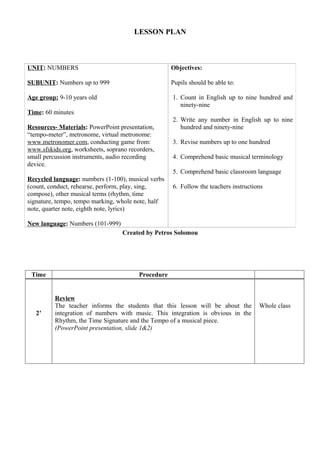
LESSON PLAN
Created by Petros Solomou
Time Procedure
2’
Review
The teacher informs the students that this lesson will be about the
integration of numbers with music. This integration is obvious in the
Rhythm, the Time Signature and the Tempo of a musical piece.
(PowerPoint presentation, slide 1&2)
Whole class
UNIT: NUMBERS
SUBUNIT: Numbers up to 999
Age group: 9-10 years old
Time: 60 minutes
Resources- Materials: PowerPoint presentation,
“tempo-meter”, metronome, virtual metronome:
www.metronomer.com, conducting game from:
www.sfskids.org, worksheets, soprano recorders,
small percussion instruments, audio recording
device.
Recycled language: numbers (1-100), musical verbs
(count, conduct, rehearse, perform, play, sing,
compose), other musical terms (rhythm, time
signature, tempo, tempo marking, whole note, half
note, quarter note, eighth note, lyrics)
New language: Numbers (101-999)
Objectives:
Pupils should be able to:
1. Count in English up to nine hundred and
ninety-nine
2. Write any number in English up to nine
hundred and ninety-nine
3. Revise numbers up to one hundred
4. Comprehend basic musical terminology
5. Comprehend basic classroom language
6. Follow the teachers instructions
3’
7’
5’
5’
18’
10’
10’
Activities
Activity 1: Rhythm
The teacher leads and the students follow, singing the “Rhythm” song. This
is an adaptation of the following song:
https://www.youtube.com/watch?
v=KUtEg8Qxuxk&index=21&list=PLDwiShyroKw7BCtlEojVBkT1Q1akc
WdZH
(PowerPoint presentation, slide 3&4)
Activity 2: Time signature - Conducting
The teacher tells the students that they will try to conduct some basic time
signatures (2/4, 3/4, 4/4). Integration of technology: use of conducting
game: http://www.sfskids.org/conduct/ (one of the students uses the
computer and the others follow). Music used: Overture to the opera
“Willian Tell” by Gioachino Rossini, “Bolero” by Maurice Ravel and
“Dance of the Knights” by Sergei Prokovief.
(PowerPoint presentation, slide 5-13)
Activity 3: Time signature-Counting
With the help of the teacher, students count some more complicated time
signatures (5/4, 7/8, 9/8, 11/4) while listening to famous pieces from the
international repertoire.
(PowerPoint presentation, slide 14-21)
Activity 4: Counting over one hundred
Students examine some really strange time signatures used by
contemporary music composers. They notice that one of them includes a
number greater than one hundred. Teacher demonstrates on the board the
way we write numbers above one hundred.
(PowerPoint presentation, slide 22-24)
Activity 5: Tempo
Use of: “tempo-meter” and digital metronome: http://metronomer.com/
(integration of technology). Writing: Students find out and write down the
tempo (number of beats per minute) and the tempo-marking of the pieces
on their worksheets.
(PowerPoint presentation, slide 25-28)
Activity 6: Writing Lyrics
On their worksheets, students connect the numbered dots to find out who
the friend of the little elephant is. Then they fill-in the text with the
appropriate word (number or verb) to create the lyrics of the song “My
rhino friend”, based on the music of the song “The little elephant” by
Cypriot composer George Hadjipieris.
(PowerPoint presentation, slide 29-31)
Activity 7: Performing/Recording
Students with the help of the teacher rehearse, perform (sing, play the
soprano recorder, play some percussion instruments) and record their song.
(PowerPoint presentation, slide 32)
Whole class
Whole class/
Individual work
Whole class
Whole class
Group work/
Individual work
Individual work
Whole class
Evaluation:
Evaluation is ongoing and takes place throughout the lesson by observation
of the pupils while they are involved in the various activities. The teacher
notes the pupil’s progress and/or areas of concern soon after the lesson.
Final Evaluation: Performance of the song “My rhino friend”.

Lesson plan petros solomou

  • 1.
    LESSON PLAN Created byPetros Solomou Time Procedure 2’ Review The teacher informs the students that this lesson will be about the integration of numbers with music. This integration is obvious in the Rhythm, the Time Signature and the Tempo of a musical piece. (PowerPoint presentation, slide 1&2) Whole class UNIT: NUMBERS SUBUNIT: Numbers up to 999 Age group: 9-10 years old Time: 60 minutes Resources- Materials: PowerPoint presentation, “tempo-meter”, metronome, virtual metronome: www.metronomer.com, conducting game from: www.sfskids.org, worksheets, soprano recorders, small percussion instruments, audio recording device. Recycled language: numbers (1-100), musical verbs (count, conduct, rehearse, perform, play, sing, compose), other musical terms (rhythm, time signature, tempo, tempo marking, whole note, half note, quarter note, eighth note, lyrics) New language: Numbers (101-999) Objectives: Pupils should be able to: 1. Count in English up to nine hundred and ninety-nine 2. Write any number in English up to nine hundred and ninety-nine 3. Revise numbers up to one hundred 4. Comprehend basic musical terminology 5. Comprehend basic classroom language 6. Follow the teachers instructions
  • 2.
    3’ 7’ 5’ 5’ 18’ 10’ 10’ Activities Activity 1: Rhythm Theteacher leads and the students follow, singing the “Rhythm” song. This is an adaptation of the following song: https://www.youtube.com/watch? v=KUtEg8Qxuxk&index=21&list=PLDwiShyroKw7BCtlEojVBkT1Q1akc WdZH (PowerPoint presentation, slide 3&4) Activity 2: Time signature - Conducting The teacher tells the students that they will try to conduct some basic time signatures (2/4, 3/4, 4/4). Integration of technology: use of conducting game: http://www.sfskids.org/conduct/ (one of the students uses the computer and the others follow). Music used: Overture to the opera “Willian Tell” by Gioachino Rossini, “Bolero” by Maurice Ravel and “Dance of the Knights” by Sergei Prokovief. (PowerPoint presentation, slide 5-13) Activity 3: Time signature-Counting With the help of the teacher, students count some more complicated time signatures (5/4, 7/8, 9/8, 11/4) while listening to famous pieces from the international repertoire. (PowerPoint presentation, slide 14-21) Activity 4: Counting over one hundred Students examine some really strange time signatures used by contemporary music composers. They notice that one of them includes a number greater than one hundred. Teacher demonstrates on the board the way we write numbers above one hundred. (PowerPoint presentation, slide 22-24) Activity 5: Tempo Use of: “tempo-meter” and digital metronome: http://metronomer.com/ (integration of technology). Writing: Students find out and write down the tempo (number of beats per minute) and the tempo-marking of the pieces on their worksheets. (PowerPoint presentation, slide 25-28) Activity 6: Writing Lyrics On their worksheets, students connect the numbered dots to find out who the friend of the little elephant is. Then they fill-in the text with the appropriate word (number or verb) to create the lyrics of the song “My rhino friend”, based on the music of the song “The little elephant” by Cypriot composer George Hadjipieris. (PowerPoint presentation, slide 29-31) Activity 7: Performing/Recording Students with the help of the teacher rehearse, perform (sing, play the soprano recorder, play some percussion instruments) and record their song. (PowerPoint presentation, slide 32) Whole class Whole class/ Individual work Whole class Whole class Group work/ Individual work Individual work Whole class
  • 3.
    Evaluation: Evaluation is ongoingand takes place throughout the lesson by observation of the pupils while they are involved in the various activities. The teacher notes the pupil’s progress and/or areas of concern soon after the lesson. Final Evaluation: Performance of the song “My rhino friend”.