
WHAT YOU SHOULD HAVE READ BUT….2010 diagnosis of atopy  University of Verona, Italy Attilio Boner
Drug allergy dal 2008 ho fatto un sottotitolo per drug allergy, prima erano all’interno della  diagnosi di allergia
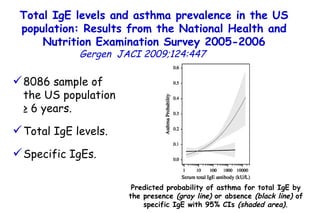
Total IgE levels and asthma prevalence in the US population: Results from the National Health and Nutrition Examination Survey 2005-2006 Gergen  JACI 2009;124:447  8086  sample of  the US population ≥ 6 years.  Total IgE levels. Specific IgEs.  Predicted probability of asthma for total IgE by the presence  (gray line)  or absence  (black line)  of specific IgE with 95% CIs  (shaded area) .
Total IgE levels and asthma prevalence in the US population: Results from the National Health and Nutrition Examination Survey 2005-2006 Gergen  JACI 2009;124:447  8086  sample of  the US population ≥ 6 years.  Total IgE levels. Specific IgEs.  Predicted probability of asthma for total IgE by the presence  (gray line)  or absence  (black line)  of specific IgE with 95% CIs  (shaded area) . Total IgE levels are associated with asthma only among persons who have positive results for at least 1  allergen-specific IgE
Total IgE levels and asthma prevalence in the US population: Results from the National Health and Nutrition Examination Survey 2005-2006 Gergen  JACI 2009;124:447  When tested for Grass,  D. pteronyssinus ,  cat, ragweed, cockroach,  Alternaria % Subjects Identified  as Atopic 92.8% 90 – 80 – 70 – 60 – 50 – 40 – 30 – 20 – 10 – 0 100 – 8086  sample of  the US population ≥ 6 years.  Total IgE levels. Specific IgEs.
Total IgE levels and asthma prevalence in the US population: Results from the National Health and Nutrition Examination Survey 2005-2006 Gergen  JACI 2009;124:447  When tested for Grass,  D. pteronyssinus ,  cat, ragweed, cockroach,  Alternaria % Subjects Identified  as Atopic 92.8% 90 – 80 – 70 – 60 – 50 – 40 – 30 – 20 – 10 – 0 100 – 8086  sample of  the US population ≥ 6 years.  Total IgE levels. Specific IgEs.  Identification of 99.2% of the atopic subjects required  5 additional allergens (birch,  D farinae , Russian thistle,  A fumigatus , and dog.
Total IgE levels and asthma prevalence in the US population: Results from the National Health and Nutrition Examination Survey 2005-2006 Gergen  JACI 2009;124:447  PREVALENCE OF ATOPY AS DEFINED BY 15 sIgEs 42.5% 45 – 40 – 35 – 30 – 25 – 20 – 15 – 10 – 5 – 0   Prevalence of atopy by the number of positive specific IgE test results.
Total IgE levels and asthma prevalence in the US population: Results from the National Health and Nutrition Examination Survey 2005-2006 Gergen  JACI 2009;124:447  PREVALENCE OF ATOPY AS DEFINED BY 15 sIgEs 42.5% 45 – 40 – 35 – 30 – 25 – 20 – 15 – 10 – 5 – 0   Prevalence of atopy by the number of positive specific IgE test results.  The complete identification of atopic subjects in a population requires a large panel of allergen-specific IgEs.
Pan-European multicenter (17 centers in 14 countries) patient based study.  A standardized panel of 18 allergens has been prick tested. 3034 patients  GA 2 LEN skin test study III: Minimum battery of  test inhalent allergens needed in epidemiological studies in patients .  Bousquet   Allergy 2009:64:1656  % Patients Sensitized  to Least One Allergen  68.2% 70 – 60 – 50 – 40 – 30 – 20 – 10 – 0 1996/3034
GA 2 LEN skin test study III: Minimum battery of  test inhalent allergens needed in epidemiological studies in patients .  Bousquet   Allergy 2009:64:1656  Eight allergens:  Grass pollen,  Dermatophagoides pt.   Birch pollen,  Cat dander,  Artemisia ,  Olive pollen,  Blatella  Alternaria   Allowed to identified more than 95% of sensitized subjects
Comparison of skin prick tests with specific serum immunoglobulin E in the diagnosis of fungal sensitization in patients with severe asthma   O'Driscoll,   CEA 2009;39:1677 SPT and specific serum IgE tests to 6 fungi (Aspergillus fumigatus, Candida albicans, Penicillium notatum, Cladosporium herbarum, Alternaria alternata and Botrytis cineria)  sIgE test for Trichophyton  121 patients with severe asthma.  66% % patients allergic to at least 1 fungi with SPTs and/or sIgE 70 – 60 – 50 – 40 – 30 – 20 – 10 – 0
Comparison of skin prick tests with specific serum immunoglobulin E in the diagnosis of fungal sensitization in patients with severe asthma   O'Driscoll,   CEA 2009;39:1677 50 – 40 – 30 – 20 – 10 – 0 45% 36% 29% 24% 22% % positivity to SPTs and/or sIgE A. fumigatus   C. albicans   P. notatum   C.herbarum  A.alternata
Comparison of skin prick tests with specific serum immunoglobulin E in the diagnosis of fungal sensitization in patients with severe asthma   O'Driscoll,   CEA 2009;39:1677 50 – 40 – 30 – 20 – 10 – 0 45% 36% 29% 24% 22% % positivity to SPTs and/or sIgE A. fumigatus   C. albicans   P. notatum   C.herbarum  A.alternata  Fungal sensitization is common in patients with severe asthma.
Comparison of skin prick tests with specific serum immunoglobulin E in the diagnosis of fungal sensitization in patients with severe asthma   O'Driscoll,   CEA 2009;39:1677 50 – 40 – 30 – 20 – 10 – 0 45% 36% 29% 24% 22% % positivity to SPTs and/or sIgE A. fumigatus   C. albicans   P. notatum   C.herbarum  A.alternata  It remains necessary to undertake both SPT and specific serum IgE testing to identify all cases of fungal sensitization.
Comparison of skin prick tests with specific serum immunoglobulin E in the diagnosis of fungal sensitization in patients with severe asthma   O'Driscoll,   CEA 2009;39:1677 Specific IgE levels (vertical axis) compared with skin prick test (SPT) weal size (horizontal axis).
Comparison of skin prick tests with specific serum immunoglobulin E in the diagnosis of fungal sensitization in patients with severe asthma   O'Driscoll,   CEA 2009;39:1677 Specific IgE levels (vertical axis) compared with skin prick test (SPT) weal size (horizontal axis). SPTs weal size increased proportional to sIgE level for all fungi except  Penicillium  and  Botrytis
Specific allergic sensitization in parents and their 18-year-old offspring in the Suburban Detroit Childhood Allergy Study Tawil Misiak  JACI 2009;123:1401   Background: Allergic sensitization is increased among offspring of sensitized parents. Objective: We sought to evaluate whether 18-year-old offspring are likely to have the same allergic sensitizations as their parents.
Specific IgE  to 6 allergens:  Dermatophagoides farinae , dog, cat, grass, ragweed, and  Alternaria alternata .  316 parent-teen triads  CAT  GRASS OR   FOR THE SAME SENSITIZATION BETWEEN MOTHER AND OFFSPRINGS 2.1 2.5 2.4 2.5 – 2.0 – 1.5 – 1.0 – 0.5 – 0 A.alternata Specific allergic sensitization in parents and their 18-year-old offspring in the Suburban Detroit Childhood Allergy Study Tawil Misiak  JACI 2009;123:1401
Specific IgE  to 6 allergens:  Dermatophagoides farinae , dog, cat, grass, ragweed, and  Alternaria alternata .  316 parent-teen triads  DOG  MITE  GRASS OR   FOR THE SAME SENSITIZATION BETWEEN FATHER AND OFFSPRINGS 2.7 2.7 2.7 3.0 – 2.5 – 2.0 – 1.5 – 1.0 – 0.5 – 0 Specific allergic sensitization in parents and their 18-year-old offspring in the Suburban Detroit Childhood Allergy Study Tawil Misiak  JACI 2009;123:1401
Specific IgE  to 6 allergens:  Dermatophagoides farinae , dog, cat, grass, ragweed, and  Alternaria alternata .  316 parent-teen triads  DOG  MITE  GRASS OR   FOR THE SAME SENSITIZATION BETWEEN FATHER AND OFFSPRINGS 3.0 – 2.5 – 2.0 – 1.5 – 1.0 – 0.5 – 0 Parental allergen-specific IgE increases the likelihood of sensitization to the same allergen in young adult offspring.  2.7 2.7 2.7 Specific allergic sensitization in parents and their 18-year-old offspring in the Suburban Detroit Childhood Allergy Study Tawil Misiak  JACI 2009;123:1401
Characterization and comparison of commercially available mite extracts for in vivo diagnosis  Brunetto  Allergy 2010:65:184  18 extracts from  Dermatophagoides pteronyssinus   and 8 from  Dermatophagoides   farinae. Total protein content and major allergen content.  Protein analysis by Bradford's method.  Values are expressed as μg protein/ml extract.   Manufacturers D. pteronyssinus   D. farinae   Mean* (±SD)  Mean* (±SD) 1 258.5 (±4.1) 326.0 (±2.2)  2 253.0 (±3.4)   84.9 (±6.3) 3   63.8 (±3.9)   28.4 (±0.5) 4 180.5 (±0.5)  191.6 (±2.3) 5 361.1 (±6.4)   353.0 (±10.5) 6  99.8 (±9.0)   73.2 (±1.1) 7  27.7 (±5.7)   20.3 (±1.4) 8 154.8 (±6.1) 167.7 (±2.8)
Characterization and comparison of commercially available mite extracts for in vivo diagnosis  Brunetto  Allergy 2010:65:184  Skin prick test results mean wheal areas (mm 2 )  Der farinae Der pteron
Characterization and comparison of commercially available mite extracts for in vivo diagnosis  Brunetto  Allergy 2010:65:184  Skin prick test results mean wheal areas (mm 2 )  Der farinae Der pteron Immunochemical analysis showed a heterogeneous amount of component/s among mite extracts from different manufacturers. Suggesting that, for some of the patient tested,  the absence of relevant allergens could strongly affect the diagnosis .
GA 2 LEN skin test study II: clinical relevance  of inhalant allergen sensitizations in Europe   Burbach   Allergy 2009:64:1507  17 allergy centres in 14 European countries (n = 3034, median age = 33 years) Aim of the study was to assess the clinical relevance of positive skin prick test  This assessment was done by an experienced allergologist according to patient history (e.g. season of symptoms, type of symptoms) and further tests (specific IgE-measurements, provocation tests), if indicated.  Relevant  was stated if the patient's prick test showed positive sensitization against the allergen in question and symptoms were reported if exposed to the allergen. corresponding flowering season.  Former relevance  was stated if the patient had previously had clinically relevant sensitizations.  No relevance  was stated if the patient's prick  test showed a positive sensitization against the allergen in question and no symptoms were reported.  Unknown  was stated if the patient was unable to deny or confirm a positive prick test sensitization by reporting present or nonexistent symptoms during the respective allergen exposure.
% Clinical Relevance of sensitizations for selected inhalant allergens.  A country-specific analysis  GA 2 LEN skin test study II: clinical relevance  of inhalant allergen sensitizations in Europe   Burbach   Allergy 2009:64:1507
An overall rate of ≥60% clinically relevant sensitizations was observed in all countries.  % Clinical Relevance of sensitizations for selected inhalant allergens.  A country-specific analysis  GA 2 LEN skin test study II: clinical relevance  of inhalant allergen sensitizations in Europe   Burbach   Allergy 2009:64:1507
Adverse reactions to skin prick testing in children. Prevalence and possible risk factors   Norrman  Pediatr Allergy Immunol 2009:20:273   5,908 patients aged ≤18 yr. Generalized allergic reactions (GAR). Vasovagal reactions (VVR).  0.12% GAR  VVR 0.12% 7/5908  0.15 – 0.10 – 0.05 – 0 7/5908  % SUBJECTS WHO PRESENTED
Adverse reactions to skin prick testing in children. Prevalence and possible risk factors   Norrman  Pediatr Allergy Immunol 2009:20:273   7.32 FEMALE SEX RR FOR VVR 6.28 AGE <1 YR 16.98 p<0.05 p<0.001 p<0.05 ACTIVE ECZEMA  RR FOR GAR 20 – 15 – 10 – 5 – 0 8 – 7 – 6 – 5 – 4 – 3 – 2 – 1 – 0
Adverse reactions to skin prick testing in children. Prevalence and possible risk factors   Norrman  Pediatr Allergy Immunol 2009:20:273   7.32 FEMALE SEX RR FOR VVR 6.28 AGE <1 YR 16.98 p<0.05 p<0.001 p<0.05 ACTIVE ECZEMA  RR FOR GAR 20 – 15 – 10 – 5 – 0 8 – 7 – 6 – 5 – 4 – 3 – 2 – 1 – 0 Skin prick test is usually a safe method of investigating sensitization in children. GARs do occur, and so the need for proper emergency handling should always be acknowledged.
Local allergy
phadiatop
Accuracy of ImmunoCAP® Rapid in the diagnosis of allergic sensitization in children between 1 and 14 years with recurrent wheezing: The IReNE study   Diaz-Vazquez   Pediatr Allergy Immunol 2009:20:601  ImmunoCAP® Rapid Wheeze-Rhinitis Child (Phadia AB, Uppsala, Sweden) is a new, qualitative test designed to measure specific IgE antibodies in the blood of children  with symptoms of asthma and rhinitis and for use in  primary care. The Wheeze-Rhinitis Child includes two control areas and  10 allergens (8 inhalants and 2 foods).  These are: cat (e1), birch ( Betula verrucosa ) (t3), mugwort ( Artemisia vulgaris ) (w6), timothy ( Phleum pratense ) (g6),  egg white (f1), dog (e5), olive pollen ( Olea europaea ) (t9),  wall pellitory ( Parietaria judaica ) (w21), house dust mite ( Dermatophagoides pteronyssinus ) (d1) and cow's milk.
Accuracy of ImmunoCAP® Rapid in the diagnosis of allergic sensitization in children between 1 and 14 years with recurrent wheezing: The IReNE study   Diaz-Vazquez   Pediatr Allergy Immunol 2009:20:601  ImmunoCAP® Rapid Wheeze-Rhinitis Child (Phadia AB, Uppsala, Sweden) is a new, qualitative test designed to measure specific IgE antibodies in the blood of children  with symptoms of asthma and rhinitis and for use in  primary care. The Wheeze-Rhinitis Child includes two control areas and  10 allergens (8 inhalants and 2 foods).  These are: cat (e1), birch ( Betula verrucosa ) (t3), mugwort ( Artemisia vulgaris ) (w6), timothy ( Phleum pratense ) (g6),  egg white (f1), dog (e5), olive pollen ( Olea europaea ) (t9),  wall pellitory ( Parietaria judaica ) (w21), house dust mite ( Dermatophagoides pteronyssinus ) (d1) and cow's milk.  Any pink–red degree on a line of an allergen is a positive result and the absence of color on such line indicates a negative test result.
Accuracy of ImmunoCAP® Rapid in the diagnosis of allergic sensitization in children between 1 and 14 years with recurrent wheezing: The IReNE study   Diaz-Vazquez   Pediatr Allergy Immunol 2009:20:601  ImmunoCAP® Rapid (ICR)  Wheeze-Rhinitis Child.  215 children (1-14 yrs)  who had ≥ 3  episodes of wheezing. ICR was read by two independent observers.  Six classes were evaluated, negative without any color and five positive degrees  of pink-red color.  GENERAL APPEARANCE OF THE  IMMUNOCAP™ RAPID DEVICE.
Accuracy of ImmunoCAP® Rapid in the diagnosis of allergic sensitization in children between 1 and 14 years with recurrent wheezing: The IReNE study   Diaz-Vazquez   Pediatr Allergy Immunol 2009:20:601  ATOPIC 50.7% % Children with sIgE ≥0.35 kU A /L (positive)  (+) ONLY  TO INHALANT ALLERGENS (+)   ONLY TO FOOD ALLERGENS 60 – 50 – 40 – 30 – 20 – 10 – 0 (+)   TO FOOD  AND INHALANT ALLERGENS 39.1% 6.5% 5.1%
Accuracy of ImmunoCAP® Rapid in the diagnosis of allergic sensitization in children between 1 and 14 years with recurrent wheezing: The IReNE study   Diaz-Vazquez   Pediatr Allergy Immunol 2009:20:601  In the identification of a child as atopic, the positive post-test probability of ICR depended on the color degrees considered: 88.4% for any positive and 97.6% for the most intense tones.  ICR showed good reliability for the most prevalent allergen, the dust mite. A greater intensity of color of the lines of ICR was related to higher levels of specific IgE in blood.  ICR is a reliable test for the identification of atopy in children .
Component resolved diagnosis
1)  In 1999 the term  component-resolved diagnostics  (CRD) was proposed by Rudolf Valenta as the concept of  using defined allergens (components), as opposed to allergen extracts (mixture of allergens and other non-allergenic components) for diagnosis of Type I allergy. 2)  Within an allergen source, such as peanut or cat, the majority of the proteins have no or little allergenic potential. Only a few selected proteins with different functions have allergenic potential. 3)  For peanut there are up to now 10 different proteins described with allergenic potential. Application of multiplexed immunoglobulin E determination on a chip in component-resolved diagnostics in allergy  Knol   CEA  2010;40:190
Component-resolved diagnosis of pollen allergy based on skin testing with profilin, polcalcin and lipid transfer protein pan-allergens   Barber,   CEA 2009;39:1764 Pan-allergens  constitute families of homologous and  structurally related proteins from different species  (i.e. profilins, lipid-transfer proteins, polcalcins) that are  responsible for extensive  IgE cross-reactivity  among a  variety of allergenic sources that are not necessarily  phylogenetically related. Sensitization to  pan-allergens  is relatively common in pollen- allergic patients.  Between 10% and 50% of pollen-allergic patients were  sensitized to  profilin , while up to 10% of patients were sensitized to  polcalcins  and  lipid transfer protein  (LTP).
1329  pollen-allergic patients. An in vitro method and skin prick test (SPT) to pan-allergens and conventional extracts.  There was a high concordance between in vitro (sIgE to major allergens) and in vivo (SPT to conventional extracts) methods in patients who were not sensitized to pan-allergens,  but  SPT  with conventional extracts  failed to diagnose patients with sensitization to pan-allergens .  Component-resolved diagnosis of pollen allergy based on skin testing with profilin, polcalcin and lipid transfer protein pan-allergens   Barber,   CEA 2009;39:1764
1329  pollen-allergic patients. An in vitro method and skin prick test (SPT) to pan-allergens and conventional extracts.  In patients simultaneously sensitized to polcalcins and profilins, there was a duplication in the number of sensitizations to major allergens. There was a statistical  association between sensitization to profilins and/or lipid transfer proteins and food allergy   (P<0.0001). Component-resolved diagnosis of pollen allergy based on skin testing with profilin, polcalcin and lipid transfer protein pan-allergens   Barber,   CEA 2009;39:1764
Micro-arrayed wheat seed and grass pollen allergens for component-resolved diagnosis   Constantin   Allergy 2009:64:1030  Wheat is a potent allergen source and can cause baker's asthma, food and pollen allergy.  Aim of the study was to develop an allergen micro-array for  differential diagnosis of baker's asthma, wheat-induced food allergy and  grass  pollen allergy .  Prevalence of IgE reactivity to wheat seed proteins, wheat pollen extract and grass pollen allergens.
Micro-arrayed wheat seed and grass pollen allergens for component-resolved diagnosis   Constantin   Allergy 2009:64:1030  Prevalence of IgE reactivity to wheat seed proteins, wheat pollen extract and grass pollen allergens.  Wheat is a potent allergen source and can cause baker's asthma, food and pollen allergy.  Aim of the study was to develop an allergen micro-array for  differential diagnosis of baker's asthma, wheat-induced food allergy and  grass  pollen allergy .
Micro-arrayed wheat seed and grass pollen allergens for component-resolved diagnosis   Constantin   Allergy 2009:64:1030  Wheat is a potent allergen source and can cause baker's asthma, food and pollen allergy.  Aim of the study was to develop an allergen micro-array for differential diagnosis of baker's asthma, wheat-induced food allergy and grass  pollen allergy.  Prevalence of IgE reactivity to wheat seed proteins, wheat pollen extract and grass pollen allergens.  There are recombinant wheat flour allergens, which are specifically recognized by patients suffering from  baker's asthma , but not from patients with food allergy to wheat or pollen allergy.
Micro-arrayed wheat seed and grass pollen allergens for component-resolved diagnosis   Constantin   Allergy 2009:64:1030  Wheat is a potent allergen source and can cause baker's asthma, food and pollen allergy.  Aim of the study was to develop an allergen micro-array for differential diagnosis of baker's asthma, wheat-induced food allergy and grass  pollen allergy.  Prevalence of IgE reactivity to wheat seed proteins, wheat pollen extract and grass pollen allergens.  rPhl p 1 and rPhl p 5 were identified as marker allergens specific for  grass pollen allergy.   They can be used to replace grass pollen extracts for allergy diagnosis and to identify grass pollen allergic patients.
Micro-arrayed wheat seed and grass pollen allergens for component-resolved diagnosis   Constantin   Allergy 2009:64:1030  Wheat is a potent allergen source and can cause baker's asthma, food and pollen allergy.  Aim of the study was to develop an allergen micro-array for differential diagnosis of baker's asthma, wheat-induced food allergy and grass  pollen allergy.  Prevalence of IgE reactivity to wheat seed proteins, wheat pollen extract and grass pollen allergens.  Profilin  was identified as a cross-reactive allergen recognized by patients suffering from baker's asthma, food and pollen allergy.
Background:  A positive specific IgE (sIgE) result for latex does not always mirror the clinical situation and is frequently found in individuals without overt latex allergy. Objective:  We sought to investigate the potential of  component-resolved diagnosis  ( CRD ) of latex allergy by microarray and to assess whether the technique allows discriminating genuine allergy from asymptomatic sensitization.  Component-resolved diagnosis from latex allergy by microarray   Ebo CEA  2010;40:348
Latex-allergic patients  (TP) and individuals sensitized to NRL ( false positive: FP ). Percentages of positive basophil activation tests (BAT) in TP and FP. 26 healthy controls. 22 latex-allergic patients with a compelling history of latex allergy. 20 latex-sensitized individuals with a frequent asymptomatic exposure to natural rubber latex CRD with the ImmunoCAP ISAC microarray. Component-resolved diagnosis from latex allergy by microarray   Ebo CEA  2010;40:348
Percentages of positive sIgE results for genuine and cross-reactive latex components, bromelain and horseradish peroxidase (HRP) by traditional singleplexed ImmunoCAP in patients ( True Positive ) and individuals sensitized to natural rubber latex ( False Positive ). Component-resolved diagnosis from latex allergy by microarray   Ebo CEA  2010;40:348 By microarray analysis it was demonstrated that latex allergic patients have selective binding of IgE to the latex allergens  Hev b 1  (elongation factor),  Hev b 3  (small rubber particle protein),  Hev b 5  (latex acidic protein) and  Hev b 6.02  (hevein).  In contrast, sensitized patients without clinical symptoms of latex allergy showed IgE binding to Hev b 8, the latex profilin .
Allergy or tolerance in children sensitized to peanut: Prevalence and differentiation using component-resolved diagnostics.  Nicolaou   JACI  2010:125:191  Background:  Not all peanut-sensitized children  develop allergic reactions on exposure. Objective:  To establish by oral food challenge the proportion of children with clinical peanut allergy among those considered peanut-sensitized by using skin prick tests and/or IgE measurement, and to investigate whether  component-resolved diagnostics using microarray could differentiate peanut allergy from tolerance .
Population-based birth cohort (n=933). Peanut sensitization by skin  tests and IgE at age 8 years. Food challenges.  Microarray with  12 pure components  Prevalence of Clinical Peanut Allergy Among Sensitized Subjects  22.4% 25 – 20 – 15 – 10 – 5 – 0 Allergy or tolerance in children sensitized to peanut: Prevalence and differentiation using component-resolved diagnostics.  Nicolaou   JACI  2010:125:191
Population-based birth cohort (n=933). Peanut sensitization by skin  tests and IgE at age 8 years. Food challenges.  Microarray with  12 pure components  Prevalence of Clinical Peanut Allergy Among Sensitized Subjects  22.4% 25 – 20 – 15 – 10 – 5 – 0 Allergy or tolerance in children sensitized to peanut: Prevalence and differentiation using component-resolved diagnostics.  Nicolaou   JACI  2010:125:191  The peanut component  Ara h 2   was the most important predictor of clinical allergy
Identification of Bet v 1-related allergens  in fig and other Moraceae fruits * .   Hemmer   C EA   2010; 40:679  Allergy to fig fruit ( Ficus carica ) has  been described in patients allergic to  Ficus benjamina  or rubber latex but may occur also in pollen-allergic patients.  Fig and other Moraceae fruits contain allergens homologous to Bet v 1 and represent clinically relevant birch pollen-associated foods.  * Fig ( F. carica ), mulberry ( Morus alba ), jackfruit  ( Artocarpus heterophyllus ; all family Moraceae)
Patch tests
TAKE HOME INFORMATIONS Le IgE totali non servono, Con 5-8 allergeni identifichiamo > 95% degli allergici, Per la diagnosi di allergia alle muffe servono sia i test in vivo che quelli in vitro, Attenti alla potenza dell’estratto quando si fanno i prick test (possibili falsi-), Sono possibili reazioni generalizzate quando si fanno i prick test ai bambini piccoli e a quelli con dermatite atopica, Identificare la positività ai diversi componenti dell’allergene ti consente di identificare il vero positivo, quello che ha sviluppato tolleranza……
TAKE HOME INFORMATIONS

Diagnosis atopy

  • 1.
    WHAT YOU SHOULDHAVE READ BUT….2010 diagnosis of atopy University of Verona, Italy Attilio Boner
  • 2.
    Drug allergy dal2008 ho fatto un sottotitolo per drug allergy, prima erano all’interno della diagnosi di allergia
  • 3.
    Total IgE levelsand asthma prevalence in the US population: Results from the National Health and Nutrition Examination Survey 2005-2006 Gergen JACI 2009;124:447 8086 sample of the US population ≥ 6 years. Total IgE levels. Specific IgEs. Predicted probability of asthma for total IgE by the presence (gray line) or absence (black line) of specific IgE with 95% CIs (shaded area) .
  • 4.
    Total IgE levelsand asthma prevalence in the US population: Results from the National Health and Nutrition Examination Survey 2005-2006 Gergen JACI 2009;124:447 8086 sample of the US population ≥ 6 years. Total IgE levels. Specific IgEs. Predicted probability of asthma for total IgE by the presence (gray line) or absence (black line) of specific IgE with 95% CIs (shaded area) . Total IgE levels are associated with asthma only among persons who have positive results for at least 1 allergen-specific IgE
  • 5.
    Total IgE levelsand asthma prevalence in the US population: Results from the National Health and Nutrition Examination Survey 2005-2006 Gergen JACI 2009;124:447 When tested for Grass, D. pteronyssinus , cat, ragweed, cockroach, Alternaria % Subjects Identified as Atopic 92.8% 90 – 80 – 70 – 60 – 50 – 40 – 30 – 20 – 10 – 0 100 – 8086 sample of the US population ≥ 6 years. Total IgE levels. Specific IgEs.
  • 6.
    Total IgE levelsand asthma prevalence in the US population: Results from the National Health and Nutrition Examination Survey 2005-2006 Gergen JACI 2009;124:447 When tested for Grass, D. pteronyssinus , cat, ragweed, cockroach, Alternaria % Subjects Identified as Atopic 92.8% 90 – 80 – 70 – 60 – 50 – 40 – 30 – 20 – 10 – 0 100 – 8086 sample of the US population ≥ 6 years. Total IgE levels. Specific IgEs. Identification of 99.2% of the atopic subjects required 5 additional allergens (birch, D farinae , Russian thistle, A fumigatus , and dog.
  • 7.
    Total IgE levelsand asthma prevalence in the US population: Results from the National Health and Nutrition Examination Survey 2005-2006 Gergen JACI 2009;124:447 PREVALENCE OF ATOPY AS DEFINED BY 15 sIgEs 42.5% 45 – 40 – 35 – 30 – 25 – 20 – 15 – 10 – 5 – 0   Prevalence of atopy by the number of positive specific IgE test results.
  • 8.
    Total IgE levelsand asthma prevalence in the US population: Results from the National Health and Nutrition Examination Survey 2005-2006 Gergen JACI 2009;124:447 PREVALENCE OF ATOPY AS DEFINED BY 15 sIgEs 42.5% 45 – 40 – 35 – 30 – 25 – 20 – 15 – 10 – 5 – 0   Prevalence of atopy by the number of positive specific IgE test results. The complete identification of atopic subjects in a population requires a large panel of allergen-specific IgEs.
  • 9.
    Pan-European multicenter (17centers in 14 countries) patient based study. A standardized panel of 18 allergens has been prick tested. 3034 patients GA 2 LEN skin test study III: Minimum battery of test inhalent allergens needed in epidemiological studies in patients . Bousquet Allergy 2009:64:1656 % Patients Sensitized to Least One Allergen 68.2% 70 – 60 – 50 – 40 – 30 – 20 – 10 – 0 1996/3034
  • 10.
    GA 2 LENskin test study III: Minimum battery of test inhalent allergens needed in epidemiological studies in patients . Bousquet Allergy 2009:64:1656 Eight allergens: Grass pollen, Dermatophagoides pt. Birch pollen, Cat dander, Artemisia , Olive pollen, Blatella Alternaria Allowed to identified more than 95% of sensitized subjects
  • 11.
    Comparison of skinprick tests with specific serum immunoglobulin E in the diagnosis of fungal sensitization in patients with severe asthma O'Driscoll, CEA 2009;39:1677 SPT and specific serum IgE tests to 6 fungi (Aspergillus fumigatus, Candida albicans, Penicillium notatum, Cladosporium herbarum, Alternaria alternata and Botrytis cineria) sIgE test for Trichophyton 121 patients with severe asthma. 66% % patients allergic to at least 1 fungi with SPTs and/or sIgE 70 – 60 – 50 – 40 – 30 – 20 – 10 – 0
  • 12.
    Comparison of skinprick tests with specific serum immunoglobulin E in the diagnosis of fungal sensitization in patients with severe asthma O'Driscoll, CEA 2009;39:1677 50 – 40 – 30 – 20 – 10 – 0 45% 36% 29% 24% 22% % positivity to SPTs and/or sIgE A. fumigatus C. albicans P. notatum C.herbarum A.alternata
  • 13.
    Comparison of skinprick tests with specific serum immunoglobulin E in the diagnosis of fungal sensitization in patients with severe asthma O'Driscoll, CEA 2009;39:1677 50 – 40 – 30 – 20 – 10 – 0 45% 36% 29% 24% 22% % positivity to SPTs and/or sIgE A. fumigatus C. albicans P. notatum C.herbarum A.alternata Fungal sensitization is common in patients with severe asthma.
  • 14.
    Comparison of skinprick tests with specific serum immunoglobulin E in the diagnosis of fungal sensitization in patients with severe asthma O'Driscoll, CEA 2009;39:1677 50 – 40 – 30 – 20 – 10 – 0 45% 36% 29% 24% 22% % positivity to SPTs and/or sIgE A. fumigatus C. albicans P. notatum C.herbarum A.alternata It remains necessary to undertake both SPT and specific serum IgE testing to identify all cases of fungal sensitization.
  • 15.
    Comparison of skinprick tests with specific serum immunoglobulin E in the diagnosis of fungal sensitization in patients with severe asthma O'Driscoll, CEA 2009;39:1677 Specific IgE levels (vertical axis) compared with skin prick test (SPT) weal size (horizontal axis).
  • 16.
    Comparison of skinprick tests with specific serum immunoglobulin E in the diagnosis of fungal sensitization in patients with severe asthma O'Driscoll, CEA 2009;39:1677 Specific IgE levels (vertical axis) compared with skin prick test (SPT) weal size (horizontal axis). SPTs weal size increased proportional to sIgE level for all fungi except Penicillium and Botrytis
  • 17.
    Specific allergic sensitizationin parents and their 18-year-old offspring in the Suburban Detroit Childhood Allergy Study Tawil Misiak JACI 2009;123:1401 Background: Allergic sensitization is increased among offspring of sensitized parents. Objective: We sought to evaluate whether 18-year-old offspring are likely to have the same allergic sensitizations as their parents.
  • 18.
    Specific IgE to 6 allergens: Dermatophagoides farinae , dog, cat, grass, ragweed, and Alternaria alternata . 316 parent-teen triads CAT GRASS OR FOR THE SAME SENSITIZATION BETWEEN MOTHER AND OFFSPRINGS 2.1 2.5 2.4 2.5 – 2.0 – 1.5 – 1.0 – 0.5 – 0 A.alternata Specific allergic sensitization in parents and their 18-year-old offspring in the Suburban Detroit Childhood Allergy Study Tawil Misiak JACI 2009;123:1401
  • 19.
    Specific IgE to 6 allergens: Dermatophagoides farinae , dog, cat, grass, ragweed, and Alternaria alternata . 316 parent-teen triads DOG MITE GRASS OR FOR THE SAME SENSITIZATION BETWEEN FATHER AND OFFSPRINGS 2.7 2.7 2.7 3.0 – 2.5 – 2.0 – 1.5 – 1.0 – 0.5 – 0 Specific allergic sensitization in parents and their 18-year-old offspring in the Suburban Detroit Childhood Allergy Study Tawil Misiak JACI 2009;123:1401
  • 20.
    Specific IgE to 6 allergens: Dermatophagoides farinae , dog, cat, grass, ragweed, and Alternaria alternata . 316 parent-teen triads DOG MITE GRASS OR FOR THE SAME SENSITIZATION BETWEEN FATHER AND OFFSPRINGS 3.0 – 2.5 – 2.0 – 1.5 – 1.0 – 0.5 – 0 Parental allergen-specific IgE increases the likelihood of sensitization to the same allergen in young adult offspring. 2.7 2.7 2.7 Specific allergic sensitization in parents and their 18-year-old offspring in the Suburban Detroit Childhood Allergy Study Tawil Misiak JACI 2009;123:1401
  • 21.
    Characterization and comparisonof commercially available mite extracts for in vivo diagnosis Brunetto Allergy 2010:65:184 18 extracts from Dermatophagoides pteronyssinus and 8 from Dermatophagoides farinae. Total protein content and major allergen content. Protein analysis by Bradford's method. Values are expressed as μg protein/ml extract. Manufacturers D. pteronyssinus D. farinae Mean* (±SD) Mean* (±SD) 1 258.5 (±4.1) 326.0 (±2.2) 2 253.0 (±3.4) 84.9 (±6.3) 3 63.8 (±3.9) 28.4 (±0.5) 4 180.5 (±0.5) 191.6 (±2.3) 5 361.1 (±6.4) 353.0 (±10.5) 6 99.8 (±9.0) 73.2 (±1.1) 7 27.7 (±5.7) 20.3 (±1.4) 8 154.8 (±6.1) 167.7 (±2.8)
  • 22.
    Characterization and comparisonof commercially available mite extracts for in vivo diagnosis Brunetto Allergy 2010:65:184 Skin prick test results mean wheal areas (mm 2 ) Der farinae Der pteron
  • 23.
    Characterization and comparisonof commercially available mite extracts for in vivo diagnosis Brunetto Allergy 2010:65:184 Skin prick test results mean wheal areas (mm 2 ) Der farinae Der pteron Immunochemical analysis showed a heterogeneous amount of component/s among mite extracts from different manufacturers. Suggesting that, for some of the patient tested, the absence of relevant allergens could strongly affect the diagnosis .
  • 24.
    GA 2 LENskin test study II: clinical relevance of inhalant allergen sensitizations in Europe Burbach Allergy 2009:64:1507 17 allergy centres in 14 European countries (n = 3034, median age = 33 years) Aim of the study was to assess the clinical relevance of positive skin prick test This assessment was done by an experienced allergologist according to patient history (e.g. season of symptoms, type of symptoms) and further tests (specific IgE-measurements, provocation tests), if indicated. Relevant was stated if the patient's prick test showed positive sensitization against the allergen in question and symptoms were reported if exposed to the allergen. corresponding flowering season. Former relevance was stated if the patient had previously had clinically relevant sensitizations. No relevance was stated if the patient's prick test showed a positive sensitization against the allergen in question and no symptoms were reported. Unknown was stated if the patient was unable to deny or confirm a positive prick test sensitization by reporting present or nonexistent symptoms during the respective allergen exposure.
  • 25.
    % Clinical Relevanceof sensitizations for selected inhalant allergens. A country-specific analysis GA 2 LEN skin test study II: clinical relevance of inhalant allergen sensitizations in Europe Burbach Allergy 2009:64:1507
  • 26.
    An overall rateof ≥60% clinically relevant sensitizations was observed in all countries. % Clinical Relevance of sensitizations for selected inhalant allergens. A country-specific analysis GA 2 LEN skin test study II: clinical relevance of inhalant allergen sensitizations in Europe Burbach Allergy 2009:64:1507
  • 27.
    Adverse reactions toskin prick testing in children. Prevalence and possible risk factors Norrman Pediatr Allergy Immunol 2009:20:273 5,908 patients aged ≤18 yr. Generalized allergic reactions (GAR). Vasovagal reactions (VVR). 0.12% GAR VVR 0.12% 7/5908 0.15 – 0.10 – 0.05 – 0 7/5908 % SUBJECTS WHO PRESENTED
  • 28.
    Adverse reactions toskin prick testing in children. Prevalence and possible risk factors Norrman Pediatr Allergy Immunol 2009:20:273 7.32 FEMALE SEX RR FOR VVR 6.28 AGE <1 YR 16.98 p<0.05 p<0.001 p<0.05 ACTIVE ECZEMA RR FOR GAR 20 – 15 – 10 – 5 – 0 8 – 7 – 6 – 5 – 4 – 3 – 2 – 1 – 0
  • 29.
    Adverse reactions toskin prick testing in children. Prevalence and possible risk factors Norrman Pediatr Allergy Immunol 2009:20:273 7.32 FEMALE SEX RR FOR VVR 6.28 AGE <1 YR 16.98 p<0.05 p<0.001 p<0.05 ACTIVE ECZEMA RR FOR GAR 20 – 15 – 10 – 5 – 0 8 – 7 – 6 – 5 – 4 – 3 – 2 – 1 – 0 Skin prick test is usually a safe method of investigating sensitization in children. GARs do occur, and so the need for proper emergency handling should always be acknowledged.
  • 30.
  • 31.
  • 32.
    Accuracy of ImmunoCAP®Rapid in the diagnosis of allergic sensitization in children between 1 and 14 years with recurrent wheezing: The IReNE study Diaz-Vazquez Pediatr Allergy Immunol 2009:20:601 ImmunoCAP® Rapid Wheeze-Rhinitis Child (Phadia AB, Uppsala, Sweden) is a new, qualitative test designed to measure specific IgE antibodies in the blood of children with symptoms of asthma and rhinitis and for use in primary care. The Wheeze-Rhinitis Child includes two control areas and 10 allergens (8 inhalants and 2 foods). These are: cat (e1), birch ( Betula verrucosa ) (t3), mugwort ( Artemisia vulgaris ) (w6), timothy ( Phleum pratense ) (g6), egg white (f1), dog (e5), olive pollen ( Olea europaea ) (t9), wall pellitory ( Parietaria judaica ) (w21), house dust mite ( Dermatophagoides pteronyssinus ) (d1) and cow's milk.
  • 33.
    Accuracy of ImmunoCAP®Rapid in the diagnosis of allergic sensitization in children between 1 and 14 years with recurrent wheezing: The IReNE study Diaz-Vazquez Pediatr Allergy Immunol 2009:20:601 ImmunoCAP® Rapid Wheeze-Rhinitis Child (Phadia AB, Uppsala, Sweden) is a new, qualitative test designed to measure specific IgE antibodies in the blood of children with symptoms of asthma and rhinitis and for use in primary care. The Wheeze-Rhinitis Child includes two control areas and 10 allergens (8 inhalants and 2 foods). These are: cat (e1), birch ( Betula verrucosa ) (t3), mugwort ( Artemisia vulgaris ) (w6), timothy ( Phleum pratense ) (g6), egg white (f1), dog (e5), olive pollen ( Olea europaea ) (t9), wall pellitory ( Parietaria judaica ) (w21), house dust mite ( Dermatophagoides pteronyssinus ) (d1) and cow's milk. Any pink–red degree on a line of an allergen is a positive result and the absence of color on such line indicates a negative test result.
  • 34.
    Accuracy of ImmunoCAP®Rapid in the diagnosis of allergic sensitization in children between 1 and 14 years with recurrent wheezing: The IReNE study Diaz-Vazquez Pediatr Allergy Immunol 2009:20:601 ImmunoCAP® Rapid (ICR) Wheeze-Rhinitis Child. 215 children (1-14 yrs) who had ≥ 3 episodes of wheezing. ICR was read by two independent observers. Six classes were evaluated, negative without any color and five positive degrees of pink-red color. GENERAL APPEARANCE OF THE IMMUNOCAP™ RAPID DEVICE.
  • 35.
    Accuracy of ImmunoCAP®Rapid in the diagnosis of allergic sensitization in children between 1 and 14 years with recurrent wheezing: The IReNE study Diaz-Vazquez Pediatr Allergy Immunol 2009:20:601 ATOPIC 50.7% % Children with sIgE ≥0.35 kU A /L (positive) (+) ONLY TO INHALANT ALLERGENS (+) ONLY TO FOOD ALLERGENS 60 – 50 – 40 – 30 – 20 – 10 – 0 (+) TO FOOD AND INHALANT ALLERGENS 39.1% 6.5% 5.1%
  • 36.
    Accuracy of ImmunoCAP®Rapid in the diagnosis of allergic sensitization in children between 1 and 14 years with recurrent wheezing: The IReNE study Diaz-Vazquez Pediatr Allergy Immunol 2009:20:601 In the identification of a child as atopic, the positive post-test probability of ICR depended on the color degrees considered: 88.4% for any positive and 97.6% for the most intense tones. ICR showed good reliability for the most prevalent allergen, the dust mite. A greater intensity of color of the lines of ICR was related to higher levels of specific IgE in blood. ICR is a reliable test for the identification of atopy in children .
  • 37.
  • 38.
    1) In1999 the term component-resolved diagnostics (CRD) was proposed by Rudolf Valenta as the concept of using defined allergens (components), as opposed to allergen extracts (mixture of allergens and other non-allergenic components) for diagnosis of Type I allergy. 2) Within an allergen source, such as peanut or cat, the majority of the proteins have no or little allergenic potential. Only a few selected proteins with different functions have allergenic potential. 3) For peanut there are up to now 10 different proteins described with allergenic potential. Application of multiplexed immunoglobulin E determination on a chip in component-resolved diagnostics in allergy Knol CEA 2010;40:190
  • 39.
    Component-resolved diagnosis ofpollen allergy based on skin testing with profilin, polcalcin and lipid transfer protein pan-allergens Barber, CEA 2009;39:1764 Pan-allergens constitute families of homologous and structurally related proteins from different species (i.e. profilins, lipid-transfer proteins, polcalcins) that are responsible for extensive IgE cross-reactivity among a variety of allergenic sources that are not necessarily phylogenetically related. Sensitization to pan-allergens is relatively common in pollen- allergic patients. Between 10% and 50% of pollen-allergic patients were sensitized to profilin , while up to 10% of patients were sensitized to polcalcins and lipid transfer protein (LTP).
  • 40.
    1329 pollen-allergicpatients. An in vitro method and skin prick test (SPT) to pan-allergens and conventional extracts. There was a high concordance between in vitro (sIgE to major allergens) and in vivo (SPT to conventional extracts) methods in patients who were not sensitized to pan-allergens, but SPT with conventional extracts failed to diagnose patients with sensitization to pan-allergens . Component-resolved diagnosis of pollen allergy based on skin testing with profilin, polcalcin and lipid transfer protein pan-allergens Barber, CEA 2009;39:1764
  • 41.
    1329 pollen-allergicpatients. An in vitro method and skin prick test (SPT) to pan-allergens and conventional extracts. In patients simultaneously sensitized to polcalcins and profilins, there was a duplication in the number of sensitizations to major allergens. There was a statistical association between sensitization to profilins and/or lipid transfer proteins and food allergy (P<0.0001). Component-resolved diagnosis of pollen allergy based on skin testing with profilin, polcalcin and lipid transfer protein pan-allergens Barber, CEA 2009;39:1764
  • 42.
    Micro-arrayed wheat seedand grass pollen allergens for component-resolved diagnosis Constantin Allergy 2009:64:1030 Wheat is a potent allergen source and can cause baker's asthma, food and pollen allergy. Aim of the study was to develop an allergen micro-array for differential diagnosis of baker's asthma, wheat-induced food allergy and grass pollen allergy . Prevalence of IgE reactivity to wheat seed proteins, wheat pollen extract and grass pollen allergens.
  • 43.
    Micro-arrayed wheat seedand grass pollen allergens for component-resolved diagnosis Constantin Allergy 2009:64:1030 Prevalence of IgE reactivity to wheat seed proteins, wheat pollen extract and grass pollen allergens. Wheat is a potent allergen source and can cause baker's asthma, food and pollen allergy. Aim of the study was to develop an allergen micro-array for differential diagnosis of baker's asthma, wheat-induced food allergy and grass pollen allergy .
  • 44.
    Micro-arrayed wheat seedand grass pollen allergens for component-resolved diagnosis Constantin Allergy 2009:64:1030 Prevalence of IgE reactivity to wheat seed proteins, wheat pollen extract and grass pollen allergens. Wheat is a potent allergen source and can cause baker's asthma, food and pollen allergy. Aim of the study was to develop an allergen micro-array for differential diagnosis of baker's asthma, wheat-induced food allergy and grass pollen allergy .
  • 45.
    Micro-arrayed wheat seedand grass pollen allergens for component-resolved diagnosis Constantin Allergy 2009:64:1030 Wheat is a potent allergen source and can cause baker's asthma, food and pollen allergy. Aim of the study was to develop an allergen micro-array for differential diagnosis of baker's asthma, wheat-induced food allergy and grass pollen allergy. Prevalence of IgE reactivity to wheat seed proteins, wheat pollen extract and grass pollen allergens. There are recombinant wheat flour allergens, which are specifically recognized by patients suffering from baker's asthma , but not from patients with food allergy to wheat or pollen allergy.
  • 46.
    Micro-arrayed wheat seedand grass pollen allergens for component-resolved diagnosis Constantin Allergy 2009:64:1030 Wheat is a potent allergen source and can cause baker's asthma, food and pollen allergy. Aim of the study was to develop an allergen micro-array for differential diagnosis of baker's asthma, wheat-induced food allergy and grass pollen allergy. Prevalence of IgE reactivity to wheat seed proteins, wheat pollen extract and grass pollen allergens. rPhl p 1 and rPhl p 5 were identified as marker allergens specific for grass pollen allergy. They can be used to replace grass pollen extracts for allergy diagnosis and to identify grass pollen allergic patients.
  • 47.
    Micro-arrayed wheat seedand grass pollen allergens for component-resolved diagnosis Constantin Allergy 2009:64:1030 Wheat is a potent allergen source and can cause baker's asthma, food and pollen allergy. Aim of the study was to develop an allergen micro-array for differential diagnosis of baker's asthma, wheat-induced food allergy and grass pollen allergy. Prevalence of IgE reactivity to wheat seed proteins, wheat pollen extract and grass pollen allergens. Profilin was identified as a cross-reactive allergen recognized by patients suffering from baker's asthma, food and pollen allergy.
  • 48.
    Background: Apositive specific IgE (sIgE) result for latex does not always mirror the clinical situation and is frequently found in individuals without overt latex allergy. Objective: We sought to investigate the potential of component-resolved diagnosis ( CRD ) of latex allergy by microarray and to assess whether the technique allows discriminating genuine allergy from asymptomatic sensitization. Component-resolved diagnosis from latex allergy by microarray Ebo CEA 2010;40:348
  • 49.
    Latex-allergic patients (TP) and individuals sensitized to NRL ( false positive: FP ). Percentages of positive basophil activation tests (BAT) in TP and FP. 26 healthy controls. 22 latex-allergic patients with a compelling history of latex allergy. 20 latex-sensitized individuals with a frequent asymptomatic exposure to natural rubber latex CRD with the ImmunoCAP ISAC microarray. Component-resolved diagnosis from latex allergy by microarray Ebo CEA 2010;40:348
  • 50.
    Percentages of positivesIgE results for genuine and cross-reactive latex components, bromelain and horseradish peroxidase (HRP) by traditional singleplexed ImmunoCAP in patients ( True Positive ) and individuals sensitized to natural rubber latex ( False Positive ). Component-resolved diagnosis from latex allergy by microarray Ebo CEA 2010;40:348 By microarray analysis it was demonstrated that latex allergic patients have selective binding of IgE to the latex allergens Hev b 1 (elongation factor), Hev b 3 (small rubber particle protein), Hev b 5 (latex acidic protein) and Hev b 6.02 (hevein). In contrast, sensitized patients without clinical symptoms of latex allergy showed IgE binding to Hev b 8, the latex profilin .
  • 51.
    Allergy or tolerancein children sensitized to peanut: Prevalence and differentiation using component-resolved diagnostics. Nicolaou JACI 2010:125:191 Background: Not all peanut-sensitized children develop allergic reactions on exposure. Objective: To establish by oral food challenge the proportion of children with clinical peanut allergy among those considered peanut-sensitized by using skin prick tests and/or IgE measurement, and to investigate whether component-resolved diagnostics using microarray could differentiate peanut allergy from tolerance .
  • 52.
    Population-based birth cohort(n=933). Peanut sensitization by skin tests and IgE at age 8 years. Food challenges. Microarray with 12 pure components Prevalence of Clinical Peanut Allergy Among Sensitized Subjects 22.4% 25 – 20 – 15 – 10 – 5 – 0 Allergy or tolerance in children sensitized to peanut: Prevalence and differentiation using component-resolved diagnostics. Nicolaou JACI 2010:125:191
  • 53.
    Population-based birth cohort(n=933). Peanut sensitization by skin tests and IgE at age 8 years. Food challenges. Microarray with 12 pure components Prevalence of Clinical Peanut Allergy Among Sensitized Subjects 22.4% 25 – 20 – 15 – 10 – 5 – 0 Allergy or tolerance in children sensitized to peanut: Prevalence and differentiation using component-resolved diagnostics. Nicolaou JACI 2010:125:191 The peanut component Ara h 2 was the most important predictor of clinical allergy
  • 54.
    Identification of Betv 1-related allergens in fig and other Moraceae fruits * . Hemmer C EA 2010; 40:679 Allergy to fig fruit ( Ficus carica ) has been described in patients allergic to Ficus benjamina or rubber latex but may occur also in pollen-allergic patients. Fig and other Moraceae fruits contain allergens homologous to Bet v 1 and represent clinically relevant birch pollen-associated foods. * Fig ( F. carica ), mulberry ( Morus alba ), jackfruit ( Artocarpus heterophyllus ; all family Moraceae)
  • 55.
  • 56.
    TAKE HOME INFORMATIONSLe IgE totali non servono, Con 5-8 allergeni identifichiamo > 95% degli allergici, Per la diagnosi di allergia alle muffe servono sia i test in vivo che quelli in vitro, Attenti alla potenza dell’estratto quando si fanno i prick test (possibili falsi-), Sono possibili reazioni generalizzate quando si fanno i prick test ai bambini piccoli e a quelli con dermatite atopica, Identificare la positività ai diversi componenti dell’allergene ti consente di identificare il vero positivo, quello che ha sviluppato tolleranza……
  • 57.