WHAT YOU SOULD HAVE READ BUT ………………… 2018
Immunotherapy
Attilio Boner
University of Verona, Italy
attilio.boner@univr.it
Selection of allergens
sottocutanea
Allergen immunotherapy for allergic asthma:
A systematic review and meta-analysis
S. Dhami, Allergy 2017;72:1825–1848
• Short-term symptom scores were
reduced but there was evidence
suggestive of publication bias.
• Short-term medication scores
were reduced, again with evidence
of potential publication bias.
98 studies
Allergen immunotherapy for allergic asthma:
A systematic review and meta-analysis
S. Dhami, Allergy 2017;72:1825–1848
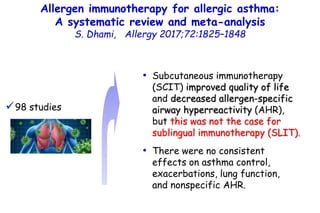
• Subcutaneous immunotherapy
(SCIT) improved quality of life
and decreased allergen-specific
airway hyperreactivity (AHR),
but this was not the case for
sublingual immunotherapy (SLIT).
• There were no consistent
effects on asthma control,
exacerbations, lung function,
and nonspecific AHR.
98 studies
Allergen immunotherapy for allergic rhinoconjunctivitis:
A systematic review and meta-analysis
S Dhami, Allergy 2017;72:1597–1631
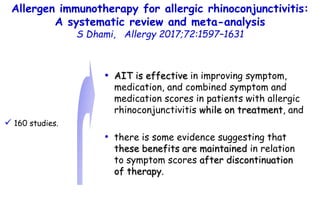
• AIT is effective in improving symptom,
medication, and combined symptom and
medication scores in patients with allergic
rhinoconjunctivitis while on treatment, and
• there is some evidence suggesting that
these benefits are maintained in relation
to symptom scores after discontinuation
of therapy.
 160 studies.
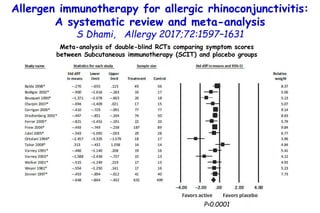
Meta-analysis of double-blind RCTs comparing symptom scores
between Subcutaneous immunotherapy (SCIT) and placebo groups
P<0.0001
Allergen immunotherapy for allergic rhinoconjunctivitis:
A systematic review and meta-analysis
S Dhami, Allergy 2017;72:1597–1631
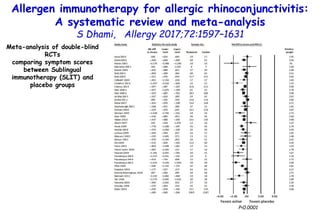
Meta-analysis of double-blind
RCTs
comparing symptom scores
between Sublingual
immunotherapy (SLIT) and
placebo groups
P<0.0001
Allergen immunotherapy for allergic rhinoconjunctivitis:
A systematic review and meta-analysis
S Dhami, Allergy 2017;72:1597–1631
Sottocutanea
Effetti collaterali
• Food allergy
desensitisation
• L’ho messe nella
food allergy
sublinguale
epicutanea
Veleno di imenotteri
Preventive effects
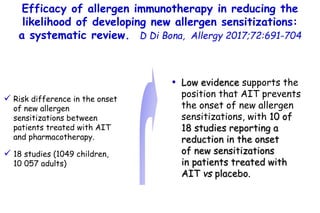
Efficacy of allergen immunotherapy in reducing the
likelihood of developing new allergen sensitizations:
a systematic review. D Di Bona, Allergy 2017;72:691-704
• Low evidence supports the
position that AIT prevents
the onset of new allergen
sensitizations, with 10 of
18 studies reporting a
reduction in the onset
of new sensitizations
in patients treated with
AIT vs placebo.
 Risk difference in the onset
of new allergen
sensitizations between
patients treated with AIT
and pharmacotherapy.
 18 studies (1049 children,
10 057 adults)
Efficacy of allergen immunotherapy in reducing the
likelihood of developing new allergen sensitizations:
a systematic review. D Di Bona, Allergy 2017;72:691-704
• Low evidence supports the
position that AIT prevents
the onset of new allergen
sensitizations, with 10 of
18 studies reporting a
reduction in the onset
of new sensitizations
in patients treated with
AIT vs placebo.
 Risk difference in the onset
of new allergen
sensitizations between
patients treated with AIT
and pharmacotherapy.
 18 studies (1049 children,
10 057 adults)
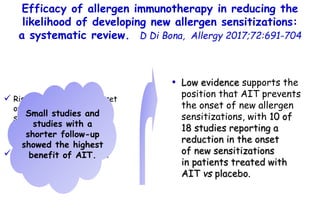
Small studies and
studies with a
shorter follow-up
showed the highest
benefit of AIT.
Efficacy of allergen immunotherapy in reducing the
likelihood of developing new allergen sensitizations:
a systematic review. D Di Bona, Allergy 2017;72:691-704
• Low evidence supports the
position that AIT prevents
the onset of new allergen
sensitizations, with 10 of
18 studies reporting a
reduction in the onset
of new sensitizations
in patients treated with
AIT vs placebo.
 Risk difference in the onset
of new allergen
sensitizations between
patients treated with AIT
and pharmacotherapy.
 18 studies (1049 children,
10 057 adults)
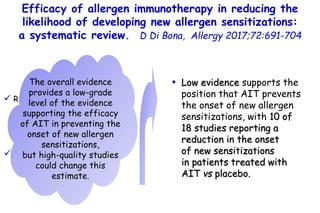
The overall evidence
provides a low-grade
level of the evidence
supporting the efficacy
of AIT in preventing the
onset of new allergen
sensitizations,
but high-quality studies
could change this
estimate.
Future possibilities

What immunotherapy

  • 1.
    WHAT YOU SOULDHAVE READ BUT ………………… 2018 Immunotherapy Attilio Boner University of Verona, Italy attilio.boner@univr.it
  • 2.
  • 3.
  • 4.
    Allergen immunotherapy forallergic asthma: A systematic review and meta-analysis S. Dhami, Allergy 2017;72:1825–1848 • Short-term symptom scores were reduced but there was evidence suggestive of publication bias. • Short-term medication scores were reduced, again with evidence of potential publication bias. 98 studies
  • 5.
    Allergen immunotherapy forallergic asthma: A systematic review and meta-analysis S. Dhami, Allergy 2017;72:1825–1848 • Subcutaneous immunotherapy (SCIT) improved quality of life and decreased allergen-specific airway hyperreactivity (AHR), but this was not the case for sublingual immunotherapy (SLIT). • There were no consistent effects on asthma control, exacerbations, lung function, and nonspecific AHR. 98 studies
  • 6.
    Allergen immunotherapy forallergic rhinoconjunctivitis: A systematic review and meta-analysis S Dhami, Allergy 2017;72:1597–1631 • AIT is effective in improving symptom, medication, and combined symptom and medication scores in patients with allergic rhinoconjunctivitis while on treatment, and • there is some evidence suggesting that these benefits are maintained in relation to symptom scores after discontinuation of therapy.  160 studies.
  • 7.
    Meta-analysis of double-blindRCTs comparing symptom scores between Subcutaneous immunotherapy (SCIT) and placebo groups P<0.0001 Allergen immunotherapy for allergic rhinoconjunctivitis: A systematic review and meta-analysis S Dhami, Allergy 2017;72:1597–1631
  • 8.
    Meta-analysis of double-blind RCTs comparingsymptom scores between Sublingual immunotherapy (SLIT) and placebo groups P<0.0001 Allergen immunotherapy for allergic rhinoconjunctivitis: A systematic review and meta-analysis S Dhami, Allergy 2017;72:1597–1631
  • 9.
  • 10.
    • Food allergy desensitisation •L’ho messe nella food allergy
  • 11.
  • 12.
  • 13.
  • 14.
  • 15.
    Efficacy of allergenimmunotherapy in reducing the likelihood of developing new allergen sensitizations: a systematic review. D Di Bona, Allergy 2017;72:691-704 • Low evidence supports the position that AIT prevents the onset of new allergen sensitizations, with 10 of 18 studies reporting a reduction in the onset of new sensitizations in patients treated with AIT vs placebo.  Risk difference in the onset of new allergen sensitizations between patients treated with AIT and pharmacotherapy.  18 studies (1049 children, 10 057 adults)
  • 16.
    Efficacy of allergenimmunotherapy in reducing the likelihood of developing new allergen sensitizations: a systematic review. D Di Bona, Allergy 2017;72:691-704 • Low evidence supports the position that AIT prevents the onset of new allergen sensitizations, with 10 of 18 studies reporting a reduction in the onset of new sensitizations in patients treated with AIT vs placebo.  Risk difference in the onset of new allergen sensitizations between patients treated with AIT and pharmacotherapy.  18 studies (1049 children, 10 057 adults) Small studies and studies with a shorter follow-up showed the highest benefit of AIT.
  • 17.
    Efficacy of allergenimmunotherapy in reducing the likelihood of developing new allergen sensitizations: a systematic review. D Di Bona, Allergy 2017;72:691-704 • Low evidence supports the position that AIT prevents the onset of new allergen sensitizations, with 10 of 18 studies reporting a reduction in the onset of new sensitizations in patients treated with AIT vs placebo.  Risk difference in the onset of new allergen sensitizations between patients treated with AIT and pharmacotherapy.  18 studies (1049 children, 10 057 adults) The overall evidence provides a low-grade level of the evidence supporting the efficacy of AIT in preventing the onset of new allergen sensitizations, but high-quality studies could change this estimate.
  • 18.