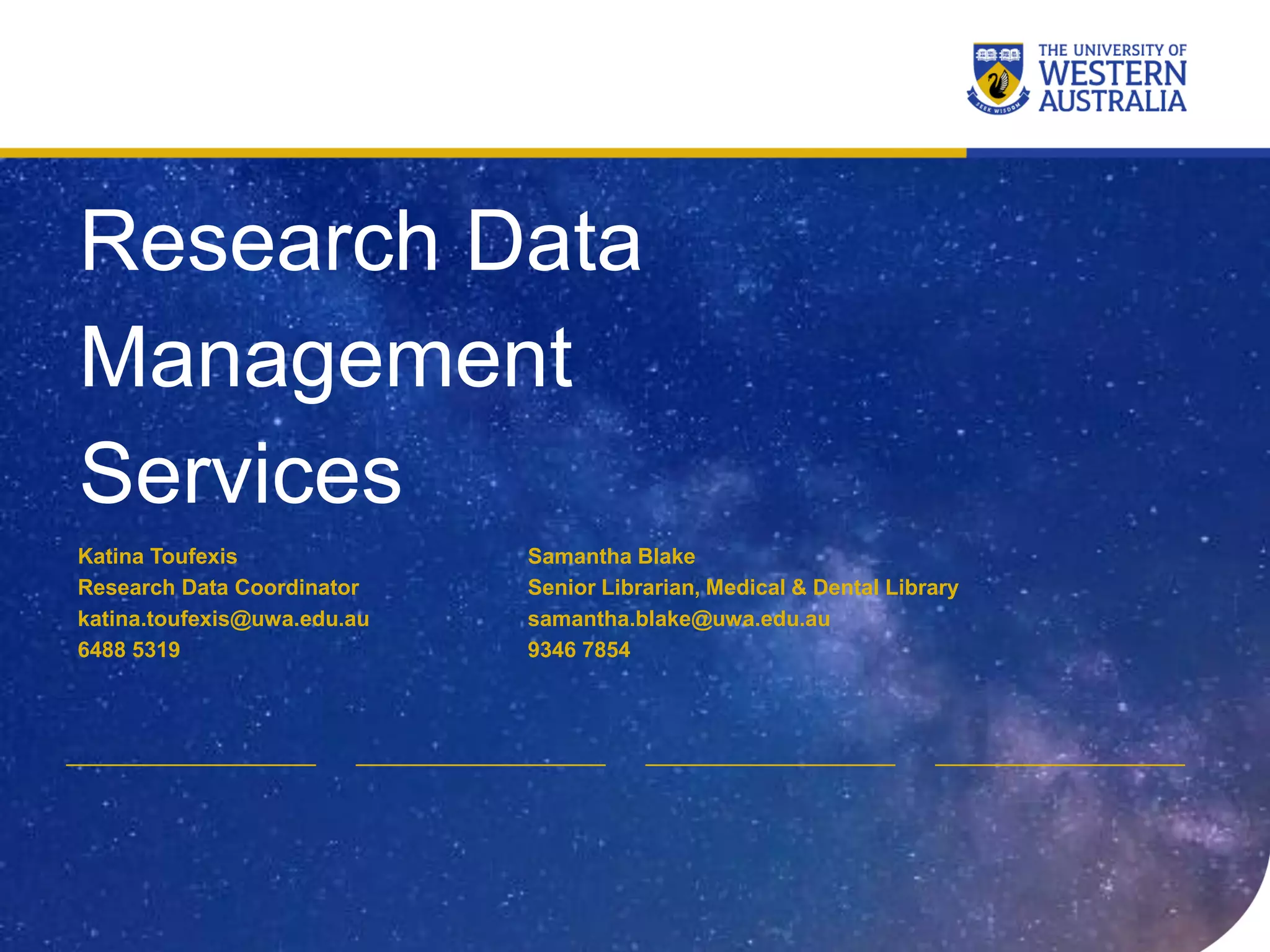

Research Data
Management
Services
Katina Toufexis
Research Data Coordinator
katina.toufexis@uwa.edu.au
6488 5319
Samantha Blake
Senior Librarian, Medical & Dental Library
samantha.blake@uwa.edu.au
9346 7854
Research Data Management at UWA
1. What is Research Data?
2. Research Data Management 101
3. Research Data Management Services at UWA
4. Research Data Management Plan
5. Research Data Management Toolkit
6. Institutional Research Data Store (IRDS)
7. Research Data Online (RDO)
Data Archiving and Networked Services (DANS)
Sharing data: good for science, good
for you
DANS promotes sustained access to digital research data. For this, DANS encourages scientific researchers to
archive and reuse data in a sustained form, for instance via the Australian National Data Service (ANDS)
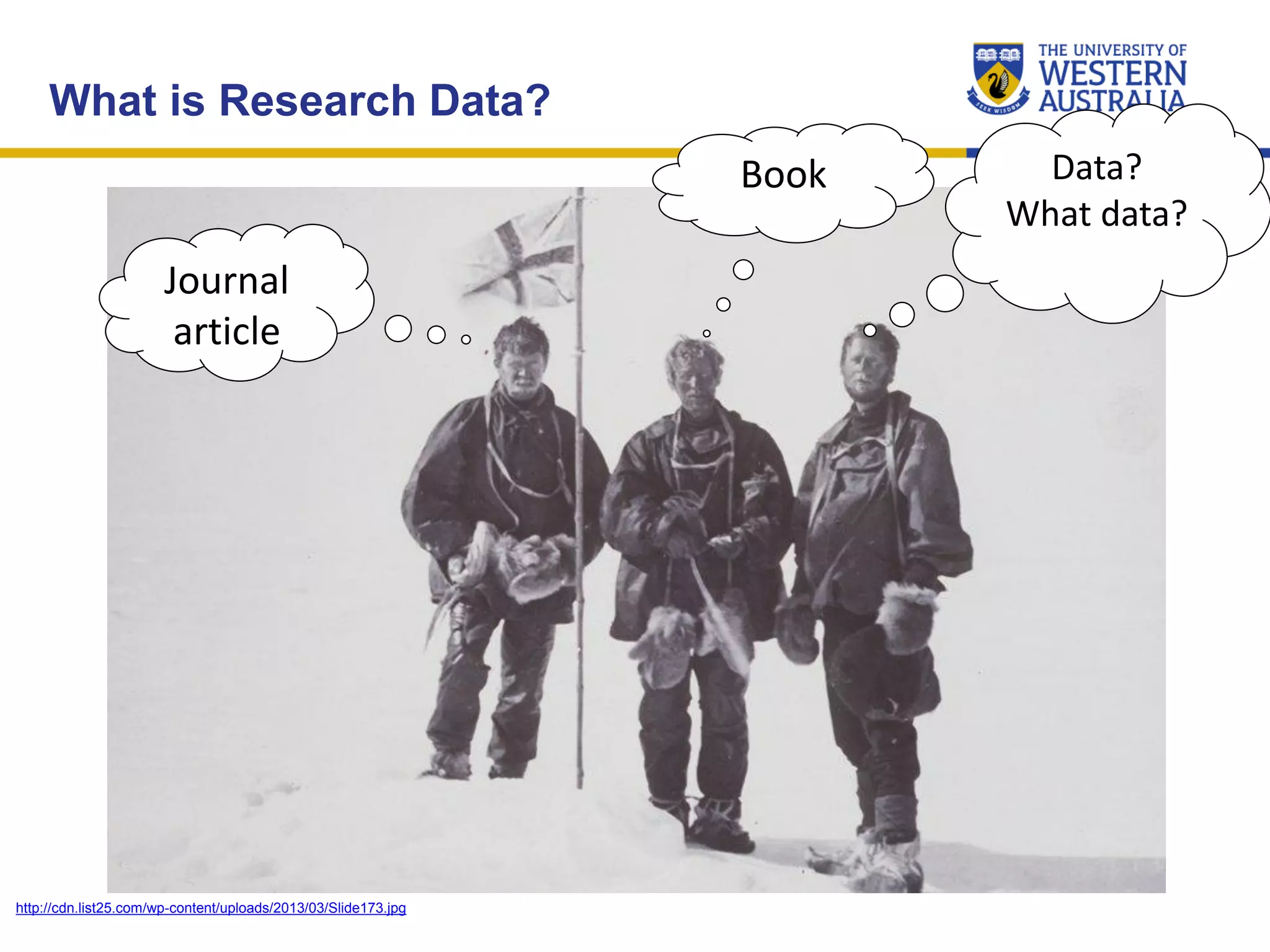
What is Research Data?
Journal
article
Data?
What data?
Book
http://cdn.list25.com/wp-content/uploads/2013/03/Slide173.jpg
What do we mean by research data?
What is Research Data?
“It is not possible to apply a uniform definition of research
data across all disciplines. Research data may be
numerical, textual, audio-visual, digital or physical,
depending on the discipline and the nature of the
research.”
Source: University of Sydney Research Data Management Policy 2014
http://sydney.edu.au/policies/showdoc.aspx?recnum=PDOC2013/337
What do we mean by research data?
What is Research Data?
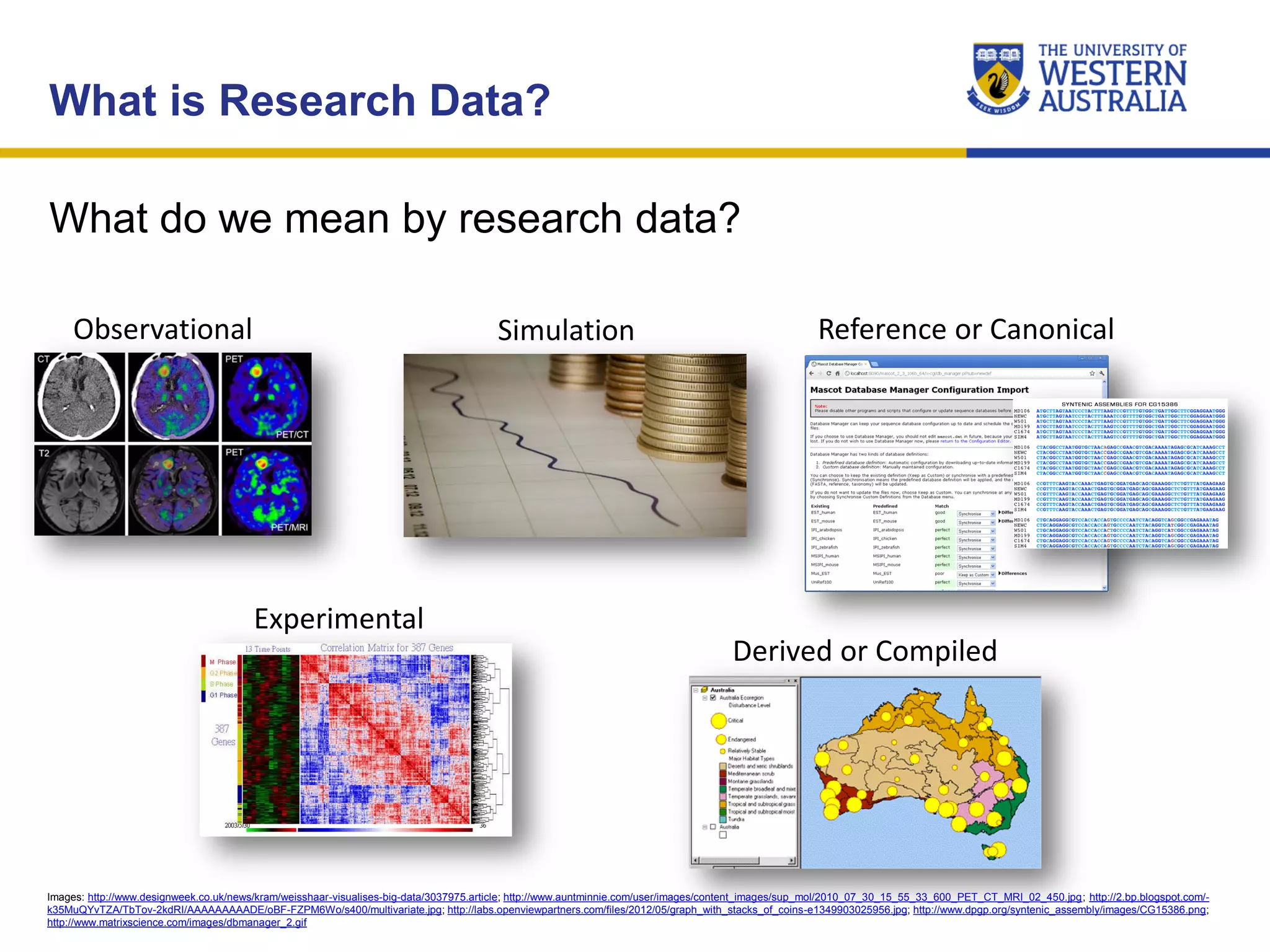
Observational
Experimental
Simulation
Derived or Compiled
Reference or Canonical
Images: http://www.designweek.co.uk/news/kram/weisshaar-visualises-big-data/3037975.article; http://www.auntminnie.com/user/images/content_images/sup_mol/2010_07_30_15_55_33_600_PET_CT_MRI_02_450.jpg; http://2.bp.blogspot.com/-
k35MuQYvTZA/TbTov-2kdRI/AAAAAAAAADE/oBF-FZPM6Wo/s400/multivariate.jpg; http://labs.openviewpartners.com/files/2012/05/graph_with_stacks_of_coins-e1349903025956.jpg; http://www.dpgp.org/syntenic_assembly/images/CG15386.png;
http://www.matrixscience.com/images/dbmanager_2.gif
Humanities Research Data?
What is Research Data?
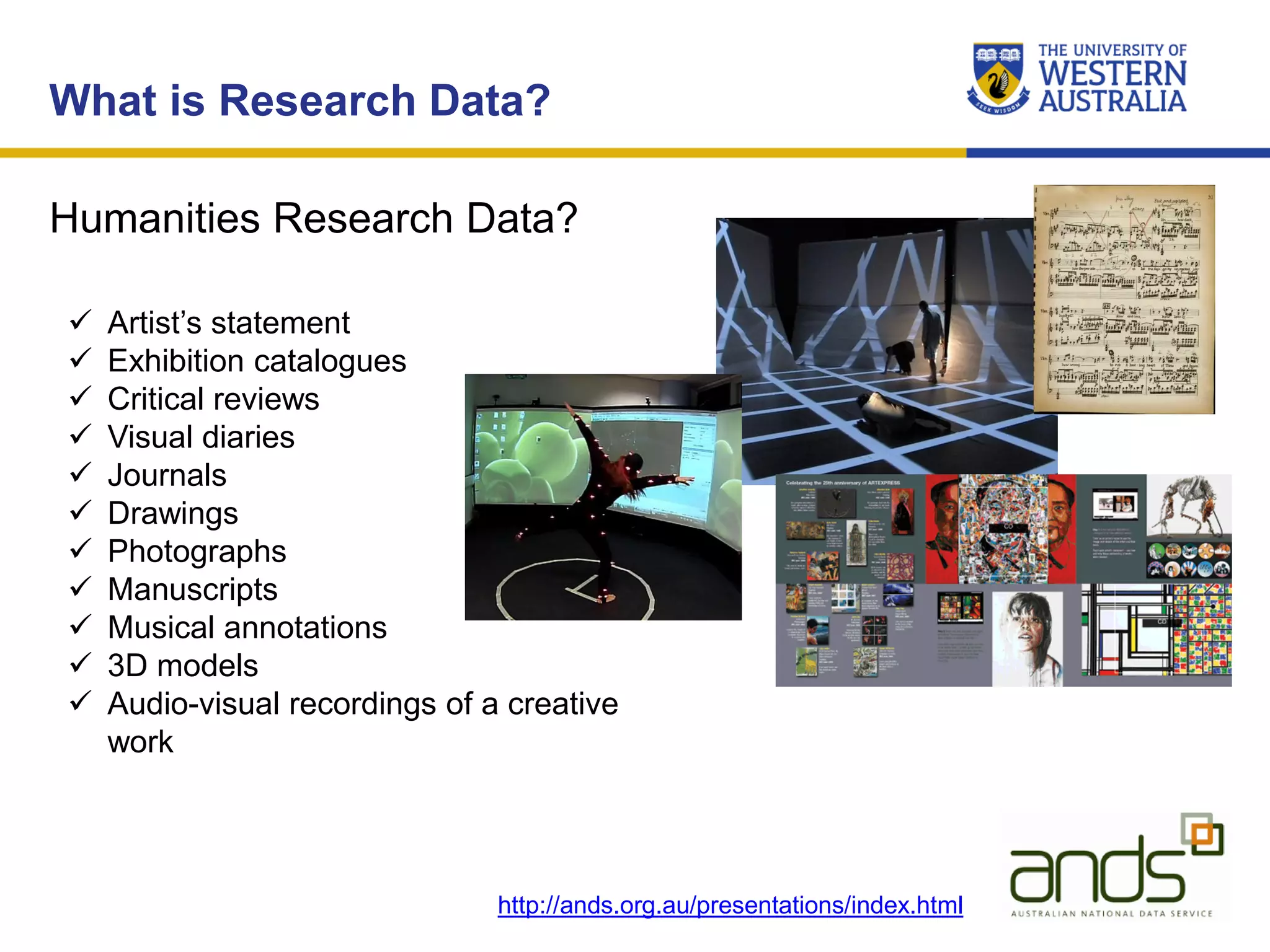
 Artist’s statement
 Exhibition catalogues
 Critical reviews
 Visual diaries
 Journals
 Drawings
 Photographs
 Manuscripts
 Musical annotations
 3D models
 Audio-visual recordings of a creative
work
http://ands.org.au/presentations/index.html
The Data Deluge
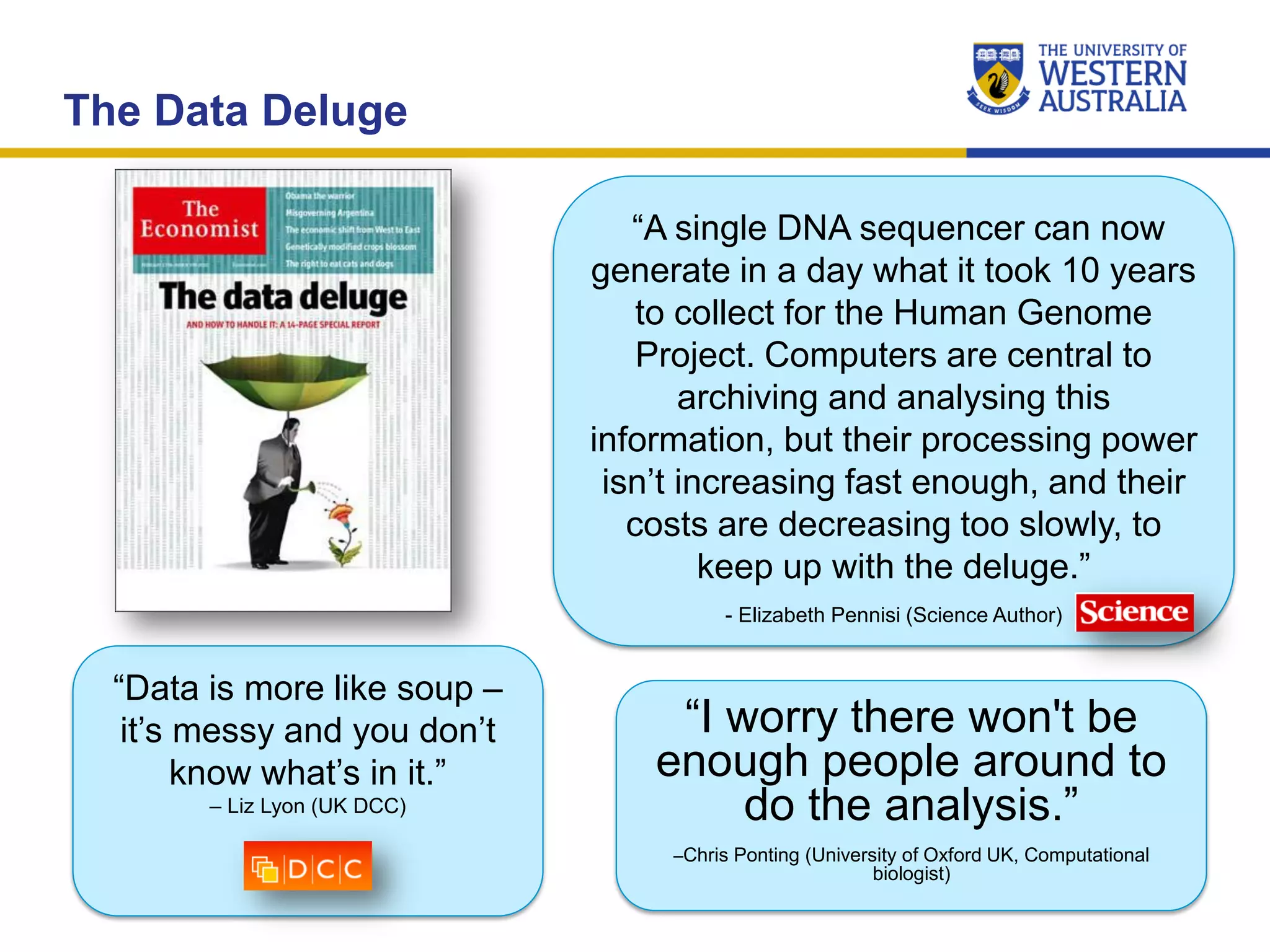
“Data is more like soup –
it’s messy and you don’t
know what’s in it.”
– Liz Lyon (UK DCC)
“I worry there won't be
enough people around to
do the analysis.”
–Chris Ponting (University of Oxford UK, Computational
biologist)
“A single DNA sequencer can now
generate in a day what it took 10 years
to collect for the Human Genome
Project. Computers are central to
archiving and analysing this
information, but their processing power
isn’t increasing fast enough, and their
costs are decreasing too slowly, to
keep up with the deluge.”
- Elizabeth Pennisi (Science Author)
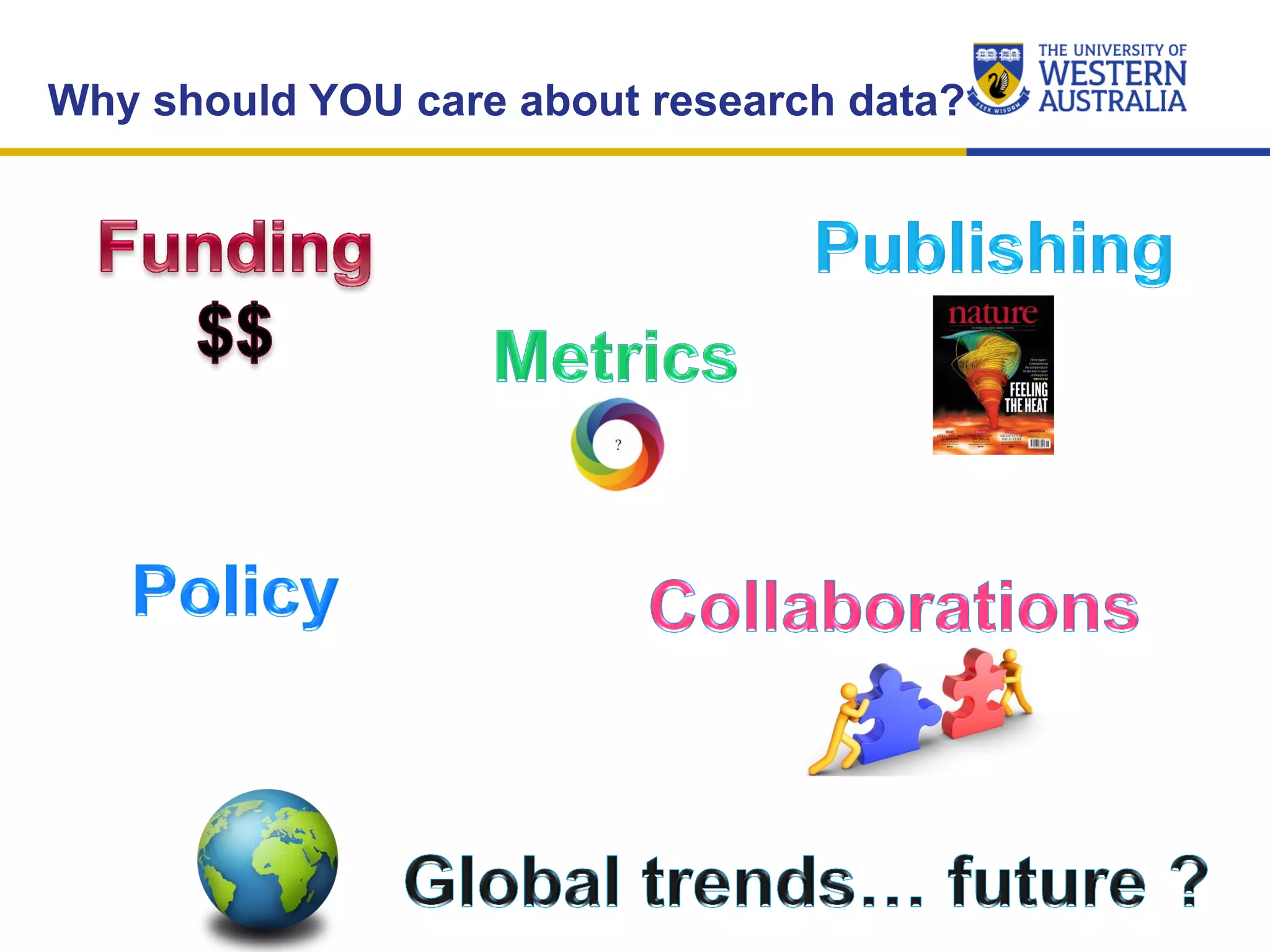
Why should YOU care about research data?
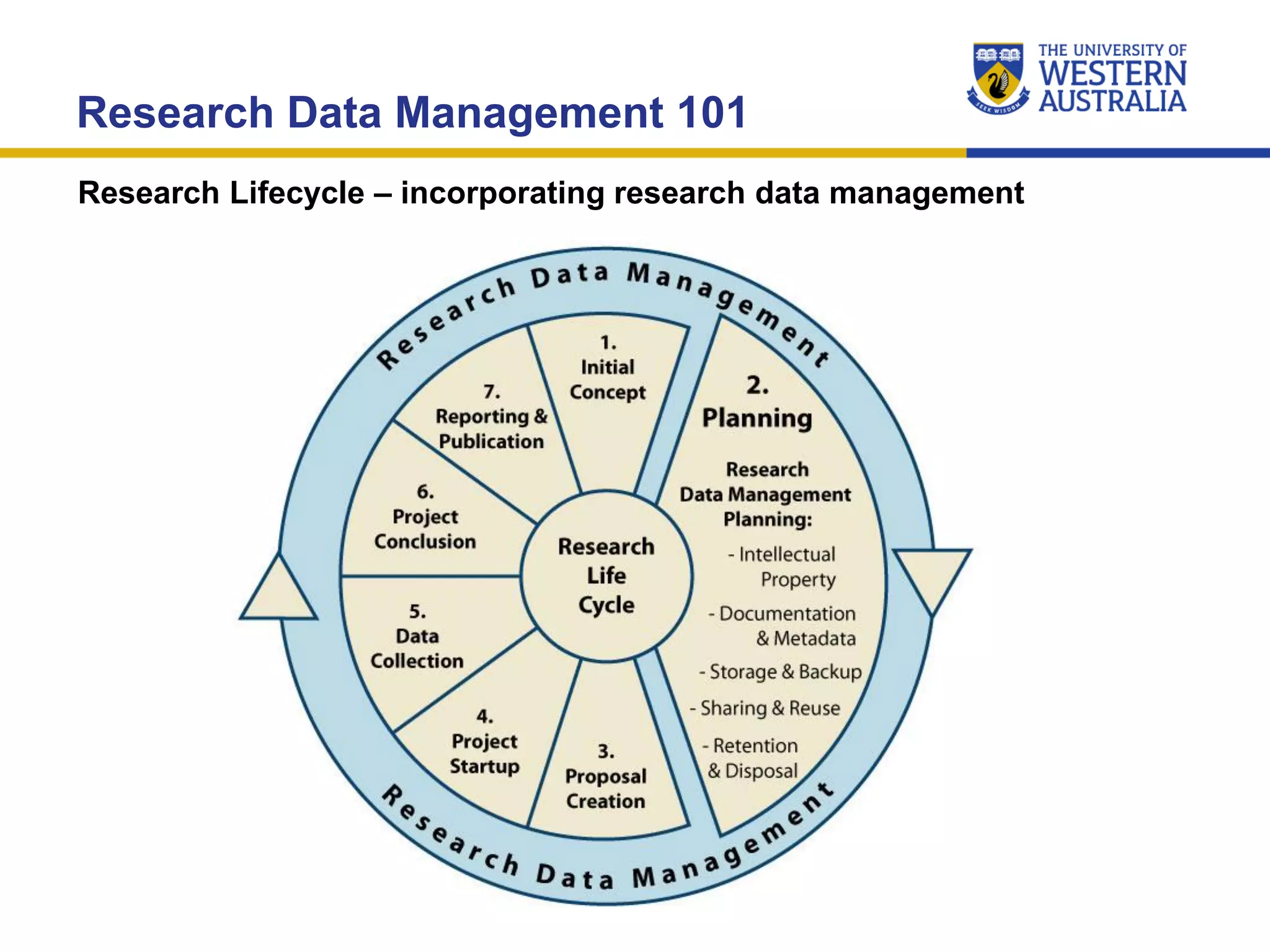
Research Data Management 101
Research Lifecycle – incorporating research data management
Research Data Management 101
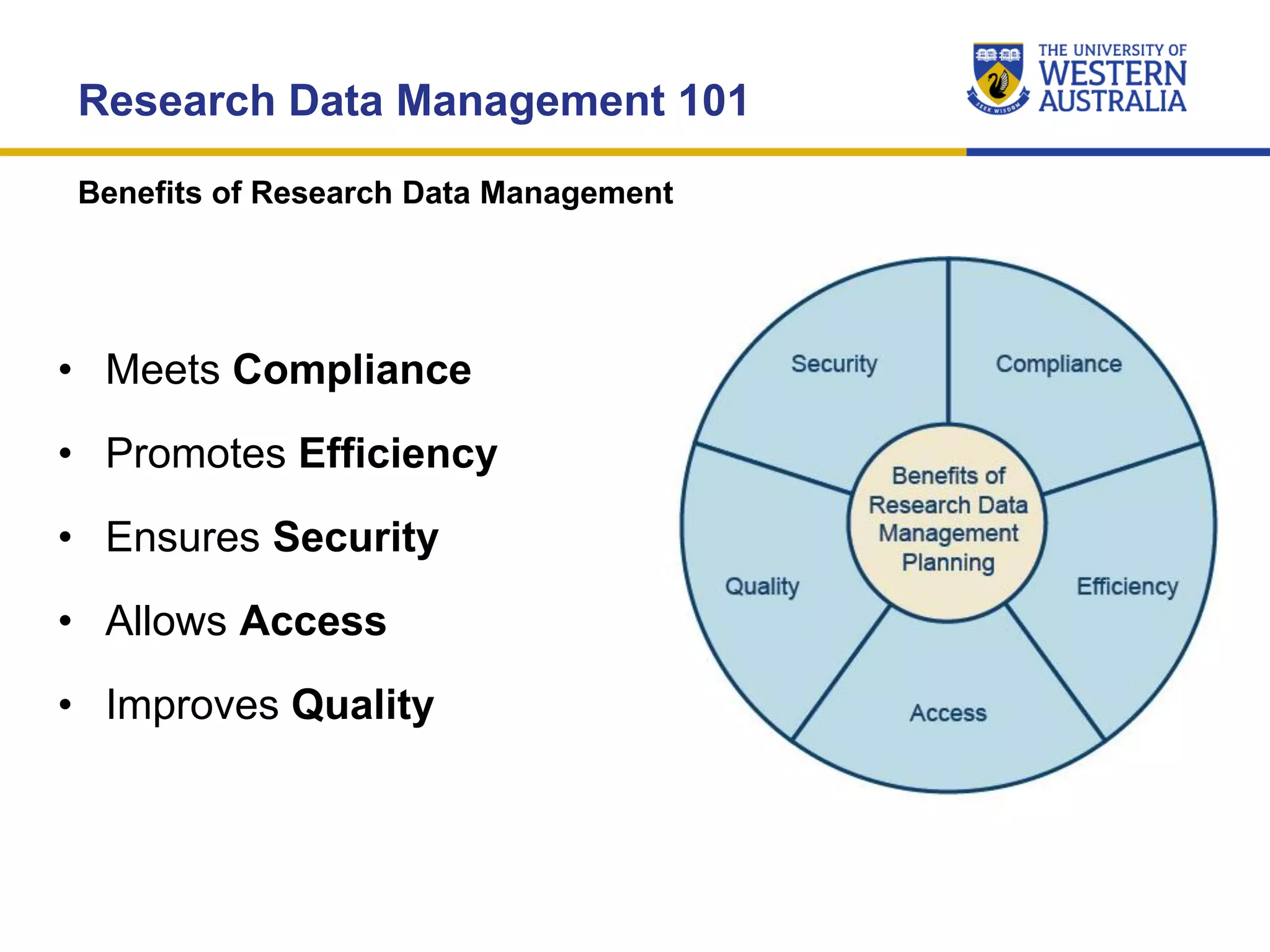
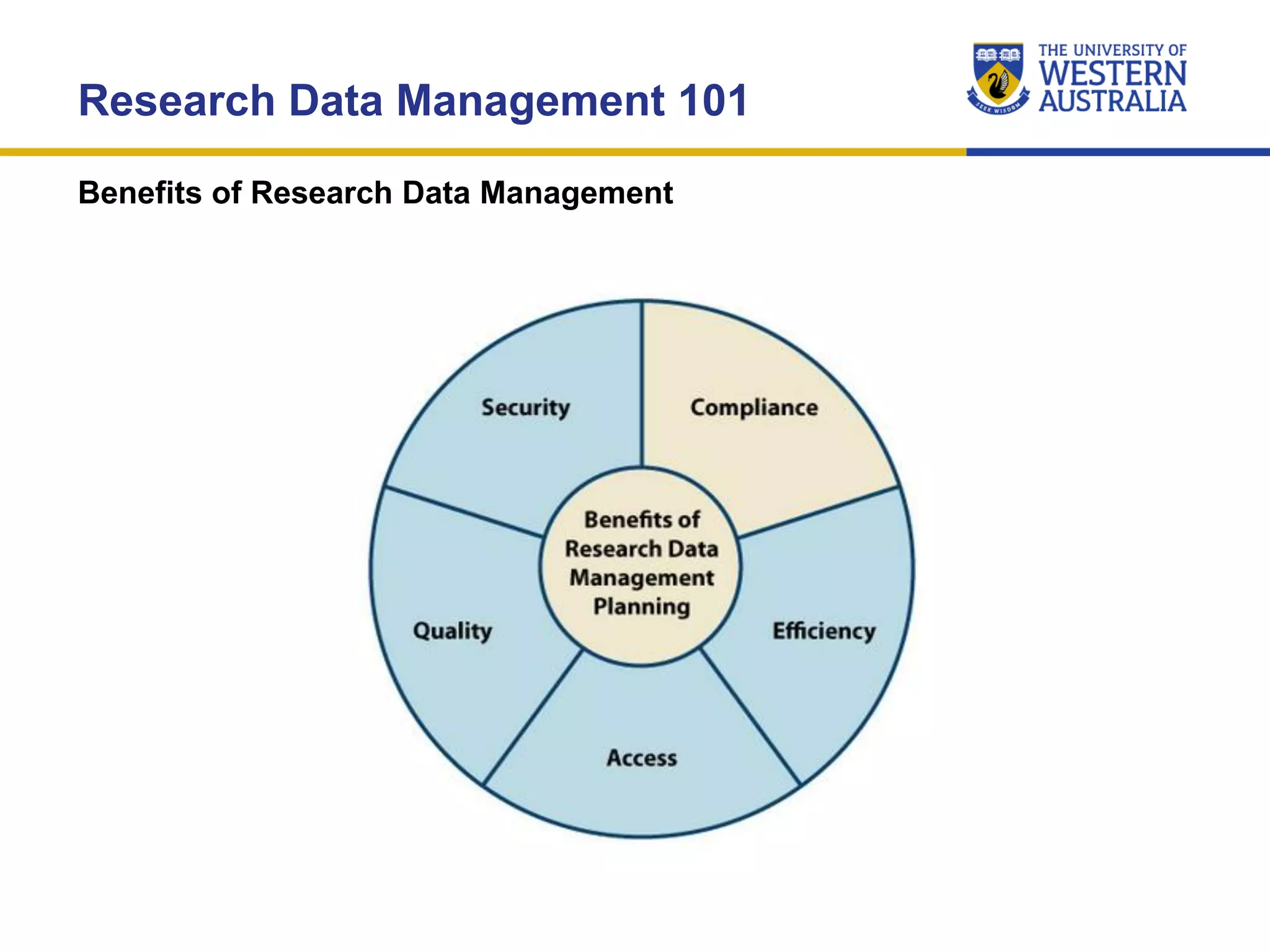
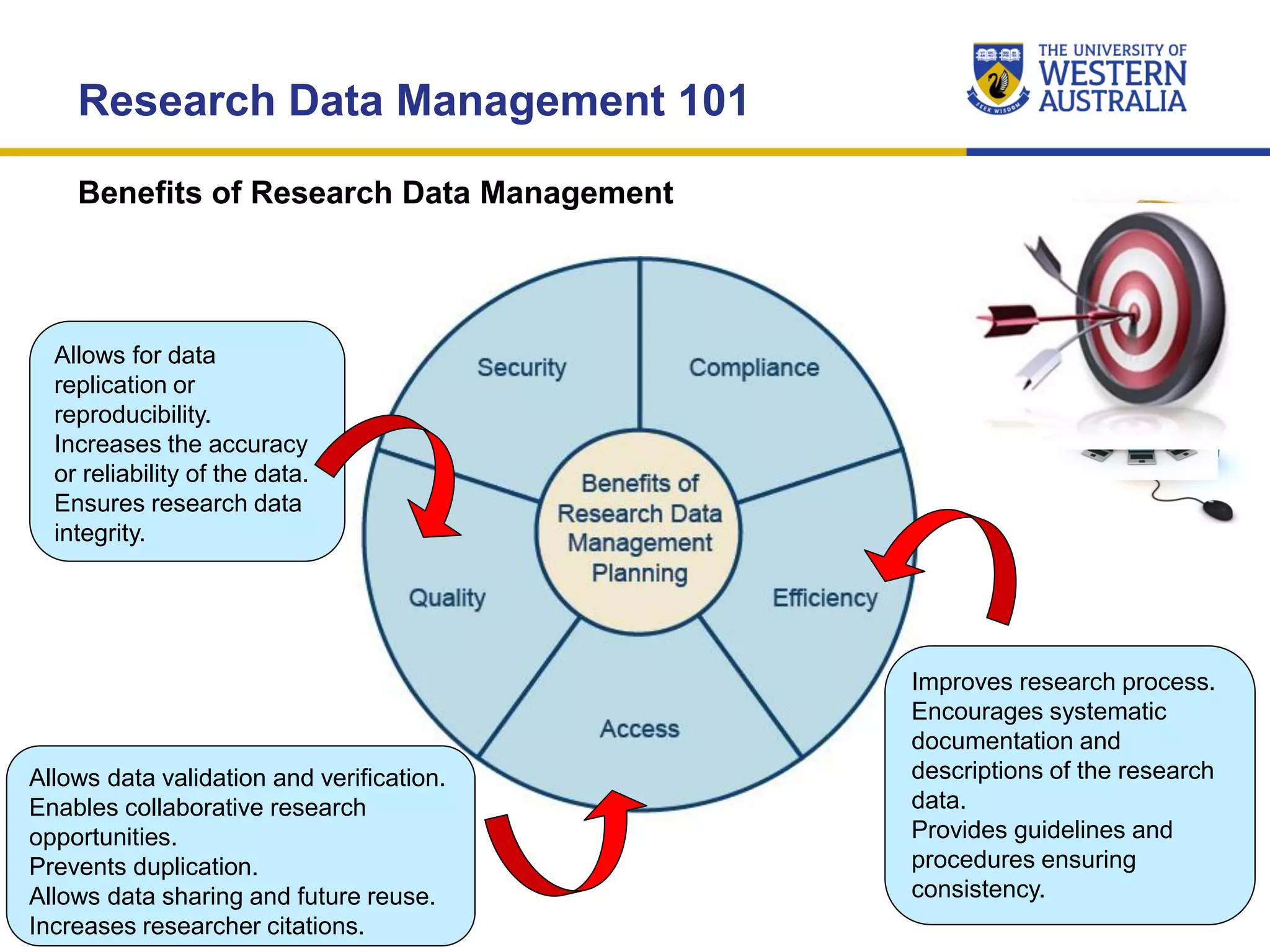
Benefits of Research Data Management
• Meets Compliance
• Promotes Efficiency
• Ensures Security
• Allows Access
• Improves Quality
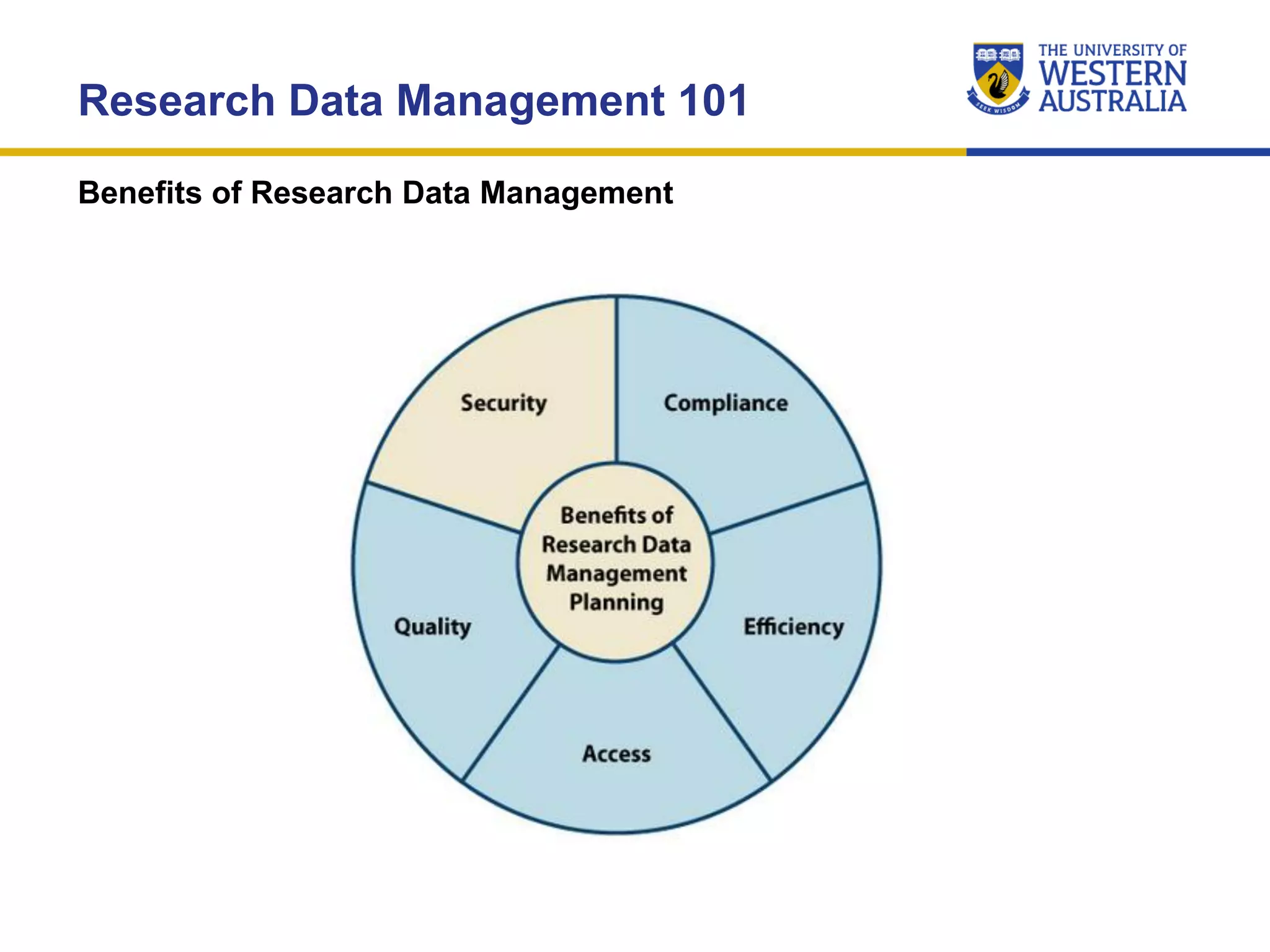
Research Data Management 101
Benefits of Research Data Management
Research Data Management 101
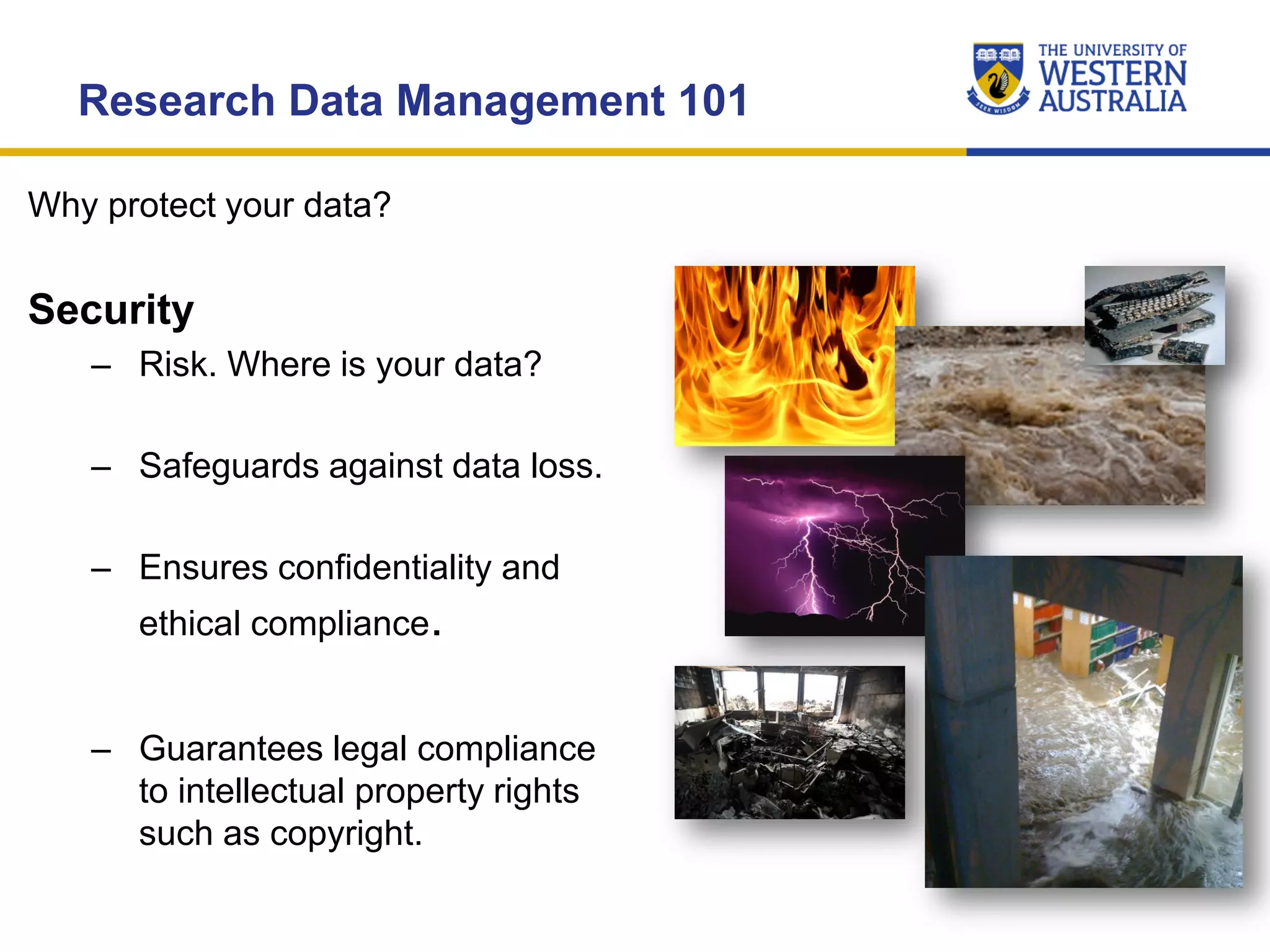
Security
– Risk. Where is your data?
– Safeguards against data loss.
– Ensures confidentiality and
ethical compliance.
– Guarantees legal compliance
to intellectual property rights
such as copyright.
Why protect your data?
Research Data Management 101
Benefits of Research Data Management
OECD cares about research data
Access to research data increases the returns from public
investment in this area; reinforces open scientific inquiry;
encourages diversity of studies and opinion; promotes new
areas of work and enables the exploration of topics not
envisioned by the initial investigators.
(OECD principles and guidelines for access to research data from public funding
2007)
http://www.oecd.org/sti/sci-tech/oecdprinciplesandguidelinesforaccesstoresearchdatafrompublicfunding.htm
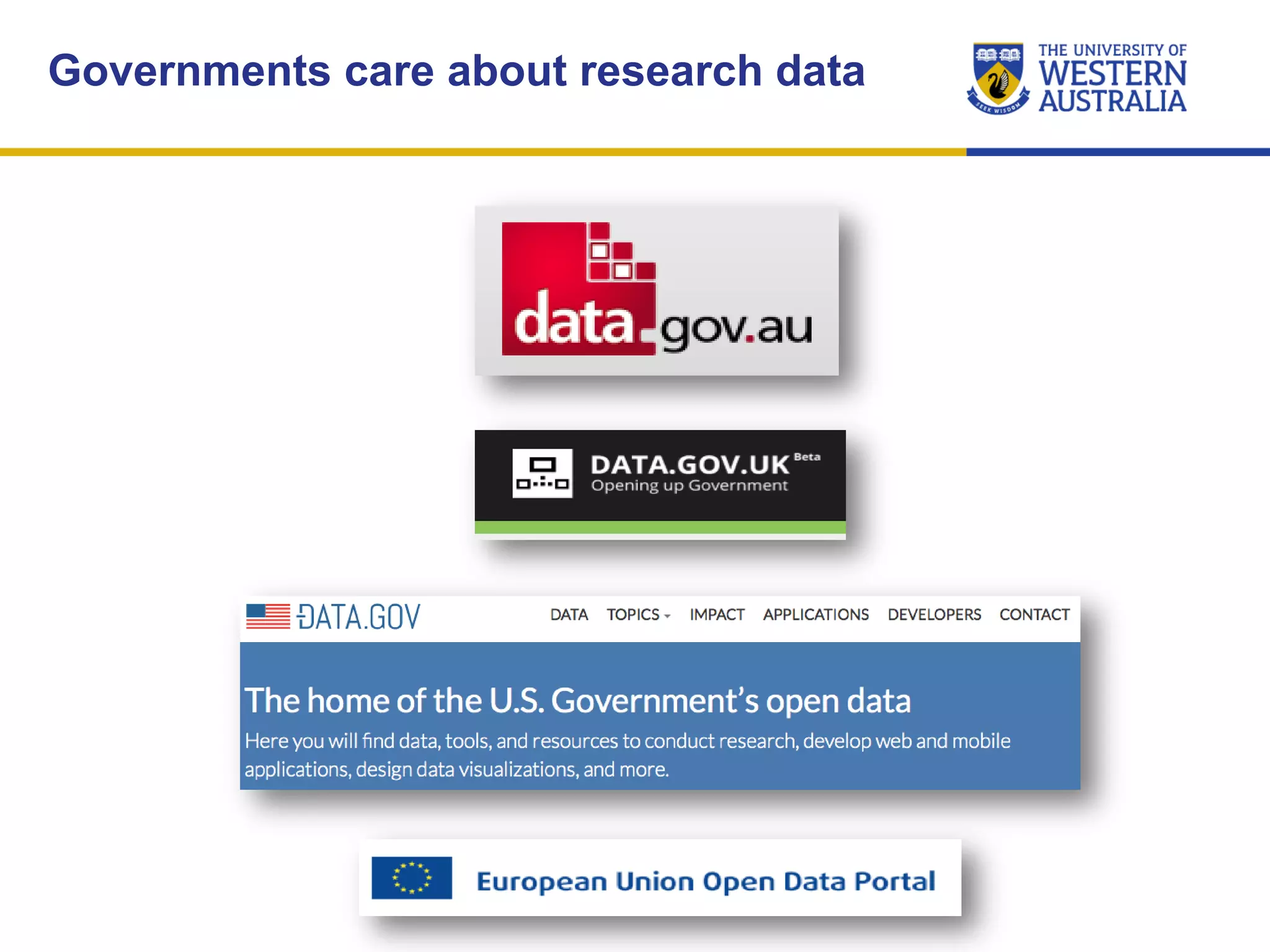
Governments care about research data
The Australian Government now declares that, in order to
promote greater participation in Australia’s democracy, it is
committed to open government based on a culture of
engagement, built on better access to and use of government
held information, and sustained by the innovative use of
technology.
Declaration of Open Government
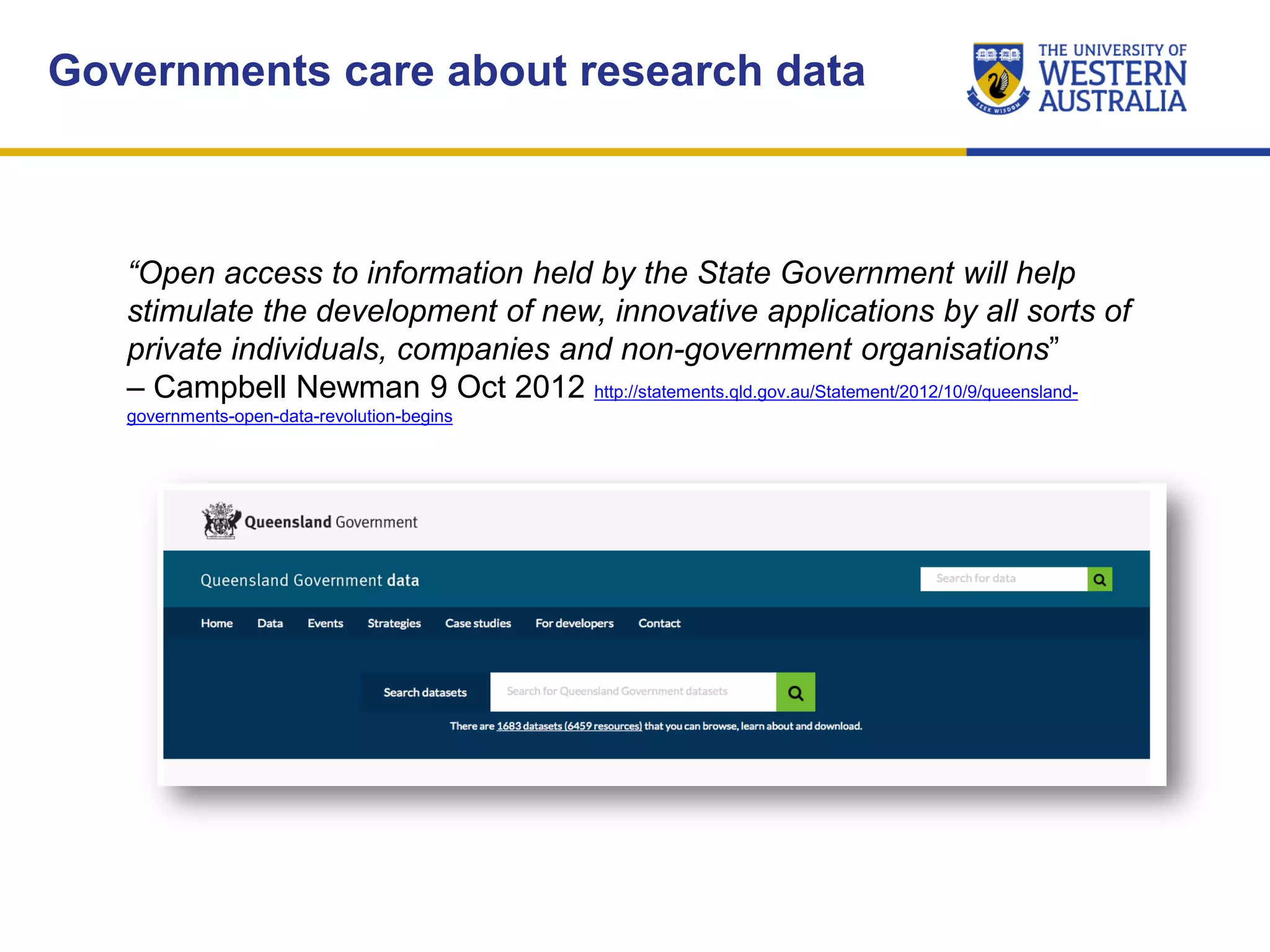
Governments care about research data
“Open access to information held by the State Government will help
stimulate the development of new, innovative applications by all sorts of
private individuals, companies and non-government organisations”
– Campbell Newman 9 Oct 2012 http://statements.qld.gov.au/Statement/2012/10/9/queensland-
governments-open-data-revolution-begins
FUNDERS care about research data
Australian Code for the Responsible Conduct of Research
(NHMRC, 2007)
Section 2: Management of Research Data & Primary Materials
“The responsible conduct of research includes the proper management
and retention of the research data. …The central aim is that sufficient
materials and data are retained to justify the outcomes of the research
and to defend them if they are challenged. The potential value of the
material for further research should also be considered, particularly
where the research would be difficult or impossible to repeat.”
https://www.nhmrc.gov.au/guidelines/publications/r39
ARC Discovery Grant requirements, February 2014:
MANAGEMENT OF DATA
Outline plans for the management of
data produced as a result of the
proposed research, including but not
limited to storage, access and re-use
arrangements.
FUNDERS care about research data
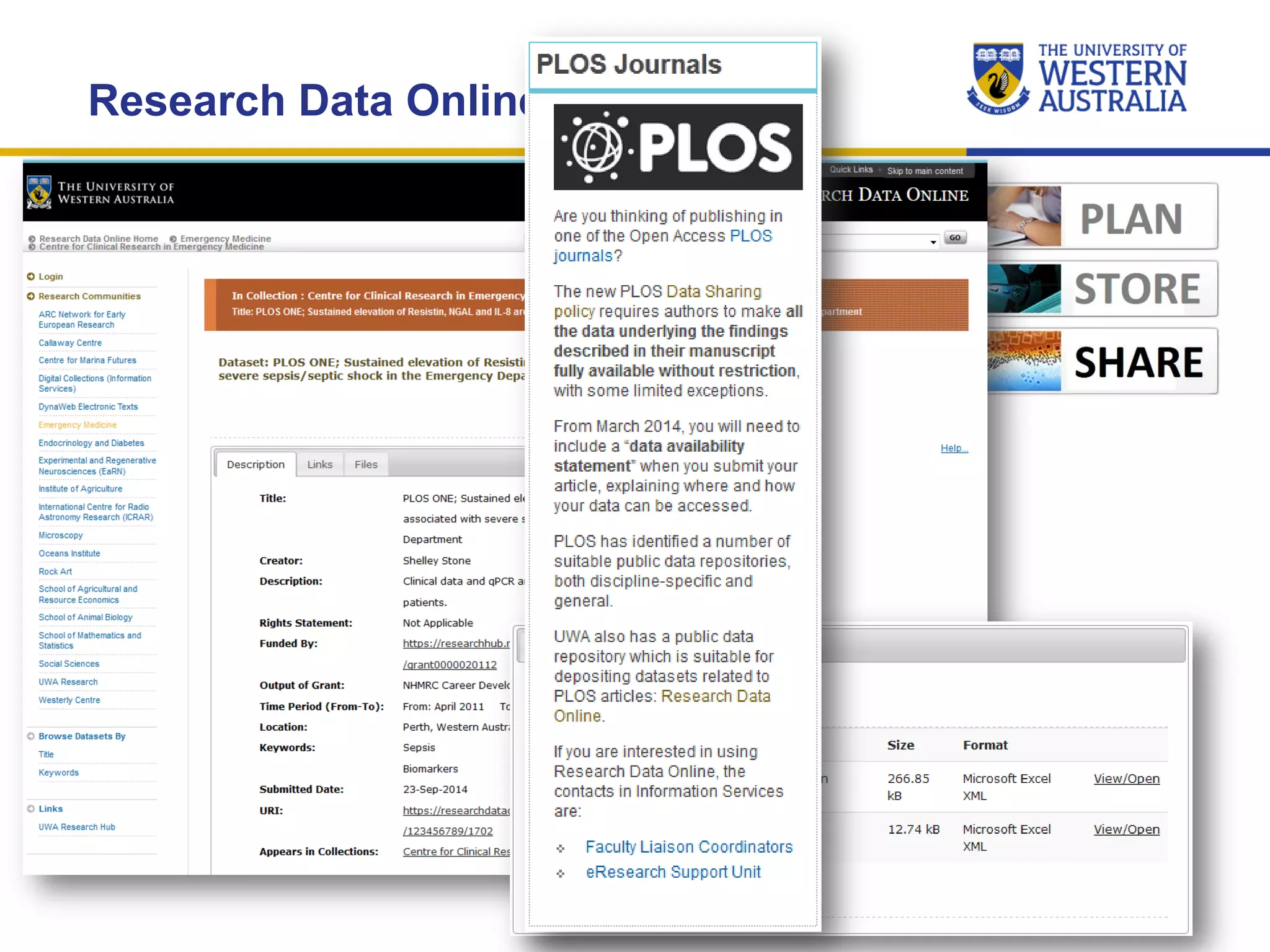
The Public Library of Science PLOS Data Sharing policy:
PLOS journals require authors to make all data underlying the findings
described in their manuscript fully available without restriction, with
rare exception.
From March 2014, you will need to include a “data availability statement”
when you submit your article, explaining where and how your data can be
accessed.
PUBLISHERS care about research data
http://www.plosone.org/static/policies#sharing
Nature
“An inherent principle of publication is that others
should be able to replicate and build upon the
authors' published claims.
Therefore, a condition of publication in a Nature
journal is that authors are required to make materials,
data and associated protocols promptly available to
readers without undue qualifications”.
PUBLISHERS care about research data
http://www.nature.com/authors/policies/availability.html
British Journal of
Educational Technology
“BJET strongly encourages authors of articles
describing empirical research to make their
data available to others, for example
through an institutional or other repository. If this is
not possible then it will not necessarily preclude
publication in the Journal, but you should note that it
is one of the criteria by which your work will be
assessed.”.
PUBLISHERS care about research data
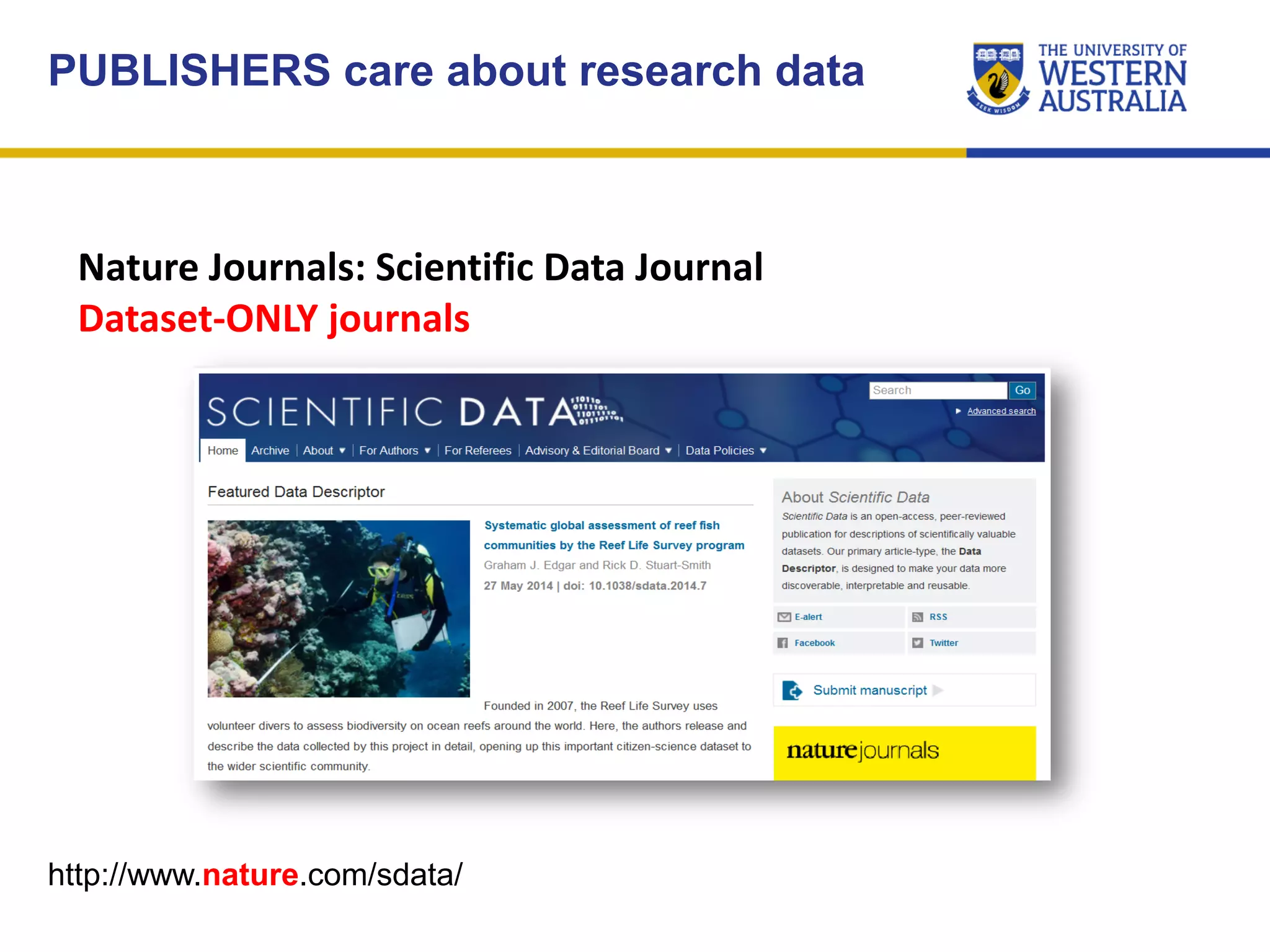
Nature Journals: Scientific Data Journal
Dataset-ONLY journals
PUBLISHERS care about research data
http://www.nature.com/sdata/
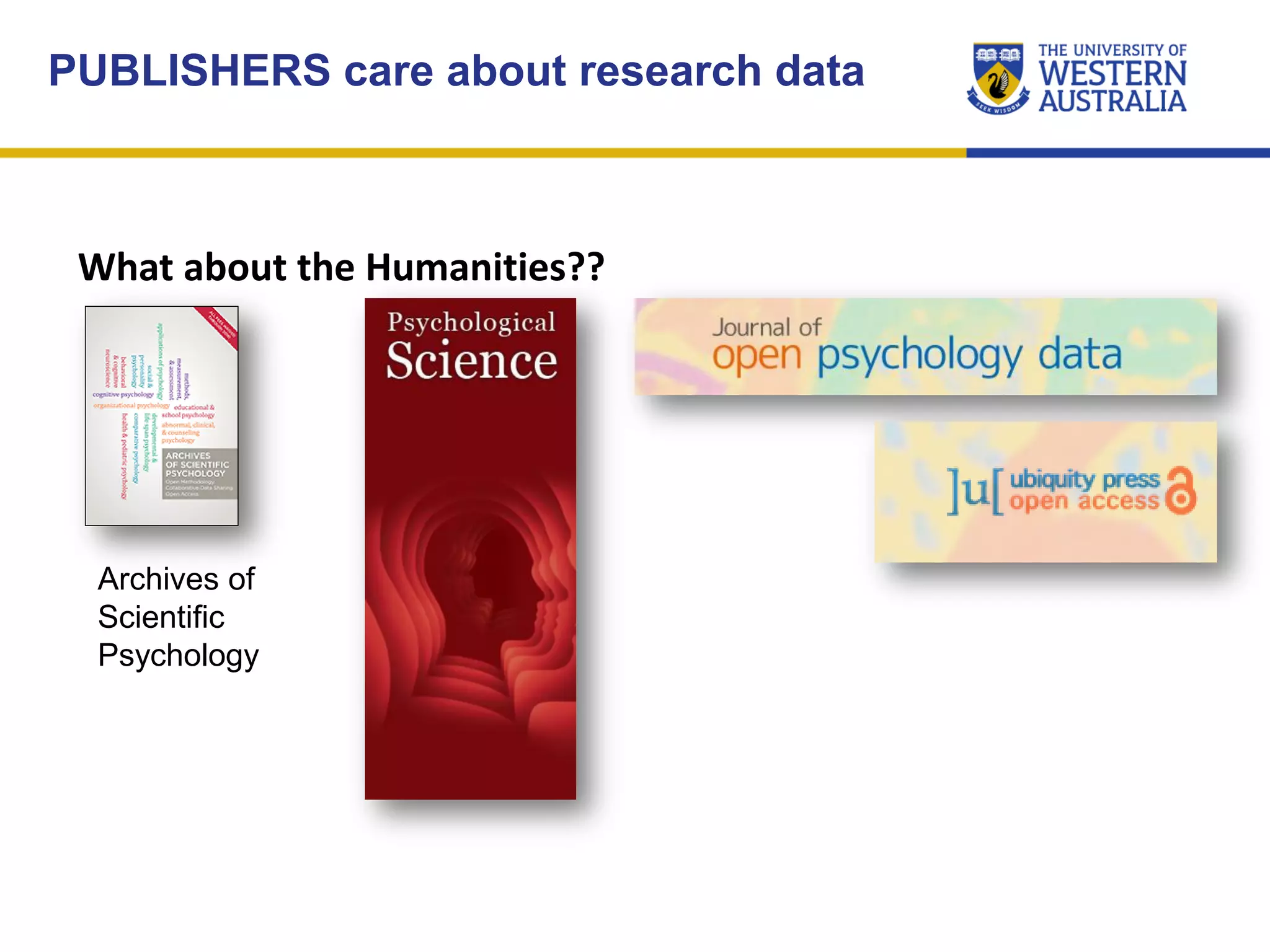
What about the Humanities??
PUBLISHERS care about research data
Archives of
Scientific
Psychology
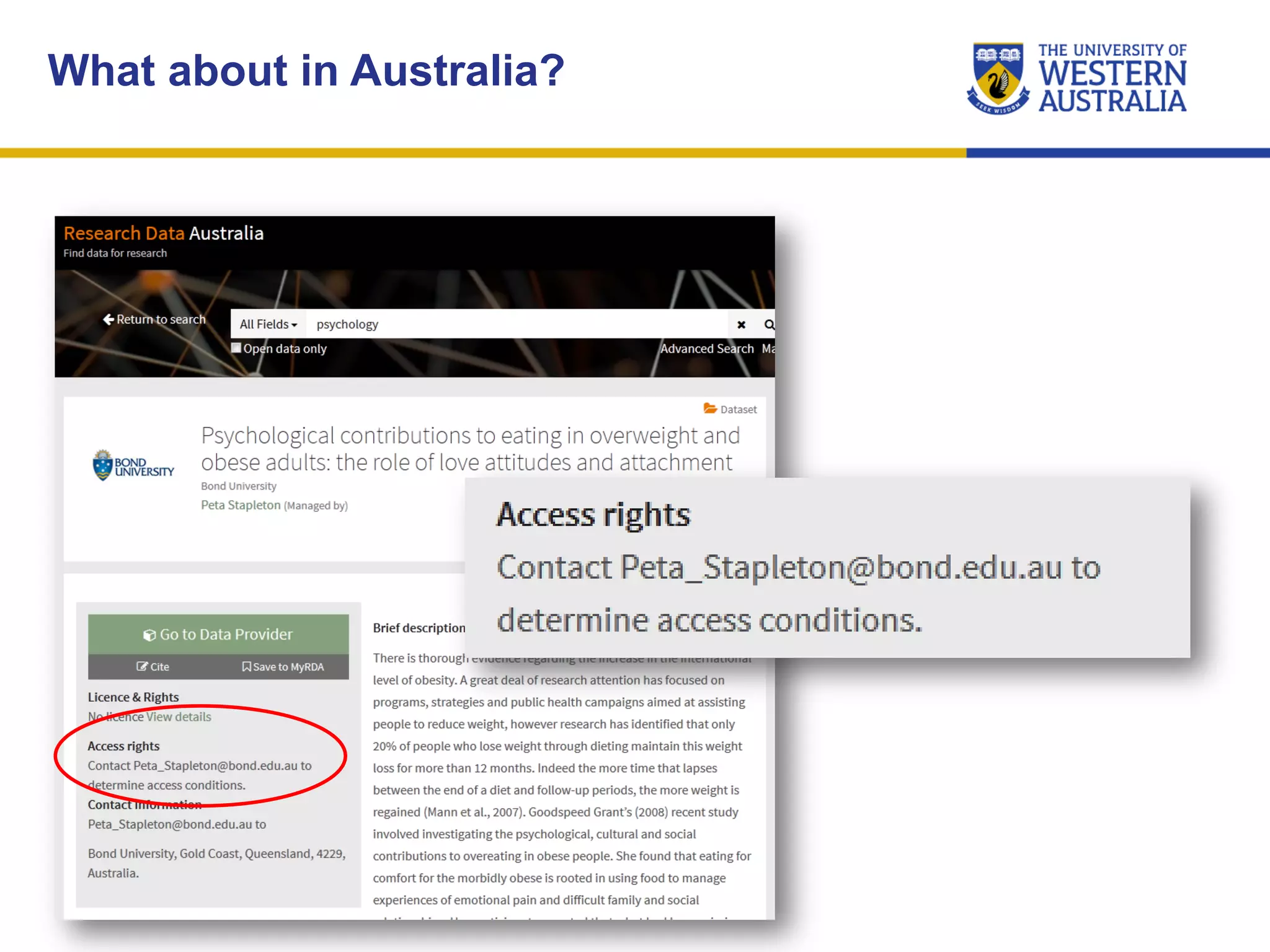
Psychology Research Data Repositories
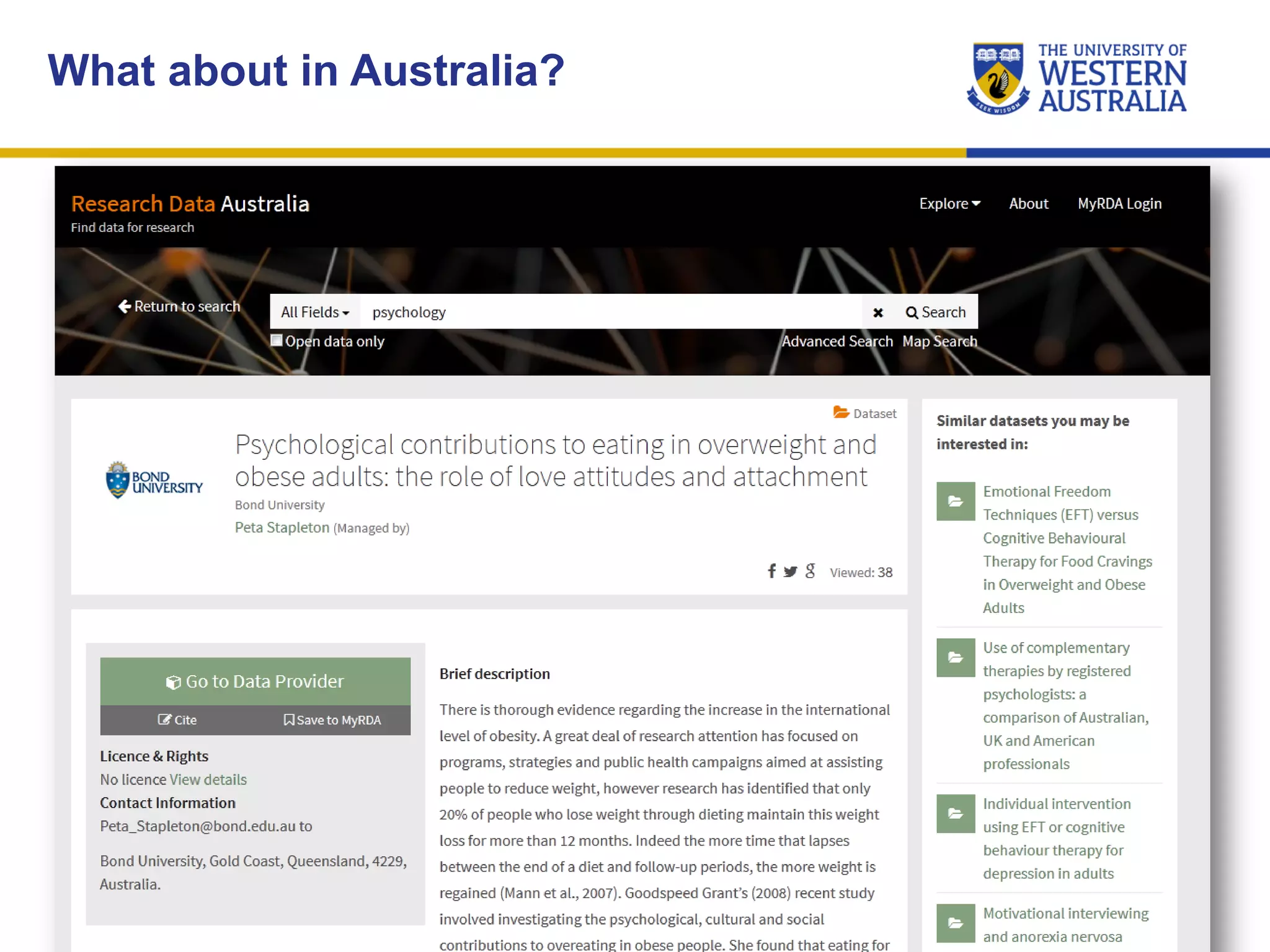
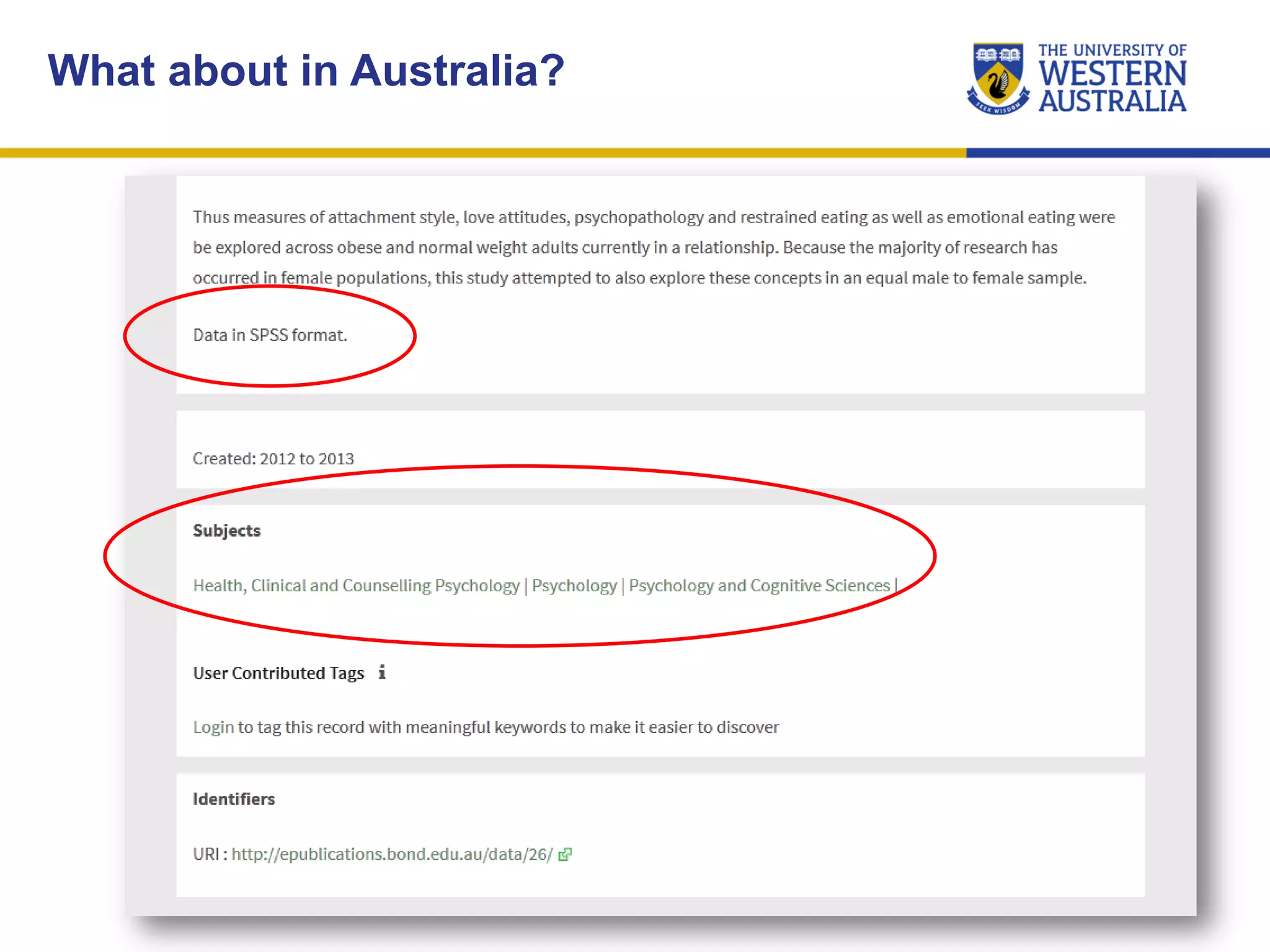
What about in Australia?
INSTITUTIONS care about research data
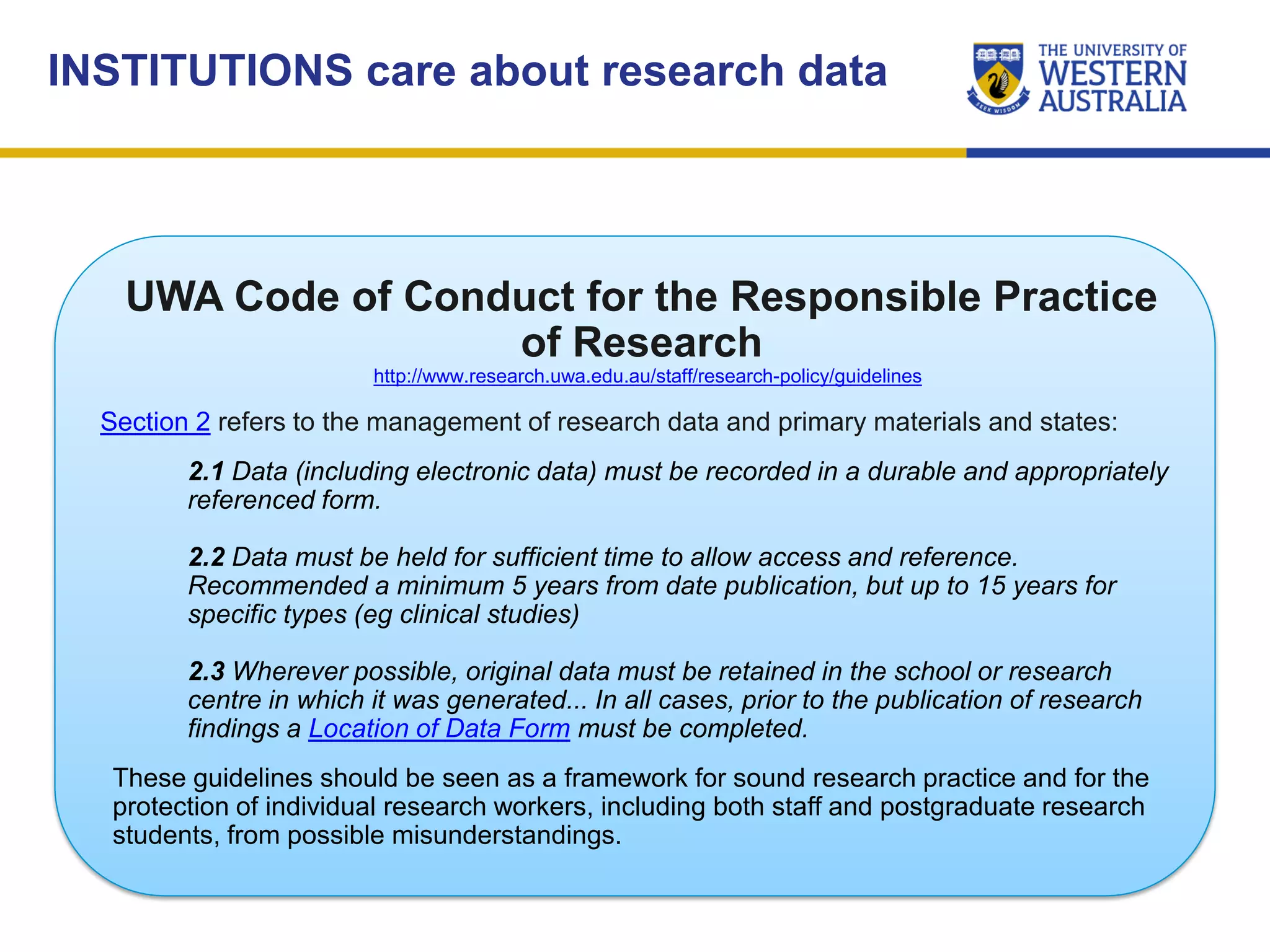
UWA Code of Conduct for the Responsible Practice
of Research
http://www.research.uwa.edu.au/staff/research-policy/guidelines
Section 2 refers to the management of research data and primary materials and states:
2.1 Data (including electronic data) must be recorded in a durable and appropriately
referenced form.
2.2 Data must be held for sufficient time to allow access and reference.
Recommended a minimum 5 years from date publication, but up to 15 years for
specific types (eg clinical studies)
2.3 Wherever possible, original data must be retained in the school or research
centre in which it was generated... In all cases, prior to the publication of research
findings a Location of Data Form must be completed.
These guidelines should be seen as a framework for sound research practice and for the
protection of individual research workers, including both staff and postgraduate research
students, from possible misunderstandings.
Research Data Management 101
Benefits of Research Data Management
Allows for data
replication or
reproducibility.
Increases the accuracy
or reliability of the data.
Ensures research data
integrity.
Improves research process.
Encourages systematic
documentation and
descriptions of the research
data.
Provides guidelines and
procedures ensuring
consistency.
Allows data validation and verification.
Enables collaborative research
opportunities.
Prevents duplication.
Allows data sharing and future reuse.
Increases researcher citations.
DATA REUSE and Open Data Citation
advantages
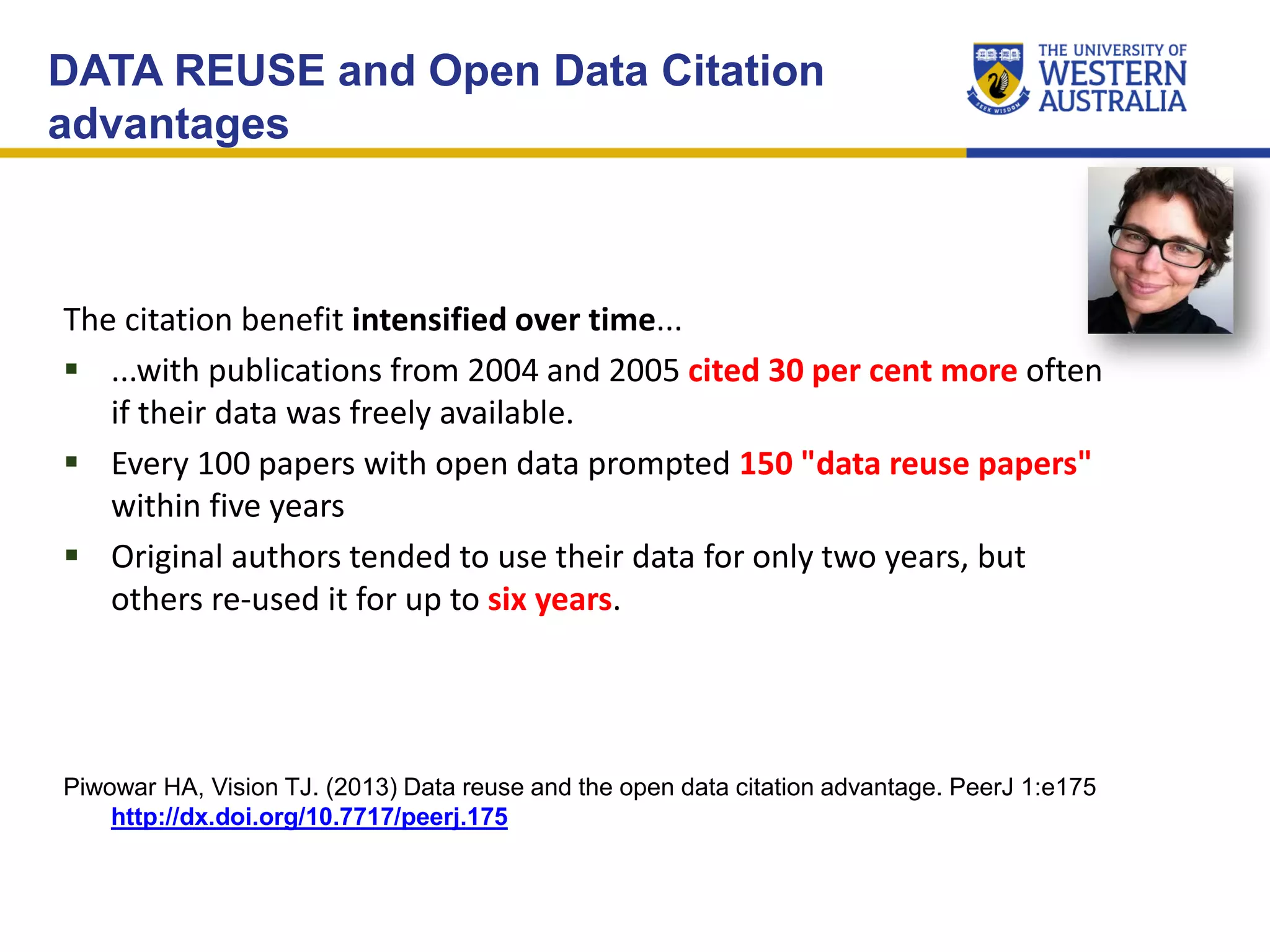
The citation benefit intensified over time...
 ...with publications from 2004 and 2005 cited 30 per cent more often
if their data was freely available.
 Every 100 papers with open data prompted 150 "data reuse papers"
within five years
 Original authors tended to use their data for only two years, but
others re-used it for up to six years.
Piwowar HA, Vision TJ. (2013) Data reuse and the open data citation advantage. PeerJ 1:e175
http://dx.doi.org/10.7717/peerj.175
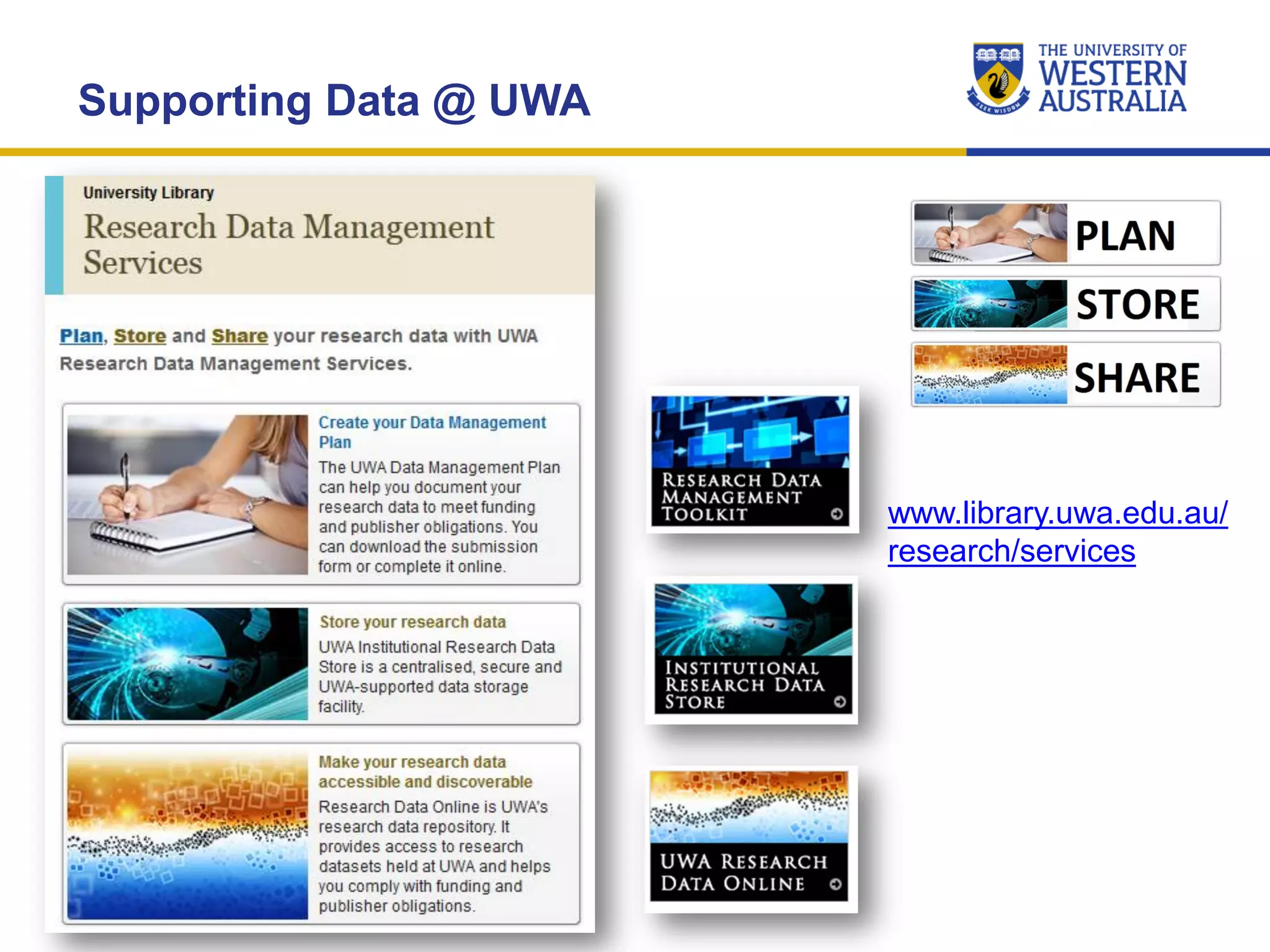
Supporting Data @ UWA
www.library.uwa.edu.au/
research/services
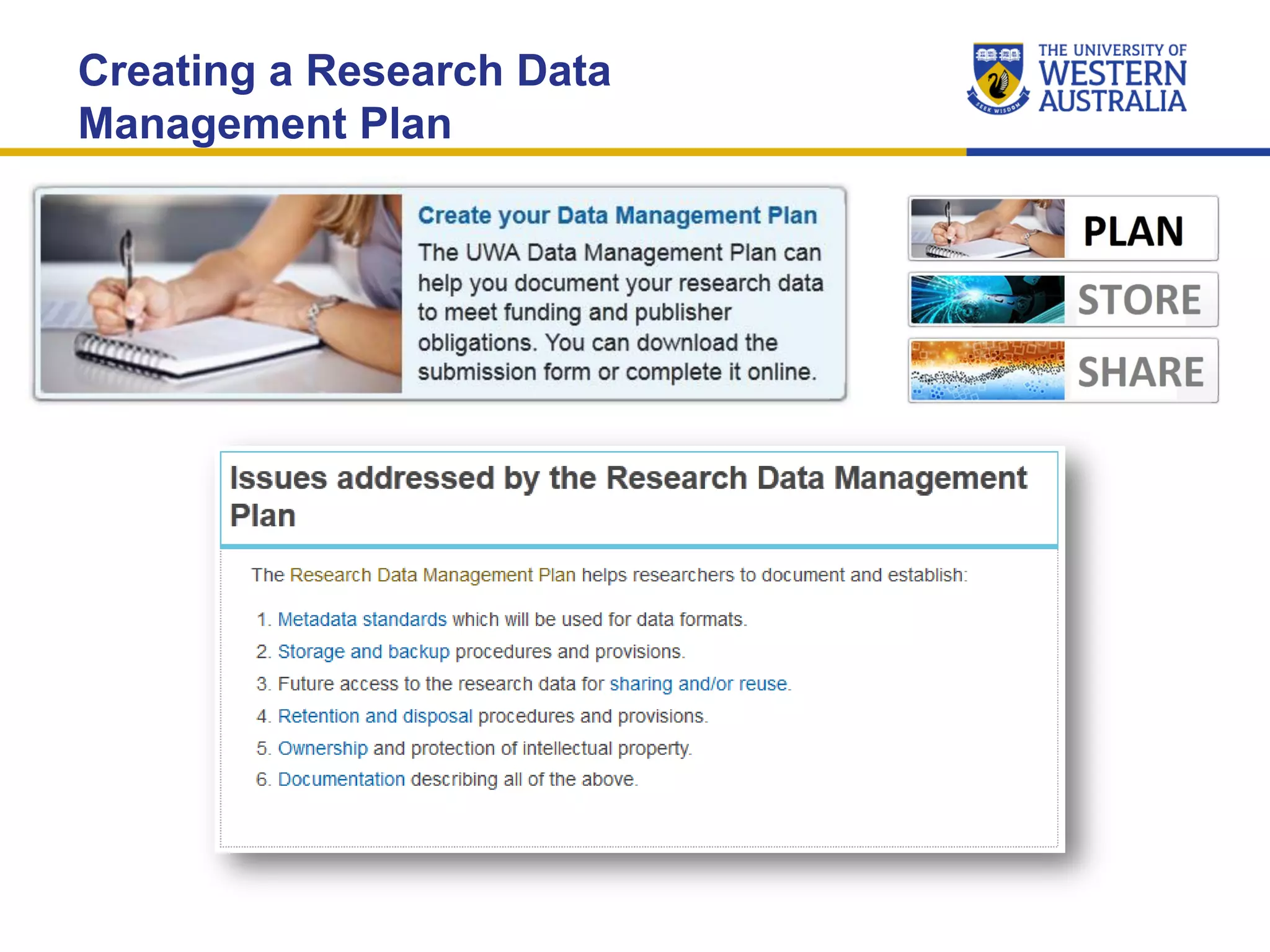
Creating a Research Data
Management Plan
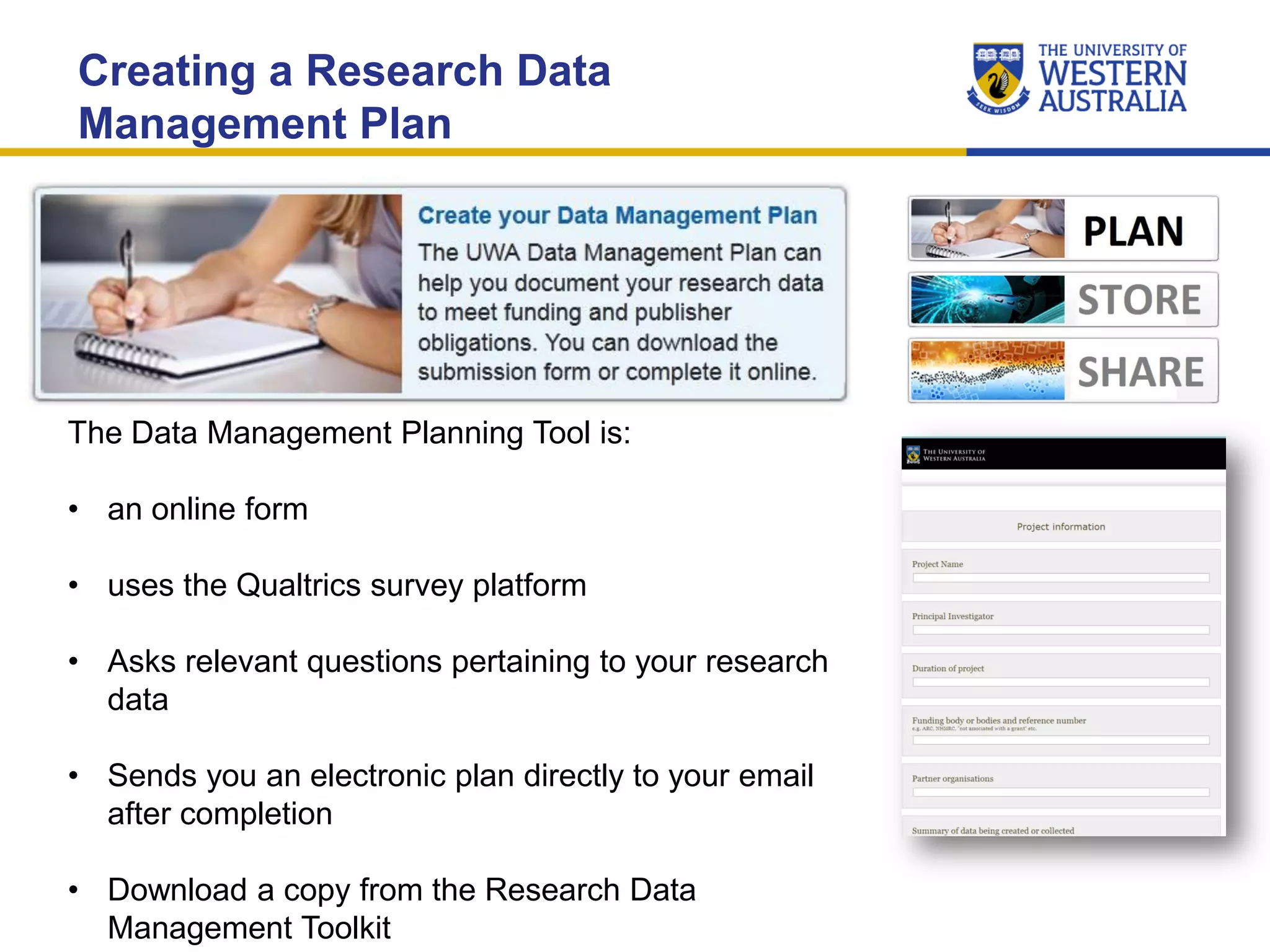
Creating a Research Data
Management Plan
The Data Management Planning Tool is:
• an online form
• uses the Qualtrics survey platform
• Asks relevant questions pertaining to your research
data
• Sends you an electronic plan directly to your email
after completion
• Download a copy from the Research Data
Management Toolkit
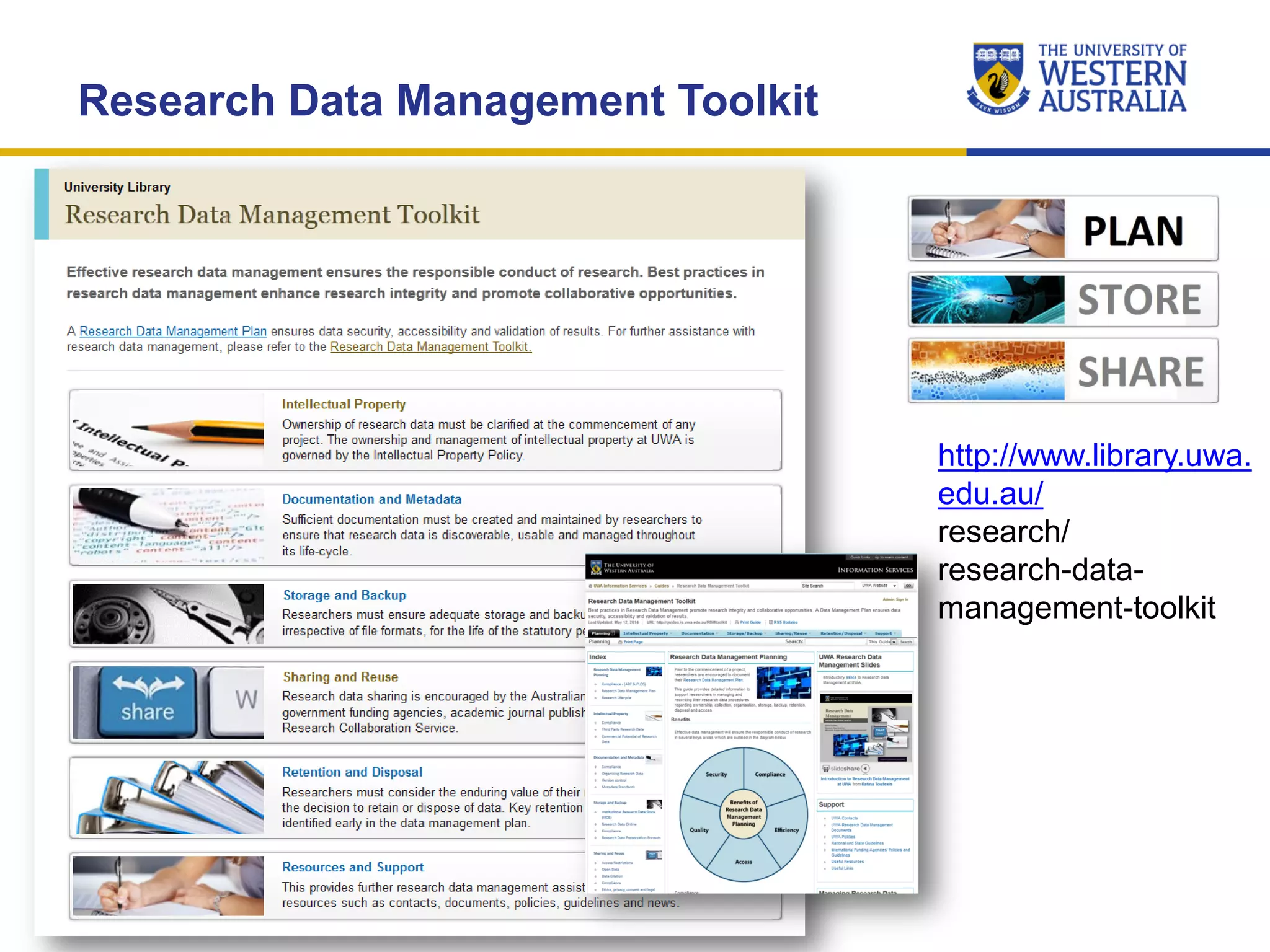
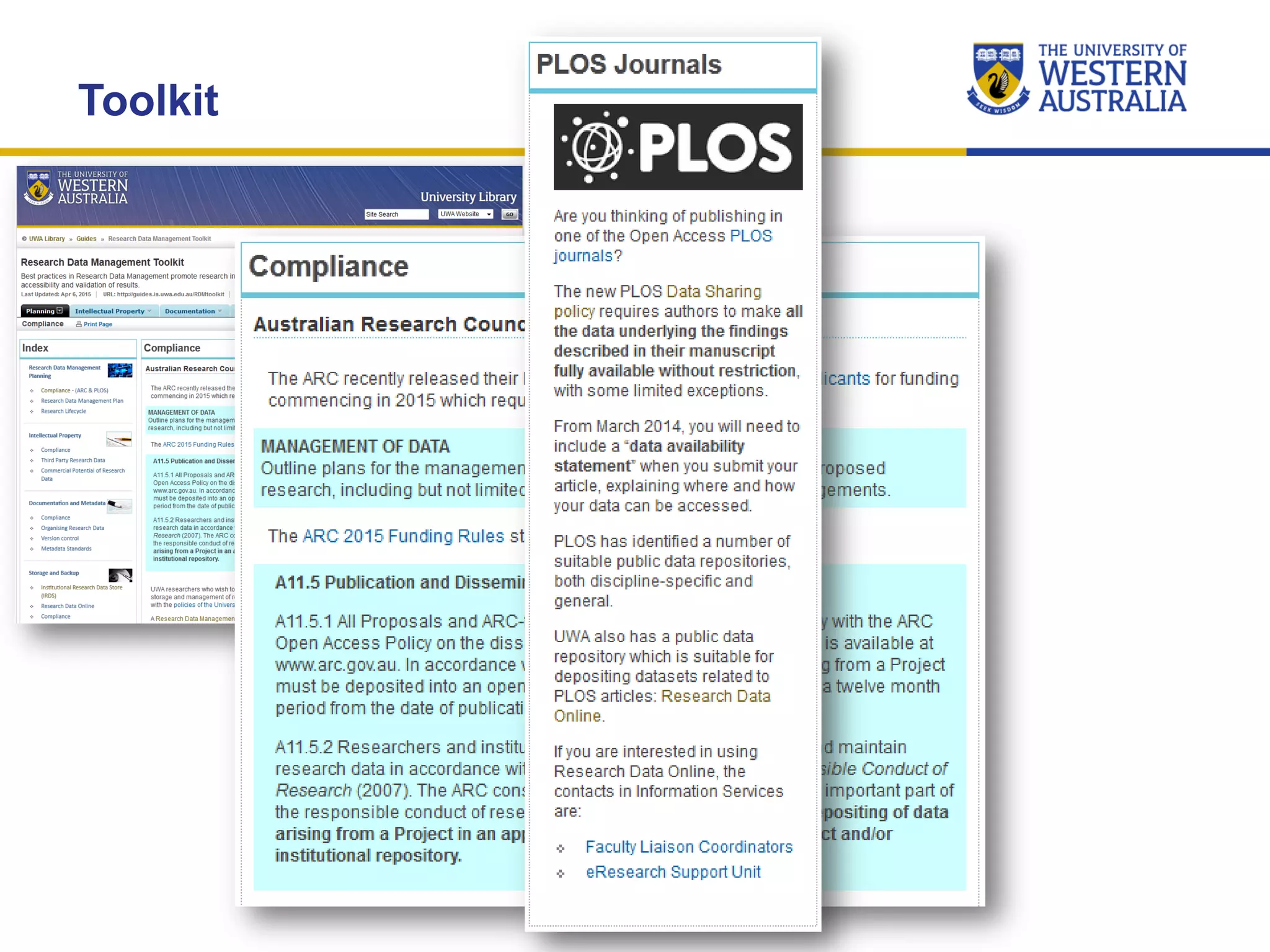
Research Data Management Toolkit
http://www.library.uwa.
edu.au/
research/
research-data-
management-toolkit
Toolkit
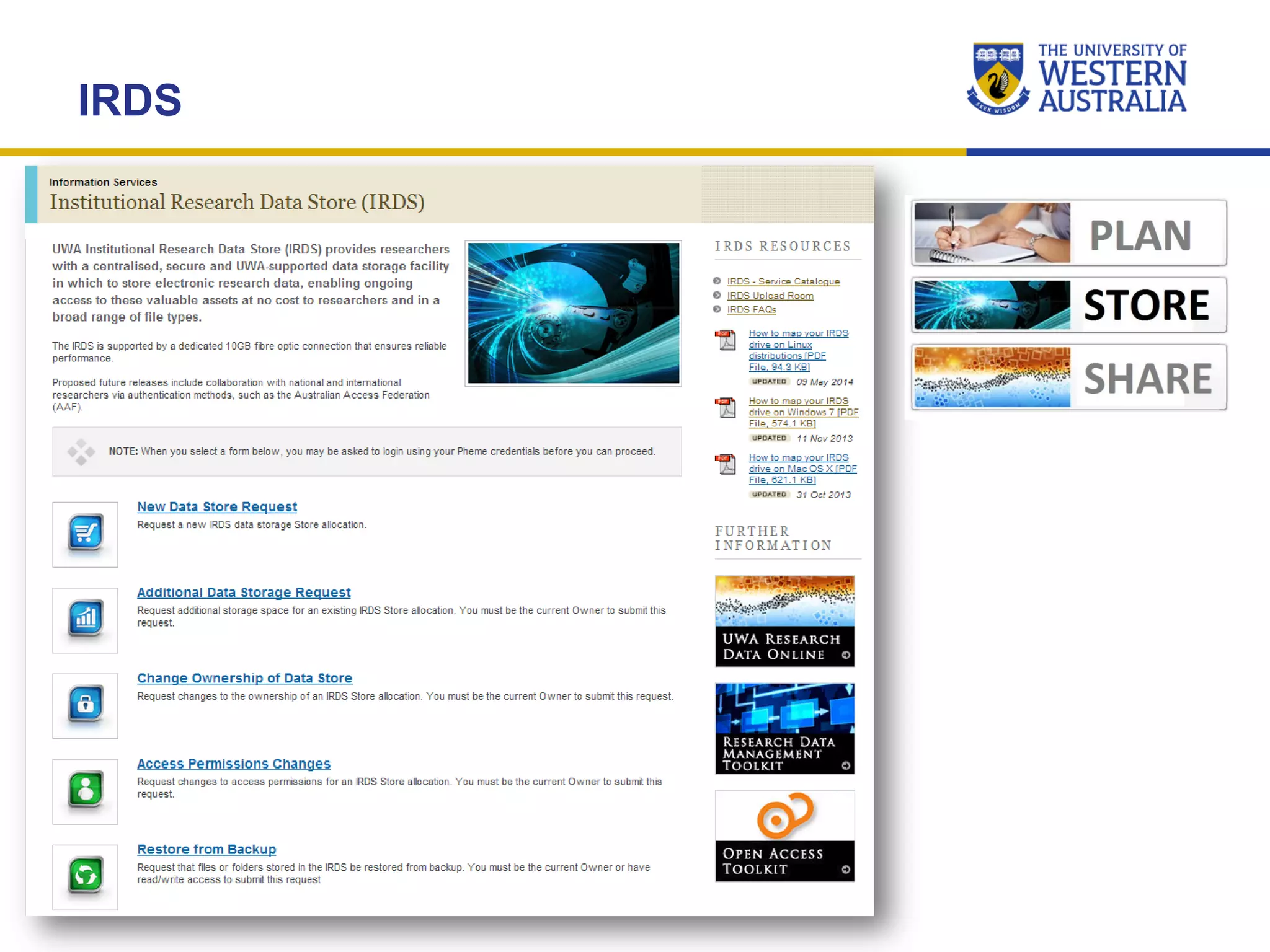
IRDS
https://www.youtube.com/watch?v=-DSl1pCMkDc
IRDS
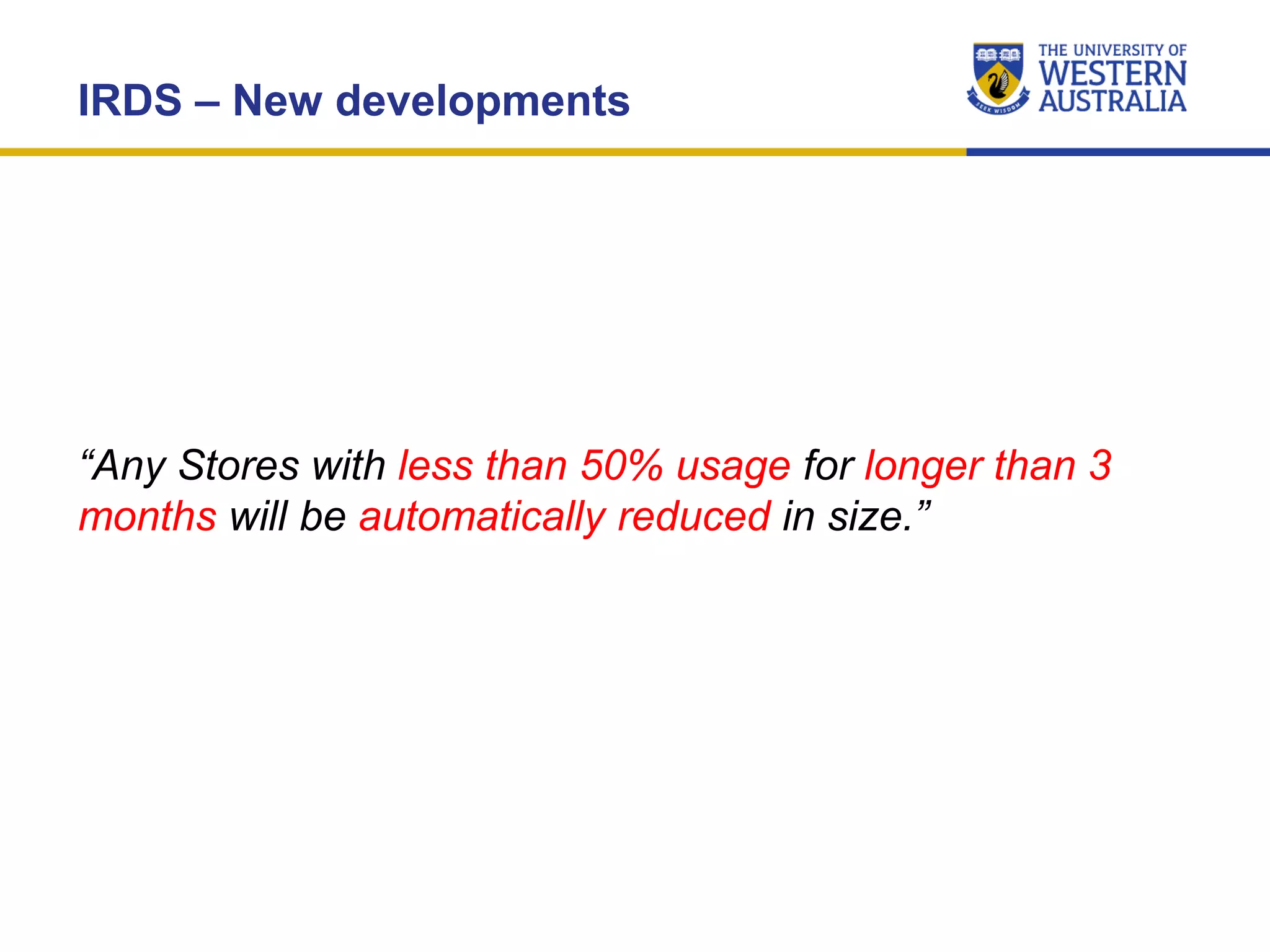
IRDS – New developments
“Any Stores with less than 50% usage for longer than 3
months will be automatically reduced in size.”
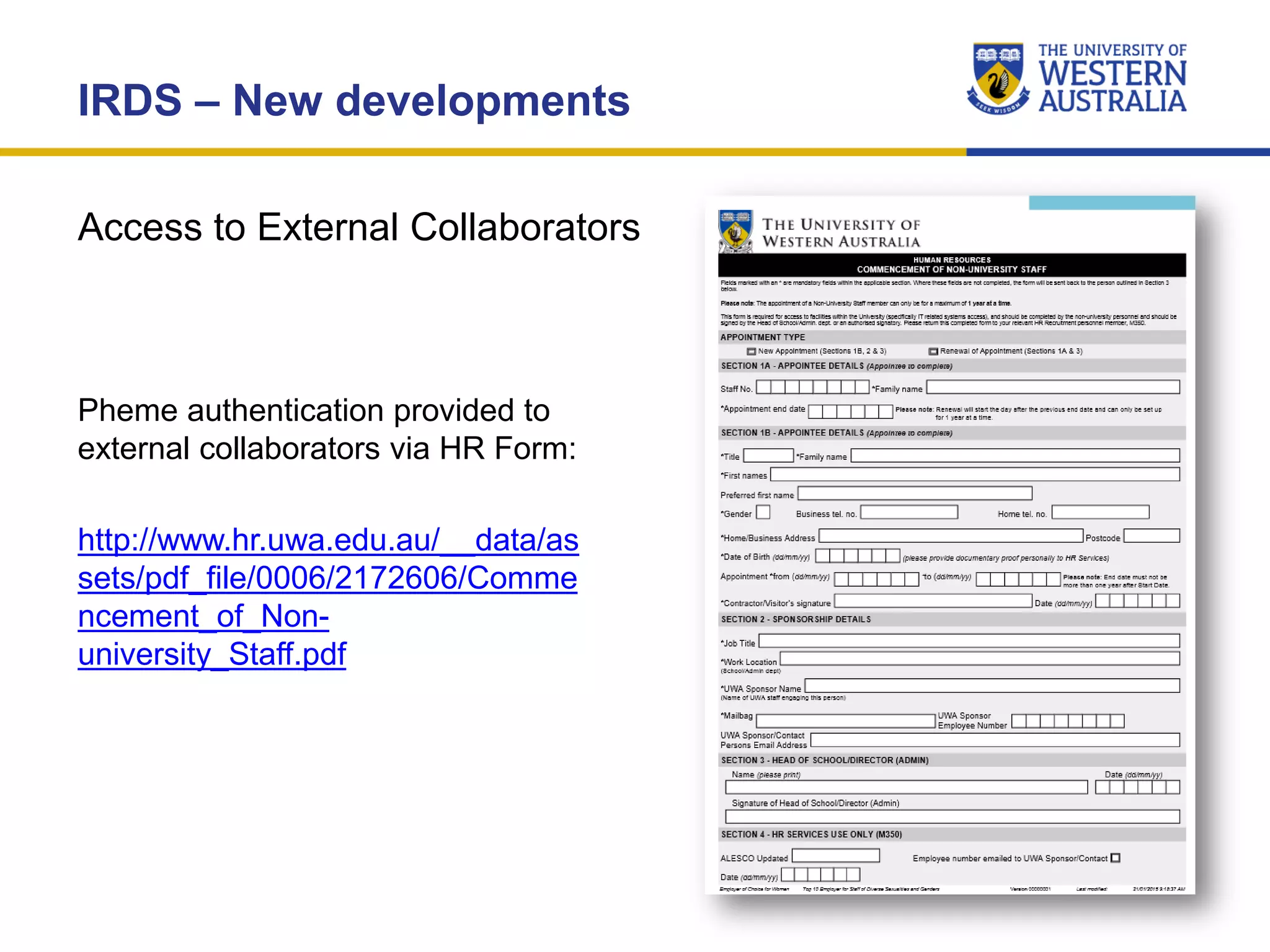
Access to External Collaborators
IRDS – New developments
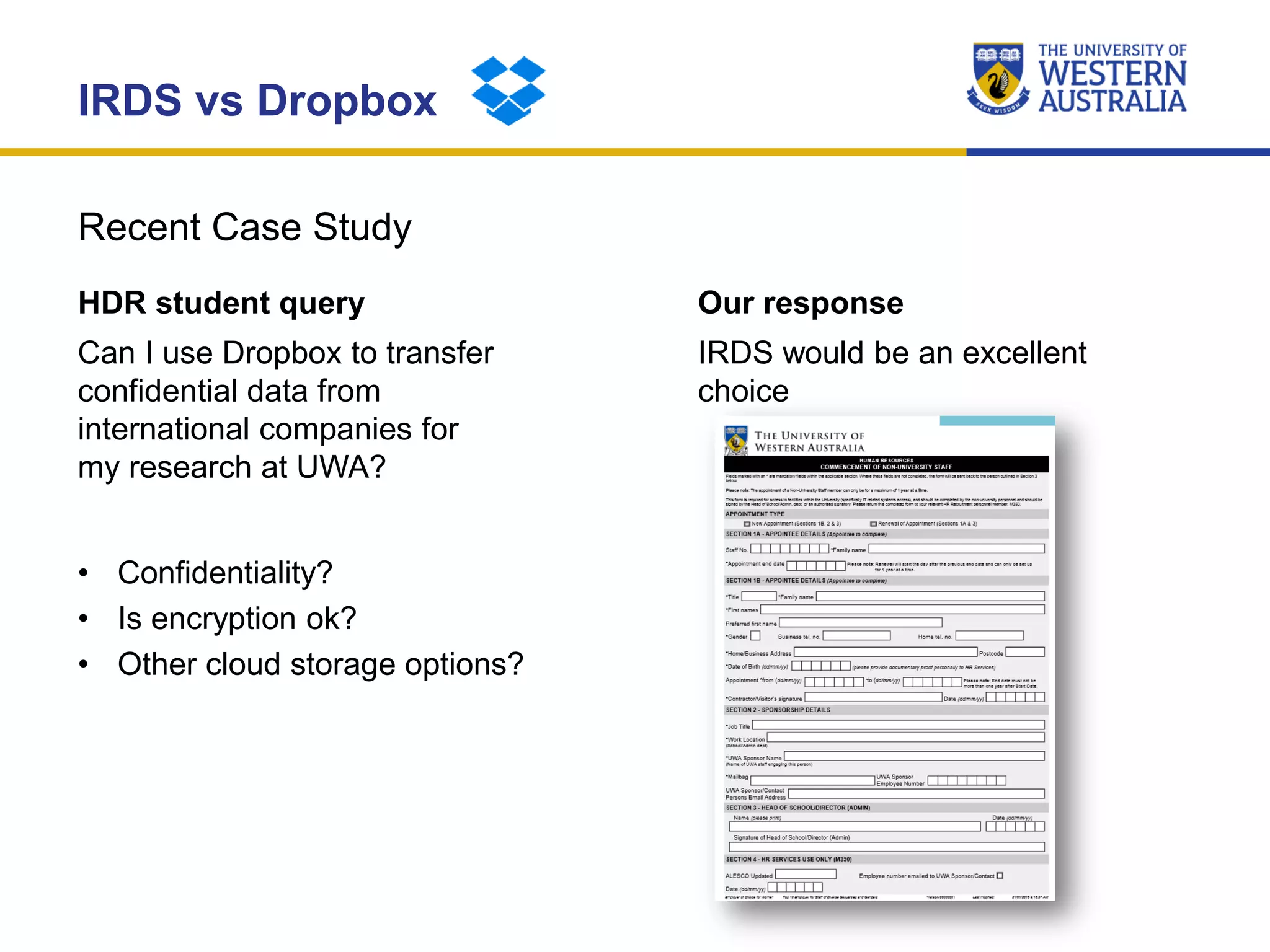
Pheme authentication provided to
external collaborators via HR Form:
http://www.hr.uwa.edu.au/__data/as
sets/pdf_file/0006/2172606/Comme
ncement_of_Non-
university_Staff.pdf
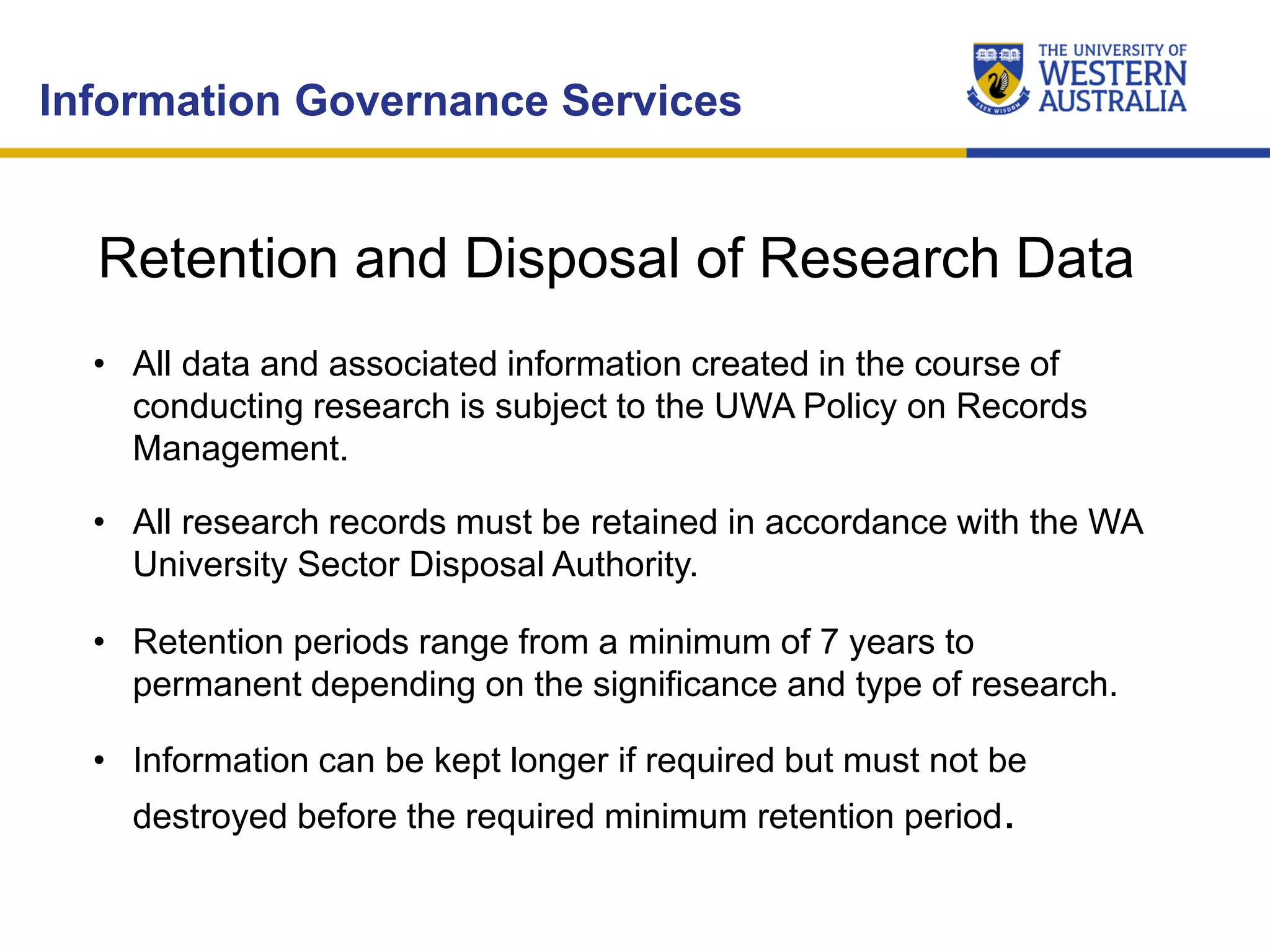
• All data and associated information created in the course of
conducting research is subject to the UWA Policy on Records
Management.
• All research records must be retained in accordance with the WA
University Sector Disposal Authority.
• Retention periods range from a minimum of 7 years to
permanent depending on the significance and type of research.
• Information can be kept longer if required but must not be
destroyed before the required minimum retention period.
Information Governance Services
Retention and Disposal of Research Data
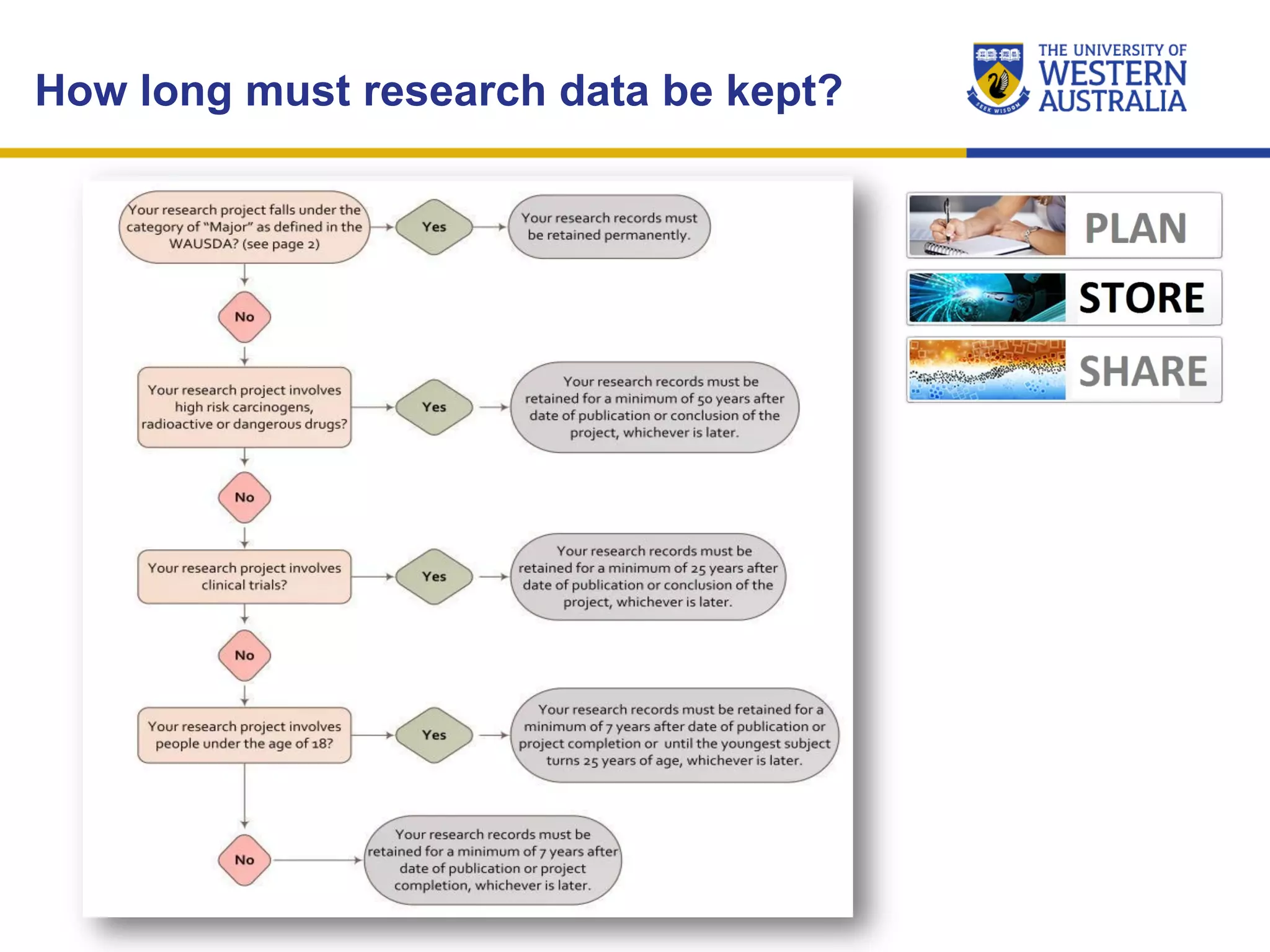
How long must research data be kept?
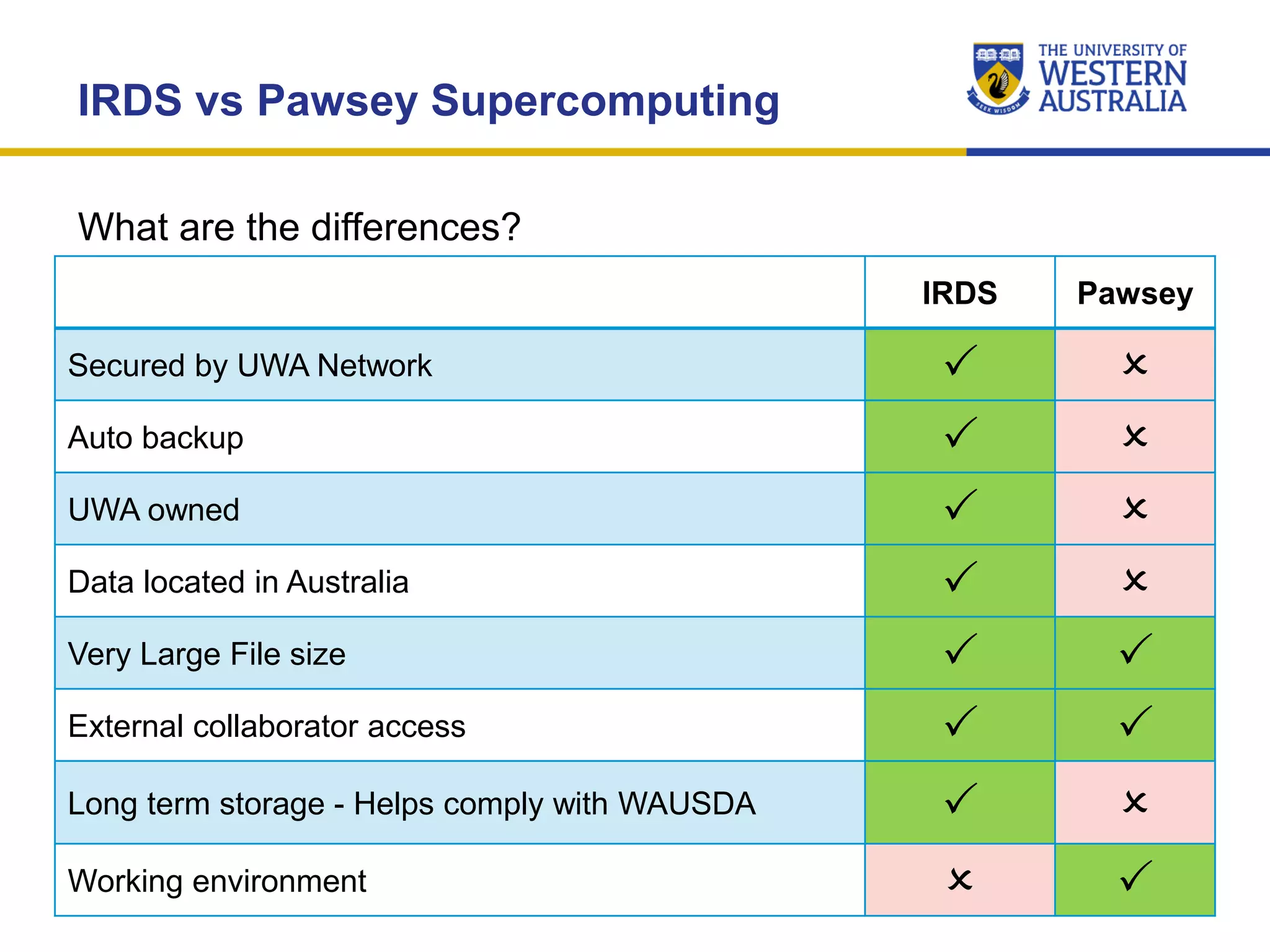
What are the differences?
IRDS vs Pawsey Supercomputing
IRDS Pawsey
Secured by UWA Network P O
Auto backup P O
UWA owned P O
Data located in Australia P O
Very Large File size P P
External collaborator access P P
Long term storage - Helps comply with WAUSDA P O
Working environment O P
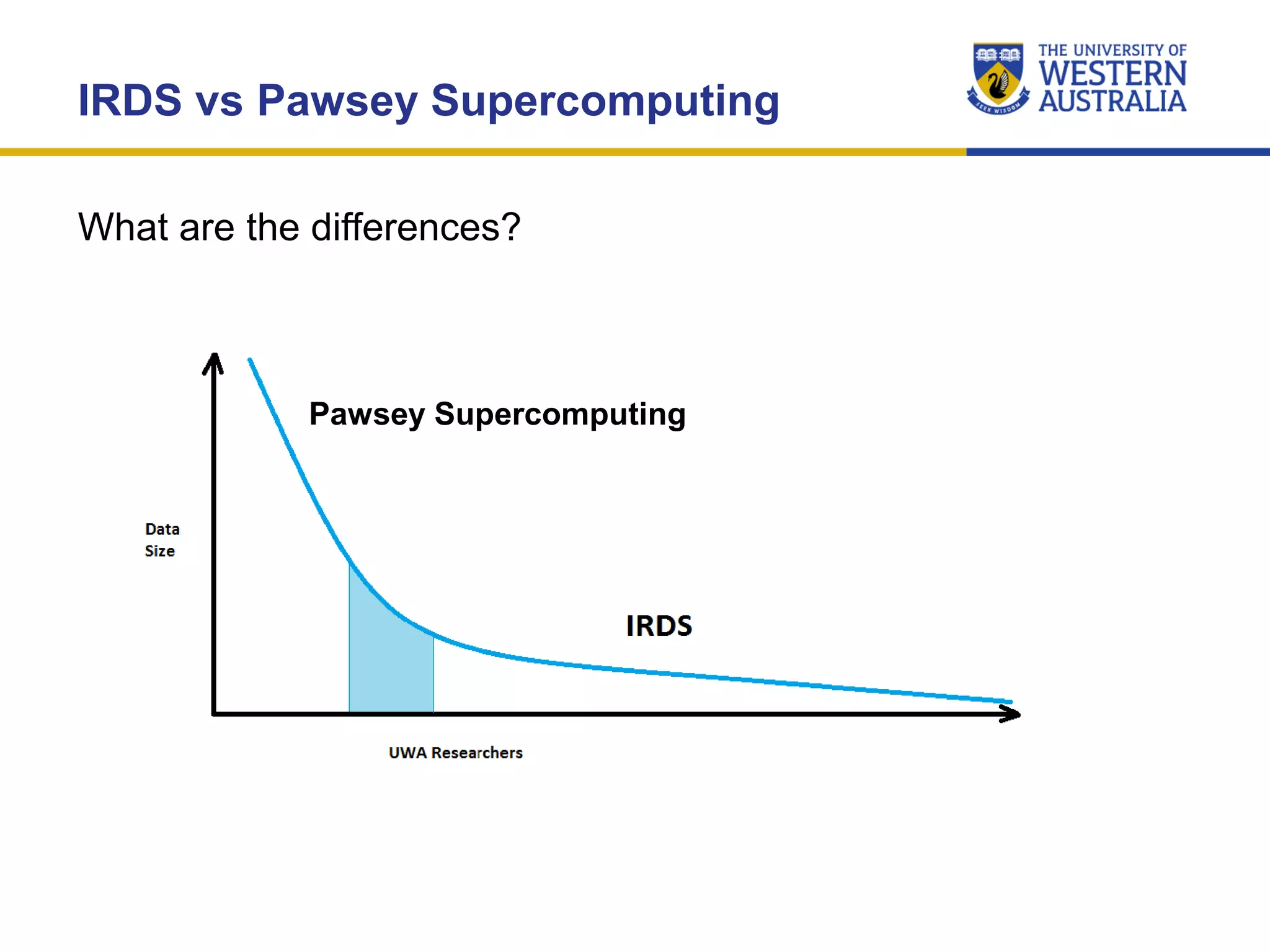
What are the differences?
IRDS vs Pawsey Supercomputing
Pawsey Supercomputing
Recent Case Study
IRDS vs Pawsey Supercomputing
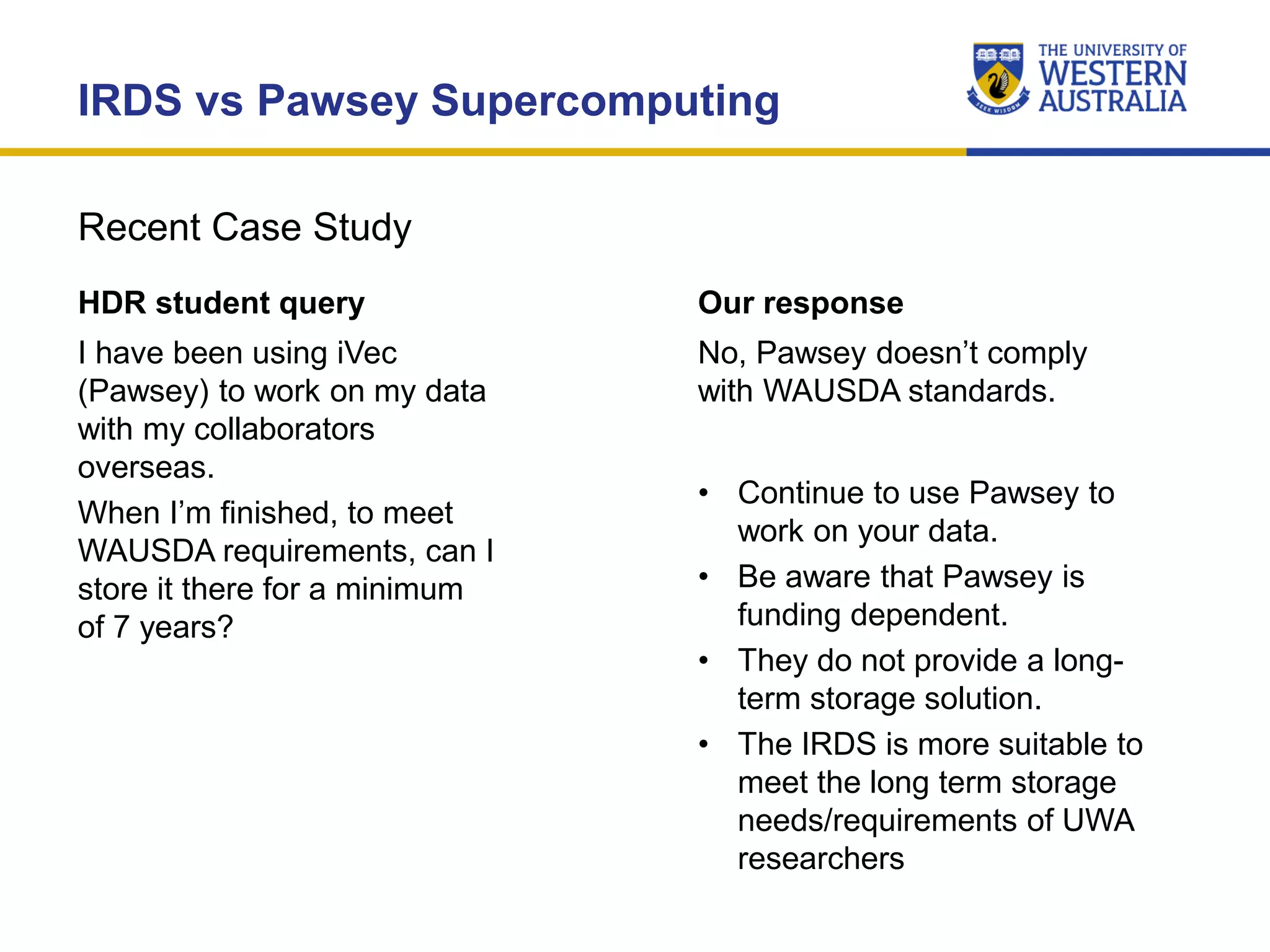
HDR student query
I have been using iVec
(Pawsey) to work on my data
with my collaborators
overseas.
When I’m finished, to meet
WAUSDA requirements, can I
store it there for a minimum
of 7 years?
Our response
No, Pawsey doesn’t comply
with WAUSDA standards.
• Continue to use Pawsey to
work on your data.
• Be aware that Pawsey is
funding dependent.
• They do not provide a long-
term storage solution.
• The IRDS is more suitable to
meet the long term storage
needs/requirements of UWA
researchers
Recent Case Study
IRDS vs Dropbox
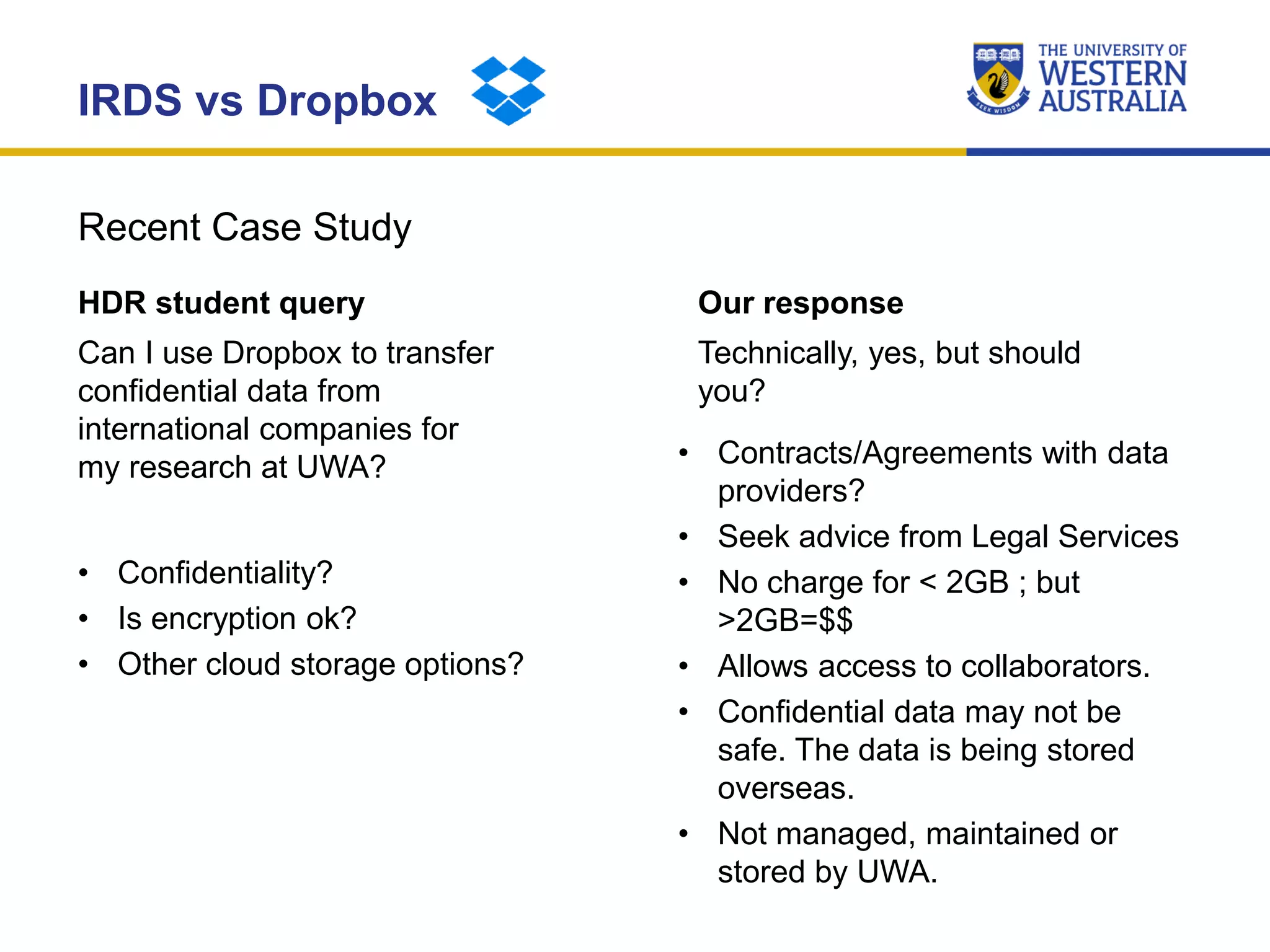
HDR student query
Can I use Dropbox to transfer
confidential data from
international companies for
my research at UWA?
• Confidentiality?
• Is encryption ok?
• Other cloud storage options?
Our response
Technically, yes, but should
you?
• Contracts/Agreements with data
providers?
• Seek advice from Legal Services
• No charge for < 2GB ; but
>2GB=$$
• Allows access to collaborators.
• Confidential data may not be
safe. The data is being stored
overseas.
• Not managed, maintained or
stored by UWA.
Recent Case Study
IRDS vs Dropbox
HDR student query
Can I use Dropbox to transfer
confidential data from
international companies for
my research at UWA?
• Confidentiality?
• Is encryption ok?
• Other cloud storage options?
Our response
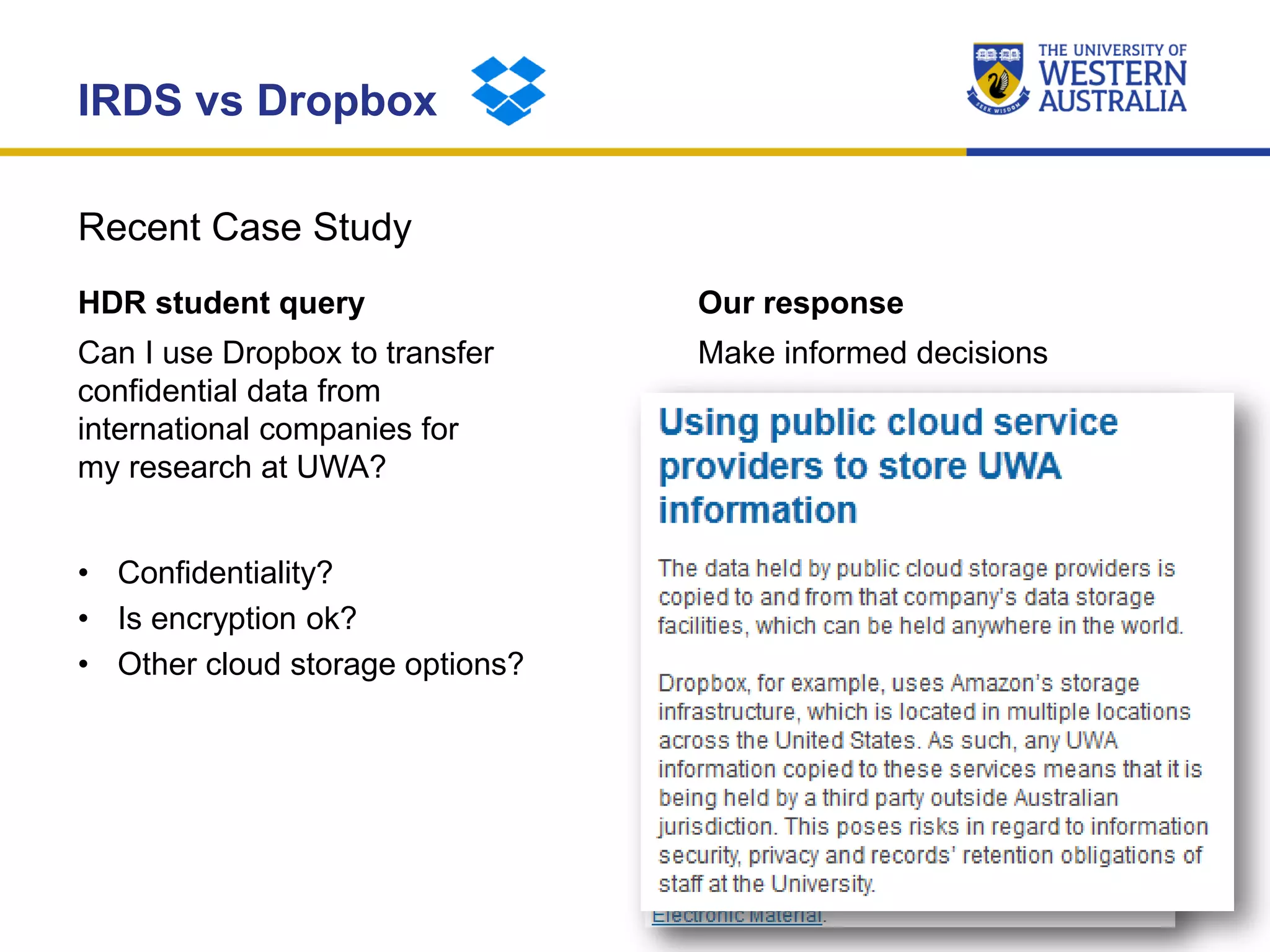
Make informed decisions
• UWA’s Information Governance
Services (IGS) provide guidance
on using public cloud storage.
– http://www.igs.uwa.edu.au/p
olicies/guides/auth/cloud-
storage
Recent Case Study
IRDS vs Dropbox
HDR student query
Can I use Dropbox to transfer
confidential data from
international companies for
my research at UWA?
• Confidentiality?
• Is encryption ok?
• Other cloud storage options?
Our response
Make informed decisions
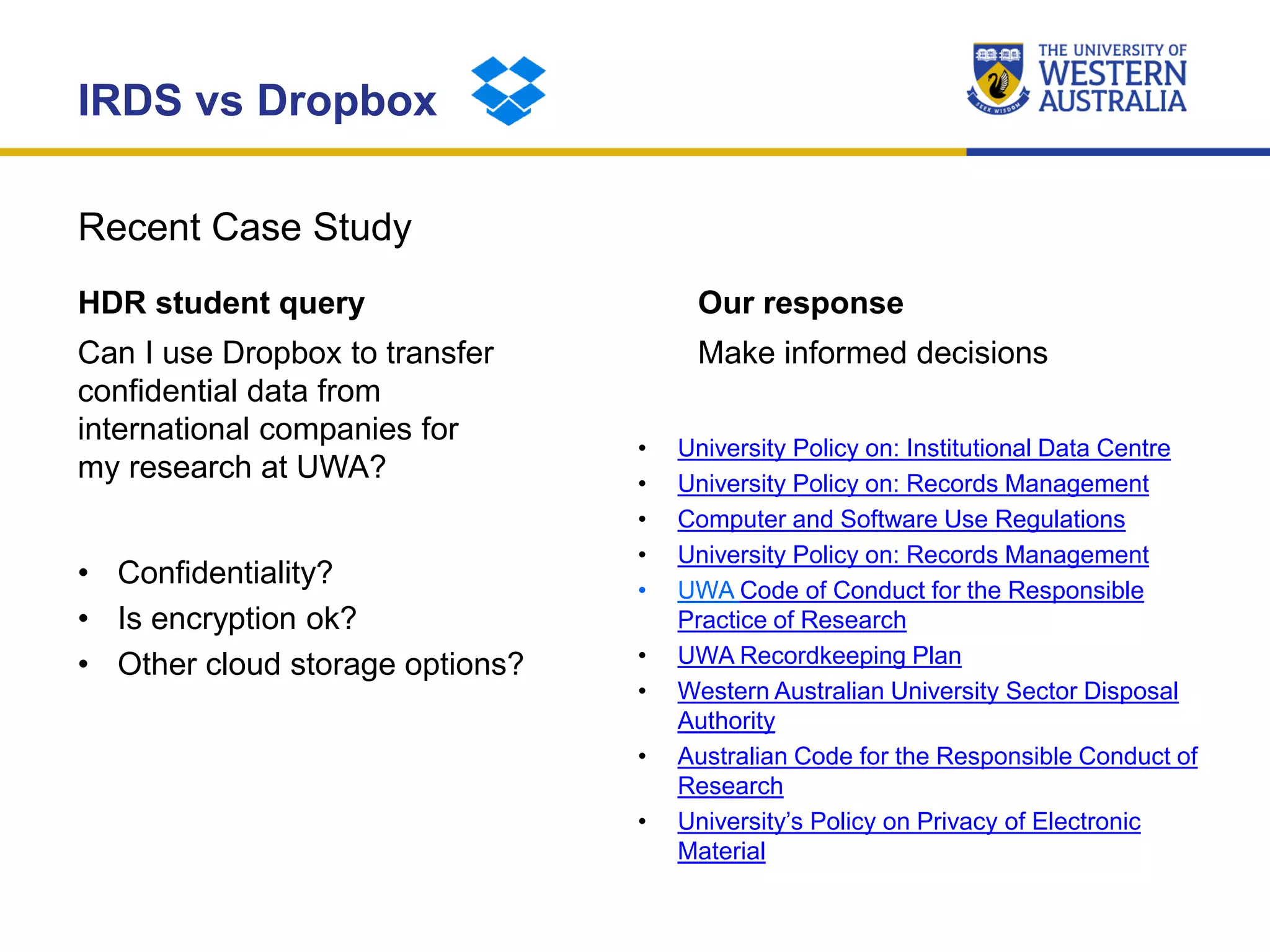
• University Policy on: Institutional Data Centre
• University Policy on: Records Management
• Computer and Software Use Regulations
• University Policy on: Records Management
• UWA Code of Conduct for the Responsible
Practice of Research
• UWA Recordkeeping Plan
• Western Australian University Sector Disposal
Authority
• Australian Code for the Responsible Conduct of
Research
• University’s Policy on Privacy of Electronic
Material
Recent Case Study
IRDS vs Dropbox
HDR student query
Can I use Dropbox to transfer
confidential data from
international companies for
my research at UWA?
• Confidentiality?
• Is encryption ok?
• Other cloud storage options?
Our response
Pawsey Supercomputing
could be an option
• Can cope with large (‘Big Data’)
datasets and file transfer.
• Allows access to collaborators.
• Not encouraged for long-term
storage (dependent on funding).
• Not managed or maintained by
UWA.
Recent Case Study
IRDS vs Dropbox
HDR student query
Can I use Dropbox to transfer
confidential data from
international companies for
my research at UWA?
• Confidentiality?
• Is encryption ok?
• Other cloud storage options?
Our response
IRDS would be an excellent
choice
• Data is stored locally.
• The IRDS maintained and
supported by UWA (Service
Desk Support 24/7)
• Encouraged for long-term
storage and can be used to
comply with WAUSDA.
– “Research records must be
retained for a minimum of 7
years after the date of
publication or project
completion, whichever is later.”
Recent Case Study
IRDS vs Dropbox
HDR student query
Can I use Dropbox to transfer
confidential data from
international companies for
my research at UWA?
• Confidentiality?
• Is encryption ok?
• Other cloud storage options?
Our response
IRDS would be an excellent
choice
• Now allows for external
collaborator access
– Pheme authentication
provided to external
collaborators via
http://www.hr.uwa.edu.au/__
data/assets/pdf_file/0006/21
72606/Commencement_of_
Non-university_Staff.pdf
Recent Case Study
IRDS vs Dropbox
HDR student query
Can I use Dropbox to transfer
confidential data from
international companies for
my research at UWA?
• Confidentiality?
• Is encryption ok?
• Other cloud storage options?
Our response
IRDS would be an excellent
choice
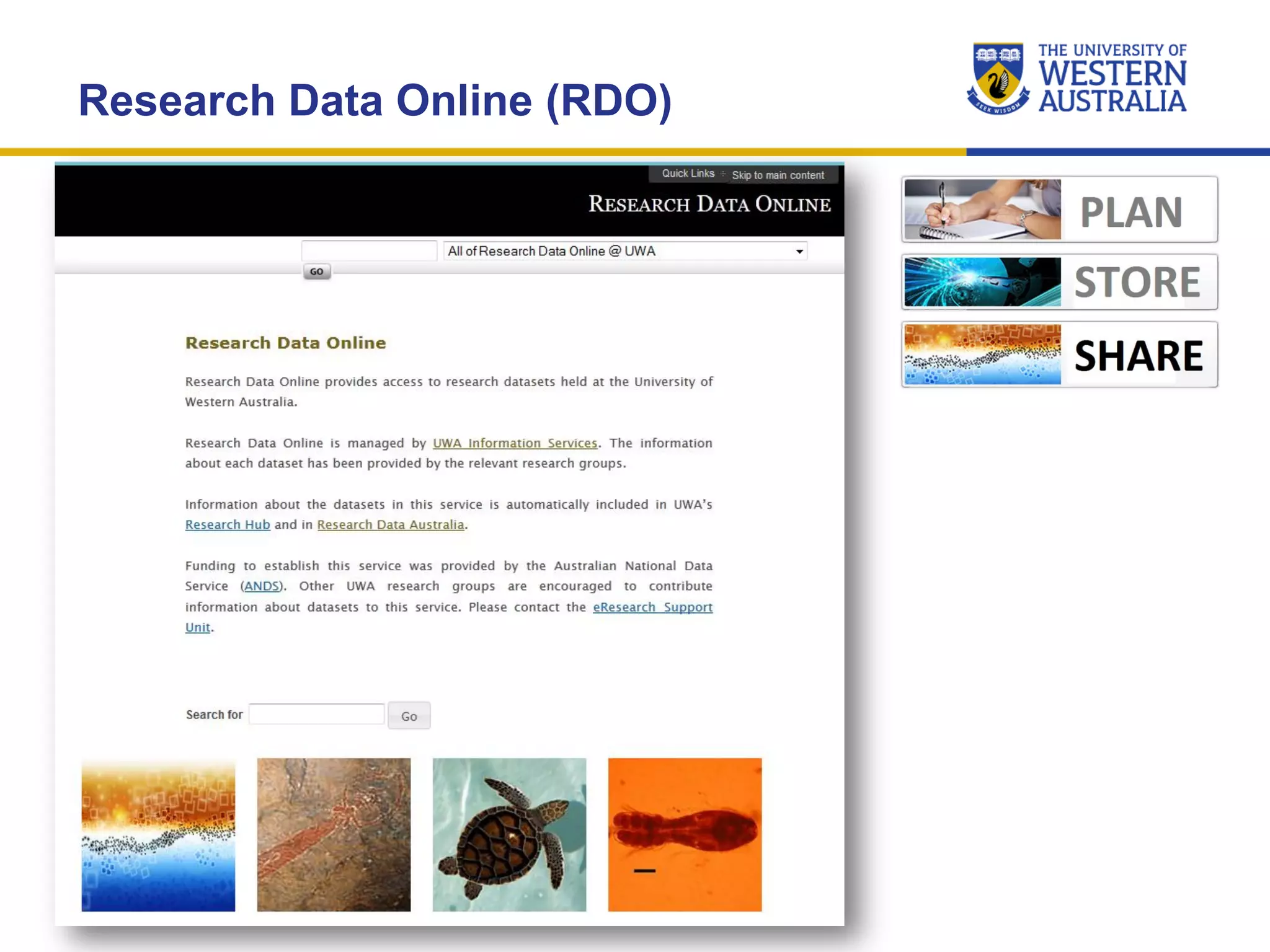
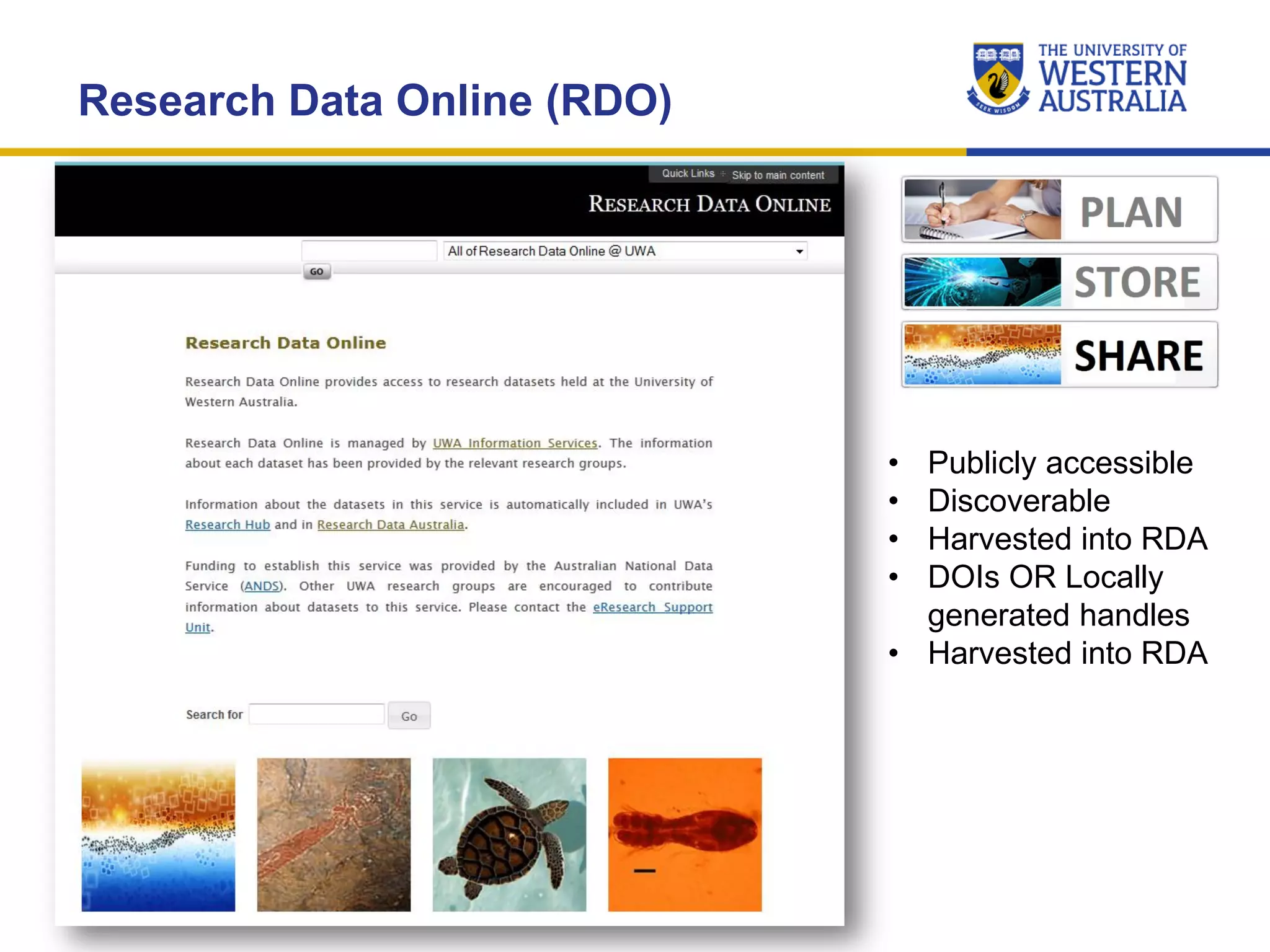
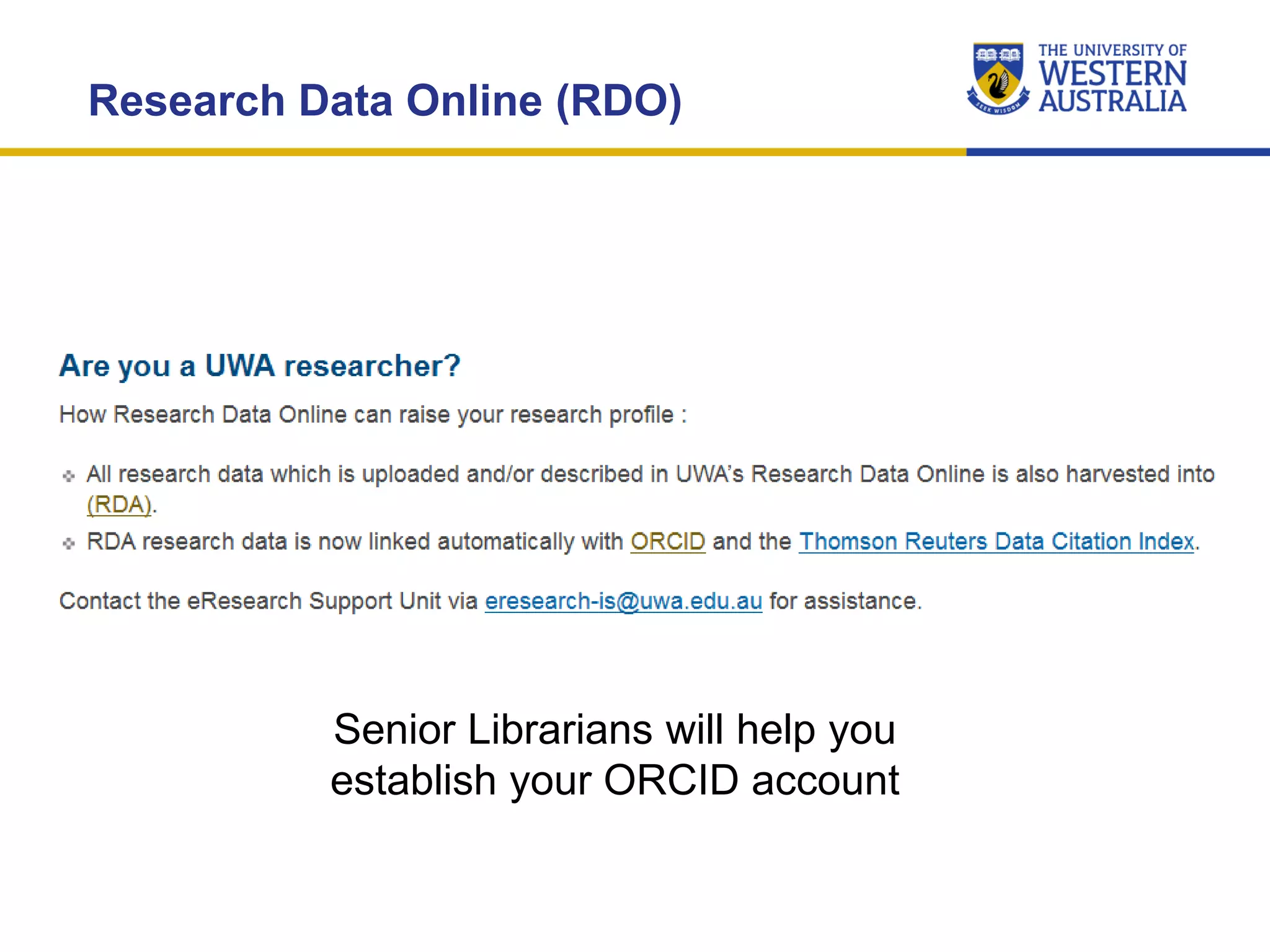
Research Data Online (RDO)
• Publicly accessible
• Discoverable
• Harvested into RDA
• DOIs OR Locally
generated handles
• Harvested into RDA
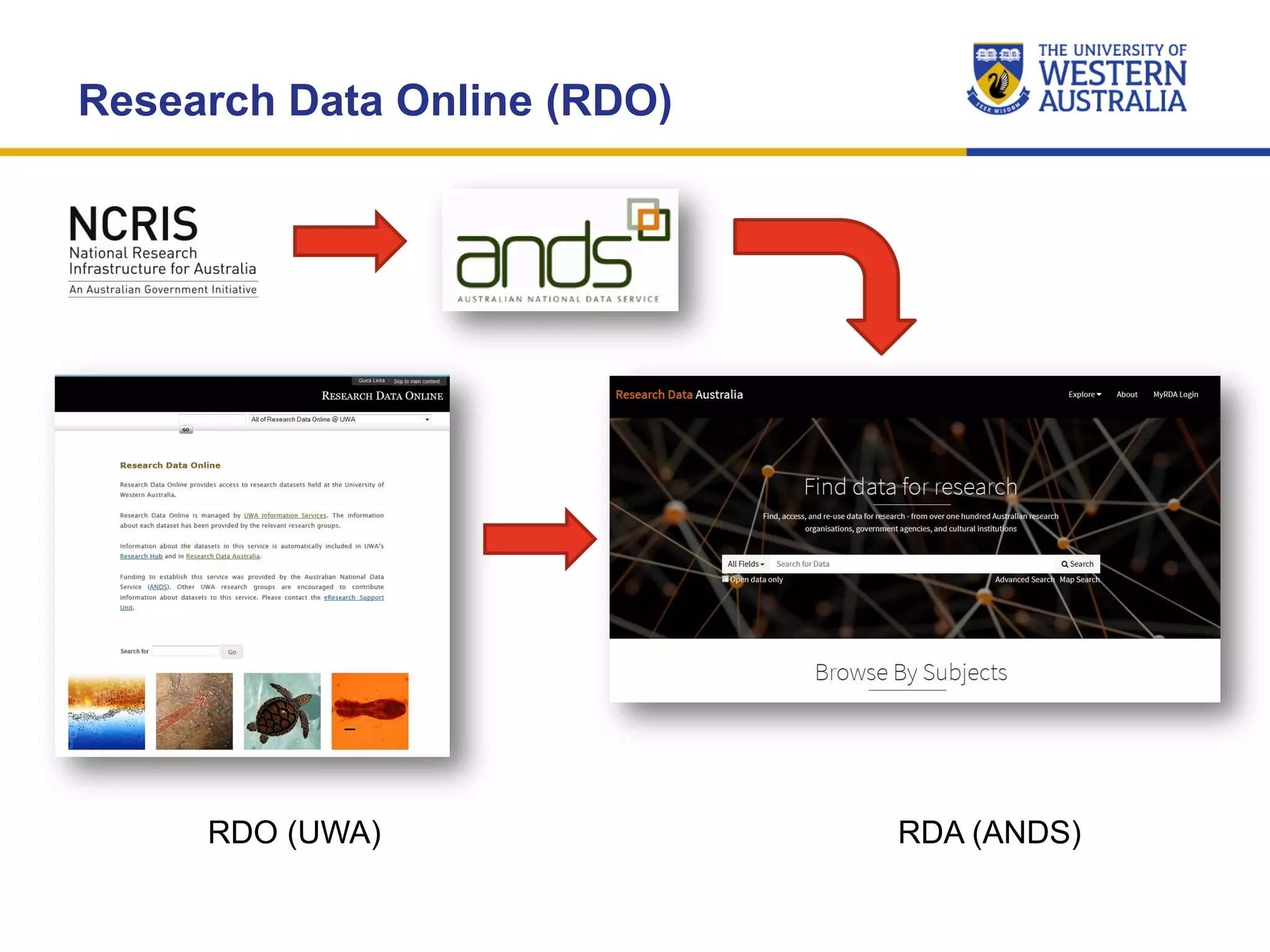
Research Data Online (RDO)
RDO (UWA) RDA (ANDS)
Research Data Online (RDO)
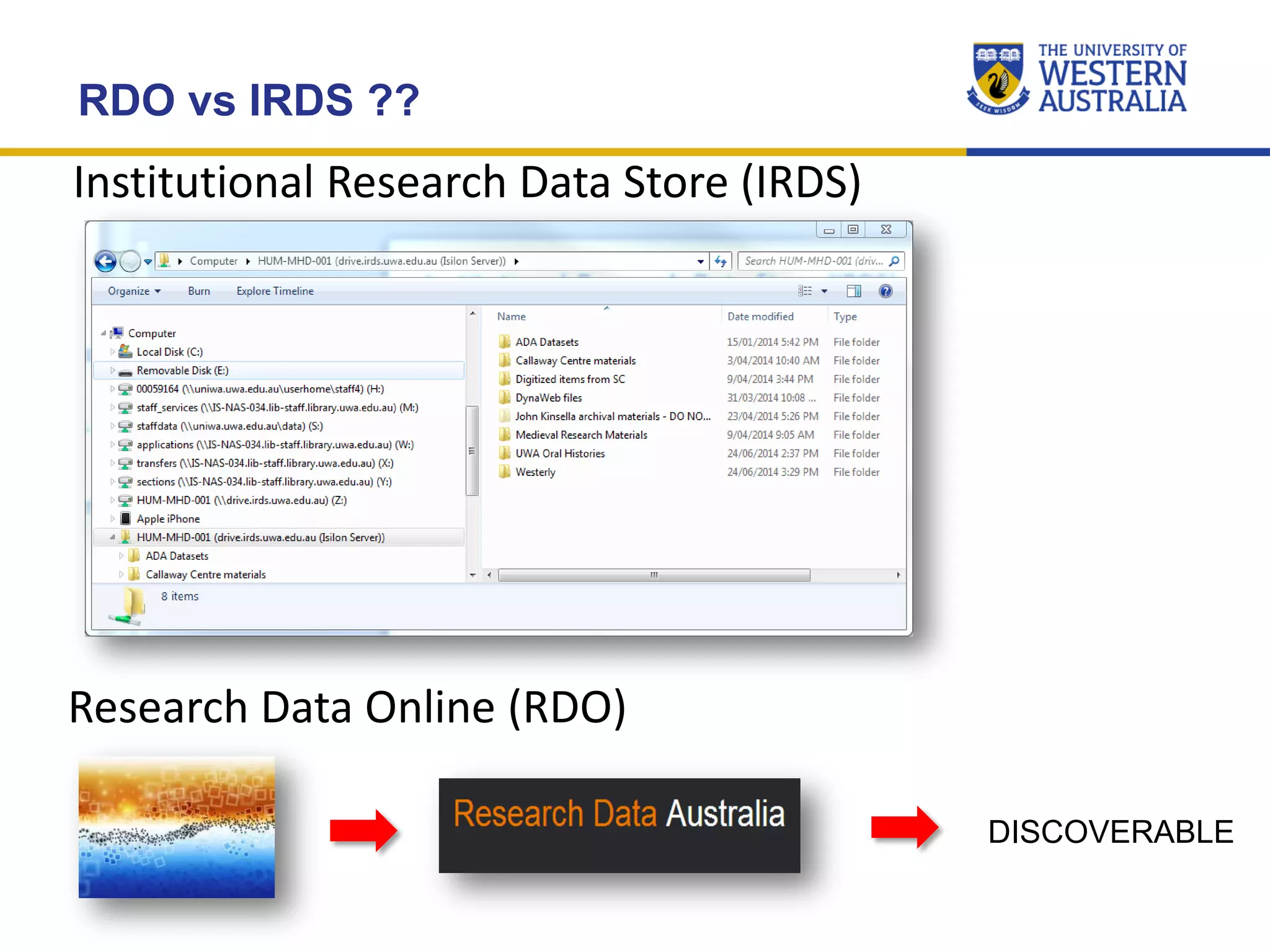
DISCOVERABLE
RDO vs IRDS ??
Institutional Research Data Store (IRDS)
Research Data Online (RDO)
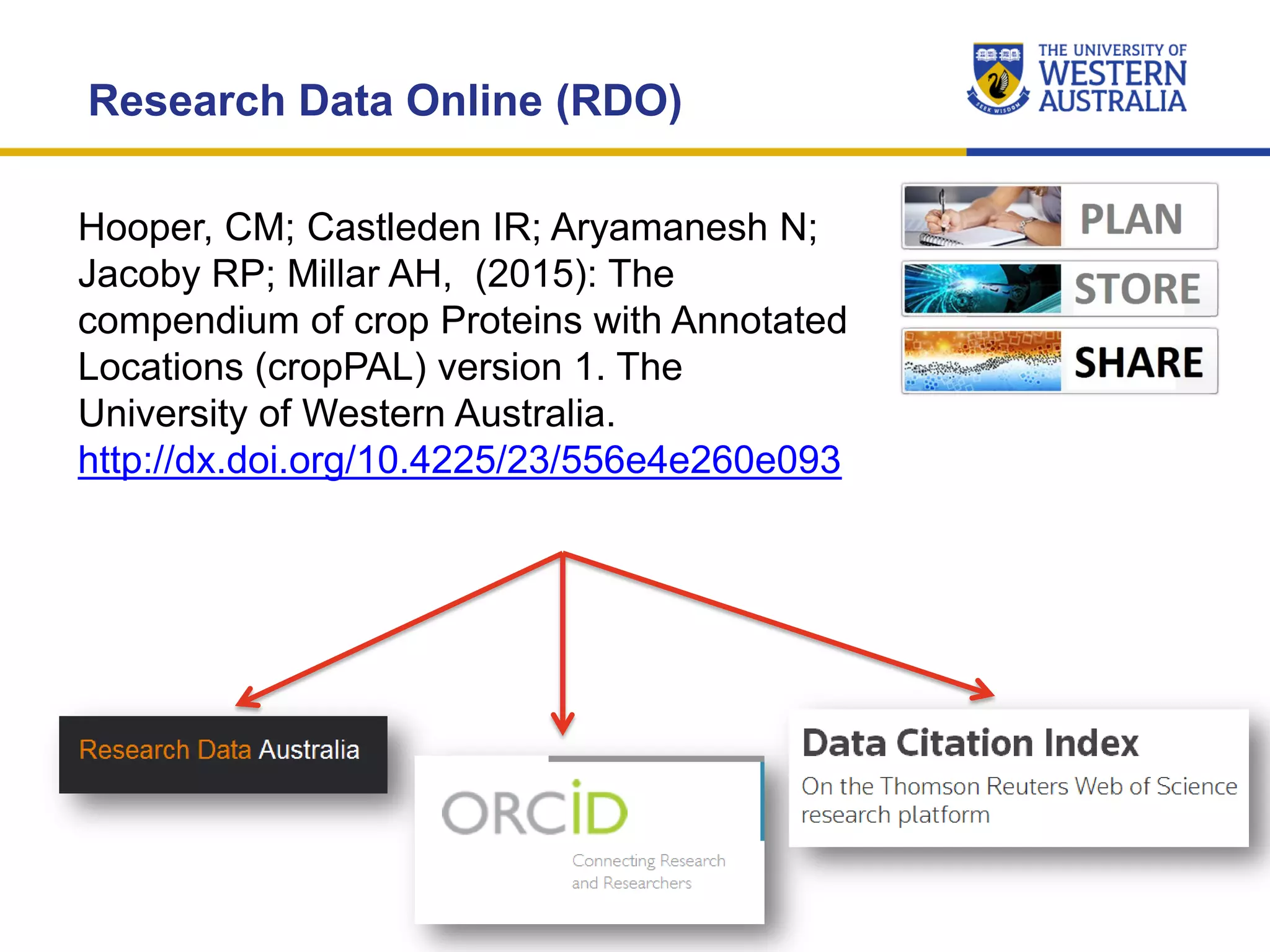
Hooper, CM; Castleden IR; Aryamanesh N;
Jacoby RP; Millar AH, (2015): The
compendium of crop Proteins with Annotated
Locations (cropPAL) version 1. The
University of Western Australia.
http://dx.doi.org/10.4225/23/556e4e260e093
Research Data Online (RDO)
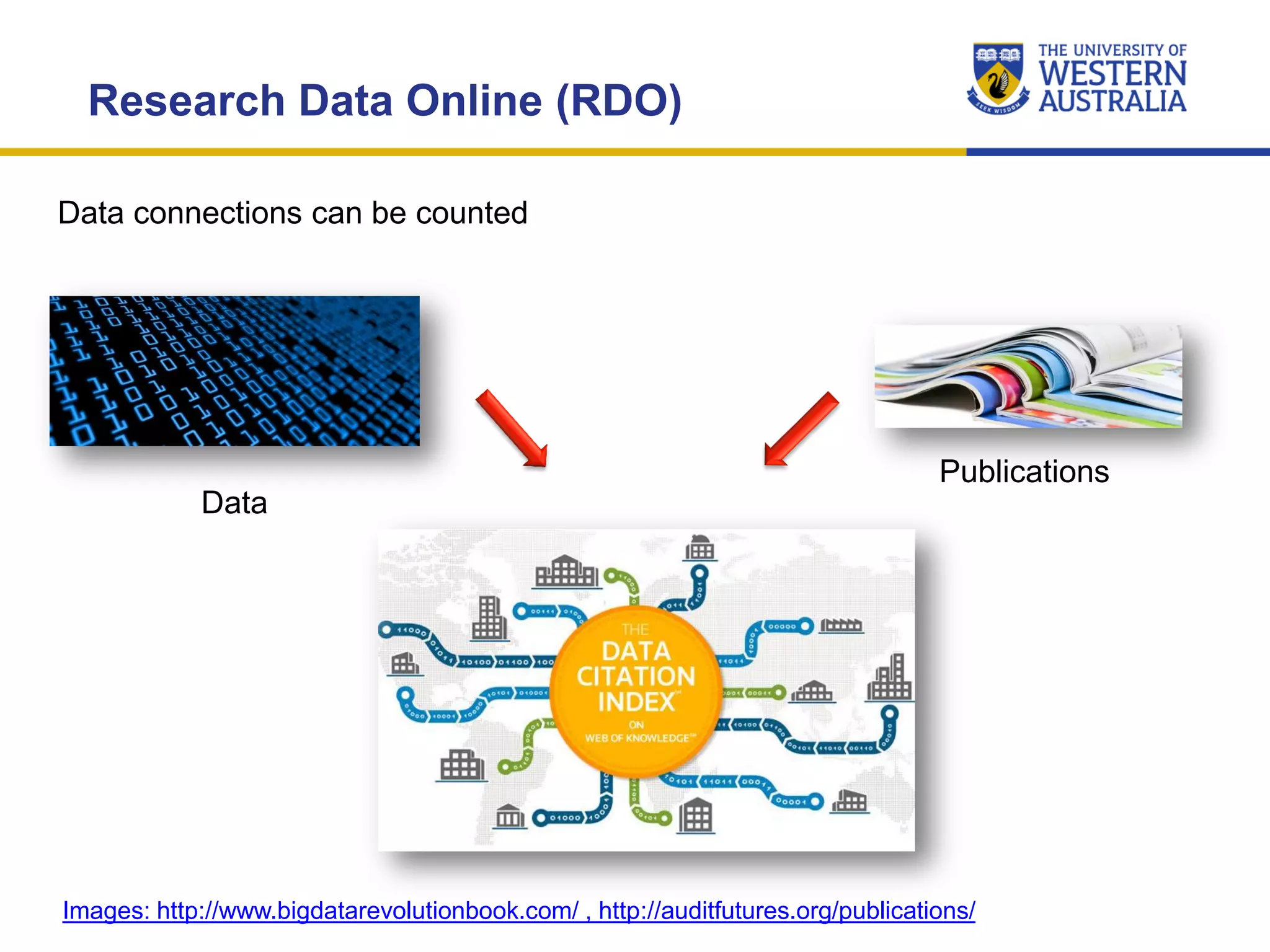
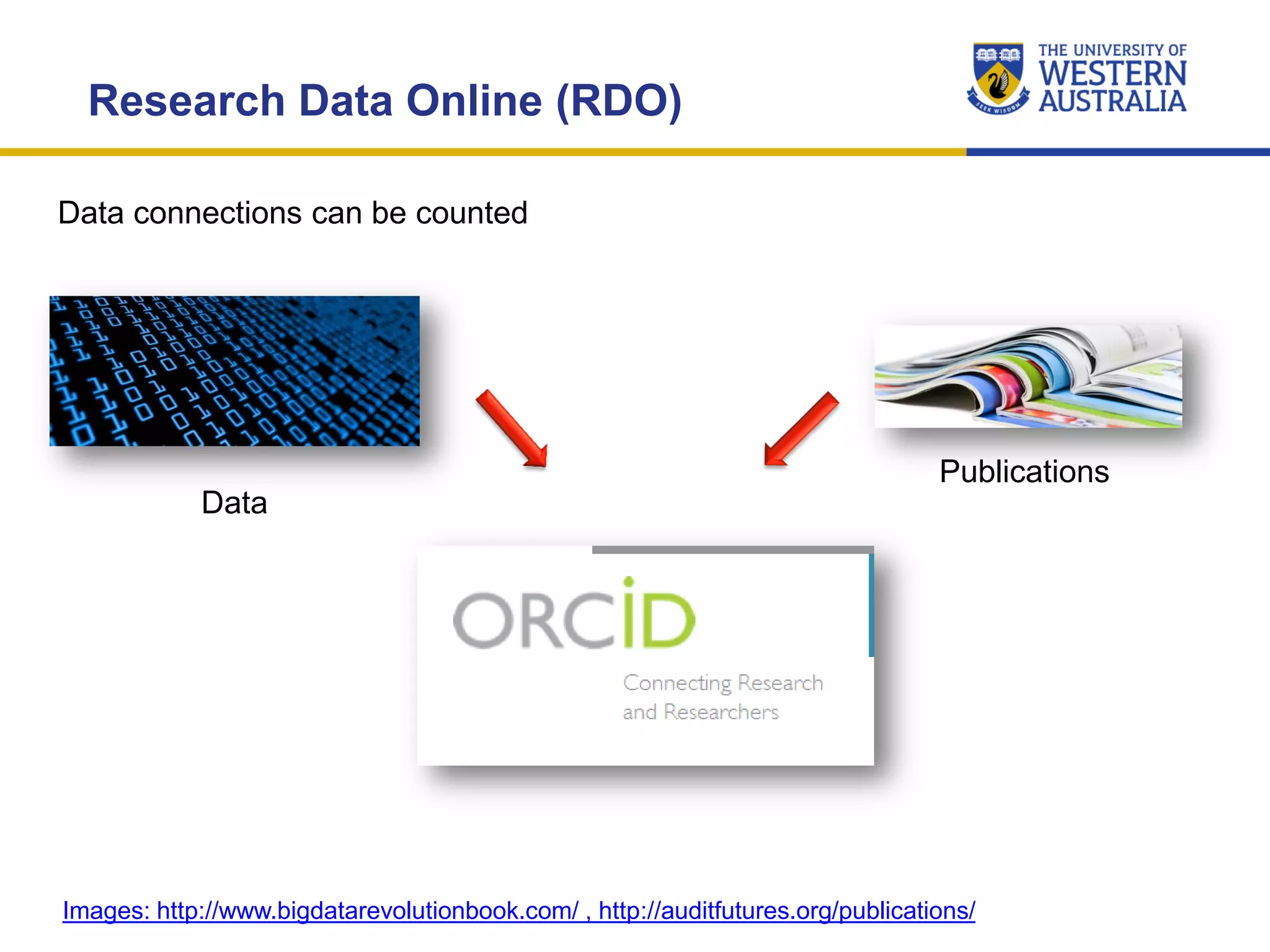
Publications
Data
Data connections can be counted
Images: http://www.bigdatarevolutionbook.com/ , http://auditfutures.org/publications/
Research Data Online (RDO)
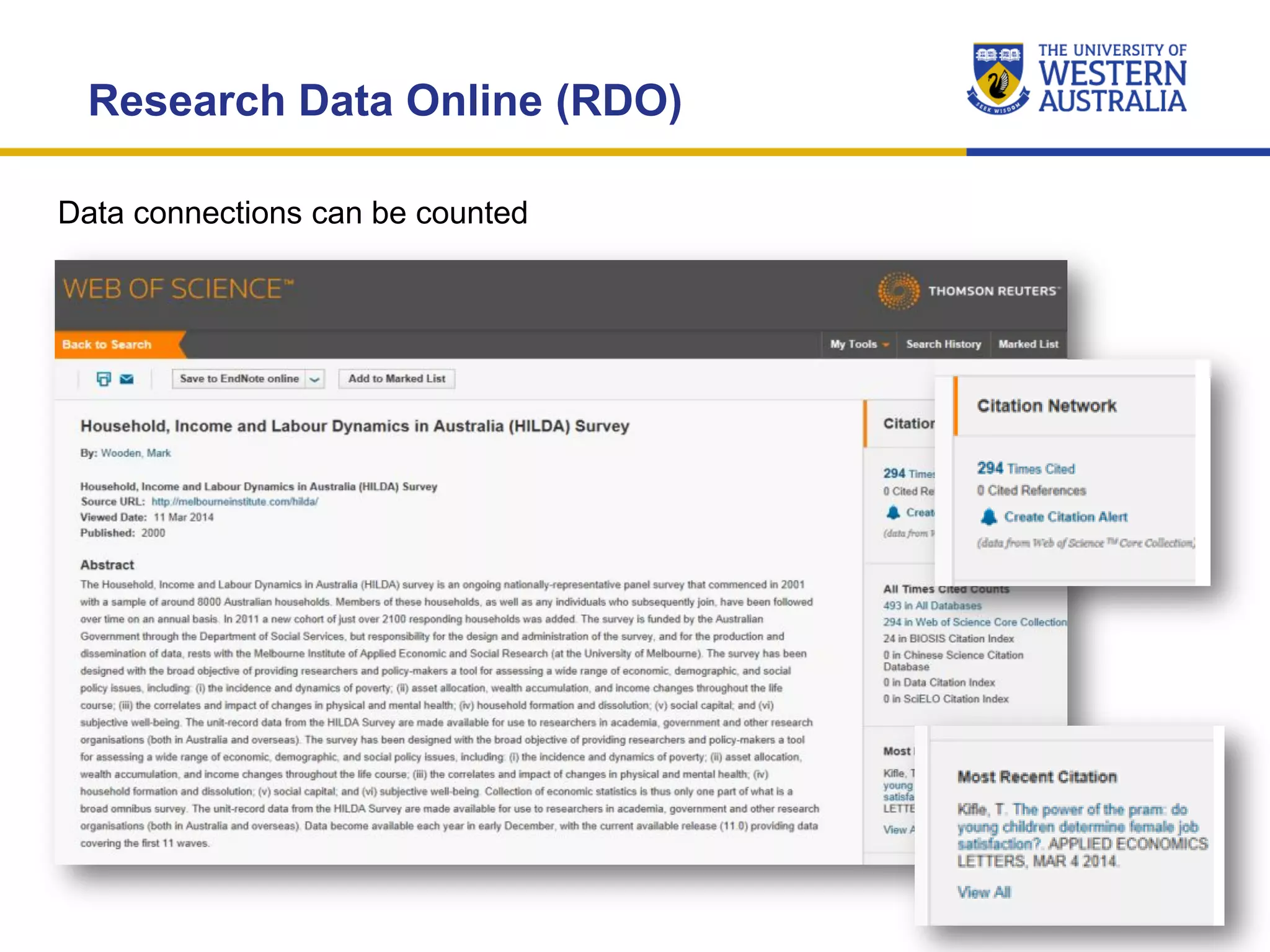
Data connections can be counted
Research Data Online (RDO)
Publications
Data
Data connections can be counted
Images: http://www.bigdatarevolutionbook.com/ , http://auditfutures.org/publications/
Research Data Online (RDO)
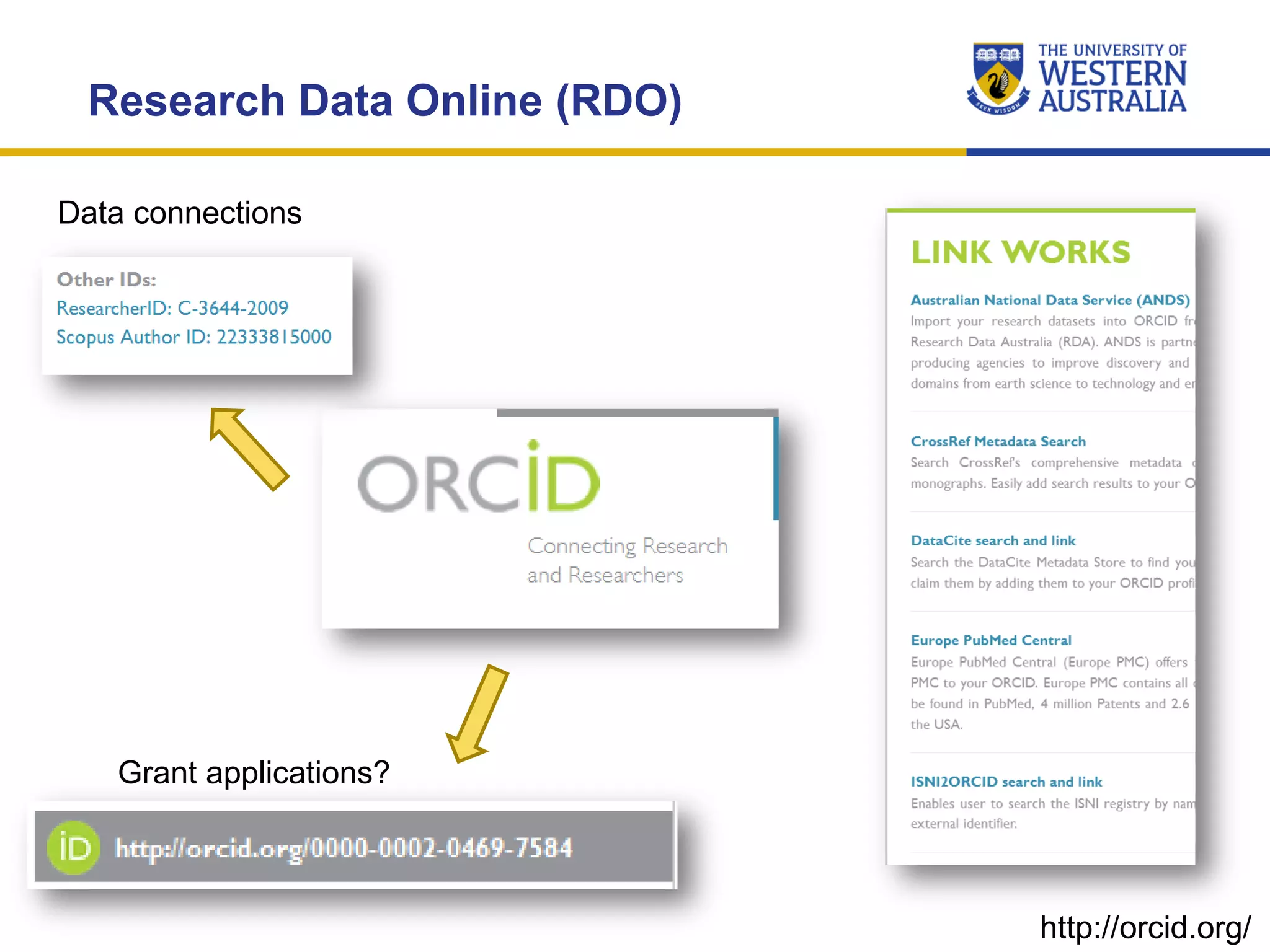
Data connections
Grant applications?
http://orcid.org/
Research Data Online (RDO)
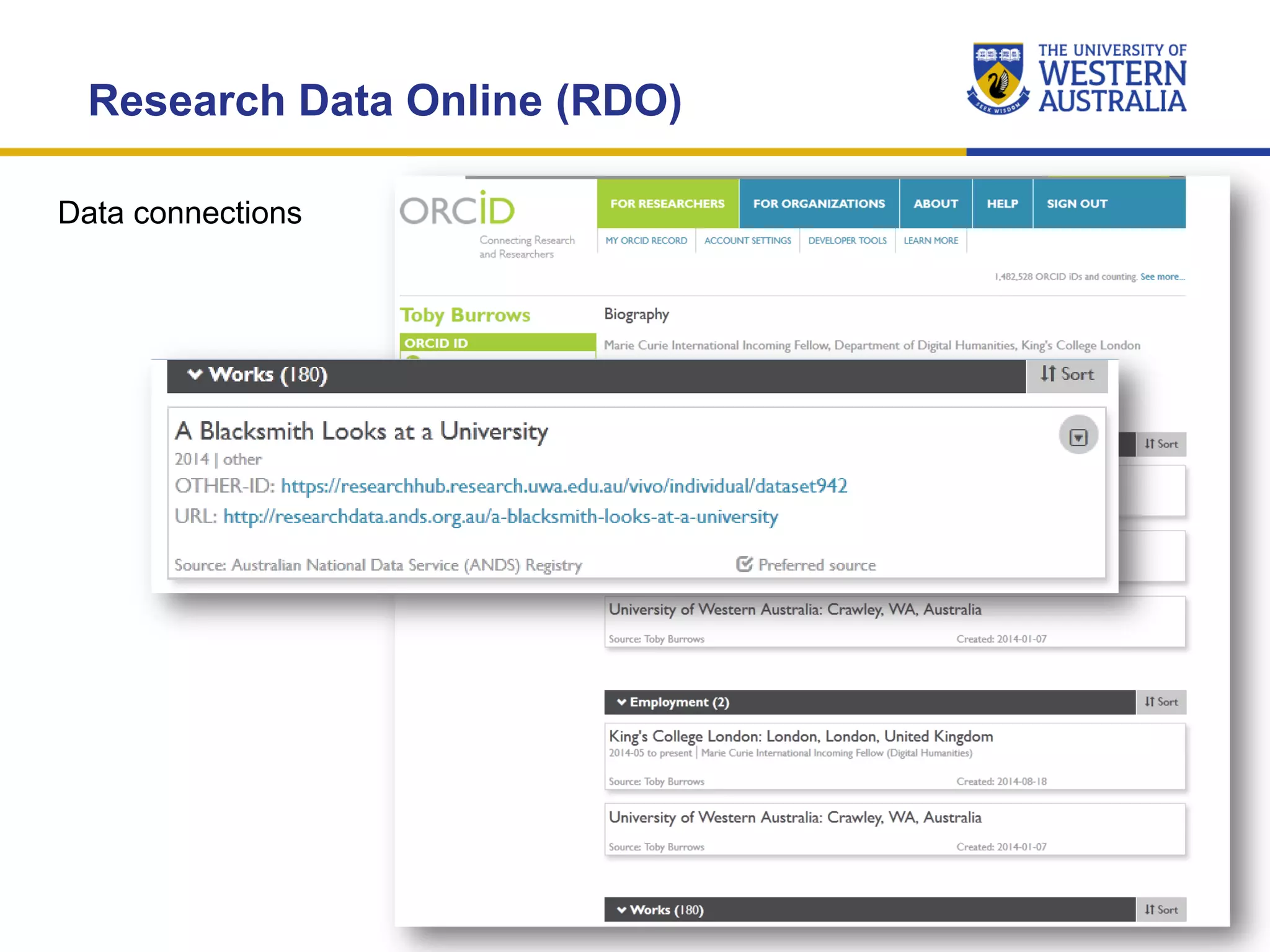
Data connections
Research Data Online (RDO)
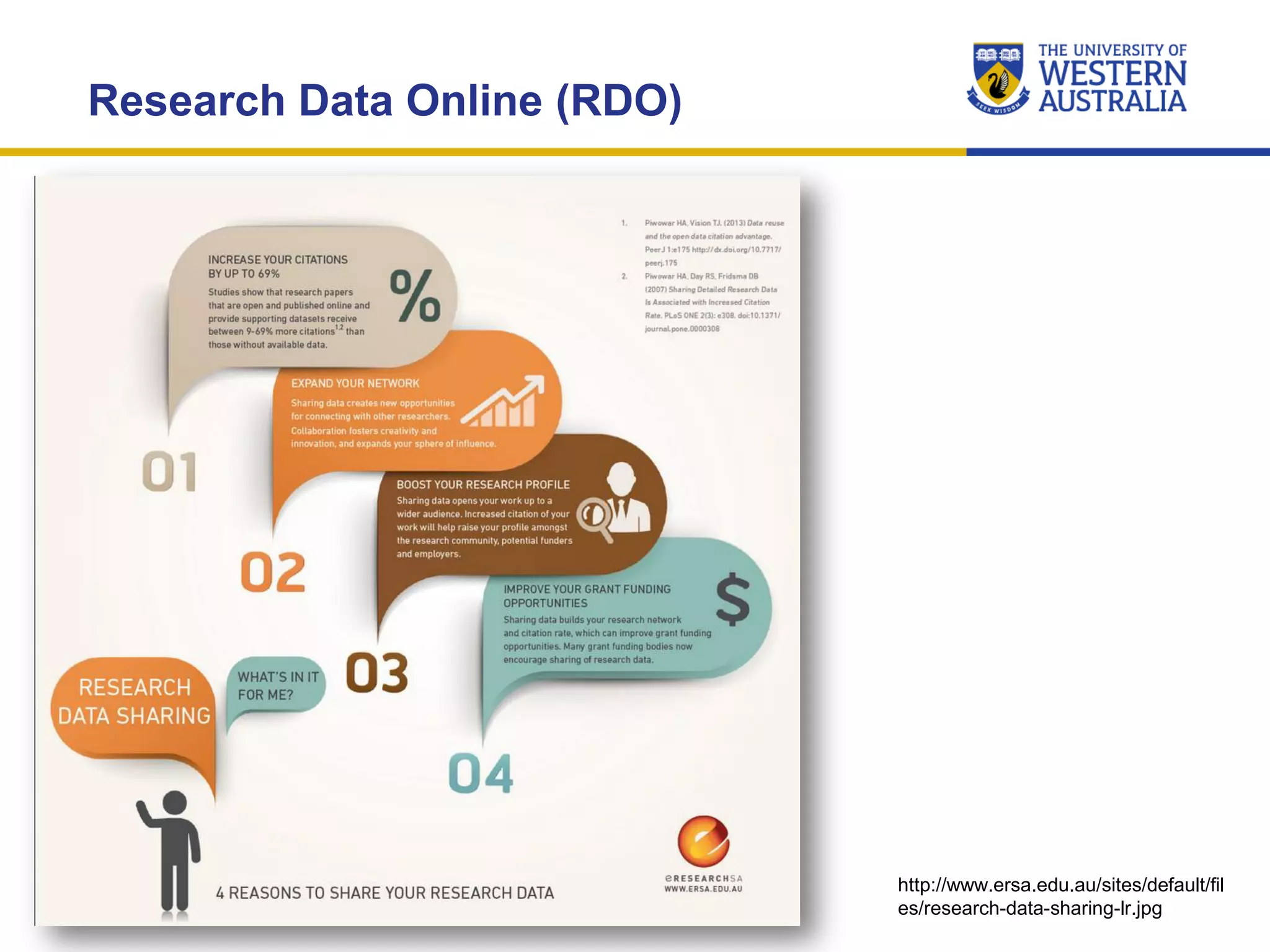
http://www.ersa.edu.au/sites/default/fil
es/research-data-sharing-lr.jpg
Research Data Online (RDO)
Senior Librarians will help you
establish your ORCID account
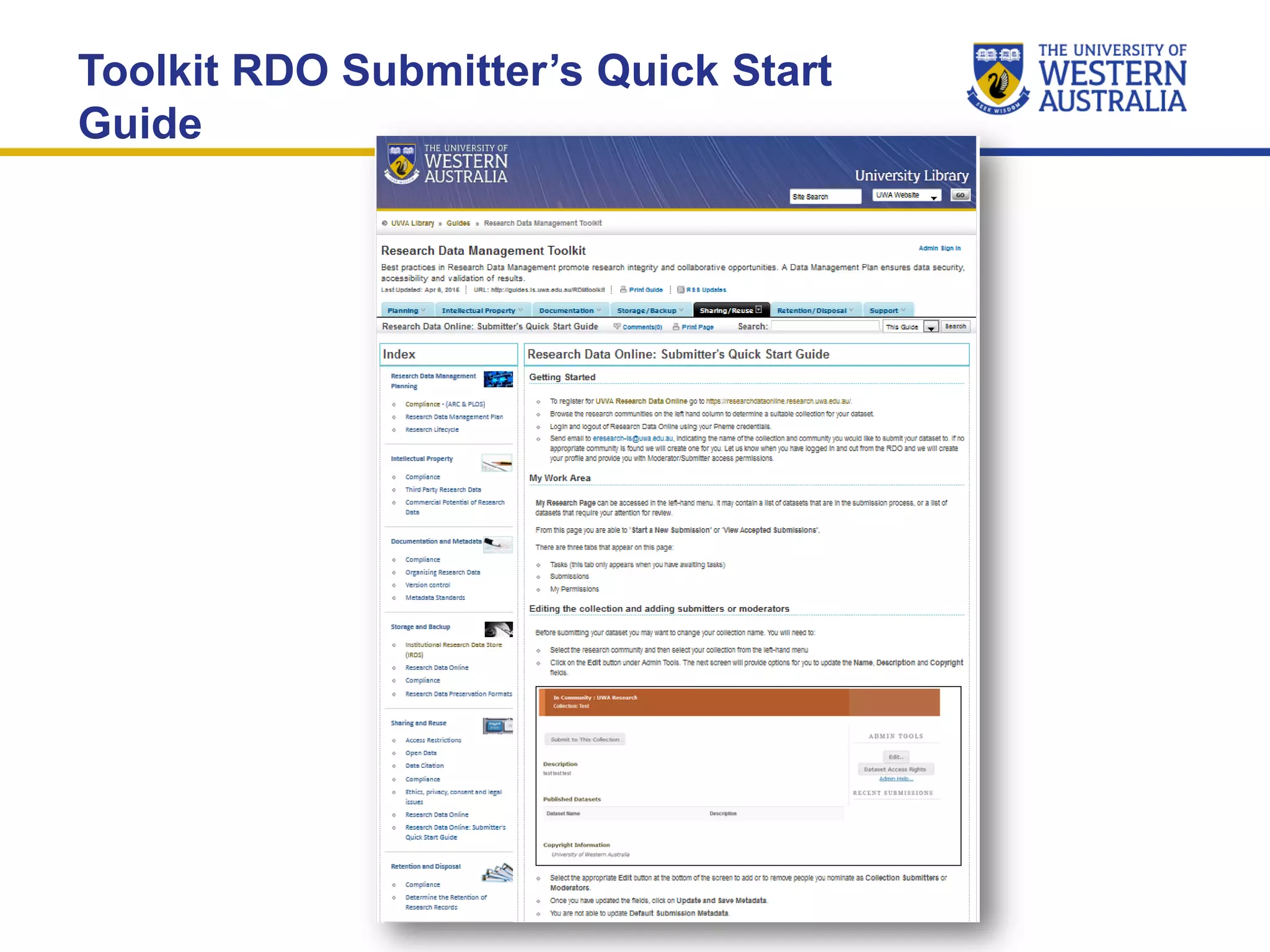
Toolkit RDO Submitter’s Quick Start
Guide
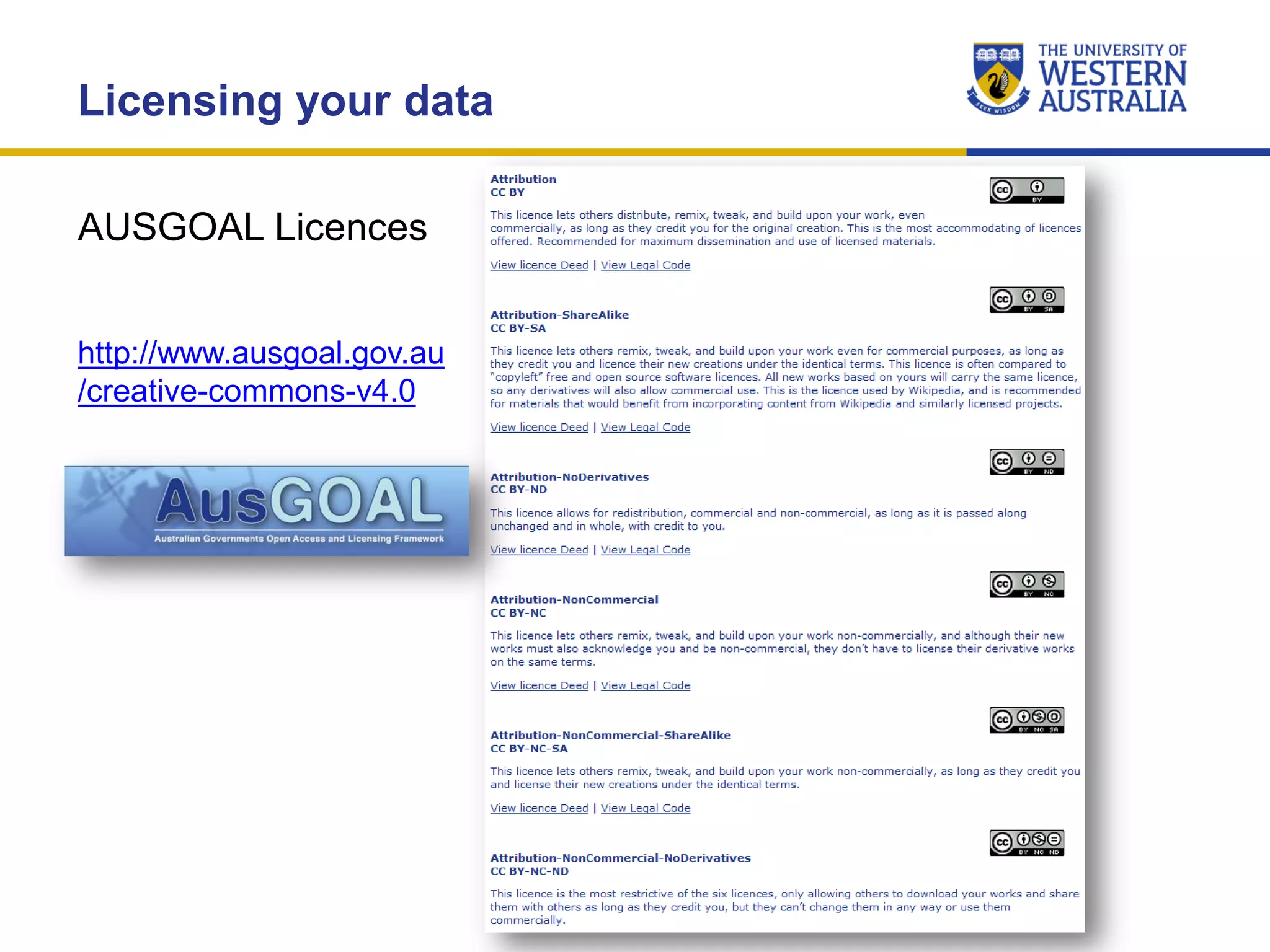
AUSGOAL Licences
Licensing your data
http://www.ausgoal.gov.au
/creative-commons-v4.0
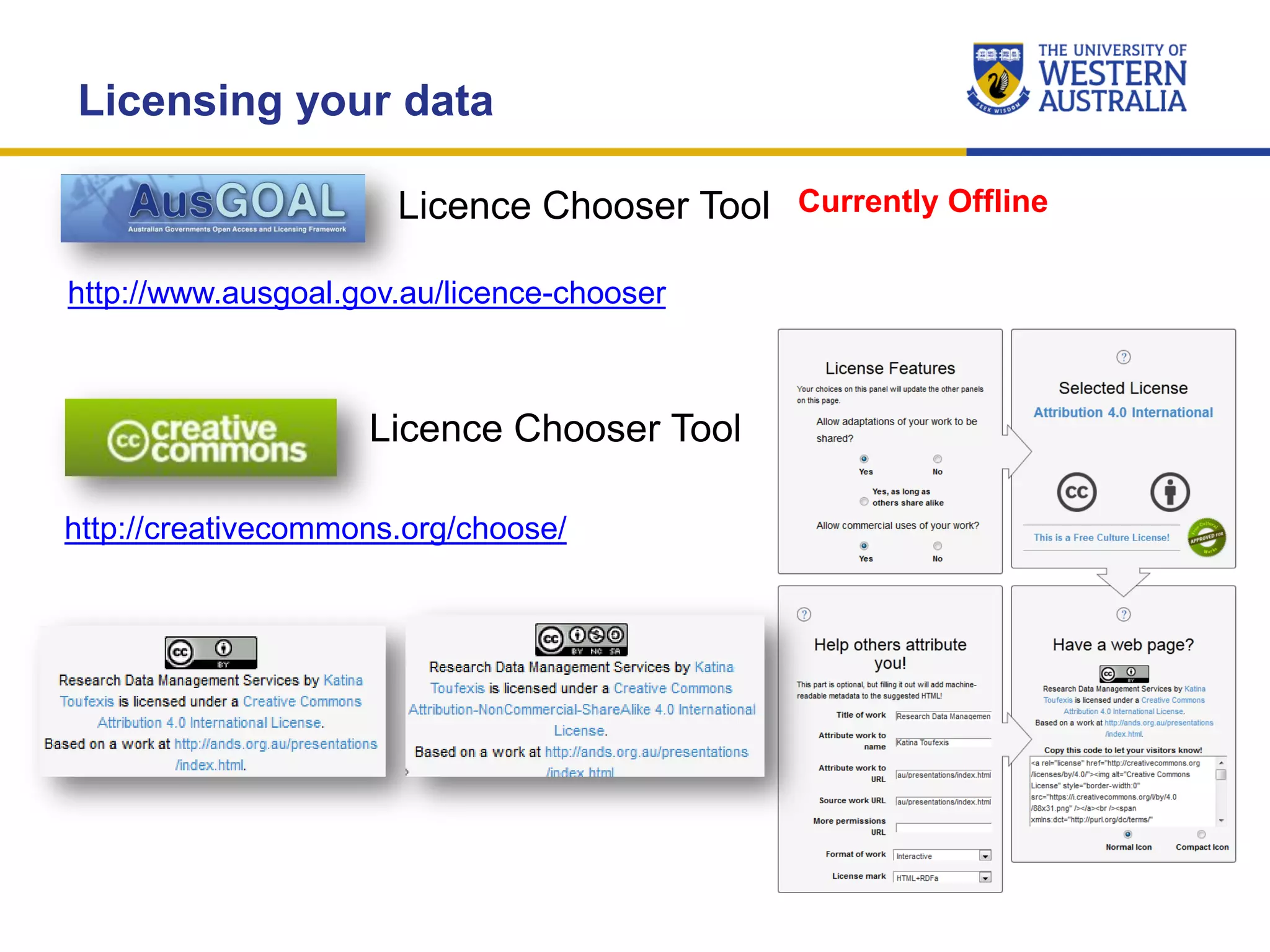
Licence Chooser Tool
Licensing your data
http://www.ausgoal.gov.au/licence-chooser
Currently Offline
Licence Chooser Tool
http://creativecommons.org/choose/
Copyright, publishing and Open Access Considerations
Licencing your data
A Shared Culture (Creative Commons)
https://www.youtube.com/watch?v=1DKm96Ftfko
Licensing your data
Legal Services
http://www.legalservices.uwa.edu.au/
admin-legalserv@uwa.edu.au
(+61 8) 6488 2414
For further assistance:
eResearch Unit
eresearch-is@uwa.edu.au
(+61 8) 6488 5319
Contacts
Questions?
Katina Toufexis
Research Data Coordinator
katina.toufexis@uwa.edu.au
6488 5319
Acknowledgment: Some slides within this presentation have been based on the ANDS presentation
“Research Data Management for Health Services Librarians” (09/07/2015intro)
Also, some slides have been based on Karen Visser’s ANDS @ UWA Data Connections presentation
(0606/2014)
http://ands.org.au/presentations/index.html
Senior Librarian for your Faculty
http://www.library.uwa.edu.au/contact/faculty-liaison-coordinators
Online Evaluation Survey

Research Data Management Services at UWA (July 2015)

  • 1.
    Research Data Management Services Katina Toufexis ResearchData Coordinator katina.toufexis@uwa.edu.au 6488 5319 Samantha Blake Senior Librarian, Medical & Dental Library samantha.blake@uwa.edu.au 9346 7854
  • 2.
    Research Data Managementat UWA 1. What is Research Data? 2. Research Data Management 101 3. Research Data Management Services at UWA 4. Research Data Management Plan 5. Research Data Management Toolkit 6. Institutional Research Data Store (IRDS) 7. Research Data Online (RDO)
  • 3.
    Data Archiving andNetworked Services (DANS) Sharing data: good for science, good for you DANS promotes sustained access to digital research data. For this, DANS encourages scientific researchers to archive and reuse data in a sustained form, for instance via the Australian National Data Service (ANDS)
  • 4.
    What is ResearchData? Journal article Data? What data? Book http://cdn.list25.com/wp-content/uploads/2013/03/Slide173.jpg
  • 5.
    What do wemean by research data? What is Research Data? “It is not possible to apply a uniform definition of research data across all disciplines. Research data may be numerical, textual, audio-visual, digital or physical, depending on the discipline and the nature of the research.” Source: University of Sydney Research Data Management Policy 2014 http://sydney.edu.au/policies/showdoc.aspx?recnum=PDOC2013/337
  • 6.
    What do wemean by research data? What is Research Data? Observational Experimental Simulation Derived or Compiled Reference or Canonical Images: http://www.designweek.co.uk/news/kram/weisshaar-visualises-big-data/3037975.article; http://www.auntminnie.com/user/images/content_images/sup_mol/2010_07_30_15_55_33_600_PET_CT_MRI_02_450.jpg; http://2.bp.blogspot.com/- k35MuQYvTZA/TbTov-2kdRI/AAAAAAAAADE/oBF-FZPM6Wo/s400/multivariate.jpg; http://labs.openviewpartners.com/files/2012/05/graph_with_stacks_of_coins-e1349903025956.jpg; http://www.dpgp.org/syntenic_assembly/images/CG15386.png; http://www.matrixscience.com/images/dbmanager_2.gif
  • 7.
    Humanities Research Data? Whatis Research Data?  Artist’s statement  Exhibition catalogues  Critical reviews  Visual diaries  Journals  Drawings  Photographs  Manuscripts  Musical annotations  3D models  Audio-visual recordings of a creative work http://ands.org.au/presentations/index.html
  • 8.
    The Data Deluge “Datais more like soup – it’s messy and you don’t know what’s in it.” – Liz Lyon (UK DCC) “I worry there won't be enough people around to do the analysis.” –Chris Ponting (University of Oxford UK, Computational biologist) “A single DNA sequencer can now generate in a day what it took 10 years to collect for the Human Genome Project. Computers are central to archiving and analysing this information, but their processing power isn’t increasing fast enough, and their costs are decreasing too slowly, to keep up with the deluge.” - Elizabeth Pennisi (Science Author)
  • 9.
    Why should YOUcare about research data?
  • 10.
    Research Data Management101 Research Lifecycle – incorporating research data management
  • 11.
    Research Data Management101 Benefits of Research Data Management • Meets Compliance • Promotes Efficiency • Ensures Security • Allows Access • Improves Quality
  • 12.
    Research Data Management101 Benefits of Research Data Management
  • 13.
    Research Data Management101 Security – Risk. Where is your data? – Safeguards against data loss. – Ensures confidentiality and ethical compliance. – Guarantees legal compliance to intellectual property rights such as copyright. Why protect your data?
  • 14.
    Research Data Management101 Benefits of Research Data Management
  • 15.
    OECD cares aboutresearch data Access to research data increases the returns from public investment in this area; reinforces open scientific inquiry; encourages diversity of studies and opinion; promotes new areas of work and enables the exploration of topics not envisioned by the initial investigators. (OECD principles and guidelines for access to research data from public funding 2007) http://www.oecd.org/sti/sci-tech/oecdprinciplesandguidelinesforaccesstoresearchdatafrompublicfunding.htm
  • 16.
    Governments care aboutresearch data The Australian Government now declares that, in order to promote greater participation in Australia’s democracy, it is committed to open government based on a culture of engagement, built on better access to and use of government held information, and sustained by the innovative use of technology. Declaration of Open Government
  • 17.
  • 18.
    Governments care aboutresearch data “Open access to information held by the State Government will help stimulate the development of new, innovative applications by all sorts of private individuals, companies and non-government organisations” – Campbell Newman 9 Oct 2012 http://statements.qld.gov.au/Statement/2012/10/9/queensland- governments-open-data-revolution-begins
  • 19.
    FUNDERS care aboutresearch data Australian Code for the Responsible Conduct of Research (NHMRC, 2007) Section 2: Management of Research Data & Primary Materials “The responsible conduct of research includes the proper management and retention of the research data. …The central aim is that sufficient materials and data are retained to justify the outcomes of the research and to defend them if they are challenged. The potential value of the material for further research should also be considered, particularly where the research would be difficult or impossible to repeat.” https://www.nhmrc.gov.au/guidelines/publications/r39
  • 20.
    ARC Discovery Grantrequirements, February 2014: MANAGEMENT OF DATA Outline plans for the management of data produced as a result of the proposed research, including but not limited to storage, access and re-use arrangements. FUNDERS care about research data
  • 21.
    The Public Libraryof Science PLOS Data Sharing policy: PLOS journals require authors to make all data underlying the findings described in their manuscript fully available without restriction, with rare exception. From March 2014, you will need to include a “data availability statement” when you submit your article, explaining where and how your data can be accessed. PUBLISHERS care about research data http://www.plosone.org/static/policies#sharing
  • 22.
    Nature “An inherent principleof publication is that others should be able to replicate and build upon the authors' published claims. Therefore, a condition of publication in a Nature journal is that authors are required to make materials, data and associated protocols promptly available to readers without undue qualifications”. PUBLISHERS care about research data http://www.nature.com/authors/policies/availability.html
  • 23.
    British Journal of EducationalTechnology “BJET strongly encourages authors of articles describing empirical research to make their data available to others, for example through an institutional or other repository. If this is not possible then it will not necessarily preclude publication in the Journal, but you should note that it is one of the criteria by which your work will be assessed.”. PUBLISHERS care about research data
  • 24.
    Nature Journals: ScientificData Journal Dataset-ONLY journals PUBLISHERS care about research data http://www.nature.com/sdata/
  • 25.
    What about theHumanities?? PUBLISHERS care about research data Archives of Scientific Psychology
  • 26.
  • 27.
    What about inAustralia?
  • 28.
    What about inAustralia?
  • 29.
    What about inAustralia?
  • 30.
    INSTITUTIONS care aboutresearch data UWA Code of Conduct for the Responsible Practice of Research http://www.research.uwa.edu.au/staff/research-policy/guidelines Section 2 refers to the management of research data and primary materials and states: 2.1 Data (including electronic data) must be recorded in a durable and appropriately referenced form. 2.2 Data must be held for sufficient time to allow access and reference. Recommended a minimum 5 years from date publication, but up to 15 years for specific types (eg clinical studies) 2.3 Wherever possible, original data must be retained in the school or research centre in which it was generated... In all cases, prior to the publication of research findings a Location of Data Form must be completed. These guidelines should be seen as a framework for sound research practice and for the protection of individual research workers, including both staff and postgraduate research students, from possible misunderstandings.
  • 31.
    Research Data Management101 Benefits of Research Data Management Allows for data replication or reproducibility. Increases the accuracy or reliability of the data. Ensures research data integrity. Improves research process. Encourages systematic documentation and descriptions of the research data. Provides guidelines and procedures ensuring consistency. Allows data validation and verification. Enables collaborative research opportunities. Prevents duplication. Allows data sharing and future reuse. Increases researcher citations.
  • 32.
    DATA REUSE andOpen Data Citation advantages The citation benefit intensified over time...  ...with publications from 2004 and 2005 cited 30 per cent more often if their data was freely available.  Every 100 papers with open data prompted 150 "data reuse papers" within five years  Original authors tended to use their data for only two years, but others re-used it for up to six years. Piwowar HA, Vision TJ. (2013) Data reuse and the open data citation advantage. PeerJ 1:e175 http://dx.doi.org/10.7717/peerj.175
  • 33.
    Supporting Data @UWA www.library.uwa.edu.au/ research/services
  • 34.
    Creating a ResearchData Management Plan
  • 35.
    Creating a ResearchData Management Plan The Data Management Planning Tool is: • an online form • uses the Qualtrics survey platform • Asks relevant questions pertaining to your research data • Sends you an electronic plan directly to your email after completion • Download a copy from the Research Data Management Toolkit
  • 36.
    Research Data ManagementToolkit http://www.library.uwa. edu.au/ research/ research-data- management-toolkit
  • 37.
  • 38.
  • 39.
  • 40.
    IRDS – Newdevelopments “Any Stores with less than 50% usage for longer than 3 months will be automatically reduced in size.”
  • 41.
    Access to ExternalCollaborators IRDS – New developments Pheme authentication provided to external collaborators via HR Form: http://www.hr.uwa.edu.au/__data/as sets/pdf_file/0006/2172606/Comme ncement_of_Non- university_Staff.pdf
  • 42.
    • All dataand associated information created in the course of conducting research is subject to the UWA Policy on Records Management. • All research records must be retained in accordance with the WA University Sector Disposal Authority. • Retention periods range from a minimum of 7 years to permanent depending on the significance and type of research. • Information can be kept longer if required but must not be destroyed before the required minimum retention period. Information Governance Services Retention and Disposal of Research Data
  • 43.
    How long mustresearch data be kept?
  • 44.
    What are thedifferences? IRDS vs Pawsey Supercomputing IRDS Pawsey Secured by UWA Network P O Auto backup P O UWA owned P O Data located in Australia P O Very Large File size P P External collaborator access P P Long term storage - Helps comply with WAUSDA P O Working environment O P
  • 45.
    What are thedifferences? IRDS vs Pawsey Supercomputing Pawsey Supercomputing
  • 46.
    Recent Case Study IRDSvs Pawsey Supercomputing HDR student query I have been using iVec (Pawsey) to work on my data with my collaborators overseas. When I’m finished, to meet WAUSDA requirements, can I store it there for a minimum of 7 years? Our response No, Pawsey doesn’t comply with WAUSDA standards. • Continue to use Pawsey to work on your data. • Be aware that Pawsey is funding dependent. • They do not provide a long- term storage solution. • The IRDS is more suitable to meet the long term storage needs/requirements of UWA researchers
  • 47.
    Recent Case Study IRDSvs Dropbox HDR student query Can I use Dropbox to transfer confidential data from international companies for my research at UWA? • Confidentiality? • Is encryption ok? • Other cloud storage options? Our response Technically, yes, but should you? • Contracts/Agreements with data providers? • Seek advice from Legal Services • No charge for < 2GB ; but >2GB=$$ • Allows access to collaborators. • Confidential data may not be safe. The data is being stored overseas. • Not managed, maintained or stored by UWA.
  • 48.
    Recent Case Study IRDSvs Dropbox HDR student query Can I use Dropbox to transfer confidential data from international companies for my research at UWA? • Confidentiality? • Is encryption ok? • Other cloud storage options? Our response Make informed decisions • UWA’s Information Governance Services (IGS) provide guidance on using public cloud storage. – http://www.igs.uwa.edu.au/p olicies/guides/auth/cloud- storage
  • 49.
    Recent Case Study IRDSvs Dropbox HDR student query Can I use Dropbox to transfer confidential data from international companies for my research at UWA? • Confidentiality? • Is encryption ok? • Other cloud storage options? Our response Make informed decisions • University Policy on: Institutional Data Centre • University Policy on: Records Management • Computer and Software Use Regulations • University Policy on: Records Management • UWA Code of Conduct for the Responsible Practice of Research • UWA Recordkeeping Plan • Western Australian University Sector Disposal Authority • Australian Code for the Responsible Conduct of Research • University’s Policy on Privacy of Electronic Material
  • 50.
    Recent Case Study IRDSvs Dropbox HDR student query Can I use Dropbox to transfer confidential data from international companies for my research at UWA? • Confidentiality? • Is encryption ok? • Other cloud storage options? Our response Pawsey Supercomputing could be an option • Can cope with large (‘Big Data’) datasets and file transfer. • Allows access to collaborators. • Not encouraged for long-term storage (dependent on funding). • Not managed or maintained by UWA.
  • 51.
    Recent Case Study IRDSvs Dropbox HDR student query Can I use Dropbox to transfer confidential data from international companies for my research at UWA? • Confidentiality? • Is encryption ok? • Other cloud storage options? Our response IRDS would be an excellent choice • Data is stored locally. • The IRDS maintained and supported by UWA (Service Desk Support 24/7) • Encouraged for long-term storage and can be used to comply with WAUSDA. – “Research records must be retained for a minimum of 7 years after the date of publication or project completion, whichever is later.”
  • 52.
    Recent Case Study IRDSvs Dropbox HDR student query Can I use Dropbox to transfer confidential data from international companies for my research at UWA? • Confidentiality? • Is encryption ok? • Other cloud storage options? Our response IRDS would be an excellent choice • Now allows for external collaborator access – Pheme authentication provided to external collaborators via http://www.hr.uwa.edu.au/__ data/assets/pdf_file/0006/21 72606/Commencement_of_ Non-university_Staff.pdf
  • 53.
    Recent Case Study IRDSvs Dropbox HDR student query Can I use Dropbox to transfer confidential data from international companies for my research at UWA? • Confidentiality? • Is encryption ok? • Other cloud storage options? Our response IRDS would be an excellent choice
  • 54.
  • 55.
    Research Data Online(RDO) • Publicly accessible • Discoverable • Harvested into RDA • DOIs OR Locally generated handles • Harvested into RDA
  • 56.
    Research Data Online(RDO) RDO (UWA) RDA (ANDS)
  • 57.
  • 58.
    DISCOVERABLE RDO vs IRDS?? Institutional Research Data Store (IRDS) Research Data Online (RDO)
  • 59.
    Hooper, CM; CastledenIR; Aryamanesh N; Jacoby RP; Millar AH, (2015): The compendium of crop Proteins with Annotated Locations (cropPAL) version 1. The University of Western Australia. http://dx.doi.org/10.4225/23/556e4e260e093 Research Data Online (RDO)
  • 60.
    Research Data Online(RDO) Publications Data Data connections can be counted Images: http://www.bigdatarevolutionbook.com/ , http://auditfutures.org/publications/
  • 61.
    Research Data Online(RDO) Data connections can be counted
  • 62.
    Research Data Online(RDO) Publications Data Data connections can be counted Images: http://www.bigdatarevolutionbook.com/ , http://auditfutures.org/publications/
  • 63.
    Research Data Online(RDO) Data connections Grant applications? http://orcid.org/
  • 64.
    Research Data Online(RDO) Data connections
  • 65.
    Research Data Online(RDO) http://www.ersa.edu.au/sites/default/fil es/research-data-sharing-lr.jpg
  • 66.
    Research Data Online(RDO) Senior Librarians will help you establish your ORCID account
  • 67.
    Toolkit RDO Submitter’sQuick Start Guide
  • 68.
    AUSGOAL Licences Licensing yourdata http://www.ausgoal.gov.au /creative-commons-v4.0
  • 69.
    Licence Chooser Tool Licensingyour data http://www.ausgoal.gov.au/licence-chooser Currently Offline Licence Chooser Tool http://creativecommons.org/choose/
  • 70.
    Copyright, publishing andOpen Access Considerations Licencing your data A Shared Culture (Creative Commons) https://www.youtube.com/watch?v=1DKm96Ftfko
  • 71.
    Licensing your data LegalServices http://www.legalservices.uwa.edu.au/ admin-legalserv@uwa.edu.au (+61 8) 6488 2414 For further assistance: eResearch Unit eresearch-is@uwa.edu.au (+61 8) 6488 5319
  • 72.
    Contacts Questions? Katina Toufexis Research DataCoordinator katina.toufexis@uwa.edu.au 6488 5319 Acknowledgment: Some slides within this presentation have been based on the ANDS presentation “Research Data Management for Health Services Librarians” (09/07/2015intro) Also, some slides have been based on Karen Visser’s ANDS @ UWA Data Connections presentation (0606/2014) http://ands.org.au/presentations/index.html Senior Librarian for your Faculty http://www.library.uwa.edu.au/contact/faculty-liaison-coordinators
  • 73.