Lessons in Using Clinical Decision Support for Chronic Disease Management Brian Dixon, MPA Regenstrief Institute, Inc. Jack Starmer, MD Vanderbilt University Medical Center Anita Samarth ASTECH Consulting
Overview The Chronic Disease Problem Agency for Healthcare Research and Quality AHRQ Health IT Portfolio AHRQ National Resource Center for HIT Innovations in Chronic Disease Management Key Lessons Project Management Alert Fatigue Human Element Conclusion Page  ©2007 AHRQ National Resource Center
The Chronic Disease Problem Chronic Diseases … afflict 90 million Americans … account for 7 of every 10 deaths … consume 2/3 of national health care expenditures … many are preventable and manageable Sources: CDC (2004, 2006); Bodenheimer, Wagner, and Grumbach (2002) Page  ©2007 AHRQ National Resource Center
The Agency for Healthcare Research and Quality (AHRQ) AHRQ Mission To improve the quality, safety, efficiency, and effectiveness of health care for all Americans AHRQ-Funded Research Patient-centered Services + Delivery Systems effectiveness research focuses on actual daily practice, not ideal situations AHRQ mission includes production  and  use of evidence-based information Page  ©2007 AHRQ National Resource Center
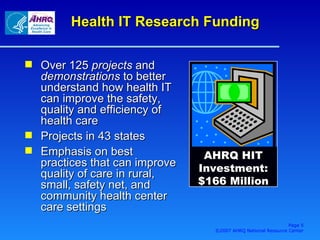
Over 125  projects  and  demonstrations  to better understand how health IT can improve the safety, quality and efficiency of health care Projects in 43 states Emphasis on  best practices that can improve quality of care in rural, small, safety net, and community health center care settings Health IT Research Funding AHRQ HIT Investment: $166 Million Page  ©2007 AHRQ National Resource Center
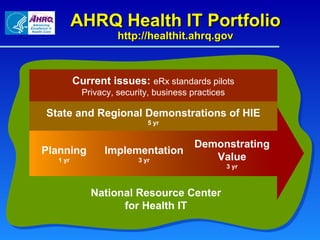
AHRQ Health IT Portfolio http://healthit.ahrq.gov State and Regional Demonstrations of HIE 5 yr Current issues:  eRx standards pilots Privacy, security, business practices National Resource Center for Health IT Planning 1 yr Implementation 3 yr Demonstrating Value 3 yr
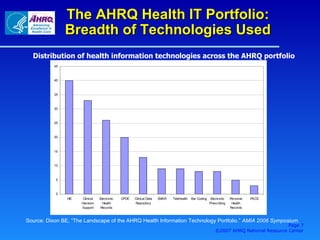
The AHRQ Health IT Portfolio: Breadth of Technologies Used Source: Dixon BE, “The Landscape of the AHRQ Health Information Technology Portfolio.”  AMIA 2006 Symposium . Distribution of health information technologies across the AHRQ portfolio Page  ©2007 AHRQ National Resource Center
A Report on IT Innovations in Chronic Disease Management (CDM)
Report Background Source: AHRQ-funded projects that target chronic diseases via health IT interventions Methods: document review, phone interviews Results: Best practices and lessons across 14 CDM projects Implementation Demonstrating value Challenges  Page  ©2007 AHRQ National Resource Center
Today’s Focus: CDSS Subset of AHRQ-funded projects that implemented clinical decision support systems (CDSS) 6 of the 14 CDM projects Demographics Medium and large urban hospitals Most an academic medical center or affiliated with one Geographically diverse Page  ©2007 AHRQ National Resource Center
CDSS Technologies Dashboards / Quality Reports Aggregation of data across the EHR Real-time feedback for clinicians Timely feedback/notification based on billing/claims data 1-7 days vs. 3-6 months Clinical Documentation / Templates Integrated reminders Remote Monitoring Page  ©2007 AHRQ National Resource Center
Key Lessons
Project Management What is project management? Ability to organize and manage project resources to complete project within scope, budget, time, and quality. Role of project management: Vendor management Stakeholder engagement Potential Impacts Go live date, budget, adoption Page  ©2007 AHRQ National Resource Center
Project Management Commercial systems require significant customization, especially for CDM Alerts, prompts Interfaces Project delays Vendor partnerships Integration with legacy systems Projects in rural areas had a hard time finding experienced personnel Page  ©2007 AHRQ National Resource Center
Alert Fatigue What is alert fatigue? Overwhelming or non-essential alerts that lead providers to ignore or stop using CDSS Where does alert fatigue present? CPOE: drug-drug interactions EHR: guideline-driven templates Potential Impact Unintended patient safety consequences Page  ©2007 AHRQ National Resource Center
Alert Fatigue Process Redesign Alert prioritization “Middle” ware Custom inbox or routine to support workflow Human Resources Nurses Medicaid workers Other non-clinical personnel Page  ©2007 AHRQ National Resource Center
The Human Element What is the human element? The other 2/3 of IT implementations Where do human elements present? Everywhere! Organizational, political, technical Potential Impact User acceptance / buy-in Provider / Patient Satisfaction Page  ©2007 AHRQ National Resource Center
The Human Element Securing trust and buy-in HIE v. referral system Socio-technical factors Patient recruitment Usability Patient-centered approaches Medication education “game” Interactive voice response (IVR) Page  ©2007 AHRQ National Resource Center
Conclusion
What’s Next? Expansion From 1-2 diseases to N diseases From local community to statewide Larger Projects Demonstrate greater value Create sustainability More Public-Private Partnerships More commercial systems Greater adoption Page  ©2007 AHRQ National Resource Center
Questions? AHRQ National Resource Center URL:  http://healthit.ahrq.gov Email:  NRC- [email_address] Brian Dixon, MPA Jack Starmer, MD Anita Samarth Page  ©2007 AHRQ National Resource Center

CDS Innovations for Chronic Disease Management

  • 1.
    Lessons in UsingClinical Decision Support for Chronic Disease Management Brian Dixon, MPA Regenstrief Institute, Inc. Jack Starmer, MD Vanderbilt University Medical Center Anita Samarth ASTECH Consulting
  • 2.
    Overview The ChronicDisease Problem Agency for Healthcare Research and Quality AHRQ Health IT Portfolio AHRQ National Resource Center for HIT Innovations in Chronic Disease Management Key Lessons Project Management Alert Fatigue Human Element Conclusion Page ©2007 AHRQ National Resource Center
  • 3.
    The Chronic DiseaseProblem Chronic Diseases … afflict 90 million Americans … account for 7 of every 10 deaths … consume 2/3 of national health care expenditures … many are preventable and manageable Sources: CDC (2004, 2006); Bodenheimer, Wagner, and Grumbach (2002) Page ©2007 AHRQ National Resource Center
  • 4.
    The Agency forHealthcare Research and Quality (AHRQ) AHRQ Mission To improve the quality, safety, efficiency, and effectiveness of health care for all Americans AHRQ-Funded Research Patient-centered Services + Delivery Systems effectiveness research focuses on actual daily practice, not ideal situations AHRQ mission includes production and use of evidence-based information Page ©2007 AHRQ National Resource Center
  • 5.
    Over 125 projects and demonstrations to better understand how health IT can improve the safety, quality and efficiency of health care Projects in 43 states Emphasis on best practices that can improve quality of care in rural, small, safety net, and community health center care settings Health IT Research Funding AHRQ HIT Investment: $166 Million Page ©2007 AHRQ National Resource Center
  • 6.
    AHRQ Health ITPortfolio http://healthit.ahrq.gov State and Regional Demonstrations of HIE 5 yr Current issues: eRx standards pilots Privacy, security, business practices National Resource Center for Health IT Planning 1 yr Implementation 3 yr Demonstrating Value 3 yr
  • 7.
    The AHRQ HealthIT Portfolio: Breadth of Technologies Used Source: Dixon BE, “The Landscape of the AHRQ Health Information Technology Portfolio.” AMIA 2006 Symposium . Distribution of health information technologies across the AHRQ portfolio Page ©2007 AHRQ National Resource Center
  • 8.
    A Report onIT Innovations in Chronic Disease Management (CDM)
  • 9.
    Report Background Source:AHRQ-funded projects that target chronic diseases via health IT interventions Methods: document review, phone interviews Results: Best practices and lessons across 14 CDM projects Implementation Demonstrating value Challenges Page ©2007 AHRQ National Resource Center
  • 10.
    Today’s Focus: CDSSSubset of AHRQ-funded projects that implemented clinical decision support systems (CDSS) 6 of the 14 CDM projects Demographics Medium and large urban hospitals Most an academic medical center or affiliated with one Geographically diverse Page ©2007 AHRQ National Resource Center
  • 11.
    CDSS Technologies Dashboards/ Quality Reports Aggregation of data across the EHR Real-time feedback for clinicians Timely feedback/notification based on billing/claims data 1-7 days vs. 3-6 months Clinical Documentation / Templates Integrated reminders Remote Monitoring Page ©2007 AHRQ National Resource Center
  • 12.
  • 13.
    Project Management Whatis project management? Ability to organize and manage project resources to complete project within scope, budget, time, and quality. Role of project management: Vendor management Stakeholder engagement Potential Impacts Go live date, budget, adoption Page ©2007 AHRQ National Resource Center
  • 14.
    Project Management Commercialsystems require significant customization, especially for CDM Alerts, prompts Interfaces Project delays Vendor partnerships Integration with legacy systems Projects in rural areas had a hard time finding experienced personnel Page ©2007 AHRQ National Resource Center
  • 15.
    Alert Fatigue Whatis alert fatigue? Overwhelming or non-essential alerts that lead providers to ignore or stop using CDSS Where does alert fatigue present? CPOE: drug-drug interactions EHR: guideline-driven templates Potential Impact Unintended patient safety consequences Page ©2007 AHRQ National Resource Center
  • 16.
    Alert Fatigue ProcessRedesign Alert prioritization “Middle” ware Custom inbox or routine to support workflow Human Resources Nurses Medicaid workers Other non-clinical personnel Page ©2007 AHRQ National Resource Center
  • 17.
    The Human ElementWhat is the human element? The other 2/3 of IT implementations Where do human elements present? Everywhere! Organizational, political, technical Potential Impact User acceptance / buy-in Provider / Patient Satisfaction Page ©2007 AHRQ National Resource Center
  • 18.
    The Human ElementSecuring trust and buy-in HIE v. referral system Socio-technical factors Patient recruitment Usability Patient-centered approaches Medication education “game” Interactive voice response (IVR) Page ©2007 AHRQ National Resource Center
  • 19.
  • 20.
    What’s Next? ExpansionFrom 1-2 diseases to N diseases From local community to statewide Larger Projects Demonstrate greater value Create sustainability More Public-Private Partnerships More commercial systems Greater adoption Page ©2007 AHRQ National Resource Center
  • 21.
    Questions? AHRQ NationalResource Center URL: http://healthit.ahrq.gov Email: NRC- [email_address] Brian Dixon, MPA Jack Starmer, MD Anita Samarth Page ©2007 AHRQ National Resource Center