The future of -
 The Indian Recruitment sector is pitched at being an industry
worth Rs 2000 crores in 2010.
 The highest grosser is the consultants in IT and Financial
Services.
 Annual salary increment in the year gone by has been to the
tune of 30-35 percent, something that even developed nations
are keen to achieve.
 Staffing demand has been on the rise in almost all sectors,
especially in banking, insurance, IT, telecom, retail and financial
services industry.
 As of today, ‘RECRUITMENT’ is the most vibrant sector with
recruiters being able to earn up to 150 % of their salary in
incentives alone.
 The human resource industry in India has grown at a
compounded annual growth rate of 21% over the past four
years and is pegged to be around Rs 22,800 crore, according
to a report by Executive Recruiters Association & Ernst &
Young.
"The Indian economic, social and cultural landscape is in the
middle of unprecedented change. The need for solutions for
complex problems of growth, innovation, and
professionalization is driving the opportunity for the HR
solutions industry in a way that has never been seen before,"
says Amit Zutshi, Partner in Ernst & Young's Transaction
Advisory Services practice. Temporary hiring has a 73%
market share while permanent staffing has 13% of the pie,
says the report.
Kamal Karanth, CEO at Kelly Services India highlights that
staffing presents huge opportunities for the industry. In India
there are 13 lacs temp workers presently in the organized
sector and estimates by the Indian Staffing Federation (ISF)
project that the demand will swell to 90 lacs, across the next
10 years.
Balaji, MD and CEO at Randstad India, highlights that for
global companies, understanding the dynamics and
characteristics of the Indian market will be a core challenge.
Another core challenge for most recruiting companies across
2013 will be low operating margins.
 Ashok Reddy, CEO at Teamlease, highlights that it will be
essential to look at how to scale the business and make the
business independent of one or two core people.
 While the outlook for 2013 is expected to remain fairly
static, the recruiting industry will likely witness changes in
terms of consolidation, new delivery models, and a
greater reliance on technology.
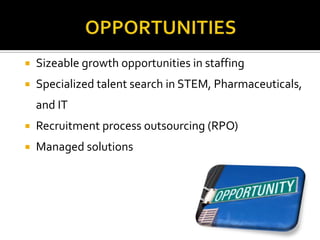
 Sizeable growth opportunities in staffing
 Specialized talent search in STEM, Pharmaceuticals,
and IT
 Recruitment process outsourcing (RPO)
 Managed solutions
 Longer recruiting cycles
 Stagnant growth outlook
 Question on ability to scale
 Availability of talent pool
 Consulting services in India comprise strategy consultants, niche boutique
consultants, recruitment consultants, business consultants, IP or
knowledge consultants, leadership consultants, and system integrators.
 Sankar Ramamurthy, Executive Director at PWHC, is optimistic that the
outlook for consulting service will be positive in 2013.
 He highlights that some services like compensation, evaluation, and
recruitment will be evergreen.
 People- based services and analytics will likely come up in a big way.
 There will likely be high demand for value-based services including learning
solutions, social media services for recruiting and branding, and
performance management.
 PSUs and homegrown companies
 SMEs and Indian multinationals
 Consolidation in the market
 Analytics and people-based services
 Relative low maturity compared to other markets
 Dearth of quality talent
 Demand side cost pressures
 The future looks extremely promising as the recruitment industry
heats up again.
 The global markets have recovered from the pangs of recession,
customer spends are comparatively increased and a general
positive outlook has been arisen in the business sector this year.
 The changes have started getting visible in the IT industry with
increase in employment opportunities.
 Increasing job opportunities can create a strong foundation for the
economy and thereby overall growth of a country can be achieved.
Recruitment & staffing industry

Recruitment & staffing industry

  • 1.
  • 2.
     The IndianRecruitment sector is pitched at being an industry worth Rs 2000 crores in 2010.  The highest grosser is the consultants in IT and Financial Services.  Annual salary increment in the year gone by has been to the tune of 30-35 percent, something that even developed nations are keen to achieve.  Staffing demand has been on the rise in almost all sectors, especially in banking, insurance, IT, telecom, retail and financial services industry.
  • 3.
     As oftoday, ‘RECRUITMENT’ is the most vibrant sector with recruiters being able to earn up to 150 % of their salary in incentives alone.  The human resource industry in India has grown at a compounded annual growth rate of 21% over the past four years and is pegged to be around Rs 22,800 crore, according to a report by Executive Recruiters Association & Ernst & Young.
  • 4.
    "The Indian economic,social and cultural landscape is in the middle of unprecedented change. The need for solutions for complex problems of growth, innovation, and professionalization is driving the opportunity for the HR solutions industry in a way that has never been seen before," says Amit Zutshi, Partner in Ernst & Young's Transaction Advisory Services practice. Temporary hiring has a 73% market share while permanent staffing has 13% of the pie, says the report.
  • 5.
    Kamal Karanth, CEOat Kelly Services India highlights that staffing presents huge opportunities for the industry. In India there are 13 lacs temp workers presently in the organized sector and estimates by the Indian Staffing Federation (ISF) project that the demand will swell to 90 lacs, across the next 10 years.
  • 6.
    Balaji, MD andCEO at Randstad India, highlights that for global companies, understanding the dynamics and characteristics of the Indian market will be a core challenge. Another core challenge for most recruiting companies across 2013 will be low operating margins.
  • 7.
     Ashok Reddy,CEO at Teamlease, highlights that it will be essential to look at how to scale the business and make the business independent of one or two core people.  While the outlook for 2013 is expected to remain fairly static, the recruiting industry will likely witness changes in terms of consolidation, new delivery models, and a greater reliance on technology.
  • 8.
     Sizeable growthopportunities in staffing  Specialized talent search in STEM, Pharmaceuticals, and IT  Recruitment process outsourcing (RPO)  Managed solutions
  • 9.
     Longer recruitingcycles  Stagnant growth outlook  Question on ability to scale  Availability of talent pool
  • 10.
     Consulting servicesin India comprise strategy consultants, niche boutique consultants, recruitment consultants, business consultants, IP or knowledge consultants, leadership consultants, and system integrators.  Sankar Ramamurthy, Executive Director at PWHC, is optimistic that the outlook for consulting service will be positive in 2013.  He highlights that some services like compensation, evaluation, and recruitment will be evergreen.  People- based services and analytics will likely come up in a big way.  There will likely be high demand for value-based services including learning solutions, social media services for recruiting and branding, and performance management.
  • 11.
     PSUs andhomegrown companies  SMEs and Indian multinationals  Consolidation in the market  Analytics and people-based services
  • 12.
     Relative lowmaturity compared to other markets  Dearth of quality talent  Demand side cost pressures
  • 13.
     The futurelooks extremely promising as the recruitment industry heats up again.  The global markets have recovered from the pangs of recession, customer spends are comparatively increased and a general positive outlook has been arisen in the business sector this year.  The changes have started getting visible in the IT industry with increase in employment opportunities.  Increasing job opportunities can create a strong foundation for the economy and thereby overall growth of a country can be achieved.