Jim’s Gym Story
Members:
Abdul Qayyum 0320220
Yeo Kai Wen 0319844
Cynthia Fong 0320499
Tan Ming Howe 0320199
Lee Jia Kiam 0320029
Nurafiqah Zariful 0321196
Storyline
Jim notices a buff guy in the gym and is inspired by his body built. Even hot girls are attracted to that buff guy. Hence, Jim
learns the buff guy’s daily workout routine and get hot chics too. (Observational learning)
Jim starts working out and often do it extra harder and better when his friends are around to impress them. (Social
facilitation)
He believes that he can be a buffer person and has his mind set on his target. (Self efficacy)
Months later……
Jim looks in the mirror but obviously few months wouldn’t have much effect on the muscles. He thought, ‘at least there’s
something, better than nothing. (Downward counterfactual thinking)
One day in the gym, Jim was working out as usual and a girl walks past and simply complimented him, Jim was so fixated
on this memory of the girl’s compliment. (Recency effect)
5 concepts
- Observational learning
- Social Facilitation
- Self - Efficacy
- Downward Counterfactual Thinking
- Recency Effect
Observational Learning
Is a type of learning process that happened when an observer engage to
repeat a person’s behavior after observing it.
How it occur?
-Attention
-Retention
-Reproduction
-Motivation
Examples:
1 2
Jim noticed a guy in the gym and he was inspired by his body built.
The ladies are attracted to the guy.
Jim learned from his daily workout routine
and hope to get hot chics just same as the guy he saw it
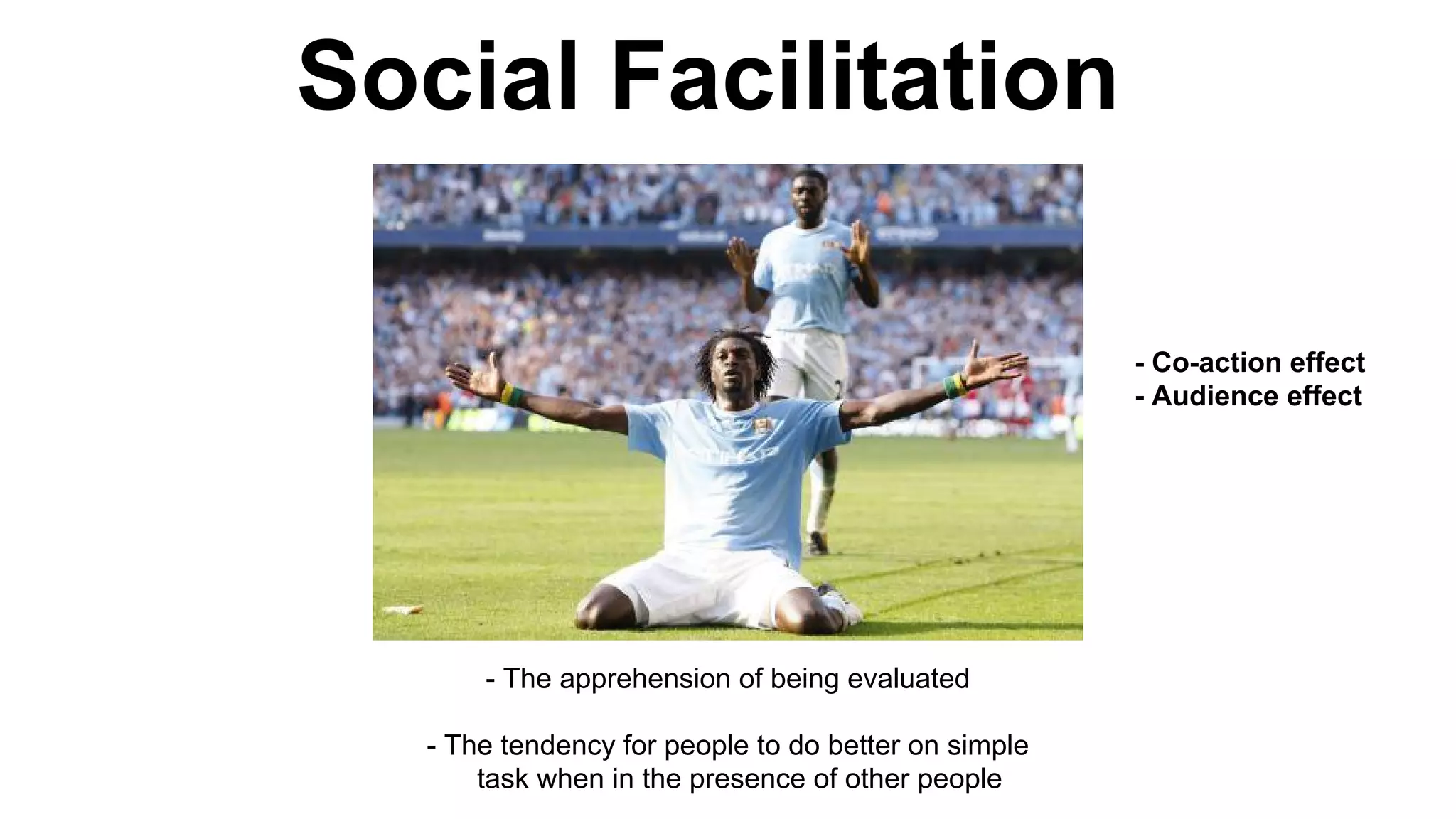
Social Facilitation
- The apprehension of being evaluated
- The tendency for people to do better on simple
task when in the presence of other people
- Co-action effect
- Audience effect
- For example, a skilled footballer performs better when he is
being watched by others. (fans, coach, teammates)
Self-Efficacy
It influences
- the choices we make
- the effort we put forth
- how long we persist when we confront obstacles (and in the face of failure)
- how we feel
- A person's judgment about being able to perform a particular activity.
- A student's "I can" or "I cannot" belief.
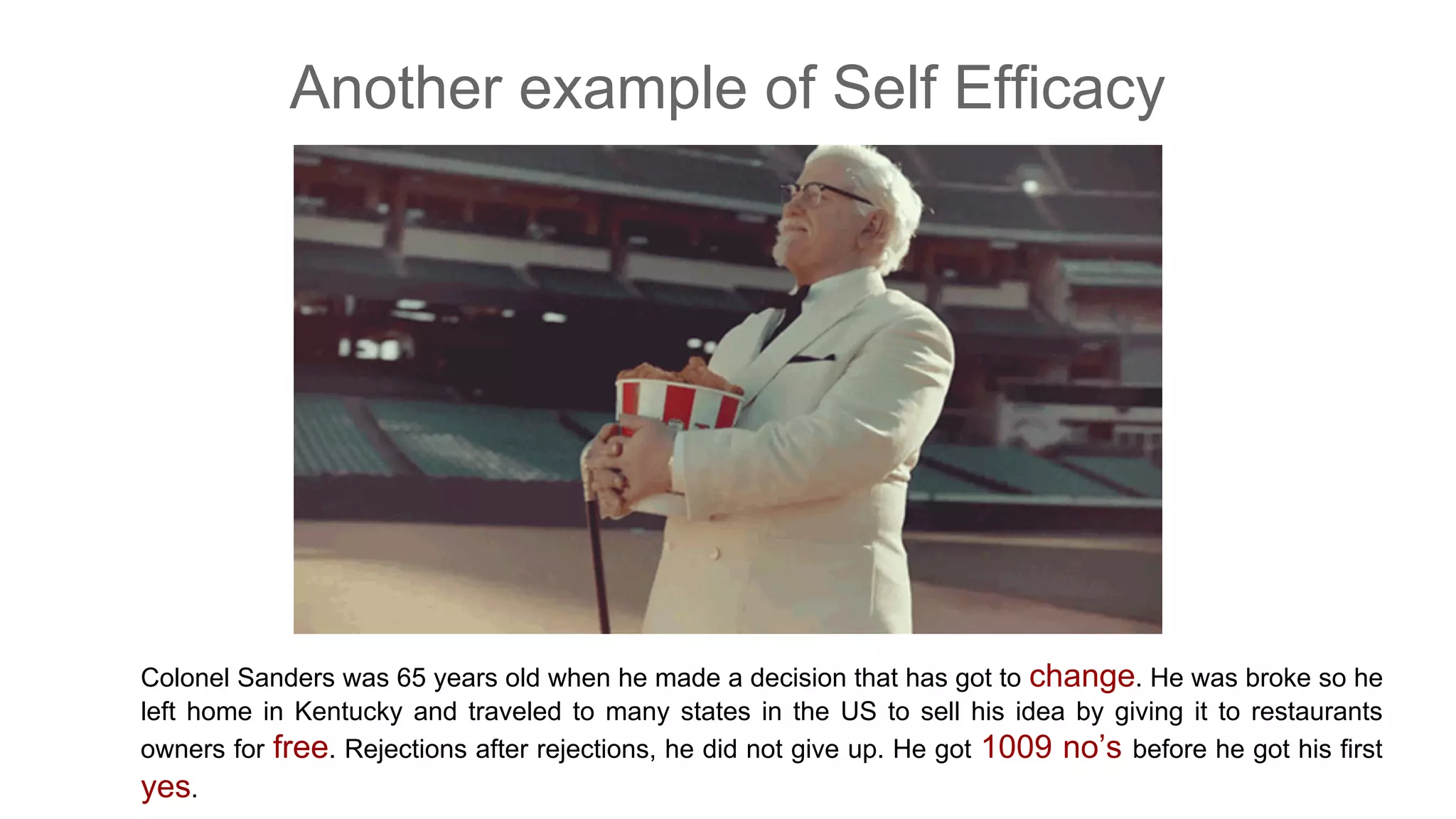
Another example of Self Efficacy
Colonel Sanders was 65 years old when he made a decision that has got to change. He was broke so he
left home in Kentucky and traveled to many states in the US to sell his idea by giving it to restaurants
owners for free. Rejections after rejections, he did not give up. He got 1009 no’s before he got his first
yes.
Downward
Counterfactual
Thinking
- thinking how it could have been worse (comforting yourself)
- often associated with negative events
- can improve or worsen your mood
In the picture: The silver medallist is thinking an upward
counterfactual about winning gold. For the bronze medallist, the
downward counterfactual thought is finishing without a medal. In
both cases, the comparison with the imagined outcome has a
stronger effect on happiness than the objective outcome.
R E C E N C Y
E F F E C T
Remembering the
most recent event.
- Chan, D. (n.d.). Why Bronze Medallists Are Happier Than Silver Winners. Retrieved May 24, 2015, from
http://www.straitstimes.com/news/opinion/invitation/story/why-bronze-medallists-are-happier-silver-
winners-20141018
- McLeod, S. (n.d.). Social Facilitation | Simply Psychology. Retrieved May 28, 2015, from http://www.
simplypsychology.org/Social-Facilitation.html
- Cherry, K. (n.d.). What Is Observational Learning? Retrieved May 28, 2015, from http://psychology.
about.com/od/oindex/fl/What-Is-Observational-Learning.htm
- Observational Learning and the Young Child. (n.d.). Retrieved May 29, 2015, from http://www.
funderstanding.com/theory/child-development/observational-learning-and-the-young-child/
- Gifted.uconn.edu,. (2000). An Introduction to Self-Efficacy. Retrieved May 27, 2015, from http://www.
gifted.uconn.edu/Siegle/SelfEfficacy/section1.html
References

Psychology concepts

  • 1.
    Jim’s Gym Story Members: AbdulQayyum 0320220 Yeo Kai Wen 0319844 Cynthia Fong 0320499 Tan Ming Howe 0320199 Lee Jia Kiam 0320029 Nurafiqah Zariful 0321196
  • 3.
    Storyline Jim notices abuff guy in the gym and is inspired by his body built. Even hot girls are attracted to that buff guy. Hence, Jim learns the buff guy’s daily workout routine and get hot chics too. (Observational learning) Jim starts working out and often do it extra harder and better when his friends are around to impress them. (Social facilitation) He believes that he can be a buffer person and has his mind set on his target. (Self efficacy) Months later…… Jim looks in the mirror but obviously few months wouldn’t have much effect on the muscles. He thought, ‘at least there’s something, better than nothing. (Downward counterfactual thinking) One day in the gym, Jim was working out as usual and a girl walks past and simply complimented him, Jim was so fixated on this memory of the girl’s compliment. (Recency effect)
  • 4.
    5 concepts - Observationallearning - Social Facilitation - Self - Efficacy - Downward Counterfactual Thinking - Recency Effect
  • 5.
    Observational Learning Is atype of learning process that happened when an observer engage to repeat a person’s behavior after observing it. How it occur? -Attention -Retention -Reproduction -Motivation
  • 6.
  • 7.
    Jim noticed aguy in the gym and he was inspired by his body built. The ladies are attracted to the guy. Jim learned from his daily workout routine and hope to get hot chics just same as the guy he saw it
  • 8.
    Social Facilitation - Theapprehension of being evaluated - The tendency for people to do better on simple task when in the presence of other people - Co-action effect - Audience effect
  • 9.
    - For example,a skilled footballer performs better when he is being watched by others. (fans, coach, teammates)
  • 10.
    Self-Efficacy It influences - thechoices we make - the effort we put forth - how long we persist when we confront obstacles (and in the face of failure) - how we feel - A person's judgment about being able to perform a particular activity. - A student's "I can" or "I cannot" belief.
  • 11.
    Another example ofSelf Efficacy Colonel Sanders was 65 years old when he made a decision that has got to change. He was broke so he left home in Kentucky and traveled to many states in the US to sell his idea by giving it to restaurants owners for free. Rejections after rejections, he did not give up. He got 1009 no’s before he got his first yes.
  • 12.
    Downward Counterfactual Thinking - thinking howit could have been worse (comforting yourself) - often associated with negative events - can improve or worsen your mood
  • 13.
    In the picture:The silver medallist is thinking an upward counterfactual about winning gold. For the bronze medallist, the downward counterfactual thought is finishing without a medal. In both cases, the comparison with the imagined outcome has a stronger effect on happiness than the objective outcome.
  • 14.
    R E CE N C Y E F F E C T Remembering the most recent event.
  • 15.
    - Chan, D.(n.d.). Why Bronze Medallists Are Happier Than Silver Winners. Retrieved May 24, 2015, from http://www.straitstimes.com/news/opinion/invitation/story/why-bronze-medallists-are-happier-silver- winners-20141018 - McLeod, S. (n.d.). Social Facilitation | Simply Psychology. Retrieved May 28, 2015, from http://www. simplypsychology.org/Social-Facilitation.html - Cherry, K. (n.d.). What Is Observational Learning? Retrieved May 28, 2015, from http://psychology. about.com/od/oindex/fl/What-Is-Observational-Learning.htm - Observational Learning and the Young Child. (n.d.). Retrieved May 29, 2015, from http://www. funderstanding.com/theory/child-development/observational-learning-and-the-young-child/ - Gifted.uconn.edu,. (2000). An Introduction to Self-Efficacy. Retrieved May 27, 2015, from http://www. gifted.uconn.edu/Siegle/SelfEfficacy/section1.html References