DOMINANT APPROACHES AND IDEAS
IN SOCIAL SCIENCES
PSYCHOANALYSIS AND RATIONAL CHOICE
OBJECTIVES
At the end of the lesson, the learner should be
able to:
1. Interpret personal and social experiences using
relevant approaches in the Social Sciences and,
2. Evaluate the strengths and weaknesses of the
approaches.
SIGMUND FREUD
Born in Freyberg town, Crech republic may 6,
1856
Graduated from medical faculty, university of
Vienna 1881
Officially organized 1896
He released ā€œInterpretation of dreamsā€ 1900
Passed away in Hampstead house
OVERVIEW OF
PSYCHOANALYSIS
 A set of philosophical of human nature
 Psychoanalysis is both an approach to
therapy and a theory of personality
 Emphasizes unconscious motivation
the main cause of behavior lie in
unconscious mind
VIEW OF HUMAN NATURE
1. Deterministic
Life is about gaining pleasure and avoiding
pain
2. Human as energy system
Freud believes that human are motivated
by the unconscious, where the Id is found
along with the aggression and sex instincts.
LEVEL OF MENTAL LIFE
1. Unconscious
Contains all feeling, urges or instinct that are
beyond our awareness but it affect our
expression, feeling, action (E.g. Slip of tongue,
dreams, wishes)
2. Preconscious
Facts stored in a part of a brain, which are not
conscious but are available for possible use in
the future (E.g. A person will never think of her
home address at that moment but when her
friend ask for it, she can easily recall it.
3. Conscious
Only level of mental life that are directly
available to us
The awareness of our own mental process
(thoughts/feeling)
Structure of Personality
Consists of three Parts:
1. Id 2. Ego 3. Superego
Id
-Infants are born with Id intact
-Operates on PLEASURE PRINCIPLES-to
gain pleasure, avoid pain
-Driven by sexual and aggressive urge
Ego
-The rational level of personality
-Operates on REALITYPRINCIPLES-
does realistic and logical thinking
• -The balance between Id and Superego
Superego
-Partially unconscious
-Operates to differentiate between good
and bad, right and wrong
-If people follow their superego, they will
feel proud but if they don’t follow they
will feel guilty and anxious
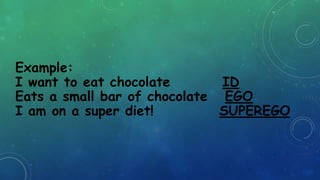
Example:
I want to eat chocolate ID
Eats a small bar of chocolate EGO
I am on a super diet! SUPEREGO
Aspects of the Psyche
Psyche
Ego- centre of consciousness
self- centre of whole psyche
analytic work moves beyond ego and
seeks to establish a relationship
between ego and self
Persona
social identity that we identify with the ego
We are much more than the social roles we
play and can move beyond them
Shadow
unconscious aspects of our personality that
have been lost, rejected, or never
integrated
if identified-less likely to blame others for
our problems

PSYCHOANALYSIS.pptx

  • 1.
    DOMINANT APPROACHES ANDIDEAS IN SOCIAL SCIENCES PSYCHOANALYSIS AND RATIONAL CHOICE
  • 2.
    OBJECTIVES At the endof the lesson, the learner should be able to: 1. Interpret personal and social experiences using relevant approaches in the Social Sciences and, 2. Evaluate the strengths and weaknesses of the approaches.
  • 3.
    SIGMUND FREUD Born inFreyberg town, Crech republic may 6, 1856 Graduated from medical faculty, university of Vienna 1881 Officially organized 1896 He released ā€œInterpretation of dreamsā€ 1900 Passed away in Hampstead house
  • 4.
    OVERVIEW OF PSYCHOANALYSIS  Aset of philosophical of human nature  Psychoanalysis is both an approach to therapy and a theory of personality  Emphasizes unconscious motivation the main cause of behavior lie in unconscious mind
  • 5.
    VIEW OF HUMANNATURE 1. Deterministic Life is about gaining pleasure and avoiding pain 2. Human as energy system Freud believes that human are motivated by the unconscious, where the Id is found along with the aggression and sex instincts.
  • 6.
    LEVEL OF MENTALLIFE 1. Unconscious Contains all feeling, urges or instinct that are beyond our awareness but it affect our expression, feeling, action (E.g. Slip of tongue, dreams, wishes)
  • 7.
    2. Preconscious Facts storedin a part of a brain, which are not conscious but are available for possible use in the future (E.g. A person will never think of her home address at that moment but when her friend ask for it, she can easily recall it. 3. Conscious Only level of mental life that are directly available to us The awareness of our own mental process (thoughts/feeling)
  • 8.
    Structure of Personality Consistsof three Parts: 1. Id 2. Ego 3. Superego
  • 9.
    Id -Infants are bornwith Id intact -Operates on PLEASURE PRINCIPLES-to gain pleasure, avoid pain -Driven by sexual and aggressive urge Ego -The rational level of personality -Operates on REALITYPRINCIPLES- does realistic and logical thinking • -The balance between Id and Superego
  • 10.
    Superego -Partially unconscious -Operates todifferentiate between good and bad, right and wrong -If people follow their superego, they will feel proud but if they don’t follow they will feel guilty and anxious
  • 11.
    Example: I want toeat chocolate ID Eats a small bar of chocolate EGO I am on a super diet! SUPEREGO
  • 12.
    Aspects of thePsyche Psyche Ego- centre of consciousness self- centre of whole psyche analytic work moves beyond ego and seeks to establish a relationship between ego and self
  • 13.
    Persona social identity thatwe identify with the ego We are much more than the social roles we play and can move beyond them Shadow unconscious aspects of our personality that have been lost, rejected, or never integrated if identified-less likely to blame others for our problems