Pseudomonas
For NEET PG
General Characteristics
● Gram negative, non sporing, motile aerobic baciilli with polar flegella
pseudomonas aeuginosa is a major human pathogen.
● Grows well at 37-42 degree C, growth at 42 degree C differentiates
pseudomonas aeuginosa from other pseudomonas spp.
● Pseudomonas aeruginosa colonised normal humans in small intestine and
skin.
● It causes disease in humans with abnormal host defense's especially in
patients with neutropenia.
● Mostly non-capsulated but strains isolated from patients with cystic fibrosis
gives mucoid colony as a result of overproduction of slime layer of alginate.
Pigment production
● Produces water soluble pigments which diffuses freely into the medium,
inhibits other bacteria and cause tissue injury.
● Pyocynin: bluish green pigment produced only by pseudomonas aeruginosa.
● Pyoverdin(fluorescein): gives greenish yellow colour to the colony
● Pyorubin: Impart red colour.
● Pyomelanin: Impart brown black colour.
Treatment
1. Pseudomonas posses a number of drug resistant plasmids conferring them
resistance to several antibiotics.
● Antipseudomoal drugs:
Extended spectrum penicillins-carbenicilline, piperacilline, ticarcilline
Extended spectrum cephalosporine:
3rd generation: ceftazidime, cefoperazone
4th generation: cefepime, cefpirome
Cont.
● Carbepenems: Imipenem, Meropenems
● Monobactam: aztreonam
● FLUOROQUINOLONES: Ciprofloxacin, levofloxacin
● Aminoglycosides: amikacin,tobramycin,gentamicin
● Drug of choice: aminoglycosides+penicillins except.
In CNS infection: ceftazidime+/- Aminoglycosides
In UTI: Ciprofloxacin
In malignant otitis externa: cprofloxacin or cephalosporine or
carbapenems
Resistance
● Resistant to common antiseptics and disinfectants such as quarentary
ammonium compounds,chlorxylenols hexachlorophans, dettol and cetrimides
and it grows in bottles containing these antiseptics and disinfectants.
● Cetrimide agar is infact used as selective media for growing pseudomonas.
● Sensitive to acids, beta glutaraldehyde, silver salts and strong phenolic
disinfectants.
● Most common organism causing infection in burn patients and silver
sulphonamide compounds are used as topical cream in burn patients.
Antigenic structure and Virulence factors
● Pili/fimbrae helps in colonisation and single polar flagella helps in
chemotactic movement towards host.
● Alginate an exopolysaccharide responsible for mucoid colony from patients
with cystic fibrosis, helps in bio-film formation and thus adhesion with host
mucosal cell and protection from immune cells.
● Lipopolysaccharide layer of cell wall responsible for endotoxic property of
organism.
Toxins
Diffusible toxins(secreted by type-II secretory system): Exotoxin A an
important enzyme which acts like diphtheria toxin and inhibits host protein
synthesis by inhibiting EF2.
Other diffusible toxins are protease, phospholipase C, elastase, hemolysins.
Non diffusible toxins(secreted by type-III secretory system): Exotoxin S and
T- bifunctiobal enzyme with GTPase and ADP-ribosyl transferase activity.
Exotoxin-U a phospholipase and Exotoxin Y an adenyl cyclase
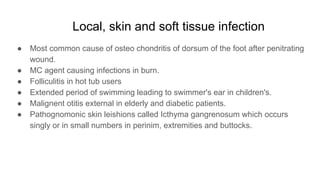
Local, skin and soft tissue infection
● Most common cause of osteo chondritis of dorsum of the foot after penitrating
wound.
● MC agent causing infections in burn.
● Folliculitis in hot tub users
● Extended period of swimming leading to swimmer's ear in children's.
● Malignent otitis external in elderly and diabetic patients.
● Pathognomonic skin leishions called Icthyma gangrenosum which occurs
singly or in small numbers in perinim, extremities and buttocks.
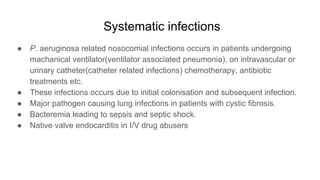
Systematic infections
● P. aeruginosa related nosocomial infections occurs in patients undergoing
machanical ventilator(ventilator associated pneumonia), on intravascular or
urinary catheter(catheter related infections) chemotherapy, antibiotic
treatments etc.
● These infections occurs due to initial colonisation and subsequent infection.
● Major pathogen causing lung infections in patients with cystic fibrosis.
● Bacteremia leading to sepsis and septic shock.
● Native valve endocarditis in I/V drug abusers

Pseudomonas for neet pg

  • 1.
  • 2.
    General Characteristics ● Gramnegative, non sporing, motile aerobic baciilli with polar flegella pseudomonas aeuginosa is a major human pathogen. ● Grows well at 37-42 degree C, growth at 42 degree C differentiates pseudomonas aeuginosa from other pseudomonas spp. ● Pseudomonas aeruginosa colonised normal humans in small intestine and skin. ● It causes disease in humans with abnormal host defense's especially in patients with neutropenia. ● Mostly non-capsulated but strains isolated from patients with cystic fibrosis gives mucoid colony as a result of overproduction of slime layer of alginate.
  • 3.
    Pigment production ● Produceswater soluble pigments which diffuses freely into the medium, inhibits other bacteria and cause tissue injury. ● Pyocynin: bluish green pigment produced only by pseudomonas aeruginosa. ● Pyoverdin(fluorescein): gives greenish yellow colour to the colony ● Pyorubin: Impart red colour. ● Pyomelanin: Impart brown black colour.
  • 4.
    Treatment 1. Pseudomonas possesa number of drug resistant plasmids conferring them resistance to several antibiotics. ● Antipseudomoal drugs: Extended spectrum penicillins-carbenicilline, piperacilline, ticarcilline Extended spectrum cephalosporine: 3rd generation: ceftazidime, cefoperazone 4th generation: cefepime, cefpirome
  • 5.
    Cont. ● Carbepenems: Imipenem,Meropenems ● Monobactam: aztreonam ● FLUOROQUINOLONES: Ciprofloxacin, levofloxacin ● Aminoglycosides: amikacin,tobramycin,gentamicin ● Drug of choice: aminoglycosides+penicillins except. In CNS infection: ceftazidime+/- Aminoglycosides In UTI: Ciprofloxacin In malignant otitis externa: cprofloxacin or cephalosporine or carbapenems
  • 6.
    Resistance ● Resistant tocommon antiseptics and disinfectants such as quarentary ammonium compounds,chlorxylenols hexachlorophans, dettol and cetrimides and it grows in bottles containing these antiseptics and disinfectants. ● Cetrimide agar is infact used as selective media for growing pseudomonas. ● Sensitive to acids, beta glutaraldehyde, silver salts and strong phenolic disinfectants. ● Most common organism causing infection in burn patients and silver sulphonamide compounds are used as topical cream in burn patients.
  • 7.
    Antigenic structure andVirulence factors ● Pili/fimbrae helps in colonisation and single polar flagella helps in chemotactic movement towards host. ● Alginate an exopolysaccharide responsible for mucoid colony from patients with cystic fibrosis, helps in bio-film formation and thus adhesion with host mucosal cell and protection from immune cells. ● Lipopolysaccharide layer of cell wall responsible for endotoxic property of organism.
  • 8.
    Toxins Diffusible toxins(secreted bytype-II secretory system): Exotoxin A an important enzyme which acts like diphtheria toxin and inhibits host protein synthesis by inhibiting EF2. Other diffusible toxins are protease, phospholipase C, elastase, hemolysins. Non diffusible toxins(secreted by type-III secretory system): Exotoxin S and T- bifunctiobal enzyme with GTPase and ADP-ribosyl transferase activity. Exotoxin-U a phospholipase and Exotoxin Y an adenyl cyclase
  • 9.
    Local, skin andsoft tissue infection ● Most common cause of osteo chondritis of dorsum of the foot after penitrating wound. ● MC agent causing infections in burn. ● Folliculitis in hot tub users ● Extended period of swimming leading to swimmer's ear in children's. ● Malignent otitis external in elderly and diabetic patients. ● Pathognomonic skin leishions called Icthyma gangrenosum which occurs singly or in small numbers in perinim, extremities and buttocks.
  • 10.
    Systematic infections ● P.aeruginosa related nosocomial infections occurs in patients undergoing machanical ventilator(ventilator associated pneumonia), on intravascular or urinary catheter(catheter related infections) chemotherapy, antibiotic treatments etc. ● These infections occurs due to initial colonisation and subsequent infection. ● Major pathogen causing lung infections in patients with cystic fibrosis. ● Bacteremia leading to sepsis and septic shock. ● Native valve endocarditis in I/V drug abusers