ORGANIC FARMING
SYSTEM
There are three types of organic farming
system :
1. Biodynamic farming
2. Natural farming
3. Bio-intensive farming
 Biodynamic farming is a spiritual-ethical-ecological
approach to agriculture, gardens, food production
and nutrition.
 It was first developed in the 1920s based on the
suggestions of Dr. Rudolf Steiner.
 Emphasis the use of manures and compost and
exclude the use of artificial chemicals on soil and
plants.
 Steiner suggested different preparations to aid
fertilization and described how these were to be
prepared.
BIODYNAMIC FARMING
 Field preparations
 Used to stimulate humus formation
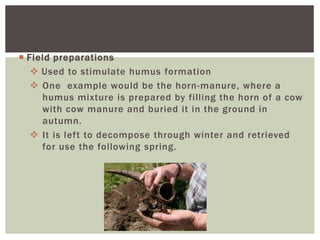
 One example would be the horn-manure, where a
humus mixture is prepared by filling the horn of a cow
with cow manure and buried it in the ground in
autumn.
 It is left to decompose through winter and retrieved
for use the following spring.
 Compost preparations
 Employ herbs which are frequently used in
medicinal treatment.
 Many of the herbs are used in organic practices to
make fertilizers, turned into the soil as green
manure
 Planting calendar
 There is astrological influences on soil and plant
development
 Some farmers would cultivate or harvest crops
based on both the phase of the moon and the
constellation of stars the moon is passing through
 Natural farming is an ecological farming approach
established by Masanobu Fukuoka, a Japanese
farmer and philosopher.
 Natural farming is a closed system, one that does
not depend on human-supplied inputs and mimic
nature.
 Fukuoka divided natural farming into several
principles :
NATURAL FARMING
 No Pesticides
 Pesticides do not only kill insects; they reside in the soil and
fruit
 Light, alcohol, aroma, poisonous plant and so forth are used
to control pests instead of chemicals
 An ecology that recovered the natural balance will drop in the
pests and disease occurrence
 No Herbicides
 Natural farming system uses the weeds rather than killing
them
 Wild grass such as rye and clover were grown for mulching
 The grass prevents soil erosion, holds moisture, propagates
microorganism, produces organic fertilizer, improves soil
ventilation and suppresses the pests.
 No tillage
 An agricultural technique which increases the amount of water that
infiltrates into the soil and increases organic matter retention and
cycling of nutrients in the soil
 It increases the amount and variety of life in and on the soil,
including disease-causing organisms and disease suppression
organisms.
 The most powerful benefit of no-tillage is improvement in soil
biological fertility, making soils more resilient
 No chemical fertilizers
 Nitrogen, phosphorous, potassium, calcium and other elements that
would be commonly given in the form of chemical fertilizer are
substituted with natural farming inputs
 Fish amino acid provides nitrogen, eggshells give calcium, animal
bones are source of phosphoric acid.
 A natural agricultural system that focuses on achieving
maximum yields from a minimum area of land
 Simultaneously increasing biodiversity and maintaining the
fertility of the soil
 Effective for backyard gardeners and smallholder farmers in
developing countries, and also has been used successfully on
small-scale commercial farms
 John Jeavons and Ecology Action developed a sustainable 8-
step food-raising method officially known as "GROW
BIOINTENSIVE - Sustainable Mini-Farming".
BIO-INTENSIVE FARMING
 Components important to the bio-intensive approach include:
i. Double-Dug, Raised Beds
ii. Composting
iii.Biointensive Planting
iv. Companion Planting
v. Carbon Farming
vi. Calorie Farming
vii.Use of Open-Pollinated Seeds
viii.A Whole-System Farming Method

Prt2008

  • 1.
  • 2.
    There are threetypes of organic farming system : 1. Biodynamic farming 2. Natural farming 3. Bio-intensive farming
  • 3.
     Biodynamic farmingis a spiritual-ethical-ecological approach to agriculture, gardens, food production and nutrition.  It was first developed in the 1920s based on the suggestions of Dr. Rudolf Steiner.  Emphasis the use of manures and compost and exclude the use of artificial chemicals on soil and plants.  Steiner suggested different preparations to aid fertilization and described how these were to be prepared. BIODYNAMIC FARMING
  • 4.
     Field preparations Used to stimulate humus formation  One example would be the horn-manure, where a humus mixture is prepared by filling the horn of a cow with cow manure and buried it in the ground in autumn.  It is left to decompose through winter and retrieved for use the following spring.
  • 5.
     Compost preparations Employ herbs which are frequently used in medicinal treatment.  Many of the herbs are used in organic practices to make fertilizers, turned into the soil as green manure  Planting calendar  There is astrological influences on soil and plant development  Some farmers would cultivate or harvest crops based on both the phase of the moon and the constellation of stars the moon is passing through
  • 6.
     Natural farmingis an ecological farming approach established by Masanobu Fukuoka, a Japanese farmer and philosopher.  Natural farming is a closed system, one that does not depend on human-supplied inputs and mimic nature.  Fukuoka divided natural farming into several principles : NATURAL FARMING
  • 7.
     No Pesticides Pesticides do not only kill insects; they reside in the soil and fruit  Light, alcohol, aroma, poisonous plant and so forth are used to control pests instead of chemicals  An ecology that recovered the natural balance will drop in the pests and disease occurrence  No Herbicides  Natural farming system uses the weeds rather than killing them  Wild grass such as rye and clover were grown for mulching  The grass prevents soil erosion, holds moisture, propagates microorganism, produces organic fertilizer, improves soil ventilation and suppresses the pests.
  • 8.
     No tillage An agricultural technique which increases the amount of water that infiltrates into the soil and increases organic matter retention and cycling of nutrients in the soil  It increases the amount and variety of life in and on the soil, including disease-causing organisms and disease suppression organisms.  The most powerful benefit of no-tillage is improvement in soil biological fertility, making soils more resilient  No chemical fertilizers  Nitrogen, phosphorous, potassium, calcium and other elements that would be commonly given in the form of chemical fertilizer are substituted with natural farming inputs  Fish amino acid provides nitrogen, eggshells give calcium, animal bones are source of phosphoric acid.
  • 9.
     A naturalagricultural system that focuses on achieving maximum yields from a minimum area of land  Simultaneously increasing biodiversity and maintaining the fertility of the soil  Effective for backyard gardeners and smallholder farmers in developing countries, and also has been used successfully on small-scale commercial farms  John Jeavons and Ecology Action developed a sustainable 8- step food-raising method officially known as "GROW BIOINTENSIVE - Sustainable Mini-Farming". BIO-INTENSIVE FARMING
  • 10.
     Components importantto the bio-intensive approach include: i. Double-Dug, Raised Beds ii. Composting iii.Biointensive Planting iv. Companion Planting v. Carbon Farming vi. Calorie Farming vii.Use of Open-Pollinated Seeds viii.A Whole-System Farming Method