Jeff Orr [email_address] 802.16 and 802.11:  The right technology in the right place
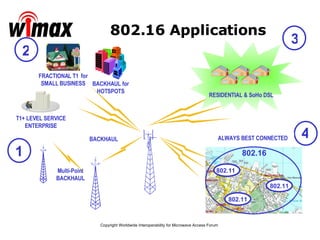
802.16 Applications BACKHAUL 1 RESIDENTIAL & SoHo DSL 3 2 4 ALWAYS BEST CONNECTED 802.16 802.11 802.11 Multi-Point BACKHAUL 802.11 FRACTIONAL T1  for SMALL BUSINESS T1+ LEVEL SERVICE ENTERPRISE BACKHAUL for HOTSPOTS
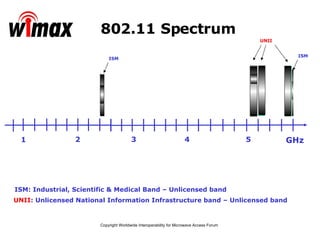
802.11 Spectrum GHz 1 3 2 4 ISM: Industrial, Scientific & Medical Band – Unlicensed band UNII : Unlicensed National Information Infrastructure band – Unlicensed band   UNII ISM 5 ISM
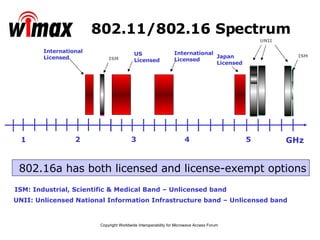
802.11/802.16 Spectrum GHz 1 3 2 4 ISM: Industrial, Scientific & Medical Band – Unlicensed band UNII: Unlicensed National Information Infrastructure band – Unlicensed band   UNII ISM 5 International Licensed US Licensed Japan Licensed International Licensed ISM 802.16a has both licensed and license-exempt options
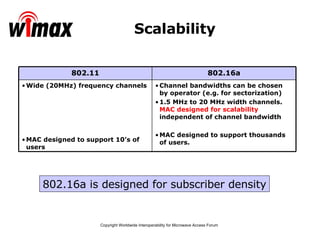
Scalability 802.16a is designed for subscriber density Channel bandwidths can be chosen by operator (e.g. for sectorization) 1.5 MHz to 20 MHz width channels.  MAC designed for scalability  independent of channel bandwidth MAC designed to support thousands of users.  Wide (20MHz) frequency channels MAC designed to support 10’s of users 802.16a 802.11
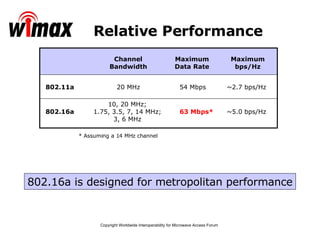
Relative Performance  802.16a ~5.0 bps/Hz ~2.7 bps/Hz 54 Mbps 20 MHz 63 Mbps* 10, 20 MHz; 1.75, 3.5, 7, 14 MHz; 3, 6 MHz 802.11a Channel Bandwidth Maximum bps/Hz Maximum Data Rate * Assuming a 14 MHz channel 802.16a is designed for metropolitan performance
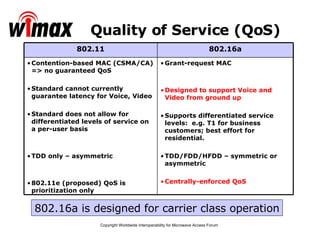
Quality of Service (QoS) 802.16a is designed for carrier class operation Grant-request MAC  Designed to support Voice and Video from ground up Supports differentiated service levels:  e.g. T1 for business customers; best effort for residential.  TDD/FDD/HFDD – symmetric or asymmetric Centrally-enforced QoS Contention-based MAC (CSMA/CA) => no guaranteed QoS Standard cannot currently guarantee latency for Voice, Video Standard does not allow for differentiated levels of service on a per-user basis TDD only – asymmetric  802.11e (proposed) QoS is prioritization only 802.16a 802.11
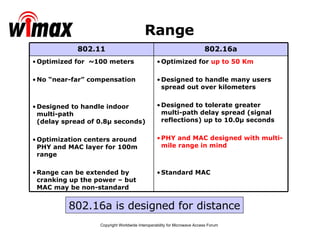
Range 802.16a is designed for distance Optimized for  up to 50 Km Designed to handle many users spread out over kilometers Designed to tolerate greater  multi-path delay spread (signal reflections) up to 10.0μ seconds PHY and MAC designed with multi-mile range in mind Standard MAC Optimized for  ~100 meters No “near-far” compensation Designed to handle indoor multi-path (delay spread of 0.8μ seconds) Optimization centers around PHY and MAC layer for 100m range Range can be extended by  cranking up the power – but MAC may be non-standard 802.16a 802.11
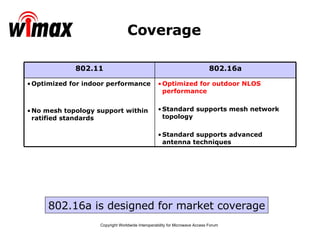
Coverage 802.16a is designed for market coverage Optimized for outdoor NLOS performance Standard supports mesh network topology Standard supports advanced antenna techniques Optimized for indoor performance No mesh topology support within ratified standards 802.16a 802.11
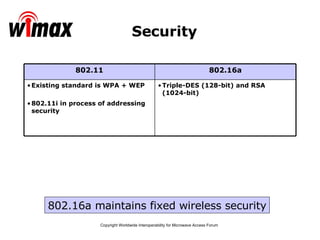
Security 802.16a maintains fixed wireless security Triple-DES (128-bit) and RSA  (1024-bit) Existing standard is WPA + WEP 802.11i in process of addressing security 802.16a 802.11
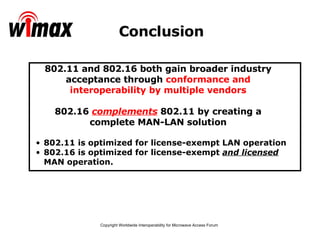
Conclusion 802.11 is optimized for license-exempt LAN operation 802.16 is optimized for license-exempt  and licensed  MAN operation. 802.11 and 802.16 both gain broader industry acceptance through  conformance and interoperability by multiple vendors 802.16  complements  802.11 by creating a complete MAN-LAN solution

Proxim Wimax

  • 1.
    Jeff Orr [email_address]802.16 and 802.11: The right technology in the right place
  • 2.
    802.16 Applications BACKHAUL1 RESIDENTIAL & SoHo DSL 3 2 4 ALWAYS BEST CONNECTED 802.16 802.11 802.11 Multi-Point BACKHAUL 802.11 FRACTIONAL T1 for SMALL BUSINESS T1+ LEVEL SERVICE ENTERPRISE BACKHAUL for HOTSPOTS
  • 3.
    802.11 Spectrum GHz1 3 2 4 ISM: Industrial, Scientific & Medical Band – Unlicensed band UNII : Unlicensed National Information Infrastructure band – Unlicensed band UNII ISM 5 ISM
  • 4.
    802.11/802.16 Spectrum GHz1 3 2 4 ISM: Industrial, Scientific & Medical Band – Unlicensed band UNII: Unlicensed National Information Infrastructure band – Unlicensed band UNII ISM 5 International Licensed US Licensed Japan Licensed International Licensed ISM 802.16a has both licensed and license-exempt options
  • 5.
    Scalability 802.16a isdesigned for subscriber density Channel bandwidths can be chosen by operator (e.g. for sectorization) 1.5 MHz to 20 MHz width channels. MAC designed for scalability independent of channel bandwidth MAC designed to support thousands of users. Wide (20MHz) frequency channels MAC designed to support 10’s of users 802.16a 802.11
  • 6.
    Relative Performance 802.16a ~5.0 bps/Hz ~2.7 bps/Hz 54 Mbps 20 MHz 63 Mbps* 10, 20 MHz; 1.75, 3.5, 7, 14 MHz; 3, 6 MHz 802.11a Channel Bandwidth Maximum bps/Hz Maximum Data Rate * Assuming a 14 MHz channel 802.16a is designed for metropolitan performance
  • 7.
    Quality of Service(QoS) 802.16a is designed for carrier class operation Grant-request MAC Designed to support Voice and Video from ground up Supports differentiated service levels: e.g. T1 for business customers; best effort for residential. TDD/FDD/HFDD – symmetric or asymmetric Centrally-enforced QoS Contention-based MAC (CSMA/CA) => no guaranteed QoS Standard cannot currently guarantee latency for Voice, Video Standard does not allow for differentiated levels of service on a per-user basis TDD only – asymmetric 802.11e (proposed) QoS is prioritization only 802.16a 802.11
  • 8.
    Range 802.16a isdesigned for distance Optimized for up to 50 Km Designed to handle many users spread out over kilometers Designed to tolerate greater multi-path delay spread (signal reflections) up to 10.0μ seconds PHY and MAC designed with multi-mile range in mind Standard MAC Optimized for ~100 meters No “near-far” compensation Designed to handle indoor multi-path (delay spread of 0.8μ seconds) Optimization centers around PHY and MAC layer for 100m range Range can be extended by cranking up the power – but MAC may be non-standard 802.16a 802.11
  • 9.
    Coverage 802.16a isdesigned for market coverage Optimized for outdoor NLOS performance Standard supports mesh network topology Standard supports advanced antenna techniques Optimized for indoor performance No mesh topology support within ratified standards 802.16a 802.11
  • 10.
    Security 802.16a maintainsfixed wireless security Triple-DES (128-bit) and RSA (1024-bit) Existing standard is WPA + WEP 802.11i in process of addressing security 802.16a 802.11
  • 11.
    Conclusion 802.11 isoptimized for license-exempt LAN operation 802.16 is optimized for license-exempt and licensed MAN operation. 802.11 and 802.16 both gain broader industry acceptance through conformance and interoperability by multiple vendors 802.16 complements 802.11 by creating a complete MAN-LAN solution