
AN ADVANCED TECHNOLOGY IN TREATMENT OF CANCERS
Introduction
   Proton therapy is a form of particle therapy
    which uses a beam of protons to irradiate
    diseased tissue, most often in the treatment of
    cancer.

   The chief advantage of proton therapy is the
    ability to more precisely localize the radiation
    dosage when compared with other types of
    external beam radiotherapy.
Description
   The accelerators used for proton therapy typically produce
    protons with energies in the range of 70 to 250 MeV .

   Such protons cause DNA damage specifically to the cells of
    the selected area without affecting the nearby tissue.


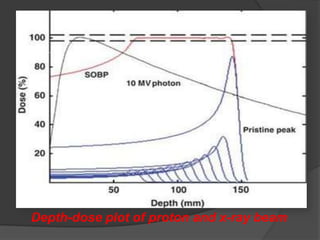
   The dose delivered to tissue is maximum just over the last
    few millimeters of the particle’s range; this maximum is
    called the Bragg peak.

   All protons of a given energy have a certain range, very few
    protons penetrate beyond that distance.
Depth-dose plot of proton and x-ray beam
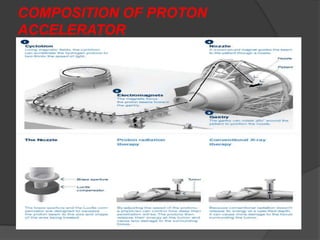
COMPOSITION OF PROTON
ACCELERATOR
Advantages
1.   Most precise form of radiation treatment available
     today.

2.   Is non-invasive and painless.

3.   Avoids the usual side effects of standard x-ray
     radiation.

4.   Highly preferred radiation treatment modality option for
     pediatric cases because children are susceptible to
     injury from standard x-ray radiation .
Side effects and risks

   Preliminary results from a 2009
    study, including high dose treatments, show
    very few or no side effects.
Applications
   Conditions Treated

     Prostate,
     Base of Skull,
     Brain and Spinal Cord,
     Eye,
     Head and Neck,
     Chest and Abdomen,
     Tumors in Children.
Comparison with other treatment
options
   X-ray radiotherapy

   X-ray radiation dose falls off gradually, while tissues
    deeper in the body than the tumor receive essentially no
    radiation during proton therapy.

   X-ray therapy causes damage to the tumor as well as the
    surrounding healthy tissues. .
   Surgery

   The benefit of external beam proton radiation lies in the
    dosimetric difference from external beam x-ray radiation
    and brachytherapy in cases, where the use of radiation
    therapy is already indicated, rather than as a direct
    competition with surgery.
THANKS
   FOR
ATTENTION
      M. Deyab
     CELL BIOLOGY

Proton therapy

  • 1.
    AN ADVANCED TECHNOLOGYIN TREATMENT OF CANCERS
  • 2.
    Introduction  Proton therapy is a form of particle therapy which uses a beam of protons to irradiate diseased tissue, most often in the treatment of cancer.  The chief advantage of proton therapy is the ability to more precisely localize the radiation dosage when compared with other types of external beam radiotherapy.
  • 3.
    Description  The accelerators used for proton therapy typically produce protons with energies in the range of 70 to 250 MeV .  Such protons cause DNA damage specifically to the cells of the selected area without affecting the nearby tissue.  The dose delivered to tissue is maximum just over the last few millimeters of the particle’s range; this maximum is called the Bragg peak.  All protons of a given energy have a certain range, very few protons penetrate beyond that distance.
  • 4.
    Depth-dose plot ofproton and x-ray beam
  • 5.
  • 6.
    Advantages 1. Most precise form of radiation treatment available today. 2. Is non-invasive and painless. 3. Avoids the usual side effects of standard x-ray radiation. 4. Highly preferred radiation treatment modality option for pediatric cases because children are susceptible to injury from standard x-ray radiation .
  • 7.
    Side effects andrisks  Preliminary results from a 2009 study, including high dose treatments, show very few or no side effects.
  • 8.
    Applications  Conditions Treated  Prostate,  Base of Skull,  Brain and Spinal Cord,  Eye,  Head and Neck,  Chest and Abdomen,  Tumors in Children.
  • 9.
    Comparison with othertreatment options  X-ray radiotherapy  X-ray radiation dose falls off gradually, while tissues deeper in the body than the tumor receive essentially no radiation during proton therapy.  X-ray therapy causes damage to the tumor as well as the surrounding healthy tissues. .
  • 10.
    Surgery  The benefit of external beam proton radiation lies in the dosimetric difference from external beam x-ray radiation and brachytherapy in cases, where the use of radiation therapy is already indicated, rather than as a direct competition with surgery.
  • 11.
    THANKS FOR ATTENTION M. Deyab CELL BIOLOGY