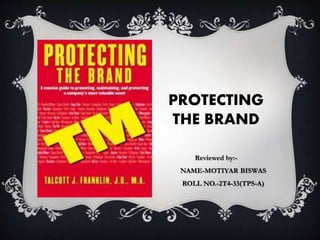
PROTECTING
THE BRAND
Reviewed by:-
NAME-MOTIYAR BISWAS
ROLL NO.-2T4-33(TPS-A)
ABOUT THE AUTHOR:-
MR. TALCOTT J. FRANKLIN is
formerly served as intellectual property
counsel for American Airlines, Inc.,
where he led the practice area responsible
for all of American’s intellectual assets.
He is one of a very few attorneys in
private practice to create from scratch a
comprehensive intellectual property
program at a fortune 100 company.
Based on his practical experience, Mr. Franklin counsels cilents
on creating strategic programs to harvest, manage and exploit
intellectual property assets, specifically tailored to each client’s
business goals and corporate structure.
TABLE OF CONTENTS:-
PART 1: The principles of brands
PART 2: Brand Use Rules.
PART 3: Tricks of the trade-The Practical side
of Brand Protection Programs.
PART-1 THE PRINCIPLES OF
BRANDS
1. A brand is a symbol that answers the question “where did this come
from?”
 A trademark is a word, name, symbol, phrase, logo, color, sound, smell, or
other marketing that lets consumers know who provides a particular
product.
2. A brand is a shortcut
 Trademarks serve as a shortcut: an easy way for consumers to associate a
service or product with quality, value, prestige, and other attributes.
3. Brands are worth their weight in gold
 An exclusive trademark associated with consistently superior
products will have incredible value.
“Brand value stems more from earning power than prestige.”
PART-2 BRAND USE RULES
GENERAL RULES OF USE
1. Use it or lose it
Rule: A trademark can be canceled for non-use.
Rationale: Because trademarks are a monopoly over a certain word,
phrase, or symbol, courts will not allow someone to hoard trademarks and
deprive the public of an otherwise useful term.
2. Don’t contribute the mark to the English language
Rule: Keep the mark out of the dictionary and the public domain. A mark
that becomes the common means of referring to a product, rather than a
source of the product, can no longer function as a trademark.
Rationale:-Courts will not give a trademark owner a monopoly over a
word that the public commonly uses to refer to a product. Otherwise,
no competitor could market the product without infringing the
trademark.
3. Don’t give the mark a split personality
Rule: Do not give the mark a definition. Use the mark as a
trademark alone, not as the name of the product.
Rationale: Marks should identify the source of a product, not the
product itself. By giving the mark a definition (other than as a trademark of
the company), the mark owner increases the likelihood that the mark will
come to identify the product itself rather than the product’s source.
7. Mind the ®s and ™s
Rule: Use the appropriate trademark designation. Trademark
owners may not claim that an unregistered mark is registered.
Rationale: Claiming registration status where none exists is a fraud
on the public. Courts have been unwilling to enforce trademark rights
where the owner misrepresented registration status by affixing the ® to
an unregistered mark.
RULES FOR USING THE BRAND IN TEXT
The following rules apply when using the mark in a sentence (in an
advertisement, for example) or as part of a larger textual presentation
(such as a business card or stationary), as opposed to using the mark by
itself.
1. Don’t let the mark stand alone
Rule: When using the mark in a sentence, always use the mark as an
adjective to modify a noun. Never use the mark as a noun or a verb.
Rationale: Trademarks identify the source of products; they do not
describe the products themselves. Once the public begins to refer to a
product by the trademark alone, the mark has become generic and cannot
receive trademark protection.
Examples:
WRONG: Nothing comes between me and my “Calvins.”
RIGHT: Nothing comes between me and my “Calvin Klein” jeans.
2. Make the mark stand out in the crowd
Rule: Distinguish the mark from the remaining text. Use some method
of alerting the reader that they are seeing a mark instead of an ordinary
word.
Rationale: If the trademark owner fails to alert the public that a word
has trademark significance, then the public has no way of knowing that the
word is a mark for the product instead of the product name.
3. Don’t let the mark lose its way home
Rule: When using a company domain name or address as a
mark, do not use the mark as a domain name or address. Do not
make directional information look like a mark, and do not make the
mark appear like directional information.
Rationale: Addresses and domain names generally cannot
function as trademarks because they identify where to find the
addressee, they do not identify a source of goods. Distinguishing
the use from other directional information will increase the
probability that the domain name will function as a trademark.
Examples:
WRONG: View our full line of products at ACME.COM®.
RIGHT: View our full line of products at www.acme.com.
PART 3 TRICKS OF THE TRADE:THE
PRACTICAL SIDE OF BRAND
PROTECTION PROGRAMS
A brand must convey your product’s values in a simple, easily
recognizable way.
For example, the “American Airlines” brand primarily stood for the
following principals:
1. Competence 2. safety 3. professionalism 4. travel 5. adventure
6. Freedom 7. reliability 8. reunion.
TIPS ON CREATING A BRAND:-
 Make a list of your product's core values.
 Develop a word, phrase, or other symbol that conveys these core values.
 Make sure that no one else is already using your brand.
TIPS ON MAINTAINING BRANDS:-
 Make affirmative decisions whether to keep or abandon a brand
 Keep records of brand use and significant events related to the brand.
 Attempt to sell, license, or affirmatively abandon brands you no longer
intend to use.
TIPS ON AVOIDING OVERBRANDING:-
 Do not apply the trademark or registration symbol to every word in
the corporate vocabulary.
 Make sure every brand also has a generic product name.
 Avoid placing the brand near the corporate address on stationary,
business cards, envelopes, signs, and advertisements.
TIPS ON CREATING BRAND STANDARDS:-
 Brand consistency reinforces the brand in consumer minds and
helps prevent brand abandonment.
 All employees should have access to the brand-standards manual.
(Employees should learn the brand's core values and how the brand
represents those values.)
 Conduct internal policing to ensure brand consistency.
TIPS ON CREATING AN EFFECTIVE LICENSING PROGRAM:-
 Understand the risks of licensing and address them up front with a
potential licensee.
(Allow the licensee to understand the brand core values, brand standards,
and marketing plan.)
 Implement a coordinated licensing strategy that supports the brand's
core values.
(Be able to articulate why a particular license supports the core
values. )
 Add value to the licensee beyond the brand itself.
(Assist the licensee by providing access to the company's internal
markets and promotional activities.)
W H Y YO U N E E D TO R E A D T H I S B O O K
This book is invaluable to anyone who wishes to understand the
intangible asset known as the trademark. Readers with a vested
interest in protecting their own company’s brand will find this
book to be worth its weigh in gold, as it is the key to protecting
any company’s most valuable asset.
Protecting the brand

Protecting the brand

  • 1.
  • 2.
    ABOUT THE AUTHOR:- MR.TALCOTT J. FRANKLIN is formerly served as intellectual property counsel for American Airlines, Inc., where he led the practice area responsible for all of American’s intellectual assets. He is one of a very few attorneys in private practice to create from scratch a comprehensive intellectual property program at a fortune 100 company.
  • 3.
    Based on hispractical experience, Mr. Franklin counsels cilents on creating strategic programs to harvest, manage and exploit intellectual property assets, specifically tailored to each client’s business goals and corporate structure.
  • 4.
    TABLE OF CONTENTS:- PART1: The principles of brands PART 2: Brand Use Rules. PART 3: Tricks of the trade-The Practical side of Brand Protection Programs.
  • 5.
    PART-1 THE PRINCIPLESOF BRANDS 1. A brand is a symbol that answers the question “where did this come from?”  A trademark is a word, name, symbol, phrase, logo, color, sound, smell, or other marketing that lets consumers know who provides a particular product. 2. A brand is a shortcut  Trademarks serve as a shortcut: an easy way for consumers to associate a service or product with quality, value, prestige, and other attributes.
  • 6.
    3. Brands areworth their weight in gold  An exclusive trademark associated with consistently superior products will have incredible value. “Brand value stems more from earning power than prestige.”
  • 7.
    PART-2 BRAND USERULES GENERAL RULES OF USE 1. Use it or lose it Rule: A trademark can be canceled for non-use. Rationale: Because trademarks are a monopoly over a certain word, phrase, or symbol, courts will not allow someone to hoard trademarks and deprive the public of an otherwise useful term. 2. Don’t contribute the mark to the English language Rule: Keep the mark out of the dictionary and the public domain. A mark that becomes the common means of referring to a product, rather than a source of the product, can no longer function as a trademark.
  • 8.
    Rationale:-Courts will notgive a trademark owner a monopoly over a word that the public commonly uses to refer to a product. Otherwise, no competitor could market the product without infringing the trademark. 3. Don’t give the mark a split personality Rule: Do not give the mark a definition. Use the mark as a trademark alone, not as the name of the product. Rationale: Marks should identify the source of a product, not the product itself. By giving the mark a definition (other than as a trademark of the company), the mark owner increases the likelihood that the mark will come to identify the product itself rather than the product’s source.
  • 9.
    7. Mind the®s and ™s Rule: Use the appropriate trademark designation. Trademark owners may not claim that an unregistered mark is registered. Rationale: Claiming registration status where none exists is a fraud on the public. Courts have been unwilling to enforce trademark rights where the owner misrepresented registration status by affixing the ® to an unregistered mark.
  • 10.
    RULES FOR USINGTHE BRAND IN TEXT The following rules apply when using the mark in a sentence (in an advertisement, for example) or as part of a larger textual presentation (such as a business card or stationary), as opposed to using the mark by itself. 1. Don’t let the mark stand alone Rule: When using the mark in a sentence, always use the mark as an adjective to modify a noun. Never use the mark as a noun or a verb. Rationale: Trademarks identify the source of products; they do not describe the products themselves. Once the public begins to refer to a product by the trademark alone, the mark has become generic and cannot receive trademark protection.
  • 11.
    Examples: WRONG: Nothing comesbetween me and my “Calvins.” RIGHT: Nothing comes between me and my “Calvin Klein” jeans. 2. Make the mark stand out in the crowd Rule: Distinguish the mark from the remaining text. Use some method of alerting the reader that they are seeing a mark instead of an ordinary word. Rationale: If the trademark owner fails to alert the public that a word has trademark significance, then the public has no way of knowing that the word is a mark for the product instead of the product name.
  • 12.
    3. Don’t letthe mark lose its way home Rule: When using a company domain name or address as a mark, do not use the mark as a domain name or address. Do not make directional information look like a mark, and do not make the mark appear like directional information. Rationale: Addresses and domain names generally cannot function as trademarks because they identify where to find the addressee, they do not identify a source of goods. Distinguishing the use from other directional information will increase the probability that the domain name will function as a trademark.
  • 13.
    Examples: WRONG: View ourfull line of products at ACME.COM®. RIGHT: View our full line of products at www.acme.com.
  • 14.
    PART 3 TRICKSOF THE TRADE:THE PRACTICAL SIDE OF BRAND PROTECTION PROGRAMS A brand must convey your product’s values in a simple, easily recognizable way. For example, the “American Airlines” brand primarily stood for the following principals: 1. Competence 2. safety 3. professionalism 4. travel 5. adventure 6. Freedom 7. reliability 8. reunion.
  • 15.
    TIPS ON CREATINGA BRAND:-  Make a list of your product's core values.  Develop a word, phrase, or other symbol that conveys these core values.  Make sure that no one else is already using your brand. TIPS ON MAINTAINING BRANDS:-  Make affirmative decisions whether to keep or abandon a brand  Keep records of brand use and significant events related to the brand.  Attempt to sell, license, or affirmatively abandon brands you no longer intend to use.
  • 16.
    TIPS ON AVOIDINGOVERBRANDING:-  Do not apply the trademark or registration symbol to every word in the corporate vocabulary.  Make sure every brand also has a generic product name.  Avoid placing the brand near the corporate address on stationary, business cards, envelopes, signs, and advertisements. TIPS ON CREATING BRAND STANDARDS:-  Brand consistency reinforces the brand in consumer minds and helps prevent brand abandonment.
  • 17.
     All employeesshould have access to the brand-standards manual. (Employees should learn the brand's core values and how the brand represents those values.)  Conduct internal policing to ensure brand consistency. TIPS ON CREATING AN EFFECTIVE LICENSING PROGRAM:-  Understand the risks of licensing and address them up front with a potential licensee. (Allow the licensee to understand the brand core values, brand standards, and marketing plan.)  Implement a coordinated licensing strategy that supports the brand's core values.
  • 18.
    (Be able toarticulate why a particular license supports the core values. )  Add value to the licensee beyond the brand itself. (Assist the licensee by providing access to the company's internal markets and promotional activities.)
  • 19.
    W H YYO U N E E D TO R E A D T H I S B O O K This book is invaluable to anyone who wishes to understand the intangible asset known as the trademark. Readers with a vested interest in protecting their own company’s brand will find this book to be worth its weigh in gold, as it is the key to protecting any company’s most valuable asset.