METABOLIC BIOCHEMISTRY
Fatty Acid Catabolism (-oxidation)
1 Dr.Suheir Ereqat
Fatty Acid Catabolism (-oxidation)
• Greatest fraction of fuel for most
organisms and organs
– Vertebrates
– Muscle (including heart), liver
• Fat sources for energy
– Ingested
– Taken from stores (Adipocytes)
– Synthesized in liver from carbohydrates
3 Dr.Suheir Ereqat
5
Digestion and Transport of Fats
Dr.Suheir Ereqat
Molecular structure of a chylomicron
80%
100 to 500 nm.
6 Dr.Suheir Ereqat
act as signals in the
uptake and metabolism of
chylomicron contents
Adipose
Tissue
Muscle
Tissue
Neutral
lipid
Liver
Glycerol
Hormones Trigger Mobilization of Stored Triacylglycerols
(
(Glucagon, Epinephrine
Dr.Suheir Ereqat
.
Entry of glycerol into the glycolytic pathway
10
Well fed state
Dr.Suheir Ereqat
About 95% of the
biologically available
energy of triacylglycerols
resides in their three long-
chain fatty acids;
only 5% is contributed by
the glycerol moiety
F 1,6 bis-p
gluconeogensis
aldolase
Fasted state
Dr.Suheir Ereqat
13 Activation
(
(Thiokinase
(Thioester)
Dr.Suheir Ereqat
14
Carnitine Shuttles
Transport
FA with14 or more carbons
The carnitine-mediated entry process is the rate limiting step for oxidation of fatty
acids in mitochondria
Dr.Suheir Ereqat
17
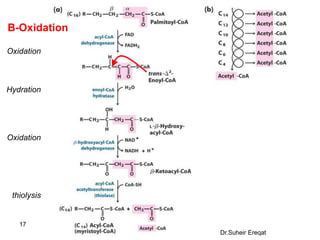
B-Oxidation
Oxidation
Hydration
Oxidation
thiolysis
Dr.Suheir Ereqat
18
Energy Yield
Dr.Suheir Ereqat
Dr.Suheir Ereqat
Oxidation of propionyl-Co A produced by oxidation of odd-number fatty acids.
31
TCA
Dr.Suheir Ereqat
In the liver, fatty acyl–CoA formed in the cytosol has two
major pathways:
(1) oxidation by enzymes in mitochondria
(2) conversion into triacylglycerols and phospholipids by
enzymes in the cytosol.
The pathway taken depends on the rate of transfer of long-
chain fatty acyl–CoA into mitochondria.
The three-step process (carnitine shuttle) by which fatty acyl
groups are carried from cytosolic fatty acyl–CoA into the
mitochondrial matrix is rate-limiting for fatty acid oxidation
and is an important point of regulation. Once fatty acyl groups
have entered the mitochondrion, they are committed to
oxidation to acetyl-CoA.
Dr.Suheir Ereqat
Two of the enzymes of oxidation are also regulated by metabolites that
signal energy sufficiency.
When the [NADH]/[NAD] ratio is high, acyl- CoA dehydrogenase is
inhibited
in addition, high concentrations of acetyl-CoA inhibit thiolase
Regulation of B-oxidation
[malonyl-CoA] ( the first intermediate in the cytosolic
biosynthesis of long-chain fatty acids from acetyl-CoA) inhibition of
CAT I to ensure that the oxidation of fatty acids is inhibited
whenever the liver is amply supplied with glucose as fuel and
is actively making triacylglycerols from excess glucose.
Dr.Suheir Ereqat
Regulation of B-oxidation
ACC: Acetyl coA carboxylase Dr.Suheir Ereqat
• Acetone
• Acetoacetate
• B- Hydroxybutyrate
Ketone Bodies
51
In liver
Dr.Suheir Ereqat
March 21
52
In periphery
TCA cycle
Dr.Suheir Ereqat
Ketone
bodies
formation
and
export
from
the
liver
Dr.Suheir Ereqat
In untreated diabetes, when the insulin level is insufficient, extrahepatic
tissues cannot take up glucose efficiently from the blood, either for fuel or
for conversion to fat.
fatty acids enter mitochondria to be degraded to acetyl-CoA—which
cannot pass through the citric acid cycle because cycle intermediates have
been drawn off for use as substrates in gluconeogenesis.
The resulting accumulation of acetyl-CoA accelerates the formation of
ketone bodies beyond the capacity of extrahepatic tissues to oxidize them.
The increased blood levels of acetoacetate and B-hydroxybutyrate
(ketosis) lower the blood pH, causing the condition known as acidosis.
acidosis can lead to coma and in some cases death.
Ketone Bodies Are Overproduced in Diabetes
and during Starvation
Dr.Suheir Ereqat
Dr.Suheir Ereqat

8-Fatty_Acid_oxidation_2021.pdf

  • 1.
    METABOLIC BIOCHEMISTRY Fatty AcidCatabolism (-oxidation) 1 Dr.Suheir Ereqat
  • 2.
    Fatty Acid Catabolism(-oxidation) • Greatest fraction of fuel for most organisms and organs – Vertebrates – Muscle (including heart), liver • Fat sources for energy – Ingested – Taken from stores (Adipocytes) – Synthesized in liver from carbohydrates 3 Dr.Suheir Ereqat
  • 3.
    5 Digestion and Transportof Fats Dr.Suheir Ereqat
  • 4.
    Molecular structure ofa chylomicron 80% 100 to 500 nm. 6 Dr.Suheir Ereqat act as signals in the uptake and metabolism of chylomicron contents
  • 5.
    Adipose Tissue Muscle Tissue Neutral lipid Liver Glycerol Hormones Trigger Mobilizationof Stored Triacylglycerols ( (Glucagon, Epinephrine Dr.Suheir Ereqat
  • 6.
    . Entry of glycerolinto the glycolytic pathway 10 Well fed state Dr.Suheir Ereqat About 95% of the biologically available energy of triacylglycerols resides in their three long- chain fatty acids; only 5% is contributed by the glycerol moiety
  • 7.
  • 8.
  • 9.
    14 Carnitine Shuttles Transport FA with14or more carbons The carnitine-mediated entry process is the rate limiting step for oxidation of fatty acids in mitochondria Dr.Suheir Ereqat
  • 10.
  • 11.
  • 12.
  • 13.
    Oxidation of propionyl-CoA produced by oxidation of odd-number fatty acids. 31 TCA Dr.Suheir Ereqat
  • 14.
    In the liver,fatty acyl–CoA formed in the cytosol has two major pathways: (1) oxidation by enzymes in mitochondria (2) conversion into triacylglycerols and phospholipids by enzymes in the cytosol. The pathway taken depends on the rate of transfer of long- chain fatty acyl–CoA into mitochondria. The three-step process (carnitine shuttle) by which fatty acyl groups are carried from cytosolic fatty acyl–CoA into the mitochondrial matrix is rate-limiting for fatty acid oxidation and is an important point of regulation. Once fatty acyl groups have entered the mitochondrion, they are committed to oxidation to acetyl-CoA. Dr.Suheir Ereqat
  • 15.
    Two of theenzymes of oxidation are also regulated by metabolites that signal energy sufficiency. When the [NADH]/[NAD] ratio is high, acyl- CoA dehydrogenase is inhibited in addition, high concentrations of acetyl-CoA inhibit thiolase Regulation of B-oxidation [malonyl-CoA] ( the first intermediate in the cytosolic biosynthesis of long-chain fatty acids from acetyl-CoA) inhibition of CAT I to ensure that the oxidation of fatty acids is inhibited whenever the liver is amply supplied with glucose as fuel and is actively making triacylglycerols from excess glucose. Dr.Suheir Ereqat
  • 16.
    Regulation of B-oxidation ACC:Acetyl coA carboxylase Dr.Suheir Ereqat
  • 17.
    • Acetone • Acetoacetate •B- Hydroxybutyrate Ketone Bodies 51 In liver Dr.Suheir Ereqat
  • 18.
    March 21 52 In periphery TCAcycle Dr.Suheir Ereqat
  • 19.
  • 20.
    In untreated diabetes,when the insulin level is insufficient, extrahepatic tissues cannot take up glucose efficiently from the blood, either for fuel or for conversion to fat. fatty acids enter mitochondria to be degraded to acetyl-CoA—which cannot pass through the citric acid cycle because cycle intermediates have been drawn off for use as substrates in gluconeogenesis. The resulting accumulation of acetyl-CoA accelerates the formation of ketone bodies beyond the capacity of extrahepatic tissues to oxidize them. The increased blood levels of acetoacetate and B-hydroxybutyrate (ketosis) lower the blood pH, causing the condition known as acidosis. acidosis can lead to coma and in some cases death. Ketone Bodies Are Overproduced in Diabetes and during Starvation Dr.Suheir Ereqat
  • 21.