Propulsion PDR 1 Team 1 September 21, 2006
Propulsion System Design Method Goal: Design a single propulsion system capable of performing the design mission (one prop, one gearbox, one battery system). Undesirable to require two propulsion systems to complete design mission Superior marketability of multi-functional aircraft Method: 1.)  Select P/D ratio for largest efficiency flexibility (P/D max =1.0 ~ MaxCim Motors)  2.)  Size propulsion system to meet dash requirements 2a.)  Maximum propeller diameter 10 in (minimize landing gear length) 2b.)  Select motor capable of providing necessary power to propeller 2c.)  Set gear ratio to ensure efficient motor operation  2d.)  Select batteries to supply the necessary voltage and current 3.)  Ensure that loiter requirement can be met with dash-optimized system 3a.)  500 ft radius circular flight path 3b.)  50 ft/s air speed 3c.)  7 minute requirement
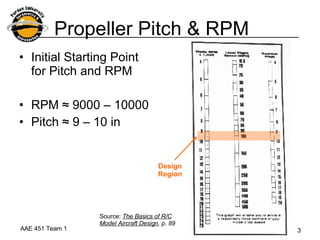
Propeller Pitch & RPM Initial Starting Point for Pitch and RPM RPM ≈ 9000 – 10000 Pitch ≈ 9 – 10 in Source:   The Basics of R/C Model Aircraft Design , p. 89 Design Region
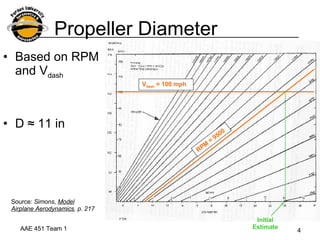
Propeller Diameter Based on RPM and V dash D ≈ 11 in Source:  Simons,  Model Airplane Aerodynamics , p. 217 V dash  = 100 mph RPM = 9500 Initial Estimate
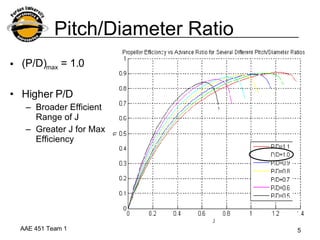
Pitch/Diameter Ratio (P/D) max  = 1.0 Higher P/D Broader Efficient Range of J Greater J for Max Efficiency
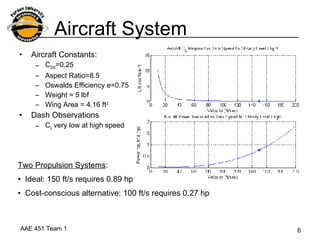
Aircraft System Aircraft Constants: C D0 =0.25  Aspect Ratio=8.5 Oswalds Efficiency e=0.75  Weight = 5 lbf Wing Area = 4.16 ft 2 Dash Observations C L  very low at high speed Two Propulsion Systems : Ideal: 150 ft/s requires 0.89 hp Cost-conscious alternative: 100 ft/s requires 0.27 hp
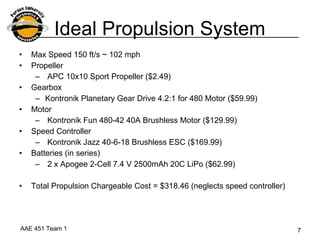
Ideal Propulsion System Max Speed 150 ft/s ~ 102 mph Propeller APC 10x10 Sport Propeller ($2.49) Gearbox Kontronik Planetary Gear Drive 4.2:1 for 480 Motor ($59.99)  Motor Kontronik Fun 480-42 40A Brushless Motor ($129.99)  Speed Controller Kontronik Jazz 40-6-18 Brushless ESC ($169.99) Batteries (in series) 2 x Apogee 2-Cell 7.4 V 2500mAh 20C LiPo ($62.99) Total Propulsion Chargeable Cost = $318.46 (neglects speed controller)
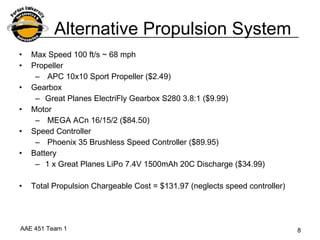
Alternative Propulsion System Max Speed 100 ft/s ~ 68 mph Propeller APC 10x10 Sport Propeller ($2.49) Gearbox Great Planes ElectriFly Gearbox S280 3.8:1 ($9.99) Motor MEGA ACn 16/15/2 ($84.50) Speed Controller Phoenix 35 Brushless Speed Controller ($89.95) Battery 1 x Great Planes LiPo 7.4V 1500mAh 20C Discharge ($34.99) Total Propulsion Chargeable Cost = $131.97 (neglects speed controller)
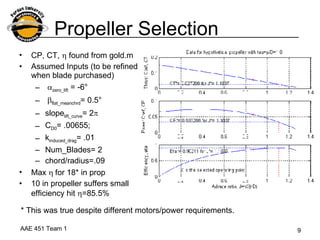
Propeller Selection CP, CT,    found from gold.m Assumed Inputs (to be refined when blade purchased)  zero_lift  = -6°  flat_meanchrd = 0.5°  slope lift_curve = 2  C D0 = .00655;  k induced_drag = .01  Num_Blades= 2 chord/radius=.09 Max   for 18* in prop  10 in propeller suffers small efficiency hit   =85.5% * This was true despite different motors/power requirements.
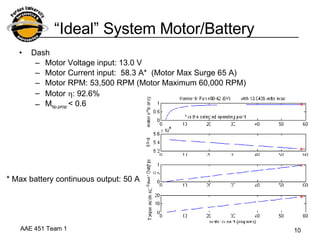
“ Ideal” System Motor/Battery Dash Motor Voltage input: 13.0 V  Motor Current input:  58.3 A*  (Motor Max Surge 65 A) Motor RPM: 53,500 RPM (Motor Maximum 60,000 RPM) Motor   : 92.6% M tip,prop  < 0.6 * Max battery continuous output: 50 A
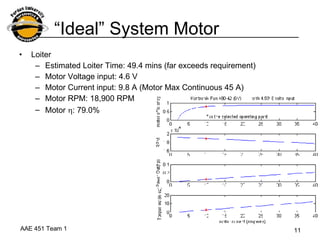
“ Ideal” System Motor Loiter Estimated Loiter Time: 49.4 mins (far exceeds requirement) Motor Voltage input: 4.6 V  Motor Current input: 9.8 A (Motor Max Continuous 45 A) Motor RPM: 18,900 RPM  Motor   : 79.0%
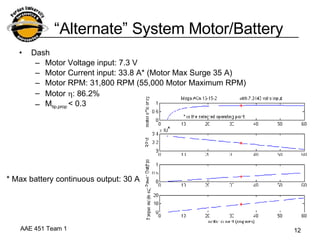
“ Alternate” System Motor/Battery Dash Motor Voltage input: 7.3 V Motor Current input: 33.8 A* (Motor Max Surge 35 A) Motor RPM: 31,800 RPM (55,000 Motor Maximum RPM) Motor   : 86.2% M tip,prop  < 0.3 * Max battery continuous output: 30 A
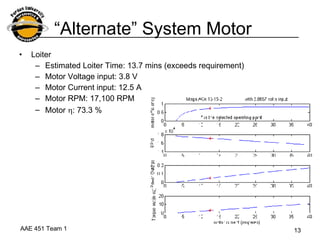
“ Alternate” System Motor Loiter Estimated Loiter Time: 13.7 mins (exceeds requirement) Motor Voltage input: 3.8 V  Motor Current input: 12.5 A Motor RPM: 17,100 RPM  Motor   : 73.3 %
Summary No need for multiple propulsion systems Battery required for dash exceeds loiter requirements Tradeoff between cost and desired performance

Propulsion Pdr

  • 1.
    Propulsion PDR 1Team 1 September 21, 2006
  • 2.
    Propulsion System DesignMethod Goal: Design a single propulsion system capable of performing the design mission (one prop, one gearbox, one battery system). Undesirable to require two propulsion systems to complete design mission Superior marketability of multi-functional aircraft Method: 1.) Select P/D ratio for largest efficiency flexibility (P/D max =1.0 ~ MaxCim Motors) 2.) Size propulsion system to meet dash requirements 2a.) Maximum propeller diameter 10 in (minimize landing gear length) 2b.) Select motor capable of providing necessary power to propeller 2c.) Set gear ratio to ensure efficient motor operation 2d.) Select batteries to supply the necessary voltage and current 3.) Ensure that loiter requirement can be met with dash-optimized system 3a.) 500 ft radius circular flight path 3b.) 50 ft/s air speed 3c.) 7 minute requirement
  • 3.
    Propeller Pitch &RPM Initial Starting Point for Pitch and RPM RPM ≈ 9000 – 10000 Pitch ≈ 9 – 10 in Source: The Basics of R/C Model Aircraft Design , p. 89 Design Region
  • 4.
    Propeller Diameter Basedon RPM and V dash D ≈ 11 in Source: Simons, Model Airplane Aerodynamics , p. 217 V dash = 100 mph RPM = 9500 Initial Estimate
  • 5.
    Pitch/Diameter Ratio (P/D)max = 1.0 Higher P/D Broader Efficient Range of J Greater J for Max Efficiency
  • 6.
    Aircraft System AircraftConstants: C D0 =0.25 Aspect Ratio=8.5 Oswalds Efficiency e=0.75 Weight = 5 lbf Wing Area = 4.16 ft 2 Dash Observations C L very low at high speed Two Propulsion Systems : Ideal: 150 ft/s requires 0.89 hp Cost-conscious alternative: 100 ft/s requires 0.27 hp
  • 7.
    Ideal Propulsion SystemMax Speed 150 ft/s ~ 102 mph Propeller APC 10x10 Sport Propeller ($2.49) Gearbox Kontronik Planetary Gear Drive 4.2:1 for 480 Motor ($59.99) Motor Kontronik Fun 480-42 40A Brushless Motor ($129.99) Speed Controller Kontronik Jazz 40-6-18 Brushless ESC ($169.99) Batteries (in series) 2 x Apogee 2-Cell 7.4 V 2500mAh 20C LiPo ($62.99) Total Propulsion Chargeable Cost = $318.46 (neglects speed controller)
  • 8.
    Alternative Propulsion SystemMax Speed 100 ft/s ~ 68 mph Propeller APC 10x10 Sport Propeller ($2.49) Gearbox Great Planes ElectriFly Gearbox S280 3.8:1 ($9.99) Motor MEGA ACn 16/15/2 ($84.50) Speed Controller Phoenix 35 Brushless Speed Controller ($89.95) Battery 1 x Great Planes LiPo 7.4V 1500mAh 20C Discharge ($34.99) Total Propulsion Chargeable Cost = $131.97 (neglects speed controller)
  • 9.
    Propeller Selection CP,CT,  found from gold.m Assumed Inputs (to be refined when blade purchased)  zero_lift = -6°  flat_meanchrd = 0.5° slope lift_curve = 2  C D0 = .00655; k induced_drag = .01 Num_Blades= 2 chord/radius=.09 Max  for 18* in prop 10 in propeller suffers small efficiency hit  =85.5% * This was true despite different motors/power requirements.
  • 10.
    “ Ideal” SystemMotor/Battery Dash Motor Voltage input: 13.0 V Motor Current input: 58.3 A* (Motor Max Surge 65 A) Motor RPM: 53,500 RPM (Motor Maximum 60,000 RPM) Motor  : 92.6% M tip,prop < 0.6 * Max battery continuous output: 50 A
  • 11.
    “ Ideal” SystemMotor Loiter Estimated Loiter Time: 49.4 mins (far exceeds requirement) Motor Voltage input: 4.6 V Motor Current input: 9.8 A (Motor Max Continuous 45 A) Motor RPM: 18,900 RPM Motor  : 79.0%
  • 12.
    “ Alternate” SystemMotor/Battery Dash Motor Voltage input: 7.3 V Motor Current input: 33.8 A* (Motor Max Surge 35 A) Motor RPM: 31,800 RPM (55,000 Motor Maximum RPM) Motor  : 86.2% M tip,prop < 0.3 * Max battery continuous output: 30 A
  • 13.
    “ Alternate” SystemMotor Loiter Estimated Loiter Time: 13.7 mins (exceeds requirement) Motor Voltage input: 3.8 V Motor Current input: 12.5 A Motor RPM: 17,100 RPM Motor  : 73.3 %
  • 14.
    Summary No needfor multiple propulsion systems Battery required for dash exceeds loiter requirements Tradeoff between cost and desired performance