VLADIMIR
PROPP’S MEDIA
THEORYEllie Moore
Vladimir Propp
■ Vladimir Propp was a Soviet Folklorist and scholar who analysed the plot
components of Russian FolkTales and their simplest narrative elements.
■ Propp broke fairytales into sections, through these sections he was able to
define the tale into a series of sequences that occurred within the Russian
fairytale.
■ He also concluded that all the characters could be resolved into 7
broad character functions:
– The Hero
– TheVillain
– The Donor
– The Helper
– The Prince/Princess
– The King
– The Dispatcher
– The False Hero
The Hero
■ The Hero is the central character in the text, their quest is to
restore the equilibrium, resolve any wrongs and wed/save
the Prince or Princess.
■ There are two different types of Hero:
– TheVictim Hero – the center of the villain’s attention
– The Seeker Hero - aids the villain’s victims
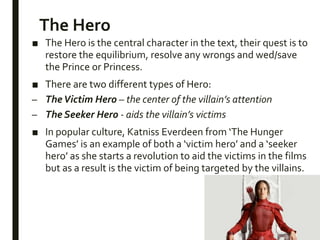
■ In popular culture, Katniss Everdeen from ‘The Hunger
Games’ is an example of both a ‘victim hero’ and a ‘seeker
hero’ as she starts a revolution to aid the victims in the films
but as a result is the victim of being targeted by the villains.
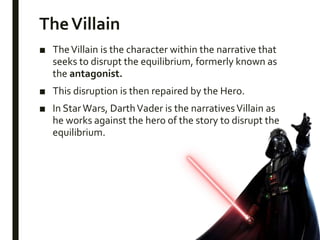
TheVillain
■ TheVillain is the character within the narrative that
seeks to disrupt the equilibrium, formerly known as
the antagonist.
■ This disruption is then repaired by the Hero.
■ In StarWars, DarthVader is the narrativesVillain as
he works against the hero of the story to disrupt the
equilibrium.
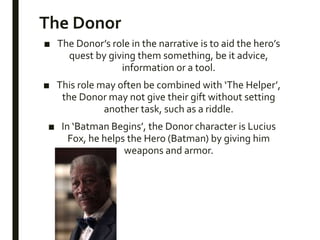
The Donor
■ The Donor’s role in the narrative is to aid the hero’s
quest by giving them something, be it advice,
information or a tool.
■ This role may often be combined with ‘The Helper’,
the Donor may not give their gift without setting
another task, such as a riddle.
■ In ‘Batman Begins’, the Donor character is Lucius
Fox, he helps the Hero (Batman) by giving him
weapons and armor.
The Helper
■ The Helper aids the victim on their quest to restore
equilibrium.
■ They are often presented as a sidekick and add a
comedic or romantic element to the narrative.
■ The limitations of the Helper often help to highlight
the hero’s defining characteristics such as their
intelligence, determination or courage.
■ In Shrek, Donkey is the narrative’s Helper as he aids
the Hero (Shrek) on his quest while also adding
comedy to the story.
The Princess/Prince
■ This is the individual within the narrative that needs
help, protecting or saving.
■ Typically female, they are the main victim of the
Villain, this creates the stereotypical ‘damsel in
distress’ seen in many narratives.
■ Occasionally, the Princess can fall for the False Hero
before being won over by the true hero of the
narrative.
■ In ‘The Princess Diaries’, Mia (The Princess) falls for
the False Hero (Josh) before being won over by
Michael.
The King
■ According to Propp, ’The King’ (or the Princess’
father) in the narrative rewards the hero, he is the
authority figure.
■ The King is often the character who issues the task
to the Hero, and also identifies the False Hero.
■ Propp noted that the Princess and the Father can
often not be clearly distinguished and therefore the
King may be a difficult character to identify in
modern storytelling.
The Dispatcher
■ The Dispatcher’s role is to sendThe Hero on their
quest to restore equilibrium.
■ The Dispatcher may be combined with another role,
such as that ofThe False Hero who follows the Hero
on their quest, disguised as a helper.
■ They may also be a family member, such as the
Princess’ father.
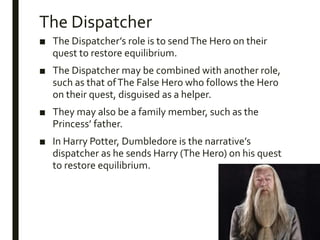
■ In Harry Potter, Dumbledore is the narrative’s
dispatcher as he sends Harry (The Hero) on his quest
to restore equilibrium.
The False Hero
■ The False Hero is the character that undermines the
Hero’s quest by pretending to aid them along the
way and subsequently betraying them.
■ As they are presented heroically throughout the
movie, they are often mistaken for the true hero.
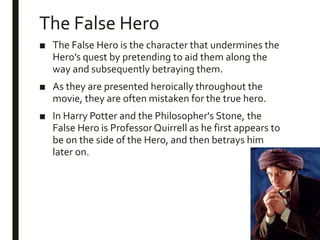
■ In Harry Potter and the Philosopher's Stone, the
False Hero is Professor Quirrell as he first appears to
be on the side of the Hero, and then betrays him
later on.

Propp's theory

  • 1.
  • 2.
    Vladimir Propp ■ VladimirPropp was a Soviet Folklorist and scholar who analysed the plot components of Russian FolkTales and their simplest narrative elements. ■ Propp broke fairytales into sections, through these sections he was able to define the tale into a series of sequences that occurred within the Russian fairytale. ■ He also concluded that all the characters could be resolved into 7 broad character functions: – The Hero – TheVillain – The Donor – The Helper – The Prince/Princess – The King – The Dispatcher – The False Hero
  • 3.
    The Hero ■ TheHero is the central character in the text, their quest is to restore the equilibrium, resolve any wrongs and wed/save the Prince or Princess. ■ There are two different types of Hero: – TheVictim Hero – the center of the villain’s attention – The Seeker Hero - aids the villain’s victims ■ In popular culture, Katniss Everdeen from ‘The Hunger Games’ is an example of both a ‘victim hero’ and a ‘seeker hero’ as she starts a revolution to aid the victims in the films but as a result is the victim of being targeted by the villains.
  • 4.
    TheVillain ■ TheVillain isthe character within the narrative that seeks to disrupt the equilibrium, formerly known as the antagonist. ■ This disruption is then repaired by the Hero. ■ In StarWars, DarthVader is the narrativesVillain as he works against the hero of the story to disrupt the equilibrium.
  • 5.
    The Donor ■ TheDonor’s role in the narrative is to aid the hero’s quest by giving them something, be it advice, information or a tool. ■ This role may often be combined with ‘The Helper’, the Donor may not give their gift without setting another task, such as a riddle. ■ In ‘Batman Begins’, the Donor character is Lucius Fox, he helps the Hero (Batman) by giving him weapons and armor.
  • 6.
    The Helper ■ TheHelper aids the victim on their quest to restore equilibrium. ■ They are often presented as a sidekick and add a comedic or romantic element to the narrative. ■ The limitations of the Helper often help to highlight the hero’s defining characteristics such as their intelligence, determination or courage. ■ In Shrek, Donkey is the narrative’s Helper as he aids the Hero (Shrek) on his quest while also adding comedy to the story.
  • 7.
    The Princess/Prince ■ Thisis the individual within the narrative that needs help, protecting or saving. ■ Typically female, they are the main victim of the Villain, this creates the stereotypical ‘damsel in distress’ seen in many narratives. ■ Occasionally, the Princess can fall for the False Hero before being won over by the true hero of the narrative. ■ In ‘The Princess Diaries’, Mia (The Princess) falls for the False Hero (Josh) before being won over by Michael.
  • 8.
    The King ■ Accordingto Propp, ’The King’ (or the Princess’ father) in the narrative rewards the hero, he is the authority figure. ■ The King is often the character who issues the task to the Hero, and also identifies the False Hero. ■ Propp noted that the Princess and the Father can often not be clearly distinguished and therefore the King may be a difficult character to identify in modern storytelling.
  • 9.
    The Dispatcher ■ TheDispatcher’s role is to sendThe Hero on their quest to restore equilibrium. ■ The Dispatcher may be combined with another role, such as that ofThe False Hero who follows the Hero on their quest, disguised as a helper. ■ They may also be a family member, such as the Princess’ father. ■ In Harry Potter, Dumbledore is the narrative’s dispatcher as he sends Harry (The Hero) on his quest to restore equilibrium.
  • 10.
    The False Hero ■The False Hero is the character that undermines the Hero’s quest by pretending to aid them along the way and subsequently betraying them. ■ As they are presented heroically throughout the movie, they are often mistaken for the true hero. ■ In Harry Potter and the Philosopher's Stone, the False Hero is Professor Quirrell as he first appears to be on the side of the Hero, and then betrays him later on.