XP
1
B.Sc. CSIT PROJECT PROPOSAL WRITING
Presented By:
Er.Ganesh Ram Suwal
BE Comp | ME Computer Engineering
Web Developer | Lecturer
Email: suwalganesh@gmail.com
8th JUNE 2021
XP
2
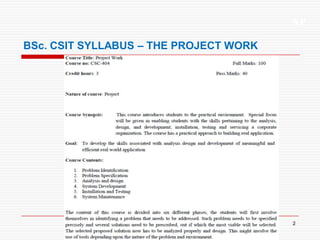
BSc. CSIT SYLLABUS – THE PROJECT WORK
XP
3
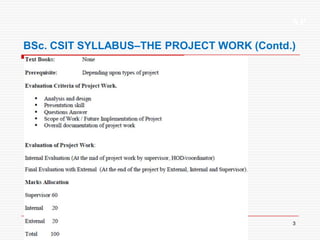
BSc. CSIT SYLLABUS–THE PROJECT WORK (Contd.)
XP
4
PROJECT
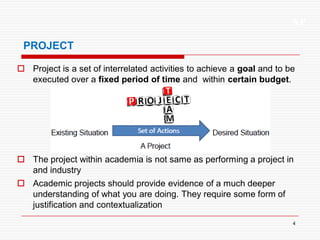
 Project is a set of interrelated activities to achieve a goal and to be
executed over a fixed period of time and within certain budget.
 The project within academia is not same as performing a project in
and industry
 Academic projects should provide evidence of a much deeper
understanding of what you are doing. They require some form of
justification and contextualization
XP
5
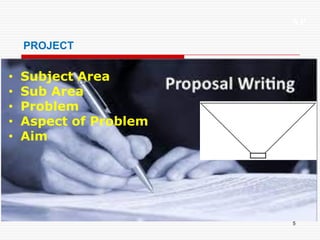
PROJECT
• Subject Area
• Sub Area
• Problem
• Aspect of Problem
• Aim
XP
6
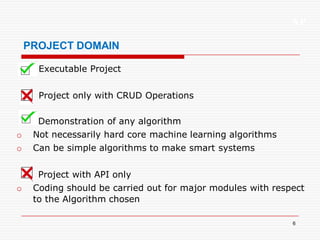
PROJECT DOMAIN
Executable Project
Project only with CRUD Operations
Demonstration of any algorithm
o Not necessarily hard core machine learning algorithms
o Can be simple algorithms to make smart systems
Project with API only
o Coding should be carried out for major modules with respect
to the Algorithm chosen
XP
7
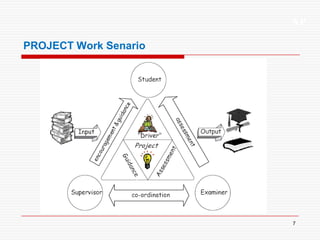
PROJECT Work Senario
XP
8
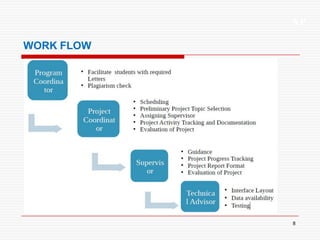
WORK FLOW
XP
9
PROPOSAL
 Proposal is a document or something what type of project
you are going to do
1. the act of offering or suggesting something for acceptance,
adoption, or performance.
2. The act of proposing.
3. A plan that is proposed.
XP
10
PROPOSAL WRITING
XP
11
PROPOSAL WRITING
XP
12
PROPOSAL FORMAT
 Title
 Overview/Introduction
 Statement of Problem
 Objective
 Literature Review (can also consist related works)
 Methodology
 Expected Result (Interface design- If possible)
 References
XP
13
TITLE
 Do not use Nepali Words like
1. Saman Kinnne
2. Kotha Bhetyo
 If you use Nepali words, elaborate it
1. Kotha Bhetyo : A web based application for searching
2. rooms for rent
 Title should not be very lengthy like
1. A prediction system which predicts the final marks of
students of abc by implementing machine learning algorithm
like Neural Network
 Title should be short but descriptive like
1. Marks Prediction System using Neural Network
XP
14
STATEMENT OF PROBLEM
 Highlight on the major issues which needs to be addressed
One paragraph is sufficient as
Prediction of Marks has always been a challenging task for abc.
They have been using software like abc, xyz; which are not
accurate as the predicted value deviates by 45%. This has
proven to one of the major hindrance in formulating its academic
plan.
XP
15
OBJECTIVES
 It should directly address the statement of problem
 Make it specific as possible and begin with word “To”
 Do not include unnecessary objectives like
o To fulfill the course requirement of B.Sc. CSIT
o To learn Neural Network
o To learn Web Programming
o To learn Python
 The objective can be framed as
o To develop marks prediction system using Neural
Network
o To decrease the deviation rate of the predictor than the
exiting one.
XP
16
LITERATURE REVIEW
 Find Recent Papers which consists of
o Title
o Writer / writers
o Published at Journals/ Conference
o Published Date
 Don't include following
o blog materials
o Wikipedia
o Videos
o websites
XP
17
WHY LITERATURE REVIEW ?
 To frame your methodology
 To justify your methodology
You should be able to answer
o Why did you chose certain techniques for data analysis
out of many ?
o Why did you chose the particular algorithm out of many ?
o Why did you chose the particular validation technique out
of many?
XP
18
HOW TO REVIEW LITERATURE?
 Read Abstract and conclusion
o If it is related to your objective then start exploring its
methodology
o Choose the best methodology out of the reviewed literatures
which can be sorted out from its findings
XP
19
THINGS TO BE INCLUDED IN METHODOLOGY
 Data Collection and selection of parameters
o From Where and how ? ( it can be secondary as well)
 Major Algorithms to be used
o Why did you chose it have to answered?
 Review/ Validation Techniques
o Why did you chose it have to answered?
 Note: Every answer should be justified with reference to the
papers you have reviewed.
XP
20
METHODOLOGY
 Data Collection
o Data Will be collected from xyz (Source)
o The repository includes details of students from 2012
 Selection of Parameters
o Mid Term Marks
o Pre-board Marks
o Assignment percentage
o Attendance
 (The above parameters have been proven successful in [5])
XP
21
METHODOLOGY (Contd.)
 Prediction Algorithm
o Back Propagation Algorithm will be used to model the
prediction system.
o (The Algorithm had an efficiency of 85 % in [3])
o List the algorithm
XP
22
METHODOLOGY (Contd.)
 Validation Technique
o Precision and Recall will be used to validate the prediction
model (The technique proved to be beneficial in [4],[6])
o List the necessary Formulas
XP
23
REFERENCES
References and Bibliography
 References list only those articles that have been referred to
within the report itself.
 A bibliography will list all the articles you have used in your
project but are not necessarily referred to in the body of the
report. Bibliographies are useful for the reader in that they
identify all material that is relevant for taking your work
forward or understanding it in more depth.
 Referencing: There are two aspects to referencing. The first
aspect to consider is how to use references correctly within the
body of your report – in terms of their presentation and
appropriateness – called citing/citation. The second aspect is
how to present these references correctly at the end of your
report.
XP
24
Writing and Structuring the Report: References
Citing References and Bibliography
 There are numerous variations on these techniques that
have their own structures.
 We are prescribed to follow IEEE format for project
report.
 APA is prescribed for internship report.
XP
25
REFERENCES
 References should be written in IEEE / APA format
1.
2.
3.
4.
5.
[1] K. Conley and D. Perry, “How does he saw me? a
recommendation engine for picking heroes in Dota2,” CS229
Previous Projects, 2013.
[2] A. Agrawal and M. Pierce “Learning Dota2 team
compositions”, 2014.
XP
26
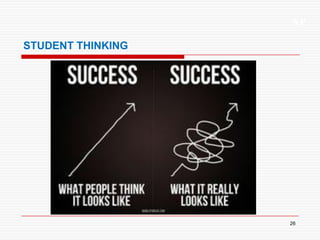
STUDENT THINKING
XP
27
Writing and Structuring the Proposal: Styling / Format
 The entire document should be in Times New Roman
font.
 The font size has to be 12 throughout in paragraphs.
 Font size for the headings will be 16,14,12 (As per the
levels)
 Figure captions should be centered below the figures.
 Table captions should be centered above
 Paragraphs must be justified alignment with 1.5
spacing
 The margins to be set as follows:
 Top = 1"
 Bottom = 1"
 Left = 1.25 "
 Right = 1"
XP
28
Writing and Structuring the Proposal: Styling / Format
 Figure/Table numbering: e.g. Figure 4.1: Figure Name for
first figure in chapter 4 and so on. Likewise Table Numbering
Headings:
5.1 Tools Used
5.1.1 Front End Tools
•JavaScript …..
5.1.2 Back End Tools
•MySQL ……
 Use page numbering 1, 2, 3…. in Body part and onward.
XP
29
Writing and Structuring the Proposal:
Avoid Plagiarism
 Plagiarism can be performed accidentally or deliberately, but
in either case it is deemed a serious academic offence.
 This is one reason why students should perform an extensive
literature survey – to ensure that they are not merely
repeating the work of others.
 Have proper citation and referencing.
Supervisors need to stay alert!
Let’s initiate for a common repository!
XP
30
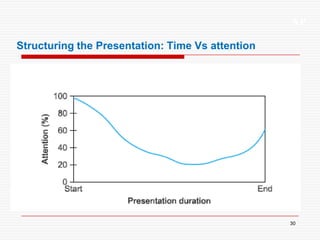
Structuring the Presentation: Time Vs attention
XP
31
Structuring the Presentation: Slides
 Proper content
 Proper formatting of slides: design, font, font size,
text color, etc.
XP
32
Structuring the Presentation: Effective Speaking
 Communicate Well: Standard language
 Dress Well: Be formal
 Voice Projection: Voice level and Clarity
 Eye Contact: Eye contact with entire audience
 Animated: Be animated and enthusiastic
 Coordination: Between the team members
 Starting / Closing statement: Introduction/ Thank you /
Queries
XP
33
Project Evaluation
 Marks distribution in percentage (out of 100):
 Proposal 10%.
 Mid Term Defense 30%
 Final Defense 60%
 Evaluators:
 Project Supervisor 60%
 Internal ( HOD/Program Coordinator/Faculty) 20%
 External 20%
A fair evaluation should be done by internal, supervisor and
external. Marks should be justifiable
XP
34
Project Evaluation
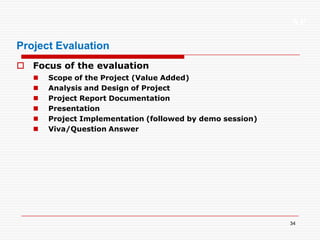
 Focus of the evaluation
 Scope of the Project (Value Added)
 Analysis and Design of Project
 Project Report Documentation
 Presentation
 Project Implementation (followed by demo session)
 Viva/Question Answer
XP
35
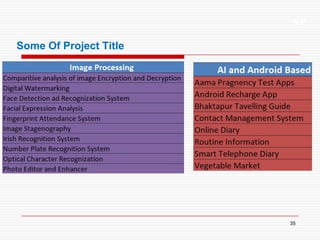
Some Of Project Title
XP
36
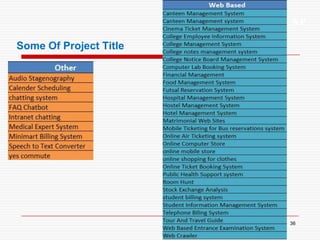
Some Of Project Title
XP
37
Suggested Reading
 Christian W. Dawson, “Projects in Computing and Information
Systems: A Student’s Guide”, 2nd Edition, Addison Wesley.
 Hossein Hassani, “How to do Final Year Projects: A Practical Guideline
for Computer Science and IT Students”.
 Mikael Berndtsson, Jörgen Hansson, Björn Olsson, Björn Lundell “Thesis
Projects: A Guide for Students in Computer Science and Information
Systems”, 2nd Edition, Springer.
XP
38
You hear and you forget,
You see and you remember,
You do and you understand
Thank You
for your attention and Patience

Proposal Writing

  • 1.
    XP 1 B.Sc. CSIT PROJECTPROPOSAL WRITING Presented By: Er.Ganesh Ram Suwal BE Comp | ME Computer Engineering Web Developer | Lecturer Email: suwalganesh@gmail.com 8th JUNE 2021
  • 2.
    XP 2 BSc. CSIT SYLLABUS– THE PROJECT WORK
  • 3.
    XP 3 BSc. CSIT SYLLABUS–THEPROJECT WORK (Contd.)
  • 4.
    XP 4 PROJECT  Project isa set of interrelated activities to achieve a goal and to be executed over a fixed period of time and within certain budget.  The project within academia is not same as performing a project in and industry  Academic projects should provide evidence of a much deeper understanding of what you are doing. They require some form of justification and contextualization
  • 5.
    XP 5 PROJECT • Subject Area •Sub Area • Problem • Aspect of Problem • Aim
  • 6.
    XP 6 PROJECT DOMAIN Executable Project Projectonly with CRUD Operations Demonstration of any algorithm o Not necessarily hard core machine learning algorithms o Can be simple algorithms to make smart systems Project with API only o Coding should be carried out for major modules with respect to the Algorithm chosen
  • 7.
  • 8.
  • 9.
    XP 9 PROPOSAL  Proposal isa document or something what type of project you are going to do 1. the act of offering or suggesting something for acceptance, adoption, or performance. 2. The act of proposing. 3. A plan that is proposed.
  • 10.
  • 11.
  • 12.
    XP 12 PROPOSAL FORMAT  Title Overview/Introduction  Statement of Problem  Objective  Literature Review (can also consist related works)  Methodology  Expected Result (Interface design- If possible)  References
  • 13.
    XP 13 TITLE  Do notuse Nepali Words like 1. Saman Kinnne 2. Kotha Bhetyo  If you use Nepali words, elaborate it 1. Kotha Bhetyo : A web based application for searching 2. rooms for rent  Title should not be very lengthy like 1. A prediction system which predicts the final marks of students of abc by implementing machine learning algorithm like Neural Network  Title should be short but descriptive like 1. Marks Prediction System using Neural Network
  • 14.
    XP 14 STATEMENT OF PROBLEM Highlight on the major issues which needs to be addressed One paragraph is sufficient as Prediction of Marks has always been a challenging task for abc. They have been using software like abc, xyz; which are not accurate as the predicted value deviates by 45%. This has proven to one of the major hindrance in formulating its academic plan.
  • 15.
    XP 15 OBJECTIVES  It shoulddirectly address the statement of problem  Make it specific as possible and begin with word “To”  Do not include unnecessary objectives like o To fulfill the course requirement of B.Sc. CSIT o To learn Neural Network o To learn Web Programming o To learn Python  The objective can be framed as o To develop marks prediction system using Neural Network o To decrease the deviation rate of the predictor than the exiting one.
  • 16.
    XP 16 LITERATURE REVIEW  FindRecent Papers which consists of o Title o Writer / writers o Published at Journals/ Conference o Published Date  Don't include following o blog materials o Wikipedia o Videos o websites
  • 17.
    XP 17 WHY LITERATURE REVIEW?  To frame your methodology  To justify your methodology You should be able to answer o Why did you chose certain techniques for data analysis out of many ? o Why did you chose the particular algorithm out of many ? o Why did you chose the particular validation technique out of many?
  • 18.
    XP 18 HOW TO REVIEWLITERATURE?  Read Abstract and conclusion o If it is related to your objective then start exploring its methodology o Choose the best methodology out of the reviewed literatures which can be sorted out from its findings
  • 19.
    XP 19 THINGS TO BEINCLUDED IN METHODOLOGY  Data Collection and selection of parameters o From Where and how ? ( it can be secondary as well)  Major Algorithms to be used o Why did you chose it have to answered?  Review/ Validation Techniques o Why did you chose it have to answered?  Note: Every answer should be justified with reference to the papers you have reviewed.
  • 20.
    XP 20 METHODOLOGY  Data Collection oData Will be collected from xyz (Source) o The repository includes details of students from 2012  Selection of Parameters o Mid Term Marks o Pre-board Marks o Assignment percentage o Attendance  (The above parameters have been proven successful in [5])
  • 21.
    XP 21 METHODOLOGY (Contd.)  PredictionAlgorithm o Back Propagation Algorithm will be used to model the prediction system. o (The Algorithm had an efficiency of 85 % in [3]) o List the algorithm
  • 22.
    XP 22 METHODOLOGY (Contd.)  ValidationTechnique o Precision and Recall will be used to validate the prediction model (The technique proved to be beneficial in [4],[6]) o List the necessary Formulas
  • 23.
    XP 23 REFERENCES References and Bibliography References list only those articles that have been referred to within the report itself.  A bibliography will list all the articles you have used in your project but are not necessarily referred to in the body of the report. Bibliographies are useful for the reader in that they identify all material that is relevant for taking your work forward or understanding it in more depth.  Referencing: There are two aspects to referencing. The first aspect to consider is how to use references correctly within the body of your report – in terms of their presentation and appropriateness – called citing/citation. The second aspect is how to present these references correctly at the end of your report.
  • 24.
    XP 24 Writing and Structuringthe Report: References Citing References and Bibliography  There are numerous variations on these techniques that have their own structures.  We are prescribed to follow IEEE format for project report.  APA is prescribed for internship report.
  • 25.
    XP 25 REFERENCES  References shouldbe written in IEEE / APA format 1. 2. 3. 4. 5. [1] K. Conley and D. Perry, “How does he saw me? a recommendation engine for picking heroes in Dota2,” CS229 Previous Projects, 2013. [2] A. Agrawal and M. Pierce “Learning Dota2 team compositions”, 2014.
  • 26.
  • 27.
    XP 27 Writing and Structuringthe Proposal: Styling / Format  The entire document should be in Times New Roman font.  The font size has to be 12 throughout in paragraphs.  Font size for the headings will be 16,14,12 (As per the levels)  Figure captions should be centered below the figures.  Table captions should be centered above  Paragraphs must be justified alignment with 1.5 spacing  The margins to be set as follows:  Top = 1"  Bottom = 1"  Left = 1.25 "  Right = 1"
  • 28.
    XP 28 Writing and Structuringthe Proposal: Styling / Format  Figure/Table numbering: e.g. Figure 4.1: Figure Name for first figure in chapter 4 and so on. Likewise Table Numbering Headings: 5.1 Tools Used 5.1.1 Front End Tools •JavaScript ….. 5.1.2 Back End Tools •MySQL ……  Use page numbering 1, 2, 3…. in Body part and onward.
  • 29.
    XP 29 Writing and Structuringthe Proposal: Avoid Plagiarism  Plagiarism can be performed accidentally or deliberately, but in either case it is deemed a serious academic offence.  This is one reason why students should perform an extensive literature survey – to ensure that they are not merely repeating the work of others.  Have proper citation and referencing. Supervisors need to stay alert! Let’s initiate for a common repository!
  • 30.
  • 31.
    XP 31 Structuring the Presentation:Slides  Proper content  Proper formatting of slides: design, font, font size, text color, etc.
  • 32.
    XP 32 Structuring the Presentation:Effective Speaking  Communicate Well: Standard language  Dress Well: Be formal  Voice Projection: Voice level and Clarity  Eye Contact: Eye contact with entire audience  Animated: Be animated and enthusiastic  Coordination: Between the team members  Starting / Closing statement: Introduction/ Thank you / Queries
  • 33.
    XP 33 Project Evaluation  Marksdistribution in percentage (out of 100):  Proposal 10%.  Mid Term Defense 30%  Final Defense 60%  Evaluators:  Project Supervisor 60%  Internal ( HOD/Program Coordinator/Faculty) 20%  External 20% A fair evaluation should be done by internal, supervisor and external. Marks should be justifiable
  • 34.
    XP 34 Project Evaluation  Focusof the evaluation  Scope of the Project (Value Added)  Analysis and Design of Project  Project Report Documentation  Presentation  Project Implementation (followed by demo session)  Viva/Question Answer
  • 35.
  • 36.
  • 37.
    XP 37 Suggested Reading  ChristianW. Dawson, “Projects in Computing and Information Systems: A Student’s Guide”, 2nd Edition, Addison Wesley.  Hossein Hassani, “How to do Final Year Projects: A Practical Guideline for Computer Science and IT Students”.  Mikael Berndtsson, Jörgen Hansson, Björn Olsson, Björn Lundell “Thesis Projects: A Guide for Students in Computer Science and Information Systems”, 2nd Edition, Springer.
  • 38.
    XP 38 You hear andyou forget, You see and you remember, You do and you understand Thank You for your attention and Patience