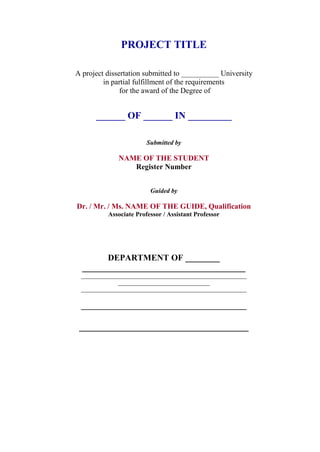
PROJECT TITLE
A project dissertation submitted to __________ University
in partial fulfillment of the requirements
for the award of the Degree of
______ OF ______ IN _________
Submitted by
NAME OF THE STUDENT
Register Number
Guided by
Dr. / Mr. / Ms. NAME OF THE GUIDE, Qualification
Associate Professor / Assistant Professor
DEPARTMENT OF ________
______________________________________
________________________________________________________
_______________________________
________________________________________________________
____________________________________________
___________________________________
2
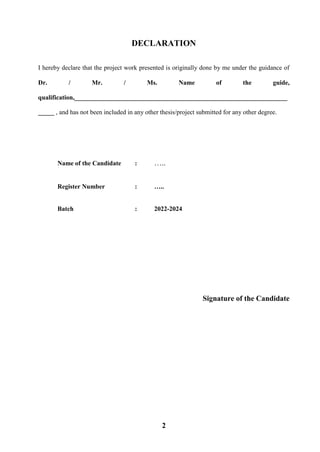
DECLARATION
I hereby declare that the project work presented is originally done by me under the guidance of
Dr. / Mr. / Ms. Name of the guide,
qualification,__________________________________________________________________
_____ , and has not been included in any other thesis/project submitted for any other degree.
Name of the Candidate : …..
Register Number : …..
Batch : 2022-2024
Signature of the Candidate
3
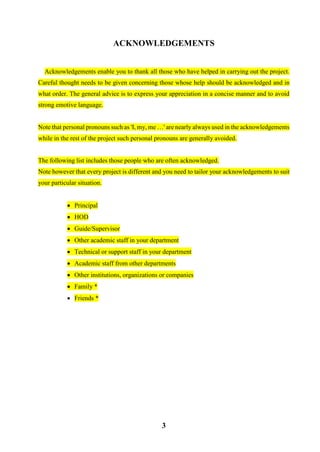
ACKNOWLEDGEMENTS
Acknowledgements enable you to thank all those who have helped in carrying out the project.
Careful thought needs to be given concerning those whose help should be acknowledged and in
what order. The general advice is to express your appreciation in a concise manner and to avoid
strong emotive language.
Note that personal pronouns such as 'I, my, me …' are nearly always used in the acknowledgements
while in the rest of the project such personal pronouns are generally avoided.
The following list includes those people who are often acknowledged.
Note however that every project is different and you need to tailor your acknowledgements to suit
your particular situation.
 Principal
 HOD
 Guide/Supervisor
 Other academic staff in your department
 Technical or support staff in your department
 Academic staff from other departments
 Other institutions, organizations or companies
 Family *
 Friends *
4
ABSTRACT
This should be three paragraphs, summarizing the project work. It is important that this is not just
a re-statement of the original project outline. From the abstract, a reader should be able to ascertain
if the project is of interest to them, and it should present results of which they may wish to know
more details.
 Paragraph 1 – Problem statement, objectives and expected outcomes
 Paragraph 2 – Methods and results
 Paragraph 3 – Conclusion
5
TABLE OF CONTENTS
Chapter Title Page No
1
1.1
1.2
1.3
Introduction
Motivation
Existing Systems/Products and Solutions
Product Needs and Proposed System
XX
1.4 Product Development Timeline
2 Literature Review XX
3
3.1
3.2
Data Collection
Description of the Data
Source and Methods of Collecting Data
XX
4
4.1
4.2
4.3
Preprocessing and Feature Selection
Overview of Preprocessing Methods
Overview of Feature Selection Methods
Preprocessing and Feature Selection Steps
XX
5
5.1
5.2
5.3
Model/Product Development
Model Architecture
Algorithms Applied
Training Overview
XX
6
6.1
6.2
Experimental Design and Evaluation
Experimental Design
Experimental Evaluation
XX
6.3 Customer Evaluation and Feedback
7
7.1
7.2
Model/Product Optimization
Overview of Model Tuning and Best Parameter Selection
Model Tuning Process and Experiments
XX
8
8.1
8.2
8.3
Product Delivery and Deployment
User Manuals
Delivery Schedule
Deployment Process
XX
9
9.1
9.2
Conclusion
Summary
Limitation and Future Work
XX
References XX
Appendix-A: Data Set XX
Appendix-B: Source Code XX
Appendix-C: Output Screenshots XX
6
Chapter 1
INTRODUTION
1.1 Motivation
Explain the motivation for your work; e.g., Why anyone should care? What are the desired benefits?.
Product need identification.
1.2 Existing Systems and Solutions
Explain why existing solutions are inadequate for the motivated problem; e.g., Is there a gap in the
literature? Is there a weakness in existing approaches?
1.3 Product Needs and Proposed System
Explain what you are proposing, what is novel/new about your idea, and why you believe this
solution will be better than previous solutions; e.g., Are you asking a new question, offering a greater
understanding of a research problem, establishing a new methodology to solve a problem, building a
new software tool, or offering greater understanding about existing methods/tools?
1.4 Product Development Timeline
Draw Gantt chart here for the project activities, project duration Jan to 31 March 2021.
7
Chapter 2
Literature Review
Identify around 15 to 20 papers and write what has been explained in the papers.
8
Chapter 3
DATA COLLECTION
3.1 Description of the Data
Describe if you collect real time data or historical data. Can you add more data to historical data.
Size of data, types of features and explanation of each feature, etc
3.2 Source and Methods of Collecting Data
From where you collected data, when?, is that data is populated daily or just historical data?, write
source code that you developed to collect data, write the steps to collect historical data with screen
shots, other points you like to mention,….Do some exploratory data analysis. Mention full dataset
is included as Appendix-A.
9
Chapter 4
PREPROCESSING AND FEATURE SELECTION
4.1 Overview of Preprocessing Methods
Explain in one or two sentences each preprocessing methods that you have applied, explain why
that method is required.
4.2 Overview of Feature Selection Methods
Explain in one or two sentences each preprocessing methods that you have applied, explain why
that method is required.
4.3 Preprocessing and Feature Selection Steps
Exploratory data analysis, Explain why a specific feature is selected or omitted, what dataset
reveals
Explain the steps such as Step1, Step2, etc, for each method. Include one or two lines of actual
source code for preprocessing / feature selection.
10
Chapter 5
MODEL DEVELOPMENT
Describe your learning algorithms, proposed algorithm(s). Make sure to include relevant
mathematical notation. For example, you can briefly include the SVM optimization
objective/formula or say what the softmax function is. It is okay to use formulas from the lecture
notes. For each algorithm, give a short description (1 paragraph) of how it works. Again, we are
looking for your understanding of how these machine learning algorithms work. Although the
teaching staff probably know the algorithms, future readers may not (reports will be posted on the
class website). Additionally, if you are using a niche or cutting-edge algorithm (e.g. long short-
term memory, SURF features, or anything else not covered in the class), you may want to explain
your algorithm using 1 paragraphs. Explain your training and testing approaches such as cross
validating, grid search etc.
5.1 Model Architecture
Describe the implementation of your proposed idea (e.g., features, algorithm(s), training
overview.) so that:
 A reader could reproduce your set-up
 A reader understand why you made your design decisions
It includes a figure illustrating your proposed idea; e.g., a flowchart/block diagram illustrating the
steps in your system(s).
5.2 Algorithms Applied
Describe the chosen algorithms, why are they selected, Include one or two lines of actual source
code
5.3 Training Overview
Explain the training methods, training process. Also, include one or two lines of actual source
code.
11
Chapter 6
EXPERIMENTAL DESIGN AND EVALUATION
You should also give details about what (hyper) parameters you chose (e.g. why did you use X
learning rate for gradient descent, what was your mini-batch size and why) and how you chose
them. Did you do cross-validation, if so, how many folds? Before you list your results, make
sure to list and explain what your primary metrics are: accuracy, precision, AUC, etc. Provide
equations for the metrics if necessary. For results, you want to have a mixture of tables and
plots. If you are solving a classification problem, you should include a confusion matrix or
AUC/AUPRC curves. Include performance metrics such as precision, recall, and accuracy. For
regression problems, state the average error. You should have both quantitative and qualitative
results. To reiterate, you must have both quantitative and qualitative results! This includes
unsupervised learning Include visualizations of results, heatmaps, examples of where your
algorithm failed and a discussion of why certain algorithms failed or succeeded. In addition,
explain whether you think you have overfit to your training set and what, if anything, you did to
mitigate that. Make sure to discuss the figures/tables in
your main text throughout this section. Your plots should include legends, axis labels, and have
font sizes that are legible when printed.
6.1 Experimental Design
 describe 2-3 experiments you plan to conduct and indicate the following for each
experiment:
o Main purpose: 1-3 sentence high level explanation
o Baseline(s): describe status quo method(s) that you will use for comparison
o Evaluation Metrics(s): which ones will you use and why?
Experiment-1: include actual experiment name here
Experiment-2: include actual experiment name here
Experiment-3: include actual experiment name here
6.2 Experimental Results
 for each experiment:
o Main finding(s): report your expected results and what you might conclude
o Include at least one placeholder figure and/or table for communicating your
experimental findings
o Include one paragraph to explain what questions are not fully answered by your
experiments as well as natural next steps for this direction of research
12
Experiment-1: include actual experiment name here
Experiment-2: include actual experiment name here
Experiment-3: include actual experiment name here
6.3 Customer Evaluation and Feedback
13
Chapter 7
MODEL OPTIMIZATION
7.1 Overview of Model Tuning and Best Parameters Selection
Give explanation for how you will tune models and select best parameters for them
7.2 Model Tuning Process and Experiments
Explain the actual model tuning process with one or two lines of actual code and provide figures
of output screens.
14
Chapter 8
PRODUCT DELIVERY AND DEPLOYMENT
8.1 User Manuals
Provide summary of each user manual – name, description, file name, etc
8.2 Delivery Schedule
Give explanation of actual time line for delivery. Assume some anonymous customer if you do
not develop for actual customers. Imagine how will you deliver and give explanation.
8.3 Deployment Process
Explain the steps of deployment, include few lines of source code. Provide screen shot of actual
webpage or mobile app screen of your deployed system.
15
Chapter 9
CONCLUSION
Summarize your report and reiterate key points. Which algorithms were the highest-
performing? Why do you think that some algorithms worked better than others? For
future work, if you had more time, more team members, or more computational resources,
what would you explore?
9.1 Summary
Summarize in one paragraph what you expect will be the take-away point from your work
9.2 Limitations and Future Work
Identify one or two missing features that you have not covered in your project. Explain how you
will continue to work on those missing features in future.
16
REFERENCES
This section should include citations for: (1) Any papers mentioned in the related work section.
(2) Papers describing algorithms that you used which were not covered in class. (3) Code or
libraries you downloaded and used. This includes libraries such as scikit-learn, Matlab toolboxes,
Tensorflow, etc. Each reference entry must include the following (preferably in this order):
author(s), title, conference/journal, publisher, year. Main body text, figures, and any discussions
are strictly forbidden from this section.
[1] Provide reference1
[2] Provide reference2
[3] Provide reference3
[4] Provide reference4
[5] etc
17
APPENDIX-A
DATA SET
18
APPENDIX-B
SOURCE CODE
19
APPENDIX-C
OUTPUT SCREEN SHOTS

Project Template - Artificial Intelligence and Data Science

  • 1.
    PROJECT TITLE A projectdissertation submitted to __________ University in partial fulfillment of the requirements for the award of the Degree of ______ OF ______ IN _________ Submitted by NAME OF THE STUDENT Register Number Guided by Dr. / Mr. / Ms. NAME OF THE GUIDE, Qualification Associate Professor / Assistant Professor DEPARTMENT OF ________ ______________________________________ ________________________________________________________ _______________________________ ________________________________________________________ ____________________________________________ ___________________________________
  • 2.
    2 DECLARATION I hereby declarethat the project work presented is originally done by me under the guidance of Dr. / Mr. / Ms. Name of the guide, qualification,__________________________________________________________________ _____ , and has not been included in any other thesis/project submitted for any other degree. Name of the Candidate : ….. Register Number : ….. Batch : 2022-2024 Signature of the Candidate
  • 3.
    3 ACKNOWLEDGEMENTS Acknowledgements enable youto thank all those who have helped in carrying out the project. Careful thought needs to be given concerning those whose help should be acknowledged and in what order. The general advice is to express your appreciation in a concise manner and to avoid strong emotive language. Note that personal pronouns such as 'I, my, me …' are nearly always used in the acknowledgements while in the rest of the project such personal pronouns are generally avoided. The following list includes those people who are often acknowledged. Note however that every project is different and you need to tailor your acknowledgements to suit your particular situation.  Principal  HOD  Guide/Supervisor  Other academic staff in your department  Technical or support staff in your department  Academic staff from other departments  Other institutions, organizations or companies  Family *  Friends *
  • 4.
    4 ABSTRACT This should bethree paragraphs, summarizing the project work. It is important that this is not just a re-statement of the original project outline. From the abstract, a reader should be able to ascertain if the project is of interest to them, and it should present results of which they may wish to know more details.  Paragraph 1 – Problem statement, objectives and expected outcomes  Paragraph 2 – Methods and results  Paragraph 3 – Conclusion
  • 5.
    5 TABLE OF CONTENTS ChapterTitle Page No 1 1.1 1.2 1.3 Introduction Motivation Existing Systems/Products and Solutions Product Needs and Proposed System XX 1.4 Product Development Timeline 2 Literature Review XX 3 3.1 3.2 Data Collection Description of the Data Source and Methods of Collecting Data XX 4 4.1 4.2 4.3 Preprocessing and Feature Selection Overview of Preprocessing Methods Overview of Feature Selection Methods Preprocessing and Feature Selection Steps XX 5 5.1 5.2 5.3 Model/Product Development Model Architecture Algorithms Applied Training Overview XX 6 6.1 6.2 Experimental Design and Evaluation Experimental Design Experimental Evaluation XX 6.3 Customer Evaluation and Feedback 7 7.1 7.2 Model/Product Optimization Overview of Model Tuning and Best Parameter Selection Model Tuning Process and Experiments XX 8 8.1 8.2 8.3 Product Delivery and Deployment User Manuals Delivery Schedule Deployment Process XX 9 9.1 9.2 Conclusion Summary Limitation and Future Work XX References XX Appendix-A: Data Set XX Appendix-B: Source Code XX Appendix-C: Output Screenshots XX
  • 6.
    6 Chapter 1 INTRODUTION 1.1 Motivation Explainthe motivation for your work; e.g., Why anyone should care? What are the desired benefits?. Product need identification. 1.2 Existing Systems and Solutions Explain why existing solutions are inadequate for the motivated problem; e.g., Is there a gap in the literature? Is there a weakness in existing approaches? 1.3 Product Needs and Proposed System Explain what you are proposing, what is novel/new about your idea, and why you believe this solution will be better than previous solutions; e.g., Are you asking a new question, offering a greater understanding of a research problem, establishing a new methodology to solve a problem, building a new software tool, or offering greater understanding about existing methods/tools? 1.4 Product Development Timeline Draw Gantt chart here for the project activities, project duration Jan to 31 March 2021.
  • 7.
    7 Chapter 2 Literature Review Identifyaround 15 to 20 papers and write what has been explained in the papers.
  • 8.
    8 Chapter 3 DATA COLLECTION 3.1Description of the Data Describe if you collect real time data or historical data. Can you add more data to historical data. Size of data, types of features and explanation of each feature, etc 3.2 Source and Methods of Collecting Data From where you collected data, when?, is that data is populated daily or just historical data?, write source code that you developed to collect data, write the steps to collect historical data with screen shots, other points you like to mention,….Do some exploratory data analysis. Mention full dataset is included as Appendix-A.
  • 9.
    9 Chapter 4 PREPROCESSING ANDFEATURE SELECTION 4.1 Overview of Preprocessing Methods Explain in one or two sentences each preprocessing methods that you have applied, explain why that method is required. 4.2 Overview of Feature Selection Methods Explain in one or two sentences each preprocessing methods that you have applied, explain why that method is required. 4.3 Preprocessing and Feature Selection Steps Exploratory data analysis, Explain why a specific feature is selected or omitted, what dataset reveals Explain the steps such as Step1, Step2, etc, for each method. Include one or two lines of actual source code for preprocessing / feature selection.
  • 10.
    10 Chapter 5 MODEL DEVELOPMENT Describeyour learning algorithms, proposed algorithm(s). Make sure to include relevant mathematical notation. For example, you can briefly include the SVM optimization objective/formula or say what the softmax function is. It is okay to use formulas from the lecture notes. For each algorithm, give a short description (1 paragraph) of how it works. Again, we are looking for your understanding of how these machine learning algorithms work. Although the teaching staff probably know the algorithms, future readers may not (reports will be posted on the class website). Additionally, if you are using a niche or cutting-edge algorithm (e.g. long short- term memory, SURF features, or anything else not covered in the class), you may want to explain your algorithm using 1 paragraphs. Explain your training and testing approaches such as cross validating, grid search etc. 5.1 Model Architecture Describe the implementation of your proposed idea (e.g., features, algorithm(s), training overview.) so that:  A reader could reproduce your set-up  A reader understand why you made your design decisions It includes a figure illustrating your proposed idea; e.g., a flowchart/block diagram illustrating the steps in your system(s). 5.2 Algorithms Applied Describe the chosen algorithms, why are they selected, Include one or two lines of actual source code 5.3 Training Overview Explain the training methods, training process. Also, include one or two lines of actual source code.
  • 11.
    11 Chapter 6 EXPERIMENTAL DESIGNAND EVALUATION You should also give details about what (hyper) parameters you chose (e.g. why did you use X learning rate for gradient descent, what was your mini-batch size and why) and how you chose them. Did you do cross-validation, if so, how many folds? Before you list your results, make sure to list and explain what your primary metrics are: accuracy, precision, AUC, etc. Provide equations for the metrics if necessary. For results, you want to have a mixture of tables and plots. If you are solving a classification problem, you should include a confusion matrix or AUC/AUPRC curves. Include performance metrics such as precision, recall, and accuracy. For regression problems, state the average error. You should have both quantitative and qualitative results. To reiterate, you must have both quantitative and qualitative results! This includes unsupervised learning Include visualizations of results, heatmaps, examples of where your algorithm failed and a discussion of why certain algorithms failed or succeeded. In addition, explain whether you think you have overfit to your training set and what, if anything, you did to mitigate that. Make sure to discuss the figures/tables in your main text throughout this section. Your plots should include legends, axis labels, and have font sizes that are legible when printed. 6.1 Experimental Design  describe 2-3 experiments you plan to conduct and indicate the following for each experiment: o Main purpose: 1-3 sentence high level explanation o Baseline(s): describe status quo method(s) that you will use for comparison o Evaluation Metrics(s): which ones will you use and why? Experiment-1: include actual experiment name here Experiment-2: include actual experiment name here Experiment-3: include actual experiment name here 6.2 Experimental Results  for each experiment: o Main finding(s): report your expected results and what you might conclude o Include at least one placeholder figure and/or table for communicating your experimental findings o Include one paragraph to explain what questions are not fully answered by your experiments as well as natural next steps for this direction of research
  • 12.
    12 Experiment-1: include actualexperiment name here Experiment-2: include actual experiment name here Experiment-3: include actual experiment name here 6.3 Customer Evaluation and Feedback
  • 13.
    13 Chapter 7 MODEL OPTIMIZATION 7.1Overview of Model Tuning and Best Parameters Selection Give explanation for how you will tune models and select best parameters for them 7.2 Model Tuning Process and Experiments Explain the actual model tuning process with one or two lines of actual code and provide figures of output screens.
  • 14.
    14 Chapter 8 PRODUCT DELIVERYAND DEPLOYMENT 8.1 User Manuals Provide summary of each user manual – name, description, file name, etc 8.2 Delivery Schedule Give explanation of actual time line for delivery. Assume some anonymous customer if you do not develop for actual customers. Imagine how will you deliver and give explanation. 8.3 Deployment Process Explain the steps of deployment, include few lines of source code. Provide screen shot of actual webpage or mobile app screen of your deployed system.
  • 15.
    15 Chapter 9 CONCLUSION Summarize yourreport and reiterate key points. Which algorithms were the highest- performing? Why do you think that some algorithms worked better than others? For future work, if you had more time, more team members, or more computational resources, what would you explore? 9.1 Summary Summarize in one paragraph what you expect will be the take-away point from your work 9.2 Limitations and Future Work Identify one or two missing features that you have not covered in your project. Explain how you will continue to work on those missing features in future.
  • 16.
    16 REFERENCES This section shouldinclude citations for: (1) Any papers mentioned in the related work section. (2) Papers describing algorithms that you used which were not covered in class. (3) Code or libraries you downloaded and used. This includes libraries such as scikit-learn, Matlab toolboxes, Tensorflow, etc. Each reference entry must include the following (preferably in this order): author(s), title, conference/journal, publisher, year. Main body text, figures, and any discussions are strictly forbidden from this section. [1] Provide reference1 [2] Provide reference2 [3] Provide reference3 [4] Provide reference4 [5] etc
  • 17.
  • 18.
  • 19.