Alex Cameron
Holloway School
Cameron.a52@Holloway.Islington.sch.uk
A proposal for assessment and feedback.
Why?
• Move the marking policy away from a high teacher input to high pupil input
• Move towards more shared formative feedback and tasks
• Raise profile of Mathematical AO2 (reasoning) and AO3 (problem solving)
objectives
• with pupils
• with staff
• More high-quality, low-stakes assessment
Alex Cameron
Holloway School
Cameron.a52@Holloway.Islington.sch.uk
A proposal for assessment and feedback.
What?
• A diagnostic
• Six questions two AO1 (fluency), two AO2 (reasoning) and two AO3 (problem
solving)
• Formative task
• Supported by explanation, scaffold task, examples, fill in gaps
• ‘www’ and ‘ebi’ statements that the students scribe (not the teacher)
This is nice, but
takes time to
do for all
pupils.
High teacher
input can
discourage
teachers from
doing it
frequently.
Student input
is much lower
than the
teacher input.
This is nice, but
takes time to
do for all
pupils.
High teacher
input can
discourage
teachers from
doing it
frequently.
Student input
is much lower
than the
teacher input.
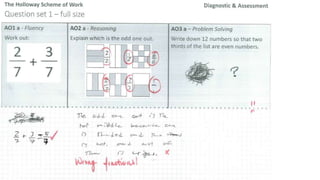
Question set 1 – full size
AO1 a - Fluency
Work out:
AO2 a - Reasoning
Explain which is the odd one out.
AO3 a – Problem Solving
Write down 12 numbers so that two
thirds of the list are even numbers.
AO1 b - Fluency
Work out:
AO2 b - Reasoning
Show why two thirds and six ninths
are equivalent fractions.
(Communicate using diagrams and words.)
AO3 b – Problem Solving
Chocolate needs to be shared equally.
Group 1 has one bar of chocolate and
there are already 3 people in the group.
Group 2 has two bars of chocolate and
there are already 5 people in the group.
Which group should you join so that every
person in all groups gets the same share of
chocolate.
Make sure you fully explain your answer.
WWW and EBI Statements
AO1 a - Fluency
I can add fractions
that have the same
denominator
AO2 a - Reasoning
I can draw conclusions
from mathematical
information
(by explaining which is the odd
one out for a set of fractions).
AO3 a – Problem Solving
I can use connections
between different parts of
mathematics
(by using properties of numbers in a
fraction problem).
AO1 b - Fluency
I can subtract
fractions that have
the same
denominator
including mixed
numbers.
AO2 b - Reasoning
I can communicate
information accurately
(by showing equivalent
fractions).
AO3 b – Problem Solving
I can translate a problem in
a non-mathematical context
into a process
(by using fractions in a problem about
sharing chocolate).
Pupil Formative Task AO1 b - Fluency
Model Example
It would help to draw a picture.
This is two whole ones and a
quarter. We now shade in over the
top of the diagram but leave three
quarters.
Now we just have to say what
there is.
___ whole ones & ___ quarters.
(Write it using fraction notation and simplify)
Scaffold Example
This is ______ whole ones
and ______ ______ .
We shade in over the top of the
diagram but leave five thirds.
Now there is:
Further Questions
Pupil Formative Task AO2 a - Reasoning
Scaffold Explanation
You need to write a fraction for each diagram and simplify it if you can.
Further Question
Which are the odd ones out for
these? Try to explain why.
Alex Cameron
Holloway School
Cameron.a52@Holloway.Islington.sch.uk
A proposal for assessment and feedback.
It’s a work in progress; I can come back in a year…
Thanks for listening…
Speak to me, email me…

Proposal for Assessment and Feedback

  • 1.
    Alex Cameron Holloway School Cameron.a52@Holloway.Islington.sch.uk Aproposal for assessment and feedback. Why? • Move the marking policy away from a high teacher input to high pupil input • Move towards more shared formative feedback and tasks • Raise profile of Mathematical AO2 (reasoning) and AO3 (problem solving) objectives • with pupils • with staff • More high-quality, low-stakes assessment
  • 2.
    Alex Cameron Holloway School Cameron.a52@Holloway.Islington.sch.uk Aproposal for assessment and feedback. What? • A diagnostic • Six questions two AO1 (fluency), two AO2 (reasoning) and two AO3 (problem solving) • Formative task • Supported by explanation, scaffold task, examples, fill in gaps • ‘www’ and ‘ebi’ statements that the students scribe (not the teacher)
  • 3.
    This is nice,but takes time to do for all pupils. High teacher input can discourage teachers from doing it frequently. Student input is much lower than the teacher input.
  • 4.
    This is nice,but takes time to do for all pupils. High teacher input can discourage teachers from doing it frequently. Student input is much lower than the teacher input.
  • 5.
    Question set 1– full size AO1 a - Fluency Work out: AO2 a - Reasoning Explain which is the odd one out. AO3 a – Problem Solving Write down 12 numbers so that two thirds of the list are even numbers. AO1 b - Fluency Work out: AO2 b - Reasoning Show why two thirds and six ninths are equivalent fractions. (Communicate using diagrams and words.) AO3 b – Problem Solving Chocolate needs to be shared equally. Group 1 has one bar of chocolate and there are already 3 people in the group. Group 2 has two bars of chocolate and there are already 5 people in the group. Which group should you join so that every person in all groups gets the same share of chocolate. Make sure you fully explain your answer.
  • 6.
    WWW and EBIStatements AO1 a - Fluency I can add fractions that have the same denominator AO2 a - Reasoning I can draw conclusions from mathematical information (by explaining which is the odd one out for a set of fractions). AO3 a – Problem Solving I can use connections between different parts of mathematics (by using properties of numbers in a fraction problem). AO1 b - Fluency I can subtract fractions that have the same denominator including mixed numbers. AO2 b - Reasoning I can communicate information accurately (by showing equivalent fractions). AO3 b – Problem Solving I can translate a problem in a non-mathematical context into a process (by using fractions in a problem about sharing chocolate).
  • 7.
    Pupil Formative TaskAO1 b - Fluency Model Example It would help to draw a picture. This is two whole ones and a quarter. We now shade in over the top of the diagram but leave three quarters. Now we just have to say what there is. ___ whole ones & ___ quarters. (Write it using fraction notation and simplify) Scaffold Example This is ______ whole ones and ______ ______ . We shade in over the top of the diagram but leave five thirds. Now there is: Further Questions
  • 8.
    Pupil Formative TaskAO2 a - Reasoning Scaffold Explanation You need to write a fraction for each diagram and simplify it if you can. Further Question Which are the odd ones out for these? Try to explain why.
  • 12.
    Alex Cameron Holloway School Cameron.a52@Holloway.Islington.sch.uk Aproposal for assessment and feedback. It’s a work in progress; I can come back in a year… Thanks for listening… Speak to me, email me…