Checking Progress Across Lesson


Our Aims:
• To develop the departments use of AFL.
• To use different learning strategies in our
  classrooms.
• To inspire our students to take control of their
  learning and help them become independent.
Checking
progress
What we are already doing...
Checking progress
• Levelled Learning Objectives
Levelled Learning Objectives
         Challenge Objectives (levelled)
Today I will learn to expand and simplify
          algebraic expressions.
           GCSE Grade D to A*
Key Words
                2(3 + m) and 3a(2b – 5a) are Grade D
• Expand
                m(4 +p) + p(3 + m) are Grade C
• Simplify
                (a + 3)(a – 4) and (a – 3)² are Grade C +
• Brackets      (3a – 2)(2a + 4) and (4a – 5)² are Grade B
• Coefficient   CHALLENGE OBJECTIVE – expand and
• Bracket       simplify surds √3(2 - √3) is Grade A*
Checking progress
• Progress sheets for students to complete
  during the lesson
Checking progress
     • Progress sheets for students to complete
       during the lesson
Progress             Evidence                  
2(3 + m)
Grade D
m(4 +p) + p(3 + m)
Grade C
(a + 3)(a – 4)
Grade C +
(4a – 5)²
Grade B
√3(2 - √3)
Grade A
Checking progress
• Use of mini whiteboards to illustrate progress
Checking progress
 • Use of mini whiteboards to illustrate progress
                      Grade D
5(a + 2)              6(b – 3)              c(3 – c)


Show me:   8(d + 2)
           9(e – 3)
           f(f + 3)
Checking progress
• Traffic light cards/ thumbs up thumbs down
Checking progress
  • 5 to 1

5Super confident
          4 Confident
                 3 OK
                      2Need help soon

                          1 Need help NOW
Checking progress
• Multiple choice traffic lights
Checking progress
 • Multiple choice traffic lights
     Expand (a + 6)(a + 3) Grade C,
show me the colour of the correct answer

                                     
a² + 9a - 18       a² + 9a + 18     a² + 18a + 9
Checking progress
  • Post-it note challenge

Answer the hardest question that you
can.
Once done and put your answer on the
post-it note (on the sticky side)
Put your name on the front.
When you are ready go and stick it on
the wall with the appropriate grade.
Checking progress
   • Post-it note challenge
Do the hardest question that you can.
Once done and put your answer on the post-it note (on the sticky side)
Put your name on the front.
When you are ready go and stick it on the wall with the appropriate grade.

 Expand:                 3a(2b – 5a) Grade D
                         3(4 + a) + a(3 + a) Grade C
                         (a + 5)(a – 7) Grade C+
                         (2a – 7)(3a + 2) Grade B
                         √2(7 - √2) is Grade A*
Checking progress
• Use of Success Criteria
Checking progress
        • Use of Success Criteria
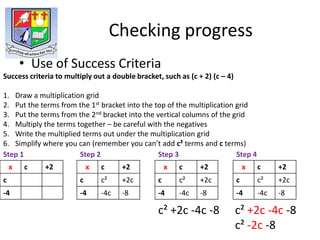
Success criteria to multiply out a double bracket, such as (c + 2) (c – 4)

1. Draw a multiplication grid
2. Put the terms from the 1st bracket into the top of the multiplication grid
3. Put the terms from the 2nd bracket into the vertical columns of the grid
4. Multiply the terms together – be careful with the negatives
5. Write the multiplied terms out under the multiplication grid
6. Simplify where you can (remember you can’t add c² terms and c terms)
Step 1                 Step 2                   Step 3                   Step 4
    x   c    +2             x   c     +2             x   c     +2                x   c     +2
c                       c       c²    +2c        c       c²    +2c           c       c²    +2c
-4                      -4      -4c   -8         -4      -4c   -8            -4      -4c   -8

                                                 c² +2c -4c -8               c² +2c -4c -8
                                                                             c² -2c -8
Checking progress
• Differentiated levelled work and graded activities
Grade D/C expand and simplify single brackets   Grade C+ to B Expand and simplify double brackets

Grade D                                         Grade C +
2(7 + d)                                        (a + 2)(a + 6)
a(3 – 5a)                                       (3 - c)(c + 9)
5b(9 – 4b + a)                                  (a + 4)²
Grade C                                         Grade B
a(2+p) + p(7 + a)                               (5a + 2)(2a + 3)
d(3 – ad) + 4a( 3 – ad)                         (3a – 6)(2a + 3)
7b(e – 2b) + 6(be – 2e)                         (4a – 5)²
Checking progress
     • Self and peer assessment
Self assessment
                    Peer assessment                      
Grade D                       Grade D
2(7 + d)                      2(7 + d)
Grade C                       Grade C
a(2+p) + p(7 + a)             a(2+p) + p(7 + a)
Grade C +                     Grade C +
(a + 2)(a + 6)                (a + 2)(a + 6)
Grade B                       Grade B
(5a + 2)(2a + 3)              (5a + 2)(2a + 3)
I’ve done well with...        You’ve done well with...

To improve I need to...       To improve you need to...
Checking progress
• Student response pads
Checking progress
     • Formative written feedback/ marking grids
Self assessment
                            Mrs Phillips thinks...
Grade D 2(7 + d)
Grade C a(2+p) + p(7 + a)
Grade C + (a + 2)(a + 6)
Grade B (5a + 2)(2a + 3)
                                       Your effort has been
                           Outstanding/Good/Satisfactory/Unsatisfactory
I’ve done well with...                        You’ve done well with...

To improve I need to...                       To improve you need to...
http://wallwisher.com/ and
              https://linoit.com/


What teachers at Queensbury School said…

http://linoit.com/users/angmaxphil/canvases/Sh
owing%20progress
Checking progress a recap...
•   Levelled Learning Objectives
•   Use of mini whiteboards to illustrate progress
•   Traffic light cards/ thumbs up thumbs down
•   Multiple choice traffic lights
•   5 to 1
•   Post-it note challenge
•   Progress sheets for students to complete during the lesson
•   Use of Success Criteria
•   Differentiated levelled work and graded activities
•   Formative written feedback/ marking grids
•   Self and peer assessment
•   http://wallwisher.com/ and https://linoit.com/
•   Student response pads
Checking Progress Across Lesson


Our Aims:
• To develop the departments use of AFL.
• To use different learning strategies in our
  classrooms.
• To inspire our students to take control of their
  learning and help them become independent.

Checking progress amp new staff 020712

  • 1.
    Checking Progress AcrossLesson Our Aims: • To develop the departments use of AFL. • To use different learning strategies in our classrooms. • To inspire our students to take control of their learning and help them become independent.
  • 2.
  • 3.
    Checking progress • LevelledLearning Objectives
  • 4.
    Levelled Learning Objectives Challenge Objectives (levelled) Today I will learn to expand and simplify algebraic expressions. GCSE Grade D to A* Key Words 2(3 + m) and 3a(2b – 5a) are Grade D • Expand m(4 +p) + p(3 + m) are Grade C • Simplify (a + 3)(a – 4) and (a – 3)² are Grade C + • Brackets (3a – 2)(2a + 4) and (4a – 5)² are Grade B • Coefficient CHALLENGE OBJECTIVE – expand and • Bracket simplify surds √3(2 - √3) is Grade A*
  • 5.
    Checking progress • Progresssheets for students to complete during the lesson
  • 6.
    Checking progress • Progress sheets for students to complete during the lesson Progress Evidence   2(3 + m) Grade D m(4 +p) + p(3 + m) Grade C (a + 3)(a – 4) Grade C + (4a – 5)² Grade B √3(2 - √3) Grade A
  • 7.
    Checking progress • Useof mini whiteboards to illustrate progress
  • 8.
    Checking progress •Use of mini whiteboards to illustrate progress Grade D 5(a + 2) 6(b – 3) c(3 – c) Show me: 8(d + 2) 9(e – 3) f(f + 3)
  • 9.
    Checking progress • Trafficlight cards/ thumbs up thumbs down
  • 10.
    Checking progress • 5 to 1 5Super confident 4 Confident 3 OK 2Need help soon 1 Need help NOW
  • 11.
    Checking progress • Multiplechoice traffic lights
  • 12.
    Checking progress •Multiple choice traffic lights Expand (a + 6)(a + 3) Grade C, show me the colour of the correct answer    a² + 9a - 18 a² + 9a + 18 a² + 18a + 9
  • 13.
    Checking progress • Post-it note challenge Answer the hardest question that you can. Once done and put your answer on the post-it note (on the sticky side) Put your name on the front. When you are ready go and stick it on the wall with the appropriate grade.
  • 14.
    Checking progress • Post-it note challenge Do the hardest question that you can. Once done and put your answer on the post-it note (on the sticky side) Put your name on the front. When you are ready go and stick it on the wall with the appropriate grade. Expand: 3a(2b – 5a) Grade D 3(4 + a) + a(3 + a) Grade C (a + 5)(a – 7) Grade C+ (2a – 7)(3a + 2) Grade B √2(7 - √2) is Grade A*
  • 15.
    Checking progress • Useof Success Criteria
  • 16.
    Checking progress • Use of Success Criteria Success criteria to multiply out a double bracket, such as (c + 2) (c – 4) 1. Draw a multiplication grid 2. Put the terms from the 1st bracket into the top of the multiplication grid 3. Put the terms from the 2nd bracket into the vertical columns of the grid 4. Multiply the terms together – be careful with the negatives 5. Write the multiplied terms out under the multiplication grid 6. Simplify where you can (remember you can’t add c² terms and c terms) Step 1 Step 2 Step 3 Step 4 x c +2 x c +2 x c +2 x c +2 c c c² +2c c c² +2c c c² +2c -4 -4 -4c -8 -4 -4c -8 -4 -4c -8 c² +2c -4c -8 c² +2c -4c -8 c² -2c -8
  • 17.
    Checking progress • Differentiatedlevelled work and graded activities Grade D/C expand and simplify single brackets Grade C+ to B Expand and simplify double brackets Grade D Grade C + 2(7 + d) (a + 2)(a + 6) a(3 – 5a) (3 - c)(c + 9) 5b(9 – 4b + a) (a + 4)² Grade C Grade B a(2+p) + p(7 + a) (5a + 2)(2a + 3) d(3 – ad) + 4a( 3 – ad) (3a – 6)(2a + 3) 7b(e – 2b) + 6(be – 2e) (4a – 5)²
  • 18.
    Checking progress • Self and peer assessment Self assessment    Peer assessment    Grade D Grade D 2(7 + d) 2(7 + d) Grade C Grade C a(2+p) + p(7 + a) a(2+p) + p(7 + a) Grade C + Grade C + (a + 2)(a + 6) (a + 2)(a + 6) Grade B Grade B (5a + 2)(2a + 3) (5a + 2)(2a + 3) I’ve done well with... You’ve done well with... To improve I need to... To improve you need to...
  • 19.
  • 20.
    Checking progress • Formative written feedback/ marking grids Self assessment   Mrs Phillips thinks... Grade D 2(7 + d) Grade C a(2+p) + p(7 + a) Grade C + (a + 2)(a + 6) Grade B (5a + 2)(2a + 3) Your effort has been Outstanding/Good/Satisfactory/Unsatisfactory I’ve done well with... You’ve done well with... To improve I need to... To improve you need to...
  • 21.
    http://wallwisher.com/ and https://linoit.com/ What teachers at Queensbury School said… http://linoit.com/users/angmaxphil/canvases/Sh owing%20progress
  • 22.
    Checking progress arecap... • Levelled Learning Objectives • Use of mini whiteboards to illustrate progress • Traffic light cards/ thumbs up thumbs down • Multiple choice traffic lights • 5 to 1 • Post-it note challenge • Progress sheets for students to complete during the lesson • Use of Success Criteria • Differentiated levelled work and graded activities • Formative written feedback/ marking grids • Self and peer assessment • http://wallwisher.com/ and https://linoit.com/ • Student response pads
  • 23.
    Checking Progress AcrossLesson Our Aims: • To develop the departments use of AFL. • To use different learning strategies in our classrooms. • To inspire our students to take control of their learning and help them become independent.

Editor's Notes

  • #3 All staff to write down how they already check progress in their lessons and share with the group
  • #4 Discuss how important it is to have levelled/graded objectives that will help the students see the progress they are making.
  • #5 Show an example of levelled objectives and how they can be used.
  • #6 Give out progress sheet and explain how it is used (students to tick off what they can do as the lesson progresses, but also that they must have evidence).
  • #7 Example of a progress sheet
  • #8 Do an example as a class
  • #9 Do an example as a class
  • #10 Ask the group how they found the last activity traffic lights and thumbs up down.
  • #11 To use 5 to 1 get the group to show you how they found the task, as above.
  • #12 Explain how to use multiple choice RAG cards
  • #13 All show the correct answer
  • #14 Explain the idea of the post-it note challenge – then get the participants to try it
  • #15 Example of post-it note challenge for the participants to try. Make sure that you have posters up saying Grade D, Grade C, Grade C+, Grade B and Grade A* for the post-it to go under/on.
  • #16 Explain that success criteria is best given to students (in the 1st instance) and worked through as a class, this will ensure the students know how to use success criteria. Once the students are happy using success criteria, it is a great plenary/independence activity and a fantastic way to check progress, by getting the students
  • #17 Two examples of success criteria – students to share with the class – this shows clear understanding of what they have been asked to do.
  • #18 Give the students a choice of the level of work they can do, with a check section at the end.
  • #19 Give the class a self and peer assessment sheet to complete
  • #20 Show them the student response pads and get them to sign up for Robs training.
  • #21 Give the attendee’s a feedback grid to complete and stick onto their work.
  • #22 Give the class a self and peer assessment sheet to complete
  • #23 This slide is to be printed off and given to the people attending the training.