University of Sydney
Faculty of Education
Education Psychology & Measurement
Masters Thesis Proposal
Making the experience of hospital for children “bearable”: the development and
evaluation of a psychoeducational intervention based upon an animated pedagogical
agent in a Developmental-Interaction multimedia environment.
Ken McCullagh
October 2000
1. Statement of topics
Making the experience of hospital for children “bearable”: the development and evaluation of a
psychoeducational intervention based upon an animated pedagogical agent in a Developmental-
Interaction multimedia environment.
2. Aims, significance and expected outcomes
Aims. The project has four related aims.
Currently there is promising research into the use of what has been called “Pedagogical Agents”, an
animated virtual assistance or guide that works with the multimedia user to enhance and support the
users experience. Into this field on multimedia computer interface design, I propose that the
development of a virtual transitional object in the form of a “Pedagogical Bear Agent” could have a
valuable place in the design of a pre-admission/preopertive hospital intervention for children.
The second aim of this project will utilise the initial content of this multimedia pre-admission resource
as proposed by CHERI1.
that being a virtual tour of the New Children’s Hospital, Westmead, to then
act as a backbone or scaffolding for future communication outlets and resources for both children and
their parents. This new resource could also be linked to have a wider school’s connection, allowing
children in hospital to maintain contact with their peers and for well children to experience the hospital
environment.
The third aim of the project is to facilitate the development of an awareness of hospitals being a
learning organisation and build closer contact between the institutions of hospital and that of school .
The outcome of this coming together of institutions would I hope lead to the creation of a new
syllabus module within the K-12 Curriculum that covers the issues surrounding hospitalisation and
illness.
Ideally this new resource could fit into three of the six key learning areas, those of “Human Society
and Its Environment”, “Personal Development, Health and Physical Education” and that of “Science
and Technology” allowing for curriculum integration via this module. The Board of Studies NSW2.
supports the strategy of curriculum integration stating that “curriculum integration enables students to
acquire an unified view of the curriculum, broadening the context of their learning beyond single key
learning areas”.
The final aim of this project being an appreciation that preparation for hospitalisation should being
with healthy children and be developed throughout the developmental periods of children rather than
the “just in time” procedure at present. The benefits from this approach would be that the bulk of
children entering hospital (that being emergency cases) would be covered and that a global
understanding of the issues of illness would be understood by the school population.
Azarnoff & Woody (1981)3.
as cited by Nelson (1995)4.
, surveyed pediatric hospitals, children’s
hospitals, and acute care general hospitals to find out whether they provided regular, planned
hospital preparation of those 1,427 hospitals that responded, only 33% reported that they did, whilst
47% reported that they provided no planned preparation for children, with 20% reporting that they
were unsure about hospital preparation.
This position is further supported by Butler(1980)5.
reporting on the Child Health and Education
Study in Britain as cited by Rodin (1983)6.
saying “that the commonest individual cause of children’s
admissions to hospitals was accidents. By the age of five, 44% of the 1,965 children studied were
reported to have had an accident requiring medical advice or attention and could only be prepared for
this through general education”.
Nelson (1995)4.
quotes Brett(1983)7.
and Poster (1984)8.
stating that “preparation of healthy children
is feasible both due to the probability of their future exposure to hospitalization and other anxiety
provoking medical procedures and due to the potential benefits of preparation for other forms of
health care, such as visits to the doctor’s office.
Significance
CHERI1.
stating that “With an estimated 90,000 children in Sydney aged between 4 and 14
having some form of chronic illness”, there is ample need to develop an integrated approach to
the issue of hospitalisation interventions.
Melamed & Siegel (1975)9.
states that “Several authors have suggested that preoperative anxiety is a
significant factor in impeding recovery from surgery (Dumas, 1963; Giller, 1963; Janis, 1958).
Backing this point up, Kane (2000) states that “ About 50 percent of all children undergoing routine
outpatient surgery present at two weeks with new-onset anxiety, night-time crying, enuresis,
separation anxiety, temper tantrums and sleep or eating disturbances. Twenty percent of these
children continue to demonstrate negative behaviors six months postoperatively”.
Outcomes.
The outcomes of this project include an appreciation of the use of pedagogical agents in multimedia
and communication tools to create positive outcomes for children with chronic illnesses. The need to
allow all children access to an entry level resource (a pre-admission) even before they are ill as part
of a general social studies syllabus within the curriculum for the Department of Education.
• Research the process of developing a multimedia psychoeducational intervention within a
children’s hospital setting
• Develop and evaluate the use of pedagogical agents as a virtual transitional object (a teddy bear)
for the reduction of stress and the development of coping strategies for children
• Review the current approaches to pre-admission resource development
• Develop a global theoretical framework for the discipline of Instructional Design that marries the
use of social learning theories and the use of pedagogical agents within education
2. Review of literature
Background
As with most research there is a perceived problem that researchers wish to address for a target
group within a social setting. In my case I am proposing to work with Professor Jeff Bailey of the
Children’s Hospital Education Research Institute CHERI, at the New Children’s Hospital Westmead
to develop a pre-admission multimedia intervention. This innovative intervention will attempt to
reduce the stress of the experience of hospital for children and at the same time act as a backbone
for the development of a collaborative learning environment to air the issues of illness and
hospitalisation.
Central to the projects claim of innovation will be the use of Animated Pedagogical Agents acting as
transitional objects allowing children to work through the issues of hospitalisation.
CHERI had already proposed a similar project called “The Coping Corner” but had not commenced
work on this project, with this new proposal moving forward and fitting well within CHERI”s key
organisation aims:
• To achieve a significant program of applied collaborative research related to the interface
between health and education
• To conduct interdisciplinary conference and seminar programs, which focus on improving
the interface between health and education – this indirectly promoting children’s health and
welfare
• To offer a limited clinical service in educational and family counselling
Making sense of the literature
Professor Jeff Bailey talks about the stressful encounters that children have to endure when
hospitalised and the lack of “empirical information to guide our understanding of how children
appraise encounters with hospitals and/or pain, what levels of fear and stress occurs, how they
approach the processing of adapting to and coping with medical procedures”.
Bailey (1998)10.
goes on the define the psychological phenomenon of coping “as the manner in which
a person’s cognitive and behavioural strategies are brought to bear to deal with a situation after the
individual had made a cognitive appraisal that the event will be stressful, taxing, frightening and/or
demanding”.
Utah State University11.
has the following resource on “Coping With Hospitization” which is a good
summary of strategies to help with that process and be kept in mind with designing a support
environment.
• Discuss the purpose of hospitals and take a hospital tour while your child is healthy
• Allow your child to bring a piece of home with her to the hospital
• As a parent, participate in the hospital care program as much as possible
• Give your child appropriate information about his illness and the various procedures to be used to
combat it
• Keep your child abreast of happenings at home. A hospitalized child needs to hear dinnertime
conversations
• Provide opportunities for your child to maintain peer connections
• Provide a time and a place for your child to play
• Work out your own stress and frustrations by maintaining balance in your life
At the same time Melamed & Siegel (1975)9.
cites earlier researches who suggests that the major
purpose of preoperative preparation is to (a) provide information to the child (b) encourage emotional
expression, and (c) establish a trusting relationship with the hospital staff.
Melamed & Siegal further states that “While a number of different procedures have been used to
impart information to the child about the hospital and his operation, they are similar in that they
attempt to correct any misinformation that he might have and to help him master the experience by
enabling him to anticipate events and procedures and to understand their meaning and purpose”.
These strategies appear to support the mechanism of coping and should be incorporated into the
design of preoperative interventions.
Throughout the literature in this field there is an emphasis of the efficacy of the intervention and at the
same time comparative studies of the various modalities. This approach has been beneficial in
defining the key issues of consideration in designing these interventions which I believe are the
following:
• Healthy children should be exposed to pre-admission resources (Nelson (1995)4.
, Peterson et al.
(1984)12.13.14.
,
• The importance of the children’s understanding of illness and medical concepts taking into
account the developmental conceptualisation of the child (Redpath et al. (1984)25.
, Rasnake &
Lischeid (1989)26.
• Children’s reactions to hospitalisation (Melamed & Siegal (1975)9.
, Nelson (1995)4.
• The comparison of different modalities aimed at reducing anxiety in children facing hospitalisation
and surgery (Peterson et al (1984)12. 13. 14.
, Elkins et al (1983)15.
,
• The correlation between the timing of the pre-admission experiences, the age of the child and the
length of stay in the hospital LaMontagne et al. (1996)16.
, Atkins (1987)17.
• The type and number of the pre-admission resources (Peterson et al. (1984)12. 13. 14.
• The use of novel new approaches to pre-admission resources (Bers et al (1997)18.
, Sheldon et al
(1999)19.
, Demaso (2000)20.
• The issues of the parents and siblings stress and negative behaviours impacting upon the child
(Atkins (1987)17.
, Utah State University (2000)11.
• The hospital as a learning environment and the culture of hospitals (Bers et al (1997)18.
• What is the effect of these strategies with children who have had previous experiences of hospital
(Nelson (1995)4.
, Melamed & Siegal (1975)9.
• How do you measure anxiety and the process of coping?, the development of Anxiety Scales
(Melamed & Siegal (1975)9.
, LaMontagne et al (2000)20.
, Spirito et al. (1990)22.
, Prezlik et al
(1999)23.
Of all the literature that I have read, the source of much of the approaches to research design and
evaluation derive from the following study by Melamed & Siegal (1975)9.
. Melamed & Siegal pose
questions about the reliability of the data from previous studies that purports to measure the child’s
anxiety, these being based upon “interview questionnaires with the parents or global ratings of the
child’s responses to the treatment procedures”. Melamed & Siegal also questioned the previous
measures which they feel do not take into consideration “Such factors as previous hospitalization,
age of the child, and prehospitalization personality, which are cited (Vernon et al., 1965) as major
determinants of psychological upset, are often uncontrolled”.
Melamed & Siegal from a historical sense talk about the origins of the use of therapeutic use of
modelling to effectively reduce children’s anxiety and fears concerning the hospital and surgery. They
state that “Vicarious extinction of emotional behavior is typically achieved by exposing the child to a
model’s approach responses towards a fearful stimulus that does not result in any adverse
consequences or that may, in fact, produce positive consequences”. It appears to me that much of
pre-admission intervention procedures and current online resource tends towards this theoretical
approach, all of which is of interest to me in design a new multimedia resource.
Melamed & Siegal study was “to investigate the efficacy of filmed modeling in reducing the emotional
reactions of children admitted to the hospital for elective surgery and in facilitating their emotional
adjustment during a posthospital period”.
In the Melamed & Siegal study they made effects to avoid the methodological flaws of previous
researchers, matching children in terms of age, sex, race and the type of surgery they were to be
exposed to. At the same time both groups “also received preoperative preparation by the hospital
staff….thus the effectiveness of the film was evaluated for its potency above that of procedures
already thought to effectively reduce anxiety in these children”.
Melamed & Siegal state that “ Since anxiety is generally regarded as a multidimensional construction
expressing itself in several response classes including physiological, skeletal-muscular, and verbal
(cognitive) behavior, a number of dependent measures were used in the present study to assess the
children’s emotional responses to hospitalization and surgery”.
For Melamed & Siegal a number of indices of the child’s emotional behaviour were employed in the
categories of self-reporting, behavioural, and physiological measures. A description of these scales,
their timings and their general application within the research methodology I will discuss in detail
within the methodology section of this proposal.
Of recent literature, the work of Cameron Nelson (1995)4.
is of most value as his literature review is
extensive and accurately reflects the body of research. Between citing Nelson and my own readings
of that literature the following observations have arose from the research which I feel needs to be
taken into consideration for my own research.
As stated earlier much of the literature investigates comparative studies of interventions with
conclusions such as following of the Melamed & Siegal (1975). Nelson states “The results of this
study demonstrates the efficacy of an audiovisual presentation providing information on
hospitalisation and on coping techniques”. Follow up studies of Melamed & Siegal (1976)24.
mentioned by Nelson were summarised to put forward to position that “filmed modelling alone was
effective in preparing children for hospitalisation….[and that] Routine hospital staff preparation did not
provide any additional intervention effects to that of the film alone in reducing anxiety”.
Although Nelson goes on to state that “the authors report that the intervention in this study suggest
age is an important factor in the decision of what time to prepare a child for hospitalisation. Younger
children appear to benefit most from preparations at the time of hospital admission, whereas older
children may benefit from preparation in advance of hospital admission. While this study and
subsequent reviews on hospitalisation preparation (Melamed, 1982; Melamed &Ridley-Johnson,
1988; Peterson & Mori, 1988) argue for the importance of a consideration of the child’s age in
preparation timing, Ross (1984) argues that individual differences must also be taken into account
when preparing children for hospitalisation”.
One of the chief individual differences for children is their cognitive development, from this standpoint
Nelson refers to the Rasnake & Lischeid study of (1989)26.
which examined the effects of
developmentally appropriate videotaped information for preparing children for hospitalisation.
Nelson states from this study that “the authors of this study argue that information that is linguistically
and cognitively appropriate is superior to other routine information or developmentally advanced
information”.
This acknowledgment of the importance of recognising individual differences such as age, cognitive
skills and preferences, fits well into the approaches of Constructivists’/Developmental-Interactive
theories and that of the use of multimedia which allows for student-centred/branched resources.
Another comparative study by Peterson et al. (1984)12.
states “… the present experiment suggests
that the factors the modeling techniques had in common were much more important to the successful
preparation of children to surgery than were such factors as similarity of the model to the child
(puppet or live child), two or three dimensional display, and setting or order in which the medical
procedures were shown”. This makes way to the idea that pedagogical agents such as my proposed
“virtual teddy bear”, may have a place into reducing anxiety and developing coping skills for children
facing hospitalisation.
Of interest in this idea of the use of transitional objects in the role of mediums for the intervention of
children in hospital, is the study by Bers et al. (1997)18.
. of the MIT Media Laboratory and MERL27.
– A
Mistubishi Electric Research Laboratory.
In the study by Bers, Marina U. et al (1997)45.
they created an interactive learning environment called
SAGE (Storytelling Agent Generation Environment) which comprised of an interactive stuffed toy
rabbit that encouraged children to explore their inner worlds through the use of personal storytelling.
“SAGE was conceived to help children “play out” what is happening in their lives by telling and
listening to stories…….With SAGE, children become the designers as well as users of their
creations”.
This project has a lot in common with my project in that it acknowledges the “ [guidance of] the
educational philosophy of Constructionism, according to which people learn best when engaged in
creating some tangible object that they can reflect upon and share with others…….SAGE seeks
cognitive and emotional engagement”.
At the same time the SAGE project also acknowledges the influence of D.W. Winnicott’s transitional
objects by stating “Winnicott (1971)23.
introduced the term “transitional object” to refer to the first “not-
me” object perceived by infants to give warmth, have texture, or move about “as if” endowed with a
life of its own – while remaining resilient and responsive. Quintessential examples are the blanket,
stuffed doll or teddy bear that some many young children like to carry around. In SAGE the rabbit
assistant plays the role of a transitional object”.
In Harris (undated)29.
she goes further to quote Winnicott “Such transitional objects “are not part of
the infant’s body [hence ‘not me’] yet are not fully recognized as belonging to external reality”
(Winnicott, Playing 2). They occupy what Winnicott calls “the potential space [that is, virtual space]
between (what was first) baby and mother-figure” (Winnicott, Playing 51)”.
Harris goes not to talk about this “potential space” as “what we might call (to make the link with
computers more clear) “virtual space”.
Referring back to Winnicott he states that “Into this play area the child gathers objects or phenomena
from external reality and uses these in the service of some sample derived from inner or personal
reality. Without hallucinating the child puts out a sample dream potential and lives with this sample in
a chosen setting of fragments for external reality” (Playing 512).”
In other words this “potential space” becomes an environment of testing and working comforting
issues faced in reality.
This parallels the similar emphasises in the development of “Pedagogical Agents” which I will talk
about within this proposal, even to the extent that their transitional object (rabbit) “is capable of some
of the types of nonverbal behaviors that humans use to indicate engagement and which are
commonly found in conversational narratives between people”.
Another study by Peterson et al. (1984)13.
studied the effects of three different modelling programs on
the reactions of hospitalised children.
• The control group received informal surgical preparation from the physician, nursing staff, and
anesthesiologist
• The second group viewed a Teddy Bear puppet show of a stuffed bear that portrayed a hospital
visit
• A third viewed a film of a hospital procedure
• A fourth viewed another film about a different procedure
The results states “that the results indicated that there were no significant differences among
experimental groups. However, those who viewed some sort of model were significantly more calm
and cooperative than those in the control group”.
What is of interest in study this for me is that the researcher used a puppet show as a modelling
device which mirrors of my intended research approach of a virtual bandage bear and is a good
comparison to the Bers et al. (1997)45.
paper as discussed which uses a programmable interactive
rabbit as means facilitating coping with hospitalisation.
In conclusion “the results of this study indicates that the information given in the three modelling
procedures was the important factor in reducing anxiety and maladaptive behaviour during
hospitalisation. It appears that the information provided is more important for successful preparation
than the similarity of the model to the child (puppet or child), the manner and order in which the
information was presented, or the setting in which the modelling took place”.
The issue becomes what is it about a puppet show (being a transitional object) that makes it
appropriate as a pre-admission intervention?
Nelson own study compares the efficacy of a hospitalisation information computer-based multimedia
intervention to a more conventional hospitalisation slide-show intervention finding that there was no
significant difference between them. The classic debate over the issue of “No
Significant Difference” I will discuss within the theoretical section of this proposal.
Of interest is Nelson’s measure instruments which I will adopt for this proposal but is open to
alteration with the input of CHERI1.
. The issue of evaluating the coping strategies of the children from
a clinical position in this project will I believe be undertaken in close liaison with CHERI1.
as this is
their area of expertise.
They have already indicated that they would recommend using the “Kidcope” (Spirito et al. (1988)30.
&
(1991)31.
as an assessment instrument, followed by urine sampling, I am suggesting the possible use
of other instruments as used by Nelson to augment their methodology.
3. Theoretical orientation
“No Significant Difference Phenomenon”
The classic debate of “No Significant Difference Phenomenon” – Richard E. Clark’s (1983)32.
summary of “there are no learning benefits to be gained from employing any specific medium to
deliver instruction…. The best current evidence is that the media are mere vehicles that deliver
instructional but do not influence student achievement any more that the truck that delivers our
groceries causes changes in our nutrition”
The “No significant Difference Phenomenon” is documented by Thomas L. Russell (1999)35.
where he
makes a compilation of the now 355 research reports, summaries and papers surrounding Robert, E.
Clarks’s (1983)32.
war cry.
Ernest H. Joy II (2000)36.
states that the research methodology for making comparisons between
technology-based and conventional delivery media is largely flawed, illustrating the inadequacy of
their methodologies and conclusion. Joy changes the debate agenda to the issue of asking “What
combination of instructional strategies and delivery media will best produce the desired learning
outcome for the intended audience” and states that “Learning effectiveness is a function of effective
pedagogical practices”. p1.
Ryan Jackson (1999)37.
in a comparative study of Clark (1994)33.
and Robert Kozma (1994)34.
presents Kozma’s argument “if there is no relationship between media and learning it may be
because we have not yet made one……and in order to establish a relationship between media and
learning we must first understand why we have failed to establish one so far”.
Jackson goes on to quote Kozma again bringing what I think is the most significant point that is “to
understand [what contribution media made to learning] this we must think about media in not in terms
of their surface features but in terms of their underlying structure [and how] they interact with
cognitive and social processes”.
An new line of inquiry that appears to take up this point as construed by me is in relate to the field of
Situated Cognitive Theory, has been put forward by Andrew Agostino (1999)38.
in his paper titled “The
Relevance of Media as Artifact: Technology Situated in Context” which I will now mention briefly.
Agostino states “What is needed is a paradigm shift from cognitive theory and traditional research
designs to situated cognition theory and designs that explore media as artifacts situated in context
and described ad indivisible fragments of the interaction between agent and environment”.
It is I feel the interaction of the child to the hospital that is of chief importance, the issues of
agency for the child and the culture of the institution of hospitals. In this regard we are now
looking at hospitals for a more Foucault which I will cover in theoretical orientation section of
this proposal.
Agostino goes on to say that “Situated cognition studies are beginning to challenge traditional notions
about teaching and learning. Many researcher now believe that it is not possible to separate ‘what we
know’ from ‘how we know’. They posit that knowledge and learning, for that matter, are fundamentally
situated within the activity from which they are developed (Brown, Collins & Duguid, 1989)”.
Agostino put forward the ideas of Lave (1997)46.
and Bereiter (1991)47.
by referring to them in that
“Knowledge acquisition is really a question of ‘enculturation’” and that “Knowledge does not solely
reside in the mind of an individual. It is distributed and shared among co-participants in authentic
situation”, respectively.
Agostino goes onto draw together what he calls the figures of the ‘situationists’ philosophy, namely
John Dewey48.
, Lev Vygotsky49.
and J.J. Gibson which have in their turn have influenced the spawning
of a variety of other theoretical positions, such as Activity Theory, Social Learning Theory, CHAT
(cultural historical activity theory), the Developmental-Interaction Approach (Bank Street), Situated
Cognition/Learning and Critical Literacy to name a few.
What Agostino says that is important is that “… media only exist as artifacts holding historical and
negotiated significance within a particular context…..Situated cognition theory has shed new light on
the way people learn and the way they interact with the environment and accordingly, with the
artifacts of that environment”.
The next question is one of which pedagogy is best the support this approach to learning, there are I
believe there are two to choose from that have been used within the multimedia context,
Developmental – Interactive and Constructivists approaches.
Jonassen, David H. (1990)41.
states that:
“Constructivism is the belief that knowledge is personally constructed form internal representations by
individuals using their experiences as a foundation. Knowledge is based upon individual
constructions that are not tied to any external reality, but rather to the knower’s interactions with the
external world. Reality is to a degree whatever the knower conceives it to be”.
Aldridge, Jerry. (1999)42.
in “A Comparison of Constructivism and Developmental-Interaction
Approaches to Education” spells out the similarities and differences between the two approaches
which are:
“ The Similarities
• Children learn best when they are active learners and interact with the environment
• The development of autonomy is primary aim of education
• Social interaction is necessary and vital for learning
• Children’s prior knowledge and interests should be used for planning instruction
The Differences
• The constructivist approach uses Piaget’s theory as its theoretical base while the developmental-
interaction approach draws from a [mainly social learning theories derived from Vygotsky and
Dewey]
• In actual practice, the constructivist approach emphasises logico-mathematical knowledge while
the developmental-interaction approach emphasises social knowledge
• The constructivist approach focuses on peer interaction for the construction of knowledge, while
the developmental-interaction approach stresses adult guidance [scaffolding] and clarification
through peer discussion
• The constructivist approach emphasises cognitive development while the developmental-
interaction approach attempts to balance and integrate cognitive and socioemotional development
• Since Piaget was not interested in context, the constructivist approach has not fully addressed
issues related to social justice, feminist and critical theories or postmodern education, while the
developmental-interaction supporters are currently evaluating the approach in light of recent
contributions by reconceptualists, including critical, and postmodern theories
In the paper Wilson et al (1991)43.
“Designing for discovery: Interactive Multimedia Learning
Environments at Bank Street College, Wilson gives a summary of the characteristic of the learning
environment and learning experience common to discovery-based multimedia learning environment
which I hope to incorporate into my pre-admission intervention. The topic heading in each category
are the following:
“Characteristics of the learning experience:
• Child-centred
• Direct experience and ‘real world’ connections
• Interaction
• Analysis and action
• Engagement
• Collaboration
• Interdisciplinary
Characteristics of the learning environment:
• Classroom as laboratory
• Organisation: Spatial and Temporal
• Flexibility and consistency
• Resource – rich
• Humaness
Of interest within the literature are the questions that have been brought up which I find the most
interesting and a source of exploration for my study:
• The issue of the validity and reliability of comparative studies of instructional mediums
• The evaluation of puppet modelling as a prime intervention and it’s relationship to animated
pedagogical agents
• The children’s concepts of reality and developmental stage impacting upon hospitalisation
• The issues of both the multimedia learning environment and it’s interaction with social learning
theories
• The effects of the child’s previous experiences of hospital impacting upon anxiety and coping
strategies
• The value of hospital as an learning environment and the appreciation of alternative cultural
values within the organisational behaviour of hospitals
Multimedia
Once we have realised that learning take place within a society of learners then we must address the
delivery platform that best suits the learning experiences that we wish to facilitate. I would like to
propose that a pschoeducative multimedia allows for the facilitation of modelling opportunities that
can lead to better coping strategies and the reduction of anxiety for children facing hospitalisation.
With this in mind I would now like to look at the question what multimedia has to offer and at the
same time start to address the issue of embedded opportunities for social learning within this
medium.
For me it is the opportunity for social learning that makes multimedia a choice for this project as
Phyllis M. Levenson and Barbara Signer (1985)39.
State:
“2. One of the greatest problems facing children with chronic disease may be the issue of self-
acceptance. Often functional (problems) and dependence on other for (care), medicine, and
assistance, accommodation (emphasise) their own sense of being different, tend to hamper feelings
of control over their lives. As these children mature into adolescents and young adults, this lack of
perceived control, unless addressed, is likely to limit efforts to assume responsibility for their own
health care and self-sufficiency.
5. Connection with the school environment and receipt of academic training is crucially important for
the overall development of the child. However, many chronic illnesses cause disruption of daily
routines and school absenteeism due to recurrent bouts of illness and/or visits to the hospital or
clinic. This, in turn, breaks the child’s contact with others the same age and may undermine
normalisation and adjustment efforts. Thus, a need also exists to provide means for chronically ill
children to maintain as much contact as possible with peers and the school.”
Levenson et al. goes on to state that microcomputers have the following unique features for
promoting self-sufficiency among chronically impaired individuals and helping them to cope with their
condition, these are:
(a) create an instructional program with a variety of options that meet the diversified needs and
learning patterns of individual participation and provide immediate feedback and coaching in a
manner tailored to particular individuals;
(b) manage lessons and track learner progress through computer documentation of responses
(verifying that patients have mastered skills necessary for self-care);
(c) link patients and their families to central database for access to patient information and feedback,
or allow communication with children or health-care professionals in other parts of the city, state,
or country
These points by Levenson et al. relates well the focus of another project by MERL27.
– “Experience
Journals” as evaluated by Demaso (2000)20.
In which he says that: “Computer based interventions
that present psychoeducational and medical information closely connected to one’s own story “may
open up new possibilities for families facing pediatric illness”.
This theme of opening up the channels of communication is taken up by Bailey (1998)10.
who reviews
a comparative study that of Sanders et al. (1994)50.
that evaluates two different interventions in
dealing with abdominal pain: standard paediatric care and a cognitive-behavioural family intervention,
concluding that the “review of the literature emphasises the importance of focusing on the
psychological aspects of hospitalisation and painful medical procedures in children”.
In the Sanders et al. study the conclusion stated that “A cognitive-behavioral intervention is more
beneficial to children’s management of RAP (recurrent abdominal pain) than standard pediatric care.
Bailey then goes on to propose his study called CHERI’s “Kids Coping Corner” which has the goal to
“ to investigate the comparative efficacy of standard paediatric consultations about painful medical
procedures with a cognitive-behavioural intervention based on a multimedia simulation to determine
whether the fear of the procedure and the fear of pain are reduced in young children undergoing
these stressful medical encounters”.
The use of multimedia and InterNet accessible resources are being used more and more as means
of delivering pre-admission resources. They range in levels of sophistication from the wide
bandwidth online STARBRIGHT Foundation.51.
supported by Steven Spielberg, to smaller operations
such as the following who have their own home-grown resources these being, The Hospital Medical
Center of Akron.52.
, KidsHealth.53
Methodist Children’s Hospital of South Texas.54.
, and Children’s
Cancer Web55
. The most interesting approaches use video and virtual reality technologies to present
a virtual modelling experience of the hospital, supported by open channels of communication, be that
chatroom, conferencing or simple experience journals in the form of web-pages.
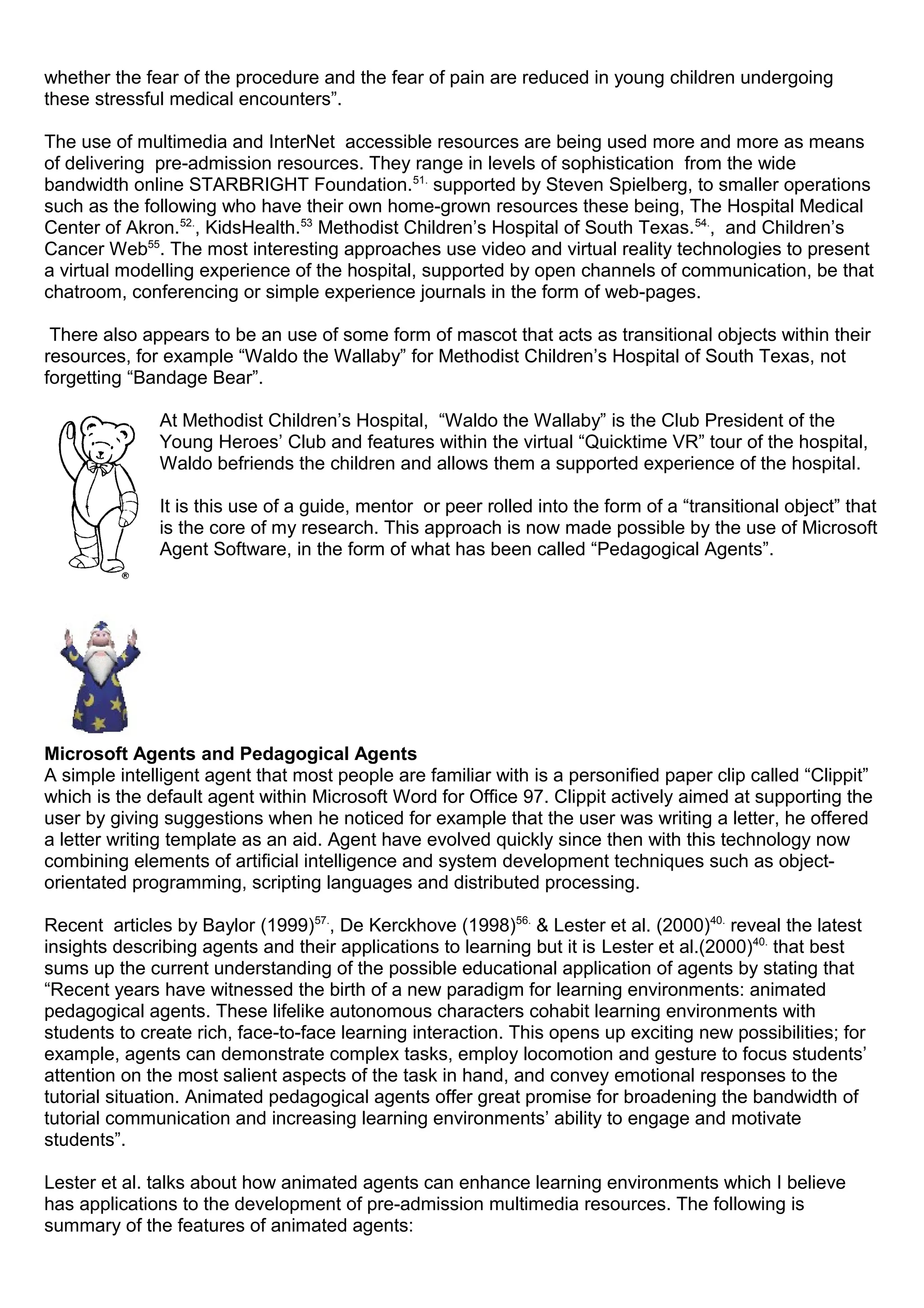
There also appears to be an use of some form of mascot that acts as transitional objects within their
resources, for example “Waldo the Wallaby” for Methodist Children’s Hospital of South Texas, not
forgetting “Bandage Bear”.
At Methodist Children’s Hospital, “Waldo the Wallaby” is the Club President of the
Young Heroes’ Club and features within the virtual “Quicktime VR” tour of the hospital,
Waldo befriends the children and allows them a supported experience of the hospital.
It is this use of a guide, mentor or peer rolled into the form of a “transitional object” that
is the core of my research. This approach is now made possible by the use of Microsoft
Agent Software, in the form of what has been called “Pedagogical Agents”.
Microsoft Agents and Pedagogical Agents
A simple intelligent agent that most people are familiar with is a personified paper clip called “Clippit”
which is the default agent within Microsoft Word for Office 97. Clippit actively aimed at supporting the
user by giving suggestions when he noticed for example that the user was writing a letter, he offered
a letter writing template as an aid. Agent have evolved quickly since then with this technology now
combining elements of artificial intelligence and system development techniques such as object-
orientated programming, scripting languages and distributed processing.
Recent articles by Baylor (1999)57.
, De Kerckhove (1998)56.
& Lester et al. (2000)40.
reveal the latest
insights describing agents and their applications to learning but it is Lester et al.(2000)40.
that best
sums up the current understanding of the possible educational application of agents by stating that
“Recent years have witnessed the birth of a new paradigm for learning environments: animated
pedagogical agents. These lifelike autonomous characters cohabit learning environments with
students to create rich, face-to-face learning interaction. This opens up exciting new possibilities; for
example, agents can demonstrate complex tasks, employ locomotion and gesture to focus students’
attention on the most salient aspects of the task in hand, and convey emotional responses to the
tutorial situation. Animated pedagogical agents offer great promise for broadening the bandwidth of
tutorial communication and increasing learning environments’ ability to engage and motivate
students”.
Lester et al. talks about how animated agents can enhance learning environments which I believe
has applications to the development of pre-admission multimedia resources. The following is
summary of the features of animated agents:
• Interactive Demonstrations – “an animated agent that inhibits a virtual world or desktop can
provide the opportunity for teaching the student how to perform a task or witness a procedure
being undertaken”. This would be particularly of value for children to witness a transitional object
agent undergoing a medical procedure that the child has to undertake in the near future
• Navigation Guidance – “an animated agent is valuable as navigational guides, leading students
around and preventing them for becoming lost”. One of the most common problems with student-
centred multimedia resources is the problem of developing an intuitive interface that allows the
user to create their path of exploration, an agent could assist in this object.
• Gaze and Gesture as Attentional Guides – “An animated agent can direct the students’
attention to a specific aspect of a chart, graphic or animation with the most common and natural
methods: gaze and gestures”.
• Nonverbal Feedback – “One of the primary role of a tutor is to provide feedback on a student’s
actions. In addition to providing verbal feedback, an agent can also use nonverbal communication
to influence the student”. This is of particular value in the area of communicating the full range of
messages that are embedded in experiencing medical procedures for even a virtual Teddy Bear
agent.
• Conversational Signal – “When people carry on face-to-face dialogues, they employ a wide
variety of nonverbal signals to help regulate the conversation and complement their verbal
utterance. While tutorial dialogue in most previous tutoring systems resembles Internet chat or a
phone conversation, animated pedagogical agents allow us to more closely model face-to-face
interactions to which people are most accustomed”.
• Conveying and Eliciting Emotion – “Motivation is a key ingredient in learning, and emotions
play an important role in motivation. By employing a computational model of emotion, animated
agents can improve students’ learning experiences in several ways (Elliott, Rickel, & Lester 1999).
First, an agent that appears to care about a student’s progress may encourage the student to care
more about her own progress. Second, an emotive pedagogical agent may convey enthusiasm for
the subject matter and thereby foster similar levels of enthusiasm in the learner. Finally, a
pedagogical agent with a rich and interesting personality may simply make learning more fun. A
learner that enjoys interacting with a pedagogical agent may have a more positive perception of
the overall learning experience and may consequently opt to spend more time in the learning
environment”.
As you can see from the above the features of pedagogical agents they fit well within the qualities
required of my proposed virtual transitional objects and at the same time afford possibilities to work
with the theoretical framework of educational pedagogues.
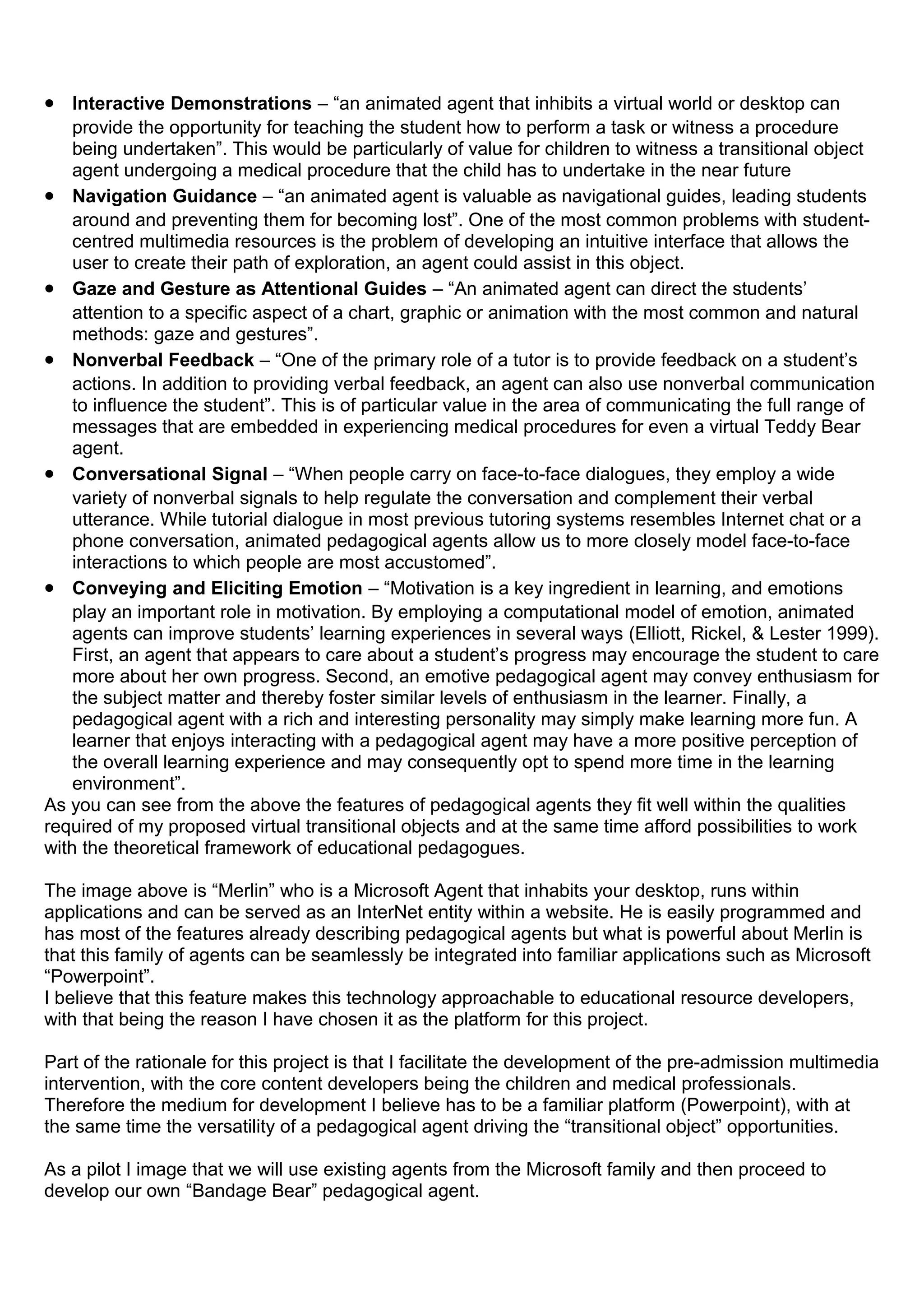
The image above is “Merlin” who is a Microsoft Agent that inhabits your desktop, runs within
applications and can be served as an InterNet entity within a website. He is easily programmed and
has most of the features already describing pedagogical agents but what is powerful about Merlin is
that this family of agents can be seamlessly be integrated into familiar applications such as Microsoft
“Powerpoint”.
I believe that this feature makes this technology approachable to educational resource developers,
with that being the reason I have chosen it as the platform for this project.
Part of the rationale for this project is that I facilitate the development of the pre-admission multimedia
intervention, with the core content developers being the children and medical professionals.
Therefore the medium for development I believe has to be a familiar platform (Powerpoint), with at
the same time the versatility of a pedagogical agent driving the “transitional object” opportunities.
As a pilot I image that we will use existing agents from the Microsoft family and then proceed to
develop our own “Bandage Bear” pedagogical agent.
References
1. CHERI Children’s Hospital Education Research Institute, The New Children’s Hospital,
Westmead
2. Board of Studies NSW. Guiding Statement on Curriculum Integration.
http://bosnsw-k6.nsw.edu.au/linkages/guidingstatement.html
Board of Studies NSW. The Primary Curriculum 2000: An Overview.
Board of Studies NSW. Personal Development, Health and Physical Education K-6.
Board of Studies NSW. Human Society and Its Environment K-6.
Board of Studies NSW. Science and Technology K-6.
Board of Studies NSW. Resource List – K-6 PDHPE
3. Azarnoff, P. & Bourque, L. & Green, J. & Rakow, S. (1975). Preparation of children for
hospitalization: Final report to NIMH. Los Angeles: UCLA Department of Pediatrics.
4. Nelson, Chad Cameron. (1994). Reduction of Healthy Children’s Fears Related to
Hospitalization: The Effectiveness of Multimedia Computer Instruction in Pediatric Health
Psychology. The University of South Dakota.
5. Butler, N. (1980). Child health and education in the seventies: some results on the 5 year
follow-up of the 1970 British Births Cohort. Health Visitor, 53, p81-82.
6. Rodin, Jocelyn. (1983). Will this hurt? Preparing children for hospital procedures. The Royal
College of Nursing of the United Kingdom, London.
7. Brett, A. (1983). Preparing children for hospitalization; A classroom teaching approach. Journal
of School Health, 53(9), p 561-553.
8. Poster, E C. (1984). Preparing healthy young children for hospitalization: A rationale and
proposal. Early Child Development and Care, 18, p41-51.
9. Melamed, Barbara G. & Siegel, Lawrence J. (1975). Reduction of Anxiety in Children Facing
Hospitalization and Surgery by Use of Filmed Modeling. Journal of Consulting and Clinical
Psychology, V43, n4, p511-521, 1975.
10. Bailey, Jeff G. (1998). The Impact of multimedia on children’s adaptive response to medical
procedures. Application form for Large Grant Support in 1998. CHERI, New Children’s Hospital
Westmead.
11. Utah State University. Health Care: Coping With Hospitalization.
http://www.usu.edu/~pat/posters/care/six/cope.html
12. Peterson, Lizette. & Ridley-Johnson, Robyn. & Tracy, Katy. & Mullins, Larry L. (1984).
Comparison of Three Modeling Procedures on the Presurgical and Postsurgical Reactions of
Children. Behavior Therapy, 15, p197-203, 1984.
13. Peterson, Lizette. & Ridley-Johnson, Robyn. & Tracy, Katy. & Mullins, Larry L. (1984).
Developing Cost-Effective Presurgical Preparation: A Comparative Analysis. Journal of Pediatric
Psychology, V9, n4, 1984.
14. Peterson, Lizette. & Ridley-Johnson, Robyn. & Tracy, Katy. & Mullins, Larry L. (1984).
Preparation of Well Children in the Classroom: An Unexpected Contrast Between the Academic
Lecture and Filmed Modeling Methods. Journal of Pediatric Psychology, V 9, n 3, p349-361,1984.
15. Elkins, Pauline D. (1985). Reducing Medical Fears in a General Population of Children: A
Comparison of Three Audiovisual Modeling Procedures. Journal of Pediatric Psychology, V10 , n1,
1985.
16. LaMontagne, Lynda L & Hepworth, Joseph T. & Johnson, Barbara D. & Cohen, Frances.
(1996). Children’s Preoperative Coping and Its Effects on Postoperative Anxiety and Return to
Normal Activity. Nursing Research, V 45(3), May/June 1996, p141-147.
17. Atkins, Darlene M. (1987). Evaluation of Pediatric Preparation Program for Short-Stay Surgical
Patients. Journal of Pediatric Psychology, V 12, n2, 1987.
18. Bers, Marina U. & Gonzalez-Heydrich, Joseph. (?). Zora: A Pilot Virtual Community in the
Pediatric Dialysis Unit. http://www.media.mit.edu/people/marinau/PediatricSociety/Abstract.html
19. Sheldon, Lesley M. (1996). An analysis of the concept of humour and its application to one
aspect of children’s nursing. Journal of Advanced Nursing, V24(6), December 1996, p1175-1183.
20. Demaso, David R. (2000) The Experience Journal: A Computer-Based Intervention For Families
Facing Congenital Heart Disease. Journal of the American Academy of Child and Adolescent
Psychiatry, June, 2000. http://www.findarticles.com/cf_0/m2250/6_39/63296768/print.jhtml
21. LaMontagne, Lynda L. & Hepworth, Joseph T. & Cohen, Frances. (2000). Effects of Surgery
Type and Attention Focus on Children’s Coping. Nursing Research, V 49(5), September/October
2000, p245-252.
22. LaMontagne, Lynda L. & Hepworth, Joseph T. & Cohen, Frances. (2000). Effects of Surgery
Type and Attention Focus on Children’s Coping. Nursing Research, V 49(5), September/October
2000, p245-252.
23. Pretzlik, Ursula. & Sylva, Kathy. (1999). Paediatric patients’ distress and coping: an
observational measure. Archives of Disease in Childhood, V 81(6), December 1999, p528-530.
24. Melamed, Barbara G. & Meyer, R. & Gee, C. & Soule, L. (1976). The influence of time and type
of preparation on children’s adjustment to hospitalization. Journal of Pediatric Psychology, 11, p31-
37.
25. Redpath, Caroline C. & Rogers, Cosby S. (1984). Healthy Children’s Concepts of Hospitals,
Medical Personnel, Operations, and Illness. Journal of Pediatric Psychology, V9, n1, 1984.
26. Rasnake, R. & Rogers, C S. (1984). Anxiety reduction in children receiving medical care:
Developmental considerations. Developmental and Behavioral Pediatrics, 10 (4), p165-175.
27. MERL. A Mitsubishi Electric Research Laboratory, Children’s Hospital Collaboration,
http://www.merl.com/projects/hospital/index.html
28. Winnicott D W. (1971). Playing and Reality. Penguin Books, Australia.
29. Harris, Leslie D. (undated). Transitional Realms: Teaching Composition in “Rhetland”.
http://iup.edu/en/workdays/Harris.html
30. Spirito, Anthony. & Stark, Lori J. & Grace, Nancy. & Stamoulis, Dean. (1991). Common
Problems and Coping Strategies Reported in Childhood and Early Adolescence. Journal of Youth
and Adolescence. V20 n5, 1991.
31. Spirito, A. & Stark, Lori J. & Williams, C. (1988). Development of a brief coping checklist for the
use with pediatric populations. Journal of Pediatric Psychology, 13 (4), Dec, p555-574.
32. Clark, Robert E. (1983). Reconsidering research on learning from media. Review of Educational
Research, 53 (4), p445-459.
33. Clark, Robert E. (1994). Media will never influence learning. Educational Technology Research
and Development, n42, p21-29.
34. Kozma, Robert B. (1994). Will media influence learning? Reframing the debate. Educational
Technology Research & Development. 42 (2), pp7-19.
35. Russell, Thomas, L. (2000). The “No Significant difference” Phenomenon.
http://cuda.teleeducation.nb.ca/nosignificantdifference/
36. Joy, Ernest, H II. & Garcia, Federico E. (2000). Measuring Learning Effectiveness: A New Look
at No-Significant-Difference Findings. JALN, V4, Issue 1 – June 2000.
37. Jackson, Ryan. (1999). Article Review: Kozma’s “Will Media Influence Learning” and Clark
“Media Will Never Influence Learning”. http://www.resnet.wm.edu/~crjack/Review_Number_1.htm
38. Agostino, Andrew. (1999). The Relevance of Media as Artifact: Technology Situated in Context.
Educational Technology & Society, V2, n4, p46-52, 1999.
39. Levenson, Phyllis M. & Signer, Barbara. (1985). Using Computers to Help Children Cope
With Chronic Illness. CHC, Fall V12, n2, 1985.
40. Lester, James C. & Johnson, W Lewis & Rickel, Jeff W. (2000). Animated Pedagogical
Agents: Face-to-Face Interaction in Interactive Learning Environments. International Journal of
Artificial Intelligence in Education, 2000.
http://www.csu.ncsu.edu/eos/users/l/lester/www/imedia/papers.html#agents
41. Jonassen, David H. (1990). Thinking Technology: Towards a Constructivist View of Instructional
Design. Educational Technology. September 1990.
42. Aldridge, Jerry. (1999). A Comparison of Constructivism and Developmental-Interaction
Approaches to Education. The Internet Source For Schools, Vol. 3 No. 1 –Fall 1999.
http://www.emtech.net/source/vol3no1/aldridge.htm
43. Wilson, Kathleen & Tally, William (1991). Designing for Discovery: Interactive Multimedia
Learning Environments at Bank Street College. CTE Technical Report Issue No.15.
http://www.edc.org/CCT/ccthome/reports/tr15.html
44. Baylor, Amy. (1999). Intelligent Agents as Cognitive Tools for Education. Education Technology,
Spring, 1999. http://edweb.sdsu.edu/people/Abaylor/Ias%20as%20cognitive%20tools20WEB.html
45. Bers, Marina U. & Ackermann Edith. & Cassell, Justine. & Donegan, Beth, Gonzalez,
Joseph. & DeMaso David R. & Strohecker, Carol. & Lualdi, Sarah. & Bromley, Dennis. & Karlin,
Judith. (1997). Interactive Storytelling Environments: Coping with Cardiac Illness at Boston’s
Children’s Hospital. MIT Media Laboratory. http://marinau.www.media.mit.edu/~marinau/CH198.html
46. Lave, J. (1997). The culture of acquisition and the practice of understanding. In D.Kirshner, &
J.A. Whitson (Eds) Situated cognition: Social, semiotic and psychological perspectives. Lawrence
Erlbaum Associates. P17-37.
47. Bereiter, C. (1991). Implications of connectionism for thinking about rules. Educational
Researcher, V20, n3, p10 –16.
48. Dewey, John. (1938). Experience & Education. Macmillian Publishing Company, New York.
49. Vygotsky, Lev S. (1985). Thought and Language. The MIT Press, Cambridge Mass. (translated
by Alex Kozulin)
50. Sanders, M R. & Shepherd, R W. & Cleghorn, G. & Woolford, H. (1994). The treatment of
recurrent abdominal pain in children: A controlled comparison of cognitive-behavioral family
intervention and standard pediatric care. Journal of Consulting and Clinical Psychology,62, p306-314.
51. STARBRIGHT Foundation. Wide bandwidth online and multimedia resources for kids in
hospital, supported by Steven Spielberg. http://www.starbright.org/
52. Children’s Hospital Medical Center of Akron. Online resources for children to learn about this
hospital. http://www.akronchildren.org/home.html
53. KidsHealth. Online resources for kids going to hospital.
http://www.kidshealth.org/kid/feel_better/places/hospital.html
54. Methodist Children’s Hospital of South Texas. Online children’s resources with a virtual tour of
the facility. http://sahealth.com/facilities/mch/index.html
55. Children’s Cancer Web – A online guide that aims to provide an overview of dedicated
childhood cancer pages available on the InterNet. http://www.ncl.ac.uk/child-
health/guides/guide2.htm
56. De Kerckhove, Derrick. (1998). Connected Intelligence: The Arrival of the Web Society. Kogan
Page. London.
57. Baylor, Amy. (1999). Intelligent Agents as Cognitive Tools for Education. Education Technology,
Spring, 1999. http://edweb.sdsu.edu/people/Abaylor/Ias%20as%20cognitive%20tools20WEB.html
58. Goldman-Segall, Ricki. (1992). Collaborative Virtual Communities: Using Learning
Constellations, A Multimedia Ethnographic Research Tool. Published in E. Barrett (Ed.), Sociomedia:
Multimedia, Hypermedia, and the Social Construction of Knowledge, Cambridge, MA: MIT Press,
p257-296, 1992.
http://work.merlin.cust.ubc.ca/Merlin/publicatins/references/collabvirtualcommunities.html
59. Filippo, David San. (1991). Dying & Death From AN Observational, Phenomenological &
Hermenutic Perspective. http://www.lutz-sanfilippo.com/lsfd&dperspectives.html
60. Coppock, Patrick John. (undated). The semiotics of a phenomenological research paradigm for
investigating the evolution and ontogenesis of cultural norm-systems in distributed virtual
environments. The University of Trondheim, College of Arts and Sciences, Department of Linguistics,
Norway. http://www.hf.unit.no/anv/wwwpages/Kassel.html
61. Engestrom, Yrjo. (1999). Expansive Visibilization of Work: An Activity-Theoretical Perspective.
Kluwer Academic Publishers, Netherlands.
4. Methodology
Design of the Study
This research project is a joint venture between myself and CHERI, with CHERI building upon their
already established expertise and credibility, with me wishing to do so.
Being employed by CHERI to carry out this project I will be guided by CHERI in their areas of
responsibility whilst at the same time breaking new ground in my role as an Instructional
Designer/Education Researcher.
CHERI role in this project is:
1. To carry out an objective medical empirical approach to the development of a system to reduce
stress and support client coping strategies
2. The assessment of conventional physiologically based symptoms of stress
3. Observations of children
4. Carry out questionnaires such as Hospital Fear Scale Questionnaire
The design of this part of the study will be based closely upon CHERI’s “Coping Corner” Proposal
1998 as it is their area of responsibility at The New Children’s Hospital to undertake this type of
research. Obviously I will be a major contributor to this undertaking but for this proposal please note
that what follows is CHERI’s research methodology taken from their mentioned grant application:
• This is a quasi-experimental pretest/posttest design using children aged between 8 and 12 years.
The invention focuses on the experience of hospital through a multimedia resource using an with
Animated Pedagogical Agent as a transitional object to walk through the undertaking of a surgical
procedure,
• Children younger than 8 years will be excluded for conceptual and literacy reasons. Young
adolescents are not included as the maturity and appeal level of the environment will be initially
designed for preadolescent children. Children who are unable to speak English fluently or read
will not be included. Efforts will be made to ensure an even spread of participants by gender and
age.
• There will be two groups. Both groups will be advised by their consulting pediatric surgeons,
however, the experimental group will be engaged in the multimedia experience.
• The independent variable will be ways of coping, group, age and gender (Kurdeck, 1987)
• The dependent variable will be levels of stress
• Several coping measures will be used to develop a measure with specific reference to the
population under study. These scales include Kidcope (Spirito, Stark and Williams, 1988) and
Children’s Strategies Coping Checklist – lntrusive Procedures (Ellerton et al. 1994)
I propose to promote the Cameron Nelson’s battery of instruments as described below and this will
be evaluated by CHERI but at this stage I have not confirmation whether we will use his approach.
The following is Nelson’s alternative battery of measure scales:
• The Early Childhood Trait Anxiety Scale
• The Hospital portion of the Children’s Medical Fears Questionnaire
• The Hospital Fears Questionnaire and
• The Information Acquisition Questionnaire
Six days later his sample were exposed to one of each of the interventions, then the children
completed:
• The Hospital portion of the Children’s Medical Fears Questionnaire
• The Hospital Fears Questionnaire
• The Information Acquisition Questionnaire and
• The Intervention Satisfaction Scale
For stress, two test will be used. The first will be a stress self-report scale constructed specially for
the study. The second, a physiological measure, will involve urine analysis measuring stress
hormone excretion. This will provide an opportunity to examine the relationship between self-reported
stress ad physiological markers of stress
• Sampling and any other medical advice will be as per the advice of a management committee
consisting of Pediatrics, a developmental pediatrician and two CIs
Methods
• In specific terms, the Hospital uses four levels of ‘urgency listing’ for pediatric surgery: 1 – surgery
in 7 days; 2 – surgery within 30 days; 3 – surgery within 6 months; and 4 – a ‘Forward Plan’.
Since children on Urgency List 1 may have a quite serious, potentially life-threatening condition,
List 2 children will be asked to be involved in this study.
• At the consultation where the waiting time is discussed, patients and their parents will be asked if
they would like to be involved in the study. If they agree, and as soon as the date of surgery is
known, patients will be pretested on the stress and coping measures 14 days before the
operation. Only patients on the morning list will be included (that is, they will be operated on
between 0800 and 1300 hours and will be admitted at approximately 1500 hours on the preceding
day). The posttest and intervention will occur immediately before admission on the day preceding
the surgery.
• The control group will complete and proceed to admission
• It is expected that we will recruit 50 participants, matched by gender and age, between the age of
8 to 12.
Data Analysis Techniques
• The coping scales will produce a typical style of coping which will act as an independent variable,
thus permitting analysis of variance with stress as the dependent variable
• ANOVAs (single factor; cell sizes will not permit multiple or repeated measures) will also be
conducted o the basis of gender and intervention group, with stress as the dependent variable. It
is likely that covariate analyses will be conducted with gender and intervention group as a
covariate pair
• Regression analysis will be used with age as the regressor and stress as the dependent variable
• Gain score analyses will be conducted from pretest to posttest based on stress
• Descriptive statistical analyses will be conducted of coping styles on the basis of gender and pre
and posttest changes
My role in this project is:
1. Design of an interactive system that will allay stress and help coping.
I am applying the theory of modelling as referred to previously by Melamed & Siegal (1975)9.
When
that stated that “Vicarious extinction of emotional behavior is typically achieved by exposing the child
to a model’s approach responses towards a fearful stimulus that does not result in any adverse
consequences or that may, in fact, produce positive consequences”.
It is evident to me from the resources used currently that the use of modelling is an already
successful methodology but what is not made concrete is the acknowledgment of the role
“transitional objects” play in that process.
I have specific research questions about transitional objects, cognition and the learning environment,
which are:
• The use of transitional objects
• The control of consciousness and interaction
• How parents reactions effect children
• How using designated interventions actually works to provide virtual models for children to
rehearse and explore reality
In order to explore and test these questions I plan to:
1. Take an iterative (repeat) approach to the design of this multimedia resource, aided by
systematically collecting data revealing the children’s responses and then integrate these
qualitative findings into the evolving resource
2. For the sample of children used in the CHERI project
• Collect data about their conscious experiences of the system through interviews (possibly using
the pedagogical agent)
• Video tape and analyse emotional responses to interactive settings
• Interview parents (semi-structured) and staff about how they used the system and the children’s
experience in hospital
I plan to focus upon the issues of agency of the children in hospital and how that effects the reliability
and validity of my research. At the same time I will also be evaluating the structure of the hospital in
terms of it’s organisational behaviour and being a learning organisation from a expansive visibilization
process perspective, following the guidelines by Yrio Engestrom (1999)61.
, using group facilitated
discussion software. For me it is important that I bring stakeholders within the hospital into this project
whilst at the same time promoting the use of alternative interventions.
Engstrom (1996) states that “ ….in their efforts to create a new model for the activity, a number of
projects focuses on constructing and appropriating new strategic instruments, both practical and
cognitive, which would enable the practitioners to create a new, expanded object for their activity.
This emphasis on instrumental remediation often entailed a relative neglect of corresponding
transformations in the division of labor, community and rules – that is, the social-organizational re-
mediation of the activity system. This led to ruptures and setbacks in the institutional implementation,
generalization and consolidation of the new models”.
The idea of the children, parents and medical professionals acting as both contributors/designers and
consumers of the resources is I believe an important component driving a successful outcome for this
intervention. The resource has to come from the ground up, not be something fought over at the top
and then imposed from above.
How the children use virtual transitional objects in the form of animated agent to cope with hospital,
together with whether this new outlet is used or not used in the area of agency is also of particular
interest to me
If possible I plan to correlate coded qualitative data with empirical data from the CHERI participant
within this project and use graphical modelling to map the children’s experiences alongside
sympathetic nervous systems and physiological responses.
In terms of methodology I envisage referring to at least two clearly different approaches, those being
Ethnographic and Phenomenological research paradigms.
In the area of using videotaping as a qualitative research tool and as a means of developing a
collaborative virtual community I will be following the approaches of Goldman-Segall (1992)58.
who
talks about “Multimedia ethnographic tools [videotaping] help[ing] build collaborative virtual
communities among researchers, the researched, and the multiple users of the research by sharing
not only the video and text data, but also sharing the interpretations”.
Goldman-Segall (1992) goes on the say that “Multimedia tools promote both the making of
discoveries about the subject one is studying as well as the communicating of the discoveries. Each
process is enriched and deepened. By using tools to communicate one’s discoveries, a recursive
process is started which feeds back into the original data – “thickening” (Geertz 1973) or layering the
original video documentation so that new discoveries are made (Goldman-Segall, 1988, 1989c)”.
In terms of the children’s understanding , use and the creation of a new paradigm of hospitalisation
from using pedagogical agents within this multimedia intervention, I intend to refer to a
phenomenological research paradigm.
Both Coppock (undated)60.
and Filippo (1991)59.
talk about the researcher reviewing the subjective
experiences of an individual or self, identifying stable aspects of the experience, and mapping the
experience in how it is associated with the other parts of life. Filippo (1991) states that “According to
Polkinghorne (1982), the phenomenological method attempts to describe the schemata and /or
themes that constitute human experience……A method of design, of the phenomenological research
technique, is to begin with an individuals description of an experience and from the experience and
description comes a more general description of the phenomenological structure. The description is
then analysed for specific themes and the core meanings of the experience”.
For example within Filippo’s (1991) research on “Dying and Death” he referred to the
phenomenological research of Elizabeth Kubler-Ross (1969) which identified five stages of dying and
the meanings associated to each of the stages, I hope to undercover the influence of transitional
objects (pedagogical agents as virtual teddy bears) upon the process of modelling and coping with
hospitalisation.
5. Ethics
As with all research there are a variety of frameworks in regards to ethics. The following points
demonstrate a set of guidelines will be adhered to:
1. Voluntary participation
2. No harm to the participants
3. Confidentiality
4. Due Process
5. Equality
6. Public perspicuity
7. Humaneness
8. Client benefit
9. Academic freedom
10.Respect for autonomy
Core Documents
• Ethical Approval – Copy of The Royal Alexandra Hospital For Children,
• Ethic Application Checklist
This submission has three broad criteria which are:
1. Scientific validity
2. Informed consent and
3. Ethical justification
Guidelines for submission and Ethics Application.
Within this criteria the following questioned must be addressed:
• Aim of project
• Hypothesis to be tested
• Simple description
• Background/Literature review
• Methods
• Subject
• Controls
• Recruitment of subjects and controls
• Power Analysis
• Intervention
• Measuring Instruments
• Analysis of Data/Statistics
• Interpretation and Application of Results
• Questionnaires to be used
• References
• Ethnical Analysis
• Potential risks
• Potential benefits
• Drugs
• Radiation
• Research Plan
• Proposed Date of commencement & Estimated Duration
• Budget & Sources of Funds
• Staffing
• Care of Participants
• Review of Progress
• Management of Adverse Events
• Winding up procedures
• Access to data, storage and disposal
• Consent
• Parent Information sheet
• Consent form
• Standard Release
• Further Information
• Declarations
For this project I will have to approach The Ethics Committees of both the University of Sydney and
The New Children’s Hospital, Westmead.
In keeping with other research undertaken in similar situations for example Bers, Marina U. et al.
(1997)18.
“ A human gate-keeper [will be used] to ensure that children will not encounter stressful
contents that they will not be prepared to deal with”.
6. Research program/Tentative time schedule
This project is estimated to take approximately 2 years with the following milestones broken into
quarterly time periods:
• Literature Search – first to second quarter of first year
• Review of instruments – first to mid second quarter of first year
• Analyse hospital environment and procedures – mid first quarter of first year till fourth quarter of
first year
• Build the multimedia environment, pilot and finalise programming – mid first quarter of first year to
fourth quarter of first year
• Conduct data collection and intervention – fourth quarter of first year till second quarter of second
year
• Data analysis – mid first quarter of second year till mid second quarter of second year
• Write up – mid quarter of second year till third quarter of second year
7. Tentative chapter outline
The Thesis
Writing of thesis and articles: Include any plans for structuring report, getting assistance and
feedback, chapters to be written, articles to be written, priorities.
Structure of thesis:
Acknowledgments
Declaration
Permission to copy
Abstract
List of Tables
Introduction
Statement of Problem
Significance of the Problem
Underlying Issues
Research Questions
Research Design and Methodology
Site and Location of the Study
Limitations of the Study
Definitions
Current Research
Chapter Outlines
Literature Review
Introduction
Stress and Coping with hospitalisation for children
D.W. Winnicott and transitional objects
Psychology of Identity
Constructivist Learning Theory
Animated Pedagogical Agent Theory
Vygotsky and the development of social learning theories, Developmental-Interaction Theory,
Activity Theory CHAT (Cultural Historical Activity Theory) and Situated Cognitive Theory
Sociology of Education Theory
NSW K-12 Curriculum
Multimedia Theory
Conclusion
Methodology
Qualitative and Quantitative Research
Research from which the study was devised
Choice of research instrument
Method of interview
Methodology Issues
Issues of validity
Issues of reliability
Confidentiality and Anonymity
Ethical Approval – Copy of The Royal Alexandra Hospital For Children, The Ethics Committee,
Guidelines for submission and Ethics Application.
Overcoming issues of bias
Debriefing
Research Procedures
• Selection Procedure
• Data Collection Procedure
• Data Analysis Techniques
Results
• The value of Animated Pedagogical Agents, situated cognitive theory, activity theory etc.
• Reduction in stress and improvement in coping
Discussion
Conclusions
References
Appendices
• Information Consent Form
• Child Consent Form
• Child Demographic Information Form
• Early Childhood Trait Anxiety Scale
• Kidcope scale – Spirito, Stark and Williams, 1988
• Children’s Strategies Coping Checklist – Intrusive Procedures - Ellerton et al., 1994
• Children’s Medical Fears Questionnaire
• Hospital Fears Questionnaire
• Information Acquisition Questionnaire
• Intervention Satisfaction Scale – Computer Intervention
• Intervention Satisfaction Scale – Human Intervention
List of Tables
Conferences
New Skills
Being able to appreciate and construction applications using Microsoft Agent Software, together with
Microsoft Visual Basic 6 where appropriate.
Resource Statement
• Digital video camera, “Sony D8 digital video camera” to create quicktime movie resources.
These selected quicktime movies would then from the basis of a multimedia support resource.
• 35mm SLR camera and tripod to create visual resources that would be the basis of a Virtual Tour
of The New Children’s Hospital, Westmead.
• Web page authoring and Multimedia software – Macromedia “Dreamweaver”, “Coursebuilder
and “Authorware Attain”.
• Microsoft Agent Software, Microsoft Powerpoint for Microsoft Agent template, Microsoft Visual
Basic Software
• Pentium III computer with 3D graphic card, digital capture card, CD-Rom burner, with associated
software for digital video editing and multimedia production
• Apple Quicktime VR Authoring Software
• 3D Studio Max modelling software
• “vPrism” software for Video Analysis
• “AFTER” software for coding and cataloguing selected video excerpts, and generating quantitative
data files for statistical analysis and reporting
• NUD*IST “Vivo” software for qualitative research
• Zing Technologies – “Zing” - Group Facilitated Discussion software, web based or group work
station versions depending on what will be allowed at the hospital.
Other
Semester 1, 2000
Between December and January this year I was ill with severe flu like symptoms which culminated in
me being referred to a Chest Specialist and then referred to Concorde Hospital for testing. Over
this period I had frequent periods of sick leave from my employer the University of Sydney,
reaching the point of actually running out of sick leave. It has only been since seeking
alternative treatment with a Chinese Medicine Doctor that I began to feel well.
Unfortunately at the same time I have been affected by being involved in a fatal car accident on
Australia Day. This was a severe accident where a motorcyclist crashed into our car head on
killing himself on impact.
The consequences of the accident have worked their way through all that I have done since that time,
with me now only realising there true depth.
As you can image I was severely upset about the fatality even through I was not at fault but had no
time to work through this issue as we had to deal with more current issues of physical recovery.
I resigned from my position as an Instructional Designer from the University of Sydney as I felt that I
was not able to cope with the pressure of that position (and I had no sick leave) and at the same time
look after my incapacitated wife.
I received a doctors certificate for the whole month of February to recover whilst at the same time
helping my wife. Since that time both my wife and I have recovered enough to return to half time
work, with me taking up a Research Assistant position ( Children and Cyberspace) at the University
of Western Sydney.
Unfortunately up until the last couple of weeks I have also suffered from stress resulting in poor sleep
patterns and neuropsychological complaints which I have received referrals from my doctor to
investigate.
These neuropsychological complaints include the following:
• Poor short term memory – not being able to remember where I placed things and constantly
moving things around to not lose them
• Being dyslexic, in terms of having difficulty in reading and speech, by reversing words and
numbers
• Strange behaviours resulting from not being able to focus on multiple thinking tasks
simultaneously
At the same time I have had the added stress of starting a new position, lacking my normal
confidence.
Looking at this all together I have struggled this semester but have not been able to work at a
standard that I am happy with and have decided to alert the university of these issues so that I may
increase my candidature to take this into account.
Together with feeling healthy and energetic, whilst working only half time, will allow me to study
productively, overcoming this semesters problems.
I had a progress meeting with the faculty this semester and we attempted to work to a deadline for
this research proposal.
Semester 2, 2000
This semester my wife was diagnosed with breast cancer which naturally added to our previous
ongoing issues resulting from our car accident. As you can image this has been a difficult time for
both my wife and I but we have struggle through.
As a result of our claims on third party insurance through our car accident it is becoming apparent
from psychometric tests by my consulting psychologist that I have suffered a minor head injury that
has made concentrating difficult for me. It appears that the difficulties that I have encountered this
year have a measurable index outside the range of my intact cognitive abilities.
As I have moved through this proposal within the last couple of months I have recently observed
noticeable improvements which I hope will continue to develop to return to my previous abilities.
As I write this proposal myself and Kathryn Crawford will meet with Professor Jeff Bailey of CHERI to
present my ideas and work towards proceeding with the next stage of offering this research agenda
for their evaluation. Therefore by the time I meet for my proposal review I should have an indication
of their level of support.
Bibliography
Books
Ames, Andrea L. & Nadeau, David, R. & Moreland, John L. (1997). VRML 2.0 Sourcebook. John
Wiley & Sons, Brisbane.
Armstrong, Felicity. (ed) (1999). Disability, Human Rights and Education: Cross-cultural
perspectives. Open University Press, Buckingham.
Brady, L. & Kennedy, K. (1999). Curriculum Construction. Prentice Hall, Sydney.
Bogdan, R and Biklen, S. (1998). Qualitative Research in Education: An Introduction to Theory and
Methods. Allyn and Bacon, Boston.
Bruner, J. (1985). Vygotsky: A Historical and Conceptual Perspective. in Wertsch, J. (Ed.) Culture
and Communication: Vygotskian Perspectives, Cambridge Press, Cambridge.
Burgess, Robert G. (1991) In the Field: An Introduction to Field Research. Routledge, London.
Gage, N.L. & Berliner, David C. (1988). Educational Psychology. Houghton Mifflin Company,
Boston.
Campbell, Joseph. (1988). The Power of Myth. DoubleDay, Sydney.
Chapman, Karen. (1986). The Sociology of Schools. Tavistock, London.
Claxton, Guy. (1999). Wise – Up. Bloomsbury, London.
Cohen, Louis. & Manion Lawrence. (1997). Research Methods in Education (4th
Edition).
Routledge, London.
Cole, Michael. (1996) Cultural Psychology: A once and Future Discipline. The Belknap Press of
Harvard University Press, Cambridge, Massachusetts.
Cole, Michael. (ed.) (1997) Mind, Culture, and Activity. Cambridge, University Press.
Cole, Michael. (1997). Cultural Psychology: A Once and Future Discipline. The Belknap Press of
Harvard University Press Cambridge, Massachusetts.
Coyne, Richard. (1999). technoromanticism: digital narrative, holism, and the romance of the real.
The MIT Press, Cambridge, Massachusetts.
Damer, Bruce. (1998). Avatars! Exploring and Building Virtual Worlds on the Internet. Peachpit
Press, Berkeley. CA. http://www.digitalspace.com/avatars/
De Bono, Edward. (1993). Serious Creativity: Using the Power of Lateral Thinking to Create New
Ideas. HarperCollinsPublishers, London.
De Kerckhove, Derrick. (1998). Connected Intelligence: The Arrival of the Web Society. Kogan
Page. London.
De Lacey, Philip. (1974). So Many Lessons to Learn: Failure in Australian Education. Pelican Books,
Penquin Books, Australia, Ringwood, Victoria.
Dombrower, E. (1998). Dombrower’s Art of Interactive Entertainment Design. McGraw-Hill, Sydney.
Dewey, John. (1938). Experience & Education. Macmillian Publishing Company, New York.
Engestrom, Yrjo. (1999). Expansive Visibilization of Work: An Activity-Theoretical Perspective.
Kluwer Academic Publishers, Netherlands.
Faulkner, Dorothy. (ed) (1998) Learning relationships in the classroom. Routledge, London.
Freire, Paulo. (1972). Cultural Action for Freedom. Penguin Books, Australia, Ringwood, Victoria.
Gagne, Robert M. (1970). The Conditions of Learning. Holt, Rinehart and Winston, Sydney.
Gardner, H. (1993). Multiple Intelligence: The Theory in Practice. BasicBooks, A division of Harper
Collins Publishers, Inc.
Giddens, Anthony. (1994). The Constitution of Society: Outline of the Theory of Structuration.
University of California Press, Berkeley.
Gilmore, Peter. & Lansbury, Russell. (1978). Ticket to Nowhere: Training and Work in Australia.
Pelican Books, Penguin Books, Australia, Ringwood, Victoria.
Goldman-Segall, Ricki. (1992). Collaborative Virtual Communities: Using Learning Constellations, A
Multimedia Ethnographic Research Tool. Published in E. Barrett (Ed.), Sociomedia: Multimedia,
Hypermedia, and the Social Construction of Knowledge, Cambridge, MA: MIT Press, p257-296,
1992. http://work.merlin.cust.ubc.ca/Merlin/publicatins/references/collabvirtualcommunities.html
Goleman, Daniel. (1996). Emotional Intelligence: Why it can matter more than IQ. Bloomsbury
Publishing Plc, London.
Grbich, Carol. (1999). Qualitative Research in Health. Allen & Unwin, St. Leonards, N.S.W.
Hagel, John III. & Armstrong, Arthur G. (1997). net.gain: Expanding markets through virtual
communities. Harvard Business School Press.
Harker, R.K & McCconnochie, K.R. (1985). Education as Cultural Artifact. The Dunmore Press,
Palmerston North, New Zealand.
Heath, Samantha. (1998). Perioperative care of the child. Quay Books, Wiltshire, England.
Heinich, Molenda, Russell. (1989). Instructional Media. Macmillan Publishing Company.
Henriques,J. & Hollway, W. & Urwin, C. & Venn, C. & Walkerdine, V. (1998). Changing the
Subject: Psychology, social regulation and subjectivity. Routledge, London.
Hoffman, Robert, R. & Palermo, David, S. (1991). Cognition and the Symbolic Processes.
Lawrence Erlbraum Associates, Publisher, Hillsdale, New Jersey.
Holt, John. (1976). Instead of Education: Ways to help people do things better. Pelican Books,
Penquin Books, Australia, Ringwood, Victoria.
Illich, Ivan. (1971). Deschooling Society. Penguin Books, Australia Ltd, Ringwood, Victoria.
Johnson, D. & Johnson, R. (1991). Learning Together and Alone. Allyn and Bacon.
Jones, Steven, G. (1995). Cybersociety 2.0: Revisiting Computer-Mediated Communication and
Community. SAGE Publications, Thousand Oaks.
Kanpol, Barry. (1994) Critical Pedagory:Introduction. Bergin & Garvey, London.
Keddie, Nell. (ed.) (1973). tinker, tailor….: the Myth of Cultural Deprivation. Penguin Books,
Australia, Ringwood, Victoria.
Kim, Amy Jo. (2000). Community Building on the Web: Secret Strategies for Successful Online
Communities. Peachpit Press, Berkeley.
King, Mike. (1997) Starting Research in Education. University of Western Sydney, Macarthur.
Kommers, P. (1996). Hypermedia Learning Environment. Erlbaum Associates, New Jersey.
Kreitner, Robert . & Kinicki, Angelo. (1995). Organizational Behavior. Irwin, Sydney.
Kvale, Steinar. (1996). InterViews: an Introduction to Qualitative Research Interviewing. SAGE
Publications, Inc. Thousands Oaks, California.
Lakoff, George. (1996). Moral Politics. The University of Chicago Press, Chicago.
Lave, J. (1997). The culture of acquisition and the practice of understanding. In D.Kirshner, & J.A.
Whitson (Eds) Situated cognition: Social, semiotic and psychological perspectives. Lawrence
Erlbaum Associates. P17-37.
Lave, J. (1988). Cognition in Practice: Mind, mathematics, and culture in everyday life. Cambridge
University Press, Cambridge Massachusetts.
Lave, J. & Wenger E. (1990). Situated learning: Legitimate peripheral participation. Cambridge:
Cambridge University Press.
Lefrancois, Guy R. (1982). Psychology for Teaching. Wadsworth Publishing Company, Belmont,
California.
Lowenfeld, Victor. (x). Creative and Mental Growth. 707/11
Levy, Pierre. (1998) Becoming Virtual: Reality in the Digital Age. Plenum Trade, New York.
Luria, A R. (1973). The Working Brain: An Introduction to Neuropsychology. Basic Books.
Matlin, Margaret W. (1994). Cognition. Harcourt Brace Publishers, Sydney.
McHoul, Alec. & Grace, Wendy. (1998). A Foucault Primer: Discourse, power and the subject.
Melbourne University Press, Melbourne.
McLuhan, Marshall. (1964). Understanding Media: The Extensions of Man. A Mentor Book, New
York.
Mitchell, David, T. & Snyder, Sharon L. (1997). The Body and Physical Difference: Discourses of
Disability. The University of Michigan Press.
Nager, Nancy & Shapiro, Edna K. (2000). Revisiting a Progressive Pedagogy: The Developmental
Interaction Approach. State University of New York Press.
Nardi, Bonnie, A. (ed.) (1996) Context and Consciousness: Activity Theory and Human-Computer
Interaction. The MIT Press, Cambridge, Massachusetts.
Nardi, Bonnie, A. & O’Day, Vicki L. (1999) Information Ecologies: Using Technology with Heart.
The MIT Press, Cambridge, Massachusetts.
Newman, Fred. & Holzman, Lois. (1993). Lev Vygotsky: Revolutionary scientist. Routledge,
London.
Negroponte, Nicholas. (1995). Being Digital. Hodder & Stoughton. Rydalmere NSW.
Nix, Don. & Spiro, Rand. (1990). Cognition, Education and Multimedia: Exploring Ideas in High
Technology. Lawrence Erlbaum Associates, Publishers, Hillsdale New Jersey.
Papert, Seymour.(1980). Mindstorms: Children, Computers, and Powerful Ideas. The Harvest Press,
Brighton, Sussex.
Porter, L. (1997). Creating the Virtual Classroom: Distance learning with the Internet. Wiley
Computer Publishing, New York.
Roblyer, M D. & Edwards, Jack. & Havriluk, Mary A. (1997). Integrating Educational Technology
into Teaching. Chapter 4: Using Instructional Software in Teaching and Learning. Merrill, imprint of
Prentice Hall, Columbus , Ohio.
Robinson, Carol. & Stalker, Kirsten. (1998). Growing Up With Disability. Jessica Kingsley
Publishers, London.
Rodin, Jocelyn. (1983). Will this hurt? Preparing children for hospital procedures. The Royal College
of Nursing of the United Kingdom, London.
Roulet, J & Spiro, R. (1996) Hypertext and Cognition chapter 2 “Studying and Learning with
Hypertext: Empirical Studies and Their Implications”. Lawrence Erlbaum Associates, New Jersey.
Salomon, G. Technology and the Future of Schooling.chapter 5 Learning in Wonderland: What Do
Computers Really Offer Education?
Scardamalia, M. & Bereiter, C. (1994). Computer Support for Knowledge-building Communities in
CSCL: Theory and Practice. Erlbaum.
Shields, Rob. (editor). (1996). Cultures of Internet: Virtual Spaces, Real Histories, Living Bodies.
Sage Publications, London.
Small, P. (1998). Magical A-Life Avatars: A new paradigm for the Internet. Manning, Greenwich.
http://www.manning.com
Smith, Marc A. (1999). Communities in Cyberspace. Routledge, London.
Slouka, Mark. (1997). War of the Worlds: The assault on reality. Abacus, London.
Toffler, Alvin. (----). Future Shock
Tapscott, Don. (1998). Growing up Digital: The Rise of the Net Generation. McGraw-Hill, Sydney.
Taylor, Steven B. (1998). Introduction to Qualitative Research Methods: A Guidebook and
Resource. John Wiley & Sons, Inc. Brisbane.
Walkerdine, Valerie. (1990). The mastery of reason: cognitive development and the production of
rationality. Routledge, London.
Walkerdine, Valerie. (1998). Daddy’s Girl: Young Girls and Popular Culture. Harvard University
Press, Cambridge, Massachusetts.
Wilcox, Sue. (1998). Web Developer.COM: Guide to 3D Avatars. Wiley Computer Publishing, New
York.
Winnicott D W. (1964). The Child, the Family and the Outside World. Pelican Book, Australia.
Winnicott D W. (1971). Playing and Reality. Penguin Books, Australia.
Whittle, David B. (1997). Cyberspace: The Human Dimension. W.H. Freeman and Company, New
York.
Vygotsky, Lev S. (1985). Thought and Language. The MIT Press, Cambridge Mass. (translated by
Alex Kozulin)
Online Conferences & Website Resources
Active Worlds – on-line interactive VRML learning worlds.
http://www.activeworlds.com/
Apple Computer Inc. (1997). Convomania: A website Designed For Sick and Disabled Children.
http://www.info.apple.com/pr/press.releases/1997/q3/970403.pr.rel.convomania.html moved to
Convonation, United Cerebral Palsy of Oklahoma. http://www.ucpokk.org/convo.htm
Apple Computer Inc. (2000). Quicktime VR Authoring Studio. Combines and integrates individual
photographs into a seamless Quicktime VR panorama.
http://www.apple.com/quicktime/qtvr/authoringstudio/
Australian Health Promoting Schools Association. Initiate and support ways of establishing in
schools a broad view of health consistent with the Ottawa Charter for Health Promotion.
http://www.hlth.qut.edu.au/ph/ahpsa/about.htm
Blossom, J & Nanny, M. Getting Bang From Your Killer Game Engines. 10:00am – 11:00am, May 6,
1998.
Board of Studies NSW. Guiding Statement on Curriculum Integration.
http://bosnsw-k6.nsw.edu.au/linkages/guidingstatement.html
Board of Studies NSW. The Primary Curriculum 2000: An Overview.
Board of Studies NSW. Personal Development, Health and Physical Education K-6.
Board of Studies NSW. Human Society and Its Environment K-6.
Board of Studies NSW. Science and Technology K-6.
Board of Studies NSW. Resource List – K-6 PDHPE
Bruckman, A. Community Design for Game Developers.10:00am – 6:00pm, March 16, 1999.
CNET staff. “IT CAME FROM….BEYOND THE BROWSER!
http://www.cnet.com/Content/Features/Howto/Beyond/index.html
Casimir, Jon. (1999). Talkin’ verbot blues: Jon Casimir finds little virtue in the conversation of a
virtual personality. Sydney Morning Herald Dec 17, 1999. http://www.vperson.com
Center for Activity Theory and Developmental Work Research
http://www.helsinki.fi/~jengestr/activity/60.htm
Children’s Hospital Medical Center of Akron. Online resources for children to learn about this
hospital. http://www.akronchildren.org/home.html
Children’s Cancer Web – A online guide that aims to provide an overview of dedicated childhood
cancer pages available on the InterNet. http://www.ncl.ac.uk/child-health/guides/guide2.htm
Computer Game Developers Conference – Long Beach, CA, http://www.cgdc.com
Computer-Supported Collaborative Learning (CSCL)
http://www.edb.utexas.edu/csclstudent/Dhsiao/theories.html
CSLI Center For The Study OF Language And Information, Stanford University. Abstract: The Media
Equation: How People Treat Computers, Television, and New Media Like Real People and Places by
Byron Reeves & Clifford Nass. http://csli-publications.stanford.edu/site/1575860538.html
ElectraCity. – a multi-user virtual world, a submission to the Australian Film Commission.
http://www.vr.org.au/ElectraCity.html
Fairfield Hospital. Online photographs with captions explaining about Farifield Hospital.
http://funrsc.fairfield/~jfleitas/hospital.html
First Frontiers. 2D Avatar Chatroom Environment.
http://www.tinman.org/Frontiers/FirstFrontiers/Welcom.html
GameBoy Monolith. Nintendo “GameBoy” Internet resource website.
http://www.vgf.net/users/gbmono/links.htm
HearMe. Live Audio Chat software. http://vp.hearme.com/products/
Hiltz, Starr, Roxanne. (1995). Teaching in a Virtual Classroom. 1995 International Conference on
Computer Assisted Instruction. ICCAI’95.
http://www.shss.montclair.edu/useful/teaching.html
Health Care: Coping With Hospitalization. Utah State University.
http://www.usu.edu/~pat/posters/care/six/cope.html
KidsHealth. Online resources for kids going to hospital.
http://www.kidshealth.org/kid/feel_better/places/hospital.html
k.i.s.s. of the panoptican and Foucault http://carmen.artsci.washington.edu/panop/subject_P.htm
Knowledge Base Project. On the Net: Resources in Virtual Reality.
http://www.hitl.washington.edu/projects/knowledge_base/onthenet.html
Methodist Children’s Hospital of South Texas. Online children’s resources with a virtual tour of the
facility. http://sahealth.com/facilities/mch/index.html
MERL. A Mitsubishi Electric Research Laboratory, Children’s Hospital Collaboration,
http://www.merl.com/projects/hospital/index.html
Experience Journals http://www.merl.com/projects/hospital/xjournal/index.html
, “Merle’s Virtual Adventure” http://www.merl.com/projects/emp/merle/We.come.html
Michel Foucault
http://carmen.artsci.washington.edu/panop/author_F.htm
Morningstar, Chip & Farmer, Randall, F. (1990). The Lessons of Lucasfilm’s Habitat. International
Conference on Cyberspace. http://www.communities.com/company/papers/lessons.html
NetSage merges with FunArts; Nass and Reeves of Stanford University join with the
combined company to lead social interface market. PR Newswire, October 20, 1998.
http://www.findarticles.com/cf_0/m4PRN/1998_Oct_20/53099044/print.jhtml
Omnimag. Interview with Clifford Nass. Rob Killheffer, 1997.
http://www.omnimag.com/archives/chats/br050297.html
On The Net. Resources in Virtual Reality.
http://www.hitl.washington.edu/projects/knowledge_base/onthenet.html
Russell, Thomas, L. (2000). The “No Significant difference” Phenomenon.
http://cuda.teleeducation.nb.ca/nosignificantdifference/
Snap Clubs. Multiple functional online community building resources.
http://clubdirectory.snap.com/index.html
STARBRIGHT Foundation. Wide bandwidth online and multimedia resources for kids in hospital,
supported by Steven Spielberg. http://www.starbright.org/
TECFA. The WWW VL: Educational Technology – Educational VR (MUD).
http://tecfa.unige.ch/edu-comp/WWW-VL/eduVR-page.html
The New Children’s Hospital. http://www.nch.edu.au
Thenetnet Review by Caitlin Burke of: The Media Equation: How People Treat Computers,
Television, and New Media Like Real People and Places by Byron Reeves & Clifford Nass.
http://thenetnet.com/schmeb/schmed15.html
The Palace. A VRML Virtual Community. http://www.thepalace.com/
The Theory of Paulo Freire
http://www.community-work-training.org.uk/freire/paulo2.htm
Virtual Children’s Hospital. Children’s Hospital of Iowa. Text based research resources concerning
the issues around hospitals. http://www.vh.org/VCH/
What is Activity Theory?
http://carbon.cudenver.edu/~mryder/itc_data/act_diff.html
WORLDS.COM. 3D Worlds using avatars, as used by StarBright. http://www.worlds.net/index2.html
Journals, eJournals, Magazines & Documents
Ainge, David J. (1996). Upper Primary Students Constructing and Exploring Three Dimensional
Shapes: A Comparison of Virtual Reality with Card Nets. Journal of Educational Computing
Research. Vol. 14 (4) 345-369, 1996.
Alao, Solomon. & Guthrie, John T. (1999). Predicting Conceptual Understanding With Cognitive
and Motivational Variables. The Journal of Educational Research. V92, n4, March/April, 1999.
Andolsek, Diane L. (1995). Virtual Reality in Education and Training. International Journal of
Instructional Media. V22, n2, p145-55, 1995.
Agostino, Andrew. (1999). The Relevance of Media as Artifact: Technology Situated in Context.
Educational Technology & Society, V2, n4, p46-52, 1999.
Araya, Agustin A. (1997). Experiencing the World Through Interactive Learning Environments.
Society for Philosophy & Technology, V3, n2, 1997.
http://scholar.lib.vt.edu/ejournals/
Atkins, Darlene M. (1987). Evaluation of Pediatric Preparation Program for Short-Stay Surgical
Patients. Journal of Pediatric Psychology, V 12, n2, 1987.
Austin, Keith. (1999). Yellow Peril. ( Pokemon) Sydney Morning Herald, November 27, 1999.
Bailey, Jeff G. (1998). The Impact of multimedia on children’s adaptive response to medical
procedures. Application form for Large Grant Support in 1998.
Baylor, Amy. (1999). Intelligent Agents as Cognitive Tools for Education. Education Technology,
Spring, 1999. http://edweb.sdsu.edu/people/Abaylor/Ias%20as%20cognitive%20tools20WEB.html
Benno, Mark. (1998). Virtual Reality. Gifted Child Today Magazine. V21, n1, p12-14, 1998.
Bereiter, C. (1991). Implications of connectionism for thinking about rules. Educational Researcher,
V20, n3, p10 –16.
Berry, Colin. (1997). The Bleeding Edge. Wired.
http://www.wired.com/wired/archive/5.10/es_gaming_pr.html
Bers, Marina U. & Ackermann Edith. & Cassell, Justine. & Donegan, Beth, Gonzalez, Joseph. &
DeMaso David R. & Strohecker, Carol. & Lualdi, Sarah. & Bromley, Dennis. & Karlin, Judith.
(1997). Interactive Storytelling Environments: Coping with Cardiac Illness at Boston’s Children’s
Hospital. MIT Media Laboratory. http://marinau.www.media.mit.edu/~marinau/CH198.html
Bers, Marina U. & Gonzalez-Heydrich, Joseph. (?). Zora: A Pilot Virtual Community in the Pediatric
Dialysis Unit. http://www.media.mit.edu/people/marinau/PediatricSociety/Abstract.html
Bossert, Phillip J. (1997). Horseless Classrooms and Virtual Learning: Reshaping Our
Environments. Nassp Bulletin. V81, n592, p3-15, Nov 1997.
Braiden, Sue. (1999). Keeping Kids Safe In Avatar-Based Communities.
http://www.tinman.org/Frontiers/FirstFrontiers/Products/SafeKids/AvatarSafety.html
Butters, Gerry. (1998). Networking in 2005: Its only Limitations May Be the Boundaries of
Imagination. Telecommunications. V32, n1, p39-41, Jan 1998.
Byrnes, Jill. (1993). Aboriginal Learning and Adult Education: Is a Synthesis Possible? Australian
Journal of Adult and Community Education. V33, n3, November 1993.
Clark, Robert E. (1983). Reconsidering research on learning from media. Review of Educational
Research, 53 (4), p445-459.
Clark, Robert E. (1994). Media will never influence learning. Educational Technology Research and
Development, n42, p21-29.
Cole, Michael. Can Cultural Psychology Help Us Think about Diversity?
http://www.ced.appstate.edu/projects/5dClhse/publications/concept/Cole.html
Coppock, Patrick John. (undated). The semiotics of a phenomenological research paradigm for
investigating the evolution and ontogenesis of cultural norm-systems in distributed virtual
environments. The University of Trondheim, College of Arts and Sciences, Department of Linguistics,
Norway. http://www.hf.unit.no/anv/wwwpages/Kassel.html
Corderoy, Robert M. & Harper, Barry M. & Hedberg, John G. (1993). Simulating algal bloom in a
lake: An interactive multimedia implementation. Australian Journal of Educational Technology, V9,
n2, p115-129, 1993.
Coulson, Andrew J. (1994). Human Life, Human Organization and Education. Education Policy
Analysis Archives. V2, n9, 1994. http://olam.ed.asu.edu/epaa/v2n9.html
Davies, Mathew, L. & Crowther, David E A. The benefits of using multimedia in higher education:
myths and realities. Aston Business School.
http://www.cti.ac.uk/publ/actlea/issue3/crowther/index.html 1/10/00
Department of Education and Training, NSW. (December, 1997). Computer-based technologies in
the primary KLAs. Teachers taking hold of new technologies – Engadine West experience.
Demaso, David R. (2000) The Experience Journal: A Computer-Based Intervention For Families
Facing Congenital Heart Disease. Journal of the American Academy of Child and Adolescent
Psychiatry, June, 2000. http://www.findarticles.com/cf_0/m2250/6_39/63296768/print.jhtml
Dunn, Rita. & Griggs, Shirley, A. & Beasley, Mark. (1995). A Meta-Analytic Validation of the Dunn
and Dunn Model of Learning-Style Preferences. The Journal of educational Research. V88, n6,
July/August, 1995.
Elkins, Pauline D. (1985). Reducing Medical Fears in a General Population of Children: A
Comparison of Three Audiovisual Modeling Procedures. Journal of Pediatric Psychology, V10 , n1,
1985.
Engestrom, Yrjo. (1999). Expansive Visibilization of Work: An Activity -Theoretical Perspective.
Computer Supported Cooperative Work 8: 63-93, 1999.
English, Miriam. (1997). ElectraCity: A multi-user virtual world. A submission to the Australian Film
Commission. http://www.vr.org.au/ElectraCity.html
Fetherston, T. (1998). A socio-cognitive framework for researching learning with IMM. Australian
Journal of Educational Technology,14(2), p98-106.
Filippo, David San. (1991). Dying & Death From AN Observational, Phenomenological &
Hermenutic Perspective. http://www.lutz-sanfilippo.com/lsfd&dperspectives.html
Fitzgerald, Robert. (1999). Designing Contexts for Learning. Novae Research Group, Australian
Technology Park.
Forder, Anthony, R. (1997). Multimedia Connections: A Case Study of A Child With Asperger’s
Syndrome. O.A.S.I.S. Online Asperger Syndrome Information and Support.
http://www.udel.edu/bkirby/asperger/folder.html
Furst-Bowe. (1996). MOOs for Teaching and Learning. Techtrends. V41, n6, p3-5, Nov-Dec 1996.
Glaser, Stan. (1997). The Real World and Virtual Worlds. Internet Research. V46, n2, p411-21, Fall
1997.
Goode, Erica. (2000). How Culture Molds Habits of Thought. New York Times.
http://www.nytimes.com/library/national/
Gordon, Julie. (1996). Tracks for Learning: Metacognition and learning technologies. Australian
Journal of Educational Technology. V12, n1, p46-55, 1996.
Grant, Mary. (1996). Development of a model using information technology for support of rural
Aboriginal students off-campus learning. Australian Journal of Educational Technology. V12, n2, p94-
108, 1996.
Greenman, Catherine. (1998). Network Help Children Cipe With Serious Illness. The New York
Times. http://www.nytimes.com/library/tech/98/05/circuits/articles/28hosp.html
Gromala, Diana, J. (1997). Virtual Avatars: Subjectivity in Virtual Environments. Visible Language.
V31, n2, p214-29, 1997.
Hannafin, Robert D. & Scott, Barry N. (1998). Identifying Critical Learner Traits in a Dynamic
Computer-Based Geometry Program. The Journal of Educational Research. V92, n1, Sept/Oct 1998.
Harris, Leslie D. (?). Transitional Realms: Teaching Composition in “Rhetland”.
http://iup.edu/en/workdays/Harris.html
Herrington, Tony. & Oliver, Ron. (1995). Critical characteristics of situated learning: Implications for
instructional design of multimedia. In J. Pearce & Ellis (Eds.) Learning with technology, University of
Melbourne, Parkville Victoria, p253-262. http://www.cowan.edu.au/lrn_sys/educres/article1.html
Herrington, Tony. & Herrington, Jan. & Oliver, Ron. (1996). Assessment in mathematics: A
multimedia resource for preservice teachers. Teaching and Learning Forum 1996.
http://wwwcleo.murdoch.edu.au/asu/pubs/tlf/tlf96/herrin65.html 4/10/00
Herrington, Tony. & Oliver, Ron. (1997). Multimedia, magic and the way students respond to a
situated learning environment. Australian Journal of Educational Technology, 13(2), p127-143.
http://cleo.murdoch.edu.au/ajet13/su97p127.html
Hodges, Melinda. (1999). Critique of “Media Will Never Influence Learning” and “Will Media
Influence Learning, Reframing the Debate”. http://www.resnet.wm/~mghodg/Webcrit2.htm
Hoffman, Helene. Vu, Dzung. (1997). Virtual Reality: Teaching Tool of the Twenty-First Century?
Academic Medicine. V72, n12, p1076-81, Dec 1997.
JAMA The Journal of American Medical Association. (1995). Sick Kids Find Help in a
Cyberspace World. Jama, V274 (24), 1995.
Jackson, Ryan. (1999). Article Review: Kozma’s “Will Media Influence Learning” and Clark “Media
Will Never Influence Learning”. http://www.resnet.wm.edu/~crjack/Review_Number_1.htm
Jonassen, David H. (1990). Thinking Technology: Towards a Constructivist View of Instructional
Design. Educational Technology. September 1990.
Jonassen, David H. (1994). Thinking Technology: Towards a Constructivist Design Model.
Educational Technology, April 1994.
Joy, Ernest, H II. & Garcia, Federico E. (2000). Measuring Learning Effectiveness: A New Look at
No-Significant-Difference Findings. JALN, V4, Issue 1 – June 2000.
Kain, Zeev N. (2000). Perioperative Psychological Issues in Children. ASA Professional Information.
Committee of Pediatric Anesthesia.
http://www.asahq.org/NEWSLETTERS/2000/08)00/perioperative0800.html
Kennedy, D. (1997). Design elements for interactive multimedia. Australian Journal of Educational
Technology, 3(1), 1-22.
Kent, Steven. (1999). Living in a Digital Playground. MSNBC. http://www.zdnet.com/
Kim, Amy, Jo. (1998). Killers Have More Fun. Wired. http://www.wired.com/archive/6.05/ultima.html
Kim, Jaehyun. Song, Young, Soo. (1997). Instructional Design Guidelines for Virtual Reality in
Classroom Applications. EDRS: ED415832.
Koschmann, T.D. & Myers, A C. & Feltovich, P J. & Barrows, H S. (1994). Using technology to
assist in realising effective learning and instruction: A principled approach to the use of computers in
collaborative learning. Journal of the Learning Sciences, V3, n3, p227-264. 1994.
Kozma, Robert B. (1994). Will media influence learning? Reframing the debate. Educational
Technology Research & Development. 42 (2), pp7-19.
Krantz, Michael. (1999). Grab Your Breastplate!: Everquest reinvents the Web role-playing game.
Time. P60, June 28, 1999. http://www.pathfinder.com
LaMontagne, Lynda L & Hepworth, Joseph T. & Johnson, Barbara D. & Cohen, Frances.
(1996). Children’s Preoperative Coping and Its Effects on Postoperative Anxiety and Return to
Normal Activity. Nursing Research, V 45(3), May/June 1996, p141-147.
LaMontagne, Lynda L. & Hepworth, Joseph T. & Cohen, Frances. (2000). Effects of Surgery
Type and Attention Focus on Children’s Coping. Nursing Research, V 49(5), September/October
2000, p245-252.
Lefevre, Greg. (1997). Sick Kids feel better by going online. CNN interactive.
http://cnn.com/RECH/9703/24/sick.kid.kid.network/index.html
Leidlmair, Karl. (1999). From the Philosophy of Technology to a Theory of Media. Society for
Philosophy & Technology. V4, n3, Spring 1999.http://scholar.lib.vt.edu/ejournals/
Lenk, Hans. (1998). Advances in the Philosophy of Technology: New Structural Characteristics of
Technologies. Society for Philosophy & Technology. V4, n 1.
http://scholar.lib.vt.edu/ejournals/
Levenson, Phyllis M. & Signer, Barbara. (1985). Using Computers to Help Children Cope With
Chronic Illness. CHC, Fall V12, n2, 1985.
Lester, James C. & Converse, Sharolyn A. & Kahler, Susan E. & Barlow, S. Todd. & Stone,
Brian A. & Bhoga, Ravinder S. (1997). The Persona Effect: Affective Impact of Animated
Pedagogical Agents. CHI 97 Electronic Publications: Papers.
http://www.acm.org/sigchi/chi97/proceedings/paper/jl.htm
Lester, James C. & Moreno, Roxana. & Mayer, Richard E. (2000). Life-Like Pedagogical Agents in
Constructivist Multimedia Environments: Cognitive Consequences of their Interaction. World
Conference on Educational Multimedia, Hypermedia, and Telecommunications.
http://www.csu.ncsu.edu/eos/users/l/lester/www/imedia/papers.html#agents
Lester, James C. & Stone, Brian A. & Stelling, Gary D. (1999). Likelike Pedagogoical Agents for
Mixed-Initiative Problem Solving in Constructivist Learning Environments. User Modeling and User-
Adapter Interaction, 9(1-2). Pp. 1-44. 1999.
http://www.csu.ncsu.edu/eos/users/l/lester/www/imedia/papers.html#agents
Lismore, Philip. (undated). Theories of Change.
http://archive.dstc.edu/AU/staff/andry/lismore/alo_th_c.html
Mabe, P. Alex (2000). Helping Children Cope with Illness and Pediatric Hospitalization. Department
of Psychiatry and Health Behavior, Medical College of Georgia
Macpherson, C & Keppell, M. (1998). Virtual reality: What is the state of play in education?
Australian Journal of Educational Technology, V14, n1, p60-74, 1998.
McCarthy, Susan. (1996). The Good Deed. WIRED.
http://www.wired.com/wired/archive/4.09/starbright_pr.html
McLellan, Hilary. (1998). Virtual Events: A Cyberspace Resource for Educators. Educational
Technology. V38, n2, p57-61, Mar-Apr 1998.
Means, B & Olson K. (1994). Technology’s Role within Constructivist Classrooms. U.S. Department
of Education.
Melamed, Barbara G. & Siegel, Lawrence J. (1975). Reduction of Anxiety in Children Facing
Hospitalization and Surgery by Use of Filmed Modeling. Journal of Consulting and Clinical
Psychology, V43, n4, p511-521, 1975.
Melamed, Barbara G. & Meyer, R. & Gee, C. & Soule, L. (1976). The influence of time and type of
preparation on children’s adjustment to hospitalization. Journal of Pediatric Psychology, 11, p31-37.
Mestrovic, Stjepan. (2000). Anthony Giddens: The Last Modernist. Canadian Journal of Sociology
Online March – April 2000. http://gpu.srv.ualberta.ca/~cjscopy/reviews/giddens.html
Mitcham, Carl. (1995). Notes Towards a Philosophy of Meta-Technology. Society for Philosophy &
Technology. V1, n1&2 Fall 1995. http://scholar.lib.vt.edu/ejournals/
Moore, Paul. (1995). Learning and Teaching in Virtual Worlds: Implications of Virtual Reality for
Education. Australian Journal of Educational Technology. V11, n2, p91-102, Summer 1995.
O’Connor, Susan. (1993). Disability and the multicultural dialogue. Centre on Human Policy,
Syracuse University. http://soeweb.syr.edu/thechp/multovw1.htm
O’Byrne, KK. & Peterson, L. & Saldana, L. (1997). Survey of pediatric hospitals’ preparation
programs: Evidence of the impact of health psychology research. Health Psychol. 1997; 16:147-154.
O’Riley, Patricia. (1996). A different Storytelling of Technology Education Curriculum, Revisions: A
Storytelling of Difference. Journal of Technology Education V7, n2 Spring, 1996.
http://scholar.lib.vt.edu/ejournals/
Pinet, Celine. (1996). Virtual Reality: Heir Apparent to CAD. Digital Library and Archives. Volume 1,
Number 1, Fall 1996.http://scholar.lib.vt.edu/ejournals/
Pea, Roy D. (1985). Beyond Amplification: Using the Computer to Reorganize Mental Functioning.
Educational Psychologist. V20, n4, p167-182, 1985.
Perkins, D N. (1985). The Fingertip Effect: How Information-Processing Technology Shapes
Thinking. Educational Researcher. V27, n11, 1985.
Peterson, Lizette. & Ridley-Johnson, Robyn. & Tracy, Katy. & Mullins, Larry L. (1984).
Comparison of Three Modeling Procedures on the Presurgical and Postsurgical Reactions of
Children. Behavior Therapy, 15, p197-203, 1984.
Peterson, Lizette. & Ridley-Johnson, Robyn. & Tracy, Katy. & Mullins, Larry L. (1984).
Developing Cost-Effective Presurgical Preparation: A Comparative Analysis. Journal of Pediatric
Psychology, V9, n4, 1984.
Peterson, Lizette. & Ridley-Johnson, Robyn. & Tracy, Katy. & Mullins, Larry L. (1984).
Preparation of Well Children in the Classroom: An Unexpected Contrast Between the Academic
Lecture and Filmed Modeling Methods. Journal of Pediatric Psychology, V 9, n 3, p349-361,1984.
Pool, Carolyn R. (1997). A New Digital Literacy: A Conversation with Paul Gilster. Educational
Leadership. V55, n3, p6-11, Nov 1997.
Poster, Elizabeth C. (?) Stress Immunization: Techniques to Help Children Cope with
Hospitalization. Material-Child Nursing Journal, p119-134
Pretzlik, Ursula. & Sylva, Kathy. (1999). Paediatric patients’ distress and coping: an observational
measure. Archives of Disease in Childhood, V 81(6), December 1999, p528-530.
Rammert, Werner. (1999). Relations that Constitute Technology and Media that make a Difference:
Towards a Social Pragmatic Theory of Technicization. Society for Philosophy & Technology. Volume
4, Number 3. http://scholar.lib.vt.edu/ejournals
Rapp, Friedrich. (1995). Explosion of Needs, Quality of Life, and the Ecology Problem.
http://scholar.lib.vt.edu/ejournals/
Rapp, Friedrich. (1999). The Material and Cultural Aspects of Technology. Society for Philosophy &
Technology. V4, n3, 1999. http://scholar.lib.vt.edu/ejournals/
Rasnake, R. & Rogers, C S. (1984). Anxiety reduction in children receiving medical care:
Developmental considerations. Developmental and Behavioral Pediatrics, 10 (4), p165-175.
Redpath, Caroline C. & Rogers, Cosby S. (1984). Healthy Children’s Concepts of Hospitals,
Medical Personnel, Operations, and Illness. Journal of Pediatric Psychology, V9, n1, 1984.
Rheingold, Howard. (1993). The Virtual Community: Homesteading on the Electronic Frontier.
HarperPerennial Paperback, USA. http://www.well.com/user/hir/vcbook/index.html
Richardson, Lesley. (1995). The Medium and the Message. Australian Journal of Educational
Technology, V11, n1, p1-11, 1995.
Russell, Glenn. & Holmes, David. (1996). Electronic Nomads? Implications of trends in
adolescents’ use of communication and information technology. Australian Journal of Educational
Technology. V12, n2, p130-144. 1996.
Saile, H. Burmeier, R. & Schmidt, LR. (1988). A meta-analysis of studies on psychological
preparation of children facing medical procedures. Psychol Health, 1988; 2:107-132.
Sainsbury, Erica J. & Walker, Richard A. (1999). Collaborative Exchanges During Assessment in
Large Classes. Department of Pharmacy and Faculty of Education, University of Sydney.
Salomom, G. (1988). AI in reverse: computer tools that turn cognitive. Journal of Educational
Computing Research. V4, n2, 1988.
Salomon, G. & Perkins, D, N. & Globerson, T. (1991). Partners in Cognition: Extending Human
Intelligence with Intelligent Technologies. Educational Researcher. April, p2-9, 1991.
Salomon, G. & Perkins, Dd. & Globerson, T. (1991). Patterns in cognition: Extending human
intelligence with intelligent technologies. Educational Researchers, V20, n3, p2-9.
Sanders, M R. & Shepherd, R W. & Cleghorn, G. & Woolford, H. (1994). The treatment of
recurrent abdominal pain in children: A controlled comparison of cognitive-behavioral family
intervention and standard pediatric care. Journal of Consulting and Clinical Psychology,62, p306-314.
Scardamalia, Marlene. & Bereiter, Carl (1994). Computer Support for Knowledge-Building
Communities. The Journal of the Learning Sciences. 3(3), p265-283.
http://carbon.cudenver.edu/~bwilson/building.html
Scardamalia, Marlene. & Bereiter, Carl Schools as Knowledge Building Organizations. Ontario
Institute for Studies in Education fo the University of Toronto.
http://csile.oise.utoronto.ca/abstracts/ciar-understanding.html
Schaumburg, Heike. (1999?). Computers as tools or as social actors? – User perspectives on the
social interface. Freie Universitat Berlin. http://userpage.fu-berlin.de/~hoige/papers/oastudy1.html
Sheldon, Lesley M. (1996). An analysis of the concept of humour and its application to one aspect of
children’s nursing. Journal of Advanced Nursing, V24(6), December 1996, p1175-1183.
Spirito, A. & Stark, Lori J. & Williams, C. (1988). Development of a brief coping checklist for the
use with pediatric populations. Journal of Pediatric Psychology, 13 (4), Dec, p555-574.
Spirito, Anthony. & Stark, Lori J. & Grace, Nancy. & Stamoulis, Dean. (1991). Common
Problems and Coping Strategies Reported in Childhood and Early Adolescence. Journal of Youth
and Adolescence. V20 n5, 1991.
Stephens, Matthew, P. (1997). Computer Simulation in the Workplace and Technology.
http://scholar.lib.vt.edu/ejournals/
Streibel, Michael, J. (1997). Information Technology, Community, Place and Presence. University of
Wisconsin-Madison. EDRS: ED409873
Strickland, Dorothy. et al. (1996). Brief Report: Two Case Studies Using Virtual Reality as a
Learning Tool for Aautistic Children. Journal of Autism & Developmental Disorders. V26, n6, p651-
59, Dec 1996.
Swartz, James, D. Hatcher, Tim. (1996). Virtual Experiences: The Impact of Mediated
Communication in a Democratic Society. Educational Technology. V36, n6, p40-44, Nov-Dec. 1996.
Taylor, Wayne. (1997). Students Responses to Their Immersion in a Virtual Environment. University
of Washington, Meeting of the American Educational Research Association. EDRS: Ed407931
UNESCO. (1997-99). Learning Without Frontiers’ (Documents and Papers).
http://www.unesco.org/education/educprog/lwf/lwf_docs.html
van Brakel, J. (1999). Telematic Life Forms. Society for Philosophy & Technology, V4, n3, Spring
1999.http://scholar.lib.vt.edu/ejournals/
Vesely, Rebecca. (1997). Wired Wards. The Netizen – Special Report.
http://hotwired.lycos.com/netizen/97/05/special4a.html
Vestich, Eli T. (1997). review of (Stoll, C. (1995). Silicon snake oil: Second thoughts on the
information highway. New York: Doubleday). Journal of Technology Education. V9 , n1- Fall
1997.http://scholar.lib.vt.edu/ejournals/
Walkerdine, Valarie. (1998). A qualitative study of young children’s use of computer games. 1999
Large Research Grant Application Form.
Webb, Noreen, M. & ender, Philip. & Lewis, Scott. (1986). Problem-Solving Strategies and Group
Processes in Small Groups Learning Computer Programming. American Educational Research
Journal. V23, n2, p243-261.
Webb, Noreen, M. & Troper, Jonathan D. & Fall, Randy. (1995). Constructive Activity and Learning
in Collaborative Small Groups. Journal of Educational Psychology. V87, n3, p406-423.
Weiner, Rebecca. (2000). Kansas Educators Turn to the Web to Create a Unique ‘Virtual’ School.
New York Times Online. http://www.nytimes.com/
Wilson, Kathleen & Tally, William (1991). Designing for Discovery: Interactive Multimedia Learning
Environments at Bank Street College, CTE Technical Report Issue No.15.
http://www.edc.org/CCT/ccthome/reports/tr15.html
Young, Steve. (1995). Serious ill kids share feeling on-line. CNN Technology,
http://www.cnn.com/TECH/9510/starbright/index.html
Thesis
Lambert, Paul. (1998). The HENRE Project: The Design and Construction of a World Wide Web
Learning Environment. University of Sydney.
Nelson, Chad Cameron. (1994). Reduction of Healthy Children’s Fears Related to Hospitalization:
The Effectiveness of Multimedia Computer Instruction in Pediatric Health Psychology. The University
of South Dakota.
Software
EverQuest (1999). Teen +. (On-line Gaming, CD-ROM). A Sony Computer Entertainment Group
Company. http://www.everquest.com/
Welcome to the world of EverQuest, a 3D massively multiplayer on-line fantasy role-playing game.
• Adventure on-line in a world that can be populated by more that 100 other player
• Journey across continents filled with perilous dungeons, eerie crypts and mysterious underwater
landscapes
• Choose from 12 unique races and 14 distinct classes
Twinsen’s Odyssey (1997). Ages 11+. (CD-ROM) Activision. http://www.activision.com/
Twinsen, the plucky hero of Relentless, returns to face his greatest challenge ever. When strange
aliens arrive from a neighbouring planet and begin kidnapping magicians and children. Twinsen
uncovering a diabolical plot to obliterate his homeworld.
In an epic adventure that will propel him across the galaxy, Twinsen must defeat the aliens and their
evil god, the dark Monk, and save his planet.
The Clue Finders’ 3rd
Grade Adventures (1997). Ages 7-9+. CD-ROM) The Learning Company.
http://www.learningco.com/
Deep in the rain forest, the ClueFinders have stumbled onto a mystery. Jungle animals are
disappearing. And now famed scientist Dr. Pythagoras has suddenly vanished. Rumors say an
ancient monster has returned and is responsible. What is going on? Joni Savage and her team of
curious kids are going to find out. Join them and together you’ll trek into the mysterious jungle.
Quest for Camelot (1998). Ages 8+. (GameBoy – Color). Titus for Nintendo.
http://www.nintendo.com.au/
Kayley’s dream to become a Knight of the Round Table come true sooner than expected when the
evil knight, Ruber, kidnaps her mother and steals Excalibur. As Kayler, can you stop Ruber’s scheme
to overthrow King Arthur and rule Camelot?
webcrossing. A fully functional (discussions, e-mails, newsgroups, chat).
http://www.webcrossing.com/
Critical Path. A secure online file service for the sending, storage and collaboration of files. Uses
docSPACE technology. http://www.docspace.com/index-flash.html
Blackboard. Blackboard is the definitive e-learning software platform encompassing a course
management system, customizable institution-wide portals, online campus communities, and an
advances architecture allowing easy integration of multiple administration systems.
http://company.blackboard.com/products/
CoVis. A website of resources for learning through Collaborative Visualization. http://covis.nwu.edu
Wimba. Wimba Forums is the Internet’s first voice forum. http://www.wimba.com/

proposal

  • 1.
    University of Sydney Facultyof Education Education Psychology & Measurement Masters Thesis Proposal Making the experience of hospital for children “bearable”: the development and evaluation of a psychoeducational intervention based upon an animated pedagogical agent in a Developmental-Interaction multimedia environment. Ken McCullagh October 2000
  • 2.
    1. Statement oftopics Making the experience of hospital for children “bearable”: the development and evaluation of a psychoeducational intervention based upon an animated pedagogical agent in a Developmental- Interaction multimedia environment. 2. Aims, significance and expected outcomes Aims. The project has four related aims. Currently there is promising research into the use of what has been called “Pedagogical Agents”, an animated virtual assistance or guide that works with the multimedia user to enhance and support the users experience. Into this field on multimedia computer interface design, I propose that the development of a virtual transitional object in the form of a “Pedagogical Bear Agent” could have a valuable place in the design of a pre-admission/preopertive hospital intervention for children. The second aim of this project will utilise the initial content of this multimedia pre-admission resource as proposed by CHERI1. that being a virtual tour of the New Children’s Hospital, Westmead, to then act as a backbone or scaffolding for future communication outlets and resources for both children and their parents. This new resource could also be linked to have a wider school’s connection, allowing children in hospital to maintain contact with their peers and for well children to experience the hospital environment. The third aim of the project is to facilitate the development of an awareness of hospitals being a learning organisation and build closer contact between the institutions of hospital and that of school . The outcome of this coming together of institutions would I hope lead to the creation of a new syllabus module within the K-12 Curriculum that covers the issues surrounding hospitalisation and illness. Ideally this new resource could fit into three of the six key learning areas, those of “Human Society and Its Environment”, “Personal Development, Health and Physical Education” and that of “Science and Technology” allowing for curriculum integration via this module. The Board of Studies NSW2. supports the strategy of curriculum integration stating that “curriculum integration enables students to acquire an unified view of the curriculum, broadening the context of their learning beyond single key learning areas”. The final aim of this project being an appreciation that preparation for hospitalisation should being with healthy children and be developed throughout the developmental periods of children rather than the “just in time” procedure at present. The benefits from this approach would be that the bulk of children entering hospital (that being emergency cases) would be covered and that a global understanding of the issues of illness would be understood by the school population. Azarnoff & Woody (1981)3. as cited by Nelson (1995)4. , surveyed pediatric hospitals, children’s hospitals, and acute care general hospitals to find out whether they provided regular, planned hospital preparation of those 1,427 hospitals that responded, only 33% reported that they did, whilst 47% reported that they provided no planned preparation for children, with 20% reporting that they were unsure about hospital preparation. This position is further supported by Butler(1980)5. reporting on the Child Health and Education Study in Britain as cited by Rodin (1983)6. saying “that the commonest individual cause of children’s admissions to hospitals was accidents. By the age of five, 44% of the 1,965 children studied were reported to have had an accident requiring medical advice or attention and could only be prepared for this through general education”.
  • 3.
    Nelson (1995)4. quotes Brett(1983)7. andPoster (1984)8. stating that “preparation of healthy children is feasible both due to the probability of their future exposure to hospitalization and other anxiety provoking medical procedures and due to the potential benefits of preparation for other forms of health care, such as visits to the doctor’s office. Significance CHERI1. stating that “With an estimated 90,000 children in Sydney aged between 4 and 14 having some form of chronic illness”, there is ample need to develop an integrated approach to the issue of hospitalisation interventions. Melamed & Siegel (1975)9. states that “Several authors have suggested that preoperative anxiety is a significant factor in impeding recovery from surgery (Dumas, 1963; Giller, 1963; Janis, 1958). Backing this point up, Kane (2000) states that “ About 50 percent of all children undergoing routine outpatient surgery present at two weeks with new-onset anxiety, night-time crying, enuresis, separation anxiety, temper tantrums and sleep or eating disturbances. Twenty percent of these children continue to demonstrate negative behaviors six months postoperatively”. Outcomes. The outcomes of this project include an appreciation of the use of pedagogical agents in multimedia and communication tools to create positive outcomes for children with chronic illnesses. The need to allow all children access to an entry level resource (a pre-admission) even before they are ill as part of a general social studies syllabus within the curriculum for the Department of Education. • Research the process of developing a multimedia psychoeducational intervention within a children’s hospital setting • Develop and evaluate the use of pedagogical agents as a virtual transitional object (a teddy bear) for the reduction of stress and the development of coping strategies for children • Review the current approaches to pre-admission resource development • Develop a global theoretical framework for the discipline of Instructional Design that marries the use of social learning theories and the use of pedagogical agents within education 2. Review of literature Background As with most research there is a perceived problem that researchers wish to address for a target group within a social setting. In my case I am proposing to work with Professor Jeff Bailey of the Children’s Hospital Education Research Institute CHERI, at the New Children’s Hospital Westmead to develop a pre-admission multimedia intervention. This innovative intervention will attempt to reduce the stress of the experience of hospital for children and at the same time act as a backbone for the development of a collaborative learning environment to air the issues of illness and hospitalisation. Central to the projects claim of innovation will be the use of Animated Pedagogical Agents acting as transitional objects allowing children to work through the issues of hospitalisation. CHERI had already proposed a similar project called “The Coping Corner” but had not commenced work on this project, with this new proposal moving forward and fitting well within CHERI”s key organisation aims: • To achieve a significant program of applied collaborative research related to the interface between health and education
  • 4.
    • To conductinterdisciplinary conference and seminar programs, which focus on improving the interface between health and education – this indirectly promoting children’s health and welfare • To offer a limited clinical service in educational and family counselling Making sense of the literature Professor Jeff Bailey talks about the stressful encounters that children have to endure when hospitalised and the lack of “empirical information to guide our understanding of how children appraise encounters with hospitals and/or pain, what levels of fear and stress occurs, how they approach the processing of adapting to and coping with medical procedures”. Bailey (1998)10. goes on the define the psychological phenomenon of coping “as the manner in which a person’s cognitive and behavioural strategies are brought to bear to deal with a situation after the individual had made a cognitive appraisal that the event will be stressful, taxing, frightening and/or demanding”. Utah State University11. has the following resource on “Coping With Hospitization” which is a good summary of strategies to help with that process and be kept in mind with designing a support environment. • Discuss the purpose of hospitals and take a hospital tour while your child is healthy • Allow your child to bring a piece of home with her to the hospital • As a parent, participate in the hospital care program as much as possible • Give your child appropriate information about his illness and the various procedures to be used to combat it • Keep your child abreast of happenings at home. A hospitalized child needs to hear dinnertime conversations • Provide opportunities for your child to maintain peer connections • Provide a time and a place for your child to play • Work out your own stress and frustrations by maintaining balance in your life At the same time Melamed & Siegel (1975)9. cites earlier researches who suggests that the major purpose of preoperative preparation is to (a) provide information to the child (b) encourage emotional expression, and (c) establish a trusting relationship with the hospital staff. Melamed & Siegal further states that “While a number of different procedures have been used to impart information to the child about the hospital and his operation, they are similar in that they attempt to correct any misinformation that he might have and to help him master the experience by enabling him to anticipate events and procedures and to understand their meaning and purpose”. These strategies appear to support the mechanism of coping and should be incorporated into the design of preoperative interventions. Throughout the literature in this field there is an emphasis of the efficacy of the intervention and at the same time comparative studies of the various modalities. This approach has been beneficial in defining the key issues of consideration in designing these interventions which I believe are the following: • Healthy children should be exposed to pre-admission resources (Nelson (1995)4. , Peterson et al. (1984)12.13.14. ,
  • 5.
    • The importanceof the children’s understanding of illness and medical concepts taking into account the developmental conceptualisation of the child (Redpath et al. (1984)25. , Rasnake & Lischeid (1989)26. • Children’s reactions to hospitalisation (Melamed & Siegal (1975)9. , Nelson (1995)4. • The comparison of different modalities aimed at reducing anxiety in children facing hospitalisation and surgery (Peterson et al (1984)12. 13. 14. , Elkins et al (1983)15. , • The correlation between the timing of the pre-admission experiences, the age of the child and the length of stay in the hospital LaMontagne et al. (1996)16. , Atkins (1987)17. • The type and number of the pre-admission resources (Peterson et al. (1984)12. 13. 14. • The use of novel new approaches to pre-admission resources (Bers et al (1997)18. , Sheldon et al (1999)19. , Demaso (2000)20. • The issues of the parents and siblings stress and negative behaviours impacting upon the child (Atkins (1987)17. , Utah State University (2000)11. • The hospital as a learning environment and the culture of hospitals (Bers et al (1997)18. • What is the effect of these strategies with children who have had previous experiences of hospital (Nelson (1995)4. , Melamed & Siegal (1975)9. • How do you measure anxiety and the process of coping?, the development of Anxiety Scales (Melamed & Siegal (1975)9. , LaMontagne et al (2000)20. , Spirito et al. (1990)22. , Prezlik et al (1999)23. Of all the literature that I have read, the source of much of the approaches to research design and evaluation derive from the following study by Melamed & Siegal (1975)9. . Melamed & Siegal pose questions about the reliability of the data from previous studies that purports to measure the child’s anxiety, these being based upon “interview questionnaires with the parents or global ratings of the child’s responses to the treatment procedures”. Melamed & Siegal also questioned the previous measures which they feel do not take into consideration “Such factors as previous hospitalization, age of the child, and prehospitalization personality, which are cited (Vernon et al., 1965) as major determinants of psychological upset, are often uncontrolled”. Melamed & Siegal from a historical sense talk about the origins of the use of therapeutic use of modelling to effectively reduce children’s anxiety and fears concerning the hospital and surgery. They state that “Vicarious extinction of emotional behavior is typically achieved by exposing the child to a model’s approach responses towards a fearful stimulus that does not result in any adverse consequences or that may, in fact, produce positive consequences”. It appears to me that much of pre-admission intervention procedures and current online resource tends towards this theoretical approach, all of which is of interest to me in design a new multimedia resource. Melamed & Siegal study was “to investigate the efficacy of filmed modeling in reducing the emotional reactions of children admitted to the hospital for elective surgery and in facilitating their emotional adjustment during a posthospital period”. In the Melamed & Siegal study they made effects to avoid the methodological flaws of previous researchers, matching children in terms of age, sex, race and the type of surgery they were to be exposed to. At the same time both groups “also received preoperative preparation by the hospital staff….thus the effectiveness of the film was evaluated for its potency above that of procedures already thought to effectively reduce anxiety in these children”. Melamed & Siegal state that “ Since anxiety is generally regarded as a multidimensional construction expressing itself in several response classes including physiological, skeletal-muscular, and verbal (cognitive) behavior, a number of dependent measures were used in the present study to assess the children’s emotional responses to hospitalization and surgery”.
  • 6.
    For Melamed &Siegal a number of indices of the child’s emotional behaviour were employed in the categories of self-reporting, behavioural, and physiological measures. A description of these scales, their timings and their general application within the research methodology I will discuss in detail within the methodology section of this proposal. Of recent literature, the work of Cameron Nelson (1995)4. is of most value as his literature review is extensive and accurately reflects the body of research. Between citing Nelson and my own readings of that literature the following observations have arose from the research which I feel needs to be taken into consideration for my own research. As stated earlier much of the literature investigates comparative studies of interventions with conclusions such as following of the Melamed & Siegal (1975). Nelson states “The results of this study demonstrates the efficacy of an audiovisual presentation providing information on hospitalisation and on coping techniques”. Follow up studies of Melamed & Siegal (1976)24. mentioned by Nelson were summarised to put forward to position that “filmed modelling alone was effective in preparing children for hospitalisation….[and that] Routine hospital staff preparation did not provide any additional intervention effects to that of the film alone in reducing anxiety”. Although Nelson goes on to state that “the authors report that the intervention in this study suggest age is an important factor in the decision of what time to prepare a child for hospitalisation. Younger children appear to benefit most from preparations at the time of hospital admission, whereas older children may benefit from preparation in advance of hospital admission. While this study and subsequent reviews on hospitalisation preparation (Melamed, 1982; Melamed &Ridley-Johnson, 1988; Peterson & Mori, 1988) argue for the importance of a consideration of the child’s age in preparation timing, Ross (1984) argues that individual differences must also be taken into account when preparing children for hospitalisation”. One of the chief individual differences for children is their cognitive development, from this standpoint Nelson refers to the Rasnake & Lischeid study of (1989)26. which examined the effects of developmentally appropriate videotaped information for preparing children for hospitalisation. Nelson states from this study that “the authors of this study argue that information that is linguistically and cognitively appropriate is superior to other routine information or developmentally advanced information”. This acknowledgment of the importance of recognising individual differences such as age, cognitive skills and preferences, fits well into the approaches of Constructivists’/Developmental-Interactive theories and that of the use of multimedia which allows for student-centred/branched resources. Another comparative study by Peterson et al. (1984)12. states “… the present experiment suggests that the factors the modeling techniques had in common were much more important to the successful preparation of children to surgery than were such factors as similarity of the model to the child (puppet or live child), two or three dimensional display, and setting or order in which the medical procedures were shown”. This makes way to the idea that pedagogical agents such as my proposed “virtual teddy bear”, may have a place into reducing anxiety and developing coping skills for children facing hospitalisation. Of interest in this idea of the use of transitional objects in the role of mediums for the intervention of children in hospital, is the study by Bers et al. (1997)18. . of the MIT Media Laboratory and MERL27. – A Mistubishi Electric Research Laboratory. In the study by Bers, Marina U. et al (1997)45. they created an interactive learning environment called SAGE (Storytelling Agent Generation Environment) which comprised of an interactive stuffed toy rabbit that encouraged children to explore their inner worlds through the use of personal storytelling.
  • 7.
    “SAGE was conceivedto help children “play out” what is happening in their lives by telling and listening to stories…….With SAGE, children become the designers as well as users of their creations”. This project has a lot in common with my project in that it acknowledges the “ [guidance of] the educational philosophy of Constructionism, according to which people learn best when engaged in creating some tangible object that they can reflect upon and share with others…….SAGE seeks cognitive and emotional engagement”. At the same time the SAGE project also acknowledges the influence of D.W. Winnicott’s transitional objects by stating “Winnicott (1971)23. introduced the term “transitional object” to refer to the first “not- me” object perceived by infants to give warmth, have texture, or move about “as if” endowed with a life of its own – while remaining resilient and responsive. Quintessential examples are the blanket, stuffed doll or teddy bear that some many young children like to carry around. In SAGE the rabbit assistant plays the role of a transitional object”. In Harris (undated)29. she goes further to quote Winnicott “Such transitional objects “are not part of the infant’s body [hence ‘not me’] yet are not fully recognized as belonging to external reality” (Winnicott, Playing 2). They occupy what Winnicott calls “the potential space [that is, virtual space] between (what was first) baby and mother-figure” (Winnicott, Playing 51)”. Harris goes not to talk about this “potential space” as “what we might call (to make the link with computers more clear) “virtual space”. Referring back to Winnicott he states that “Into this play area the child gathers objects or phenomena from external reality and uses these in the service of some sample derived from inner or personal reality. Without hallucinating the child puts out a sample dream potential and lives with this sample in a chosen setting of fragments for external reality” (Playing 512).” In other words this “potential space” becomes an environment of testing and working comforting issues faced in reality. This parallels the similar emphasises in the development of “Pedagogical Agents” which I will talk about within this proposal, even to the extent that their transitional object (rabbit) “is capable of some of the types of nonverbal behaviors that humans use to indicate engagement and which are commonly found in conversational narratives between people”. Another study by Peterson et al. (1984)13. studied the effects of three different modelling programs on the reactions of hospitalised children. • The control group received informal surgical preparation from the physician, nursing staff, and anesthesiologist • The second group viewed a Teddy Bear puppet show of a stuffed bear that portrayed a hospital visit • A third viewed a film of a hospital procedure • A fourth viewed another film about a different procedure The results states “that the results indicated that there were no significant differences among experimental groups. However, those who viewed some sort of model were significantly more calm and cooperative than those in the control group”. What is of interest in study this for me is that the researcher used a puppet show as a modelling device which mirrors of my intended research approach of a virtual bandage bear and is a good comparison to the Bers et al. (1997)45. paper as discussed which uses a programmable interactive rabbit as means facilitating coping with hospitalisation.
  • 8.
    In conclusion “theresults of this study indicates that the information given in the three modelling procedures was the important factor in reducing anxiety and maladaptive behaviour during hospitalisation. It appears that the information provided is more important for successful preparation than the similarity of the model to the child (puppet or child), the manner and order in which the information was presented, or the setting in which the modelling took place”. The issue becomes what is it about a puppet show (being a transitional object) that makes it appropriate as a pre-admission intervention? Nelson own study compares the efficacy of a hospitalisation information computer-based multimedia intervention to a more conventional hospitalisation slide-show intervention finding that there was no significant difference between them. The classic debate over the issue of “No Significant Difference” I will discuss within the theoretical section of this proposal. Of interest is Nelson’s measure instruments which I will adopt for this proposal but is open to alteration with the input of CHERI1. . The issue of evaluating the coping strategies of the children from a clinical position in this project will I believe be undertaken in close liaison with CHERI1. as this is their area of expertise. They have already indicated that they would recommend using the “Kidcope” (Spirito et al. (1988)30. & (1991)31. as an assessment instrument, followed by urine sampling, I am suggesting the possible use of other instruments as used by Nelson to augment their methodology. 3. Theoretical orientation “No Significant Difference Phenomenon” The classic debate of “No Significant Difference Phenomenon” – Richard E. Clark’s (1983)32. summary of “there are no learning benefits to be gained from employing any specific medium to deliver instruction…. The best current evidence is that the media are mere vehicles that deliver instructional but do not influence student achievement any more that the truck that delivers our groceries causes changes in our nutrition” The “No significant Difference Phenomenon” is documented by Thomas L. Russell (1999)35. where he makes a compilation of the now 355 research reports, summaries and papers surrounding Robert, E. Clarks’s (1983)32. war cry. Ernest H. Joy II (2000)36. states that the research methodology for making comparisons between technology-based and conventional delivery media is largely flawed, illustrating the inadequacy of their methodologies and conclusion. Joy changes the debate agenda to the issue of asking “What combination of instructional strategies and delivery media will best produce the desired learning outcome for the intended audience” and states that “Learning effectiveness is a function of effective pedagogical practices”. p1. Ryan Jackson (1999)37. in a comparative study of Clark (1994)33. and Robert Kozma (1994)34. presents Kozma’s argument “if there is no relationship between media and learning it may be because we have not yet made one……and in order to establish a relationship between media and learning we must first understand why we have failed to establish one so far”. Jackson goes on to quote Kozma again bringing what I think is the most significant point that is “to understand [what contribution media made to learning] this we must think about media in not in terms of their surface features but in terms of their underlying structure [and how] they interact with cognitive and social processes”. An new line of inquiry that appears to take up this point as construed by me is in relate to the field of Situated Cognitive Theory, has been put forward by Andrew Agostino (1999)38. in his paper titled “The Relevance of Media as Artifact: Technology Situated in Context” which I will now mention briefly.
  • 9.
    Agostino states “Whatis needed is a paradigm shift from cognitive theory and traditional research designs to situated cognition theory and designs that explore media as artifacts situated in context and described ad indivisible fragments of the interaction between agent and environment”. It is I feel the interaction of the child to the hospital that is of chief importance, the issues of agency for the child and the culture of the institution of hospitals. In this regard we are now looking at hospitals for a more Foucault which I will cover in theoretical orientation section of this proposal. Agostino goes on to say that “Situated cognition studies are beginning to challenge traditional notions about teaching and learning. Many researcher now believe that it is not possible to separate ‘what we know’ from ‘how we know’. They posit that knowledge and learning, for that matter, are fundamentally situated within the activity from which they are developed (Brown, Collins & Duguid, 1989)”. Agostino put forward the ideas of Lave (1997)46. and Bereiter (1991)47. by referring to them in that “Knowledge acquisition is really a question of ‘enculturation’” and that “Knowledge does not solely reside in the mind of an individual. It is distributed and shared among co-participants in authentic situation”, respectively. Agostino goes onto draw together what he calls the figures of the ‘situationists’ philosophy, namely John Dewey48. , Lev Vygotsky49. and J.J. Gibson which have in their turn have influenced the spawning of a variety of other theoretical positions, such as Activity Theory, Social Learning Theory, CHAT (cultural historical activity theory), the Developmental-Interaction Approach (Bank Street), Situated Cognition/Learning and Critical Literacy to name a few. What Agostino says that is important is that “… media only exist as artifacts holding historical and negotiated significance within a particular context…..Situated cognition theory has shed new light on the way people learn and the way they interact with the environment and accordingly, with the artifacts of that environment”. The next question is one of which pedagogy is best the support this approach to learning, there are I believe there are two to choose from that have been used within the multimedia context, Developmental – Interactive and Constructivists approaches. Jonassen, David H. (1990)41. states that: “Constructivism is the belief that knowledge is personally constructed form internal representations by individuals using their experiences as a foundation. Knowledge is based upon individual constructions that are not tied to any external reality, but rather to the knower’s interactions with the external world. Reality is to a degree whatever the knower conceives it to be”. Aldridge, Jerry. (1999)42. in “A Comparison of Constructivism and Developmental-Interaction Approaches to Education” spells out the similarities and differences between the two approaches which are: “ The Similarities • Children learn best when they are active learners and interact with the environment • The development of autonomy is primary aim of education • Social interaction is necessary and vital for learning • Children’s prior knowledge and interests should be used for planning instruction The Differences • The constructivist approach uses Piaget’s theory as its theoretical base while the developmental- interaction approach draws from a [mainly social learning theories derived from Vygotsky and Dewey]
  • 10.
    • In actualpractice, the constructivist approach emphasises logico-mathematical knowledge while the developmental-interaction approach emphasises social knowledge • The constructivist approach focuses on peer interaction for the construction of knowledge, while the developmental-interaction approach stresses adult guidance [scaffolding] and clarification through peer discussion • The constructivist approach emphasises cognitive development while the developmental- interaction approach attempts to balance and integrate cognitive and socioemotional development • Since Piaget was not interested in context, the constructivist approach has not fully addressed issues related to social justice, feminist and critical theories or postmodern education, while the developmental-interaction supporters are currently evaluating the approach in light of recent contributions by reconceptualists, including critical, and postmodern theories In the paper Wilson et al (1991)43. “Designing for discovery: Interactive Multimedia Learning Environments at Bank Street College, Wilson gives a summary of the characteristic of the learning environment and learning experience common to discovery-based multimedia learning environment which I hope to incorporate into my pre-admission intervention. The topic heading in each category are the following: “Characteristics of the learning experience: • Child-centred • Direct experience and ‘real world’ connections • Interaction • Analysis and action • Engagement • Collaboration • Interdisciplinary Characteristics of the learning environment: • Classroom as laboratory • Organisation: Spatial and Temporal • Flexibility and consistency • Resource – rich • Humaness Of interest within the literature are the questions that have been brought up which I find the most interesting and a source of exploration for my study: • The issue of the validity and reliability of comparative studies of instructional mediums • The evaluation of puppet modelling as a prime intervention and it’s relationship to animated pedagogical agents • The children’s concepts of reality and developmental stage impacting upon hospitalisation • The issues of both the multimedia learning environment and it’s interaction with social learning theories • The effects of the child’s previous experiences of hospital impacting upon anxiety and coping strategies • The value of hospital as an learning environment and the appreciation of alternative cultural values within the organisational behaviour of hospitals
  • 11.
    Multimedia Once we haverealised that learning take place within a society of learners then we must address the delivery platform that best suits the learning experiences that we wish to facilitate. I would like to propose that a pschoeducative multimedia allows for the facilitation of modelling opportunities that can lead to better coping strategies and the reduction of anxiety for children facing hospitalisation. With this in mind I would now like to look at the question what multimedia has to offer and at the same time start to address the issue of embedded opportunities for social learning within this medium. For me it is the opportunity for social learning that makes multimedia a choice for this project as Phyllis M. Levenson and Barbara Signer (1985)39. State: “2. One of the greatest problems facing children with chronic disease may be the issue of self- acceptance. Often functional (problems) and dependence on other for (care), medicine, and assistance, accommodation (emphasise) their own sense of being different, tend to hamper feelings of control over their lives. As these children mature into adolescents and young adults, this lack of perceived control, unless addressed, is likely to limit efforts to assume responsibility for their own health care and self-sufficiency. 5. Connection with the school environment and receipt of academic training is crucially important for the overall development of the child. However, many chronic illnesses cause disruption of daily routines and school absenteeism due to recurrent bouts of illness and/or visits to the hospital or clinic. This, in turn, breaks the child’s contact with others the same age and may undermine normalisation and adjustment efforts. Thus, a need also exists to provide means for chronically ill children to maintain as much contact as possible with peers and the school.” Levenson et al. goes on to state that microcomputers have the following unique features for promoting self-sufficiency among chronically impaired individuals and helping them to cope with their condition, these are: (a) create an instructional program with a variety of options that meet the diversified needs and learning patterns of individual participation and provide immediate feedback and coaching in a manner tailored to particular individuals; (b) manage lessons and track learner progress through computer documentation of responses (verifying that patients have mastered skills necessary for self-care); (c) link patients and their families to central database for access to patient information and feedback, or allow communication with children or health-care professionals in other parts of the city, state, or country These points by Levenson et al. relates well the focus of another project by MERL27. – “Experience Journals” as evaluated by Demaso (2000)20. In which he says that: “Computer based interventions that present psychoeducational and medical information closely connected to one’s own story “may open up new possibilities for families facing pediatric illness”. This theme of opening up the channels of communication is taken up by Bailey (1998)10. who reviews a comparative study that of Sanders et al. (1994)50. that evaluates two different interventions in dealing with abdominal pain: standard paediatric care and a cognitive-behavioural family intervention, concluding that the “review of the literature emphasises the importance of focusing on the psychological aspects of hospitalisation and painful medical procedures in children”. In the Sanders et al. study the conclusion stated that “A cognitive-behavioral intervention is more beneficial to children’s management of RAP (recurrent abdominal pain) than standard pediatric care. Bailey then goes on to propose his study called CHERI’s “Kids Coping Corner” which has the goal to “ to investigate the comparative efficacy of standard paediatric consultations about painful medical procedures with a cognitive-behavioural intervention based on a multimedia simulation to determine
  • 12.
    whether the fearof the procedure and the fear of pain are reduced in young children undergoing these stressful medical encounters”. The use of multimedia and InterNet accessible resources are being used more and more as means of delivering pre-admission resources. They range in levels of sophistication from the wide bandwidth online STARBRIGHT Foundation.51. supported by Steven Spielberg, to smaller operations such as the following who have their own home-grown resources these being, The Hospital Medical Center of Akron.52. , KidsHealth.53 Methodist Children’s Hospital of South Texas.54. , and Children’s Cancer Web55 . The most interesting approaches use video and virtual reality technologies to present a virtual modelling experience of the hospital, supported by open channels of communication, be that chatroom, conferencing or simple experience journals in the form of web-pages. There also appears to be an use of some form of mascot that acts as transitional objects within their resources, for example “Waldo the Wallaby” for Methodist Children’s Hospital of South Texas, not forgetting “Bandage Bear”. At Methodist Children’s Hospital, “Waldo the Wallaby” is the Club President of the Young Heroes’ Club and features within the virtual “Quicktime VR” tour of the hospital, Waldo befriends the children and allows them a supported experience of the hospital. It is this use of a guide, mentor or peer rolled into the form of a “transitional object” that is the core of my research. This approach is now made possible by the use of Microsoft Agent Software, in the form of what has been called “Pedagogical Agents”. Microsoft Agents and Pedagogical Agents A simple intelligent agent that most people are familiar with is a personified paper clip called “Clippit” which is the default agent within Microsoft Word for Office 97. Clippit actively aimed at supporting the user by giving suggestions when he noticed for example that the user was writing a letter, he offered a letter writing template as an aid. Agent have evolved quickly since then with this technology now combining elements of artificial intelligence and system development techniques such as object- orientated programming, scripting languages and distributed processing. Recent articles by Baylor (1999)57. , De Kerckhove (1998)56. & Lester et al. (2000)40. reveal the latest insights describing agents and their applications to learning but it is Lester et al.(2000)40. that best sums up the current understanding of the possible educational application of agents by stating that “Recent years have witnessed the birth of a new paradigm for learning environments: animated pedagogical agents. These lifelike autonomous characters cohabit learning environments with students to create rich, face-to-face learning interaction. This opens up exciting new possibilities; for example, agents can demonstrate complex tasks, employ locomotion and gesture to focus students’ attention on the most salient aspects of the task in hand, and convey emotional responses to the tutorial situation. Animated pedagogical agents offer great promise for broadening the bandwidth of tutorial communication and increasing learning environments’ ability to engage and motivate students”. Lester et al. talks about how animated agents can enhance learning environments which I believe has applications to the development of pre-admission multimedia resources. The following is summary of the features of animated agents:
  • 13.
    • Interactive Demonstrations– “an animated agent that inhibits a virtual world or desktop can provide the opportunity for teaching the student how to perform a task or witness a procedure being undertaken”. This would be particularly of value for children to witness a transitional object agent undergoing a medical procedure that the child has to undertake in the near future • Navigation Guidance – “an animated agent is valuable as navigational guides, leading students around and preventing them for becoming lost”. One of the most common problems with student- centred multimedia resources is the problem of developing an intuitive interface that allows the user to create their path of exploration, an agent could assist in this object. • Gaze and Gesture as Attentional Guides – “An animated agent can direct the students’ attention to a specific aspect of a chart, graphic or animation with the most common and natural methods: gaze and gestures”. • Nonverbal Feedback – “One of the primary role of a tutor is to provide feedback on a student’s actions. In addition to providing verbal feedback, an agent can also use nonverbal communication to influence the student”. This is of particular value in the area of communicating the full range of messages that are embedded in experiencing medical procedures for even a virtual Teddy Bear agent. • Conversational Signal – “When people carry on face-to-face dialogues, they employ a wide variety of nonverbal signals to help regulate the conversation and complement their verbal utterance. While tutorial dialogue in most previous tutoring systems resembles Internet chat or a phone conversation, animated pedagogical agents allow us to more closely model face-to-face interactions to which people are most accustomed”. • Conveying and Eliciting Emotion – “Motivation is a key ingredient in learning, and emotions play an important role in motivation. By employing a computational model of emotion, animated agents can improve students’ learning experiences in several ways (Elliott, Rickel, & Lester 1999). First, an agent that appears to care about a student’s progress may encourage the student to care more about her own progress. Second, an emotive pedagogical agent may convey enthusiasm for the subject matter and thereby foster similar levels of enthusiasm in the learner. Finally, a pedagogical agent with a rich and interesting personality may simply make learning more fun. A learner that enjoys interacting with a pedagogical agent may have a more positive perception of the overall learning experience and may consequently opt to spend more time in the learning environment”. As you can see from the above the features of pedagogical agents they fit well within the qualities required of my proposed virtual transitional objects and at the same time afford possibilities to work with the theoretical framework of educational pedagogues. The image above is “Merlin” who is a Microsoft Agent that inhabits your desktop, runs within applications and can be served as an InterNet entity within a website. He is easily programmed and has most of the features already describing pedagogical agents but what is powerful about Merlin is that this family of agents can be seamlessly be integrated into familiar applications such as Microsoft “Powerpoint”. I believe that this feature makes this technology approachable to educational resource developers, with that being the reason I have chosen it as the platform for this project. Part of the rationale for this project is that I facilitate the development of the pre-admission multimedia intervention, with the core content developers being the children and medical professionals. Therefore the medium for development I believe has to be a familiar platform (Powerpoint), with at the same time the versatility of a pedagogical agent driving the “transitional object” opportunities. As a pilot I image that we will use existing agents from the Microsoft family and then proceed to develop our own “Bandage Bear” pedagogical agent.
  • 14.
    References 1. CHERI Children’sHospital Education Research Institute, The New Children’s Hospital, Westmead 2. Board of Studies NSW. Guiding Statement on Curriculum Integration. http://bosnsw-k6.nsw.edu.au/linkages/guidingstatement.html Board of Studies NSW. The Primary Curriculum 2000: An Overview. Board of Studies NSW. Personal Development, Health and Physical Education K-6. Board of Studies NSW. Human Society and Its Environment K-6. Board of Studies NSW. Science and Technology K-6. Board of Studies NSW. Resource List – K-6 PDHPE 3. Azarnoff, P. & Bourque, L. & Green, J. & Rakow, S. (1975). Preparation of children for hospitalization: Final report to NIMH. Los Angeles: UCLA Department of Pediatrics. 4. Nelson, Chad Cameron. (1994). Reduction of Healthy Children’s Fears Related to Hospitalization: The Effectiveness of Multimedia Computer Instruction in Pediatric Health Psychology. The University of South Dakota. 5. Butler, N. (1980). Child health and education in the seventies: some results on the 5 year follow-up of the 1970 British Births Cohort. Health Visitor, 53, p81-82. 6. Rodin, Jocelyn. (1983). Will this hurt? Preparing children for hospital procedures. The Royal College of Nursing of the United Kingdom, London. 7. Brett, A. (1983). Preparing children for hospitalization; A classroom teaching approach. Journal of School Health, 53(9), p 561-553. 8. Poster, E C. (1984). Preparing healthy young children for hospitalization: A rationale and proposal. Early Child Development and Care, 18, p41-51. 9. Melamed, Barbara G. & Siegel, Lawrence J. (1975). Reduction of Anxiety in Children Facing Hospitalization and Surgery by Use of Filmed Modeling. Journal of Consulting and Clinical Psychology, V43, n4, p511-521, 1975. 10. Bailey, Jeff G. (1998). The Impact of multimedia on children’s adaptive response to medical procedures. Application form for Large Grant Support in 1998. CHERI, New Children’s Hospital Westmead. 11. Utah State University. Health Care: Coping With Hospitalization. http://www.usu.edu/~pat/posters/care/six/cope.html 12. Peterson, Lizette. & Ridley-Johnson, Robyn. & Tracy, Katy. & Mullins, Larry L. (1984). Comparison of Three Modeling Procedures on the Presurgical and Postsurgical Reactions of Children. Behavior Therapy, 15, p197-203, 1984. 13. Peterson, Lizette. & Ridley-Johnson, Robyn. & Tracy, Katy. & Mullins, Larry L. (1984). Developing Cost-Effective Presurgical Preparation: A Comparative Analysis. Journal of Pediatric Psychology, V9, n4, 1984. 14. Peterson, Lizette. & Ridley-Johnson, Robyn. & Tracy, Katy. & Mullins, Larry L. (1984). Preparation of Well Children in the Classroom: An Unexpected Contrast Between the Academic Lecture and Filmed Modeling Methods. Journal of Pediatric Psychology, V 9, n 3, p349-361,1984. 15. Elkins, Pauline D. (1985). Reducing Medical Fears in a General Population of Children: A Comparison of Three Audiovisual Modeling Procedures. Journal of Pediatric Psychology, V10 , n1, 1985. 16. LaMontagne, Lynda L & Hepworth, Joseph T. & Johnson, Barbara D. & Cohen, Frances. (1996). Children’s Preoperative Coping and Its Effects on Postoperative Anxiety and Return to Normal Activity. Nursing Research, V 45(3), May/June 1996, p141-147. 17. Atkins, Darlene M. (1987). Evaluation of Pediatric Preparation Program for Short-Stay Surgical Patients. Journal of Pediatric Psychology, V 12, n2, 1987. 18. Bers, Marina U. & Gonzalez-Heydrich, Joseph. (?). Zora: A Pilot Virtual Community in the Pediatric Dialysis Unit. http://www.media.mit.edu/people/marinau/PediatricSociety/Abstract.html 19. Sheldon, Lesley M. (1996). An analysis of the concept of humour and its application to one aspect of children’s nursing. Journal of Advanced Nursing, V24(6), December 1996, p1175-1183.
  • 15.
    20. Demaso, DavidR. (2000) The Experience Journal: A Computer-Based Intervention For Families Facing Congenital Heart Disease. Journal of the American Academy of Child and Adolescent Psychiatry, June, 2000. http://www.findarticles.com/cf_0/m2250/6_39/63296768/print.jhtml 21. LaMontagne, Lynda L. & Hepworth, Joseph T. & Cohen, Frances. (2000). Effects of Surgery Type and Attention Focus on Children’s Coping. Nursing Research, V 49(5), September/October 2000, p245-252. 22. LaMontagne, Lynda L. & Hepworth, Joseph T. & Cohen, Frances. (2000). Effects of Surgery Type and Attention Focus on Children’s Coping. Nursing Research, V 49(5), September/October 2000, p245-252. 23. Pretzlik, Ursula. & Sylva, Kathy. (1999). Paediatric patients’ distress and coping: an observational measure. Archives of Disease in Childhood, V 81(6), December 1999, p528-530. 24. Melamed, Barbara G. & Meyer, R. & Gee, C. & Soule, L. (1976). The influence of time and type of preparation on children’s adjustment to hospitalization. Journal of Pediatric Psychology, 11, p31- 37. 25. Redpath, Caroline C. & Rogers, Cosby S. (1984). Healthy Children’s Concepts of Hospitals, Medical Personnel, Operations, and Illness. Journal of Pediatric Psychology, V9, n1, 1984. 26. Rasnake, R. & Rogers, C S. (1984). Anxiety reduction in children receiving medical care: Developmental considerations. Developmental and Behavioral Pediatrics, 10 (4), p165-175. 27. MERL. A Mitsubishi Electric Research Laboratory, Children’s Hospital Collaboration, http://www.merl.com/projects/hospital/index.html 28. Winnicott D W. (1971). Playing and Reality. Penguin Books, Australia. 29. Harris, Leslie D. (undated). Transitional Realms: Teaching Composition in “Rhetland”. http://iup.edu/en/workdays/Harris.html 30. Spirito, Anthony. & Stark, Lori J. & Grace, Nancy. & Stamoulis, Dean. (1991). Common Problems and Coping Strategies Reported in Childhood and Early Adolescence. Journal of Youth and Adolescence. V20 n5, 1991. 31. Spirito, A. & Stark, Lori J. & Williams, C. (1988). Development of a brief coping checklist for the use with pediatric populations. Journal of Pediatric Psychology, 13 (4), Dec, p555-574. 32. Clark, Robert E. (1983). Reconsidering research on learning from media. Review of Educational Research, 53 (4), p445-459. 33. Clark, Robert E. (1994). Media will never influence learning. Educational Technology Research and Development, n42, p21-29. 34. Kozma, Robert B. (1994). Will media influence learning? Reframing the debate. Educational Technology Research & Development. 42 (2), pp7-19. 35. Russell, Thomas, L. (2000). The “No Significant difference” Phenomenon. http://cuda.teleeducation.nb.ca/nosignificantdifference/ 36. Joy, Ernest, H II. & Garcia, Federico E. (2000). Measuring Learning Effectiveness: A New Look at No-Significant-Difference Findings. JALN, V4, Issue 1 – June 2000. 37. Jackson, Ryan. (1999). Article Review: Kozma’s “Will Media Influence Learning” and Clark “Media Will Never Influence Learning”. http://www.resnet.wm.edu/~crjack/Review_Number_1.htm 38. Agostino, Andrew. (1999). The Relevance of Media as Artifact: Technology Situated in Context. Educational Technology & Society, V2, n4, p46-52, 1999. 39. Levenson, Phyllis M. & Signer, Barbara. (1985). Using Computers to Help Children Cope With Chronic Illness. CHC, Fall V12, n2, 1985. 40. Lester, James C. & Johnson, W Lewis & Rickel, Jeff W. (2000). Animated Pedagogical Agents: Face-to-Face Interaction in Interactive Learning Environments. International Journal of Artificial Intelligence in Education, 2000. http://www.csu.ncsu.edu/eos/users/l/lester/www/imedia/papers.html#agents 41. Jonassen, David H. (1990). Thinking Technology: Towards a Constructivist View of Instructional Design. Educational Technology. September 1990. 42. Aldridge, Jerry. (1999). A Comparison of Constructivism and Developmental-Interaction Approaches to Education. The Internet Source For Schools, Vol. 3 No. 1 –Fall 1999. http://www.emtech.net/source/vol3no1/aldridge.htm
  • 16.
    43. Wilson, Kathleen& Tally, William (1991). Designing for Discovery: Interactive Multimedia Learning Environments at Bank Street College. CTE Technical Report Issue No.15. http://www.edc.org/CCT/ccthome/reports/tr15.html 44. Baylor, Amy. (1999). Intelligent Agents as Cognitive Tools for Education. Education Technology, Spring, 1999. http://edweb.sdsu.edu/people/Abaylor/Ias%20as%20cognitive%20tools20WEB.html 45. Bers, Marina U. & Ackermann Edith. & Cassell, Justine. & Donegan, Beth, Gonzalez, Joseph. & DeMaso David R. & Strohecker, Carol. & Lualdi, Sarah. & Bromley, Dennis. & Karlin, Judith. (1997). Interactive Storytelling Environments: Coping with Cardiac Illness at Boston’s Children’s Hospital. MIT Media Laboratory. http://marinau.www.media.mit.edu/~marinau/CH198.html 46. Lave, J. (1997). The culture of acquisition and the practice of understanding. In D.Kirshner, & J.A. Whitson (Eds) Situated cognition: Social, semiotic and psychological perspectives. Lawrence Erlbaum Associates. P17-37. 47. Bereiter, C. (1991). Implications of connectionism for thinking about rules. Educational Researcher, V20, n3, p10 –16. 48. Dewey, John. (1938). Experience & Education. Macmillian Publishing Company, New York. 49. Vygotsky, Lev S. (1985). Thought and Language. The MIT Press, Cambridge Mass. (translated by Alex Kozulin) 50. Sanders, M R. & Shepherd, R W. & Cleghorn, G. & Woolford, H. (1994). The treatment of recurrent abdominal pain in children: A controlled comparison of cognitive-behavioral family intervention and standard pediatric care. Journal of Consulting and Clinical Psychology,62, p306-314. 51. STARBRIGHT Foundation. Wide bandwidth online and multimedia resources for kids in hospital, supported by Steven Spielberg. http://www.starbright.org/ 52. Children’s Hospital Medical Center of Akron. Online resources for children to learn about this hospital. http://www.akronchildren.org/home.html 53. KidsHealth. Online resources for kids going to hospital. http://www.kidshealth.org/kid/feel_better/places/hospital.html 54. Methodist Children’s Hospital of South Texas. Online children’s resources with a virtual tour of the facility. http://sahealth.com/facilities/mch/index.html 55. Children’s Cancer Web – A online guide that aims to provide an overview of dedicated childhood cancer pages available on the InterNet. http://www.ncl.ac.uk/child- health/guides/guide2.htm 56. De Kerckhove, Derrick. (1998). Connected Intelligence: The Arrival of the Web Society. Kogan Page. London. 57. Baylor, Amy. (1999). Intelligent Agents as Cognitive Tools for Education. Education Technology, Spring, 1999. http://edweb.sdsu.edu/people/Abaylor/Ias%20as%20cognitive%20tools20WEB.html 58. Goldman-Segall, Ricki. (1992). Collaborative Virtual Communities: Using Learning Constellations, A Multimedia Ethnographic Research Tool. Published in E. Barrett (Ed.), Sociomedia: Multimedia, Hypermedia, and the Social Construction of Knowledge, Cambridge, MA: MIT Press, p257-296, 1992. http://work.merlin.cust.ubc.ca/Merlin/publicatins/references/collabvirtualcommunities.html 59. Filippo, David San. (1991). Dying & Death From AN Observational, Phenomenological & Hermenutic Perspective. http://www.lutz-sanfilippo.com/lsfd&dperspectives.html 60. Coppock, Patrick John. (undated). The semiotics of a phenomenological research paradigm for investigating the evolution and ontogenesis of cultural norm-systems in distributed virtual environments. The University of Trondheim, College of Arts and Sciences, Department of Linguistics, Norway. http://www.hf.unit.no/anv/wwwpages/Kassel.html 61. Engestrom, Yrjo. (1999). Expansive Visibilization of Work: An Activity-Theoretical Perspective. Kluwer Academic Publishers, Netherlands. 4. Methodology
  • 17.
    Design of theStudy This research project is a joint venture between myself and CHERI, with CHERI building upon their already established expertise and credibility, with me wishing to do so. Being employed by CHERI to carry out this project I will be guided by CHERI in their areas of responsibility whilst at the same time breaking new ground in my role as an Instructional Designer/Education Researcher. CHERI role in this project is: 1. To carry out an objective medical empirical approach to the development of a system to reduce stress and support client coping strategies 2. The assessment of conventional physiologically based symptoms of stress 3. Observations of children 4. Carry out questionnaires such as Hospital Fear Scale Questionnaire The design of this part of the study will be based closely upon CHERI’s “Coping Corner” Proposal 1998 as it is their area of responsibility at The New Children’s Hospital to undertake this type of research. Obviously I will be a major contributor to this undertaking but for this proposal please note that what follows is CHERI’s research methodology taken from their mentioned grant application: • This is a quasi-experimental pretest/posttest design using children aged between 8 and 12 years. The invention focuses on the experience of hospital through a multimedia resource using an with Animated Pedagogical Agent as a transitional object to walk through the undertaking of a surgical procedure, • Children younger than 8 years will be excluded for conceptual and literacy reasons. Young adolescents are not included as the maturity and appeal level of the environment will be initially designed for preadolescent children. Children who are unable to speak English fluently or read will not be included. Efforts will be made to ensure an even spread of participants by gender and age. • There will be two groups. Both groups will be advised by their consulting pediatric surgeons, however, the experimental group will be engaged in the multimedia experience. • The independent variable will be ways of coping, group, age and gender (Kurdeck, 1987) • The dependent variable will be levels of stress • Several coping measures will be used to develop a measure with specific reference to the population under study. These scales include Kidcope (Spirito, Stark and Williams, 1988) and Children’s Strategies Coping Checklist – lntrusive Procedures (Ellerton et al. 1994) I propose to promote the Cameron Nelson’s battery of instruments as described below and this will be evaluated by CHERI but at this stage I have not confirmation whether we will use his approach. The following is Nelson’s alternative battery of measure scales: • The Early Childhood Trait Anxiety Scale • The Hospital portion of the Children’s Medical Fears Questionnaire • The Hospital Fears Questionnaire and • The Information Acquisition Questionnaire Six days later his sample were exposed to one of each of the interventions, then the children completed: • The Hospital portion of the Children’s Medical Fears Questionnaire • The Hospital Fears Questionnaire • The Information Acquisition Questionnaire and • The Intervention Satisfaction Scale
  • 18.
    For stress, twotest will be used. The first will be a stress self-report scale constructed specially for the study. The second, a physiological measure, will involve urine analysis measuring stress hormone excretion. This will provide an opportunity to examine the relationship between self-reported stress ad physiological markers of stress • Sampling and any other medical advice will be as per the advice of a management committee consisting of Pediatrics, a developmental pediatrician and two CIs Methods • In specific terms, the Hospital uses four levels of ‘urgency listing’ for pediatric surgery: 1 – surgery in 7 days; 2 – surgery within 30 days; 3 – surgery within 6 months; and 4 – a ‘Forward Plan’. Since children on Urgency List 1 may have a quite serious, potentially life-threatening condition, List 2 children will be asked to be involved in this study. • At the consultation where the waiting time is discussed, patients and their parents will be asked if they would like to be involved in the study. If they agree, and as soon as the date of surgery is known, patients will be pretested on the stress and coping measures 14 days before the operation. Only patients on the morning list will be included (that is, they will be operated on between 0800 and 1300 hours and will be admitted at approximately 1500 hours on the preceding day). The posttest and intervention will occur immediately before admission on the day preceding the surgery. • The control group will complete and proceed to admission • It is expected that we will recruit 50 participants, matched by gender and age, between the age of 8 to 12. Data Analysis Techniques • The coping scales will produce a typical style of coping which will act as an independent variable, thus permitting analysis of variance with stress as the dependent variable • ANOVAs (single factor; cell sizes will not permit multiple or repeated measures) will also be conducted o the basis of gender and intervention group, with stress as the dependent variable. It is likely that covariate analyses will be conducted with gender and intervention group as a covariate pair • Regression analysis will be used with age as the regressor and stress as the dependent variable • Gain score analyses will be conducted from pretest to posttest based on stress • Descriptive statistical analyses will be conducted of coping styles on the basis of gender and pre and posttest changes My role in this project is: 1. Design of an interactive system that will allay stress and help coping. I am applying the theory of modelling as referred to previously by Melamed & Siegal (1975)9. When that stated that “Vicarious extinction of emotional behavior is typically achieved by exposing the child to a model’s approach responses towards a fearful stimulus that does not result in any adverse consequences or that may, in fact, produce positive consequences”. It is evident to me from the resources used currently that the use of modelling is an already successful methodology but what is not made concrete is the acknowledgment of the role “transitional objects” play in that process. I have specific research questions about transitional objects, cognition and the learning environment, which are: • The use of transitional objects • The control of consciousness and interaction
  • 19.
    • How parentsreactions effect children • How using designated interventions actually works to provide virtual models for children to rehearse and explore reality In order to explore and test these questions I plan to: 1. Take an iterative (repeat) approach to the design of this multimedia resource, aided by systematically collecting data revealing the children’s responses and then integrate these qualitative findings into the evolving resource 2. For the sample of children used in the CHERI project • Collect data about their conscious experiences of the system through interviews (possibly using the pedagogical agent) • Video tape and analyse emotional responses to interactive settings • Interview parents (semi-structured) and staff about how they used the system and the children’s experience in hospital I plan to focus upon the issues of agency of the children in hospital and how that effects the reliability and validity of my research. At the same time I will also be evaluating the structure of the hospital in terms of it’s organisational behaviour and being a learning organisation from a expansive visibilization process perspective, following the guidelines by Yrio Engestrom (1999)61. , using group facilitated discussion software. For me it is important that I bring stakeholders within the hospital into this project whilst at the same time promoting the use of alternative interventions. Engstrom (1996) states that “ ….in their efforts to create a new model for the activity, a number of projects focuses on constructing and appropriating new strategic instruments, both practical and cognitive, which would enable the practitioners to create a new, expanded object for their activity. This emphasis on instrumental remediation often entailed a relative neglect of corresponding transformations in the division of labor, community and rules – that is, the social-organizational re- mediation of the activity system. This led to ruptures and setbacks in the institutional implementation, generalization and consolidation of the new models”. The idea of the children, parents and medical professionals acting as both contributors/designers and consumers of the resources is I believe an important component driving a successful outcome for this intervention. The resource has to come from the ground up, not be something fought over at the top and then imposed from above. How the children use virtual transitional objects in the form of animated agent to cope with hospital, together with whether this new outlet is used or not used in the area of agency is also of particular interest to me If possible I plan to correlate coded qualitative data with empirical data from the CHERI participant within this project and use graphical modelling to map the children’s experiences alongside sympathetic nervous systems and physiological responses. In terms of methodology I envisage referring to at least two clearly different approaches, those being Ethnographic and Phenomenological research paradigms. In the area of using videotaping as a qualitative research tool and as a means of developing a collaborative virtual community I will be following the approaches of Goldman-Segall (1992)58. who talks about “Multimedia ethnographic tools [videotaping] help[ing] build collaborative virtual communities among researchers, the researched, and the multiple users of the research by sharing not only the video and text data, but also sharing the interpretations”.
  • 20.
    Goldman-Segall (1992) goeson the say that “Multimedia tools promote both the making of discoveries about the subject one is studying as well as the communicating of the discoveries. Each process is enriched and deepened. By using tools to communicate one’s discoveries, a recursive process is started which feeds back into the original data – “thickening” (Geertz 1973) or layering the original video documentation so that new discoveries are made (Goldman-Segall, 1988, 1989c)”. In terms of the children’s understanding , use and the creation of a new paradigm of hospitalisation from using pedagogical agents within this multimedia intervention, I intend to refer to a phenomenological research paradigm. Both Coppock (undated)60. and Filippo (1991)59. talk about the researcher reviewing the subjective experiences of an individual or self, identifying stable aspects of the experience, and mapping the experience in how it is associated with the other parts of life. Filippo (1991) states that “According to Polkinghorne (1982), the phenomenological method attempts to describe the schemata and /or themes that constitute human experience……A method of design, of the phenomenological research technique, is to begin with an individuals description of an experience and from the experience and description comes a more general description of the phenomenological structure. The description is then analysed for specific themes and the core meanings of the experience”. For example within Filippo’s (1991) research on “Dying and Death” he referred to the phenomenological research of Elizabeth Kubler-Ross (1969) which identified five stages of dying and the meanings associated to each of the stages, I hope to undercover the influence of transitional objects (pedagogical agents as virtual teddy bears) upon the process of modelling and coping with hospitalisation. 5. Ethics As with all research there are a variety of frameworks in regards to ethics. The following points demonstrate a set of guidelines will be adhered to: 1. Voluntary participation 2. No harm to the participants 3. Confidentiality 4. Due Process 5. Equality 6. Public perspicuity 7. Humaneness 8. Client benefit 9. Academic freedom 10.Respect for autonomy Core Documents • Ethical Approval – Copy of The Royal Alexandra Hospital For Children, • Ethic Application Checklist This submission has three broad criteria which are: 1. Scientific validity 2. Informed consent and 3. Ethical justification Guidelines for submission and Ethics Application. Within this criteria the following questioned must be addressed: • Aim of project • Hypothesis to be tested • Simple description
  • 21.
    • Background/Literature review •Methods • Subject • Controls • Recruitment of subjects and controls • Power Analysis • Intervention • Measuring Instruments • Analysis of Data/Statistics • Interpretation and Application of Results • Questionnaires to be used • References • Ethnical Analysis • Potential risks • Potential benefits • Drugs • Radiation • Research Plan • Proposed Date of commencement & Estimated Duration • Budget & Sources of Funds • Staffing • Care of Participants • Review of Progress • Management of Adverse Events • Winding up procedures • Access to data, storage and disposal • Consent • Parent Information sheet • Consent form • Standard Release • Further Information • Declarations For this project I will have to approach The Ethics Committees of both the University of Sydney and The New Children’s Hospital, Westmead. In keeping with other research undertaken in similar situations for example Bers, Marina U. et al. (1997)18. “ A human gate-keeper [will be used] to ensure that children will not encounter stressful contents that they will not be prepared to deal with”. 6. Research program/Tentative time schedule
  • 22.
    This project isestimated to take approximately 2 years with the following milestones broken into quarterly time periods: • Literature Search – first to second quarter of first year • Review of instruments – first to mid second quarter of first year • Analyse hospital environment and procedures – mid first quarter of first year till fourth quarter of first year • Build the multimedia environment, pilot and finalise programming – mid first quarter of first year to fourth quarter of first year • Conduct data collection and intervention – fourth quarter of first year till second quarter of second year • Data analysis – mid first quarter of second year till mid second quarter of second year • Write up – mid quarter of second year till third quarter of second year 7. Tentative chapter outline The Thesis Writing of thesis and articles: Include any plans for structuring report, getting assistance and feedback, chapters to be written, articles to be written, priorities. Structure of thesis: Acknowledgments Declaration Permission to copy Abstract List of Tables Introduction Statement of Problem Significance of the Problem Underlying Issues Research Questions Research Design and Methodology Site and Location of the Study Limitations of the Study Definitions Current Research Chapter Outlines Literature Review Introduction Stress and Coping with hospitalisation for children D.W. Winnicott and transitional objects Psychology of Identity Constructivist Learning Theory Animated Pedagogical Agent Theory Vygotsky and the development of social learning theories, Developmental-Interaction Theory, Activity Theory CHAT (Cultural Historical Activity Theory) and Situated Cognitive Theory
  • 23.
    Sociology of EducationTheory NSW K-12 Curriculum Multimedia Theory Conclusion Methodology Qualitative and Quantitative Research Research from which the study was devised Choice of research instrument Method of interview Methodology Issues Issues of validity Issues of reliability Confidentiality and Anonymity Ethical Approval – Copy of The Royal Alexandra Hospital For Children, The Ethics Committee, Guidelines for submission and Ethics Application. Overcoming issues of bias Debriefing Research Procedures • Selection Procedure • Data Collection Procedure • Data Analysis Techniques Results • The value of Animated Pedagogical Agents, situated cognitive theory, activity theory etc. • Reduction in stress and improvement in coping Discussion Conclusions References Appendices • Information Consent Form • Child Consent Form • Child Demographic Information Form • Early Childhood Trait Anxiety Scale • Kidcope scale – Spirito, Stark and Williams, 1988 • Children’s Strategies Coping Checklist – Intrusive Procedures - Ellerton et al., 1994 • Children’s Medical Fears Questionnaire • Hospital Fears Questionnaire • Information Acquisition Questionnaire • Intervention Satisfaction Scale – Computer Intervention • Intervention Satisfaction Scale – Human Intervention
  • 24.
    List of Tables Conferences NewSkills Being able to appreciate and construction applications using Microsoft Agent Software, together with Microsoft Visual Basic 6 where appropriate. Resource Statement • Digital video camera, “Sony D8 digital video camera” to create quicktime movie resources. These selected quicktime movies would then from the basis of a multimedia support resource. • 35mm SLR camera and tripod to create visual resources that would be the basis of a Virtual Tour of The New Children’s Hospital, Westmead. • Web page authoring and Multimedia software – Macromedia “Dreamweaver”, “Coursebuilder and “Authorware Attain”. • Microsoft Agent Software, Microsoft Powerpoint for Microsoft Agent template, Microsoft Visual Basic Software • Pentium III computer with 3D graphic card, digital capture card, CD-Rom burner, with associated software for digital video editing and multimedia production • Apple Quicktime VR Authoring Software • 3D Studio Max modelling software • “vPrism” software for Video Analysis • “AFTER” software for coding and cataloguing selected video excerpts, and generating quantitative data files for statistical analysis and reporting • NUD*IST “Vivo” software for qualitative research • Zing Technologies – “Zing” - Group Facilitated Discussion software, web based or group work station versions depending on what will be allowed at the hospital. Other Semester 1, 2000 Between December and January this year I was ill with severe flu like symptoms which culminated in me being referred to a Chest Specialist and then referred to Concorde Hospital for testing. Over this period I had frequent periods of sick leave from my employer the University of Sydney, reaching the point of actually running out of sick leave. It has only been since seeking alternative treatment with a Chinese Medicine Doctor that I began to feel well. Unfortunately at the same time I have been affected by being involved in a fatal car accident on Australia Day. This was a severe accident where a motorcyclist crashed into our car head on killing himself on impact. The consequences of the accident have worked their way through all that I have done since that time, with me now only realising there true depth. As you can image I was severely upset about the fatality even through I was not at fault but had no time to work through this issue as we had to deal with more current issues of physical recovery. I resigned from my position as an Instructional Designer from the University of Sydney as I felt that I was not able to cope with the pressure of that position (and I had no sick leave) and at the same time look after my incapacitated wife. I received a doctors certificate for the whole month of February to recover whilst at the same time helping my wife. Since that time both my wife and I have recovered enough to return to half time
  • 25.
    work, with metaking up a Research Assistant position ( Children and Cyberspace) at the University of Western Sydney. Unfortunately up until the last couple of weeks I have also suffered from stress resulting in poor sleep patterns and neuropsychological complaints which I have received referrals from my doctor to investigate. These neuropsychological complaints include the following: • Poor short term memory – not being able to remember where I placed things and constantly moving things around to not lose them • Being dyslexic, in terms of having difficulty in reading and speech, by reversing words and numbers • Strange behaviours resulting from not being able to focus on multiple thinking tasks simultaneously At the same time I have had the added stress of starting a new position, lacking my normal confidence. Looking at this all together I have struggled this semester but have not been able to work at a standard that I am happy with and have decided to alert the university of these issues so that I may increase my candidature to take this into account. Together with feeling healthy and energetic, whilst working only half time, will allow me to study productively, overcoming this semesters problems. I had a progress meeting with the faculty this semester and we attempted to work to a deadline for this research proposal. Semester 2, 2000 This semester my wife was diagnosed with breast cancer which naturally added to our previous ongoing issues resulting from our car accident. As you can image this has been a difficult time for both my wife and I but we have struggle through. As a result of our claims on third party insurance through our car accident it is becoming apparent from psychometric tests by my consulting psychologist that I have suffered a minor head injury that has made concentrating difficult for me. It appears that the difficulties that I have encountered this year have a measurable index outside the range of my intact cognitive abilities. As I have moved through this proposal within the last couple of months I have recently observed noticeable improvements which I hope will continue to develop to return to my previous abilities. As I write this proposal myself and Kathryn Crawford will meet with Professor Jeff Bailey of CHERI to present my ideas and work towards proceeding with the next stage of offering this research agenda for their evaluation. Therefore by the time I meet for my proposal review I should have an indication of their level of support.
  • 26.
    Bibliography Books Ames, Andrea L.& Nadeau, David, R. & Moreland, John L. (1997). VRML 2.0 Sourcebook. John Wiley & Sons, Brisbane. Armstrong, Felicity. (ed) (1999). Disability, Human Rights and Education: Cross-cultural perspectives. Open University Press, Buckingham. Brady, L. & Kennedy, K. (1999). Curriculum Construction. Prentice Hall, Sydney. Bogdan, R and Biklen, S. (1998). Qualitative Research in Education: An Introduction to Theory and Methods. Allyn and Bacon, Boston. Bruner, J. (1985). Vygotsky: A Historical and Conceptual Perspective. in Wertsch, J. (Ed.) Culture and Communication: Vygotskian Perspectives, Cambridge Press, Cambridge. Burgess, Robert G. (1991) In the Field: An Introduction to Field Research. Routledge, London. Gage, N.L. & Berliner, David C. (1988). Educational Psychology. Houghton Mifflin Company, Boston. Campbell, Joseph. (1988). The Power of Myth. DoubleDay, Sydney. Chapman, Karen. (1986). The Sociology of Schools. Tavistock, London. Claxton, Guy. (1999). Wise – Up. Bloomsbury, London. Cohen, Louis. & Manion Lawrence. (1997). Research Methods in Education (4th Edition). Routledge, London. Cole, Michael. (1996) Cultural Psychology: A once and Future Discipline. The Belknap Press of Harvard University Press, Cambridge, Massachusetts. Cole, Michael. (ed.) (1997) Mind, Culture, and Activity. Cambridge, University Press. Cole, Michael. (1997). Cultural Psychology: A Once and Future Discipline. The Belknap Press of Harvard University Press Cambridge, Massachusetts. Coyne, Richard. (1999). technoromanticism: digital narrative, holism, and the romance of the real. The MIT Press, Cambridge, Massachusetts. Damer, Bruce. (1998). Avatars! Exploring and Building Virtual Worlds on the Internet. Peachpit Press, Berkeley. CA. http://www.digitalspace.com/avatars/ De Bono, Edward. (1993). Serious Creativity: Using the Power of Lateral Thinking to Create New Ideas. HarperCollinsPublishers, London. De Kerckhove, Derrick. (1998). Connected Intelligence: The Arrival of the Web Society. Kogan Page. London. De Lacey, Philip. (1974). So Many Lessons to Learn: Failure in Australian Education. Pelican Books, Penquin Books, Australia, Ringwood, Victoria. Dombrower, E. (1998). Dombrower’s Art of Interactive Entertainment Design. McGraw-Hill, Sydney. Dewey, John. (1938). Experience & Education. Macmillian Publishing Company, New York. Engestrom, Yrjo. (1999). Expansive Visibilization of Work: An Activity-Theoretical Perspective. Kluwer Academic Publishers, Netherlands. Faulkner, Dorothy. (ed) (1998) Learning relationships in the classroom. Routledge, London. Freire, Paulo. (1972). Cultural Action for Freedom. Penguin Books, Australia, Ringwood, Victoria. Gagne, Robert M. (1970). The Conditions of Learning. Holt, Rinehart and Winston, Sydney. Gardner, H. (1993). Multiple Intelligence: The Theory in Practice. BasicBooks, A division of Harper Collins Publishers, Inc. Giddens, Anthony. (1994). The Constitution of Society: Outline of the Theory of Structuration. University of California Press, Berkeley. Gilmore, Peter. & Lansbury, Russell. (1978). Ticket to Nowhere: Training and Work in Australia. Pelican Books, Penguin Books, Australia, Ringwood, Victoria. Goldman-Segall, Ricki. (1992). Collaborative Virtual Communities: Using Learning Constellations, A Multimedia Ethnographic Research Tool. Published in E. Barrett (Ed.), Sociomedia: Multimedia, Hypermedia, and the Social Construction of Knowledge, Cambridge, MA: MIT Press, p257-296, 1992. http://work.merlin.cust.ubc.ca/Merlin/publicatins/references/collabvirtualcommunities.html Goleman, Daniel. (1996). Emotional Intelligence: Why it can matter more than IQ. Bloomsbury Publishing Plc, London.
  • 27.
    Grbich, Carol. (1999).Qualitative Research in Health. Allen & Unwin, St. Leonards, N.S.W. Hagel, John III. & Armstrong, Arthur G. (1997). net.gain: Expanding markets through virtual communities. Harvard Business School Press. Harker, R.K & McCconnochie, K.R. (1985). Education as Cultural Artifact. The Dunmore Press, Palmerston North, New Zealand. Heath, Samantha. (1998). Perioperative care of the child. Quay Books, Wiltshire, England. Heinich, Molenda, Russell. (1989). Instructional Media. Macmillan Publishing Company. Henriques,J. & Hollway, W. & Urwin, C. & Venn, C. & Walkerdine, V. (1998). Changing the Subject: Psychology, social regulation and subjectivity. Routledge, London. Hoffman, Robert, R. & Palermo, David, S. (1991). Cognition and the Symbolic Processes. Lawrence Erlbraum Associates, Publisher, Hillsdale, New Jersey. Holt, John. (1976). Instead of Education: Ways to help people do things better. Pelican Books, Penquin Books, Australia, Ringwood, Victoria. Illich, Ivan. (1971). Deschooling Society. Penguin Books, Australia Ltd, Ringwood, Victoria. Johnson, D. & Johnson, R. (1991). Learning Together and Alone. Allyn and Bacon. Jones, Steven, G. (1995). Cybersociety 2.0: Revisiting Computer-Mediated Communication and Community. SAGE Publications, Thousand Oaks. Kanpol, Barry. (1994) Critical Pedagory:Introduction. Bergin & Garvey, London. Keddie, Nell. (ed.) (1973). tinker, tailor….: the Myth of Cultural Deprivation. Penguin Books, Australia, Ringwood, Victoria. Kim, Amy Jo. (2000). Community Building on the Web: Secret Strategies for Successful Online Communities. Peachpit Press, Berkeley. King, Mike. (1997) Starting Research in Education. University of Western Sydney, Macarthur. Kommers, P. (1996). Hypermedia Learning Environment. Erlbaum Associates, New Jersey. Kreitner, Robert . & Kinicki, Angelo. (1995). Organizational Behavior. Irwin, Sydney. Kvale, Steinar. (1996). InterViews: an Introduction to Qualitative Research Interviewing. SAGE Publications, Inc. Thousands Oaks, California. Lakoff, George. (1996). Moral Politics. The University of Chicago Press, Chicago. Lave, J. (1997). The culture of acquisition and the practice of understanding. In D.Kirshner, & J.A. Whitson (Eds) Situated cognition: Social, semiotic and psychological perspectives. Lawrence Erlbaum Associates. P17-37. Lave, J. (1988). Cognition in Practice: Mind, mathematics, and culture in everyday life. Cambridge University Press, Cambridge Massachusetts. Lave, J. & Wenger E. (1990). Situated learning: Legitimate peripheral participation. Cambridge: Cambridge University Press. Lefrancois, Guy R. (1982). Psychology for Teaching. Wadsworth Publishing Company, Belmont, California. Lowenfeld, Victor. (x). Creative and Mental Growth. 707/11 Levy, Pierre. (1998) Becoming Virtual: Reality in the Digital Age. Plenum Trade, New York. Luria, A R. (1973). The Working Brain: An Introduction to Neuropsychology. Basic Books. Matlin, Margaret W. (1994). Cognition. Harcourt Brace Publishers, Sydney. McHoul, Alec. & Grace, Wendy. (1998). A Foucault Primer: Discourse, power and the subject. Melbourne University Press, Melbourne. McLuhan, Marshall. (1964). Understanding Media: The Extensions of Man. A Mentor Book, New York. Mitchell, David, T. & Snyder, Sharon L. (1997). The Body and Physical Difference: Discourses of Disability. The University of Michigan Press. Nager, Nancy & Shapiro, Edna K. (2000). Revisiting a Progressive Pedagogy: The Developmental Interaction Approach. State University of New York Press. Nardi, Bonnie, A. (ed.) (1996) Context and Consciousness: Activity Theory and Human-Computer Interaction. The MIT Press, Cambridge, Massachusetts. Nardi, Bonnie, A. & O’Day, Vicki L. (1999) Information Ecologies: Using Technology with Heart. The MIT Press, Cambridge, Massachusetts.
  • 28.
    Newman, Fred. &Holzman, Lois. (1993). Lev Vygotsky: Revolutionary scientist. Routledge, London. Negroponte, Nicholas. (1995). Being Digital. Hodder & Stoughton. Rydalmere NSW. Nix, Don. & Spiro, Rand. (1990). Cognition, Education and Multimedia: Exploring Ideas in High Technology. Lawrence Erlbaum Associates, Publishers, Hillsdale New Jersey. Papert, Seymour.(1980). Mindstorms: Children, Computers, and Powerful Ideas. The Harvest Press, Brighton, Sussex. Porter, L. (1997). Creating the Virtual Classroom: Distance learning with the Internet. Wiley Computer Publishing, New York. Roblyer, M D. & Edwards, Jack. & Havriluk, Mary A. (1997). Integrating Educational Technology into Teaching. Chapter 4: Using Instructional Software in Teaching and Learning. Merrill, imprint of Prentice Hall, Columbus , Ohio. Robinson, Carol. & Stalker, Kirsten. (1998). Growing Up With Disability. Jessica Kingsley Publishers, London. Rodin, Jocelyn. (1983). Will this hurt? Preparing children for hospital procedures. The Royal College of Nursing of the United Kingdom, London. Roulet, J & Spiro, R. (1996) Hypertext and Cognition chapter 2 “Studying and Learning with Hypertext: Empirical Studies and Their Implications”. Lawrence Erlbaum Associates, New Jersey. Salomon, G. Technology and the Future of Schooling.chapter 5 Learning in Wonderland: What Do Computers Really Offer Education? Scardamalia, M. & Bereiter, C. (1994). Computer Support for Knowledge-building Communities in CSCL: Theory and Practice. Erlbaum. Shields, Rob. (editor). (1996). Cultures of Internet: Virtual Spaces, Real Histories, Living Bodies. Sage Publications, London. Small, P. (1998). Magical A-Life Avatars: A new paradigm for the Internet. Manning, Greenwich. http://www.manning.com Smith, Marc A. (1999). Communities in Cyberspace. Routledge, London. Slouka, Mark. (1997). War of the Worlds: The assault on reality. Abacus, London. Toffler, Alvin. (----). Future Shock Tapscott, Don. (1998). Growing up Digital: The Rise of the Net Generation. McGraw-Hill, Sydney. Taylor, Steven B. (1998). Introduction to Qualitative Research Methods: A Guidebook and Resource. John Wiley & Sons, Inc. Brisbane. Walkerdine, Valerie. (1990). The mastery of reason: cognitive development and the production of rationality. Routledge, London. Walkerdine, Valerie. (1998). Daddy’s Girl: Young Girls and Popular Culture. Harvard University Press, Cambridge, Massachusetts. Wilcox, Sue. (1998). Web Developer.COM: Guide to 3D Avatars. Wiley Computer Publishing, New York. Winnicott D W. (1964). The Child, the Family and the Outside World. Pelican Book, Australia. Winnicott D W. (1971). Playing and Reality. Penguin Books, Australia. Whittle, David B. (1997). Cyberspace: The Human Dimension. W.H. Freeman and Company, New York. Vygotsky, Lev S. (1985). Thought and Language. The MIT Press, Cambridge Mass. (translated by Alex Kozulin) Online Conferences & Website Resources Active Worlds – on-line interactive VRML learning worlds. http://www.activeworlds.com/ Apple Computer Inc. (1997). Convomania: A website Designed For Sick and Disabled Children. http://www.info.apple.com/pr/press.releases/1997/q3/970403.pr.rel.convomania.html moved to Convonation, United Cerebral Palsy of Oklahoma. http://www.ucpokk.org/convo.htm Apple Computer Inc. (2000). Quicktime VR Authoring Studio. Combines and integrates individual photographs into a seamless Quicktime VR panorama.
  • 29.
    http://www.apple.com/quicktime/qtvr/authoringstudio/ Australian Health PromotingSchools Association. Initiate and support ways of establishing in schools a broad view of health consistent with the Ottawa Charter for Health Promotion. http://www.hlth.qut.edu.au/ph/ahpsa/about.htm Blossom, J & Nanny, M. Getting Bang From Your Killer Game Engines. 10:00am – 11:00am, May 6, 1998. Board of Studies NSW. Guiding Statement on Curriculum Integration. http://bosnsw-k6.nsw.edu.au/linkages/guidingstatement.html Board of Studies NSW. The Primary Curriculum 2000: An Overview. Board of Studies NSW. Personal Development, Health and Physical Education K-6. Board of Studies NSW. Human Society and Its Environment K-6. Board of Studies NSW. Science and Technology K-6. Board of Studies NSW. Resource List – K-6 PDHPE Bruckman, A. Community Design for Game Developers.10:00am – 6:00pm, March 16, 1999. CNET staff. “IT CAME FROM….BEYOND THE BROWSER! http://www.cnet.com/Content/Features/Howto/Beyond/index.html Casimir, Jon. (1999). Talkin’ verbot blues: Jon Casimir finds little virtue in the conversation of a virtual personality. Sydney Morning Herald Dec 17, 1999. http://www.vperson.com Center for Activity Theory and Developmental Work Research http://www.helsinki.fi/~jengestr/activity/60.htm Children’s Hospital Medical Center of Akron. Online resources for children to learn about this hospital. http://www.akronchildren.org/home.html Children’s Cancer Web – A online guide that aims to provide an overview of dedicated childhood cancer pages available on the InterNet. http://www.ncl.ac.uk/child-health/guides/guide2.htm Computer Game Developers Conference – Long Beach, CA, http://www.cgdc.com Computer-Supported Collaborative Learning (CSCL) http://www.edb.utexas.edu/csclstudent/Dhsiao/theories.html CSLI Center For The Study OF Language And Information, Stanford University. Abstract: The Media Equation: How People Treat Computers, Television, and New Media Like Real People and Places by Byron Reeves & Clifford Nass. http://csli-publications.stanford.edu/site/1575860538.html ElectraCity. – a multi-user virtual world, a submission to the Australian Film Commission. http://www.vr.org.au/ElectraCity.html Fairfield Hospital. Online photographs with captions explaining about Farifield Hospital. http://funrsc.fairfield/~jfleitas/hospital.html First Frontiers. 2D Avatar Chatroom Environment. http://www.tinman.org/Frontiers/FirstFrontiers/Welcom.html GameBoy Monolith. Nintendo “GameBoy” Internet resource website. http://www.vgf.net/users/gbmono/links.htm HearMe. Live Audio Chat software. http://vp.hearme.com/products/ Hiltz, Starr, Roxanne. (1995). Teaching in a Virtual Classroom. 1995 International Conference on Computer Assisted Instruction. ICCAI’95. http://www.shss.montclair.edu/useful/teaching.html Health Care: Coping With Hospitalization. Utah State University. http://www.usu.edu/~pat/posters/care/six/cope.html KidsHealth. Online resources for kids going to hospital. http://www.kidshealth.org/kid/feel_better/places/hospital.html k.i.s.s. of the panoptican and Foucault http://carmen.artsci.washington.edu/panop/subject_P.htm Knowledge Base Project. On the Net: Resources in Virtual Reality. http://www.hitl.washington.edu/projects/knowledge_base/onthenet.html Methodist Children’s Hospital of South Texas. Online children’s resources with a virtual tour of the facility. http://sahealth.com/facilities/mch/index.html MERL. A Mitsubishi Electric Research Laboratory, Children’s Hospital Collaboration, http://www.merl.com/projects/hospital/index.html Experience Journals http://www.merl.com/projects/hospital/xjournal/index.html
  • 30.
    , “Merle’s VirtualAdventure” http://www.merl.com/projects/emp/merle/We.come.html Michel Foucault http://carmen.artsci.washington.edu/panop/author_F.htm Morningstar, Chip & Farmer, Randall, F. (1990). The Lessons of Lucasfilm’s Habitat. International Conference on Cyberspace. http://www.communities.com/company/papers/lessons.html NetSage merges with FunArts; Nass and Reeves of Stanford University join with the combined company to lead social interface market. PR Newswire, October 20, 1998. http://www.findarticles.com/cf_0/m4PRN/1998_Oct_20/53099044/print.jhtml Omnimag. Interview with Clifford Nass. Rob Killheffer, 1997. http://www.omnimag.com/archives/chats/br050297.html On The Net. Resources in Virtual Reality. http://www.hitl.washington.edu/projects/knowledge_base/onthenet.html Russell, Thomas, L. (2000). The “No Significant difference” Phenomenon. http://cuda.teleeducation.nb.ca/nosignificantdifference/ Snap Clubs. Multiple functional online community building resources. http://clubdirectory.snap.com/index.html STARBRIGHT Foundation. Wide bandwidth online and multimedia resources for kids in hospital, supported by Steven Spielberg. http://www.starbright.org/ TECFA. The WWW VL: Educational Technology – Educational VR (MUD). http://tecfa.unige.ch/edu-comp/WWW-VL/eduVR-page.html The New Children’s Hospital. http://www.nch.edu.au Thenetnet Review by Caitlin Burke of: The Media Equation: How People Treat Computers, Television, and New Media Like Real People and Places by Byron Reeves & Clifford Nass. http://thenetnet.com/schmeb/schmed15.html The Palace. A VRML Virtual Community. http://www.thepalace.com/ The Theory of Paulo Freire http://www.community-work-training.org.uk/freire/paulo2.htm Virtual Children’s Hospital. Children’s Hospital of Iowa. Text based research resources concerning the issues around hospitals. http://www.vh.org/VCH/ What is Activity Theory? http://carbon.cudenver.edu/~mryder/itc_data/act_diff.html WORLDS.COM. 3D Worlds using avatars, as used by StarBright. http://www.worlds.net/index2.html Journals, eJournals, Magazines & Documents Ainge, David J. (1996). Upper Primary Students Constructing and Exploring Three Dimensional Shapes: A Comparison of Virtual Reality with Card Nets. Journal of Educational Computing Research. Vol. 14 (4) 345-369, 1996. Alao, Solomon. & Guthrie, John T. (1999). Predicting Conceptual Understanding With Cognitive and Motivational Variables. The Journal of Educational Research. V92, n4, March/April, 1999. Andolsek, Diane L. (1995). Virtual Reality in Education and Training. International Journal of Instructional Media. V22, n2, p145-55, 1995. Agostino, Andrew. (1999). The Relevance of Media as Artifact: Technology Situated in Context. Educational Technology & Society, V2, n4, p46-52, 1999. Araya, Agustin A. (1997). Experiencing the World Through Interactive Learning Environments. Society for Philosophy & Technology, V3, n2, 1997. http://scholar.lib.vt.edu/ejournals/ Atkins, Darlene M. (1987). Evaluation of Pediatric Preparation Program for Short-Stay Surgical Patients. Journal of Pediatric Psychology, V 12, n2, 1987. Austin, Keith. (1999). Yellow Peril. ( Pokemon) Sydney Morning Herald, November 27, 1999. Bailey, Jeff G. (1998). The Impact of multimedia on children’s adaptive response to medical procedures. Application form for Large Grant Support in 1998. Baylor, Amy. (1999). Intelligent Agents as Cognitive Tools for Education. Education Technology, Spring, 1999. http://edweb.sdsu.edu/people/Abaylor/Ias%20as%20cognitive%20tools20WEB.html
  • 31.
    Benno, Mark. (1998).Virtual Reality. Gifted Child Today Magazine. V21, n1, p12-14, 1998. Bereiter, C. (1991). Implications of connectionism for thinking about rules. Educational Researcher, V20, n3, p10 –16. Berry, Colin. (1997). The Bleeding Edge. Wired. http://www.wired.com/wired/archive/5.10/es_gaming_pr.html Bers, Marina U. & Ackermann Edith. & Cassell, Justine. & Donegan, Beth, Gonzalez, Joseph. & DeMaso David R. & Strohecker, Carol. & Lualdi, Sarah. & Bromley, Dennis. & Karlin, Judith. (1997). Interactive Storytelling Environments: Coping with Cardiac Illness at Boston’s Children’s Hospital. MIT Media Laboratory. http://marinau.www.media.mit.edu/~marinau/CH198.html Bers, Marina U. & Gonzalez-Heydrich, Joseph. (?). Zora: A Pilot Virtual Community in the Pediatric Dialysis Unit. http://www.media.mit.edu/people/marinau/PediatricSociety/Abstract.html Bossert, Phillip J. (1997). Horseless Classrooms and Virtual Learning: Reshaping Our Environments. Nassp Bulletin. V81, n592, p3-15, Nov 1997. Braiden, Sue. (1999). Keeping Kids Safe In Avatar-Based Communities. http://www.tinman.org/Frontiers/FirstFrontiers/Products/SafeKids/AvatarSafety.html Butters, Gerry. (1998). Networking in 2005: Its only Limitations May Be the Boundaries of Imagination. Telecommunications. V32, n1, p39-41, Jan 1998. Byrnes, Jill. (1993). Aboriginal Learning and Adult Education: Is a Synthesis Possible? Australian Journal of Adult and Community Education. V33, n3, November 1993. Clark, Robert E. (1983). Reconsidering research on learning from media. Review of Educational Research, 53 (4), p445-459. Clark, Robert E. (1994). Media will never influence learning. Educational Technology Research and Development, n42, p21-29. Cole, Michael. Can Cultural Psychology Help Us Think about Diversity? http://www.ced.appstate.edu/projects/5dClhse/publications/concept/Cole.html Coppock, Patrick John. (undated). The semiotics of a phenomenological research paradigm for investigating the evolution and ontogenesis of cultural norm-systems in distributed virtual environments. The University of Trondheim, College of Arts and Sciences, Department of Linguistics, Norway. http://www.hf.unit.no/anv/wwwpages/Kassel.html Corderoy, Robert M. & Harper, Barry M. & Hedberg, John G. (1993). Simulating algal bloom in a lake: An interactive multimedia implementation. Australian Journal of Educational Technology, V9, n2, p115-129, 1993. Coulson, Andrew J. (1994). Human Life, Human Organization and Education. Education Policy Analysis Archives. V2, n9, 1994. http://olam.ed.asu.edu/epaa/v2n9.html Davies, Mathew, L. & Crowther, David E A. The benefits of using multimedia in higher education: myths and realities. Aston Business School. http://www.cti.ac.uk/publ/actlea/issue3/crowther/index.html 1/10/00 Department of Education and Training, NSW. (December, 1997). Computer-based technologies in the primary KLAs. Teachers taking hold of new technologies – Engadine West experience. Demaso, David R. (2000) The Experience Journal: A Computer-Based Intervention For Families Facing Congenital Heart Disease. Journal of the American Academy of Child and Adolescent Psychiatry, June, 2000. http://www.findarticles.com/cf_0/m2250/6_39/63296768/print.jhtml Dunn, Rita. & Griggs, Shirley, A. & Beasley, Mark. (1995). A Meta-Analytic Validation of the Dunn and Dunn Model of Learning-Style Preferences. The Journal of educational Research. V88, n6, July/August, 1995. Elkins, Pauline D. (1985). Reducing Medical Fears in a General Population of Children: A Comparison of Three Audiovisual Modeling Procedures. Journal of Pediatric Psychology, V10 , n1, 1985. Engestrom, Yrjo. (1999). Expansive Visibilization of Work: An Activity -Theoretical Perspective. Computer Supported Cooperative Work 8: 63-93, 1999. English, Miriam. (1997). ElectraCity: A multi-user virtual world. A submission to the Australian Film Commission. http://www.vr.org.au/ElectraCity.html Fetherston, T. (1998). A socio-cognitive framework for researching learning with IMM. Australian Journal of Educational Technology,14(2), p98-106.
  • 32.
    Filippo, David San.(1991). Dying & Death From AN Observational, Phenomenological & Hermenutic Perspective. http://www.lutz-sanfilippo.com/lsfd&dperspectives.html Fitzgerald, Robert. (1999). Designing Contexts for Learning. Novae Research Group, Australian Technology Park. Forder, Anthony, R. (1997). Multimedia Connections: A Case Study of A Child With Asperger’s Syndrome. O.A.S.I.S. Online Asperger Syndrome Information and Support. http://www.udel.edu/bkirby/asperger/folder.html Furst-Bowe. (1996). MOOs for Teaching and Learning. Techtrends. V41, n6, p3-5, Nov-Dec 1996. Glaser, Stan. (1997). The Real World and Virtual Worlds. Internet Research. V46, n2, p411-21, Fall 1997. Goode, Erica. (2000). How Culture Molds Habits of Thought. New York Times. http://www.nytimes.com/library/national/ Gordon, Julie. (1996). Tracks for Learning: Metacognition and learning technologies. Australian Journal of Educational Technology. V12, n1, p46-55, 1996. Grant, Mary. (1996). Development of a model using information technology for support of rural Aboriginal students off-campus learning. Australian Journal of Educational Technology. V12, n2, p94- 108, 1996. Greenman, Catherine. (1998). Network Help Children Cipe With Serious Illness. The New York Times. http://www.nytimes.com/library/tech/98/05/circuits/articles/28hosp.html Gromala, Diana, J. (1997). Virtual Avatars: Subjectivity in Virtual Environments. Visible Language. V31, n2, p214-29, 1997. Hannafin, Robert D. & Scott, Barry N. (1998). Identifying Critical Learner Traits in a Dynamic Computer-Based Geometry Program. The Journal of Educational Research. V92, n1, Sept/Oct 1998. Harris, Leslie D. (?). Transitional Realms: Teaching Composition in “Rhetland”. http://iup.edu/en/workdays/Harris.html Herrington, Tony. & Oliver, Ron. (1995). Critical characteristics of situated learning: Implications for instructional design of multimedia. In J. Pearce & Ellis (Eds.) Learning with technology, University of Melbourne, Parkville Victoria, p253-262. http://www.cowan.edu.au/lrn_sys/educres/article1.html Herrington, Tony. & Herrington, Jan. & Oliver, Ron. (1996). Assessment in mathematics: A multimedia resource for preservice teachers. Teaching and Learning Forum 1996. http://wwwcleo.murdoch.edu.au/asu/pubs/tlf/tlf96/herrin65.html 4/10/00 Herrington, Tony. & Oliver, Ron. (1997). Multimedia, magic and the way students respond to a situated learning environment. Australian Journal of Educational Technology, 13(2), p127-143. http://cleo.murdoch.edu.au/ajet13/su97p127.html Hodges, Melinda. (1999). Critique of “Media Will Never Influence Learning” and “Will Media Influence Learning, Reframing the Debate”. http://www.resnet.wm/~mghodg/Webcrit2.htm Hoffman, Helene. Vu, Dzung. (1997). Virtual Reality: Teaching Tool of the Twenty-First Century? Academic Medicine. V72, n12, p1076-81, Dec 1997. JAMA The Journal of American Medical Association. (1995). Sick Kids Find Help in a Cyberspace World. Jama, V274 (24), 1995. Jackson, Ryan. (1999). Article Review: Kozma’s “Will Media Influence Learning” and Clark “Media Will Never Influence Learning”. http://www.resnet.wm.edu/~crjack/Review_Number_1.htm Jonassen, David H. (1990). Thinking Technology: Towards a Constructivist View of Instructional Design. Educational Technology. September 1990. Jonassen, David H. (1994). Thinking Technology: Towards a Constructivist Design Model. Educational Technology, April 1994. Joy, Ernest, H II. & Garcia, Federico E. (2000). Measuring Learning Effectiveness: A New Look at No-Significant-Difference Findings. JALN, V4, Issue 1 – June 2000. Kain, Zeev N. (2000). Perioperative Psychological Issues in Children. ASA Professional Information. Committee of Pediatric Anesthesia. http://www.asahq.org/NEWSLETTERS/2000/08)00/perioperative0800.html Kennedy, D. (1997). Design elements for interactive multimedia. Australian Journal of Educational Technology, 3(1), 1-22. Kent, Steven. (1999). Living in a Digital Playground. MSNBC. http://www.zdnet.com/
  • 33.
    Kim, Amy, Jo.(1998). Killers Have More Fun. Wired. http://www.wired.com/archive/6.05/ultima.html Kim, Jaehyun. Song, Young, Soo. (1997). Instructional Design Guidelines for Virtual Reality in Classroom Applications. EDRS: ED415832. Koschmann, T.D. & Myers, A C. & Feltovich, P J. & Barrows, H S. (1994). Using technology to assist in realising effective learning and instruction: A principled approach to the use of computers in collaborative learning. Journal of the Learning Sciences, V3, n3, p227-264. 1994. Kozma, Robert B. (1994). Will media influence learning? Reframing the debate. Educational Technology Research & Development. 42 (2), pp7-19. Krantz, Michael. (1999). Grab Your Breastplate!: Everquest reinvents the Web role-playing game. Time. P60, June 28, 1999. http://www.pathfinder.com LaMontagne, Lynda L & Hepworth, Joseph T. & Johnson, Barbara D. & Cohen, Frances. (1996). Children’s Preoperative Coping and Its Effects on Postoperative Anxiety and Return to Normal Activity. Nursing Research, V 45(3), May/June 1996, p141-147. LaMontagne, Lynda L. & Hepworth, Joseph T. & Cohen, Frances. (2000). Effects of Surgery Type and Attention Focus on Children’s Coping. Nursing Research, V 49(5), September/October 2000, p245-252. Lefevre, Greg. (1997). Sick Kids feel better by going online. CNN interactive. http://cnn.com/RECH/9703/24/sick.kid.kid.network/index.html Leidlmair, Karl. (1999). From the Philosophy of Technology to a Theory of Media. Society for Philosophy & Technology. V4, n3, Spring 1999.http://scholar.lib.vt.edu/ejournals/ Lenk, Hans. (1998). Advances in the Philosophy of Technology: New Structural Characteristics of Technologies. Society for Philosophy & Technology. V4, n 1. http://scholar.lib.vt.edu/ejournals/ Levenson, Phyllis M. & Signer, Barbara. (1985). Using Computers to Help Children Cope With Chronic Illness. CHC, Fall V12, n2, 1985. Lester, James C. & Converse, Sharolyn A. & Kahler, Susan E. & Barlow, S. Todd. & Stone, Brian A. & Bhoga, Ravinder S. (1997). The Persona Effect: Affective Impact of Animated Pedagogical Agents. CHI 97 Electronic Publications: Papers. http://www.acm.org/sigchi/chi97/proceedings/paper/jl.htm Lester, James C. & Moreno, Roxana. & Mayer, Richard E. (2000). Life-Like Pedagogical Agents in Constructivist Multimedia Environments: Cognitive Consequences of their Interaction. World Conference on Educational Multimedia, Hypermedia, and Telecommunications. http://www.csu.ncsu.edu/eos/users/l/lester/www/imedia/papers.html#agents Lester, James C. & Stone, Brian A. & Stelling, Gary D. (1999). Likelike Pedagogoical Agents for Mixed-Initiative Problem Solving in Constructivist Learning Environments. User Modeling and User- Adapter Interaction, 9(1-2). Pp. 1-44. 1999. http://www.csu.ncsu.edu/eos/users/l/lester/www/imedia/papers.html#agents Lismore, Philip. (undated). Theories of Change. http://archive.dstc.edu/AU/staff/andry/lismore/alo_th_c.html Mabe, P. Alex (2000). Helping Children Cope with Illness and Pediatric Hospitalization. Department of Psychiatry and Health Behavior, Medical College of Georgia Macpherson, C & Keppell, M. (1998). Virtual reality: What is the state of play in education? Australian Journal of Educational Technology, V14, n1, p60-74, 1998. McCarthy, Susan. (1996). The Good Deed. WIRED. http://www.wired.com/wired/archive/4.09/starbright_pr.html McLellan, Hilary. (1998). Virtual Events: A Cyberspace Resource for Educators. Educational Technology. V38, n2, p57-61, Mar-Apr 1998. Means, B & Olson K. (1994). Technology’s Role within Constructivist Classrooms. U.S. Department of Education. Melamed, Barbara G. & Siegel, Lawrence J. (1975). Reduction of Anxiety in Children Facing Hospitalization and Surgery by Use of Filmed Modeling. Journal of Consulting and Clinical Psychology, V43, n4, p511-521, 1975. Melamed, Barbara G. & Meyer, R. & Gee, C. & Soule, L. (1976). The influence of time and type of preparation on children’s adjustment to hospitalization. Journal of Pediatric Psychology, 11, p31-37.
  • 34.
    Mestrovic, Stjepan. (2000).Anthony Giddens: The Last Modernist. Canadian Journal of Sociology Online March – April 2000. http://gpu.srv.ualberta.ca/~cjscopy/reviews/giddens.html Mitcham, Carl. (1995). Notes Towards a Philosophy of Meta-Technology. Society for Philosophy & Technology. V1, n1&2 Fall 1995. http://scholar.lib.vt.edu/ejournals/ Moore, Paul. (1995). Learning and Teaching in Virtual Worlds: Implications of Virtual Reality for Education. Australian Journal of Educational Technology. V11, n2, p91-102, Summer 1995. O’Connor, Susan. (1993). Disability and the multicultural dialogue. Centre on Human Policy, Syracuse University. http://soeweb.syr.edu/thechp/multovw1.htm O’Byrne, KK. & Peterson, L. & Saldana, L. (1997). Survey of pediatric hospitals’ preparation programs: Evidence of the impact of health psychology research. Health Psychol. 1997; 16:147-154. O’Riley, Patricia. (1996). A different Storytelling of Technology Education Curriculum, Revisions: A Storytelling of Difference. Journal of Technology Education V7, n2 Spring, 1996. http://scholar.lib.vt.edu/ejournals/ Pinet, Celine. (1996). Virtual Reality: Heir Apparent to CAD. Digital Library and Archives. Volume 1, Number 1, Fall 1996.http://scholar.lib.vt.edu/ejournals/ Pea, Roy D. (1985). Beyond Amplification: Using the Computer to Reorganize Mental Functioning. Educational Psychologist. V20, n4, p167-182, 1985. Perkins, D N. (1985). The Fingertip Effect: How Information-Processing Technology Shapes Thinking. Educational Researcher. V27, n11, 1985. Peterson, Lizette. & Ridley-Johnson, Robyn. & Tracy, Katy. & Mullins, Larry L. (1984). Comparison of Three Modeling Procedures on the Presurgical and Postsurgical Reactions of Children. Behavior Therapy, 15, p197-203, 1984. Peterson, Lizette. & Ridley-Johnson, Robyn. & Tracy, Katy. & Mullins, Larry L. (1984). Developing Cost-Effective Presurgical Preparation: A Comparative Analysis. Journal of Pediatric Psychology, V9, n4, 1984. Peterson, Lizette. & Ridley-Johnson, Robyn. & Tracy, Katy. & Mullins, Larry L. (1984). Preparation of Well Children in the Classroom: An Unexpected Contrast Between the Academic Lecture and Filmed Modeling Methods. Journal of Pediatric Psychology, V 9, n 3, p349-361,1984. Pool, Carolyn R. (1997). A New Digital Literacy: A Conversation with Paul Gilster. Educational Leadership. V55, n3, p6-11, Nov 1997. Poster, Elizabeth C. (?) Stress Immunization: Techniques to Help Children Cope with Hospitalization. Material-Child Nursing Journal, p119-134 Pretzlik, Ursula. & Sylva, Kathy. (1999). Paediatric patients’ distress and coping: an observational measure. Archives of Disease in Childhood, V 81(6), December 1999, p528-530. Rammert, Werner. (1999). Relations that Constitute Technology and Media that make a Difference: Towards a Social Pragmatic Theory of Technicization. Society for Philosophy & Technology. Volume 4, Number 3. http://scholar.lib.vt.edu/ejournals Rapp, Friedrich. (1995). Explosion of Needs, Quality of Life, and the Ecology Problem. http://scholar.lib.vt.edu/ejournals/ Rapp, Friedrich. (1999). The Material and Cultural Aspects of Technology. Society for Philosophy & Technology. V4, n3, 1999. http://scholar.lib.vt.edu/ejournals/ Rasnake, R. & Rogers, C S. (1984). Anxiety reduction in children receiving medical care: Developmental considerations. Developmental and Behavioral Pediatrics, 10 (4), p165-175. Redpath, Caroline C. & Rogers, Cosby S. (1984). Healthy Children’s Concepts of Hospitals, Medical Personnel, Operations, and Illness. Journal of Pediatric Psychology, V9, n1, 1984. Rheingold, Howard. (1993). The Virtual Community: Homesteading on the Electronic Frontier. HarperPerennial Paperback, USA. http://www.well.com/user/hir/vcbook/index.html Richardson, Lesley. (1995). The Medium and the Message. Australian Journal of Educational Technology, V11, n1, p1-11, 1995. Russell, Glenn. & Holmes, David. (1996). Electronic Nomads? Implications of trends in adolescents’ use of communication and information technology. Australian Journal of Educational Technology. V12, n2, p130-144. 1996. Saile, H. Burmeier, R. & Schmidt, LR. (1988). A meta-analysis of studies on psychological preparation of children facing medical procedures. Psychol Health, 1988; 2:107-132.
  • 35.
    Sainsbury, Erica J.& Walker, Richard A. (1999). Collaborative Exchanges During Assessment in Large Classes. Department of Pharmacy and Faculty of Education, University of Sydney. Salomom, G. (1988). AI in reverse: computer tools that turn cognitive. Journal of Educational Computing Research. V4, n2, 1988. Salomon, G. & Perkins, D, N. & Globerson, T. (1991). Partners in Cognition: Extending Human Intelligence with Intelligent Technologies. Educational Researcher. April, p2-9, 1991. Salomon, G. & Perkins, Dd. & Globerson, T. (1991). Patterns in cognition: Extending human intelligence with intelligent technologies. Educational Researchers, V20, n3, p2-9. Sanders, M R. & Shepherd, R W. & Cleghorn, G. & Woolford, H. (1994). The treatment of recurrent abdominal pain in children: A controlled comparison of cognitive-behavioral family intervention and standard pediatric care. Journal of Consulting and Clinical Psychology,62, p306-314. Scardamalia, Marlene. & Bereiter, Carl (1994). Computer Support for Knowledge-Building Communities. The Journal of the Learning Sciences. 3(3), p265-283. http://carbon.cudenver.edu/~bwilson/building.html Scardamalia, Marlene. & Bereiter, Carl Schools as Knowledge Building Organizations. Ontario Institute for Studies in Education fo the University of Toronto. http://csile.oise.utoronto.ca/abstracts/ciar-understanding.html Schaumburg, Heike. (1999?). Computers as tools or as social actors? – User perspectives on the social interface. Freie Universitat Berlin. http://userpage.fu-berlin.de/~hoige/papers/oastudy1.html Sheldon, Lesley M. (1996). An analysis of the concept of humour and its application to one aspect of children’s nursing. Journal of Advanced Nursing, V24(6), December 1996, p1175-1183. Spirito, A. & Stark, Lori J. & Williams, C. (1988). Development of a brief coping checklist for the use with pediatric populations. Journal of Pediatric Psychology, 13 (4), Dec, p555-574. Spirito, Anthony. & Stark, Lori J. & Grace, Nancy. & Stamoulis, Dean. (1991). Common Problems and Coping Strategies Reported in Childhood and Early Adolescence. Journal of Youth and Adolescence. V20 n5, 1991. Stephens, Matthew, P. (1997). Computer Simulation in the Workplace and Technology. http://scholar.lib.vt.edu/ejournals/ Streibel, Michael, J. (1997). Information Technology, Community, Place and Presence. University of Wisconsin-Madison. EDRS: ED409873 Strickland, Dorothy. et al. (1996). Brief Report: Two Case Studies Using Virtual Reality as a Learning Tool for Aautistic Children. Journal of Autism & Developmental Disorders. V26, n6, p651- 59, Dec 1996. Swartz, James, D. Hatcher, Tim. (1996). Virtual Experiences: The Impact of Mediated Communication in a Democratic Society. Educational Technology. V36, n6, p40-44, Nov-Dec. 1996. Taylor, Wayne. (1997). Students Responses to Their Immersion in a Virtual Environment. University of Washington, Meeting of the American Educational Research Association. EDRS: Ed407931 UNESCO. (1997-99). Learning Without Frontiers’ (Documents and Papers). http://www.unesco.org/education/educprog/lwf/lwf_docs.html van Brakel, J. (1999). Telematic Life Forms. Society for Philosophy & Technology, V4, n3, Spring 1999.http://scholar.lib.vt.edu/ejournals/ Vesely, Rebecca. (1997). Wired Wards. The Netizen – Special Report. http://hotwired.lycos.com/netizen/97/05/special4a.html Vestich, Eli T. (1997). review of (Stoll, C. (1995). Silicon snake oil: Second thoughts on the information highway. New York: Doubleday). Journal of Technology Education. V9 , n1- Fall 1997.http://scholar.lib.vt.edu/ejournals/ Walkerdine, Valarie. (1998). A qualitative study of young children’s use of computer games. 1999 Large Research Grant Application Form. Webb, Noreen, M. & ender, Philip. & Lewis, Scott. (1986). Problem-Solving Strategies and Group Processes in Small Groups Learning Computer Programming. American Educational Research Journal. V23, n2, p243-261. Webb, Noreen, M. & Troper, Jonathan D. & Fall, Randy. (1995). Constructive Activity and Learning in Collaborative Small Groups. Journal of Educational Psychology. V87, n3, p406-423.
  • 36.
    Weiner, Rebecca. (2000).Kansas Educators Turn to the Web to Create a Unique ‘Virtual’ School. New York Times Online. http://www.nytimes.com/ Wilson, Kathleen & Tally, William (1991). Designing for Discovery: Interactive Multimedia Learning Environments at Bank Street College, CTE Technical Report Issue No.15. http://www.edc.org/CCT/ccthome/reports/tr15.html Young, Steve. (1995). Serious ill kids share feeling on-line. CNN Technology, http://www.cnn.com/TECH/9510/starbright/index.html Thesis Lambert, Paul. (1998). The HENRE Project: The Design and Construction of a World Wide Web Learning Environment. University of Sydney. Nelson, Chad Cameron. (1994). Reduction of Healthy Children’s Fears Related to Hospitalization: The Effectiveness of Multimedia Computer Instruction in Pediatric Health Psychology. The University of South Dakota. Software EverQuest (1999). Teen +. (On-line Gaming, CD-ROM). A Sony Computer Entertainment Group Company. http://www.everquest.com/ Welcome to the world of EverQuest, a 3D massively multiplayer on-line fantasy role-playing game. • Adventure on-line in a world that can be populated by more that 100 other player • Journey across continents filled with perilous dungeons, eerie crypts and mysterious underwater landscapes • Choose from 12 unique races and 14 distinct classes Twinsen’s Odyssey (1997). Ages 11+. (CD-ROM) Activision. http://www.activision.com/ Twinsen, the plucky hero of Relentless, returns to face his greatest challenge ever. When strange aliens arrive from a neighbouring planet and begin kidnapping magicians and children. Twinsen uncovering a diabolical plot to obliterate his homeworld. In an epic adventure that will propel him across the galaxy, Twinsen must defeat the aliens and their evil god, the dark Monk, and save his planet. The Clue Finders’ 3rd Grade Adventures (1997). Ages 7-9+. CD-ROM) The Learning Company. http://www.learningco.com/ Deep in the rain forest, the ClueFinders have stumbled onto a mystery. Jungle animals are disappearing. And now famed scientist Dr. Pythagoras has suddenly vanished. Rumors say an ancient monster has returned and is responsible. What is going on? Joni Savage and her team of curious kids are going to find out. Join them and together you’ll trek into the mysterious jungle. Quest for Camelot (1998). Ages 8+. (GameBoy – Color). Titus for Nintendo. http://www.nintendo.com.au/ Kayley’s dream to become a Knight of the Round Table come true sooner than expected when the evil knight, Ruber, kidnaps her mother and steals Excalibur. As Kayler, can you stop Ruber’s scheme to overthrow King Arthur and rule Camelot? webcrossing. A fully functional (discussions, e-mails, newsgroups, chat). http://www.webcrossing.com/ Critical Path. A secure online file service for the sending, storage and collaboration of files. Uses docSPACE technology. http://www.docspace.com/index-flash.html Blackboard. Blackboard is the definitive e-learning software platform encompassing a course management system, customizable institution-wide portals, online campus communities, and an advances architecture allowing easy integration of multiple administration systems. http://company.blackboard.com/products/ CoVis. A website of resources for learning through Collaborative Visualization. http://covis.nwu.edu Wimba. Wimba Forums is the Internet’s first voice forum. http://www.wimba.com/