Islam: Six Articles of Faith
• Muslim Beliefs about Human Nature
– According to the Qur'an, Allah "created man from a
clot of blood" at the same time he created
the jinn from fire. Humans are the greatest of all
creatures, created with free will for the purpose of
obeying and serving God.
• Muslim Beliefs about Life and Salvation
– The object of life is to live in a way that is pleasing to
Allah so that one may gain Paradise. It is believed that
at puberty, an account of each person's deeds is
opened, and this will be used at the Day of Judgment
to determine his eternal fate.
Islam: Six Articles of Faith
• Beliefs about the Afterlife
– There will be a day of judgment and humanity will be
divided between the eternal destinations of Paradise
and Hell.
• Views of Other Religions
– The Qur'an is clear that there must be "no compulsion
in religion" (2:256). Yet Islam is not indifferent to
conversion either - Muslims consider their religion to
the be the one true religion, and invite people of all
races, nationalities and religions to be part of it.
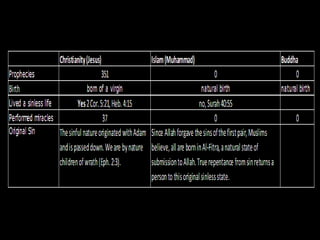
Christianity
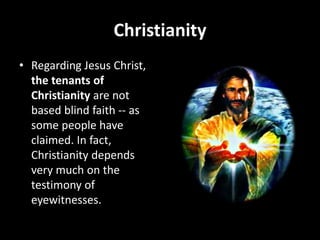
• Regarding Jesus Christ,
the tenants of
Christianity are not
based blind faith -- as
some people have
claimed. In fact,
Christianity depends
very much on the
testimony of
eyewitnesses.
The Bible is true historically
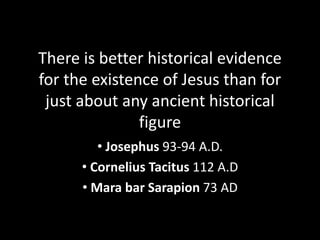
There is better historical evidence
for the existence of Jesus than for
just about any ancient historical
figure
• Josephus 93-94 A.D.
• Cornelius Tacitus 112 A.D
• Mara bar Sarapion 73 AD
Josephus 93-94 A.D.
• "At this time there was a wise man who was called
Jesus. And his conduct was good, and [he] was
known to be virtuous. And many people from among
the Jews and other nations became his disciples.
Pilate condemned him to be crucified and to die. And
those who had become his disciples did not abandon
his discipleship. They reported that he had appeared
to them three days after his crucifixion and that he
was alive; accordingly, he was perhaps the messiah
concerning whom the prophets have recounted
wonders." Antiquities of the Jews, XVIII.iii.3
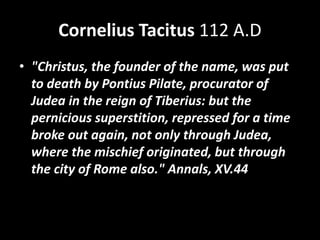
Cornelius Tacitus 112 A.D
• "Christus, the founder of the name, was put
to death by Pontius Pilate, procurator of
Judea in the reign of Tiberius: but the
pernicious superstition, repressed for a time
broke out again, not only through Judea,
where the mischief originated, but through
the city of Rome also." Annals, XV.44
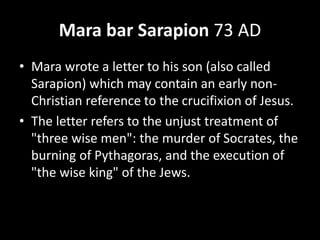
Mara bar Sarapion 73 AD
• Mara wrote a letter to his son (also called
Sarapion) which may contain an early non-
Christian reference to the crucifixion of Jesus.
• The letter refers to the unjust treatment of
"three wise men": the murder of Socrates, the
burning of Pythagoras, and the execution of
"the wise king" of the Jews.
Other sources
• Pliny the Younger (c. 61 - c. 112)
• Lucian of Samosata (Born 115 AD)
• Julius Africanus c 221
• Celsus late second century
• Dead Sea scrolls first century or older
Skeptical Eyewitness
• Thomas, doubted. He said, "Except I shall see
in His hands the print of the nails, and thrust
my hand into His side, I will not believe." Later,
when Jesus appeared and told him examine
His wounds to see that He really rose from the
dead, Thomas said, "My Lord and my God."
(John 20:24-28)

Proof of the truth prt2

  • 1.
    Islam: Six Articlesof Faith • Muslim Beliefs about Human Nature – According to the Qur'an, Allah "created man from a clot of blood" at the same time he created the jinn from fire. Humans are the greatest of all creatures, created with free will for the purpose of obeying and serving God. • Muslim Beliefs about Life and Salvation – The object of life is to live in a way that is pleasing to Allah so that one may gain Paradise. It is believed that at puberty, an account of each person's deeds is opened, and this will be used at the Day of Judgment to determine his eternal fate.
  • 2.
    Islam: Six Articlesof Faith • Beliefs about the Afterlife – There will be a day of judgment and humanity will be divided between the eternal destinations of Paradise and Hell. • Views of Other Religions – The Qur'an is clear that there must be "no compulsion in religion" (2:256). Yet Islam is not indifferent to conversion either - Muslims consider their religion to the be the one true religion, and invite people of all races, nationalities and religions to be part of it.
  • 3.
    Christianity • Regarding JesusChrist, the tenants of Christianity are not based blind faith -- as some people have claimed. In fact, Christianity depends very much on the testimony of eyewitnesses.
  • 5.
    The Bible istrue historically
  • 6.
    There is betterhistorical evidence for the existence of Jesus than for just about any ancient historical figure • Josephus 93-94 A.D. • Cornelius Tacitus 112 A.D • Mara bar Sarapion 73 AD
  • 7.
    Josephus 93-94 A.D. •"At this time there was a wise man who was called Jesus. And his conduct was good, and [he] was known to be virtuous. And many people from among the Jews and other nations became his disciples. Pilate condemned him to be crucified and to die. And those who had become his disciples did not abandon his discipleship. They reported that he had appeared to them three days after his crucifixion and that he was alive; accordingly, he was perhaps the messiah concerning whom the prophets have recounted wonders." Antiquities of the Jews, XVIII.iii.3
  • 8.
    Cornelius Tacitus 112A.D • "Christus, the founder of the name, was put to death by Pontius Pilate, procurator of Judea in the reign of Tiberius: but the pernicious superstition, repressed for a time broke out again, not only through Judea, where the mischief originated, but through the city of Rome also." Annals, XV.44
  • 9.
    Mara bar Sarapion73 AD • Mara wrote a letter to his son (also called Sarapion) which may contain an early non- Christian reference to the crucifixion of Jesus. • The letter refers to the unjust treatment of "three wise men": the murder of Socrates, the burning of Pythagoras, and the execution of "the wise king" of the Jews.
  • 10.
    Other sources • Plinythe Younger (c. 61 - c. 112) • Lucian of Samosata (Born 115 AD) • Julius Africanus c 221 • Celsus late second century • Dead Sea scrolls first century or older
  • 11.
    Skeptical Eyewitness • Thomas,doubted. He said, "Except I shall see in His hands the print of the nails, and thrust my hand into His side, I will not believe." Later, when Jesus appeared and told him examine His wounds to see that He really rose from the dead, Thomas said, "My Lord and my God." (John 20:24-28)